


ISO/IEC 14496-15:2017
(Main)Information technology — Coding of audio-visual objects — Part 15: Carriage of network abstraction layer (NAL) unit structured video in the ISO base media file format
Information technology — Coding of audio-visual objects — Part 15: Carriage of network abstraction layer (NAL) unit structured video in the ISO base media file format
ISO/IEC 14496-15:2017 specifies the storage format for streams of video that is structured as NAL units, such as AVC (ISO/IEC 14496‑10) and HEVC (ISO/IEC 23008‑2) video streams.
Technologies de l'information — Codage des objets audiovisuels — Partie 15: Transport de vidéo structuré en unités NAL au format ISO de base pour les fichiers médias
General Information
- Status
- Withdrawn
- Publication Date
- 22-Feb-2017
- Withdrawal Date
- 22-Feb-2017
- Current Stage
- 9599 - Withdrawal of International Standard
- Start Date
- 24-Sep-2019
- Completion Date
- 12-Feb-2026
Relations
- Effective Date
- 08-Jan-2022
- Effective Date
- 08-Jan-2022
- Effective Date
- 02-Sep-2017
- Effective Date
- 05-Nov-2015

Get Certified
Connect with accredited certification bodies for this standard

BSI Group
BSI (British Standards Institution) is the business standards company that helps organizations make excellence a habit.

NYCE
Mexican standards and certification body.
Sponsored listings
Frequently Asked Questions
ISO/IEC 14496-15:2017 is a standard published by the International Organization for Standardization (ISO). Its full title is "Information technology — Coding of audio-visual objects — Part 15: Carriage of network abstraction layer (NAL) unit structured video in the ISO base media file format". This standard covers: ISO/IEC 14496-15:2017 specifies the storage format for streams of video that is structured as NAL units, such as AVC (ISO/IEC 14496‑10) and HEVC (ISO/IEC 23008‑2) video streams.
ISO/IEC 14496-15:2017 specifies the storage format for streams of video that is structured as NAL units, such as AVC (ISO/IEC 14496‑10) and HEVC (ISO/IEC 23008‑2) video streams.
ISO/IEC 14496-15:2017 is classified under the following ICS (International Classification for Standards) categories: 35.040 - Information coding; 35.040.40 - Coding of audio, video, multimedia and hypermedia information. The ICS classification helps identify the subject area and facilitates finding related standards.
ISO/IEC 14496-15:2017 has the following relationships with other standards: It is inter standard links to ISO/IEC 14496-15:2017/Amd 2:2019, ISO/IEC 14496-15:2017/Amd 1:2018, ISO/IEC 14496-15:2019, ISO/IEC 14496-15:2014. Understanding these relationships helps ensure you are using the most current and applicable version of the standard.
ISO/IEC 14496-15:2017 is available in PDF format for immediate download after purchase. The document can be added to your cart and obtained through the secure checkout process. Digital delivery ensures instant access to the complete standard document.
Standards Content (Sample)
INTERNATIONAL ISO/IEC
STANDARD 14496-15
Fourth edition
2017-02
Information technology — Coding of
audio-visual objects —
Part 15:
Carriage of network abstraction layer
(NAL) unit structured video in the ISO
base media file format
Technologies de l’information — Codage des objets audiovisuels —
Partie 15: Transport de vidéo structuré en unités NAL au format ISO
de base pour les fichiers médias
Reference number
©
ISO/IEC 2017
© ISO/IEC 2017, Published in Switzerland
All rights reserved. Unless otherwise specified, no part of this publication may be reproduced or utilized otherwise in any form
or by any means, electronic or mechanical, including photocopying, or posting on the internet or an intranet, without prior
written permission. Permission can be requested from either ISO at the address below or ISO’s member body in the country of
the requester.
ISO copyright office
Ch. de Blandonnet 8 • CP 401
CH-1214 Vernier, Geneva, Switzerland
Tel. +41 22 749 01 11
Fax +41 22 749 09 47
copyright@iso.org
www.iso.org
ii © ISO/IEC 2017 – All rights reserved
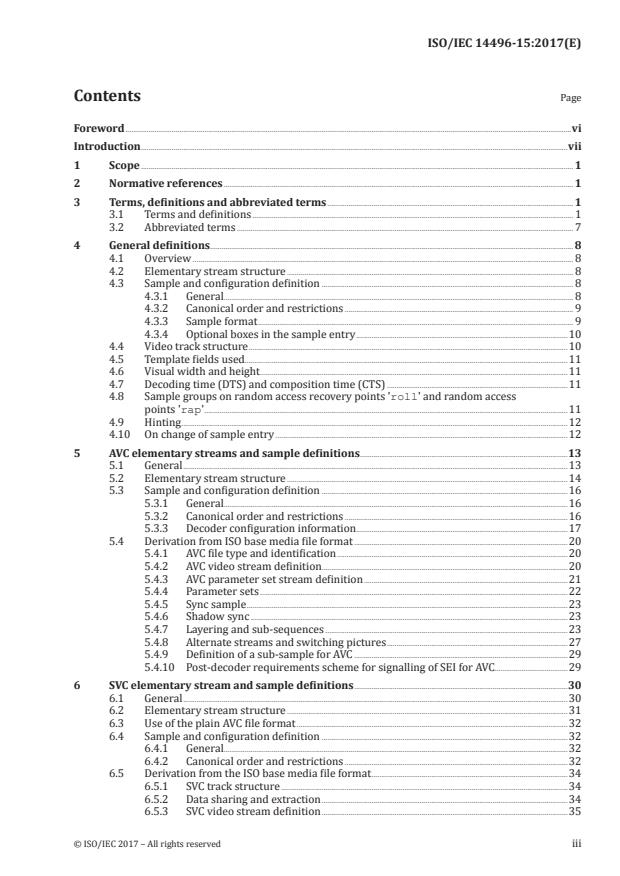
Contents Page
Foreword .vi
Introduction .vii
1 Scope . 1
2 Normative references . 1
3 Terms, definitions and abbreviated terms . 1
3.1 Terms and definitions . 1
3.2 Abbreviated terms . 7
4 General definitions . 8
4.1 Overview . 8
4.2 Elementary stream structure . 8
4.3 Sample and configuration definition . 8
4.3.1 General. 8
4.3.2 Canonical order and restrictions . 9
4.3.3 Sample format . 9
4.3.4 Optional boxes in the sample entry .10
4.4 Video track structure .10
4.5 Template fields used.11
4.6 Visual width and height .11
4.7 Decoding time (DTS) and composition time (CTS) .11
4.8 Sample groups on random access recovery points ʹrollʹ and random access
points ʹrapʹ .11
4.9 Hinting .12
4.10 On change of sample entry .12
5 AVC elementary streams and sample definitions .13
5.1 General .13
5.2 Elementary stream structure .14
5.3 Sample and configuration definition .16
5.3.1 General.16
5.3.2 Canonical order and restrictions .16
5.3.3 Decoder configuration information .17
5.4 Derivation from ISO base media file format .20
5.4.1 AVC file type and identification .20
5.4.2 AVC video stream definition.20
5.4.3 AVC parameter set stream definition .21
5.4.4 Parameter sets .22
5.4.5 Sync sample .23
5.4.6 Shadow sync .23
5.4.7 Layering and sub-sequences .23
5.4.8 Alternate streams and switching pictures .27
5.4.9 Definition of a sub-sample for AVC .29
5.4.10 Post-decoder requirements scheme for signalling of SEI for AVC.29
6 SVC elementary stream and sample definitions .30
6.1 General .30
6.2 Elementary stream structure .31
6.3 Use of the plain AVC file format .32
6.4 Sample and configuration definition .32
6.4.1 General.32
6.4.2 Canonical order and restrictions .32
6.5 Derivation from the ISO base media file format .34
6.5.1 SVC track structure .34
6.5.2 Data sharing and extraction .34
6.5.3 SVC video stream definition .35
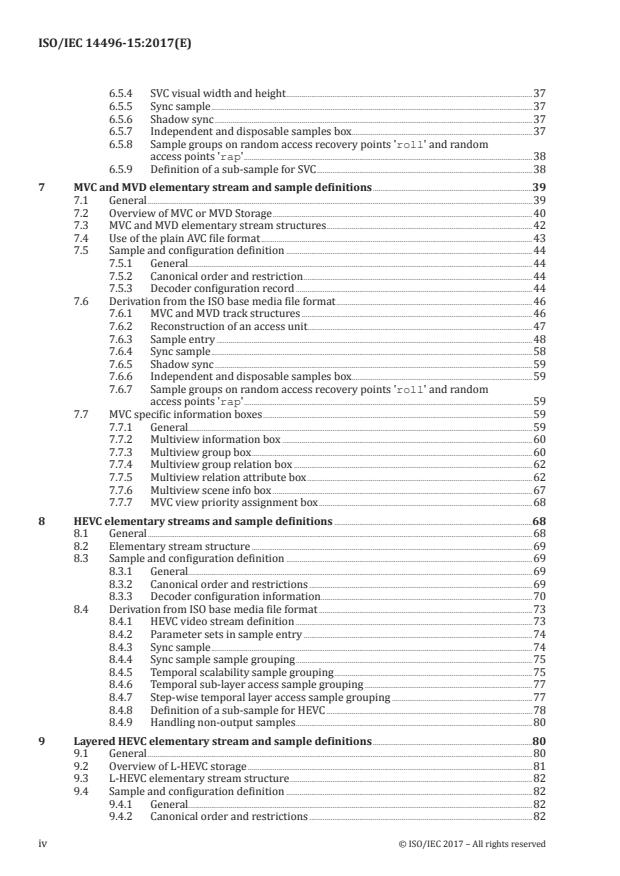
© ISO/IEC 2017 – All rights reserved iii
6.5.4 SVC visual width and height .37
6.5.5 Sync sample .37
6.5.6 Shadow sync .37
6.5.7 Independent and disposable samples box.37
6.5.8 Sample groups on random access recovery points ʹrollʹ and random
access points ʹrapʹ .38
6.5.9 Definition of a sub-sample for SVC .38
7 MVC and MVD elementary stream and sample definitions .39
7.1 General .39
7.2 Overview of MVC or MVD Storage .40
7.3 MVC and MVD elementary stream structures .42
7.4 Use of the plain AVC file format .43
7.5 Sample and configuration definition .44
7.5.1 General.44
7.5.2 Canonical order and restriction .44
7.5.3 Decoder configuration record .44
7.6 Derivation from the ISO base media file format .46
7.6.1 MVC and MVD track structures .46
7.6.2 Reconstruction of an access unit.47
7.6.3 Sample entry .48
7.6.4 Sync sample .58
7.6.5 Shadow sync .59
7.6.6 Independent and disposable samples box.59
7.6.7 Sample groups on random access recovery points ʹrollʹ and random
access points ʹrapʹ .59
7.7 MVC specific information boxes .59
7.7.1 General.59
7.7.2 Multiview information box .60
7.7.3 Multiview group box .60
7.7.4 Multiview group relation box .62
7.7.5 Multiview relation attribute box .62
7.7.6 Multiview scene info box .67
7.7.7 MVC view priority assignment box .68
8 HEVC elementary streams and sample definitions .68
8.1 General .68
8.2 Elementary stream structure .69
8.3 Sample and configuration definition .69
8.3.1 General.69
8.3.2 Canonical order and restrictions .69
8.3.3 Decoder configuration information .70
8.4 Derivation from ISO base media file format .73
8.4.1 HEVC video stream definition .73
8.4.2 Parameter sets in sample entry .74
8.4.3 Sync sample .74
8.4.4 Sync sample sample grouping .75
8.4.5 Temporal scalability sample grouping .75
8.4.6 Temporal sub-layer access sample grouping .77
8.4.7 Step-wise temporal layer access sample grouping .77
8.4.8 Definition of a sub-sample for HEVC .78
8.4.9 Handling non-output samples .80
9 Layered HEVC elementary stream and sample definitions .80
9.1 General .80
9.2 Overview of L-HEVC storage .81
9.3 L-HEVC elementary stream structure .82
9.4 Sample and configuration definition .82
9.4.1 General.82
9.4.2 Canonical order and restrictions .82
iv © ISO/IEC 2017 – All rights reserved
9.4.3 Decoder configuration record .82
9.5 Derivation from the ISO base media file format and the HEVC file format (Clause 8) .83
9.5.1 L-HEVC track structure.83
9.5.2 Data sharing and reconstruction of an L-HEVC bitstream .84
9.5.3 L-HEVC video stream definition .85
9.5.4 L-HEVC visual width and height .88
9.5.5 Sync sample .88
9.5.6 Independent and disposable samples box.89
9.5.7 Stream access point sample group .89
9.5.8 The ʹrollʹ, ʹrapʹ, ʹsyncʹ, ʹtsasʹ and ʹstsaʹ sample groups .89
9.5.9 Definition of a sub-sample for L-HEVC .90
9.5.10 Handling non-output samples .90
9.6 L-HEVC specific structures .90
9.6.1 External base layer sample group .90
9.6.2 The operating points information sample group.91
9.6.3 The layer information sample group .94
10 Storage of tiled HEVC and L-HEVC video streams .95
10.1 General .95
10.2 NAL unit map entry .95
10.2.1 Definition .95
10.2.2 Syntax .96
10.2.3 Semantics .96
10.3 Tile region group entry .97
10.3.1 Definition .97
10.3.2 Syntax .97
10.3.3 Semantics .97
10.4 Tile sub track definition .99
10.4.1 General.99
10.4.2 TileSubTrackGroupBox .99
10.5 HEVC and L-HEVC tile track .99
10.5.1 General.99
10.5.2 Sample entry name and format for HEVC tile tracks .100
10.5.3 Sample entry name and format for L-HEVC tile tracks .101
10.5.4 Bitstream reconstruction from tile base and tile tracks .102
10.5.5 Sample entry names for tile base tracks.102
Annex A (normative) In-stream structures .104
Annex B (normative) SVC, MVC, and MVD sample group and sub-track definitions .113
Annex C (normative) Temporal metadata support.134
Annex D (normative) File format toolsets and brands .143
Annex E (normative) Sub-parameters for the MIME type “codecs” parameter.145
© ISO/IEC 2017 – All rights reserved v
Foreword
ISO (the International Organization for Standardization) and IEC (the International Electrotechnical
Commission) form the specialized system for worldwide standardization. National bodies that are
members of ISO or IEC participate in the development of International Standards through technical
committees established by the respective organization to deal with particular fields of technical
activity. ISO and IEC technical committees collaborate in fields of mutual interest. Other international
organizations, governmental and non-governmental, in liaison with ISO and IEC, also take part in the
work. In the field of information technology, ISO and IEC have established a joint technical committee,
ISO/IEC JTC 1.
The procedures used to develop this document and those intended for its further maintenance are
described in the ISO/IEC Directives, Part 1. In particular the different approval criteria needed for the
different types of ISO documents should be noted. This document was drafted in accordance with the
editorial rules of the ISO/IEC Directives, Part 2 (see www .iso .org/ directives).
Attention is drawn to the possibility that some of the elements of this document may be the subject of
patent rights. ISO shall not be held responsible for identifying any or all such patent rights. Details of
any patent rights identified during the development of the document will be in the Introduction and/or
on the ISO list of patent declarations received (see www .iso .org/ patents).
Any trade name used in this document is information given for the convenience of users and does not
constitute an endorsement.
For an explanation on the voluntary nature of standards, the meaning of ISO specific terms and
expressions related to conformity assessment, as well as information about ISO’s adherence to the
World Trade Organization (WTO) principles in the Technical Barriers to Trade (TBT) see the following
URL: w w w . i s o .org/ iso/ foreword .html.
The committee responsible for this document is ISO/IEC JTC 1, Information technology, Subcommittee
SC 29, Coding of audio, picture, multimedia and hypermedia information.
This fourth edition cancels and replaces the third edition (ISO/IEC 14496-15:2014), which has been
technically revised.
It also incorporates the Technical Corrigendum ISO/IEC 14496-15:2014/Cor 1:2015.
A list of all parts in the ISO/IEC 14496 series can be found on the ISO website.
vi © ISO/IEC 2017 – All rights reserved
Introduction
This document defines a storage format based on, and compatible with, the ISO Base Media File Format
(ISO/IEC 14496-12), which is used by the MP4 file format (ISO/IEC 14496-14) and the Motion JPEG 2000
file format (ISO/IEC 15444-3) among others. This document enables video streams formatted as
Network Adaptation Layer Units (NAL Units) to
a) be used in conjunction with other media streams, such as audio,
b) be used in an MPEG-4 systems environment, if desired,
c) be formatted for delivery by a streaming server, using hint tracks, and
d) inherit all the use cases and features of the ISO Base Media File Format on which MP4 and MJ2
are based.
This document may be used as a standalone specification; it specifies how NAL unit structured video
content shall be stored in an ISO Base Media File Format compliant format. However, it is normally
used in the context of a specification, such as the MP4 file format, derived from the ISO Base Media File
Format, that permits the use of NAL unit structured video such as AVC (ISO/IEC 14496-10) video and
High Efficiency Video Coding (HEVC, ISO/IEC 23008-2) video.
The ISO Base Media File Format is becoming increasingly common as a general-purpose media container
format for the exchange of digital media, and its use in this context should accelerate both adoption and
interoperability.
The International Organization for Standardization (ISO) and International Electrotechnical
Commission (IEC) draw attention to the fact that it is claimed that compliance with this document may
involve the use of a patent.
The ISO and IEC take no position concerning the evidence, validity and scope of this patent right.
The holder of this patent right has assured the ISO and IEC that he is willing to negotiate licences under
reasonable and non-discriminatory terms and conditions with applicants throughout the world. In this
respect, the statement of the holder of this patent right is registered with the ISO and IEC.
Attention is drawn to the possibility that some of the elements of this document may be the subject of
patent rights. ISO and IEC shall not be held responsible for identifying any or all such patent rights.
© ISO/IEC 2017 – All rights reserved vii
INTERNATIONAL STANDARD ISO/IEC 14496-15:2017(E)
Information technology — Coding of audio-visual
objects —
Part 15:
Carriage of network abstraction layer (NAL) unit
structured video in the ISO base media file format
1 Scope
This document specifies the storage format for streams of video that is structured as NAL units, such
as AVC (ISO/IEC 14496-10) and HEVC (ISO/IEC 23008-2) video streams.
2 Normative references
The following documents are referred to in the text in such a way that some or all of their content
constitutes requirements of this document. For dated references, only the edition cited applies. For
undated references, the latest edition of the referenced document (including any amendments) applies.
ISO/IEC 14496-12:2015, Information technology — Coding of audio-visual objects — Part 12: ISO base
media file format
ISO/IEC 14496-10:2014, Information technology — Coding of audio-visual objects — Part 10: Advanced
Video Coding
1)
ISO/IEC 23008-2:— , Information technology — High efficiency coding and media delivery in
heterogeneous environments — Part 2: High efficiency video coding
3 Terms, definitions and abbreviated terms
3.1 Terms and definitions
For the purposes of this document, the terms and definitions given in ISO/IEC 14496-10 or
ISO/IEC 23008-2, and the following apply.
ISO and IEC maintain terminological databases for use in standardization at the following addresses:
— IEC Electropedia: available at http:// www.e lectropedia. org/
— ISO Online browsing platform: available at http:// www. iso. org/o bp
3.1.1
3D-AVC NAL unit
3D-AVC VCL NAL unit
NAL unit with type 21 with avc_3d_extension_flag equal to 1
Note 1 to entry: As specified in ISO/IEC 14496-10:2014, Annex J.
1) To be published.
© ISO/IEC 2017 – All rights reserved 1
3.1.2
aggregator
in-stream structure (3.1.10) using a NAL unit header for grouping of NAL units belonging to the
same sample
3.1.3
AVC base layer
maximum subset of a bitstream that is AVC compatible (i.e. a bitstream not using any of the functionality
of ISO/IEC 14496-10:2014, Annex G, Annex H, Annex I, or Annex J)
Note 1 to entry: The AVC base layer is represented by AVC VCL NAL units and associated non-VCL NAL units.
Note 2 to entry: The AVC base layer itself can be a temporal scalable bitstream.
3.1.4
AVC NAL unit
AVC VCL NAL unit (3.1.5) and its associated non-VCL NAL units in a bitstream
3.1.5
AVC VCL NAL unit
NAL unit with type 1 to 5 (inclusive)
Note 1 to entry: As specified in ISO/IEC 14496-10.
3.1.6
complete subset
minimal set of tracks that contain all the information in the original bitstream
3.1.7
cropped frame dimensions
width and height of the decoded frame after applying the output cropping parameters specified by the
active SPS
3.1.8
extraction path
set of operations on the original bitstream, each yielding a subset bitstream, ordered such that the
complete bitstream is first in the set, and the base layer is last, and all the bitstreams are in decreasing
complexity (along one of the scalability axes, such as resolution), and where every bitstream is a valid
operating point
Note 1 to entry: An extraction path may be represented by the values of priority_id in the NAL unit headers.
Alternatively, an extraction path can be represented by the run of tiers or by a set of hierarchically dependent tracks.
3.1.9
extractor
in-stream structure (3.1.10) using a NAL unit header for extraction of data from other tracks
Note 1 to entry: Extractors contain instructions on how to extract data from other tracks. Logically, an extractor
can be seen as a pointer to data. While reading a track containing extractors, the extractor is replaced by the data
it is pointing to.
3.1.10
in-stream structure
structure residing within sample data
3.1.11
layer set
set of layers represented within a bitstream created from another bitstream by operation of the sub-
bitstream extraction process
Note 1 to entry: As specified in ISO/IEC 23008-2.
2 © ISO/IEC 2017 – All rights reserved
3.1.12
MVC NAL unit
MVC VCL NAL unit (3.1.13) and its associated non-VCL NAL units in an MVC stream
Note 1 to entry: As specified in ISO/IEC 14496-10:2014, Annex H.
3.1.13
MVC VCL NAL unit
NAL unit with type 20, and NAL units with type 14 when the immediately following NAL units are AVC
VCL NAL units
Note 1 to entry: As specified in ISO/IEC 14496-10.
Note 2 to entry: MVC VCL NAL units do not affect the decoding process of a legacy AVC decoder.
3.1.14
MVC+D depth NAL unit
MVC+D depth VCL NAL unit
NAL unit with type 21 containing a coded slice extension for a depth view component
Note 1 to entry: As specified in ISO/IEC 14496-10:2014, Annex I.
3.1.15
MVD NAL unit
MVD VCL NAL unit
NAL unit with type 21, containing a coded slice extension for a depth view component coded with
MVC+D or 3D-AVC, or a 3D-AVC texture view component
Note 1 to entry: As specified in ISO/IEC 14496-10:2014, Annex I or Annex J.
3.1.16
NAL-unit-like structure
data structure that is similar to NAL units in the sense that it also has a NAL unit header and a payload,
with a difference that the payload might not follow the start code emulation prevention mechanism
required for the NAL unit syntax
Note 1 to entry: As specified in ISO/IEC 14496-10 or ISO/IEC 23008-2.
3.1.17
natively present
not included in an aggregator (3.1.2) or an extractor (3.1.9)
Note 1 to entry: Data referred to by (hence not included in) an aggregator is considered as natively present. Data
included in an aggregator is not considered as natively present.
3.1.18
operating point
independently decodable subset of a layered bitstream
Note 1 to entry: For a layered HEVC elementary stream or tiled HEVC and L-HEVC video streams, one or more
layers in the set of layers are indicated to be output layers.
Note 2 to entry: Each operating point consists of all the data needed to decode this particular bitstream subset.
Note 3 to entry: In an SVC stream, an operating point represents a particular spatial resolution, temporal
resolution, and quality, and can be represented either by (i) specific values of DTQ (dependency_id, temporal_id
and quality_id) or (ii) specific values of P (priority_id) or (iii) combinations of them (e.g. PDTQ). Note that the
usage of priority_id is defined by the application. In an SVC file, a track represents one or more operating points.
Within a track, tiers may be used to define multiple operating points.
© ISO/IEC 2017 – All rights reserved 3
Note 4 to entry: The bitstream subset of an MVC or MVD operating point represents a particular set of target
output views at a particular temporal resolution, and consists of all the data needed to decode this particular
bitstream subset. In MVD, each target output view in the bitstream subset of an MVD operating point may contain
a texture view, a depth view or both.
Note 5 to entry: An operating point is referred to as an operation point in ISO/IEC 14496-10:2014, Annex H or an
output operation point in ISO/IEC 23008-2.
3.1.19
output layer set
set of layers consisting of the layers of one of the specified layer sets (3.1.11), where one or more layers
in the set of layers are indicated to be output layers
Note 1 to entry: As specified in ISO/IEC 23008-2.
3.1.20
parameter set
video parameter set, sequence parameter set, or picture parameter set, as defined in the applicable
video standard (e.g. ISO/IEC 14496-10 or ISO/IEC 23008-2)
Note 1 to entry: This term is used to refer to all types of parameter sets.
3.1.21
parameter set elementary stream
elementary stream containing samples made up of only sequence and picture parameter set NAL units
synchronized with the video elementary stream (3.1.38)
3.1.22
picture unit
set of VCL NAL units and their associated non-VCL NAL units
Note 1 to entry: As specified in ISO/IEC 23008-2.
3.1.23
prefix NAL unit
NAL units with type 14
Note 1 to entry: As specified in ISO/IEC 14496-10.
Note 2 to entry: Prefix NAL units provide scalability information about AVC VCL NAL units and filler data NAL
units. Prefix NAL units do not affect the decoding process of a legacy AVC decoder. The behaviour of a legacy AVC
file reader as a response to prefix NAL units is undefined.
3.1.24
reference layer
layer that is indicated as possibly needed for decoding of another layer
Note 1 to entry: As specified in ISO/IEC 23008-2 and as specified by the ʹoinfʹ sample group defined in 9.6.2.
3.1.25
scalable layer
layer
set of VCL NAL units with the same values of dependency_id, quality_
id and temporal_id, and the associated non-VCL NAL units
Note 1 to entry: The non-VCL NAL units as specified in ISO/IEC 14496-10.
Note 2 to entry: A scalable layer with any of dependency_id, quality_id, and temporal_id not equal to 0 enhances
the video by one or more scalability levels in at least one direction (temporal, quality or spatial resolution).
4 © ISO/IEC 2017 – All rights reserved
Note 3 to entry: SVC uses a “layered” encoder design that results in a bitstream representing “coding layers”. In
some publications, the “base layer” is the first quality layer of a specific coding layer. In some publications, the
base layer is the scalable layer with the lowest priority. The SVC file format uses “scalable layer” or “layer” in a
general way for describing nested bitstreams (using terms like AVC base layer or SVC enhancement layer).
3.1.26
scalable layer
layer
set of VCL NAL units with the same values of
nuh_layer_id and the associated non-VCL NAL units
Note 1 to entry: The non-VCL NAL units as specified in ISO/IEC 14496-10.
Note 2 to entry: A scalable layer with any of dependency_id, quality_id, and temporal_id not equal to 0 enhances
the video by one or more scalability levels in at least one direction (temporal, quality or spatial resolution).
Note 3 to entry: SVC uses a “layered” encoder design that results in a bitstream representing “coding layers”. In
some publications, the “base layer” is the first quality layer of a specific coding layer. In some publications, the
base layer is the scalable layer with the lowest priority. The SVC file format uses “scalable layer” or “layer” in a
general way for describing nested bitstreams (using terms like AVC base layer or SVC enhancement layer).
3.1.27
scalable layer representation
bitstream subset that is required for decoding the scalable layer (3.1.25), consisting of the scalable layer
itself and all the scalable layers on which the scalable layer depends
Note 1 to entry: A scalable layer representation is also referred to as the representation of the scalable layer.
3.1.28
sub-picture
proper subset of coded slices of a layer representation
3.1.29
sub-picture tier
tier that consists of sub-pictures (3.1.28)
Note 1 to entry: Any coded slice that is not included in the tier representation of a sub-picture tier is not to be
referred to in inter prediction or inter-layer prediction for decoding of the sub-picture tier.
3.1.30
sub-layer
set of VCL NAL units with a particular value of TemporalId and the associated non-VCL NAL units
Note 1 to entry: The non-VCL NAL units are specified in ISO/IEC 23008-2.
3.1.31
SVC enhancement layer
layer that specifies a part of a scalable bitstream that enhances the video
Note 1 to entry: An SVC enhancement layer is represented by SVC VCL NAL units and the associated non-VCL NAL
units and SEI messages.
Note 2 to entry: Usually, an SVC enhancement layer represents a spatial or coarse-grain scalability (CGS) coding
layer (identified by a specific value of dependency_id).
3.1.32
SVC NAL unit
SVC VCL NAL unit and its associated non-VCL NAL units in an SVC stream (3.1.33)
Note 1 to entry: As specified in ISO/IEC 14496-10:2014, Annex G.
© ISO/IEC 2017 – All rights reserved 5
3.1.33
SVC stream
bitstream represented by the operating point for which dependency_id is equal to mDid, temporal_id
is the greatest temporal_id value among mOpSet, and quality_id is the greatest quality_id value among
mOpSet, where the greatest value of dependency_id of all the operating points represented by DTQ
(dependency_id, temporal_id and quality_id) combinations is equal to mDid, and the set of all the
operating points with dependency_id equal to mDid is mOpSet.
Note 1 to entry: The term “SVC stream” is referenced by “decoding/accessing the entire stream” in this document.
There may be NAL units that are not required for decoding this operating point.
3.1.34
SVC VCL NAL unit
NAL unit with type 20, and NAL units with type 14 when the immediately following NAL units are AVC
VCL NAL units
Note 1 to entry: As specified in ISO/IEC 14496-10:2014, Annex G.
Note 2 to entry: SVC VCL NAL units do not affect
...
Questions, Comments and Discussion
Ask us and Technical Secretary will try to provide an answer. You can facilitate discussion about the standard in here.
Loading comments...