

ISO 20975-2:2018
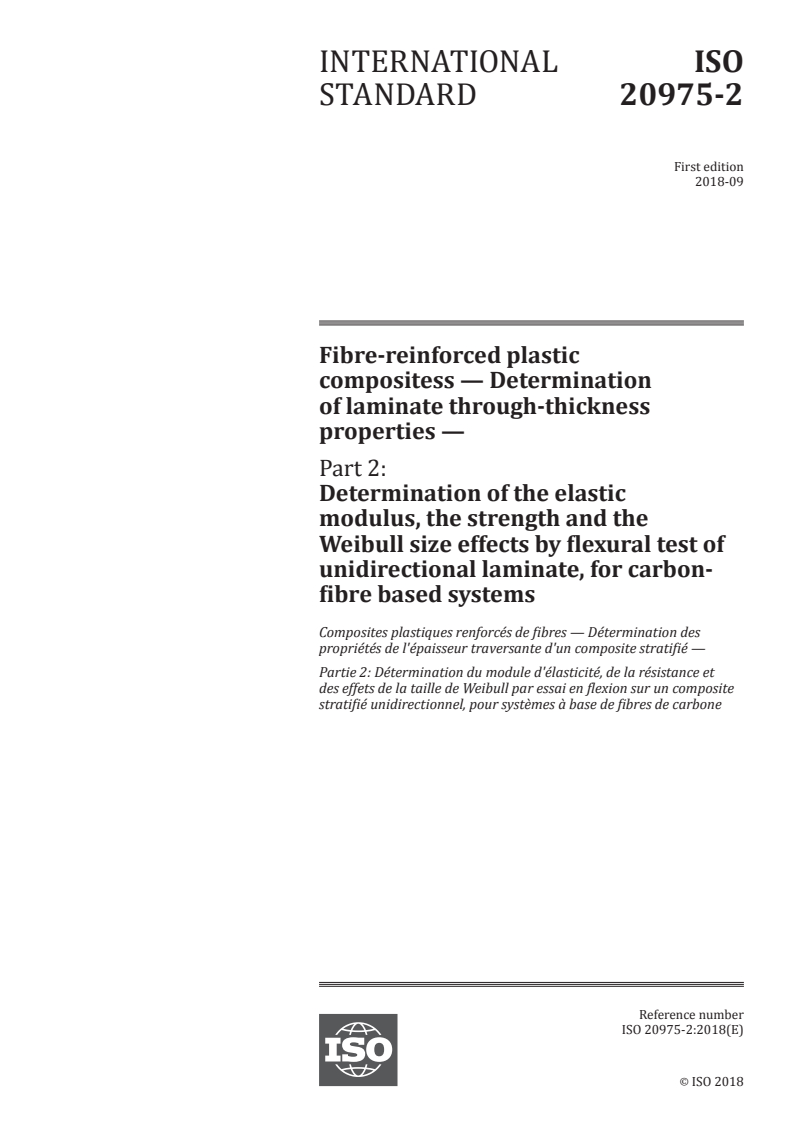
(Main)Fibre-reinforced plastic compositess — Determination of laminate through-thickness properties — Part 2: Determination of the elastic modulus, the strength and the Weibull size effects by flexural test of unidirectional laminate, for carbon-fibre based systems
General Information
- Abstract
This document specifies a flexural test method for determining the through-thickness (out-of-plane) tensile properties of laminated carbon fibre-reinforced plastic (CFRP) composites, including strength, fracture strain, and modulus. This document is applicable to unidirectional CFRP (UD-CFRP) laminates. In addition, the calculation of effective volume is also described due to size effects of the through-thickness tensile strength.
- Status
- Published
- Publication Date
- 15-Aug-2018
- Technical Committee
- ISO/TC 61/SC 13 - Composites and reinforcement fibres
- Drafting Committee
- ISO/TC 61/SC 13/WG 2 - Laminates and moulding compounds
- Current Stage
- 9093 - International Standard confirmed
- Start Date
- 05-Dec-2023
- Completion Date
- 29-Aug-2026
Buy Documents
ISO 20975-2:2018 - Fibre-reinforced plastic compositess -- Determination of laminate through-thickness properties
ISO 20975-2:2018 - Fibre-reinforced plastic compositess — Determination of laminate through-thickness properties — Part 2: Determination of the elastic modulus, the strength and the Weibull size effects by flexural test of unidirectional laminate, for carbon-fibre based systems/16/2018
Overview
ISO 20975-2:2018 defines a standardized flexural test method to determine the through-thickness (out-of-plane) tensile properties of carbon fibre‑reinforced plastic (CFRP) laminates. It applies to unidirectional CFRP (UD‑CFRP) laminates and covers measurement of through‑thickness tensile strength, fracture strain, and elastic modulus, plus quantitative assessment of Weibull size effects through calculation of an effective volume. The procedure uses a rectangular specimen loaded in three‑point bending to infer out‑of‑plane tensile stresses and strains.
Key Topics
- Test principle: Three‑point flexural loading with the specimen’s longitudinal axis oriented through the laminate thickness; deflect until rupture and derive through‑thickness stress–strain behavior.
- Measured properties: Through‑thickness tensile strength (σf), fracture strain, and modulus (E) derived from the linear region of the stress–strain curve.
- Weibull analysis & effective volume: Procedures to determine the Weibull modulus (m) and calculate the specimen’s effective volume (Veff) to quantify size effects on strength.
- Specimen geometry & preparation:
- Typical specimen width: 10 ± 0.5 mm; thickness example shown as 10 mm (span length L must satisfy L/t > 25).
- Machining of specimens from test plates per ISO 1268 and ISO 2818; thickness and width tolerances within central third.
- Conditioning & environment: Conditioning per ISO 291 (standard atmosphere 23/50 unless otherwise agreed); testing under controlled temperature and humidity.
- Apparatus & instrumentation:
- Testing machine per ISO 5893 with constant speed.
- Fixture parameters include support and loading‑nose radii (example values: supports ≈2 mm, loading nose ≈5 mm).
- Displacement transducer and data acquisition to record force vs. deflection.
- Calculations & reporting: Standardized formulas for through‑thickness stress, strain, modulus, Weibull modulus, effective volume and recommended expression of results and significant figures.
Applications
ISO 20975-2:2018 is intended for:
- Composite material test laboratories validating out‑of‑plane mechanical performance of UD‑CFRP.
- Material engineers and R&D teams assessing laminate durability and failure risk related to thickness direction loading.
- OEMs and suppliers in aerospace, automotive, wind energy and sporting goods where through‑thickness strength affects structural integrity and damage tolerance.
- Certification bodies and quality control groups requiring reproducible comparatives and size‑effect analysis for design validation.
Related Standards
- ISO 291 - Conditioning atmospheres
- ISO 1268‑1 / ISO 1268‑4 - Production of test plates (prepregs)
- ISO 2818 - Specimen preparation by machining
- ISO 5893 - Test machine requirements
- ISO 20501 - Weibull statistics for strength data
- Reference comparisons: ASTM D6415 and ASTM D7291 (discussed in the ISO introduction)
Keywords: ISO 20975-2:2018, through-thickness properties, CFRP, unidirectional laminate, flexural test, Weibull modulus, effective volume, through-thickness tensile strength, through-thickness modulus.
Buy Documents
ISO 20975-2:2018 - Fibre-reinforced plastic compositess -- Determination of laminate through-thickness properties
ISO 20975-2:2018 - Fibre-reinforced plastic compositess — Determination of laminate through-thickness properties — Part 2: Determination of the elastic modulus, the strength and the Weibull size effects by flexural test of unidirectional laminate, for carbon-fibre based systems/16/2018
Get Certified
Connect with accredited certification bodies for this standard

DIN CERTCO
DIN Group product certification.

Smithers Quality Assessments
US management systems and product certification.
Sponsored listings
Frequently Asked Questions
ISO 20975-2:2018 is a standard published by the International Organization for Standardization (ISO). Its full title is "Fibre-reinforced plastic compositess — Determination of laminate through-thickness properties — Part 2: Determination of the elastic modulus, the strength and the Weibull size effects by flexural test of unidirectional laminate, for carbon-fibre based systems". This standard covers: This document specifies a flexural test method for determining the through-thickness (out-of-plane) tensile properties of laminated carbon fibre-reinforced plastic (CFRP) composites, including strength, fracture strain, and modulus. This document is applicable to unidirectional CFRP (UD-CFRP) laminates. In addition, the calculation of effective volume is also described due to size effects of the through-thickness tensile strength.
This document specifies a flexural test method for determining the through-thickness (out-of-plane) tensile properties of laminated carbon fibre-reinforced plastic (CFRP) composites, including strength, fracture strain, and modulus. This document is applicable to unidirectional CFRP (UD-CFRP) laminates. In addition, the calculation of effective volume is also described due to size effects of the through-thickness tensile strength.
ISO 20975-2:2018 is classified under the following ICS (International Classification for Standards) categories: 83.120 - Reinforced plastics. The ICS classification helps identify the subject area and facilitates finding related standards.
ISO 20975-2:2018 is available in PDF format for immediate download after purchase. The document can be added to your cart and obtained through the secure checkout process. Digital delivery ensures instant access to the complete standard document.
Standards Content (Sample)
INTERNATIONAL ISO
STANDARD 20975-2
First edition
2018-09
Fibre-reinforced plastic
compositess — Determination
of laminate through-thickness
properties —
Part 2:
Determination of the elastic
modulus, the strength and the
Weibull size effects by flexural test of
unidirectional laminate, for carbon-
fibre based systems
Composites plastiques renforcés de fibres — Détermination des
propriétés de l'épaisseur traversante d'un composite stratifié —
Partie 2: Détermination du module d'élasticité, de la résistance et
des effets de la taille de Weibull par essai en flexion sur un composite
stratifié unidirectionnel, pour systèmes à base de fibres de carbone
Reference number
©
ISO 2018
© ISO 2018
All rights reserved. Unless otherwise specified, or required in the context of its implementation, no part of this publication may
be reproduced or utilized otherwise in any form or by any means, electronic or mechanical, including photocopying, or posting
on the internet or an intranet, without prior written permission. Permission can be requested from either ISO at the address
below or ISO’s member body in the country of the requester.
ISO copyright office
CP 401 • Ch. de Blandonnet 8
CH-1214 Vernier, Geneva
Phone: +41 22 749 01 11
Fax: +41 22 749 09 47
Email: copyright@iso.org
Website: www.iso.org
Published in Switzerland
ii © ISO 2018 – All rights reserved
Contents Page
Foreword .iv
Introduction .v
1 Scope . 1
2 Normative references . 1
3 Terms and definitions . 1
4 Principle . 2
5 Conditioning . 3
5.1 Conditioning of test specimen . 3
5.2 Temperature and humidity in testing . 3
6 Apparatus . 3
7 Test specimens. 4
7.1 Shape and dimensions . 4
7.2 Preparation of specimens . 4
7.2.1 General. 4
7.2.2 Test plate . 4
7.3 Specimen inspection . 5
7.4 Number of specimens . 5
8 Procedure. 6
9 Calculations. 6
9.1 Through-thickness tensile stress . 6
9.2 Through-thickness tensile strength . 7
9.3 Weibull modulus by flexural test . 7
9.4 Effective volume of flexural specimen . 7
9.5 Through-thickness tensile strain . 8
9.6 Through-thickness tensile strain at failure . 8
9.7 Through-thickness tensile modulus . 8
9.8 Significant figures of stress and elastic modulus . 8
9.9 Expression of results . 9
10 Precision . 9
11 Test report . 9
Annex A (informative) Precision data obtained from an interlaboratory test .11
Bibliography .13
Foreword
ISO (the International Organization for Standardization) is a worldwide federation of national standards
bodies (ISO member bodies). The work of preparing International Standards is normally carried out
through ISO technical committees. Each member body interested in a subject for which a technical
committee has been established has the right to be represented on that committee. International
organizations, governmental and non-governmental, in liaison with ISO, also take part in the work.
ISO collaborates closely with the International Electrotechnical Commission (IEC) on all matters of
electrotechnical standardization.
The procedures used to develop this document and those intended for its further maintenance are
described in the ISO/IEC Directives, Part 1. In particular the different approval criteria needed for the
different types of ISO documents should be noted. This document was drafted in accordance with the
editorial rules of the ISO/IEC Directives, Part 2 (see www .iso .org/directives).
Attention is drawn to the possibility that some of the elements of this document may be the subject of
patent rights. ISO shall not be held responsible for identifying any or all such patent rights. Details of
any patent rights identified during the development of the document will be in the Introduction and/or
on the ISO list of patent declarations received (see www .iso .org/patents).
Any trade name used in this document is information given for the convenience of users and does not
constitute an endorsement.
For an explanation on the voluntary nature of standards, the meaning of ISO specific terms and
expressions related to conformity assessment, as well as information about ISO's adherence to the
World Trade Organization (WTO) principles in the Technical Barriers to Trade (TBT) see the following
URL: www .iso .org/iso/foreword .html
This document was prepared by Technical Committee ISO/TC 61, Plastics, Subcommittee SC 13,
Composites and reinforcement fibres.
A list of all parts in the ISO 20975 series can be found on the ISO website.
Any feedback or questions on this document should be directed to the user’s national standards body. A
complete listing of these bodies can be found at www .iso .org/members .html.
iv © ISO 2018 – All rights reserved
Introduction
With the increasing number of applications of composite materials, the necessity of a test method
[1]
for evaluating through-thickness mechanical properties has been recognized. ASTM D6415 and
[2]
ASTM D7291 were proposed for evaluating out-of-plane properties. However, ASTM D6415 has
no method for evaluating through-thickness tensile modulus because this test method is based on
evaluating the curved beam strength of a fibre-reinforced polymer matrix composite laminate panel.
[2]
Further, the following problems have been reported regarding ASTM D7291 ; bonding between the
specimen and the loading tab is required, the stress distribution in the specimen is not uniform, and a
[3],[4]
local stress concentration is generated . This means that the fracture load depends on the maximum
stress induced at the point of the stress concentration. Therefore, through-thickness strength evaluated
by ASTM D7291 cannot be simply compared with other specimens. In addition, it was reported that the
apparent out-of-plane modulus evaluated under ASTM D7291 varies with strain gage position, strain
[5]
gage length, and specimen thickness . This document provides a test method to evaluate the through-
thickness mechanical properties of composite materials.
INTERNATIONAL STANDARD ISO 20975-2:2018(E)
Fibre-reinforced plastic compositess — Determination of
laminate through-thickness properties —
Part 2:
Determination of the elastic modulus, the strength and
the Weibull size effects by flexural test of unidirectional
laminate, for carbon-fibre based systems
1 Scope
This document specifies a flexural test method for determining the through-thickness (out-of-plane)
tensile properties of laminated carbon fibre-reinforced plastic (CFRP) composites, including strength,
fracture strain, and modulus. This document is applicable to unidirectional CFRP (UD-CFRP) laminates.
In addition, the calculation of effective volume is also described due to size effects of the through-
thickness tensile strength.
2 Normative references
The following documents are referred to in the text in such a way that some or all of their content
constitutes requirements of this document. For dated references, only the edition cited applies. For
undated references, the latest edition of the referenced document (including any amendments) applies.
ISO 291, Plastics — Standard atmospheres for conditioning and testing
ISO 1268-1, Fibre-reinforced plastics — Methods of producing test plates — Part 1: General conditions
ISO 1268-4, Fibre-reinforced plastics — Methods of producing test plates — Part 4: Moulding of prepregs
ISO 2818, Plastics — Preparation of test specimens by machining
ISO 5893, Rubber and plastics test equipment — Tensile, flexural and compression types (constant rate of
traverse) — Specification
ISO 20501, Fine ceramics (advanced ceramics, advanced technical ceramics) — Weibull statistics for
strength data
3 Terms and definitions
For the purposes of this document, the following terms and definitions apply.
ISO and IEC maintain terminological databases for use in standardization at the following addresses:
— ISO Online browsing platform: available at https: //www .iso .org/obp
— IEC Electropedia: available at http: //www .electropedia .org/
3.1
span length of flexural test
L
length of span between supports
3.2
flexural load
P
load on specimen from loading nose at any given time
3.3
through-thickness tensile stress
σ
nominal stress in the outer surface of the flexural test specimen at mid-span
Note 1 to entry: It is calculated according to the relationship given by Formula (2).
3.4
deflection
D
distance through which the top or bottom surface of the test specimen at mid-span has deflected during
flexure from its original position
3.5
through-thickness strain
ε
nominal fractional change in length of an element in the outer surface of the test specimen at mid-span
3.6
through-thickness tensile strength
σ
f
maximum through-thickness tensile stress by flexural test or through-thickness stress at failure
3.7
through-thickness modulus
E
slope calculated from linear region of through thickness stress–strain curve
3.8
Weibull modulus of through-thickness strength data
m
empirical parameter that decides the probability density function of the Weibull distribution
3.9
effective volume of flexural specimen
V
eff
size of an equivalent uniaxial tensile specimen that has the same probability of rupture as the test
specimen
Note 1 to entry: The effective volume is parameter of Weibull size effects of strength. It is calculated from the
thickness, the width and the span length of the flexural test, and the Weibull modulus based on beam theory.
4 Principle
A rectangular test specimen, whose longitudinal direction coincides with the through-thickness
direction of the CFRP laminate, is positioned between two supports and deflected by means of a loading
edge acting on the specimen midway between the supports. The test specimen is deflected at a constant
rate until rupture occurs on the outer surface of
...
INTERNATIONAL ISO
STANDARD 20975-2
First edition
2018-09
Fibre-reinforced plastic
compositess — Determination
of laminate through-thickness
properties —
Part 2:
Determination of the elastic
modulus, the strength and the
Weibull size effects by flexural test of
unidirectional laminate, for carbon-
fibre based systems
Composites plastiques renforcés de fibres — Détermination des
propriétés de l'épaisseur traversante d'un composite stratifié —
Partie 2: Détermination du module d'élasticité, de la résistance et
des effets de la taille de Weibull par essai en flexion sur un composite
stratifié unidirectionnel, pour systèmes à base de fibres de carbone
Reference number
©
ISO 2018
© ISO 2018
All rights reserved. Unless otherwise specified, or required in the context of its implementation, no part of this publication may
be reproduced or utilized otherwise in any form or by any means, electronic or mechanical, including photocopying, or posting
on the internet or an intranet, without prior written permission. Permission can be requested from either ISO at the address
below or ISO’s member body in the country of the requester.
ISO copyright office
CP 401 • Ch. de Blandonnet 8
CH-1214 Vernier, Geneva
Phone: +41 22 749 01 11
Fax: +41 22 749 09 47
Email: copyright@iso.org
Website: www.iso.org
Published in Switzerland
ii © ISO 2018 – All rights reserved
Contents Page
Foreword .iv
Introduction .v
1 Scope . 1
2 Normative references . 1
3 Terms and definitions . 1
4 Principle . 2
5 Conditioning . 3
5.1 Conditioning of test specimen . 3
5.2 Temperature and humidity in testing . 3
6 Apparatus . 3
7 Test specimens. 4
7.1 Shape and dimensions . 4
7.2 Preparation of specimens . 4
7.2.1 General. 4
7.2.2 Test plate . 4
7.3 Specimen inspection . 5
7.4 Number of specimens . 5
8 Procedure. 6
9 Calculations. 6
9.1 Through-thickness tensile stress . 6
9.2 Through-thickness tensile strength . 7
9.3 Weibull modulus by flexural test . 7
9.4 Effective volume of flexural specimen . 7
9.5 Through-thickness tensile strain . 8
9.6 Through-thickness tensile strain at failure . 8
9.7 Through-thickness tensile modulus . 8
9.8 Significant figures of stress and elastic modulus . 8
9.9 Expression of results . 9
10 Precision . 9
11 Test report . 9
Annex A (informative) Precision data obtained from an interlaboratory test .11
Bibliography .13
Foreword
ISO (the International Organization for Standardization) is a worldwide federation of national standards
bodies (ISO member bodies). The work of preparing International Standards is normally carried out
through ISO technical committees. Each member body interested in a subject for which a technical
committee has been established has the right to be represented on that committee. International
organizations, governmental and non-governmental, in liaison with ISO, also take part in the work.
ISO collaborates closely with the International Electrotechnical Commission (IEC) on all matters of
electrotechnical standardization.
The procedures used to develop this document and those intended for its further maintenance are
described in the ISO/IEC Directives, Part 1. In particular the different approval criteria needed for the
different types of ISO documents should be noted. This document was drafted in accordance with the
editorial rules of the ISO/IEC Directives, Part 2 (see www .iso .org/directives).
Attention is drawn to the possibility that some of the elements of this document may be the subject of
patent rights. ISO shall not be held responsible for identifying any or all such patent rights. Details of
any patent rights identified during the development of the document will be in the Introduction and/or
on the ISO list of patent declarations received (see www .iso .org/patents).
Any trade name used in this document is information given for the convenience of users and does not
constitute an endorsement.
For an explanation on the voluntary nature of standards, the meaning of ISO specific terms and
expressions related to conformity assessment, as well as information about ISO's adherence to the
World Trade Organization (WTO) principles in the Technical Barriers to Trade (TBT) see the following
URL: www .iso .org/iso/foreword .html
This document was prepared by Technical Committee ISO/TC 61, Plastics, Subcommittee SC 13,
Composites and reinforcement fibres.
A list of all parts in the ISO 20975 series can be found on the ISO website.
Any feedback or questions on this document should be directed to the user’s national standards body. A
complete listing of these bodies can be found at www .iso .org/members .html.
iv © ISO 2018 – All rights reserved
Introduction
With the increasing number of applications of composite materials, the necessity of a test method
[1]
for evaluating through-thickness mechanical properties has been recognized. ASTM D6415 and
[2]
ASTM D7291 were proposed for evaluating out-of-plane properties. However, ASTM D6415 has
no method for evaluating through-thickness tensile modulus because this test method is based on
evaluating the curved beam strength of a fibre-reinforced polymer matrix composite laminate panel.
[2]
Further, the following problems have been reported regarding ASTM D7291 ; bonding between the
specimen and the loading tab is required, the stress distribution in the specimen is not uniform, and a
[3],[4]
local stress concentration is generated . This means that the fracture load depends on the maximum
stress induced at the point of the stress concentration. Therefore, through-thickness strength evaluated
by ASTM D7291 cannot be simply compared with other specimens. In addition, it was reported that the
apparent out-of-plane modulus evaluated under ASTM D7291 varies with strain gage position, strain
[5]
gage length, and specimen thickness . This document provides a test method to evaluate the through-
thickness mechanical properties of composite materials.
INTERNATIONAL STANDARD ISO 20975-2:2018(E)
Fibre-reinforced plastic compositess — Determination of
laminate through-thickness properties —
Part 2:
Determination of the elastic modulus, the strength and
the Weibull size effects by flexural test of unidirectional
laminate, for carbon-fibre based systems
1 Scope
This document specifies a flexural test method for determining the through-thickness (out-of-plane)
tensile properties of laminated carbon fibre-reinforced plastic (CFRP) composites, including strength,
fracture strain, and modulus. This document is applicable to unidirectional CFRP (UD-CFRP) laminates.
In addition, the calculation of effective volume is also described due to size effects of the through-
thickness tensile strength.
2 Normative references
The following documents are referred to in the text in such a way that some or all of their content
constitutes requirements of this document. For dated references, only the edition cited applies. For
undated references, the latest edition of the referenced document (including any amendments) applies.
ISO 291, Plastics — Standard atmospheres for conditioning and testing
ISO 1268-1, Fibre-reinforced plastics — Methods of producing test plates — Part 1: General conditions
ISO 1268-4, Fibre-reinforced plastics — Methods of producing test plates — Part 4: Moulding of prepregs
ISO 2818, Plastics — Preparation of test specimens by machining
ISO 5893, Rubber and plastics test equipment — Tensile, flexural and compression types (constant rate of
traverse) — Specification
ISO 20501, Fine ceramics (advanced ceramics, advanced technical ceramics) — Weibull statistics for
strength data
3 Terms and definitions
For the purposes of this document, the following terms and definitions apply.
ISO and IEC maintain terminological databases for use in standardization at the following addresses:
— ISO Online browsing platform: available at https: //www .iso .org/obp
— IEC Electropedia: available at http: //www .electropedia .org/
3.1
span length of flexural test
L
length of span between supports
3.2
flexural load
P
load on specimen from loading nose at any given time
3.3
through-thickness tensile stress
σ
nominal stress in the outer surface of the flexural test specimen at mid-span
Note 1 to entry: It is calculated according to the relationship given by Formula (2).
3.4
deflection
D
distance through which the top or bottom surface of the test specimen at mid-span has deflected during
flexure from its original position
3.5
through-thickness strain
ε
nominal fractional change in length of an element in the outer surface of the test specimen at mid-span
3.6
through-thickness tensile strength
σ
f
maximum through-thickness tensile stress by flexural test or through-thickness stress at failure
3.7
through-thickness modulus
E
slope calculated from linear region of through thickness stress–strain curve
3.8
Weibull modulus of through-thickness strength data
m
empirical parameter that decides the probability density function of the Weibull distribution
3.9
effective volume of flexural specimen
V
eff
size of an equivalent uniaxial tensile specimen that has the same probability of rupture as the test
specimen
Note 1 to entry: The effective volume is parameter of Weibull size effects of strength. It is calculated from the
thickness, the width and the span length of the flexural test, and the Weibull modulus based on beam theory.
4 Principle
A rectangular test specimen, whose longitudinal direction coincides with the through-thickness
direction of the CFRP laminate, is positioned between two supports and deflected by means of a loading
edge acting on the specimen midway between the supports. The test specimen is deflected at a constant
rate until rupture occurs on the outer surface of
...