


ISO/IEC 15149:2011
(Main)Information technology — Telecommunications and information exchange between systems — Magnetic field area network (MFAN)
Information technology — Telecommunications and information exchange between systems — Magnetic field area network (MFAN)
ISO/IEC 15149:2011 specifies the physical layer and media access control layer protocols of a wireless network over a magnetic field in a low frequency band (~300 kHz), for wireless communication in harsh environments (i.e. around metal, underwater, underground, etc.). The physical layer protocol is designed for the following scope: low carrier frequency for large magnetic field area and reliable communication in harsh environments; simple and robust modulation for a low implementation cost and error performance; variable coding and bandwidth for a link adaptation. The media access control layer protocol is designed for the following scope: simple and efficient network topology for low power consumption; variable superframe structure for compact and efficient data transmission; dynamic address assignment for small packet size and efficient address management. ISO/IEC 15149:2011 supports several kbps data transmission in a wireless network within a distance of several metres. It can be applied to various services such as the following areas: in the environmental industry, to manage pollution levels in soil and water using wireless underground or underwater sensors; in the construction industry, to monitor the integrity of buildings and bridges using wireless, inner-corrosion sensors; in the consumer-electronics industry, to detect food spoilage in wet, airtight storage areas and to transfer the sensing data from the inside to the outside; in the agricultural industry, to manage the moisture level as well as mineral status in soil using buried wireless sensors; in the transportation industry, to manage road conditions and traffic information using wireless underground sensors.
Technologies de l'information — Téléinformatique — Réseau de zone de champ magnétique (MFAN)
General Information
- Status
- Withdrawn
- Publication Date
- 29-Nov-2011
- Withdrawal Date
- 29-Nov-2011
- Drafting Committee
- ISO/IEC JTC 1/SC 6/WG 1 - Physical and data link layers
- Current Stage
- 9599 - Withdrawal of International Standard
- Start Date
- 06-Nov-2020
- Completion Date
- 12-Feb-2026
Relations
- Effective Date
- 07-Oct-2012
- Effective Date
- 07-Oct-2012
- Effective Date
- 07-Oct-2012
- Effective Date
- 07-Oct-2012


Get Certified
Connect with accredited certification bodies for this standard

BSI Group
BSI (British Standards Institution) is the business standards company that helps organizations make excellence a habit.

NYCE
Mexican standards and certification body.
Sponsored listings
Frequently Asked Questions
ISO/IEC 15149:2011 is a standard published by the International Organization for Standardization (ISO). Its full title is "Information technology — Telecommunications and information exchange between systems — Magnetic field area network (MFAN)". This standard covers: ISO/IEC 15149:2011 specifies the physical layer and media access control layer protocols of a wireless network over a magnetic field in a low frequency band (~300 kHz), for wireless communication in harsh environments (i.e. around metal, underwater, underground, etc.). The physical layer protocol is designed for the following scope: low carrier frequency for large magnetic field area and reliable communication in harsh environments; simple and robust modulation for a low implementation cost and error performance; variable coding and bandwidth for a link adaptation. The media access control layer protocol is designed for the following scope: simple and efficient network topology for low power consumption; variable superframe structure for compact and efficient data transmission; dynamic address assignment for small packet size and efficient address management. ISO/IEC 15149:2011 supports several kbps data transmission in a wireless network within a distance of several metres. It can be applied to various services such as the following areas: in the environmental industry, to manage pollution levels in soil and water using wireless underground or underwater sensors; in the construction industry, to monitor the integrity of buildings and bridges using wireless, inner-corrosion sensors; in the consumer-electronics industry, to detect food spoilage in wet, airtight storage areas and to transfer the sensing data from the inside to the outside; in the agricultural industry, to manage the moisture level as well as mineral status in soil using buried wireless sensors; in the transportation industry, to manage road conditions and traffic information using wireless underground sensors.
ISO/IEC 15149:2011 specifies the physical layer and media access control layer protocols of a wireless network over a magnetic field in a low frequency band (~300 kHz), for wireless communication in harsh environments (i.e. around metal, underwater, underground, etc.). The physical layer protocol is designed for the following scope: low carrier frequency for large magnetic field area and reliable communication in harsh environments; simple and robust modulation for a low implementation cost and error performance; variable coding and bandwidth for a link adaptation. The media access control layer protocol is designed for the following scope: simple and efficient network topology for low power consumption; variable superframe structure for compact and efficient data transmission; dynamic address assignment for small packet size and efficient address management. ISO/IEC 15149:2011 supports several kbps data transmission in a wireless network within a distance of several metres. It can be applied to various services such as the following areas: in the environmental industry, to manage pollution levels in soil and water using wireless underground or underwater sensors; in the construction industry, to monitor the integrity of buildings and bridges using wireless, inner-corrosion sensors; in the consumer-electronics industry, to detect food spoilage in wet, airtight storage areas and to transfer the sensing data from the inside to the outside; in the agricultural industry, to manage the moisture level as well as mineral status in soil using buried wireless sensors; in the transportation industry, to manage road conditions and traffic information using wireless underground sensors.
ISO/IEC 15149:2011 is classified under the following ICS (International Classification for Standards) categories: 35.110 - Networking. The ICS classification helps identify the subject area and facilitates finding related standards.
ISO/IEC 15149:2011 has the following relationships with other standards: It is inter standard links to ISO/IEC 15149-1:2014, ISO/IEC 15149-2:2015, ISO/IEC 15149-4:2016, ISO/IEC 15149-3:2016. Understanding these relationships helps ensure you are using the most current and applicable version of the standard.
ISO/IEC 15149:2011 is available in PDF format for immediate download after purchase. The document can be added to your cart and obtained through the secure checkout process. Digital delivery ensures instant access to the complete standard document.
Standards Content (Sample)
INTERNATIONAL ISO/IEC
STANDARD 15149
First edition
2011-12-01
Information technology —
Telecommunications and information
exchange between systems — Magnetic
field area network (MFAN)
Technologies de l'information — Téléinformatique — Réseau de zone
de champ magnétique (MFAN)
Reference number
©
ISO/IEC 2011
© ISO/IEC 2011
All rights reserved. Unless otherwise specified, no part of this publication may be reproduced or utilized in any form or by any means,
electronic or mechanical, including photocopying and microfilm, without permission in writing from either ISO at the address below or
ISO's member body in the country of the requester.
ISO copyright office
Case postale 56 CH-1211 Geneva 20
Tel. + 41 22 749 01 11
Fax + 41 22 749 09 47
E-mail copyright@iso.org
Web www.iso.org
Published in Switzerland
ii © ISO/IEC 2011 – All rights reserved
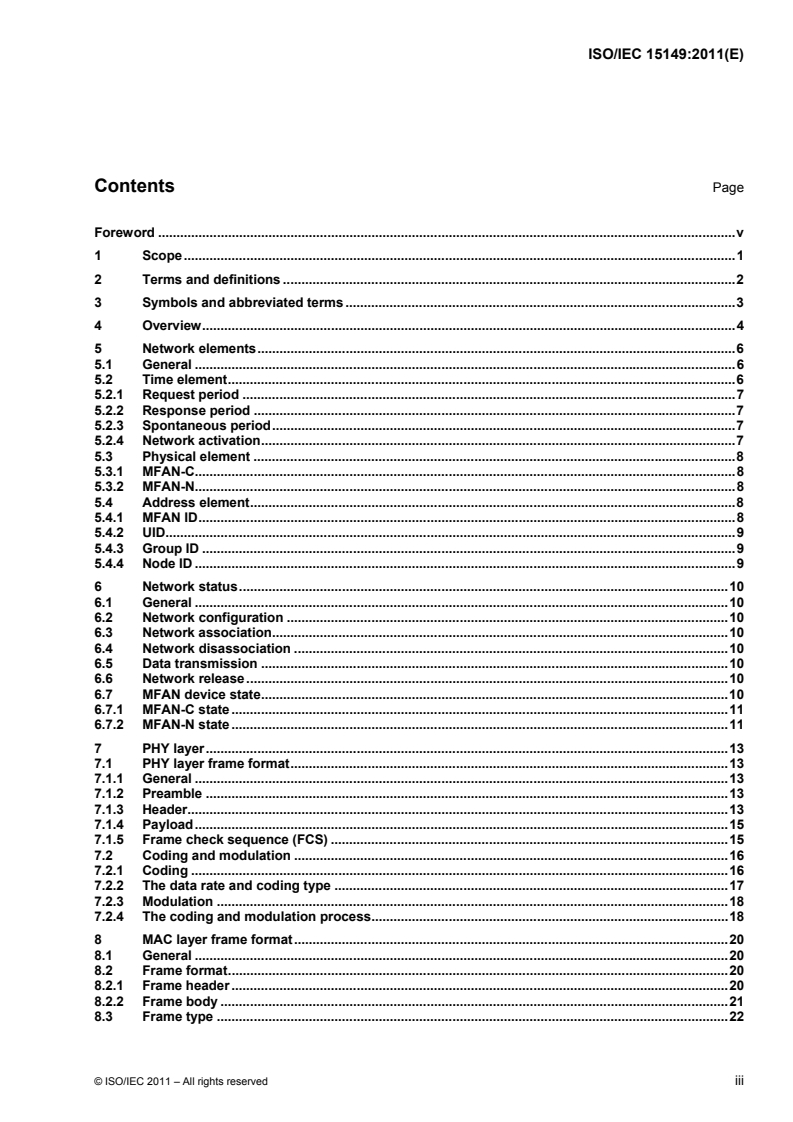
Contents Page
Foreword . v
1 Scope . 1
2 Terms and definitions . 2
3 Symbols and abbreviated terms . 3
4 Overview . 4
5 Network elements . 6
5.1 General . 6
5.2 Time element . 6
5.2.1 Request period . 7
5.2.2 Response period . 7
5.2.3 Spontaneous period . 7
5.2.4 Network activation . 7
5.3 Physical element . 8
5.3.1 MFAN-C. 8
5.3.2 MFAN-N. 8
5.4 Address element . 8
5.4.1 MFAN ID . 8
5.4.2 UID . 9
5.4.3 Group ID . 9
5.4.4 Node ID . 9
6 Network status . 10
6.1 General . 10
6.2 Network configuration . 10
6.3 Network association . 10
6.4 Network disassociation . 10
6.5 Data transmission . 10
6.6 Network release . 10
6.7 MFAN device state . 10
6.7.1 MFAN-C state . 11
6.7.2 MFAN-N state . 11
7 PHY layer . 13
7.1 PHY layer frame format . 13
7.1.1 General . 13
7.1.2 Preamble . 13
7.1.3 Header. 13
7.1.4 Payload . 15
7.1.5 Frame check sequence (FCS) . 15
7.2 Coding and modulation . 16
7.2.1 Coding . 16
7.2.2 The data rate and coding type . 17
7.2.3 Modulation . 18
7.2.4 The coding and modulation process . 18
8 MAC layer frame format . 20
8.1 General . 20
8.2 Frame format . 20
8.2.1 Frame header . 20
8.2.2 Frame body . 21
8.3 Frame type . 22
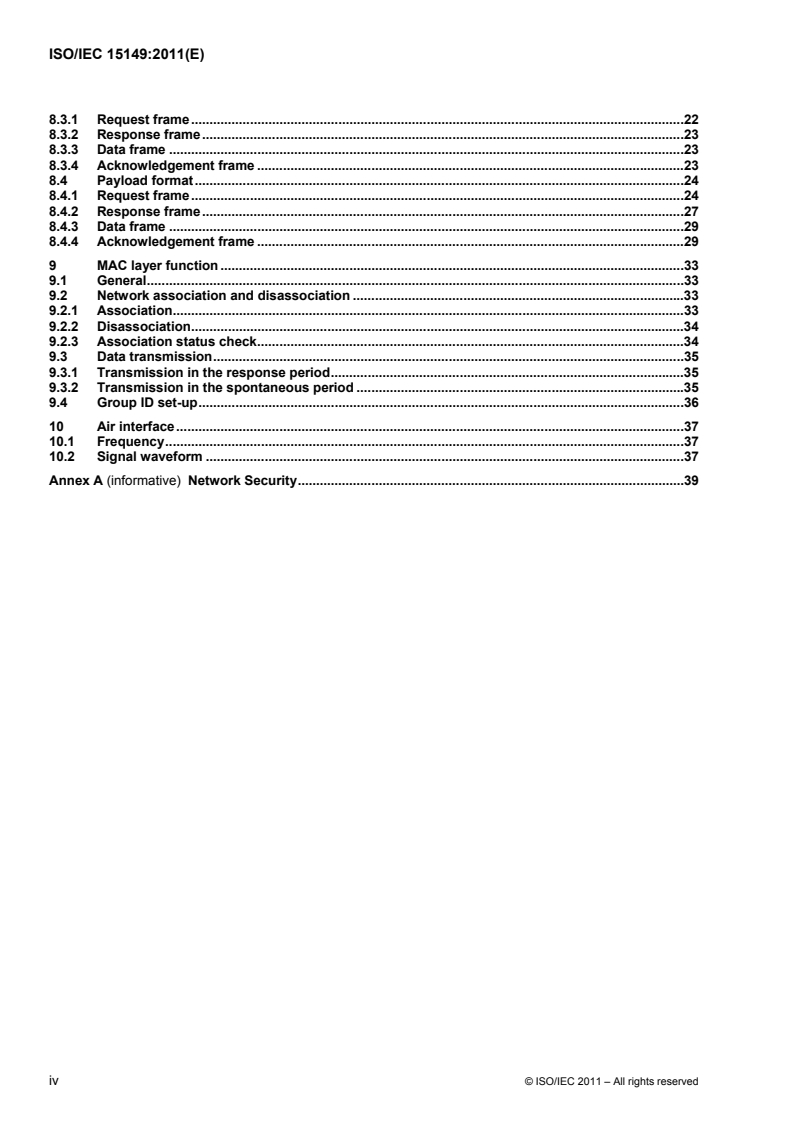
© ISO/IEC 2011 – All rights reserved iii
8.3.1 Request frame .22
8.3.2 Response frame .23
8.3.3 Data frame .23
8.3.4 Acknowledgement frame .23
8.4 Payload format .24
8.4.1 Request frame .24
8.4.2 Response frame .27
8.4.3 Data frame .29
8.4.4 Acknowledgement frame .29
9 MAC layer function .33
9.1 General .33
9.2 Network association and disassociation .33
9.2.1 Association .33
9.2.2 Disassociation .34
9.2.3 Association status check .34
9.3 Data transmission .35
9.3.1 Transmission in the response period .35
9.3.2 Transmission in the spontaneous period .35
9.4 Group ID set-up .36
10 Air interface .37
10.1 Frequency .37
10.2 Signal waveform .37
Annex A (informative) Network Security .39
iv © ISO/IEC 2011 – All rights reserved
Foreword
ISO (the International Organization for Standardization) and IEC (the International Electrotechnical
Commission) form the specialized system for worldwide standardization. National bodies that are members of
ISO or IEC participate in the development of International Standards through technical committees
established by the respective organization to deal with particular fields of technical activity. ISO and IEC
technical committees collaborate in fields of mutual interest. Other international organizations, governmental
and non-governmental, in liaison with ISO and IEC, also take part in the work. In the field of information
technology, ISO and IEC have established a joint technical committee, ISO/IEC JTC 1.
International Standards are drafted in accordance with the rules given in the ISO/IEC Directives, Part 2.
The main task of the joint technical committee is to prepare International Standards. Draft International
Standards adopted by the joint technical committee are circulated to national bodies for voting. Publication as
an International Standard requires approval by at least 75 % of the national bodies casting a vote.
Attention is drawn to the possibility that some of the elements of this document may be the subject of patent
rights. ISO and IEC shall not be held responsible for identifying any or all such patent rights.
ISO/IEC 15149 was prepared by Joint Technical Committee ISO/IEC JTC 1, Information technology,
Subcommittee SC 6, Telecommunications and information exchange between systems.
© ISO/IEC 2011 – All rights reserved v
INTERNATIONAL STANDARD ISO/IEC 15149:2011(E)
Information technology — Telecommunications and information
exchange between systems — Magnetic field area network
(MFAN)
1 Scope
This International Standard specifies the physical layer and media access control layer protocols of a wireless
network over a magnetic field in a low frequency band (~300 kHz), for wireless communication in harsh
environments (i.e. around metal, underwater, underground, etc.).
The physical layer protocol is designed for the following scope:
low carrier frequency for large magnetic field area and reliable communication in harsh environments;
simple and robust modulation for a low implementation cost and error performance;
variable coding and bandwidth for a link adaptation.
The media access control layer protocol is designed for the following scope:
simple and efficient network topology for low power consumption;
variable superframe structure for compact and efficient data transmission;
dynamic address assignment for small packet size and efficient address management.
This International Standard supports several kbps data transmission in a wireless network within a distance of
several metres. It can be applied to various services such as the following areas:
in the environmental industry, to manage pollution levels in soil and water using wireless underground or
underwater sensors;
in the construction industry, to monitor the integrity of buildings and bridges using wireless, inner-
corrosion sensors;
in the consumer-electronics industry, to detect food spoilage in wet, airtight storage areas and to transfer
the sensing data from the inside to the outside;
in the agricultural industry, to manage the moisture level as well as mineral status in soil using buried
wireless sensors;
in the transportation industry, to manage road conditions and traffic information using wireless
underground sensors.
© ISO/IEC 2011 – All rights reserved 1
2 Terms and definitions
For the purposes of this document, the following terms and definitions apply.
2.1
magnetic field area network
MFAN
wireless network that provides reliable communication in harsh environments using magnetic field
2.2
magnetic field area network coordinator
MFAN-C
device that manages the connection and release of nodes within the communication area and the sending and
receiving time of data in an MFAN
2.3
magnetic field area network node
MFAN-N
device except the coordinator that forms a network in an MFAN
2 © ISO/IEC 2011 – All rights reserved
3 Symbols and abbreviated terms
ARq Association Request
ARs Association Response
ARA Association Response Acknowledgement
ASC Association Status Check
ASK Amplitude Shift Keying
ASRq Association Status Request
ASRs Association Status Response
ASRA Association Status Response Acknowledgement
BPSK Binary Phase Shift Keying
CRC Cyclic Redundancy Check
DA Data Acknowledgement
DaRq Disassociation Request
DaRs Disassociation Response
DaRA Disassociation Response Acknowledgement
DRq Data Request
DRs Data Response
DRA Data Response Acknowledgement
FCS Frame Check Sequence
GSRq Group ID Set-up Request
GSRs Group ID Set-up Response
GSRA Group ID Set-up Response Acknowledgement
HCS Header Check Sequence
LSB Least Significant Bit
MAC Media Access Control
MFAN Magnetic Field Area Network
MFAN-C Magnetic Field Area Network Coordinator
MFAN-N Magnetic Field Area Network Node
NRZ-L Non-Return-to-Zero Level
PHY PHYsical layer protocol
RA Response Acknowledgement
RR Response Request
SIFS Short InterFrame Space
TDMA Time Division Multiple Access
UID Unique IDentifier
© ISO/IEC 2011 – All rights reserved 3
4 Overview
MFAN is a wireless communication network that can transmit and receive data over a magnetic field in a low
frequency band. Wireless communication over a magnetic field enables reliable communication and extends
the communication system coverage around metal, soil, and water. It is designed using those characteristics
of the magnetic field communication. It uses a low carrier frequency for reliable communication and large
magnetic field area in harsh environments, a simple and robust modulation like BPSK for a low
implementation cost and error probability, and a dynamic coding technique like Manchester or NRZ-L coding
for noise robustness. In essence, it provides several kbps data transmission within a distance of several
meters.
Also, it uses a simple and efficient network topology like a star topology for low power consumption. The
dynamic address assignment is used for the small packet size and efficient address management, and the
adaptive link quality control is considered with variable data transmission speed and coding. The devices in
MFAN are specified into two elements according to the role: MFAN-C for a coordinator, and MFAN-N for a
node. In a network, there can be one coordinator. When a node joins the network, the coordinator assigns the
time-slots for each device upon the node's request and the coordinator's decision. So, TDMA is considered for
the data transmission.
As shown in Figure 1, MFAN-Ns are buried under the ground, and MFAN-C is placed above the ground. If
MFAN-N receives the sensing data from the sensors, MFAN-N sends its received data to MFAN-C over a
magnetic field. MFAN-C sends the received data from MFAN-N to the monitoring center by either wireless or
wired communication for long distance.
3D management
GIS
Wireless repeater
server
Mobile monitoring center
Localization
management
server
DB
server
MFAN- C
MFAN- C MFAN- C
MFAN- C
MFAN- C
MFAN- C
MFAN- N
MFAN-N
MFAN-N
MFAN- N
MFAN-N
MFAN- N
MFAN-N
Ground monitoring Levee & dam
Underground life line
structure structure
Figure 1 – Underground monitoring system
Wireless communication in harsh environments has been significantly required in various industries. It is
difficult for a sensor node to transmit its data by a radio frequency around metal, soil, and water with the
existing standards of wireless communication. MFAN is an alternative standard that enables several sensor
nodes inside metal, soil, and water to transfer their data to a coordinator outside using the characteristics of
magnetic field. Therefore it can be applied to various services in harsh environments.
4 © ISO/IEC 2011 – All rights reserved
For example, in ground status monitoring as shown in Figure 2, the sensor nodes can be buried under the
ground to sense ground cave-in, ground sinking, land sliding, and so on. Another example of MFAN is the
underground infrastructure management in Figure 3. In this example, the sensor nodes are attached to the
pipes, and can detect gas or water leaks and notify its location. For the building and bridge management in
Figure 4, the sensor nodes can be placed on beams and columns to detect the integrity of the structure. In
pollution monitoring as shown in Figure 5, the sensor nodes can detect the quality of the soil and water. It can
detect poisonous chemical, pH(Hydrogen ion exponent), and temperature by sensor nodes that are placed
below ground and water.
Figure 3 – Underground infrastructure
Figure 2 – Ground status monitoring
management
Figure 4 – Building & bridge management Figure 5 – Pollution monitoring
© ISO/IEC 2011 – All rights reserved 5
5 Network elements
5.1 General
The main elements of MFAN are divided into time and physical element. The time element refers to the
superframe consisting of a request period, a response period, and a spontaneous period, and the physical
element refers to the network consisting of MFAN-C and MFAN-Ns. The most basic one in the physical
element is the node. Node is classified into two types: MFAN-C to manage the network and MFAN-N to
communicate with MFAN-C.
Figures 6 and 7 show the structures of superframe and network which are the time and physical elements,
respectively. The node that needs to be decided first in MFAN is MFAN-C, and the superframe begins with
MFAN-C transmitting a request packet in the request period. MFAN-C is charged of managing the association,
disassociation, release, and scheduling of MFAN-Ns. One MFAN can use one channel where only one node
is utilized as MFAN-C and the rest of them become MFAN-N. The rest of the nodes in MFAN excluding
MFAN-C become MFAN-N. Note that any nodes can become either MFAN-C or MFAN-N depending upon its
role. Basically, a peer-to-peer connection between MFAN-C and MFAN-N is considered.
5.2 Time element
The time element used in MFAN is the time slot of the TDMA method. MFAN-C manages the MFAN-N group
that transmits data in the response period, and the time slots are self-arranged by the selected MFAN-Ns. The
superframe of MFAN, as shown in Figure 6, consists of a request period, a response period, and a
spontaneous period, and the lengths of the request and response period are variable. The superframe begins
with MFAN-C transmitting a RR packet to MFAN-Ns in the request period.
Super frame Super frame Super frame
N-1 N N+1
variable
variable
variable variable
Spontaneous
Request
Response period
period
period
Figure 6 – MFAN superframe structure
The RR packet has information which MFAN-Ns can send response packets during response periods, and the
selected MFAN-Ns can transmit the response packet in the response period according to the RR packet
information.
6 © ISO/IEC 2011 – All rights reserved
5.2.1 Request period
In the request period, MFAN-C transmits the RR packet with the information about the usage of MFAN-Ns in
order for MFAN-N to send the response packet during response periods.
5.2.2 Response period
In the response period, MFAN-N can transmit response packet according to the received RR packet of MFAN-
C, and the response period can be divided into several time slots according to the number of the selected
MFAN-Ns in MFAN. Each time slot length is variable according to the length of the response frame and the
acknowledgement. If the MFAN-C schedules a response period, the slot number is decided by the order of the
divided time slot. Otherwise the slot number is zero. MFAN-C assigns time slots to either MFAN-N or a
particular group for the use of the response period, and the nodes in the assigned group independently
transmit the data frame in the response period.
5.2.3 Spontaneous period
The spontaneous period begins when there is no node transmitting the response packet for a certain period of
time. In this period, nodes can transmit data even without MFAN-C’s request. This period is maintained until
MFAN-C transmits a request packet.
5.2.4 Network activation
The superframe of MFAN is divided into the request period, the response period, and the spontaneous period.
MFAN-C and MFAN-Ns in MFAN operate in each period as follows:
5.2.4.1 Request packet transmission within the request period
In the request period, MFAN-C sends the RR packet to MFAN-Ns. Based on this, the MFAN-N that have
received the RR packet decide whether to transmit response packets in the response period. MFAN-C can
determine the MFAN-N group to transmit in the response period.
5.2.4.2 Response packet transmission within the response period
The MFAN-Ns selected by MFAN-C can transmit the response packet in the response period. When MFAN-N
transmits the response packet in the response period, MFAN-C that has received the response packet
transmits the RA packet. MFAN-N that has not received the RA packet transmits response packets every
time-slot until it receives a RA packet from MFAN-C.
5.2.4.3 Data packet transmission in the spontaneous period
A spontaneous period begins if MFAN-N does not transmit any response packets for a certain period of time,
and this period is maintained until MFAN-C transmits a RR packet. In the spontaneous period, MFAN-N can
transmit data without the request of MFAN-C.
© ISO/IEC 2011 – All rights reserved 7
5.3 Physical element
The physical element configuring MFAN is divided into MFAN-C and MFAN-N in which all MFAN-Ns are
connected into MFAN-C (i.e. a central connectivity device). The basic element, node, is distinguished into
MFAN-C and MFAN-N according to its role. MFAN-C manages the whole MFAN and there must exist only
one MFAN-C per one network. MFAN-C manages MFAN-N by sending the RR packet. MFAN-N must transmit
response packets according to MFAN-C’s management. MFAN can be configured as shown in Figure 7.
Figure 7 – MFAN
5.3.1 MFAN-C
MFAN-C is a node that manages MFAN; only one MFAN-C exists per one network, and it manages and
controls MFAN-N by the RR packet.
5.3.2 MFAN-N
MFAN-N is a node that resides within an MFAN (excluding MFAN-C), and a maximum of 65,519 MFAN-Ns
can exist per network. It transmits response packets according to the RR packet transmitted by MFAN-C.
5.4 Address element
In order to identify MFAN-Ns, MFAN uses address systems such as MFAN ID, UID, group ID and node ID.
5.4.1 MFAN ID
MFAN has its own ID that identifies each network from the others; the value should not be duplicated in other
MFANs, and the value is maintained as long as MFAN exists. Its value is defined by user to distinguish
networks.
8 © ISO/IEC 2011 – All rights reserved
5.4.2 UID
UID is a unique identifier consisting of 64 bits; it consists of group ID, IC manufacturer's code, and IC
manufacturer's serial number. MFAN-N is identified by UID.
Unit: Byte
1 1 6
Group ID IC manufacturer's code IC manufacturer's serial number
Figure 8 – UID structure
5.4.3 Group ID
MFAN-N can be grouped by applications. Group ID is the identifier for the grouped MFAN-Ns within the
network. MFAN-C can request a response to a specific MFAN-N group in order to mitigate the packet collision.
Some group IDs are reserved in Table 1. Its value is defined by user to distinguish groups.
Table 1 – Reserved group ID
Group ID Content Remarks
0xFF All groups When selecting all groups
0xF0 – 0xFE Reserved -
5.4.4 Node ID
Node ID is an identifier used instead of UID to identify nodes, and it has a 16 bit address assigned by MFAN-
C. Some node IDs are reserved in Table 2.
Table 2 – Reserved node ID
Node ID Content Remarks
0xFFFF All nodes When broadcasting or transmitting all nodes
0xFFFE Unjoined node Default ID for MFAN-N
0xFFF0 – 0xFFFD Reserved -
© ISO/IEC 2011 – All rights reserved 9
6 Network status
6.1 General
In an MFAN, MFAN-N may enter the active states of network configuration, network association, response
transmission, data transmission, network disassociation, and network release.
6.2 Network configuration
MFAN-C configures a network by transmitting a request packet to MFAN-N in the request period. MFAN ID is
included in the request packet so that MFAN-N can identify the connecting network. The minimum period of
network means when only MFAN-C exists, and it consists of only the request period and the spontaneous
period.
6.3 Network association
When MFAN-C sends the ARq packet in the request period, MFAN-N probes the received packet and then if it
is the ARq packet for the desired MFAN, MFAN-N sends the ARs packet to the MFAN-C in the response
period. MFAN-C, having received the ARs packet, transmits the ARA packet to MFAN-N. The network
association of MFAN-N is completed upon receiving the ARA packet from MFAN-C.
6.4 Network disassociation
MFAN-N, associated with MFAN, can be disassociated either by MFAN-C’s request or by itself. MFAN-C can
send the DaRq packet to MFAN-N according to the current network status for a forced disassociation. In the
case of spontaneous disassociation due to shutting down and going out of the network coverage, MFAN-C
can know the association status of MFAN-N by the response of ASRq from MFAN-C.
6.5 Data transmission
When MFAN-C sends the DRq packet in the request period to MFAN-N, MFAN-N sends DRs packet to
MFAN-C according to the requested data type. Upon receiving the DRs packet, MFAN-C sends the DRA
packet to MFAN-N, and MFAN-N, having received the DRA packet, completes the data transmission.
6.6 Network release
MFAN release can be divided into normal release through the request of MFAN-Ns and abnormal release due
to a sudden situation. Normal release refers to MFAN-C releasing the network by its own decision and by
sending the DaRq packet to all MFAN-Ns. Abnormal network release refers to MFAN-C shutting down or
going out of the network coverage.
6.7 MFAN device state
MFAN device state includes the MFAN-C state and the MFAN-N state. In detail, MFAN-C states are divided
into the standby state, the packet analysis state, and the packet generation state whereas MFAN-N states are
composed of the hibernation state, the activation state, the standby state, the packet analysis state, and the
packet generation state.
10 © ISO/IEC 2011 – All rights reserved
6.7.1 MFAN-C state
The state of MFAN-C goes to the standby state when the power turns on. In the standby state, when the
application system commands sending the RR packet or the superframe begins, the state of MFAN-C goes to
the packet generation state and MFAN-C sends the RR packet to MFAN-Ns. And then the state of MFAN-C
goes back to the standby state. If MFAN-C receives the packet (either response or data packet) from MFAN-
Ns while doing the carrier detection in the standby state, the state of MFAN-C goes to the packet analysis
state. If the destination ID of the received packet and the node ID of MFAN-C are the same, the state of
MFAN-C goes to the packet generation state, and then MFAN-C generates the RA or DA packet and sends it
to MFAN-N in the packet generation state. After that, the state of MFAN-C goes back to the standby state. On
the other hand, if there are errors in the data packet, the state of MFAN-C goes back directly to the standby
state. In the packet analysis state, when there are errors in the received response packet or destination ID of
the received response packet and node ID of MFAN-C do not correspond, MFAN-C regenerates the RR
packet in the packet generation state and retransmits it to MFAN-Ns, and then the state goes to the standby
state. If these failures occur consecutively, the procedure of the packet analysis state is repeated as many
times as needed (maximum N times). In (N+1)th procedure, the state of MFAN-C goes from the packet
analysis state to the standby state. MFAN-C state diagram is as Figure 9.
Figure 9 – MFAN-C state diagram
6.7.2 MFAN-N state
The state of MFAN-N goes into the hibernation state when the power turns on. In the hibernation state, when
the wake-up sequence is detected, the state goes into the activation state. The wake-up sequence is defined
in 7.1. When MFAN-N receives the RR packet, the state of MFAN-N goes into the packet analysis state and
MFAN-N analyzes the received RR packet. If the destination ID of the RR packet and MFAN-N ID (group ID
and node ID) correspond, the state of MFAN-N goes into the packet generation state and MFAN-N sends the
response packet to MFAN-C, and then the state of MFAN-N moves into the standby state. If not, the state
goes back to the hibernation state.
© ISO/IEC 2011 – All rights reserved 11
While doing the carrier detection in the standby state, the state of MFAN-N goes to the hibernation state when
MFAN-N receives the RA packet of its own node or to the packet generation state when MFNA-N receives the
RA packet of other nodes. And the state of MFAN-N goes to the hibernation state when the slot-number is not
allocated and the time-out period is over in the standby state or to the packet generation state when the slot-
number is allocated and the time-out period is over (up to N times consecutively). However, the state goes to
the hibernation state when the slot-number is allocated and the time-out period at N+1th is over. If the slot-
number is allocated and MFAN-N does not receive RA packet during the time-out period, the state of MFAN-N
goes from the standby state to the packet generation state. And then MFAN-N regenerates and retransmits
the response packet to MFAN-C and the state of MFAN-N goes from the packet generation state to the
standby state. The retransmission of the response packet is repeated as many times as needed (maximum N
times). In the (N+1)th time-out period, the state goes from the standby state to the hibernation state. If MFAN-
N receives the RR packet in the standby state while doing the carrier detection, the state is moved to the
packet analysis state.
When the system interrupt occurs in the hibernation state, the state of MFAN-N is changed to the activation
state. If MFAN-N receives data from the system, the state goes to the packet generation state. And then
MFNA-N generates and sends data packet to the MFAN-C, and the state of MFAN-N goes to the standby
state. If MFAN-N receives the DA packet, the state goes back to the hibernation state. If not, the state goes to
the packet generation state and MFAN-N retransmits the data and then the state goes back to the standby
state up to N times. MFAN-N state diagram is as Figure 10.
Figure 10 – MFAN-N state diagram
12 © ISO/IEC 2011 – All rights reserved
7 PHY layer
7.1 PHY layer frame format
7.1.1 General
This section describes the physical layer frame format. As shown in Figure 11, the PHY layer frame consists
of three components: the preamble, the header, and the payload. When transmitting the packet, the preamble
is sent first, followed by the header and finally by the payload. An LSB is the first bit transmitted.
Figure 11 – PHY layer frame format
7.1.2 Preamble
As shown in Figure 12, the preamble consists of two portions: a 8-bit wake-up sequence of [0000 0000] and a
16-bit synchronization sequence consisting of a 12-bit sequence of [000000000000] followed by a 4-bit
sequence of [1010]. The wake-up sequence is only included in the preamble of RR packet in the request
period. The synchronization sequence can be used for the packet acquisition, the symbol timing and the
carrier frequency estimation.
The preamble is coded using the TYPE 0 defined in 7.1.3.1. The wake-up sequence is modulated by ASK, but
the synchronization sequence by BPSK.
Figure 12 – Preamble format
7.1.3 Header
The header is added after the preamble to convey information about a payload. As shown in Figure 13, the
header is composed of 24 bits. Bits 0-2 are the data rate and coding field. Bits 3-10 are the payload data
length field. Bits 16-23 are a CRC-8 HCS. The details are defined in Table 3.
© ISO/IEC 2011 – All rights reserved 13
The header is coded using the TYPE 0 defined in 7.1.3.1.
Figure 13 – Header format
Table 3 – Header definition of physical layer
Bit Content Description
Specifies the data rate and coding at which the payload is received (see
b2-b0 Data rate and coding
Table 4)
Specifies the number of octets in the payload (which does not include the
b10-b3 Payload data length
FCS)
b15-b11 Reserved Reserved and set to zero
b23-b16 HCS Provides a CRC-8 HCS (see 7.1.3.3)
7.1.3.1 Data rate and coding
Depending on the data rate and coding used, bits 0-2 are set according to the values in Table 4. The details of
TYPE 0~7 are described in 7.2.2.
Table 4 – Definition of the data rate and coding
Type Value (b2 b1 b0) Data rate Coding method
TYPE 0 000 1 kbps Manchester
TYPE 1 001 2 kbps Manchester
TYPE 2 010 4 kbps Manchester
TYPE 3 011 2 kbps NRZ-L + Scrambling
TYPE 4 100 4 kbps NRZ-L + Scrambling
TYPE 5 101 8 kbps NRZ-L + Scrambling
TYPE 6 110 Reserved -
TYPE 7 111 Reserved -
14 © ISO/IEC 2011 – All rights reserved
7.1.3.2 Payload data length
The payload data length is an unsigned 8-bit integer that indicates the number of octets in the payload, which
does not include the FCS. It ranges from 0x00 to a maximum of 0xFF bytes.
7.1.3.3 Header check sequence (HCS)
The header is checked for errors using a CRC-8 HCS. The HCS covers a data rate and coding, a payload
data length and a reserved 5-bit. The primitive polynomial is given as,
2 3 4 7 2 5 7 8
g(D) = (1+D)(1+D + D + D + D ) = 1+ D+ D + D + D + D
A schematic of the processing order is shown in Figure 14. The registers are initialized to all zeros.
Data is accumulated while the switch S in Figure 14 is being placed at ‘1’; when the last bit has been
accumulated, the switch S goes to ‘2’ and HCS is transmitted from the register beginning with in D .
Figure 14 – Encoder of header check sequence
7.1.4 Payload
As shown in Figure 15, the payload consists of a variable length data and the FCS. If the payload data length
field in the header has zero, FCS is not sent.
Data Frame check sequence
(0~255 byte) (2 byte)
Figure 15 – Format of payload
7.1.5 Frame check sequence (FCS)
The payload is checked for errors using a CRC-16 FCS defined in Table 5. The FCS covers a variable length
16 12 5
data. The primitive polynomial is X +X +X +1. The registers are initialized to all ones. The frame check
sequence is obtained by inverting the calculated CRC-16 bits.
Table 5 – Cyclic redundancy check for frame check sequence
CRC type Length Polynomial Preset Residue
16 12 5
ISO/IEC 13239 16 Bit X +X +X+1 0xFFFF 0x1D0F
© ISO/IEC 2011 – All rights reserved 15
7.2 Coding and modulation
7.2.1 Coding
7.2.1.1 Manchester coding
Manchester code has a transition in the middle of every bit interval whether a one or a zero is being sent. A
zero is represented by a half-bit-wide pulse positioned during the first half to the bit interval. A one is
represented by a half-bit-wide pulse positioned during the second half to the bit interval.
Figure 16 – Definition of Manchester coding
7.2.1.2 NRZ-L coding
With NRZ-L(Level) a zero is represented by zero level and a one is represented by one level.
Figure 17 – Definition of NRZ-L coding
16 © ISO/IEC 2011 – All rights reserved
7.2.1.3 Scrambling
A scrambler is used to whiten only a payload data encoded by NRZ-L. The primitive polynomial g(D) is given
as,
14 15
g(D) = 1+ D + D
where D is a bit delay element. Figure 18 shows the scrambler’s block diagram. d is generated as follows,
k
d = d d
k k-14 k-15
where '' denotes modulo-2 addition. The scrambler is initialized to a seed value, 0xFFFF. The scrambled
data bit, b , is obtained as:
k
b = sd
k k k
where s represents the non-scrambled data bit.
k
Figure 18 – Scrambler block diagram
7.2.2 The data rate and coding type
The physical layer supports 8 Types as shown in Table 4.
Preamble and header are encoded by TYPE 0 using Manchester coding at a data rate of 1 kbps, however
payload is encoded using the appropriate data rate of 1, 2, 4, or 8 kbps and coding. The data rate and coding
type of the payload are specified in the data rate and coding field in the header.
© ISO/IEC 2011 – All rights reserved 17
7.2.3 Modulation
The communications between MFAN-C and MFAN-N uses either ASK modulation or BPSK modulation.
7.2.3.1 ASK modulation
As shown in Figure 19, the encoded serial input data is converted into a number representing one of the two
ASK constellation points. ( is the carrier frequency of MFAN.)
c
Figure 19 – ASK modulation diagram
7.2.3.2 BPSK modulation
The transmission between MFAN-C and MFAN-N uses the BPSK modulation. As shown in Figure 20, the
encoded serial input data is converted into a number representing one of the two BPSK constellation points.
( is the carrier frequency of MFAN.)
c
Figure 20 – BPSK modulation diagram
7.2.4 The coding and modulation process
7.2.4.1 The coding and modulating process of the preamble
The preamble sequence (see 7.1.2) is encoded using the TYPE 0 (see 7.2.2). The wake-up sequence, if any,
is modulated by ASK and the synchronization sequence by BPSK.
Figure 21 – The coding and modulation process of the preamble
18 © ISO/IEC 2011 – All rights reserved
7.2.4.2 The coding and modulation process of the header
As shown in Figure 22, header is formatted by appending a data rate and coding, a payload data length, a
5-bit zero (see 7.1.3) and HCS value. The resulting combination is encoded using the TYPE 0 (see 7.2.2) and
then modulated by BPSK.
Header check TYPE 0
Header BPSK
sequence signal
information modulation
addition conversion
Figure 22 – The coding and modulation process of header
7.2.4.3 The coding and modulation process of the payload
As shown in Figure 23, payload is formatted by appending data and FCS value, which is calculated over the
data. The resulting combination is encoded using the TYPE I (I = 0~7) (see 7.2.2) and then modulated by
BPSK.
Figure 23 – The coding and modulation process of payload
© ISO/IEC 2011 – All rights reserved 19
8 MAC layer frame format
8.1 General
The MAC frame of MFAN consists of the frame header and the frame body. The frame header has information
for data among MFAN-Ns, and the frame body has the data for transmissions between MFAN devices.
8.2 Frame format
All frame of MAC consists of the frame header and the frame body as shown in Figure 24.
1) Frame header: Consists of the MFAN ID, frame control, source node ID, destination no
...
Questions, Comments and Discussion
Ask us and Technical Secretary will try to provide an answer. You can facilitate discussion about the standard in here.
Loading comments...