

ISO/IEC/IEEE 8802-1AS:2021/Amd 1:2025
(Amendment)Information technology — Telecommunications and information exchange between systems — Local and metropolitan area networks — Part 1AS: Timing and synchronization for time-sensitive applications in bridged local area networks — Amendment 1: Inclusive terminology
General Information
- Abstract
- Status
- Published
- Publication Date
- 07-Apr-2025
- Current Stage
- 6060 - International Standard published
- Start Date
- 08-Apr-2025
- Due Date
- 28-May-2027
- Completion Date
- 08-Apr-2025
Buy Documents

ISO/IEC/IEEE 8802-1AS:2021/Amd 1:2025 - Information technology — Telecommunications and information exchange between systems — Local and metropolitan area networks — Part 1AS: Timing and synchronization for time-sensitive applications in bridged local area networks — Amendment 1: Inclusive terminology Released:8. 04. 2025
Overview
ISO/IEC/IEEE 8802-1AS:2021/Amd 1:2025 is an amendment to the international standard (IEEE Std 802.1AS™) that governs timing and synchronization for time-sensitive applications in bridged local area networks (LANs). Published as IEEE Std 802.1ASdr‑2024 and adopted in the ISO/IEC/IEEE 8802 series, this amendment’s primary purpose is to update terminology to be inclusive, replacing legacy terms with alternatives identified by IEEE Std 1588g™‑2022. Figures and illustrations in the base standard are updated only to reflect the revised terminology.
Key topics and technical points
- Timing and synchronization for bridged LANs: The standard addresses mechanisms used to maintain synchronized time and frequency across bridged and switched Ethernet networks for time-sensitive applications.
- Terminology updates: Amendment 1 replaces prior terms with inclusive alternatives (aligned with IEEE 1588g‑2022). Changes are editorial in nature - no new protocol mechanics are introduced.
- PTP-related concepts referenced: Keywords and concepts retained or referenced include Grandmaster Clock, Grandmaster PTP Instance, PTP Relay Instance, PTP End Instance, phase offset, frequency offset, syntonization, and time-aware system.
- Synchronization objectives: Emphasis on accurate phase and frequency alignment (phase offset, frequency offset) and robust methods for clock distribution across network bridges and relays.
- Compatibility and update process: This amendment is a fast‑track adoption integrating IEEE editorial changes into the ISO/IEC/IEEE publication process.
Applications
- Time-sensitive networking (TSN) deployments requiring sub-microsecond or deterministic time alignment
- Industrial automation and control systems where coordinated timing is critical
- Professional audio/video and broadcast systems relying on synchronized media streams
- Telecommunications backhaul and distributed measurement systems
- Power systems and smart-grid devices that depend on precise timing for protection and monitoring
Who should use this standard
- Network architects and engineers designing TSN or PTP-based synchronization in bridged LANs
- Device and NIC manufacturers implementing IEEE 802.1AS timing functions
- System integrators and solution providers deploying time-aware networks
- Test labs, certification bodies, and standards compliance teams
Related standards
- IEEE Std 802.1AS™ (base timing and synchronization specification)
- IEEE Std 1588™ family (Precision Time Protocol) - specifically IEEE Std 1588g™‑2022 for terminology alignment
- Other parts of the ISO/IEC/IEEE 8802 series for LAN/MAN specifications
This amendment improves clarity and inclusivity in the standard’s language while preserving the original technical requirements for precise timing and synchronization in bridged local area networks.
Relations
- Effective Date
- 01-Jun-2024
Buy Documents
ISO/IEC/IEEE 8802-1AS:2021/Amd 1:2025 - Information technology — Telecommunications and information exchange between systems — Local and metropolitan area networks — Part 1AS: Timing and synchronization for time-sensitive applications in bridged local area networks — Amendment 1: Inclusive terminology Released:8. 04. 2025
Get Certified
Connect with accredited certification bodies for this standard

BSI Group
BSI (British Standards Institution) is the business standards company that helps organizations make excellence a habit.

NYCE
Mexican standards and certification body.
Sponsored listings
Frequently Asked Questions
ISO/IEC/IEEE 8802-1AS:2021/Amd 1:2025 is a standard published by the International Organization for Standardization (ISO). Its full title is "Information technology — Telecommunications and information exchange between systems — Local and metropolitan area networks — Part 1AS: Timing and synchronization for time-sensitive applications in bridged local area networks — Amendment 1: Inclusive terminology". This standard covers: Information technology — Telecommunications and information exchange between systems — Local and metropolitan area networks — Part 1AS: Timing and synchronization for time-sensitive applications in bridged local area networks — Amendment 1: Inclusive terminology
Information technology — Telecommunications and information exchange between systems — Local and metropolitan area networks — Part 1AS: Timing and synchronization for time-sensitive applications in bridged local area networks — Amendment 1: Inclusive terminology
ISO/IEC/IEEE 8802-1AS:2021/Amd 1:2025 is classified under the following ICS (International Classification for Standards) categories: 35.110 - Networking. The ICS classification helps identify the subject area and facilitates finding related standards.
ISO/IEC/IEEE 8802-1AS:2021/Amd 1:2025 has the following relationships with other standards: It is inter standard links to ISO/IEC/IEEE 8802-1AS:2021. Understanding these relationships helps ensure you are using the most current and applicable version of the standard.
ISO/IEC/IEEE 8802-1AS:2021/Amd 1:2025 is available in PDF format for immediate download after purchase. The document can be added to your cart and obtained through the secure checkout process. Digital delivery ensures instant access to the complete standard document.
Standards Content (Sample)
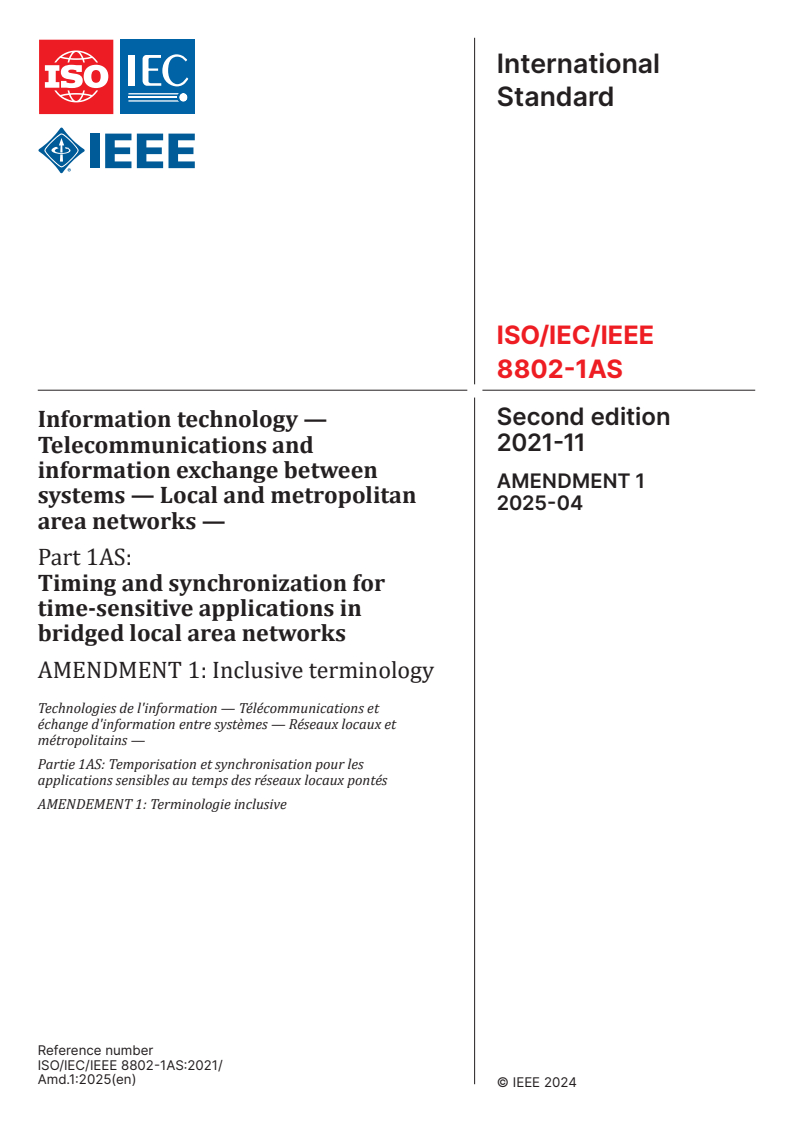
International
Standard
ISO/IEC/IEEE
8802-1AS
Second edition
Information technology —
2021-11
Telecommunications and
information exchange between
AMENDMENT 1
systems — Local and metropolitan
2025-04
area networks —
Part 1AS:
Timing and synchronization for
time-sensitive applications in
bridged local area networks
AMENDMENT 1: Inclusive terminology
Technologies de l'information — Télécommunications et
échange d'information entre systèmes — Réseaux locaux et
métropolitains —
Partie 1AS: Temporisation et synchronisation pour les
applications sensibles au temps des réseaux locaux pontés
AMENDEMENT 1: Terminologie inclusive
Reference number
ISO/IEC/IEEE 8802-1AS:2021/
Amd.1:2025(en)
© IEEE 2024
ISO/IEC/IEEE 8802-1AS:2021/Amd.1:2025(en)
© IEEE 2024
All rights reserved. Unless otherwise specified, or required in the context of its implementation, no part of this publication may
be reproduced or utilized otherwise in any form or by any means, electronic or mechanical, including photocopying, or posting on
the internet or an intranet, without prior written permission. Permission can be requested from IEEE at the address below.
Institute of Electrical and Electronics Engineers, Inc
3 Park Avenue, New York
NY 10016-5997, USA
Email: stds.ipr@ieee.org
Website: www.ieee.org
Published in Switzerland
© IEEE 2024 – All rights reserved
ii
ISO/IEC/IEEE 8802-1AS:2021/Amd.1:2025(en)
Foreword
ISO (the International Organization for Standardization) and IEC (the International Electrotechnical
Commission) form the specialized system for worldwide standardization. National bodies that are members
of ISO or IEC participate in the development of International Standards through technical committees
established by the respective organization to deal with particular fields of technical activity. ISO and IEC
technical committees collaborate in fields of mutual interest. Other international organizations, governmental
and non-governmental, in liaison with ISO and IEC, also take part in the work.
The procedures used to develop this document and those intended for its further maintenance are described
in the ISO/IEC Directives, Part 1. In particular, the different approval criteria needed for the different types of
document should be noted (see www.iso.org/directives or www.iec.ch/members_experts/refdocs).
IEEE Standards documents are developed within the IEEE Societies and the Standards Coordinating
Committees of the IEEE Standards Association (IEEE-SA) Standards Board. The IEEE develops its standards
through a consensus development process, approved by the American National Standards Institute, which
brings together volunteers representing varied viewpoints and interests to achieve the final product.
Volunteers are not necessarily members of the Institute and serve without compensation. While the IEEE
administers the process and establishes rules to promote fairness in the consensus development process, the
IEEE does not independently evaluate, test, or verify the accuracy of any of the information contained in its
standards.
ISO and IEC draw attention to the possibility that the implementation of this document may involve the use of
(a) patent(s). ISO and IEC take no position concerning the evidence, validity or applicability of any claimed
patent rights in respect thereof. As of the date of publication of this document, ISO and IEC had not received
notice of (a) patent(s) which may be required to implement this document. However, implementers are
cautioned that this may not represent the latest information, which may be obtained from the patent database
available at www.iso.org/patents and https://patents.iec.ch. ISO and IEC shall not be held responsible for
identifying any or all such patent rights.
Any trade name used in this document is information given for the convenience of users and does not
constitute an endorsement.
For an explanation of the voluntary nature of standards, the meaning of ISO specific terms and expressions
related to conformity assessment, as well as information about ISO's adherence to the World Trade
Organization (WTO) principles in the Technical Barriers to Trade (TBT), see www.iso.org/iso/foreword.html.
In the IEC, see www.iec.ch/understanding-standards.
ISO/IEC/IEEE 8802-1AS:2021/Amd 1 was prepared by the LAN/MAN of the IEEE Computer Society (as IEEE
Std 802.1ASdr-2024) and drafted in accordance with its editorial rules. It was adopted, under the “fast-track
procedure” defined in the Partner Standards Development Organization cooperation agreement between ISO
and IEEE, by Joint Technical Committee ISO/IEC JTC 1, Information technology, Subcommittee SC 6 ,
Telecommunications and information exchange between systems.
A list of all parts in the ISO/IEC/IEEE 8802 series can be found on the ISO and IEC websites.
Any feedback or questions on this document should be directed to the user’s national standards body. A
complete listing of these bodies can be found at www.iso.org/members.html and www.iec.ch/national-
committees.
© IEEE 2024 – All rights reserved
iii
Title page
IEEE Std 802.1ASdr™-2024
(Amendment to IEEE Std 802.1AS™-2020
as amended by IEEE Std 802.1AS™-2020/Cor 1-2021)
IEEE Standard for
Local and Metropolitan Area Networks—
Timing and Synchronization for
Time-Sensitive Applications
Amendment 1: Inclusive Terminology
Developed by the
LAN/MAN Standards Committee
of the
IEEE Computer Society
Approved 15 February 2024
IEEE SA Standards Board
ISO/IEC/IEEE 8802-1AS:2021/Amd.1:2025(en)
Abstract: This amendment to IEEE Std 802.1AS™-2020 replaces terminology with alternative
terminology identified by IEEE Std 1588g™-2022. All changes made in figures are only to replace
terminology.
Keywords: amendment, best timeTransmitter, frequency offset, Grandmaster Clock, Grandmaster
PTP Instance, IEEE 802.1AS™, IEEE 802.1ASdr™, phase offset, PTP End Instance, PTP Relay
Instance, synchronization, syntonization, time-aware system
The Institute of Electrical and Electronics Engineers, Inc.
3 Park Avenue, New York, NY 10016-5997, USA
All rights reserved. Published 6 March 2024. Printed in the United States of America.
MoCA is a registered trademark of the Multimedia over Coax Alliance.
POSIX is a registered trademark of The Institute of Electrical and Electronics Engineers, Incorporated.
IEEE and IEEE 802 are registered trademarks in the U.S. Patent & Trademark Office, owned by The Institute of Electrical and Electronics
Engineers, Incorporated.
PDF: ISBN 978-8-8557-0539-3 STD26794
Print: ISBN 978-8-8557-0540-9 STDPD26794
IEEE prohibits discrimination, harassment and bullying.
For more information, visit https://www.ieee.org/about/corporate/governance/p9-26.html.
No part of this publication may be reproduced in any form, in an electronic retrieval system or otherwise, without the prior written permission
of the publisher.
ISO/IEC/IEEE 8802-1AS:2021/Amd.1:2025(en)
Important Notices and Disclaimers Concerning IEEE Standards
Documents
IEEE Standards documents are made available for use subject to important notices and legal disclaimers.
These notices and disclaimers, or a reference to this page (https://standards.ieee.org/ipr/disclaimers.html),
appear in all standards and may be found under the heading “Important Notices and Disclaimers Concerning
IEEE Standards Documents.”
Notice and Disclaimer of Liability Concerning the Use of IEEE Standards
Documents
IEEE Standards documents are developed within IEEE Societies and subcommittees of IEEE Standard s
Association (IEEE SA) Board of Governors. IEEE develops its standards through an accredited consensus
development process, which brings together volunteers representing varied viewpoints and interests to
achieve the final product. IEEE standards are documents developed by volunteers with scientific, academic,
and industry-based expertise in technical working groups. Volunteers are not necessarily members of IEEE
or IEEE SA and participate without compensation from IEEE. While IEEE administers the process and
establishes rules to promote fairness in the consensus development process, IEEE does not independently
evaluate, test, or verify the accuracy of any of the information or the soundness of any judgments contained
in its standards.
IEEE makes no warranties or representations concerning its standards, and expressly disclaims al l
warranties, express or implied, concerning this standard, including but not limited to the warranties o f
merchantability, fitness for a particular purpose and non-infringement. IEEE Standards documents do not
guarantee safety, security, health, or environmental protection, or guarantee against interference with or
from other devices or networks. In addition, IEEE does not warrant or represent that the use of the material
contained in its standards is free from patent infringement. IEEE Standards documents are supplied “AS IS ”
and “WITH ALL FAULTS.”
Use of an IEEE standard is wholly voluntary. The existence of an IEEE standard does not imply that ther e
are no other ways to produce, test, measure, purchase, market, or provide other goods and services related t o
the scope of the IEEE standard. Furthermore, the viewpoint expressed at the time a standard is approved and
issued is subject to change brought about through developments in the state of the art and comments
received from users of the standard.
In publishing and making its standards available, IEEE is not suggesting or rendering professional or other
services for, or on behalf of, any person or entity, nor is IEEE undertaking to perform any duty owed by any
other person or entity to another. Any person utilizing any IEEE Standards document, should rely upon their
own independent judgment in the exercise of reasonable care in any given circumstances or, as appropriate,
seek the advice of a competent professional in determining the appropriateness of a given IEEE standard.
IN NO EVENT SHALL IEEE BE LIABLE FOR ANY DIRECT, INDIRECT, INCIDENTAL, SPECIAL,
EXEMPLARY, OR CONSEQUENTIAL DAMAGES (INCLUDING, BUT NOT LIMITED TO: THE
NEED TO PROCURE SUBSTITUTE GOODS OR SERVICES; LOSS OF USE, DATA, OR PROFITS;
OR BUSINESS INTERRUPTION) HOWEVER CAUSED AND ON ANY THEORY OF LIABILITY,
WHETHER IN CONTRACT, STRICT LIABILITY, OR TORT (INCLUDING NEGLIGENCE OR
OTHERWISE) ARISING IN ANY WAY OUT OF THE PUBLICATION, USE OF, OR RELIANCE
UPON ANY STANDARD, EVEN IF ADVISED OF THE POSSIBILITY OF SUCH DAMAGE AND
REGARDLESS OF WHETHER SUCH DAMAGE WAS FORESEEABLE.
ISO/IEC/IEEE 8802-1AS:2021/Amd.1:2025(en)
Translations
The IEEE consensus balloting process involves the review of documents in English only. In the event that an
IEEE standard is translated, only the English version published by IEEE is the approved IEEE standard.
Official statements
A statement, written or oral, that is not processed in accordance with the IEEE SA Standards Board
Operations Manual shall not be considered or inferred to be the official position of IEEE or any of its
committees and shall not be considered to be, nor be relied upon as, a formal position of IEEE. At lectures,
symposia, seminars, or educational courses, an individual presenting information on IEEE standards shall
make it clear that the presenter’s views should be considered the personal views of that individual rather
than the formal position of IEEE, IEEE SA, the Standards Committee, or the Working Group. Statements
made by volunteers may not represent the formal position of their employer(s) or affiliation(s).
Comments on standards
Comments for revision of IEEE Standards documents are welcome from any interested party, regardless of
membership affiliation with IEEE or IEEE SA. However, IEEE does not provide interpretations,
consulting information, or advice pertaining to IEEE Standards documents.
Suggestions for changes in documents should be in the form of a proposed change of text, together with
appropriate supporting comments. Since IEEE standards represent a consensus of concerned interests, it is
important that any responses to comments and questions also receive the concurrence of a balance of interests.
For this reason, IEEE and the members of its Societies and subcommittees of the IEEE SA Board of
Governors are not able to provide an instant response to comments, or questions except in those cases where
the matter has previously been addressed. For the same reason, IEEE does not respond to interpretation
requests. Any person who would like to participate in evaluating comments or in revisions to an IEEE standard
is welcome to join the relevant IEEE working group. You can indicate interest in a working group using th e
Interests tab in the Manage Profile & Interests area of the IEEE SA myProject system. An IEEE Account is
needed to access the application.
Comments on standards should be submitted using the Contact Us form.
Laws and regulations
Users of IEEE Standards documents should consult all applicable laws and regulations. Compliance with the
provisions of any IEEE Standards document does not constitute compliance to any applicable regulatory
requirements. Implementers of the standard are responsible for observing or referring to the applicable
regulatory requirements. IEEE does not, by the publication of its standards, intend to urge action that is not
in compliance with applicable laws, and these documents may not be construed as doing so.
Data privacy
Users of IEEE Standards documents should evaluate the standards for considerations of data privacy and
data ownership in the context of assessing and using the standards in compliance with applicable laws and
regulations.
Available at: https://development.standards.ieee.org/myproject-web/public/view.html#landing.
Available at: https://standards.ieee.org/content/ieee-standards/en/about/contact/index.html.
ISO/IEC/IEEE 8802-1AS:2021/Amd.1:2025(en)
Copyrights
IEEE draft and approved standards are copyrighted by IEEE under U.S. and international copyright laws.
They are made available by IEEE and are adopted for a wide variety of both public and private uses. These
include both use, by reference, in laws and regulations, and use in private self-regulation, standardization,
and the promotion of engineering practices and methods. By making these documents available for use and
adoption by public authorities and private users, neither IEEE nor its licensors waive any rights in copyrigh t
to the documents.
Photocopies
Subject to payment of the appropriate licensing fees, IEEE will grant users a limited, non-exclusive license
to photocopy portions of any individual standard for company or organizational internal use or individual,
non-commercial use only. To arrange for payment of licensing fees, please contact Copyright Clearance
Center, Customer Service, 222 Rosewood Drive, Danvers, MA 01923 USA; +1 978 750 8400;
https://www.copyright.com/. Permission to photocopy portions of any individual standard for educational
classroom use can also be obtained through the Copyright Clearance Center.
Updating of IEEE Standards documents
Users of IEEE Standards documents should be aware that these documents may be superseded at any time
by the issuance of new editions or may be amended from time to time through the issuance of amendments,
corrigenda, or errata. An official IEEE document at any point in time consists of the current edition of the
document together with any amendments, corrigenda, or errata then in effect.
Every IEEE standard is subjected to review at least every 10 years. When a document is more than 10 years
old and has not undergone a revision process, it is reasonable to conclude that its contents, although still o f
some value, do not wholly reflect the present state of the art. Users are cautioned to check to determine that
they have the latest edition of any IEEE standard.
In order to determine whether a given document is the current edition and whether it has been amended
through the issuance of amendments, corrigenda, or errata, visit IEEE Xplore or contact IEEE. For more
information about the IEEE SA or IEEE’s standards development process, visit the IEEE SA Website.
Errata
Errata, if any, for all IEEE standards can be accessed on the IEEE SA Website. Search for standard number
and year of approval to access the web page of the published standard. Errata links are located under the
Additional Resources Details section. Errata are also available in IEEE Xplore. Users are encouraged to
periodically check for errata.
Patents
IEEE standards are developed in compliance with the IEEE SA Patent Policy.
Attention is called to the possibility that implementation of this standard may require use of subject matter
covered by patent rights. By publication of this standard, no position is taken by the IEEE with respect to the
existence or validity of any patent rights in connection therewith. If a patent holder or patent applicant has
Available at: https://ieeexplore.ieee.org/browse/standards/collection/ieee.
Available at: https://standards.ieee.org/standard/index.html.
Available at: https://standards.ieee.org/about/sasb/patcom/materials.html.
ISO/IEC/IEEE 8802-1AS:2021/Amd.1:2025(en)
filed a statement of assurance via an Accepted Letter of Assurance, then the statement is listed on the
IEEE SA Website at https://standards.ieee.org/about/sasb/patcom/patents.html. Letters of Assurance may
indicate whether the Submitter is willing or unwilling to grant licenses under patent rights without
compensation or under reasonable rates, with reasonable terms and conditions that are demonstrably free o f
any unfair discrimination to applicants desiring to obtain such licenses.
Essential Patent Claims may exist for which a Letter of Assurance has not been received. The IEEE is not
responsible for identifying Essential Patent Claims for which a license may be required, for conducting
inquiries into the legal validity or scope of Patents Claims, or determining whether any licensing terms o r
conditions provided in connection with submission of a Letter of Assurance, if any, or in any licensing
agreements are reasonable or non-discriminatory. Users of this standard are expressly advised that
determination of the validity of any patent rights, and the risk of infringement of such rights, is entirely their
own responsibility. Further information may be obtained from the IEEE Standards Association.
IMPORTANT NOTICE
Technologies, application of technologies, and recommended procedures in various industries evolve over
time. The IEEE standards development process allows participants to review developments in industries,
technologies, and practices, and to determine what, if any, updates should be made to the IEEE standard.
During this evolution, the technologies and recommendations in IEEE standards may be implemented i n
ways not foreseen during the standard’s development. IEEE standards development activities consider
research and information presented to the standards development group in developing any safety
recommendations. Other information about safety practices, changes in technology or technology
implementation, or impact by peripheral systems also may be pertinent to safety considerations during
implementation of the standard. Implementers and users of IEEE Standards documents are responsible for
determining and complying with all appropriate safety, security, environmental, health, and interference
protection practices and all applicable laws and regulations.
ISO/IEC/IEEE 8802-1AS:2021/Amd.1:2025(en)
Participants
At the time this standard was submitted to the IEEE SA Standards Board for approval, the IEEE 802.1
Working Group had the following membership:
Glenn Parsons, Chair
Jessy V. Rouyer, Vice Chair
János Farkas, TSN Task Group Chair
Geoffrey Garner, Editor IEEE Std 802.1AS
Silvana Rodrigues, Editor P802.1ASdr
Katsuyuki Akizuki Mark Hantel Karen Randall
Konstantinos Alexandris Marc Holness
Maximilian Riegel
Venkat Arunarthi Daniel Hopf
Atsushi Sato
Ralf Assmann Woojung Huh
Frank Schewe
Huajie Bao Satoko Itaya
Michael Seaman
Yoshihiro Ito
Rudy Belliardi
Maik Seewald
Jeremias Blendin Michael Karl
Ramesh Sivakolundu
Christian Boiger Stephan Kehrer
Johannes Specht
Paul Bottorff Marcel Kiessling
Nemanja Stamenic
Radhakrishna Canchi Gavin Lai
Marius Stanica
Feng Chen Yizhou Li
Guenter Steindl
Abhijit Choudhury Joao Lopes
Karim Traore
Paul Congdon Lily Lyu
Max Turner
Rodney Cummings Christophe Mangin
Balazs Varga
Josef Dorr Scott Mansfield
Ganesh Venkatesan
Hesham Elbakoury Olaf Mater
Tongtong Wang
Anna Engelmann David McCall
Karl Weber
Thomas Enzinger Larry McMillan
Leon Wessels
Donald Fedyk Martin Mittelberger
Ludwig Winkel
Norman Finn Hiroki Nakano
Jordon Woods
Craig Gunther Takumi Nomura
Takahiro Yamaura
Marina Gutierrez Donald R. Pannell
Stephen Haddock Dieter Proell Nader Zein
ISO/IEC/IEEE 8802-1AS:2021/Amd.1:2025(en)
The following members of the individual balloting committee voted on this standard. Balloters may have
voted for approval, disapproval, or abstention.
Thomas Alexander Raj Jain Venkatesha Prasad
Boon Chong Ang Pranav Jha Dieter Proell
Butch Anton Lokesh Kabra Alon Regev
Greg Armstrong Piotr Karocki Annette Reilly
Stefan Aust Stephan Kehrer Denis Reilly
Stuart Kerry Maximilian Riegel
Denis Beaudoin
Christian Boiger Yongbum Kim Markus Rindchen
Vern Brethour Mallory Knodel Silvana Rodrigues
Ashley Butterworth Jeff Koftinoff Benjamin Rolfe
Paul Cardinal Gavin Lai Jessy V. Rouyer
Pin Chang Hyeong Ho Lee Mark Sturza
Baw Chng Greg Luri Caroline Treuthardt
Paul Congdon Jingfei Lv Richard Tse
Rodney Cummings Christophe Mangin Max Turner
Patrick Diamond Scott Mansfield Dmitri Varsanofiev
Donald Dunn Sven Meier Ganesh Venkatesan
David Michel John Vergis
Darwin Engwer
Donald Fedyk Ronald Murias James Weaver
Andrew Fieldsend William Rogelio Marchand Nino Stephen Webb
Geoffrey Garner Mfanasibili Nkonyane Scott Willy
Marek Hajduczenia Satoshi Obara Ludwig Winkel
Marco Hernandez Bansi Patel Andreas Wolf
Werner Hoelzl Arumugam Paventhan Oren Yuen
C. Huntley Cam Posani Janusz Zalewski
When the IEEE SA Standards Board approved this standard on 15 February 2024, it had the following
membership:
David J. Law, Chair
Vacant Position, Vice Chair
Gary Hoffman, Past Chair
Alpesh Shah, Secretary
Sara R. Biyabani Yousef Kimiagar Robby Robson
Ted Burse Joseph L. Koepfinger* Jon W. Rosdahl
Stephen Dukes Howard Li Mark Siira
Doug Edwards Xiaohui Liu Lei Wang
J. Travis Griffith John Haiying Lu F. Keith Waters
Guido R. Hiertz Kevin W. Lu Sha Wei
Ronald W. Hotchkiss Hiroshi Mano Philip B. Winston
Hao Hu Paul Nikolich Don Wright
*Member Emeritus
ISO/IEC/IEEE 8802-1AS:2021/Amd.1:2025(en)
Introduction
This introduction is not part of IEEE Std 802.1ASdr-2024, IEEE Standard for Local and Metropolitan Area
Networks—Timing and Synchronization for Time-Sensitive Applications—Amendment 1: Inclusive Terminology.
The first edition of IEEE Std 802.1AS was published in 2011. A first corrigendum, IEEE Std
802.1AS-2011/Cor1-2013, provided technical and editorial corrections. A second corrigendum, IEEE St d
802.1AS-2011/Cor2-2015 provided additional technical and editorial corrections.
The second edition, IEEE Std 802.1AS-2020, added support for multiple gPTP domains, Common Mean
Link Delay Service, external port configuration, and Fine Timing Measurement for IEEE 802.11 transport.
Backward compatibility with IEEE Std 802.1AS-2011 was maintained. A corrigendum, IEEE Std
802.1AS-2020/Cor1-2021, provides technical and editorial corrections.
This amendment to IEEE Std 802.1AS-2020 replaces terminology with alternative terminology identified by
IEEE Std 1588g-2022, IEEE Standard for a Precision Clock Synchronization Protocol for Networked
Measurement and Control Systems—Amendment 2: Master-Slave Optional Alternative Terminology. All
changes made in figures are only to replace terminology.
ISO/IEC/IEEE 8802-1AS:2021/Amd.1:2025(en)
Contents
4. Acronyms and abbreviations . 16
5. Conformance. 17
5.4 PTP Instance requirements and options. 17
5.6 MAC-specific timing and synchronization methods for IEEE Std 802.11-2016 . 18
7. Time-synchronization model for a packet network .19
7.2 Architecture of a time-aware network . 19
7.3 Time synchronization . 20
7.4 PTP Instance architecture . 21
7.5 Differences between gPTP (IEEE Std 802.1AS) and PTP (IEEE Std 1588-2019) . 22
8. IEEE 802.1AS concepts and terminology . 23
8.4 Messages. 23
8.5 Ports . 23
8.6 PTP Instance characterization.23
9. Application interfaces . 26
9.1 Overview of the interfaces. 26
9.2 ClockSourceTime interface . 26
9.3 ClockTargetEventCapture interface . 26
9.4 ClockTargetTriggerGenerate interface . 27
9.5 ClockTargetClockGenerator interface. 29
9.6 ClockTargetPhaseDiscontinuity interface . 30
10. Media-independent layer specification. 31
10.1 Overview. 31
10.2 Time-synchronization state machines. 33
10.3 Best mastertimeTransmitter clock selection, external port configuration, and announce
interval setting state machines . 54
10.5 Message attributes. 82
10.6 Message formats . 82
10.7 Protocol timing characterization.84
11. Media-dependent layer specification for full-duplex point-to-point links. 86
11.1 Overview. 86
11.2 State machines for MD entity specific to full-duplex point-to-point links. 87
11.3 Message attributes. 88
11.4 Message formats . 88
12. Media-dependent layer specification for IEEE 802.11 links. 90
12.1 Overview. 90
12.4 Determination of asCapable. 95
12.5 State machines . 95
12.6 FTM parameters. 106
12.7 Format of VendorSpecific information element. 107
12.8 Synchronization message interval . 108
ISO/IEC/IEEE 8802-1AS:2021/Amd.1:2025(en)
13. Media-dependent layer specification for interface to IEEE 802.3 Ethernet passive optical
network link . 109
13.1 Overview. 109
13.3 Message format. 113
13.5 Layering for IEEE 802.3 EPON links . 114
13.6 Service interface definitions . 114
13.7 MD entity global variables .115
13.8 State machines . 115
14. Timing and synchronization management. 117
14.1 General. 117
14.2 Default Parameter Data Set (defaultDS). 118
14.3 Current Parameter Data Set (currentDS) . 119
14.4 Parent Parameter Data Set (parentDS). 121
14.7 Acceptable MasterTimeTransmitter Table Parameter Data Set
(acceptableMasterTimeTransmitterTableDS) . 121
14.8 Port Parameter Data Set (portDS). 122
14.10 Port Parameter Statistics Data Set (portStatisticsDS). 123
14.11 Acceptable MasterTimeTransmitter Port Parameter Data Set
(acceptableMasterTimeTransmitterPortDS). 123
14.16 Common Mean Link Delay Service Link Port Parameter Data Set (cmldsLinkPortDS). 124
15. Managed object definitions. 125
15.2 Structure of the MIB . 125
15.3 Relationship to MIB in IEEE Std 802.1AS-2011 . 132
15.4 Security considerations . 133
15.5 Textual conventions defined in this MIB . 133
15.6 IEEE 802.1AS MIB module, . 134
16. Media-dependent layer specification for CSN. 205
16.1 Overview. 205
16.5 Synchronization messages . 205
16.6 Specific CSN requirements. 205
Annex A (normative) Protocol Implementation Conformance Statement (PICS) proforma . 206
A.5 Major capabilities . 206
A.7 Minimal time-aware system. 207
A.9 Best mastertimeTransmitter clock . 209
A.10 Grandmaster-capable PTP Instance . 211
A.11 Media-independent mastertimeTransmitter. 212
A.13 Media-dependent, full-duplex point-to-point link . 213
A.14 Media-dependent IEEE 802.11 link. 216
A.15 Media-dependent IEEE 802.3 EPON link . 217
A.16 Media-dependent CSN link . 217
Annex F (informative) PTP profile included in this standard .218
F.4 PTP options. 218
Annex G (informative) The asymmetry compensation measurement procedure based on line-swapping . 219
G.2 Pre-conditions for measurement . 219
ISO/IEC/IEEE 8802-1AS:2021/Amd.1:2025(en)
G.3 Measurement procedure. 219
ISO/IEC/IEEE 8802-1AS:2021/Amd.1:2025(en)
List of figures
Figure 7-8—PTP Instance model . 21
Figure 9-1—Application interfaces . 26
Figure 10-1—Model for media-independent layer of PTP Instance . 32
Figure 10-2—Time-synchronization state machines—overview and interrelationships. 34
Figure 10-3—SiteSyncSync state machine. 44
Figure 10-5—ClockMasterSyncSendClockTimeTransmitterSyncSend state machine . 47
Figure 10-6—ClockMasterSyncOffsetClockTimeTransmitterSyncOffset state machine. 49
Figure 10-7—ClockMasterSyncReceiveClockTimeTransmitterSyncReceive state machine. 51
Figure 10-8—PortSyncSyncSend state machine . 52
Figure 10-9—ClockSlaveClockTimeReceiverSync state machine . 54
Figure 10-10—Example mastertimeTransmitter/slavetimeReceiver hierarchy of PTP Instances . 56
Figure 10-11—Best mastertimeTransmitter clock selection state machines—overview
and interrelationships. 63
Figure 10-12—External port configuration state machines—overview and interrelationships . 65
Figure 10-14—PortAnnounceInformation state machine. 75
Figure 10-18—PortAnnounceTransmit state machine . 81
Figure 11-2—Transport of time-synchronization information. 86
Figure 11-3—Model for a PTP Instance of a time-aware system with full-duplex point-to-point links . 87
Figure 12-1—Timing measurement procedure for IEEE 802.11 links . 91
Figure 12-2—Fine Timing Measurement procedure for IEEE 802.11 links. 91
Figure 12-4—Media-dependent and lower entities in stations with IEEE 802.11 links . 94
Figure 12-5—MasterTimeTransmitter state machine A
(a) For TM, receives information from the PortSync entity and sends to
slavetimeReceiver, and
(b) for FTM, receives and stores information from the PortSync entity . 97
Figure 12-6—MasterTimeTransmitter state machine B
(a) For TM, not invoked and
(b) for FTM, receives initial FTM request from slavetimeReceiver and sends
information received from upstream to slavetimeReceiver in successive FTM frames. 98
Figure 12-7—SlaveTimeReceiver state machine . 103
Figure 13-1—IEEE 802.3 EPON time-synchronization interfaces . 112
Figure 13-2—IEEE 802.3 EPON interface model. 114
Figure G-1—Asymmetry compensation measurement procedure . 219
ISO/IEC/IEEE 8802-1AS:2021/Amd.1:2025(en)
List of tables
Table 10-1—Summary of scope of global variables used by time synchronization state machines
(see 10.2.4 and 10.2.5). 40
Table 10-2—PTP Port state definitions . 55
Table 10-3—Summary of scope of global variables used by best mastertimeTransmitter clock
selection, external port configuration, and announce interval setting state machines
(see 10.3.9 and 10.3.10). 66
Table 10-9—Values of flag bits. 83
Table 12-2—FTM parameters relevant to time-synchronization transport . 107
Table 14-2—currentDS table. 120
Table 14-6—acceptableMasterTimeTransmitterTableDS table. 122
Table 14-7—portState enumeration. 122
Table 14-13—acceptableMasterTimeTransmitterPortDS table . 124
Table 15-1—IEEE8021-AS-V2V3 MIB structure and object cross reference. 126
ISO/IEC/IEEE 8802-1AS:2021/Amd.1:2025(en)
IEEE Standard for
Local and Metropolitan Area Networks—
Timing and Synchronization for
Time-Sensitive Applications
Amendment 1: Inclusive Terminology
(This amendment is based on IEEE Std 802.1AS™-2020 as amended by IEEE Std 802.1AS™-2020/Cor 1-2021.)
NOTE—The editing instructions contained in this amendment define how to merge the material contained therein into
the existing base standard and its amendments to form the comprehensive standard.
The editing instructions are shown in bold italic. Four editing instructions are used: change, delete, insert, and replace.
Change is used to make corrections in existing text or tables. The editing instruction specifies the location of the change
and describes what is being changed by using strikethrough (to remove old material) and underscore (to add ne w
material). Delete removes existing material. Insert adds new material without disturbing the existing material. Deletions
and insertions may require renumbering. If so, renumbering instructions are given in the editing instruction. Replace is
used to make changes in figures or equations by removing the existing figure or equation and replacing it with a ne w
one. Editing instructions, change markings, and this NOTE will not be carried over into future editions because the
changes will be incorporated into the base standard.
Notes in text, tables, and figures are given for information only and do not contain requirements needed to implement the standard.
ISO/IEC/IEEE 8802-1AS:2021/Amd.1:2025(en)
IEEE Std 802.1ASdr-2024
IEEE Standard for Local and Metropolitan Area Networks—Timing and Synchronization for Time-Sensitive Applications—
Amendment 1: Inclusive Terminology
4. Acronyms and abbreviations
Change the entries for “BMC” and “BMCA” in Clause 4 as follows:
BMCBTC best mastertimeTransmitter clock
BMCABTCA best mastertimeTransmitter clock algorithm
ISO/IEC/IEEE 8802-1AS:2021/Amd.1:2025(en)
IEEE Std 802.1ASdr-2024
IEEE Standard for Local and Metropolitan Area Networks—Timing and Synchronization for Time-Sensitive Applications—
Amendment 1: Inclusive Terminology
5. Conformance
5.4 PTP Instance requirements and options
5.4.1 Summary of requirements
Change items e) and f) in the lettered list in 5.1.4 (as amended by IEEE Std 802.1AS-2020/Cor 1-2021) as
follows:
e) Implement the ClockSlaveTimeReceiverSync state machine (10.2.13).
f) Support the following best mastertimeTransmitter clock algorithm (BMCABTCA) requirements:
1) Implement the BMCABTCA (10.3.1.1, 10.3.1.2, 10.3.2, 10.3.3, 10.3.4, 10.3.5, 10.3.6, 10.3.8,
and 10.3.10).
2) For domain 0, implement specifications for externalPortConfigurationEnabled value of FALSE
(10.3.1).
3)
...