

ISO/IEC/IEEE 8802-1Q:2024/Amd 35:2024
(Amendment)Telecommunications and exchange between information technology systems — Requirements for local and metropolitan area networks — Part 1Q: Bridges and bridged networks — Amendment 35: Congestion isolation
General Information
- Abstract
- Status
- Published
- Publication Date
- 06-Nov-2024
- Current Stage
- 6060 - International Standard published
- Start Date
- 07-Nov-2024
- Due Date
- 11-Dec-2025
- Completion Date
- 07-Nov-2024
Buy Documents

ISO/IEC/IEEE 8802-1Q:2024/Amd 35:2024 - Telecommunications and exchange between information technology systems — Requirements for local and metropolitan area networks — Part 1Q: Bridges and bridged networks — Amendment 35: Congestion isolation Released:12/19/2024
Overview
ISO/IEC/IEEE 8802-1Q:2024/Amd 35:2024 is an international standard developed by ISO, IEC, and IEEE, focusing on the requirements for local and metropolitan area networks, specifically for bridges and bridged networks. Amendment 35 introduces critical support for congestion isolation in network bridges, adding protocols and mechanisms designed to enhance the performance and reliability of bridged networks, particularly within data center and high-traffic environments.
Congestion isolation allows systems to identify and isolate congesting data flows, reducing congestion-related packet loss and latency, and minimizing the impact of high-traffic flows on other network traffic. The amendment defines protocols, management objects, and signaling methods for these capabilities, supporting the deployment of more robust and efficient VLAN-aware bridges.
Key Topics
Congestion Isolation for VLAN Bridges:
- Defines mechanisms for VLAN-aware bridges to identify and isolate data flows causing congestion.
- Introduces the concept of a Congestion Isolation Point (CIP), which detects congestion, isolates affected flows, and communicates status via Congestion Isolation Messages (CIM).
Protocols and Signaling:
- Specifies protocols for signaling congestion isolation between bridges and end stations.
- Details the use of Explicit Congestion Notification (ECN) as defined by IETF RFC 3168, integrated with Active Queue Management (AQM) techniques.
Configuration and Management:
- Provides YANG data models to facilitate configuration and management of congestion isolation in managed networks.
- Describes managed object definitions for per-stream classification, metering, and the Congestion Isolation Protocol.
Interoperability and Optional Features:
- Supports discovery of peer bridges and stations that also implement congestion isolation, promoting interoperability in multi-vendor environments.
- Allows flexibility in transmission selection algorithms and de-isolation methods.
Applications
Implementing the congestion isolation features of ISO/IEC/IEEE 8802-1Q:2024/Amd 35:2024 is particularly advantageous in scenarios such as:
Data Center Networks:
- Reduces head-of-line blocking, latency, and packet loss, especially important for time-sensitive and high-bandwidth applications.
- Improves fairness and performance for multi-tenant or virtualized environments where multiple traffic flows share network resources.
Enterprise LANs and Metropolitan Area Networks:
- Enhances quality of service by ensuring that high-volume (potentially misbehaving) flows do not degrade the experience for all users.
- Enables more predictable network behavior as network operators can manage and isolate congestion at the flow level.
Carrier and Service Provider Networks:
- Strengthens support for differentiated services and congestion management in large-scale Layer 2 backbones.
Network Equipment Vendors:
- Facilitates the development of standards-compliant products supporting advanced Layer 2 congestion management for enterprise and carrier markets.
Related Standards
The congestion isolation capabilities in Amendment 35 closely integrate with a range of IEEE and IETF standards, including:
- IEEE Std 802.1Q: The core standard for bridges and bridged networks, into which this amendment is incorporated.
- IEEE Std 802.1AB: The Link Layer Discovery Protocol (LLDP), used for neighbor and capability discovery in bridged networks.
- IETF RFC 3168: Explicit Congestion Notification (ECN), which enables network nodes to signal congestion without dropping packets.
- IEEE Std 802.1CB: Stream identification rules used by bridges for per-stream flow tracking and management.
- IEEE 802.1Qci (PSFP), 802.1Qcr (ATS): Related standards for stream filtering, policing, and traffic shaping, which share flow classification and metering methods with congestion isolation.
Together, these standards help network architects and engineers build scalable, efficient, and reliable bridged networks, with optimized congestion management for critical modern applications.
By aligning with ISO/IEC/IEEE 8802-1Q:2024/Amd 35:2024, organizations can ensure their network infrastructure meets current best practices for congestion control, interoperability, and network performance in complex environments.
Relations
- Effective Date
- 11-May-2024
- Effective Date
- 16-Dec-2023
Buy Documents
ISO/IEC/IEEE 8802-1Q:2024/Amd 35:2024 - Telecommunications and exchange between information technology systems — Requirements for local and metropolitan area networks — Part 1Q: Bridges and bridged networks — Amendment 35: Congestion isolation Released:12/19/2024
Get Certified
Connect with accredited certification bodies for this standard

BSI Group
BSI (British Standards Institution) is the business standards company that helps organizations make excellence a habit.

NYCE
Mexican standards and certification body.
Sponsored listings
Frequently Asked Questions
ISO/IEC/IEEE 8802-1Q:2024/Amd 35:2024 is a standard published by the International Organization for Standardization (ISO). Its full title is "Telecommunications and exchange between information technology systems — Requirements for local and metropolitan area networks — Part 1Q: Bridges and bridged networks — Amendment 35: Congestion isolation". This standard covers: Telecommunications and exchange between information technology systems — Requirements for local and metropolitan area networks — Part 1Q: Bridges and bridged networks — Amendment 35: Congestion isolation
Telecommunications and exchange between information technology systems — Requirements for local and metropolitan area networks — Part 1Q: Bridges and bridged networks — Amendment 35: Congestion isolation
ISO/IEC/IEEE 8802-1Q:2024/Amd 35:2024 is classified under the following ICS (International Classification for Standards) categories: 35.110 - Networking. The ICS classification helps identify the subject area and facilitates finding related standards.
ISO/IEC/IEEE 8802-1Q:2024/Amd 35:2024 has the following relationships with other standards: It is inter standard links to ISO/IEC/IEEE 8802-1Q:2024, ISO/IEC/IEEE 8802-1Q:2020. Understanding these relationships helps ensure you are using the most current and applicable version of the standard.
ISO/IEC/IEEE 8802-1Q:2024/Amd 35:2024 is available in PDF format for immediate download after purchase. The document can be added to your cart and obtained through the secure checkout process. Digital delivery ensures instant access to the complete standard document.
Standards Content (Sample)
International
Standard
ISO/IEC/IEEE
8802-1Q
Third edition
Telecommunications and exchange
2024-08
between information technology
systems — Requirements for local
AMENDMENT 35
and metropolitan area networks —
2024-11
Part 1Q:
Corrected version
Bridges and bridged networks 2024-12
AMENDMENT 35: Congestion isolation
Télécommunications et échange entre systèmes informatiques —
Exigences pour les réseaux locaux et métropolitains —
Partie 1Q: Ponts et réseaux pontés
AMENDEMENT 35: Prévention de la congestion
Reference number
ISO/IEC/IEEE 8802-1Q:2024/
Amd.35:2024(en)
© IEEE 2023
ISO/IEC/IEEE 8802-1Q:2024/Amd.35:2024(en)
© IEEE 2023
All rights reserved. Unless otherwise specified, or required in the context of its implementation, no part of this publication may
be reproduced or utilized otherwise in any form or by any means, electronic or mechanical, including photocopying, or posting on
the internet or an intranet, without prior written permission. Permission can be requested from IEEE at the address below.
Institute of Electrical and Electronics Engineers, Inc
3 Park Avenue, New York
NY 10016-5997, USA
Email: stds.ipr@ieee.org
Website: www.ieee.org
Published in Switzerland
© IEEE 2023 – All rights reserved
ii
ISO/IEC/IEEE 8802-1Q:2024/Amd.35:2024(en)
Foreword
ISO (the International Organization for Standardization) and IEC (the International Electrotechnical
Commission) form the specialized system for worldwide standardization. National bodies that are members
of ISO or IEC participate in the development of International Standards through technical committees
established by the respective organization to deal with particular fields of technical activity. ISO and IEC
technical committees collaborate in fields of mutual interest. Other international organizations, governmental
and non-governmental, in liaison with ISO and IEC, also take part in the work.
The procedures used to develop this document and those intended for its further maintenance are described
in the ISO/IEC Directives, Part 1. In particular, the different approval criteria needed for the different types of
document should be noted. This document was drafted in accordance with the editorial rules of the ISO/IEC
Directives, Part 2 (see www.iso.org/directives or www.iec.ch/members_experts/refdocs).
IEEE Standards documents are developed within IEEE Societies and subcommittees of IEEE Standards
Association (IEEE SA) Board of Governors. IEEE develops its standards through an accredited consensus
development process, which brings together volunteers representing varied viewpoints and interests to
achieve the final product. IEEE standards are documents developed by volunteers with scientific, academic,
and industry-based expertise in technical working groups. Volunteers are not necessarily members of IEEE or
IEEE SA and participate without compensation from IEEE. While IEEE administers the process and establishes
rules to promote fairness in the consensus development process, IEEE does not independently evaluate, test,
or verify the accuracy of any of the information or the soundness of any judgments contained in its standards.
ISO and IEC draw attention to the possibility that the implementation of this document may involve the use of
(a) patent(s). ISO and IEC take no position concerning the evidence, validity or applicability of any claimed
patent rights in respect thereof. As of the date of publication of this document, ISO and IEC had received notice
of (a) patent(s) which may be required to implement this document. However, implementers are cautioned
that this may not represent the latest information, which may be obtained from the patent database available
at www.iso.org/patents and https://patents.iec.ch. ISO and IEC shall not be held responsible for identifying
any or all such patent rights.
Any trade name used in this document is information given for the convenience of users and does not
constitute an endorsement.
For an explanation of the voluntary nature of standards, the meaning of ISO specific terms and expressions
related to conformity assessment, as well as information about ISO's adherence to the World Trade
Organization (WTO) principles in the Technical Barriers to Trade (TBT), see www.iso.org/iso/foreword.html.
In the IEC, see www.iec.ch/understanding-standards.
ISO/IEC/IEEE 8802-1Q:2024/Amd.35 was prepared by the LAN/MAN of the IEEE Computer Society (as IEEE
Std 802.1Qcz-2023) and drafted in accordance with its editorial rules. It was adopted, under the “fast-track
procedure” defined in the Partner Standards Development Organization cooperation agreement between ISO
and IEEE, by Joint Technical Committee ISO/IEC JTC 1, Information technology, Subcommittee SC 6,
Telecommunications and information exchange between systems.
A list of all parts in the ISO/IEC/IEEE 8802 series can be found on the ISO and IEC websites.
Any feedback or questions on this document should be directed to the user’s national standards body. A
complete listing of these bodies can be found at www.iso.org/members.html and www.iec.ch/national-
committees.
This corrected version of ISO/IEC/IEEE 8802-1Q:2024/Amd.35 incorporates the following correction:
— the edition number on the cover page has been corrected.
© IEEE 2023 – All rights reserved
iii
ISO/IEC/IEEE 8802-1Q:2024/Amd.35:2024(en)
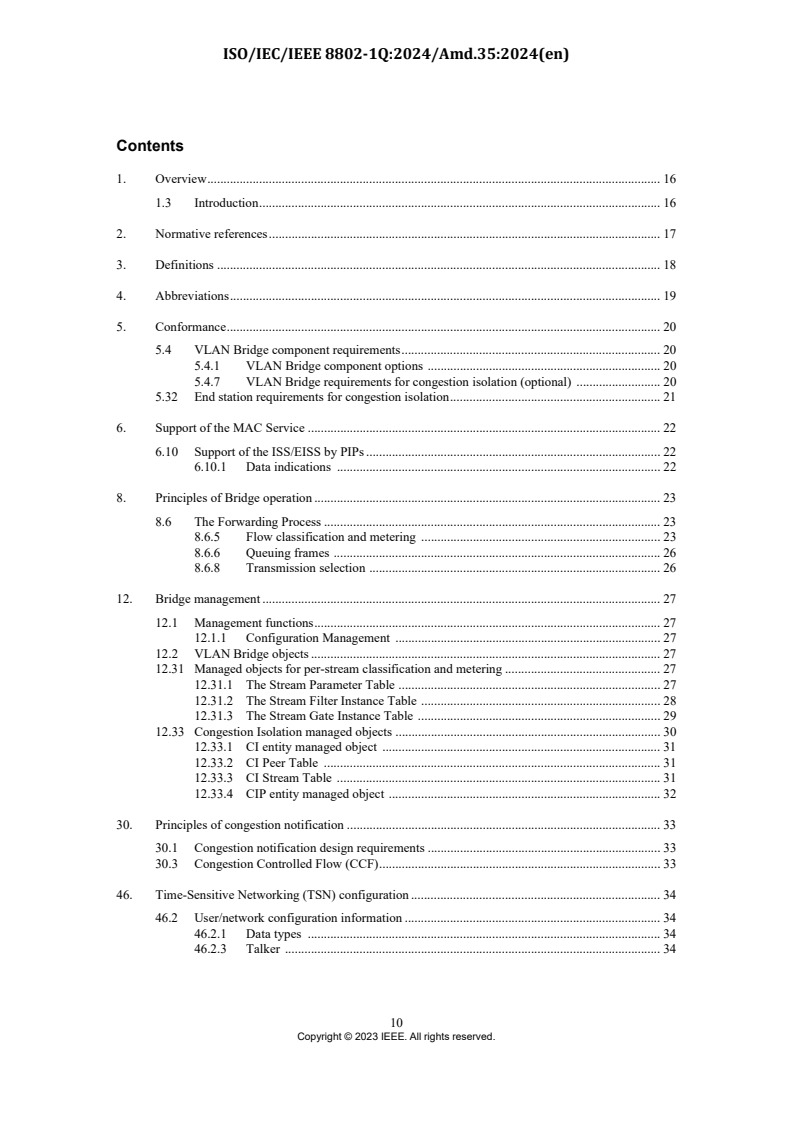
Contents
1. Overview. 16
1.3 Introduction. 16
2. Normative references. 17
3. Definitions . 18
4. Abbreviations. 19
5. Conformance. 20
5.4 VLAN Bridge component requirements. 20
5.4.1 VLAN Bridge component options . 20
5.4.7 VLAN Bridge requirements for congestion isolation (optional) . 20
5.32 End station requirements for congestion isolation. 21
6. Support of the MAC Service . 22
6.10 Support of the ISS/EISS by PIPs . 22
6.10.1 Data indications . 22
8. Principles of Bridge operation . 23
8.6 The Forwarding Process . 23
8.6.5 Flow classification and metering . 23
8.6.6 Queuing frames . 26
8.6.8 Transmission selection . 26
12. Bridge management . 27
12.1 Management functions. 27
12.1.1 Configuration Management . 27
12.2 VLAN Bridge objects . 27
12.31 Managed objects for per-stream classification and metering . 27
12.31.1 The Stream Parameter Table . 27
12.31.2 The Stream Filter Instance Table . 28
12.31.3 The Stream Gate Instance Table . 29
12.33 Congestion Isolation managed objects . 30
12.33.1 CI entity managed object . 31
12.33.2 CI Peer Table . 31
12.33.3 CI Stream Table . 31
12.33.4 CIP entity managed object . 32
30. Principles of congestion notification . 33
30.1 Congestion notification design requirements . 33
30.3 Congestion Controlled Flow (CCF). 33
46. Time-Sensitive Networking (TSN) configuration . 34
46.2 User/network configuration information . 34
46.2.1 Data types . 34
46.2.3 Talker . 34
ISO/IEC/IEEE 8802-1Q:2024/Amd.35:2024(en)
48. YANG Data Models . 35
48.2 IEEE 802.1Q YANG models. 35
48.2.8 Congestion Isolation (CI) model . 35
48.3 Structure of the YANG models . 36
48.3.7 Asynchronous Traffic Shaping (ATS) model . 36
48.3.8 Congestion Isolation (CI) model . 37
48.4 Security considerations . 38
48.4.8 Security considerations of the Congestion Isolation model . 38
48.5 YANG schema tree definitions. 39
48.5.11 Schema for the ieee802-dot1q-stream-filters-gates YANG module . 39
48.5.12 Schema for the ieee802-dot1q-stream-filters-gates-bridge YANG module . 39
48.5.13 Schema for the ieee802-dot1q-ats YANG module . 40
48.5.14 Schema for the ieee802-dot1q-ats-bridge YANG module . 40
48.5.15 Schema for the ieee802-dot1q-congestion-isolation YANG module . 41
48.5.16 Schema for the ieee802-dot1q-congestion-isolation-bridge YANG module . 42
48.6 YANG modules . 43
48.6.2 The ieee802-dot1q-types YANG module . 43
48.6.11 The ieee802-dot1q-stream-filters-gates YANG module . 58
48.6.12 The ieee802-dot1q-stream-filters-gates-bridge YANG module . 64
48.6.13 The ieee802-dot1q-ats YANG module . 65
48.6.14 The ieee802-dot1q-ats-bridge YANG module . 70
48.6.15 The ieee802-dot1q-congestion-isolation YANG module . 72
48.6.16 The ieee802-dot1q-congestion-isolation-bridge YANG module . 80
49. Congestion Isolation . 82
49.1 Congestion isolation objectives .83
49.2 Principles of congestion isolation .84
49.2.1 Congesting flow identification . 85
49.2.2 IEEE Std 802.1CB stream identification . 85
49.2.3 Flow priority modification . 85
49.2.4 Priority-based Flow Control interaction . 85
49.2.5 Congestion isolation signaling . 86
49.2.6 Congesting to non-congesting status change . 86
49.2.7 System topology and port orientation . 87
49.2.8 Comparison to Congestion Notification . 87
49.3 The Congestion Isolation Aware Forwarding Process . 88
49.3.1 CIP Congestion Detection . 89
49.3.2 CIP transmission gates . 89
49.3.3 CIM Demultiplexer . 89
49.3.4 Congesting flow identification . 89
49.3.5 CIM Multiplexer . 89
49.3.6 CI Peer Table . 90
49.3.7 CI Stream Table . 90
49.4 Congestion Isolation Protocol. 90
49.4.1 Variables controlling operation .90
49.4.2 CIP procedures . 94
49.4.3 Encoding of the CIM PDU . 101
49.4.4 LLDP Congestion Isolation TLV . 104
49.5 Topology Recognition . 105
49.5.1 TR theory of operation . 105
49.5.2 TR variables controlling operation . 106
49.5.3 TR procedures . 106
ISO/IEC/IEEE 8802-1Q:2024/Amd.35:2024(en)
Annex A (normative) PICS proforma—Bridge implementations . 108
A.5 Major capabilities . 108
A.7 Relay and filtering of frames . 108
A.14 Bridge management . 109
A.47 YANG. 110
A.53 Congestion Isolation . 111
Annex B (normative) PICS proforma—End station implementations . 112
B.5 Major capabilities . 112
B.19 Congestion Isolation . 112
Annex D (normative) IEEE 802.1 Organizationally Specific TLVs . 113
D.1 Requirements of the IEEE 802.1 Organizationally Specific TLV sets. 113
D.2 Organizationally Specific TLV definitions. 113
D.2.15 Congestion Isolation TLV . 113
D.2.16 Topology Recognition TLV . 115
D.3 IEEE 802.1 Organizationally Specific TLV management. 116
D.3.2 IEEE 802.1 managed objects—TLV variables . 116
D.4 PICS proforma for IEEE 802.1 Organizationally Specific TLV extensions . 117
D.4.3 Major capabilities and options . 117
D.5 IEEE 802.1/LLDP extension MIB. 118
D.5.2 Structure of the IEEE 802.1/LLDP extension MIB . 118
D.5.4 Security considerations for IEEE 802.1 LLDP extension MIB module . 119
D.5.5 IEEE 802.1 LLDP extension MIB module—version 2 . 121
D.6 IEEE 802.1/LLDP extension YANG. 193
D.6.1 YANG framework . 193
D.6.2 IEEE 802.1 Organizationally Specific TLV YANG data models . 193
D.6.3 Structure of the IEEE 802.1/LLDP extension YANG models . 198
D.6.4 Security considerations . 199
D.6.5 Definition of the IEEE 802.1/LLDP extension YANG modules . 200
D.6.6 IEEE 802.1/LLDP extension YANG modules . 204
Annex W (informative) Maintaining frame order with Congestion Isolation . 225
W.1 Queue markers for order preservation . 227
W.2 Congestion Isolation queuing and Priority-based Flow Control . 229
Annex X (informative) Bibliography . 232
ISO/IEC/IEEE 8802-1Q:2024/Amd.35:2024(en)
Figures
Figure 8-13 Flow classification and metering . 23
Figure 8-15a Per-stream classification and assignment for CI. 24
Figure 48-17 Congestion Isolation model . 35
Figure 49-1 Congestion Isolation example operation. 82
Figure 49-2 Congestion Isolation reference diagram . 88
Figure 49-3 Layer-2 CIM encapsulation . 102
Figure 49-4 IPv4 layer-3 CIM encapsulation . 102
Figure 49-5 IPv6 layer-3 CIM encapsulation . 103
Figure 49-6 CIM PDU. 103
Figure D-15 Congestion Isolation TLV format. 113
Figure D-16 Topology Recognition TLV Format . 115
Figure D-17 YANG hierarchy with IEEE 802.1Q Extension TLV YANG. 193
Figure D-18 basicSet TLV model . 194
Figure D-19 cnSet TLV model. 195
Figure D-20 dcbxSet TLV model. 196
Figure D-21 evbSet TLV model. 197
Figure D-22 ciSet TLV model. 197
Figure D-23 trSet TLV model . 198
Figure W-1 Isolation out-of-order frame example . 225
Figure W-2 De-isolation out-of-order frame example . 226
Figure W-3 Using queue markers and counters to preserve order when isolating. 227
Figure W-4 Using queue markers and counters to preserve order when de-isolating . 228
Figure W-5 Example Bridge buffering supporting PFC and CI . 229
Figure W-6 Example CI initiation by downstream peer . 230
Figure W-7 Example CI in process . 230
Figure W-8 Example PFC request for congesting queue . 231
Figure W-9 Example PFC request to avoid packet loss with CI enabled . 231
ISO/IEC/IEEE 8802-1Q:2024/Amd.35:2024(en)
Tables
Table 12-34 The Stream Parameter Table. 27
Table 12-35 Stream Filter Instance Table . 28
Table 12-36 The Stream Gate Instance Table. 29
Table 12-42 CI entity managed object . 31
Table 12-43 CI Peer Table entry . 31
Table 12-45 CIP entity managed object. 32
Table 12-44 CI Stream Table entry. 32
Table 48-1 Summary of the YANG modules. 36
Table 48-7 Stream filters and stream gates model YANG modules . 36
Table 48-9 CI model YANG modules . 37
Table 48-8 ATS model YANG modules. 37
Table 49-1 Congestion Isolation Message EtherType . 102
Table D-1 IEEE 802.1 Organizationally Specific TLVs . 113
Table D-13a Device Type field values . 115
Table D-13b Port Orientation field values . 116
Table D-14 IEEE 802.1 extension MIB object group conformance requirements . 118
Table D-15 IEEE 802.1/LLDP extension MIB object cross reference. 118
Table D-16 Summary of the YANG modules. 198
ISO/IEC/IEEE 8802-1Q:2024/Amd.35:2024(en)
IEEE Standard for
Local and Metropolitan Area Networks—
Bridges and Bridged Networks
Amendment 35:
Congestion Isolation
(This amendment is based on IEEE Std 802.1Q™-2022.)
NOTE—The editing instructions contained in this amendment define how to merge the material contained therein into
the existing base standard and its amendments to form the comprehensive standard.
The editing instructions are shown in bold italics. Four editing instructions are used: change, delete, insert, and replace.
Change is used to make corrections in existing text or tables. The editing instruction specifies the location of the change
and describes what is being changed by using strikethrough (to remove old material) and underscore (to add new
material). Delete removes existing material. Insert adds new material without disturbing the existing material. Deletions
and insertions may require renumbering. If so, renumbering instructions are given in the editing instruction. Replace is
used to make changes in figures or equations by removing the existing figure or equation and replacing it with a new
one. Editing instructions, change markings, and this note will not be carried over into future editions because the
changes will be incorporated into the base standard.
Notes in text, tables, and figures are given for information only and do not contain requirements needed to implement the standard.
ISO/IEC/IEEE 8802-1Q:2024/Amd.35:2024(en)
IEEE Std 802.1Qcz-2023
IEEE Standard for Local and Metropolitan Area Networks—Bridges and Bridged Networks
Amendment 35: Congestion Isolation
1. Overview
1.3 Introduction
Insert new text at the end of 1.3 as follows:
This standard specifies protocols, procedures, and managed objects that support the isolation of congesting
data flows within data center environments. This is achieved by enabling systems to individually identify
flows creating congestion, isolate those flows to the congesting queue, and signal to neighbors. This
mechanism reduces head-of-line blocking for non-congesting flows sharing the same traffic class.
Congestion Isolation is used with higher layer protocols that utilize end-to-end congestion control in order to
reduce packet loss and latency. To this end, it:
ct) Defines a means for VLAN-aware Bridges that support congestion isolation to identify flows that
are creating congestion.
cu) Defines a means for adjusting transmission selection for frames of congesting flows.
cv) Provides a means for discovering peer VLAN-aware Bridges and stations that support congestion
isolation.
cw) Defines a means for signaling congestion isolation to supporting peer Bridges and stations.
cx) Defines a means for recognizing a system’s level and port orientation within the topology relative to
the edge.
ISO/IEC/IEEE 8802-1Q:2024/Amd.35:2024(en)
IEEE Std 802.1Qcz-2023
IEEE Standard for Local and Metropolitan Area Networks—Bridges and Bridged Networks
Amendment 35: Congestion Isolation
2. Normative references
Insert the following references into Clause 2 in alphanumeric order:
IEEE Std 802.1CS™, IEEE Standard for Local and Metropolitan Area Networks—Link-local Registration
7, 8
Protocol.
IETF RFC 768 (STD0006), User Datagram Protocol, August 1980.
IETF RFC 791 (STD0005), Internet Protocol—DARPA Internet Program Protocol Specification, September
1981.
IETF RFC 3168, The Addition of Explicit Congestion Notification (ECN) to IP, September 2001.
IETF RFC 3232, Assigned Numbers: RFC 1700 is Replaced by an On-line Database, January 2002.
IETF RFC 6335, Internet Assigned Numbers Authority (IANA) Procedures for the Management of the
Service Name and Transport Protocol Port Number Registry, August 2011.
IETF RFC 8200 (STD0086), Internet Protocol, Version 6 (IPv6) Specification, July 2017.
The IEEE standards or products referred to in Clause 2 are trademarks owned by The Institute of Electrical and Electronics Engineers,
Incorporated.
IEEE publications are available from The Institute of Electrical and Electronics Engineers (https://standards.ieee.org/).
IETF RFCs are available from the Internet Engineering Task Force (https://www.ietf.org/).
ISO/IEC/IEEE 8802-1Q:2024/Amd.35:2024(en)
IEEE Std 802.1Qcz-2023
IEEE Standard for Local and Metropolitan Area Networks—Bridges and Bridged Networks
Amendment 35: Congestion Isolation
3. Definitions
Insert the following definitions in the appropriate collating sequence, renumbering accordingly:
3.1 congesting flow: A sequence of frames the end-to-end congestion controlled higher layer protocol treats
as belonging to a single flow that is experiencing congestion within a congestion isolation aware system.
3.2 congestion isolation aware system: A Bridge component conforming to the congestion isolation
provisions of this standard.
3.3 Congestion Isolation Message (CIM): A message transmitted by a congestion isolation aware system,
conveying congesting flow information used by the upstream peer congestion isolation aware system.
3.4 Congestion Isolation Point (CIP): A Virtual Local Area Network (VLAN) Bridge or end station Port
function that monitors a set of queues for congesting flows, isolates congesting flows to a congesting queue,
and can generate Congestion Isolation Messages.
ISO/IEC/IEEE 8802-1Q:2024/Amd.35:2024(en)
IEEE Std 802.1Qcz-2023
IEEE Standard for Local and Metropolitan Area Networks—Bridges and Bridged Networks
Amendment 35: Congestion Isolation
4. Abbreviations
Insert the following abbreviations into Clause 4, in the appropriate collating sequence:
CI Congestion Isolation
CIM Congestion Isolation Message
CIP Congestion Isolation Point
ISO/IEC/IEEE 8802-1Q:2024/Amd.35:2024(en)
IEEE Std 802.1Qcz-2023
IEEE Standard for Local and Metropolitan Area Networks—Bridges and Bridged Networks
Amendment 35: Congestion Isolation
5. Conformance
5.4 VLAN Bridge component requirements
5.4.1 VLAN Bridge component options
Insert new list item ag) at the end of the lettered list in 5.4.1 as follows:
ag) Support for Congestion Isolation (CI) operation (5.4.7).
5.4.1.6 ETS Bridge requirements
Insert new list item a) at the beginning of the lettered list in 5.4.1.6 as follows, renumbering all
subsequent items:
a) Support the ETS algorithm (8.6.8.3).
Insert 5.4.7 after 5.4.6 as follows:
5.4.7 VLAN Bridge requirements for congestion isolation (optional)
A VLAN-aware Bridge implementation that conforms to the provisions of this standard for congestion
isolation in Clause 49 shall:
a) Support, on one or more Ports, the creation of at least one Congestion Isolation Point (49.3.1).
b) Support Explicit Congestion Notification (ECN) as defined by IETF RFC 3168 and associated
updates along with Active Queue Management (AQM) as described in 49.2.1.
c) Support per-stream classification and metering for CI as specified in 8.6.5.2.3.
d) Support, at each Congestion Isolation Point, the variables and procedures of the Congestion
Isolation Protocol (49.4).
e) Support the ability to configure the variables controlling the operation of Congestion Isolation
(12.33.1), the CI Peer Table (12.33.2), the CI Stream Table (12.33.3), and each CIP (12.33.4).
f) Conform to the required capabilities of IEEE Std 802.1AB.
g) Support the use of the Congestion Isolation TLV in LLDP (D.2.15).
A VLAN Bridge implementation that conforms to the provisions of this standard for congestion isolation
may:
h) Support the monitoring of more than one queue on a Bridge Port (49.4.1.2.5).
i) Support transmission selection algorithms other than strict priority.
j) Support the de-isolation of congesting flows by means other than the empty status of a congesting
queue (49.2.6).
k) Support the Congestion Isolation YANG model (48.3.8).
l) Support Topology Recognition (49.5).
ISO/IEC/IEEE 8802-1Q:2024/Amd.35:2024(en)
IEEE Std 802.1Qcz-2023
IEEE Standard for Local and Metropolitan Area Networks—Bridges and Bridged Networks
Amendment 35: Congestion Isolation
Insert 5.32 after 5.31 as follows:
5.32 End station requirements for congestion isolation
An end station implementation that conforms to the provisions of this standard for congestion isolation in
Clause 49 shall:
a) Support Explicit Congestion Notification (ECN) as defined by IETF RFC 3168 and associated
updates along with Active Queue Management (AQM) as described in 49.2.1.
b) Support, at each Congestion Isolation Point, the variables and procedures of the Congestion
Isolation Protocol (49.4).
c) Conform to the required capabilities of IEEE Std 802.1AB.
d) Support the use of the Congestion Isolation TLV in LLDP (D.2.15).
An end station implementation that conforms to the provisions of this standard for congestion isolation in
Clause 49 may:
e) Support transmission selection algorithms other than strict priority.
f) Support the de-isolation of congesting flows by means other than the empty status of a congesting
queue (49.2.6).
g) Support the Congestion Isolation YANG model (48.3.8).
h) Support non-relay end station or server functionality of Topology Recognition (49.5).
ISO/IEC/IEEE 8802-1Q:2024/Amd.35:2024(en)
IEEE Std 802.1Qcz-2023
IEEE Standard for Local and Metropolitan Area Networks—Bridges and Bridged Networks
Amendment 35: Congestion Isolation
6. Support of the MAC Service
6.10 Support of the ISS/EISS by PIPs
6.10.1 Data indications
Change the first paragraph of 6.10.1 as follows:
On receipt of an M_UNITDATA.indication primitive from the PIP-ISS, if the PIP is congestion aware
(5.4.1.4) and the initial octets of the mac_service_data_unit contain a valid CNM encapsulation, the received
frame is processed according to 32.16. If the PIP is congestion isolation aware (5.4.7) and the initial octets of
the mac_service_data_unit contain a valid CIM encapsulation (49.4.3), the received frame is processed
according to 49.4.2.6. Otherwise, the received frame shall be discarded if:
ISO/IEC/IEEE 8802-1Q:2024/Amd.35:2024(en)
IEEE Std 802.1Qcz-2023
IEEE Standard for Local and Metropolitan Area Networks—Bridges and Bridged Networks
Amendment 35: Congestion Isolation
8. Principles of Bridge operation
8.6 The Forwarding Process
8.6.5 Flow classification and metering
Change the text in 8.6.5 as follows:
The Forwarding Process can apply flow classification and metering to frames that are received on a Bridge
Port and have one or more potential transmission ports. Bridge Ports and end stations may support
Per-Stream Filtering and Policing (PSFP), Asynchronous Traffic Shaping (ATS) filtering and eligibility time
assignment, Congestion Isolation (CI), or the general flow classification rules specified in 8.6.5.1.
NOTE—The general flow classification and metering specification was added to this standard by IEEE Std
802.1Q-2005, PSFP by IEEE Std 802.1Qci-2017, and ATS by IEEE Std 802.1Qcr-2020, and CI by IEEE Std
802.1Qcz-2023.
PSFP and ATS, ATS, and CI share common per-stream classification and metering elements, as shown in
Figure 8-13. The Stream identification function specified in IEEE Std 802.1CB can be used to associate
received frames with these elements.
Change Figure 8-13 as follows:
Figure 8-13—Flow classification and metering
Egress filtering (8.6.4)
Flow classification and metering (8.6.5)
General flow Per-stream classification and metering (8.6.5.2)
(Per-Stream Filtering and Policing, PSFP)
classification and metering
(ATS Filtering and Eligibility Time Assignment)
(8.6.5.1)
(Congestion Isolation)
Stream filtering (8.6.5.3)
(PSFP, ATS, CI)
Maximum SDU Size Filtering (8.6.5.3.1)
(PSFP, ATS)
Stream Gating (8.6.5.4)
(PSFP, ATS, CI)
Flow metering (8.6.5.5)
(PSFP)
ATS Eligibility Time Assignment (8.6.5.6)
(ATS)
Queuing frames (8.6.6)
Figure 8-13—Flow classification and metering
ISO/IEC/IEEE 8802-1Q:2024/Amd.35:2024(en)
IEEE Std 802.1Qcz-2023
IEEE Standard for Local and Metropolitan Area Networks—Bridges and Bridged Networks
Amendment 35: Congestion Isolation
8.6.5.2 Per-stream classification and metering
Change the first sentence of 8.6.5.2 as follows:
When Per-Stream Filtering and Policing (PSFP) or Asynchronous Traffic Shaping (ATS), Asynchronous
Traffic Shaping (ATS), or Congestion Isolation (CI) is used, filtering and policing decisions for received
frames are made, and subsequent queuing (8.6.6) and transmission selection decisions (8.6.8) supported, as
follows:
Insert 8.6.5.2.3 after 8.6.5.2.2 as follows:
8.6.5.2.3 CI Support
Each Bridge component or an end station that implements Congestion Isolation supports stream
identification and stream gates to allow traffic class modification, with the following:
a) A single Stream Filter Instance Table (8.6.5.3).
b) A single Stream Gate Instance Table (8.6.5.4).
The relationship between stream filters and stream gates for streams subject to CI processing (as identified
by the stream filter) is illustrated by Figure 8-15a for a number of streams.
Figure 8-15a—Per-stream classification and assignment for CI
Monitored Congesting
Egress filtering (8.6.4)
Stream Filter 1 Stream Filter 2
stream_handle 13 stream_handle Null
priority 4 priority 3
Stream Gate ID 1 Stream Gate ID 2
Counters Counters
Stream Gate 1 Stream Gate 2
gate state=open gate state=open
IPV=3 IPV=4
Queuing frames (8.6.6)
Monitored Congesting
KEY
Stream ID: stream filter instance identifier (8.6.5.3)
Gate ID: stream gate instance identifier (8.6.5.3, 8.6.5.4)
Figure 8-15a—Per-stream classification and assignment for CI
Congestion isolation uses two stream filter instances from the stream filter instance table (8.6.5.3) to select
stream gate instances that will modify the priority of flows. One stream filter instance is used to modify the
priority of congesting flows from the monitored queue to the congesting queue. The other stream filter
instance is used to modify the priority of congesting flows from the congesting queue back to the monitored
queue. There are no filter specifications used by congestion isolation.
ISO/IEC/IEEE 8802-1Q:2024/Amd.35:2024(en)
IEEE Std 802.1Qcz-2023
IEEE Standard for Local and Metropolitan Area Networks—Bridges and Bridged Networks
Amendment 35: Congestion Isolation
The stream_handle and priority parameters associated with a received frame select the stream filter instance
of congestion isolation for a particular monitored traffic class. The purpose of the stream filter is to select the
stream gate instance that will modify the priority of congesting flow frames so they will traverse the
congesting queue. The absence of a stream_handle and the priority parameter associated with a received
frame select the stream gate instance that will modify the priority of received frames back to the priority of
the monitored queue.
NOTE—Changes to the frame’s priority are intended to persist (see 49.2.4 and 49.2.6) by modifying the Priority Code
Point (see 6.9.3) or other indicators used to select the traffic class, such as the Differentiated Services Code Point (see
IETF RFC 2474). As noted in 6.8.1, modification to a frame will require the FCS to be regenerated. Options for
regenerating the FCS are discussed in Annex O.
Congestion isolation uses two stream gate instances from the stream gate instance table (8.6.5.4) to modify
the priority of flows. The operational and an administrative stream gate state (8.6.10.4, 8.6.10.5, 12.31.3) is
set to Open for Congestion Isolation and the GateClosedDueToInvalidRxEnable and
GateClosedDueToOctetsExceededEnable parameters are set to FALSE. The internal priority value (IPV) is
used in place of the priority value associated with the frame to determine the frame’s traffic class, using the
Traffic Class Table as specified in 8.6.6. The stream gate control list feature is not used by Congestion
Isolation and is set to null.
8.6.5.3 Stream filtering
Change second paragraph and associated list in 8.6.5.3 as follows:
Each stream filter comprises the following:
a) An integer stream filter identifier.
b) A stream_handle specification, either:
1) A single value, as specified in IEEE Std 802.1CB.
2) A wildcard, that matches any stream_handle.
3) If congestion isolation is supported, a null-handle, that matches when no stream_handle is
provided.
c) A priority specification, either:
1) A single priority value.
2) A wildcard value that matches any priority value.
d) Maximum SDU size filtering (8.6.5.3.1) information, comprising:
1) An integer Maximum SDU size, in octets. A value of 0 disables maximum SDU size filtering
for this stream filter.
2) A boolean StreamBlockedDueToOversizeFrameEnable parameter.
3) A boolean StreamBlockedDueToOversizeFrame parameter.
e) An integer stream gate identifier (8.6.5.4).
f) An integer flow meter instance identifier (8.6.5.5).
If this parameter is absent, frames associated with the stream filter are not subject to flow metering.
g) An integer ATS sched
...