


ISO 6381:1981
(Main)Ethylene and propylene for industrial use — Determination of traces of carbon monoxide and carbon dioxide — Gas chromatographic method
Ethylene and propylene for industrial use — Determination of traces of carbon monoxide and carbon dioxide — Gas chromatographic method
Describes a method based on the separation of carbon monoxide, methane and corbon dioxide by gas chromatography through a Carbosieve B or Porapak N column, followed by passage through a column of hydrogenation catalyst which transforms the oxides of carbon to methane thus allowing the use of a flame ionization detector to make the final determination.
Éthylène et propylène à usage industriel — Dosage des traces de monoxyde et de dioxyde de carbone — Méthode par chromatographie en phase gazeuse
General Information
- Status
- Withdrawn
- Publication Date
- 30-Sep-1981
- Withdrawal Date
- 30-Sep-1981
- Technical Committee
- ISO/TC 47 - Chemistry
- Drafting Committee
- ISO/TC 47 - Chemistry
- Current Stage
- 9599 - Withdrawal of International Standard
- Start Date
- 27-May-2002
- Completion Date
- 12-Feb-2026
ISO 6381:1981 - Ethylene and propylene for industrial use -- Determination of traces of carbon monoxide and carbon dioxide -- Gas chromatographic method
ISO 6381:1981 - Éthylene et propylene a usage industriel -- Dosage des traces de monoxyde et de dioxyde de carbone -- Méthode par chromatographie en phase gazeuse
ISO 6381:1981 - Éthylene et propylene a usage industriel -- Dosage des traces de monoxyde et de dioxyde de carbone -- Méthode par chromatographie en phase gazeuse
Get Certified
Connect with accredited certification bodies for this standard

ECOCERT
Organic and sustainability certification.

Eurofins Food Testing Global
Global leader in food, environment, and pharmaceutical product testing.

Intertek Bangladesh
Intertek certification and testing services in Bangladesh.
Sponsored listings
Frequently Asked Questions
ISO 6381:1981 is a standard published by the International Organization for Standardization (ISO). Its full title is "Ethylene and propylene for industrial use — Determination of traces of carbon monoxide and carbon dioxide — Gas chromatographic method". This standard covers: Describes a method based on the separation of carbon monoxide, methane and corbon dioxide by gas chromatography through a Carbosieve B or Porapak N column, followed by passage through a column of hydrogenation catalyst which transforms the oxides of carbon to methane thus allowing the use of a flame ionization detector to make the final determination.
Describes a method based on the separation of carbon monoxide, methane and corbon dioxide by gas chromatography through a Carbosieve B or Porapak N column, followed by passage through a column of hydrogenation catalyst which transforms the oxides of carbon to methane thus allowing the use of a flame ionization detector to make the final determination.
ISO 6381:1981 is classified under the following ICS (International Classification for Standards) categories: 71.080.10 - Aliphatic hydrocarbons. The ICS classification helps identify the subject area and facilitates finding related standards.
ISO 6381:1981 is available in PDF format for immediate download after purchase. The document can be added to your cart and obtained through the secure checkout process. Digital delivery ensures instant access to the complete standard document.
Standards Content (Sample)
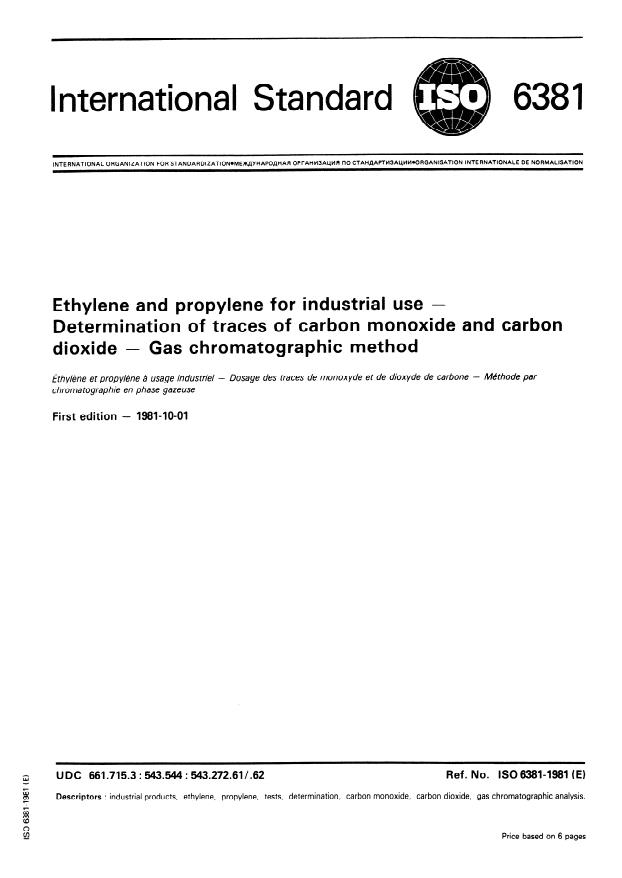
International Standard
INTERNATIONAL ORGANIZATION FOR STANDARDlZATlONWlE)I(L1YHAPO~HAR OPTAHM3ALWlR f-IO CTAH~APTM3AL(MWORGANlSATlON INTERNATIONALE DE NORMALISATION
Ethylene and propylene for industrial use -
Determination of traces of carbon monoxide and carbon
dioxide - Gas chromatographic method
&y/&e et prop yl&ne A usage industriel - Dosage des traces de monoxyde et de dioxyde de carbone - IWthode par
chroma tographie en phase gazeuse
First edition - 1981-10-01
UDC 661.715.3 : 543.544 : 543.272.6V.62
Ref. No. ISO6381-1981 (E)
Descriptors : industrial products, ethylene, propylene, tests,
determination, carbon monoxide, carbon dioxide, gas chromatographic analysis.
Price based on 6 pages
Foreword
IS0 (the International Organization for Standardization) is a worldwide federation of
national standards institutes (IS0 member bodies). The work of developing lnter-
national Standards is carried out through IS0 technical committees. Every member
body interested in a subject for which a technical committee has been set up has the
right to be represented on that committee. International organizations, governmental
and non-governmental, in liaison with ISO, also take part in the work.
Qraft International Standards adopted by the technical committees are circulated to
the member bodies for approval before their acceptance as International Standards by
the IS0 Council.
International Standard IS0 6381 was developed by Technical Committee lSO/TC 47,
Chemistry, and was circulated to the member bodies in October 1979.
It has been approved by the member bodies of the following countries :
Australia Germany, F. R. Philippines
Austria
Hungary Poland
Belgium India Portugal
China
Italy Romania
Czechoslovakia Korea, Rep. of
South Africa, Rep. of
France
Netherlands Switzerland
No member body expressed disapproval of the document.
International Organization for Standardization, 1981
Printed in Switzerland
IS0 6381-1981 (E)
INTERNATIONAL STANDARD
Ethylene and propylene for industrial use -
Determination of traces of carbon monoxide and carbon
dioxide - Gas chromatographic method
4.5 Chromosorb W AW 80400.1)
‘I Scope and field of application
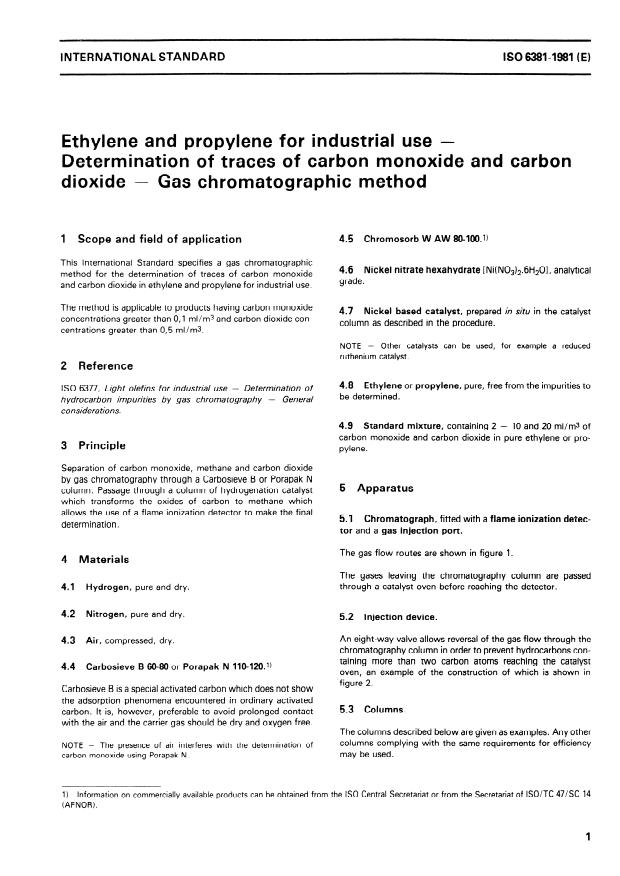
This International Standard specifies a gas chromatographic
4.6 Nickel nitrate hexahydrate [Ni( N03)2~6H~01, analytical
method for the determination of traces of carbon monoxide
grade.
and carbon dioxide in ethylene and propylene for industrial use.
The method is applicable to products having carbon monoxide
4.7 Nickel based catalyst, prepared in situ in the catalyst
concentrations greater than 0,l ml/m3 and carbon dioxide con-
column as described in the procedure.
centrations greater than 0,5 ml/m?
NOTE - Other catalysts can be used, for example a reduced
ruthenium catalyst.
2 Reference
4.8 Ethylene or propylene, pure, free from the impurities to
IS0 6377, light olefins for industrial use - Determination of
be determined.
hydrocarbon impurities by gas chromatography - General
considerations.
4.9 Standard mixture, containing 2 - 10 and 20 ml/m3 of
carbon monoxide and carbon dioxide in pure ethylene or pro-
3 Principle
pylene.
Separation of carbon monoxide, methane and carbon dioxide
by gas chromatography through a Carbosieve B or Porapak N
5 Apparatus
column. Passage through a column of hydrogenation catalyst
which transforms the oxides of carbon to methane which
allows the use of a flame ionization detector to make the final
5.1 Chromatograph, fitted with a flame ionization detec-
determination.
tor and a gas injection port.
The gas flow routes are shown in figure 1.
4 Materials
The gases leaving the chromatography column are passed
through a catalyst oven before reaching the detector.
4.1 Hydrogen, pure and dry.
4.2 Nitrogen, pure and dry.
5.2 Injection device.
An eight-way valve allows reversal of the gas flow through the
4.3 Air, compressed, dry.
chromatography column in order to prevent hydrocarbons con-
taining more than two carbon atoms reaching the catalyst
4.4 Carbosieve B 60-80 or Porapak N 110-120.~)
oven, an example of the construction of which is shown in
figure 2.
Carbosieve B is a special activated carbon which does not show
the adsorption phenomena encountered in ordinary activated
5.3 Columns.
carbon.
...
Norme internationale
INTERNATIONAL ORGANIZATION FOR STANDARDIZATlON.ME~YHAPO~HAR OPTAHM3AL&lR l-l0 CTAH~APTH3A~HM.ORGANISATlON INTERNATIONALE DE NORMALISATION
Éthylène et propylène à usage industriel - Dosage des
traces de monoxyde et de dioxyde de carbone - Méthode
par chromatographie en phase gazeuse
Ethylene and propylene for industrial use - Determination of traces of carbon monoxide and carbon dioxide - Gas
chroma tographic method
Première édition - 1981-10-01
Réf. no : ISO 63814981 (FI
CDU 661.715.3 : 543.544 : 543.272.61/ .62
Descripteurs : produit industriel, éthylène, propylène, essai, détermination, monoxyde de carbone, dicxyde de carbone, méthode
chromatographique en phase gazeuse.
Prix basé sur 6 pages
Avant-propos
L’ISO (Organisation internationale de normalisation) est une fédération mondiale
d’organismes nationaux de normalisation (comités membres de I’ISO). L’élaboration
des Normes internationales est confiée aux comités techniques de I’ISO. Chaque
comité membre intéresse par une étude a le droit de faire partie du comité technique
correspondant. Les organisations internationales, gouvernementales et non gouverne-
mentales, en liaison avec I’ISO, participent également aux travaux.
Les projets de Normes internationales adoptés par les comités techniques sont soumis
aux comités membres pour approbation, avant leur acceptation comme Normes inter-
nationales par le Conseil de I’ISO.
La Norme internationale ISO 6381 a été élaborée par le comité technique ISO/TC 47,
Chimie, et a été soumise aux comités membres en octobre 1979.
Les comités membres des pays suivants l’ont approuvée :
Afrique du Sud, Rép. d’ Corée, Rép. de
Philippines
Allemagne, R.F. France Pologne
Australie Hongrie Portugal
Inde
Au triche Roumanie
Belgique Italie Suisse
Pays- Bas
Chine Tchécoslovaquie
Aucun comité membre ne l’a désapprouvée.
Organisation internationale de normalisation, 1981
Imprimé en Suisse
Iso 6381-1981 (F)
NORME INTERNATIONALE
Éthylène et propylène à usage industriel - Dosage des
traces de monoxyde et de dioxyde de carbone - Méthode
par chromatographie en phase gazeuse
4.4 Carbosieve B, 60-80 ou Porapak N, 100-120.1)
1 Objet et domaine d’application
Le Carbosieve B est un charbon actif spécial ne présentant pas
La présente Norme internationale spécifie une méthode par
les phénomènes d’adsorption rencontrés avec les charbons
chromatographie en phase gazeuse pour le dosage des traces
actifs usuels. Cependant, il convient d’éviter des contacts pro-
de monoxyde et de dioxyde de carbone dans l’éthylène et le
longés avec l’air, et le gaz éluant doit être sec et exempt d’oxy-
propyléne à usage industriel.
gène.
La méthode est applicable aux produits dont la concentration
NOTE - Avec le Porapak N, le dosage du monoxyde de carbone est
en monoxyde de carbone est supérieure à 0,l ml/m3 et celle en
perturbé par la présence d’air.
dioxyde de carbone est supérieu-re à 0,5 ml/m?
4.5 Chromosorb W, AW 80-100.1)
2 Référence
4.6 Nitrate de nickel hexahydraté, [Ni (N0&.6H201, pour
analyse.
ISO 6377, OMfines légères à usage industriel - Dosage des
impuretés h ydrocarbonées par chroma tographie en phase
4.7 Catalyseur à base de nickel, le préparer directement
gazeuse - Considérations générales.
dans le tube de catalyse, comme indiqué au mode opératoire.
NOTE - D’autres catalyseurs peuvent être utilisés, par exemple, un
catalyseur au ruthénium réduit.
3 Principe
4.8 Éthylene ou propylène pur, ne contenant aucune des
Séparation du monoxyde de carbone, du méthane et du
impuretés à doser.
dioxyde de carbone par chromatographie en phase gazeuse sur
une colonne garnie de Carbosieve B ou de Porapak N. Passage
sur une colonne garnie d’un catalyseur d’hydrogénation qui
4.9 M&ange étalon, contenant 2 - 10 et 20 mVm3 de
transforme les oxydes de carbone en méthane, ce qui permet
monoxyde de carbone et de dioxyde de carbone dans l’éthylène
d’utiliser un d&ecteur à ionisation de flamme pour effectuer les
ou le propylène pur.
dosages finals.
5 Appareillage
4 Produits
5.1
Chromatographe, équipé d’un dbtecteur gi Ponkation
de flamme et d’une vanne d%chantillonnage des w.
4.1 Hydrogane, pur et sec.
Les circuits gazeux sont établis suivant la figure 1.
4.2 Azote, pur et sec.
À la sortie de la colonne de chromatographie, les gaz sont
envoyés dans un four de catalyse avant de gagner le détecteur.
4.3 Air comprimé, sec.
1) Des informations s
...
Norme internationale
INTERNATIONAL ORGANIZATION FOR STANDARDIZATlON.ME~YHAPO~HAR OPTAHM3AL&lR l-l0 CTAH~APTH3A~HM.ORGANISATlON INTERNATIONALE DE NORMALISATION
Éthylène et propylène à usage industriel - Dosage des
traces de monoxyde et de dioxyde de carbone - Méthode
par chromatographie en phase gazeuse
Ethylene and propylene for industrial use - Determination of traces of carbon monoxide and carbon dioxide - Gas
chroma tographic method
Première édition - 1981-10-01
Réf. no : ISO 63814981 (FI
CDU 661.715.3 : 543.544 : 543.272.61/ .62
Descripteurs : produit industriel, éthylène, propylène, essai, détermination, monoxyde de carbone, dicxyde de carbone, méthode
chromatographique en phase gazeuse.
Prix basé sur 6 pages
Avant-propos
L’ISO (Organisation internationale de normalisation) est une fédération mondiale
d’organismes nationaux de normalisation (comités membres de I’ISO). L’élaboration
des Normes internationales est confiée aux comités techniques de I’ISO. Chaque
comité membre intéresse par une étude a le droit de faire partie du comité technique
correspondant. Les organisations internationales, gouvernementales et non gouverne-
mentales, en liaison avec I’ISO, participent également aux travaux.
Les projets de Normes internationales adoptés par les comités techniques sont soumis
aux comités membres pour approbation, avant leur acceptation comme Normes inter-
nationales par le Conseil de I’ISO.
La Norme internationale ISO 6381 a été élaborée par le comité technique ISO/TC 47,
Chimie, et a été soumise aux comités membres en octobre 1979.
Les comités membres des pays suivants l’ont approuvée :
Afrique du Sud, Rép. d’ Corée, Rép. de
Philippines
Allemagne, R.F. France Pologne
Australie Hongrie Portugal
Inde
Au triche Roumanie
Belgique Italie Suisse
Pays- Bas
Chine Tchécoslovaquie
Aucun comité membre ne l’a désapprouvée.
Organisation internationale de normalisation, 1981
Imprimé en Suisse
Iso 6381-1981 (F)
NORME INTERNATIONALE
Éthylène et propylène à usage industriel - Dosage des
traces de monoxyde et de dioxyde de carbone - Méthode
par chromatographie en phase gazeuse
4.4 Carbosieve B, 60-80 ou Porapak N, 100-120.1)
1 Objet et domaine d’application
Le Carbosieve B est un charbon actif spécial ne présentant pas
La présente Norme internationale spécifie une méthode par
les phénomènes d’adsorption rencontrés avec les charbons
chromatographie en phase gazeuse pour le dosage des traces
actifs usuels. Cependant, il convient d’éviter des contacts pro-
de monoxyde et de dioxyde de carbone dans l’éthylène et le
longés avec l’air, et le gaz éluant doit être sec et exempt d’oxy-
propyléne à usage industriel.
gène.
La méthode est applicable aux produits dont la concentration
NOTE - Avec le Porapak N, le dosage du monoxyde de carbone est
en monoxyde de carbone est supérieure à 0,l ml/m3 et celle en
perturbé par la présence d’air.
dioxyde de carbone est supérieu-re à 0,5 ml/m?
4.5 Chromosorb W, AW 80-100.1)
2 Référence
4.6 Nitrate de nickel hexahydraté, [Ni (N0&.6H201, pour
analyse.
ISO 6377, OMfines légères à usage industriel - Dosage des
impuretés h ydrocarbonées par chroma tographie en phase
4.7 Catalyseur à base de nickel, le préparer directement
gazeuse - Considérations générales.
dans le tube de catalyse, comme indiqué au mode opératoire.
NOTE - D’autres catalyseurs peuvent être utilisés, par exemple, un
catalyseur au ruthénium réduit.
3 Principe
4.8 Éthylene ou propylène pur, ne contenant aucune des
Séparation du monoxyde de carbone, du méthane et du
impuretés à doser.
dioxyde de carbone par chromatographie en phase gazeuse sur
une colonne garnie de Carbosieve B ou de Porapak N. Passage
sur une colonne garnie d’un catalyseur d’hydrogénation qui
4.9 M&ange étalon, contenant 2 - 10 et 20 mVm3 de
transforme les oxydes de carbone en méthane, ce qui permet
monoxyde de carbone et de dioxyde de carbone dans l’éthylène
d’utiliser un d&ecteur à ionisation de flamme pour effectuer les
ou le propylène pur.
dosages finals.
5 Appareillage
4 Produits
5.1
Chromatographe, équipé d’un dbtecteur gi Ponkation
de flamme et d’une vanne d%chantillonnage des w.
4.1 Hydrogane, pur et sec.
Les circuits gazeux sont établis suivant la figure 1.
4.2 Azote, pur et sec.
À la sortie de la colonne de chromatographie, les gaz sont
envoyés dans un four de catalyse avant de gagner le détecteur.
4.3 Air comprimé, sec.
1) Des informations s
...
Questions, Comments and Discussion
Ask us and Technical Secretary will try to provide an answer. You can facilitate discussion about the standard in here.
Loading comments...