

ISO 37157:2018
(Main)Smart community infrastructures — Smart transportation for compact cities
General Information
- Abstract
ISO 37157:2018 describes criteria to help plan or organize smart transportation for compact cities. It is intended to apply to cities facing a decline in population. Smart transportation can be applied to the issue of population loss as a means of attracting people back to the city.
- Status
- Published
- Publication Date
- 03-Apr-2018
- Current Stage
- 9093 - International Standard confirmed
- Start Date
- 27-Oct-2023
- Completion Date
- 29-Aug-2026
Buy Documents


ISO 37157:2018 - Smart community infrastructures -- Smart transportation for compact cities

ISO 37157:2018 - Smart community infrastructures — Smart transportation for compact cities/4/2018
Overview
ISO 37157:2018 - Smart community infrastructures - Smart transportation for compact cities - provides criteria to plan and organize smart transportation systems aimed at regenerating depopulated urban centres. Published by ISO/TC 268 (Sustainable cities and communities), the standard targets cities facing population decline and describes how compact-city design combined with high‑quality transit can attract and retain residents.
Key topics and requirements
The standard sets practical, measurable guidance (not normative references) for designing transit that supports compact cities:
- Compact city definition: facilities and amenities accessible within approximately 1 km radius.
- Service frequency: transit services at least every 10 minutes during rush hour.
- Station/stop spacing: average distance between stops no more than 300 m (with local exemptions).
- Network shape: radial service networks linking target area to surrounding suburbs.
- Vehicle and service characteristics:
- Easy, accessible entry/exit for elderly, children and people with disabilities.
- Comfortable, low-noise/vibration rides; space for bicycles/large items where appropriate.
- Adequate acceleration for short-interval stop performance and dedicated lanes/tracks where possible.
- Environmental and operational performance:
- Promote low-emission vehicles (e.g., battery-powered buses), minimize vibration/noise, and optimize life-cycle performance.
- Energy-saving measures (regenerative braking, optimized schedules, efficient vehicle operation).
- Land use and reuse: support land reuse for urban facilities without adverse chemical/geological impact.
- Information & fare systems: provide clear passenger information (signage, real-time apps, arrival displays) and electronic-based payment integration.
- Maintenance & modification: guidance on maintaining service quality and adapting systems over time.
Applications
ISO 37157:2018 is practical for:
- Designing transit-led redevelopment plans for small downtowns and compact urban cores.
- Specifying service levels and vehicle attributes for local/regional transit agencies.
- Evaluating technology choices (LRT, buses, AGT) for compact-city contexts.
- Integrating mobility, land-use planning and sustainability goals to reverse urban decline.
Keywords: ISO 37157, smart transportation, compact city, compact cities, service frequency, station spacing, light rail transit, AGT, battery-powered buses, electronic payment, energy saving.
Who should use this standard
- City planners and urban designers developing compact-city strategies.
- Public transport authorities and operators assessing service design.
- Mobility planners, sustainable infrastructure consultants, and policy makers focused on urban regeneration.
- Technology providers and vendors proposing transit solutions for compact urban areas.
Related guidance
Developed by ISO/TC 268 SC1; sustainability aspects considered in line with ISO Guide 82. For project-level implementation, combine this standard with local planning codes and transport engineering guidance.
Relations
- Consolidated By
ISO 15027-2:2026 - Immersion suits — Part 2: Safety and performance requirements for abandonment suits - Effective Date
- 06-Jun-2022
Buy Documents
ISO 37157:2018 - Smart community infrastructures -- Smart transportation for compact cities
ISO 37157:2018 - Smart community infrastructures — Smart transportation for compact cities/4/2018
Get Certified
Connect with accredited certification bodies for this standard

BSI Group
BSI (British Standards Institution) is the business standards company that helps organizations make excellence a habit.

Bureau Veritas
Bureau Veritas is a world leader in laboratory testing, inspection and certification services.

DNV
DNV is an independent assurance and risk management provider.
Sponsored listings
Frequently Asked Questions
ISO 37157:2018 is a standard published by the International Organization for Standardization (ISO). Its full title is "Smart community infrastructures — Smart transportation for compact cities". This standard covers: ISO 37157:2018 describes criteria to help plan or organize smart transportation for compact cities. It is intended to apply to cities facing a decline in population. Smart transportation can be applied to the issue of population loss as a means of attracting people back to the city.
ISO 37157:2018 describes criteria to help plan or organize smart transportation for compact cities. It is intended to apply to cities facing a decline in population. Smart transportation can be applied to the issue of population loss as a means of attracting people back to the city.
ISO 37157:2018 is classified under the following ICS (International Classification for Standards) categories: 03.220.01 - Transport in general; 13.020.20 - Environmental economics. Sustainability. The ICS classification helps identify the subject area and facilitates finding related standards.
ISO 37157:2018 has the following relationships with other standards: It is inter standard links to ISO 15027-2:2026. Understanding these relationships helps ensure you are using the most current and applicable version of the standard.
ISO 37157:2018 is available in PDF format for immediate download after purchase. The document can be added to your cart and obtained through the secure checkout process. Digital delivery ensures instant access to the complete standard document.
Standards Content (Sample)
INTERNATIONAL ISO
STANDARD 37157
First edition
2018-04
Smart community infrastructures —
Smart transportation for compact cities
Infrastructures communautaires intelligentes — Transport intelligent
dans les villes compactes
Reference number
©
ISO 2018
© ISO 2018
All rights reserved. Unless otherwise specified, or required in the context of its implementation, no part of this publication may
be reproduced or utilized otherwise in any form or by any means, electronic or mechanical, including photocopying, or posting
on the internet or an intranet, without prior written permission. Permission can be requested from either ISO at the address
below or ISO’s member body in the country of the requester.
ISO copyright office
CP 401 • Ch. de Blandonnet 8
CH-1214 Vernier, Geneva
Phone: +41 22 749 01 11
Fax: +41 22 749 09 47
Email: copyright@iso.org
Website: www.iso.org
Published in Switzerland
ii © ISO 2018 – All rights reserved
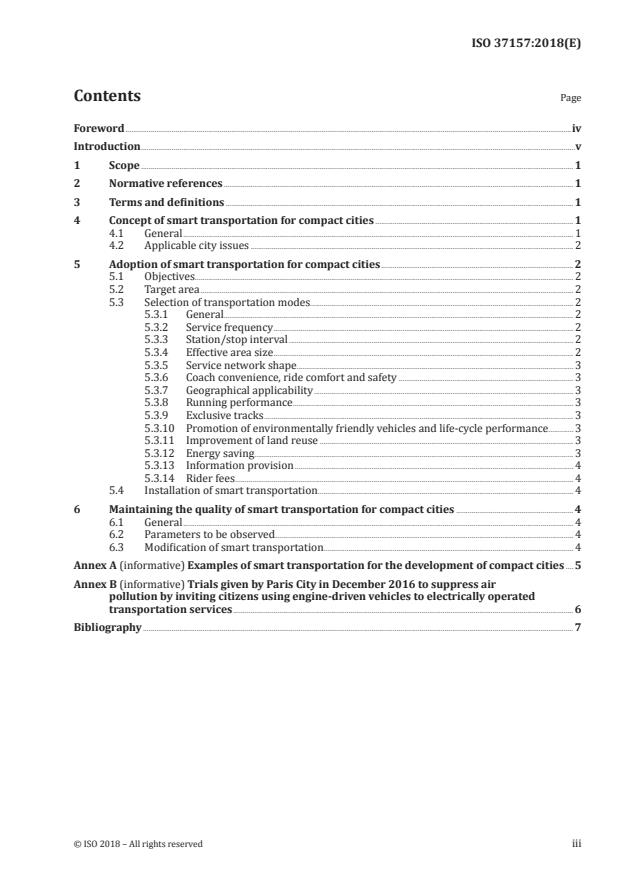
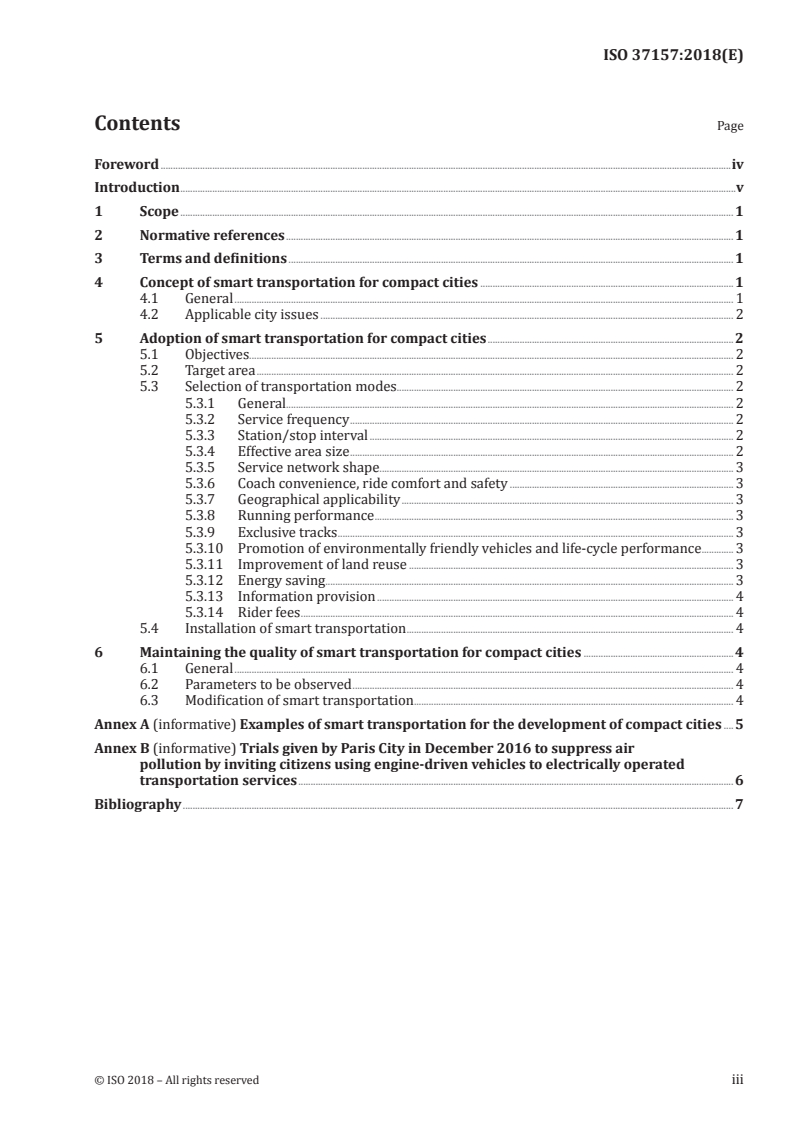
Contents Page
Foreword .iv
Introduction .v
1 Scope . 1
2 Normative references . 1
3 Terms and definitions . 1
4 Concept of smart transportation for compact cities . 1
4.1 General . 1
4.2 Applicable city issues . 2
5 Adoption of smart transportation for compact cities . 2
5.1 Objectives. 2
5.2 Target area . 2
5.3 Selection of transportation modes. 2
5.3.1 General. 2
5.3.2 Service frequency . 2
5.3.3 Station/stop interval . 2
5.3.4 Effective area size . 2
5.3.5 Service network shape. 3
5.3.6 Coach convenience, ride comfort and safety . 3
5.3.7 Geographical applicability . 3
5.3.8 Running performance . 3
5.3.9 Exclusive tracks . 3
5.3.10 Promotion of environmentally friendly vehicles and life-cycle performance . 3
5.3.11 Improvement of land reuse . 3
5.3.12 Energy saving . . . 3
5.3.13 Information provision . 4
5.3.14 Rider fees . 4
5.4 Installation of smart transportation . 4
6 Maintaining the quality of smart transportation for compact cities .4
6.1 General . 4
6.2 Parameters to be observed . 4
6.3 Modification of smart transportation. 4
Annex A (informative) Examples of smart transportation for the development of compact cities .5
Annex B (informative) Trials given by Paris City in December 2016 to suppress air
pollution by inviting citizens using engine-driven vehicles to electrically operated
transportation services . 6
Bibliography . 7
Foreword
ISO (the International Organization for Standardization) is a worldwide federation of national standards
bodies (ISO member bodies). The work of preparing International Standards is normally carried out
through ISO technical committees. Each member body interested in a subject for which a technical
committee has been established has the right to be represented on that committee. International
organizations, governmental and non-governmental, in liaison with ISO, also take part in the work.
ISO collaborates closely with the International Electrotechnical Commission (IEC) on all matters of
electrotechnical standardization.
The procedures used to develop this document and those intended for its further maintenance are
described in the ISO/IEC Directives, Part 1. In particular the different approval criteria needed for the
different types of ISO documents should be noted. This document was drafted in accordance with the
editorial rules of the ISO/IEC Directives, Part 2 (see www .iso .org/ directives).
Attention is drawn to the possibility that some of the elements of this document may be the subject of
patent rights. ISO shall not be held responsible for identifying any or all such patent rights. Details of
any patent rights identified during the development of the document will be in the Introduction and/or
on the ISO list of patent declarations received (see www .iso .org/ patents).
Any trade name used in this document is information given for the convenience of users and does not
constitute an endorsement.
For an explanation on the voluntary nature of standards, the meaning of ISO specific terms and
expressions related to conformity assessment, as well as information about ISO's adherence to the
World Trade Organization (WTO) principles in the Technical Barriers to Trade (TBT) see the following
URL: www .iso .org/ iso/ foreword .html.
This document was prepared by Technical Committee ISO/TC 268, Sustainable cities and communities,
Subcommittee SC 1, Smart community infrastructures
In the development of this document, ISO Guide 82 has been taken into account in addressing
sustainability issues.
iv © ISO 2018 – All rights reserved
Introduction
A compact city is an urban design concept that invites people back to a small area in a city where
the population has decreased or is decreasing. Modal shifts of passengers from public to private
transportation have resulted in people moving out of the city centre into the suburbs, since private
transportation enables movement without dependent time schedules and fixed routes. The problems
associated with public transportation are mainly related to station or stop intervals, service frequency,
approaches to stations/stops and service routes and networks. Furthermore, large-scale shopping
malls and hospitals are frequently constructed outside cities. Such a situation accelerates the outflow of
residents, resulting in the de-urbanization of city centres. Downtown, the public realm and community
safety fall into decline, causing more people to move out to the suburbs. This negative spiral continues,
changing the character of a city.
One way to pre-empt the deterioration of a city centre is through the creation of a compact city. The
concept behind compact cities is that facilities for citizens, such as shopping malls, offices and hospitals,
are placed in a small target areas. These facilities are connected to one another by short-interval, high-
frequency public transportation which can be easily accessed by citizens. Additionally, this type of
transportation reconnects citizens living in the suburbs to the urban centre, with service lines laid
radially in relation to the suburbs surrounding the area. This transportation network successfully
attracts people into a target area from its periphery and retains them therein. This is a solution to
the problem of declining city centres, utilizing smart transportation to resuscitate small downtown
areas. This document describes a way to organize smart transportation to create a compact city that
regenerates a declining urban centre and rejuvenates its economic, physical and social infrastructure.
INTERNATIONAL STANDARD ISO 37157:2018(E)
Smart community infrastructures — Smart transportation
for compact cities
1 Scope
This document describes criteria to help plan or organize smart transportation for compact cities. It
is intended to apply to cities facing a decline in population. Smart transportation can be applied to the
issue of population loss as a means of attracting people back to the city.
2 Normative references
There are no normative references in this document.
...
INTERNATIONAL ISO
STANDARD 37157
First edition
2018-04
Smart community infrastructures —
Smart transportation for compact cities
Infrastructures communautaires intelligentes — Transport intelligent
dans les villes compactes
Reference number
©
ISO 2018
© ISO 2018
All rights reserved. Unless otherwise specified, or required in the context of its implementation, no part of this publication may
be reproduced or utilized otherwise in any form or by any means, electronic or mechanical, including photocopying, or posting
on the internet or an intranet, without prior written permission. Permission can be requested from either ISO at the address
below or ISO’s member body in the country of the requester.
ISO copyright office
CP 401 • Ch. de Blandonnet 8
CH-1214 Vernier, Geneva
Phone: +41 22 749 01 11
Fax: +41 22 749 09 47
Email: copyright@iso.org
Website: www.iso.org
Published in Switzerland
ii © ISO 2018 – All rights reserved
Contents Page
Foreword .iv
Introduction .v
1 Scope . 1
2 Normative references . 1
3 Terms and definitions . 1
4 Concept of smart transportation for compact cities . 1
4.1 General . 1
4.2 Applicable city issues . 2
5 Adoption of smart transportation for compact cities . 2
5.1 Objectives. 2
5.2 Target area . 2
5.3 Selection of transportation modes. 2
5.3.1 General. 2
5.3.2 Service frequency . 2
5.3.3 Station/stop interval . 2
5.3.4 Effective area size . 2
5.3.5 Service network shape. 3
5.3.6 Coach convenience, ride comfort and safety . 3
5.3.7 Geographical applicability . 3
5.3.8 Running performance . 3
5.3.9 Exclusive tracks . 3
5.3.10 Promotion of environmentally friendly vehicles and life-cycle performance . 3
5.3.11 Improvement of land reuse . 3
5.3.12 Energy saving . . . 3
5.3.13 Information provision . 4
5.3.14 Rider fees . 4
5.4 Installation of smart transportation . 4
6 Maintaining the quality of smart transportation for compact cities .4
6.1 General . 4
6.2 Parameters to be observed . 4
6.3 Modification of smart transportation. 4
Annex A (informative) Examples of smart transportation for the development of compact cities .5
Annex B (informative) Trials given by Paris City in December 2016 to suppress air
pollution by inviting citizens using engine-driven vehicles to electrically operated
transportation services . 6
Bibliography . 7
Foreword
ISO (the International Organization for Standardization) is a worldwide federation of national standards
bodies (ISO member bodies). The work of preparing International Standards is normally carried out
through ISO technical committees. Each member body interested in a subject for which a technical
committee has been established has the right to be represented on that committee. International
organizations, governmental and non-governmental, in liaison with ISO, also take part in the work.
ISO collaborates closely with the International Electrotechnical Commission (IEC) on all matters of
electrotechnical standardization.
The procedures used to develop this document and those intended for its further maintenance are
described in the ISO/IEC Directives, Part 1. In particular the different approval criteria needed for the
different types of ISO documents should be noted. This document was drafted in accordance with the
editorial rules of the ISO/IEC Directives, Part 2 (see www .iso .org/ directives).
Attention is drawn to the possibility that some of the elements of this document may be the subject of
patent rights. ISO shall not be held responsible for identifying any or all such patent rights. Details of
any patent rights identified during the development of the document will be in the Introduction and/or
on the ISO list of patent declarations received (see www .iso .org/ patents).
Any trade name used in this document is information given for the convenience of users and does not
constitute an endorsement.
For an explanation on the voluntary nature of standards, the meaning of ISO specific terms and
expressions related to conformity assessment, as well as information about ISO's adherence to the
World Trade Organization (WTO) principles in the Technical Barriers to Trade (TBT) see the following
URL: www .iso .org/ iso/ foreword .html.
This document was prepared by Technical Committee ISO/TC 268, Sustainable cities and communities,
Subcommittee SC 1, Smart community infrastructures
In the development of this document, ISO Guide 82 has been taken into account in addressing
sustainability issues.
iv © ISO 2018 – All rights reserved
Introduction
A compact city is an urban design concept that invites people back to a small area in a city where
the population has decreased or is decreasing. Modal shifts of passengers from public to private
transportation have resulted in people moving out of the city centre into the suburbs, since private
transportation enables movement without dependent time schedules and fixed routes. The problems
associated with public transportation are mainly related to station or stop intervals, service frequency,
approaches to stations/stops and service routes and networks. Furthermore, large-scale shopping
malls and hospitals are frequently constructed outside cities. Such a situation accelerates the outflow of
residents, resulting in the de-urbanization of city centres. Downtown, the public realm and community
safety fall into decline, causing more people to move out to the suburbs. This negative spiral continues,
changing the character of a city.
One way to pre-empt the deterioration of a city centre is through the creation of a compact city. The
concept behind compact cities is that facilities for citizens, such as shopping malls, offices and hospitals,
are placed in a small target areas. These facilities are connected to one another by short-interval, high-
frequency public transportation which can be easily accessed by citizens. Additionally, this type of
transportation reconnects citizens living in the suburbs to the urban centre, with service lines laid
radially in relation to the suburbs surrounding the area. This transportation network successfully
attracts people into a target area from its periphery and retains them therein. This is a solution to
the problem of declining city centres, utilizing smart transportation to resuscitate small downtown
areas. This document describes a way to organize smart transportation to create a compact city that
regenerates a declining urban centre and rejuvenates its economic, physical and social infrastructure.
INTERNATIONAL STANDARD ISO 37157:2018(E)
Smart community infrastructures — Smart transportation
for compact cities
1 Scope
This document describes criteria to help plan or organize smart transportation for compact cities. It
is intended to apply to cities facing a decline in population. Smart transportation can be applied to the
issue of population loss as a means of attracting people back to the city.
2 Normative references
There are no normative references in this document.
...