

ISO 37165:2020
(Main)Smart community infrastructures — Guidance on smart transportation with the use of digitally processed payment (d-payment)
General Information
- Abstract
This document provides guidance on how to organize and implement smart transportation by digitally processed payment (d-payment) in order to provide a safe, convenient payment method for citizens and city visitors in transportation and its related or additional services. This will additionally benefit operators managing fee receipt in transportation services and money transfer or transactions between these business operators and banks or settlement organizations. Smart transportation by d-payment is not intended to eliminate cash payment from transportation services but is helpful in organizing inter-operator, city, regional and national common ticket networks and providing trading services independent of local currencies.
- Status
- Published
- Publication Date
- 23-Sep-2020
- Current Stage
- 9093 - International Standard confirmed
- Start Date
- 17-Dec-2025
- Completion Date
- 29-Aug-2026
Buy Documents



ISO 37165:2020 - Smart community infrastructures -- Guidance on smart transportation with the use of digitally processed payment (d-payment)

ISO 37165:2020 - Smart community infrastructures — Guidance on smart transportation with the use of digitally processed payment (d-payment)/24/2020
Overview
ISO 37165:2020 provides guidance for organizing and implementing smart transportation systems that use digitally processed payment (d-payment). The standard explains how d-payment and digital wallets can be applied across transportation services (local, regional and international) to deliver safe, convenient, traceable and efficient fare collection while not replacing cash outright. It emphasizes interoperability for inter-operator, city, regional and national ticketing networks and the potential for trading services independent of local currencies.
Key topics and technical requirements
- Concept and capability of d-payment: Defines digitally processed payment and the role of a d-payment wallet, highlighting non-centralized, end-to-end transactions and both online and offline modes.
- Security: Focus on wallet security and use of public-key cryptography, tamper-free and non-repudiable transactions, and measures to protect operators and customers.
- Operational models: Guidance on operation, management and quality maintenance of d-payment systems in transport environments.
- System components: Recommended trusted infrastructure elements, including:
- credible service management modules
- transaction communication modules
- terminal application modules
- registration centres and big data analysis centres
- Performance and monitoring: Parameters for quality maintenance and operational traceability to reduce fraud and improve settlement.
- Social and economic aims: Alignment with UN Sustainable Development Goals (e.g., sustainable cities, innovation, reduced inequalities).
Practical applications
ISO 37165 is intended to guide practical deployment of d-payment across:
- Public transit ticketing (buses, trams, ferries, metros)
- Inter-operator and multi-modal fare systems
- Airport, rail and cross-border transportation payment scenarios
- Ancillary services (parking, station retail, on-board purchases) Benefits include faster boarding, lower cash-handling costs, improved reconciliation and secure settlements between operators, banks and settlement organizations. D-payment particularly improves accessibility for users who struggle with cash (children, elderly, people with disabilities) and eases payment for international visitors.
Who should use this standard
- City planners and smart-city program managers
- Public transport operators and ticketing system vendors
- Payment system architects, fintech and wallet providers
- Banks, clearing/settlement organizations and regulators
- Procurement teams and technology integrators in mobility services
Related standards
ISO 37165 references applicability to transport services described in other ISO smart community standards (for example ISO 37154 and ISO 37157–37163 series). There are no normative references in ISO 37165:2020.
Keywords: ISO 37165, smart transportation, d-payment, digitally processed payment, digital wallet, payment security, public-key cryptography, transit ticketing, smart city.
Buy Documents
ISO 37165:2020 - Smart community infrastructures -- Guidance on smart transportation with the use of digitally processed payment (d-payment)
ISO 37165:2020 - Smart community infrastructures — Guidance on smart transportation with the use of digitally processed payment (d-payment)/24/2020
Get Certified
Connect with accredited certification bodies for this standard

BSI Group
BSI (British Standards Institution) is the business standards company that helps organizations make excellence a habit.

Bureau Veritas
Bureau Veritas is a world leader in laboratory testing, inspection and certification services.

DNV
DNV is an independent assurance and risk management provider.
Sponsored listings
Frequently Asked Questions
ISO 37165:2020 is a standard published by the International Organization for Standardization (ISO). Its full title is "Smart community infrastructures — Guidance on smart transportation with the use of digitally processed payment (d-payment)". This standard covers: This document provides guidance on how to organize and implement smart transportation by digitally processed payment (d-payment) in order to provide a safe, convenient payment method for citizens and city visitors in transportation and its related or additional services. This will additionally benefit operators managing fee receipt in transportation services and money transfer or transactions between these business operators and banks or settlement organizations. Smart transportation by d-payment is not intended to eliminate cash payment from transportation services but is helpful in organizing inter-operator, city, regional and national common ticket networks and providing trading services independent of local currencies.
This document provides guidance on how to organize and implement smart transportation by digitally processed payment (d-payment) in order to provide a safe, convenient payment method for citizens and city visitors in transportation and its related or additional services. This will additionally benefit operators managing fee receipt in transportation services and money transfer or transactions between these business operators and banks or settlement organizations. Smart transportation by d-payment is not intended to eliminate cash payment from transportation services but is helpful in organizing inter-operator, city, regional and national common ticket networks and providing trading services independent of local currencies.
ISO 37165:2020 is classified under the following ICS (International Classification for Standards) categories: 03.220.01 - Transport in general; 13.020.20 - Environmental economics. Sustainability. The ICS classification helps identify the subject area and facilitates finding related standards.
ISO 37165:2020 is available in PDF format for immediate download after purchase. The document can be added to your cart and obtained through the secure checkout process. Digital delivery ensures instant access to the complete standard document.
Standards Content (Sample)
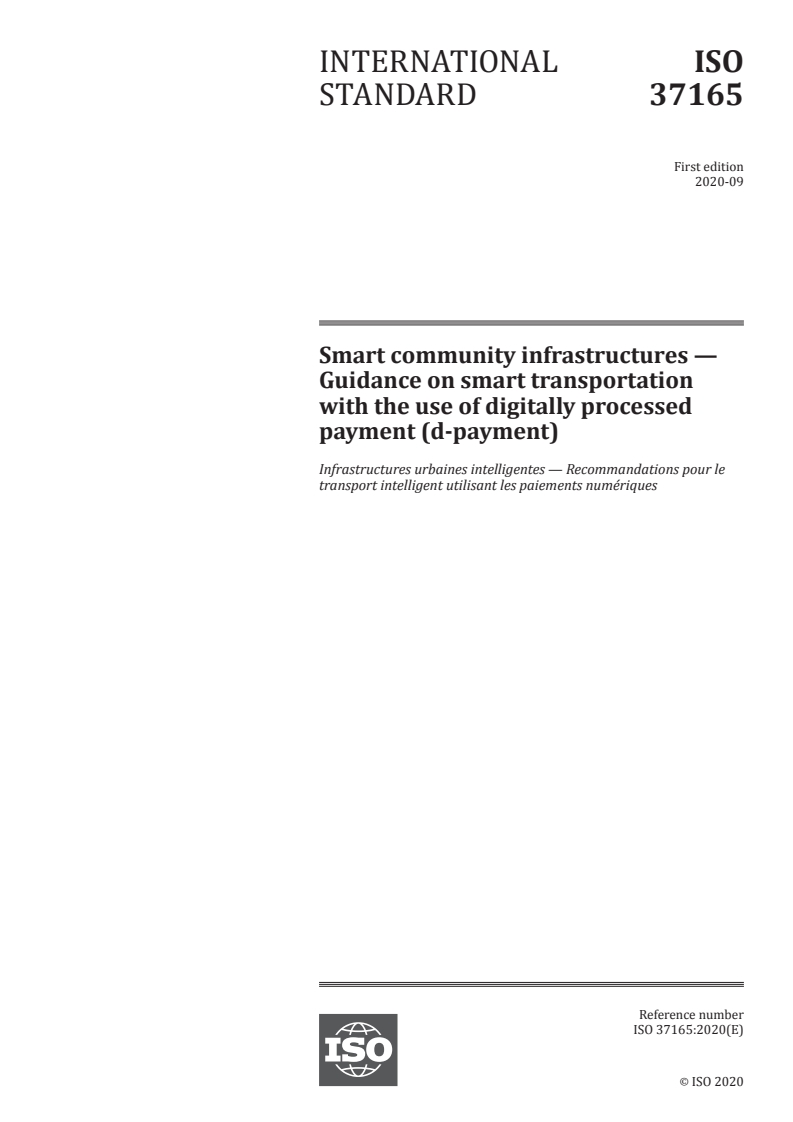
INTERNATIONAL ISO
STANDARD 37165
First edition
2020-09
Smart community infrastructures —
Guidance on smart transportation
with the use of digitally processed
payment (d-payment)
Infrastructures urbaines intelligentes — Recommandations pour le
transport intelligent utilisant les paiements numériques
Reference number
©
ISO 2020
© ISO 2020
All rights reserved. Unless otherwise specified, or required in the context of its implementation, no part of this publication may
be reproduced or utilized otherwise in any form or by any means, electronic or mechanical, including photocopying, or posting
on the internet or an intranet, without prior written permission. Permission can be requested from either ISO at the address
below or ISO’s member body in the country of the requester.
ISO copyright office
CP 401 • Ch. de Blandonnet 8
CH-1214 Vernier, Geneva
Phone: +41 22 749 01 11
Email: copyright@iso.org
Website: www.iso.org
Published in Switzerland
ii © ISO 2020 – All rights reserved
Contents Page
Foreword .iv
Introduction .v
1 Scope . 1
2 Normative references . 1
3 Terms and definitions . 1
4 Concept of smart transportation by d-payment. 1
4.1 General . 1
4.2 Capability of d-payment in transportation . 2
4.3 Satisfaction of SDGs . 2
5 Expectations for smart transportation by d-payment. 2
5.1 Background . 2
5.1.1 Local services . 2
5.1.2 International services . 2
5.1.3 Operators’ internal management . 3
5.2 Customers who prefer d-payment . 3
5.3 D-payment effective business fields . 3
5.4 D-payment effective situations . 3
6 Features of d-payment . 4
7 Security of smart transportation by d-payment . 4
7.1 General . 4
7.2 D-payment wallet security . 4
8 Operation of smart transportation by d-payment . 5
9 Management of smart transportation by d-payment . 5
9.1 General . 5
9.2 Security-trusted infrastructures for d-payment systems . 5
9.2.1 General. 5
9.2.2 Credible service management modules . 5
9.2.3 Big data analysis centres . 5
9.2.4 Registration centres . 6
9.2.5 Transaction communication modules . 6
9.2.6 Terminal application modules . 6
10 Quality maintenance of smart transportation by d-payment . 6
10.1 General . 6
10.2 Parameters to be observed . 6
Bibliography . 8
Foreword
ISO (the International Organization for Standardization) is a worldwide federation of national standards
bodies (ISO member bodies). The work of preparing International Standards is normally carried out
through ISO technical committees. Each member body interested in a subject for which a technical
committee has been established has the right to be represented on that committee. International
organizations, governmental and non-governmental, in liaison with ISO, also take part in the work.
ISO collaborates closely with the International Electrotechnical Commission (IEC) on all matters of
electrotechnical standardization.
The procedures used to develop this document and those intended for its further maintenance are
described in the ISO/IEC Directives, Part 1. In particular, the different approval criteria needed for the
different types of ISO documents should be noted. This document was drafted in accordance with the
editorial rules of the ISO/IEC Directives, Part 2 (see www .iso .org/ directives).
Attention is drawn to the possibility that some of the elements of this document may be the subject of
patent rights. ISO shall not be held responsible for identifying any or all such patent rights. Details of
any patent rights identified during the development of the document will be in the Introduction and/or
on the ISO list of patent declarations received (see www .iso .org/ patents).
Any trade name used in this document is information given for the convenience of users and does not
constitute an endorsement.
For an explanation of the voluntary nature of standards, the meaning of ISO specific terms and
expressions related to conformity assessment, as well as information about ISO's adherence to the
World Trade Organization (WTO) principles in the Technical Barriers to Trade (TBT), see www .iso .org/
iso/ foreword .html.
This document was prepared by Technical Committee ISO/TC 268, Sustainable cities and communities,
Subcommittee SC 1, Smart community infrastructures.
Any feedback or questions on this document should be directed to the user’s national standards body. A
complete listing of these bodies can be found at www .iso .org/ members .html.
iv © ISO 2020 – All rights reserved
Introduction
Each day a huge number of city residents and visitors use transportation services by paying fares for
every ride in and between cities. Fast ticket processing for these customers is required in order to avoid
congestion in ticket offices and at ticket vending machines. In some transportation services, operators
do not sell tickets but request that customers pay the exact fare as no change is given. Payment of
transportation fares is normally in local currencies, including hard currencies. International travellers
have to pay their travel costs in such currencies after having exchanged money in advance. Credit cards
are an option for payment but not all cards are accepted in some places, especially when paying small
amounts.
Thus, easy procedures for the payment of precise amounts are indispensable in city life and business
activities, including transportation rides. In transportation and its related or additional services,
customers have to pay many kinds of fees besides transportation fares. They want to pay in their
preferred ways, which can include a variety of options. Proper collection of fares or fees in an easy
way assists the business of transportation and leads to sustainable local services for citizens, since the
business is financially stabilized with reduced handling costs and the avoidance of fee receipt failure.
Digitally processed payment (d-payment) is a method of paying fees using a digital form of an existing
and circulated currency, which works like common coins and paper bills. The sums of fares or fees
collected in the services are extremely large, even though the amount paid by customers for each
transaction is small. Therefore, the payment system requires high security, not necessarily just for the
protection of customer payments but also to protect operators from, for example, theft by employees
who directly handle and manage cash.
This document describes the concept of d-payment in transportation and its related or additional
services, and its safe management and practical application thereof, which will be helpful to citizens
and city visitors using such services and beneficial to the service operators.
INTERNATIONAL STANDARD ISO 37165:2020(E)
Smart community infrastructures — Guidance on smart
transportation with the use of digitally processed payment
(d-payment)
1 Scope
This document provides guidance on how to organize and implement smart transportation by digitally
processed payment (d-payment) in order to provide a safe, convenient payment method for citizens
and city visitors in transportation and its related or additional services. This will additionally benefit
operators managing fee receipt in transportation services and money transfer or transactions between
these business operators and banks or settlement organizations.
Smart transportation by d-payment is not intended to eliminate cash payment from transportation
services but is helpful in organizing inter-operator, city, regional and national common ticket networks
and providing trading services independent of local currencies.
2 Normative references
There are no normative references in this document.
3 Terms and definitions
For the purposes of this document, the following terms and definitions apply.
ISO and IEC maintain terminological databases for use in standardization at the following addresses:
— ISO Online browsing platform: available at https:// www .iso .org/ obp
— IEC Electropedia: available at http:// www .electropedia .org/
3.1
smart transportation by d-payment
transportation and its related or additional services in which payment is digitally processed
3.2
digitally processed payment
d-payment
currency forms operated, managed and controlled in mathematical algorithms like actual currencies
having circulation and trading functions, which are cashable or exchangeable for hard currencies
through transactions using digital wallets
3.3
d-payment wallet
digital account managed by using public-key cryptography
4 Concept of smart transportation by d-payment
4.1 General
Cash payment in transportation causes difficulties for both customers and operators. Operators have to
be prepared to receive cash that is not easy to manage, since coins and paper bills are heavy and take up
space. Non-cash payment, typically with credit cards and pre-paid cards, is convenient for both. However,
even then customers have to hold these cards and not all card readers work with all types of card.
Thus, fast and simple payment procedures without cash or cards with limited applicability are needed,
especially when purchasing tickets at ticket offices and vending machines and when taking bus, tram
or ferry rides. In ticketing procedures, payment processes take time. Therefore, some operators
do not give change. Easy payment encourages citizens to take casual rides as people hesitate to use
transportation services over short distances when they don’t have the exact or small change. Pre-paid
cards were developed to provide customers with a means of non-cash payment, and the number of
passengers using these has increased. If payment can be digitally transacted independently of hard
currencies, including such cards, the result is pure non-cash
...
INTERNATIONAL ISO
STANDARD 37165
First edition
2020-09
Smart community infrastructures —
Guidance on smart transportation
with the use of digitally processed
payment (d-payment)
Infrastructures urbaines intelligentes — Recommandations pour le
transport intelligent utilisant les paiements numériques
Reference number
©
ISO 2020
© ISO 2020
All rights reserved. Unless otherwise specified, or required in the context of its implementation, no part of this publication may
be reproduced or utilized otherwise in any form or by any means, electronic or mechanical, including photocopying, or posting
on the internet or an intranet, without prior written permission. Permission can be requested from either ISO at the address
below or ISO’s member body in the country of the requester.
ISO copyright office
CP 401 • Ch. de Blandonnet 8
CH-1214 Vernier, Geneva
Phone: +41 22 749 01 11
Email: copyright@iso.org
Website: www.iso.org
Published in Switzerland
ii © ISO 2020 – All rights reserved
Contents Page
Foreword .iv
Introduction .v
1 Scope . 1
2 Normative references . 1
3 Terms and definitions . 1
4 Concept of smart transportation by d-payment. 1
4.1 General . 1
4.2 Capability of d-payment in transportation . 2
4.3 Satisfaction of SDGs . 2
5 Expectations for smart transportation by d-payment. 2
5.1 Background . 2
5.1.1 Local services . 2
5.1.2 International services . 2
5.1.3 Operators’ internal management . 3
5.2 Customers who prefer d-payment . 3
5.3 D-payment effective business fields . 3
5.4 D-payment effective situations . 3
6 Features of d-payment . 4
7 Security of smart transportation by d-payment . 4
7.1 General . 4
7.2 D-payment wallet security . 4
8 Operation of smart transportation by d-payment . 5
9 Management of smart transportation by d-payment . 5
9.1 General . 5
9.2 Security-trusted infrastructures for d-payment systems . 5
9.2.1 General. 5
9.2.2 Credible service management modules . 5
9.2.3 Big data analysis centres . 5
9.2.4 Registration centres . 6
9.2.5 Transaction communication modules . 6
9.2.6 Terminal application modules . 6
10 Quality maintenance of smart transportation by d-payment . 6
10.1 General . 6
10.2 Parameters to be observed . 6
Bibliography . 8
Foreword
ISO (the International Organization for Standardization) is a worldwide federation of national standards
bodies (ISO member bodies). The work of preparing International Standards is normally carried out
through ISO technical committees. Each member body interested in a subject for which a technical
committee has been established has the right to be represented on that committee. International
organizations, governmental and non-governmental, in liaison with ISO, also take part in the work.
ISO collaborates closely with the International Electrotechnical Commission (IEC) on all matters of
electrotechnical standardization.
The procedures used to develop this document and those intended for its further maintenance are
described in the ISO/IEC Directives, Part 1. In particular, the different approval criteria needed for the
different types of ISO documents should be noted. This document was drafted in accordance with the
editorial rules of the ISO/IEC Directives, Part 2 (see www .iso .org/ directives).
Attention is drawn to the possibility that some of the elements of this document may be the subject of
patent rights. ISO shall not be held responsible for identifying any or all such patent rights. Details of
any patent rights identified during the development of the document will be in the Introduction and/or
on the ISO list of patent declarations received (see www .iso .org/ patents).
Any trade name used in this document is information given for the convenience of users and does not
constitute an endorsement.
For an explanation of the voluntary nature of standards, the meaning of ISO specific terms and
expressions related to conformity assessment, as well as information about ISO's adherence to the
World Trade Organization (WTO) principles in the Technical Barriers to Trade (TBT), see www .iso .org/
iso/ foreword .html.
This document was prepared by Technical Committee ISO/TC 268, Sustainable cities and communities,
Subcommittee SC 1, Smart community infrastructures.
Any feedback or questions on this document should be directed to the user’s national standards body. A
complete listing of these bodies can be found at www .iso .org/ members .html.
iv © ISO 2020 – All rights reserved
Introduction
Each day a huge number of city residents and visitors use transportation services by paying fares for
every ride in and between cities. Fast ticket processing for these customers is required in order to avoid
congestion in ticket offices and at ticket vending machines. In some transportation services, operators
do not sell tickets but request that customers pay the exact fare as no change is given. Payment of
transportation fares is normally in local currencies, including hard currencies. International travellers
have to pay their travel costs in such currencies after having exchanged money in advance. Credit cards
are an option for payment but not all cards are accepted in some places, especially when paying small
amounts.
Thus, easy procedures for the payment of precise amounts are indispensable in city life and business
activities, including transportation rides. In transportation and its related or additional services,
customers have to pay many kinds of fees besides transportation fares. They want to pay in their
preferred ways, which can include a variety of options. Proper collection of fares or fees in an easy
way assists the business of transportation and leads to sustainable local services for citizens, since the
business is financially stabilized with reduced handling costs and the avoidance of fee receipt failure.
Digitally processed payment (d-payment) is a method of paying fees using a digital form of an existing
and circulated currency, which works like common coins and paper bills. The sums of fares or fees
collected in the services are extremely large, even though the amount paid by customers for each
transaction is small. Therefore, the payment system requires high security, not necessarily just for the
protection of customer payments but also to protect operators from, for example, theft by employees
who directly handle and manage cash.
This document describes the concept of d-payment in transportation and its related or additional
services, and its safe management and practical application thereof, which will be helpful to citizens
and city visitors using such services and beneficial to the service operators.
INTERNATIONAL STANDARD ISO 37165:2020(E)
Smart community infrastructures — Guidance on smart
transportation with the use of digitally processed payment
(d-payment)
1 Scope
This document provides guidance on how to organize and implement smart transportation by digitally
processed payment (d-payment) in order to provide a safe, convenient payment method for citizens
and city visitors in transportation and its related or additional services. This will additionally benefit
operators managing fee receipt in transportation services and money transfer or transactions between
these business operators and banks or settlement organizations.
Smart transportation by d-payment is not intended to eliminate cash payment from transportation
services but is helpful in organizing inter-operator, city, regional and national common ticket networks
and providing trading services independent of local currencies.
2 Normative references
There are no normative references in this document.
3 Terms and definitions
For the purposes of this document, the following terms and definitions apply.
ISO and IEC maintain terminological databases for use in standardization at the following addresses:
— ISO Online browsing platform: available at https:// www .iso .org/ obp
— IEC Electropedia: available at http:// www .electropedia .org/
3.1
smart transportation by d-payment
transportation and its related or additional services in which payment is digitally processed
3.2
digitally processed payment
d-payment
currency forms operated, managed and controlled in mathematical algorithms like actual currencies
having circulation and trading functions, which are cashable or exchangeable for hard currencies
through transactions using digital wallets
3.3
d-payment wallet
digital account managed by using public-key cryptography
4 Concept of smart transportation by d-payment
4.1 General
Cash payment in transportation causes difficulties for both customers and operators. Operators have to
be prepared to receive cash that is not easy to manage, since coins and paper bills are heavy and take up
space. Non-cash payment, typically with credit cards and pre-paid cards, is convenient for both. However,
even then customers have to hold these cards and not all card readers work with all types of card.
Thus, fast and simple payment procedures without cash or cards with limited applicability are needed,
especially when purchasing tickets at ticket offices and vending machines and when taking bus, tram
or ferry rides. In ticketing procedures, payment processes take time. Therefore, some operators
do not give change. Easy payment encourages citizens to take casual rides as people hesitate to use
transportation services over short distances when they don’t have the exact or small change. Pre-paid
cards were developed to provide customers with a means of non-cash payment, and the number of
passengers using these has increased. If payment can be digitally transacted independently of hard
currencies, including such cards, the result is pure non-cash
...