


ISO/FDIS 15027-2
(Main)Immersion suits — Part 2: Safety and performance requirements for abandonment suits
Immersion suits — Part 2: Safety and performance requirements for abandonment suits
Combinaisons d'immersion — Partie 2: Exigences de sécurité et de performance pour les combinaisons d'abandon
General Information
- Status
- Not Published
- Technical Committee
- ISO/TC 188/SC 1 - Personal safety equipment
- Drafting Committee
- ISO/TC 188/SC 1 - Personal safety equipment
- Current Stage
- 5020 - FDIS ballot initiated: 2 months. Proof sent to secretariat
- Start Date
- 09-Feb-2026
- Completion Date
- 09-Feb-2026
Relations
- Effective Date
- 12-Feb-2026
- Consolidates
ISO 37157:2018 - Smart community infrastructures — Smart transportation for compact cities - Effective Date
- 06-Jun-2022
- Revises
ISO 15027-2:2012 - Immersion suits — Part 2: Abandonment suits, requirements including safety - Effective Date
- 23-Apr-2020
Overview
ISO/FDIS 15027-2:2025 (Immersion suits - Part 2) specifies safety and performance requirements for abandonment suits used to protect people from the effects of cold‑water immersion. This third edition (revising ISO 15027-2:2012) defines minimum performance, marking and information requirements for dry and wet abandonment suits intended to reduce cold shock, delay hypothermia and improve survivability until rescue. The document is part of the ISO 15027 series and is intended as a practical minimum for manufacturers, purchasers, regulators and end users.
Key topics and requirements
- Scope and definitions: Clear terminology (immersion suit, abandonment suit, dry/wet suit, clo value, buddy line, sprayhood, etc.) to ensure consistent application.
- Performance levels: Thermal protection classifications (including a new level E equivalent to SOLAS uninsulated immersion suits) and associated minimum immersed clo values to guide suitability by water temperature.
- Health and ergonomics: Requirements to permit rapid donning, maintain mobility (propulsion and self‑extrication), and avoid undue discomfort that could impair survival.
- Materials and construction: Specifications for fabrics, inherent buoyant materials, foam flotation, component strength, flammability resistance and water ingress control.
- Accessories and safety features: Buddy lines, conspicuity (retro‑reflective materials), sprayhoods, closures and compatibility with personal flotation devices (PFDs)/lifejackets.
- Testing and verification: References test methods in ISO 15027‑3 and normative links to related standards (ISO 12402 series for PFDs, ISO textile and materials tests).
- Marking and information: Mandatory markings, manufacturer-supplied information, point‑of‑sale consumer labels and an informative Annex A on thermal protection times relevant to the ISO 15027 series.
Applications and users
ISO 15027-2 is used to:
- Design and certify abandonment suits for commercial vessels, offshore installations, search & rescue, and recreational craft.
- Guide procurement and acceptance testing by shipowners, offshore operators and safety officers.
- Support manufacturers in selecting materials, labelling and user instructions to meet regulatory expectations and market claims.
- Help regulators, inspectors and training organisations assess suitability for different water temperatures and operational scenarios.
Target users include manufacturers, maritime safety managers, employers with workers on or near water, coastal rescue services and consumers buying immersion protection.
Related standards
- ISO 15027-1 (constant wear suits)
- ISO 15027-3 (test methods)
- ISO 12402 series (personal flotation devices / lifejackets)
- Relevant ISO textile and material test standards (e.g., tensile, tear, ageing and colour fastness)
Keywords: ISO 15027-2, immersion suits, abandonment suits, safety and performance requirements, thermal protection, cold-water immersion, hypothermia, SOLAS, lifejacket, PFD.
Buy Documents

ISO/FDIS 15027-2 - Immersion suits — Part 2: Safety and performance requirements for abandonment suits Released:3/8/2023

ISO/FDIS 15027-2 - Immersion suits — Part 2: Safety and performance requirements for abandonment suits Released:18. 12. 2025

REDLINE ISO/FDIS 15027-2 - Immersion suits — Part 2: Safety and performance requirements for abandonment suits Released:18. 12. 2025

ISO/FDIS 15027-2 - Immersion suits — Part 2: Safety and performance requirements for abandonment suits/18/2025
REDLINE ISO/FDIS 15027-2 - Immersion suits — Part 2: Safety and performance requirements for abandonment suits/18/2025
ISO/FDIS 15027-2 - Combinaisons d'immersion — Partie 2: Exigences de sécurité et de performance pour les combinaisons d'abandon Released:20. 01. 2026
Get Certified
Connect with accredited certification bodies for this standard

NSF International
Global independent organization facilitating standards development and certification.

CIS Institut d.o.o.
Personal Protective Equipment (PPE) certification body. Notified Body NB-2890 for EU Regulation 2016/425 PPE.

Kiwa BDA Testing
Building and construction product certification.
Sponsored listings
Frequently Asked Questions
ISO/FDIS 15027-2 is a draft published by the International Organization for Standardization (ISO). Its full title is "Immersion suits — Part 2: Safety and performance requirements for abandonment suits". This standard covers: Immersion suits — Part 2: Safety and performance requirements for abandonment suits
Immersion suits — Part 2: Safety and performance requirements for abandonment suits
ISO/FDIS 15027-2 is classified under the following ICS (International Classification for Standards) categories: 13.340.10 - Protective clothing. The ICS classification helps identify the subject area and facilitates finding related standards.
ISO/FDIS 15027-2 has the following relationships with other standards: It is inter standard links to FprEN ISO 15027-2, ISO 37157:2018, ISO 15027-2:2012. Understanding these relationships helps ensure you are using the most current and applicable version of the standard.
ISO/FDIS 15027-2 is available in PDF format for immediate download after purchase. The document can be added to your cart and obtained through the secure checkout process. Digital delivery ensures instant access to the complete standard document.
Standards Content (Sample)
DRAFT INTERNATIONAL STANDARD
ISO/DIS 15027-2
ISO/TC 188/SC 1 Secretariat: AFNOR
Voting begins on: Voting terminates on:
2023-05-03 2023-07-26
Immersion suits —
Part 2:
Abandonment suits, requirements including safety
Combinaisons de protection thermique en cas d'immersion —
Partie 2: Combinaisons d'abandon, exigences, y compris la sécurité
ICS: 13.340.10
This document is circulated as received from the committee secretariat.
THIS DOCUMENT IS A DRAFT CIRCULATED
FOR COMMENT AND APPROVAL. IT IS
ISO/CEN PARALLEL PROCESSING
THEREFORE SUBJECT TO CHANGE AND MAY
NOT BE REFERRED TO AS AN INTERNATIONAL
STANDARD UNTIL PUBLISHED AS SUCH.
IN ADDITION TO THEIR EVALUATION AS
BEING ACCEPTABLE FOR INDUSTRIAL,
TECHNOLOGICAL, COMMERCIAL AND
USER PURPOSES, DRAFT INTERNATIONAL
STANDARDS MAY ON OCCASION HAVE TO
BE CONSIDERED IN THE LIGHT OF THEIR
POTENTIAL TO BECOME STANDARDS TO
WHICH REFERENCE MAY BE MADE IN
Reference number
NATIONAL REGULATIONS.
ISO/DIS 15027-2:2023(E)
RECIPIENTS OF THIS DRAFT ARE INVITED
TO SUBMIT, WITH THEIR COMMENTS,
NOTIFICATION OF ANY RELEVANT PATENT
RIGHTS OF WHICH THEY ARE AWARE AND TO
PROVIDE SUPPORTING DOCUMENTATION. © ISO 2023
ISO/DIS 15027-2:2023(E)
DRAFT INTERNATIONAL STANDARD
ISO/DIS 15027-2
ISO/TC 188/SC 1 Secretariat: AFNOR
Voting begins on: Voting terminates on:
Immersion suits —
Part 2:
Abandonment suits, requirements including safety
Combinaisons de protection thermique en cas d'immersion —
Partie 2: Combinaisons d'abandon, exigences, y compris la sécurité
ICS: 13.340.10
This document is circulated as received from the committee secretariat.
THIS DOCUMENT IS A DRAFT CIRCULATED
FOR COMMENT AND APPROVAL. IT IS
© ISO 2023
ISO/CEN PARALLEL PROCESSING
THEREFORE SUBJECT TO CHANGE AND MAY
All rights reserved. Unless otherwise specified, or required in the context of its implementation, no part of this publication may
NOT BE REFERRED TO AS AN INTERNATIONAL
be reproduced or utilized otherwise in any form or by any means, electronic or mechanical, including photocopying, or posting on STANDARD UNTIL PUBLISHED AS SUCH.
the internet or an intranet, without prior written permission. Permission can be requested from either ISO at the address below
IN ADDITION TO THEIR EVALUATION AS
or ISO’s member body in the country of the requester. BEING ACCEPTABLE FOR INDUSTRIAL,
TECHNOLOGICAL, COMMERCIAL AND
ISO copyright office
USER PURPOSES, DRAFT INTERNATIONAL
CP 401 • Ch. de Blandonnet 8
STANDARDS MAY ON OCCASION HAVE TO
BE CONSIDERED IN THE LIGHT OF THEIR
CH-1214 Vernier, Geneva
POTENTIAL TO BECOME STANDARDS TO
Phone: +41 22 749 01 11
WHICH REFERENCE MAY BE MADE IN
Reference number
Email: copyright@iso.org
NATIONAL REGULATIONS.
Website: www.iso.org ISO/DIS 15027-2:2023(E)
RECIPIENTS OF THIS DRAFT ARE INVITED
Published in Switzerland
TO SUBMIT, WITH THEIR COMMENTS,
NOTIFICATION OF ANY RELEVANT PATENT
RIGHTS OF WHICH THEY ARE AWARE AND TO
ii
PROVIDE SUPPORTING DOCUMENTATION. © ISO 2023
ISO/DIS 15027-2:2023(E)
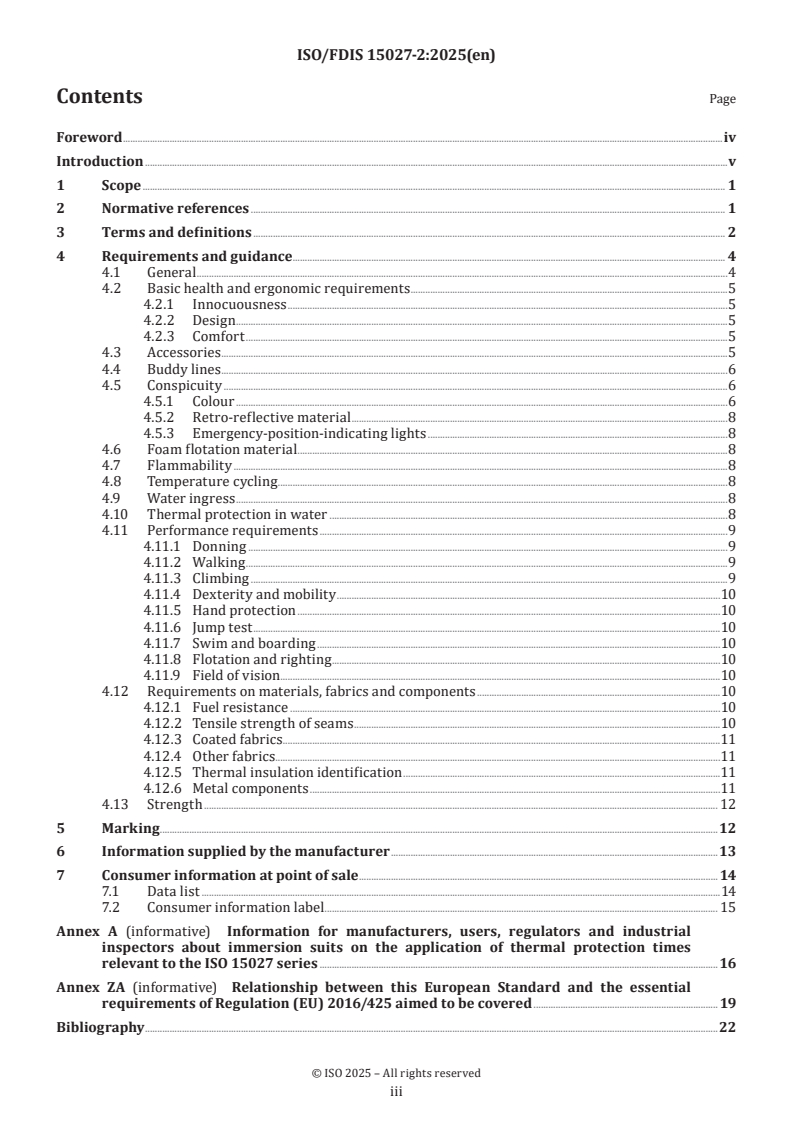
Contents Page
Foreword .iv
Introduction .v
1 Scope . 1
2 Normative references . 1
3 Terms and definitions . 2
4 Requirements . 5
4.1 General . 5
4.2 Basic health and ergonomic requirements . 6
4.2.1 Innocuousness . 6
4.2.2 Design . 6
4.2.3 Comfort . 6
4.3 Accessories . 7
4.4 Buddy lines . 7
4.5 Conspicuity . 7
4.5.1 Colour . 7
4.5.2 Retro-reflective material . 9
4.5.3 Emergency position-indicating-lights . 9
4.6 Foam flotation material . 9
4.7 Flammability . 9
4.8 Temperature cycling . . 9
4.9 Leakage . 10
4.10 Thermal protection in water . 10
4.11 Performance requirements . 10
4.11.1 Walking . 10
4.11.2 Climbing . 11
4.11.3 Donning . 11
4.11.4 Dexterity and mobility . 11
4.11.5 Hand protection . 11
4.11.6 Jump test . 11
4.11.7 Swim and boarding . 11
4.11.8 Flotation and righting . 11
4.11.9 Field of vision. 11
4.12 Requirements on materials, fabrics and components .12
4.12.1 Fuel resistance .12
4.12.2 Tensile strength of seams .12
4.12.3 Coated fabrics. 12
4.12.4 Other fabrics . .12
4.12.5 Thermal insulation identification . 13
4.12.6 Metal components .13
4.12.7 Thermal insulation identification . 13
4.13 Strength . 13
5 Marking . .13
6 Information supplied by the manufacturer .14
7 Consumer information at point of sale .14
7.1 Data list . 14
7.2 Consumer information label . 15
Annex A (informative) Guidelines for manufacturers, users, regulators and industrial
inspectors about immersion suits with respect to the application of thermal
protection times relevant to the ISO 15027 series .17
Annex ZA (informative) Relationship between this European Standard and the essential
requirements of Regulation 2016/425 aimed to be covered .20
iii
ISO/DIS 15027-2:2023(E)
Foreword
ISO (the International Organization for Standardization) is a worldwide federation of national standards
bodies (ISO member bodies). The work of preparing International Standards is normally carried out
through ISO technical committees. Each member body interested in a subject for which a technical
committee has been established has the right to be represented on that committee. International
organizations, governmental and non-governmental, in liaison with ISO, also take part in the work.
ISO collaborates closely with the International Electrotechnical Commission (IEC) on all matters of
electrotechnical standardization.
The procedures used to develop this document and those intended for its further maintenance are
described in the ISO/IEC Directives, Part 1. In particular, the different approval criteria needed for the
different types of ISO documents should be noted. This document was drafted in accordance with the
editorial rules of the ISO/IEC Directives, Part 2 (see www.iso.org/directives).
Attention is drawn to the possibility that some of the elements of this document may be the subject of
patent rights. ISO shall not be held responsible for identifying any or all such patent rights. Details of
any patent rights identified during the development of the document will be in the Introduction and/or
on the ISO list of patent declarations received (see www.iso.org/patents).
Any trade name used in this document is information given for the convenience of users and does not
constitute an endorsement.
For an explanation of the voluntary nature of standards, the meaning of ISO specific terms and
expressions related to conformity assessment, as well as information about ISO’s adherence to
the World Trade Organization (WTO) principles in the Technical Barriers to Trade (TBT), see
www.iso.org/iso/foreword.html.
This document was prepared by the Technical Committee ISO/TC 188, Small craft, Subcommittee SC 1,
Personal safety equipment, in accordance with the Agreement on technical cooperation between ISO and
CEN (Vienna Agreement).
This third edition cancels and replaces the second edition (ISO 15027-2:2012), which has been
technically revised.
The main changes are as follows:
— Terms and conditions have been revised;
— a new thermal performance level E, equivalent to SOLAS uninsulated immersion suit (see 4.10,
Table 3) has been added;
— a minimum immersed CLO values to Suit Performance levels (see 4.10, Table 3) has been added;
— in Clause 5, warnings in marking have been revised;
— in clause 7, the consumer information has been revised;
— Annex A has been revised;
A list of all parts in the ISO 15027 series can be found on the ISO website.
Any feedback or questions on this document should be directed to the user’s national standards body. A
complete listing of these bodies can be found at www.iso.org/members.html.
iv
ISO/DIS 15027-2:2023(E)
Introduction
This part of ISO 15027 has been prepared to meet the needs of persons engaged in certain activities on
or near water. Abandonment suits manufactured and maintained according to this part of ISO 15027
will provide protection from cold shock and delay the onset of hypothermia.
The complete immersion system (suit and clothes worn under the suit) should be able to keep the user
alive long enough for the rescue services to find and recover them. An individual's estimated thermal
protection time will depend on water temperature and wave state as well as their physiology. Detailed
in this part of ISO 15027 are the minimum recommended insulation levels and the associated water
temperatures in which they are to be used.
This part of ISO 15027 is intended to serve as a minimum performance requirement for manufacturers,
purchasers and users of such safety equipment and seeks to ensure that the equipment provides
effective performance in use. The abandonment suit should not jeopardize safety by causing undue
discomfort which could result in a degradation of performance.
The abandonment suit shall have no features which will be likely to have any detrimental effect on
the operation of other life-saving equipment that may be used. In particular, any part of the suit which
might pose a snagging hazard shall be suitably covered, protected or restrained.
The primary aims in wearing an abandonment suit are:
a) to reduce the risk of cold shock and delay the onset of hypothermia;
b) to enable the user to propel himself in the water and extricate himself from the water without it
becoming an encumbrance;
c) to make the user sufficiently conspicuous in the water so as to aid his recovery.
Many circumstances may alter the performance of the suit, such as wave action or the wearing
of additional equipment. Users, owners and employers should ensure that equipment is correctly
maintained according to the manufacturer's instructions.
An abandonment suit may often be worn with a lifejacket as it will provide extra flotation and may help
to bring a user to a face-up position.
v
DRAFT INTERNATIONAL STANDARD ISO/DIS 15027-2:2023(E)
Immersion suits —
Part 2:
Abandonment suits, requirements including safety
1 Scope
This document specifies performance and safety requirements for abandonment suits and suit systems
in emergency situations professional and leisure activities to protect the user against the effects of cold
water immersion, such as reducing cold shock and delaying the onset of hypothermia.,.
It is applicable for dry and wet abandonment suits.
Constant wear suits are not covered by this document. The requirements of constant wear suits are
given in ISO 15027-1:20xx. Test methods are given in ISO 15027-3:20xx.
2 Normative references
The following documents are referred to in the text in such a way that some or all of their content
constitutes requirements of this document. For dated references, only the edition cited applies. For
undated references, the latest edition of the referenced document (including any amendments) applies.
1)
CIE 15:2004, Colorimetry
ISO 13688:2013, Protective clothing — General requirements
ISO 105-A02, Textiles — Tests for colour fastness — Part A02: Grey scale for assessing change in colour
ISO 105-E02, Textiles — Tests for colour fastness — Part E02: Colour fastness to sea water
ISO 105-X12, Textiles — Tests for colour fastness — Part X12: Colour fastness to rubbing
ISO 188, Rubber, vulcanized or thermoplastic — Accelerated ageing and heat resistance tests
ISO 1421, Rubber- or plastics-coated fabrics — Determination of tensile strength and elongation at break
ISO 2411:2000, Rubber- or plastics-coated fabrics — Determination of coating adhesion
ISO 3801:1977, Textiles — Woven fabrics — Determination of mass per unit length and mass per unit area
ISO 4674-1:2003, Rubber- or plastics-coated fabrics — Determination of tear resistance — Part 1: Constant
rate of tear methods
ISO 7854:1995, Rubber- or plastics-coated fabrics — Determination of resistance to damage by flexing
ISO 9227, Corrosion tests in artificial atmospheres — Salt spray tests
ISO 12401, Small craft — Deck safety harness and safety line — Safety requirements and test methods
ISO 12402-2:2020, Personal flotation devices — Part 2: Lifejackets, performance level 275 — Safety
requirements
ISO 12402-3:2020, Personal flotation devices — Part 3: Lifejackets, performance level 150 — Safety
requirements
1) Available from https:// www .cie .co .at/ main/ publist .html.
ISO/DIS 15027-2:2023(E)
ISO 12402-4:2020, Personal flotation devices — Part 4: Lifejackets, performance level 100 — Safety
requirements
ISO 12402-5:2020, Personal flotation devices — Part 5: Buoyancy aids (level 50) — Safety requirements
ISO 12402-6:2020, Personal flotation devices — Part 6: Special purpose lifejackets and buoyancy aids —
Safety requirements and additional test methods
ISO 12402-7:2020, Personal flotation devices — Part 7: Materials and components — Safety requirements
and test methods
ISO 12402-8:2020, Personal flotation devices — Part 8: Accessories — Safety requirements and test
methods
ISO 12402-9:2020, Personal flotation devices — Part 9: Evaluation
ISO 13934-1, Textiles — Tensile properties of fabrics — Part 1: Determination of maximum force and
elongation at maximum force using the strip method
ISO 13935-2, Textiles — Seam tensile properties of fabrics and made-up textile articles — Part 2:
Determination of maximum force to seam rupture using the grab method
ISO 15027-3:20xx, Immersion suits — Part 3: Test methods
2) 3)
Resolution A. 658(16) adopted by the IMO Assembly to amend the International Convention for the
Safety of Life at Sea (SOLAS), 1974, Use and fitting of retro-reflective materials on life-saving appliances
3 Terms and definitions
For the purposes of this document, the following terms and definitions apply.
3.1
immersion suit
suit designed to protect the user's body from the cooling effects of immersion in water
Note 1 to entry: Cooling effects include cold shock (3.21) and hypothermia (3.14).
[SOURCE: ISO 15027-1:20xx, 3.1]
3.2
constant wear suit
immersion suit designed to be routinely worn for activities on or near water in anticipation of
immersion in water, but permitting physical activity to such an extent that actions can be undertaken
without undue encumbrance and thus, head, hands and feet need not be covered
[SOURCE: ISO 15027-1:20xx, 3.2]
3.3
abandonment suit
immersion suit including head, hand and feet protection designed to permit rapid donning in the event
of an imminent immersion in water
[SOURCE: ISO 15027-1:2012, 3.3]
2) Accessible at https:// www .imo .org/ KnowledgeCentre/ Ho wAndWhereT oFindIMOIn formation/ In
dexofIMORe solutions/ Pages/ Assembly -(A) .aspx.
3) IMO is the abbreviation for International Maritime Organization. It is based in London, UK. IMO issues
regulations which are then published as laws by the member states.
ISO/DIS 15027-2:2023(E)
3.4
dry suit
immersion suit designed to protect the user against the effect of cold water immersion by precluding
the entry of water upon immersion
[SOURCE: ISO 15027-1:20xx, 3.4]
3.5
wet suit
immersion suit designed to protect the user against the effect of cold water immersion by providing
insulation and limiting the entry and exit of water upon immersion
[SOURCE: ISO 15027-1:20xx, 3.5]
3.6
primary suit closure
closure used in the donning of the suit
[SOURCE: ISO 15027-1:20xx, 3.6]
3.7
secondary suit closure
additional closure which can be operated by the user to enhance the fit of the suit
[SOURCE: ISO 15027-1:20xx, 3.7]
3.8
inherent buoyant material
material that provides buoyancy, forming a permanent part of the suit, with a density less than that of
water
[SOURCE: ISO 15027-1:20xx, 3.8]
3.9
exterior fabric
outer fabric of a suit, either in the form of a single or composite fabric
[SOURCE: ISO 15027-1:20xx, 3.9]
3.10
retro‑reflective material
material that reflects light beams back to their point of origin
[SOURCE: ISO 15027-1:20xx, 3.10]
3.11
sprayhood
cover brought or placed in front of the face of the user in order to reduce or eliminate the splashing of
water from waves or the like onto the airways, and thereby promoting the survival of the user in rough
water conditions
[SOURCE: ISO 15027-1:20xx, 3.11]
3.12
buddy line
length of cord which can be tied or otherwise fixed to another person, or to that person’s personal
flotation device or other objects, so as to keep a user in the vicinity of that person or object with a view
to making location and thus rescue easier
[SOURCE: ISO 15027-1:20xx, 3.12]
ISO/DIS 15027-2:2023(E)
3.13
clo value
unit to express the relative thermal insulation values of various clothing assemblies
2 –1
Note 1 to entry: One clo is equal to 0,155 Km W .
[SOURCE: ISO 15027-1:20xx, 3.13]
3.14
hypothermia
condition where body core temperature is below 35 °C
[SOURCE: ISO 15027-1:20xx, 3.14]
3.15
working environment
environment in which the user of a suit system would engage in normal work
[SOURCE: ISO 15027-1:20xx, 3.15]
3.16
helicopter transit suit
constant wear suit worn by helicopter occupants
[SOURCE: ISO 15027-1:20xx, 3.16]
3.17
offshore installation
structure or vessel that is permanently or temporarily sited at sea or away from the shore in a fresh
water lake or river and which is not covered under other international regulations
[SOURCE: ISO 15027-1:20xx, 3.17]
3.18
suit system
suit system
immersion suit including its components and accessories, and any auxiliary buoyancy or PFD (3.23)
Note 1 to entry: Storage bag is not part of the suit system.
3.19
underclothing
clothes worn under the suit system
[SOURCE: ISO 15027-1:20xx, 3.19]
3.20
heat strain
increase of body temperature induced by sustained heat stress which cannot be fully compensated by
temperature regulation, or activation of thermoeffective activities in response to heat stress which
cause sustained changes in the state of other, nonthermal, regulatory systems
[SOURCE: ISO 15027-1:20xx, 3.20]
3.21
cold shock
short transitory phase lasting about 2 to 3 min upon sudden immersion in cold water and characterized
by an uncontrollable hyperventilation accompanied by other cardio-respiratory distress
[SOURCE: ISO 15027-1:20xx, 3.21]
ISO/DIS 15027-2:2023(E)
3.22
emergency position-indicating light
emergency position-indicating light
device which emits light so as to increase the chances of a user being located
3.23
personal flotation device
PFD
garment or device which, when correctly worn and used in water, provides the user with a specific
amount of buoyancy which increases the likelihood of survival
4 Requirements
4.1 General
4.1.1 An abandonment suit system shall meet the requirements of this part of ISO 15027. The suit
shall not be damaged or fail in its determined function when tested in accordance with all tests in
ISO 15027-3:2012, Clause 3.
When a PFD or auxiliary buoyancy is part of the suit system, it shall be tested and included as part of
the suit system.
4.1.2 All suit samples shall undergo temperature cycling in accordance with ISO 15027-3:20XX, 3.3,
followed by the rotating shock bin test in accordance with ISO 15027-3:20XX, 3.4, and cleaning shall
be done according to the specification of the manufacturer in accordance with ISO 15027-3:20XX, 3.11
prior to all remaining tests.
4.1.3 The manufacturer shall specify the components of the suit system including underclothing
and additional items. The abandonment suit shall cover the whole body with the exception of the face.
The hood shall make a tight fit around the face to limit water ingress. Hand covering shall be provided
either by integral hand protection or by permanently attached hand protection/gloves. Test by visual
inspection.
The abandonment suit may incorporate additional items compliant with 4.3 and ISO 12402-8, none of
which shall impair its performance with respect to the requirements of this part of ISO 15027, either by
their presence or their use.
4.1.4 The risk of heat stress and discomfort shall be taken into account in the design and use of the
suit system. This should be accompanied in the information supplied by the manufacturer by specific
advice or warnings according to Clause 6.
NOTE In general, the higher the protection against cold shock and hypothermia, the higher is the possibility
of heat strain. The user of an abandonment suit needs to balance those two effects when choosing a device.
4.1.5 The size of the suit shall fit size(s) of the intended user(s). When multiple size ranges are
provided, the size ranges should overlap. If an adult universally sized suit is provided, it shall be sized to
fit at least every person between 1,50 m and 1,95 m. Test in accordance with ISO 15027-3:2012.
4.1.6 The rotating shock bin test according to ISO 15027-3:2012, 3.4 shall be performed on each suit
before performing the relevant tests according to ISO 15027-3:2012, Clause 3. There shall be no visible
migration of insulation material and no visible wear-and-tear damage after the rotating shock bin test.
4.1.7 Unless the suit system has been designed to be used without a PFD, the suit system shall not
prevent the donning of a personal flotation device (PFD) in accordance with ISO 12402-2 or ISO 12402-3,
and the manufacturer of the suit system shall specify the type of PFD (inflatable and/or inherent) to be
used.
ISO/DIS 15027-2:2023(E)
4.1.8 The suit system shall be designed in such a way as to minimize the risk of snagging. Test in
accordance with ISO 15027-3:2012, 3.1.
4.1.9 Materials, fabrics and components shall conform to the requirements of 4.11.
4.1.10 The suit system shall be designed so as not to impede the user during normal use when tested
in accordance with ISO 15027-3:xxxx, 3.10x.
4.1.11 A suit which is designed to be worn without a PFD shall be tested in accordance with
ISO 15027-3. When comparing the initial measurements with the measurement after 24 h, the loss of
buoyancy shall not exceed 5 %.
4.1.12 The strength of the suit shall be tested in accordance with ISO 15027-3, X.X. No damage, such as
separated or broken seams, broken zippers, buckles, and webbing shall occur. The load shall be no less
than 1 350 N.
4.1.13 The lifting loop shall be tested in accordance with ISO 15027-3, X.X. No damage, such as
separated or broken seams, broken zippers, buckles, and webbing shall occur. The load shall be no less
than 3 200 N
4.2 Basic health and ergonomic requirements
4.2.1 Innocuousness
The suit system shall not adversely affect the health or hygiene of the user. The materials shall not, in
the foreseeable conditions of normal use, release substances generally known to be toxic, carcinogenic,
mutagenic, allergenic, toxic to reproduction or otherwise harmful.
NOTE More information can be found in ISO 13688.
Materials should be selected to minimize the environmental impact of the production and disposal of
protective clothing (see ISO 13688:2013, Annex F).
The examination, in combination with the following requirements in 4.2, shall determine whether
the claim that the materials are suitable for use in the protective clothing or protective equipment is
justified. Particular attention has to be paid to the presence of plasticizers, unreacted components,
heavy metals, impurities and the chemical identity of pigments and dyes.
4.2.2 Design
The design of the suit system shall facilitate its correct positioning on the user and shall ensure that it
remains in place for the foreseeable period of use, taking into account ambient factors, together with
the movements and postures that the wearer could adopt during the course of work or other activity.
For this purpose, appropriate means, such as adequate adjustment systems or adequate size ranges
shall be provided so as to enable the suit system to be adapted to the morphology of the user.
4.2.3 Comfort
4.2.3.1 The suit system shall provide users with a level of comfort consistent with the level of
protection against hazards for which it is intended, the ambient conditions, the level of the user’s
activity, and the anticipated duration of use of the protective clothing.
The suit system shall not
— have rough, sharp or hard surfaces that irritate or injure the user;
— be so tight, loose and/or heavy that it restricts normal movement.
ISO/DIS 15027-2:2023(E)
4.2.3.2 If applicable, the suit shall be made of materials with low water vapour resistance and/or high
air permeability and/or shall be sufficiently ventilated to minimize discomfort and thermal stress.
4.2.3.3 A suit system that imposes significant ergonomic burdens such as heat stress, or is inherently
uncomfortable because of the need to provide adequate protection, should be accompanied by specific
advice or warnings in the information supplied by the manufacturer. Specific advice on the appropriate
duration for continuous use of the clothing in the intended application(s) should be given.
4.3 Accessories
If the suit is provided with accessories, such as a sprayhood, safety harnesses or safety lines, whistles,
lights or buddy lines, they shall comply with ISO 12401 and/or ISO 12402-8:2020 and the relevant
clauses of this part of ISO 15027.
If the suit is intended to be used without a personal flotation device (PFD), the suit shall be provided
with a permanently attached whistle and a light.
If the suit is intended to be used with a PFD, the PFD shall be fitted with a light.
Suit systems may be equipped with further accessories. Where applicable, such accessories shall comply
with ISO 12402-8:2020, and shall be tested as a part of the suit system. No accessory shall impair the
suit system’s performance.
4.4 Buddy lines
A buddy line, if provided, shall be made from synthetic cord or webbing and shall be at least 1 500 mm
in length. The line shall be attached securely to the suit and have a free end with a releasable means for
attachment to another person or object, such as a loop, a snap hook, or a wooden or plastic toggle. The
buddy line, if provided, shall be readily accessible to at least one of the user's gloved hands as confirmed
during device testing. The attachment means and line shall be stowed in such a way that they do not
create a hazard or affect the normal operation of the immersion suit. If hardware is provided as an
attachment means, it shall not have sharp edges. The assembly shall float in fresh water. Hardware
on the buddy line shall either not be broken, or if broken, not expose sharp edges after pull testing.
Weathering testing is not required when the buddy line is normally stowed inside a pocket.
If provided, a buddy line shall be tested in accordance with ISO 12402-9:2020, 5.5.6 and withstand a
+1
(750 ± 50) N load for at least 3 min without any damage. The force required to separate the buddy
line from the suit shall be greater than 750 N and less than 1 500 N. The separation of the buddy line
from the immersion suit shall not adversely affect the integrity of the immersion suit. This shall be
verified by visual inspection.
The buddy line, if provided, shall be in accordance with ISO 12402-8:2006, 5.4. The buddy line, if
provided, shall be marked with "ISO 12402-8", suffixed with the words "buddy line" at least in the
official language(s) of the country of destination. Additionally, a marking shall be included on the buddy
line or the outside of a pocket in which a buddy line is stowed, in letters at least 12 mm high, with the
words "NOT FOR LIFTING" at least in the official language(s) of the country of destination.
4.5 Conspicuity
4.5.1 Colour
4.5.1.1 The colour of the exposed portions (excluding components such as webbing, zips and other
fittings) of a suit when deployed in face-up floating position shall be in the colour range from yellow to
red, the chromaticity coordinates for non-fluorescent colours shall lie within one of the areas defined
ISO/DIS 15027-2:2023(E)
in Table 1 and the luminance factor shall exceed the corresponding value in Table 1. The chromaticity
coordinates and the luminance factor for fluorescent colours shall comply with Table 2.
The face-up floating position is defined during in-water test according to ISO 15027-3:2012, 3.10.6.3.
4.5.1.2 The colour of the material samples shall be measured with the procedures defined in
CIE 15:2004 with polychromatic illumination D and 45/0 geometry and 2° standard observer.
The specimen shall have a black underlay with reflectance of less than 0,04. The specimens shall be
conditioned for at least 24 h at (20 ± 2) °C and (65 ± 5) % relative humidity. If the test is carried out
in other conditions, the test shall be conducted within 5 min after withdrawal from the conditioning
atmosphere.
4.5.1.3 The colour fastness (dry and wet) of suit material when determined in accordance with
ISO 105-A02 shall be resistant to rubbing (wet and dry), when tested in accordance with ISO 105-X12 to
at least step 4, and to salt water when tested in accordance with ISO 105-E02 to at least step 4.
Table 1 — Chromaticity coordinates x and y and luminance factor β for yellow, orange and red
non‑fluorescent colours of suit material
Chromaticity coordinates Luminance factor
Colour
x y β
Yellow 0,389 0,610 > 0,35
0,320 0,490
0,405 0,400
0,500 0,500
Orange 0,500 0,500 > 0,25
0,405 0,400
0,470 0,330
0,600 0,400
Red 0,610 0,400 > 0,15
0,470 0,330
0,525 0,270
0,700 0,300
Table 2 — Chromaticity coordinates x and y and luminance factor β for yellow, yellow-orange,
orange, orange‑red and red fluorescent colours of suit material
Chromaticity coordinates Luminance factor
Colour
x y β
Fluorescent yellow 0,380 0,610 > 0,60
0,320 0,490
0,370 0,440
0,440 0,550
Fluorescent yellow-orange 0,440 0,550 > 0,50
0,370 0,440
0,420 0,390
0,505 0,490
Fluorescent orange 0,505 0,490 > 0,40
0,420 0,390
0,460 0,350
0,575 0,425
Fluorescent orange-red 0,575 0,425 > 0,30
0,460 0,350
0,488 0,320
0,630 0,360
ISO/DIS 15027-2:2023(E)
TTabablele 2 2 ((ccoonnttiinnueuedd))
Chromaticity coordinates Luminance factor
Colour
x y β
Fluorescent red 0,630 0,360 > 0,20
0,488 0,320
0,525 0,280
0,695 0,300
4.5.2 Retro‑reflective material
A passive light system of retro-reflective material shall be provided. This shall conform to the
specification detailed in IMO Resolution A.658(16), Annex 2. If it is the only light system, then a total
2 2
area of not less than 400 cm shall be provided. At least 100 cm shall be affixed to the hood and in
addition at least 250 cm shall be clear of the water and visible in the suit's normal in-water position as
tested in ISO 15027-3:20xx, 3.10.6.4.1. At least one piece of 50 cm shall be affixed to the back of the suit.
The performance of the retro-reflective material shall not be degraded by the method used to apply it
to the suit. Test in accordance with ISO 15027-3:20xx, 3.10.6.4.2.
4.5.3 Emergency position-indicating-lights
An active light system shall be provided either on the associated PFD or on the suit if the abandonment
suit is intended to be used without a PFD.
The active light system shall conform to the standard for emergency lights in ISO 12402-8:2020.
Alternative systems to provide conspicuity to assist search and rescue operations, such as combinations
of active light systems (emergency lights) and passive light systems (retro-reflective material) will be
acceptable if they meet the specifications for both emergency lights and retro-reflective material as
defined above.
4.6 Foam flotation material
Foam flotation material used to assist the buoyancy performance of the suit system shall comply with
ISO 12402-7:2020, 4.8.
The buoyancy of the suit system shall be tested in accordance with ISO 15027-3:2020,3.7. The buoyancy
measurement after 24 h shall not exceed 5 % buoyancy loss of the original buoyancy.
4.7 Flammability
When tested in accordance with ISO 15027-3:20xx, 3.10, the suit system materials shall not sustain
burning nor continue melting 6 s after being removed from the flames.
4.8 Temperature cycling
The suit system, excluding a separate PFD, where applicable, shall be resistant to damage caused by
changes in ambient temperature.
After temperature cycling in accordance with ISO 15027-3:20xx, 3.3, the suit system shall show no
visible damage to the external and internal construction components such as shrinking, cracking,
swelling, dissolution or change of mechanical qualities.
Additionally after temperature cycling , dry suits shall be subjected to the leak test in accordance with
ISO 15027-3:20xx, 3.13.
ISO/DIS 15027-2:2023(E)
4.9 Leakage
The leakage of a dry abandonment suit system during jumping shall be measured in accordance with
ISO 15027-3:20xx, 3.13.1 and the mass of measured water shall not exceed 500 g.
The leakage of a dry abandonment suit system during swimming shall also be measured in accordance
with ISO 15027-3:20xx, 3.13.2 and the mass of measured water shall not exceed 200 g.
4.10 Thermal protection in water
The suit system with the underclothing specified by the manufacturer or with standard underclothing
according to ISO 15027-3:20xx, 3.14.1.2 shall provide the user with thermal protection in a
hydrostatical compressed state as defined by its flotation position. This document recognizes the need
for different levels of thermal protection depending upon the water temperature in which the suit will
be used. The conditions of thermal protection are shown in Table 3. Testing shall be in accordance with
ISO 15027-3:20xx, 3.14.
None of the six human test subjects' core temperatures shall fall more than 2 °C. Each human test
subject's skin temperature shall not be lower than 10 °C for a time period of more than 15 min. If either
of these two requirements is not fulfilled, the suit system shall be deemed to have failed.
NOTE See Annex A for more information on thermal protection time.
Table 3 — Thermal suit performance levels
a
Suit performance level
b c
A B C D E
Duration (h) 6 4 2 2 1
Water temperature (°C) 2 2 5 10 5
Immersed CLO (minimum) 0,75 0,60 0,33 0,25 0,16
a
Tests are performed in calm water. Rough conditions (e.g. wind, waves) will decrease the stated period of immersion.
b
Equivalent to SOLAS insulated immersion suit, when tested at a water temperature of maximum 2 °C.
c
Equivalent to SOLAS uninsulated immersion suit.
There are two options for measuring thermal protection provided that the results are equivalent:
a) using a thermal manikin, in accordance with ISO 15027-3:20xx, 3.8.1;
The validation of the thermal manikin test results shall be accompanied by an exchange of
experience between the manikin testing laboratories based on round robin testing, and the
correlation of results between the tests with human test subject and manikin.
b) using human test subjects, in accordance with ISO 15027-3:20xx, 3.8.2.
When tested with a thermal manikin in accordance with ISO 15027-3:20xx, the clo value shall not
be less than the values indicated in Table 3.
When using human subjects for testing none of the six human test subjects' core temperatures shall
fall more than 2 °C. Each human test subject's skin temperature shall not be lower than 10 °C for a
time period of more than 15 min. If either of these two requirements is not fulfilled, the suit system
shall be deemed to have failed.
4.11 Performance requirements
4.11.1 Walking
A user wearing the suit system correctly donned shall be able to walk easily as tested in accordance
with ISO 15027-3:20xx, 3.15.3.2.
ISO/DIS 15027-2:2023(E)
4.11.2 Climbing
A user wearing the suit system correctly donned shall be able to climb freely as tested in accordance
with ISO 15027-3:20xx, 3.15.4.2.
4.11.3 Donning
When tested in accordance with ISO 15027-3:20xx, 3.15.2.1 a), it shall be possible to don the suit system,
and secure all primary closures within 2 min.
Where the suit system includes a separate PFD, the 2 min donning time shall include donning of the
uninflated PFD and subsequent inflation.
There shall be no damage to the suit system after donning.
4.11.4 D
...
FINAL DRAFT
International
Standard
ISO/TC 188/SC 1
Immersion suits —
Secretariat: AFNOR
Part 2:
Voting begins on:
2025-12-29
Safety and performance
requirements for abandonment
Voting terminates on:
2026-02-23
suits
Combinaisons d'immersion —
Partie 2: Exigences de sécurité et de performance pour les
combinaisons d'abandon
RECIPIENTS OF THIS DRAFT ARE INVITED TO SUBMIT,
WITH THEIR COMMENTS, NOTIFICATION OF ANY
RELEVANT PATENT RIGHTS OF WHICH THEY ARE AWARE
AND TO PROVIDE SUPPOR TING DOCUMENTATION.
IN ADDITION TO THEIR EVALUATION AS
BEING ACCEPTABLE FOR INDUSTRIAL, TECHNO-
ISO/CEN PARALLEL PROCESSING LOGICAL, COMMERCIAL AND USER PURPOSES, DRAFT
INTERNATIONAL STANDARDS MAY ON OCCASION HAVE
TO BE CONSIDERED IN THE LIGHT OF THEIR POTENTIAL
TO BECOME STAN DARDS TO WHICH REFERENCE MAY BE
MADE IN NATIONAL REGULATIONS.
Reference number
FINAL DRAFT
International
Standard
ISO/TC 188/SC 1
Immersion suits —
Secretariat: AFNOR
Part 2:
Voting begins on:
Safety and performance
requirements for abandonment suits
Voting terminates on:
Combinaisons d'immersion —
Partie 2: Exigences de sécurité et de performance pour les
combinaisons d'abandon
RECIPIENTS OF THIS DRAFT ARE INVITED TO SUBMIT,
WITH THEIR COMMENTS, NOTIFICATION OF ANY
RELEVANT PATENT RIGHTS OF WHICH THEY ARE AWARE
AND TO PROVIDE SUPPOR TING DOCUMENTATION.
© ISO 2025
IN ADDITION TO THEIR EVALUATION AS
All rights reserved. Unless otherwise specified, or required in the context of its implementation, no part of this publication may
BEING ACCEPTABLE FOR INDUSTRIAL, TECHNO-
ISO/CEN PARALLEL PROCESSING
LOGICAL, COMMERCIAL AND USER PURPOSES, DRAFT
be reproduced or utilized otherwise in any form or by any means, electronic or mechanical, including photocopying, or posting on
INTERNATIONAL STANDARDS MAY ON OCCASION HAVE
the internet or an intranet, without prior written permission. Permission can be requested from either ISO at the address below
TO BE CONSIDERED IN THE LIGHT OF THEIR POTENTIAL
or ISO’s member body in the country of the requester.
TO BECOME STAN DARDS TO WHICH REFERENCE MAY BE
MADE IN NATIONAL REGULATIONS.
ISO copyright office
CP 401 • Ch. de Blandonnet 8
CH-1214 Vernier, Geneva
Phone: +41 22 749 01 11
Email: copyright@iso.org
Website: www.iso.org
Published in Switzerland Reference number
ii
Contents Page
Foreword .iv
Introduction .v
1 Scope . 1
2 Normative references . 1
3 Terms and definitions . 2
4 Requirements and guidance . . 4
4.1 General .4
4.2 Basic health and ergonomic requirements .5
4.2.1 Innocuousness .5
4.2.2 Design .5
4.2.3 Comfort .5
4.3 Accessories .5
4.4 Buddy lines .6
4.5 Conspicuity .6
4.5.1 Colour .6
4.5.2 Retro-reflective material .8
4.5.3 Emergency-position-indicating lights .8
4.6 Foam flotation material .8
4.7 Flammability .8
4.8 Temperature cycling . .8
4.9 Water ingress .8
4.10 Thermal protection in water .8
4.11 Performance requirements .9
4.11.1 Donning .9
4.11.2 Walking .9
4.11.3 Climbing .9
4.11.4 Dexterity and mobility .10
4.11.5 Hand protection .10
4.11.6 Jump test .10
4.11.7 Swim and boarding .10
4.11.8 Flotation and righting .10
4.11.9 Field of vision.10
4.12 Requirements on materials, fabrics and components .10
4.12.1 Fuel resistance .10
4.12.2 Tensile strength of seams .10
4.12.3 Coated fabrics.11
4.12.4 Other fabrics . .11
4.12.5 Thermal insulation identification .11
4.12.6 Metal components .11
4.13 Strength . 12
5 Marking . .12
6 Information supplied by the manufacturer .13
7 Consumer information at point of sale . 14
7.1 Data list .14
7.2 Consumer information label . 15
Annex A (informative) Information for manufacturers, users, regulators and industrial
inspectors about immersion suits on the application of thermal protection times
relevant to the ISO 15027 series .16
Annex ZA (informative) Relationship between this European Standard and the essential
requirements of Regulation (EU) 2016/425 aimed to be covered . 19
Bibliography .22
iii
Foreword
ISO (the International Organization for Standardization) is a worldwide federation of national standards
bodies (ISO member bodies). The work of preparing International Standards is normally carried out through
ISO technical committees. Each member body interested in a subject for which a technical committee
has been established has the right to be represented on that committee. International organizations,
governmental and non-governmental, in liaison with ISO, also take part in the work. ISO collaborates closely
with the International Electrotechnical Commission (IEC) on all matters of electrotechnical standardization.
The procedures used to develop this document and those intended for its further maintenance are described
in the ISO/IEC Directives, Part 1. In particular, the different approval criteria needed for the different types
of ISO document should be noted. This document was drafted in accordance with the editorial rules of the
ISO/IEC Directives, Part 2 (see www.iso.org/directives).
ISO draws attention to the possibility that the implementation of this document may involve the use of (a)
patent(s). ISO takes no position concerning the evidence, validity or applicability of any claimed patent
rights in respect thereof. As of the date of publication of this document, ISO had not received notice of (a)
patent(s) which may be required to implement this document. However, implementers are cautioned that
this may not represent the latest information, which may be obtained from the patent database available at
www.iso.org/patents. ISO shall not be held responsible for identifying any or all such patent rights.
Any trade name used in this document is information given for the convenience of users and does not
constitute an endorsement.
For an explanation of the voluntary nature of standards, the meaning of ISO specific terms and expressions
related to conformity assessment, as well as information about ISO’s adherence to the World Trade
Organization (WTO) principles in the Technical Barriers to Trade (TBT), see www.iso.org/iso/foreword.html.
This document was prepared by Technical Committee ISO/TC 188, Small craft, Subcommittee SC 1, Personal
safety equipment, in collaboration with the European Committee for Standardization (CEN) Technical
Committee CEN/TC 162, Protective clothing including hand and arm protection and lifejackets, in accordance
with the Agreement on technical cooperation between ISO and CEN (Vienna Agreement).
This third edition cancels and replaces the second edition (ISO 15027-2:2012), which has been technically
revised.
The main changes are as follows:
— the terms and definitions have been revised;
— in Table 3, a new thermal performance level E, equivalent to SOLAS uninsulated immersion suit has
been added;
— in Table 3, minimum immersed clo values to suit performance levels have been added;
— in Clause 5, warnings in marking have been revised;
— in Clause 7, the consumer information has been revised;
— Annex A has been revised.
A list of all parts in the ISO 15027 series can be found on the ISO website.
Any feedback or questions on this document should be directed to the user’s national standards body. A
complete listing of these bodies can be found at www.iso.org/members.html.
iv
Introduction
This document has been prepared to meet the needs of persons engaged in certain activities on or near water.
Abandonment suits manufactured and maintained according to this document will provide protection from
cold shock and delay the onset of hypothermia.
The complete immersion system (suit and clothes worn under the suit) is intended to keep the user alive
long enough for the rescue services to find and recover them. An individual’s estimated thermal protection
time depends on water temperature and wave state as well as their physiology. This document provides the
minimum recommended insulation levels and the associated water temperatures in which the suits are to
be used.
This document is intended to serve as a minimum performance requirement for manufacturers, purchasers
and users of such safety equipment and seeks to ensure that the equipment provides effective performance
in use. The abandonment suit is not intended to jeopardize safety by causing undue discomfort which can
result in a degradation of performance.
The abandonment suit is not intended to have any features which can have a detrimental effect on the
operation of other life-saving equipment. In particular, any part of the suit which might pose a snagging
hazard is intended to be suitably covered, protected or restrained.
The primary aims in wearing an abandonment suit are:
a) to reduce the risk of cold shock and delay the onset of hypothermia;
b) to enable users to propel themselves in the water and extricate themselves from the water without it
becoming an encumbrance;
c) to make users sufficiently conspicuous in the water so as to aid their recovery.
The performance of the suit may be altered by a number of factors, including wave action or the wearing of
additional equipment. Users, owners and employers should ensure that equipment is correctly maintained
according to the manufacturer’s instructions.
A suit system may comprise one or more pieces provided that in all cases it meets the requirements of this
document as a complete system.
An abandonment suit may often be worn with a lifejacket as it will provide flotation and can help to bring a
user to a face-up position.
v
FINAL DRAFT International Standard ISO/FDIS 15027-2:2025(en)
Immersion suits —
Part 2:
Safety and performance requirements for abandonment suits
1 Scope
This document specifies performance and safety requirements for abandonment suits and suit systems in
emergency situations for professional and leisure activities to protect the user against the effects of cold-
water immersion, by reducing cold shock and delaying the onset of hypothermia.
If a suit system includes a personal flotation device (PFD), it provides protection against drowning.
This document is applicable to dry and wet abandonment suits.
This document does not apply to constant wear suits. Requirements for constant wear suits are given in
ISO 15027-1:—.
Test methods for immersion suits are given in ISO 15027-3:—.
2 Normative references
The following documents are referred to in the text in such a way that some or all of their content constitutes
requirements of this document. For dated references, only the edition cited applies. For undated references,
the latest edition of the referenced document (including any amendments) applies.
ISO 105-A02:1993, Textiles — Tests for colour fastness — Part A02: Grey scale for assessing change in colour
ISO 105-A02:1993/Cor 2:2005, Textiles — Tests for colour fastness — Part A02: Grey scale for assessing change
in colour — Technical Corrigendum 2
ISO 105-E02:2013, Textiles — Tests for colour fastness — Part E02: Colour fastness to sea water
ISO 105-X12:2016, Textiles — Tests for colour fastness — Part X12: Colour fastness to rubbing
ISO 188:2023, Rubber, vulcanized or thermoplastic — Accelerated ageing and heat resistance tests
ISO 1421:2016, Rubber- or plastics-coated fabrics — Determination of tensile strength and elongation at break
ISO 2411:2017, Rubber- or plastics-coated fabrics — Determination of coating adhesion
ISO 3801:1977, Textiles — Woven fabrics — Determination of mass per unit length and mass per unit area
ISO 4674-1:2016, Rubber- or plastics-coated fabrics — Determination of tear resistance — Part 1: Constant rate
of tear methods
ISO 7854:1995, Rubber- or plastics-coated fabrics — Determination of resistance to damage by flexing
ISO 9227:2022, Corrosion tests in artificial atmospheres — Salt spray tests
ISO 12402-2:2020, Personal flotation devices — Part 2: Lifejackets, performance level 275 — Safety requirements
ISO 12402-3:2020, Personal flotation devices — Part 3: Lifejackets, performance level 150 — Safety requirements
ISO 12402-4:2020, Personal flotation devices — Part 4: Lifejackets, performance level 100 — Safety requirements
ISO 12402-5:2020, Personal flotation devices — Part 5: Buoyancy aids (level 50) — Safety requirements
ISO 12402-7:2020, Personal flotation devices — Part 7: Materials and components — Safety requirements and
test methods
ISO 12402-8:2020, Personal flotation devices — Part 8: Accessories — Safety requirements and test methods
ISO 12402-9:2020, Personal flotation devices — Part 9: Evaluation
ISO 13688:2013, Protective clothing — General requirements
ISO 13934-1:2013, Textiles — Tensile properties of fabrics — Part 1: Determination of maximum force and
elongation at maximum force using the strip method
ISO 13937-4:2000, Textiles — Tear properties of fabrics — Part 4: Determination of tear force of tongue-shaped
test specimens (Double tear test)
1)
ISO 15027-3:— , Immersion suits — Part 3: Test methods
CIE 015:2018, Colorimetry
2)
Resolution MSC. 481(102) adopted by the IMO Assembly to amend the International Convention for the
Safety of Life at Sea (SOLAS), 1974, Revised recommendation on the use and fitting of retro-reflective materials
on life-saving appliances
3 Terms and definitions
For the purposes of this document, the following terms and definitions apply.
ISO and IEC maintain terminology databases for use in standardization at the following addresses:
— ISO Online browsing platform: available at https:// www .iso .org/ obp
— IEC Electropedia: available at https:// www .electropedia .org/
3.1
immersion suit
suit designed to protect the user’s body from the cooling effects of immersion in water
Note 1 to entry: Cooling effects include cold shock (3.17) and hypothermia (3.11).
3.2
constant wear suit
immersion suit (3.1) designed to be routinely worn for activities on or near water in anticipation of immersion
in water, but permitting physical activity to such an extent that actions can be undertaken without undue
encumbrance and, thus, the head, hands and feet do not need to be covered
3.3
abandonment suit
immersion suit (3.1) including head, hand and feet protection designed to permit rapid donning in the event
of an imminent immersion in water
3.4
dry suit
immersion suit (3.1) designed to protect the user against the effect of cold-water immersion by precluding
the entry of water upon immersion
1) Under preparation. This document, ISO 15027-1 and ISO 15027-3 are being developed together and will be published
together. The date will be added just before publication.
2) IMO is the abbreviation for International Maritime Organization, based in London, UK. IMO issues regulations which
are then published as laws by the member states.
3.5
wet suit
immersion suit (3.1) designed to protect the user against the effect of cold-water immersion by providing
insulation and limiting the entry and exit of water upon immersion
3.6
primary suit closure
closure used in the donning of the suit
3.7
secondary suit closure
additional closure which can be operated by the user to enhance the fit of the suit
3.8
retro-reflective material
material that reflects light beams back to their point of origin
3.9
buddy line
length of cord which can be tied or otherwise fixed to another person, or to that person’s personal flotation
device (3.18) or other objects, so as to keep a user in the vicinity of that person or object with a view to
making location and, thus, rescue easier
3.10
clo value
unit to express the relative thermal insulation values of various clothing assemblies
2 –1
Note 1 to entry: One clo is equal to 0,155 K·m ·W .
3.11
hypothermia
condition where body core temperature is below 35 °C
3.12
helicopter transit suit
constant wear suit (3.2) worn by helicopter occupants
3.13
offshore installation
structure or vessel that is permanently or temporarily sited at sea or away from the shore in a fresh water
lake or river and which is not covered by other international regulations
3.14
suit system
immersion suit (3.1) including its components and accessories, and any auxiliary buoyancy or personal
flotation device (3.18)
Note 1 to entry: The storage bag is not part of the suit system.
3.15
underclothing
clothes worn under a suit system (3.14)
3.16
heat strain
increase of body core temperature induced by sustained heat stress which cannot be fully compensated by
temperature regulation, or activation of thermoeffective activities in response to heat stress which cause
sustained changes in the state of other, non-thermal regulatory systems
3.17
cold shock
short transitory phase lasting about 2 min to 3 min upon sudden immersion in cold water and characterized
by an uncontrollable hyperventilation accompanied by other cardiorespiratory distress
3.18
personal flotation device
PFD
garment or device which, when correctly worn and used in water, provides the user with a specific amount
of buoyancy which increases the likelihood of survival
3.19
emergency-position-indicating light
device which emits light so as to increase the chances of the user being located
4 Requirements and guidance
4.1 General
4.1.1 An abandonment suit system shall not be damaged or fail in its determined function when tested in
accordance with ISO 15027-3:—, Clause 4.
When a PFD or auxiliary buoyancy is part of the suit system, it shall be tested and included as part of the
suit system.
4.1.2 The suit system shall be designed so as not to impede the user during normal use when tested in
accordance with ISO 15027-3:—, 4.15.
4.1.3 All suit samples shall undergo temperature cycling in accordance with ISO 15027-3:—, 4.3, followed
by the rotating shock bin test in accordance with ISO 15027-3:—, 4.4.
Following ISO 15027-3:—, 4.3, and ISO 15027-3:—, 4.4, and prior to all remaining tests, cleaning shall be
done according to the specification of the manufacturer in accordance with ISO 15027-3:—, 4.11.
Material, fabric and component samples shall be preconditioned as defined in 4.12.
4.1.4 The manufacturer shall specify the components of the suit system including components and
accessories, and any auxiliary buoyancy or PFD, and underclothing. The abandonment suit shall cover the
whole body with the exception of the face. The hood shall make a tight fit around the face to limit water
ingress. Hand covering shall be provided either by integral hand protection or by permanently attached
hand protection/gloves. Test by visual inspection.
The abandonment suit may incorporate additional items conforming to 4.3 and ISO 12402-8:2020, none
of which shall impair its performance with respect to the requirements of this document, either by their
presence or their use.
4.1.5 The risk of heat stress and discomfort should be taken into account in the design and use of the
suit system. This should be included in the information supplied by the manufacturer by specific advice or
warnings according to Clause 6. This should be evaluated when testing in accordance with ISO 15027-3:—,
4.15 and 4.16.
In general, the higher the protection against cold shock and hypothermia, the higher the possibility of heat
strain. The user of an abandonment suit should balance those two effects when choosing a device.
4.1.6 There shall be no visible migration of insulation material and no visible wear-and-tear damage after
the rotating shock bin test specified in ISO 15027-3:—, 4.4. Material samples are excluded from the rotating
shock bin test.
4.1.7 A suit system designed to be used with a lifejacket shall not prevent the donning of a PFD in
accordance with ISO 12402-2:2020 or ISO 12402-3:2020. The manufacturer of the suit system shall specify
the type of PFD (inflatable or inherent) to be used. PFDs in accordance with ISO 12402-4 and ISO 12402-5
are not applicable in suit systems.
4.1.8 The suit system shall be designed in such a way as to minimize the risk of snagging. Test in accordance
with ISO 15027-3:—, 4.15 and 4.16.
4.1.9 The size of the suit shall fit the size(s) of the intended user(s). If an adult universally sized suit is
provided, it shall be sized to fit at least every person between 1,50 m and 1,95 m. Test in accordance with
ISO 15027-3:—, 4.15.2.1 a).
4.2 Basic health and ergonomic requirements
4.2.1 Innocuousness
The suit system shall not adversely affect the health or hygiene of the user. The materials shall not, in
the foreseeable conditions of normal use, release substances generally known to be toxic, carcinogenic,
mutagenic, allergenic, toxic to reproduction or otherwise harmful.
The materials shall meet the requirements of ISO 13688:2013, 4.2.
NOTE More information can be found in ISO 13688. Carefully selected materials minimize the environmental
impact of the production and disposal of protective clothing (see ISO 13688:2013, Annex F).
4.2.2 Design
The design of the suit system shall facilitate its correct positioning on the user and shall ensure that it
remains in place for the foreseeable period of use, considering ambient factors, together with the movements
and postures that the wearer is likely to adopt during the course of abandonment activity. For this purpose,
appropriate means, such as adequate adjustment systems or adequate size ranges shall be provided so as to
enable the suit system to be adapted to the morphology of the user. Test in accordance with ISO 15027-3:—,
4.15 and 4.16.
4.2.3 Comfort
4.2.3.1 The suit system shall provide users with a level of comfort consistent with the level of protection
against hazards for which it is intended, the ambient conditions, the level of the user’s activity, and the
anticipated duration of use of the protective clothing.
The suit system shall not:
— have rough, sharp or hard surfaces that irritate or injure the user;
— be so tight, loose or heavy that it restricts normal movement.
This shall be evaluated when testing in accordance with ISO 15027-3:—, 4.15 and 4.16.
4.2.3.2 A suit system that imposes significant ergonomic burdens such as heat stress, or is inherently
uncomfortable because of the need to provide adequate protection, should be accompanied by specific
advice or warnings in the information supplied by the manufacturer. Specific advice on the appropriate
duration for continuous use of the clothing in the intended application(s) should be given.
4.3 Accessories
Suit systems may be equipped with accessories. Where applicable, such accessories shall conform to
ISO 12402-8:2020, and shall be tested as a part of the suit system. No accessory shall impair the suit system’s
performance.
If the suit is intended to be used without a PFD, the suit shall be provided with a permanently attached
whistle and a light.
If the suit is intended to be used with a PFD, the PFD shall be fitted with a light.
4.4 Buddy lines
A buddy line, if provided, shall be made from synthetic cord or webbing and shall be at least 1 500 mm
in length. The line shall be attached securely to the suit and have a free end with a releasable means for
attachment to another person or object, such as a loop, a snap hook, or a wooden or plastic toggle. The buddy
line, if provided, shall be readily accessible to one of the user’s gloved hands as confirmed during device
testing. The attachment means and line shall be stowed in such a way that they do not create a hazard or
affect the normal operation of the immersion suit. If hardware is provided as an attachment means, it shall
not have sharp edges. The assembly shall float in fresh water. Hardware on the buddy line shall either not be
broken, or if broken, not expose sharp edges after pull testing. Weathering testing is not required when the
buddy line is normally stowed inside a pocket,
If provided, a buddy line shall be tested in accordance with ISO 12402-9:2020, 5.5.6, and withstand a
+1
(750 ± 50) N load for at least 3 min without any damage. The force required to separate the buddy line
from the suit shall be greater than 750 N and less than 1 500 N. The separation of the buddy line from the
immersion suit shall not adversely affect the integrity of the immersion suit. This shall be verified by visual
inspection.
The buddy line, if provided, shall be in accordance with ISO 12402-8:2020, 5.4.
The buddy line, if provided, shall be marked with “ISO 12402-8”, and suffixed with the words “buddy line” at
least in the official language(s) of the country of destination. Additionally, a marking shall be included on the
buddy line or the outside of a pocket in which a buddy line is stowed, in letters at least 12 mm high, with the
words “NOT FOR LIFTING” at least in the official language(s) of the country of destination.
4.5 Conspicuity
4.5.1 Colour
4.5.1.1 The colour of the exposed portions (excluding components such as webbing, zips and other fittings)
of the suit when deployed in the face-up floating position shall be in the colour range from yellow to red. The
chromaticity coordinates for non-fluorescent colours shall lie within one of the areas defined in Table 1. The
luminance factor shall exceed the corresponding value in Table 1.
The chromaticity coordinates and the luminance factor for fluorescent colours shall conform to Table 2.
The face-up floating position can be defined during an in-water test in accordance with ISO 15027-3:—, 4.16.3.
Table 1 — Chromaticity coordinates x and y and luminance factor β for yellow, orange and red non-
fluorescent colours of suit material
Chromaticity coordinates Luminance factor
Colour
x y β
0,389 0,610
0,320 0,490
Yellow > 0,35
0,405 0,400
0,500 0,500
0,500 0,500
0,405 0,400
Orange > 0,25
0,470 0,330
0,600 0,400
0,610 0,400
0,470 0,330
Red > 0,15
0,525 0,270
0,700 0,300
Table 2 — Chromaticity coordinates x and y and luminance factor β for yellow, yellow-orange,
orange, orange-red and red fluorescent colours of suit material
Chromaticity coordinates Luminance factor
Colour
x y β
0,380 0,610
0,320 0,490
Fluorescent yellow > 0,60
0,370 0,440
0,440 0,550
0,440 0,550
0,370 0,440
Fluorescent yellow-orange > 0,50
0,420 0,390
0,505 0,490
0,505 0,490
0,420 0,390
Fluorescent orange > 0,40
0,460 0,350
0,575 0,425
0,575 0,425
0,460 0,350
Fluorescent orange-red > 0,30
0,488 0,320
0,630 0,360
0,630 0,360
0,488 0,320
Fluorescent red > 0,20
0,525 0,280
0,695 0,300
4.5.1.2 The colour of the material samples shall be measured with the procedures defined in CIE 015:2018
with polychromatic illumination D65 and 45°/0° geometry and 2° standard observer. The specimen shall
have a black underlay with reflectance of less than 0,04. The specimens shall be conditioned for at least 24 h
at (20 ± 2) °C and (65 ± 5) % relative humidity. If the test is carried out in other conditions, the test shall be
conducted within 5 min after withdrawal from the conditioning atmosphere.
4.5.1.3 The colour fastness (dry and wet) of immersion suit material shall be determined in accordance
with ISO 105-A02:1993 and ISO 105-A02:1993/Cor 2:2005. The resistance to rubbing (wet and dry) shall be
tested in accordance with ISO 105-X12:2016 to at least step 4. The resistance to salt water shall be tested in
accordance with ISO 105-E02:2013 to at least step 4.
4.5.2 Retro-reflective material
A passive light system of retro-reflective material shall be provided with the suit system. This shall conform
to the specification detailed in IMO Resolution MSC. 481(102), Annex 2.
A total area of not less than 400 cm shall be provided with the suit system.
At least 100 cm of retro-reflective material shall be affixed to the hood, if a hood is provided, and in addition,
at least 250 cm shall be clear of the water and visible in the suit’s normal in-water position as tested in
ISO 15027-3:—, 4.16.4.1. At least one piece of 50 cm shall be affixed to the back of the suit.
The performance of the retro-reflective material shall not be degraded by the method used to apply it to the
suit. Test in accordance with ISO 15027-3:—, 4.16.4.2.
4.5.3 Emergency-position-indicating lights
An active light system shall be provided either on the associated PFD or on the suit if the abandonment suit
is intended to be used without a PFD.
The active light system shall conform to the requirements for emergency lights in accordance with
ISO 12402-8:2020.
Alternative systems to provide conspicuity to assist search and rescue operations, such as combinations of
active light systems (emergency lights) and passive light systems (retro-reflective material) may be used if
they meet the specifications for both emergency lights and retro-reflective material as defined in 4.5.2.
4.6 Foam flotation material
Foam flotation material used to assist the buoyancy performance of the suit system shall be tested in
accordance with and conform to ISO 12402-7:2020, 4.8.
The buoyancy of the suit system shall be tested in accordance with ISO 15027-3:—, 4.7. The buoyancy
measurement after 24 h shall not exceed 5 % buoyancy loss of the original buoyancy.
4.7 Flammability
The suit system, excluding a separate PFD, shall neither be consumed, nor sustain burning, nor continue
melting 6 s after being removed from the flames, when tested in accordance with ISO 15027-3:—, 4.10.
4.8 Temperature cycling
The suit system, excluding a separate PFD, shall be resistant to damage caused by changes in ambient
temperature.
After temperature cycling in accordance with ISO 15027-3:—, 4.3, the suit system shall show no visible
damage to the external and internal construction components, such as shrinking, cracking, swelling,
dissolution or change of mechanical qualities.
4.9 Water ingress
The water ingress of a dry abandonment suit during jumping shall be measured in accordance with
ISO 15027-3:—, 4.13.1, and the mass of measured water shall not exceed 500 g.
The water ingress of a dry abandonment suit during swimming shall be measured in accordance with
ISO 15027-3:—, 4.13.2, and the mass of measured water shall not exceed 200 g.
4.10 Thermal protection in water
The suit system with the underclothing specified by the manufacturer, or with standard underclothing in
accordance with ISO 15027-3:—, 4.14.1.2, shall provide the user with thermal protection in a hydrostatical
compressed state as defined by its flotation position. This document recognizes the need for different levels
of thermal protection depending upon the water temperature in which the suit will be used. The conditions
of thermal protection are shown in Table 3. Testing shall be in accordance with ISO 15027-3:—, 4.14.
NOTE See Annex A for more information on thermal protection time.
Table 3 — Suit thermal performance levels
a
Suit thermal performance level
Parameter
b c
A B C D E
Duration (h) 6 4 2 2 1
Water temperature (°C) 2 2 5 10 5
Immersed clo value
0,75 0,60 0,33 0,25 0,16
(minimum)
a
Tests are performed in calm water. Rough conditions (e.g. wind, waves) will decrease the stated period of immersion.
b
Equivalent to SOLAS insulated immersion suit, when tested at a water temperature of maximum 2 °C.
c
Equivalent to SOLAS uninsulated immersion suit.
There are two options for measuring thermal protection, as follows:
a) Using a thermal manikin, in accordance with ISO 15027-3:—, 4.14.1.
When tested with a thermal manikin, in accordance with ISO 15027-3:—,, 4.14.1, the clo value shall not
be less than the values indicated in Table 3.
b) Using human test subjects, in accordance with ISO 15027-3:—, 4.14.2.
When testing with human test subjects, in accordance with ISO 15027-3:—, 4.14.2, none of the six human
test subjects’ core temperatures shall fall more than 2 °C. Each human test subject’s skin temperature
shall not be lower than 10 °C for a time period of more than 15 min. If either of these two requirements
is not fulfilled, the suit system is deemed to have failed.
4.11 Performance requirements
4.11.1 Donning
When tested in accordance with ISO 15027-3:—, 4.15.2.1 a), it shall be possible to don the suit system, and
secure all primary suit closures, within 2 min.
Where the suit system includes a separate PFD, the 2 min donning time shall include donning of the
uninflated PFD and subsequent inflation.
There shall not be any damage to the suit system after donning.
4.11.2 Walking
A user wearing the suit system correctly donned shall be able to walk easily as tested in accordance with
ISO 15027-3:—, 4.15.3.2.
4.11.3 Climbing
A user wearing the suit system correctly donned shall be able to climb freely as tested in accordance with
ISO 15027-3:—, 4.15.4.2.
4.11.4 Dexterity and mobility
When tested in accordance with ISO 15027-3:—, 4.15.5, the suit system shall not hinder the user’s dexterity
or mobility. The design shall ensure that protected parts of the body do not get uncovered by expected
movements by the user.
4.11.5 Hand protection
When removeable hand protection is provided, a user wearing a suit system correctly donned shall be able
to remove the permanently attached (e.g. by a cord) hand protection from its stowed position and don it
when tested in accordance with ISO 15027-3:—, 4.16.2.2.
4.11.6 Jump test
A user wearing a suit system correctly donned shall be able to jump vertically feet first into water from a
+ 05,
height of (45, ) m. The suit shall not be dislodged or damaged by the jump or cause harm to the test
subject when tested in accordance with ISO 15027-3:—, 4.16.1.
4.11.7 Swim and boarding
A user wearing the suit system correctly donned, with both primary and secondary (if fitted) suit closure
systems secured, shall be able to swim and to board a platform or life raft. This shall be tested in accordance
with ISO 15027-3:—, 4.16.6.
4.11.8 Flotation and righting
A user wearing the suit system correctly donned, with both the primary and secondary suit closure systems
activated (if fitted), shall be able to adopt a face-up position in water in not more than 5 s and remain in that
position without any movement from the user when testing in accordance with ISO 15027-3:—, 4.16.3.
The suit system shall provide a freeboard of not less than 120 mm when tested in accordance with
ISO 12402-9:2020, 5.6.5. This may be provided by a PFD specified by the manufacturer. Where the suit
system is claimed to provide flotation without a PFD, an auxiliary means of buoyancy such as an orally
inflated bladder may be used to obtain this freeboard, provided that the freeboard obtained without the
auxiliary means of buoyancy is at least 50 mm.
4.11.9 Field of vision
The suit system, when correctly donned and adjusted, shall not prevent the user from having an acceptable
field of vision. The lateral field of vision shall be at least 120° when wearing the immersion suit correctly
donned and adjusted, when tested in accordance with ISO 15027-3:—, 4.
...
ISO/TC 188/SC 1
Secretariat: AFNOR
Third edition
2024-04-05
Date: 2025-03-17
Immersion suits —
Part 2: Abandonment suits, safety
Safety and performance requirements for abandonment suits
Combinaisons de protection thermique en cas d'immersion — —
Partie 2: Combinaisons d'abandon, exigencesExigences de sécurité et de performance pour les combinaisons
d'abandon
FDIS stage
All rights reserved. Unless otherwise specified, or required in the context of its implementation, no part of this
publication may be reproduced or utilized otherwise in any form or by any means, electronic or mechanical,
including photocopying, or posting on the internet or an intranet, without prior written permission. Permission can
be requested from either ISO at the address below or ISO’s member body in the country of the requester.
ISO copyright office
CP 401 • Ch. de Blandonnet 8
CH-1214 Vernier, Geneva
Phone: + 41 22 749 01 11
E-mail: copyright@iso.org
Website: www.iso.org
ii
Published in Switzerland
iii
Contents
Foreword . v
Introduction . vii
1 Scope . 1
2 Normative references . 1
3 Terms and definitions . 2
4 Requirements and guidance . 5
4.1 General . 5
4.2 Basic health and ergonomic requirements . 6
4.3 Accessories . 6
4.4 Buddy lines . 7
4.5 Conspicuity . 7
4.6 Foam flotation material . 10
4.7 Flammability . 10
4.8 Temperature cycling . 10
4.9 Water ingress . 10
4.10 Thermal protection in water . 10
4.11 Performance requirements . 11
4.12 Requirements on materials, fabrics and components . 12
4.13 Strength . 14
5 Marking . 14
6 Information supplied by the manufacturer . 15
7 Consumer information at point of sale . 16
7.1 Data list . 16
7.2 Consumer information label . 16
Annex A (informative) Information for manufacturers, users, regulators and industrial
inspectors about immersion suits on the application of thermal protection times
relevant to the ISO 15027 series . 18
Annex ZA (informative) Relationship between this European Standard and the essential
requirements of Regulation (EU) 2016/425 aimed to be covered . 21
Bibliography . 24
iv
Foreword
ISO (the International Organization for Standardization) is a worldwide federation of national standards
bodies (ISO member bodies). The work of preparing International Standards is normally carried out through
ISO technical committees. Each member body interested in a subject for which a technical committee has been
established has the right to be represented on that committee. International organizations, governmental and
non-governmental, in liaison with ISO, also take part in the work. ISO collaborates closely with the
International Electrotechnical Commission (IEC) on all matters of electrotechnical standardization.
The procedures used to develop this document and those intended for its further maintenance are described
in the ISO/IEC Directives, Part 1. In particular, the different approval criteria needed for the different types of
ISO documentsdocument should be noted. This document was drafted in accordance with the editorial rules
of the ISO/IEC Directives, Part 2 (see www.iso.org/directives).
Attention is drawnISO draws attention to the possibility that some of the elementsimplementation of this
document may beinvolve the subjectuse of (a) patent(s). ISO takes no position concerning the evidence,
validity or applicability of any claimed patent rights in respect thereof. As of the date of publication of this
document, ISO had not received notice of (a) patent(s) which may be required to implement this document.
However, implementers are cautioned that this may not represent the latest information, which may be
obtained from the patent database available at www.iso.org/patents. ISO shall not be held responsible for
identifying any or all such patent rights. Details of any patent rights identified during the development of the
document will be in the Introduction and/or on the ISO list of patent declarations received (see ).
Any trade name used in this document is information given for the convenience of users and does not
constitute an endorsement.
For an explanation of the voluntary nature of standards, the meaning of ISO specific terms and expressions
related to conformity assessment, as well as information about ISO’s adherence to the World Trade
Organization (WTO) principles in the Technical Barriers to Trade (TBT), see www.iso.org/iso/foreword.html.
This document was prepared by the Technical Committee ISO/TC 188, Small craft, Subcommittee SC 1,
Personal safety equipment, in collaboration with the European Committee for Standardization (CEN) Technical
Committee CEN/TC 162, Protective clothing including hand and arm protection and lifejackets, in accordance
with the Agreement on technical cooperation between ISO and CEN (Vienna Agreement).
This third edition cancels and replaces the second edition (ISO 15027-2:2012), which has been technically
revised.
The main changes are as follows:
— Termsthe terms and definitions have been revised;
— in Table 3, a new thermal performance level E, equivalent to SOLAS uninsulated immersion suit (see 4.10,
Table 3) has been added;
— in Table 3a, minimum immersed CLOclo values to Suit Performancesuit performance levels (see 4.10,
Table 3) hashave been added;
— in Clause 5Clause 5,, warnings in marking have been revised;
— in Clause 7clause 7,, the consumer information has been revised;
— Annex A has been revised.
A list of all parts in the ISO 15027 series can be found on the ISO website.
v
Any feedback or questions on this document should be directed to the user’s national standards body. A
complete listing of these bodies can be found at www.iso.org/members.html.
vi
Introduction
This document of ISO 15027 has been prepared to meet the needs of persons engaged in certain activities on
or near water.
Abandonment suits manufactured and maintained according to this document of ISO 15027 will provide
protection from cold shock and delay the onset of hypothermia.
The complete immersion system (suit and clothes worn under the suit) is intended to keep the user alive long
enough for the rescue services to find and recover them. An individual'sindividual’s estimated thermal
protection time depends on water temperature and wave state as well as their physiology. Detailed in thisThis
document of ISO 15027 areprovides the minimum recommended insulation levels and the associated water
temperatures in which the suits are to be used.
This document of ISO 15027 is intended to serve as a minimum performance requirement for manufacturers,
purchasers and users of such safety equipment and seeks to ensure that the equipment provides effective
performance in use. The abandonment suit is not intended to jeopardize safety by causing undue discomfort
which maycan result in a degradation of performance.
The abandonment suit is not intended to have noany features which wouldcan have anya detrimental effect
on the operation of other life-saving equipment that may be used. In particular, any part of the suit which
might pose a snagging hazard is intended to be suitably covered, protected or restrained.
The primary aims in wearing an abandonment suit are:
a) to reduce the risk of cold shock and delay the onset of hypothermia;
b) to enable the userusers to propel themselves in the water and extricate himselfthemselves from the water
without it becoming an encumbrance;
c) to make the userusers sufficiently conspicuous in the water so as to aid histheir recovery.
The performance of the suit may be altered by a number of factors, including wave action or the wearing of
additional equipment. Users, owners and employers should ensure that equipment is correctly maintained
according to manufacturer'sthe manufacturer’s instructions.
A suit system may comprise one or more pieces provided that in all cases it meets the requirements of this
document as a complete system.
An abandonment suit may often be worn with a lifejacket as it will provide flotation and maycan help to bring
a user to a face-up position.
vii
Immersion suits —
Part 2: Abandonment suits,
Safety and performance requirements including safetyfor
abandonment suits
1 Scope
This document specifies performance and safety requirements for abandonment suits and suit systems in
emergency situations for professional and leisure activities to protect the user against the effects of cold-water
immersion, by reducing cold shock and delaying the onset of hypothermia.
If a suit system includes a personal flotation device (PFD), it provides protection against drowning.
ItThis document is applicable forto dry and wet abandonment suits.
Constant wear suits areThis document does not covered by this document. The requirements ofapply to
constant wear suits. Requirements for constant wear suits are given in ISO 15027-1. :—.
Test methods for immersion suits are given in ISO 15027-3.:—.
2 Normative references
The following documents are referred to in the text in such a way that some or all of their content constitutes
requirements of this document. For dated references, only the edition cited applies. For undated references,
the latest edition of the referenced document (including any amendments) applies.
CIE 015:2018, Colorimetry
ISO 105-A02:1993, Textiles — Tests for colour fastness — Part A02: Grey scale for assessing change in colour
ISO 105-E02A02:1993/Cor 2:2005, Textiles — Tests for colour fastness — Part E02: Colour fastness to sea water
A02: Grey scale for assessing change in colour — Technical Corrigendum 2
ISO 105-X12E02:2013, Textiles — Tests for colour fastness — Part E02: Colour fastness to sea water
ISO 105-X12:2016, Textiles — Tests for colour fastness — Part X12: Colour fastness to rubbing
ISO 188:2023, Rubber, vulcanized or thermoplastic — Accelerated ageing and heat resistance tests
ISO 1421:2016, Rubber- or plastics-coated fabrics — Determination of tensile strength and elongation at break
ISO 2411:2017, Rubber- or plastics-coated fabrics — Determination of coating adhesion
ISO 3801:1977, Textiles — Woven fabrics — Determination of mass per unit length and mass per unit area
ISO 4674-1:2016, Rubber- or plastics-coated fabrics — Determination of tear resistance — Part 1: Constant rate
of tear methods
ISO 7854:1995, Rubber- or plastics-coated fabrics — Determination of resistance to damage by flexing
Available from http://www.cie.co.at/main/publist.html.
ISO 9227:2022, Corrosion tests in artificial atmospheres — Salt spray tests
ISO 12401, Small craft — Deck safety harness and safety line — Safety requirements and test methods
ISO 12402-2:2020, Personal flotation devices — Part 2: Lifejackets, performance level 275 — Safety
requirements
ISO 12402-3:2020, Personal flotation devices — Part 3: Lifejackets, performance level 150 — Safety
requirements
ISO 12402-4:2020, Personal flotation devices — Part 4: Lifejackets, performance level 100 — Safety
requirements
ISO 12402-5:2020, Personal flotation devices — Part 5: Buoyancy aids (level 50) — Safety requirements
ISO 12402-7:2020, Personal flotation devices — Part 7: Materials and components — Safety requirements and
test methods
ISO 12402-8:2020, Personal flotation devices — Part 8: Accessories — Safety requirements and test methods
ISO 12402-9:2020, Personal flotation devices — Part 9: Test methodsEvaluation
ISO 13688:2013, Protective clothing — General requirements
ISO 13934-1:2013, Textiles — Tensile properties of fabrics — Part 1: Determination of maximum force and
elongation at maximum force using the strip method
ISO 13937-4:2000, Textiles — Tear properties of fabrics — Part 4: Determination of tear force of tongue-shaped
test specimens (Double tear test)
1)
ISO 15027-3:2020,:— , Immersion suits — Part 3: Test methods
CIE 015:2018, Colorimetry
2)
Resolution MSC. 481(102) adopted by the IMO Assembly to amend the International Convention for the
Safety of Life at Sea (SOLAS), 1974, Revised recommendation on the use and fitting of retro-reflective materials
on life-saving appliances
3 Terms and definitions
For the purposes of this document, the following terms and definitions apply.
ISO and IEC maintain terminology databases for use in standardization at the following addresses:
ISO Online browsing platform: available at https://www.iso.org/obp
—
— IEC Electropedia: available at https://www.electropedia.org/
1)
Under preparation. This document, ISO 15027-1 and ISO 15027-3 are being developed together and will be published
together. The date will be added just before publication.
2)
IMO is the abbreviation for International Maritime Organization, based in London, UK. IMO issues regulations which
are then published as laws by the member states.
3.1
immersion suit
suit designed to protect the user’s body from the cooling effects of immersion in water
Note 1 to entry: Cooling effects include cold shock (3.17(3.21)) and hypothermia (3.11(3.14).).
3.2
constant wear suit
immersion suit (3.1) designed to be routinely worn for activities on or near water in anticipation of immersion
in water, but permitting physical activity to such an extent that actions can be undertaken without undue
encumbrance and, thus, the head, hands and feet do not need notto be covered
3.3
abandonment suit
immersion suit (3.1) including head, hand and feet protection designed to permit rapid donning in the event
of an imminent immersion in water
3.4
dry suit
immersion suit (3.1) designed to protect the user against the effect of cold-water immersion by precluding the
entry of water upon immersion
3.5
wet suit
immersion suit (3.1) designed to protect the user against the effect of cold-water immersion by providing
insulation and limiting the entry and exit of water upon immersion
3.6
primary suit closure
closure used in the donning of the suit
3.7
secondary suit closure
additional closure which can be operated by the user to enhance the fit of the suit
3.8
inherent buoyant material
material that provides buoyancy, forming a permanent part of the suit, with a density less than that of water
3.113.8 3.9
retro-reflective material
material that reflects light beams back to their point of origin
3.10
sprayhood
cover brought or placed in front of the face of the user in order to reduce or eliminate the splashing of water
from waves or the like onto the airways, and thereby promoting the survival of the user in rough water
conditions
3.153.9 3.11
buddy line
length of cord which can be tied or otherwise fixed to another person, or to that person’s personal flotation
device (3.18) or other objects, so as to keep a user in the vicinity of that person or object with a view to making
location and, thus, rescue easier
3.163.10 3.12
clo value
unit to express the relative thermal insulation values of various clothing assemblies
2 –1
Note 1 to entry: One clo is equal to 0,1555 m²·155 K·m ·W− .
3.173.11 3.13
hypothermia
condition where body core temperature is below 35 °C
3.183.12 3.14
helicopter transit suit
constant wear suit (3.2) worn by helicopter occupants
3.193.13 3.15
offshore installation
structure or vessel that is permanently or temporarily sited at sea or away from the shore in a fresh water
lake or river and which is not covered underby other international regulations
3.203.14 3.16
suit system
immersion suit (3.1) including its components and accessories, and any auxiliary buoyancy or personal
flotation device (3.18PFD (3.22))
Note 1 to entry: Storage The storage bag is not part of the suit system.
3.213.15 3.17
underclothing
clothes worn under thea suit system (3.14)
3.223.16 3.18
heat strain
increase of body core temperature induced by sustained heat stress which cannot be fully compensated by
temperature regulation, or activation of thermoeffective activities in response to heat stress which cause
sustained changes in the state of other, nonthermal,non-thermal regulatory systems
3.233.17 3.19
cold shock
short transitory phase lasting about 2 min to 3 min upon sudden immersion in cold water and characterized
by an uncontrollable hyperventilation accompanied by other cardio-respiratorycardiorespiratory distress
3.241.1 3.20
emergency position-indicating light
device which emits light so as to increase the chances of a user being located
3.273.18 3.21
personal flotation device
(PFD)
garment or device which, when correctly worn and used in water, provides the user with a specific amount of
buoyancy which increases the likelihood of survival
3.19
emergency-position-indicating light
device which emits light so as to increase the chances of the user being located
4 Requirements and guidance
4.1 General
4.1.1 An abandonment suit system shall not be damaged or fail in its determined function when tested in
accordance with all tests in ISO 15027-3:2020,:—, Clause 4.
When a PFD or auxiliary buoyancy is part of the suit system, it shall be tested and included as part of the suit
system.
4.1.2 The suit system shall be designed so as not to impede the user during normal use when tested in
accordance with ISO 15027-3:—, 4.1.2 15.
4.1.3 All suit samples shall undergo temperature cycling in accordance with ISO 15027-3:2020,:—, 4.3,
followed by the rotating shock bin test in accordance with ISO 15027-3:2020,:—, 4.4, and.
Following ISO 15027-3:—, 4.3, and ISO 15027-3:—, 4.4, and prior to all remaining tests, cleaning shall be done
according to the specification of the manufacturer in accordance with ISO 15027-3:2020,:—, 4.11, prior to all
remaining tests. .
Material, fabric and component samples shall be preconditioned as defined in 4.12Material samples shall
undergo temperature cycling in accordance with ISO 15027-3:XXX, 4.3, followed by cleaning according to the
specification of the manufacturer in accordance with ISO 15027-3:XXX, 4.11, prior to all remaining tests.
4.1.3 .
4.1.24.1.4 The manufacturer shall specify the components of the suit system including components and
accessories, and any auxiliary buoyancy or personal flotation device (PFD),, and underclothing. The
abandonment suit shall cover the whole body with the exception of the face. The hood shall make a tight fit
around the face to limit water ingress. Hand covering shall be provided either by integral hand protection or
by permanently attached hand protection/gloves. Test by visual inspection.
The abandonment suit may incorporate additional items compliant with 4.3conforming to 4.3 and ISO 12402-
8:2020, none of which shall impair its performance with respect to the requirements of this document, either
by their presence or their use.
4.1.34.1.5 4.1.4 The risk of heat stress and discomfort shallshould be taken into account in the design
and use of the suit system. This should be accompaniedincluded in the information supplied by the
manufacturer by specific advice or warnings according to Clause 6. This shallshould be evaluated when testing
in accordance with ISO 15027-3:2020,:—, 4.15 and 4.16.
NOTE In general, the higher the protection against cold shock and hypothermia, the higher is the possibility
of heat strain. The user of an abandonment suit should balance those two effects when choosing a device.
4.1.4 4.1.5 The size of the suit shall fit size(s) of the intended user(s). If an adult universally sized suit is
provided, it shall be sized to fit at least every person between 1,50 m and 1,95 m. Test in accordance with ISO
15027-3:2020XX, 4.15.2.1 a).
4.1.54.1.6 4.1.6 There shall be no visible migration of insulation material and no visible wear-and-tear
damage after the rotating shock bin test specified in ISO 15027-3:2020,:—, 4.4. Material samples are excluded
from the rotating shock bin test.
4.1.64.1.7 4.1.7 A suit system designed to be used with a lifejacket shall not prevent the donning of a
PFD in accordance with ISO 12402-2:2020 or ISO 12402-3:2020. The manufacturer of the suit system shall
specify the type of PFD (inflatable or inherent) to be used. PFDs in accordance with ISO 12402-4 and
ISO 12402-5 are not applicable in suit systems.
4.1.74.1.8 4.1.8 The suit system shall be designed in such a way as to minimize the risk of snagging.
Test in accordance with ISO 15027-3:2020,:—, 4.15 and 4.16.
4.1.84.1.9 4.1.9 The size of the suit systemshall fit the size(s) of the intended user(s). If an adult
universally sized suit is provided, it shall be designed so as notsized to impede the user during normal use
when testedfit at least every person between 1,50 m and 1,95 m. Test in accordance with ISO 15027-
3:2020,:—, 4.15.2.1 a).
4.2 Basic health and ergonomic requirements
4.2.1 Innocuousness
The suit system shall not adversely affect the health or hygiene of the user. The materials shall not, in the
foreseeable conditions of normal use, release substances generally known to be toxic, carcinogenic, mutagenic,
allergenic, toxic to reproduction or otherwise harmful.
The materials shall meet the requirements of ISO 13688:2013, 4.2.
NOTE More information can be found in ISO 13688. Carefully selected materials minimize the environmental impact
of the production and disposal of protective clothing (see ISO 13688:2013, Annex F).
4.2.2 Design
The design of the suit system shall facilitate its correct positioning on the user and shall ensure that it remains
in place for the foreseeable period of use, considering ambient factors, together with the movements and
postures that the wearer couldis likely to adopt during the course of abandonment activity. For this purpose,
appropriate means, such as adequate adjustment systems or adequate size ranges shall be provided so as to
enable the suit system to be adapted to the morphology of the user. Test in accordance with ISO 15027-
3:2020,:—, 4.15 and 4.16.
4.2.3 Comfort
4.2.3.1 The suit system shall provide users with a level of comfort consistent with the level of protection
against hazards for which it is intended, the ambient conditions, the level of the user’s activity, and the
anticipated duration of use of the protective clothing.
The suit system shall not:
— have rough, sharp or hard surfaces that irritate or injure the user;
— be so tight, loose or heavy that it restricts normal movement.
This shall be evaluated when testing in accordance with ISO 15027-3:2020,:—, 4.15 and 4.16.
4.2.3.2 A suit system that imposes significant ergonomic burdens such as heat stress, or is inherently
uncomfortable because of the need to provide adequate protection, should be accompanied by specific advice
or warnings in the information supplied by the manufacturer. Specific advice on the appropriate duration for
continuous use of the clothing in the intended application(s) should be given.
4.3 Accessories
Suit systems may be equipped with accessories. Where applicable, such accessories shall comply withconform
to ISO 12402-8:2020, and shall be tested as a part of the suit system. No accessory shall impair the suit
system’s performance.
If the suit is intended to be used without a personal flotation device (PFD),PFD, the suit shall be provided with
a permanently attached whistle and a light.
If the suit is intended to be used with a PFD, the PFD shall be fitted with a light.
4.4 Buddy lines
A buddy line, if provided, shall be made from synthetic cord or webbing and shall be at least 1 500 mm in
length. The line shall be attached securely to the suit and have a free end with a releasable means for
attachment to another person or object, such as a loop, a snap hook, or a wooden or plastic toggle. The buddy
line, if provided, shall be readily accessible to one of the user’s gloved hands as confirmed during device
testing. The attachment means and line shall be stowed in such a way that they do not create a hazard or affect
the normal operation of the immersion suit. If hardware is provided as an attachment means, it shall not have
sharp edges. The assembly shall float in fresh water. Hardware on the buddy line shall either not be broken,
or if broken, not expose sharp edges after pull testing. Weathering testing is not required when the buddy line
is normally stowed inside a pocket,
If provided, a buddy line shall be tested in accordance with ISO 12402-9:2020, 5.5.6and6, and withstand a
+ 1
(750 ± 50) N load for at least 3 min without any damage. The force required to separate the buddy line from
the suit shall be greater than 750 N and less than 1 500 N. The separation of the buddy line from the immersion
suit shall not adversely affect the integrity of the immersion suit. This shall be verified by visual inspection.
The buddy line, if provided, shall be in accordance with ISO 12402-8:2020, 5.4.
The buddy line, if provided, shall be marked with “ISO 12402-8”, and suffixed with the words “buddy line” at
least in the official language(s) of the country of destination. Additionally, a marking shall be included on the
buddy line or the outside of a pocket in which a buddy line is stowed, in letters at least 12 mm high, with the
words “NOT FOR LIFTING” at least in the official language(s) of the country of destination.
4.5 Conspicuity
4.5.1 Colour
4.5.1.1 The colour of the exposed portions (excluding components such as webbing, zips and other fittings)
of athe suit when deployed in the face-up floating position shall be in the colour range from yellow to red, the.
The chromaticity coordinates for non-fluorescent colours shall lie within one of the areas defined in
Table 1and the. The luminance factor shall exceed the corresponding value in Table 1The chromaticity
coordinates and the luminance factor for fluorescent colours shall comply with Table 2.
The chromaticity coordinates and the luminance factor for fluorescent colours shall conform to Table 2.
The face-up floating position iscan be defined during an in-water test according to in accordance with
ISO 15027-3:2020,:—, 4.16.3.
Table 1 — Chromaticity coordinates x and y and luminance factor β for yellow, orange and red non-
fluorescent colours of suit material
Chromaticity coordinates Luminance factor
Colour
x y β
0,389 0,610
0,320 0,490
Yellow > 0,35
0,405 0,400
0,500 0,500
0,500 0,500
0,405 0,400
Orange > 0,25
0,470 0,330
0,600 0,400
Chromaticity coordinates Luminance factor
Colour
x y β
0,610 0,400
0,470 0,330
Red > 0,15
0,525 0,270
0,700 0,300
Table 2 — Chromaticity coordinates x and y and luminance factor β for yellow, yellow-orange, orange,
orange-red and red fluorescent colours of suit material
Chromaticity coordinates Luminance factor
Colour
x y β
0,380 0,610
0,320 0,490
Fluorescent yellow > 0,60
0,370 0,440
0,440 0,550
0,440 0,550
0,370 0,440
Fluorescent yellow-orange > 0,50
0,420 0,390
0,505 0,490
0,505 0,490
0,420 0,390
Fluorescent orange > 0,40
0,460 0,350
0,575 0,425
0,575 0,425
0,460 0,350
Fluorescent orange-red > 0,30
0,488 0,320
0,630 0,360
0,630 0,360
0,488 0,320
Fluorescent red > 0,20
0,525 0,280
0,695 0,300
4.5.1.2 The colour of the material samples shall be measured with the procedures defined in CIE 015:2018
with polychromatic illumination D65 and (0°/45°)°/0° geometry and 2° standard observer. The specimen
shall have a black underlay with reflectance of less than 0,04. The specimens shall be conditioned for at least
24 h at (20 ± 2) °C and (65 ± 5) % relative humidity. If the test is carried out in other conditions, the test shall
be conducted within 5 min after withdrawal from the conditioning atmosphere.
4.5.1.3 The colour fastness (dry and wet) of immersion suit material shall be determined in accordance
with ISO 105-A02.:1993 and ISO 105-A02:1993/Cor 2:2005. The resistance to rubbing (wet and dry) shall be
tested in accordance with ISO 105-X12:2016 to at least step 4. The resistance to salt water shall be tested in
accordance with ISO 105-E02:2013 to at least step 4.
Table — Chromaticity coordinates x and y and luminance factor β for yellow, orange and red
non-fluorescent colours of suit material
Chromaticity coordinates Luminance factor
Colour
x y β
0,389 0,610
0,320 0,490
Yellow > 0,35
0,405 0,400
0,500 0,500
Chromaticity coordinates Luminance factor
Colour
x y β
0,500 0,500
0,405 0,400
Orange > 0,25
0,470 0,330
0,600 0,400
0,610 0,400
0,470 0,330
Red > 0,15
0,525 0,270
0,700 0,300
Table — Chromaticity coordinates x and y and luminance factor β for yellow, yellow-orange, orange,
orange-red and red fluorescent colours of suit material
Chromaticity coordinates Luminance factor
Colour
x y β
0,380 0,610
0,320 0,490
Fluorescent yellow > 0,60
0,370 0,440
0,440 0,550
0,440 0,550
0,370 0,440
Fluorescent yellow-orange > 0,50
0,420 0,390
0,505 0,490
0,505 0,490
0,420 0,390
Fluorescent orange > 0,40
0,460 0,350
0,575 0,425
0,575 0,425
0,460 0,350
Fluorescent orange-red > 0,30
0,488 0,320
0,630 0,360
0,630 0,360
0,488 0,320
Fluorescent red > 0,20
0,525 0,280
0,695 0,300
4.5.2 Retro-reflective material
A passive light system of retro-reflective material shall be provided with the suit system. This shall conform
to the specification detailed in IMO Resolution MSC. 481(102), Annex 2.
A total area of not less than 400 cm shall be provided with the suit system.
At least 100 cm of retro-reflective material shall be affixed to the hood, if a hood is provided, and in addition,
at least 250 cm shall be clear of the water and visible in the suit’s normal in-water position as tested in
ISO 15027-3:2020,:—, 4.16.4.1. At least one piece of 50 cm shall be affixed to the back of the suit.
The performance of the retro-reflective material shall not be degraded by the method used to apply it to the
suit. Test in accordance with ISO 15027-3:2020,:—, 4.16.4.2.
4.5.3 Emergency-position-indicating -lights
An active light system shall be provided either on the associated PFD or on the suit if the abandonment suit is
intended to be used without a PFD.
The active light system shall conform to the standardrequirements for emergency lights in accordance with
ISO 12402-8:2020.
Alternative systems to provide conspicuity to assist search and rescue operations, such as combinations of
active light systems (emergency lights) and passive light systems (retro-reflective material) willmay be
acceptableused if they meet the specifications for both emergency lights and retro-reflective material as
defined in 4.5.2above.
4.6 Foam flotation material
Foam flotation material used to assist the buoyancy performance of the suit system shall be tested in
accordance with and comply withconform to ISO 12402-7:2020, 4.8.
The buoyancy of the suit system shall be tested in accordance with ISO 15027-3:2020,:—, 4.7. The buoyancy
measurement after 24 h shall not exceed 5 % buoyancy loss of the original buoyancy.
4.7 Flammability
The suit system, excluding a separate PFD, shall neither be consumed, nor sustain burning, nor continue
melting 6 s after being removed from the flames, when tested in accordance with ISO 15027-3:2020,:—, 4.10.
4.8 Temperature cycling
The suit system, excluding a separate PFD, shall be resistant to damage caused by changes in ambient
temperature.
After temperature cycling in accordance with ISO 15027-3:2020,:—, 4.3, the suit system shall show no visible
damage to the external and internal construction components, such as shrinking, cracking, swelling,
dissolution or change of mechanical qualities.
4.9 Water ingress
The water ingress of a dry abandonment suit during jumping shall be measured in accordance with ISO 15027-
3:2020,:—, 4.13.1, and the mass of measured water shall not exceed 500 g.
The water ingress of a dry abandonment suit during swimming shall also be measured in accordance with
ISO 15027-3:2020,:—, 4.13.2, and the mass of measured water shall not exceed 200 g.
4.10 Thermal protection in water
The suit system with the underclothing specified by the manufacturer, or with standard underclothing
according toin accordance with ISO 15027-3:2020,:—, 4.14.1.2, shall provide the user with thermal protection
in a hydrostatical compressed state as defined by its flotation position. This document recognizes the need for
different levels of thermal protection depending upon the water temperature in which the suit will be used.
The conditions of thermal protection are shown in Table 3. Testing shall be in accordance with ISO 15027-
3:2020,:—, 4.14.
NOTE See Annex A for more information on thermal protection time.
Table 3 — Suit thermal performance levels
a
Suit thermal performance level
Parameter
b c
A B C D E
Duration (h) 6 4 2 2 1
Water temperature (°C) 2 2 5 10 5
Immersed CLO clo value
0,75 0,60 0,33 0,25 0,16
(minimum)
a
Tests are performed in calm water. Rough conditions (e.g. wind, waves) will decrease the stated period of immersion.
b
Equivalent to SOLAS insulated immersion suit, when tested at a water temperature of maximum 2 °C.
c
Equivalent to SOLAS uninsulated immersion suit.
There are two options for measuring thermal protection, as follows:
a) usingUsing a thermal manikin, in accordance with ISO 15027-3:2020,:—, 4.14.1;.
When tested with a thermal manikin, in accordance with ISO 15027-3:2020,:—,, 4.14.1, the Cloclo value
shall not be less than the values indicated in Table 3.
c)b) usingUsing human test subjects, in accordance with ISO 15027-3:2020,:—, 4.14.2.
When testing with human test subjects, in accordance with ISO 15027-3:2020,:—, 4.14.2, none of the six
human test subjects’ core temperatures shall fall more than 2 °C. Each human test subject’s skin
temperature shall not be lower than 10 °C for a time period of more than 15 min. If either of these two
requirements is not fulfilled, the suit system is deemed to have failed.
4.11 Performance requirements
4.11.1 Donning
When tested in accordance with ISO 15027-3:2020,:—, 4.15.2.1 a), it shall be possible to don the suit system,
and secure all primary suit closures, within 2 min.
Where the suit system includes a separate PFD, the 2 min donning time shall include donning of the uninflated
PFD and subsequent inflation.
There shall not be noany damage to the suit system after donning.
4.11.2 Walking
A user wearing the suit system correctly donned shall be able to walk easily as tested in accordance with
ISO 15027-3:2020,:—, 4.15.3.2.
4.11.3 Climbing
A user wearing the suit system correctly donned shall be able to climb freely as tested in accordance with
ISO 15027-3:2020,:—, 4.15.4.2.
4.11.4 Dexterity and mobility
When tested in accordance with ISO 15027-3:2020,:—, 4.15.5, the suit system, shall not hinder the user’s
dexterity or mobility. The design shall ensure that protected parts of the body do not get uncovered by
expected movements by the user.
4.11.5 Hand protection
IfWhen removeable hand protection is provided, a user wearing a suit system correctly donned shall be able
to remove the permanently attached (e.g. by a cord) hand protection from its stowed position and don it when
tested in accordance with ISO 15027-3:2020,:—, 4.16.2.2.
4.11.6 Jump test
A user wearing a suit system correctly donned shall be able to jump vertically feet first into water from a height
+ 0,5
of ()(4,5 ) m. The suit shall not be dislodged or damaged by the jump or cause harm to the test subject
when tested in accordance with ISO 15027-3:2020,:—, 4.16.1.
4.11.7 Swim and boarding
A user wearing the suit system correctly donned, with both primary and secondary (if fitted) suit closure
systems secured, shall be able to swim and to board a platform or life raft. This shall be tested in accordance
with ISO 15027-3:2020,:—, 4.16.6.
4.11.8 Flotation and righting
A user wearing the suit system correctly donned, with both the primary and secondary suit closure systems
activated (if fitted), shall be able to adopt a face-up position in water in not more than 5 s and remain in that
position without any movement from the user when testing in accordance with ISO 15027-3:2020,:—, 4.16.3.
The suit system shall provide a freeboard of not less than 120 mm when tested in accordance with ISO 12402-
9:2020, 5.6.5. This may be provided by a PFD specified by the manufacturer. Where the suit system is claimed
to provide flotation without a PFD, an auxiliary means of buoyancy such as an orally inflated bladder may be
used to obtain this freeboard, provided that the freeboard obtained without the auxiliary means of buoyancy
is at least 50 mm.
4.11.9 Field of vision
The suit system, when correctly donned and adjusted, shall not prevent the user from having an acceptable
field of vision. The lateral and vertical field of vision shall be at least 120° when wearing the immersion suit
correctly donned and adjusted, when tested in accordance with ISO 15027-3:2020,:—, 4.16.5.
4.12 Requirements on materials, fabrics and components
4.12.1 Fuel resistance
Samples of material, fabricsseams and components of the suit shall withstand the tests in accordance with
ISO 15027-3:2020,:—, 4.6, after having been submitted to the temperature cycling in accordance with
ISO 15027-3:2020,:—, 4.3.
After the fuel resistance test, the tensile seam strength shall be at least 150 N when tested in accordance with
ISO 15027-3:2020,:—, 4.5.
4.12.2 Tensile strength of seams
The tensile strength of the seams shall be of at least 300 N when tested in accordance with ISO 15027-
3:2020,:—, 4.5.
This does not apply to cosmetic seams that play no part in the performance of the suit, as well as neck, wrist
and ankle seams.
4.12.3 Coated fabrics
Coated fabrics shall comply withconform to the following requirements.:
a) Coating adhesion shall be tested in accordance with ISO 2411:2017 at 100 mm/min, and shall be not less
than 50 N per 50 mm width.
b) Coating adhesion shall also be tested when wet following ageing in accordance with ISO 188:2023, with
an exposure of (336,0 ± 0,5) h in fresh water at (70,0 ± 1,0) °C, following which. Then, the method in
ISO 2411:2017 shall be applied at 100 mm/min, and shall not be less than 40 N per 50 mm width.
c) Tear strength shall be tested in accordance with ISO 4674-1:2016, Method method A, and shall not be less
than 25 N.
d) Resistance to flex cracking shall be tested in accordance with ISO 7854:1995, method A, using 9 000 flex
cycles, following which there shall be nonot be any visible cracking or deterioration.
e) Breaking strength shall be tested in accordance with ISO 1421:2016, Method 1, following conditioning of
(24,0 ± 0,5) h at room temperature, and shall be not less than 200 N per 50 mm width when tested.
f) Breaking strength shall be tested in accordance with ISO 1421:2016, Method 1, following conditioning of
(24,0 ± 0,5) h immersion in fresh water at room temperature, and shall be not less than 200 N per 50 mm
width when tested.
g) Elongation at break shall be tested in accordan
...
FINAL DRAFT
International
Standard
ISO/TC 188/SC 1
Immersion suits —
Secretariat: AFNOR
Part 2:
Voting begins on:
2026-02-09
Safety and performance
requirements for abandonment
Voting terminates on:
2026-04-06
suits
Combinaisons d'immersion —
Partie 2: Exigences de sécurité et de performance pour les
combinaisons d'abandon
RECIPIENTS OF THIS DRAFT ARE INVITED TO SUBMIT,
WITH THEIR COMMENTS, NOTIFICATION OF ANY
RELEVANT PATENT RIGHTS OF WHICH THEY ARE AWARE
AND TO PROVIDE SUPPOR TING DOCUMENTATION.
IN ADDITION TO THEIR EVALUATION AS
BEING ACCEPTABLE FOR INDUSTRIAL, TECHNO-
ISO/CEN PARALLEL PROCESSING LOGICAL, COMMERCIAL AND USER PURPOSES, DRAFT
INTERNATIONAL STANDARDS MAY ON OCCASION HAVE
TO BE CONSIDERED IN THE LIGHT OF THEIR POTENTIAL
TO BECOME STAN DARDS TO WHICH REFERENCE MAY BE
MADE IN NATIONAL REGULATIONS.
Reference number
FINAL DRAFT
International
Standard
ISO/TC 188/SC 1
Immersion suits —
Secretariat: AFNOR
Part 2:
Voting begins on:
Safety and performance
Voting terminates
requirements for abandonment
on:
suits
Combinaisons d'immersion —
Partie 2: Exigences de sécurité et de performance pour les
combinaisons d'abandon
RECIPIENTS OF THIS DRAFT ARE INVITED TO SUBMIT,
WITH THEIR COMMENTS, NOTIFICATION OF ANY
RELEVANT PATENT RIGHTS OF WHICH THEY ARE AWARE
AND TO PROVIDE SUPPOR TING DOCUMENTATION.
© ISO 2026
IN ADDITION TO THEIR EVALUATION AS
All rights reserved. Unless otherwise specified, or required in the context of its implementation, no part of this publication may
BEING ACCEPTABLE FOR INDUSTRIAL, TECHNO-
ISO/CEN PARALLEL PROCESSING
LOGICAL, COMMERCIAL AND USER PURPOSES, DRAFT
be reproduced or utilized otherwise in any form or by any means, electronic or mechanical, including photocopying, or posting on
INTERNATIONAL STANDARDS MAY ON OCCASION HAVE
the internet or an intranet, without prior written permission. Permission can be requested from either ISO at the address below
TO BE CONSIDERED IN THE LIGHT OF THEIR POTENTIAL
or ISO’s member body in the country of the requester.
TO BECOME STAN DARDS TO WHICH REFERENCE MAY BE
MADE IN NATIONAL REGULATIONS.
ISO copyright office
CP 401 • Ch. de Blandonnet 8
CH-1214 Vernier, Geneva
Phone: +41 22 749 01 11
Email: copyright@iso.org
Website: www.iso.org
Published in Switzerland Reference number
ii
Contents Page
Foreword .iv
Introduction .v
1 Scope . 1
2 Normative references . 1
3 Terms and definitions . 2
4 Requirements and guidance . . 4
4.1 General .4
4.2 Basic health and ergonomic requirements .5
4.2.1 Innocuousness .5
4.2.2 Design .5
4.2.3 Comfort .5
4.3 Accessories .6
4.4 Buddy lines .6
4.5 Conspicuity .6
4.5.1 Colour .6
4.5.2 Retro-reflective material .8
4.5.3 Emergency-position-indicating lights .8
4.6 Foam flotation material .8
4.7 Flammability .8
4.8 Temperature cycling . .8
4.9 Water ingress .8
4.10 Thermal protection in water .8
4.11 Performance requirements .9
4.11.1 Donning .9
4.11.2 Walking .9
4.11.3 Climbing .9
4.11.4 Dexterity and mobility .10
4.11.5 Hand protection .10
4.11.6 Jump test .10
4.11.7 Swim and boarding .10
4.11.8 Flotation and righting .10
4.11.9 Field of vision.10
4.12 Requirements on materials, fabrics and components .10
4.12.1 Fuel resistance .10
4.12.2 Tensile strength of seams .10
4.12.3 Coated fabrics.11
4.12.4 Other fabrics . .11
4.12.5 Metal components .11
4.13 Strength . 12
5 Marking . .12
6 Information supplied by the manufacturer .13
7 Consumer information at point of sale . 14
7.1 Data list .14
7.2 Consumer information label . 15
Annex A (informative) Information for manufacturers, users, regulators and industrial
inspectors about immersion suits on the application of thermal protection times
relevant to the ISO 15027 series .16
Annex ZA (informative) Relationship between this European Standard and the essential
requirements of Regulation (EU) 2016/425 aimed to be covered . 19
Bibliography .22
iii
Foreword
ISO (the International Organization for Standardization) is a worldwide federation of national standards
bodies (ISO member bodies). The work of preparing International Standards is normally carried out through
ISO technical committees. Each member body interested in a subject for which a technical committee
has been established has the right to be represented on that committee. International organizations,
governmental and non-governmental, in liaison with ISO, also take part in the work. ISO collaborates closely
with the International Electrotechnical Commission (IEC) on all matters of electrotechnical standardization.
The procedures used to develop this document and those intended for its further maintenance are described
in the ISO/IEC Directives, Part 1. In particular, the different approval criteria needed for the different types
of ISO document should be noted. This document was drafted in accordance with the editorial rules of the
ISO/IEC Directives, Part 2 (see www.iso.org/directives).
ISO draws attention to the possibility that the implementation of this document may involve the use of (a)
patent(s). ISO takes no position concerning the evidence, validity or applicability of any claimed patent
rights in respect thereof. As of the date of publication of this document, ISO had not received notice of (a)
patent(s) which may be required to implement this document. However, implementers are cautioned that
this may not represent the latest information, which may be obtained from the patent database available at
www.iso.org/patents. ISO shall not be held responsible for identifying any or all such patent rights.
Any trade name used in this document is information given for the convenience of users and does not
constitute an endorsement.
For an explanation of the voluntary nature of standards, the meaning of ISO specific terms and expressions
related to conformity assessment, as well as information about ISO’s adherence to the World Trade
Organization (WTO) principles in the Technical Barriers to Trade (TBT), see www.iso.org/iso/foreword.html.
This document was prepared by Technical Committee ISO/TC 188, Small craft, Subcommittee SC 1, Personal
safety equipment, in collaboration with the European Committee for Standardization (CEN) Technical
Committee CEN/TC 162, Protective clothing including hand and arm protection and lifejackets, in accordance
with the Agreement on technical cooperation between ISO and CEN (Vienna Agreement).
This third edition cancels and replaces the second edition (ISO 15027-2:2012), which has been technically
revised.
The main changes are as follows:
— the terms and definitions have been revised;
— in Table 3, a new thermal performance level E, equivalent to SOLAS uninsulated immersion suit has been
added;
— in Table 3, minimum immersed clo values to suit performance levels have been added;
— in Clause 5, warnings in marking have been revised;
— in Clause 7, the consumer information has been revised;
— Annex A has been revised.
A list of all parts in the ISO 15027 series can be found on the ISO website.
Any feedback or questions on this document should be directed to the user’s national standards body. A
complete listing of these bodies can be found at www.iso.org/members.html.
iv
Introduction
This document has been prepared to meet the needs of persons engaged in certain activities on or near
water.
Abandonment suits manufactured and maintained according to this document will provide protection from
cold shock and delay the onset of hypothermia.
The complete immersion system (suit and clothes worn under the suit) is intended to keep the user alive
long enough for the rescue services to find and recover them. An individual’s estimated thermal protection
time depends on water temperature and wave state as well as their physiology. This document provides the
minimum recommended insulation levels and the associated water temperatures in which the suits are to
be used.
This document is intended to serve as a minimum performance requirement for manufacturers, purchasers
and users of such safety equipment and seeks to ensure that the equipment provides effective performance
in use. The abandonment suit is not intended to jeopardize safety by causing undue discomfort which can
result in a degradation of performance.
The abandonment suit is not intended to have any features which can have a detrimental effect on the
operation of other life-saving equipment. In particular, any part of the suit which might pose a snagging
hazard is intended to be suitably covered, protected or restrained.
The primary aims in wearing an abandonment suit are:
a) to reduce the risk of cold shock and delay the onset of hypothermia;
b) to enable users to propel themselves in the water and extricate themselves from the water without it
becoming an encumbrance;
c) to make users sufficiently conspicuous in the water so as to aid their recovery.
The performance of the suit may be altered by a number of factors, including wave action or the wearing of
additional equipment. Users, owners and employers should ensure that equipment is correctly maintained
according to the manufacturer’s instructions.
A suit system may comprise one or more pieces provided that in all cases it meets the requirements of this
document as a complete system.
An abandonment suit may often be worn with a lifejacket as it will provide flotation and can help to bring a
user to a face-up position.
v
FINAL DRAFT International Standard ISO/FDIS 15027-2:2025(en)
Immersion suits —
Part 2:
Safety and performance requirements for abandonment suits
1 Scope
This document specifies performance and safety requirements for abandonment suits and suit systems in
emergency situations for professional and leisure activities to protect the user against the effects of cold-
water immersion, by reducing cold shock and delaying the onset of hypothermia.
If a suit system includes a personal flotation device (PFD), it provides protection against drowning.
This document is applicable to dry and wet abandonment suits.
This document does not apply to constant wear suits. Requirements for constant wear suits are given in
ISO 15027-1:—.
Test methods for immersion suits are given in ISO 15027-3:—.
2 Normative references
The following documents are referred to in the text in such a way that some or all of their content constitutes
requirements of this document. For dated references, only the edition cited applies. For undated references,
the latest edition of the referenced document (including any amendments) applies.
ISO 105-A02: 1993, Textiles — Tests for colour fastness — Part A02: Grey scale for assessing change in colour
ISO 105-A02: 1993/ Cor 2:2005, Textiles — Tests for colour fastness — Part A02: Grey scale for assessing change
in colour — Technical Corrigendum 2
ISO 105-E02: 2013, Textiles — Tests for colour fastness — Part E02: Colour fastness to sea water
ISO 105-X12: 2016, Textiles — Tests for colour fastness — Part X12: Colour fastness to rubbing
ISO 188:2023, Rubber, vulcanized or thermoplastic — Accelerated ageing and heat resistance tests
ISO 1421:2016, Rubber- or plastics-coated fabrics — Determination of tensile strength and elongation at break
ISO 2411:2017, Rubber- or plastics-coated fabrics — Determination of coating adhesion
ISO 3801:1977, Textiles — Woven fabrics — Determination of mass per unit length and mass per unit area
ISO 4674-1:2016, Rubber- or plastics-coated fabrics — Determination of tear resistance — Part 1: Constant rate
of tear methods
ISO 7854:1995, Rubber- or plastics-coated fabrics — Determination of resistance to damage by flexing
ISO 9227:2022, Corrosion tests in artificial atmospheres — Salt spray tests
ISO 12402-2:2020, Personal flotation devices — Part 2: Lifejackets, performance level 275 — Safety requirements
ISO 12402-3:2020, Personal flotation devices — Part 3: Lifejackets, performance level 150 — Safety requirements
ISO 12402-4:2020, Personal flotation devices — Part 4: Lifejackets, performance level 100 — Safety requirements
ISO 12402-5:2020, Personal flotation devices — Part 5: Buoyancy aids (level 50) — Safety requirements
ISO 12402-7:2020, Personal flotation devices — Part 7: Materials and components — Safety requirements and
test methods
ISO 12402-8:2020, Personal flotation devices — Part 8: Accessories — Safety requirements and test methods
ISO 12402-9:2020, Personal flotation devices — Part 9: Evaluation
ISO 13688:2013, Protective clothing — General requirements
ISO 13934-1:2013, Textiles — Tensile properties of fabrics — Part 1: Determination of maximum force and
elongation at maximum force using the strip method
ISO 13937-4:2000, Textiles — Tear properties of fabrics — Part 4: Determination of tear force of tongue-shaped
test specimens (Double tear test)
1)
ISO 15027-3:— , Immersion suits — Part 3: Test methods
CIE 015:2018, Colorimetry
2)
Resolution MSC. 481(102) adopted by the IMO Assembly to amend the International Convention for the
Safety of Life at Sea (SOLAS), 1974, Revised recommendation on the use and fitting of retro-reflective materials
on life-saving appliances
3 Terms and definitions
For the purposes of this document, the following terms and definitions apply.
ISO and IEC maintain terminology databases for use in standardization at the following addresses:
— ISO Online browsing platform: available at https:// www .iso .org/ obp
— IEC Electropedia: available at https:// www .electropedia .org/
3.1
immersion suit
suit designed to protect the user’s body from the cooling effects of immersion in water
Note 1 to entry: Cooling effects include cold shock (3.17) and hypothermia (3.11).
3.2
constant wear suit
immersion suit (3.1) designed to be routinely worn for activities on or near water in anticipation of immersion
in water, but permitting physical activity to such an extent that actions can be undertaken without undue
encumbrance and, thus, the head, hands and feet do not need to be covered
3.3
abandonment suit
immersion suit (3.1) including head, hand and feet protection designed to permit rapid donning in the event
of an imminent immersion in water
3.4
dry suit
immersion suit (3.1) designed to protect the user against the effect of cold-water immersion by precluding
the entry of water upon immersion
1) Under preparation. This document, ISO 15027-1 and ISO 15027-3 are being developed together and will be published
together. The date will be added just before publication.
2) IMO is the abbreviation for International Maritime Organization, based in London, UK. IMO issues regulations which
are then published as laws by the member states.
3.5
wet suit
immersion suit (3.1) designed to protect the user against the effect of cold-water immersion by providing
insulation and limiting the entry and exit of water upon immersion
3.6
primary suit closure
closure used in the donning of the suit
3.7
secondary suit closure
additional closure which can be operated by the user to enhance the fit of the suit
3.8
retro-reflective material
material that reflects light beams back to their point of origin
3.9
buddy line
length of cord which can be tied or otherwise fixed to another person, or to that person’s personal flotation
device (3.18) or other objects, so as to keep a user in the vicinity of that person or object with a view to
making location and, thus, rescue easier
3.10
clo value
unit to express the relative thermal insulation values of various clothing assemblies
2 –1
Note 1 to entry: One clo is equal to 0,155 K·m ·W .
3.11
hypothermia
condition where body core temperature is below 35 °C
3.12
helicopter transit suit
constant wear suit (3.2) worn by helicopter occupants
3.13
offshore installation
structure or vessel that is permanently or temporarily sited at sea or away from the shore in a fresh water
lake or river and which is not covered by other international regulations
3.14
suit system
immersion suit (3.1) including its components and accessories, and any auxiliary buoyancy or personal
flotation device (3.18)
Note 1 to entry: The storage bag is not part of the suit system.
3.15
underclothing
clothes worn under a suit system (3.14)
3.16
heat strain
increase of body core temperature induced by sustained heat stress which cannot be fully compensated by
temperature regulation, or activation of thermoeffective activities in response to heat stress which cause
sustained changes in the state of other, non-thermal regulatory systems
3.17
cold shock
short transitory phase lasting about 2 min to 3 min upon sudden immersion in cold water and characterized
by an uncontrollable hyperventilation accompanied by other cardiorespiratory distress
3.18
personal flotation device
PFD
garment or device which, when correctly worn and used in water, provides the user with a specific amount
of buoyancy which increases the likelihood of survival
3.19
emergency-position-indicating light
device which emits light so as to increase the chances of the user being located
4 Requirements and guidance
4.1 General
4.1.1 An abandonment suit system shall not be damaged or fail in its determined function when tested in
accordance with ISO 15027-3:—, Clause 4.
When a PFD or auxiliary buoyancy is part of the suit system, it shall be tested and included as part of the suit
system.
4.1.2 The suit system shall be designed so as not to impede the user during normal use when tested in
accordance with ISO 15027-3:—, 4.15.
4.1.3 All suit samples shall undergo temperature cycling in accordance with ISO 15027-3:—, 4.3, followed
by the rotating shock bin test in accordance with ISO 15027-3:—, 4.4.
Following ISO 15027-3:—, 4.3, and ISO 15027-3:—, 4.4, and prior to all remaining tests, cleaning shall be
done according to the specification of the manufacturer in accordance with ISO 15027-3:—, 4.11.
Material, fabric and component samples shall be preconditioned as defined in ISO 15027-3:—, 4.1.
4.1.4 The manufacturer shall specify the components of the suit system including components and
accessories, and any auxiliary buoyancy or PFD, and underclothing. The abandonment suit shall cover the
whole body with the exception of the face. The hood shall make a tight fit around the face to limit water
ingress. Hand covering shall be provided either by integral hand protection or by permanently attached
hand protection/gloves. Test by visual inspection.
The abandonment suit may incorporate additional items conforming to 4.3 and ISO 12402-8:2020, none
of which shall impair its performance with respect to the requirements of this document, either by their
presence or their use.
4.1.5 The risk of heat stress and discomfort should be taken into account in the design and use of the
suit system. This should be included in the information supplied by the manufacturer by specific advice or
warnings according to Clause 6. This should be evaluated when testing in accordance with ISO 15027-3:—,
4.15 and 4.16.
In general, the higher the protection against cold shock and hypothermia, the higher the possibility of heat
strain. The user of an abandonment suit should balance those two effects when choosing a device.
4.1.6 There shall be no visible migration of insulation material and no visible wear-and-tear damage after
the rotating shock bin test specified in ISO 15027-3:—, 4.4. Material samples are excluded from the rotating
shock bin test.
4.1.7 A suit system designed to be used with a lifejacket shall not prevent the donning of a PFD in
accordance with ISO 12402-2:2020 or ISO 12402-3:2020. The manufacturer of the suit system shall specify
the type of PFD (inflatable or inherent) to be used. PFDs in accordance with ISO 12402-4 and ISO 12402-5
are not applicable in suit systems.
4.1.8 The suit system shall be designed in such a way as to minimize the risk of snagging. Test in accordance
with ISO 15027-3:—, 4.15 and 4.16.
4.1.9 The size of the suit shall fit the size(s) of the intended user(s). If an adult universally sized suit is
provided, it shall be sized to fit at least every person between 1,50 m and 1,95 m. Test in accordance with
ISO 15027-3:—, 4.15.2.1.1.
4.1.10 Unless otherwise specified in this document, the sampling rules and subject requirements of
ISO 15027-3:—, Clause 4 (including ISO 15027-3:—, 4.2 and 4.12) apply.
When the number of samples to be tested is “at least [x]” or “a minimum of [x]” that number of [x] samples
shall be tested. Whenever it is possible, material samples shall be taken directly from the suit.
4.1.11 For reporting, all individual and average results shall be reported.
4.2 Basic health and ergonomic requirements
4.2.1 Innocuousness
The suit system shall not adversely affect the health or hygiene of the user. The materials shall not, in
the foreseeable conditions of normal use, release substances generally known to be toxic, carcinogenic,
mutagenic, allergenic, toxic to reproduction or otherwise harmful.
The materials shall meet the requirements of ISO 13688:2013, 4.2.
NOTE More information can be found in ISO 13688. Carefully selected materials minimize the environmental
impact of the production and disposal of protective clothing (see ISO 13688:2013, Annex F).
4.2.2 Design
The design of the suit system shall facilitate its correct positioning on the user and shall ensure that it
remains in place for the foreseeable period of use, considering ambient factors, together with the movements
and postures that the wearer is likely to adopt during the course of abandonment activity. For this purpose,
appropriate means, such as adequate adjustment systems or adequate size ranges shall be provided so as to
enable the suit system to be adapted to the morphology of the user. Test in accordance with ISO 15027-3:—,
4.15 and 4.16.
4.2.3 Comfort
4.2.3.1 The suit system shall provide users with a level of comfort consistent with the level of protection
against hazards for which it is intended, the ambient conditions, the level of the user’s activity, and the
anticipated duration of use of the protective clothing.
The suit system shall not:
— have rough, sharp or hard surfaces that irritate or injure the user;
— be so tight, loose or heavy that it restricts normal movement.
This shall be evaluated when testing in accordance with ISO 15027-3:—, 4.15 and 4.16.
4.2.3.2 A suit system that imposes significant ergonomic burdens such as heat stress, or is inherently
uncomfortable because of the need to provide adequate protection, should be accompanied by specific
advice or warnings in the information supplied by the manufacturer. Specific advice on the appropriate
duration for continuous use of the clothing in the intended application(s) should be given.
4.3 Accessories
Suit systems may be equipped with accessories. Where applicable, such accessories shall conform to
ISO 12402-8:2020, and shall be tested as a part of the suit system. No accessory shall impair the suit system’s
performance.
If the suit is intended to be used without a PFD, the suit shall be provided with a permanently attached
whistle and a light.
If the suit is intended to be used with a PFD, the PFD shall be fitted with a light.
4.4 Buddy lines
A buddy line, if provided, shall be made from synthetic cord or webbing and shall be at least 1 500 mm
in length. The line shall be attached securely to the suit and have a free end with a releasable means for
attachment to another person or object, such as a loop, a snap hook, or a wooden or plastic toggle. The buddy
line, if provided, shall be readily accessible to one of the user’s gloved hands as confirmed during device
testing. The attachment means and line shall be stowed in such a way that they do not create a hazard or
affect the normal operation of the immersion suit. If hardware is provided as an attachment means, it shall
not have sharp edges. The assembly shall float in fresh water. Hardware on the buddy line shall either not be
broken, or if broken, not expose sharp edges after pull testing. Weathering testing is not required when the
buddy line is normally stowed inside a pocket,
If provided, a buddy line shall be tested in accordance with ISO 12402-9:2020, 5.5.6, and withstand a
+1
(750 ± 50) N load for at least 3 min without any damage. The force required to separate the buddy line
from the suit shall be greater than 750 N and less than 1 500 N. The separation of the buddy line from the
immersion suit shall not adversely affect the integrity of the immersion suit. This shall be verified by visual
inspection.
The buddy line, if provided, shall be in accordance with ISO 12402-8:2020, 5.4.
The buddy line, if provided, shall be marked with “ISO 12402-8”, and suffixed with the words “buddy line” at
least in the official language(s) of the country of destination. Additionally, a marking shall be included on the
buddy line or the outside of a pocket in which a buddy line is stowed, in letters at least 12 mm high, with the
words “NOT FOR LIFTING” at least in the official language(s) of the country of destination.
4.5 Conspicuity
4.5.1 Colour
4.5.1.1 The colour of the exposed portions (excluding components such as webbing, zips and other fittings)
of the suit when deployed in the face-up floating position shall be in the colour range from yellow to red. The
chromaticity coordinates for non-fluorescent colours shall lie within one of the areas defined in Table 1. The
luminance factor shall exceed the corresponding value in Table 1.
The chromaticity coordinates and the luminance factor for fluorescent colours shall conform to Table 2.
The face-up floating position can be defined during an in-water test in accordance with ISO 15027-3:—,
4.16.3.
Table 1 — Chromaticity coordinates x and y and luminance factor β for yellow, orange and red non-
fluorescent colours of suit material
Chromaticity coordinates Luminance factor
Colour
x y β
0,389 0,610
0,320 0,490
Yellow > 0,35
0,405 0,400
0,500 0,500
0,500 0,500
0,405 0,400
Orange > 0,25
0,470 0,330
0,600 0,400
0,610 0,400
0,470 0,330
Red > 0,15
0,525 0,270
0,700 0,300
Table 2 — Chromaticity coordinates x and y and luminance factor β for yellow, yellow-orange,
orange, orange-red and red fluorescent colours of suit material
Chromaticity coordinates Luminance factor
Colour
x y β
0,380 0,610
0,320 0,490
Fluorescent yellow > 0,60
0,370 0,440
0,440 0,550
0,440 0,550
0,370 0,440
Fluorescent yellow-orange > 0,50
0,420 0,390
0,505 0,490
0,505 0,490
0,420 0,390
Fluorescent orange > 0,40
0,460 0,350
0,575 0,425
0,575 0,425
0,460 0,350
Fluorescent orange-red > 0,30
0,488 0,320
0,630 0,360
0,630 0,360
0,488 0,320
Fluorescent red > 0,20
0,525 0,280
0,695 0,300
4.5.1.2 The colour of the material samples shall be measured with the procedures defined in CIE 015:2018
with polychromatic illumination D65 and 45°/0° geometry and 2° standard observer. The specimen shall
have a black underlay with reflectance of less than 0,04. The specimens shall be conditioned for at least 24 h
at (20 ± 2) °C and (65 ± 5) % relative humidity. If the test is carried out in other conditions, the test shall be
conducted within 5 min after withdrawal from the conditioning atmosphere.
4.5.1.3 The colour fastness (dry and wet) of immersion suit material shall be determined in accordance
with ISO 105-A02: 1993 and ISO 105-A02: 1993/ Cor 2:2005. The resistance to rubbing (wet and dry) shall be
tested in accordance with ISO 105-X12: 2016 to at least step 4. The resistance to salt water shall be tested in
accordance with ISO 105-E02: 2013 to at least step 4.
4.5.2 Retro-reflective material
A passive light system of retro-reflective material shall be provided with the suit system. This shall conform
to the specification detailed in IMO Resolution MSC. 481(102), Annex 2.
A total area of not less than 400 cm shall be provided with the suit system.
At least 100 cm of retro-reflective material shall be affixed to the hood, if a hood is provided, and in addition,
at least 250 cm shall be clear of the water and visible in the suit’s normal in-water position as tested in
ISO 15027-3:—, 4.16.4.1. At least one piece of 50 cm shall be affixed to the back of the suit.
The performance of the retro-reflective material shall not be degraded by the method used to apply it to the
suit. Test in accordance with ISO 15027-3:—, 4.16.4.2.
4.5.3 Emergency-position-indicating lights
An active light system shall be provided either on the associated PFD or on the suit if the abandonment suit
is intended to be used without a PFD.
The active light system shall conform to the requirements for emergency lights in accordance with
ISO 12402-8:2020.
Alternative systems to provide conspicuity to assist search and rescue operations, such as combinations of
active light systems (emergency lights) and passive light systems (retro-reflective material) may be used if
they meet the specifications for both emergency lights and retro-reflective material as defined in 4.5.2.
4.6 Foam flotation material
Foam flotation material used to assist the buoyancy performance of the suit system shall be tested in
accordance with and conform to ISO 12402-7:2020, 4.8.
The buoyancy of the suit system shall be tested in accordance with ISO 15027-3:—, 4.7. The buoyancy
measurement after 24 h shall not exceed 5 % buoyancy loss of the original buoyancy.
4.7 Flammability
The suit system, excluding a separate PFD, shall neither be consumed, nor sustain burning, nor continue
melting 6 s after being removed from the flames, when tested in accordance with ISO 15027-3:—, 4.10.
4.8 Temperature cycling
The suit system, excluding a separate PFD, shall be resistant to damage caused by changes in ambient
temperature.
After temperature cycling in accordance with ISO 15027-3:—, 4.3, the suit system shall show no visible
damage to the external and internal construction components, such as shrinking, cracking, swelling,
dissolution or change of mechanical qualities.
4.9 Water ingress
The water ingress of a dry abandonment suit during jumping shall be measured in accordance with
ISO 15027-3:—, 4.13.1, and the mass of measured water shall not exceed 500 g in each test subject.
The water ingress of a dry abandonment suit during swimming shall be measured in accordance with
ISO 15027-3:—, 4.13.2, and the mass of measured water shall not exceed 200 g in each test subject.
4.10 Thermal protection in water
The suit system with the underclothing specified by the manufacturer, or with standard underclothing in
accordance with ISO 15027-3:—, 4.14.2.2, shall provide the user with thermal protection in a hydrostatical
compressed state as defined by its flotation position. This document recognizes the need for different levels
of thermal protection depending upon the water temperature in which the suit will be used. The conditions
of thermal protection are shown in Table 3. Testing shall be in accordance with ISO 15027-3:—, 4.14.
Table 3 — Suit thermal performance levels
a
Suit thermal performance level
Parameter
b c
A B C D E
Duration (h) 6 4 2 2 1
Water temperature (°C) 2 2 5 10 5
Immersed clo value
0,75 0,60 0,33 0,25 0,16
(minimum)
a
Tests are performed in calm water. Rough conditions (e.g. wind, waves) will decrease the stated period of immersion.
b
Equivalent to SOLAS insulated immersion suit, when tested at a water temperature of maximum 2 °C.
c
Equivalent to SOLAS uninsulated immersion suit.
There are two options for measuring thermal protection, as follows:
a) Using a thermal manikin, in accordance with ISO 15027-3:—, 4.14.2.
When tested with a thermal manikin, in accordance with ISO 15027-3:—, 4.14.2, the average clo value
of the three measurements of the same suit system shall not be less than the values indicated in Table 3.
b) Using human test subjects, in accordance with ISO 15027-3:—, 4.14.3.
When testing with human test subjects, in accordance with ISO 15027-3:—, 4.14.3, none of the six human
test subjects’ core temperatures shall fall more than 2 °C. Each human test subject’s skin temperature
shall not be lower than 10 °C for a time period of more than 15 min. If either of these two requirements
is not fulfilled, the suit system is deemed to have failed.
NOTE 1 See Annex A for more information on thermal protection time.
NOTE 2 When it is necessary to determine the thermal insulation identification, for the purpose of changing or
modifying the thermal layer(s) of the suit, see ISO 15027-3:—, Annex E.
4.11 Performance requirements
4.11.1 Donning
When tested in accordance with ISO 15027-3:—, 4.15.2.1.1, it shall be possible to don the suit system, and
secure all primary suit closures, within 2 min in each test subject.
Where the suit system includes a separate PFD, the 2 min donning time shall include donning of the
uninflated PFD and subsequent inflation.
There shall not be any damage to the suit system after donning.
4.11.2 Walking
A user wearing the suit system correctly donned shall be able to walk easily as tested in accordance with
ISO 15027-3:—, 4.15.3.2. The average time for each human test subject wearing the suit shall not be more
than 25 % greater than their average time without the suit.
4.11.3 Climbing
A user wearing the suit system correctly donned shall be able to climb freely as tested in accordance with
ISO 15027-3:—, 4.15.4.2. The average time for each human test subject wearing the suit shall not be more
than 25 % greater than their average time without the suit.
4.11.4 Dexterity and mobility
For each test subject, when tested in accordance with ISO 15027-3:—, 4.15.5, the suit system shall not
hinder the user’s dexterity or mobility. The design shall ensure that protected parts of the body do not get
uncovered by expected movements by the user.
4.11.5 Hand protection
When removeable hand protection is provided, each test subject wearing a suit system correctly donned
shall be able to remove the permanently attached (e.g. by a cord) hand protection from its stowed position
and don it when tested in accordance with ISO 15027-3:—, 4.16.2.2.
4.11.6 Jump test
Each test subject wearing a suit system correctly donned shall be able to jump vertically feet first into water
+ 05,
from a height of (45, ) m. The suit shall not be dislodged or damaged by the jump or cause harm to the
test subject when tested in accordance with ISO 15027-3:—, 4.16.1.
4.11.7 Swim and boarding
Each test subject wearing the suit system correctly donned, with both primary and secondary (if fitted) suit
closure systems secured, shall be able to swim and then board a platform or life raft within 5 min. This shall
be tested in accordance with ISO 15027-3:—, 4.16.6.
4.11.8 Flotation and righting
Each test subject wearing the suit system correctly donned, with both the primary and secondary suit
closure systems activ
...
ISO/TC 188/SC 1
Secretariat: AFNOR
Third edition
2023-03-29
Date: 2025-12-17
Immersion suits —
Part 2: Abandonment suits, safety
Safety and performance requirements for abandonment suits
Combinaisons de protection thermique en cas d'immersion — —
Partie 2: Combinaisons d'abandon, exigencesExigences de sécurité et de performance pour les
combinaisons d'abandon
TTTTTThhhhhihiiiiis drs drs drs drs drs draaaaaafffffftttttt i i i i i is s s s s s ssususususuubbbbbbmmmmmmiiiiiitttttttttttteeeeeedd d d d d ttttttoooooo aaaaaa ppppppaaaaaarrrrrraaaaaallellellellellellel l l l l l vvvvvvooooootttttteeeeee i i i i i innnnnn IIIIIISSSSSSOOOOOO,,,,,, CCCCCCEEEEEEN.N.N.N.N.N.
FDIS stage
All rights reserved. Unless otherwise specified, or required in the context of its implementation, no part of this publication
may be reproduced or utilized otherwise in any form or by any means, electronic or mechanical, including photocopying,
or posting on the internet or an intranet, without prior written permission. Permission can be requested from either ISO
at the address below or ISO’s member body in the country of the requester.
ISO copyright office
CP 401 • Ch. de Blandonnet 8
CH-1214 Vernier, Geneva
Phone: + 41 22 749 01 11
E-mail: copyright@iso.org
Website: www.iso.org
Published in Switzerland
iii
Contents
Foreword . v
Introduction . vii
1 Scope . 1
2 Normative references . 1
3 Terms and definitions . 2
4 Requirements and guidance . 5
4.1 General . 5
4.2 Basic health and ergonomic requirements . 6
4.3 Accessories . 7
4.4 Buddy lines . 7
4.5 Conspicuity . 7
4.6 Foam flotation material . 10
4.7 Flammability . 10
4.8 Temperature cycling . 10
4.9 Water ingress . 10
4.10 Thermal protection in water . 10
4.11 Performance requirements . 11
4.12 Requirements on materials, fabrics and components . 12
4.13 Strength . 14
5 Marking . 14
6 Information supplied by the manufacturer . 15
7 Consumer information at point of sale . 16
7.1 Data list . 16
7.2 Consumer information label . 17
Annex A (informative) Information for manufacturers, users, regulators and industrial
inspectors about immersion suits on the application of thermal protection times
relevant to the ISO 15027 series . 19
Annex ZA (informative) Relationship between this European Standard and the essential
requirements of Regulation (EU) 2016/425 aimed to be covered . 22
Bibliography . 24
iv
Foreword
ISO (the International Organization for Standardization) is a worldwide federation of national standards
bodies (ISO member bodies). The work of preparing International Standards is normally carried out through
ISO technical committees. Each member body interested in a subject for which a technical committee has been
established has the right to be represented on that committee. International organizations, governmental and
non-governmental, in liaison with ISO, also take part in the work. ISO collaborates closely with the
International Electrotechnical Commission (IEC) on all matters of electrotechnical standardization.
The procedures used to develop this document and those intended for its further maintenance are described
in the ISO/IEC Directives, Part 1. In particular, the different approval criteria needed for the different types of
ISO documentsdocument should be noted. This document was drafted in accordance with the editorial rules
of the ISO/IEC Directives, Part 2 (see www.iso.org/directives).
Attention is drawnISO draws attention to the possibility that some of the elementsimplementation of this
document may beinvolve the subjectuse of (a) patent(s). ISO takes no position concerning the evidence,
validity or applicability of any claimed patent rights in respect thereof. As of the date of publication of this
document, ISO had not received notice of (a) patent(s) which may be required to implement this document.
However, implementers are cautioned that this may not represent the latest information, which may be
obtained from the patent database available at www.iso.org/patents. ISO shall not be held responsible for
identifying any or all such patent rights. Details of any patent rights identified during the development of the
document will be in the Introduction and/or on the ISO list of patent declarations received (see ).
Any trade name used in this document is information given for the convenience of users and does not
constitute an endorsement.
For an explanation of the voluntary nature of standards, the meaning of ISO specific terms and expressions
related to conformity assessment, as well as information about ISO’s adherence to the World Trade
Organization (WTO) principles in the Technical Barriers to Trade (TBT), see www.iso.org/iso/foreword.html.
This document was prepared by the Technical Committee ISO/TC 188, Small craft, Subcommittee SC 1,
Personal safety equipment, in collaboration with the European Committee for Standardization (CEN) Technical
Committee CEN/TC 162, Protective clothing including hand and arm protection and lifejackets, in accordance
with the Agreement on technical cooperation between ISO and CEN (Vienna Agreement).
This third edition cancels and replaces the second edition (ISO 15027-2:2012), which has been technically
revised.
The main changes are as follows:
— Termsthe terms and definitions have been revised;
— in Table 3, a new thermal performance level E, equivalent to SOLAS uninsulated immersion suit (see 4.10,
Table 3) has been added;
— in Table 3a, minimum immersed CLOclo values to Suit Performancesuit performance levels (see 4.10,
Table 3) hashave been added;
— in Clause 5, warnings in marking have been revised;
— in Clause 7clause 7,, the consumer information has been revised;
— Annex A has been revised.
A list of all parts in the ISO 15027 series can be found on the ISO website.
v
Any feedback or questions on this document should be directed to the user’s national standards body. A
complete listing of these bodies can be found at www.iso.org/members.html.
vi
Introduction
This document of ISO 15027 has been prepared to meet the needs of persons engaged in certain activities on
or near water.
Abandonment suits manufactured and maintained according to this document of ISO 15027 will provide
protection from cold shock and delay the onset of hypothermia.
The complete immersion system (suit and clothes worn under the suit) is intended to keep the user alive long
enough for the rescue services to find and recover them. An individual’s estimated thermal protection time
depends on water temperature and wave state as well as their physiology. Detailed in thisThis document of
ISO 15027 areprovides the minimum recommended insulation levels and the associated water temperatures
in which the suits are to be used.
This document of ISO 15027 is intended to serve as a minimum performance requirement for manufacturers,
purchasers and users of such safety equipment and seeks to ensure that the equipment provides effective
performance in use. The abandonment suit is not intended to jeopardize safety by causing undue discomfort
which maycan result in a degradation of performance.
The abandonment suit is not intended to have noany features which wouldcan have anya detrimental effect
on the operation of other life-saving equipment that may be used. In particular, any part of the suit which
might pose a snagging hazard is intended to be suitably covered, protected or restrained.
The primary aims in wearing an abandonment suit are:
a) to reduce the risk of cold shock and delay the onset of hypothermia;
b) to enable the userusers to propel themselves in the water and extricate himselfthemselves from the water
without it becoming an encumbrance;
c) to make the userusers sufficiently conspicuous in the water so as to aid histheir recovery.
The performance of the suit may be altered by a number of factors, including wave action or the wearing of
additional equipment. Users, owners and employers should ensure that equipment is correctly maintained
according to manufacturer'sthe manufacturer’s instructions.
A suit system may comprise one or more pieces provided that in all cases it meets the requirements of this
document as a complete system.
An abandonment suit may often be worn with a lifejacket as it will provide flotation and maycan help to bring
a user to a face-up position.
vii
Immersion suits —
Part 2:Abandonment suits,
Safety and performance requirements including safetyfor
abandonment suits
1 Scope
This document specifies performance and safety requirements for abandonment suits and suit systems in
emergency situations for professional and leisure activities to protect the user against the effects of cold-water
immersion, by reducing cold shock and delaying the onset of hypothermia.
If a suit system includes a personal flotation device (PFD), it provides protection against drowning.
ItThis document is applicable forto dry and wet abandonment suits.
Constant wear suits areThis document does not covered by this document. The requirements ofapply to
constant wear suits. Requirements for constant wear suits are given in ISO 15027-1:2020. :—.
Test methods for immersion suits are given in ISO 15027-3:2020.:—.
2 Normative references
The following documents are referred to in the text in such a way that some or all of their content constitutes
requirements of this document. For dated references, only the edition cited applies. For undated references,
the latest edition of the referenced document (including any amendments) applies.
CIE 015:2018, Colorimetry
ISO 105-A02:1993, Textiles — Tests for colour fastness — Part A02: Grey scale for assessing change in colour
ISO 105-E02A02:1993/Cor 2:2005, Textiles — Tests for colour fastness — Part E02: Colour fastness to sea water
A02: Grey scale for assessing change in colour — Technical Corrigendum 2
ISO 105-X12E02:2013, Textiles — Tests for colour fastness — Part E02: Colour fastness to sea water
ISO 105-X12:2016, Textiles — Tests for colour fastness — Part X12: Colour fastness to rubbing
ISO 188:2023, Rubber, vulcanized or thermoplastic — Accelerated ageing and heat resistance tests
ISO 1421:2016, Rubber- or plastics-coated fabrics — Determination of tensile strength and elongation at break
ISO 2411:2017, Rubber- or plastics-coated fabrics — Determination of coating adhesion
ISO 3801:1977, Textiles — Woven fabrics — Determination of mass per unit length and mass per unit area
ISO 4674-1:2016, Rubber- or plastics-coated fabrics — Determination of tear resistance — Part 1: Constant rate
of tear methods
ISO 7854:1995, Rubber- or plastics-coated fabrics — Determination of resistance to damage by flexing
Available from http://www.cie.co.at/main/publist.html.
ISO 9227:2022, Corrosion tests in artificial atmospheres — Salt spray tests
ISO 12401, Small craft — Deck safety harness and safety line — Safety requirements and test methods
ISO 12402-2:2020, Personal flotation devices — Part 2: Lifejackets, performance level 275 — Safety
requirements
ISO 12402-3:2020, Personal flotation devices — Part 3: Lifejackets, performance level 150 — Safety
requirements
ISO 12402-4:2020, Personal flotation devices — Part 4: Lifejackets, performance level 100 — Safety
requirements
ISO 12402-5:2020, Personal flotation devices — Part 5: Buoyancy aids (level 50) — Safety requirements
ISO 12402-7:2020, Personal flotation devices — Part 7: Materials and components — Safety requirements and
test methods
ISO 12402-8:2020, Personal flotation devices — Part 8: Accessories — Safety requirements and test methods
ISO 12402-9:2020, Personal flotation devices — Part 9: Test methodsEvaluation
ISO 13688:2013, Protective clothing — General requirementsISOrequirements
ISO 13934-1:2013, Textiles — Tensile properties of fabrics — Part 1: Determination of maximum force and
elongation at maximum force using the strip method
ISO 13937-4:2000, Textiles — Tear properties of fabrics — Part 4: Determination of tear force of tongue-shaped
test specimens (Double tear test)
1)
ISO 15027-3:2020,:— , Immersion suits — Part 3: Test methods
CIE 015:2018, Colorimetry
2)
Resolution MSC. 481(102) adopted by the IMO Assembly to amend the International Convention for the
Safety of Life at Sea (SOLAS), 1974, Revised recommendation on the use and fitting of retro-reflective materials
on life-saving appliances
3 Terms and definitions
For the purposes of this document, the following terms and definitions apply.
ISO and IEC maintain terminology databases for use in standardization at the following addresses:
ISO Online browsing platform: available at https://www.iso.org/obp3.1
—
— IEC Electropedia: available at https://www.electropedia.org/
1)
Under preparation. This document, ISO 15027-1 and ISO 15027-3 are being developed together and will be published
together. The date will be added just before publication.
IMO is the abbreviation for International Maritime Organization, based in London, UK. IMO issues
regulations which are then published as laws by the member states.
2)
IMO is the abbreviation for International Maritime Organization, based in London, UK. IMO issues regulations which
are then published as laws by the member states.
3.1
immersion suit
suit designed to protect the user’s body from the cooling effects of immersion in water
Note 1 to entry: Cooling effects include cold shock (3.17(3.21)) and hypothermia (3.11(3.14).).
3.2
constant wear suit
immersion suit (3.1) designed to be routinely worn for activities on or near water in anticipation of immersion
in water, but permitting physical activity to such an extent that actions can be undertaken without undue
encumbrance and, thus, the head, hands and feet do not need notto be covered
3.3
abandonment suit
immersion suit (3.1) including head, hand and feet protection designed to permit rapid donning in the event
of an imminent immersion in water
3.4 3
dry suit
immersion suit (3.1) designed to protect the user against the effect of cold-water immersion by precluding the
entry of water upon immersion
3.5
wet suit
immersion suit (3.1) designed to protect the user against the effect of cold-water immersion by providing
insulation and limiting the entry and exit of water upon immersion
3.6
primary suit closure
closure used in the donning of the suit
3.7
secondary suit closure
additional closure which can be operated by the user to enhance the fit of the suit
3.8
inherent buoyant material
material that provides buoyancy, forming a permanent part of the suit, with a density less than that of water
3.8 3.9
retro-reflective material
material that reflects light beams back to their point of origin
3.10
sprayhood
cover brought or placed in front of the face of the user in order to reduce or eliminate the splashing of water
from waves or the like onto the airways, and thereby promoting the survival of the user in rough water
conditions
3.9 3.11
buddy line
length of cord which can be tied or otherwise fixed to another person, or to that person’s personal flotation
device (3.18) or other objects, so as to keep a user in the vicinity of that person or object with a view to making
location and, thus, rescue easier
3.10 3.12
clo value
unit to express the relative thermal insulation values of various clothing assemblies
2 –1
Note 1 to entry: One clo is equal to 0,1555 m²·155 K·m ·W− .
3.11 3.13
hypothermia
condition where body core temperature is below 35 °C
3.12 3.14
helicopter transit suit
constant wear suit (3.2) worn by helicopter occupants
3.13 3.15
offshore installation
structure or vessel that is permanently or temporarily sited at sea or away from the shore in a fresh water
lake or river and which is not covered underby other international regulations
3.14 3.16
suit system
immersion suit (3.1) including its components and accessories, and any auxiliary buoyancy or personal
flotation device (3.18PFD (3.22))
Note 1 to entry: Storage The storage bag is not part of the suit system.
3.15 3.17
underclothing
clothes worn under thea suit system (3.14)
3.16 3.18
heat strain
increase of body core temperature induced by sustained heat stress which cannot be fully compensated by
temperature regulation, or activation of thermoeffective activities in response to heat stress which cause
sustained changes in the state of other, nonthermal,non-thermal regulatory systems
3.17 3.19
cold shock
short transitory phase lasting about 2 min to 3 min upon sudden immersion in cold water and characterized
by an uncontrollable hyperventilation accompanied by other cardio-respiratorycardiorespiratory distress
3.181.1 3.20
emergency position-indicating light
device which emits light so as to increase the chances of a user being located
3.193.18 3.21
personal flotation device
(PFD)
garment or device which, when correctly worn and used in water, provides the user with a specific amount of
buoyancy which increases the likelihood of survival
3.19
emergency-position-indicating light
device which emits light so as to increase the chances of the user being located
4 Requirements and guidance
4.1 General
4.1.1 An abandonment suit system shall not be damaged or fail in its determined function when tested in
accordance with all tests in ISO 15027-3:2020,:—, Clause 4.
When a PFD or auxiliary buoyancy is part of the suit system, it shall be tested and included as part of the suit
system.
4.1.2 The suit system shall be designed so as not to impede the user during normal use when tested in
accordance with ISO 15027-3:—, 4.15.
4.1.3 All suit samples shall undergo temperature cycling in accordance with ISO 15027-3:2020,:—, 4.3,
followed by the rotating shock bin test in accordance with ISO 15027-3:2020,:—, 4.4, and.
Following ISO 15027-3:—, 4.3, and ISO 15027-3:—, 4.4, and prior to all remaining tests, cleaning shall be done
according to the specification of the manufacturer in accordance with ISO 15027-3:2020,:—, 4.11, prior to all
remaining tests. .
Material, fabric and component samples shall undergo temperature cyclingbe preconditioned as defined in
accordance with ISO 15027-3:XXX,:—, 4.3, followed by cleaning according to the specification of the
manufacturer in accordance with ISO 15027-3:XXX, 4.11, prior to all remaining tests.
4.1.
4.1.24.1.4 3 The manufacturer shall specify the components of the suit system including
components and accessories, and any auxiliary buoyancy or personal flotation device (PFD),, and
underclothing. The abandonment suit shall cover the whole body with the exception of the face. The hood shall
make a tight fit around the face to limit water ingress. Hand covering shall be provided either by integral hand
protection or by permanently attached hand protection/gloves. Test by visual inspection.
The abandonment suit may incorporate additional items compliant with 4.3conforming to 4.3 and ISO 12402-
8:2020, none of which shall impair its performance with respect to the requirements of this document, either
by their presence or their use.
4.1.34.1.5 4.1.4 The risk of heat stress and discomfort shallshould be taken into account in the
design and use of the suit system. This should be accompaniedincluded in the information supplied by the
manufacturer by specific advice or warnings according to Clause 6Clause 6. This shallshould be evaluated
when testing in accordance with ISO 15027-3:2020,:—, 4.15 and 4.16.
NOTE In general, the higher the protection against cold shock and hypothermia, the higher is the
possibility of heat strain. The user of an abandonment suit should balance those two effects when choosing a
device.
4.1.4 4.1.5 The size of the suit shall fit size(s) of the intended user(s). If an adult universally sized suit is
provided, it shall be sized to fit at least every person between 1,50 m and 1,95 m. Test in accordance with ISO
15027-3:2020XX, 4.15.2.1 a).
4.1.54.1.6 4.1.6 There shall be no visible migration of insulation material and no visible wear-
and-tear damage after the rotating shock bin test specified in ISO 15027-3:2020,:—, 4.4. Material samples are
excluded from the rotating shock bin test.
4.1.64.1.7 4.1.7 A suit system designed to be used with a lifejacket shall not prevent the donning
of a PFD in accordance with ISO 12402-2:2020 or ISO 12402-3:2020. The manufacturer of the suit system shall
specify the type of PFD (inflatable or inherent) to be used. PFDs in accordance with ISO 12402-4 and
ISO 12402-5 are not applicable in suit systems.
4.1.74.1.8 4.1.8 The suit system shall be designed in such a way as to minimize the risk of
snagging. Test in accordance with ISO 15027-3:2020,:—, 4.15 and 4.16.
4.1.9 4.1.9 The size of the suit systemshall fit the size(s) of the intended user(s). If an adult universally
sized suit is provided, it shall be designed so as notsized to impede the user during normal use when tested fit
at least every person between 1,50 m and 1,95 m. Test in accordance with ISO 15027-3:2020,:—, 4.15.2.1.1.
4.1.10 Unless otherwise specified in this document, the sampling rules and subject requirements of
ISO 15027-3:—, Clause 4 (including ISO 15027-3:—, 4.2 and 4.12) apply.
When the number of samples to be tested is “at least [x]” or “a minimum of [x]” that number of [x] samples
shall be tested. Whenever it is possible, material samples shall be taken directly from the suit.
4.1.84.1.11 For reporting, all individual and average results shall be reported.
4.2 Basic health and ergonomic requirements
4.2.1 Innocuousness
The suit system shall not adversely affect the health or hygiene of the user. The materials shall not, in the
foreseeable conditions of normal use, release substances generally known to be toxic, carcinogenic, mutagenic,
allergenic, toxic to reproduction or otherwise harmful.
The materials shall meet the requirements of ISO 13688:2013, 4.2.
NOTE More information can be found in ISO 13688. Carefully selected materials minimize the environmental impact
of the production and disposal of protective clothing (see ISO 13688:2013, Annex F).
4.2.2 Design
The design of the suit system shall facilitate its correct positioning on the user and shall ensure that it remains
in place for the foreseeable period of use, considering ambient factors, together with the movements and
postures that the wearer couldis likely to adopt during the course of abandonment activity. For this purpose,
appropriate means, such as adequate adjustment systems or adequate size ranges shall be provided so as to
enable the suit system to be adapted to the morphology of the user. Test in accordance with ISO 15027-
3:2020,:—, 4.15 and 4.16.
4.2.3 Comfort
4.2.3.1 The suit system shall provide users with a level of comfort consistent with the level of protection
against hazards for which it is intended, the ambient conditions, the level of the user’s activity, and the
anticipated duration of use of the protective clothing.
The suit system shall not:
— have rough, sharp or hard surfaces that irritate or injure the user;
— be so tight, loose or heavy that it restricts normal movement.
This shall be evaluated when testing in accordance with ISO 15027-3:2020,:—, 4.15 and 4.16.
4.2.3.2 A suit system that imposes significant ergonomic burdens such as heat stress, or is inherently
uncomfortable because of the need to provide adequate protection, should be accompanied by specific advice
or warnings in the information supplied by the manufacturer. Specific advice on the appropriate duration for
continuous use of the clothing in the intended application(s) should be given.
4.3 Accessories
Suit systems may be equipped with accessories. Where applicable, such accessories shall comply withconform
to ISO 12402-8:2020, and shall be tested as a part of the suit system. No accessory shall impair the suit
system’s performance.
If the suit is intended to be used without a personal flotation device (PFD),PFD, the suit shall be provided with
a permanently attached whistle and a light.
If the suit is intended to be used with a PFD, the PFD shall be fitted with a light.
4.4 Buddy lines
A buddy line, if provided, shall be made from synthetic cord or webbing and shall be at least 1 500 mm in
length. The line shall be attached securely to the suit and have a free end with a releasable means for
attachment to another person or object, such as a loop, a snap hook, or a wooden or plastic toggle. The buddy
line, if provided, shall be readily accessible to one of the user’s gloved hands as confirmed during device
testing. The attachment means and line shall be stowed in such a way that they do not create a hazard or affect
the normal operation of the immersion suit. If hardware is provided as an attachment means, it shall not have
sharp edges. The assembly shall float in fresh water. Hardware on the buddy line shall either not be broken,
or if broken, not expose sharp edges after pull testing. Weathering testing is not required when the buddy line
is normally stowed inside a pocket,
If provided, a buddy line shall be tested in accordance with ISO 12402-9:2020, 5.5.6and6, and withstand a
+ 1
(750 ± 50) N load for at least 3 min without any damage. The force required to separate the buddy line from
the suit shall be greater than 750 N and less than 1 500 N. The separation of the buddy line from the immersion
suit shall not adversely affect the integrity of the immersion suit. This shall be verified by visual inspection.
The buddy line, if provided, shall be in accordance with ISO 12402-8:2020, 5.4.
The buddy line, if provided, shall be marked with “ISO 12402-8”, and suffixed with the words “buddy line” at
least in the official language(s) of the country of destination. Additionally, a marking shall be included on the
buddy line or the outside of a pocket in which a buddy line is stowed, in letters at least 12 mm high, with the
words “NOT FOR LIFTING” at least in the official language(s) of the country of destination.
4.5 Conspicuity
4.5.1 Colour
4.5.1.1 The colour of the exposed portions (excluding components such as webbing, zips and other fittings)
of athe suit when deployed in the face-up floating position shall be in the colour range from yellow to red, the.
The chromaticity coordinates for non-fluorescent colours shall lie within one of the areas defined in
Table 1Table 1 and the. The luminance factor shall exceed the corresponding value in Table 1Table 1. The
chromaticity coordinates and the luminance factor for fluorescent colours shall comply with Table 2.
The chromaticity coordinates and the luminance factor for fluorescent colours shall conform to Table 2.
The face-up floating position iscan be defined during an in-water test according to in accordance with
ISO 15027-3:2020,:—, 4.16.3.
Table 1 — Chromaticity coordinates x and y and luminance factor β for yellow, orange and red non-
fluorescent colours of suit material
Chromaticity coordinates Luminance factor
Colour
x y β
0,389 0,610
0,320 0,490
Yellow > 0,35
0,405 0,400
0,500 0,500
0,500 0,500
0,405 0,400
Orange > 0,25
0,470 0,330
0,600 0,400
0,610 0,400
0,470 0,330
Red > 0,15
0,525 0,270
0,700 0,300
Table 2 — Chromaticity coordinates x and y and luminance factor β for yellow, yellow-orange, orange,
orange-red and red fluorescent colours of suit material
Chromaticity coordinates Luminance factor
Colour
x y β
0,380 0,610
0,320 0,490
Fluorescent yellow > 0,60
0,370 0,440
0,440 0,550
0,440 0,550
0,370 0,440
Fluorescent yellow-orange > 0,50
0,420 0,390
0,505 0,490
0,505 0,490
0,420 0,390
Fluorescent orange > 0,40
0,460 0,350
0,575 0,425
0,575 0,425
0,460 0,350
Fluorescent orange-red > 0,30
0,488 0,320
0,630 0,360
0,630 0,360
0,488 0,320
Fluorescent red > 0,20
0,525 0,280
0,695 0,300
4.5.1.2 The colour of the material samples shall be measured with the procedures defined in CIE 015:2018
with polychromatic illumination D65 and (0°/45°)°/0° geometry and 2° standard observer. The specimen
shall have a black underlay with reflectance of less than 0,04. The specimens shall be conditioned for at least
24 h at (20 ± 2) °C and (65 ± 5) % relative humidity. If the test is carried out in other conditions, the test shall
be conducted within 5 min after withdrawal from the conditioning atmosphere.
4.5.1.3 The colour fastness (dry and wet) of immersion suit material shall be determined in accordance
with ISO 105-A02.:1993 and ISO 105-A02:1993/Cor 2:2005. The resistance to rubbing (wet and dry) shall be
tested in accordance with ISO 105-X12:2016 to at least step 4. The resistance to salt water shall be tested in
accordance with ISO 105-E02:2013 to at least step 4.
Table — Chromaticity coordinates x and y and luminance factor β for yellow, orange and red
non-fluorescent colours of suit material
Chromaticity coordinates Luminance factor
Colour
x y β
0,389 0,610
0,320 0,490
Yellow > 0,35
0,405 0,400
0,500 0,500
0,500 0,500
0,405 0,400
Orange > 0,25
0,470 0,330
0,600 0,400
0,610 0,400
0,470 0,330
Red > 0,15
0,525 0,270
0,700 0,300
Table — Chromaticity coordinates x and y and luminance factor β for yellow, yellow-orange, orange,
orange-red and red fluorescent colours of suit material
Chromaticity coordinates Luminance factor
Colour
x y β
0,380 0,610
0,320 0,490
Fluorescent yellow > 0,60
0,370 0,440
0,440 0,550
0,440 0,550
0,370 0,440
Fluorescent yellow-orange > 0,50
0,420 0,390
0,505 0,490
0,505 0,490
0,420 0,390
Fluorescent orange > 0,40
0,460 0,350
0,575 0,425
0,575 0,425
0,460 0,350
Fluorescent orange-red > 0,30
0,488 0,320
0,630 0,360
0,630 0,360
0,488 0,320
Fluorescent red > 0,20
0,525 0,280
0,695 0,300
4.5.2 Retro-reflective material
A passive light system of retro-reflective material shall be provided with the suit system. This shall conform
to the specification detailed in IMO Resolution MSC. 481(102), Annex 2.
A total area of not less than 400 cm shall be provided with the suit system.
At least 100 cm of retro-reflective material shall be affixed to the hood, if a hood is provided, and in addition,
at least 250 cm shall be clear of the water and visible in the suit’s normal in-water position as tested in
ISO 15027-3:2020,:—, 4.16.4.1. At least one piece of 50 cm shall be affixed to the back of the suit.
The performance of the retro-reflective material shall not be degraded by the method used to apply it to the
suit. Test in accordance with ISO 15027-3:2020,:—, 4.16.4.2.
4.5.3 Emergency-position-indicating -lights
An active light system shall be provided either on the associated PFD or on the suit if the abandonment suit is
intended to be used without a PFD.
The active light system shall conform to the standardrequirements for emergency lights in accordance with
ISO 12402-8:2020.
Alternative systems to provide conspicuity to assist search and rescue operations, such as combinations of
active light systems (emergency lights) and passive light systems (retro-reflective material) willmay be
acceptableused if they meet the specifications for both emergency lights and retro-reflective material as
defined in 4.5.2above.
4.6 Foam flotation material
Foam flotation material used to assist the buoyancy performance of the suit system shall be tested in
accordance with and comply withconform to ISO 12402-7:2020, 4.8.
The buoyancy of the suit system shall be tested in accordance with ISO 15027-3:2020,:—, 4.7. The buoyancy
measurement after 24 h shall not exceed 5 % buoyancy loss of the original buoyancy.
4.7 Flammability
The suit system, excluding a separate PFD, shall neither be consumed, nor sustain burning, nor continue
melting 6 s after being removed from the flames, when tested in accordance with ISO 15027-3:2020,:—, 4.10.
4.8 Temperature cycling
The suit system, excluding a separate PFD, shall be resistant to damage caused by changes in ambient
temperature.
After temperature cycling in accordance with ISO 15027-3:2020,:—, 4.3, the suit system shall show no visible
damage to the external and internal construction components, such as shrinking, cracking, swelling,
dissolution or change of mechanical qualities.
4.9 Water ingress
The water ingress of a dry abandonment suit during jumping shall be measured in accordance with ISO 15027-
3:2020,:—, 4.13.1, and the mass of measured water shall not exceed 500 g in each test subject.
The water ingress of a dry abandonment suit during swimming shall also be measured in accordance with
ISO 15027-3:2020,:—, 4.13.2, and the mass of measured water shall not exceed 200 g in each test subject.
4.10 Thermal protection in water
The suit system with the underclothing specified by the manufacturer, or with standard underclothing
according toin accordance with ISO 15027-3:2020,:—, 4.14.12.2, shall provide the user with thermal
protection in a hydrostatical compressed state as defined by its flotation position. This document recognizes
the need for different levels of thermal protection depending upon the water temperature in which the suit
will be used. The conditions of thermal protection are shown in Table 3Table 3. Testing shall be in accordance
with ISO 15027-3:2020,:—, 4.14.
NOTE See Annex A for more information on thermal protection time.
Table 3 — Suit thermal performance levels
a
Suit thermal performance level
Parameter
b c
A B C D E
Duration (h) 6 4 2 2 1
Water temperature (°C) 2 2 5 10 5
Immersed CLO clo value
0,75 0,60 0,33 0,25 0,16
(minimum)
a Tests are performed in calm water. Rough conditions (e.g. wind, waves) will decrease the stated period of immersion.
b Equivalent to SOLAS insulated immersion suit, when tested at a water temperature of maximum 2 °C.
c Equivalent to SOLAS uninsulated immersion suit.
There are two options for measuring thermal protection, as follows:
a) usingUsing a thermal manikin, in accordance with ISO 15027-3:2020,:—, 4.14.1;2.
When tested with a thermal manikin, in accordance with ISO 15027-3:2020,:—, 4.14.12, the Cloaverage
clo value of the three measurements of the same suit system shall not be less than the values indicated in
Table 3.
b) usingUsing human test subjects, in accordance with ISO 15027-3:2020,:—, 4.14.23.
When testing with human test subjects, in accordance with ISO 15027-3:2020,:—, 4.14.23, none of the six
human test subjects'subjects’ core temperatures shall fall more than 2 °C. Each human test
subject'ssubject’s skin temperature shall not be lower than 10 °C for a time period of more than 15 min.
If either of these two requirements is not fulfilled, the suit system is deemed to have failed.
NOTE 1 See Annex A for more information on thermal protection time.
NOTE 2 When it is necessary to determine the thermal insulation identification, for the purpose of changing or
modifying the thermal layer(s) of the suit, see ISO 15027-3:—, Annex E.
4.11 Performance requirements
4.11.1 Donning
When tested in accordance with ISO 15027-3:2020,:—, 4.15.2.1 a),.1, it shall be possible to don the suit system,
and secure all primary suit closures, within 2 min. in each test subject.
Where the suit system includes a separate PFD, the 2 min donning time shall include donning of the uninflated
PFD and subsequent inflation.
There shall not be noany damage to the suit system after donning.
4.11.2 Walking
A user wearing the suit system correctly donned shall be able to walk easily as tested in accordance with
ISO 15027-3:2020, 4.15.3.2. -3:—, 4.15.3.2. The average time for each human test subject wearing the suit shall
not be more than 25 % greater than their average time without the suit.
4.11.3 Climbing
A user wearing the suit system correctly donned shall be able to climb freely as tested in accordance with
ISO 15027-3:2020, 4.15.4.2-3:—, 4.15.4.2. The average time for each human test subject wearing the suit shall
not be more than 25 % greater than their average time without the suit.
4.11.4 Dexterity and mobility
WhenFor each test subject, when tested in accordance with ISO 15027-3:2020,:—, 4.15.5, the suit system, shall
not hinder the user'suser’s dexterity or mobility. The design shall ensure that protected parts of the body do
not get uncovered by expected movements by the user.
4.11.5 Hand protection
IfWhen removeable hand protection is provided, a usereach test subject wearing a suit system correctly
donned shall be able to remove the permanently attached (e.g. by a cord) hand protection from its stowed
position and don it when tested in accordance with ISO 15027-3:2020,:—, 4.16.2.2.
4.11.6 Jump test
A userEach test subject wearing a suit system correctly donned shall be able to jump vertically feet first into
+ 0,5
water from a height of ()(4,5 ) m. The suit shall not be dislodged or damaged by the jump or cause harm
to the test subject when tested in accordance with ISO 15027-3:2020,:—, 4.16.1.
4.11.7 Swim and boarding
A userEach test subject wearing the suit system correctly donned, with both primary and secondary (if fitted)
suit closure systems secured, shall be able to swim and tothen board a platform or life raft. within 5 min. This
shall be tested in accordance with ISO 15027-3:2020,:—, 4.16.6.
4.11.8 Flotation and righting
A userEach test subject wearing the suit system correctly donned, with both the primary and secondary suit
closure systems activated (if fitted), shall be able to adopt a face-up position in water in not more than 5 s and
remain in that position without any movement from the user when testing in accordance with ISO 15027-
3:2020,:—, 4.16.3.
The suit system shall provide a freeboard of not less than 120 mm when tested in accordance with ISO 12402-
9:2020, 5.6.5. This may be provided by a PFD specified by the manufacturer. Where the suit system is claimed
to provide flotation without a PFD, an auxiliary means of buoyancy such as an orally inflated bladder may be
used to obtain this freeboard, provided that the freeboard obtained without the auxiliary means of buoyancy
is at least 50 mm.
4.11.9 Field of vision
The suit system, when correctly donned and adjusted, shall not prevent the user from having an acceptable
field of vision. The lateral and vertical field of vision shall be at least 120° when wearing the immersion suit
correctly donned and adjusted, when tested in accordance with ISO 15027-3:2020,:—, 4.16.5.
4.12 Requirements on materials, fabrics and components
4.12.1 Fuel resistance
Samples of material, fabricsseams and components of the suit shall withstand the tests in accordance with
ISO 15027-3:2020,:—, 4.6, after having been submitted to the temperature cycling in accordance with
ISO 15027-3:2020,:—, 4.3.
After the fuel resistance test, the tensile seam strength shall be at least 150 N in each sample when tested in
accordance with ISO 15027-3:2020,:—, 4.5.
4.12.2 Tensile strength of seams
The tensile s
...
PROJET FINAL
Norme
internationale
ISO/TC 188/SC 1
Combinaisons d'immersion —
Secrétariat: AFNOR
Partie 2:
Début de vote:
2025-12-29
Exigences de sécurité et de
performance pour les combinaisons
Vote clos le:
2026-02-23
d'abandon
Immersion suits —
Part 2: Safety and performance requirements for abandonment
suits
LES DESTINATAIRES DU PRÉSENT PROJET SONT
INVITÉS À PRÉSENTER, AVEC LEURS OBSERVATIONS,
NOTIFICATION DES DROITS DE PROPRIÉTÉ DONT ILS
AURAIENT ÉVENTUELLEMENT CONNAISSANCE ET À
FOURNIR UNE DOCUMENTATION EXPLICATIVE.
OUTRE LE FAIT D’ÊTRE EXAMINÉS POUR
ÉTABLIR S’ILS SONT ACCEPTABLES À DES FINS
INDUSTRIELLES, TECHNOLOGIQUES ET COM-MERCIALES,
AINSI QUE DU POINT DE VUE DES UTILISATEURS, LES
PROJETS DE NORMES
TRAITEMENT PARALLÈLE ISO/CEN
INTERNATIONALES DOIVENT PARFOIS ÊTRE CONSIDÉRÉS
DU POINT DE VUE DE LEUR POSSI BILITÉ DE DEVENIR DES
NORMES POUVANT
SERVIR DE RÉFÉRENCE DANS LA RÉGLEMENTATION
NATIONALE.
Numéro de référence
PROJET FINAL
Norme
internationale
ISO/TC 188/SC 1
Combinaisons d'immersion —
Secrétariat: AFNOR
Partie 2:
Début de vote:
Exigences de sécurité et de 2025-12-29
performance pour les combinaisons
Vote clos le:
2026-02-23
d'abandon
Immersion suits —
Part 2: Safety and performance requirements for abandonment
suits
LES DESTINATAIRES DU PRÉSENT PROJET SONT
INVITÉS À PRÉSENTER, AVEC LEURS OBSERVATIONS,
NOTIFICATION DES DROITS DE PROPRIÉTÉ DONT ILS
AURAIENT ÉVENTUELLEMENT CONNAISSANCE ET À
FOURNIR UNE DOCUMENTATION EXPLICATIVE.
DOCUMENT PROTÉGÉ PAR COPYRIGHT
OUTRE LE FAIT D’ÊTRE EXAMINÉS POUR
ÉTABLIR S’ILS SONT ACCEPTABLES À DES FINS
© ISO 2025 INDUSTRIELLES, TECHNOLOGIQUES ET COM-MERCIALES,
AINSI QUE DU POINT DE VUE DES UTILISATEURS, LES
Tous droits réservés. Sauf prescription différente ou nécessité dans le contexte de sa mise en œuvre, aucune partie de cette
PROJETS DE NORMES
TRAITEMENT PARALLÈLE ISO/CEN
INTERNATIONALES DOIVENT PARFOIS ÊTRE CONSIDÉRÉS
publication ne peut être reproduite ni utilisée sous quelque forme que ce soit et par aucun procédé, électronique ou mécanique,
DU POINT DE VUE DE LEUR POSSI BILITÉ DE DEVENIR DES
y compris la photocopie, ou la diffusion sur l’internet ou sur un intranet, sans autorisation écrite préalable. Une autorisation peut
NORMES POUVANT
être demandée à l’ISO à l’adresse ci-après ou au comité membre de l’ISO dans le pays du demandeur.
SERVIR DE RÉFÉRENCE DANS LA RÉGLEMENTATION
NATIONALE.
ISO copyright office
Case postale 401 • Ch. de Blandonnet 8
CH-1214 Vernier, Genève
Tél.: +41 22 749 01 11
E-mail: copyright@iso.org
Web: www.iso.org
Publié en Suisse Numéro de référence
ii
Sommaire Page
Avant-propos .iv
Introduction .vi
1 Domaine d'application . 1
2 Références normatives . 1
3 Termes et définitions . 2
4 Exigences et lignes directrices . 4
4.1 Généralités .4
4.2 Exigences fondamentales relatives à la santé et à l'ergonomie .5
4.2.1 Innocuité .5
4.2.2 Conception .5
4.2.3 Confort .6
4.3 Accessoires .6
4.4 Lignes de rappel .6
4.5 Repérage.7
4.5.1 Couleur .7
4.5.2 Matériau rétro-réfléchissant .8
4.5.3 Feux de détresse indiquant la position .8
4.6 Matériau de flottabilité en mousse .9
4.7 Inflammabilité .9
4.8 Cycle de température .9
4.9 Entrée d'eau.9
4.10 Protection thermique dans l'eau .9
4.11 Exigences de performance .10
4.11.1 Enfilage .10
4.11.2 Marcher .10
4.11.3 Grimper .10
4.11.4 Dextérité et mobilité .10
4.11.5 Protection des mains .11
4.11.6 Essai de saut .11
4.11.7 Nager et embarquer .11
4.11.8 Flottaison et redressement .11
4.11.9 Champ visuel . .11
4.12 Exigences relatives aux matériaux, textiles et composants .11
4.12.1 Résistance aux hydrocarbures .11
4.12.2 Résistance à la traction des joints ou coutures .11
4.12.3 Textiles enduits . . 12
4.12.4 Autres textiles. 12
4.12.5 Identification de l'isolation thermique . 12
4.12.6 Éléments métalliques . 12
4.13 Résistance . 13
5 Marquage .13
6 Informations fournies par le fabricant . 14
7 Information du consommateur au point de vente .15
7.1 Liste des données . 15
7.2 Étiquette d'information pour les consommateurs . 15
Annexe A (informative) Informations pour les fabricants, les utilisateurs, les régulateurs et les
inspecteurs industriels concernant les combinaisons d'immersion au sujet des temps
de protection thermique correspondant à la série de normes ISO 15027 . 17
Annex ZA (informative) Relation entre la présente Norme européenne et les exigences
essentielles concernées du Règlement (UE) 2016/425 .20
Bibliographie .23
iii
Avant-propos
L'ISO (Organisation internationale de normalisation) est une fédération mondiale d'organismes nationaux
de normalisation (comités membres de l'ISO). L'élaboration des Normes internationales est en général
confiée aux comités techniques de l'ISO. Chaque comité membre intéressé par une étude a le droit de faire
partie du comité technique créé à cet effet. Les organisations internationales, gouvernementales et non
gouvernementales, en liaison avec l'ISO participent également aux travaux. L'ISO collabore étroitement avec
la Commission électrotechnique internationale (IEC) en ce qui concerne la normalisation électrotechnique.
Les procédures utilisées pour élaborer le présent document et celles destinées à sa mise à jour sont
décrites dans les Directives ISO/IEC, Partie 1. Il convient, en particulier, de prendre note des différents
critères d'approbation requis pour les différents types de documents ISO. Le présent document
a été rédigé conformément aux règles de rédaction données dans les Directives ISO/IEC, Partie 2
(voir www.iso.org/directives).
L'ISO attire l'attention sur le fait que la mise en application du présent document peut entraîner l'utilisation
d'un ou de plusieurs brevets. L'ISO ne prend pas position quant à la preuve, à la validité et à l'applicabilité
de tout droit de propriété revendiqué à cet égard. À la date de publication du présent document, l'ISO
n'avait pas reçu notification qu'un ou plusieurs brevets pouvaient être nécessaires à sa mise en application.
Toutefois, il y a lieu d'avertir les responsables de la mise en application du présent document que des
informations plus récentes sont susceptibles de figurer dans la base de données de brevets, disponible à
l'adresse www.iso.org/brevets. L'ISO ne saurait être tenue pour responsable de ne pas avoir identifié tout ou
partie de tels droits de brevet.
Les appellations commerciales éventuellement mentionnées dans le présent document sont données pour
information, par souci de commodité, à l'intention des utilisateurs et ne sauraient constituer un engagement.
Pour une explication de la nature volontaire des normes, la signification des termes et expressions
spécifiques de l'ISO liés à l'évaluation de la conformité, ou pour toute information au sujet de l'adhésion de
l'ISO aux principes de l'Organisation mondiale du commerce (OMC) concernant les obstacles techniques au
commerce (OTC), voir www.iso.org/avant-propos.
Le présent document a été élaboré par le comité technique ISO/TC 188, Petits navires, sous-comité SC 1,
Équipements de sécurité individuels, en collaboration avec le comité technique CEN/TC 162, Vêtements de
protection, y compris la protection de la main et du bras et y compris les gilets de sauvetage, du Comité européen
de normalisation (CEN), conformément à l'Accord de coopération technique entre l'ISO et le CEN (Accord de
Vienne).
Cette troisième édition annule et remplace la deuxième édition (ISO 15027-2:2012), qui a fait l'objet d'une
révision technique.
Les principales modifications sont les suivantes:
— les termes et définitions ont été révisés;
— au Tableau 3, ajout d'un nouveau niveau de performance thermique E, équivalent à celui de la combinaison
d'immersion SOLAS non isolée;
— au Tableau 3, ajout de valeurs clo en immersion minimales pour les niveaux de performance des
combinaisons;
— à l'Article 5, révision des avertissements dans les marquages;
— à l'Article 7, révision des informations pour le consommateur;
— révision de l'Annexe A.
Une liste de toutes les parties de la série ISO 15027 se trouve sur le site web de l'ISO.
iv
Il convient que l'utilisateur adresse tout retour d'information ou toute question concernant le présent
document à l'organisme national de normalisation de son pays. Une liste exhaustive desdits organismes se
trouve à l'adresse www.iso.org/fr/members.html.
v
Introduction
Le présent document a été élaboré pour répondre aux besoins des personnes exerçant certaines activités,
sur l'eau ou à proximité de l'eau.
Les combinaisons d'abandon fabriquées et entretenues conformément au présent document fourniront une
protection contre les chocs thermiques et retarderont l'apparition de l'hypothermie.
Le système d'immersion complet (la combinaison et les vêtements portés sous celle-ci) est destiné à maintenir
en vie son porteur suffisamment longtemps pour permettre aux services de sauvetage de le retrouver et de
le sauver. La durée estimée de protection thermique pour un individu dépend de la température de l'eau, de
l'état de la mer ainsi que de sa physiologie. Le présent document fournit les niveaux d'isolation minimaux
recommandés et les températures de l'eau associée dans laquelle les combinaisons doivent être utilisées.
Le présent document a pour but d'établir les exigences de performances minimales pour les besoins des
fabricants, acheteurs et utilisateurs de ces équipements de sécurité, en garantissant que ces équipements
présentent à l'usage un niveau satisfaisant de performance. Les combinaisons d'abandon ne sont pas
destinées à compromettre la sécurité en provoquant une gêne excessive qui peut entraîner une dégradation
des performances.
La combinaison d'abandon n'est pas conçue pour présenter des caractéristiques qui peuvent nuire au
fonctionnement d'autres équipements de sauvetage. En particulier, toute partie de la combinaison qui
pourrait présenter un risque d'accrochage est destinée à être convenablement couverte, protégée ou
immobilisée.
Les principaux objectifs du port d'une combinaison d'abandon sont de:
a) réduire le risque de choc froid et retarder l'apparition de l'hypothermie;
b) permettre aux utilisateurs de se déplacer dans l'eau par eux-mêmes et d'en sortir sans qu'elle devienne
une entrave;
c) rendre les utilisateurs suffisamment repérables dans l'eau afin de faciliter leur sauvetage.
Les performances de la combinaison peuvent être altérées par un certain nombre de facteurs, notamment
l'action des vagues ou le port d'équipements supplémentaires. Il convient que les utilisateurs, les
propriétaires et les employeurs s'assurent que l'équipement est correctement entretenu, conformément aux
instructions du fabricant.
Un système de combinaison peut comprendre une ou plusieurs pièces à condition de satisfaire dans tous les
cas aux exigences du présent document en tant que système complet.
Une combinaison d'abandon peut souvent être portée avec un gilet de sauvetage car celui-ci apportera de la
flottabilité et peut contribuer au retournement d'un porteur en position face vers le haut.
vi
PROJET FINAL Norme internationale ISO/FDIS 15027-2:2025(fr)
Combinaisons d'immersion —
Partie 2:
Exigences de sécurité et de performance pour les
combinaisons d'abandon
1 Domaine d'application
Le présent document spécifie les exigences de performance et de sécurité pour les combinaisons et systèmes
de combinaison d'abandon en situation d'urgence pour des activités professionnelles et de loisirs afin
de protéger l'utilisateur des effets de l'immersion dans l'eau froide, en réduisant le choc thermique et en
retardant l'apparition de l'hypothermie.
Si un système de combinaison inclut un équipement individuel de flottabilité (EIF), il fournit une protection
contre la noyade.
Le présent document est applicable aux combinaisons d'abandon sèches ou humides.
Le présent document ne s'applique pas aux combinaisons de port permanent. Les exigences concernant les
combinaisons de port permanent sont données dans l'ISO 15027-1:—.
Les méthodes d'essai des combinaisons d'immersion sont données dans l'ISO 15027-3:—.
2 Références normatives
Les documents suivants sont cités dans le texte de sorte qu'ils constituent, pour tout ou partie de leur
contenu, des exigences du présent document. Pour les références datées, seule l'édition citée s'applique. Pour
les références non datées, la dernière édition du document de référence s'applique (y compris les éventuels
amendements).
ISO 105-A02:1993, Textiles — Essais de solidité des teintures — Partie A02: Échelle de gris pour l'évaluation des
dégradations
ISO 105-A02:1993/Cor 2:2005, Textiles — Essais de solidité des teintures — Partie A02: Échelle de gris pour
l’évaluation des dégradations — Rectificatif technique 2
ISO 105-E02:2013, Textiles — Essais de solidité des coloris — Partie E02: Solidité des coloris à l'eau de mer
ISO 105-X12:2016, Textiles — Essais de solidité des coloris — Partie X12: Solidité des coloris au frottement
ISO 188:2023, Caoutchouc vulcanisé ou thermoplastique — Essais de résistance au vieillissement accéléré et à
la chaleur
ISO 1421:2016, Supports textiles revêtus de caoutchouc ou de plastique — Détermination de la force de rupture
et de l'allongement à la rupture
ISO 2411:2017, Supports textiles revêtus de caoutchouc ou de plastique — Détermination de l’adhérence du
revêtement
ISO 3801:1977, Textiles — Tissus — Détermination de la masse par unité de longueur et de la masse par unité de
surface
ISO 4674-1:2016, Supports textiles revêtus de caoutchouc ou de plastique — Détermination de la résistance au
déchirement — Partie 1: Méthodes à vitesse constante de déchirement
ISO 7854:1995, Supports textiles revêtus de caoutchouc ou de plastique — Détermination de la résistance à la
flexion
ISO 9227:2022, Essais de corrosion en atmosphères artificielles — Essais aux brouillards salins
ISO 12402-2:2020, Équipements individuels de flottabilité — Partie 2: Gilets de sauvetage, niveau de performance
275 — Exigences de sécurité
ISO 12402-3:2020, Équipements individuels de flottabilité — Partie 3: Gilets de sauvetage, niveau de performance
150 — Exigences de sécurité
ISO 12402-4:2020, Équipements individuels de flottabilité — Partie 4: Gilets de sauvetage, niveau de
performance 100 — Exigences de sécurité
ISO 12402-5:2020, Équipements individuels de flottabilité — Partie 5: Aides à la flottabilité (niveau 50) —
Exigences de sécurité
ISO 12402-7:2020, Équipements individuels de flottabilité — Partie 7: Matériaux et composants — Exigences de
sécurité et méthodes d'essai
ISO 12402-8:2020, Équipements individuels de flottabilité — Partie 8: Accessoires — Exigences de sécurité et
méthodes d'essai
ISO 12402-9:2020, Équipements individuels de flottabilité — Partie 9: Évaluation
ISO 13688:2013, Vêtements de protection — Exigences générales
ISO 13934-1:2013, Textiles — Propriétés des étoffes en traction — Partie 1: Détermination de la force maximale
et de l'allongement à la force maximale par la méthode sur bande
ISO 13937-4:2000, Textiles — Propriétés de déchirement des étoffes — Partie 4: Détermination de la force de
déchirure des éprouvettes en languette (Essai de la double déchirure)
1)
ISO 15027-3 , Combinaisons d’immersion — Partie 3: Méthodes d’essai
CIE 015:2018, Colorimétrie
2)
Résolution MSC. 481(102) adoptée par l'Assemblée de l'OMI afin d'amender la Convention internationale
sur la sauvegarde de la vie humaine en mer (SOLAS), 1974, Recommandation révisée sur l'utilisation et
installation des matériaux rétro réfléchissants sur les équipements de sauvetage
3 Termes et définitions
Pour les besoins du présent document, les termes et définitions suivants s'appliquent.
L'ISO et l'IEC tiennent à jour des bases de données terminologiques destinées à être utilisées en normalisation,
consultables aux adresses suivantes:
— ISO Online browsing platform: disponible à l'adresse https:// www .iso .org/ obp
— IEC Electropedia: disponible à l'adresse https:// www .electropedia .org/
3.1
combinaison d'immersion
combinaison conçue pour protéger le corps de l'utilisateur des effets du refroidissement en cas d'immersion
dans l'eau
Note 1 à l'article: Les effets du refroidissement comprennent le choc froid (3.17) et l'hypothermie (3.11).
1) En cours d'élaboration. Le présent document, l'ISO 15027-1 et l'ISO 15027-3 sont développés conjointement et seront
publiés ensemble. La date sera ajoutée peu de temps avant la publication.
2) « OMI » est l'abréviation d'Organisation maritime internationale. Elle est domiciliée à Londres, au Royaume-Uni.
L'OMI publie des réglementations qui sont ensuite publiées comme lois par ses États membres.
3.2
combinaison de port permanent
combinaison d'immersion (3.1) conçue pour être portée systématiquement lors d'activités sur l'eau ou à
proximité de l'eau, afin de prévoir un risque d'immersion dans l'eau, mais permettant une activité physique
suffisante pour agir sans entrave, et pour cela la tête, les mains et les pieds n'ont pas besoin d'être couverts
3.3
combinaison d'abandon
combinaison d'immersion (3.1), comprenant la protection de la tête, des mains et des pieds, conçue pour être
enfilée rapidement en cas de danger imminent d'immersion dans l'eau
3.4
combinaison sèche
combinaison d'immersion (3.1) conçue pour protéger l'utilisateur des effets de l'immersion dans l'eau froide
en empêchant l'entrée de l'eau en cas d'immersion
3.5
combinaison humide
combinaison d'immersion (3.1) conçue pour protéger l'utilisateur des effets de l'immersion dans l'eau froide
en fournissant de l'isolation et en limitant l'entrée et la sortie de l'eau en cas d'immersion
3.6
fermeture primaire de combinaison
fermeture utilisée lors de l'enfilage de la combinaison
3.7
fermeture secondaire de combinaison
fermeture supplémentaire que l'utilisateur peut manœuvrer pour améliorer l'ajustement de la combinaison
3.8
matériau rétroréfléchissant
matériau qui réfléchit les rayons lumineux vers leur point d'origine
3.9
ligne de rappel
longueur de cordage qui peut être amarrée ou fixée à une autre personne ou à son équipement individuel de
flottabilité (3.18) ou à d'autres objets, afin de maintenir l'utilisateur à proximité de cette personne ou de cet
objet, dans le but de faciliter son repérage, et donc son sauvetage
3.10
valeur clo
unité utilisée pour exprimer les valeurs relatives d'isolation thermique de divers ensembles vestimentaires
2 –1
Note 1 à l'article: Un clo équivaut à 0,155 K·m ·W .
3.11
hypothermie
condition rencontrée lorsque la température interne du corps est inférieure à 35 °C
3.12
combinaison pour passager d'hélicoptère
combinaison de port permanent (3.2) portée par les occupants d'un hélicoptère
3.13
installation offshore
structure ou navire situé temporairement ou en permanence en mer ou loin du rivage sur des lacs ou des
rivières, et n'entrant pas dans le cadre d'autres réglementations internationales
3.14
système de combinaison
combinaison d'immersion (3.1) avec tous ses composants et accessoires, ainsi que tout auxiliaire de flottabilité
ou équipement individuel de flottabilité (3.18)
Note 1 à l'article: Le sachet d'emballage ne fait pas partie du système de combinaison.
3.15
vêtements
vêtements portés en dessous d'un système de combinaison (3.14)
3.16
tension thermique
augmentation de la température interne du corps due à une contrainte thermique prolongée qui ne peut être
totalement compensée par la régulation de la température ou par des activités thermo-efficaces en réponse
à un stress thermique qui provoque des modifications prolongées de l'état d'autres systèmes régulateurs
non thermiques
3.17
choc froid
phase transitoire courte d'environ 2 min à 3 min lors d'une immersion soudaine dans l'eau froide, caractérisée
par une hyperventilation incontrôlable accompagnée par d'autres réflexes de détresse cardio-respiratoire
3.18
équipement individuel de flottabilité
EIF
vêtement ou équipement qui, lorsqu'il est porté et utilisé correctement dans l'eau, procure à son utilisateur
une certaine flottabilité qui augmente sa probabilité de survie
3.19
lampe de détresse
dispositif qui émet de la lumière afin d'augmenter les chances de repérage de l'utilisateur
4 Exigences et lignes directrices
4.1 Généralités
4.1.1 Une combinaison d'abandon ne doit pas être endommagée ou faire défaut dans sa fonction
déterminée lorsqu'elle est soumise à essai conformément à l'ISO 15027-3:—, Article 4.
Lorsqu'un EIF ou un auxiliaire de flottabilité fait partie du système de combinaison, il doit être soumis à
essai et inclus dans le système de combinaison.
4.1.2 Le système de combinaison doit être conçu de manière à ne pas gêner l'utilisateur pendant une
utilisation normale, lors des essais réalisés conformément à l'ISO 15027-3:—, 4.15.
4.1.3 Tous les échantillons de combinaison doivent être soumis à l'essai de cycle de température
conformément à l'ISO 15027-3:—, 4.3, suivi par l'essai de choc dans la cuve rotative conformément à
l'ISO 15027-3:—, 4.4.
Suite à l'ISO 15027-3:—, 4.3 ainsi qu'à l'ISO 15027-3:—, 4.4 et avant tous les autres essais, un nettoyage doit
être effectué selon les spécifications du fabricant, conformément à l'ISO 15027-3:—, 4.11.
Les échantillons de matériaux, textiles et composants doivent être préconditionnés comme défini en 4.12.
4.1.4 Le fabricant doit spécifier les éléments du système de combinaison, y compris les composants et
les accessoires, ainsi que tout auxiliaire de flottabilité ou EIF, et les vêtements portés sous la combinaison.
La combinaison d'abandon doit recouvrir le corps entier à l'exception du visage. La capuche doit avoir un
ajustement serré sur le visage afin de limiter les entrées d'eau. Les mains doivent être recouvertes par une
protection des mains intégrée ou par une protection des mains/gants reliée à demeure. Essais par inspection
visuelle.
La combinaison d'abandon peut comprendre des accessoires complémentaires conformes à 4.3 et à
l'ISO 12402-8:2020, lesquels ne doivent pas réduire les performances de celle-ci par rapport aux exigences
du présent document, soit par leur présence, soit par leur utilisation.
4.1.5 Il convient de prendre en compte le risque de tension thermique et d'inconfort dans la conception et
l'utilisation du système de combinaison. Il convient que les informations fournies par le fabricant incluent
des avis ou avertissements spécifiques sur ces points conformément à l'Article 6. Il convient d'évaluer ceci
lors d'essais effectués conformément à l'ISO 15027-3:—, 4.15 et 4.16.
En général, plus la protection contre les chocs froids et l'hypothermie est importante, plus la possibilité de
tension thermique sera importante. Il convient que l'utilisateur d'une combinaison d'abandon tienne compte
de ces deux effets contradictoires lors du choix d'une combinaison.
4.1.6 Il ne doit y avoir aucun signe visible de migration du matériau d'isolation ni aucun dommage visible
d'usure après l'essai de choc dans la cuve rotative spécifié dans l'ISO 15027-3:—, 4.4. Les échantillons de
matériaux sont exclus de l'essai de choc dans la cuve rotative.
4.1.7 Un système de combinaison conçu pour être utilisé avec un gilet de sauvetage ne doit pas empêcher
d'enfiler un EIF conformément à l'ISO 12402-2:2020 ou l'ISO 12402-3:2020. Le fabricant du système de
combinaison doit spécifier le type d'EIF (à flottabilité inhérente ou gonflable) à utiliser. Les EIF conformes à
l'ISO 12402-4 et à l'ISO 12402-5 ne sont pas applicables dans les systèmes de combinaisons.
4.1.8 Le système de combinaison doit être conçu de manière à réduire au minimum le risque d'accrochage.
L'essai est réalisé conformément à l'ISO 15027-3:—, 4.15 et 4.16.
4.1.9 Les dimensions de la combinaison doivent s'adapter à la taille ou aux tailles de l'utilisateur ou
des utilisateurs. Lorsqu'une combinaison pour adulte de taille universelle est fournie, elle doit au moins
pouvoir être portée par toute personne mesurant entre 1,50 m et 1,95 m. Essai effectué conformément à
l'ISO 15027-3:—, 4.15.2.1 a).
4.2 Exigences fondamentales relatives à la santé et à l'ergonomie
4.2.1 Innocuité
Le système de combinaison ne doit pas nuire à la santé ou l'hygiène de l'utilisateur. Les matériaux ne doivent
pas, dans les conditions prévisibles d'utilisation normale, libérer de substances généralement connues pour
être toxiques, cancérigènes, mutagènes, allergiques, reprotoxiques ou autrement nuisibles.
Les matériaux doivent satisfaire aux exigences de l'ISO 13688:2013, 4.2.
NOTE Des informations supplémentaires sont disponibles dans l'ISO 13688. Les matériaux choisis avec soin
réduisent au minimum l'impact environnemental de la production et de l'élimination des vêtements de protection
(voir l'ISO 13688:2013, Annexe F).
4.2.2 Conception
Le système de combinaison doit être conçu de façon telle qu'il puisse être placé aussi aisément que possible
sur l'utilisateur dans la position appropriée et s'y maintenir pendant la période prévisible d'utilisation,
en prenant en compte des facteurs ambiants, ainsi que des mouvements et des postures que le porteur
est susceptible d'adopter au cours de l'activité d'abandon. Dans ce but, des moyens appropriés, tels que
des systèmes de réglage adéquats ou des gammes de dimensions adéquates doivent être fournis afin de
permettre au système de combinaison de s'adapter à la morphologie de l'utilisateur. L'essai est réalisé
conformément à l'ISO 15027-3:—, 4.15 et 4.16.
4.2.3 Confort
4.2.3.1 Le système de combinaison doit fournir aux utilisateurs un niveau de confort compatible avec le
niveau de protection contre les risques pour lesquels il est prévu, avec les conditions ambiantes, avec le
niveau d'activité de l'utilisateur, et avec la durée d'utilisation prévue des vêtements de protection.
Le système de combinaison ne doit pas:
— présenter de surfaces rugueuses, aigües ou dures, qui irritent ou blessent l'utilisateur;
— être tellement serré, desserré ou lourd qu'il restreigne les mouvements normaux.
Ceci doit être évalué lors d'essais effectués conformément à l'ISO 15027-3:—, 4.15 et 4.16.
4.2.3.2 Il convient qu'un système de combinaison qui impose d'importantes contraintes ergonomiques
comme la tension thermique, ou qui est intrinsèquement inconfortable en raison de la nécessité de fournir
une protection adéquate, soit accompagné de conseils ou d'avertissements spécifiques dans les informations
fournies par le fabricant. Il convient de donner des conseils spécifiques sur la durée appropriée d'une
utilisation continue de la combinaison dans l'application ou les applications prévues.
4.3 Accessoires
Les systèmes de combinaison peuvent être équipés d'accessoires. Le cas échéant, ces accessoires doivent
être conformes à l'ISO 12402-8:2020 et être soumis à essai en tant qu'élément du système de combinaison.
Aucun accessoire ne doit entraver les performances du système de combinaison.
Si la combinaison est destinée à être portée sans EIF, celle-ci doit être munie d'un sifflet fixé en permanence
et d'une source lumineuse.
Si la combinaison est destinée à être portée avec un EIF, l'EIF doit être muni d'une source lumineuse.
4.4 Lignes de rappel
Si elle est fournie, la ligne de rappel doit être un cordage ou une sangle en fibre synthétique et doit avoir une
longueur d'au moins 1 500 mm. Cette ligne doit être solidement attachée à la combinaison et son extrémité
libre doit disposer d'un dispositif largable de liaison avec une autre personne ou un objet, tel qu'une
boucle, un mousqueton, ou un cabillot en bois ou en plastique. La ligne de rappel, si elle est fournie, doit
être immédiatement accessible par au moins une des mains de l'utilisateur portant des gants, et cela doit
être vérifié lors de l'essai du dispositif. La ligne de rappel et le dispositif d'accrochage doivent être rangés
de manière à ne pas créer de danger ni affecter l'utilisation normale de la combinaison d'immersion. Si un
système est fourni comme dispositif d'accrochage, il ne doit pas avoir de bords tranchants. L'ensemble doit
flotter en eau douce. Après l'essai de traction, les systèmes de fixation de la ligne de rappel ne doivent pas se
casser ou, s'ils se cassent, ne doivent pas avoir de bord tranchant exposé. L'essai de vieillissement n'est pas
nécessaire lorsque la ligne rappel est normalement rangée dans une poche.
Si elle est fournie, la ligne de rappel doit être soumise à essai conformément à l'ISO 12402-9:2020, 5.5.6 et
+1
supporter une charge de (750 ± 50) N pendant au moins 3 min sans aucune détérioration. La force
requise pour séparer la ligne de rappel de la combinaison doit être supérieure à 750 N et inférieure à 1 500 N.
La séparation de la ligne de rappel de la combinaison d'immersion ne doit pas altérer l'intégrité de cette
dernière. Cela doit être vérifié par inspection visuelle.
Si elle est fournie, la ligne de rappel doit être conforme à l'ISO 12402-8:2020, 5.4.
Si elle est fournie, la ligne de rappel doit porter le marquage «ISO 12402-8» et celui-ci doit être suivi des
mots «ligne de rappel» au moins dans la ou les langues officielles du pays de destination (« buddy line » en
anglais). En outre, un marquage doit être fixé sur la ligne de rappel ou à l'extérieur de la poche dans laquelle
elle est rangée, en lettres d'au moins 12 mm de hauteur, avec les mots «PAS POUR LE LEVAGE» au moins
dans la ou les langues officielles du pays de destination (« NOT FOR LIFTING » en anglais).
4.5 Repérage
4.5.1 Couleur
4.5.1.1 La couleur des parties exposées de la combinaison (en excluant des éléments comme des sangles,
des fermetures à glissière ou d'autres accessoires), lorsqu'elle est déployée dans sa position de flottaison face
vers le haut, doit être comprise dans une gamme allant du jaune au rouge. Les coordonnées de chromaticité
pour les couleurs non fluorescentes doivent être comprises dans une des plages définies dans le Tableau 1.
Le facteur de luminance doit être supérieur à la valeur minimale correspondante du Tableau 1.
Les coordonnées de chromaticité et le facteur de luminance pour les couleurs fluorescentes doivent être
conformes au Tableau 2.
La position de flottaison face vers le haut peut être définie lors d'un essai dans l'eau effectué conformément
à l'ISO 15027-3:—,4.16.3.
Tableau 1 — Coordonnées de chromaticité x et y et facteur de luminance β pour les couleurs non
fluorescentes jaune, orange et rouge pour matériau de combinaison
Coordonnées de chromaticité Facteur de luminance
Couleur
x y β
0,389 0,610
0,320 0,490
Jaune > 0,35
0,405 0,400
0,500 0,500
0,500 0,500
0,405 0,400
Orange > 0,25
0,470 0,330
0,600 0,400
0,610 0,400
0,470 0,330
Rouge > 0,15
0,525 0,270
0,700 0,300
Tableau 2 — Coordonnées de chromaticité x et y et facteur de luminance β pour les couleurs
fluorescentes jaune, jaune-orange, orange, orange-rouge et rouge pour matériau de combinaison
Coordonnées de chromaticité Facteur de luminance
Couleur
x y β
0,380 0,610
0,320 0,490
Jaune fluorescent > 0,60
0,370 0,440
0,440 0,550
0,440 0,550
0,370 0,440
Jaune-orange fluorescent > 0,50
0,420 0,390
0,505 0,490
0,505 0,490
0,420 0,390
Orange fluorescent > 0,40
0,460 0,350
0,575 0,425
0,575 0,425
0,460 0,350
Orange-rouge fluorescent > 0,30
0,488 0,320
0,630 0,360
0,630 0,360
0,488 0,320
Rouge fluorescent > 0,20
0,525 0,280
0,695 0,300
4.5.1.2 La couleur des échantillons de matériau doit être mesurée selon les procédures définies dans
la CIE 015:2018 avec illumination polychromatique D65, et une géométrie 45°/0° et observateur standard
de 2°. Le spécimen doit avoir une sous-couche noire ayant une réflectance inférieure à 0,04. Les échantillons
doivent être conditionnés pendant au moins 24 h à (20 ± 2) °C et à une humidité relative de (65 ± 5) %. Si
l'essai est effectué dans d'autres conditions, il doit être conduit dans un délai de 5 min après le retrait de
l'atmosphère de conditionnement.
4.5.1.3 La solidité des teintures (sèches et humides) du matériau de la combinaison d'immersion doit
être déterminée conformément à l'ISO 105-A02:1993 et à l'ISO 105-A02:1993/Cor 2:2005. La résistance au
frottement (humide et sec) doit être soumise à essai conformément à l'ISO 105-X12:2016, a minima jusqu'à
l'étape 4. La résistance à l'eau salée doit être soumise à essai conformément à l'ISO 105-E02:2013, a minima
jusqu'à l'étape 4.
4.5.2 Matériau rétro-réfléchissant
Un système lumineux passif en matériau rétro-réfléchissant doit être fourni avec le système de combinaison.
Il doit être conforme aux spécifications détaillées dans la résolution MSC. 481(102), Annexe 2, de l'OMI.
Une surface totale minimale de 400 cm doit être fournie avec le système de combinaison.
Au moins 100 cm de matériau rétro-réfléchissant doivent être fixés sur la capuche, si une capuche est
fournie et en supplément, au moins 250 cm doivent être hors de l'eau et visibles dans la position normale de
la combinaison dans l'eau, définie lors des essais décrits dans l'ISO 15027-3:—, 4.16.4.1. Au moins un élément
de 50 cm doit être fixé dans le dos de la combinaison.
Les performances du matériau rétro-réfléchissant ne doivent pas être dégradées par la méthode utilisée
pour l'appliquer sur la combinaison. Les essais doivent être effectués conformément à l'ISO 15027-3:—,
4.16.4.2.
4.5.3 Feux de détresse indiquant la position
Une source lumineuse active doit être fournie soit sur l'EIF associé, soit sur la combinaison d'abandon si elle
est conçue pour être utilisée sans EIF.
La source lumineuse active doit être conforme aux exigences relatives aux lampes de détresse de
l'ISO 12402-8:2020.
D'autres systèmes de signalisation peuvent être utilisés pour faciliter les opérations de recherche et de
sauvetage, comme un système mixte de sources lumineuses actives (lampes de détresse) et passives
(matériau rétro-réfléchissant), à condition d'être conformes aux spécifications à la fois des lampes de
détresse et des matériaux rétro-réfléchissants définis en 4.5.2.
4.6 Matériau de flottabilité en mousse
Les matériaux de flottabilité en mousse utilisés pour contribuer aux performances de flottabilité du système
de combinaison doivent être soumis à essai conformément à l'ISO 12402-7:2020, 4.8 et satisfaire à ses
exigences pertinentes.
La flottabilité du système de combinaison doit ensuite être soumise à essai conformément à l'ISO 15027-3:—
, 4.7. La flottabilité mesurée après 24 h ne doit pas présenter de perte de flottabilité supérieure à 5 % par
rapport à la flottabilité d'origine.
4.7 Inflammabilité
Le système de combinaison, excluant l'EIF séparé, ne doit ni se consumer, ni continuer à brûler ou à fondre
six secondes après avoir été retiré des flammes, lors d'essais effectués conformément à l'ISO 15027-3:—,
4.10.
4.8 Cycle de température
Le système de combinaison, excluant l'EIF séparé, doit résister aux dommages créés par des variations de
température ambiante.
Après l'essai de cycle de température conformément à l'ISO 15027-3:—, 4.3, le système de combinaison ne
doit présenter aucune détérioration visible sur les composants internes et externes de sa construction,
comme un rétrécissement, l'apparition de fissures, de gonflements, une dissolution ou un changement de
leurs qualités mécaniques.
4.9 Entrée d'eau
L'
...
Questions, Comments and Discussion
Ask us and Technical Secretary will try to provide an answer. You can facilitate discussion about the standard in here.
Loading comments...