

ISO 11999-3:2025
(Main)PPE for firefighters — Test methods and requirements for PPE used by firefighters who are at risk of exposure to high levels of heat and/or flame while fighting fires occurring in structures — Part 3: Clothing
General Information
- Abstract
This document specifies the minimum design and performance requirements for clothing as part of personal protective equipment (PPE) to be used by firefighters, primarily but not solely to protect against exposure to flame and high thermal loads, and particulates (including other products of combustion). To assist with choice based on user risk assessment, a single level of heat and flame protection is included with a number of options that can provide additional protection. For more information on firefighter risk assessment consult ISO/TR 21808. The scope of this document does not include clothing for use in high-risk fire exposures where for example, reflective protective clothing according to ISO 15538 could be more appropriate, or for use in long-term firefighting operations in high ambient temperature, for example bush, wildland, or forest firefighting where clothing according to ISO 15384 (ISO 16073-3) could be more appropriate. Similarly, this document does not include clothing to protect against chemical and biological hazards, other than against short-term and accidental exposure while engaged in firefighting and associated activities when fighting fires occurring in structures. This document describes types, design, and performance of clothing, the specific requirements for clothing, marking, and manufacturer’s instructions.
- Status
- Published
- Publication Date
- 24-Apr-2025
- Technical Committee
- ISO/TC 94/SC 14 - Firefighters' personal equipment
- Drafting Committee
- ISO/TC 94/SC 14 - Firefighters' personal equipment
- Current Stage
- 6060 - International Standard published
- Start Date
- 25-Apr-2025
- Due Date
- 15-Aug-2025
- Completion Date
- 25-Apr-2025
Buy Documents

ISO 11999-3:2025 - PPE for firefighters — Test methods and requirements for PPE used by firefighters who are at risk of exposure to high levels of heat and/or flame while fighting fires occurring in structures — Part 3: Clothing Released:25. 04. 2025
Overview
ISO 11999-3:2025 - "PPE for firefighters - Test methods and requirements for PPE used by firefighters who are at risk of exposure to high levels of heat and/or flame while fighting fires occurring in structures - Part 3: Clothing" sets minimum design and performance requirements for structural firefighting clothing. The standard defines test methods and mandatory/optional performance criteria for garments intended to protect against flame, high thermal loads and particulates produced during structural firefighting, while excluding specialist ensembles for reflective high‑risk exposures or long‑duration wildland operations.
Key topics and requirements
- Scope and exclusions: Focused on structural firefighting clothing; not intended for specialist reflective garments (see ISO 15538) or long-term wildland clothing (see ISO 15384 / ISO 16073-3). Limited chemical/biological protection only for short-term accidental exposure.
- Design and configuration: Requirements for garment construction, component assembly, closures, pockets, sizing, neck protection, inspection access, reinforcements, anti‑wicking barriers, protective wristlets, cowls, and integration of smart devices.
- Heat and flame performance: Test methods for flame resistance, heat resistance, convective and radiant heat transfer, combined exposures (optional), residual strength after radiant exposure, contact heat, conductive/compressive heat, and thread heat resistance.
- Mechanical properties: Tensile strength, tear strength, seam strength, abrasion resistance (optional), and dimensional stability after cleaning.
- Liquid, particulate and viral resistance: Water penetration, particulate resistance (normative particulate test), liquid runoff penetration; viral penetration testing is optional.
- Thermal comfort and wearability: Measures such as evaporative resistance (RET) and other comfort metrics are included.
- Additional/optional tests: Garment flame engulfment using instrumented manikin, drag rescue device (DRD)/lifeline, molten aluminium splash, high visibility requirements, and hardware corrosion resistance.
- Quality and documentation: Sampling, pretreatment (conditioning, laundering), marking, and manufacturer’s instructions with required test-result detail.
Applications - who uses this standard
- PPE manufacturers and designers developing structural firefighting garments to meet internationally harmonized test methods and performance claims.
- Independent test laboratories performing the specified tests (heat, flame, particulate, mechanical).
- Procurement officers, fire services and safety managers specifying minimum performance for PPE in tenders and acceptance testing.
- Regulators and certification bodies using ISO 11999-3:2025 as a benchmark for compliance and conformity assessment.
- Risk assessors and technical advisors (see ISO/TR 21808 for firefighter risk assessment guidance).
Related standards
- ISO/TR 21808 - Firefighter risk assessment guidance
- ISO 15538 - Reflective protective clothing for very high-risk exposures
- ISO 15384 / ISO 16073-3 - Wildland/bushfire firefighting clothing
ISO 11999-3:2025 helps ensure firefighter protective clothing achieves consistent, documented levels of heat, flame and particulate protection while supporting informed PPE selection, procurement and certification.
Relations
- Effective Date
- 06-Jun-2022
Buy Documents
ISO 11999-3:2025 - PPE for firefighters — Test methods and requirements for PPE used by firefighters who are at risk of exposure to high levels of heat and/or flame while fighting fires occurring in structures — Part 3: Clothing Released:25. 04. 2025
Get Certified
Connect with accredited certification bodies for this standard

CIS Institut d.o.o.
Personal Protective Equipment (PPE) certification body. Notified Body NB-2890 for EU Regulation 2016/425 PPE.

Kiwa BDA Testing
Building and construction product certification.
Kmetijski inštitut Slovenije
Agricultural Institute of Slovenia. Soil testing, plant health, agricultural product analysis.
Sponsored listings
Frequently Asked Questions
ISO 11999-3:2025 is a standard published by the International Organization for Standardization (ISO). Its full title is "PPE for firefighters — Test methods and requirements for PPE used by firefighters who are at risk of exposure to high levels of heat and/or flame while fighting fires occurring in structures — Part 3: Clothing". This standard covers: This document specifies the minimum design and performance requirements for clothing as part of personal protective equipment (PPE) to be used by firefighters, primarily but not solely to protect against exposure to flame and high thermal loads, and particulates (including other products of combustion). To assist with choice based on user risk assessment, a single level of heat and flame protection is included with a number of options that can provide additional protection. For more information on firefighter risk assessment consult ISO/TR 21808. The scope of this document does not include clothing for use in high-risk fire exposures where for example, reflective protective clothing according to ISO 15538 could be more appropriate, or for use in long-term firefighting operations in high ambient temperature, for example bush, wildland, or forest firefighting where clothing according to ISO 15384 (ISO 16073-3) could be more appropriate. Similarly, this document does not include clothing to protect against chemical and biological hazards, other than against short-term and accidental exposure while engaged in firefighting and associated activities when fighting fires occurring in structures. This document describes types, design, and performance of clothing, the specific requirements for clothing, marking, and manufacturer’s instructions.
This document specifies the minimum design and performance requirements for clothing as part of personal protective equipment (PPE) to be used by firefighters, primarily but not solely to protect against exposure to flame and high thermal loads, and particulates (including other products of combustion). To assist with choice based on user risk assessment, a single level of heat and flame protection is included with a number of options that can provide additional protection. For more information on firefighter risk assessment consult ISO/TR 21808. The scope of this document does not include clothing for use in high-risk fire exposures where for example, reflective protective clothing according to ISO 15538 could be more appropriate, or for use in long-term firefighting operations in high ambient temperature, for example bush, wildland, or forest firefighting where clothing according to ISO 15384 (ISO 16073-3) could be more appropriate. Similarly, this document does not include clothing to protect against chemical and biological hazards, other than against short-term and accidental exposure while engaged in firefighting and associated activities when fighting fires occurring in structures. This document describes types, design, and performance of clothing, the specific requirements for clothing, marking, and manufacturer’s instructions.
ISO 11999-3:2025 is classified under the following ICS (International Classification for Standards) categories: 13.340.10 - Protective clothing. The ICS classification helps identify the subject area and facilitates finding related standards.
ISO 11999-3:2025 has the following relationships with other standards: It is inter standard links to ISO 11999-3:2015. Understanding these relationships helps ensure you are using the most current and applicable version of the standard.
ISO 11999-3:2025 is available in PDF format for immediate download after purchase. The document can be added to your cart and obtained through the secure checkout process. Digital delivery ensures instant access to the complete standard document.
Standards Content (Sample)
International
Standard
ISO 11999-3
Second edition
PPE for firefighters — Test methods
2025-04
and requirements for PPE used
by firefighters who are at risk of
exposure to high levels of heat
and/or flame while fighting fires
occurring in structures —
Part 3:
Clothing
Équipement de protection individuelle pour pompiers —
Méthodes d'essai et exigences pour les équipements de protection
individuelle utilisés par les pompiers qui risquent d'être exposés
à des niveaux élevés de chaleur et/ou de flamme lorsqu'ils
combattent des incendies dans des structures —
Partie 3: Vêtements
Reference number
© ISO 2025
All rights reserved. Unless otherwise specified, or required in the context of its implementation, no part of this publication may
be reproduced or utilized otherwise in any form or by any means, electronic or mechanical, including photocopying, or posting on
the internet or an intranet, without prior written permission. Permission can be requested from either ISO at the address below
or ISO’s member body in the country of the requester.
ISO copyright office
CP 401 • Ch. de Blandonnet 8
CH-1214 Vernier, Geneva
Phone: +41 22 749 01 11
Email: copyright@iso.org
Website: www.iso.org
Published in Switzerland
ii
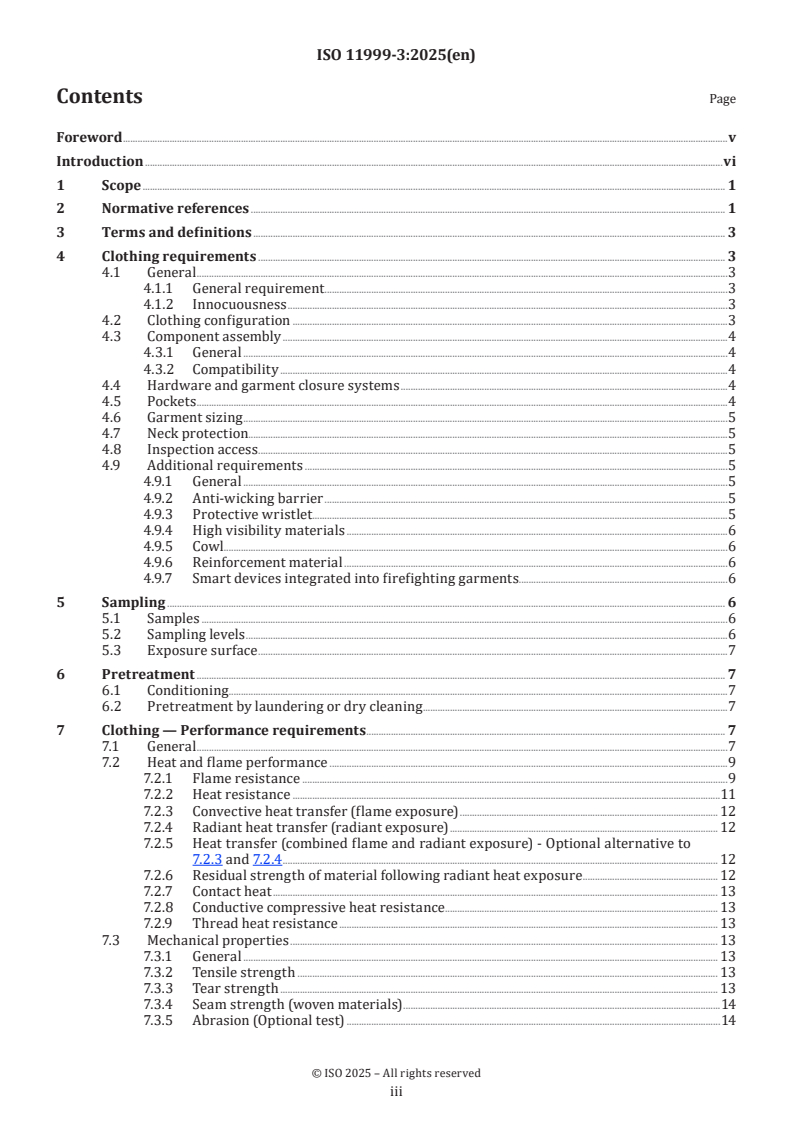
Contents Page
Foreword .v
Introduction .vi
1 Scope . 1
2 Normative references . 1
3 Terms and definitions . 3
4 Clothing requirements . 3
4.1 General .3
4.1.1 General requirement . .3
4.1.2 Innocuousness .3
4.2 Clothing configuration .3
4.3 Component assembly .4
4.3.1 General .4
4.3.2 Compatibility .4
4.4 Hardware and garment closure systems .4
4.5 Pockets .4
4.6 Garment sizing .5
4.7 Neck protection.5
4.8 Inspection access .5
4.9 Additional requirements .5
4.9.1 General .5
4.9.2 Anti-wicking barrier .5
4.9.3 Protective wristlet.5
4.9.4 High visibility materials .6
4.9.5 Cowl.6
4.9.6 Reinforcement material .6
4.9.7 Smart devices integrated into firefighting garments.6
5 Sampling . 6
5.1 Samples .6
5.2 Sampling levels .6
5.3 Exposure surface .7
6 Pretreatment . 7
6.1 Conditioning.7
6.2 Pretreatment by laundering or dry cleaning .7
7 Clothing — Performance requirements . 7
7.1 General .7
7.2 Heat and flame performance .9
7.2.1 Flame resistance .9
7.2.2 Heat resistance .11
7.2.3 Convective heat transfer (flame exposure) . 12
7.2.4 Radiant heat transfer (radiant exposure) . 12
7.2.5 Heat transfer (combined flame and radiant exposure) - Optional alternative to
7.2.3 and 7.2.4 . 12
7.2.6 Residual strength of material following radiant heat exposure . 12
7.2.7 Contact heat . 13
7.2.8 Conductive compressive heat resistance. 13
7.2.9 Thread heat resistance . 13
7.3 Mechanical properties . 13
7.3.1 General . 13
7.3.2 Tensile strength . 13
7.3.3 Tear strength . 13
7.3.4 Seam strength (woven materials) .14
7.3.5 Abrasion (Optional test) .14
iii
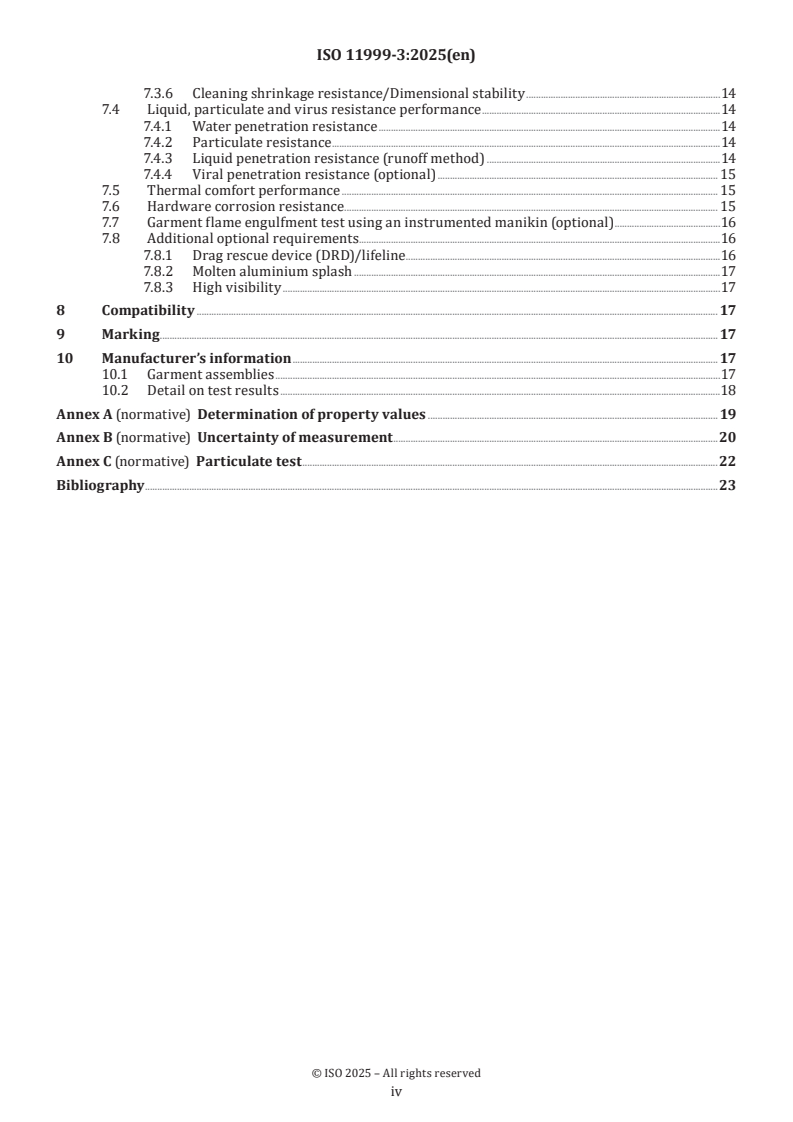
7.3.6 Cleaning shrinkage resistance/Dimensional stability .14
7.4 Liquid, particulate and virus resistance performance .14
7.4.1 Water penetration resistance .14
7.4.2 Particulate resistance .14
7.4.3 Liquid penetration resistance (runoff method) .14
7.4.4 Viral penetration resistance (optional) . 15
7.5 Thermal comfort performance . 15
7.6 Hardware corrosion resistance . 15
7.7 Garment flame engulfment test using an instrumented manikin (optional) .16
7.8 Additional optional requirements.16
7.8.1 Drag rescue device (DRD)/lifeline .16
7.8.2 Molten aluminium splash .17
7.8.3 High visibility .17
8 Compatibility . 17
9 Marking . . 17
10 Manufacturer’s information . 17
10.1 Garment assemblies .17
10.2 Detail on test results .18
Annex A (normative) Determination of property values . 19
Annex B (normative) Uncertainty of measurement .20
Annex C (normative) Particulate test .22
Bibliography .23
iv
Foreword
ISO (the International Organization for Standardization) is a worldwide federation of national standards
bodies (ISO member bodies). The work of preparing International Standards is normally carried out through
ISO technical committees. Each member body interested in a subject for which a technical committee
has been established has the right to be represented on that committee. International organizations,
governmental and non-governmental, in liaison with ISO, also take part in the work. ISO collaborates closely
with the International Electrotechnical Commission (IEC) on all matters of electrotechnical standardization.
The procedures used to develop this document and those intended for its further maintenance are described
in the ISO/IEC Directives, Part 1. In particular, the different approval criteria needed for the different types
of ISO document should be noted. This document was drafted in accordance with the editorial rules of the
ISO/IEC Directives, Part 2 (see www.iso.org/directives).
ISO draws attention to the possibility that the implementation of this document may involve the use of (a)
patent(s). ISO takes no position concerning the evidence, validity or applicability of any claimed patent
rights in respect thereof. As of the date of publication of this document, ISO had not received notice of (a)
patent(s) which may be required to implement this document. However, implementers are cautioned that
this may not represent the latest information, which may be obtained from the patent database available at
www.iso.org/patents. ISO shall not be held responsible for identifying any or all such patent rights.
Any trade name used in this document is information given for the convenience of users and does not
constitute an endorsement.
For an explanation of the voluntary nature of standards, the meaning of ISO specific terms and expressions
related to conformity assessment, as well as information about ISO's adherence to the World Trade
Organization (WTO) principles in the Technical Barriers to Trade (TBT), see www.iso.org/iso/foreword.html.
This document was prepared by Technical Committee ISO/TC 94, Personal safety — Protective clothing and
equipment, Subcommittee SC 14, Firefighters’ personal equipment.
This second edition cancels and replaces the first edition (ISO 11999-3:2015), which has been technically
revised.
The main changes are as follows:
— the design requirement have been amended and added to (e.g. cowl, high visibility, inspection access,
neck protection)
— all the heat and flame properties have been brought to amended single levels (see Table 1);
— all the mechanical properties have been brought to amended single levels (see Table 1), including adding
abrasion requirement;
— all the chemical, particulate and liquid properties have been brought to amended single levels (see
Table 1), including particulate testing;
— additional tests have been added or changed (including making optional) including but not limited to
high visibility, molten metal, drag rescue device/lifeline; resistance evaporative transfer (RET), garment
flame engulfment.
A list of all parts in the ISO 11999 series can be found on the ISO website.
Any feedback or questions on this document should be directed to the user’s national standards body. A
complete listing of these bodies can be found at www.iso.org/members.html.
v
Introduction
In a world where there is an ever-increasing focus on worker occupational health and safety, Fire Services
are faced with the dilemma of trying to provide firefighters with as safe a work environment as is reasonably
possible whilst also having to deal with the known and unknown risks our firefighters face whilst fighting
fires in both the urban and wildland environments.
In the course of their duties firefighters are exposed to many hazardous chemicals that could include smoke,
soot, carcinogens, biproducts of combustion such as heavy metals, benzene and per-fluorinated compounds
which can be inhaled, ingested, and/or absorbed through the skin of firefighters. Where possible, the level
of risk that each hazard presents to firefighters is to be eliminated or reduced to an acceptable level. The
guidance given in ISO/TR 21808 indicates how to carry out a Risk Assessment by acknowledging the hazards
that may be present, the likelihood of the firefighters becoming exposed to them and possible consequence
of such exposure if not addressed.
With the 2023 statement by the World Health Organization (WHO) elevating the classification of occupational
exposure as a firefighter to Group 1, ISO TC94 SC14 Project Group on Contaminants are taking all possible
steps to reduce the risk from exposures to firefighters by reviewing all Standards pertaining to PPE used by
firefighters and making recommendations to address identified shortfalls.
The following is an extract from the 2023 statement released by the WHO:
— International Agency for Research on Cancer (IARC), the cancer agency of the World Health Organization
(WHO), has evaluated the carcinogenicity of occupational exposure as a firefighter;
— Working Group of 25 international experts, including 3 Invited Specialists, from 8 countries was convened
by the IARC Monographs programme for a meeting in Lyon;
— After thoroughly reviewing the available scientific literature, the Working Group classified occupational
exposure as a firefighter as carcinogenic to humans (Group 1), on the basis of sufficient evidence for
cancer in humans.
ISO/TR 21808 provides guidance on how to carry out a risk assessment.
The guideline was developed previously based on the work of CEN Technical Committee TC 162, Joint
Working Group for firefighters Personal Protective Equipment and has been modified to encompass PPE
worn by all emergency service personnel. (CEN/TC 162/JWG FFPPE N 52 “Risk assessment guidelines for
choosing the PPE for firefighters”)”.
vi
International Standard ISO 11999-3:2025(en)
PPE for firefighters — Test methods and requirements for
PPE used by firefighters who are at risk of exposure to high
levels of heat and/or flame while fighting fires occurring in
structures —
Part 3:
Clothing
1 Scope
This document specifies the minimum design and performance requirements for clothing as part of personal
protective equipment (PPE) to be used by firefighters, primarily but not solely to protect against exposure
to flame and high thermal loads, and particulates (including other products of combustion).
To assist with choice based on user risk assessment, a single level of heat and flame protection is included
with a number of options that can provide additional protection. For more information on firefighter risk
assessment consult ISO/TR 21808.
The scope of this document does not include clothing for use in high-risk fire exposures where for example,
reflective protective clothing according to ISO 15538 could be more appropriate, or for use in long-term
firefighting operations in high ambient temperature, for example bush, wildland, or forest firefighting where
clothing according to ISO 15384 (ISO 16073-3) could be more appropriate.
Similarly, this document does not include clothing to protect against chemical and biological hazards, other
than against short-term and accidental exposure while engaged in firefighting and associated activities
when fighting fires occurring in structures.
This document describes types, design, and performance of clothing, the specific requirements for clothing,
marking, and manufacturer’s instructions.
2 Normative references
For the purposes of this document, the following terms and definitions given in ISO 11999-1 and ISO 19591
Personal protective equipment for firefighters – Standard terms and definitions apply
ISO 811, Textiles — Determination of resistance to water penetration — Hydrostatic pressure test
ISO 3146, Plastics — Determination of melting behaviour (melting temperature or melting range) of semi-
crystalline polymers by capillary tube and polarizing-microscope methods
ISO 3175-1, Textiles — Professional care, drycleaning and wetcleaning of fabrics and garments — Part 1:
Assessment of performance after cleaning and finishing
ISO 5077, Textiles — Determination of dimensional change in washing and drying
ISO 6330, Textiles — Domestic washing and drying procedures for textile testing
ISO 6530, Protective clothing — Protection against liquid chemicals — Test method for resistance of materials
to penetration by liquids
ISO 6942, Protective clothing — Protection against heat and fire — Method of test: Evaluation of materials and
material assemblies when exposed to a source of radiant heat
ISO 9151, Protective clothing against heat and flame — Determination of heat transmission on exposure to flame
ISO 9185, Protective clothing — Assessment of resistance of materials to molten metal splash
ISO 9227, Corrosion tests in artificial atmospheres — Salt spray tests
ISO 11092, Textiles — Physiological effects — Measurement of thermal and water-vapour resistance under
steady-state conditions (sweating guarded-hotplate test)
ISO 11999-1, PPE for firefighters — Test methods and requirements for PPE used by firefighters who are at risk
of exposure to high levels of heat and/or flame while fighting fires occurring in structures — Part 1: General
ISO 12127-1, Clothing for protection against heat and flame — Determination of contact heat transmission
through protective clothing or constituent materials — Part 1: Contact heat produced by heating cylinder
ISO 12947-2, Textiles — Determination of the abrasion resistance of fabrics by the Martindale method — Part 2:
Determination of specimen breakdown
ISO 13506-1, Protective clothing against heat and flame — Part 1: Test method for complete garments —
Measurement of transferred energy using an instrumented manikin
ISO 13506-2, Protective clothing against heat and flame — Part 2: Skin burn injury prediction — Calculation
requirements and test cases
ISO 13688:2013, Protective clothing — General requirements
ISO 13688:2013+Amd.1:2021, Protective clothing — General requirements — Amendment 1
ISO 13934-1, Textiles — Tensile properties of fabrics — Part 1: Determination of maximum force and elongation
at maximum force using the strip method
ISO 13935-2, Textiles — Seam tensile properties of fabrics and made-up textile articles — Part 2: Determination
of maximum force to seam rupture using the grab method
ISO 13937-2, Textiles — Tear properties of fabrics — Part 2: Determination of tear force of trouser-shaped test
specimens (Single tear method)
ISO 14116:2015, Protective clothing — Protection against flame — Limited flame spread materials, material
assemblies and clothing
ISO 15025:2016, Protective clothing — Protection against flame — Method of test for limited flame spread
ISO 16604, Clothing for protection against contact with blood and body fluids — Determination of resistance
of protective clothing materials to penetration by blood-borne pathogens — Test method using Phi-X 174
bacteriophage
ISO 17492, Clothing for protection against heat and flame — Determination of heat transmission on exposure to
both flame and radiant heat
ISO 17493, Clothing and equipment for protection against heat — Test method for convective heat resistance
using a hot air circulating oven
ISO/TS 20141, Personal safety — Personal protective equipment — Guidelines on compatibility testing of PPE
ISO 20471, High visibility clothing — Test methods and requirements
NFPA 1970 (1971)-2025, Standard on Protective Ensembles for Structural and Proximity Fire Fighting, Work
Apparel and Open-Circuit Self-Contained Breathing Apparatus (SCBA) for Emergency Services, and Personal
Alert Safety Systems (PASS)
ASTM F2299/F2299M 24, Standard Test Method for Determining the Initial Efficiency of Materials Used in
Medical Face Masks to Penetration by Particulates Using Latex Spheres
3 Terms and definitions
For the purposes of this document, the following terms and definitions given in ISO 11999-1 apply.
ISO and IEC maintain terminology databases for use in standardization at the following addresses:
— ISO Online browsing platform: available at https:// www .iso .org/ obp
— IEC Electropedia: available at https:// www .electropedia .org/
3.1
cowl
oversized hood shaped covering worn over a helmet attached to a garment
3.2
smart devices
functional device, which interacts with its environment, i.e. it responds or adapts to changes in the
environment
Note 1 to entry: The term “smart device” may refer to either a smart “hardware”, “textile”, or other “material” or a
“smart system”. Only the context, in which the term is used, will determine which one of the these is intended.
4 Clothing requirements
4.1 General
4.1.1 General requirement
The garment shall meet the requirements of ISO 13688 and of ISO 11999-1.
Design requirements for clothing are in 4.1 to 4.9. Sampling and pretreatment are in Clauses 5 and 6.
Performance requirements are in Clause 7, including a number of requirements that are optional (7.3.5, 7.4.4,
7.7, 7.8).
4.1.2 Innocuousness
Acceptability of materials in relation to innocuousness shall be according to ISO 13688:2013 + Amd.1:2021,
4.2 with due consideration to Note 1 and Annex F, materials shall not be made of or release substances
generally known to be toxic, carcinogenic, mutagenic, allergenic, toxic to reproduction or otherwise harmful.
4.2 Clothing configuration
Firefighters' protective clothing shall provide protection for the firefighter’s upper and lower torso, neck,
arms, and legs, but excluding the head, hands, and feet. It shall consist of a garment which can be, for example:
— a one piece protective coverall designed to cover the upper and lower torso including the neck, arms and legs,
— a protective coat and a pair of protective trousers with an overlap of sufficient length to provide
protection to the wearer (see ISO 11999-2).
Where multi-layer clothing assemblies are used to achieve the specified performance levels, the layers shall
be either permanently attached or the various layers shall be clearly labelled with a warning statement
under 9.
4.3 Component assembly
4.3.1 General
Protective garments shall consist of a component assembly that provides the necessary number and type of
layers for achieving the performance specified in this document.
Any component assembly reinforcement or padding used in high-wear or load-bearing areas, such as
pockets, cuffs, knees, elbows, and shoulders shall meet the requirements of 7.2.1.2 and 7.2.2.
NOTE The reinforcement or padding used can have a negative impact on the breathability/comfort of the garment.
Component assemblies shall have a means of securing the interlining and innermost lining, where present,
to the outer material.
4.3.2 Compatibility
The interlining and innermost layers shall extend, as a minimum, to the neckline seams, to the bottom of the
outer materials hems, and to within 25 mm of the sleeve end of the outer material.
The interlining and innermost layers shall be configured to overlap at all closures.
In all trousers, the interlining and innermost layers shall extend, as a minimum, to the waistline seam, and
to within 75 mm of the bottom outer material hems of the legs.
The ends of the interlining and innermost layers shall be attached at or adjacent to the coat sleeves or the
trouser legs. The distance between the attachment points of any mechanism used to attach the liner shall
not be greater than 25 mm, and the mechanism shall not be expandable.
Verification of the fulfilment of this requirement shall be made by visual inspection.
4.4 Hardware and garment closure systems
Hardware penetrating the outer material shall not be exposed on the innermost surface of the component
assembly.
Protective clothing shall be designed to ensure that the hardware shall not have sharp edges, roughness or
projections which are likely to cause injury to the wearer or damage to the garment.
The area of closure systems shall provide the same level of protection as the rest of the garment.
The distance between discontinuous closure system (e.g. buttonholes or press-fasteners) shall not lead to
unprotected openings in the garment. If slide fastener are used, the slide fastener shall be designed to lock
when completely closed including when using a fast release mechanism zipper. The closure system shall not
open accidentally.
Verification of the fulfilment of these requirements shall be made by manual and visual inspection.
4.5 Pockets
External pockets, where provided, shall have a means of fastening them in the closed position to prevent
entry of burning debris or water, excluding radio pockets. Dedicated radio pockets shall have a means of
draining water.
Where garments are constructed with pockets, the pockets shall be constructed to the following designs:
a) external patch pocket is a pocket made of a separate piece of outer-shell material sewn onto the outside
of a garment and shall conform to 7.2.1.2 and 7.2.2;
b) external inset pocket is a pocket made inside the garment and made of materials which shall be conform
to 7.2.1.2 and 7.2.2.
All external pocket flaps shall be capable of fastening the pocket closed. They shall be minimum of 20 mm
wider than the opening (minimum of 10 mm on each side) to prevent the flap from being tucked into the
pocket. Exceptions are allowed for radio pockets and side pockets below the waist which do not extend more
than 10° (degree) forward of the side seam.
Verification shall be checked by visual inspection and physical measurement.
NOTE Increasing the number of pockets can lead to additional weight and insulation of the garment which could
increase the physiological impact on the wearer. It could also result in the accumulation of more contaminants.
4.6 Garment sizing
Manufacturers shall develop garment sizes based on the requirements of ISO 13688 meeting the range of
anthropometric size of gender specific users.
4.7 Neck protection
The collar shall have a closure system. The collar and closure system shall meet the flame and thermal
requirements specified in 7.2.
The collar shall have a minimum height of 75 mm when measured at any point around the collar except to
within 50 mm from either side of the front closure system. The front closure area shall be permitted to have
a minimum height of 50 mm.
4.8 Inspection access
Sewn-in liners shall have inspection access which is designed to enable the inspection of all layers and/or liners.
The inspection access shall be closed by means that cannot be opened accidentally.
NOTE The inspection access provides the possibility to inspect the protective layers or liners and the various
seams. From a design perspective, it cannot be possible to check all layers or liners in all areas of the garment.
Where garments have a removable inner liner, each part shall be identified for correct reassembly.
4.9 Additional requirements
4.9.1 General
When choosing optional design elements, a suitable and sufficient risk assessment shall be carried out.
4.9.2 Anti-wicking barrier
For any anti-wicking barrier used in a garment either as part of an interlining at the edge part of a moisture
barrier or as the edge part of an innermost lining e.g. at the end of the sleeves, the trouser legs or bottom
of a jacket, the width of material shall not exceed10 cm for jackets and 15 cm for trousers. The anti-wicking
barrier shall meet the requirements of limited flame spread 7.2.1.2, 7.2.1.3.
4.9.3 Protective wristlet
Each protective garment sleeve shall have a protective wristlet or other means of protection at the wrist
which is designed with the intention of preventing the ingress of both water and burning debris.
The protective wristlets shall meet the requirements of limited flame spread 7.2.1.2, 7.2.1.3.
4.9.4 High visibility materials
4.9.4.1 General
If high-visibility materials are used, the minimum area requirements for high-visibility materials shall be as
specified in 4.9.4.2 and 4.9.4.3. Both separate-performance materials and combined-performance materials
shall meet the requirements of 7.8.
4.9.4.2 Retroreflective materials
Retroreflective material shall be attached to the outermost surface of the protective clothing with a
minimum area of not less than 0,13 m . All-around visibility shall be ensured by having at least one band
encircling each of the arms, legs, and torso regions of the garments.
4.9.4.3 Fluorescent material or combined retroreflective/fluorescent material
When fluorescent or combined retroreflective and fluorescent material is applied, the minimum area of
fluorescent material shall not be less than 0,2 m . All-around visibility shall be ensured by having at least
one band encircling each of the arms, legs, and torso regions of the garments.
4.9.5 Cowl
Where a garment may be designed with a cowl permanently fixed on the jacket or a removable cowl (different
from fire hood according to ISO 11999-9), the cowl shall be constructed meeting the requirements of the
7.2.1.2 and 7.2.2.
NOTE The use of a cowl might have a negative effect on the heat build-up or the wearer’s perception (e.g. hearing).
4.9.6 Reinforcement material
Any reinforcement material shall meet the requirements of 7.2.1.2 and 7.2.2.
4.9.7 Smart devices integrated into firefighting garments
Where smart devices are integrated (whether permanently fixed or not), the interfaced areas or areas of
interaction shall be designed so that the level of protection is maintained. Verification by visual inspection.
NOTE EN 17673 is based on ISO 11612 and ISO 13688 and how these smart devices need to be tested in
addition to the requirements covered by these standards, but also include specific electrical safety and functionality
requirements.
5 Sampling
5.1 Samples
Samples for testing in accordance with the requirements in Clause 7 shall consist of materials and
components used in the actual construction of the protective clothing. Samples that are prepared or cut
from a representative garment shall be permitted.
5.2 Sampling levels
Unless otherwise specified, the number and size of specimens for the different tests shall be in accordance
with the respective standards.
5.3 Exposure surface
In all surface tests, the outermost surface of the component assembly shall be exposed, except for flame
spread testing of the innermost lining (see 7.1) and testing for thermal comfort performance (see 7.5) when
the innermost surface is exposed.
6 Pretreatment
6.1 Conditioning
Pretreatments are done to provide uniformly treated materials for testing.
Unless otherwise specified in the specific test methods, all specimens shall be conditioned for a minimum of
24 h by exposure to a temperature of (20 ± 2) °C and a relative humidity of (65 ± 5) % prior to testing.
Unless otherwise specified in the specific methods, all specimens shall be tested within 5 min after removal
from the conditioning environment.
6.2 Pretreatment by laundering or dry cleaning
In order to ensure consistency of testing, pretreatment by laundering (one laundering cycle consisting of
one washing and one drying), or dry cleaning is done to remove contaminants, finishes, or dressings from
the manufacturing process.
NOTE Ageing and life expectancy is not to be confused with these pretreatments.
If laundering or dry-cleaning method is not specified by manufacture instructions, samples shall be
subjected to five cleaning cycles with a normal load in a front loading horizontal drum machine using non-
phosphate reference detergent No 3 in soft water in accordance with the procedures of ISO 6330 at 60 °C
normal wash (6 N). The dry procedure shall be F tumble dry at normal temperature (max 80 °C) measured
at the outlet temperature.
Materials that are labelled as dry cleanable only shall be dry cleaned five times in accordance with
ISO 3175-1. A laundry bag shall not be used.
7 Clothing — Performance requirements
7.1 General
The performance of firefighter protective clothing shall be classified in each performance category as
specified in Table 1.
Table 1 — Classification of performance
Performance property Test method Clause Pretreatment by Performance requirement
laundering or
dry-cleaning
HEAT AND FLAME
Procedure A (face exposure) and
7.2.1, 7.2.1.2
Flame resistance ISO 15025 before/after B (bottom edge exposure)
and 7.2.1.3
According to Tables 2 and 3
TTaabblle 1 e 1 ((ccoonnttiinnueuedd))
Performance property Test method Clause Pretreatment by Performance requirement
laundering or
dry-cleaning
— no melting, dripping, separa-
tion, or ignition
+8
Test at 260 °C with shrink-
Heat resistance ISO 17493 7.2.2 after
age ≤5 % for outer layer
+8
Test at 180 °C with shrink-
age ≤5 % for other layers
HTI ≥ 13
before
HTI − HTI ≥ 4
24 12
Heat transfer flame ISO 9151 7.2.3
HTI ≥ 15
after
HTI − HTI ≥ 4
24 12
RHTl ≥ 18
before
RHTl – RHTl ≥ 4
ISO 6942, Method
24 12
Heat transfer radiant 7.2.4
B at 40 kW/m
RHTl ≥ 20
after
RHTl – RHTl ≥ 4
24 12
ISO 17492 ISO 17492,
7.2.5 after ≥1 400 kJ/m
as alternative to TPI analysis pro-
ISO 9151 and ISO 6942 cedure
after pre-treatment
Residual strength fol-
with ISO 6942,
lowing radiant exposure ISO 13934-1 7.2.6 strength ≥600 N
Method A at 20 kW/
(outer material)
m
Contact heat ISO 17127-1 7.2.7 before/after ≥10 s at 260 °C
at 260 °C rating ≥13,5 s
Conductive compressive
heat resistance (rein-
with contact pressure of 55 kPa
ISO 12127-1 7.2.8 after
forced knee and shoulder
for knees and 14 kPa for shoul-
regions)
ders
Shall not, melt at
Thread heat resistance
ISO 3146 7.2.9 before +5
(garment and wristlet) 260 °C °C
MECHANICAL
Tensile strength (outer
ISO 13934-1 7.3.2 after ≥800 N
material)
Tear strength (outer ISO 13937-2,
7.3.3 after ≥40 N
material) Method B
Seam strength (structur-
ISO 13935-2 7.3.4 after ≥300 N
al seams)
Abrasion resistance
≥20 000 rubs for outer layer
(specimen breakdown ISO 12947-2 7.3.5 before
≥10 000 rubs for inner layer
point)(optional)
Shrinkage
Dimensional stability ISO 5077 7.3.6 after ≤ ±3 % (woven)
≤ ±5 % (non-woven and knitted)
CHEMICAL PARTICU-
LATE & VIRUS
Water penetration
≥175 kPa, increase at a rate of
resistance at a minimum ISO 811 7.4.1 after
(5 ± 0,05) kPa/min
this clause or 7.4.2
TTaabblle 1 e 1 ((ccoonnttiinnueuedd))
Performance property Test method Clause Pretreatment by Performance requirement
laundering or
dry-cleaning
Particulate resistance at
a minimum this clause Annex C 7.4.2 after ≥90 % filtration efficiency
or 7.4.1
No penetration to innermost sur-
Liquid penetration (run- after and according
face against two chemicals
ISO 6530 7.4.3
off method) to 7.4.3
Index repellency ≥80 %
Viral penetration resist-
ISO 16604 7.4.4 after No penetration
ance (optional)
OTHER
Thermal comfort perfor-
ISO 11092 7.5 before ≤20 m Pa/W
mance (R )
ET
Inherently corrosion resistant
ISO 9227 with material - only light surface-type
Hardware corrosion
5 % saline solu- 7.6 before corrosion or oxidation; Ferrous
resistance
tion for 20 h metals - no corrosion of base
metal
Whole garment test
TMPF ≥ 0,29
exposure to heat flux of ISO 13506-1 and
7.7 after 1 cycle
Report burn prediction and
84 kW/m for a duration ISO 13506-2
transferred energy
of 8 s (optional)
OTHER OPTIONAL RE-
QUIREMENTS
Design
DRD/lifeline assemblage mate-
Drag rescue device /
7.8.1 after rials strength ≥1 000 N with no
Lifeline (optional)
damage
Functionality test
No ignitio
...