

ISO 23616:2024
(Main)Cleaning, inspection and repair of firefighters' personal protective equipment (PPE)
General Information
- Abstract
This document provides requirements, guidance and recommendations for the cleaning, inspection, and repair of PPE for use by firefighters. This document is intended to be used by those responsible for the cleaning, inspections, and repair of firefighters PPE, however, it will also provide vital guidance to those who are responsible for establishing such a program including fire and rescue services. This document does not cover the following at this time: a) chemical protective clothing; b) PPE required for protection against chemical, biological, radiological and nuclear (CBRN) materials. The selection and use of personal protective equipment (PPE) for firefighters are covered by ISO/TR 21808.
- Status
- Published
- Publication Date
- 14-Aug-2024
- Technical Committee
- ISO/TC 94/SC 14 - Firefighters' personal equipment
- Drafting Committee
- ISO/TC 94/SC 14 - Firefighters' personal equipment
- Current Stage
- 6060 - International Standard published
- Start Date
- 15-Aug-2024
- Due Date
- 22-Sep-2025
- Completion Date
- 15-Aug-2024

Overview
ISO 23616:2024 - Cleaning, inspection and repair of firefighters' personal protective equipment (PPE) - is an international standard that establishes requirements, guidance and recommendations for maintaining firefighters’ PPE. Published in 2024 (Second edition), the standard is intended for those who perform or manage cleaning, inspection and repair activities and for organizations (e.g., fire and rescue services) that establish PPE maintenance programmes. It excludes chemical protective clothing and PPE for CBRN hazards. For PPE selection and use see ISO/TR 21808.
Key topics and technical requirements
ISO 23616:2024 covers a comprehensive set of technical topics, including:
- General principles: scope, terms, innocuousness (safety of procedures) and management system considerations.
- Inspection: definitions and procedures for routine and advanced inspection, plus periodic fit‑for‑purpose testing.
- Cleaning and decontamination: requirements for routine cleaning, advanced cleaning, contamination handling and recommended cleaning procedures.
- Repair: guidance on basic and advanced repairs for garments, moisture barriers, hardware, reflective trim and more.
- Component‑level guidance: tailored requirements for garments, gloves, helmets, footwear, fire hoods and respiratory protective devices (RPDs) - including inspection, cleaning, drying and repair sub‑procedures.
- Records and reporting: documentation practices, traceability and procedures for reporting PPE health and safety concerns.
- Management systems: establishing a program, roles/responsibilities, training and quality controls to ensure innocuousness and consistent outcomes.
These elements emphasize safety, traceability and prolonging service life while maintaining protective performance.
Applications and who uses it
ISO 23616:2024 is practical for:
- Fire and rescue services establishing or improving PPE maintenance programmes.
- PPE technicians and laundries that clean, inspect and repair firefighting gear.
- Procurement and fleet managers who set maintenance specifications and contracts.
- Health & safety officers responsible for compliance, incident response and PPE lifecycle management. Practical benefits include improved firefighter safety, reduced failure risk, standardized cleaning/repair methods, regulatory alignment and better lifecycle cost control.
Related standards
- ISO/TR 21808 - Selection and use of personal protective equipment for firefighters (referenced for PPE selection guidance).
Keywords: ISO 23616:2024, cleaning firefighters PPE, inspection PPE, repair firefighters' PPE, decontamination, PPE maintenance program, fire and rescue services.
Relations
- Effective Date
- 24-Sep-2022
Get Certified
Connect with accredited certification bodies for this standard

CIS Institut d.o.o.
Personal Protective Equipment (PPE) certification body. Notified Body NB-2890 for EU Regulation 2016/425 PPE.

Kiwa BDA Testing
Building and construction product certification.
Kmetijski inštitut Slovenije
Agricultural Institute of Slovenia. Soil testing, plant health, agricultural product analysis.
Sponsored listings
Frequently Asked Questions
ISO 23616:2024 is a standard published by the International Organization for Standardization (ISO). Its full title is "Cleaning, inspection and repair of firefighters' personal protective equipment (PPE)". This standard covers: This document provides requirements, guidance and recommendations for the cleaning, inspection, and repair of PPE for use by firefighters. This document is intended to be used by those responsible for the cleaning, inspections, and repair of firefighters PPE, however, it will also provide vital guidance to those who are responsible for establishing such a program including fire and rescue services. This document does not cover the following at this time: a) chemical protective clothing; b) PPE required for protection against chemical, biological, radiological and nuclear (CBRN) materials. The selection and use of personal protective equipment (PPE) for firefighters are covered by ISO/TR 21808.
This document provides requirements, guidance and recommendations for the cleaning, inspection, and repair of PPE for use by firefighters. This document is intended to be used by those responsible for the cleaning, inspections, and repair of firefighters PPE, however, it will also provide vital guidance to those who are responsible for establishing such a program including fire and rescue services. This document does not cover the following at this time: a) chemical protective clothing; b) PPE required for protection against chemical, biological, radiological and nuclear (CBRN) materials. The selection and use of personal protective equipment (PPE) for firefighters are covered by ISO/TR 21808.
ISO 23616:2024 is classified under the following ICS (International Classification for Standards) categories: 13.340.10 - Protective clothing. The ICS classification helps identify the subject area and facilitates finding related standards.
ISO 23616:2024 has the following relationships with other standards: It is inter standard links to ISO 23616:2022. Understanding these relationships helps ensure you are using the most current and applicable version of the standard.
ISO 23616:2024 is available in PDF format for immediate download after purchase. The document can be added to your cart and obtained through the secure checkout process. Digital delivery ensures instant access to the complete standard document.
Standards Content (Sample)
International
Standard
ISO 23616
Second edition
Cleaning, inspection and repair of
2024-08
firefighters' personal protective
equipment (PPE)
Nettoyage, inspection et réparation des équipements de
protection individuelle (PPE) des pompiers
Reference number
© ISO 2024
All rights reserved. Unless otherwise specified, or required in the context of its implementation, no part of this publication may
be reproduced or utilized otherwise in any form or by any means, electronic or mechanical, including photocopying, or posting on
the internet or an intranet, without prior written permission. Permission can be requested from either ISO at the address below
or ISO’s member body in the country of the requester.
ISO copyright office
CP 401 • Ch. de Blandonnet 8
CH-1214 Vernier, Geneva
Phone: +41 22 749 01 11
Email: copyright@iso.org
Website: www.iso.org
Published in Switzerland
ii
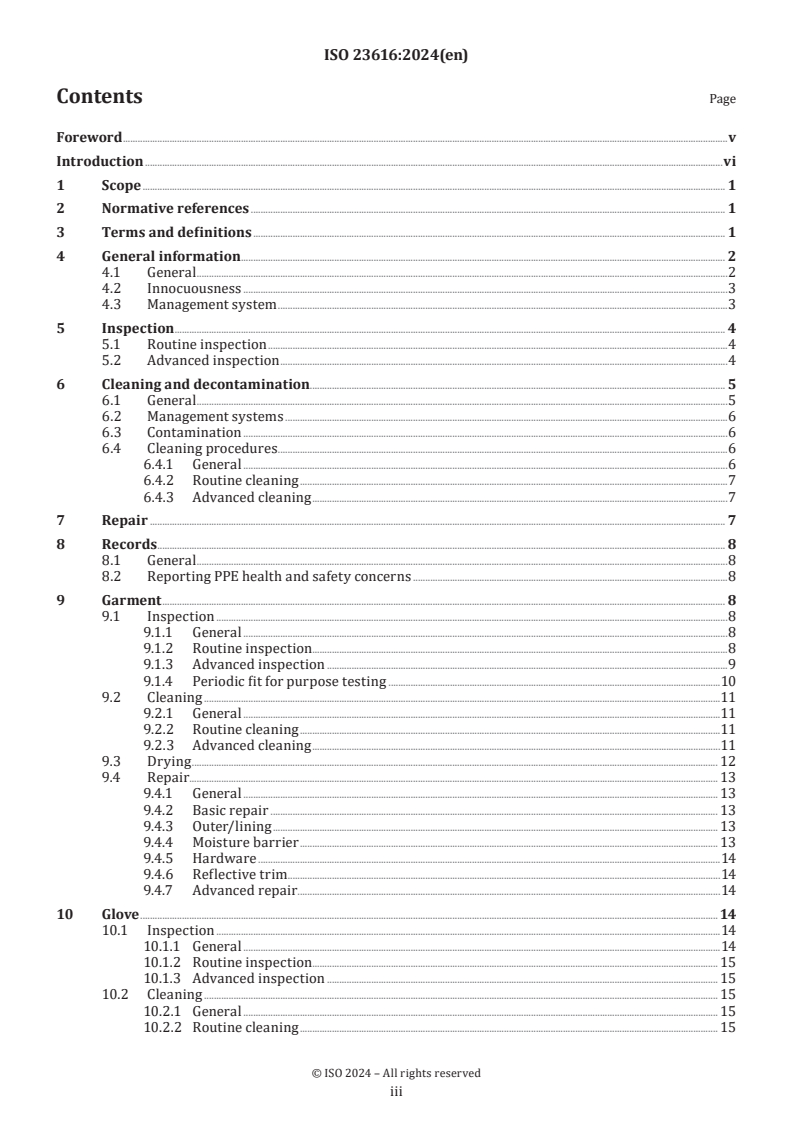
Contents Page
Foreword .v
Introduction .vi
1 Scope . 1
2 Normative references . 1
3 Terms and definitions . 1
4 General information . 2
4.1 General .2
4.2 Innocuousness .3
4.3 Management system .3
5 Inspection . 4
5.1 Routine inspection .4
5.2 Advanced inspection .4
6 Cleaning and decontamination. 5
6.1 General .5
6.2 Management systems .6
6.3 Contamination .6
6.4 Cleaning procedures .6
6.4.1 General .6
6.4.2 Routine cleaning .7
6.4.3 Advanced cleaning .7
7 Repair . 7
8 Records . . 8
8.1 General .8
8.2 Reporting PPE health and safety concerns .8
9 Garment . 8
9.1 Inspection .8
9.1.1 General .8
9.1.2 Routine inspection .8
9.1.3 Advanced inspection .9
9.1.4 Periodic fit for purpose testing .10
9.2 Cleaning .11
9.2.1 General .11
9.2.2 Routine cleaning .11
9.2.3 Advanced cleaning .11
9.3 Drying . 12
9.4 Repair. 13
9.4.1 General . 13
9.4.2 Basic repair . 13
9.4.3 Outer/lining . 13
9.4.4 Moisture barrier . 13
9.4.5 Hardware .14
9.4.6 Reflective trim.14
9.4.7 Advanced repair . .14
10 Glove . 14
10.1 Inspection .14
10.1.1 General .14
10.1.2 Routine inspection . 15
10.1.3 Advanced inspection . 15
10.2 Cleaning . 15
10.2.1 General . 15
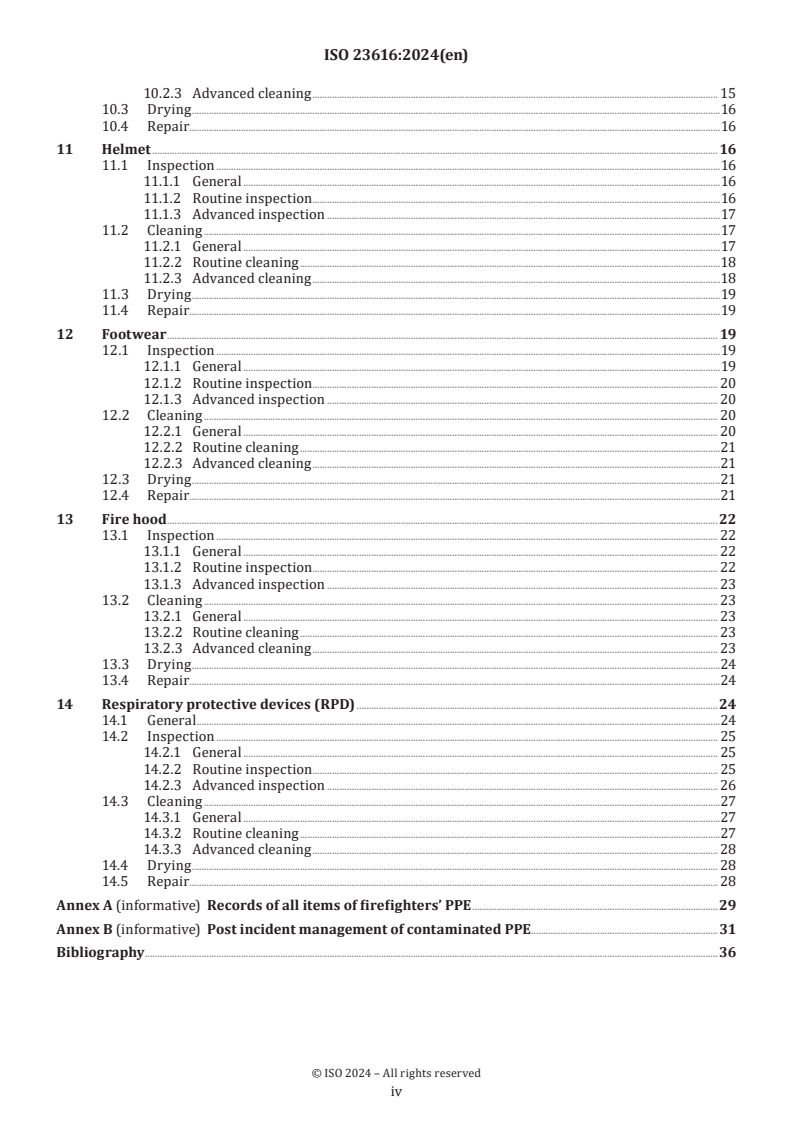
10.2.2 Routine cleaning . 15
iii
10.2.3 Advanced cleaning . 15
10.3 Drying .16
10.4 Repair.16
11 Helmet . 16
11.1 Inspection .16
11.1.1 General .16
11.1.2 Routine inspection .16
11.1.3 Advanced inspection .17
11.2 Cleaning .17
11.2.1 General .17
11.2.2 Routine cleaning .18
11.2.3 Advanced cleaning .18
11.3 Drying .19
11.4 Repair.19
12 Footwear . 19
12.1 Inspection .19
12.1.1 General .19
12.1.2 Routine inspection . 20
12.1.3 Advanced inspection . 20
12.2 Cleaning . 20
12.2.1 General . 20
12.2.2 Routine cleaning .21
12.2.3 Advanced cleaning .21
12.3 Drying .21
12.4 Repair.21
13 Fire hood .22
13.1 Inspection . 22
13.1.1 General . 22
13.1.2 Routine inspection . 22
13.1.3 Advanced inspection . 23
13.2 Cleaning . 23
13.2.1 General . 23
13.2.2 Routine cleaning . 23
13.2.3 Advanced cleaning . 23
13.3 Drying .24
13.4 Repair.24
14 Respiratory protective devices (RPD) .24
14.1 General .24
14.2 Inspection . 25
14.2.1 General . 25
14.2.2 Routine inspection . 25
14.2.3 Advanced inspection . 26
14.3 Cleaning .27
14.3.1 General .27
14.3.2 Routine cleaning .27
14.3.3 Advanced cleaning . 28
14.4 Drying . 28
14.5 Repair. 28
Annex A (informative) Records of all items of firefighters’ PPE .29
Annex B (informative) Post incident management of contaminated PPE .31
Bibliography .36
iv
Foreword
ISO (the International Organization for Standardization) is a worldwide federation of national standards
bodies (ISO member bodies). The work of preparing International Standards is normally carried out through
ISO technical committees. Each member body interested in a subject for which a technical committee
has been established has the right to be represented on that committee. International organizations,
governmental and non-governmental, in liaison with ISO, also take part in the work. ISO collaborates closely
with the International Electrotechnical Commission (IEC) on all matters of electrotechnical standardization.
The procedures used to develop this document and those intended for its further maintenance are described
in the ISO/IEC Directives, Part 1. In particular, the different approval criteria needed for the different types
of ISO document should be noted. This document was drafted in accordance with the editorial rules of the
ISO/IEC Directives, Part 2 (see www.iso.org/directives).
ISO draws attention to the possibility that the implementation of this document may involve the use of (a)
patent(s). ISO takes no position concerning the evidence, validity or applicability of any claimed patent
rights in respect thereof. As of the date of publication of this document, ISO had not received notice of (a)
patent(s) which may be required to implement this document. However, implementers are cautioned that
this may not represent the latest information, which may be obtained from the patent database available at
www.iso.org/patents. ISO shall not be held responsible for identifying any or all such patent rights.
Any trade name used in this document is information given for the convenience of users and does not
constitute an endorsement.
For an explanation of the voluntary nature of standards, the meaning of ISO specific terms and expressions
related to conformity assessment, as well as information about ISO's adherence to the World Trade
Organization (WTO) principles in the Technical Barriers to Trade (TBT), see www.iso.org/iso/foreword.html.
This document was prepared by Technical Committee ISO/TC 94, Personal safety — Personal protective
equipment, Subcommittee SC 14, Firefighters' personal equipment.
This second edition cancels and replaces the first edition (ISO 23616:2022), which has been technically
revised.
The main changes are as follows:
— editorial changes throughout the document.
Any feedback or questions on this document should be directed to the user’s national standards body. A
complete listing of these bodies can be found at www.iso.org/members.html.
v
Introduction
The purpose of this document is to provide the requirements, guidance, and recommendations, and establish
criteria regarding the cleaning, inspection, and repair of firefighters' personal protective equipment (PPE).
This document has been developed in response to growing concerns about contaminated PPE and potential
health hazards for firefighters. Fire and rescue services, and the manufacturers of PPE, want to provide
instructions and guidance to effectively minimize and manage this risk.
Following the designation by the World Health Organization of firefighting as an at risk occupation from
cancer, the intent of this document is to consider all technologies for decontaminating and cleaning
firefighters PPE, including all new technologies, i.e LC0 processes.
It is the responsibility of the firefighter (initially and ongoing) to undertake regular inspections of their
PPE, and there should also be a reliable system/mechanism, (including training), to ensure that this can be
achieved effectively.
This document also provides instruction and guidance to fire and rescue services regarding more advanced
cleaning, inspection and repair.
vi
International Standard ISO 23616:2024(en)
Cleaning, inspection and repair of firefighters' personal
protective equipment (PPE)
1 Scope
This document provides requirements, guidance and recommendations for the cleaning, inspection, and
repair of PPE for use by firefighters.
This document is intended to be used by those responsible for the cleaning, inspections, and repair of
firefighters PPE, however, it will also provide vital guidance to those who are responsible for establishing
such a program including fire and rescue services.
This document does not cover the following at this time:
a) chemical protective clothing;
b) PPE required for protection against chemical, biological, radiological and nuclear (CBRN) materials.
The selection and use of personal protective equipment (PPE) for firefighters are covered by ISO/TR 21808.
2 Normative references
The following documents are referred to in the text in such a way that some or all of their content constitutes
requirements of this document. For dated references, only the edition cited applies. For undated references,
the latest edition of the referenced document (including any amendments) applies.
ISO/TS 16975-1, Respiratory protective devices — Selection, use and maintenance — Part 1: Establishing and
implementing a respiratory protective device programme
ISO/TS 16975-2, Respiratory protective devices — Selection, use and maintenance — Part 2: Condensed
guidance to establishing and implementing a respiratory protective device programme
ISO/TR 19591, Personal protective equipment for firefighters — Standard terms and definitions
ISO/TR 21808, Best practices on the selection and use of personal protective equipment (PPE) designed to
provide protection for firefighters
3 Terms and definitions
For the purposes of this document, the following terms and definitions given in ISO/TR 19591, ISO/TR 21808
and the following apply.
ISO and IEC maintain terminological databases for use in standardization at the following addresses:
— ISO Online browsing platform: available at http:// www .iso .org/ obp
— IEC Electropedia: available at http:// www .electropedia .org/
3.1
advanced cleaning
cleaning by the product manufacturer, the manufacturers approved organization, a specialized competent
organization, or mutually agreed competent organization when a PPE item has been, or is potentially
exposed to a hazardous or dangerous contaminant
Note 1 to entry: CBRN contaminated PPE are to be disposed of not cleaned. PPE should be disposed of following local
laws and regulations.
Note 2 to entry: Some known chemicals are commercially available for industrial use. PPE that have been exposed to
known chemicals may not have to be disposed of. Specialist advice shall be sought on the contamination, however, the
PPE shall be treated in the first instance as if the contamination is unknown.
Note 3 to entry: The decision to decontaminate or dispose of PPE shall be made following a detailed risk assessment.
3.2
advanced inspection
inspection to ensure PPE is fit for purpose before return to use looking at all aspects of the PPE (e.g. inside,
outside, defects, wear and tear, need for repairs or disposal)
3.3
competent organization
organization that is experienced in the inspection, cleaning, maintainance or repair of firefighters PPE
3.4
contaminant
undesirable solid, liquid, gaseous or particulate hazardous substance such as
a) products of combustion (e.g. soot),
b) body fluids,
c) infectious micro-organisms, and
d) chemicals (e.g. asbestos or respirable fibres, flammable, corrosive, carcinogenic, mutagenic, toxic or
sensitizing substances)
3.5
contaminated PPE
any PPE that has been exposed to a contaminant (3.4)
3.6
repair
rectification of defects identified in PPE so that the required level of protection is re-established
3.7
routine cleaning
periodic cleaning conducted by the user as per manufacturers or suppliers’ instructions
3.8
routine inspection
superficial inspections by user of their PPE upon issue, or after return from cleaning or repair, and after
each use
4 General information
4.1 General
Any PPE provided to a firefighter shall be maintained in efficient working order and good repair. During
cleaning, inspection and repair, alternative PPE shall be provided to ensure continually operational
availability of the firefighter.
Every firefighter shall ensure that any PPE provided to them is clean, in optimum working order and in good
repair before being used.
When an item of PPE needs to be cleaned or repaired, the fire and rescue service shall ensure that suitable
replacement PPE is made available.
The fire and rescue service shall ensure that its firefighters, service providers or members of the public are
not unnecessarily exposed to soiled or potentially contaminated PPE.
An effective cleaning, inspection and repair system includes the following:
a) inspection — checking for faults, damage, wear and tear, dirt, etc.;
b) cleaning — including disinfection and decontamination if appropriate;
c) repair;
d) replacement;
e) recording.
f) testing — to ensure PPE is operating as intended;
4.2 Innocuousness
Any cleaning, repair or maintenance carried out on firefighting PPE shall not impact the innocuousness of
that PPE.
See ISO 13688:2013, 4.2 and ISO 13688:2013/Amd.1:2021, 4.2, and ISO 21420 and
ISO 21420:2020/Amd.1:2022, 4.2.
4.3 Management system
All routine PPE cleaning and inspection shall be carried out according to the manufacturers or supplier’s
instructions and shall be conducted by a competent firefighter or competent person or competent
organization, such as a PPE manufacturer, a competent laundry or other competent organization.
All advanced PPE cleaning, inspection and repair shall be carried out by a competent organization. Training
shall be provided by the PPE manufacturers or suppliers of the same PPE item to the competent person or
organization undertaking the advanced cleaning, inspection, and repair.
The competent organization responsible for cleaning, inspection and repair, shall develop and implement
a program for the care and maintenance of PPE used by the members of the fire and rescue service in the
performance of their assigned functions.
The program shall provide sufficient PPE to maintain service continuity during cleaning inspection and repair.
This program shall have the goals of providing instruction and guidance to the suitable cleaning, inspection
and repair of PPE for its intended use, through:
a) Maintaining such PPE in a safe, usable condition to provide the intended protection to the firefighter.
b) Removing from use any PPE that could cause or contribute to firefighter injury or health issues.
c) Reconditioning, repairing, or retiring such PPE as necessary.
The competent organization shall develop and provide specific criteria for removal of PPE considered to be
not fit for purpose or beyond economic repair.
When handling PPE prior to cleaning, those handling the PPE shall observe appropriate health and safety
precautions to protect them from any contaminants. Cross contamination shall be avoided at every stage of
the process, especially during routine cleaning and inspection.
All firefighter PPE that is found or suspected to be soiled or contaminated shall be cleaned or decontaminated
before any additional inspection and/or repair is initiated.
All repairs shall be carried out in accordance with manufacturer’s instructions by competent organizations.
All PPE that is found or suspected to be soiled or contaminated shall be cleaned or decontaminated before
any additional inspection is initiated.
As a minimum, advanced cleaning (see 6.4.3) and advance inspection (see 5.2) shall be carried out as
required and at least once per year.
5 Inspection
5.1 Routine inspection
Individual firefighters shall conduct routine inspections of their PPE upon issue and after each use, cleaning
and/or repair. These checks shall be carried out by the firefighters before and after each use to identify any
defects before being exposed to hazardous situations.
There shall be clear criteria and instructions provided to the firefighters for when and how to send PPE for
cleaning and inspection. The instructions shall include details of how to prevent cross contamination and
how those transporting or receiving these items can be protected.
The inspection criteria shall be selected based on the potential consequence and may include:
If the abnormality is
a) minor: take no action,
b) moderate: send for repair, and
c) major: prohibit use, major repair or discard and replace.
5.2 Advanced inspection
Advanced cleaning shall be carried out prior to advanced inspection.
Any advanced inspection shall be carried out according to the manufacturer’s instructions by competent
firefighters, competent persons or competent organizations.
The PPE manufacturer, or supplier, or competent organization shall determine the level of training required
to perform advanced inspections. They shall maintain records of such training.
If the competent organization is endorsed to provide training, it shall be permitted to determine the level of
training necessary to perform the inspection.
Advanced inspections of all PPE which has been issued shall be conducted at a minimum of every 12 months,
or whenever routine inspections indicate that a problem could exist. PPE which has been properly stored
according to the manufacturer’s instruction and are not being used are not required to be subjected to
advanced inspection.
New PPE, that have been stored in accordance with manufacturer’s instructions, are not required to be
subjected to advanced inspection.
The findings of the inspection shall be recorded, see Clause 8.
6 Cleaning and decontamination
6.1 General
Firefighters shall evaluate and determine the required cleaning level (routine cleaning or advanced cleaning)
in accordance with the procedures of a competent organization.
Firefighters shall distinguish between appropriate cleaning levels by reference to the following factors:
a) soiling:
— soiling in regular use require hygienic cleaning.
b) contamination:
— biological contamination (e.g. blood);
— fire contamination due to combustion products during fire (e.g. smoke, soot);
— chemical contamination (e.g. oil, grease, battery acid);
— unidentified CBRN agents;
— soiling due to other activities not listed above.
The cleaning methods are determined in 6.4.2 and 6.4.3.
PPE contaminated unintentionally by unidentified CBRN agents shall be destroyed in accordance with local
laws and legislation after confirmed exposure and shall not be subjected to cleaning or decontamination.
Some known chemicals are commercially available for industrial use. PPE that has been exposed to known
chemicals may not have to be disposed of. Specialist advice shall be sought on the contamination. The
PPE shall be isolated until the contamination is identified and an appropriate decontamination process is
identified. The decision regarding decontamination shall be made following a detailed risk assessment.
Only competent organization persons shall be responsible for performing or managing advanced cleaning of
PPE contaminated with hazardous materials.
Contaminated PPE shall not be brought into the home or transported in fire apparatus cabs or passenger
compartments within personal vehicles. It is recommended that a procedure be established within the fire
service whereby contaminated PPE is removed from the body as soon as possible after the intervention and
packed in a vapour-proof and puncture resistant bag/container. Where cleaning of PPE is required, guidance
shall be provided to the firefighter by the fire and rescue service on how to identify contamination, as
opposed to soiling, and on how best to clean the PPE in a safe and effective manner.
Commercial dry cleaning shall not be used as the means of cleaning or decontaminating PPE unless approved
by the PPE manufacturer.
When an organization is used for cleaning or decontamination, they shall demonstrate to the fire and rescue
service’s satisfaction that the procedures are effective and do not degrade the intrinsic qualities of the item,
the materials used in the construction of the item, or the level of performance of the PPE.
Consideration shall be taken of all new technologies for improving the efficacy of cleaning PPE. These
considerations shall also take into account any impact in the performance of the PPE.
When conducting a cleaning with cleaning chemicals, the operator shall be aware of the safety data sheet
and act accordingly by wearing the appropriate PPE.
Waste waters discharged from the laundry process and its environmental effects shall be considered and
shall conform to local laws and/or national regulations when discharging waste waters or effluent to public
drainage or waterways.
6.2 Management systems
The competent organizations shall provide the means for having PPE cleaned and decontaminated.
Fire and rescue services shall have written procedures that detail decontamination and cleaning processes
for contaminated PPE. These procedures shall:
a) Minimize the risk of contamination to all people from exposure to contaminated garments/firefighting PPE.
b) Require that PPE not be worn or stored in the non-operational living areas of the fire and rescue service
facilities.
c) Ensure PPE be stored in a correctly lit, ventilated and dedicated storage room, which is isolated from
any other section of the fire station.
d) Provide training in identifying contamination and determining the cleaning methods (routine and
advanced cleaning) to be applied. PPE known or suspected to be contaminated by hazardous materials
shall be assessed at the incident to determine the appropriate level of treatment.
Items shall be prepared for safe transportation. For further guidance, see Annex B on post incident
management of contaminated PPE.
Contaminated or potentially contaminated PPE should not be worn or taken into the cabin of the fire
appliance/truck. Where this is unavoidable, the cabin of the fire appliance/truck shall be cleaned and
decontaminated at the first possible opportunity once firefighting operations have ceased.
When firefighters are combating a moving wildland fire, they are often required to move on an ongoing
basis during firefighting operations with no opportunity to change PPE, therefore the PPE shall be cleaned
at the first possible opportunity, this may be at the end of an allocated shift.
Where possible and where the contaminant and its source have been identified, the competent organization
shall consult the supplier of the contaminant and the manufacturer of the PPE for an appropriate
decontamination agent and process.
6.3 Contamination
Cleaning requirements will be dictated by contaminant and exposure. Soiling due to normal wear shall
require routine cleaning to be undertaken. Biological, product of combustion and chemical contamination
shall require advanced cleaning. The cleaning levels are described in 6.4.2 and 6.4.3.
PPE contaminated by unidentified CBRN agents shall be destroyed in accordance with local laws and
legislation after confirmed exposure and shall not be subjected to cleaning or decontamination.
6.4 Cleaning procedures
6.4.1 General
The member(s) of the competent organization who has received training in the cleaning of PPE shall be
responsible for performing or managing advanced cleaning of PPE contaminated with hazardous materials.
When cleaning or decontamination is completed, there shall be a method to periodically demonstrate to the
fire and rescue service’s satisfaction that the procedures are effective, do not degrade the intrinsic qualities
of the materials and the level of performance of the PPE. As it is impossible to identify or to quantify all the
existing pollutants, a generalized cleaning method that can clean as many pollutants as possible shall be
used to clean all the PPE.
Waste waters discharged from laundry process and its environmental effects shall be considered. Refer
to local laws and/or national regulations when discharging waste waters or effluent to public drainage or
waterways.
6.4.2 Routine cleaning
Routine cleaning includes
a) hygienic cleaning, and
b) partial cleaning completed by fire fighter (e.g. brushing of clothing).
Firefighters shall ensure that their PPE is cleaned routinely and as required. The routine cleaning shall
be done by a trained and competent person. The routine cleaning shall be carried out according to the
manufacturer’s or supplier’s instructions.
6.4.3 Advanced cleaning
Any advanced cleaning shall be carried out by competent firefighters or competent organization according
to the manufacturer’s instructions.
Before advanced cleaning is undertaken advice shall be taken on whether the contaminant can be removed.
Advance cleaning includes
a) decontamination from chemical contamination,
b) decontamination from biological contamination, and
c) decontamination from contamination due to products of combustion.
Items contaminated by unidentified CBRN must be
...