


ISO/FDIS 29601
(Main)Paints and varnishes — Corrosion protection by protective paint systems — Assessment of porosity in a dry film
Paints and varnishes — Corrosion protection by protective paint systems — Assessment of porosity in a dry film
ISO 29601:2011 specifies procedures for detecting the presence of porosity in a protective paint system of any thickness on a steel or other metallic substrate. The procedures given are based on methods using two different types of test equipment, the choice of equipment depending on the dry film thickness. These procedures are only applicable to the testing of electrically non-conductive parts of a paint system. The test methods specified are mainly intended for use with new coatings, but can also be used for coatings which have been in service for some time. In the latter case, it is important to bear in mind that the coating might have been penetrated by substances in contact with the coating during service.
Peintures et vernis — Anticorrosion par systèmes de peinture — Évaluation de la porosité d'un feuil sec
L'ISO 29601:2011 spécifie des modes opératoires permettant de détecter l'existence de porosité dans un système de revêtement de peinture, quelle qu'en soit l'épaisseur, appliqué sur un subjectile en acier ou sur tout autre métal. Les modes opératoires fournis dans la présente Norme internationale sont basés sur des méthodes faisant appel à deux types d'équipement d'essai, le choix de l'équipement étant fonction de l'épaisseur du feuil sec. Ces modes opératoires ne s'appliquent qu'aux essais des couches électriquement non conductrices d'un système de peinture. Les méthodes d'essai spécifiées sont destinées principalement aux revêtements neufs mais peuvent aussi être employées pour les revêtements déjà mis en service. Dans ce dernier cas, il est important de garder à l'esprit le fait que des substances en contact avec le revêtement ont pu y pénétrer pendant la période en service.
General Information
- Status
- Not Published
- Technical Committee
- ISO/TC 35/SC 14 - Protective paint systems for steel structures
- Drafting Committee
- ISO/TC 35/SC 14 - Protective paint systems for steel structures
- Current Stage
- 5020 - FDIS ballot initiated: 2 months. Proof sent to secretariat
- Start Date
- 29-Jan-2026
- Completion Date
- 29-Jan-2026
Relations
- Effective Date
- 12-Feb-2026
- Effective Date
- 06-Jun-2022
- Effective Date
- 06-Jun-2022
Overview
ISO/FDIS 29601, titled Paints and varnishes - Corrosion protection by protective paint systems - Assessment of porosity in a dry film, is an international standard developed by ISO Technical Committee ISO/TC 35/SC 14. This standard specifies procedures for detecting porosity in protective paint systems applied to steel or other metallic substrates. Porosity assessment is crucial for ensuring the integrity and corrosion protection performance of coatings, especially on electrically conductive materials.
The document details two primary methods for porosity detection based on the dry film thickness and the electrical conductivity characteristic of the coating: low-voltage pinhole detection and high-voltage holiday detection. The standard applies mainly to electrically non-conductive parts of paint systems and is suitable for both new and in-service coatings.
Key Topics
Porosity Definition and Importance
Porosity refers to the presence of one or more discontinuities such as pinholes, voids, cracks, or thin spots in a protective coating that reduce its dielectric strength and protective abilities. Detecting these discontinuities is essential for maintaining coating durability and protecting metal substrates from corrosion.Test Methods
- Low-Voltage Pinhole Detection: Uses a wet sponge moistened with tap water to conduct low voltage (9 V or 90 V) electrical current through any discontinuities detected in the coating. This method is suited for thinner coatings and employs a battery-operated device with visual or audible alarms.
- High-Voltage Holiday Detection: Employs adjustable high-voltage output (ranging from 1 kV to 35 kV) to detect breakdowns caused by defects in thicker coatings. This method relies on the dielectric strength of the coating and can identify discontinuities via electrical breakdown.
Equipment Verification and Calibration
Both testing methods require verification of the functionality of the detector equipment, including confirming output voltage and alarms, as well as optionally using known artificial defects to ensure accurate readings.Test Voltage Selection
The appropriate test voltage depends on the dry film thickness of the coating and is critical to avoid damage while ensuring accurate porosity detection. Guidance tables are included in the standard for voltage settings associated with different coating thickness ranges.Application Scope
The standard is applicable primarily to new protective paint systems but can also be applied to aged coatings with caution since service exposure may influence coating porosity characteristics.
Applications
Corrosion Protection Assessment
ISO 29601 assists manufacturers, inspectors, and quality control professionals in reliably detecting porosity to prevent corrosion in steel structures, pipelines, marine vessels, bridges, and industrial equipment.Quality Control in Coating Processes
By implementing the procedures specified in this standard, coating applicators can verify the integrity of protective layers immediately after application, enhancing durability and performance warranties.Maintenance and Service Inspections
Inspectors can utilize these test methods to assess the condition of coatings in service to plan maintenance, detect coating degradation, and prevent substrate exposure.Compliance with International Standards
The standard complements the ISO 12944 series on corrosion protection and aligns with other related standards addressing thickness measurement and adhesion testing, facilitating a comprehensive coating quality evaluation program.
Related Standards
ISO 12944 Series - Covers corrosion protection of steel structures by protective paint systems, including design, application, and maintenance.
ISO 19840:2012 - Specifies measurement methods for dry film thickness on rough surfaces.
ISO 16276-1 and ISO 16276-2 - Focus on adhesion testing of coatings via pull-off and cross-cut methods respectively.
ISO/IEC Directives Part 1 and Part 2 - Outline the rules and procedures for drafting and maintaining ISO standards.
Keywords: ISO 29601, corrosion protection, protective paint systems, porosity detection, paint porosity assessment, low-voltage pinhole detection, high-voltage holiday detection, dry film thickness, coating integrity, metallic substrates, quality control, corrosion prevention standards, paint system testing.


ISO/FDIS 29601 - Paints and varnishes — Corrosion protection by protective paint systems — Assessment of porosity in a dry film Released:15. 01. 2026

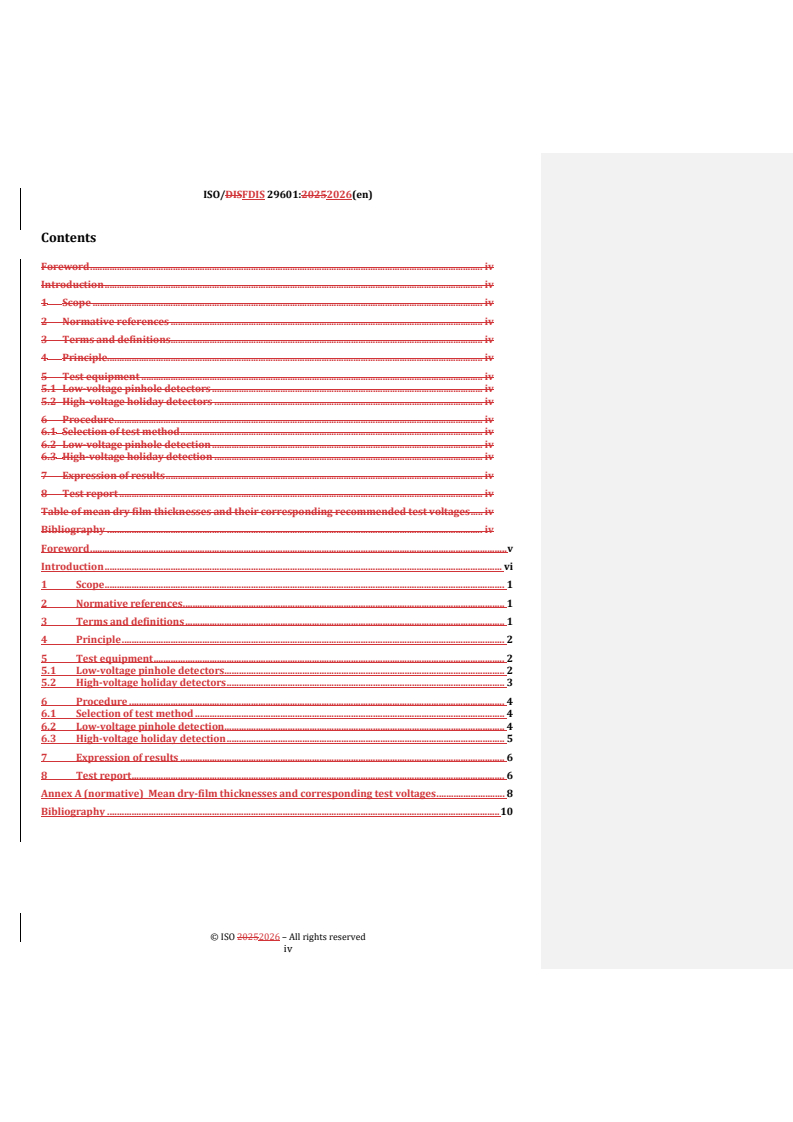
REDLINE ISO/FDIS 29601 - Paints and varnishes — Corrosion protection by protective paint systems — Assessment of porosity in a dry film Released:15. 01. 2026

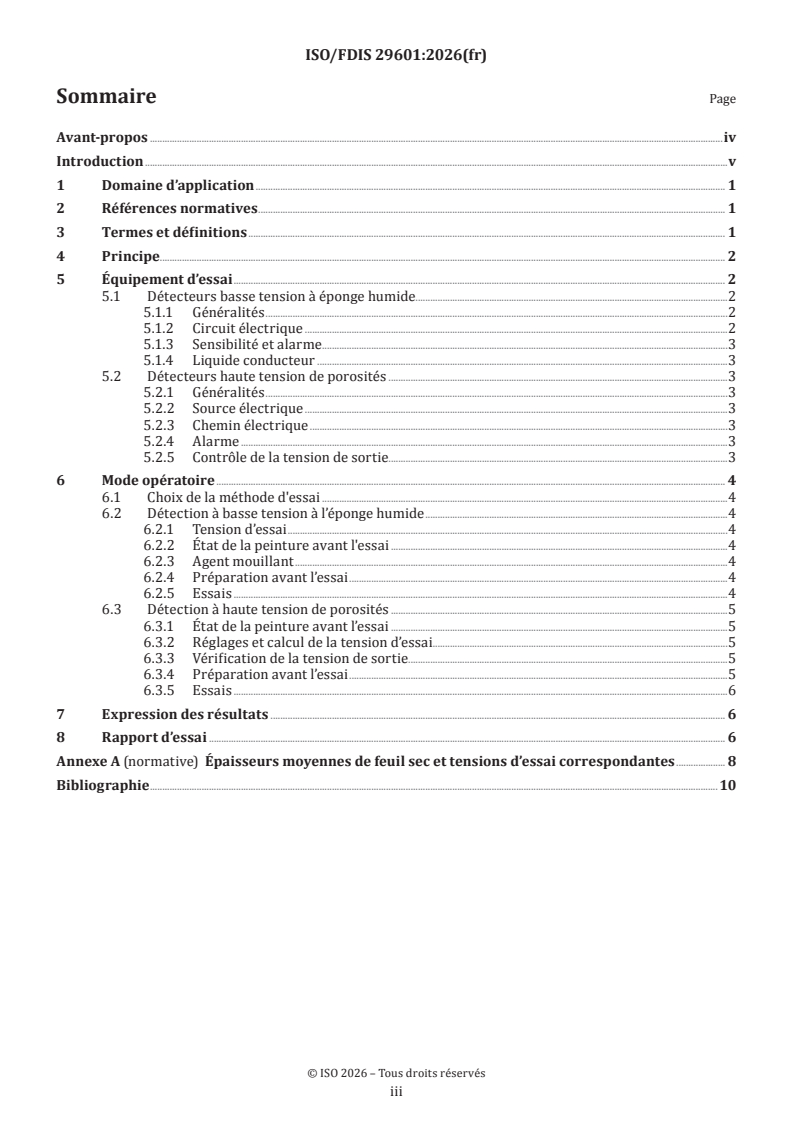
ISO/FDIS 29601 - Peintures et vernis — Anticorrosion par systèmes de peinture — Évaluation de la porosité d'un feuil sec Released:28. 01. 2026
Frequently Asked Questions
ISO/FDIS 29601 is a draft published by the International Organization for Standardization (ISO). Its full title is "Paints and varnishes — Corrosion protection by protective paint systems — Assessment of porosity in a dry film". This standard covers: ISO 29601:2011 specifies procedures for detecting the presence of porosity in a protective paint system of any thickness on a steel or other metallic substrate. The procedures given are based on methods using two different types of test equipment, the choice of equipment depending on the dry film thickness. These procedures are only applicable to the testing of electrically non-conductive parts of a paint system. The test methods specified are mainly intended for use with new coatings, but can also be used for coatings which have been in service for some time. In the latter case, it is important to bear in mind that the coating might have been penetrated by substances in contact with the coating during service.
ISO 29601:2011 specifies procedures for detecting the presence of porosity in a protective paint system of any thickness on a steel or other metallic substrate. The procedures given are based on methods using two different types of test equipment, the choice of equipment depending on the dry film thickness. These procedures are only applicable to the testing of electrically non-conductive parts of a paint system. The test methods specified are mainly intended for use with new coatings, but can also be used for coatings which have been in service for some time. In the latter case, it is important to bear in mind that the coating might have been penetrated by substances in contact with the coating during service.
ISO/FDIS 29601 is classified under the following ICS (International Classification for Standards) categories: 87.020 - Paint coating processes. The ICS classification helps identify the subject area and facilitates finding related standards.
ISO/FDIS 29601 has the following relationships with other standards: It is inter standard links to FprEN ISO 29601, ISO 13506-2:2024, ISO 29601:2011. Understanding these relationships helps ensure you are using the most current and applicable version of the standard.
ISO/FDIS 29601 is available in PDF format for immediate download after purchase. The document can be added to your cart and obtained through the secure checkout process. Digital delivery ensures instant access to the complete standard document.
Standards Content (Sample)
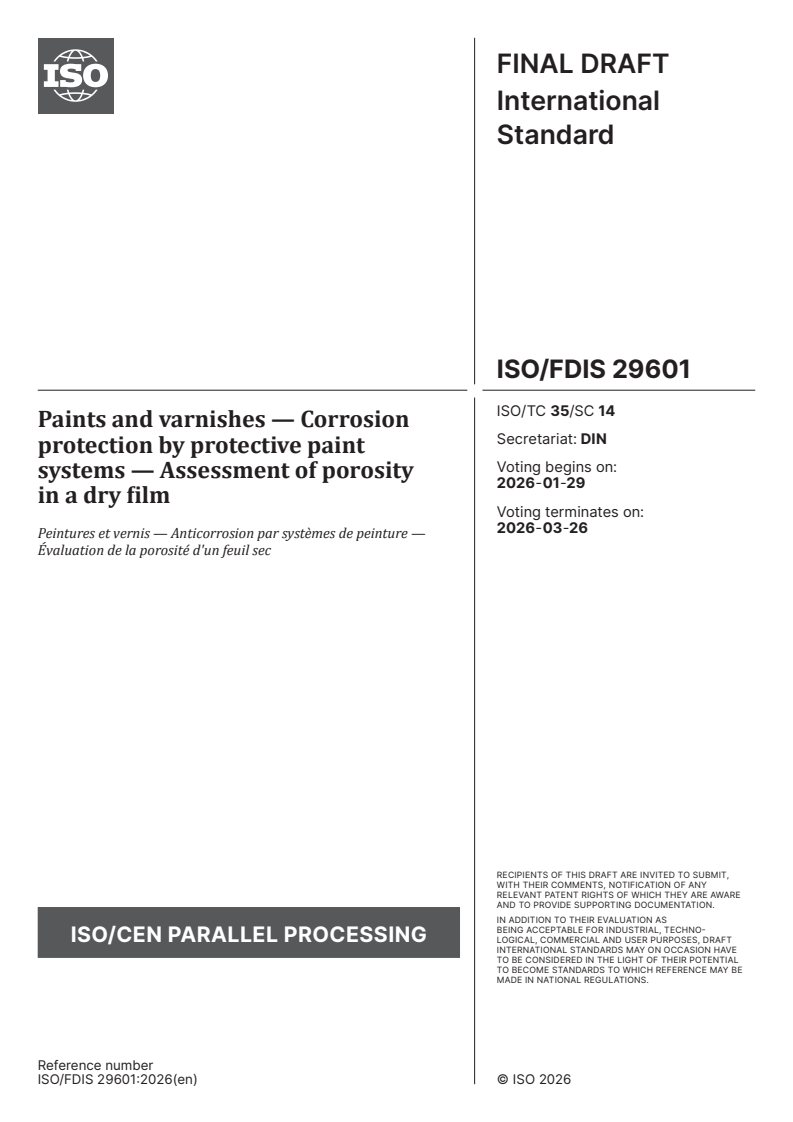
FINAL DRAFT
International
Standard
ISO/TC 35/SC 14
Paints and varnishes — Corrosion
Secretariat: DIN
protection by protective paint
Voting begins on:
systems — Assessment of porosity
2026-01-29
in a dry film
Voting terminates on:
2026-03-26
Peintures et vernis — Anticorrosion par systèmes de peinture —
Évaluation de la porosité d'un feuil sec
RECIPIENTS OF THIS DRAFT ARE INVITED TO SUBMIT,
WITH THEIR COMMENTS, NOTIFICATION OF ANY
RELEVANT PATENT RIGHTS OF WHICH THEY ARE AWARE
AND TO PROVIDE SUPPOR TING DOCUMENTATION.
IN ADDITION TO THEIR EVALUATION AS
BEING ACCEPTABLE FOR INDUSTRIAL, TECHNO
ISO/CEN PARALLEL PROCESSING LOGICAL, COMMERCIAL AND USER PURPOSES, DRAFT
INTERNATIONAL STANDARDS MAY ON OCCASION HAVE
TO BE CONSIDERED IN THE LIGHT OF THEIR POTENTIAL
TO BECOME STAN DARDS TO WHICH REFERENCE MAY BE
MADE IN NATIONAL REGULATIONS.
Reference number
FINAL DRAFT
International
Standard
ISO/TC 35/SC 14
Paints and varnishes — Corrosion
Secretariat: DIN
protection by protective paint
Voting begins on:
systems — Assessment of porosity
in a dry film
Voting terminates on:
Peintures et vernis — Anticorrosion par systèmes de peinture —
Évaluation de la porosité d'un feuil sec
RECIPIENTS OF THIS DRAFT ARE INVITED TO SUBMIT,
WITH THEIR COMMENTS, NOTIFICATION OF ANY
RELEVANT PATENT RIGHTS OF WHICH THEY ARE AWARE
AND TO PROVIDE SUPPOR TING DOCUMENTATION.
© ISO 2026
IN ADDITION TO THEIR EVALUATION AS
All rights reserved. Unless otherwise specified, or required in the context of its implementation, no part of this publication may
BEING ACCEPTABLE FOR INDUSTRIAL, TECHNO
ISO/CEN PARALLEL PROCESSING
LOGICAL, COMMERCIAL AND USER PURPOSES, DRAFT
be reproduced or utilized otherwise in any form or by any means, electronic or mechanical, including photocopying, or posting on
INTERNATIONAL STANDARDS MAY ON OCCASION HAVE
the internet or an intranet, without prior written permission. Permission can be requested from either ISO at the address below
TO BE CONSIDERED IN THE LIGHT OF THEIR POTENTIAL
or ISO’s member body in the country of the requester.
TO BECOME STAN DARDS TO WHICH REFERENCE MAY BE
MADE IN NATIONAL REGULATIONS.
ISO copyright office
CP 401 • Ch. de Blandonnet 8
CH-1214 Vernier, Geneva
Phone: +41 22 749 01 11
Email: copyright@iso.org
Website: www.iso.org
Published in Switzerland Reference number
ii
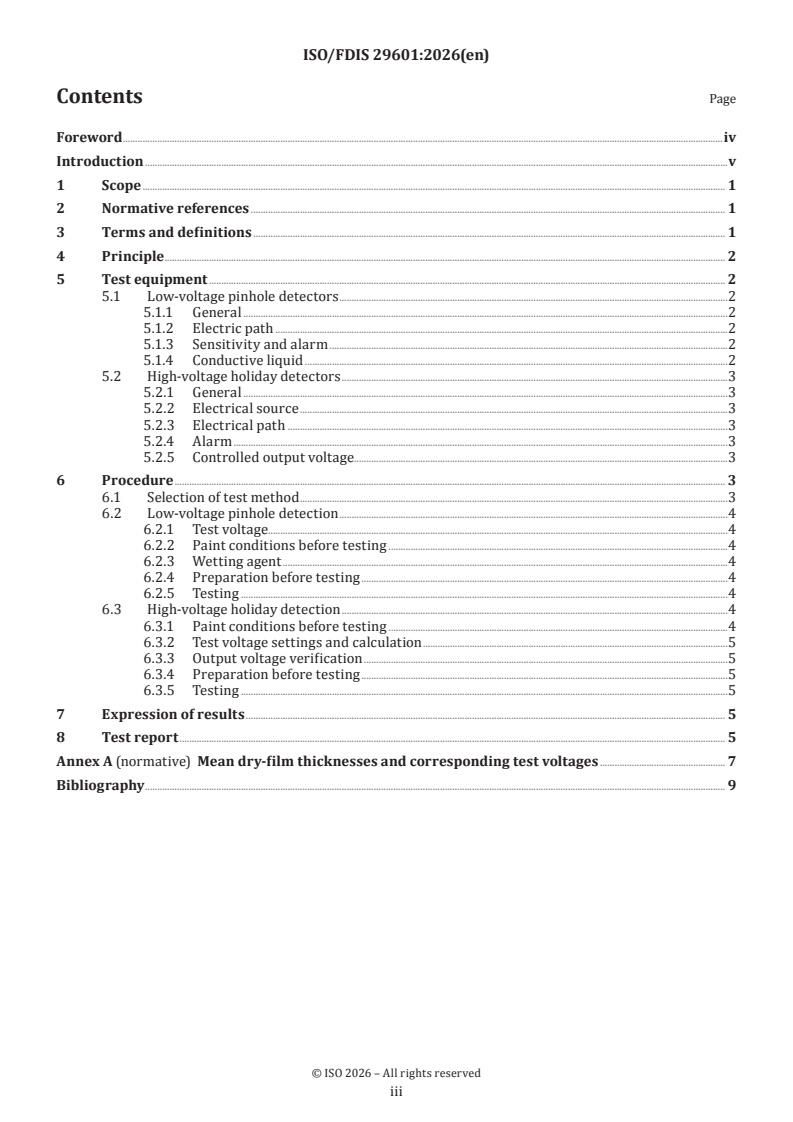
Contents Page
Foreword .iv
Introduction .v
1 Scope . 1
2 Normative references . 1
3 Terms and definitions . 1
4 Principle . 2
5 Test equipment . 2
5.1 Low-voltage pinhole detectors .2
5.1.1 General .2
5.1.2 Electric path .2
5.1.3 Sensitivity and alarm .2
5.1.4 Conductive liquid .2
5.2 High-voltage holiday detectors .3
5.2.1 General .3
5.2.2 Electrical source .3
5.2.3 Electrical path .3
5.2.4 Alarm .3
5.2.5 Controlled output voltage.3
6 Procedure . 3
6.1 Selection of test method .3
6.2 Low-voltage pinhole detection .4
6.2.1 Test voltage.4
6.2.2 Paint conditions before testing .4
6.2.3 Wetting agent .4
6.2.4 Preparation before testing .4
6.2.5 Testing .4
6.3 High-voltage holiday detection .4
6.3.1 Paint conditions before testing .4
6.3.2 Test voltage settings and calculation .5
6.3.3 Output voltage verification .5
6.3.4 Preparation before testing .5
6.3.5 Testing .5
7 Expression of results . 5
8 Test report . 5
Annex A (normative) Mean dry-film thicknesses and corresponding test voltages . 7
Bibliography . 9
iii
Foreword
ISO (the International Organization for Standardization) is a worldwide federation of national standards
bodies (ISO member bodies). The work of preparing International Standards is normally carried out through
ISO technical committees. Each member body interested in a subject for which a technical committee
has been established has the right to be represented on that committee. International organizations,
governmental and non-governmental, in liaison with ISO, also take part in the work. ISO collaborates closely
with the International Electrotechnical Commission (IEC) on all matters of electrotechnical standardization.
The procedures used to develop this document and those intended for its further maintenance are described
in the ISO/IEC Directives, Part 1. In particular, the different approval criteria needed for the different types
of ISO document should be noted. This document was drafted in accordance with the editorial rules of the
ISO/IEC Directives, Part 2 (see www.iso.org/directives).
ISO draws attention to the possibility that the implementation of this document may involve the use of (a)
patent(s). ISO takes no position concerning the evidence, validity or applicability of any claimed patent
rights in respect thereof. As of the date of publication of this document, ISO had not received notice of (a)
patent(s) which may be required to implement this document. However, implementers are cautioned that
this may not represent the latest information, which may be obtained from the patent database available at
www.iso.org/patents. ISO shall not be held responsible for identifying any or all such patent rights.
Any trade name used in this document is information given for the convenience of users and does not
constitute an endorsement.
For an explanation of the voluntary nature of standards, the meaning of ISO specific terms and expressions
related to conformity assessment, as well as information about ISO's adherence to the World Trade
Organization (WTO) principles in the Technical Barriers to Trade (TBT), see www.iso.org/iso/foreword.html.
This document was prepared by Technical Committee ISO/TC 35, Paints and varnishes, Subcommittee
SC 14, Protective paint systems for steel structures, in collaboration with the European Committee for
Standardization (CEN) Technical Committee CEN/TC 139, Paints and varnishes, in accordance with the
Agreement on technical cooperation between ISO and CEN (Vienna Agreement).
This second edition cancels and replaces the first edition (ISO 29601:2011), which has been technically
revised.
The main changes are as follows:
— general (editorial) update of terminology;
— update on cleaning procedure before measurement;
— update on verification of test equipment;
— update on voltage calculation;
— low voltage measurement was confirmed.
Any feedback or questions on this document should be directed to the user’s national standards body. A
complete listing of these bodies can be found at www.iso.org/members.html.
iv
Introduction
This document supplements the ISO 12944 series with regard to the detection of porosity in a dry film. If
specified or agreed, this document can also be used for other applications.
The objective of this document is to achieve uniformity of practice for the detection of porosity in a dry film.
The methods chosen entail the detection of porosity using one of two types of equipment, a low-voltage
pinhole detector or a high-voltage holiday detector.
This document complements the following International Standards:
— ISO 19840, which concerns the measurement of the thickness of dry films on rough surfaces;
— ISO 16276-1, which concerns the measurement of the adhesion of a coating by pull-off testing;
— ISO 16276-2, which concerns the measurement of the adhesion by cross-cut and X-cut testing.
v
FINAL DRAFT International Standard ISO/FDIS 29601:2026(en)
Paints and varnishes — Corrosion protection by protective
paint systems — Assessment of porosity in a dry film
1 Scope
This document specifies procedures for detecting the presence of porosity in a protective paint system of
any thickness on a steel or other metallic substrate. The procedures given in this document are based on
methods using two different types of test equipment, the choice of equipment depending on the dry-film
thickness. These procedures are only applicable to the testing of electrically non-conductive parts of a paint
system.
The test methods specified are mainly intended for use with new coatings, but can also be used for coatings
which have been in service for some time. In the latter case, it is important to bear in mind that the coating
can have been penetrated by substances in contact with the coating during service.
2 Normative references
There are no normative references in this document.
3 Terms and definitions
For the purposes of this document, the following terms and definitions apply.
ISO and IEC maintain terminology databases for use in standardization at the following addresses:
— ISO Online browsing platform: available at https:// www .iso .org/ obp
— IEC Electropedia: available at https:// www .electropedia .org/
3.1
porosity
presence of one or more discontinuities in a coating
3.2
discontinuity
holiday
hole, pit, pinhole, void, crack, thin spot, inclusion, contamination or other flaw in a coating that significantly
lowers the dielectric strength of the coating
Note 1 to entry: Certain types of discontinuity can also be described as a holiday.
3.3
nominal dry-film thickness
NDFT
dry-film thickness specified for each coat or for the whole paint system to achieve the required durability
[SOURCE: ISO 19840:2012, 3.6]
3.4
mean dry-film thickness
arithmetic mean of all the individual dry-film thicknesses in the inspection area
[SOURCE: ISO 19840:2012, 3.5]
3.5
inspection area
designated area for inspection as defined in the specification
Note 1 to entry: If inspection areas are not defined, the whole structure is a single inspection area.
3.6
electrical breakdown
process that occurs when an insulating material, subjected to high enough voltage, suddenly becomes an
electrical conductor and electrical current flows through it
3.7
dielectric strength
maximum voltage required to produce a dielectric breakdown through a material
4 Principle
Porosity in a protective paint system
...
Style Definition: Heading 1: Indent: Left: 0 cm, First
ISO/DISFDIS 29601
line: 0 cm
ISO/TC 35/SC 14
Style Definition: Heading 2: Font: Bold, Indent: Left: 0
cm, First line: 0 cm
Secretariat: DIN
Style Definition: Heading 3: Font: Bold, Indent: Left: 0
cm, First line: 0 cm
Date: 2025-05-202026-01-15
Style Definition: Heading 4: Font: Bold, Indent: Left: 0
cm, First line: 0 cm
Style Definition: Heading 5: Font: Bold, Indent: Left: 0
cm, First line: 0 cm
Style Definition: Heading 6: Font: Bold
Style Definition: IntroHeading1: Font: Bold, Indent:
Paints and varnishes — Corrosion protection by protective paint
Left: 0 cm, First line: 0 cm
systems — Assessment of porosity in a dry film
Style Definition: IntroHeading2: Font: Bold, Indent:
Left: 0 cm, First line: 0 cm
Peintures et vernis — Anticorrosion par systèmes de peinture — Évaluation de la porosité d'un feuil sec
Style Definition: IntroHeading3: Font: Bold, Indent:
Left: 0 cm, First line: 0 cm
Style Definition: IntroHeading4: Font: Bold, Indent:
Left: 0 cm, First line: 0 cm
Style Definition: IntroHeading5: Font: Bold, Indent:
Left: 0 cm, First line: 0 cm
Style Definition: IntroHeading6
Style Definition: IntroHeading7
Style Definition: IntroHeading8
FDIS stage
Style Definition: IntroHeading9
Style Definition: ANNEX
Style Definition: Key Text
Style Definition: Key Title
Warning for WD’s and CD’s
Style Definition
...
This document is not an ISO International Standard. It is distributed for review and comment. It is subject to change
without notice and may not be referred to as an International Standard.
Style Definition
...
Recipients of this draft are invited to submit, with their comments, notification of any relevant patent rights of which Style Definition
...
they are aware and to provide supporting documentation.
Style Definition
...
Style Definition
...
Style Definition: TermNum6: Font: Bold
Style Definition: Body Text
Style Definition: boxedText
Style Definition: Boxed List Continue 1
TThhiiss d drraftaft i iss s suubbmmiitttteded t too a pa pararallel vallel vootte e iinn I ISSOO,, C CEENN.
Style Definition: boxedTitle
Style Definition: FooterCentered
Style Definition: FooterPageNumber
Style Definition: FooterPageRomanNumber
Style Definition: FooterCenteredContinued
Style Definition: TPS Markup Base
Formatted: French (Switzerland)
Formatted: French (Switzerland)
ISO/DISFDIS 29601:20252026(en)
All rights reserved. Unless otherwise specified, or required in the context of its implementation, no part of this publication
may be reproduced or utilized otherwise in any form or by any means, electronic or mechanical, including photocopying,
or posting on the internet or an intranet, without prior written permission. Permission can be requested from either ISO
at the address below or ISO’s member body in the country of the requester.
ISO copyright office
CP 401 • Ch. de Blandonnet 8
CH-1214 Vernier, Geneva
Formatted: English (United Kingdom)
Phone: + 41 22 749 01 11
E-mail: copyright@iso.org
Formatted: German (Germany)
Website: www.iso.org
Field Code Changed
Published in Switzerland
Formatted: English (United Kingdom)
iii
ISO/DISFDIS 29601:20252026(en)
Contents
Foreword . iv
Introduction . iv
1 Scope . iv
2 Normative references . iv
3 Terms and definitions . iv
4 Principle. iv
5 Test equipment . iv
5.1 Low-voltage pinhole detectors . iv
5.2 High-voltage holiday detectors . iv
6 Procedure . iv
6.1 Selection of test method . iv
6.2 Low-voltage pinhole detection . iv
6.3 High-voltage holiday detection . iv
7 Expression of results . iv
8 Test report . iv
Table of mean dry film thicknesses and their corresponding recommended test voltages . iv
Bibliography . iv
Foreword . v
Introduction . vi
1 Scope . 1
2 Normative references . 1
3 Terms and definitions . 1
4 Principle . 2
5 Test equipment . 2
5.1 Low-voltage pinhole detectors. 2
5.2 High-voltage holiday detectors . 3
6 Procedure . 4
6.1 Selection of test method . 4
6.2 Low-voltage pinhole detection . 4
6.3 High-voltage holiday detection . 5
7 Expression of results . 6
8 Test report . 6
Annex A (normative) Mean dry-film thicknesses and corresponding test voltages . 8
Bibliography . 10
iv
ISO/DISFDIS 29601:20252026(en)
Foreword
ISO (the International Organization for Standardization) is a worldwide federation of national standards
bodies (ISO member bodies). The work of preparing International Standards is normally carried out through
ISO technical committees. Each member body interested in a subject for which a technical committee has been
established has the right to be represented on that committee. International organizations, governmental and
non-governmental, in liaison with ISO, also take part in the work. ISO collaborates closely with the
International Electrotechnical Commission (IEC) on all matters of electrotechnical standardization.
The procedures used to develop this document and those intended for its further maintenance are described
in the ISO/IEC Directives, Part 1. In particular, the different approval criteria needed for the different types of
ISO document should be noted. This document was drafted in accordance with the editorial rules of the
ISO/IEC Directives, Part 2 (see www.iso.org/directives).
Formatted: English (United Kingdom)
ISO draws attention to the possibility that the implementation of this document may involve the use of (a)
patent(s). ISO takes no position concerning the evidence, validity or applicability of any claimed patent rights
in respect thereof. As of the date of publication of this document, ISO had not received notice of (a) patent(s)
Formatted: Font color: Auto
which may be required to implement this document. However, implementers are cautioned that this may not
represent the latest information, which may be obtained from the patent database available at
www.iso.org/patents.www.iso.org/patents. ISO shall not be held responsible for identifying any or all such
patent rights.
Any trade name used in this document is information given for the convenience of users and does not
constitute an endorsement.
For an explanation of the voluntary nature of standards, the meaning of ISO specific terms and expressions
related to conformity assessment, as well as information about ISO's adherence to the World Trade
Organization (WTO) principles in the Technical Barriers to Trade (TBT), see
www.iso.org/iso/foreword.htmlwww.iso.org/iso/foreword.html.
Formatted: English (United Kingdom)
This document was prepared by Technical Committee ISO/TC 35, Paints and varnishes, Subcommittee SC 14,
Protective paint systems for steel structures, in collaboration with the European Committee for Standardization
Formatted: Font: Not Italic
(CEN) Technical Committee CEN/TC 139, Paints and varnishes, in accordance with the Agreement on technical
Formatted: Font: Not Italic
cooperation between ISO and CEN (Vienna Agreement).
Formatted: Font: Not Italic
This second edition cancels and replaces the first edition (ISO 29601:2011), which has been technically
revised.
The main changes are as follows:
— — general (editorial) update of terminology ;
Formatted: List Continue 1
— — update on cleaning procedure before measurement;
— — update on verification of test equipment ;
— — update on voltage calculation;
— — low voltage measurement was confirmed.
Any feedback or questions on this document should be directed to the user’s national standards body. A
Formatted: English (United Kingdom)
complete listing of these bodies can be found at www.iso.org/members.htmlwww.iso.org/members.html.
Formatted: English (United Kingdom)
v
ISO/DISFDIS 29601:20252026(en)
Introduction
This document supplements the ISO 12944 series with regard to the detection of porosity in a dry film. If
specified or agreed, this document can also be used for other applications.
The objective of this document is to achieve uniformity of practice for the detection of porosity in a dry film.
The methods chosen entail the detection of porosity using one of two types of equipment, a low-voltage
pinhole detector or a high-voltage holiday detector.
This document complements the following International Standards:
— ISO 19840, which concerns the measurement of the thickness of dry films on rough surfaces; Formatted: List Continue 1, No bullets or numbering
ISO 16276-1
— , which concerns the measurement of the adhesion of a coating by pull-off testing ; Formatted: List Continue 1, No bullets or numbering
— ISO 16276-2, which concerns the measurement of the adhesion by cross-cut and X -cut testing.
vi
ISO/DISFDIS 29601:20252026(en)
Paints and varnishes — Corrosion protection by protective paint
systems — Assessment of porosity in a dry film
1 Scope
This document specifies procedures for detecting the presence of porosity in a protective paint system of any
thickness on a steel or other metallic substrate. The procedures given in this document are based on methods
using two different types of test equipment, the choice of equipment depending on the dry-film thickness.
These procedures are only applicable to the testing of electrically non-conductive parts of a paint system.
The test methods specified are mainly intended for use with new coatings, but can also be used for coatings
which have been in service for some time. In the latter case, it is important to bear in mind that the coating
can have been penetrated by substances in contact with the coating during service.
2 Normative references
There are no normative references in this document.
3 Terms and definitions
For the purposes of this document, the following terms and definitions apply.
ISO and IEC maintain terminology databases for use in standardization at the following addresses:
Formatted: English (United Kingdom)
Formatted: Font: 11 pt, English (United Kingdom)
— — ISO Online browsing platform: available at https://www.iso.org/obphttps://www.iso.org/obp
Formatted: English (United Kingdom)
— — IEC Electropedia: available at https://www.electropedia.org/https://www.electropedia.org/
Formatted: English (United Kingdom)
3.1
porosity
presence of one or more discontinuities in a coating
3.2
discontinuity
holiday
hole, pit, pinhole, void, crack, thin spot, inclusion, contamination or other flaw in a coating that significantly
lowers the dielectric strength of the coating
Note 1 to entry: Certain types of discontinuity can also be described as a holiday.
3.3
nominal dry-film thickness
NDFT
dry-film thickness specified for each coat or for the whole paint system to achieve the required durability
[SOURCE: ISO 19840:2012, 3.6]
3.4
mean dry-film thickness
arithmetic mean of all the individual dry-film thicknesses in the inspection area
[SOURCE: ISO 19840:2012, 3.5]
Formatted: FooterPageNumber
ISO/DISFDIS 29601:20252026(en)
3.5
inspection area
designated area for inspection as defined in the specification
Note 1 to entry: If inspection areas are not defined, the whole structure is a single inspection area.
3.6
electrical breakdown
process that occurs when an insulating material, subjected to high enough voltage, suddenly becomes an
electrical conductor and electrical current flows through it
3.7
dielectric strength
maximum voltage required to produce a dielectric breakdown through a material
4 Principle
Porosity in a protective paint system applied to a conductive metal surface is detected either by low-voltage
wet-sponge testing or high-voltage holiday testing. Low-voltage pinhole detectors use moisture to conduct
electrical current through any discontinuity in the coating. High-voltage holiday detectors generate electrical
breakdown in a discontinuity when the discontinuity has a lower dielectric strength than the paint system.
In both cases, the apparatus is electrically connected to the metallic substrate, often by means of a signal return
cable, and a DC voltage is applied by means of a probe. When a discontinuity is detected, an alarm is triggered.
The test voltage is determined by the thickness of the non-conductive part of the coating.
5 Test equipment
5.1 Low-voltage pinhole detectors
5.1.1 General
Low-voltage pinhole detectors are normally battery-operated for portability. They can either be single-
voltage, 9 V or 90 V, or dual-voltage, switchable between 9 V and 90 V.
Verify correct working and functionality ofthat the apparatus is working and functioning correctly, e.g. if the
output voltage, or the resistance if it meetsmeet the manufacturer's recommendation. If possible, the
functionality can be tested with a known discontinuityholiday on the item or, if agreed, an a artificialartificially
made holidaydiscontinuity.
5.1.2 Electric path
To provide an electrically conductive path through any discontinuity in the coating, an open-cell sponge
moistened with tap water is used to apply the voltage. A cable with a suitable spring-operated connector
(crocodile clip) is required to make contact to the bare substrate to form the si
...
PROJET FINAL
Norme
internationale
ISO/TC 35/SC 14
Peintures et vernis — Anticorrosion
Secrétariat: DIN
par systèmes de peinture —
Début de vote:
Évaluation de la porosité d'un feuil
2026-01-29
sec
Vote clos le:
2026-03-26
Paints and varnishes — Corrosion protection by protective paint
systems — Assessment of porosity in a dry film
LES DESTINATAIRES DU PRÉSENT PROJET SONT
INVITÉS À PRÉSENTER, AVEC LEURS OBSERVATIONS,
NOTIFICATION DES DROITS DE PROPRIÉTÉ DONT ILS
AURAIENT ÉVENTUELLEMENT CONNAISSANCE ET À
FOURNIR UNE DOCUMENTATION EXPLICATIVE.
OUTRE LE FAIT D’ÊTRE EXAMINÉS POUR
ÉTABLIR S’ILS SONT ACCEPTABLES À DES FINS
INDUSTRIELLES, TECHNOLOGIQUES ET COM-MERCIALES,
AINSI QUE DU POINT DE VUE DES UTILISATEURS, LES
PROJETS DE NORMES
TRAITEMENT PARALLÈLE ISO/CEN
INTERNATIONALES DOIVENT PARFOIS ÊTRE CONSIDÉRÉS
DU POINT DE VUE DE LEUR POSSI BILITÉ DE DEVENIR DES
NORMES POUVANT
SERVIR DE RÉFÉRENCE DANS LA RÉGLEMENTATION
NATIONALE.
Numéro de référence
PROJET FINAL
Norme
internationale
ISO/TC 35/SC 14
Peintures et vernis — Anticorrosion
Secrétariat: DIN
par systèmes de peinture —
Début de vote:
Évaluation de la porosité d'un feuil
2026-01-29
sec
Vote clos le:
2026-03-26
Paints and varnishes — Corrosion protection by protective paint
systems — Assessment of porosity in a dry film
LES DESTINATAIRES DU PRÉSENT PROJET SONT
INVITÉS À PRÉSENTER, AVEC LEURS OBSERVATIONS,
NOTIFICATION DES DROITS DE PROPRIÉTÉ DONT ILS
AURAIENT ÉVENTUELLEMENT CONNAISSANCE ET À
FOURNIR UNE DOCUMENTATION EXPLICATIVE.
DOCUMENT PROTÉGÉ PAR COPYRIGHT
OUTRE LE FAIT D’ÊTRE EXAMINÉS POUR
ÉTABLIR S’ILS SONT ACCEPTABLES À DES FINS
© ISO 2026 INDUSTRIELLES, TECHNOLOGIQUES ET COM-MERCIALES,
AINSI QUE DU POINT DE VUE DES UTILISATEURS, LES
Tous droits réservés. Sauf prescription différente ou nécessité dans le contexte de sa mise en œuvre, aucune partie de cette
PROJETS DE NORMES
TRAITEMENT PARALLÈLE ISO/CEN
INTERNATIONALES DOIVENT PARFOIS ÊTRE CONSIDÉRÉS
publication ne peut être reproduite ni utilisée sous quelque forme que ce soit et par aucun procédé, électronique ou mécanique,
DU POINT DE VUE DE LEUR POSSI BILITÉ DE DEVENIR DES
y compris la photocopie, ou la diffusion sur l’internet ou sur un intranet, sans autorisation écrite préalable. Une autorisation peut
NORMES POUVANT
être demandée à l’ISO à l’adresse ci-après ou au comité membre de l’ISO dans le pays du demandeur.
SERVIR DE RÉFÉRENCE DANS LA RÉGLEMENTATION
NATIONALE.
ISO copyright office
Case postale 401 • Ch. de Blandonnet 8
CH-1214 Vernier, Genève
Tél.: +41 22 749 01 11
E-mail: copyright@iso.org
Web: www.iso.org
Publié en Suisse Numéro de référence
ii
Sommaire Page
Avant-propos .iv
Introduction .v
1 Domaine d’application . 1
2 Références normatives . 1
3 Termes et définitions . 1
4 Principe. 2
5 Équipement d’essai . 2
5.1 Détecteurs basse tension à éponge humide.2
5.1.1 Généralités .2
5.1.2 Circuit électrique .2
5.1.3 Sensibilité et alarme .3
5.1.4 Liquide conducteur .3
5.2 Détecteurs haute tension de porosités .3
5.2.1 Généralités .3
5.2.2 Source électrique .3
5.2.3 Chemin électrique .3
5.2.4 Alarme .3
5.2.5 Contrôle de la tension de sortie.3
6 Mode opératoire . 4
6.1 Choix de la méthode d'essai .4
6.2 Détection à basse tension à l’éponge humide .4
6.2.1 Tension d’essai .4
6.2.2 État de la peinture avant l'essai .4
6.2.3 Agent mouillant .4
6.2.4 Préparation avant l’essai .4
6.2.5 Essais .4
6.3 Détection à haute tension de porosités .5
6.3.1 État de la peinture avant l’essai .5
6.3.2 Réglages et calcul de la tension d’essai . .5
6.3.3 Vérification de la tension de sortie.5
6.3.4 Préparation avant l’essai .5
6.3.5 Essais .6
7 Expression des résultats . 6
8 Rapport d’essai . 6
Annexe A (normative) Épaisseurs moyennes de feuil sec et tensions d’essai correspondantes . 8
Bibliographie . 10
iii
Avant-propos
L’ISO (Organisation internationale de normalisation) est une fédération mondiale d’organismes nationaux
de normalisation (comités membres de l’ISO). L’élaboration des Normes internationales est en général
confiée aux comités techniques de l’ISO. Chaque comité membre intéressé par une étude a le droit de faire
partie du comité technique créé à cet effet. Les organisations internationales, gouvernementales et non
gouvernementales, en liaison avec l’ISO participent également aux travaux. L’ISO collabore étroitement avec
la Commission électrotechnique internationale (IEC) en ce qui concerne la normalisation électrotechnique.
Les procédures utilisées pour élaborer le présent document et celles destinées à sa mise à jour sont
décrites dans les Directives ISO/IEC, Partie 1. Il convient, en particulier, de prendre note des différents
critères d’approbation requis pour les différents types de documents ISO. Le présent document
a été rédigé conformément aux règles de rédaction données dans les Directives ISO/IEC, Partie 2
(voir www.iso.org/directives).
L’ISO attire l’attention sur le fait que la mise en application du présent document peut entraîner l’utilisation
d’un ou de plusieurs brevets. L’ISO ne prend pas position quant à la preuve, à la validité et à l’applicabilité de
tout droit de brevet revendiqué à cet égard. À la date de publication du présent document, l’ISO n’avait pas
reçu notification qu’un ou plusieurs brevets pouvaient être nécessaires à sa mise en application. Toutefois,
il y a lieu d’avertir les responsables de la mise en application du présent document que des informations
plus récentes sont susceptibles de figurer dans la base de données de brevets, disponible à l’adresse
www.iso.org/brevets. L’ISO ne saurait être tenue pour responsable de ne pas avoir identifié tout ou partie de
tels droits de brevet.
Les appellations commerciales éventuellement mentionnées dans le présent document sont données pour
information, par souci de commodité, à l’intention des utilisateurs et ne sauraient constituer un engagement.
Pour une explication de la nature volontaire des normes, la signification des termes et expressions
spécifiques de l’ISO liés à l’évaluation de la conformité, ou pour toute information au sujet de l’adhésion de
l’ISO aux principes de l’Organisation mondiale du commerce (OMC) concernant les obstacles techniques au
commerce (OTC), voir le lien suivant: www.iso.org/avant-propos.
Le présent document a été élaboré par le comité technique ISO/TC 35, Peintures et vernis, SC 14,Systèmes
de peinture protectrice pour les structures en acier, en collaboration avec le comité technique CEN/TC 139,
Peintures et vernis du Comité européen de normalisation (CEN), conformément à l'Accord de coopération
technique entre l'ISO et le CEN (Accord de Vienne).
Cette seconde édition annule et remplace la première édition (ISO 29601:2011), qui a fait l’objet d’une
révision technique.
Les principales modifications sont les suivantes:
— mise à jour générale (rédactionnelle) de la terminologie;
— mise à jour du mode opératoire de nettoyage avant le mesurage;
— mise à jour de la vérification de l'équipement d'essai;
— mise à jour du calcul de la tension;
— confirmation du mesurage basse tension.
Il convient que l’utilisateur adresse tout retour d’information ou toute question concernant le présent
document à l’organisme national de normalisation de son pays. Une liste exhaustive desdits organismes se
trouve à l’adresse www.iso.org/members.html.
iv
Introduction
Le présent document complète la série ISO 12944 pour ce qui concerne la détection de la porosité d’un
feuil sec. S'il est spécifié ou fait l’objet d’un accord, ce document peut également être utilisé pour d’autres
applications.
L’objectif du présent document est d’harmoniser les pratiques pour la détection de la porosité d’un feuil sec.
En fonction des méthodes choisies, la détection de la porosité est réalisée au moyen d’un des deux types
d’équipements: un détecteur basse tension à éponge humide ou un détecteur haute tension de porosités.
Ce document complète les Normes internationales suivantes:
— l’ISO 19840, relative au mesurage de l’épaisseur de feuils secs sur des surfaces rugueuses;
— l’ISO 16276-1, relative au mesurage de l’adhérence d’un revêtement par essai de traction;
— l'ISO 16276-2, relative au mesurage de l'adhérence par essai de quadrillage et essai à la croix de Saint-
André.
v
PROJET FINAL Norme internationale ISO/FDIS 29601:2026(fr)
Peintures et vernis — Anticorrosion par systèmes de peinture
— Évaluation de la porosité d'un feuil sec
1 Domaine d’application
Le présent document spécifie des modes opératoires permettant de détecter l’existence de porosité dans
un système de revêtement de peinture, quelle qu’en soit l’épaisseur, appliqué sur un subjectile en acier ou
sur tout autre métal. Les modes opératoires fournis dans le présent document sont basés sur des méthodes
faisant appel à deux types d’équipements d’essai, le choix de l’équipement étant fonction de l’épaisseur du
feuil sec. Ces modes opératoires ne s’appliquent qu’aux essais des couches électriquement non conductrices
d’un système de peinture.
Les méthodes d’essai spécifiées sont destinées principalement aux revêtements neufs, mais peuvent aussi
être employées pour les revêtements déjà mis en service. Dans ce dernier cas, il est important de garder
à l’esprit le fait que des substances en contact avec le revêtement ont pu y pénétrer pendant la période en
service.
2 Références normatives
Le présent document ne contient aucune référence normative.
3 Termes et définitions
Pour les besoins du présent document, les termes et définitions suivants s'appliquent.
L'ISO et l'IEC tiennent à jour des bases de données terminologiques destinées à être utilisées en normalisation,
consultables aux adresses suivantes:
— ISO Online browsing platform: disponible à l’adresse https:// www .iso .org/ obp
— IEC Electropedia: disponible à l'adresse https:// www .electropedia .org/
3.1
porosité
présence d’une ou plusieurs discontinuités dans un revêtement
3.2
discontinuité
porosité
trou, piqûre, “trou d’épingle”, vide, fissure, sous-épaisseur, inclusion, contamination ou autre défaut dans un
revêtement diminuant de façon significative sa résistance diélectrique
Note 1 à l'article: Certains types de discontinuités peuvent aussi être décrits comme un manque de matière.
3.3
épaisseur nominale du feuil sec
NDFT
épaisseur du feuil sec spécifiée pour chaque couche ou pour l’ensemble du système de peinture afin d’obtenir
la durabilité requise
[SOURCE: ISO 19840:2012, 3.6]
3.4
épaisseur moyenne du feuil sec
moyenne arithmétique de toutes les épaisseurs individuelles du feuil sec dans l’aire de contrôle
[SOURCE: ISO 19840:2012, 3.5]
3.5
aire de contrôle
surface désignée pour le contrôle comme défini dans la spécification
Note 1 à l'article: En l’absence d'aires de contrôle définies, la totalité de l’ouvrage constitue une aire de contrôle unique.
3.6
rupture diélectrique
processus qui se produit lorsqu’un matériau isolant, soumis à une tension suffisamment élevée, devient
soudainement un conducteur électrique et que le courant électrique circule à travers lui
3.7
résistance diélectrique
tension maximale requise pour produire une rupture diélectrique à travers un matériau
4 Principe
La porosité d’un système de peinture de protection appliqué sur une surface en métal conductrice est détectée
soit par un contrôle à basse tension à l’éponge humide, soit par un contrôle à haute tension de porosités.
Les détecteurs basse tension à éponge humide utilisent l’humidité pour conduire le courant électrique à
travers toute discontinuité dans le revêtement. Les détecteurs haute tension de porosités engendrent une
rupture diélectrique à travers une discontinuité lorsque cette dernière présente une résistance diélectrique
inférieure à celle d
...
Questions, Comments and Discussion
Ask us and Technical Secretary will try to provide an answer. You can facilitate discussion about the standard in here.
Loading comments...