


ISO/FDIS 23693-3
(Main)Determination of the resistance to gas explosions of passive fire protection materials — Part 3: Tubular and I-section substrates subject to elastic deformation only
Determination of the resistance to gas explosions of passive fire protection materials — Part 3: Tubular and I-section substrates subject to elastic deformation only
ISO 23693 part 1 aims to simulate the mechanical loads that could be imparted to passive fire protection (PFP) materials and systems by explosions resulting from releases of flammable gas, pressurised liquefied gas, flashing liquid fuels, or dust that may precede a fire. Explosions can give rise to pressure and drag forces and damage to PFP materials in a gas explosion can be caused by the direct effects of pressure and drag loadings and by the deflection of the substrate supporting the PFP material. This part of the ISO 23693 series deals with tests to assess the performance of PFP material to the combined effects of pressure and drag loading that occur in the flow path of a gas explosion. This part of the standard excludes specimens whereby the substrate is subject to plastic deformation or brittle failure.
Détermination de la résistance aux explosions de gaz des matériaux de protection passive contre l’incendie — Partie 3: Supports tubulaires et de section en I soumis à une déformation élastique uniquement
General Information
- Status
- Not Published
- Technical Committee
- ISO/TC 92/SC 2 - Fire containment
- Current Stage
- 5020 - FDIS ballot initiated: 2 months. Proof sent to secretariat
- Start Date
- 23-Jan-2026
- Completion Date
- 23-Jan-2026
Overview
ISO/FDIS 23693-3:2026 is a forthcoming international standard developed by ISO Technical Committee ISO/TC 92, Subcommittee SC 2, focusing on fire safety and containment resistance. This part of the ISO 23693 series provides methodologies for determining the resistance of passive fire protection (PFP) materials when applied to tubular and I-section substrates that undergo elastic deformation only during gas explosions.
Gas explosions caused by flammable gases, pressurized liquefied gases, flashing liquid fuels, or dust may impose dynamic pressure and drag forces on structural elements coated or protected with PFP materials. This standard specifies test methods to simulate such mechanical loads and assess PFP performance under combined pressure and drag loading scenarios in explosion flow paths. Importantly, it excludes substrates subject to plastic deformation or brittle failure, focusing strictly on elastic behavior.
Key Topics
- Scope of Testing: Simulation of mechanical loads on PFP materials from gas explosions involving various combustible sources.
- Substrate Types: Tubular and I-section substrates experiencing only elastic deformation during explosive loading.
- Mechanical Loads Considered: Combined effects of stagnation pressure, side-on overpressure, and drag forces as arise in explosion flow.
- Test Methods:
- Measurement-based approach using instrumented substrates to capture pressure profiles.
- Computation Fluid Dynamics (CFD) modeling to simulate explosion loads and flow dynamics.
- Instrumentation and Measurement: Detailed sensor placement guidelines on tubular and I-beam specimens to accurately measure pressure loads.
- Environmental Conditions: Standardization of testing environment to ensure reliable and reproducible results.
- Performance Assessment: Criteria for evaluating damage and degradation in PFP materials under test loading.
- Data Analysis and Reporting: Guidance on analyzing pressure profiles, drag loads, and formulating test reports.
Applications
ISO 23693-3:2026 is essential for industries requiring robust passive fire protection solutions on structural steel members prone to gas explosion hazards. Applications include:
- Oil and Gas Facilities: Protection of pipelines, tubular supports, and structural beams from explosion-induced mechanical forces.
- Chemical and Petrochemical Plants: Ensuring integrity of PFP systems on pressurized tubing and I-beams used in process infrastructure.
- Industrial Fire Safety Engineering: Design verification and certification of fire protection coatings and claddings subjected to explosion stress.
- Risk Assessment and Mitigation: Facilitating simulation and experimental validation of structural response to explosive threats.
- Regulatory Compliance: Meeting evolving safety standards for explosion resistance in buildings and industrial installations.
By applying these standardized test methods, manufacturers and safety engineers can reliably benchmark PFP materials’ resistance, optimize protection systems, and enhance overall fire and explosion safety.
Related Standards
- ISO 23693-1: General requirements for determination of resistance to gas explosions of PFP materials.
- ISO/TC 92 Series: Various standards addressing fire safety, fire containment, and protective materials.
- ISO/IEC Directives: Editorial and procedural framework supporting the development and maintenance of this standard.
- Other PFP Material Testing Standards: Complementary standards assessing fire resistance, mechanical durability, and environmental resilience.
Adherence to ISO 23693-3 supports consistency with the broader framework of international fire safety standards, fostering harmonization and interoperability in protective measures against explosion hazards.
Keywords: ISO 23693-3, passive fire protection materials, gas explosion resistance, tubular substrates, I-section substrates, elastic deformation, fire safety standards, explosion mechanical loads, pressure measurement, CFD modeling, industrial fire protection, structural fire resistance.
Buy Documents


ISO/FDIS 23693-3 - Determination of the resistance to gas explosions of passive fire protection materials — Part 3: Tubular and I-section substrates subject to elastic deformation only Released:9. 01. 2026
REDLINE ISO/FDIS 23693-3 - Determination of the resistance to gas explosions of passive fire protection materials — Part 3: Tubular and I-section substrates subject to elastic deformation only Released:9. 01. 2026
Get Certified
Connect with accredited certification bodies for this standard

NSF International
Global independent organization facilitating standards development and certification.

CIS Institut d.o.o.
Personal Protective Equipment (PPE) certification body. Notified Body NB-2890 for EU Regulation 2016/425 PPE.

Kiwa BDA Testing
Building and construction product certification.
Sponsored listings
Frequently Asked Questions
ISO/FDIS 23693-3 is a draft published by the International Organization for Standardization (ISO). Its full title is "Determination of the resistance to gas explosions of passive fire protection materials — Part 3: Tubular and I-section substrates subject to elastic deformation only". This standard covers: ISO 23693 part 1 aims to simulate the mechanical loads that could be imparted to passive fire protection (PFP) materials and systems by explosions resulting from releases of flammable gas, pressurised liquefied gas, flashing liquid fuels, or dust that may precede a fire. Explosions can give rise to pressure and drag forces and damage to PFP materials in a gas explosion can be caused by the direct effects of pressure and drag loadings and by the deflection of the substrate supporting the PFP material. This part of the ISO 23693 series deals with tests to assess the performance of PFP material to the combined effects of pressure and drag loading that occur in the flow path of a gas explosion. This part of the standard excludes specimens whereby the substrate is subject to plastic deformation or brittle failure.
ISO 23693 part 1 aims to simulate the mechanical loads that could be imparted to passive fire protection (PFP) materials and systems by explosions resulting from releases of flammable gas, pressurised liquefied gas, flashing liquid fuels, or dust that may precede a fire. Explosions can give rise to pressure and drag forces and damage to PFP materials in a gas explosion can be caused by the direct effects of pressure and drag loadings and by the deflection of the substrate supporting the PFP material. This part of the ISO 23693 series deals with tests to assess the performance of PFP material to the combined effects of pressure and drag loading that occur in the flow path of a gas explosion. This part of the standard excludes specimens whereby the substrate is subject to plastic deformation or brittle failure.
ISO/FDIS 23693-3 is classified under the following ICS (International Classification for Standards) categories: 13.220.50 - Fire-resistance of building materials and elements. The ICS classification helps identify the subject area and facilitates finding related standards.
ISO/FDIS 23693-3 is available in PDF format for immediate download after purchase. The document can be added to your cart and obtained through the secure checkout process. Digital delivery ensures instant access to the complete standard document.
Standards Content (Sample)
FINAL DRAFT
International
Standard
ISO/TC 92/SC 2
Determination of the resistance
Secretariat: ANSI
to gas explosions of passive fire
Voting begins on:
protection materials —
2026-01-23
Part 3:
Voting terminates on:
2026-03-20
Tubular and I-section substrates
subject to elastic deformation only
RECIPIENTS OF THIS DRAFT ARE INVITED TO SUBMIT,
WITH THEIR COMMENTS, NOTIFICATION OF ANY
RELEVANT PATENT RIGHTS OF WHICH THEY ARE AWARE
AND TO PROVIDE SUPPOR TING DOCUMENTATION.
IN ADDITION TO THEIR EVALUATION AS
BEING ACCEPTABLE FOR INDUSTRIAL, TECHNO-
LOGICAL, COMMERCIAL AND USER PURPOSES, DRAFT
INTERNATIONAL STANDARDS MAY ON OCCASION HAVE
TO BE CONSIDERED IN THE LIGHT OF THEIR POTENTIAL
TO BECOME STAN DARDS TO WHICH REFERENCE MAY BE
MADE IN NATIONAL REGULATIONS.
Reference number
FINAL DRAFT
International
Standard
ISO/TC 92/SC 2
Determination of the resistance
Secretariat: ANSI
to gas explosions of passive fire
Voting begins on:
protection materials —
Part 3:
Voting terminates on:
Tubular and I-section substrates
subject to elastic deformation only
RECIPIENTS OF THIS DRAFT ARE INVITED TO SUBMIT,
WITH THEIR COMMENTS, NOTIFICATION OF ANY
RELEVANT PATENT RIGHTS OF WHICH THEY ARE AWARE
AND TO PROVIDE SUPPOR TING DOCUMENTATION.
© ISO 2026
IN ADDITION TO THEIR EVALUATION AS
All rights reserved. Unless otherwise specified, or required in the context of its implementation, no part of this publication may
BEING ACCEPTABLE FOR INDUSTRIAL, TECHNO-
LOGICAL, COMMERCIAL AND USER PURPOSES, DRAFT
be reproduced or utilized otherwise in any form or by any means, electronic or mechanical, including photocopying, or posting on
INTERNATIONAL STANDARDS MAY ON OCCASION HAVE
the internet or an intranet, without prior written permission. Permission can be requested from either ISO at the address below
TO BE CONSIDERED IN THE LIGHT OF THEIR POTENTIAL
or ISO’s member body in the country of the requester.
TO BECOME STAN DARDS TO WHICH REFERENCE MAY BE
MADE IN NATIONAL REGULATIONS.
ISO copyright office
CP 401 • Ch. de Blandonnet 8
CH-1214 Vernier, Geneva
Phone: +41 22 749 01 11
Email: copyright@iso.org
Website: www.iso.org
Published in Switzerland Reference number
ii
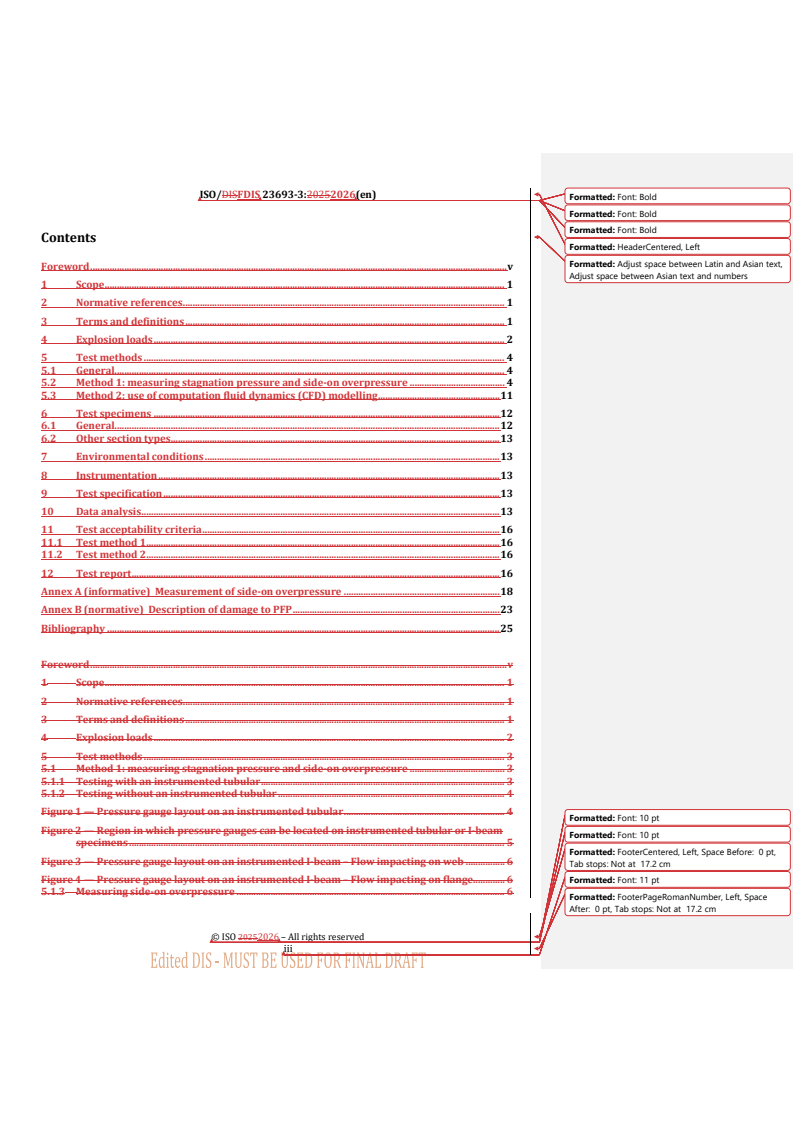
Contents Page
Foreword .iv
1 Scope . 1
2 Normative references . 1
3 Terms and definitions . 1
4 Explosion loads . 2
5 Test methods . 3
5.1 General .3
5.2 Method 1: measuring stagnation pressure and side-on overpressure .4
5.2.1 Testing with an instrumented tubular .4
5.2.2 Testing without an instrumented tubular .4
5.2.3 Measuring side-on overpressure .6
5.3 Method 2: use of computation fluid dynamics (CFD) modelling .7
6 Test specimens . 8
6.1 General .8
6.2 Other section types .8
7 Environmental conditions . 9
8 Instrumentation . 9
9 Test specification . 9
10 Data analysis . 9
11 Test acceptability criteria .11
11.1 Test method 1 .11
11.2 Test method 2 .11
12 Test report .11
Annex A (informative) Measurement of side-on overpressure .12
Annex B (normative) Description of damage to PFP .15
Bibliography . 17
iii
Foreword
ISO (the International Organization for Standardization) is a worldwide federation of national standards
bodies (ISO member bodies). The work of preparing International Standards is normally carried out through
ISO technical committees. Each member body interested in a subject for which a technical committee
has been established has the right to be represented on that committee. International organizations,
governmental and non-governmental, in liaison with ISO, also take part in the work. ISO collaborates closely
with the International Electrotechnical Commission (IEC) on all matters of electrotechnical standardization.
The procedures used to develop this document and those intended for its further maintenance are described
in the ISO/IEC Directives, Part 1. In particular, the different approval criteria needed for the different types
of ISO document should be noted. This document was drafted in accordance with the editorial rules of the
ISO/IEC Directives, Part 2 (see www.iso.org/directives).
ISO draws attention to the possibility that the implementation of this document may involve the use of (a)
patent(s). ISO takes no position concerning the evidence, validity or applicability of any claimed patent
rights in respect thereof. As of the date of publication of this document, ISO had not received notice of (a)
patent(s) which may be required to implement this document. However, implementers are cautioned that
this may not represent the latest information, which may be obtained from the patent database available at
www.iso.org/patents. ISO shall not be held responsible for identifying any or all such patent rights.
Any trade name used in this document is information given for the convenience of users and does not
constitute an endorsement.
For an explanation of the voluntary nature of standards, the meaning of ISO specific terms and expressions
related to conformity assessment, as well as information about ISO's adherence to the World Trade
Organization (WTO) principles in the Technical Barriers to Trade (TBT), see www.iso.org/iso/foreword.html.
This document was prepared by Technical Committee ISO/TC 92, Fire safety, Subcommittee SC 2, Fire
Resistance.
A list of all parts in the ISO 23693 series can be found on the ISO website.
Any feedback or questions on this document should be directed to the user’s national standards body. A
complete listing of these bodies can be found at www.iso.org/members.html.
iv
FINAL DRAFT International Standard ISO/FDIS 23693-3:2026(en)
Determination of the resistance to gas explosions of passive
fire protection materials —
Part 3:
Tubular and I-section substrates subject to elastic
deformation only
1 Scope
This document describes methods for simulating the mechanical loads that can be imparted to passive fire
protection (PFP) materials and systems by explosions resulting from releases of flammable gas, pressurized
liquefied gas, flashing liquid fuels, or dust that can precede a fire.
These methods can be used to determine the resistance of passive fire protection materials to such events.
This document considers PFP materials applied to substrates that are subject to the combined effects of
pressure and drag that occur in the flow path of an explosion. This document excludes specimens in which
the substrate is subject to plastic deformation or brittle failure
2 Normative references
The following documents are referred to in the text in such a way that some or all of their content constitutes
requirements of this document. For dated references, only the edition cited applies. For undated references,
the latest edition of the referenced document (including any amendments) applies.
ISO 23693-1, Determination of the resistance to gas explosions of passive fire protection materials — Part 1:
General requirements
3 Terms and definitions
For the purposes of this document, the following terms and definitions apply.
ISO and IEC maintain terminology databases for use in standardization at the following addresses:
— ISO Online browsing platform: available at https:// www .iso .org/ obp
— IEC Electropedia: available at https:// www .electropedia .org/
3.1
congested region
region that is occupied by items that provide obstacles to flow ahead of the flame,
thereby increasing flame velocity, the rate at which energy is released, and the overpressure produced
3.2
drag load
load on items resulting from the flow of gas generated by a gas explosion
3.3
overpressure
difference between actual pressure and ambient pressure
3.4
pressure load
load on an object resulting from the overpressure (3.3) generated by a gas explosion
3.5
projected area
part of the vent area that the instrumented test specimen covers
3.6
rise time
time for the pressure in a blast wave to rise to the peak overpressure (3.3)
3.7
side-on overpressure
overpressure (3.3) measured at right angles to the direction of travel of a blast wave
Note 1 to entry: This can also be described as incident or free field overpressure.
3.8
stagnation pressure
pressure at a location perpendicular to and facing the direction of the flow, where the velocity of the
explosion gases has been reduced to zero
3.9
streamlined housing
housing that a pressure transducer can be mounted into, which, if aligned with the direction of travel of the
blast wave and flow generated by a gas explosion, allows the side-on overpressure (3.7) to be measured
3.10
substrate
section to which the passive fire protection (PFP) materials are attached or mounted
4 Explosion loads
Methods for generating explosive loads are described in ISO 23693-1. Due to the nature of the specimen
being tested, it will be exposed to a combination of overpressure and drag loads. Pressure loads come from
the overpressure generated by the explosion; the drag loads are generated by the high velocity gas flow
around the object. To ensure that PFP systems applied to this type of object can survive a gas explosion it is
necessary to test them against a combination of pressure and drag loads.
To achieve a combination of pressure and drag loads, the test specimen shall be located in, or near, the vent
of a confined gas explosion or at the edge of the congested region of an unconfined gas explosion, where the
velocity of the gas flow will produce a drag load.
The pressure load is obtained by measuring the side-on overpressure.
Drag load is characterized either by measuring the stagnation pressure on an instrumented tubular
positioned so as to receive the same drag load as the specimen being tested or by instrumenting the
specimen being tested. When the instrumented tubular is used, it shall be located in the same position as the
specimen during a calibration test conducted under the same test conditions.
The drag load on an object in a flow is given by Formula (1):
D = C A p (1)
L D dyn
where
D is the drag load, in newtons (N);
L
C is the drag coefficient of object;
D
A is the projected area of object normal to flow direction, in square metres (m );
p is the dynamic pressure, in newtons per square metre (N/m ), and is calculated using
dyn
Formula (2):
p = ρu /2 (2)
dyn
where
ρ is the gas density, in kilograms per cubic metre (kg/m );
u is the flow velocity, in metres per second (m/s).
It is difficult to know the actual drag coefficient of an object as it changes with shape, orientation, flow
velocity and flow conditions. When computer programs that model the effects of a gas explosion calculate
drag load they typically assume a C of unity, so drag load is equal to the dynamic pressure.
D
When conducting gas explosion trials, the dynamic pressure can be calculated from the measured stagnation
pressure and side-on pressure using Formula (3):
p = p – p (3)
dyn stag side
where
p is the stagnation pressure, in newtons per square metre, (N/m );
stag
p side-on pressure, in newtons per square metre, (N/m ).
side
NOTE 1 The actual drag load on an object is dependent both on the flow velocity and the drag coefficient of the
object. The drag coefficient is dependent on the geometry and orientation of the object being considered.
NOTE 2 This document does not consider bending or deflection of samples. If used for rating PFP performance of
bending and deflection, it is necessary to perform additional analysis.
Test laboratories should be aware of the significant potential hazards involved in gas explosion resistance
testing and take appropriate steps to ensure the safety of all concerned.
5 Test methods
5.1 General
Two test methods are available, both designed to ensure that the required levels of overpressure and drag
load are attained. The two methods are:
a) Method 1: quantifying the drag and pressure loads by direct measurement of the stagnation pressure
and side-on overpressure.
b) Method 2: using computational fluid dynamic modelling to simulate the gas explosion such that the drag
load and overpressure load on the specimen under test can be calculated.
These methods are described in 5.2 and 5.3.
5.2 Method 1: measuring stagnation pressure and side-on overpressure
5.2.1 Testing with an instrumented tubular
An instrumented tubular shall have a minimum external diameter of 100 mm. Its external diameter shall
be within ±20 % of the tubular diameter or I-beam depth of the specimen to be tested. For testing involving
an I-beam section, the depth of the section is the dimension of the specimen measured perpendicular to
the flow direction and perpendicular to the span. The instrumented tubular shall have three pressure
gauges mounted to measure the stagnation pressure of the flow, see Figure 1. The pressure gauges shall
be mounted in the central 50 % of the length of the tubular spaced 100 mm apart (see Figures 1 and 2). If
multiple specimens are to be tested then the same number of instrumented tubulars shall be required in a
calibration test and put in the same positions in which the specimens are to be mounted. When a calibration
test has been carried out using an instrumented tubular(s) the result of the test will be considered valid for
any specimen tested to the same test conditions. The calibration would only need to be repeated if there is
a change in the test conditions.
NOTE I-beam refers to I sections of any dimension.
5.2.2 Testing without an instrumented tubular
If an instrumented tubular is not used then the specimen(s) being tested shall be instrumented to measure
stagnation pressure. This shall be done without impairing the PFP systems being tested. If the test specimen
is a tubular, the three pressure gauges shall be mounted as shown in Figures 1 and 2. If the specimen to be
instrumented is an I-beam then three pressure gauges are to be mounted on it as shown in Figures 3 or 4
depending on the orientation of the I-beam relative to the flow path.
Dimensions in millimetres
Key
p stagnation pressure transducer
stag
1 direction of gas flow
Figure 1 — Pressure gauge layout on an instrumented tubular
Key
1 instrumented tubular or specimen
2 region in which pressure gauges can be located
3 supports
L length of instrumented tubular or specimen
Figure 2 — Regi
...
Formatted
...
Style Definition
...
Style Definition
...
Style Definition
...
Style Definition
...
ISO/DISFDIS 23693-3:2025(en)
Style Definition
...
ISO/TC 92/SC 2
Style Definition
...
Style Definition
...
Secretariat: ANSI
Style Definition
...
Date: 20252026-01-08-06
Style Definition
...
Style Definition
...
Style Definition
...
Style Definition
...
Style Definition
...
Style Definition
...
Determination of the resistance to gas explosions of passive fire
Style Definition
...
protection materials — —
Style Definition
...
Style Definition
...
Style Definition
...
Style Definition
...
Style Definition
...
Part 3: Style Definition
...
Style Definition
Tubular and I-beam specimenssection substrates subject to elastic
...
Style Definition
deformation only
...
Style Definition
...
Style Definition
...
Style Definition
...
Style Definition
...
Style Definition
...
Style Definition
...
Style Definition
...
Style Definition
...
FDIS stage
Style Definition
...
Style Definition
...
Style Definition
...
Style Definition
...
Style Definition
...
Style Definition
...
Style Definition
...
Style Definition
...
Style Definition
...
Style Definition
...
Style Definition
...
Style Definition
...
Style Definition
...
Style Definition
...
Style Definition
...
Style Definition
...
Style Definition
...
Style Definition
...
Style Definition
...
Style Definition
...
Style Definition
...
Style Definition
...
Style Definition
...
Style Definition
...
Style Definition
...
St l D fi iti
Formatted: Font: Bold
Formatted: HeaderCentered
Formatted: Default Paragraph Font
Formatted: Adjust space between Latin and Asian text,
All rights reserved. Unless otherwise specified, or required in the context of its implementation, no part of this publication
Adjust space between Asian text and numbers
may be reproduced or utilized otherwise in any form or by any means, electronic or mechanical, including photocopying,
or posting on the internet or an intranet, without prior written permission. Permission can be requested from either ISO
at the address below or ISO’s member body in the country of the requester.
ISO copyright office
CP 401 • Ch. de Blandonnet 8
CH-1214 Vernier, Geneva
Phone: + 41 22 749 01 11
Formatted: French (France)
EmailE-mail: copyright@iso.org
Formatted: French (France)
Website: www.iso.orgwww.iso.org
Formatted: French (France)
Published in Switzerland
Formatted: FooterPageRomanNumber
ii
ISO/DISFDIS 23693-3:20252026(en)
Formatted: Font: Bold
Formatted: Font: Bold
Formatted: Font: Bold
Contents
Formatted: HeaderCentered, Left
Formatted: Adjust space between Latin and Asian text,
Foreword . v
Adjust space between Asian text and numbers
1 Scope . 1
2 Normative references . 1
3 Terms and definitions . 1
4 Explosion loads . 2
5 Test methods . 4
5.1 General. 4
5.2 Method 1: measuring stagnation pressure and side-on overpressure . 4
5.3 Method 2: use of computation fluid dynamics (CFD) modelling . 11
6 Test specimens . 12
6.1 General. 12
6.2 Other section types . 13
7 Environmental conditions . 13
8 Instrumentation . 13
9 Test specification . 13
10 Data analysis . 13
11 Test acceptability criteria . 16
11.1 Test method 1 . 16
11.2 Test method 2 . 16
12 Test report . 16
Annex A (informative) Measurement of side-on overpressure . 18
Annex B (normative) Description of damage to PFP . 23
Bibliography . 25
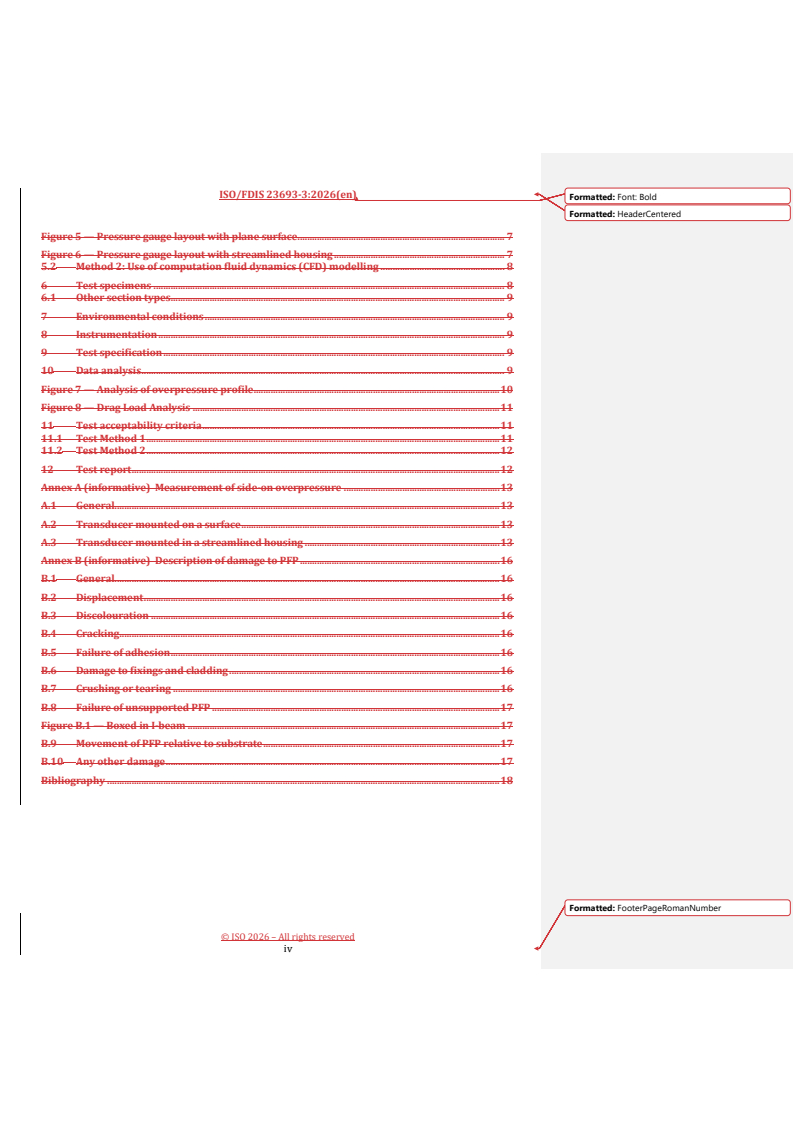
Foreword . v
1 Scope . 1
2 Normative references . 1
3 Terms and definitions . 1
4 Explosion loads . 2
5 Test methods . 3
5.1 Method 1: measuring stagnation pressure and side-on overpressure . 3
5.1.1 Testing with an instrumented tubular . 3
5.1.2 Testing without an instrumented tubular . 4
Figure 1 — Pressure gauge layout on an instrumented tubular . 4
Formatted: Font: 10 pt
Figure 2 — Region in which pressure gauges can be located on instrumented tubular or I-beam
Formatted: Font: 10 pt
specimens . 5
Formatted: FooterCentered, Left, Space Before: 0 pt,
Figure 3 — Pressure gauge layout on an instrumented I-beam – Flow impacting on web . 6
Tab stops: Not at 17.2 cm
Figure 4 — Pressure gauge layout on an instrumented I-beam – Flow impacting on flange. 6 Formatted: Font: 11 pt
5.1.3 Measuring side-on overpressure . 6
Formatted: FooterPageRomanNumber, Left, Space
After: 0 pt, Tab stops: Not at 17.2 cm
iii
Formatted: Font: Bold
Formatted: HeaderCentered
Figure 5 — Pressure gauge layout with plane surface. 7
Figure 6 — Pressure gauge layout with streamlined housing . 7
5.2 Method 2: Use of computation fluid dynamics (CFD) modelling . 8
6 Test specimens . 8
6.1 Other section types . 9
7 Environmental conditions . 9
8 Instrumentation . 9
9 Test specification . 9
10 Data analysis . 9
Figure 7 — Analysis of overpressure profile . 10
Figure 8 — Drag Load Analysis . 11
11 Test acceptability criteria . 11
11.1 Test Method 1 . 11
11.2 Test Method 2 . 12
12 Test report . 12
Annex A (informative) Measurement of side-on overpressure . 13
A.1 General. 13
A.2 Transducer mounted on a surface . 13
A.3 Transducer mounted in a streamlined housing . 13
Annex B (informative) Description of damage to PFP . 16
B.1 General. 16
B.2 Displacement . 16
B.3 Discolouration . 16
B.4 Cracking . 16
B.5 Failure of adhesion . 16
B.6 Damage to fixings and cladding . 16
B.7 Crushing or tearing . 16
B.8 Failure of unsupported PFP . 17
Figure B.1 — Boxed in I-beam . 17
B.9 Movement of PFP relative to substrate . 17
B.10 Any other damage . 17
Bibliography . 18
Formatted: FooterPageRomanNumber
iv
ISO/DISFDIS 23693-3:20252026(en)
Formatted: Font: Bold
Formatted: Font: Bold
Formatted: Font: Bold
Foreword
Formatted: HeaderCentered, Left
Formatted: Adjust space between Latin and Asian text,
Adjust space between Asian text and numbers
ISO (the International Organization for Standardization) is a worldwide federation of national standards
bodies (ISO member bodies). The work of preparing International Standards is normally carried out through
ISO technical committees. Each member body interested in a subject for which a technical committee has been
established has the right to be represented on that committee. International organizations, governmental and
non-governmental, in liaison with ISO, also take part in the work. ISO collaborates closely with the
International Electrotechnical Commission (IEC) on all matters of electrotechnical standardization.
The procedures used to develop this document and those intended for its further maintenance are described
in the ISO/IEC Directives, Part 1. In particular, the different approval criteria needed for the different types of
ISO document should be noted. This document was drafted in accordance with the editorial rules of the
ISO/IEC Directives, Part 2 (see www.iso.org/directives).
Formatted: English (United Kingdom)
ISO draws attention to the possibility that the implementation of this document may involve the use of (a)
patent(s). ISO takes no position concerning the evidence, validity or applicability of any claimed patent rights
in respect thereof. As of the date of publication of this document, ISO had not received notice of (a) patent(s)
Formatted: Font: Not Italic, Font color: Auto
which may be required to implement this document. However, implementers are cautioned that this may not
represent the latest information, which may be obtained from the patent database available at
www.iso.org/patents.www.iso.org/patents. ISO shall not be held responsible for identifying any or all such
patent rights.
Any trade name used in this document is information given for the convenience of users and does not
constitute an endorsement.
For an explanation of the voluntary nature of standards, the meaning of ISO specific terms and expressions
related to conformity assessment, as well as information about ISO's adherence to the World Trade
Organization (WTO) principles in the Technical Barriers to Trade (TBT), see www.iso.org/iso/foreword.html.
Formatted: English (United Kingdom)
Field Code Changed
This document was prepared by Technical Committee ISO/TC 92, Fire Safetysafety, Subcommittee SC 2, Fire
Formatted: Font: Italic
ContainmentResistance.
Formatted: Adjust space between Latin and Asian text,
A list of all parts in the ISO 23693 series can be found on the ISO website.
Adjust space between Asian text and numbers
Formatted: Default Paragraph Font
Any feedback or questions on this document should be directed to the user’s national standards body. A
complete listing of these bodies can be found at www.iso.org/members.html. Formatted: Default Paragraph Font
Formatted: Default Paragraph Font
Formatted: English (United Kingdom)
Field Code Changed
Formatted: Font: 10 pt
Formatted: Font: 10 pt
Formatted: FooterCentered, Left, Space Before: 0 pt,
Tab stops: Not at 17.2 cm
Formatted: Font: 11 pt
Formatted: FooterPageRomanNumber, Left, Space
After: 0 pt, Tab stops: Not at 17.2 cm
v
DRAFT International Standard ISO/DIS 23693-3:2025(en)
Formatted: Left
Determination of the resistance to gas explosions of passive fire
protection materials — —
Formatted: Main Title 2, Adjust space between Latin
Part 3:
and Asian text, Adjust space between Asian text and
Tubular and I-Beam Specimenssection substrates subject to elastic
numbers
deformation only
1 Scope
This document describes methods for simulating the mechanical loads that couldcan be imparted to passive
Formatted: Adjust space between Latin and Asian text,
fire protection (PFP) materials and systems by explosions resulting from releases of flammable gas, Adjust space between Asian text and numbers
pressurized liquefied gas, flashing liquid fuels, or dust that can precede a fire.
These methods can be used to determine the resistance of passive fire protection materials to such events.
This standarddocument considers PFP materials applied to substrates that are subject to the combined effects
of pressure and drag that occur in the flow path of an explosion. This part of the standarddocument excludes
specimens wherebyin which the substrate is subject to plastic deformation or brittle failure
2 Normative references
The following documents are referred to in the text in such a way that some or all of their content constitutes
requirements of this document. For dated references, only the edition cited applies. For undated references,
the latest edition of the referenced document (including any amendments) applies.
ISO 23693--1, Determination of the resistance to gas explosions of passive fire protection materials — Part 1:
Formatted: Default Paragraph Font
General requirements
Formatted: Default Paragraph Font
Formatted: Default Paragraph Font
3 Terms and definitions
Formatted: Default Paragraph Font
For the purposes of this document, the following terms and definitions apply.
Formatted: Adjust space between Latin and Asian text,
Adjust space between Asian text and numbers, Tab
ISO and IEC maintain terminology databases for use in standardization at the following addresses:
stops: Not at 0.7 cm + 1.4 cm + 2.1 cm + 2.8 cm +
3.5 cm + 4.2 cm + 4.9 cm + 5.6 cm + 6.3 cm + 7 cm
— — ISO Online browsing platform: available at https://www.iso.org/obphttps://www.iso.org/obp
Formatted: Adjust space between Latin and Asian text,
Adjust space between Asian text and numbers
— — IEC Electropedia: available at https://www.electropedia.org/https://www.electropedia.org/
Formatted: Adjust space between Latin and Asian text,
3.1 3.1
Adjust space between Asian text and numbers, Tab
congested region
stops: Not at 0.7 cm + 1.4 cm + 2.1 cm + 2.8 cm +
< explosion test rig> region that is occupied by items that provide obstacles to flow ahead of the flame, thereby
3.5 cm + 4.2 cm + 4.9 cm + 5.6 cm + 6.3 cm + 7 cm
increasing flame velocity, the rate at which energy is released, and the overpressure produced
Formatted: TermNum2, Adjust space between Latin
and Asian text, Adjust space between Asian text and
3.2 3.2
numbers
drag load
Formatted: Footer, Left, Space After: 0 pt, Tab stops:
load on items resulting from the flow of gas generated by a gas explosion
Not at 17.2 cm
Formatted: Font: Bold
Formatted: HeaderCentered
3.3 3.3
overpressure
difference between actual pressure and ambient pressure
3.4 3.4
pressure load
load on an object resulting from the overpressure (3.3)(3.3) generated by a gas explosion
3.5 3.5
projected area
part of the vent area that the instrumented test specimen covers
3.6 3.6
rise time
time for the pressure in a blast wave to rise to the peak overpressure (3.3)(3.3)
3.7 3.7
side-on overpressure
overpressure (3.3)(3.3) measured at right angles to the direction of travel of a blast wave
Note 1 to entry: It This can also be described as incident or free field overpressure.
3.8 3.8
stagnation pressure
pressure at a location perpendicular to and facing the direction of the flow, where the velocity of the explosion
gases havehas been reduced to zero
3.9 3.9
streamlined housing
housing that a pressure transducer can be mounted into that, which, if aligned with the direction of travel of
the blast wave and flow generated by a gas explosion that, allows the side-on overpressure (3.7) to be measured
Formatted: Font: Italic
3.10 3.10
substrate
section to which the passive fire protection (PFP) materials are attached or mounted
4 Explosion loads
Methods for generating explosive loads are described in Part ISO 23693-1. Due to the nature of the specimen
being tested, it will be exposed to a combination of overpressure and drag loads. Pressure loads come from
the overpressure generated by the explosion; the drag loads are generated by the high velocity gas flow around
the object. To ensure that PFP systems applied to this type of object can survive a gas explosion it is necessary
to test them against a combination of pressure and drag loads.
To achieve a combination of drag and pressure and drag loads, the test specimen shall be located in, or near,
the vent of a confined gas explosion or at the edge of the congested region of an unconfined gas explosion,
where the velocity of the gas flow will produce a drag load.
The pressure load is obtained by measuring the side-on overpressure.
Drag load is characterisedcharacterized either by measuring the stagnation pressure on an instrumented
tubular positioned so as to receive the same drag load as the specimen being tested or by instrumenting the
specimen being tested. When the instrumented tubular is used, it shall be located in the same position as the
specimen during a calibration test conducted under the same test conditions.
Formatted: FooterPageNumber
ISO/DISFDIS 23693-3:20252026(en) Formatted: Font: 11 pt, Bold
Formatted: Font: 11 pt, Bold
Formatted: Font: 11 pt, Bold
The drag load on an object in a flow is given by Formula (1):Formula (1):
Formatted: Font: Bold
D = C A p (1)
L D dyn
Formatted: HeaderCentered, Left
Formatted: Font: Not Italic
Where:
Formatted: label
D drag load, N;
L
Formatted: Adjust space between Latin and Asian text,
Adjust space between Asian text and numbers, Tab
CD drag coefficient of object;
stops: Not at 0.7 cm + 1.4 cm + 2.1 cm + 2.8 cm +
3.5 cm + 4.2 cm + 4.9 cm + 5.6 cm + 6.3 cm + 7 cm
A projected area of object normal to flow direction, m ;
pdyn dynamic pressure, N/m .
where
DL is the drag load, in newtons (N);
CD is the drag coefficient of object;
A is the projected area of object normal to flow direction, in square metres (m );
p is the dynamic pressure, in newtons per square metre (N/m ), and is calculated using Formula (2):
dyn
pdyn = ρu /2 (2)
Formatted: Font: Not Italic
Formatted: Font: Not Italic
where
Formatted: Adjust space between Latin and Asian text,
ρ is the gas density, in kilograms per cubic metre (kg/m );
Adjust space between Asian text and numbers, Tab
u is the flow velocity, in metres per second (m/s). stops: Not at 0.7 cm + 1.4 cm + 2.1 cm + 2.8 cm +
3.5 cm + 4.2 cm + 4.9 cm + 5.6 cm + 6.3 cm + 7 cm
where:
ρ Gas density, kg/m
u Flow velocity, m/s
It is difficult to know the actual drag coefficient of an object as it changes with shape, orientation, flow velocity
Formatted: Adjust space between Latin and Asian text,
and flow conditions. When computer programmesprograms that model the effects of a gas explosion calculate
Adjust space between Asian text and numbers
drag load they typically assume a C C of unity, so drag load is equal to the dynamic pressure.
d D
Formatted: Not Superscript/ Subscript
When conducting gas explosion trials, the dynamic pressure can be calculated from the measured stagnation
Formatted: label
pressure and side-on pressure using Formula (2):Formula (3):
Formatted: label
p = p – p (23) Formatted: Adjust space between Latin and Asian text,
dyn stag side
Adjust space between Asian text and numbers, Tab
Where: stops: Not at 0.7 cm + 1.4 cm + 2.1 cm + 2.8 cm +
3.5 cm + 4.2 cm + 4.9 cm + 5.6 cm + 6.3 cm + 7 cm
p stagnation pressure, N/m ;
stag
Formatted: Adjust space between Latin and Asian text,
Adjust space between Asian text and numbers, Tab
p side-on pressure, N/m .
side
stops: Not at 0.7 cm + 1.4 cm + 2.1 cm + 2.8 cm +
3.5 cm + 4.2 cm + 4.9 cm + 5.6 cm + 6.3 cm + 7 cm
NOTE1: thewhere
Formatted: Font: 10 pt
pstag is the stagnation pressure, in newtons per square metre, (N/m ); Formatted: Font: 10 pt
pside side-on pressure, in newtons per square metre, (N/m ).
Formatted: FooterCentered, Left, Space Before: 0 pt,
NOTE 1 The actual drag load on an object is dependent both on the flow velocity and the drag coefficient of the object.
Tab stops: Not at 17.2 cm
The drag coefficient is dependent on the geometry and orientation of the object being considered.
Formatted: Font: 11 pt
NOTE2: NOTE 2 This document does not consider bending/ or deflection of samples. It should not beIf used for rating
Formatted: FooterPageNumber, Left, Space After: 0 pt,
PFP performance of bending and deflection without, it is necessary to perform additional analysis.
Tab stops: Not at 17.2 cm
Formatted: Font: Bold
Formatted: HeaderCentered
Test laboratories should be aware of the significant potential hazards involved in gas explosion resistance
Formatted: Adjust space between Latin and Asian text,
testing and take appropriate steps to ensure the safety of all concerned. Adjust space between Asian text and numbers
5 Test methods
5.1 General
Two test methods are available, both designed to ensure that the required levels of overpressure and drag
Formatted: Adjust space between Latin and Asian text,
load are attained. The two methods are: Adjust space between Asian text and numbers
a) a) Method 1: quantifying the drag and pressure loads by direct measurement of the stagnation
Formatted: Numbered + Level: 1 + Numbering Style: a,
pressure and side-on overpressure.
b, c, … + Start at: 1 + Alignment: Left + Aligned at: 0
cm + Indent at: 0 cm
b) b) Method 2: using computational fluid dynamic modelling to simulate the gas explosion such that
the drag load and overpressure load on the specimen under test can be calculated.
These methods are described in 5.1 and 5.2:5.2 and 5.3.
Formatted: Adjust space between Latin and Asian text,
Adjust space between Asian text and numbers
5.15.2 Method 1: measuring stagnation pressure and side-on overpressure
Formatted: Adjust space between Latin and Asian text,
Adjust space between Asian text and numbers, Tab
5.1.15.2.1 Testing with an instrumented tubular
stops: Not at 0.71 cm
Formatted: Adjust space between Latin and Asian text,
An instrumented tubular shall have a minimum external diameter of 100 mm. Its external diameter shall be
Adjust space between Asian text and numbers, Tab
within ±20 % of the tubular diameter or I-beam depth of the specimen to be tested. For testing involving an I-
stops: Not at 0.71 cm + 0.99 cm + 1.27 cm
beam section, the depth of the section is the dimension of the specimen measured perpendicular to the flow
direction and perpendicular to the span. The instrumented tubular shall have three pressure gauges mounted
Formatted: Adjust space between Latin and Asian text,
to measure the stagnation pressure of the flow, see Figure 1.Figure 1. The pressure gauges shall be mounted
Adjust space between Asian text and numbers
in the central 50 % of the length of the tubular spaced 100 mm apart, see Figures 1 and 2. (see Figures 1 and
2). If multiple specimens are to be tested then the same number of instrumented tubulars shall be required in
a calibration test and put in the same positions in which the specimens are to be mounted. When a calibration
test has been carried out using an instrumented tubular(s) the result of the test will be considered valid for
any specimen tested to the same test conditions. The calibration would only need to be repeated if there is a
change in the test conditions.
NOTE I-beam refers to I sections of any dimension.
Formatted: Adjust space between Latin and Asian text,
Adjust space between Asian text and numbers, Tab
5.1.25.2.2 Testing without an instrumented tubular
stops: Not at 0.7 cm + 1.4 cm + 2.1 cm + 2.8 cm +
3.5 cm + 4.2 cm + 4.9 cm + 5.6 cm + 6.3 cm + 7 cm
If an instrumented tubular is not used then the specimen(s) being tested shall be instrumented to measure
Formatted: Adjust space between Latin and Asian text,
stagnation pressure. This shall be done without impairing the PFP systems being tested. If the test specimen
Adjust space between Asian text and numbers, Tab
is a tubular, the three pressure gauges shall be mounted as shown in Figures 1 and 2.Figures 1 and 2. If the
stops: Not at 0.71 cm + 0.99 cm + 1.27 cm
specimen to be instrumented is an I-beam then three pressure gauges are to be mounted on it as shown in
Formatted: Adjust space between Latin and Asian text,
Figures 3 or 4Figures 3 or 4 depending on the orientation of the I-beam relative to the flow path.
Adjust space between Asian text and numbers
Formatted: FooterPageNumber
ISO/DISFDIS 23693-3:20252026(en) Formatted: Font: 11 pt, Bold
Formatted: Font: 11 pt, Bold
Formatted: Font: 11 pt, Bold
Dimensions in millimetres
Formatted: Font: Bold
Formatted: HeaderCentered, Left
Formatted: Adjust space between Latin and Asian text,
Adjust space between Asian text and numbers, Tab
stops: Not at 0.7 cm + 1.4 cm + 2.1 cm + 2.8 cm +
3.5 cm + 4.2 cm + 4.9 cm + 5.6 cm + 6.3 cm + 7 cm
Key
Formatted: None, Adjust space between Latin and
p stagnation pressure transducer
stag
Asian text, Adjust space between Asian text and
1 Direction of gas flow.
numbers
pstag stagnation pressure transducer
Formatted: Font: 10 pt
1 direction of gas flow
Formatted: Font: 10 pt
Figure 1 — Pressure gauge layout on an instrumented tubular
Formatted: FooterCentered, Left, Space Before: 0 pt,
Tab stops: Not at 17.2 cm
Formatted: Font: 11 pt
Formatted: FooterPageNumber, Left, Space After: 0 pt,
Tab stops: Not at 17.2 cm
Formatted: Font: Bold
Formatted: HeaderCentered
Key
Formatted: Adjust space between Latin and Asian text,
1 instrumented tubular or specimen
Adjust space between Asian text and numbers, Tab
2 region in which pressure gauges can be located stops: Not at 0.7 cm + 1.4 cm + 2.1 cm + 2.8 cm +
3.5 cm + 4.2 cm + 4.9 cm + 5.6 cm + 6.3 cm + 7 cm
3 supports
L length of instrumented tubular or specimen
1 instrumented tubular or specimen
2 region in which pressure gauges can be located
3 supports
L length of instrumented tubular or specimen
Figure 2 — Region in which pressure gauges can be located on instrumented tubular or I-beam
Formatted: None, Adjust space between Latin and
specimens Asian text, Adjust space between Asian text and
numbers
Formatted: FooterPageNumber
ISO/DISFDIS 23693-3:20252026(en) Formatted: Font: 11 pt, Bold
Formatted: Font: 11 pt, Bold
Formatted: Font: 11 pt, Bold
Dimensions in millimetres
Formatted: Font: Bold
Formatted: HeaderCentered, Left
Formatted: Indent: Left: 0 cm, Hanging: 0.61 cm,
Adjust space between Latin and Asian text, Adjust space
between Asian text and numbers, Tab stops: Not at 0.7
cm + 1.4 cm + 2.1 cm + 2.8 cm + 3.5 cm + 4.2 cm +
Key
4.9 cm + 5.6 cm + 6.3 cm + 7 cm
Y Section.
Formatted: Font: 10 pt
d section depth
Formatted: Font: 10 pt
1 Direction of gas flow
Formatted: FooterCentered, Left, Space Before: 0 pt,
Tab stops: Not at 17.2 cm
Y section
Formatted: Font: 11 pt
d section depth
Formatted: FooterPageNumber, Left, Space After: 0 pt,
1 direction of gas flow
Tab stops: Not at 17.2 cm
Formatted: Font: Bold
Formatted: HeaderCentered
Figure 3 — Pressure gauge layout on an instrumented I-beam – Flow impacting on web
Formatted: None, Adjust space between Latin and
Asian text, Adjust space between Asian text and
numbers
Dimensions in millimetres
Key
Formatted: Indent: Left: 0 cm, Hanging: 0.61 cm,
Y Section.
Adjust space between Latin and Asian text, Adjust space
d section depth between Asian text and numbers, Tab stops: Not at 0.7
cm + 1.4 cm + 2.1 cm + 2.8 cm + 3.5 cm + 4.2 cm +
1 Direction of gas flow
4.9 cm + 5.6 cm + 6.3 cm + 7 cm
Z section
d section depth
Formatted: FooterPageNumber
ISO/DISFDIS 23693-3:20252026(en) Formatted: Font: 11 pt, Bold
Formatted: Font: 11 pt, Bold
Formatted: Font: 11 pt, Bold
1 direction of gas flow
Formatted: Font: Bold
Figure 4 — Pressure gauge layout on an instrumented I-beam – Flow impacting on flange
Formatted: HeaderCentered, Left
Formatted: None, Adjust space between Latin and
5.1.35.2.3 Measuring side-on overpressure
Asian text, Adjust space between Asian text and
numbers
Side-on overpressure shall be measured using three pressure gauges either positioned:
Formatted: Adjust space between Latin and Asian text,
Adjust space between Asian text and numbers, Tab
— On--— on a plane surface, (see Figure 5,Figure 5; the plane surface can be any suitably located horizontal or
stops: Not at 0.71 cm + 0.99 cm + 1.27 cm
vertical surface.); or
Formatted: Adjust space between Latin and Asian text,
Or
Adjust space between Asian text and numbers
Formatted: List Continue 1 (-), Bulleted + Level: 1 +
— Inin a suitable streamlined housingshousing aligned with the direction of flow, (see Figure 6.Figure 6).
Aligned at: 0 cm + Indent at: 0 cm, Adjust space
between Latin and Asian text, Adjust space between
Methods for measuring side-on overpressure are described in Annex A.Annex A. If multiple specimens are
Asian text and numbers
being tested then it would only be necessary to measure side-on overpressure using three gauges, provided
Formatted: List Continue 1 (-), Bulleted + Level: 1 +
that the side-on overpressure measured is representative of that to which all the specimens are exposed.
Aligned at: 0 cm + Indent at: 0 cm, Adjust space
between Latin and Asian text, Adjust space between
NOTE Additional gauges can be installed to measure the stagnation and side-on pressures, to provide redundancy.
Asian text and numbers
Formatted: Adjust space between Latin and Asian text,
Adjust space between Asian text and numbers
Formatted: Adjust space between Latin and Asian text,
Adjust space between Asian text and numbers, Tab
stops: Not at 0.7 cm + 1.4 cm + 2.1 cm + 2.8 cm +
3.5 cm + 4.2 cm + 4.9 cm + 5.6 cm + 6.3 cm + 7 cm
Formatted: Font: 10 pt
Formatted: Font: 10 pt
Formatted: FooterCentered, Left, Space Before: 0 pt,
Tab stops: Not at 17.2 cm
Formatted: Font: 11 pt
Formatted: FooterPageNumber, Left, Space After: 0 pt,
Tab stops: Not at 17.2 cm
Formatted: Font: Bold
Formatted: HeaderCentered
Dimensions in metres
Key
Formatted: Adjust space between Latin and Asian text,
1 test specimen
Adjust space between Asian text and numbers, Tab
2 Direction of gas flow. stops: Not at 0.7 cm + 1.4 cm + 2.1 cm + 2.8 cm +
3.5 cm + 4.2 cm + 4.9 cm + 5.6 cm + 6.3 cm + 7 cm
pside side-on overpressure transducer
1 test specimen
2 direction of gas flow
pside side-on overpressure transducer
Figure 5 — Pressure gauge layout with plane surface
Formatted: None, Adjust space between Latin and
Asian text, Adjust space between Asian text and
numbers
Formatted: FooterPageNumber
ISO/DISFDIS 23693-3:20252026(en) Formatted: Font: 11 pt, Bold
Formatted: Font: 11 pt, Bold
Formatted: Font: 11 pt, Bold
Dimensions in metres
Formatted: Font: Bold
Formatted: HeaderCentered, Left
Key
Formatted: Adjust space between Latin and Asian text,
1 test specimen
Adjust space between Asian text and numbers, Tab
2 Direction of gas flow. stops: Not at 0.7 cm + 1.4 cm + 2.1 cm + 2.8 cm +
3.5 cm + 4.2 cm + 4.9 cm + 5.6 cm + 6.3 cm + 7 cm
pside side-on overpressure transducer
1 test specimen
2 direction of gas flow
pside side-on overpressure transducer
Figure 6 — Pressure gauge layout with streamlined housing
Formatted: None, Adjust space between Latin and
Asian text, Adjust space between Asian text and
numbers
5.25.3 Method 2: use of computation fluid dynamics (CFD) modelling
Formatted: Adjust space between Latin and Asian text,
Adjust space between Asian text and numbers, Tab
If it is not practicable to measure stagnation pressure, the test configuration can be validated using a
stops: Not at 0.71 cm
combination of explosion modelling and calibration tests. This combination of modelling and testing mustshall
provide sufficient evidence that the test configuration is suitable for determining if a specimen can withstand
Formatted: Adjust space between Latin and Asian text,
the required explosion loads.
Adjust space between Asian text and numbers
The explosion modelling shall be carried out using a computer program that employs Computational Fluid Formatted: Default Paragraph Font
Dynamicscomputational fluid dynamics (CFD). The CFD application shall output dynamic pressure in the form
Formatted: Font: 10 pt
given in formula 1, section 4. Formula (1). The CFD code shall be a publicly or commercially available code,
Formatted: Font: 10 pt
with published validation studies on its suitability for modelling of gas explosions, with reference to publicly
available test data. These tests shall be representative of the conditions being modelled.
Formatted: FooterCentered, Left, Space Before: 0 pt,
Tab stops: Not at 17.2 cm
The modelling shall be carried out to determine the optimum arrangement to demonstrate that the flow field
Formatted: Font: 11 pt
established prior to interaction with the specimen achieves the required drag parameter. Prior to interaction
Formatted: FooterPageNumber, Left, Space After: 0 pt,
shall mean a minimum of one specimen diameter upstream of the specimen.
Tab stops: Not at 17.2 cm
Formatted: Font: Bold
Formatted: HeaderCentered
Where an overpressure criterion is also specified, the CFD modelling shall be employed to ensure that both
the pressure and drag conditions are met.
When the required test conditions have been identified using the CFD modelling, then a calibration test shall
be carried out to confirm the overpressures calculated by the CFD modelling. The test conditions in the
calibration test shall be the same as those used in the CFD modelling. In the calibration test, the overpressure
generated in the test facility shall be measured at a minimum 3 locations. These shall be at positions that yield
good measurements of the overall static explosion pressure and may not be in locations that are significantly
influenced by blast wave reflections or flow effects. The measured peak overpressures and durations shall
agree with those calculated by the CFD modelling within ±15 %.
When the specimen is tested the overpressure shall be measured at the same locations as in the calibration
test, to confirm that the calibration conditions have been replicated. The measured peak overpressures and
durations shall be within ±15 % of those measured in the calibration test and shall not deviate by more than
±20 % from those estimated by the CFD modelling.
The calibration of a test configuration does not need to be repeated for tests on further specimens with the
same, or sufficiently similar, form and layout. Where the specimen dimensions are the same as previously
tested and all other aspects of the test configuration are the same, reference can be made to a calibration
process carried out previously. However, measurement of pressure shall be made to confirm that the
calibration conditions have been replicated in the test on the specimen.
6 Test specimens
6.1 General
PFP coatings or PFP dry fit systems shall be tested attached to a suitable test specimen. In a gas explosion,
Formatted: Adjust space between Latin and Asian text,
damage to the PFP is caused by a combination of the effects of the gas explosion on the test specimen and the Adjust space between Asian text and numbers
distortion of the test specimen resulting from the explosion loads applied to it.
NOTE Clause 6This clause describes the testing of specimens which are relatively rigid and unlikely to distort
Formatted: Adjust space between Latin and Asian text,
significantly. This part of the standard shall not beIf this clause is used to assess bending and deflection on the
Adjust space between Asian text and numbers, Tab
performance of PFP without, further analysis is necessary.
stops: Not at 0.7 cm + 1.4 cm + 2.1 cm + 2.8 cm +
3.5 cm + 4.2 cm + 4.9 cm + 5.6 cm + 6.3 cm + 7 cm
Test specimens of either a tubular or an I-beam shape may be tested. Any size tubular section of more than
Formatted: Adjust space between Latin and Asian text,
100 mm external diameter including the PFP may be used. Any I-beam section with a minimum size of 100 mm
Adjust space between Asian text and numbers
in either dimension including the PFP may be tested. An I-beam specimen may be mounted with its web either
parallel or perpendicular to the venting flow direction.
The specimen shall be located within the flow path of the explosion so that it is exposed to high velocity flow.
To achieve the required loading regime with a confined gas explosion, the specimen should be mounted in or
close to a vent. When the gas explosion is unconfined, the specimen should be located at the edge of the
congested region.
The length of the test specimen shall be chosen to suit the geometry of the test facility but shall not be less
than 2 m. Test specimens shall be rigidly supported only at their ends. For confined explosions the test
specimen(s) including coating or jacket shall not have a projected area of more than 30 % of the area of the
vent into which it is installed. If necessary, the test specimen(s) can extend beyond the edge of the vent.
The geometry of the gas explosion may allow more than one specimen to be exposed to the required loads and
if this is done, the spe
...
Questions, Comments and Discussion
Ask us and Technical Secretary will try to provide an answer. You can facilitate discussion about the standard in here.
Loading comments...