

ISO/IEC 11770-4:2017
(Main)Information technology — Security techniques — Key management — Part 4: Mechanisms based on weak secrets
General Information
- Abstract
ISO/IEC 11770-4:2017 defines key establishment mechanisms based on weak secrets, i.e. secrets that can be readily memorized by a human, and hence, secrets that will be chosen from a relatively small set of possibilities. It specifies cryptographic techniques specifically designed to establish one or more secret keys based on a weak secret derived from a memorized password, while preventing offline brute-force attacks associated with the weak secret. ISO/IEC 11770-4:2017 is not applicable to the following aspects of key management: - life-cycle management of weak secrets, strong secrets, and established secret keys; - mechanisms to store, archive, delete, destroy, etc. weak secrets, strong secrets, and established secret keys.
- Status
- Published
- Publication Date
- 16-Nov-2017
- Drafting Committee
- ISO/IEC JTC 1/SC 27/WG 2 - Cryptography and security mechanisms
- Current Stage
- 9092 - International Standard to be revised
- Start Date
- 27-Oct-2023
- Completion Date
- 29-Aug-2026
Buy Documents


ISO/IEC 11770-4:2017 - Information technology -- Security techniques -- Key management

ISO/IEC 11770-4:2017 - Information technology — Security techniques — Key management — Part 4: Mechanisms based on weak secrets/17/2017
Overview
ISO/IEC 11770-4:2017 - "Information technology - Security techniques - Key management - Part 4: Mechanisms based on weak secrets" specifies cryptographic mechanisms for establishing secret keys when the starting secret is a human-memorizable, weak secret (e.g., a password). The standard defines techniques that enable password‑based key agreement and key retrieval while preventing offline brute‑force and dictionary attacks on those weak secrets. It does not cover life‑cycle management or storage/archival/destruction of secrets and keys.
Key topics and technical requirements
- Definition of weak secrets: secrets chosen from a relatively small set (memorized passwords) and the associated attack model (brute‑force and dictionary attacks).
- Password‑authenticated key agreement (PAKE): balanced and augmented schemes to negotiate shared keys securely.
- Balanced mechanisms (BKAM1, BKAM2) - for two parties that share the same weak secret.
- Augmented mechanisms (AKAM1, AKAM2, AKAM3) - for client/server scenarios where the server stores verification data derived from the client’s weak secret (one‑way verifier).
- BKAM2 is based on J-PAKE; AKAM3 is based on AugPAKE (reflected in the standard).
- Password‑authenticated key retrieval (KRM1): protocols for a party to retrieve or reconstruct keys with server assistance using a weak secret.
- Domain parameters and cryptographic primitives: specification of required domain parameters, hash‑functions (collision‑resistant), finite field and elliptic curve considerations (references to ISO/IEC 10118‑1 and ISO/IEC 15946‑1 concepts appear).
- Functional building blocks and operations: prior shared parameters, functions for data conversion (Annex A), object identifiers (Annex B), and guidance on parameter choices (Annex C).
- Security goals: guarantee that secret keys are established only when the correct weak secret/verifier is used, and to limit offline guessing feasibility.
Note: the document includes a patent notice and records known patent declarations.
Practical applications
- Secure password‑based authentication and session key establishment for:
- Client–server systems (web, API, authentication servers)
- Mobile and desktop applications requiring password-derived keys
- Environments where clients cannot store strong secrets securely and need server‑assisted retrieval
- Use cases that require resistance to offline password‑guessing attacks while relying on memorized credentials.
Who should use this standard
- Security architects and protocol designers specifying password‑based key agreement or retrieval.
- Software/security engineers implementing PAKE/AugPAKE/J‑PAKE derived protocols.
- Vendors of authentication servers, identity platforms, and secure storage solutions.
- Auditors and compliance officers assessing password‑based key management controls.
Related standards
- ISO/IEC 11770 series (key management)
- Relevant cryptographic references: ISO/IEC 10118‑1 (hash functions), ISO/IEC 15946‑1 (elliptic curve contexts)
Keywords: ISO/IEC 11770-4:2017, weak secrets, password-authenticated key agreement, PAKE, J-PAKE, AugPAKE, key retrieval, offline brute-force protection.
Relations
- Effective Date
- 21-Aug-2021
- Effective Date
- 14-Oct-2020
- Effective Date
- 04-Nov-2015
Buy Documents
ISO/IEC 11770-4:2017 - Information technology -- Security techniques -- Key management
ISO/IEC 11770-4:2017 - Information technology — Security techniques — Key management — Part 4: Mechanisms based on weak secrets/17/2017
Get Certified
Connect with accredited certification bodies for this standard

BSI Group
BSI (British Standards Institution) is the business standards company that helps organizations make excellence a habit.

Bureau Veritas
Bureau Veritas is a world leader in laboratory testing, inspection and certification services.

DNV
DNV is an independent assurance and risk management provider.
Sponsored listings
Frequently Asked Questions
ISO/IEC 11770-4:2017 is a standard published by the International Organization for Standardization (ISO). Its full title is "Information technology — Security techniques — Key management — Part 4: Mechanisms based on weak secrets". This standard covers: ISO/IEC 11770-4:2017 defines key establishment mechanisms based on weak secrets, i.e. secrets that can be readily memorized by a human, and hence, secrets that will be chosen from a relatively small set of possibilities. It specifies cryptographic techniques specifically designed to establish one or more secret keys based on a weak secret derived from a memorized password, while preventing offline brute-force attacks associated with the weak secret. ISO/IEC 11770-4:2017 is not applicable to the following aspects of key management: - life-cycle management of weak secrets, strong secrets, and established secret keys; - mechanisms to store, archive, delete, destroy, etc. weak secrets, strong secrets, and established secret keys.
ISO/IEC 11770-4:2017 defines key establishment mechanisms based on weak secrets, i.e. secrets that can be readily memorized by a human, and hence, secrets that will be chosen from a relatively small set of possibilities. It specifies cryptographic techniques specifically designed to establish one or more secret keys based on a weak secret derived from a memorized password, while preventing offline brute-force attacks associated with the weak secret. ISO/IEC 11770-4:2017 is not applicable to the following aspects of key management: - life-cycle management of weak secrets, strong secrets, and established secret keys; - mechanisms to store, archive, delete, destroy, etc. weak secrets, strong secrets, and established secret keys.
ISO/IEC 11770-4:2017 is classified under the following ICS (International Classification for Standards) categories: 35.030 - IT Security; 35.040 - Information coding. The ICS classification helps identify the subject area and facilitates finding related standards.
ISO/IEC 11770-4:2017 has the following relationships with other standards: It is inter standard links to ISO/IEC 11770-4:2017/Amd 1:2019, ISO/IEC 11770-4:2017/Amd 2:2021, ISO/IEC 11770-4:2006. Understanding these relationships helps ensure you are using the most current and applicable version of the standard.
ISO/IEC 11770-4:2017 is available in PDF format for immediate download after purchase. The document can be added to your cart and obtained through the secure checkout process. Digital delivery ensures instant access to the complete standard document.
Standards Content (Sample)
INTERNATIONAL ISO/IEC
STANDARD 11770-4
Second edition
2017-11
Information technology — Security
techniques — Key management —
Part 4:
Mechanisms based on weak secrets
Technologies de l'information — Techniques de sécurité — Gestion
de clés —
Partie 4: Mécanismes basés sur des secrets faibles
Reference number
©
ISO/IEC 2017
© ISO/IEC 2017, Published in Switzerland
All rights reserved. Unless otherwise specified, no part of this publication may be reproduced or utilized otherwise in any form
or by any means, electronic or mechanical, including photocopying, or posting on the internet or an intranet, without prior
written permission. Permission can be requested from either ISO at the address below or ISO’s member body in the country of
the requester.
ISO copyright office
Ch. de Blandonnet 8 • CP 401
CH-1214 Vernier, Geneva, Switzerland
Tel. +41 22 749 01 11
Fax +41 22 749 09 47
copyright@iso.org
www.iso.org
ii © ISO/IEC 2017 – All rights reserved
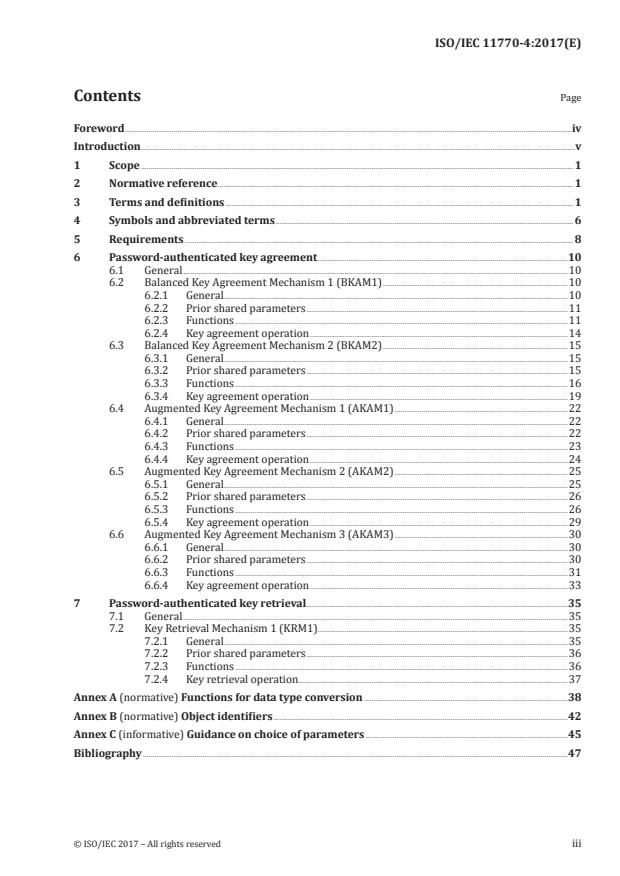
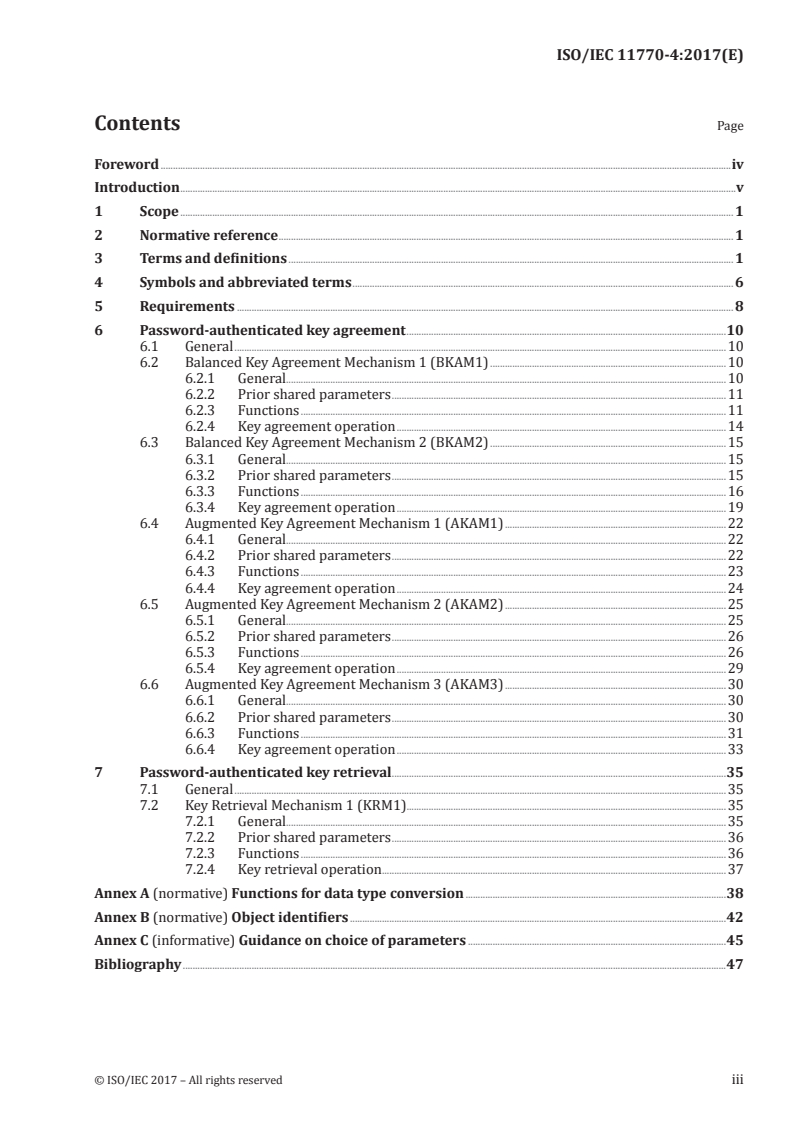
Contents Page
Foreword .iv
Introduction .v
1 Scope . 1
2 Normative reference . 1
3 Terms and definitions . 1
4 Symbols and abbreviated terms . 6
5 Requirements . 8
6 Password-authenticated key agreement .10
6.1 General .10
6.2 Balanced Key Agreement Mechanism 1 (BKAM1) .10
6.2.1 General.10
6.2.2 Prior shared parameters .11
6.2.3 Functions .11
6.2.4 Key agreement operation .14
6.3 Balanced Key Agreement Mechanism 2 (BKAM2) .15
6.3.1 General.15
6.3.2 Prior shared parameters .15
6.3.3 Functions .16
6.3.4 Key agreement operation .19
6.4 Augmented Key Agreement Mechanism 1 (AKAM1) .22
6.4.1 General.22
6.4.2 Prior shared parameters .22
6.4.3 Functions .23
6.4.4 Key agreement operation .24
6.5 Augmented Key Agreement Mechanism 2 (AKAM2) .25
6.5.1 General.25
6.5.2 Prior shared parameters .26
6.5.3 Functions .26
6.5.4 Key agreement operation .29
6.6 Augmented Key Agreement Mechanism 3 (AKAM3) .30
6.6.1 General.30
6.6.2 Prior shared parameters .30
6.6.3 Functions .31
6.6.4 Key agreement operation .33
7 Password-authenticated key retrieval .35
7.1 General .35
7.2 Key Retrieval Mechanism 1 (KRM1).35
7.2.1 General.35
7.2.2 Prior shared parameters .36
7.2.3 Functions .36
7.2.4 Key retrieval operation . .37
Annex A (normative) Functions for data type conversion .38
Annex B (normative) Object identifiers .42
Annex C (informative) Guidance on choice of parameters .45
Bibliography .47
© ISO/IEC 2017 – All rights reserved iii
Foreword
ISO (the International Organization for Standardization) and IEC (the International Electrotechnical
Commission) form the specialized system for worldwide standardization. National bodies that are
members of ISO or IEC participate in the development of International Standards through technical
committees established by the respective organization to deal with particular fields of technical
activity. ISO and IEC technical committees collaborate in fields of mutual interest. Other international
organizations, governmental and non-governmental, in liaison with ISO and IEC, also take part in the
work. In the field of information technology, ISO and IEC have established a joint technical committee,
ISO/IEC JTC 1.
The procedures used to develop this document and those intended for its further maintenance are
described in the ISO/IEC Directives, Part 1. In particular the different approval criteria needed for the
different types of ISO documents should be noted. This document was drafted in accordance with the
editorial rules of the ISO/IEC Directives, Part 2 (see www.iso.org/directives).
Attention is drawn to the possibility that some of the elements of this document may be the subject of
patent rights. ISO shall not be held responsible for identifying any or all such patent rights. Details of
any patent rights identified during the development of the document will be in the Introduction and/or
on the ISO list of patent declarations received (see www.iso.org/patents).
Any trade name used in this document is information given for the convenience of users and does not
constitute an endorsement.
For an explanation on the voluntary nature of standards, the meaning of ISO specific terms and
expressions related to conformity assessment, as well as information about ISO's adherence to the
World Trade Organization (WTO) principles in the Technical Barriers to Trade (TBT) see the following
URL: www.iso.org/iso/foreword.html.
This document was prepared by ISO/IEC JTC 1, Information technology, SC 27, IT Security techniques.
This second edition cancels and replaces the first edition (ISO/IEC 11770-4:2006), which has been
technically revised. It also incorporates the Technical Corrigendum ISO/IEC 11770-4:2006/Cor1:2009.
This edition includes the following significant changes with respect to the previous edition:
— revision of the Balanced Key Agreement Mechanism 1 (BKAM1) to address the attacks reported in
Reference [6];
— addition of a new Balanced Key Agreement Mechanism 2 (BKAM2) based on the J-PAKE scheme of
Reference [5];
— addition of a new Augmented Key Agreement Mechanism 3 (AKAM3) based on the AugPAKE scheme
of Reference [23].
A list of all parts in the ISO/IEC 11770 series can be found on the ISO website.
iv © ISO/IEC 2017 – All rights reserved
Introduction
The mechanisms specified in this document are designed to achieve one of the following three goals.
a) Balanced password-authenticated key agreement: Establish one or more shared secret keys
between two entities that share a common weak secret. In a balanced password-authenticated key
agreement mechanism, the shared secret keys are the result of a data exchange between the two
entities; the shared secret keys are established if, and only if, the two entities have used the same
weak secret; and neither of the two entities can predetermine the values of the shared secret keys.
b) Augmented password-authenticated key agreement: Establish one or more shared secret keys
between two entities A and B, where A has a weak secret and B has verification data derived from
a one-way function of A’s weak secret. In an augmented password-authenticated key agreement
mechanism, the shared secret keys are the result of a data exchange between the two entities; the
shared secret keys are established if, and only if, the two entities have used the weak secret and the
corresponding verification data; and neither of the two entities can predetermine the values of the
shared secret keys.
NOTE 1 This type of key agreement mechanism is unable to protect A’s weak secret being discovered by
B, but only increases the cost for an adversary to get A's weak secret from B. A typical application scenario
would involve use between a client (A) and a server (B).
c) Password-authenticated key retrieval: Establish one or more secret keys for an entity, A,
associated with another entity, B, where A has a weak secret and B has a strong secret associated
with A's weak secret. In an authenticated key retrieval mechanism, the secret keys, retrievable by
A (not necessarily derivable by B), are the result of a data exchange between the two entities, and
the secret keys are established if, and only if, the two entities have used the weak secret and the
associated strong secret. However, although B’s strong secret is associated with A's weak secret,
the strong secret does not (in itself) contain sufficient information to permit either the weak secret
or the secret keys established in the mechanism to be determined.
NOTE 2 This type of key retrieval mechanism is used in those applications where A does not have secure
storage for a strong secret, and requires B’s assistance to retrieve the strong secret. Such a mechanism is
appropriate for use between a client (A) and a server (B).
The International Organization for Standardization (ISO) and International Electrotechnical
Commission (IEC) draw attention to the fact that it is claimed that compliance with this document may
involve the use of patents.
ISO and IEC take no position concerning the evidence, validity and scope of these patent rights. The
holders of these patent rights have assured ISO and IEC that they are willing to negotiate licences under
reasonable and non-discriminatory terms and conditions with applicants throughout the world. In this
respect, the statements of the holders of these patent rights are registered with ISO and IEC. Information
may be obtained from:
National Institute of Advanced Industrial Science and Technology
1–1–1 Umezono
Tsukuba, Ibaraki
305–8560 Japan
Attention is drawn to the possibility that some of the elements of this document may be the subject of
patent rights other than those identified above. ISO and IEC shall not be held responsible for identifying
any or all such patent rights.
ISO (www.iso.org/patents) and IEC (http://patents.iec.ch) maintain online databases of patents
relevant to their documents. Users are encouraged to consult the databases for the most up to date
information concerning patents.
© ISO/IEC 2017 – All rights reserved v
INTERNATIONAL STANDARD ISO/IEC 11770-4:2017(E)
Information technology — Security techniques — Key
management —
Part 4:
Mechanisms based on weak secrets
1 Scope
This document defines key establishment mechanisms based on weak secrets, i.e. secrets that can be
readily memorized by a human, and hence, secrets that will be chosen from a relatively small set of
possibilities. It specifies cryptographic techniques specifically designed to establish one or more secret
keys based on a weak secret derived from a memorized password, while preventing offline brute-force
attacks associated with the weak secret. This document is not applicable to the following aspects of key
management:
— life-cycle management of weak secrets, strong secrets, and established secret keys;
— mechanisms to store, archive, delete, destroy, etc. weak secrets, strong secrets, and established
secret keys.
2 Normative reference
There are no normative references in this document.
3 Terms and definitions
For the purposes of this document, the following terms and definitions apply.
ISO and IEC maintain terminological databases for use in standardization at the following addresses:
— IEC Electropedia: available at http://www.electropedia.org/
— ISO Online browsing platform: available at http://www.iso.org/obp
3.1
augmented password-authenticated key agreement
password-authenticated key agreement where entity A uses a password-based weak secret and entity B
uses verification data derived from a one-way function of A's weak secret to negotiate and authenticate
one or more shared secret keys
3.2
balanced password-authenticated key agreement
password-authenticated key agreement where two entities A and B use a shared common password-
based weak secret to negotiate and authenticate one or more shared secret keys
3.3
brute-force attack
attack on a cryptosystem that employs an exhaustive search of a set of keys, passwords or other data
© ISO/IEC 2017 – All rights reserved 1
3.4
collision-resistant hash-function
hash-function satisfying the following property: it is computationally infeasible to find any two distinct
inputs which map to the same output
Note 1 to entry: Computational feasibility depends on the specific security requirements and environment. Refer
to ISO/IEC 10118-1:2016, Annex C.
[SOURCE: ISO/IEC 10118-1:2016, 3.1]
3.5
dictionary attack
(on a password-based system) attack on a cryptosystem that employs a search of a given list of
passwords
Note 1 to entry: A dictionary attack on a password-based system can use a stored list of specific password values
or a stored list of words from a natural language dictionary.
3.6
domain parameter
data item which is common to and known by or accessible to all entities within the domain
Note 1 to entry: The set of domain parameters may contain data items such as hash-function identifier, length of
the hash-token, length of the recoverable part of the message, finite field parameters, elliptic curve parameters,
or other parameters specifying the security policy in the domain.
[SOURCE: ISO/IEC 9796-3:2006, 3.2]
3.7
elliptic curve
cubic curve E without a singular point
Note 1 to entry: The set of points E together with an appropriately defined operation for a field that includes all
coefficients of the equation describing E is called the definition field of E. In ISO/IEC 15946-1, only finite fields
F are dealt with as the definition field. When it is necessary to describe the definition field F of E explicitly, the
curve is denoted as E/F.
Note 2 to entry: The form of a cubic curve equation used to define an elliptic curve varies depending on the field. The
general form of an appropriate cubic equation for all possible finite fields is defined in ISO/IEC 15946-1:2016, 6.1.
[SOURCE: ISO/IEC 15946-1:2016, 3.3, modified]
3.8
explicit key authentication
assurance for entity B that entity A is the only other entity that is in
possession of the correct key
Note 1 to entry: Implicit key authentication from entity A to entity B and key confirmation from entity A to entity
B together imply explicit key authentication from entity A to entity B.
[SOURCE: ISO/IEC 11770-3:2015, 3.12, modified]
3.9
hash-function
function which maps strings of bits of variable (but usually upper bounded) length to fixed-length
strings of bits, satisfying the following two properties:
— for a given output, it is computationally infeasible to find an input which maps to this output;
— for a given input, it is computationally infeasible to find a second input which maps to the same output.
Note 1 to entry: Computational feasibility depends on the specific security requirements and environment. Refer
to ISO/IEC 10118-1:2016, Annex C.
2 © ISO/IEC 2017 – All rights reserved
[SOURCE: ISO/IEC 10118-1:2016, 3.4]
3.10
hashed password
result of applying a hash-function to a password
3.11
implicit key authentication
assurance for entity B that entity A is the only other entity that can possibly
be in possession of the correct key
[SOURCE: ISO/IEC 11770-3:2015, 3.16, modified]
3.12
key
sequence of symbols that controls the operation of a cryptographic transformation (e.g. encryption,
decryption, cryptographic check function computation, signature calculation, or signature verification)
[SOURCE: ISO/IEC 11770-3:2015, 3.17]
3.13
key agreement
process of establishing a shared secret key between entities in such a way that neither of them can
predetermine the value of that key
Note 1 to entry: By predetermine, it is meant that neither entity A nor entity B can, in a computationally efficient
way, choose a smaller key space and force the computed key in the protocol to fall into that key space.
[SOURCE: ISO/IEC 11770-3:2015, 3.18]
3.14
key confirmation
assurance for entity B that entity A is in possession of the correct key
[SOURCE: ISO/IEC 11770-3:2015, 3.20, modified]
3.15
key control
ability to choose the key or the parameters used in the key computation
[SOURCE: ISO/IEC 11770-3:2015, 3.21]
3.16
key derivation function
function which takes as input a number of parameters, at least one of which shall be secret, and which
gives as output keys appropriate for the intended algorithm(s) and applications
3.17
key establishment
process of making available a shared secret key to one or more entities
Note 1 to entry: Key establishment includes key agreement, key transport and key retrieval.
3.18
key management
administration and use of generation, registration, certification, deregistration, distribution,
installation, storage, archiving, revocation, derivation and destruction of keying material in accordance
with a security policy
[SOURCE: ISO/IEC 11770-1:2010, 2.28]
© ISO/IEC 2017 – All rights reserved 3
3.19
key retrieval
process of establishing a key for one or more entities known as the retrieving entities with the
involvement of one or more other entities who are not necessarily able to access the key after the
process, and which normally requires authentication of the retrieving entity/entities by the other
entity/entities
3.20
key token
key establishment message sent from one entity to another entity during the execution of a key
establishment mechanism
3.21
key token check function
function that utilizes a key token and other publicly known parameters as input and outputs a Boolean
value during the execution of a key establishment mechanism
3.22
key token factor
value that is kept secret and that is used, possibly in conjunction with a weak secret, to create a key token
3.23
key token generation function
function that utilizes a key token factor and other parameters as input and outputs a key token during
the execution of a key establishment mechanism
3.24
message authentication code algorithm
algorithm for computing a function which maps strings of bits and a secret key to fixed-length strings
of bits, satisfying the following two properties:
— for any key and any input string, the function can be computed efficiently;
— for any fixed key, and given no prior knowledge of the key, it is computationally infeasible to
compute the function value on any new input string, even given knowledge of a set of input strings
and corresponding function values, where the value of the ith input string may have been chosen
after observing the value of the first i-1 function values (for integers i > 1)
[SOURCE: ISO/IEC 9797-1:2011, 3.10, modified]
3.25
mutual key authentication
assurance for two entities that only the other entity is in possession of the correct key
3.26
one-way function
function with the property that it is easy to compute the output for a given input but it is computationally
infeasible to find an input which maps to a given output
[SOURCE: ISO/IEC 11770-3:2015, 3.30]
3.27
password
secret word, phrase, number, or character sequence used for entity authentication, which is a memorized
weak secret
4 © ISO/IEC 2017 – All rights reserved
3.28
password-authenticated key agreement
process of establishing one or more shared secret keys between two entities using prior shared
password-based information (which means that either both of them have the same shared password
or one has the password and the other has password verification data) and neither of them can
predetermine the values of the shared secret keys
3.29
password-authenticated key retrieval
key retrieval process where one entity A has a weak secret derived from a password and the other
entity B has a strong secret associated with A’s weak secret; these two entities, using their own secrets,
negotiate a secret key which is retrievable by A, but not (necessarily) derivable by B
3.30
password-entangled key token
key token which is derived from both a weak secret and a key token factor
3.31
password verification data
data that is used to verify an entity’s knowledge of a specific password
3.32
random element derivation function
function that utilizes a password and other parameters as input and outputs a random element
3.33
salt
random variable incorporated as secondary input to a one-way or encryption function that is used to
derive password verification data
3.34
secret
value known only to authorized entities
3.35
secret key
key used with symmetric cryptographic techniques by a specified set of entities
[SOURCE: ISO/IEC 11770-3:2015, 3.36]
3.36
secret value derivation function
function that utilizes a key token factor, a key token, and other parameters as input and outputs a secret
value which is used to compute one or more secret keys
3.37
strong secret
secret with a sufficient degree of entropy that conducting an exhaustive search for the secret is
infeasible, even given knowledge that would enable a correct guess for the secret to be distinguished
from an incorrect guess
Note 1 to entry: This may, for example, be achieved by randomly choosing the secret from a sufficiently large set
of possible values under uniform distribution.
3.38
weak secret
secret that can be conveniently memorized by a human being
Note 1 to entry: Typically, this means that the entropy of the secret is limited, so that an exhaustive search for the
secret (or, a dictionary attack) may be feasible, given knowledge that would enable a correct guess for the secret
to be distinguished from an incorrect guess.
© ISO/IEC 2017 – All rights reserved 5
4 Symbols and abbreviated terms
A, B distinguishing identities of entities represented as octet strings
a , a elliptic curve coefficients
1 2
BS2I a function that converts a bit string into an integer (described in Annex A)
b, b bits (i.e. either 0 or 1)
i
C, C , C functions for generating a key token based on a password and a key token factor
DL EC
c an integer satisfying 1 ≤ c ≤ q – 1
D, D , D functions for generating a key token based on only a key token factor
DL EC
E an elliptic curve defined by two elliptic curve coefficients, a and a . For the purpose
1 2
of this document, an elliptic curve is not only the set of points on the curve, but
[13]
also a group operation defined on these points as specified in ISO/IEC 15946-1 .
FE2I a function that converts a field element into an integer (described in Annex A)
FE2OS a function that converts a field element into an octet string (described in Annex A)
F(q) the finite field with q elements
G,G ,G points of order r on E over F(q)
a b
GE2OS a function that converts a group element into an octet string; when the group el-
X
ement is a point on E, this function converts the x-coordinate of the point into an
octet string and ignores the y-coordinate (described in Annex A)
g, g , g , g elements of multiplicative order r in F(q)
1 a b
g an element of multiplicative order q - 1 in F(q)
q-1
H a collision-resistant hash-function taking an octet string as input and giving a bit
string as output, e.g. based on one of the dedicated hash-functions specified in
[11]
ISO/IEC 10118-3
h(x, L ) a collision-resistant hash-function taking an octet string x and an integer L as
K K
input and giving a bit string of length L (in bits) as output, e.g. based on one of the
K
[11]
dedicated hash-functions specified in ISO/IEC 10118-3
I2FE a function that converts an integer into a field element (described in Annex A)
I2OS a function that converts an integer into an octet string (described in Annex A)
I2P a function that converts an integer into a point on the curve E (described in Annex A)
J, J , J functions for generating a password verification element from a password
DL EC
K a function for deriving a key from a secret value and a key derivation parameter
KC_1_U an octet string of the constant value “KC_1_U” that literally means unilateral key
confirmation
K , K , . secret keys established using a key establishment mechanism
1 2
k the cofactor that is either the value (q − 1)/r in DL domain parameters or the value
of #E/r in EC domain parameters
6 © ISO/IEC 2017 – All rights reserved
L the length (in bits) of an established secret key
K
MAX a function that takes two integers as input and outputs the integer with a larger
value; if the two integers are identical, it outputs an error message
MIN a function that takes two integers as input and outputs the integer with a smaller
value; if the two integers are identical, it outputs an error message
M an octet that is represented by values from 00 hex to FF hex
i
m an integer
mac(k, m) a message authentication code (MAC) function taking a key k and a variable-length
message m as input and giving a fixed-length output, e.g., by using one of the MAC
[10]
algorithms specified in ISO/IEC 9797-2
mod binary operation, where y = a mod b is defined to be the unique integer y satisfying
0 ≤ y < b and (a − y) is an integer multiple of b
n an integer
null an empty octet string with the byte length zero
OS2I a function that converts an octet string into an integer (described in Annex A)
o , o ′, o , o ′ bit strings, which are used to specify a key confirmation process
A A B B
P , P , . key derivation parameter octet strings
1 2
p, p odd prime integers
i
m
q the number of elements in the finite field F(q). In the EC setting, q is either p or 2
for some integer m ≥ 1. In the DL setting, q is p.
NOTE 1 This document treats only a prime field or a binary field in the EC setting
and only a prime field in the DL setting, because these cases are widely used and
their security properties have been well-explored.
R, R , R , functions for deriving a random element from a password
1DL 1EC
R , R
2DL 2EC
r the order of the desired group, which is a prime dividing either q – 1 in the DL
setting or #E in the EC setting
s , s key token factors of entities A and B, respectively, corresponding to key tokens
A B
w and w . The key token factors should be generated at random from a selected
A B
range since this maximizes the difficulty of recovering the key token factor by
collision-search methods. Methods of random number generation are specified in
[14]
ISO/IEC 18031 .
T a function for checking validity of a key token
V, V , V , V , functions for generating secret values
A B ADL
V , V , V
AEC BDL BEC
w , w key tokens or password-entangled key tokens of entities A and B respectively, cor-
A B
responding to key token factors s and s ; they are integers in the DL setting and
A B
points in the EC setting
z a secret value used to derive the keys; it is an integer in the DL setting and a point
in the EC setting
© ISO/IEC 2017 – All rights reserved 7
π a password-based octet string which is generally derived from the following data
items: a) a password or a hashed password, b) identities for one or more entities,
c) an identity of a communication session if more than one session may execute
concurrently, and d) a salt value and/or other data. All items except the first are
optional.
NOTE 2 As addressed in Reference [26], including entity and session identities in the
computation of π can prevent an unknown key-share attack. As further addressed
in Reference [6], putting these identities into the session key computation function
rather than in the computation of π can also avoid a number of attacks, including
the unknown key-share attack.
#E the number of points on the elliptic curve, E
[x] × Y multiplication operation in the EC setting that takes an integer x and a point Y on the
curve E as input and produces a point Z on the curve E, where Z = [x] × Y = Y + Y + … + Y
adding x − 1 times if x is positive. The operation satisfies [0] × Y = 0 (the point at
E
infinity), and [-x] × Y = [x] × (-Y).
m
{β , β , …, β } an element of F(s ) where s is either p or 2, and β is an integer satisfying 0 ≤ β ≤ s − 1
m-1 m-2 0 i i
|| X ||Y denotes the result of the concatenation of octet strings X and Y in the order
specified. In cases where the result of concatenating two or more octet strings is
input to a cryptographic function as part of one of the mechanisms specified in
this document, this result shall be composed so that it can be uniquely resolved
into its constituent octet strings, i.e. so that there is no possibility of ambiguity in
interpretation. This latter property could be achieved in a variety of different ways,
depending on the application. For example, it could be guaranteed by a) fixing the
length of each of the octet strings throughout the domain of use of the mechanism,
or b) encoding the sequence of concatenated octet strings using a method that
guarantees unique decoding, e.g. using the distinguished encoding rules defined
[9]
in ISO/IEC 8825-1 .
0 the point at infinity on the elliptic curve, E
E
5 Requirements
It is assumed that the entities are aware of each other’s claimed identities. This may be achieved by the
inclusion of identities in information exchanged between the two entities, or it may be apparent from
the context of use of the mechanism.
It is assumed that if the entities are engaged in several sessions in parallel, the entities are aware of
a unique session identity for each session. This may be achieved by the inclusion of session identities
in information exchanged between the entities, or it may be apparent from the context of use of the
mechanism.
It is assumed that the entities are aware of a common set of domain parameters, which are used to
compute a variety of functions in the key establishment mechanism. Each mechanism can be used with
one of two different sets of domain parameters, depending on whether the mechanism operates over
the multiplicative group of values in F(q) or over the additive group of elements in an elliptic curve
defined over F(q). In the first case, the mechanism is said to operate in the DL (for “discrete logarithm”)
setting, and in the second case, the mechanism is said to operate in the EC (for “elliptic curve”) setting.
The selection of parameters for both cases is discussed in Annex C.
NOTE 1 It is fundamentally important to the correct operation of the mechanisms that any domain
parameters are held correctly by each participant. Use by any party of accidentally or deliberately corrupted
domain parameters can result in compromise of the mechanisms, which could allow an unauthorized third party
to discover an established secret key.
The two sets of domain parameters are as follows.
8 © ISO/IEC 2017 – All rights reserved
A set of DL domain parameters consists of:
— F(q) a specific representation of the finite field with q elements;
— q the number of elements in F(q), which is an odd prime integer;
— r the order of the desired group of elements from the finite field, which is a prime divisor of q – 1;
— g an element of multiplicative order r in F(q) [g is called the generator of a subgroup of r elements
in F(q)];
— g an element of multiplicative order q − 1 in F(q);
q-1
— k the value (q − 1)/r, also called the cofactor, satisfying k = 2 or k = 2p p …p , for primes
1 2 t
p > r, i = 1, 2, …, t.
i
A method of generating g can be found in Chapter 4 of References [18] and [22].
q-1
A set of EC domain parameters consists of:
— F(q) a specific representation of the finite field with q elements;
— q the number of elements in F(q), which is
— p, an odd prime integer, or
m
— 2 for some positive integer m ≥ 1;
— a , a two elliptic curve coefficients, elements of F(q), that define an elliptic curve E;
1 2
— E an elliptic curve defined by two elliptic curve coefficients, a and a . For the purpose of this
1 2
document, an elliptic curve is not only the set of points on the curve, but also a group operation
[13]
defined on these points as specified in ISO/IEC 15946-1 . It is defined by one of the following two
formulae:
2 3
— Y = X + a X + a over the field F(p),
1 2
2 3 2 m
— Y + XY = X + a X + a over the field F(2 ), together with an extra point 0 referred to as the
1 2 E
point of infinity;
— #E the number of points on E;
— r the order of the desired group, which is a prime integer dividing #E;
— G a curve point of order r (G is called the generator of a subgroup of r points on E);
n n
— k the value #E/r, also called the cofactor, satisfying k = 2 or k = 2 p p …p , for n = {0, 1, 2} and
1 2 t
primes p > r, i = 1, 2, …, t.
i
n
NOTE 2 If the cofactor k is 2 p p …p , for n = {0, 1, 2} and primes p < r, i = 1, 2, …, t, and the key token check
1 2 t i
function T in 6.2.3.3 is used, small subgroup attacks (e.g. see Reference [21]) are possible.
EC
When entities make use of a specified mechanism in the EC setting, it is assumed that the entities
are aware of the form of the point representation, i.e. a point is represented in either compressed,
[13]
uncompressed or hybrid form. For further information on point representations, see ISO/IEC 15946-1 .
In many of the mechanisms specified in this document, one of the participants is required to select
a value at random from a given set of values, e.g. an integer from a specified range. This shall be
implemented using a random number generation method based on a random bit generation (e.g. one
[14]
of the methods in ISO/IEC 18031 ) in such a way that the selected value is chosen uniformly (or near
uniformly) at random from the complete set of possible values. Furthermore, when prime numbers are
generated, it is assumed that the generation follows a secure method, e.g., using one of the methods in
[15]
ISO/IEC 18032 .
© ISO/IEC 2017 – All rights reserved 9
It is also assumed that the entities are aware of a common hash-function H, e.g. one of the dedicated
[11]
hash-functions specified in ISO/IEC 10118-3 .
6 Password-authenticated key agreement
6.1 General
Clause 6 specifies five password-authenticated key agreement mechanisms. The first and second
mechanisms, specified in 6.2 and 6.3 respectively, are balanced password-authenticated key agreement
mechanisms, which require the two entities to share a weak secret. The third, fourth, and fifth
mechanisms, specified in 6.4, 6.5, and 6.6, respectively, are augmented password-authenticated key
agreement mechanisms, which require one of the two entities to possess verification data for a weak
secret known to the other entity.
All five password-authenticated key agreement mechanisms have the following initialisation process
and key establishment process.
Initialisation process: The two entities involved agree to use a set of valid domain parameters, a set of
key derivation parameters and a set of functions, all of which may be publicly known. The two entities
also agree to use either a shared password-based weak secret which is known only to them, or shared
password-based information that means one entity has a password-based weak secret and the other
entity has the corresponding password verification data.
Key establishment process:
a) Generate and exchange key tokens. The two entities involved each randomly choose one or more key
token factors associated with the domain parameters, create the corresponding key tokens, which
may be associated with the password or password verification data (a key token associated with
the password or password verification data is called a “password-entangled key token”), and then
make the key tokens available to the other entity.
b) Check validity of key tokens. Depending on the operations for producing key tokens in step a), the
two entities involved each choose an appropriate method to validate the received key tokens based
on the domain parameters. If any validation fails, output “invalid” and stop.
c) Derive shared secret keys. The two entities involved each apply certain secret value derivation
functions to their own key token factor, the other entity's key tokens and/or shared password
or password verification data to produce a shared secret value. Each entity further applies a key
derivation function to the shared secret value and the key derivation parameters, to derive one or
more shared secret keys.
d) Check key confirmation. The two entities involved use the shared secret keys established using the
above steps to confirm their awareness of the keys to each other. This step is optional in Balanced
Mechanisms 1 and 2 but mandatory in Augmented Mechanisms 1, 2, and 3.
6.2 Balanced Key Agreement Mechanism 1 (BKAM1)
6.2.1 General
This key agreement mechanism is designed to achieve balanced password-authenticated key
agreement, which establishes one or more shared secret keys between entities A and B with joint key
control and prior sharing of a password-based octet string, π. This mechanism provides mutual implicit
key authentication and, optionally, mutual explicit key authentication.
This mechanism works in both the DL and EC settings.
NOTE This mechanism is based on References [6] and [17] and the mechanism called {DL,EC}BPKAS-SPEKE
in Reference [8].
10 © ISO/IEC 2017 – All rights reserved
6.2.2 Prior shared parameters
The key agreement between two entities A and B takes place in an environment where the two entities
share the following parameters:
— a shared password-based octet string, π;
— a set of valid domain parameters (either DL domain parameters or EC domain parameters) as
specified in Clause 5;
— a random element derivation function, R;
— a key token generation function, D;
— a key token check function, T;
— a session identity generation function, S;
— a secret value derivation function, V;
— a key derivation function, K;
— a Boolean value, b, which indicates whether cofactor multiplication is desired. If b = 1, cofactor
multiplication is desired; otherwise it is not;
— one or more key derivation parameter octet strings {P , P , .}, where A and B shall agree to use the
1 2
same P values;
i
— the length of a shared secret key, L .
K
NOTE Cofactor multiplication is used to map a received key token into a valid group ele
...
INTERNATIONAL ISO/IEC
STANDARD 11770-4
Second edition
2017-11
Information technology — Security
techniques — Key management —
Part 4:
Mechanisms based on weak secrets
Technologies de l'information — Techniques de sécurité — Gestion
de clés —
Partie 4: Mécanismes basés sur des secrets faibles
Reference number
©
ISO/IEC 2017
© ISO/IEC 2017, Published in Switzerland
All rights reserved. Unless otherwise specified, no part of this publication may be reproduced or utilized otherwise in any form
or by any means, electronic or mechanical, including photocopying, or posting on the internet or an intranet, without prior
written permission. Permission can be requested from either ISO at the address below or ISO’s member body in the country of
the requester.
ISO copyright office
Ch. de Blandonnet 8 • CP 401
CH-1214 Vernier, Geneva, Switzerland
Tel. +41 22 749 01 11
Fax +41 22 749 09 47
copyright@iso.org
www.iso.org
ii © ISO/IEC 2017 – All rights reserved
Contents Page
Foreword .iv
Introduction .v
1 Scope . 1
2 Normative reference . 1
3 Terms and definitions . 1
4 Symbols and abbreviated terms . 6
5 Requirements . 8
6 Password-authenticated key agreement .10
6.1 General .10
6.2 Balanced Key Agreement Mechanism 1 (BKAM1) .10
6.2.1 General.10
6.2.2 Prior shared parameters .11
6.2.3 Functions .11
6.2.4 Key agreement operation .14
6.3 Balanced Key Agreement Mechanism 2 (BKAM2) .15
6.3.1 General.15
6.3.2 Prior shared parameters .15
6.3.3 Functions .16
6.3.4 Key agreement operation .19
6.4 Augmented Key Agreement Mechanism 1 (AKAM1) .22
6.4.1 General.22
6.4.2 Prior shared parameters .22
6.4.3 Functions .23
6.4.4 Key agreement operation .24
6.5 Augmented Key Agreement Mechanism 2 (AKAM2) .25
6.5.1 General.25
6.5.2 Prior shared parameters .26
6.5.3 Functions .26
6.5.4 Key agreement operation .29
6.6 Augmented Key Agreement Mechanism 3 (AKAM3) .30
6.6.1 General.30
6.6.2 Prior shared parameters .30
6.6.3 Functions .31
6.6.4 Key agreement operation .33
7 Password-authenticated key retrieval .35
7.1 General .35
7.2 Key Retrieval Mechanism 1 (KRM1).35
7.2.1 General.35
7.2.2 Prior shared parameters .36
7.2.3 Functions .36
7.2.4 Key retrieval operation . .37
Annex A (normative) Functions for data type conversion .38
Annex B (normative) Object identifiers .42
Annex C (informative) Guidance on choice of parameters .45
Bibliography .47
© ISO/IEC 2017 – All rights reserved iii
Foreword
ISO (the International Organization for Standardization) and IEC (the International Electrotechnical
Commission) form the specialized system for worldwide standardization. National bodies that are
members of ISO or IEC participate in the development of International Standards through technical
committees established by the respective organization to deal with particular fields of technical
activity. ISO and IEC technical committees collaborate in fields of mutual interest. Other international
organizations, governmental and non-governmental, in liaison with ISO and IEC, also take part in the
work. In the field of information technology, ISO and IEC have established a joint technical committee,
ISO/IEC JTC 1.
The procedures used to develop this document and those intended for its further maintenance are
described in the ISO/IEC Directives, Part 1. In particular the different approval criteria needed for the
different types of ISO documents should be noted. This document was drafted in accordance with the
editorial rules of the ISO/IEC Directives, Part 2 (see www.iso.org/directives).
Attention is drawn to the possibility that some of the elements of this document may be the subject of
patent rights. ISO shall not be held responsible for identifying any or all such patent rights. Details of
any patent rights identified during the development of the document will be in the Introduction and/or
on the ISO list of patent declarations received (see www.iso.org/patents).
Any trade name used in this document is information given for the convenience of users and does not
constitute an endorsement.
For an explanation on the voluntary nature of standards, the meaning of ISO specific terms and
expressions related to conformity assessment, as well as information about ISO's adherence to the
World Trade Organization (WTO) principles in the Technical Barriers to Trade (TBT) see the following
URL: www.iso.org/iso/foreword.html.
This document was prepared by ISO/IEC JTC 1, Information technology, SC 27, IT Security techniques.
This second edition cancels and replaces the first edition (ISO/IEC 11770-4:2006), which has been
technically revised. It also incorporates the Technical Corrigendum ISO/IEC 11770-4:2006/Cor1:2009.
This edition includes the following significant changes with respect to the previous edition:
— revision of the Balanced Key Agreement Mechanism 1 (BKAM1) to address the attacks reported in
Reference [6];
— addition of a new Balanced Key Agreement Mechanism 2 (BKAM2) based on the J-PAKE scheme of
Reference [5];
— addition of a new Augmented Key Agreement Mechanism 3 (AKAM3) based on the AugPAKE scheme
of Reference [23].
A list of all parts in the ISO/IEC 11770 series can be found on the ISO website.
iv © ISO/IEC 2017 – All rights reserved
Introduction
The mechanisms specified in this document are designed to achieve one of the following three goals.
a) Balanced password-authenticated key agreement: Establish one or more shared secret keys
between two entities that share a common weak secret. In a balanced password-authenticated key
agreement mechanism, the shared secret keys are the result of a data exchange between the two
entities; the shared secret keys are established if, and only if, the two entities have used the same
weak secret; and neither of the two entities can predetermine the values of the shared secret keys.
b) Augmented password-authenticated key agreement: Establish one or more shared secret keys
between two entities A and B, where A has a weak secret and B has verification data derived from
a one-way function of A’s weak secret. In an augmented password-authenticated key agreement
mechanism, the shared secret keys are the result of a data exchange between the two entities; the
shared secret keys are established if, and only if, the two entities have used the weak secret and the
corresponding verification data; and neither of the two entities can predetermine the values of the
shared secret keys.
NOTE 1 This type of key agreement mechanism is unable to protect A’s weak secret being discovered by
B, but only increases the cost for an adversary to get A's weak secret from B. A typical application scenario
would involve use between a client (A) and a server (B).
c) Password-authenticated key retrieval: Establish one or more secret keys for an entity, A,
associated with another entity, B, where A has a weak secret and B has a strong secret associated
with A's weak secret. In an authenticated key retrieval mechanism, the secret keys, retrievable by
A (not necessarily derivable by B), are the result of a data exchange between the two entities, and
the secret keys are established if, and only if, the two entities have used the weak secret and the
associated strong secret. However, although B’s strong secret is associated with A's weak secret,
the strong secret does not (in itself) contain sufficient information to permit either the weak secret
or the secret keys established in the mechanism to be determined.
NOTE 2 This type of key retrieval mechanism is used in those applications where A does not have secure
storage for a strong secret, and requires B’s assistance to retrieve the strong secret. Such a mechanism is
appropriate for use between a client (A) and a server (B).
The International Organization for Standardization (ISO) and International Electrotechnical
Commission (IEC) draw attention to the fact that it is claimed that compliance with this document may
involve the use of patents.
ISO and IEC take no position concerning the evidence, validity and scope of these patent rights. The
holders of these patent rights have assured ISO and IEC that they are willing to negotiate licences under
reasonable and non-discriminatory terms and conditions with applicants throughout the world. In this
respect, the statements of the holders of these patent rights are registered with ISO and IEC. Information
may be obtained from:
National Institute of Advanced Industrial Science and Technology
1–1–1 Umezono
Tsukuba, Ibaraki
305–8560 Japan
Attention is drawn to the possibility that some of the elements of this document may be the subject of
patent rights other than those identified above. ISO and IEC shall not be held responsible for identifying
any or all such patent rights.
ISO (www.iso.org/patents) and IEC (http://patents.iec.ch) maintain online databases of patents
relevant to their documents. Users are encouraged to consult the databases for the most up to date
information concerning patents.
© ISO/IEC 2017 – All rights reserved v
INTERNATIONAL STANDARD ISO/IEC 11770-4:2017(E)
Information technology — Security techniques — Key
management —
Part 4:
Mechanisms based on weak secrets
1 Scope
This document defines key establishment mechanisms based on weak secrets, i.e. secrets that can be
readily memorized by a human, and hence, secrets that will be chosen from a relatively small set of
possibilities. It specifies cryptographic techniques specifically designed to establish one or more secret
keys based on a weak secret derived from a memorized password, while preventing offline brute-force
attacks associated with the weak secret. This document is not applicable to the following aspects of key
management:
— life-cycle management of weak secrets, strong secrets, and established secret keys;
— mechanisms to store, archive, delete, destroy, etc. weak secrets, strong secrets, and established
secret keys.
2 Normative reference
There are no normative references in this document.
3 Terms and definitions
For the purposes of this document, the following terms and definitions apply.
ISO and IEC maintain terminological databases for use in standardization at the following addresses:
— IEC Electropedia: available at http://www.electropedia.org/
— ISO Online browsing platform: available at http://www.iso.org/obp
3.1
augmented password-authenticated key agreement
password-authenticated key agreement where entity A uses a password-based weak secret and entity B
uses verification data derived from a one-way function of A's weak secret to negotiate and authenticate
one or more shared secret keys
3.2
balanced password-authenticated key agreement
password-authenticated key agreement where two entities A and B use a shared common password-
based weak secret to negotiate and authenticate one or more shared secret keys
3.3
brute-force attack
attack on a cryptosystem that employs an exhaustive search of a set of keys, passwords or other data
© ISO/IEC 2017 – All rights reserved 1
3.4
collision-resistant hash-function
hash-function satisfying the following property: it is computationally infeasible to find any two distinct
inputs which map to the same output
Note 1 to entry: Computational feasibility depends on the specific security requirements and environment. Refer
to ISO/IEC 10118-1:2016, Annex C.
[SOURCE: ISO/IEC 10118-1:2016, 3.1]
3.5
dictionary attack
(on a password-based system) attack on a cryptosystem that employs a search of a given list of
passwords
Note 1 to entry: A dictionary attack on a password-based system can use a stored list of specific password values
or a stored list of words from a natural language dictionary.
3.6
domain parameter
data item which is common to and known by or accessible to all entities within the domain
Note 1 to entry: The set of domain parameters may contain data items such as hash-function identifier, length of
the hash-token, length of the recoverable part of the message, finite field parameters, elliptic curve parameters,
or other parameters specifying the security policy in the domain.
[SOURCE: ISO/IEC 9796-3:2006, 3.2]
3.7
elliptic curve
cubic curve E without a singular point
Note 1 to entry: The set of points E together with an appropriately defined operation for a field that includes all
coefficients of the equation describing E is called the definition field of E. In ISO/IEC 15946-1, only finite fields
F are dealt with as the definition field. When it is necessary to describe the definition field F of E explicitly, the
curve is denoted as E/F.
Note 2 to entry: The form of a cubic curve equation used to define an elliptic curve varies depending on the field. The
general form of an appropriate cubic equation for all possible finite fields is defined in ISO/IEC 15946-1:2016, 6.1.
[SOURCE: ISO/IEC 15946-1:2016, 3.3, modified]
3.8
explicit key authentication
assurance for entity B that entity A is the only other entity that is in
possession of the correct key
Note 1 to entry: Implicit key authentication from entity A to entity B and key confirmation from entity A to entity
B together imply explicit key authentication from entity A to entity B.
[SOURCE: ISO/IEC 11770-3:2015, 3.12, modified]
3.9
hash-function
function which maps strings of bits of variable (but usually upper bounded) length to fixed-length
strings of bits, satisfying the following two properties:
— for a given output, it is computationally infeasible to find an input which maps to this output;
— for a given input, it is computationally infeasible to find a second input which maps to the same output.
Note 1 to entry: Computational feasibility depends on the specific security requirements and environment. Refer
to ISO/IEC 10118-1:2016, Annex C.
2 © ISO/IEC 2017 – All rights reserved
[SOURCE: ISO/IEC 10118-1:2016, 3.4]
3.10
hashed password
result of applying a hash-function to a password
3.11
implicit key authentication
assurance for entity B that entity A is the only other entity that can possibly
be in possession of the correct key
[SOURCE: ISO/IEC 11770-3:2015, 3.16, modified]
3.12
key
sequence of symbols that controls the operation of a cryptographic transformation (e.g. encryption,
decryption, cryptographic check function computation, signature calculation, or signature verification)
[SOURCE: ISO/IEC 11770-3:2015, 3.17]
3.13
key agreement
process of establishing a shared secret key between entities in such a way that neither of them can
predetermine the value of that key
Note 1 to entry: By predetermine, it is meant that neither entity A nor entity B can, in a computationally efficient
way, choose a smaller key space and force the computed key in the protocol to fall into that key space.
[SOURCE: ISO/IEC 11770-3:2015, 3.18]
3.14
key confirmation
assurance for entity B that entity A is in possession of the correct key
[SOURCE: ISO/IEC 11770-3:2015, 3.20, modified]
3.15
key control
ability to choose the key or the parameters used in the key computation
[SOURCE: ISO/IEC 11770-3:2015, 3.21]
3.16
key derivation function
function which takes as input a number of parameters, at least one of which shall be secret, and which
gives as output keys appropriate for the intended algorithm(s) and applications
3.17
key establishment
process of making available a shared secret key to one or more entities
Note 1 to entry: Key establishment includes key agreement, key transport and key retrieval.
3.18
key management
administration and use of generation, registration, certification, deregistration, distribution,
installation, storage, archiving, revocation, derivation and destruction of keying material in accordance
with a security policy
[SOURCE: ISO/IEC 11770-1:2010, 2.28]
© ISO/IEC 2017 – All rights reserved 3
3.19
key retrieval
process of establishing a key for one or more entities known as the retrieving entities with the
involvement of one or more other entities who are not necessarily able to access the key after the
process, and which normally requires authentication of the retrieving entity/entities by the other
entity/entities
3.20
key token
key establishment message sent from one entity to another entity during the execution of a key
establishment mechanism
3.21
key token check function
function that utilizes a key token and other publicly known parameters as input and outputs a Boolean
value during the execution of a key establishment mechanism
3.22
key token factor
value that is kept secret and that is used, possibly in conjunction with a weak secret, to create a key token
3.23
key token generation function
function that utilizes a key token factor and other parameters as input and outputs a key token during
the execution of a key establishment mechanism
3.24
message authentication code algorithm
algorithm for computing a function which maps strings of bits and a secret key to fixed-length strings
of bits, satisfying the following two properties:
— for any key and any input string, the function can be computed efficiently;
— for any fixed key, and given no prior knowledge of the key, it is computationally infeasible to
compute the function value on any new input string, even given knowledge of a set of input strings
and corresponding function values, where the value of the ith input string may have been chosen
after observing the value of the first i-1 function values (for integers i > 1)
[SOURCE: ISO/IEC 9797-1:2011, 3.10, modified]
3.25
mutual key authentication
assurance for two entities that only the other entity is in possession of the correct key
3.26
one-way function
function with the property that it is easy to compute the output for a given input but it is computationally
infeasible to find an input which maps to a given output
[SOURCE: ISO/IEC 11770-3:2015, 3.30]
3.27
password
secret word, phrase, number, or character sequence used for entity authentication, which is a memorized
weak secret
4 © ISO/IEC 2017 – All rights reserved
3.28
password-authenticated key agreement
process of establishing one or more shared secret keys between two entities using prior shared
password-based information (which means that either both of them have the same shared password
or one has the password and the other has password verification data) and neither of them can
predetermine the values of the shared secret keys
3.29
password-authenticated key retrieval
key retrieval process where one entity A has a weak secret derived from a password and the other
entity B has a strong secret associated with A’s weak secret; these two entities, using their own secrets,
negotiate a secret key which is retrievable by A, but not (necessarily) derivable by B
3.30
password-entangled key token
key token which is derived from both a weak secret and a key token factor
3.31
password verification data
data that is used to verify an entity’s knowledge of a specific password
3.32
random element derivation function
function that utilizes a password and other parameters as input and outputs a random element
3.33
salt
random variable incorporated as secondary input to a one-way or encryption function that is used to
derive password verification data
3.34
secret
value known only to authorized entities
3.35
secret key
key used with symmetric cryptographic techniques by a specified set of entities
[SOURCE: ISO/IEC 11770-3:2015, 3.36]
3.36
secret value derivation function
function that utilizes a key token factor, a key token, and other parameters as input and outputs a secret
value which is used to compute one or more secret keys
3.37
strong secret
secret with a sufficient degree of entropy that conducting an exhaustive search for the secret is
infeasible, even given knowledge that would enable a correct guess for the secret to be distinguished
from an incorrect guess
Note 1 to entry: This may, for example, be achieved by randomly choosing the secret from a sufficiently large set
of possible values under uniform distribution.
3.38
weak secret
secret that can be conveniently memorized by a human being
Note 1 to entry: Typically, this means that the entropy of the secret is limited, so that an exhaustive search for the
secret (or, a dictionary attack) may be feasible, given knowledge that would enable a correct guess for the secret
to be distinguished from an incorrect guess.
© ISO/IEC 2017 – All rights reserved 5
4 Symbols and abbreviated terms
A, B distinguishing identities of entities represented as octet strings
a , a elliptic curve coefficients
1 2
BS2I a function that converts a bit string into an integer (described in Annex A)
b, b bits (i.e. either 0 or 1)
i
C, C , C functions for generating a key token based on a password and a key token factor
DL EC
c an integer satisfying 1 ≤ c ≤ q – 1
D, D , D functions for generating a key token based on only a key token factor
DL EC
E an elliptic curve defined by two elliptic curve coefficients, a and a . For the purpose
1 2
of this document, an elliptic curve is not only the set of points on the curve, but
[13]
also a group operation defined on these points as specified in ISO/IEC 15946-1 .
FE2I a function that converts a field element into an integer (described in Annex A)
FE2OS a function that converts a field element into an octet string (described in Annex A)
F(q) the finite field with q elements
G,G ,G points of order r on E over F(q)
a b
GE2OS a function that converts a group element into an octet string; when the group el-
X
ement is a point on E, this function converts the x-coordinate of the point into an
octet string and ignores the y-coordinate (described in Annex A)
g, g , g , g elements of multiplicative order r in F(q)
1 a b
g an element of multiplicative order q - 1 in F(q)
q-1
H a collision-resistant hash-function taking an octet string as input and giving a bit
string as output, e.g. based on one of the dedicated hash-functions specified in
[11]
ISO/IEC 10118-3
h(x, L ) a collision-resistant hash-function taking an octet string x and an integer L as
K K
input and giving a bit string of length L (in bits) as output, e.g. based on one of the
K
[11]
dedicated hash-functions specified in ISO/IEC 10118-3
I2FE a function that converts an integer into a field element (described in Annex A)
I2OS a function that converts an integer into an octet string (described in Annex A)
I2P a function that converts an integer into a point on the curve E (described in Annex A)
J, J , J functions for generating a password verification element from a password
DL EC
K a function for deriving a key from a secret value and a key derivation parameter
KC_1_U an octet string of the constant value “KC_1_U” that literally means unilateral key
confirmation
K , K , . secret keys established using a key establishment mechanism
1 2
k the cofactor that is either the value (q − 1)/r in DL domain parameters or the value
of #E/r in EC domain parameters
6 © ISO/IEC 2017 – All rights reserved
L the length (in bits) of an established secret key
K
MAX a function that takes two integers as input and outputs the integer with a larger
value; if the two integers are identical, it outputs an error message
MIN a function that takes two integers as input and outputs the integer with a smaller
value; if the two integers are identical, it outputs an error message
M an octet that is represented by values from 00 hex to FF hex
i
m an integer
mac(k, m) a message authentication code (MAC) function taking a key k and a variable-length
message m as input and giving a fixed-length output, e.g., by using one of the MAC
[10]
algorithms specified in ISO/IEC 9797-2
mod binary operation, where y = a mod b is defined to be the unique integer y satisfying
0 ≤ y < b and (a − y) is an integer multiple of b
n an integer
null an empty octet string with the byte length zero
OS2I a function that converts an octet string into an integer (described in Annex A)
o , o ′, o , o ′ bit strings, which are used to specify a key confirmation process
A A B B
P , P , . key derivation parameter octet strings
1 2
p, p odd prime integers
i
m
q the number of elements in the finite field F(q). In the EC setting, q is either p or 2
for some integer m ≥ 1. In the DL setting, q is p.
NOTE 1 This document treats only a prime field or a binary field in the EC setting
and only a prime field in the DL setting, because these cases are widely used and
their security properties have been well-explored.
R, R , R , functions for deriving a random element from a password
1DL 1EC
R , R
2DL 2EC
r the order of the desired group, which is a prime dividing either q – 1 in the DL
setting or #E in the EC setting
s , s key token factors of entities A and B, respectively, corresponding to key tokens
A B
w and w . The key token factors should be generated at random from a selected
A B
range since this maximizes the difficulty of recovering the key token factor by
collision-search methods. Methods of random number generation are specified in
[14]
ISO/IEC 18031 .
T a function for checking validity of a key token
V, V , V , V , functions for generating secret values
A B ADL
V , V , V
AEC BDL BEC
w , w key tokens or password-entangled key tokens of entities A and B respectively, cor-
A B
responding to key token factors s and s ; they are integers in the DL setting and
A B
points in the EC setting
z a secret value used to derive the keys; it is an integer in the DL setting and a point
in the EC setting
© ISO/IEC 2017 – All rights reserved 7
π a password-based octet string which is generally derived from the following data
items: a) a password or a hashed password, b) identities for one or more entities,
c) an identity of a communication session if more than one session may execute
concurrently, and d) a salt value and/or other data. All items except the first are
optional.
NOTE 2 As addressed in Reference [26], including entity and session identities in the
computation of π can prevent an unknown key-share attack. As further addressed
in Reference [6], putting these identities into the session key computation function
rather than in the computation of π can also avoid a number of attacks, including
the unknown key-share attack.
#E the number of points on the elliptic curve, E
[x] × Y multiplication operation in the EC setting that takes an integer x and a point Y on the
curve E as input and produces a point Z on the curve E, where Z = [x] × Y = Y + Y + … + Y
adding x − 1 times if x is positive. The operation satisfies [0] × Y = 0 (the point at
E
infinity), and [-x] × Y = [x] × (-Y).
m
{β , β , …, β } an element of F(s ) where s is either p or 2, and β is an integer satisfying 0 ≤ β ≤ s − 1
m-1 m-2 0 i i
|| X ||Y denotes the result of the concatenation of octet strings X and Y in the order
specified. In cases where the result of concatenating two or more octet strings is
input to a cryptographic function as part of one of the mechanisms specified in
this document, this result shall be composed so that it can be uniquely resolved
into its constituent octet strings, i.e. so that there is no possibility of ambiguity in
interpretation. This latter property could be achieved in a variety of different ways,
depending on the application. For example, it could be guaranteed by a) fixing the
length of each of the octet strings throughout the domain of use of the mechanism,
or b) encoding the sequence of concatenated octet strings using a method that
guarantees unique decoding, e.g. using the distinguished encoding rules defined
[9]
in ISO/IEC 8825-1 .
0 the point at infinity on the elliptic curve, E
E
5 Requirements
It is assumed that the entities are aware of each other’s claimed identities. This may be achieved by the
inclusion of identities in information exchanged between the two entities, or it may be apparent from
the context of use of the mechanism.
It is assumed that if the entities are engaged in several sessions in parallel, the entities are aware of
a unique session identity for each session. This may be achieved by the inclusion of session identities
in information exchanged between the entities, or it may be apparent from the context of use of the
mechanism.
It is assumed that the entities are aware of a common set of domain parameters, which are used to
compute a variety of functions in the key establishment mechanism. Each mechanism can be used with
one of two different sets of domain parameters, depending on whether the mechanism operates over
the multiplicative group of values in F(q) or over the additive group of elements in an elliptic curve
defined over F(q). In the first case, the mechanism is said to operate in the DL (for “discrete logarithm”)
setting, and in the second case, the mechanism is said to operate in the EC (for “elliptic curve”) setting.
The selection of parameters for both cases is discussed in Annex C.
NOTE 1 It is fundamentally important to the correct operation of the mechanisms that any domain
parameters are held correctly by each participant. Use by any party of accidentally or deliberately corrupted
domain parameters can result in compromise of the mechanisms, which could allow an unauthorized third party
to discover an established secret key.
The two sets of domain parameters are as follows.
8 © ISO/IEC 2017 – All rights reserved
A set of DL domain parameters consists of:
— F(q) a specific representation of the finite field with q elements;
— q the number of elements in F(q), which is an odd prime integer;
— r the order of the desired group of elements from the finite field, which is a prime divisor of q – 1;
— g an element of multiplicative order r in F(q) [g is called the generator of a subgroup of r elements
in F(q)];
— g an element of multiplicative order q − 1 in F(q);
q-1
— k the value (q − 1)/r, also called the cofactor, satisfying k = 2 or k = 2p p …p , for primes
1 2 t
p > r, i = 1, 2, …, t.
i
A method of generating g can be found in Chapter 4 of References [18] and [22].
q-1
A set of EC domain parameters consists of:
— F(q) a specific representation of the finite field with q elements;
— q the number of elements in F(q), which is
— p, an odd prime integer, or
m
— 2 for some positive integer m ≥ 1;
— a , a two elliptic curve coefficients, elements of F(q), that define an elliptic curve E;
1 2
— E an elliptic curve defined by two elliptic curve coefficients, a and a . For the purpose of this
1 2
document, an elliptic curve is not only the set of points on the curve, but also a group operation
[13]
defined on these points as specified in ISO/IEC 15946-1 . It is defined by one of the following two
formulae:
2 3
— Y = X + a X + a over the field F(p),
1 2
2 3 2 m
— Y + XY = X + a X + a over the field F(2 ), together with an extra point 0 referred to as the
1 2 E
point of infinity;
— #E the number of points on E;
— r the order of the desired group, which is a prime integer dividing #E;
— G a curve point of order r (G is called the generator of a subgroup of r points on E);
n n
— k the value #E/r, also called the cofactor, satisfying k = 2 or k = 2 p p …p , for n = {0, 1, 2} and
1 2 t
primes p > r, i = 1, 2, …, t.
i
n
NOTE 2 If the cofactor k is 2 p p …p , for n = {0, 1, 2} and primes p < r, i = 1, 2, …, t, and the key token check
1 2 t i
function T in 6.2.3.3 is used, small subgroup attacks (e.g. see Reference [21]) are possible.
EC
When entities make use of a specified mechanism in the EC setting, it is assumed that the entities
are aware of the form of the point representation, i.e. a point is represented in either compressed,
[13]
uncompressed or hybrid form. For further information on point representations, see ISO/IEC 15946-1 .
In many of the mechanisms specified in this document, one of the participants is required to select
a value at random from a given set of values, e.g. an integer from a specified range. This shall be
implemented using a random number generation method based on a random bit generation (e.g. one
[14]
of the methods in ISO/IEC 18031 ) in such a way that the selected value is chosen uniformly (or near
uniformly) at random from the complete set of possible values. Furthermore, when prime numbers are
generated, it is assumed that the generation follows a secure method, e.g., using one of the methods in
[15]
ISO/IEC 18032 .
© ISO/IEC 2017 – All rights reserved 9
It is also assumed that the entities are aware of a common hash-function H, e.g. one of the dedicated
[11]
hash-functions specified in ISO/IEC 10118-3 .
6 Password-authenticated key agreement
6.1 General
Clause 6 specifies five password-authenticated key agreement mechanisms. The first and second
mechanisms, specified in 6.2 and 6.3 respectively, are balanced password-authenticated key agreement
mechanisms, which require the two entities to share a weak secret. The third, fourth, and fifth
mechanisms, specified in 6.4, 6.5, and 6.6, respectively, are augmented password-authenticated key
agreement mechanisms, which require one of the two entities to possess verification data for a weak
secret known to the other entity.
All five password-authenticated key agreement mechanisms have the following initialisation process
and key establishment process.
Initialisation process: The two entities involved agree to use a set of valid domain parameters, a set of
key derivation parameters and a set of functions, all of which may be publicly known. The two entities
also agree to use either a shared password-based weak secret which is known only to them, or shared
password-based information that means one entity has a password-based weak secret and the other
entity has the corresponding password verification data.
Key establishment process:
a) Generate and exchange key tokens. The two entities involved each randomly choose one or more key
token factors associated with the domain parameters, create the corresponding key tokens, which
may be associated with the password or password verification data (a key token associated with
the password or password verification data is called a “password-entangled key token”), and then
make the key tokens available to the other entity.
b) Check validity of key tokens. Depending on the operations for producing key tokens in step a), the
two entities involved each choose an appropriate method to validate the received key tokens based
on the domain parameters. If any validation fails, output “invalid” and stop.
c) Derive shared secret keys. The two entities involved each apply certain secret value derivation
functions to their own key token factor, the other entity's key tokens and/or shared password
or password verification data to produce a shared secret value. Each entity further applies a key
derivation function to the shared secret value and the key derivation parameters, to derive one or
more shared secret keys.
d) Check key confirmation. The two entities involved use the shared secret keys established using the
above steps to confirm their awareness of the keys to each other. This step is optional in Balanced
Mechanisms 1 and 2 but mandatory in Augmented Mechanisms 1, 2, and 3.
6.2 Balanced Key Agreement Mechanism 1 (BKAM1)
6.2.1 General
This key agreement mechanism is designed to achieve balanced password-authenticated key
agreement, which establishes one or more shared secret keys between entities A and B with joint key
control and prior sharing of a password-based octet string, π. This mechanism provides mutual implicit
key authentication and, optionally, mutual explicit key authentication.
This mechanism works in both the DL and EC settings.
NOTE This mechanism is based on References [6] and [17] and the mechanism called {DL,EC}BPKAS-SPEKE
in Reference [8].
10 © ISO/IEC 2017 – All rights reserved
6.2.2 Prior shared parameters
The key agreement between two entities A and B takes place in an environment where the two entities
share the following parameters:
— a shared password-based octet string, π;
— a set of valid domain parameters (either DL domain parameters or EC domain parameters) as
specified in Clause 5;
— a random element derivation function, R;
— a key token generation function, D;
— a key token check function, T;
— a session identity generation function, S;
— a secret value derivation function, V;
— a key derivation function, K;
— a Boolean value, b, which indicates whether cofactor multiplication is desired. If b = 1, cofactor
multiplication is desired; otherwise it is not;
— one or more key derivation parameter octet strings {P , P , .}, where A and B shall agree to use the
1 2
same P values;
i
— the length of a shared secret key, L .
K
NOTE Cofactor multiplication is used to map a received key token into a valid group ele
...