

ISO/IEC TR 38509
(Main)Information technology — Governance of IT — Responsible governance of IT for digital inclusion
- Status
- Not Published
- Technical Committee
- ISO/IEC JTC 1/SC 40 - IT service management and IT governance
- Drafting Committee
- ISO/IEC JTC 1/SC 40/WG 1 - Governance of InformationTechnology
- Current Stage
- 6000 - International Standard under publication - 60 Publication
- Start Date
- 10-Sep-2026
Buy Documents
ISO/IEC DTR 38509 - Information technology — Governance of IT — Responsible governance of IT for digital inclusion
REDLINE ISO/IEC DTR 38509 - Information technology — Governance of IT — Responsible governance of IT for digital inclusion
ISO/IEC TR 38509 is an ISO technical report on responsible governance of IT for digital inclusion. It gives informative guidance on how governing bodies and policy makers can embed digital inclusion into governance of IT. The report is aimed at organizations of all sizes in the private, public and non-profit sectors.
What does ISO/IEC TR 38509 specify?
ISO/IEC TR 38509 specifies the governance implications of digital inclusion. It is guidance for decision-makers, not a certification document, and it is written to help organizations shape policies, oversight and service delivery so digital services are more inclusive.
The report is organized as follows:
- Clause 1 states the scope.
- Clause 2 names the referenced governance standard.
- Clause 3 defines the main terms used in the report.
- Clause 4 explains the link between good governance and digital inclusion.
- Clause 5 sets out principles, sources of guidance and implementation considerations.
- Clause 6 focuses on governing body responsibilities.
- Clause 7 describes a governance framework for digital inclusion.
| Annex | What it covers |
|---|---|
| Annex A | Application of a human-centred approach in digital inclusion, with illustrative examples. |
| Annex B | Accessibility and digital inclusion in the Metaverse, including Virtual Reality (VR) considerations. |
The report is not intended or appropriate for certification purposes or for regulatory or contractual use.
What are the key requirements of ISO/IEC TR 38509?
ISO/IEC TR 38509 is a guidance document, so its main value is the governance approach it recommends. The key points are how to make digital inclusion a leadership responsibility, how to translate it into policy and oversight, and how to monitor whether digital services remain accessible, usable and trustworthy.
Digital inclusion principles and implementation
- Clause 5.1 sets out the core principles: equitable access, digital literacy and education, universal usability and Human-centred design (HCD), affordability and infrastructure, and stakeholder engagement and inclusion. In practice, this means inclusion has to be addressed in design, skills development, cost, and participation, not only in one area.
- Clause 5.3.2 distinguishes accessibility from reasonable adjustment. Accessibility is a proactive design approach for broad use, while reasonable adjustment is a case-by-case response to specific needs. This matters because organizations need both broad inclusive design and a process for individual support.
- Clause 5.3.3 links stakeholder engagement to practical design choices such as multimodal interfaces, compatibility with assistive technologies, multilingual support and feedback from diverse user groups. That means inclusion work should be informed by real users, not only by internal assumptions.
- Clause 5.4 summarizes recurring implementation issues in Table 1. The table helps organizations turn inclusion into concrete topics such as access, literacy, affordability, infrastructure and engagement.
Governing body duties
- Clause 6.1 makes the governing body accountable for digital inclusivity in the organization’s digital services. It is expected to set values, oversee risk, monitor performance and seek assurance that inclusion is embedded in the organization.
- Clause 6.3 says the governing body should engage stakeholders, evaluate digital inclusivity strategies and outcomes, direct priorities and resourcing, and monitor outcomes. In practice, this means inclusion needs targets, funding, escalation paths and regular review.
- Clause 6.4 maps the ISO/IEC 38500 governance principles to digital inclusion. Purpose, value generation, strategy, oversight, accountability, stakeholder engagement, leadership, data and decisions, risk governance, social responsibility, and viability over time are all tied to inclusion outcomes. This helps organizations align inclusion with their normal governance model.
- Clause 6.5 highlights emerging technology, the balance between inclusion and organizational performance, and trustworthiness. For organizations, the key point is that new digital services should be checked for their effect on access, transparency, privacy, usability and confidence.
Governance framework
- Clause 7 turns the guidance into a framework with six elements: direction, capability, policy, delegation, performance and accountability. These are the levers an organization uses to make inclusion part of routine governance.
- Clauses 7.2 to 7.7 explain that direction should reflect security, privacy, user experience, accessibility, transparency, data privacy, fair use and responsible sourcing, while capability, policy, delegation, performance and accountability need to be defined and monitored. In practice, organizations need clear roles, supporting skills, measurable expectations and assurance mechanisms for inclusive digital services.
What terms does ISO/IEC TR 38509 define?
ISO/IEC TR 38509 defines the key governance and inclusion terms it uses so readers can apply the guidance consistently.
- Governance - the system of directing and controlling.
- Governance Framework - the strategies, policies, decision-making structures and accountabilities through which governance arrangements operate.
- Social Responsibility - an organization’s responsibility for the impacts of its decisions and activities on society and the environment, through transparent and ethical behaviour.
- Accessibility - the extent to which products, systems, services, environments and facilities can be used by people with the widest range of needs and capabilities in a given context.
- Usability - the extent to which a system, product or service can be used by specified users to achieve specified goals with effectiveness, efficiency and satisfaction.
- Human-centred design (HCD) - an approach to system design and development that uses human factors and usability knowledge to make interactive systems more usable.
- Reasonable Adjustment - necessary and appropriate modification or adjustment, not imposing a disproportionate or undue burden, to ensure equal exercise of rights and freedoms.
- Digital Inclusion - equitable, meaningful and safe access to use, lead and design digital technologies, services and associated opportunities for everyone, everywhere.
Who uses ISO/IEC TR 38509?
ISO/IEC TR 38509 is intended for governing bodies and policy makers in organizations of all types and sizes. It is also relevant to people who develop organizational policies and standards for digital services.
In practice, it is used by boards, executives, IT governance teams, accessibility and inclusion leads, risk and assurance functions, and people responsible for digital service policy. It is especially relevant to organizations that provide services to citizens or consumers and need to align IT decisions with accessibility, stakeholder engagement and ethical governance.
Which standards are used with ISO/IEC TR 38509?
ISO/IEC TR 38509 builds on a set of governance, accessibility, human-centred design and quality standards that support digital inclusion.
- ISO/IEC 38500:2024 - the governance model and principles that the report uses as its main foundation.
- ISO/IEC TR 38502:2017 - the framework and model for governance of IT.
- ISO 26000:2010 - social responsibility and stakeholder-focused behaviour.
- ISO 27500:2016 and ISO 27501:2019 - human-centred organization principles and guidance for managers.
- ISO/IEC 30071-1:2019 - code of practice for accessible information and communication technology (ICT) products and services.
- ISO 9241 series - human-centred design, accessibility and presentation of information, including parts cited in the document such as ISO 9241-210, ISO 9241-220 and ISO 9241-171.
- ISO/IEC 40500:2025 - Web Content Accessibility Guidelines (WCAG) 2.2.
- ISO/IEC 25010:2011, ISO/TR 25060:2023 and ISO/IEC 25019:2023 - quality models, usability-related information and quality-in-use evaluation.
- ISO/IEC TS 5723:2022 - trustworthiness vocabulary.
What does the ISO/IEC TR 38509 document contain?
The document contains explanatory guidance, definitions, governance principles, implementation considerations and a governance framework for digital inclusion. Table 1 summarizes common implementation issues, Table 2 maps ISO/IEC 38500 principles to digital inclusion, and Table 3 breaks the governance framework into direction, capability, policy, delegation, performance and accountability.
It also includes Figure 1 and Figure 2, which show the governance of IT model and the governance framework. Annex A gives illustrative applications of a human-centred approach, and Annex B discusses accessibility and digital inclusion in VR and the Metaverse.
Buy Documents
ISO/IEC DTR 38509 - Information technology — Governance of IT — Responsible governance of IT for digital inclusion
REDLINE ISO/IEC DTR 38509 - Information technology — Governance of IT — Responsible governance of IT for digital inclusion
Get Certified
Connect with accredited certification bodies for this standard

BSI Group
BSI (British Standards Institution) is the business standards company that helps organizations make excellence a habit.

NYCE
Mexican standards and certification body.
Sponsored listings
Frequently Asked Questions
ISO/IEC TR 38509 is a draft published by the International Organization for Standardization (ISO). Its full title is "Information technology — Governance of IT — Responsible governance of IT for digital inclusion". This standard covers: Information technology — Governance of IT — Responsible governance of IT for digital inclusion
Information technology — Governance of IT — Responsible governance of IT for digital inclusion
ISO/IEC TR 38509 is classified under the following ICS (International Classification for Standards) categories: 35.020 - Information technology (IT) in general. The ICS classification helps identify the subject area and facilitates finding related standards.
ISO/IEC TR 38509 is available in PDF format for immediate download after purchase. The document can be added to your cart and obtained through the secure checkout process. Digital delivery ensures instant access to the complete standard document.
Standards Content (Sample)
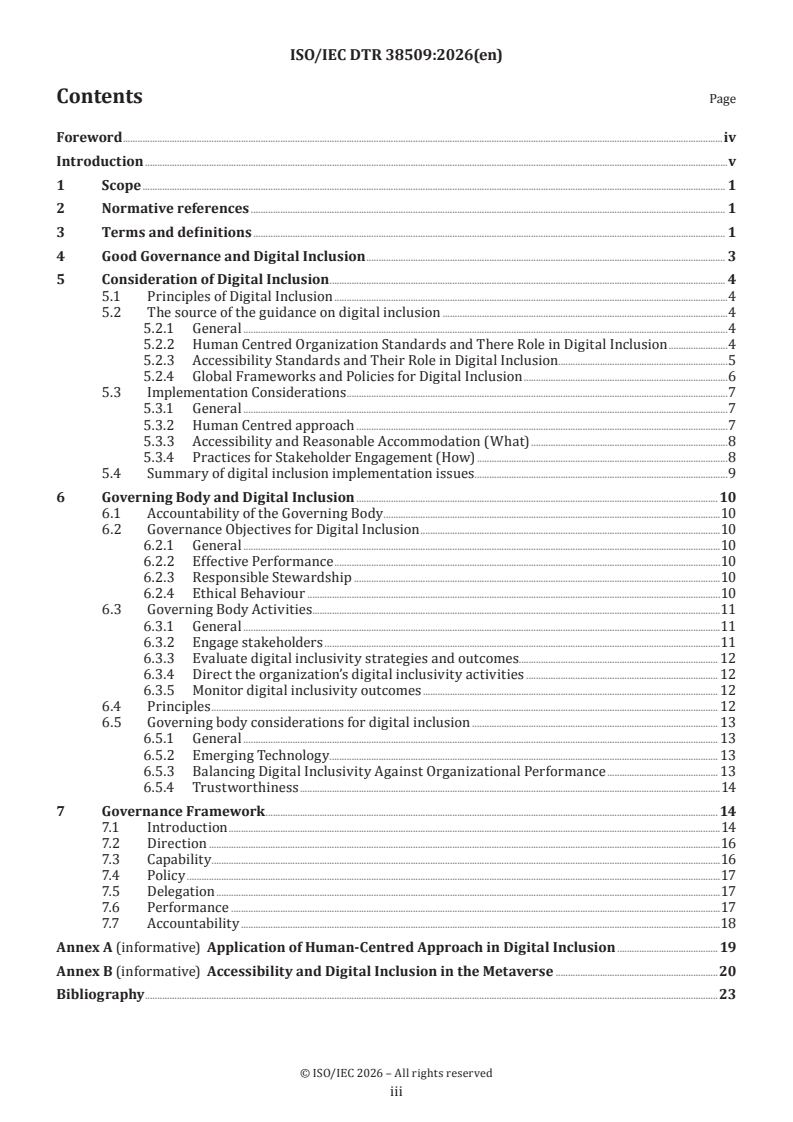
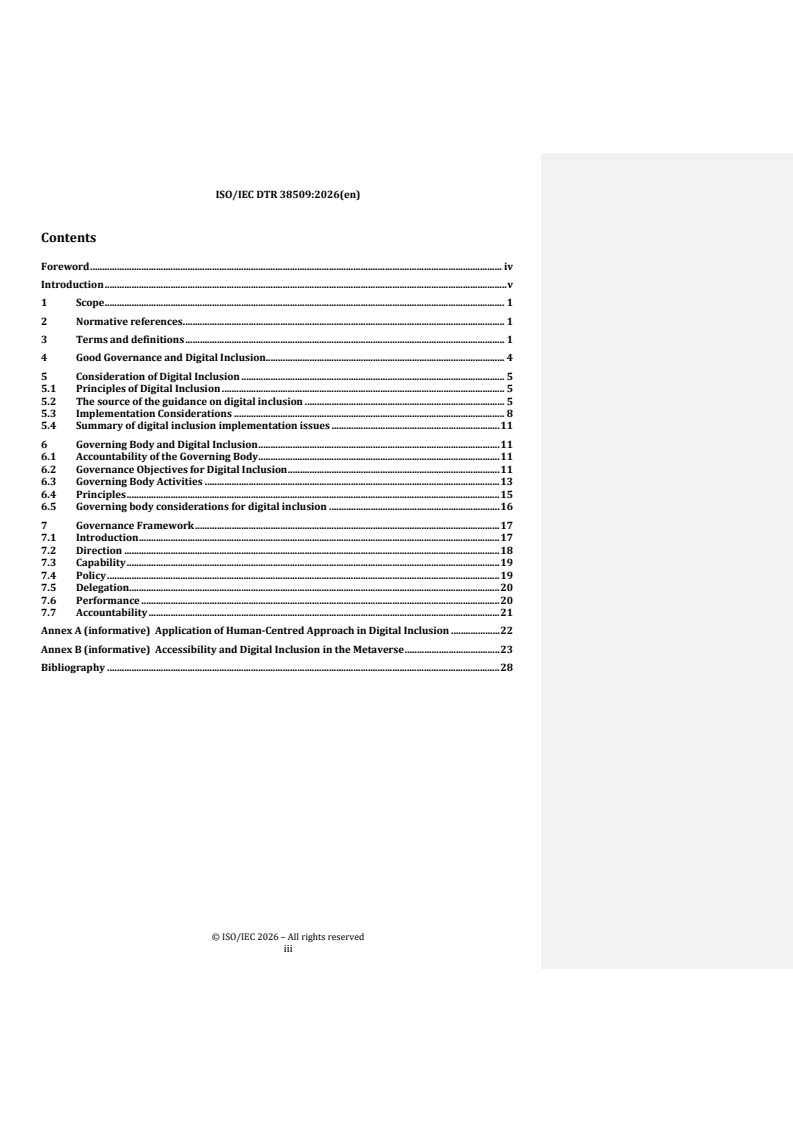
Contents
- Introduction
- 1 Scope
- 2 Normative references
- 3 Terms and definitions
- 3.1 governance
- 3.2 governance framework, noun
- 3.3 social responsibility, noun
- 3.4 inclusive behaviour, noun
- 3.5 fairness, noun
- 3.6 accessibility, noun
- 3.7 usability, noun
- 3.8 human factors, noun
- 3.9 HCD, noun
- 3.10 inclusiveness, noun
- 3.11 reasonable adjustment, noun
- 3.12 digital inclusion, noun
- 3.13 adaptive technology, noun
- 3.14 social inclusion
- 3.15 trustworthiness
- 4 Good Governance and Digital Inclusion
- 5 Consideration of Digital Inclusion
- 5.1 Principles of Digital Inclusion
- 5.2 The source of the guidance on digital inclusion
- 5.3 Implementation Considerations
- 5.4 Summary of digital inclusion implementation issues
- 6 Governing Body and Digital Inclusion
- 6.1 Accountability of the Governing Body
- 6.2 Governance Objectives for Digital Inclusion
- 6.3 Governing Body Activities
- 6.4 Principles
- 6.5 Governing body considerations for digital inclusion
- 7 Governance Framework
- 7.1 Introduction
- 7.2 Direction
- 7.3 Capability
- 7.4 Policy
- 7.5 Delegation
- 7.6 Performance
- 7.7 Accountability
- Annex A
- Annex B
- Bibliography
Introduction
This document has been developed to give informative material to support decision-making processes that prioritize equitable access, transparency, accountability, and the sustainable use of IT in ways that foster digital inclusion. This document is applicable to organizations that aim to integrate the perspectives on digital inclusion into their governance of IT practices.
Digital inclusion is an aspect of Social Inclusion which involves ensuring that everyone has equal opportunities to participate in and benefit from the digital services or technologies linked activities and decisions of an organization. It involves creating an inclusive digital environment that values diversity, removes barriers, fosters participation, and aligns with principles of social responsibility by recognizing the broader societal impacts of organizational decisions in the digital sphere. Users who can benefit from digital inclusion can be those with age-related, physical or mental impairments; or those who have no experience or confidence with digital services; and those with no access to digital services. Digital Inclusion strategies are often shaped by legal and ethical considerations, as many jurisdictions have introduced laws and policies that promote diversity and Inclusion. For organizations, particularly those that provide services to citizens or consumers, embracing digital inclusion is vital. It enhances their reputation as responsible corporate citizens and ensures that their digital services can reach and benefit a broader segment of the community.
Effective digital inclusion strategies can expand access to a wider talent pool, increase employee satisfaction, and drive innovation. By prioritizing digital inclusion, organizations contribute positively to society while achieving sustainable growt However, digital inclusion does not happen by chance. Achieving this depends on having a clear vision, strong leadership, well-defined policies, and adequate resources. Implementing digital inclusion aligns with the principles of good governance, ensuring accountability, strategic alignment, and the effective use of resources to foster an inclusive digital future.
This document provides guidance on the governance implications of digital inclusion. Within the International Standards arena, the guidance in the areas of governance of information technology falls within the scope of ISO/IEC JTC 1/SC 40.
The primary intended audience for this document is the governing body. It is also relevant to those involved in developing organizational policies and standards.
FINAL DRAFT Technical Report ISO/IEC DTR 38509:2026(en) Information technology — Governance of IT — Responsible governance of IT for digital inclusion
1 Scope
This document describes the governance implications of digital inclusion. It is intended for governing bodies and policy makers of all types of organizations (whether large or small) in the private, public and non-profit sectors.
It provides perspectives on digital inclusion considerations, the role of governing bodies in ensuring organisations address these considerations, as well as governance practices. It is not intended or appropriate for certification purposes or for regulatory or contractual use.
2 Normative references
There are no normative references in this document.
3 Terms and definitions
For the purposes of this document, the following terms and definitions apply. ISO and IEC maintain terminology databases for use in standardization at the following addresses:
- ISO Online browsing platform: available at https:// www .iso .org/ obp
- IEC Electropedia: available at https:// www .electropedia .org/
3.1 governance
system of directing and controlling [1] [SOURCE: ISO/IEC 38500:2024 , 3.3]
3.2 governance framework, noun
strategies, policies, decision-making structures and accountabilities through which the organization’s Governance (3.1) arrangements operate [2] [SOURCE: ISO/IEC TR 38502:2017 , 3.1]
3.3 social responsibility, noun
responsibility of an organization for the impacts of its decisions and activities on society and the environment, through transparent and ethical behaviour that - contributes to sustainable development, including the health and the welfare of society; - takes into account the expectations of stakeholders; - is in compliance with applicable law and consistent with international norms of behaviour; and - is integrated throughout the organization and practised in its relationships
ISO/IEC DTR 38509:2026(en) [3] [SOURCE: ISO 26000:2010 , 2.18, modified — Notes to entry removed.]
3.4 inclusive behaviour, noun
conduct that promotes Inclusion (3.10) [4] [SOURCE: ISO 30415:2021 , 3.14, modified — Notes to entry removed.]
3.5 fairness, noun
principle that everyone is subject to policies, processes, and practices that are equitable and, as far as possible, free from systematic bias [5] [SOURCE: ISO 30400:2022 , 3.7.14]
3.6 accessibility, noun
extent to which products, systems, services, environments and facilities can be used by people from a population with the widest range of user needs, characteristics and capabilities to achieve identified goals in identified contexts of use [6] [SOURCE: ISO 9241-112:2017 , 3.15]
3.7 usability, noun
extent to which a system, product or service can be used by specified users to achieve specified goals with effectiveness, efficiency and satisfaction in a specified context of use [7] [SOURCE: ISO 9241-210:2010 , 2.13]
3.8 human factors, noun
ergonomics, noun scientific discipline concerned with the understanding of interactions among human and other elements of a system, and the profession that applies theory, principles, data and methods to design in order to optimize human well-being and overall system performance [8] [SOURCE: ISO 26800:2011 , 2.2, modified — Note 1 to entry removed.]
3.9 HCD, noun
human-centred design, noun approach to system design and development that aims to make interactive systems more usable by focussing on the use of the system; applying human factors/Ergonomics (3.8) and Usability (3.7) knowledge and techniques [7] [SOURCE: ISO 9241-210:2010 , 3.7, modified — Notes to entry removed.]
3.10 inclusiveness, noun
inclusion, noun process of including all stakeholders Note 1 to entry: This involves stakeholders from different groups being accepted, welcomed, enabled to have a voice, and to develop a sense of belonging.
[9] [SOURCE: ISO 25550:2022 , 3.11 — modified, deleted “in organizational contexts”, deleted Note 1 to entry, deleted Note 2 to entry, and changed “Note 3 to entry” to “Note 1 to entry”.]
ISO/IEC DTR 38509:2026(en)
3.11 reasonable adjustment, noun
reasonable accommodation, noun necessary and appropriate modification and adjustments not imposing a disproportionate or undue burden, where needed in a particular case, to ensure that persons with disabilities enjoy or exercise on an equal basis with others all human rights and fundamental freedoms Note 1 to entry: In order to avoid confusion, Reasonable Adjustment (3.11) is the term used in this document. [SOURCE: United Nations Convention on the Rights of Persons with Disabilities, Article 2, available at https:// www .un .org/ development/ desa/ disabilities/ convention -on -the -rights -of -persons -with -disabilities [10] .html , modified — "reasonable adjustment" is now the permitted term.]
3.12 digital inclusion, noun
equitable, meaningful, and safe access to use, lead, and design digital technologies, services, and associated opportunities for everyone, everywhere [SOURCE: UN Round Table – Digital Inclusion, available at https:// social .desa .un .org/ issues/ poverty [11] -eradication/ digital -inclusion ]
3.13 adaptive technology, noun
technology used by individuals with disabilities to enable the performance of functions that might otherwise be difficult or impossible Note 1 to entry: Adapted from the definition of assistive technology by the World Health Organization (WHO).
3.14 social inclusion
process of improving the terms on which individuals and groups take part in society to improve the ability, opportunity, and dignity of those disadvantaged on the basis of their identity [SOURCE: World Bank Group - Social Inclusion, available at https:// www .worldbank .org/ en/ topic/ social [12] -inclusion ]
3.15 trustworthiness
ability to meet stakeholders' expectations in a verifiable way [13] [SOURCE: ISO/IEC TS 5723:2022 , 3.1]
4 Good Governance and Digital Inclusion
Digital inclusion, the equitable access to and effective use of digital technologies and services, is essential for ensuring that all individuals and communities can participate fully in the digital economy and society. The governance of digital inclusion requires intentional leadership, inclusive policies, and accountable decisionmaking structures that embed inclusivity as a strategic objective, not a peripheral concern. Governance is the system through which an organization is directed, controlled, and held accountable. Good governance means that decision-making within the organization is based on the organization’s ethos, culture, norms, practices, behaviours, structures and processes. Good governance can assist organizations in achieving three broad outcomes:
- Effective performance: Ensuring that organizational objectives are efficiently, effectively and continuously met.
- Responsible stewardship: Managing resources sustainably for current and future needs.
- Ethical behaviour: Upholding values and ethical standards in all organizational activities.
ISO/IEC DTR 38509:2026(en) Good governance creates and maintains an organization with a clear purpose that delivers long-term [14] value consistent with the expectations of its relevant stakeholders. As explained in ISO 37000:2021 the implementation of good governance of an organization is based on leadership, values, and a framework of mechanisms, processes and structures that are appropriate for the organization’s internal and external context.
Good governance is essential for enabling digital inclusion. Good governance fosters an organizational culture where inclusivity is a core principle rather than an afterthought. Key practices include:
- Actively engaging stakeholders, including underserved communities, in shaping policies and standards.
- Upholding high standards of inclusivity in internal operations and external service delivery.
- Ensuring that equity, transparency, and ethical practices are foundational to all decisions and activities. By embedding digital inclusion into governance, organizations can better meet stakeholder expectations, build trust, and contribute to a delivery of more equitable digital services.
5 Consideration of Digital Inclusion
5.1 Principles of Digital Inclusion
Digital inclusion is structured around core principles that guide policy development, technological innovation, and programs aimed at bridging the digital divide. The following principles are essential:
- Equitable Access: Ensuring all individuals have affordable access to digital technologies, including digital devices and assistive technologies.
- Digital Literacy and Education: Empowering users with the skills to engage meaningfully with digital tools and platforms, for example, aligned with the UNESCO Digital Literacy Framework.
- Universal Usability and Human Centred Design: Designing interfaces that support diverse user needs, [7] [15] aligned to ISO 9241-210:2010 series and ISO/IEC 30071-1:2019 .
- Affordability and Infrastructure: Developing cost-effective solutions and extending infrastructure to underserved communities, reinforced by the UN Sustainable Development Goals (SDGs 9 and 10).
- Stakeholder Engagement and Inclusion: Ensuring that diverse perspectives are meaningfully incorporated into the design, delivery, and governance of digital systems, building trust and [3] responsiveness, as emphasized in ISO 26000:2010 on Social Responsibility.
5.2 The source of the guidance on digital inclusion
5.2.1 General
This clause describes the key standards and frameworks that provide guidance for achieving digital inclusion.
5.2.2 Human Centred Organization Standards and There Role in Digital Inclusion
Human-centred organization standards establish principles that guide organizations in embedding [16] inclusivity and user well-being into governance and operations. ISO 27500:2016 outlines values such as:
- Capitalizing on individual differences as an organizational strength - recognizing diversity of skills, knowledge, and characteristics as opportunities rather than constraints.
- Making usability and accessibility strategic business objectives -positioning them as core to strategy, policy, and service delivery, both internally and externally.
ISO/IEC DTR 38509:2026(en) - Being open and trustworthy - ensuring transparency, honest communication, and timely information sharing with stakeholders.
- Acting in socially responsible ways - considering wider societal impacts, aligning with ethical behaviour [3] and ISO 26000:2010 .
[8] Complementing this, ISO 26800:2011 defines ergonomics as the optimization of human-system interaction, ensuring intuitive, adaptable, and efficient digital systems. It general principles include:
- Human-centred approach - systems ought adapt to people.
- Consideration of human diversity - accounting for abilities, limitations, and characteristics.
- Systems thinking - recognizing interaction among people, tasks, tools, and environment.
- Criteria-based evaluation - assessing effectiveness, efficiency, safety, usability, and well-being. Together, these standards highlight the importance of designing organizations and technologies that respect human diversity and prioritize inclusivity. In the context of digital inclusion, they provide a foundation for embedding accessibility and usability as organizational priorities rather than optional features. They encourage governing bodies to view digital inclusivity as a driver of long-term value, trust, and societal responsibility. By aligning governance practices with these principles, organizations can reduce digital barriers, support equitable participation, and create technology ecosystems that are sustainable, adaptable, and centred on people’s needs.
5.2.3 Accessibility Standards and Their Role in Digital Inclusion
Accessibility standards establish guidelines and technical specifications to ensure digital technologies are inclusive. These standards are fundamental to digital inclusion as they provide a framework for designing, developing, and implementing technologies that are accessible to all users, including those with disabilities. By ensuring compliance with accessibility standards, organizations can create an inclusive digital environment that supports full participation in society.
The relationship between accessibility standards and digital inclusion is crucial because:
- They ensure equitable access – standards provide guidelines for developing technology that accommodates diverse needs, removing barriers to access.
- They support universal design – accessibility standards promote the creation of digital services that can be used by everyone, regardless of ability.
- They enhance usability – clear principles for user interface design improve the usability and effectiveness of digital tools.
- They drive policy and regulation – policies and regulations incorporate accessibility standards to promote digital inclusion strategies.
These international standards provide structured approaches and best practices to ensure digital systems and services are usable, accessible, and inclusive across diverse user needs and contexts:
[17] - ISO/IEC 40500:2025 – Information technology — W3C Web Content Accessibility Guidelines (WCAG) 2.2. Defines how to make Web content more accessible to people with disabilities. [18] - ISO/TR 25060:2023 – Systems and software engineering — Systems and software Quality Requirements and Evaluation (SQuaRE) — Common Industry Format (CIF) for usability: General framework for usability-related information. It provides a usability framework that supports the specification and evaluation of user-centred software design and interfaces, essential for digital inclusivity.
[19] - ISO/IEC 25010:2011 – Systems and software engineering — Systems and software Quality Requirements and Evaluation (SQuaRE) — System and software quality models. It defines quality
ISO/IEC DTR 38509:2026(en) characteristics for systems and software, including usability and accessibility as components of "quality in use." [20] - ISO/IEC Guide 71:2014 – Guide for addressing accessibility in standards. It offers guidance to standards developers on incorporating accessibility features, including principles like perceivability, operability, and compatibility with assistive technologies—core to digital inclusion. [21] - ISO/IEC 29138-1:2018 – Information technology — Accessibility considerations for people with disabilities — Part 1: User needs summary. It summarizes user accessibility needs that can inform design and evaluation of digital products and services, helping organizations meet a broad range of user requirements.
[15] - ISO/IEC 30071-1:2019 – Information technology — Development of user interface accessibility — Part 1: Code of practice for creating accessible ICT products and services. It is a comprehensive standard providing practical guidance to developers and managers for embedding accessibility in ICT development processes, aligning well with governance of digital inclusion. [22] - ISO/IEC 24786:2009 – Information technology — User interfaces — Accessible user interface for accessibility settings. It provides requirements and recommendations for enabling users to access and adjust accessibility features in IT environments—essential for supporting assistive technology users. - ISO 9241 Series – Ergonomics of Human-System Interaction. This series covers a wide range of standards relevant to human-centred and accessible design. Key parts include:
[23] - ISO 9241-171:2008 – Ergonomics of human-system interaction — Part 171: Guidance on software accessibility. It offers detailed guidance on how to design software that supports users with disabilities, supporting accessible service delivery.
[24] - ISO 9241-220:2019 – Ergonomics of human-system interaction — Processes for enabling, executing and assessing human-centred design within organizations. It defines the human-centred design process at an organizational level, emphasizing governance structures that support inclusive design.
[25] - ISO 9241-112:2025 – Ergonomics of human-system interaction — Principles for the presentation of information. It provides principles that support clear, perceptible, and understandable presentation of information—critical for inclusive user interfaces.
5.2.4 Global Frameworks and Policies for Digital Inclusion
International agreements and policies in advancing digital inclusion play a critical role by setting strategic frameworks that promote equitable access to digital resources. These frameworks help establish guidelines for accessibility, user rights, and compliance with international standards, ensuring that digital technologies support inclusive participation in all aspects of life. Key framework promoting digital inclusion include:
- UN Convention on the Rights of Persons with Disabilities (CRPD):
- Article 5: Prohibits all discrimination on the basis of disability and ensures equal and effective legal protection, requiring reasonable accommodation.
- Article 9: Accessibility – Mandates equal access to physical environments, ICT, and services.
- Article 21: Freedom of Expression – Ensures access to information through accessible formats.
- UN Convention on the Rights of the Child (CRC):
...
Contents
- Introduction
- 1 Scope
- 2 Normative references
- 3 Terms and definitions
- 3.1 Governance
- 3.2 Governance Framework
- 3.3 Social Responsibility
- 3.4 Inclusive Behaviour
- 3.5 Fairness
- 3.6 Accessibility
- 3.7 Usability
- 3.8 Human Factors
- 3.9 HCD, noun
- 3.10 Inclusiveness
- 3.11 Reasonable Adjustment
- 3.12 Digital Inclusion
- 3.13 Adaptive Technology
- 3.14 Social Inclusion
- 3.15 Trustworthiness
- 4 Good Governance and Digital Inclusion
- 5 Consideration of Digital Inclusion
- 5.1 Principles of Digital Inclusion
- 5.2 The source of the guidance on digital inclusion
- 5.3 Implementation Considerations
- 2. Digital Empower users with the skills UNESCO Digital Literacy Builds user confidence and
- 3. Universal Simplify interfaces to ensure ISO 9241 series emphasizes Improves adoption, user
- 6 Governing Body and Digital Inclusion
- 6.1 Accountability of the Governing Body
- 6.2 Governance Objectives for Digital Inclusion
- 6.3 Governing Body Activities
- 6.4 Principles
- 6.5 Governing body Considerations considerations for digital inclusion
- 7 Governance Framework
- 7.1 Introduction
- 7.2 Direction
- 7.3 Capability
- 7.4 Policy
- 7.5 Delegation
- 7.6 Performance
- 7.7 Accountability
- Annex A
- Annex B
- Bibliography
Introduction
This document has been developed to give informative material to support decision-making processes that prioritize equitable access, transparency, accountability, and the sustainable use of IT in ways that foster Digital Inclusion.digital inclusion. This technical reportdocument is applicable to organizations that aim to integrate the perspectives on Digital Inclusiondigital inclusion into their Governancegovernance of IT practices.
Digital Inclusioninclusion is an aspect of Social Inclusion which involves ensuring that everyone has equal opportunities to participate in and benefit from the digital services or technologies linked activities and decisions of an organization. It involves creating an inclusive digital environment that values diversity, removes barriers, fosters participation, and aligns with principles of social responsibility by recognizing the broader societal impacts of organizational decisions in the digital sphere. Users who can benefit from digital inclusion can be those with age-related, physical or mental impairments; or those who have no experience or confidence with digital services; and those with no access to digital services. Digital Inclusion strategies are often shaped by legal and ethical considerations, as many jurisdictions have introduced laws and policies that promote diversity and Inclusion. For organizations, particularly those that provide services to citizens or consumers, embracing Digital Inclusiondigital inclusion is vital. It enhances their reputation as responsible corporate citizens and ensures that their digital services can reach and benefit a broader segment of the community.
Effective Digital Inclusiondigital inclusion strategies can expand access to a wider talent pool, increase employee satisfaction, and drive innovation. By prioritizing Digital Inclusiondigital inclusion, organizations contribute positively to society while achieving sustainable growth.growt However, Digital Inclusiondigital inclusion does not happen by chance. Achieving this depends on having a clear vision, strong leadership, well-defined policies, and adequate resources. Implementing Digital Inclusiondigital inclusion aligns with the principles of good Governancegovernance, ensuring accountability, strategic alignment, and the effective use of resources to foster an inclusive Digitaldigital future. This document provides guidance on the Governancegovernance implications of Digital Inclusion.digital inclusion. Within the International Standards arena, the guidance in the areas of Governancegovernance of information technology falls within the scope of ISO/IEC JTC 1/SC 40. The primary intended audience for this document is the governing body. It is also relevant to those involved in developing organizational policies and standards.
ISO/IEC DTR 38509:2026(en) Information technology - — Governance of IT -— Responsible governance of IT for digital inclusion
1 Scope
This Technical Report provides informative guidance ondocument describes the governance implications of Digital Inclusion digital inclusion.
It is intended for governing bodybodies and policy makers of all types of organizations (whether large or small) in the private, public and non-profit sectors.W3C It provides perspectives on digital inclusion considerations, the role of governing bodies in ensuring and organisations address these considerations, as well as governance practices. It is not intended or appropriate for certification purposes or for regulatory or contractual use.
2 Normative references
The following documents are referred to in the text in such a way that some or all of their content constitutes requirements of this document. For dated references, only the edition cited applies. For undated references, the latest edition of the referenced document (including any amendments) applies. ISO/IEC 38500:2024, Information technology — Governance of IT for the organization ISO/IEC 38500, Information technology — Governance of IT for the organization There are no normative references in this document.
3 Terms and definitions
For the purposes of this document, the following terms and definitions apply. ISO and IEC maintain terminology databases for use in standardization at the following addresses:
- ISO Online browsing platform: available at https://www.iso.org/obphttps://www.iso.org/obp
- IEC Electropedia: available at https://www.electropedia.org/https://www.electropedia.org/
3.1 Governance
governance system of directing and controlling [SOURCE: ISO/IEC 38500:2024ISO/IEC 38500:2024, 3.3]
3.2 Governance Framework
governance framework, noun strategies, policies, decision-making structures and accountabilities through which the organization’s Governance (3.1) arrangements operate [SOURCE: ISO/IEC TR 38502:2017, 3.1]
ISO/IEC DTR 38509:2026(en)
3.3 Social Responsibility
social responsibility, noun responsibility of an organization for the impacts of its decisions and activities on society and the environment, through transparent and ethical behaviour that - contributes to sustainable development, including the health and the welfare of society; - takes into account the expectations of stakeholders; - is in compliance with applicable law and consistent with international norms of behaviour; and - is integrated throughout the organization and practised in its relationships [SOURCE: ISO 26000:2010, 2.18], modified — Notes to entry removed.]
3.4 Inclusive Behaviour
conductinginclusive behaviour, noun conduct that promotes Inclusion (3.10) [SOURCE: ISO 30415:2021, 3.14], modified — Notes to entry removed.]
3.5 Fairness
fairness, noun principle that everyone is subject to policies, processes, and practices that are equitable and, as far as possible, free from systematic bias [SOURCE: ISO 30400:2022, 3.7.14] Field Code Changed
3.6 Accessibility
accessibility, noun extent to which products, systems, services, environments and facilities can be used by people from a population with the widest range of user needs, characteristics and capabilities to achieve identified goals in identified contexts of use [SOURCE: ISO 9241-112:2017, 3.15] Field Code Changed
3.7 Usability
usability, noun extent to which a system, product or service can be used by specified users to achieve specified goals with effectiveness, efficiency and satisfaction in a specified context of use [SOURCE: ISO 9241-210:2010, 2.13] Field Code Changed
3.8 Human Factors
Ergonomics human factors, noun
ISO/IEC DTR 38509:2026(en) ergonomics, noun scientific discipline concerned with the understanding of interactions among human and other elements of a system, and the profession that applies theory, principles, data and methods to design in order to optimize human well-being and overall system performance [SOURCE: ISO 26800:2011, 2.2], 2.2, modified — Note 1 to entry removed.]
3.9 HCD, noun
Humanhuman-centred design, noun approach to system design and development that aims to make interactive systems more usable by focussing on the use of the system; applying human factors (), /Ergonomics (3.8) and Usability (3.7) knowledge and techniques [SOURCE: ISO 9241-210:2010 3.7], 3.7, modified — Notes to entry removed.]
3.10 Inclusiveness
Inclusion inclusiveness, noun inclusion, noun process of including all stakeholders Note 1 to entry: This involves stakeholders from different groups being accepted, welcomed, enabled to have a voice, and to develop a sense of belonging.
[SOURCE: ISO 25550:2022, 3.11– — modified, deleted “in organizational contexts”, deleted Note 1 to entry, deleted Note 2 to entry, and changed “Note 3 to entry” to “Note 1 to entry”]”.]
3.11 Reasonable Adjustment
Reasonable Accommodation reasonable adjustment, noun reasonable accommodation, noun necessary and appropriate modification and adjustments not imposing a disproportionate or undue burden, where needed in a particular case, to ensure that persons with disabilities enjoy or exercise on an equal basis with others all human rights and fundamental freedoms Note 1 to entry: In order to avoid confusion, Reasonable Adjustment (3.11) is the term used in this document. [SOURCE: United Nations Convention on the Rights of Persons with Disabilities, Article 2, available at https://www.un.org/development/desa/disabilities/convention-on-the-rights-of-persons-with- [10] disabilities.html ,, modified — 'reasonable adjustment'"reasonable adjustment" is now the permitted term.]
3.12 Digital Inclusion
digital inclusion, noun equitable, meaningful, and safe access to use, lead, and design digital technologies, services, and associated opportunities for everyone, everywhere.
[SOURCE: UN Round Table – Digital Inclusion, available at https://social.desa.un.org/issues/poverty- [11] eradication/digital-inclusion ]]
ISO/IEC DTR 38509:2026(en)
3.13 Adaptive Technology
adaptive technology, noun technology used by individuals with disabilities to enable the performance of functions that might otherwise be difficult or impossible [SOURCE: Note 1 to entry: Adapted from the definition of Assistive Technologyassistive technology by the World Health Organization (WHO).]).
3.14 Social Inclusion
social inclusion process of improving the terms on which individuals and groups take part in society to improve the ability, opportunity, and dignity of those disadvantaged on the basis of their identity [SOURCE: World Bank Group - Social Inclusion, available at https://www.worldbank.org/en/topic/social- [12] inclusion ]]
3.15 Trustworthiness
trustworthiness ability to meet stakeholders' expectations in a verifiable way [SOURCE: ISO/IEC TS 5723:2022 Information technology — Trustworthiness — Vocabulary,, 3.1]
4 Good Governance and Digital Inclusion
Digital inclusion, the equitable access to and effective use of digital technologies and services, is essential for ensuring that all individuals and communities can participate fully in the digital economy and society. The governance of digital inclusion requires intentional leadership, inclusive policies, and accountable decisionmaking structures that embed inclusivity as a strategic objective, not a peripheral concern. Governance is the system through which an organization is directed, controlled, and held accountable. Good governance means that decision-making within the organization is based on the organization’s ethos, culture, norms, practices, behaviours, structures and processes. Good Governancegovernance can assist organizations in achieving three broad outcomes:
- Effective performance: Ensuring that organizational objectives are efficiently, effectively and continuously met.
- Responsible stewardship: Managing resources sustainably for current and future needs.
- Ethical behaviour: Upholding values and ethical standards in all organizational activities. Good governance creates and maintains an organization with a clear purpose that delivers long-term value consistent with the expectations of its relevant stakeholders. As explained in ISO 37000:2021 the implementation of good governance of an organization is based on leadership, values, and a framework of mechanisms, processes and structures that are appropriate for the organization’s internal and external context.
Good governance is essential for enabling digital inclusion. Good governance fosters an organizational culture where inclusivity is a core principle rather than an afterthought. Key practices include:
- Actively engaging stakeholders, including underserved communities, in shaping policies and standards.
ISO/IEC DTR 38509:2026(en) - Upholding high standards of inclusivity in internal operations and external service delivery. - Ensuring that equity, transparency, and ethical practices are foundational to all decisions and activities. By embedding digital inclusion into governance, organizations can better meet stakeholder expectations, build trust, and contribute to a delivery of more equitable digital services.
5 Consideration of Digital Inclusion
5.1 Principles of Digital Inclusion
Digital inclusion is structured around core principles that guide policy development, technological innovation, and programs aimed at bridging the digital divide. The following principles are essential:
- Equitable Access: Ensuring all individuals have affordable access to digital technologies, including digital devices and assistive technologies.
- Digital Literacy and Education: Empowering users with the skills to engage meaningfully with digital tools and platforms, for example, aligned with the UNESCO Digital Literacy Framework.
- Universal Usability and Human Centred Design: Designing interfaces that support diverse user needs, aligned to ISO 9241-210:2010 series and ISO/IEC 30071-1:2019.
Field Code Changed - Affordability and Infrastructure: Developing cost-effective solutions and extending infrastructure to underserved communities, reinforced by the UN Sustainable Development Goals (SDGs 9 and 10). - Stakeholder Engagement and Inclusion: Ensuring that diverse perspectives are meaningfully incorporated into the design, delivery, and governance of digital systems, building trust and responsiveness, as emphasized in ISO 26000:2010 on Social Responsibility. Field Code Changed
5.2 The source of the guidance on digital inclusion
5.2.1 The following subsections describeGeneral
This clause describes the key standards and frameworks that provide guidance for achieving digital inclusion. 5.2.15.2.2 Human Centred Organization Standards and There Role in Digital Inclusion Human-centred organization standards establish principles that guide organizations in embedding inclusivity and user well-being into governance and operations. ISO 27500:2016 outlines values such as:
Field Code Changed - Capitalizing on individual differences as an organizational strength - recognizing diversity of skills, knowledge, and characteristics as opportunities rather than constraints. - Making usability and accessibility strategic business objectives -positioning them as core to strategy, policy, and service delivery, both internally and externally.
- Being open and trustworthy - ensuring transparency, honest communication, and timely information sharing with stakeholders.
- Acting in socially responsible ways - considering wider societal impacts, aligning with ethical behaviour and ISO 26000:2010.
Field Code Changed Complementing this, ISO 26800:2011 defines ergonomics as the optimization of human-system interaction, ensuring intuitive, adaptable, and efficient digital systems. It general principles include:
ISO/IEC DTR 38509:2026(en) - Human-centred approach - systems shouldought adapt to people. - Consideration of human diversity - accounting for abilities, limitations, and characteristics. - Systems thinking - recognizing interaction among people, tasks, tools, and environment. - Criteria-based evaluation - assessing effectiveness, efficiency, safety, usability, and well-being. Together, these standards highlight the importance of designing organizations and technologies that respect human diversity and prioritize inclusivity. In the context of digital inclusion, they provide a foundation for embedding accessibility and usability as organizational priorities rather than optional features. They encourage governing bodies to view digital inclusivity as a driver of long-term value, trust, and societal responsibility. By aligning governance practices with these principles, organizations can reduce digital barriers, support equitable participation, and create technology ecosystems that are sustainable, adaptable, and centred on people’s needs.
5.2.25.2.3 Accessibility Standards and Their Role in Digital Inclusion Accessibility standards establish guidelines and technical specifications to ensure digital technologies are inclusive. These standards are fundamental to digital inclusion as they provide a framework for designing, developing, and implementing technologies that are accessible to all users, including those with disabilities. By ensuring compliance with accessibility standards, organizations can create an inclusive digital environment that supports full participation in society.
The relationship between accessibility standards and digital inclusion is crucial because:
- They ensure equitable access – Standardsstandards provide guidelines for developing technology that accommodates diverse needs, removing barriers to access.
- They support universal design – Accessibilityaccessibility standards promote the creation of digital services that can be used by everyone, regardless of ability.
- They enhance usability – Clearclear principles for user interface design improve the usability and effectiveness of digital tools.
- They drive policy and regulation – policies and regulations incorporate accessibility standards to promote digital inclusion strategies.
These international standards provide structured approaches and best practices to ensure digital systems and services are usable, accessible, and inclusive across diverse user needs and contexts:
- ISO/IEC 40500:2025 – Information technology — W3C Web Content Accessibility Guidelines (WCAG) 2.2. Defines how to make Web content more accessible to people with disabilities.
- ISO/TR 25060:2023 – Systems and software engineering — Systems and software Quality Requirements and Evaluation (SQuaRE) — Common Industry Format (CIF) for usability: General framework for usability-related information – Systems and software engineering — Systems and software Quality Requirements and Evaluation (SQuaRE) — Common Industry Format (CIF) for usability: General framework for usability-related information. It provides a usability framework that supports the specification and evaluation of user-centred software design and interfaces, essential for digital inclusivity.
- ISO/IEC 25010:2011 – Systems and software engineering — Systems and software Quality Requirements and Evaluation (SQuaRE) — System and software quality models – Systems and software engineering — Systems and software Quality Requirements and Evaluation (SQuaRE) — System and software quality
ISO/IEC DTR 38509:2026(en) models. It defines quality characteristics for systems and software, including usability and accessibility as components of "quality in use." - ISO/IEC Guide 71:2014 – Guide for addressing accessibility in standards. It offers guidance to standards developers on incorporating accessibility features, including principles like perceivability, operability, and compatibility with assistive technologies—core to digital inclusion. - ISO/IEC 29138-1:2018 – Information technology — Accessibility considerations for people with disabilities — Part 1: User needs summary. It summarizes user accessibility needs that can inform design and evaluation of digital products and services, helping organizations meet a broad range of user requirements.
- ISO/IEC 30071-1:2019 – Information technology — Development of user interface accessibility — Part 1:
...