

ISO/IEC 38505-1:2026
(Main)Information technology — Governance of data — Part 1: Application of ISO/IEC 38500 to the governance of data
- Abstract
This document provides principles for governing bodies of organizations (which can comprise owners, directors, partners, executive managers, or similar) on the effective, efficient and acceptable use of data within their organizations by: applying the governance principles and model of ISO/IEC 38500 to the governance of data; assuring stakeholders that, if the principles and practices proposed by this document are followed, they can have confidence in the organization’s governance of data; informing and guiding governing bodies in the use and protection of data in their organizations. This document can also provide guidance to a wider community, including: executive managers; external businesses or technical specialists, such as legal or accounting specialists, retail or industrial associations, or professional bodies; internal and external service providers (including consultants); auditors. This document applies to the governance of the current and future use of data that is created, collected, stored, secured, protected, or controlled by IT systems, and impacts the management processes and decisions relating to data. This document defines the governance of data as a subset or domain of the governance of IT, which itself is a subset or domain of organizational, or in the case of a corporation, corporate governance. This document is applicable to all organizations, including public and private companies, government entities, and not-for-profit organizations. This document is applicable to organizations of all sizes, regardless of the extent of their dependence on data.
- Status
- Published
- Publication Date
- 19-Aug-2026
- Technical Committee
- ISO/IEC JTC 1/SC 40 - IT service management and IT governance
- Drafting Committee
- ISO/IEC JTC 1/SC 40/WG 1 - Governance of InformationTechnology
- Current Stage
- 6060 - International Standard published - 60 Publication
- Start Date
- 20-Aug-2026
- Due Date
- 09-Jun-2026
- Completion Date
- 09-Jun-2026
ISO/IEC 38505-1:2026 is an International Standard published by ISO that gives guidance on the governance of data in organizations. It applies the governance principles and model of ISO/IEC 38500 to data use, protection and accountability so governing bodies can evaluate, direct and monitor data-related decisions. It is written mainly for governing bodies, but it is also useful to executive managers, auditors, service providers and technical specialists who support data governance.
What does ISO/IEC 38505-1:2026 specify?
ISO/IEC 38505-1:2026 specifies principles for governing bodies on the effective, efficient and acceptable use of data within their organizations. It focuses on governance within an organization, not the mechanics of storing or managing data, and it treats governance of data as a domain within governance of IT and, in turn, organizational or corporate governance.
The standard applies to data that is created, collected, stored, secured, protected or controlled by IT systems, and to the management processes and decisions affected by that data. It is applicable to public and private companies, government entities and not-for-profit organizations, and to organizations of all sizes.
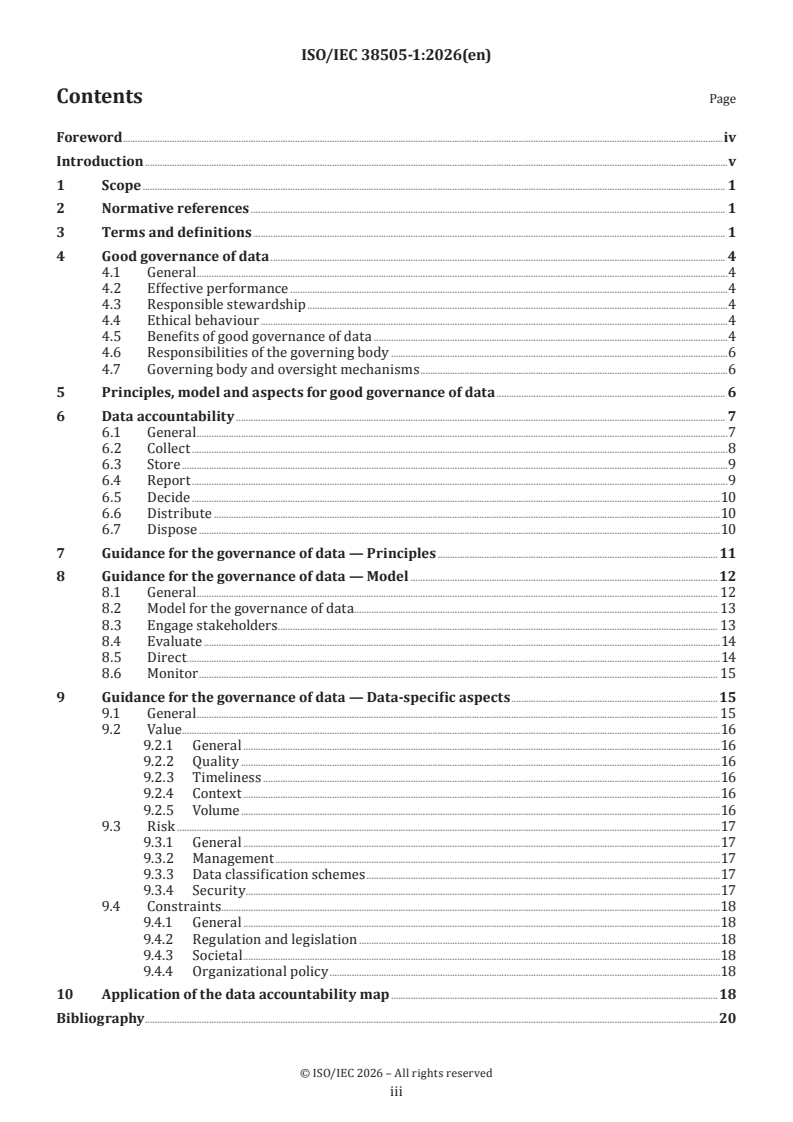
The document is organized into Clause 1 Scope, Clause 2 Normative references, Clause 3 Terms and definitions, Clause 4 Good governance of data, Clause 5 Principles, model and aspects for good governance of data, Clause 6 Data accountability, Clause 7 Guidance for the governance of data - Principles, Clause 8 Guidance for the governance of data - Model, Clause 9 Guidance for the governance of data - Data-specific aspects, Clause 10 Application of the data accountability map, and a Bibliography.
What are the key requirements of ISO/IEC 38505-1:2026?
ISO/IEC 38505-1:2026 is a principles-based governance document. Its main practical message is that governing bodies stay accountable for data governance, even when day-to-day data work is delegated.
Governing body responsibility and oversight
Clause 4 says good governance of data supports effective performance, responsible stewardship and ethical behaviour. In practice, that means the governing body needs to protect value, trust and compliance while still enabling innovation and sound decisions.
Clauses 4.6 and 4.7 say the governing body should establish oversight mechanisms that fit the organization’s dependence on data and its data risk exposure. That matters because audit, security, risk management and related committees need enough knowledge to oversee data use properly.
Principles and governance model
Clause 7 and Table 1 apply the ISO/IEC 38500 principles to data use: purpose, value generation, strategy, oversight, accountability, stakeholder engagement, leadership, data and decisions, risk governance, social responsibility, and viability and performance over time. For a reader, this means data collection, storage, reporting, decision-making, distribution and disposal should all support the organization’s purpose and strategy.
Clause 8 turns those principles into a governance cycle of engage stakeholders, evaluate, direct and monitor. In practice, the governing body uses that cycle to understand needs, approve direction, check performance and adjust oversight as conditions change.
Data accountability across the lifecycle
Clause 6 defines the data accountability map with six activities: collect, store, report, decide, distribute and dispose. This is useful because it separates governance responsibilities from operational data management and shows where accountabilities need to be clear.
In collect, store and report, the standard points to internal systems, external exchanges, sensor data, subscriptions, cloud stores and analytic tools such as data mining and machine learning (ML). The practical point is that governing bodies should understand where data comes from, where it is held, and how context or new analysis can create new data.
In decide, distribute and dispose, the standard emphasizes that automated decisions still remain under governing-body accountability, that outward sharing of data needs policy and controls, and that disposal must balance risk reduction, legal retention duties and eco-responsibility. This matters because data is not only kept or shared - it is also used to make decisions and, when needed, removed safely.
Value, risk and constraints
Clause 9 says data governance should be judged through value, risk and constraints. Value depends on quality, timeliness, context and volume; risk covers management, classification and security; constraints include regulation, legislation, societal expectations and organizational policy.
Clause 10 applies those aspects to the data accountability map and Table 2, which gives a practical checklist for governing bodies. In practice, this helps decide what to leverage, what to protect, who should act and how often the arrangement should be reviewed.
What terms does ISO/IEC 38505-1:2026 define?
- Governance of data - the system by which current and future data is collected, stored, secured, protected or controlled by IT systems and affects management processes and decisions.
- Data accountability - the property that ensures the actions of an entity can be traced uniquely to that entity.
- Anonymization - a process that irreversibly alters personally identifiable information (PII) so a PII principal can no longer be identified directly or indirectly.
- Pseudonymization - a process that replaces identifying information with an alias while keeping a link that may still allow identification in restricted circumstances.
- Personally identifiable information (PII) - information that can establish a link to a natural person, or is or might be directly or indirectly linked to that person.
- PII principal - the natural person to whom the PII relates.
- Cloud computing - a paradigm for network access to a scalable and elastic pool of shareable physical or virtual resources with self-service provisioning and administration on demand.
- Machine learning (ML) - a process of optimizing model parameters so the model’s behaviour reflects the data or experience.
Who uses ISO/IEC 38505-1:2026?
ISO/IEC 38505-1:2026 is mainly for governing bodies such as owners, directors, partners and executive managers. They use it to set direction, oversee risk, approve policy and ask for assurance that data is being handled responsibly.
It also supports executive managers, legal and accounting specialists, external businesses or professional bodies, internal and external service providers, consultants and auditors. Those users apply it when designing controls, advising on policy, assessing governance, or reviewing whether an organization’s data use is credible and accountable.
What changed in ISO/IEC 38505-1:2026 from the previous edition?
ISO/IEC 38505-1:2026 is the second edition and it cancels and replaces ISO/IEC 38505-1:2017. The document states that it has been technically revised, with the main change being alignment with ISO/IEC 38500:2024, which is itself aligned to ISO 37000.
Which standards are used with ISO/IEC 38505-1:2026?
ISO/IEC 38500 is the normative reference. It provides the underlying governance of IT principles and model that ISO/IEC 38505-1:2026 applies to data.
The document also names these related standards and uses them as supporting references:
- ISO/IEC/TS 38501 - implementation guidance for governance of IT arrangements.
- ISO/IEC/TR 38502 - framework and model for governance of IT.
- ISO 31000 - risk management guidance.
- ISO 37000:2021 - governance of organizations guidance.
- ISO/IEC 27000 - overview of information security management systems (ISMS).
- ISO/IEC 27002:2022 - information security controls, including data classification examples.
- ISO/IEC 27018 - controls for protecting PII in public clouds.
- ISO/IEC 20889 - de-identification terminology and techniques.
- ISO/IEC 22989:2022 - artificial intelligence (AI) concepts and terminology.
- ISO 37001:2025 - anti-bribery management systems, cited in risk examples.
What does the ISO/IEC 38505-1:2026 document contain?
ISO/IEC 38505-1:2026 contains two central figures: Figure 1, the governance of data map, and Figure 2, the governance of data model. It also contains Table 1, which maps the 11 ISO/IEC 38500 principles to expected outcomes for data governance, and Table 2, which links the collect, store, report, decide, distribute and dispose activities to value, risk and constraints.
Clause 6 explains the data accountability activities in practical terms, including examples of how data is created, stored, analyzed, shared and disposed of. Clause 9 gives the value-risk-constraint lens that governing bodies use to judge data sets and related policies. Together, these parts support policy setting, oversight, audits, risk review and governance design.
Relations
- Effective Date
- 10-Jun-2023
Get Certified
Connect with accredited certification bodies for this standard

BSI Group
BSI (British Standards Institution) is the business standards company that helps organizations make excellence a habit.

NYCE
Mexican standards and certification body.
Sponsored listings
Frequently Asked Questions
ISO/IEC 38505-1:2026 is a standard published by the International Organization for Standardization (ISO). Its full title is "Information technology — Governance of data — Part 1: Application of ISO/IEC 38500 to the governance of data". This standard covers: This document provides principles for governing bodies of organizations (which can comprise owners, directors, partners, executive managers, or similar) on the effective, efficient and acceptable use of data within their organizations by: applying the governance principles and model of ISO/IEC 38500 to the governance of data; assuring stakeholders that, if the principles and practices proposed by this document are followed, they can have confidence in the organization’s governance of data; informing and guiding governing bodies in the use and protection of data in their organizations. This document can also provide guidance to a wider community, including: executive managers; external businesses or technical specialists, such as legal or accounting specialists, retail or industrial associations, or professional bodies; internal and external service providers (including consultants); auditors. This document applies to the governance of the current and future use of data that is created, collected, stored, secured, protected, or controlled by IT systems, and impacts the management processes and decisions relating to data. This document defines the governance of data as a subset or domain of the governance of IT, which itself is a subset or domain of organizational, or in the case of a corporation, corporate governance. This document is applicable to all organizations, including public and private companies, government entities, and not-for-profit organizations. This document is applicable to organizations of all sizes, regardless of the extent of their dependence on data.
This document provides principles for governing bodies of organizations (which can comprise owners, directors, partners, executive managers, or similar) on the effective, efficient and acceptable use of data within their organizations by: applying the governance principles and model of ISO/IEC 38500 to the governance of data; assuring stakeholders that, if the principles and practices proposed by this document are followed, they can have confidence in the organization’s governance of data; informing and guiding governing bodies in the use and protection of data in their organizations. This document can also provide guidance to a wider community, including: executive managers; external businesses or technical specialists, such as legal or accounting specialists, retail or industrial associations, or professional bodies; internal and external service providers (including consultants); auditors. This document applies to the governance of the current and future use of data that is created, collected, stored, secured, protected, or controlled by IT systems, and impacts the management processes and decisions relating to data. This document defines the governance of data as a subset or domain of the governance of IT, which itself is a subset or domain of organizational, or in the case of a corporation, corporate governance. This document is applicable to all organizations, including public and private companies, government entities, and not-for-profit organizations. This document is applicable to organizations of all sizes, regardless of the extent of their dependence on data.
ISO/IEC 38505-1:2026 is classified under the following ICS (International Classification for Standards) categories: 35.020 - Information technology (IT) in general. The ICS classification helps identify the subject area and facilitates finding related standards.
ISO/IEC 38505-1:2026 has the following relationships with other standards: It is inter standard links to ISO/IEC 38505-1:2017. Understanding these relationships helps ensure you are using the most current and applicable version of the standard.
ISO/IEC 38505-1:2026 is available in PDF format for immediate download after purchase. The document can be added to your cart and obtained through the secure checkout process. Digital delivery ensures instant access to the complete standard document.
Standards Content (Sample)
Contents
- Introduction
- 1 Scope
- 2 Normative references
- 3 Terms and definitions
- 3.1 anonymization
- 3.2 big data
- 3.3 cloud computing
- 3.4 data accountability
- 3.5 de-identification
- 3.6 governance of data
- 3.7 internet of things
- 3.8 machine learning
- 3.9 pseudonymization
- 3.10 personally identifiable information
- 3.11 PII principal
- 3.12 risk management
- 4 Good governance of data
- 4.1 General
- 4.2 Effective performance
- 4.3 Responsible stewardship
- 4.4 Ethical behaviour
- 4.5 Benefits of good governance of data
- 4.6 Responsibilities of the governing body
- 4.7 Governing body and oversight mechanisms
- 5 Principles, model and aspects for good governance of data
- 6 Data accountability
- 6.1 General
- 6.2 Collect
- 6.3 Store
- 6.4 Report
- 6.5 Decide
- 6.6 Distribute
- 6.7 Dispose
- 7 Guidance for the governance of data — Principles
- 8 Guidance for the governance of data — Model
- 8.1 General
- 8.2 Model for the governance of data
- 8.3 Engage stakeholders
- 8.4 Evaluate
- 8.5 Direct
- 8.6 Monitor
- 9 Guidance for the governance of data — Data-specific aspects
- 9.1 General
- 9.2 Value
- 9.3 Risk
- 9.4 Constraints
- 10 Application of the data accountability map
- Bibliography
Introduction
The objective of this document is to provide principles, definitions and a model for governing bodies to use when evaluating, directing and monitoring the handling and use of data in their organizations. This document is high-level, principles-based and advisory. In addition to providing broad guidance on the role of a governing body, it encourages organizations to use appropriate standards to underpin their governance of data.
All organizations use data; and the major proportion of the data is stored electronically across IT systems. With the advent of cloud computing, the realization of the potential of the “internet of things” and the increasing use of “big data” analytics and artificial intelligence (AI), data have become easier to generate, gather, store and mine for useful information. This flood of data brings with it an urgent requirement and responsibility for governing bodies to ensure that valuable opportunities are leveraged, and sensitive data are protected and secured.
Governance of data plays a critical role in ensuring the responsible, innovative, sustainable, and ethical use of data.
Governance of data is an ongoing practice, adapting to the evolving data landscape. This document has been prepared to provide guidance to the members of governing bodies to apply a principles-based approach to the governance of data to increase the value of the data while preventing the risks associated with the data. ISO/IEC 38500 provides principles, model, and framework for the governing bodies of organizations to guide their current use and to plan for their future use of Information technology (IT), and this document concerns the application of ISO/IEC 38500. While this document describes the governance of data and its use within an organization, guidance on the implementation arrangement for the effective governance of IT in general is found in ISO/IEC/TS 38501. The constructs in ISO/IEC/TS 38501 can help to identify internal and external factors relating to the governance of IT and help to define beneficial outcomes and identify evidence of success.
The use of AI and the growth of data have created extensive opportunities for the analysis and use of data in decision making. Because legal regulations sometimes lag behind or are not developed, it is up to an organization to ensure the ethical use of data.
As with ISO/IEC 38500, this document is addressed primarily to the governing body of an organization and applies equally regardless of the size of the organization or its industry or sector. The principles of this document can be relevant for the governing bodies of data exchange networks, platforms, spaces and for other inter-organizational data governance contexts. However, the inter-organizational aspects of data governance are outside the scope of this document.
Governance is distinct from management and concerns evaluating, directing and monitoring the use of data, rather than the mechanics of storing, retrieving or managing the data. This document outlines an understanding of various data management and techniques to enunciate the strategies and policies that can be directed by the governing body.
International Standard ISO/IEC 38505-1:2026(en) Information technology — Governance of data — Part 1:
Application of ISO/IEC 38500 to the governance of data
1 Scope
This document provides principles for governing bodies of organizations (which can comprise owners, directors, partners, executive managers, or similar) on the effective, efficient and acceptable use of data within their organizations by:
- applying the governance principles and model of ISO/IEC 38500 to the governance of data;
- assuring stakeholders that, if the principles and practices proposed by this document are followed, they can have confidence in the organization’s governance of data;
- informing and guiding governing bodies in the use and protection of data in their organizations. This document can also provide guidance to a wider community, including:
- executive managers;
- external businesses or technical specialists, such as legal or accounting specialists, retail or industrial associations, or professional bodies;
- internal and external service providers (including consultants);
- auditors.
This document applies to the governance of the current and future use of data that is created, collected, stored, secured, protected, or controlled by IT systems, and impacts the management processes and decisions relating to data.
This document defines the governance of data as a subset or domain of the governance of IT, which itself is a subset or domain of organizational, or in the case of a corporation, corporate governance. This document is applicable to all organizations, including public and private companies, government entities, and not-for-profit organizations. This document is applicable to organizations of all sizes, regardless of the extent of their dependence on data.
2 Normative references
The following documents are referred to in the text in such a way that some or all of their content constitutes requirements of this document. For dated references, only the edition cited applies. For undated references, the latest edition of the referenced document (including any amendments) applies. ISO/IEC 38500, Information technology — Governance of IT for the organization
3 Terms and definitions
For the purposes of this document, the terms and definitions given in ISO/IEC 38500 and the following apply.
ISO/IEC 38505-1:2026(en) ISO and IEC maintain terminology databases for use in standardization at the following addresses:
- IEC Electropedia: available at https:// www .electropedia .org/
- ISO Online browsing platform: available at https:// www .iso .org/ obp
3.1 anonymization
process by which personally identifiable information (PII) is irreversibly altered in such a way that a PII principal can no longer be identified directly or indirectly, either by the PII controller alone or in collaboration with any other party [SOURCE: ISO/IEC 29100:2024, 3.2]
3.2 big data
extensive datasets — primarily in the data characteristics of volume, variety, velocity, and/or variability — that require a scalable technology for efficient storage, manipulation, management, and analysis Note 1 to entry: Big data is commonly used in many different ways, for example as the name of the scalable technology used to handle big data extensive datasets.
[SOURCE: ISO/IEC 20546:2019, 3.1.2]
3.3 cloud computing
paradigm for enabling network access to a scalable and elastic pool of shareable physical or virtual resources with self-service provisioning and administration on-demand Note 1 to entry: Examples of resources include servers, operating systems, networks, software, applications, and storage equipment.
Note 2 to entry: Self-service provisioning refers to the provisioning of resources provided to cloud services performed by cloud service customers through automated means.
[SOURCE: ISO/IEC 22123-1:2023, 3.1.1]
3.4 data accountability
property that ensures that the actions of an entity can be traced uniquely to the entity Note 1 to entry: The “use” of data includes all activities associated with data.
3.5 de-identification
general term for any process of removing the association between a set of identifying data and the data subject [SOURCE: ISO 25237:2017, 3.20]
3.6 governance of data
system by which current and future data is collected, stored, secured, protected or controlled by IT systems, and impacts the management processes and decisions relating to data
ISO/IEC 38505-1:2026(en)
3.7 internet of things
IoT global infrastructure for the information society, enabling advanced services by interconnecting (physical and virtual) things based on existing and evolving interoperable information and communication technologies Note 1 to entry: Through the exploitation of identification, data capture, processing and communication capabilities, the IoT makes full use of things to offer services to all kinds of applications, whilst ensuring that security and privacy requirements are fulfilled.
Note 2 to entry: In a broad perspective, the IoT can be perceived as a vision with technological and societal implications. [SOURCE: Rec. ITU-T Y.2060]
3.8 machine learning
ML process of optimizing model parameters through computational techniques, such that the model's behaviour reflects the data or experience [SOURCE: ISO/IEC 22989:2022, 3.3.5]
3.9 pseudonymization
process applied to personally identifiable information (PII) (3.10) which replaces identifying information with an alias Note 1 to entry: Pseudonymization can be performed either by PII principals themselves or by PII controllers. Pseudonymization can be used by PII principals to consistently use a resource or service without disclosing their identity to this resource or service (or between services), while still being held accountable for that use. Note 2 to entry: Pseudonymization does not rule out the possibility that there can be (a restricted set of) privacy stakeholders other than the PII controller of the pseudonymized data which are able to determine the PII principal’s identity based on the alias and data linked to it.
[SOURCE: ISO/IEC 29100:2024, 3.22]
3.10 personally identifiable information
PII information that (a) can be used to establish a link between the information and the natural person to whom such information relates, or (b) is or might be directly or indirectly linked to a natural person Note 1 to entry: The “natural person” in the definition is the PII principal. To determine whether a PII principal is identifiable, account should be taken of all the means which can reasonably be used by the privacy stakeholder holding the data, or by any other party, to establish the link between the set of PII and the natural person. [SOURCE: ISO/IEC 29100:2024, 3.7]
3.11 PII principal
data subject natural person to whom the personally identifiable information (PII) (3.10) relates [SOURCE: ISO/IEC 29100:2024, 3.9]
3.12 risk management
coordinated activities to direct and control an organization with regard to risk [SOURCE: ISO 31000:2018, 3.2]
ISO/IEC 38505-1:2026(en)
4 Good governance of data
4.1 General
Organizations make decisions based on data. When that data has integrity, there is a greater opportunity to make informed decisions. Good governance of data provides an oversight environment in which organizational data can be collected, stored, processed and reported with integrity while making the data available as required and maintaining the confidentiality requirements that the organization has adopted or has been forced to adopt. Good governance of data supports governing bodies in ensuring that the use of data throughout an organization contributes to the fulfilment of the organizational purpose and the realization of the key governance outcomes outlined in ISO 37000. These outcomes are effective performance (4.2), responsible stewardship (4.3) and ethical behaviour (4.4).
4.2 Effective performance
Governance of data enhances the organization's performance through:
- innovation in services, markets and business; appropriate implementation and operation of data assets;
- clarity of responsibility and accountability for both the protection and potential to add value;
- minimization of adverse or unintended consequences.
4.3 Responsible stewardship
Good governance of data ensures that governing bodies are responsible stewards of the organization’s data, leading to:
- proper protection and ethical use of data, including the organization’s intellectual property and stakeholder data;
- the ability to meet legislative, regulatory and contractual obligations related to data protection, privacy and use;
- increased preparedness to prevent and mitigate data risks, including data breaches, misuse or loss of trust from stakeholders;
- inclusive practices, especially in government contexts, where data governance supports the delivery of services that respect the rights, cultural identity and needs of all citizens and individuals protected by relevant legislation, with special consideration for indigenous peoples' data and social inclusivity.
4.4 Ethical behaviour
Good data governance ensures the ethical use of organizational data through:
- ensuring that data is handled in a way that respects stakeholder rights and fosters transparency, integrity and compliance with regulations;
- protecting the confidentiality of sensitive business data (e.g. proprietary recipes, design specifications);
- safeguarding the trust of stakeholders, including business partners, customers and the public;
- ensuring that data is used responsibly, without compromising ethical standards or social responsibilities.
4.5 Benefits of good governance of data
Good governance of data assists governing bodies in ensuring that the use of data throughout an organization contributes positively to the performance of the organization through enabling:
- innovation in services, markets and business;
ISO/IEC 38505-1:2026(en) - appropriate implementation and operation of data assets; - clarity of responsibility and accountability for both the protection and potential to add value; - minimization of adverse or unintended consequences; - sound decision making based on the data assets collected, stored, processed and reported. Organizations with good governance of data should be expected to be:
- trustworthy organizations for data owners and data users to transact with;
- able to provide reliable data for sharing;
- protectors of the organization’s intellectual property, other party intellectual property, and other value derived from data;
- organizations with policy and practice in place to deter hackers and fraudulent activity;
- prepared to minimize the impact of data breaches;
- aware of when and how data can be reused;
- able to demonstrate good data handling practices.
This document applies to all organizations, including governments who are dependent on data to inform national decision making. Good governance of government data results in the delivery of services and solutions that are appropriate for every citizen. This involves respecting the rights, the cultural identity and the needs of each citizen. Special consideration should be given to the rights and obligations relating to indigenous peoples’ data, and to the appropriate handling and use of data that reflects a position of social inclusivity.
This document guides the effective, efficient and acceptable use of data by applying governance principles. Governing bodies, by ensuring that their organizations follow these principles, are assisted in managing risks and encouraging the exploitation of opportunities arising from the sage handling and accurate interpretation of quality data.
Good governance of data also assists governing bodies in assuring conformance with obligations (regulatory, legislative, contractual) concerning the acceptable use and handling of data. This document establishes a model for the governance of data (see Figure 1). The risk of governing bodies not fulfilling their obligation is mitigated by giving due attention to the model and in appropriately applying the principles.
Inadequate provision for the governance of data can expose an organization to several risks and adverse outcomes including:
- penalties of not complying with legislation, especially legislation relating to required privacy measures;
- loss of confidentiality of business data, e.g. recipes or design specifications;
- loss of trust from stakeholders, including business partners, customers and the public;
- inability to carry out critical organizational functions due to lack of trustworthy or business-relevant data;
- increased competition through the strategic use of data by competitors. Governing bodies can be held accountable for data related issues, including:
- breaches of privacy, spam, health and safety, record keeping legislation and regulations;
- nonconformity with mandated standards relating to security and social responsibility;
ISO/IEC 38505-1:2026(en) - matters relating to intellectual property rights.
4.6 Responsibilities of the governing body
The governing body’s authority, responsibility and accountability for the effective, efficient and acceptable use of data arise from its overall responsibility for governance of the organization, and its obligations to its external stakeholders, including regulators.
A key focus of the governing body’s role in the governance of data is to ensure that the organization obtains and protects value from investments in data and associated IT, while managing risk and taking constraints into account.
Additionally, the governing body should ensure that there is a clear understanding of what data are being used by the organization and for what purpose, and that there is an effective management system in place to ensure the obligations, such as data protection, privacy and respect for intellectual property, can be met.
4.7 Governing body and oversight mechanisms
The governing body should establish oversight mechanisms for governance of data that are appropriate to the level of business dependency on data and risk exposure regarding data. The governing body should have a clear understanding of the importance of data to the organization’s business strategies as well as the potential strategic risk to the organization from the use of that data. The level of attention that a governing body gives to data should be based on these factors. The governing body should ensure that its members and associated governance mechanisms (such as audit, security, risk management and related committees) as well as managers have the requisite knowledge and understanding of the importance of data.
The governing body may establish a subcommittee to assist the governing body in overseeing the organization’s use of data from a strategic point of view. The need for a subcommittee depends on the importance of data to the organization and its size.
The governing body should ensure that an appropriate governance framework is established for the governance and management of data.
The governing body should monitor the effectiveness of the mechanisms for the governance and management of data by requiring processes such as audit and independent assessments to gain assurance that governance is effective.
5 Principles, model and aspects for good governance of data
As ISO/IEC 38500 highlights, the governance of IT is a subset or domain of organizational governance, or in the case of a corporation, corporate governance. This document builds on and extends ISO/IEC 38500 to specifically examine data and its use by the organization.
ISO/IEC 38500 outlines 11 principles for good governance of IT, as follows:
a) purpose; b) value generation; c) strategy; d) oversight; e) accountability; f) stakeholder engagement; g) leadership;
ISO/IEC 38505-1:2026(en) h) data and decisions; i) risk governance; j) social responsibility; k) viability and performance over time.
Adherence to the ISO/IEC 38500 principles requires all data use activities (collection, storage, reporting, decision-making, distribution and disposal) to be carried out in full alignment with the stated purpose, strategy and values of the organization and in accordance with compliance requirements, stakeholder and societal expectations.
...