


ISO/ASTM 51702:2002
(Main)Practice for dosimetry in a gamma irradiation facility for radiation processing
Practice for dosimetry in a gamma irradiation facility for radiation processing
ISO/ASTM 15702 outlines dosimetric procedures to be followed in irradiator characterization, process qualification, and routine processing in a gamma irradiation facility. These procedures ensure that all product processed with ionizing radiation from isotopic gamma sources receive absorbed doses within a predetermined range. Other procedures related to irradiator characterization, process qualification and routine processing that may influence absorbed doses in the product are also discussed. Dosimetry is one component of a total quality assurance programme for an irradiation facility. Other controls besides dosimetry may be required for specific applications such as medical device sterilization and food preservation.
Pratique de la dosimétrie dans une installation de traitement par irradiation gamma
General Information
- Status
- Withdrawn
- Publication Date
- 17-Apr-2002
- Withdrawal Date
- 17-Apr-2002
- Current Stage
- 9599 - Withdrawal of International Standard
- Start Date
- 25-Oct-2004
- Completion Date
- 12-Feb-2026
Relations
- Revises
ISO 15571:1998 - Practice for dosimetry in a gamma irradiation facility for radiation processing - Effective Date
- 15-Apr-2008
- Effective Date
- 15-Apr-2008
Get Certified
Connect with accredited certification bodies for this standard

BSMI (Bureau of Standards, Metrology and Inspection)
Taiwan's standards and inspection authority.
Sponsored listings
Frequently Asked Questions
ISO/ASTM 51702:2002 is a standard published by the International Organization for Standardization (ISO). Its full title is "Practice for dosimetry in a gamma irradiation facility for radiation processing". This standard covers: ISO/ASTM 15702 outlines dosimetric procedures to be followed in irradiator characterization, process qualification, and routine processing in a gamma irradiation facility. These procedures ensure that all product processed with ionizing radiation from isotopic gamma sources receive absorbed doses within a predetermined range. Other procedures related to irradiator characterization, process qualification and routine processing that may influence absorbed doses in the product are also discussed. Dosimetry is one component of a total quality assurance programme for an irradiation facility. Other controls besides dosimetry may be required for specific applications such as medical device sterilization and food preservation.
ISO/ASTM 15702 outlines dosimetric procedures to be followed in irradiator characterization, process qualification, and routine processing in a gamma irradiation facility. These procedures ensure that all product processed with ionizing radiation from isotopic gamma sources receive absorbed doses within a predetermined range. Other procedures related to irradiator characterization, process qualification and routine processing that may influence absorbed doses in the product are also discussed. Dosimetry is one component of a total quality assurance programme for an irradiation facility. Other controls besides dosimetry may be required for specific applications such as medical device sterilization and food preservation.
ISO/ASTM 51702:2002 is classified under the following ICS (International Classification for Standards) categories: 17.240 - Radiation measurements. The ICS classification helps identify the subject area and facilitates finding related standards.
ISO/ASTM 51702:2002 has the following relationships with other standards: It is inter standard links to ISO 15571:1998, ISO/ASTM 51702:2004. Understanding these relationships helps ensure you are using the most current and applicable version of the standard.
ISO/ASTM 51702:2002 is available in PDF format for immediate download after purchase. The document can be added to your cart and obtained through the secure checkout process. Digital delivery ensures instant access to the complete standard document.
Standards Content (Sample)
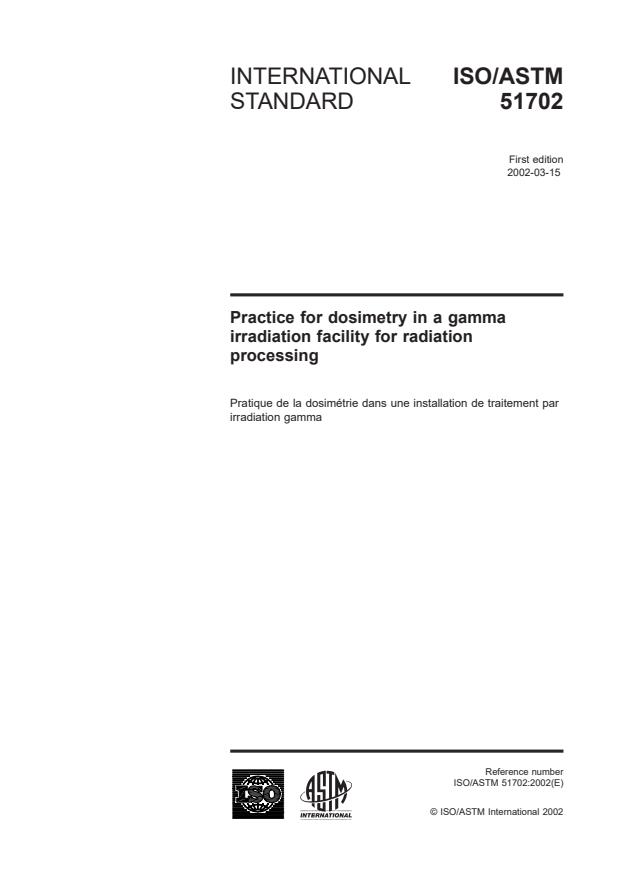
INTERNATIONAL ISO/ASTM
STANDARD 51702
First edition
2002-03-15
Practice for dosimetry in a gamma
irradiation facility for radiation
processing
Pratique de la dosimétrie dans une installation de traitement par
irradiation gamma
Reference number
© ISO/ASTM International 2002
PDF disclaimer
This PDF file may contain embedded typefaces. In accordance with Adobe’s licensing policy, this file may be printed or viewed but shall
not be edited unless the typefaces which are embedded are licensed to and installed on the computer performing the editing. In
downloading this file, parties accept therein the responsibility of not infringing Adobe’s licensing policy. Neither the ISO Central
Secretariat nor ASTM International accepts any liability in this area.
Adobe is a trademark of Adobe Systems Incorporated.
Details of the software products used to create this PDF file can be found in the General Info relative to the file; the PDF-creation
parameters were optimized for printing. Every care has been taken to ensure that the file is suitable for use by ISO member bodies
and ASTM members. In the unlikely event that a problem relating to it is found, please inform the ISO Central Secretariat or ASTM
International at the addresses given below.
© ISO/ASTM International 2002
All rights reserved. Unless otherwise specified, no part of this publication may be reproduced or utilized in any form or by any means, electronic or mechanical,
including photocopying and microfilm, without permission in writing from either ISO at the address below or ISO’s member body in the country of the
requester. In the United States, such requests should be sent to ASTM International.
ISO copyright office ASTM International, 100 Barr Harbor Drive, PO Box C700,
Case postale 56 • CH-1211 Geneva 20 West Conshohocken, PA 19428-2959, USA
Tel. +41 22 749 01 11 Tel. +610 832 9634
Fax +41 22 749 09 47 Fax +610 832 9635
E-mail copyright@iso.ch E-mail khooper@astm.org
Web www.iso.ch Web www.astm.org
Printed in the United States
ii © ISO/ASTM International 2002 – All rights reserved
Contents Page
1 Scope . 1
2 Referenced documents . 1
3 Terminology . 2
4 Significance and use . 2
5 Radiation source characteristics . 2
6 Types of facilities and modes of operation . 3
7 Dosimetry systems . 3
8 Installation qualification . 3
9 Process qualification . 4
10 Routine product processing . 5
11 Certification . 6
12 Measurement uncertainty . 6
13 Keywords . 6
Bibliography . 7
© ISO/ASTM International 2002 – All rights reserved iii
Foreword
ISO (the International Organization for Standardization) is a worldwide federation of national standards bodies
(ISO member bodies). The work of preparing International Standards is normally carried out through ISO
technical committees. Each member body interested in a subject for which a technical committee has been
established has the right to be represented on that committee. International organizations, governmental and
non-governmental, in liaison with ISO, also take part in the work. ISO collaborates closely with the
International Electrotechnical Commission (IEC) on all matters of electrotechnical standardization.
Draft International Standards adopted by the technical committees are circulated to the member bodies for
voting. Publication as an International Standard requires approval by at least 75% of the member bodies
casting a vote.
ASTM International is one of the world’s largest voluntary standards development organizations with global
participation from affected stakeholders. ASTM technical committees follow rigorous due process balloting
procedures.
A pilot project between ISO and ASTM International has been formed to develop and maintain a group of
ISO/ASTM radiation processing dosimetry standards. Under this pilot project, ASTM Subcommittee E10.01,
Dosimetry for Radiation Processing, is responsible for the development and maintenance of these dosimetry
standards with unrestricted participation and input from appropriate ISO member bodies.
Attention is drawn to the possibility that some of the elements of this International Standard may be the subject
of patent rights. Neither ISO nor ASTM International shall be held responsible for identifying any or all such
patent rights.
International Standard ISO/ASTM 51702 was developed by ASTM Committee E10, Nuclear Technology and
Applications, through Subcommittee E10.01, and by Technical Committee ISO/TC 85, Nuclear Energy.
iv © ISO/ASTM International 2002 – All rights reserved
Standard Practice for
Dosimetry in a Gamma Irradiation Facility for Radiation
Processing
This standard is issued under the fixed designation ISO/ASTM 51702; the number immediately following the designation indicates the
year of original adoption or, in the case of revision, the year of last revision.
1. Scope E 170 Terminology Relating to Radiation Measurements
and Dosimetry
1.1 This practice outlines dosimetric procedures to be fol-
E 177 Practice for Use of the Terms Precision and Bias in
lowed in irradiator characterization, process qualification, and
ASTM Test Methods
routine processing in a gamma irradiation facility. These
E 456 Terminology Relating to Quality and Statistics
procedures ensure that all product processed with ionizing
E 666 Practice for Calculating Absorbed Dose from Gamma
radiation from isotopic gamma sources receive absorbed doses
or X Radiation
within a predetermined range. Other procedures related to
E 668 Practice for Application of Thermoluminescence-
irradiator characterization, process qualification, and routine
Dosimetry (TLD) Systems for Determining Absorbed Dose
processing that may influence absorbed dose in the product are
in Radiation Hardness Testing of Electronic Devices
also discussed. Information about effective or regulatory dose
E 1026 Practice for Using the Fricke Reference Standard
limits is not within the scope of this document.
Dosimetry System
1.2 Dosimetry is one component of a total quality assurance
2.2 ISO Standard:
program for an irradiation facility. Other controls besides
ISO 11137 Sterilization of Health Care Products–Require-
dosimetry may be required for specific applications such as
ments for Validation and Routine Control-Radiation Ster-
medical device sterilization and food preservation.
ilization
1.3 For the irradiation of food and the radiation sterilization
2.3 ISO/ASTM Standards:
of health care products, other specific ISO standards exist. For
51204 Practice for Dosimetry in Gamma Irradiation Facili-
food irradiation, see ISO/ASTM Practice 51204. For the
ties for Food Processing
radiation sterilization of health care products, see ISO
2 51205 Practice for Use of a Ceric-Cerous Sulfate Dosimetry
11137(1) . In those areas covered by ISO 11137, that standard
System
takes precedence.
51261 Guide for Selection and Calibration of Dosimetry
1.4 For guidance in the selection, calibration, and use of
Systems for Radiation Processing
specific dosimeters, and interpretation of absorbed dose in the
51275 Practice for Use of a Radiochromic Film Dosimetry
product from dosimetry measurements, see ISO/ASTM Guide
System
51261, ASTM Practices E 666, E 668, E 1026, and ISO/ASTM
51276 Practice for Use of a Polymethylmethacrylate Do-
Practices 51205, 51275, 51276, 51310, 51400, 51401, 51538,
simetry System
51540, 51607, and 51650. For discussion of radiation dosim-
51310 Practice for Use of a Radiochromic Optical
etry for gamma rays, see ICRU Report 14.
Waveguide Dosimetry System
1.5 This standard does not purport to address all of the
51400 Practice for Characterization and Performance of a
safety concerns, if any, associated with its use. It is the
High-Dose Radiation Dosimetry Calibration Laboratory
responsibility of the user of this standard to establish appro-
51401 Practice for Use of a Dichromate Dosimetry System
priate safety and health practices and determine the applica-
51431 Practice for Dosimetry in Electron and Bremsstrahl-
bility of regulatory limitations prior to use.
ung Irradiation Facilities for Food Processing
2. Referenced Documents
51538 Practice for Use of the Ethanol-Chlorobenzene Do-
simetry System
2.1 ASTM Standards:
51539 Guide for Use of Radiation-Sensitive Indicators
51540 Practice for Use of a Radiochromic Liquid Dosim-
etry System
This practice is under the jurisdiction of ASTM Committee E10 on Nuclear
51607 Practice for Use of the Alanine-EPR Dosimetry
Technology and Applications and is the direct responsibility of Subcommittee 3
System
E10.01 on Dosimetry for Radiation Processing, and is also under the jurisdiction of
51650 Practice for Use of a Cellulose Acetate Dosimetry
ISO/TC 85/WG 3.
System
Current edition approved Jan. 22, 2002. Published March 15, 2002. Originally
published as E 1702-95. Last previous ASTM edition E 1702–00. ASTM
e1
E 1702–95 was adopted by ISO in 1998 with the intermediate designation ISO
15571:1998(E). The present International Standard ISO/ASTM 51702:2002(E) is a 3
Annual Book of ASTM Standards, Vol 12.02.
revision of ISO 15571. 4
Annual Book of ASTM Standards, Vol 14.02.
The boldface numbers in parentheses refer to the bibliography at the end of this 5
Available from International Organization for Standardization, 1 Rue de
practice.
Varembé, Case de Postale 56, CH-1211 Geneva, Switzerland.
© ISO/ASTM International 2002 – All rights reserved
51707 Guide for Estimating Uncertainties in Dosimetry for 4.1.3 Disinfection of consumer products;
Radiation Processing
4.1.4 Cross-linking or degradation of polymers and elas-
2.4 ICRU Reports:
tomers;
ICRU Report 14 Radiation Dosimetry: X-Rays and Gamma
4.1.5 Polymerization of monomers and grafting of mono-
Rays with Maximum Photon Energies Between 0.6 and 50
mers onto polymers;
MeV
4.1.6 Control of pathogens in liquid or solid waste;
ICRU Report 60 Radiation Quantities and Units
4.1.7 Enhancement of color in gemstones and other mate-
rials;
3. Terminology
4.1.8 Modification of characteristics of semiconductor de-
3.1 Definitions—Other terms used in this practice are de-
vices; and
fined in ASTM Terminology E 170 and ICRU Report 60.
4.1.9 Research on materials effects.
3.1.1 absorbed dose—quantity of radiation energy imparted
per unit mass of a specified material. The unit of absorbed dose NOTE 1—Dosimetry is required for regulated irradiation processes such
as the sterilization of medical devices and the treatment of food. It may be
is the gray (Gy), where 1 Gy is equivalent to the absorption of
less important for other industrial processes, for example, polymer
1 J per kg ( = 100 rad). The mathematical relationship is the
modification, which can be evaluated by changes in the physical and
quotient of de¯bydm, where de¯ is the mean energy imparted by
chemical properties of the irradiated materials.
ionizing radiation to matter of mass dm (see ICRU 60).
4.2 Dosimeters are used as a means of quality control of the
D 5 de¯/dm (1)
process by relating the measured response of the dosimeter to
3.1.2 absorbed-dose mapping—measurement of the
radiation to the absorbed dose in the product or in a specified
absorbed-dose distribution within an irradiation unit through
material such as water.
the use of dosimeters placed at specified locations.
4.3 An irradiation process usually requires a minimum
3.1.3 compensating dummy—simulated product used during
absorbed dose to achieve the desired effect. There also may be
routine production runs with irradiation units containing less
a maximum absorbed dose that the product can tolerate and
product than specified in the product loading configuration or
still meet its functional specifications. Dosimetry is essential to
used at the beginning or end of a production run to compensate
the irradiation process since it is used both to determine these
for the absence of product.
limits and to confirm that the product is irradiated within these
3.1.4 dosimeter set—one or more dosimeters used to mea-
limits.
sure the absorbed dose at a location to a desired confidence
4.4 The absorbed-dose distribution within the product de-
level and whose average reading is used as the absorbed dose
pends on the overall product dimensions and weight, irradia-
measurement at that location.
tion geometry, and source activity distribution. The operating
3.1.5 dosimetry system—a system used for determining
parameter that determines the absorbed dose is the timer
absorbed dose, consisting of dosimeters, measurement instru-
setting. The timer setting must be controlled to obtain repro-
ments and their associated reference standards, and procedures
ducible results.
for the system’s use.
4.5 Before an irradiation process can be used, the irradiator
3.1.6 irradiation unit—a volume of material with a speci-
must be qualified to determine its effectiveness in reproducibly
fied loading configuration irradiated as a single entity.
delivering known, controllable absorbed doses. This involves
3.1.7 production run (continuous-flow irradiation)—a se-
testing the process equipment, calibrating the equipment and
ries of irradiation units consisting of materials or products
dosimetry system, and characterizing the magnitude, distribu-
having similar radiation-absorption characteristics that are
tion, and reproducibility of the absorbed dose delivered by the
irradiated sequentially to a specified range of absorbed dose.
irradiator to a reference material.
3.1.8 simulated product—a mass of material with attenua-
4.6 To ensure consistent and reproducible dose delivery in a
tion and scattering properties similar to those of a particular
qualified process, routine process control requires documented
material or combination of materials. This term is sometimes
product handling procedures before and after the irradiation,
referred to as dummy product.
consistent product loading configurations, monitoring of criti-
3.1.9 timer setting—parameter varied to control the time
cal processing parameters, routine product dosimetry, and
during which an irradiation unit is exposed to radiation.
documentation of the required activities and functions.
4. Significance and Use
5. Radiation Source Characteristics
4.1 Various products and materials routinely are irradiated
at predetermined doses at gamma irradiation facilities to reduce 5.1 The radiation source used in a facility considered in this
their microbial population or to modify their characteristics. practice consists of sealed linear elements (rods or “pencils”)
Dosimetry requirements may vary depending upon the irradia- of cobalt-60 or cesium-137 arranged in one or more planar or
tion application and end use of the product. Some examples of cylindrical arrays. Cobalt-60 and cesium-137 sources decay at
irradiation applications where dosimetry may be used are: known rates, emitting photons with known energies. Between
4.1.1 Sterilization of medical devices; source additions, removals, or redistributions, the only varia-
4.1.2 Treatment of food for the purpose of parasite and tion in the source output is the steady reduction in the activity
pathogen control, insect disinfestation, and shelf life extension; due to the radioactive decay.
© ISO/ASTM International 2002 – All rights reserved
6. Types of Facilities and Modes of Operation establish relationships between absorbed dose in a reproducible
geometry and the operating parameters of the facility, (2)to
6.1 Radiation processing facilities may be categorized by
characterize dose variations when these conditions fluctuate
irradiator type (for example, container or bulk flow), conveyor
statistically and through normal operations, and (3) to measure
system (for example, shuffle-dwell or continuous), and operat-
absorbed dose distributions in reference materials.
ing mode (for example, batch or continuous). Product may be
8.2 Equipment Documentation:
moved to the location in the facility where the irradiation will
8.2.1 Establish and document the irradiator qualification
take place either while the source is shielded (batch operation),
program that demonstrates that the irradiator, operating within
or while the source is exposed (continuous operation). Product
specified limits, will consistently produce an absorbed-dose
may be transported in irradiation containers past the source at
distribution in a given product to predetermined specification.
a uniform controlled speed (continuous conveyance), or in-
Such documentation shall be retained for the life of the
stead may undergo a series of discrete controlled movements
irradiator, and shall include:
separated by controlled time periods during which the irradia-
8.2.1.1 A description of the instrumentation and equipment
tion container is stationary (shuffle-dwell). The source may
for ensuring the reproducibility, within specified limits, of the
extend above and below the product (overlapping source) or
source-to-product geometry and of the time the product spends
the product may extend above and below the source (overlap-
at different locations in the irradiation zone.
ping product). For the overlapping product configuration, the
irradiation unit is moved past the source at two or more 8.3 Equipment Testing and Calibration:
different levels. For irradiators with rectangular source arrays, 8.3.1 Processing Equipment—The absorbed dose in the
the irradiation container generally makes one or more passes
product in an irradiation container depends on the operating
on each side of the source. In bulk-flow irradiators, products parameters of the irradiation facility, which are controlled by
such as grain or flour flow in loose form past the source.
the processing equipment and instrumentation.
6.2 For low absorbed-dose applications that may require
8.3.1.1 Test all processing equipment and instrumentation
particularly high mechanical speed, various techniques are
that may influence absorbed dose in order to verify satisfactory
used to reduce the absorbed-dose rates. These may include use
operation of the irradiator within the design specifications.
of only a portion of the source, use of attenuators, and
8.3.1.2 Implement a documented calibration program to
irradiation at greater distances from the source.
ensure that all processing equipment and instrumentation that
6.3 The details of a particular irradiator design and the mode
may influence absorbed dose are calibrated periodically.
of operation affect the delivery of absorbed dose to a product.
8.3.2 Analytical Equipment—The accuracy of the absorbed-
They therefore should be considered when performing the
dose measurement depends on the correct operation and
absorbed-dose measurements required in Sections 8, 9, and 10.
calibration of the analytical equipment used in the analysis of
the dosimeters.
7. Dosimetry Systems
8.3.2.1 Check the performance of the analytical equipment
7.1 Dosimetry systems used to determine absorbed dose
periodically to ensure that the equipment is functioning in
shall cover the absorbed dose range of interest and shall be
accordance with performance specifications. Repeat this check
calibrated before use.
following equipment modification or servicing and prior to the
7.2 Dosimetry System Selection—It is important that the
use of the equipment for a dosimetry system calibration. This
dosimetry system be evaluated for those parameters associated
check can be accomplished by using standards such as cali-
with gamma irradiation facilities that may influence the dosim-
brated optical density filters, wavelength standards, or cali-
eter response, for example, gamma-ray energy, absorbed-dose
brated thickness gages supplied by the manufacturer or na-
rate, and environmental conditions such as temperature, hu-
tional or accredited standards laboratories. The correct
midity, and light. Guidance as to desirable characteristics and
performance of dosimetry analysis equipment also can be
selection criteria can be found in ISO/ASTM Guide 51261.
demonstrated by showing that the analysis results from dosim-
Details for individual dosimetry systems are given in ASTM
eters, given known absorbed doses, are in agreement with the
Practice E 1026, and ISO/ASTM Practices 51205, 51275,
expected results within the limits of the dosimetry system
51276, 51310, 51401, 51538, 51540, 51607, and 51650.
uncertainty. However, this method is only applicable to refer-
7.3 Dosimetry System Calibration—It is important that the
ence standard dosimetry systems where the long-term stability
dosimetry system used is properly calibrated with calibration
of the response has been demonstrated and documented.
traceable to a recognized national or international standard.
8.3.2.2 Implement a documented calibration program to
Guidance for calibration can be found in ISO/ASTM Guide
ensure that all analytical equipment used in the analysis of
51261.
dosimeters is calibrated periodically.
8. Installation Qualification
8.3.2.3 Prior to each use of an analytical instrument, check
the zero setting and, if applicable, the full scale reading.
8.1 Objective:
8.4 Irradiator Characterization:
8.1.1 The purpose of dosimetry in qualifying a gamma
irradiation facility is to establish baseline data for evaluating 8.4.1 The absorbed dose received by any portion of product
the effectiveness, predictability, and reproducibility of the in an irradiation unit depends on facility parameters such as the
system under the range of conditions over which the facility activity and geometry of the source, the source-to-product
distance, and the irradiation geometry, and on processing
will operate. For example, dosimetry shall be used (1)to
© ISO/ASTM International 2002 – All rights reserved
parameters such as the irradiation time, the product composi- guide for dosimeter placement for process qualification as
tion and density, and the
...
Questions, Comments and Discussion
Ask us and Technical Secretary will try to provide an answer. You can facilitate discussion about the standard in here.
Loading comments...