


ISO 80601-2-13:2022/FDAmd 1
(Amendment)Medical electrical equipment — Part 2-13: Particular requirements for basic safety and essential performance of an anaesthetic workstation — Amendment 1
Medical electrical equipment — Part 2-13: Particular requirements for basic safety and essential performance of an anaesthetic workstation — Amendment 1
Appareils électromédicaux — Partie 2-13: Exigences particulières de sécurité de base et de performances essentielles pour les postes de travail d'anesthésie — Amendement 1
General Information
- Status
- Not Published
- Technical Committee
- ISO/TC 121/SC 1 - Breathing attachments and anaesthetic machines
- Current Stage
- 5020 - FDIS ballot initiated: 2 months. Proof sent to secretariat
- Start Date
- 27-Feb-2026
- Completion Date
- 27-Feb-2026
Relations
- Effective Date
- 12-Feb-2026
- Effective Date
- 23-Mar-2024
- Effective Date
- 09-Mar-2024
Overview
ISO 80601-2-13:2022/FDAmd 1 is an international amendment standard published by ISO, focusing on medical electrical equipment. Specifically, it addresses particular requirements for the basic safety and essential performance of an anaesthetic workstation. This amendment brings critical updates to the requirements and terminology relevant to anaesthetic workstations, prioritizing patient safety, device interoperability, and cybersecurity in a clinical environment.
This amendment is an essential resource for manufacturers, healthcare providers, regulatory bodies, and medical device professionals concerned with the compliance and safe operation of anaesthetic workstations.
Key Topics
- Essential Performance and Safety: Updates on the definition and maintenance of essential functions, including criteria to ensure continued safety, operational availability, and minimal clinical functionality.
- System Recovery: New requirements for automatic recovery following malfunctions, emphasizing the restoration of ventilation/gas delivery with minimal interruption and clear alarm systems to notify operators.
- Oxygen 90+ Compatibility: Introduction of precise marking, compatibility criteria, and gas composition for devices designed to use Oxygen 90+, reflecting changes in medical gas supplies and practices.
- Cybersecurity Enhancements: Enhanced requirements on risk control measures, user interface authentication, firecall (break glass) functions, and security level targets to ensure resilience against cyber threats.
- Documentation and Labelling: Expanded rules for information supply, including conformance with ISO 20417:2021 and requirements for clear marking and instructions regarding compatibility, safe operation, and troubleshooting.
- Anaesthetic Gas Scavenging and Component Interchangeability: Updates to definitions and requirements for scavenging systems (AGSS), breathing set connectors, and the safe integration of third-party accessories.
- Manual Configuration Safeguards: Measures to prevent unintended changes to device configuration, especially regarding features like Oxygen 90+ compatibility.
- Breathing System and Ventilator Connections: Standardization of connection geometry, marking, and safety for breathing tubes, reservoir bags, and access ports in accordance with referenced ISO standards.
Applications
ISO 80601-2-13:2022/FDAmd 1 is vital in various healthcare and regulatory applications:
- Manufacturers: Guides medical device manufacturers in designing and labeling compliant anaesthetic workstations, ensuring compatibility with both traditional oxygen and Oxygen 90+ mixtures, and integrating updated cybersecurity features.
- Healthcare Facilities: Provides clinical engineers and healthcare administrators with the framework to assess, select, and maintain anaesthetic workstations that meet current safety, performance, and interoperability requirements.
- Testing and Certification Bodies: Offers updated criteria for functional and safety testing, risk management evaluation, and conformity assessment of anaesthetic workstations.
- Regulatory Authorities: Enables regulators to enforce harmonized safety and performance benchmarks across different markets.
- Training and Risk Management: Enhances staff training programs and standard operating procedures, particularly on new alarm systems, system recovery protocols, and safe manual configurations.
Related Standards
For full compliance and optimal integration, the following standards are directly referenced or provide relevant guidance:
- ISO 20417:2021 - Medical devices: Information to be supplied by the manufacturer
- IEC 62304:2006 + AMD 1:2015 – Medical device software life cycle processes
- IEC/TR 60601-4-5:2021 – Guidance on medical device and system security (cybersecurity for medical devices)
- ISO 4135 – Anaesthetic and respiratory equipment - Vocabulary (definition of Oxygen 90+ under discussion)
- ISO 5356-1:2015, ISO 5356-2:2015 – Conical connectors for anaesthetic and respiratory equipment
- ISO 5367:2023 – Breathing tubes and systems
- ISO 80369-7:2021 – Luer connectors for medical devices
- ISO 7000 – Graphical symbols for use on equipment
By adhering to ISO 80601-2-13:2022/FDAmd 1 and its related standards, stakeholders can ensure that anaesthetic workstations meet up-to-date international requirements-enhancing patient safety, operational reliability, and cybersecurity in modern healthcare settings.
Buy Documents

ISO 80601-2-13:2022/FDAmd 1 - Medical electrical equipment — Part 2-13: Particular requirements for basic safety and essential performance of an anaesthetic workstation — Amendment 1/3/2025


ISO 80601-2-13:2022/FDAmd 1 - Medical electrical equipment — Part 2-13: Particular requirements for basic safety and essential performance of an anaesthetic workstation — Amendment 1/13/2026

REDLINE ISO 80601-2-13:2022/FDAmd 1 - Medical electrical equipment — Part 2-13: Particular requirements for basic safety and essential performance of an anaesthetic workstation — Amendment 1/13/2026


ISO 80601-2-13:2022/FDAmd 1 - Appareils électromédicaux — Partie 2-13: Exigences particulières de sécurité de base et de performances essentielles pour les postes de travail d'anesthésie — Amendement 1/5/2025


ISO 80601-2-13:2022/FDAmd 1 - Appareils électromédicaux — Partie 2-13: Exigences particulières de sécurité de base et de performances essentielles pour les postes de travail d'anesthésie — Amendement 1
Get Certified
Connect with accredited certification bodies for this standard

BSI Group
BSI (British Standards Institution) is the business standards company that helps organizations make excellence a habit.

TÜV Rheinland
TÜV Rheinland is a leading international provider of technical services.

TÜV SÜD
TÜV SÜD is a trusted partner of choice for safety, security and sustainability solutions.
Sponsored listings
Frequently Asked Questions
ISO 80601-2-13:2022/FDAmd 1 is a draft published by the International Organization for Standardization (ISO). Its full title is "Medical electrical equipment — Part 2-13: Particular requirements for basic safety and essential performance of an anaesthetic workstation — Amendment 1". This standard covers: Medical electrical equipment — Part 2-13: Particular requirements for basic safety and essential performance of an anaesthetic workstation — Amendment 1
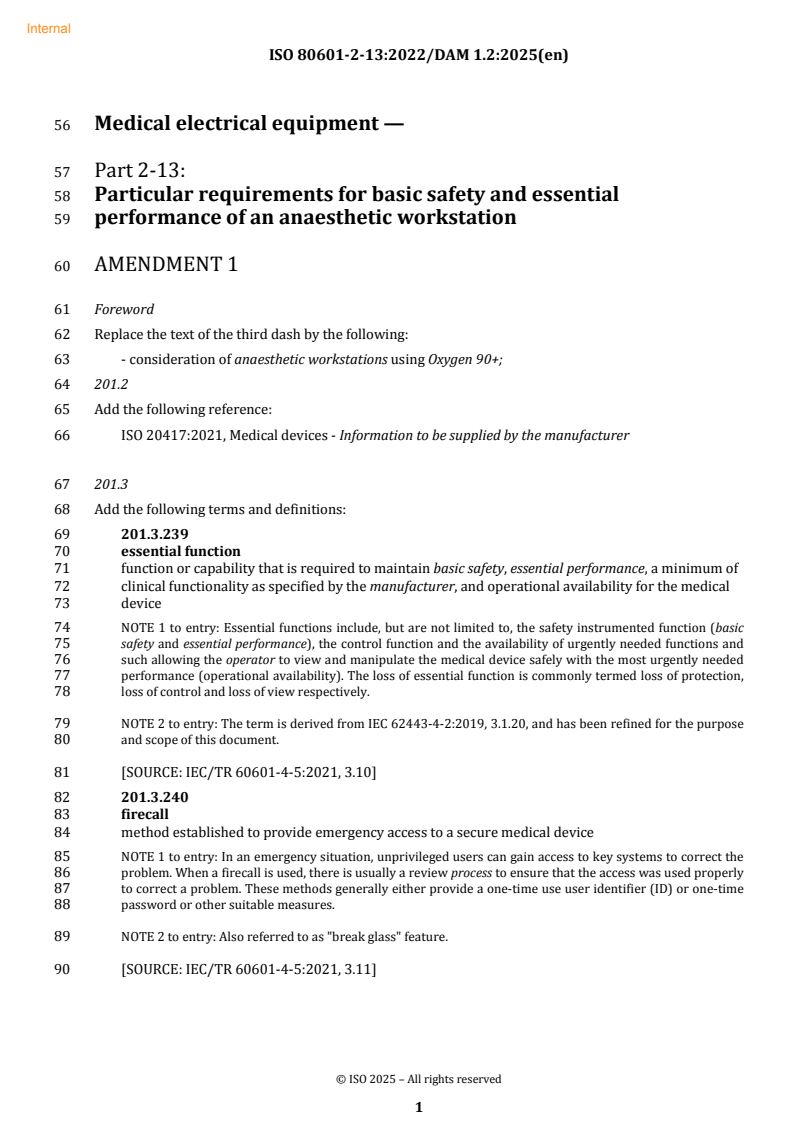
Medical electrical equipment — Part 2-13: Particular requirements for basic safety and essential performance of an anaesthetic workstation — Amendment 1
ISO 80601-2-13:2022/FDAmd 1 is classified under the following ICS (International Classification for Standards) categories: 11.040.10 - Anaesthetic, respiratory and reanimation equipment. The ICS classification helps identify the subject area and facilitates finding related standards.
ISO 80601-2-13:2022/FDAmd 1 has the following relationships with other standards: It is inter standard links to EN ISO 80601-2-13:2022/FprA1, ISO 3643:2024, ISO 80601-2-13:2022. Understanding these relationships helps ensure you are using the most current and applicable version of the standard.
ISO 80601-2-13:2022/FDAmd 1 is available in PDF format for immediate download after purchase. The document can be added to your cart and obtained through the secure checkout process. Digital delivery ensures instant access to the complete standard document.
Standards Content (Sample)
DRAFT
Amendment
ISO 80601-2-
13:2022/
DAM 1.2
ISO/TC 121/SC 1
Medical electrical equipment —
Secretariat: DIN
Part 2-13:
Voting begins on:
Particular requirements for basic
2025-09-17
safety and essential performance of
Voting terminates on:
an anaesthetic workstation 2025-11-12
AMENDMENT 1
Appareils électromédicaux —
Partie 2-13: Exigences particulières de sécurité de base et de
performances essentielles pour les postes de travail d'anesthésie
AMENDEMENT 1
ICS: 11.040.10
THIS DOCUMENT IS A DRAFT CIRCULATED
FOR COMMENTS AND APPROVAL. IT
IS THEREFORE SUBJECT TO CHANGE
Member bodies are requested to consult relevant national interests in IEC/SC AND MAY NOT BE REFERRED TO AS AN
INTERNATIONAL STANDARD UNTIL
62D before casting their ballot to the e-Balloting application.
PUBLISHED AS SUCH.
IN ADDITION TO THEIR EVALUATION AS
This document is circulated as received from the committee secretariat.
BEING ACCEPTABLE FOR INDUSTRIAL,
TECHNOLOGICAL, COMMERCIAL AND
USER PURPOSES, DRAFT INTERNATIONAL
STANDARDS MAY ON OCCASION HAVE TO
BE CONSIDERED IN THE LIGHT OF THEIR
POTENTIAL TO BECOME STANDARDS TO
ISO/CEN PARALLEL PROCESSING
WHICH REFERENCE MAY BE MADE IN
NATIONAL REGULATIONS.
RECIPIENTS OF THIS DRAFT ARE INVITED
TO SUBMIT, WITH THEIR COMMENTS,
NOTIFICATION OF ANY RELEVANT PATENT
RIGHTS OF WHICH THEY ARE AWARE AND TO
PROVIDE SUPPORTING DOCUMENTATION.
Reference number
ISO 80601-2-13.2:2022/DAM
1:2025(en)
DRAFT
ISO 80601-2-13.2:2022/DAM 1:2025(en)
Amendment
ISO 80601-2-
13:2022/
DAM 1.2
ISO/TC 121/SC 1
Medical electrical equipment —
Secretariat: DIN
Part 2-13:
Voting begins on:
Particular requirements for basic
safety and essential performance of
Voting terminates on:
an anaesthetic workstation
AMENDMENT 1
Appareils électromédicaux —
Partie 2-13: Exigences particulières de sécurité de base et de
performances essentielles pour les postes de travail d'anesthésie
AMENDEMENT 1
ICS: 11.040.10
THIS DOCUMENT IS A DRAFT CIRCULATED
FOR COMMENTS AND APPROVAL. IT
IS THEREFORE SUBJECT TO CHANGE
Member bodies are requested to consult relevant national interests in IEC/SC AND MAY NOT BE REFERRED TO AS AN
INTERNATIONAL STANDARD UNTIL
62D before casting their ballot to the e-Balloting application.
PUBLISHED AS SUCH.
IN ADDITION TO THEIR EVALUATION AS
This document is circulated as received from the committee secretariat.
BEING ACCEPTABLE FOR INDUSTRIAL,
© ISO 2025
TECHNOLOGICAL, COMMERCIAL AND
USER PURPOSES, DRAFT INTERNATIONAL
All rights reserved. Unless otherwise specified, or required in the context of its implementation, no part of this publication may
STANDARDS MAY ON OCCASION HAVE TO
be reproduced or utilized otherwise in any form or by any means, electronic or mechanical, including photocopying, or posting on
BE CONSIDERED IN THE LIGHT OF THEIR
the internet or an intranet, without prior written permission. Permission can be requested from either ISO at the address below
POTENTIAL TO BECOME STANDARDS TO
ISO/CEN PARALLEL PROCESSING
WHICH REFERENCE MAY BE MADE IN
or ISO’s member body in the country of the requester.
NATIONAL REGULATIONS.
ISO copyright office
RECIPIENTS OF THIS DRAFT ARE INVITED
CP 401 • Ch. de Blandonnet 8
TO SUBMIT, WITH THEIR COMMENTS,
CH-1214 Vernier, Geneva
NOTIFICATION OF ANY RELEVANT PATENT
Phone: +41 22 749 01 11
RIGHTS OF WHICH THEY ARE AWARE AND TO
PROVIDE SUPPORTING DOCUMENTATION.
Email: copyright@iso.org
Website: www.iso.org
Reference number
Published in Switzerland ISO 80601-2-13.2:2022/DAM
1:2025(en)
ii
ISO 80601-2-13:2022/DAM 1:2025(en)
21 Foreword
22 ISO (the International Organization for Standardization) and IEC (the International Electrotechnical
23 Commission) form the specialized system for worldwide standardization. National bodies that are
24 members of ISO or IEC participate in the development of International Standards through technical
25 committees established by the respective organization to deal with particular fields of technical activity.
26 ISO and IEC technical committees collaborate in fields of mutual interest. Other international
27 organizations, governmental and non-governmental, in liaison with ISO and IEC, also take part in the
28 work.
29 The procedures used to develop this document and those intended for its further maintenance are
30 described in the ISO/IEC Directives, Part 1. In particular, the different approval criteria needed for the
31 different types of document should be noted. This document was drafted in accordance with the editorial
32 rules of the ISO/IEC Directives, Part 2 (see www.iso.org/directives or
33 www.iec.ch/members_experts/refdocs).
34 Attention is drawn to the possibility that some of the elements of this document may be the subject of
35 patent rights. ISO and IEC shall not be held responsible for identifying any or all such patent rights. Details
36 of any patent rights identified during the development of the document will be in the Introduction and/or
37 on the ISO list of patent declarations received (see www.iso.org/patents) or the IEC list of patent
38 declarations received (see patents.iec.ch).
39 Any trade name used in this document is information given for the convenience of users and does not
40 constitute an endorsement.
41 For an explanation of the voluntary nature of standards, the meaning of ISO specific terms and
42 expressions related to conformity assessment, as well as information about ISO's adherence to the World
43 Trade Organization (WTO) principles in the Technical Barriers to Trade (TBT) see
44 www.iso.org/iso/foreword.html. In the IEC, see www.iec.ch/understanding-standards.
45 Amendment 1 to ISO/IEC 80601-2-13:2022 was prepared jointly by Technical Committee ISO/TC 121,
46 Anaesthetic and respiratory equipment, Subcommittee SC 1, Breathing attachments and anaesthetic
47 machines, and Technical Committee IEC/TC 62 Electrical equipment in medical practice, Subcommittee SC
48 62D Electromedical equipment, in collaboration with the European Committee for Standardization (CEN)
49 Technical Committee CEN/TC 215, Respiratory and anaesthetic equipment, in accordance with the
50 Agreement on technical cooperation between ISO and CEN (Vienna Agreement).
51 A list of all parts in the ISO 80601 and the IEC 80601 series can be found on the ISO and IEC websites.
52 Any feedback or questions on this document should be directed to the user’s national standards body. A
53 complete listing of these bodies can be found at www.iso.org/members.html and www.iec.ch/national-
54 committees.
iii
Internal
ISO 80601-2-13:2022/DAM 1.2:2025(en)
56 Medical electrical equipment —
57 Part 2-13:
58 Particular requirements for basic safety and essential
59 performance of an anaesthetic workstation
60 AMENDMENT 1
61 Foreword
62 Replace the text of the third dash by the following:
63 - consideration of anaesthetic workstations using Oxygen 90+;
64 201.2
65 Add the following reference:
66 ISO 20417:2021, Medical devices - Information to be supplied by the manufacturer
67 201.3
68 Add the following terms and definitions:
69 201.3.239
70 essential function
71 function or capability that is required to maintain basic safety, essential performance, a minimum of
72 clinical functionality as specified by the manufacturer, and operational availability for the medical
73 device
74 NOTE 1 to entry: Essential functions include, but are not limited to, the safety instrumented function (basic
75 safety and essential performance), the control function and the availability of urgently needed functions and
76 such allowing the operator to view and manipulate the medical device safely with the most urgently needed
77 performance (operational availability). The loss of essential function is commonly termed loss of protection,
78 loss of control and loss of view respectively.
79 NOTE 2 to entry: The term is derived from IEC 62443-4-2:2019, 3.1.20, and has been refined for the purpose
80 and scope of this document.
81 [SOURCE: IEC/TR 60601-4-5:2021, 3.10]
82 201.3.240
83 firecall
84 method established to provide emergency access to a secure medical device
85 NOTE 1 to entry: In an emergency situation, unprivileged users can gain access to key systems to correct the
86 problem. When a firecall is used, there is usually a review process to ensure that the access was used properly
87 to correct a problem. These methods generally either provide a one-time use user identifier (ID) or one-time
88 password or other suitable measures.
89 NOTE 2 to entry: Also referred to as "break glass" feature.
90 [SOURCE: IEC/TR 60601-4-5:2021, 3.11]
ISO 80601-2-13:2022/DAM 1.2:2025(en)
91 *201.3.241
92 interchangeable AGSS
93 anaesthetic gas scavenging system that by design is intended to be used with different models and
94 manufacturers’ anaesthetic workstations
95 NOTE 1 to entry: Connections of interchangeable AGSSs can be non-operator detachable.
96 201.3.242
97 Oxygen 90+ (O 90+)
98 a gas mixture that meets the following criteria for composition:
99 - Oxygen (O₂): volume fraction of no less than 90%
100 - Argon (Ar): volume fraction of no more than 5%
101 - Nitrogen (N₂): volume fraction of no more than 10%
102 - Carbon dioxide (CO₂): volume fraction of less than 300 ppm
103 - Carbon monoxide (CO): volume fraction of less than 10 ppm
104 - Nitrogen oxides (NOx): volume fraction of less than 2 ppm
105 - Sulfur dioxide (SO₂): volume fraction of less than 1 ppm
106 - Water (H₂O): volume fraction of less than 67 ppm
107 - Oils: less then 0.1 mg/m
108 NOTE 1 to entry: Regional or national regulations might specify the colour coding for Oxygen 90+.
109 [SOURCE: ISO/DIS 4135 Amd1:-, 3.1.1.22.2]
110 201.3.243
111 security level
112 level corresponding to the required set of countermeasures and inherent cybersecurity properties
113 of devices and systems for a zone or conduit based on assessment of risk for the zone or conduit
114 [SOURCE: IEC/TR 60601-4-5:2021, 3.23]
115 201.3.244
116 SL-T
117 Target Security Levels (SL-T) are the desired level of security for a particular system. This is usually
118 determined by performing a risk assessment on a system and determining that it needs a particular
119 level of security to ensure its correct operation
120 [SOURCE: ISO 602443-3-3:2013, 3.3]
121 201.3.245
122 system recovery
123 method for fault handling via an automatic restart of programmable electronic subsystem (PESS) for
124 parts of the ME equipment or for the complete ME equipment
125 NOTE 1 to entry: There is guidance or rationale for this definition contained in Clause AA.
126 [SOURCE: ISO 80601-2-12:2023, 201.3.298]
ISO 80601-2-13:2022/DAM 1.2:2025(en)
127 201.3.246
128 waste volatile anaesthetic agent capture system
129 system that collects and stores waste volatile anaesthetic agents from the exhaust port of a breathing
130 system
131 201.4
132 Add the following subclause:
133 201.4.3.101 System recovery
134 NOTE 1 There is guidance or rationale for this subclause contained in Clause AA.
135 a) Following a malfunction, the anaesthetic workstation should perform a system recovery to attempt
136 to restore essential performance of the anaesthetic workstation.
137 NOTE 2 An anaesthetic workstation or a subassembly function can become disturbed by a malfunction that
138 could jeopardize the essential performance of the anaesthetic workstation. Without system recovery, the patient
139 would have to be disconnected and connected to an alternative means of ventilation or gas delivery. Ventilation
140 or gas delivery would thus be interrupted until an alternative means of ventilation or gas delivery is connected.
141 System recovery, as specified in this subclause, attempts to automatically re-establish ventilation or gas delivery
142 in a shorter period. If necessary, the anaesthetic workstation can be replaced later when it has fewer
143 consequences for the patient´s therapy.
144 b) System recovery may result in the temporary:
145 1) cessation in the ventilation or gas delivery leading to risk of harm; or
146 2) reduction in the function of anaesthetic workstation subassemblies without cessation of
147 ventilation or gas delivery.
148 EXAMPLE The temporary blanking of the display.
149 c) During a system recovery with a cessation of ventilation or gas delivery that could lead to a
150 hazardous situation:
151 1) the anaesthetic workstation shall allow spontaneous patient breathing. Manual ventilation shall
152 be available within 15 s in accordance with 201.102.12; and
153 NOTE 3 During a system recovery, there can be a short period where manual ventilation is not possible
154 because the pneumatic system may have to be restarted by the anaesthetic workstation.
155 2) the anaesthetic workstation shall be equipped with an alarm system to indicate system recovery
156 with a cessation of ventilation or gas delivery.
157 i) The alarm condition for a system recovery with a cessation of ventilation or gas delivery
158 shall be high priority or may be an alternative alarm signal. The type of alternative
159 alarm signal or alarm condition delay and alarm signal generation delay for the alarm
160 signal shall be documented in the risk management file.
161 d) During a system recovery without a cessation of ventilation or gas delivery, the anaesthetic
162 workstation shall be equipped with an alarm system to indicate system recovery without a
163 cessation of ventilation or gas delivery.
164 1) The alarm condition for system recovery without a cessation of ventilation or gas delivery shall
165 be at least low priority with an auditory alarm signal or may be an alternative alarm signal. The
166 type of alternative alarm signal or alarm condition delay and alarm signal generation delay for
167 the alarm signal shall be documented in the risk management file.
ISO 80601-2-13:2022/DAM 1.2:2025(en)
168 e) Following a system recovery without operator intervention, the anaesthetic workstation shall
169 attempt to operate with the same system configuration settings, ventilation or gas delivery
170 settings and alarm settings as before the system recovery.
171 1) If ventilation settings, gas delivery settings or alarm settings are different after the system
172 recovery, the anaesthetic workstation alarm system shall indicate any change in settings.
173 2) The alarm generated shall be at least medium priority.
174 f) The duration of a system recovery with a cessation of ventilation or gas delivery should be as short
175 as practicable to avoid an unacceptable risk to the patient and shall be documented in the risk
176 management file.
177 g) The maximum duration of a system recovery of ventilation or gas delivery shall be disclosed in the
178 instructions for use.
179 Check conformance by inspection of the instructions for use, inspection of the risk management file and
180 functional testing.
181 201.4
182 Add the following subclause:
183 201.4.5 Alternative risk control measures or test methods for ME equipment or ME system
184 Amendment (add prior to the compliance check):
185 aa) Subsequent revisions of dated references (new editions or amendments) may be used in
186 substitution of a referenced document provided the manufacturer can demonstrate the hazard or
187 hazardous situation addressed in the dated normative reference is adequately resolved in the
188 subsequent revision.
189 201.4.10.101*
190 Add the following new NOTE below NOTE 2:
191 NOTE 3 Anaesthetic workstations can provide the supply gas to drive other devices such as high flow
192 therapy, oxygen flow meters or suction equipment. See also 201.7.9.2.101 qq).
193 201.5.101.4
194 Replace the text of the second dash:
195 with Oxygen 90+ if the anaesthetic workstation is rated compatible or conditionally
196 compatible with Oxygen 90+.
197 Replace the third dash by a NOTE:
198 NOTE The concentration of oxygen and balance gases can vary over time in a gas supply with Oxygen 90+.
199 201.7
200 Add the following subclause:
201 201.7.1.101 Information to be supplied by the manufacturer
202 The information supplied by the manufacturer including marking, labelling and instructions for use
203 shall conform with ISO 20417:2021.
ISO 80601-2-13:2022/DAM 1.2:2025(en)
204 Check conformance by application of ISO 20417:2021.
205 201.7.2.21*
206 Replace the existing text by:
207 This subclause does not apply.
208 201.7.2.101
209 Delete this subclause completely.
210 201.7.2.104
211 Delete this subclause completely.
212 201.7.2
213 Add the following subclause:
214 201.7.2.107 Oxygen 90+
215 The anaesthetic workstation and its components shall be marked whether it is compatible,
216 conditionally compatible or incompatible with Oxygen 90+. A workstation that can be used with
217 Oxygen 90+ with restrictions shall be rated conditionally compatible with Oxygen 90+, see
218 201.7.9.2.101, ii).
219 An Oxygen 90+ compatibility marking shall be placed on the anaesthetic workstation, next to the gas
220 supply connectors. A single marking is sufficient to cover all components that are described in the
221 instructions for use of the anaesthetic workstation.
222 NOTE Symbols for the marking of compatibility with Oxygen 90+ will be defined in ISO 7000.
223 201.7.9.1
224 Replace the existing text by:
225 This subclause does not apply.
226 201.7.9.2.101
227 Replace the text in list item ii) with the following:
228 ii)
229 — the type of oxygen the anaesthetic workstation or its individual components are compatible with
230 (oxygen or Oxygen 90+) and;
231 — if the anaesthetic workstation or its components is rated conditionally compatible with Oxygen 90+,
232 a description of the conditions under which it can be used with Oxygen 90+ and;
233 — if the anaesthetic workstation or its components is rated conditionally compatible or compatible with
234 Oxygen 90+, the gas composition of Oxygen 90+ as defined in 201.3.245;
235 Replace the text in list item jj) with the following:
236 jj) if the anaesthetic workstation or its individual components is rated conditionally compatible or
237 compatible for use with Oxygen 90+, the consequences of the use of Oxygen 90+, e.g. possible argon
238 accumulation and varying oxygen concentrations;
ISO 80601-2-13:2022/DAM 1.2:2025(en)
239 Add the following list items and NOTE below oo)*:
240 pp) list of any component or function that is pneumatically powered, the type of gas needed and its
241 consumption of gas in l/min;
242 qq) a description of those components that are pneumatically powered that cannot be used in
243 parallel;
244 NOTE If too many devices are used in parallel the pressure supply to the anaesthetic workstation can be
245 overloaded.
246 201.9.2.103*
247 Delete this subclause completely.
248 201.9.2.104*
249 Delete this subclause completely.
250 201.12.4.101*
251 Replace the text in list item a) by the following:
252 a) A means of protection against accidental adjustment of operating controls that can create a
253 hazardous situation shall be provided. This includes:
254 deactivating fresh gas flow to a patient permanently (i.e. not reactivating without user
255 interaction);
256 deactivating the anaesthetic vapour delivery system permanently (i.e. not reactivating
257 without user interaction);
258 activating the standby mode of an anaesthetic workstation;
259 accidental turning off of the anaesthetic workstation or its individual components.
260 The means for preventing an accidental adjustment shall be single fault safe.
261 The means preventing the accidental adjustment as listed above shall be analysed and documented
262 in the risk management file.
263 EXAMPLE 1 Requiring a confirmation step can be one method. The same confirmation step as for any
264 other adjustment might not be appropriate.
265 NOTE 1 Logging of each single operator adjustment leading to permanent deactivation of fresh gas
266 flow or vapour delivery, activation of the standby mode or turning off the anaesthetic workstation or its
267 individual components can help investigating adverse events.
268 NOTE 2 Detecting patient breathing activity during standby or when no fresh gas is being delivered
269 to the patient and announcing an alarm signal (e.g. optical and acoustical with a high volume level) can help to
270 prevent adverse outcomes in such situations.
271 Add list item d) before the conformance check:
272 d) If an anaesthetic workstation is equipped with a manual configuration for use with Oxygen 90+,
273 the configuration shall be protected from unintended use.
274 NOTE 3 The configuration can be protected e.g. by the use of a password. A configuration that does not match the
275 input oxygen supply can increase inaccuracy or may lead to unexpected behaviour.
ISO 80601-2-13:2022/DAM 1.2:2025(en)
276 201.12.4.102*
277 Replace the text in the last row for subclause 201.12.4.108 of Table 201.104 by the following:
278 protection device for the workplace environment (AGSS) if the anaesthetic workstation is equipped
279 with means to deliver nitrous oxide or is designed to be equipped with an anaesthetic vapour delivery
280 system
281 201.12.4.104
282 Add the following text:
283 Anaesthetic workstations equipped with an anaesthetic ventilator shall have a means to monitor the
284 exhaled volume.
285 201.12.4.104.1*
286 Replace Table footnote a in Table 201.105 by the following:
287 a V is measured by means of a pressure sensor at the test lung, where
T
288 V = C x (P - P ) and
T insp exp
289 V is the volume delivered to the test lung
T
290 C is the Compliance of the test lung
291 P is the inspiratory pressure measured in the test lung
insp
292 P is the expiratory pressure measured in the test lung
exp
294 201.12.4.107.3*
295 Replace the text of the NOTE by the following:
296 NOTE Oxygen 90+ can have major influence on the output of a hypoxic mixture delivery selection
297 protection device, as the supply oxygen and balance gas concentrations can vary simultaneously.
298 201.12.4.108*
299 Replace the first paragraph by the following text:
300 If the anaesthetic workstation is equipped with means to deliver nitrous oxide or is designed to be
301 equipped with an anaesthetic vapour delivery system, the anaesthetic workstation shall either
302 201.12.4.109
303 Replace list item a) 2) by the following text:
304 2) if not so equipped, the instructions for use of the anaesthetic workstation shall contain a
305 statement to the effect that the anaesthetic workstation is to be provided with airway pressure
306 monitoring equipment conforming with this document before being put into service; also, it shall
307 describe how to connect that component. Manufacturers of the airway pressure monitoring
308 equipment shall make available on request information on how to connect that component to the
309 anaesthetic workstation, the anaesthetic breathing system and the anaesthetic ventilator.
310 201.14.101
ISO 80601-2-13:2022/DAM 1.2:2025(en)
311 Replace the headline of this subclause by:
312 201.14.101 Software life cycle
313 Delete the EXAMPLE.
314 Replace the second paragraph with the following:
315 Check conformance by inspection of the documentation required by IEC 62304:2006+AMD1:2015 for
316 the software safety class C (see IEC 62304:2006+AMD1:2015, 1.4).
317 201.14
318 Add the following subclause:
319 201.14.102 Cybersecurity capabilities of an anaesthetic workstation
320 a) An anaesthetic workstation should contribute to the safe operation related to cybersecurity.
321 b) Risk control measures as specified in IEC/TR 60601-4-5:2021, Clauses 4 to 7, should be implemented, as
322 appropriate, with the following additions to IEC/TR 60601-4-5:2021, 4.6.3.
323 1) Essential function: Data interfaces to an IT-network connection may be subject to attack (via
324 physical or logical disconnection). After disconnection of all data interfaces, if it is necessary to
325 restart the anaesthetic workstation, all clinical functions except the affected remote functionality
326 should be in place and operate as intended.
327 2) Firecall functions: As an anaesthetic workstation is used with healthcare professional operator
328 supervision, the user interface need not require authentication for operators and thus need not
329 require firecall functions. If authentication for operators to operator accessible settings is in place
330 also for the user interface, a firecall function should be able to overrule that operator
331 authentication combined with a log entry protected against modifications by the operator (i.e.
332 responsible organization log). IT-network interfaces including those for remote access typically
333 require authentication but should not include firecall functions.
334 3) Target security level SL-T: For user interfaces and for remote setting of clinical functions, the
335 expected security level of SL-T, as specified in IEC/TR 60601-4-5:2021, is 1 or better.
336 Authentication is not required for operators of the user interface of the anaesthetic workstation.
337 Authentication is required for remote access through a data interface. The expected security
338 level of SL-T, as specified in IEC/TR 60601-4-5:2021, is 2 or better for secure updates or
339 restorage of software, remotely or locally.
340 201.101.4.2.1
341 Add the following NOTE after item b):
342 NOTE It can be sufficient to use an Oxygen connector if the device is rated compatible or conditionally
343 compatible with Oxygen 90+.
344 201.101.6.1
345 Replace the text of list item c) by the following:
346 c) The accuracy of the graduations of any flowmeter or flow rate adjustment control used in the
347 anaesthetic gas delivery system shall be:
ISO 80601-2-13:2022/DAM 1.2:2025(en)
348 — within ±10 % of the indicated value for flow rates between 10 % and 100 % of full scale with pure
349 oxygen
350 — within ±15 % of the indicated value for flow rates between 10 % and 100 % of full scale with Oxygen
351 90+
352 when discharged into the ambient atmosphere (see 201.5.101.2).
353 201.101.7
354 Replace the text of the first paragraph by the following:
355 At any flow rate and supply pressure given in normal use, the oxygen concentration shall be:
356 — within ±5 % volume fraction of the set or indicated value for an anaesthetic workstation which is
357 designed or configured for use with pure oxygen;
358 — within ± (5 % volume fraction or 10 % of the set or indicated value, the higher value applies), of the
359 set or indicated value with Oxygen 90+ for an anaesthetic workstation which has a configuration for
360 use with Oxygen 90+;
361 — within +5 % volume fraction, -(5 % volume fraction or 15 % of the set or indicated value, the higher
362 value applies) of the set or indicated value with Oxygen 90+ for an anaesthetic workstation which has
363 no configuration for use with Oxygen 90+.
364 201.102.1.1.1
365 Delete this subclause completely.
366 201.102.1.1.3
367 Replace the text of the third dash by the following:
368 — the symbols shown in Figure 201.102 (symbols ISO 7000-3902 and ISO 7000-3903, see Table
369 201.D.2.101, symbol No. 10 and symbol No. 11).
370 Add the following Figure as Figure 201.102:
a) Symbol for marking “on” b) Symbol for marking “off”
371 Figure 201.102 — Absorbent bypass control markings
372 201.102.1.2
373 Replace list item c) by the following text:
374 c) information on how to connect the anaesthetic breathing system;
375 Replace list item f) by the following text:
376 f) information on any means of pressure relief, including pressure/flow rate
377 characteristics measured with air under STPD conditions;
ISO 80601-2-13:2022/DAM 1.2:2025(en)
378 Replace list item j) by the following text:
379 j) instructions for use of exhaust valves not integrated into the anaesthetic breathing
380 system, which shall describe the pressure/flow-rate characteristics of the exhaust valve
381 including the opening pressure and the pressure drop at a flow rate of 30 l/min air
382 under STPD conditions;
383 Replace list item l) by the following text:
384 l) for breathing system components intended to be assembled by the operator, the
385 resistance at 2,5 l/min, 15 l/min and 30 l/min measured with air under STPD
386 conditions; and compliance of those components;
387 Replace list item n) by the following text:
388 n) the inspiratory and expiratory pressure/flow rate characteristics of the anaesthetic
389 breathing system, including the pressure at
390 — 30 l/min if the anaesthetic breathing system is intended for adult patients;
391 — 15 l/min if the anaesthetic breathing system is intended for paediatric patients;
392 — 2,5 l/min if the anaesthetic breathing system is intended for neonatal patients;
393 at a fresh gas flow rate of (10 ± 1) l/min air under STPD conditions; and state that the data is
394 generated using air under STPD conditions;
395 Replace list item p) 2) by the following text:
396 p) 2) a method for the operator to test an anaesthetic breathing system for maximum pressure
397 fluctuation at the patient connection port for spontaneous breathing mode and inspiratory
398 and expiratory breathing phases of automatic ventilation;
399 — for changes of fresh gas flow
400 — for the use of oxygen flush;
401 NOTE By using this method the operator can determine if an anaesthetic breathing system is suitable for a
402 patient.
403 201.102.2.2
404 Replace the headline of this subclause by:
405 201.102.2.2 * Adjustable pressure limit protection devices
406 Replace list item a) 2) by the following text:
407 a) 2) if not so equipped, the instructions for use of the anaesthetic breathing system shall
408 contain a statement to the effect that the anaesthetic breathing system is to be provided
409 with a protection device to limit the pressure at the patient connection port to an operator-
410 adjustable pressure conforming with this document before the anaesthetic breathing
411 system is put into service and shall describe how to connect that component to the
412 anaesthetic workstation available (e.g. in integration instructions) upon request.
413 Replace list item b) 2) by the following text:
414 b) Adjustable pressure limit protection devices shall ensure that under normal condition the
415 pressure at the patient connection port does not exceed the operator-set maximum value by
416 1) during any automatic ventilation mode:
ISO 80601-2-13:2022/DAM 1.2:2025(en)
417 — more than 15 % or 10 hPa (10 cmH2O), whichever is greater, with a fresh gas flow of
418 air ≤ 25 l/min (STPD conditions);
419 — more than 20 % or 15 hPa (15 cmH2O), whichever is greater, with 5 l/min fresh gas
420 flow of air (STPD conditions) and the maximum oxygen flush of the anaesthetic
421 workstation;
422 2) during manual or spontaneous ventilation mode:
423 — more than 15 % or 10 hPa (10 cmH2O), whichever is greater, with a fresh gas flow of
424 air ≤ 25 l/min (STPD conditions);
425 — more than 20 % or 20 hPa (20 cmH2O), whichever is greater, with 5 l/min fresh gas
426 flow of air (STPD conditions) and the maximum oxygen flush of the anaesthetic
427 workstation.
428 NOTE 1 25 l/min is considered to be a maximum continuous fresh gas flow.
429 NOTE 2 During automatic ventilation, the O2 flush is not synchronized with an inspiration or expiration
430 phase. During manual ventilation, the operator presses the breathing bag to apply an inspiratory breathing
431 stroke and would have to press the O2 flush at the same time to cause an increase of pressure to the given
432 maximum pressure.
433 NOTE 3 The maximum O2 flush can be 75 l/min Oxygen or Oxygen 90+ (STPD conditions) or can be limited
434 to a lower value if the anaesthetic gas delivery system is integrated in the anaesthetic workstation.
435 NOTE 4 A fresh gas flow of 5 l/min is considered to be a high but reasonable fresh gas flow for an adult
436 with a minute volume of 5 l/min in automatic and manual ventilation (see table 201.105).
437 Check conformance by functional testing and, if applicable, by inspection of the instructions for use.
438 201.102.4
439 Delete this subclause completely.
440 201.102.5.1
441 Replace the first paragraph by the following text:
442 The patient connection port shall be a coaxial 22 mm cone/15 mm socket or a 15 mm socket
443 connector complying with ISO 5356-1:2015. The patient connection port may swivel.
444 201.102.5.2
445 Replace list item b) and the last paragraph by the following text:
446 b) have a 30 mm cone conforming with ISO 5356-1:2015 with a means to prevent
447 connection of the orifice to any anaesthetic breathing system port or component.
448 Check conformance by inspection of the manufacturer´s technical documentation.
449 201.102.5.3.1
450 Replace the last paragraph by the following text:
451 Check conformance by inspection.
452 Replace Figure 201.102 with the following Figure and renumber as Figure 201.103:
ISO 80601-2-13:2022/DAM 1.2:2025(en)
a) Arrangement for breathing system b) Arrangement for breathing system
component with a 22 mm socket reservoir component with a 22 mm cone reservoir
bag connector port bag connector port
Key to a) and b)
1 Patient interface with a 15/22 mm coaxial connector
2 Reservoir bag [22 mm socket]
3 inspiratory and expiratory connection ports (22 mm cones)
4 Reservoir bag port (22 mm socket)
5 Circle absorber assembly
6 Flexible bag arm or bag swivel mount with a 22 mm cone (direct connection to the reservoir
bag)
7 22 mm cone on both ends of the tube connecting the breathing system with the breathing bag
453 Figure 201.103 — Schematic representation of the connectors and the arrangement of the
454 breathing system in relation to the type of reservoir bag connection port
455 201.102.5.3.2
456 Replace the first paragraph by the following text:
457 The reservoir bag connection port shall be marked with the word “bag” or the equivalent in a
458 language that is acceptable to the intended operator, or symbol ISO 7000-3904 (see Figure
459 201.104 and Table 201.D.2.101 No. 12).
461 Add the following Figure as Figure 201.104:
464 Figure 201.104 — Symbol for the reservoir bag connection port
465 201.102.5.4
466 Replace the text in the subclause by the following text:
467 Anaesthetic ventilators that are operator-detachable, i.e. without the use of a tool and not intended to
468 be directly connected to a breathing set shall not engage with connectors conforming with
469 ISO 5356-1:2015 and breathing tubes conforming with ISO 5367:2023.
470 NOTE Breathing sets are defined in ISO 5367:2023.
471 Check conformance by inspection, functional testing and application of the tests of ISO 5356-1:2015,
472 ISO 5356-2:2015+AMD1:2019 and ISO 5367:2023.
ISO 80601-2-13:2022/DAM 1.2:2025(en)
473 201.102.5.5
474 Replace the text in the subclause by the following text:
475 If an anaesthetic breathing system is operator-detachable without the use of a tool, it shall be a fitting
476 that does not engage with connectors conforming with ISO 5356-1:2015 and breathing tubes
477 conforming with ISO 5367:2023.
478 NOTE This does not apply to the inspiratory and expiratory port connectors. See 201.102.5.6.
479 Check conformance by inspection of the manufacturer´s technical documentation.
480 201.102.5.6
481 Replace the second paragraph by the following text:
482 Check conformance by inspection of the manufacturer’s technical documentation.
483 201.102.5.7
484 Replace the headline of this subclause by:
485 201.102.5.7 Access ports for breathing sets
487 Replace the text in the subclause by the following text:
488 a) Access ports shall be socket (female) L2 Luer lock connectors complying with ISO 80369-7:2021.
489 NOTE These ports provide access to the gas within the breathing set for the purposes of:
490 i) monitoring the composition and the pressure of the breathing gas, and
491 ii) administering a drug into the breathing system via a hypodermic syringe.
492 b) Access ports shall be provided with a means to prevent leakage to the atmosphere when not in
493 use. If the means is via a cap or plug, the cap or plug shall be captive.
494 c) Access ports should be marked with the appropriate words or symbol, e. g.
495 1) “access port” or IEC 60417-5448; or
496 2) “sample port” or ISO 7000-0795; or
497 3) “input port” or ISO 7000-0794.
498 d) Include in the instructions for use a Warning to the effect: “As this [insert name of medical device
499 here] uses a Luer connector for other than intravascular or hypodermic access, there is a possibility
500 that an inadvertent connection can occur between this [insert name of medical device here] and
501 another medical device or accessory using a Luer connector, which can result in a hazardous situation
502 causing harm to the patient.”
503 Check conformance by visual inspection and functional testing.
504 201.102.5
ISO 80601-2-13:2022/DAM 1.2:2025(en)
505 Add the following subclause:
506 201.102.5.8 Sampling gas return ports
507 a) Sampling gas return ports shall not engage with connectors as specified in ISO 5356-1:2015 or ISO
508 80369-7.
509 b) Sampling gas return ports shall be provided with a means to prevent leakage to atmosphere when
510 not in use. If this means is via a cap or plug, the cap or plug shall be captive.
511 c) Sampling gas return ports shall be marked with the words “gas return” or symbol ISO 7000-0794.
512 Check conformance by visual inspection and functional testing.
513 201.102.8.1
514 Replace list item b) and the last paragraph by the following text:
515 b) other connectors compatible with a breathing tube conforming with ISO 5367:2023.
516 Check conformance by inspection and application of the tests of ISO 5356-1:2015.
517 201.102.8.3
518 Replace the text in the subclause by the following text:
519 a) Breathing tubes shall comply with ISO 5367:2023.
520 b) Breathing tubes connecting the patient with the inspiratory and expiratory port connectors of a
521 circle absorber assembly shall prevent a misconnection of the patient or make it detectable.
522 This may be achieved by e.g.
523 1) a pre-assembled set of breathing tubes that cannot be disassembled by the operator (this includes
524 e. g. co-axial systems, double-D-systems)(see Figure 201.105.1);
525 2) creating a fixed connection of both ends of a pair of breathing tubes, where the distance between
526 the ends of this pair of breathing tubes then shall not exceed 300 mm (see Figure 201.105.2).
527 Add the following Figure and key as Figure 201.105.1
530 a) correct connection
ISO 80601-2-13:2022/DAM 1.2:2025(en)
532 b) Incorrect connection
534 c) Incorrect connection
536 Key to a) and b) and c)
537 1 Patient interface device (e.g. tracheal tube, facemask) with a 15 mm cone or 22 mm socket connector
538 2 Inspiratory breathing tubes with 22 mm sockets on both ends
539 3 Expiratory breathing tubes with 22 mm sockets on both ends
540 4 Anaesthetic workstation
541 5 A permanent connection between the T-piece and expiratory breathing tube prevents incorrect
542 connection
543 Figure 201.105.1 — pre-assembled set of breathing tubes that cannot be disassembled by the
544 operator
546 Renumber Figure 201.103 as Figure 201.105.2
548 Renumber the following Figures throughout the text.
549 201.102.10
550 Replace the thirdline in the text of the Key of Figure 201.104 by the following text:
551 3 rigid container (optional)
553 201.102.11
554 Replace the text in the subclause by the following text:
555 An operator-accessible fresh-gas inlet should have a means to prevent unintentional disconnection.
556 In a circle absorber assembly, the fresh-gas inlet should be placed between the absorbent container
557 and the inspiratory valve.
ISO 80601-2-13:2022/DAM 1.2:2025(en)
558 201.103.1.1
559 Add the following items below EXAMPLE 2:
560 c) Interchangeable AGSS´s shall be marked with the symbol for the mandatory action: “Refer to
561 instruction manual/booklet”, given in IEC 60601-1:2005+AMD1:2012+AMD2:2020, Table D.2,
562 number 10).
563 d) Interchangeable AGSS´s shall be marked with symbol 6, 7, 8 or 9 as appropriate, according to Table
564 201.D.2.101
565 201.103.1.2
566 Add the following below item b):
567 c) Information on whether or not an interchangeable AGSS or its individual components and
568 accessories can be used in a magnetic resonance imaging (MRI) environment and any related
569 restrictions and, where applicable, the maximum safe magnetic field strength.
570 201.103.3.1.1
571 Replace the text in the subclause by the following text:
572 The pressure at the inlet to the AGSS shall not exceed:
573 a) 3,5 hPa (3,5 cmH O) at flows of air ≤ 25 l/min (STPD conditions); or
574 NOTE 1 25 l/min is considered to be a maximum continuous fresh gas flow.
575 b) 5 hPa (5 cmH O) with
576 I) for a non-interchangeable AGSS:
577 - either an AGSS inlet flow of 75 l/min air (STPD conditions); or
578 - the maximum oxygen flush of the anaesthetic workstation
579 II) for an interchangeable AGSS
580 - an AGSS inlet flow of 75 l/min air (STPD conditions).
581 The pressure at the inlet of an active AGSS shall not exceed the limits of a) and b) at the rated minimum
582 disposal flowrate and the rated maximum disposal flowrate as indicated in the instructions for use.
583 NOTE 2 AGSS´s can include a waste volatile anaesthetic agent capture system.
584 Check conformance by inspection of the instructions for use and functional testing.
585 201.103.3.2.1
586 Replace the text in the subclause by the following text:
587 Under single fault conditions, the pressure at the inlet to the AGSS shall not exceed:
588 a) for a non-interchangeable AGSS:
589 — either 10 hPa (10 cmH O) with an AGSS inlet flow of 75 l/min air (STPD conditions);
590 or
591 — 10 hPa (10 cmH O) with the maximum oxygen flush of the anaesthetic workstation
592 b) for an interchangeable AGSS:
ISO 80601-2-13:2022/DAM 1.2:2025(en)
593 — 10 hPa (10 cmH O) at an AGSS inlet flow of 75 l/min air (STPD conditions)
594 201.103.3.1.4
595 Replace the list items by the following text and add the following Figure as Figure 201.107:
596 a) for a non-interchangeable AGSS, check conformance with the following breathing pattern in the
597 anaesthetic breathing system or anaesthetic ventilator of
598 frequency of 20 cycles/min;
599 I:E ratio 1:1;
600 tidal volume of 1 l;
601 fresh gas flow of 10 l/min oxygen under STPD condition.
602 b) for a
...
FINAL DRAFT
Amendment
ISO 80601-2-
13:2022/
FDAM 1
ISO/TC 121/SC 1
Medical electrical equipment —
Secretariat: DIN
Part 2-13:
Voting begins on:
2026-02-27
Particular requirements for basic
safety and essential performance of
Voting terminates on:
2026-04-24
an anaesthetic workstation
AMENDMENT 1
Appareils électromédicaux —
Partie 2-13: Exigences particulières de sécurité de base et de
performances essentielles pour les postes de travail d'anesthésie
AMENDEMENT 1
Member bodies are requested to consult relevant national interests in IEC/SC
62D before casting their ballot to the e-Balloting application.
RECIPIENTS OF THIS DRAFT ARE INVITED TO SUBMIT,
WITH THEIR COMMENTS, NOTIFICATION OF ANY
RELEVANT PATENT RIGHTS OF WHICH THEY ARE AWARE
AND TO PROVIDE SUPPOR TING DOCUMENTATION.
IN ADDITION TO THEIR EVALUATION AS
BEING ACCEPTABLE FOR INDUSTRIAL, TECHNO-
ISO/CEN PARALLEL PROCESSING LOGICAL, COMMERCIAL AND USER PURPOSES, DRAFT
INTERNATIONAL STANDARDS MAY ON OCCASION HAVE
TO BE CONSIDERED IN THE LIGHT OF THEIR POTENTIAL
TO BECOME STAN DARDS TO WHICH REFERENCE MAY BE
MADE IN NATIONAL REGULATIONS.
Reference number
ISO 80601-2-13:2022/FDAM 1:2026(en) © ISO 2026
FINAL DRAFT
ISO 80601-2-13:2022/FDAM 1:2026(en)
Amendment
ISO 80601-2-
13:2022/
FDAM 1
ISO/TC 121/SC 1
Medical electrical equipment —
Secretariat: DIN
Part 2-13:
Voting begins on:
Particular requirements for basic
safety and essential performance of
Voting terminates on:
an anaesthetic workstation
AMENDMENT 1
Appareils électromédicaux —
Partie 2-13: Exigences particulières de sécurité de base et de
performances essentielles pour les postes de travail d'anesthésie
AMENDEMENT 1
Member bodies are requested to consult relevant national interests in IEC/SC
62D before casting their ballot to the e-Balloting application.
RECIPIENTS OF THIS DRAFT ARE INVITED TO SUBMIT,
WITH THEIR COMMENTS, NOTIFICATION OF ANY
RELEVANT PATENT RIGHTS OF WHICH THEY ARE AWARE
AND TO PROVIDE SUPPOR TING DOCUMENTATION.
© ISO 2026
IN ADDITION TO THEIR EVALUATION AS
All rights reserved. Unless otherwise specified, or required in the context of its implementation, no part of this publication may
BEING ACCEPTABLE FOR INDUSTRIAL, TECHNO-
ISO/CEN PARALLEL PROCESSING
LOGICAL, COMMERCIAL AND USER PURPOSES, DRAFT
be reproduced or utilized otherwise in any form or by any means, electronic or mechanical, including photocopying, or posting on
INTERNATIONAL STANDARDS MAY ON OCCASION HAVE
the internet or an intranet, without prior written permission. Permission can be requested from either ISO at the address below
TO BE CONSIDERED IN THE LIGHT OF THEIR POTENTIAL
or ISO’s member body in the country of the requester.
TO BECOME STAN DARDS TO WHICH REFERENCE MAY BE
MADE IN NATIONAL REGULATIONS.
ISO copyright office
CP 401 • Ch. de Blandonnet 8
CH-1214 Vernier, Geneva
Phone: +41 22 749 01 11
Email: copyright@iso.org
Website: www.iso.org
Published in Switzerland Reference number
ISO 80601-2-13:2022/FDAM 1:2026(en) © ISO 2026
ii
ISO 80601-2-13:2022/FDAM 1:2026(en)
Foreword
ISO (the International Organization for Standardization) and IEC (the International Electrotechnical
Commission) form the specialized system for worldwide standardization. National bodies that are members
of ISO or IEC participate in the development of International Standards through technical committees
established by the respective organization to deal with particular fields of technical activity. ISO and IEC
technical committees collaborate in fields of mutual interest. Other international organizations, governmental
and non-governmental, in liaison with ISO and IEC, also take part in the work.
The procedures used to develop this document and those intended for its further maintenance are described
in the ISO/IEC Directives, Part 1. In particular, the different approval criteria needed for the different types of
document should be noted. This document was drafted in accordance with the editorial rules of the ISO/IEC
Directives, Part 2 (see www.iso.org/directives or www.iec.ch/members_experts/refdocs).
ISO and IEC draw attention to the possibility that the implementation of this document may involve the use of
(a) patent(s). ISO and IEC take no position concerning the evidence, validity or applicability of any claimed
patent rights in respect thereof. As of the date of publication of this document, ISO and IEC had not received
notice of (a) patent(s) which may be required to implement this document. However, implementers are
cautioned that this may not represent the latest information, which may be obtained from the patent database
available at www.iso.org/patents and https://patents.iec.ch. ISO and IEC shall not be held responsible for
identifying any or all such patent rights.
Any trade name used in this document is information given for the convenience of users and does not
constitute an endorsement.
For an explanation of the voluntary nature of standards, the meaning of ISO specific terms and expressions
related to conformity assessment, as well as information about ISO's adherence to the World Trade
Organization (WTO) principles in the Technical Barriers to Trade (TBT) see www.iso.org/iso/foreword.html.
In the IEC, see www.iec.ch/understanding-standards.
This document was prepared jointly by Technical Committee ISO/TC 121, Anaesthetic and respiratory
equipment, Subcommittee SC 1, Breathing attachments and anaesthetic machines, and Technical Committee
IEC/TC 62, Electrical equipment in medical practice, Subcommittee SC 62D, Electromedical equipment, in
collaboration with the European Committee for Standardization (CEN) Technical Committee CEN/TC 215,
Respiratory and anaesthetic equipment, in accordance with the Agreement on technical cooperation between
ISO and CEN (Vienna Agreement).
A list of all parts in the ISO 80601 and the IEC 80601 series can be found on the ISO and IEC websites.
Any feedback or questions on this document should be directed to the user’s national standards body. A
complete listing of these bodies can be found at www.iso.org/members.html and www.iec.ch/national-
committees.
iii
ISO 80601-2-13:2022/FDAM 1:2026(en)
Medical electrical equipment —
Part 2-13:
Particular requirements for basic safety and essential
performance of an anaesthetic workstation
AMENDMENT 1
Foreword
Replace the text of the third dash by the following:
- consideration of anaesthetic workstations using Oxygen 90+;
201.2
Add the following reference:
ISO 20417:2021, Medical devices - Information to be supplied by the manufacturer
201.3
Add the following terms and definitions:
201.3.239
essential function
function or capability that is required to maintain basic safety, essential performance, a minimum of
clinical functionality as specified by the manufacturer, and operational availability for the medical device
NOTE 1 to entry: Essential functions include, but are not limited to, the safety instrumented function (basic safety
and essential performance), the control function and the availability of urgently needed functions and such allowing
the operator to view and manipulate the medical device safely with the most urgently needed performance
(operational availability). The loss of essential function is commonly termed loss of protection, loss of control and
loss of view respectively.
NOTE 2 to entry: The term is derived from IEC 62443-4-2:2019, 3.1.20, and has been refined for the purpose and
scope of this document.
[SOURCE: IEC/TR 60601-4-5:2021, 3.10]
201.3.240
firecall
method established to provide emergency access to a secure medical device
NOTE 1 to entry: In an emergency situation, unprivileged users can gain access to key systems to correct the
problem. When a firecall is used, there is usually a review process to ensure that the access was used properly to
correct a problem. These methods generally either provide a one-time use user identifier (ID) or one-time password
or other suitable measures.
NOTE 2 to entry: Also referred to as "break glass" feature.
ISO 80601-2-13:2022/FDAM 1:2026(en)
[SOURCE: IEC/TR 60601-4-5:2021, 3.11]
*201.3.241
interchangeable AGSS
anaesthetic gas scavenging system that by design is intended to be used with different models and
manufacturers’ anaesthetic workstations
NOTE 1 to entry: Connections of interchangeable AGSSs can be non-operator detachable.
201.3.242
Oxygen 90+ (O 90+)
a gas mixture that meets the following criteria for composition:
- Oxygen (O₂): volume fraction of no less than 90%
- Argon (Ar): volume fraction of no more than 5%
- Nitrogen (N₂): volume fraction of no more than 10%
- Carbon dioxide (CO₂): volume fraction of no more than 300 ppm
- Carbon monoxide (CO): volume fraction of no more than 10 ppm
- Nitrogen oxides (NOx): volume fraction of no more than 2 ppm
- Sulfur dioxide (SO₂): volume fraction of no more than 1 ppm
- Water (H₂O): volume fraction of no more than 67 ppm
- Oils: no more than 0.1 mg/m
NOTE 1 to entry: Regional or national regulations can specify the colour coding for Oxygen 90+.
NOTE 2 to entry: It is expected that the definition of Oxygen 90+ is added to ISO 4135.
201.3.243
security level
level corresponding to the required set of countermeasures and inherent cybersecurity properties of
devices and systems for a zone or conduit based on assessment of risk for the zone or conduit
[SOURCE: IEC/TR 60601-4-5:2021, 3.23]
201.3.244
Target Security Levels
SL-T
Target Security Levels are the desired level of security for a particular system. This is usually determined
by performing a risk assessment on a system and determining that it needs a particular level of security
to ensure its correct operation
[SOURCE: ISO 602443-3-3:2013, 3.3]
201.3.245
system recovery
method for fault handling via an automatic restart of programmable electronic subsystem (PESS) for parts
of the ME equipment or for the complete ME equipment
NOTE 1 to entry: There is guidance or rationale for this definition contained in Clause AA.
ISO 80601-2-13:2022/FDAM 1:2026(en)
[SOURCE: ISO 80601-2-12:2023, 201.3.298]
201.3.246
waste volatile anaesthetic agent capture system
system that collects and stores waste volatile anaesthetic agents from the exhaust port of a breathing
system
201.4
Add the following subclause:
201.4.3.101 System recovery
NOTE 1 There is guidance or rationale for this subclause contained in Clause AA.
a) Following a malfunction, the anaesthetic workstation should perform a system recovery to attempt to
restore essential performance of the anaesthetic workstation.
NOTE 2 An anaesthetic workstation or a subassembly function can become disturbed by a malfunction that can
jeopardize the essential performance of the anaesthetic workstation. Without system recovery, the patient would have
to be disconnected and connected to an alternative means of ventilation or gas delivery. Ventilation or gas delivery
would thus be interrupted until an alternative means of ventilation or gas delivery is connected. System recovery, as
specified in this subclause, attempts to automatically re-establish ventilation or gas delivery in a shorter period. If
necessary, the anaesthetic workstation can be replaced later when it has fewer consequences for the patient´s
therapy.
b) System recovery can result in the temporary:
1) cessation in the ventilation or gas delivery leading to risk of harm; or
2) reduction in the function of anaesthetic workstation subassemblies without cessation of ventilation
or gas delivery.
EXAMPLE The temporary blanking of the display.
c) During a system recovery with a cessation of ventilation or gas delivery that can lead to a hazardous
situation:
1) the anaesthetic workstation shall allow spontaneous patient breathing. Manual ventilation shall be
available within 15 s in accordance with 201.102.12; and
NOTE 3 During a system recovery, there can be a short period where manual ventilation is not possible because
the pneumatic system may have to be restarted by the anaesthetic workstation.
2) the anaesthetic workstation shall be equipped with an alarm system to indicate system recovery with
a cessation of ventilation or gas delivery.
i) The alarm condition for a system recovery with a cessation of ventilation or gas delivery shall
be high priority or may be an alternative alarm signal. The type of alternative alarm signal
or alarm condition delay and alarm signal generation delay for the alarm signal shall be
documented in the risk management file.
ISO 80601-2-13:2022/FDAM 1:2026(en)
d) During a system recovery without a cessation of ventilation or gas delivery, the anaesthetic workstation
shall be equipped with an alarm system to indicate system recovery without a cessation of ventilation
or gas delivery.
1) The alarm condition for system recovery without a cessation of ventilation or gas delivery shall be
at least low priority with an auditory alarm signal or may be an alternative alarm signal. The type of
alternative alarm signal or alarm condition delay and alarm signal generation delay for the alarm
signal shall be documented in the risk management file.
e) Following a system recovery without operator intervention, the anaesthetic workstation shall attempt
to operate with the same system configuration settings, ventilation or gas delivery settings and alarm
settings as before the system recovery.
1) If ventilation settings, gas delivery settings or alarm settings are different after the system
recovery, the anaesthetic workstation alarm system shall indicate any change in settings.
2) The alarm generated shall be at least medium priority.
f) The duration of a system recovery with a cessation of ventilation or gas delivery should be as short as
practicable to avoid an unacceptable risk to the patient and shall be documented in the risk management
file.
g) The maximum duration of a system recovery of ventilation or gas delivery shall be disclosed in the
instructions for use.
Check conformance by inspection of the instructions for use, inspection of the risk management file and
functional testing.
201.4
Add the following subclause:
201.4.5 Alternative risk control measures or test methods for ME equipment or ME system
Amendment (add prior to the compliance check):
aa) Subsequent revisions of dated references (new editions or amendments) may be used in substitution
of a referenced document provided the manufacturer can demonstrate the hazard or hazardous situation
addressed in the dated normative reference is adequately resolved in the subsequent revision.
201.4.10.101*
Add the following new NOTE below NOTE 2:
NOTE 3 Anaesthetic workstations can provide the supply gas to drive other devices such as high flow therapy,
oxygen flow meters or suction equipment. See also 201.7.9.2.101 qq).
201.5.101.4
Replace the text of the second dash:
with Oxygen 90+ if the anaesthetic workstation is rated compatible or conditionally compatible
with Oxygen 90+.
ISO 80601-2-13:2022/FDAM 1:2026(en)
Replace the third dash by a NOTE:
NOTE The concentration of oxygen and balance gases can vary over time in a gas supply with Oxygen 90+.
201.7
Add the following subclause:
201.7.1.101 Information to be supplied by the manufacturer
The information supplied by the manufacturer including marking, labelling and instructions for use shall
conform with ISO 20417.
Check conformance by application of ISO 20417.
201.7.2.21*
Replace the existing text by:
This subclause does not apply.
201.7.2.101
Delete this subclause completely.
201.7.2.104
Delete this subclause completely.
201.7.2
Add the following subclause:
201.7.2.107 Oxygen 90+
The anaesthetic workstation and its components shall be marked whether it is compatible, conditionally
compatible or incompatible with Oxygen 90+. A workstation that can be used with Oxygen 90+ with
restrictions shall be rated conditionally compatible with Oxygen 90+, see 201.7.9.2.101, ii).
An Oxygen 90+ compatibility marking shall be placed on the anaesthetic workstation, next to the gas supply
connectors. A single marking may be sufficient to cover all components that are described in the
instructions for use of the anaesthetic workstation. Additional markings can be required by risk
management, e.g. to inform the operator.
NOTE Symbols for the marking of compatibility with Oxygen 90+ have been proposed for inclusion in ISO 7000.
201.7.9.1
Replace the existing text by:
This subclause does not apply.
ISO 80601-2-13:2022/FDAM 1:2026(en)
201.7.9.2.101
Replace the text in list item ii) with the following:
ii)
— the type of oxygen the anaesthetic workstation or its individual components are compatible with (oxygen
or Oxygen 90+) and;
— if the anaesthetic workstation or its components is rated conditionally compatible with Oxygen 90+, a
description of the conditions under which it can be used with Oxygen 90+ and;
— if the anaesthetic workstation or its components is rated conditionally compatible or compatible with
Oxygen 90+, the gas composition of Oxygen 90+ as defined in 201.3.242;
Replace the text in list item jj) with the following:
jj) if the anaesthetic workstation or its individual components is rated conditionally compatible or
compatible for use with Oxygen 90+, the consequences of the use of Oxygen 90+, e.g. possible argon
accumulation and varying oxygen concentrations;
Add the following list items and NOTE below oo)*:
pp) list of any component or function that is pneumatically powered, the type of gas needed and its
consumption of gas in l/min;
qq) a description of those components that are pneumatically powered that cannot be used in parallel;
NOTE If too many devices are used in parallel, the pressure supply to the anaesthetic workstation can be
overloaded.
201.9.2.103*
Delete this subclause completely.
201.9.2.104*
Delete this subclause completely.
201.12.4.101*
Replace the text in list item a) by the following:
a) A means of protection against accidental adjustment of operating controls that can create a
hazardous situation shall be provided. This includes:
deactivating fresh gas flow to a patient permanently (i.e. not reactivating without user
interaction);
deactivating the anaesthetic vapour delivery system permanently (i.e. not reactivating without
user interaction);
activating the standby mode of an anaesthetic workstation;
accidental turning off of the anaesthetic workstation or its individual components.
The means for preventing an accidental adjustment shall be single fault safe.
The means preventing the accidental adjustment as listed above shall be analysed and documented in the
risk management file.
ISO 80601-2-13:2022/FDAM 1:2026(en)
EXAMPLE 1 Requiring a confirmation step can be one method. The same confirmation step as for any other
adjustment will possibly not be appropriate.
NOTE 1 Logging of each single operator adjustment leading to permanent deactivation of fresh gas flow
or vapour delivery, activation of the standby mode or turning off the anaesthetic workstation or its individual
components can help investigating adverse events.
NOTE 2 Detecting patient breathing activity during standby or when no fresh gas is being delivered to
the patient and announcing an alarm signal (e.g. optical and acoustical with a high volume level) can help to prevent
adverse outcomes in such situations.
Add list item d) before the conformance check:
d) If an anaesthetic workstation is equipped with a manual configuration for use with Oxygen 90+, the
configuration shall be protected from unintended use.
NOTE 3 The configuration can be protected e.g. by the use of a password. A configuration that does not match the input
oxygen supply can increase inaccuracy or can lead to unexpected behaviour.
201.12.4.102*
Replace the text in the last row for subclause 201.12.4.108 of Table 201.104 by the following:
protection device for the workplace environment (AGSS) if the anaesthetic workstation is equipped with
means to deliver nitrous oxide or is designed to be equipped with an anaesthetic vapour delivery system
201.12.4.104
Add the following text:
Anaesthetic workstations equipped with an anaesthetic ventilator shall have a means to monitor the
exhaled volume.
201.12.4.104.1*
Replace Table footnote a in Table 201.105 by the following:
a V is measured by means of a pressure sensor at the test lung, where
T
V = C x (P - P ) and
T insp exp
V is the volume delivered to the test lung
T
C is the Compliance of the test lung
P is the inspiratory pressure measured in the test lung
insp
P is the expiratory pressure measured in the test lung
exp
201.12.4.107.3*
Replace the text of the NOTE by the following:
NOTE Oxygen 90+ can have major influence on the output of a hypoxic mixture delivery selection protection
device, as the supply oxygen and balance gas concentrations can vary simultaneously.
ISO 80601-2-13:2022/FDAM 1:2026(en)
201.12.4.108*
Replace the first paragraph by the following text:
If the anaesthetic workstation is equipped with means to deliver nitrous oxide or is designed to be
equipped with an anaesthetic vapour delivery system, the anaesthetic workstation shall either
201.12.4.109
Replace list item a) 2) by the following text:
2) if not so equipped, the instructions for use of the anaesthetic workstation shall contain a statement to
the effect that the anaesthetic workstation is to be provided with airway pressure monitoring
equipment conforming with this document before being put into service; also, it shall describe how to
connect that component. Manufacturers of the airway pressure monitoring equipment shall make
available on request information on how to connect that component to the anaesthetic workstation,
the anaesthetic breathing system and the anaesthetic ventilator.
201.14.101
Replace the headline of this subclause by:
201.14.101 Software life cycle
Delete the EXAMPLE.
Replace the second paragraph with the following:
Check conformance by inspection of the documentation required by IEC 62304:2006+AMD1:2015 for the
software safety class C (see IEC 62304:2006+AMD1:2015, 1.4).
201.14
Add the following subclause:
201.14.102 Cybersecurity capabilities of an anaesthetic workstation
a) An anaesthetic workstation should contribute to the safe operation related to cybersecurity.
b) Risk control measures as specified in IEC/TR 60601-4-5:2021, Clauses 4 to 7, should be implemented, as
appropriate, with the following additions to IEC/TR 60601-4-5:2021, 4.6.3.
1) Essential function: Data interfaces to an IT-network connection can be subject to attack (via physical
or logical disconnection). After disconnection of all data interfaces, if it is necessary to restart the
anaesthetic workstation, all clinical functions except the affected remote functionality should be in
place and operate as intended.
2) Firecall functions: As an anaesthetic workstation is used with healthcare professional operator
supervision, the user interface need not require authentication for operators and thus need not
require firecall functions. If authentication for operators to operator accessible settings is in place also
for the user interface, a firecall function should be able to overrule that operator authentication
combined with a log entry protected against modifications by the operator (i.e. responsible
organization log). IT-network interfaces including those for remote access typically require
authentication but should not include firecall functions.
ISO 80601-2-13:2022/FDAM 1:2026(en)
3) Target security level SL-T: For user interfaces and for remote setting of clinical functions, the expected
security level of SL-T, as specified in IEC/TR 60601-4-5:2021, is 1 or better. Authentication is not
required for operators of the user interface of the anaesthetic workstation. Authentication is required
for remote access through a data interface. The expected security level of SL-T, as specified in IEC/TR
60601-4-5:2021, is 2 or better for secure updates or restorage of software, remotely or locally.
201.101.4.2.1
Add the following NOTE after item b):
NOTE It can be sufficient to use an Oxygen connector if the device is rated compatible or conditionally compatible
with Oxygen 90+.
201.101.6.1
Replace the text of list item c) by the following:
c) The accuracy of the graduations of any flowmeter or flow rate adjustment control used in the anaesthetic
gas delivery system shall be:
— within ±10 % of the indicated value for flow rates between 10 % and 100 % of full scale with oxygen >99
%Vol;
— within ±15 % of the indicated value for flow rates between 10 % and 100 % of full scale with Oxygen 90+
when discharged into the ambient atmosphere (see 201.5.101.2).
201.101.7
Replace the text of the first paragraph by the following:
At any flow rate and supply pressure given in normal use, the oxygen concentration shall be:
— within ±5 % volume fraction of the set or indicated value for an anaesthetic workstation which is designed
or configured for use with oxygen >99 %Vol;
— within ± (5 % volume fraction or 10 % of the set or indicated value, the higher value applies), of the set
or indicated value with Oxygen 90+ for an anaesthetic workstation which has a configuration for use with
Oxygen 90+ and has been rated conditionally compatible or compatible with Oxygen 90+;
— within +5 % volume fraction, -(5 % volume fraction or 15 % of the set or indicated value, the higher value
applies) of the set or indicated value with Oxygen 90+ for an anaesthetic workstation which has no
configuration for use with Oxygen 90+ and has been rated conditionally compatible or compatible with
Oxygen 90+.
201.102.1.1.1
Delete this subclause completely.
201.102.1.1.3
Replace the text of the third dash by the following:
— the symbols shown in Figure 201.102 (symbols ISO 7000-3902 and ISO 7000-3903, see Table
201.D.2.101, symbol No. 10 and symbol No. 11).
Add the following Figure as Figure 201.102:
ISO 80601-2-13:2022/FDAM 1:2026(en)
a) Symbol for marking “on” b) Symbol for marking “off”
(bypassed)
Figure 201.102 — Absorbent bypass control markings
201.102.1.2
Replace list item c) by the following text:
c) information on how to connect the anaesthetic breathing system;
Replace list item f) by the following text:
f) information on any means of pressure relief, including pressure/flow rate characteristics
measured with air under STPD conditions;
Replace list item j) by the following text:
j) instructions for use of exhaust valves not integrated into the anaesthetic breathing system,
which shall describe the pressure/flow-rate characteristics of the exhaust valve including the
opening pressure and the pressure drop at a flow rate of 30 l/min air under STPD conditions;
Replace list item l) by the following text:
l) for breathing system components intended to be assembled by the operator, the resistance
at;
30 l/min if the anaesthetic breathing system is intended for adult patients;
15 l/min if the anaesthetic breathing system is intended for paediatric patients;
2,5 l/min if the anaesthetic breathing system is intended for neonatal patients;
at a fresh gas flow rate of (10 ± 1) l/min air under STPD conditions; and state that the data is collected
using air under STPD conditions;
Replace list item n) by the following text:
n) the inspiratory and expiratory pressure/flow rate characteristics of the anaesthetic breathing
system at a fresh gas flow rate of (10 ± 1) l/min air under STPD conditions, including the
pressure at
ISO 80601-2-13:2022/FDAM 1:2026(en)
— 30 l/min if the anaesthetic breathing system is intended for adult patients;
— 15 l/min if the anaesthetic breathing system is intended for paediatric patients;
— 2,5 l/min if the anaesthetic breathing system is intended for neonatal patients.
For all three flow rates it shall be disclosed that the data is collected using air under STPD conditions.
Replace list item p) 2) by the following text:
p) 2) a method for the operator to test an anaesthetic breathing system for maximum pressure change at
the patient connection port for spontaneous breathing mode and inspiratory and expiratory
breathing phases of automatic ventilation;
— for changes of fresh gas flow
— for the use of oxygen flush;
NOTE By using this method the operator can determine if an anaesthetic breathing system is suitable for a patient.
201.102.2.2
Replace the headline of this subclause by:
201.102.2.2 * Adjustable pressure limit protection devices
Replace list item a) 2) by the following text:
a) 2) if not so equipped, the instructions for use of the anaesthetic breathing system shall contain a
statement to the effect that the anaesthetic breathing system is to be provided with a protection
device to limit the pressure at the patient connection port to an operator-adjustable pressure
conforming with this document before the anaesthetic breathing system is put into service and
shall describe how to connect that component to the anaesthetic workstation available (e.g. in
integration instructions) upon request.
Replace list item b) by the following text:
b) Adjustable pressure limit protection devices shall ensure that under normal condition the pressure at
the patient connection port does not exceed the operator-set maximum value by
1) during any automatic ventilation mode:
— more than 15 % or 10 hPa (10 cmH2O), whichever is greater, with a fresh gas flow of air
≤25 l/min (STPD conditions);
— more than 20 % or 15 hPa (15 cmH2O), whichever is greater, with 5 l/min fresh gas flow
of air (STPD conditions) and the maximum oxygen flush of the anaesthetic workstation;
2) during manual or spontaneous ventilation mode:
— more than 15 % or 10 hPa (10 cmH2O), whichever is greater, with a fresh gas flow of air
≤25 l/min (STPD conditions);
— more than 20 % or 20 hPa (20 cmH2O), whichever is greater, with 5 l/min fresh gas flow
of air (STPD conditions) and the maximum oxygen flush of the anaesthetic workstation.
NOTE 1 25 l/min is considered to be a maximum continuous fresh gas flow.
NOTE 2 During automatic ventilation, the O2 flush is not synchronized with an inspiration or expiration phase.
During manual ventilation, the operator presses the breathing bag to apply an inspiratory breathing stroke and
would have to press the O2 flush at the same time to cause an increase of pressure to the given maximum pressure.
ISO 80601-2-13:2022/FDAM 1:2026(en)
NOTE 3 The maximum O2 flush can be 75 l/min Oxygen or Oxygen 90+ (STPD conditions) or can be limited to a
lower value if the anaesthetic gas delivery system is integrated in the anaesthetic workstation.
NOTE 4 A fresh gas flow of 5 l/min is considered to be a high but reasonable fresh gas flow for an adult with a
minute volume of 5 l/min in automatic and manual ventilation (see table 201.105).
Check conformance by functional testing and, if applicable, by inspection of the instructions for use.
201.102.4
Delete this subclause completely.
201.102.5.1
Replace the first paragraph by the following text:
The patient connection port shall be a coaxial 22 mm cone/15 mm socket or a 15 mm socket connector
complying with ISO 5356-1:2015. The patient connection port may swivel.
201.102.5.2
Replace list item b) and the last paragraph by the following text:
b) have a 30 mm cone conforming with ISO 5356-1:2015 with a means to prevent connection of
the orifice to anaesthetic breathing system ports conforming with ISO 5356-1:2025 or ISO 5367:2014.
Check conformance by inspection of the manufacturer´s technical documentation.
201.102.5.3.1
Replace the last paragraph by the following text:
Check conformance by inspection.
Replace Figure 201.102 with the following Figure and renumber as Figure 201.103:
a) Arrangement for breathing system b) Arrangement for breathing system
component with a 22 mm socket reservoir component with a 22 mm cone reservoir
bag connector port bag connector port
Key to a) and b)
1 Patient interface with a 15/22 mm coaxial connector
2 Reservoir bag [22 mm socket]
3 inspiratory and expiratory connection ports (22 mm cones)
ISO 80601-2-13:2022/FDAM 1:2026(en)
4 Reservoir bag port (22 mm socket)
5 Circle absorber assembly
6 Flexible bag arm or bag swivel mount with a 22 mm cone (direct connection to the reservoir
bag)
7 22 mm cone on both ends of the tube connecting the breathing system with the breathing bag
Figure 201.103 — Schematic representation of the connectors and the arrangement of the breathing
system in relation to the type of reservoir bag connection port
201.102.5.3.2
Replace the first paragraph by the following text:
The reservoir bag connection port shall be marked with the word “bag” or the equivalent in a language
that is acceptable to the intended operator, or symbol ISO 7000-3904 (see Figure 201.104 and Table
201.D.2.101 No. 12).
Add the following Figure as Figure 201.104:
Figure 201.104 — Symbol for the reservoir bag connection port
201.102.5.4
Replace the text in the subclause by the following text:
Anaesthetic ventilators that are operator-detachable, i.e. without the use of a tool and not intended to be
directly connected to a breathing set shall not engage with connectors conforming with ISO 5356-1:2015
and breathing tubes conforming with ISO 5367:2023.
NOTE Breathing sets are defined in ISO 5367:2023.
Check conformance by inspection, functional testing and application of the tests of ISO 5356-1:2015,
ISO 5356-2:2015+AMD1:2019 and ISO 5367:2023.
201.102.5.5
Replace the text in the subclause by the following text:
If an anaesthetic breathing system is operator-detachable without the use of a tool, it shall be a fitting that
does not engage with connectors conforming with ISO 5356-1:2015 and breathing tubes conforming with
ISO 5367:2023.
NOTE This does not apply to the inspiratory and expiratory port connectors. See 201.102.5.6.
Check conformance by inspection of the manufacturer´s technical documentation.
ISO 80601-2-13:2022/FDAM 1:2026(en)
201.102.5.6
Replace the second paragraph by the following text:
Check conformance by inspection of the manufacturer’s technical documentation.
201.102.5.7
Replace the headline of this subclause by:
201.102.5.7 Access ports for breathing sets
Replace the text in the subclause by the following text:
a) Access ports shall be socket (female) L2 Luer lock connectors complying with ISO 80369-7:2021.
NOTE These ports provide access to the gas within the breathing set for the purposes of:
i) monitoring the composition and the pressure of the breathing gas, and
ii) administering a drug into the breathing system via a hypodermic syringe.
b) Access ports shall be provided with a means to prevent leakage to the atmosphere when not in use. If
the means is via a cap or plug, the cap or plug shall be captive.
c) Access ports should be marked with the appropriate words or symbol, e. g.
1) “access port” or IEC 60417-5448; or
2) “sample port” or ISO 7000-0795; or
3) “input port” or ISO 7000-0794.
d) Include in the instructions for use a Warning to the effect: “As this [insert name of medical device here]
uses a Luer connector for other than intravascular or hypodermic access, there is a possibility that an
inadvertent connection can occur between this [insert name of medical device here] and another medical
device or accessory using a Luer connector, which can result in a hazardous situation causing harm to the
patient.”
Check conformance by visual inspection and functional testing.
201.102.5
Add the following subclause:
201.102.5.8 Sampling gas return ports
a) Sampling gas return ports shall not engage with connectors as specified in ISO 5356-1:2015 or ISO 80369-
7.
b) Sampling gas return ports shall be provided with a means to prevent leakage to atmosphere when not
in use. If this means is via a cap or plug, the cap or plug shall be captive.
ISO 80601-2-13:2022/FDAM 1:2026(en)
c) Sampling gas return ports shall be marked with the words “gas return” or symbol ISO 7000-0794.
Check conformance by visual inspection and functional testing.
201.102.8.1
Replace list item b) and the last paragraph by the following text:
b) other connectors compatible with a breathing tube conforming with ISO 5367:2023.
Check conformance by inspection and application of the tests of ISO 5356-1:2015.
201.102.8.3
Replace the text in the subclause by the following text:
a) Breathing tubes shall comply with ISO 5367:2023.
b) Breathing tubes connecting the patient with the inspiratory and expiratory port connectors of a circle
absorber assembly shall prevent a misconnection of the patient or make it detectable.
This may be achieved by e.g.
1) a pre-assembled set of breathing tubes that cannot be disassembled by the operator (this includes e. g.
co-axial systems, double-D-systems) (see Figure 201.105.1);
2) creating a fixed connection of both ends of a pair of breathing tubes, where the distance between the
ends of this pair of breathing tubes then shall not exceed 300 mm (see Figure 201.105.2).
Add the following Figure and key as Figure 201.105.1
a) Correct connection
b) Incorrect connection
ISO 80601-2-13:2022/FDAM 1:2026(en)
c) Incorrect connection
Key to a) and b) and c)
1 Patient interface device (e.g. tracheal tube, facemask) with a 15 mm cone or 22 mm socket connector
2 Inspiratory breathing tubes with 22 mm sockets on both ends
3 Expiratory breathing tubes with 22 mm sockets on both ends
4 Anaesthetic workstation
5 A permanent connection between the T-piece and expiratory breathing tube prevents incorrect connection
Figure 201.105.1 — Pre-assembled set of breathing tubes that cannot be disassembled by the
operator
Renumber Figure 201.103 as Figure 201.105.2.
Renumber the following Figures throughout the text.
201.102.10
Replace the thirdline in the text of the Key of Figure 201.104 by the following text:
3 rigid container (optional)
201.102.11
Replace the text in the subclause by the following text:
An operator-accessible fresh-gas inlet should have a means to prevent unintentional disconnection.
In a circle absorber assembly, the fresh-gas inlet should be placed between the absorbent container and
the inspiratory valve.
201.103.1.1
Add the following items below EXAMPLE 2:
c) Interchangeable AGSS´s shall be marked with the symbol for the mandatory action: “Refer to
instruction manual/booklet”, given in IEC 60601-1:2005+AMD1:2012+AMD2:2020, Table D.2,
number 10).
ISO 80601-2-13:2022/FDAM 1:2026(en)
d) Interchangeable AGSS´s shall be marked with symbol 6, 7, 8 or 9 as appropriate, according to Table
201.D.2.101
201.103.1.2
Add the following below item b):
c) Information on whether or not an interchangeable AGSS or its individual components and accessories
can be used in a magnetic resonance imaging (MRI) environment and any related restrictions and,
where applicable, the maximum safe magnetic field strength.
201.103.3.1.1
Replace the text in the subclause by the following text:
The pressure at the inlet to the AGSS shall not exceed:
a) 3,5 hPa (3,5 cmH O) at flows of air ≤25 l/min (STPD conditions); or
NOTE 1 25 l/min is considered to be a maximum continuous fresh gas flow.
b) 5 hPa (5 cmH O) with
I) for a non-interchangeable AGSS:
- either an AGSS inlet flow of 75 l/min air (STPD conditions); or
- the maximum oxygen flush of the anaesthetic workstation
II) for an interchangeable AGSS
- an AGSS inlet flow of 75 l/min air (STPD conditions).
The pressure at the inlet of an active AGSS shall not exceed the limits of a) and b) at the rated minimum
disposal flowrate and the rated maximum disposal flowrate as indicated in the instructions for use.
NOTE 2 AGSS´s can include a waste volatile anaesthetic agent capture system.
Check conformance by inspection of the instructions for use and functional testing.
201.103.3.2.1
Replace the text in the subclause by the following text:
Under single fault conditions, the pressure at the inlet to the AGSS shall not exceed:
a) for a non-interchangeable AGSS:
— either 10 hPa (10 cmH O) with an AGSS inlet flow of 75 l/min air (STPD conditions); or
— 10 hPa (10 cmH O) with the maximum oxygen flush of the anaesthetic workstation
b) for an interchangeable AGSS:
— 10 hPa (10 cmH O) at an AGSS inlet flow of 75 l/min air (STPD conditions)
201.103.3.1.4
ISO 80601-2-13:2022/FDAM 1:2026(en)
Replace the list items by the following text and add the following Figure as Figure 201.107:
a) for a non-interchangeable AGSS, check conformance with the following breathing pattern in the
anaesthetic breathing system or anaesthetic ventilator of
frequency of 20 cycles/min;
I:E ratio 1:1;
tidal volume of 1 l;
fresh gas flow of 10 l/min oxygen under STPD condition.
b) for an interchangeable AGSS, check conformance with the following flow-pattern (half-sine wave pulse
with a peak flow of 31,5 l/min) applied to the AGSS inlet using oxygen (under STPD condition):
Key
T time in seconds
Y flow in litres per minute
Figure 201.107 — Flow pattern applied to the inlet of an interchangeable AGSS for adjustable
pressure limit, at the rated minimum disposal flowrate indicated in the instructions for use
c) for active AGSS for a low-flow transfer and receiving system at disposal flowrates between
— the rated minimum disposal flowrate indicated in the instructions for use but at least 25 l/min, and
— 50 l/min;
d) for active AGSS for a high-flow transfer and receiving system at disposal flowrates between
— the rated minimum disposal flowrate indicated in the instructions for use but at least 50 l/min, and
— 80 l/min.
Renumber the following Figures throughout the text.
ISO 80601-2-13:2022/FDAM 1:2026(en)
201.103.4.2
Replace the headline of this subclause by
201.103.4.2 Connections between subassemblies of transfer systems or receiving
systems
Replace the text in the subclause by the following text:
If the connectors between subassemblies of transfer systems or receiving systems are user detachable, they
a) shall be designed to prevent mis-assembly; and
b) shall not engage with:
— terminal units as specified in ISO 9170-1:2017 and ISO 9170-2:2008;
— low-pressure hose assemblies as specified in ISO 5359:2014;
— conical connectors conforming with ISO 5356-1:2015 or ISO 5356-2:2012+AMD1:2019.
Check conformance by functional testing.
201.103.4.3
In the first paragraph replace ISO 80369-7:2016 by ISO 80369-7:2021.
Delete the NOTE.
...
Internal
Draft Amendment
ISO 80601-2-13:2022/DAM 1.2:20252026(en)
ISO TC 121/SC 1/JWG 1
Date: 2025-12-162026-02-13
Medical electrical equipment — Part 2-13: Particular requirements
for basic safety and essential performance of an anaesthetic
workstation -—
Amendment 1
ISO 80601-2-13:2022/DAM 1.2:2025(en)
All rights reserved. Unless otherwise specified, or required in the context of its implementation, no part of this
publication may be reproduced or utilized otherwise in any form or by any means, electronic or mechanical, including
photocopying, or posting on the internet or an intranet, without prior written permission. Permission can be requested
from either ISO at the address below or ISO’s member body in the country of the requester.
ISO copyright office
CP 401 • Ch. de Blandonnet 8
CH-1214 Vernier, Geneva
Phone: +41 22 749 01 11
Email: copyright@iso.org
Website: www.iso.org
Published in Switzerland
ii
ISO 80601-2-13:2022/DAMFDAM 1:20252026(en)
Foreword
ISO (the International Organization for Standardization) and IEC (the International Electrotechnical
Commission) form the specialized system for worldwide standardization. National bodies that are members
of ISO or IEC participate in the development of International Standards through technical committees
established by the respective organization to deal with particular fields of technical activity. ISO and IEC
technical committees collaborate in fields of mutual interest. Other international organizations, governmental
and non-governmental, in liaison with ISO and IEC, also take part in the work.
The procedures used to develop this document and those intended for its further maintenance are described
in the ISO/IEC Directives, Part 1. In particular, the different approval criteria needed for the different types of
document should be noted. This document was drafted in accordance with the editorial rules of the ISO/IEC
Directives, Part 2 (see www.iso.org/directives or www.iec.ch/members_experts/refdocs).
ISO and IEC draw attention to the possibility that the implementation of this document may involve the use of
(a) patent(s). ISO and IEC take no position concerning the evidence, validity or applicability of any claimed
patent rights in respect thereof. As of the date of publication of this document, ISO and IEC had not received
notice of (a) patent(s) which may be required to implement this document. However, implementers are
cautioned that this may not represent the latest information, which may be obtained from the patent database
available at www.iso.org/patents and https://patents.iec.ch. ISO and IEC shall not be held responsible for
identifying any or all such patent rights.
Any trade name used in this document is information given for the convenience of users and does not
constitute an endorsement.
For an explanation of the voluntary nature of standards, the meaning of ISO specific terms and expressions
related to conformity assessment, as well as information about ISO's adherence to the World Trade
Organization (WTO) principles in the Technical Barriers to Trade (TBT) see www.iso.org/iso/foreword.html.
In the IEC, see www.iec.ch/understanding-standards.
.
This document was prepared jointly by Technical Committee ISO/TC 121, Anaesthetic and respiratory
equipment, Subcommittee SC 1, Breathing attachments and anaesthetic machines, and Technical Committee
IEC/TC 62, Electrical equipment in medical practice, Subcommittee SC 62D, Electromedical equipment, in
collaboration with the European Committee for Standardization (CEN) Technical Committee CEN/TC 215,
Respiratory and anaesthetic equipment, in accordance with the Agreement on technical cooperation between
ISO and CEN (Vienna Agreement).
A list of all parts in the ISO 80601 and the IEC 80601 series can be found on the ISO and IEC websites.
Any feedback or questions on this document should be directed to the user’s national standards body. A
complete listing of these bodies can be found at www.iso.org/members.html and www.iec.ch/national-
committees.
iii
Internal
ISO 80601-2-13:2022/DAMFDAM 1.2:2025:2026(en)
Medical electrical equipment —
Part 2-13:
Particular requirements for basic safety and essential
performance of an anaesthetic workstation
AMENDMENT 1
Foreword
Replace the text of the third dash by the following:
- consideration of anaesthetic workstations using Oxygen 90+;
201.2
Add the following reference:
ISO 20417:2021, Medical devices - Information to be supplied by the manufacturer
201.3
Add the following terms and definitions:
201.3.239
essential function
function or capability that is required to maintain basic safety, essential performance, a minimum of
clinical functionality as specified by the manufacturer, and operational availability for the medical device
NOTE 1 to entry: Essential functions include, but are not limited to, the safety instrumented function (basic safety
and essential performance), the control function and the availability of urgently needed functions and such allowing
the operator to view and manipulate the medical device safely with the most urgently needed performance
(operational availability). The loss of essential function is commonly termed loss of protection, loss of control and
loss of view respectively.
NOTE 2 to entry: The term is derived from IEC 62443-4-2:2019, 3.1.20, and has been refined for the purpose and
scope of this document.
[SOURCE: IEC/TR 60601-4-5:2021, 3.10]
201.3.240
firecall
method established to provide emergency access to a secure medical device
NOTE 1 to entry: In an emergency situation, unprivileged users can gain access to key systems to correct the
problem. When a firecall is used, there is usually a review process to ensure that the access was used properly to
correct a problem. These methods generally either provide a one-time use user identifier (ID) or one-time password
or other suitable measures.
NOTE 2 to entry: Also referred to as "break glass" feature.
ISO 80601-2-13:2022/DAMFDAM 1.2:2025:2026(en)
[SOURCE: IEC/TR 60601-4-5:2021, 3.11]
*201.3.241
interchangeable AGSS
anaesthetic gas scavenging system that by design is intended to be used with different models and
manufacturers’ anaesthetic workstations
NOTE 1 to entry: Connections of interchangeable AGSSs can be non-operator detachable.
201.3.242
Oxygen 90+ (O 90+)
a gas mixture that meets the following criteria for composition:
- Oxygen (O₂): volume fraction of no less than 90%
- Argon (Ar): volume fraction of no more than 5%
- Nitrogen (N₂): volume fraction of no more than 10%
- Carbon dioxide (CO₂): volume fraction of no more than 300 ppm
- Carbon monoxide (CO): volume fraction of no more than 10 ppm
- Nitrogen oxides (NOx): volume fraction of no more than 2 ppm
- Sulfur dioxide (SO₂): volume fraction of no more than 1 ppm
- Water (H₂O): volume fraction of no more than 67 ppm
- Oils: no more than 0.1 mg/m
NOTE 1 to entry: Regional or national regulations mightcan specify the colour coding for Oxygen 90+.
NOTE 2 to entry: It is expected that the definition of Oxygen 90+ is added to ISO 4135.
201.3.243
security level
level corresponding to the required set of countermeasures and inherent cybersecurity properties of
devices and systems for a zone or conduit based on assessment of risk for the zone or conduit
[SOURCE: IEC/TR 60601-4-5:2021, 3.23]
201.3.244
Target Security Levels
SL-T
Target Security Levels are the desired level of security for a particular system. This is usually determined
by performing a risk assessment on a system and determining that it needs a particular level of security
to ensure its correct operation
[SOURCE: ISO 602443-3-3:2013, 3.3]
201.3.245
system recovery
method for fault handling via an automatic restart of programmable electronic subsystem (PESS) for parts
of the ME equipment or for the complete ME equipment
NOTE 1 to entry: There is guidance or rationale for this definition contained in Clause AA.
ISO 80601-2-13:2022/DAMFDAM 1.2:2025:2026(en)
[SOURCE: ISO 80601-2-12:2023, 201.3.298]
201.3.246
waste volatile anaesthetic agent capture system
system that collects and stores waste volatile anaesthetic agents from the exhaust port of a breathing
system
201.4
Add the following subclause:
201.4.3.101 System recovery
NOTE 1 There is guidance or rationale for this subclause contained in Clause AA.
a) Following a malfunction, the anaesthetic workstation should perform a system recovery to attempt to
restore essential performance of the anaesthetic workstation.
NOTE 2 An anaesthetic workstation or a subassembly function can become disturbed by a malfunction that
couldcan jeopardize the essential performance of the anaesthetic workstation. Without system recovery, the patient
would have to be disconnected and connected to an alternative means of ventilation or gas delivery. Ventilation or
gas delivery would thus be interrupted until an alternative means of ventilation or gas delivery is connected. System
recovery, as specified in this subclause, attempts to automatically re-establish ventilation or gas delivery in a shorter
period. If necessary, the anaesthetic workstation can be replaced later when it has fewer consequences for the
patient´s therapy.
b) System recovery maycan result in the temporary:
1) cessation in the ventilation or gas delivery leading to risk of harm; or
2) reduction in the function of anaesthetic workstation subassemblies without cessation of ventilation
or gas delivery.
EXAMPLE The temporary blanking of the display.
c) During a system recovery with a cessation of ventilation or gas delivery that couldcan lead to a
hazardous situation:
1) the anaesthetic workstation shall allow spontaneous patient breathing. Manual ventilation shall be
available within 15 s in accordance with 201.102.12; and
NOTE 3 During a system recovery, there can be a short period where manual ventilation is not possible because
the pneumatic system may have to be restarted by the anaesthetic workstation.
2) the anaesthetic workstation shall be equipped with an alarm system to indicate system recovery with
a cessation of ventilation or gas delivery.
i) The alarm condition for a system recovery with a cessation of ventilation or gas delivery shall
be high priority or may be an alternative alarm signal. The type of alternative alarm signal
or alarm condition delay and alarm signal generation delay for the alarm signal shall be
documented in the risk management file.
ISO 80601-2-13:2022/DAMFDAM 1.2:2025:2026(en)
d) During a system recovery without a cessation of ventilation or gas delivery, the anaesthetic workstation
shall be equipped with an alarm system to indicate system recovery without a cessation of ventilation
or gas delivery.
1) The alarm condition for system recovery without a cessation of ventilation or gas delivery shall be
at least low priority with an auditory alarm signal or may be an alternative alarm signal. The type of
alternative alarm signal or alarm condition delay and alarm signal generation delay for the alarm
signal shall be documented in the risk management file.
e) Following a system recovery without operator intervention, the anaesthetic workstation shall attempt
to operate with the same system configuration settings, ventilation or gas delivery settings and alarm
settings as before the system recovery.
1) If ventilation settings, gas delivery settings or alarm settings are different after the system
recovery, the anaesthetic workstation alarm system shall indicate any change in settings.
2) The alarm generated shall be at least medium priority.
f) The duration of a system recovery with a cessation of ventilation or gas delivery should be as short as
practicable to avoid an unacceptable risk to the patient and shall be documented in the risk management
file.
g) The maximum duration of a system recovery of ventilation or gas delivery shall be disclosed in the
instructions for use.
Check conformance by inspection of the instructions for use, inspection of the risk management file and
functional testing.
201.4
Add the following subclause:
201.4.5 Alternative risk control measures or test methods for ME equipment or ME system
Amendment (add prior to the compliance check):
aa) Subsequent revisions of dated references (new editions or amendments) may be used in substitution
of a referenced document provided the manufacturer can demonstrate the hazard or hazardous situation
addressed in the dated normative reference is adequately resolved in the subsequent revision.
201.4.10.101*
Add the following new NOTE below NOTE 2:
NOTE 3 Anaesthetic workstations can provide the supply gas to drive other devices such as high flow therapy,
oxygen flow meters or suction equipment. See also 201.7.9.2.101 qq).
201.5.101.4
Replace the text of the second dash:
with Oxygen 90+ if the anaesthetic workstation is rated compatible or conditionally compatible
with Oxygen 90+.
ISO 80601-2-13:2022/DAMFDAM 1.2:2025:2026(en)
Replace the third dash by a NOTE:
NOTE The concentration of oxygen and balance gases can vary over time in a gas supply with Oxygen 90+.
201.7
Add the following subclause:
201.7.1.101 Information to be supplied by the manufacturer
The information supplied by the manufacturer including marking, labelling and instructions for use shall
conform with ISO 20417.
Check conformance by application of ISO 20417.
201.7.2.21*
Replace the existing text by:
This subclause does not apply.
201.7.2.101
Delete this subclause completely.
201.7.2.104
Delete this subclause completely.
201.7.2
Add the following subclause:
201.7.2.107 Oxygen 90+
The anaesthetic workstation and its components shall be marked whether it is compatible, conditionally
compatible or incompatible with Oxygen 90+. A workstation that can be used with Oxygen 90+ with
restrictions shall be rated conditionally compatible with Oxygen 90+, see 201.7.9.2.101, ii).
An Oxygen 90+ compatibility marking shall be placed on the anaesthetic workstation, next to the gas supply
connectors. A single marking may be sufficient to cover all components that are described in the
instructions for use of the anaesthetic workstation. Additional markings can be required by risk
management, e.g. to inform the operator.
NOTE Symbols for the marking of compatibility with Oxygen 90+ have been proposed for inclusion in ISO 7000.
201.7.9.1
Replace the existing text by:
This subclause does not apply.
ISO 80601-2-13:2022/DAMFDAM 1.2:2025:2026(en)
201.7.9.2.101
Replace the text in list item ii) with the following:
ii)
— the type of oxygen the anaesthetic workstation or its individual components are compatible with (oxygen
or Oxygen 90+) and;
— if the anaesthetic workstation or its components is rated conditionally compatible with Oxygen 90+, a
description of the conditions under which it can be used with Oxygen 90+ and;
— if the anaesthetic workstation or its components is rated conditionally compatible or compatible with
Oxygen 90+, the gas composition of Oxygen 90+ as defined in 201.3.242;
Replace the text in list item jj) with the following:
jj) if the anaesthetic workstation or its individual components is rated conditionally compatible or
compatible for use with Oxygen 90+, the consequences of the use of Oxygen 90+, e.g. possible argon
accumulation and varying oxygen concentrations;
Add the following list items and NOTE below oo)*:
pp) list of any component or function that is pneumatically powered, the type of gas needed and its
consumption of gas in l/min;
qq) a description of those components that are pneumatically powered that cannot be used in parallel;
NOTE If too many devices are used in parallel, the pressure supply to the anaesthetic workstation can be
overloaded.
201.9.2.103*
Delete this subclause completely.
201.9.2.104*
Delete this subclause completely.
201.12.4.101*
Replace the text in list item a) by the following:
a) A means of protection against accidental adjustment of operating controls that can create a
hazardous situation shall be provided. This includes:
deactivating fresh gas flow to a patient permanently (i.e. not reactivating without user
interaction);
deactivating the anaesthetic vapour delivery system permanently (i.e. not reactivating without
user interaction);
activating the standby mode of an anaesthetic workstation;
accidental turning off of the anaesthetic workstation or its individual components.
The means for preventing an accidental adjustment shall be single fault safe.
The means preventing the accidental adjustment as listed above shall be analysed and documented in the
risk management file.
ISO 80601-2-13:2022/DAMFDAM 1.2:2025:2026(en)
EXAMPLE 1 Requiring a confirmation step can be one method. The same confirmation step as for any other
adjustment mightwill possibly not be appropriate.
NOTE 1 Logging of each single operator adjustment leading to permanent deactivation of fresh gas flow
or vapour delivery, activation of the standby mode or turning off the anaesthetic workstation or its individual
components can help investigating adverse events.
NOTE 2 Detecting patient breathing activity during standby or when no fresh gas is being delivered to
the patient and announcing an alarm signal (e.g. optical and acoustical with a high volume level) can help to prevent
adverse outcomes in such situations.
Add list item d) before the conformance check:
d) If an anaesthetic workstation is equipped with a manual configuration for use with Oxygen 90+, the
configuration shall be protected from unintended use.
NOTE 3 The configuration can be protected e.g. by the use of a password. A configuration that does not match the input
oxygen supply can increase inaccuracy or maycan lead to unexpected behaviour.
201.12.4.102*
Replace the text in the last row for subclause 201.12.4.108 of Table 201.104 by the following:
protection device for the workplace environment (AGSS) if the anaesthetic workstation is equipped with
means to deliver nitrous oxide or is designed to be equipped with an anaesthetic vapour delivery system
201.12.4.104
Add the following text:
Anaesthetic workstations equipped with an anaesthetic ventilator shall have a means to monitor the
exhaled volume.
201.12.4.104.1*
Replace Table footnote a in Table 201.105 by the following:
a V is measured by means of a pressure sensor at the test lung, where
T
V = C x (P - P ) and
T insp exp
V is the volume delivered to the test lung
T
C is the Compliance of the test lung
P is the inspiratory pressure measured in the test lung
insp
P is the expiratory pressure measured in the test lung
exp
201.12.4.107.3*
Replace the text of the NOTE by the following:
NOTE Oxygen 90+ can have major influence on the output of a hypoxic mixture delivery selection protection
device, as the supply oxygen and balance gas concentrations can vary simultaneously.
ISO 80601-2-13:2022/DAMFDAM 1.2:2025:2026(en)
201.12.4.108*
Replace the first paragraph by the following text:
If the anaesthetic workstation is equipped with means to deliver nitrous oxide or is designed to be
equipped with an anaesthetic vapour delivery system, the anaesthetic workstation shall either
201.12.4.109
Replace list item a) 2) by the following text:
2) if not so equipped, the instructions for use of the anaesthetic workstation shall contain a statement to
the effect that the anaesthetic workstation is to be provided with airway pressure monitoring
equipment conforming with this document before being put into service; also, it shall describe how to
connect that component. Manufacturers of the airway pressure monitoring equipment shall make
available on request information on how to connect that component to the anaesthetic workstation,
the anaesthetic breathing system and the anaesthetic ventilator.
201.14.101
Replace the headline of this subclause by:
201.14.101 Software life cycle
Delete the EXAMPLE.
Replace the second paragraph with the following:
Check conformance by inspection of the documentation required by IEC 62304:2006+AMD1:2015 for the
software safety class C (see IEC 62304:2006+AMD1:2015, 1.4).
201.14
Add the following subclause:
201.14.102 Cybersecurity capabilities of an anaesthetic workstation
a) An anaesthetic workstation should contribute to the safe operation related to cybersecurity.
b) Risk control measures as specified in IEC/TR 60601-4-5:2021, Clauses 4 to 7, should be implemented, as
appropriate, with the following additions to IEC/TR 60601-4-5:2021, 4.6.3.
1) Essential function: Data interfaces to an IT-network connection maycan be subject to attack (via
physical or logical disconnection). After disconnection of all data interfaces, if it is necessary to restart
the anaesthetic workstation, all clinical functions except the affected remote functionality should be in
place and operate as intended.
2) Firecall functions: As an anaesthetic workstation is used with healthcare professional operator
supervision, the user interface need not require authentication for operators and thus need not
require firecall functions. If authentication for operators to operator accessible settings is in place also
for the user interface, a firecall function should be able to overrule that operator authentication
combined with a log entry protected against modifications by the operator (i.e. responsible
organization log). IT-network interfaces including those for remote access typically require
authentication but should not include firecall functions.
ISO 80601-2-13:2022/DAMFDAM 1.2:2025:2026(en)
3) Target security level SL-T: For user interfaces and for remote setting of clinical functions, the expected
security level of SL-T, as specified in IEC/TR 60601-4-5:2021, is 1 or better. Authentication is not
required for operators of the user interface of the anaesthetic workstation. Authentication is required
for remote access through a data interface. The expected security level of SL-T, as specified in IEC/TR
60601-4-5:2021, is 2 or better for secure updates or restorage of software, remotely or locally.
201.101.4.2.1
Add the following NOTE after item b):
NOTE It can be sufficient to use an Oxygen connector if the device is rated compatible or conditionally compatible
with Oxygen 90+.
201.101.6.1
Replace the text of list item c) by the following:
c) The accuracy of the graduations of any flowmeter or flow rate adjustment control used in the anaesthetic
gas delivery system shall be:
— within ±10 % of the indicated value for flow rates between 10 % and 100 % of full scale with oxygen >99
%Vol;
— within ±15 % of the indicated value for flow rates between 10 % and 100 % of full scale with Oxygen 90+
when discharged into the ambient atmosphere (see 201.5.101.2).
201.101.7
Replace the text of the first paragraph by the following:
At any flow rate and supply pressure given in normal use, the oxygen concentration shall be:
— within ±5 % volume fraction of the set or indicated value for an anaesthetic workstation which is designed
or configured for use with oxygen >99 %Vol;
— within ± (5 % volume fraction or 10 % of the set or indicated value, the higher value applies), of the set
or indicated value with Oxygen 90+ for an anaesthetic workstation which has a configuration for use with
Oxygen 90+ and has been rated conditionally compatible or compatible with Oxygen 90+;
— within +5 % volume fraction, -(5 % volume fraction or 15 % of the set or indicated value, the higher value
applies) of the set or indicated value with Oxygen 90+ for an anaesthetic workstation which has no
configuration for use with Oxygen 90+ and has been rated conditionally compatible or compatible with
Oxygen 90+.
201.102.1.1.1
Delete this subclause completely.
201.102.1.1.3
Replace the text of the third dash by the following:
— the symbols shown in Figure 201.102 (symbols ISO 7000-3902 and ISO 7000-3903, see Table
201.D.2.101, symbol No. 10 and symbol No. 11).
Add the following Figure as Figure 201.102:
ISO 80601-2-13:2022/DAMFDAM 1.2:2025:2026(en)
a) Symbol for marking “on” b) Symbol for marking “off”
(bypassed)
Figure 201.102 — Absorbent bypass control markings
201.102.1.2
Replace list item c) by the following text:
c) information on how to connect the anaesthetic breathing system;
Replace list item f) by the following text:
f) information on any means of pressure relief, including pressure/flow rate characteristics
measured with air under STPD conditions;
Replace list item j) by the following text:
j) instructions for use of exhaust valves not integrated into the anaesthetic breathing system,
which shall describe the pressure/flow-rate characteristics of the exhaust valve including the
opening pressure and the pressure drop at a flow rate of 30 l/min air under STPD conditions;
Replace list item l) by the following text:
l) for breathing system components intended to be assembled by the operator, the resistance
at;
30 l/min if the anaesthetic breathing system is intended for adult patients;
15 l/min if the anaesthetic breathing system is intended for paediatric patients;
2,5 l/min if the anaesthetic breathing system is intended for neonatal patients;
at a fresh gas flow rate of (10 ± 1) l/min air under STPD conditions; and state that the data is collected
using air under STPD conditions;
Replace list item n) by the following text:
n) the inspiratory and expiratory pressure/flow rate characteristics of the anaesthetic breathing
system at a fresh gas flow rate of (10 ± 1) l/min air under STPD conditions, including the
pressure at
ISO 80601-2-13:2022/DAMFDAM 1.2:2025:2026(en)
— 30 l/min if the anaesthetic breathing system is intended for adult patients;
— 15 l/min if the anaesthetic breathing system is intended for paediatric patients;
— 2,5 l/min if the anaesthetic breathing system is intended for neonatal patients.
For all three flow rates it shall be disclosed that the data is collected using air under STPD conditions.
Replace list item p) 2) by the following text:
p) 2) a method for the operator to test an anaesthetic breathing system for maximum pressure change at
the patient connection port for spontaneous breathing mode and inspiratory and expiratory
breathing phases of automatic ventilation;
— for changes of fresh gas flow
— for the use of oxygen flush;
NOTE By using this method the operator can determine if an anaesthetic breathing system is suitable for a patient.
201.102.2.2
Replace the headline of this subclause by:
201.102.2.2 * Adjustable pressure limit protection devices
Replace list item a) 2) by the following text:
a) 2) if not so equipped, the instructions for use of the anaesthetic breathing system shall contain a
statement to the effect that the anaesthetic breathing system is to be provided with a protection
device to limit the pressure at the patient connection port to an operator-adjustable pressure
conforming with this document before the anaesthetic breathing system is put into service and
shall describe how to connect that component to the anaesthetic workstation available (e.g. in
integration instructions) upon request.
Replace list item b) by the following text:
b) Adjustable pressure limit protection devices shall ensure that under normal condition the pressure at
the patient connection port does not exceed the operator-set maximum value by
1) during any automatic ventilation mode:
— more than 15 % or 10 hPa (10 cmH2O), whichever is greater, with a fresh gas flow of air
≤25 l/min (STPD conditions);
— more than 20 % or 15 hPa (15 cmH2O), whichever is greater, with 5 l/min fresh gas flow
of air (STPD conditions) and the maximum oxygen flush of the anaesthetic workstation;
2) during manual or spontaneous ventilation mode:
— more than 15 % or 10 hPa (10 cmH2O), whichever is greater, with a fresh gas flow of air
≤25 l/min (STPD conditions);
— more than 20 % or 20 hPa (20 cmH2O), whichever is greater, with 5 l/min fresh gas flow
of air (STPD conditions) and the maximum oxygen flush of the anaesthetic workstation.
NOTE 1 25 l/min is considered to be a maximum continuous fresh gas flow.
NOTE 2 During automatic ventilation, the O2 flush is not synchronized with an inspiration or expiration phase.
During manual ventilation, the operator presses the breathing bag to apply an inspiratory breathing stroke and
would have to press the O2 flush at the same time to cause an increase of pressure to the given maximum pressure.
ISO 80601-2-13:2022/DAMFDAM 1.2:2025:2026(en)
NOTE 3 The maximum O2 flush can be 75 l/min Oxygen or Oxygen 90+ (STPD conditions) or can be limited to a
lower value if the anaesthetic gas delivery system is integrated in the anaesthetic workstation.
NOTE 4 A fresh gas flow of 5 l/min is considered to be a high but reasonable fresh gas flow for an adult with a
minute volume of 5 l/min in automatic and manual ventilation (see table 201.105).
Check conformance by functional testing and, if applicable, by inspection of the instructions for use.
201.102.4
Delete this subclause completely.
201.102.5.1
Replace the first paragraph by the following text:
The patient connection port shall be a coaxial 22 mm cone/15 mm socket or a 15 mm socket connector
complying with ISO 5356-1:2015. The patient connection port may swivel.
201.102.5.2
Replace list item b) and the last paragraph by the following text:
b) have a 30 mm cone conforming with ISO 5356-1:2015 with a means to prevent connection of
the orifice to anaesthetic breathing system ports conforming with ISO 5356-1:2025 or ISO 5367:2014.
Check conformance by inspection of the manufacturer´s technical documentation.
201.102.5.3.1
Replace the last paragraph by the following text:
Check conformance by inspection.
Replace Figure 201.102 with the following Figure and renumber as Figure 201.103:
a) Arrangement for breathing system b) Arrangement for breathing system
component with a 22 mm socket reservoir component with a 22 mm cone reservoir
bag connector port bag connector port
Key to a) and b)
1 Patient interface with a 15/22 mm coaxial connector
2 Reservoir bag [22 mm socket]
3 inspiratory and expiratory connection ports (22 mm cones)
ISO 80601-2-13:2022/DAMFDAM 1.2:2025:2026(en)
4 Reservoir bag port (22 mm socket)
5 Circle absorber assembly
6 Flexible bag arm or bag swivel mount with a 22 mm cone (direct connection to the reservoir
bag)
7 22 mm cone on both ends of the tube connecting the breathing system with the breathing bag
Figure 201.103 — Schematic representation of the connectors and the arrangement of the breathing
system in relation to the type of reservoir bag connection port
201.102.5.3.2
Replace the first paragraph by the following text:
The reservoir bag connection port shall be marked with the word “bag” or the equivalent in a language
that is acceptable to the intended operator, or symbol ISO 7000-3904 (see Figure 201.104 and Table
201.D.2.101 No. 12).
Add the following Figure as Figure 201.104:
Figure 201.104 — Symbol for the reservoir bag connection port
201.102.5.4
Replace the text in the subclause by the following text:
Anaesthetic ventilators that are operator-detachable, i.e. without the use of a tool and not intended to be
directly connected to a breathing set shall not engage with connectors conforming with ISO 5356-1:2015
and breathing tubes conforming with ISO 5367:2023.
NOTE Breathing sets are defined in ISO 5367:2023.
Check conformance by inspection, functional testing and application of the tests of ISO 5356-1:2015,
ISO 5356-2:2015+AMD1:2019 and ISO 5367:2023.
201.102.5.5
Replace the text in the subclause by the following text:
If an anaesthetic breathing system is operator-detachable without the use of a tool, it shall be a fitting that
does not engage with connectors conforming with ISO 5356-1:2015 and breathing tubes conforming with
ISO 5367:2023.
NOTE This does not apply to the inspiratory and expiratory port connectors. See 201.102.5.6.
Check conformance by inspection of the manufacturer´s technical documentation.
ISO 80601-2-13:2022/DAMFDAM 1.2:2025:2026(en)
201.102.5.6
Replace the second paragraph by the following text:
Check conformance by inspection of the manufacturer’s technical documentation.
201.102.5.7
Replace the headline of this subclause by:
201.102.5.7 Access ports for breathing sets
Replace the text in the subclause by the following text:
a) Access ports shall be socket (female) L2 Luer lock connectors complying with ISO 80369-7:2021.
NOTE These ports provide access to the gas within the breathing set for the purposes of:
i) monitoring the composition and the pressure of the breathing gas, and
ii) administering a drug into the breathing system via a hypodermic syringe.
b) Access ports shall be provided with a means to prevent leakage to the atmosphere when not in use. If
the means is via a cap or plug, the cap or plug shall be captive.
c) Access ports should be marked with the appropriate words or symbol, e. g.
1) “access port” or IEC 60417-5448; or
2) “sample port” or ISO 7000-0795; or
3) “input port” or ISO 7000-0794.
d) Include in the instructions for use a Warning to the effect: “As this [insert name of medical device here]
uses a Luer connector for other than intravascular or hypodermic access, there is a possibility that an
inadvertent connection can occur between this [insert name of medical device here] and another medical
device or accessory using a Luer connector, which can result in a hazardous situation causing harm to the
patient.”
Check conformance by visual inspection and functional testing.
201.102.5
Add the following subclause:
201.102.5.8 Sampling gas return ports
a) Sampling gas return ports shall not engage with connectors as specified in ISO 5356-1:2015 or ISO 80369-
7.
b) Sampling gas return ports shall be provided with a means to prevent leakage to atmosphere when not
in use. If this means is via a cap or plug, the cap or plug shall be captive.
ISO 80601-2-13:2022/DAMFDAM 1.2:2025:2026(en)
c) Sampling gas return ports shall be marked with the words “gas return” or symbol ISO 7000-0794.
Check conformance by visual inspection and functional testing.
201.102.8.1
Replace list item b) and the last paragraph by the following text:
b) other connectors compatible with a breathing tube conforming with ISO 5367:2023.
Check conformance by inspection and application of the tests of ISO 5356-1:2015.
201.102.8.3
Replace the text in the subclause by the following text:
a) Breathing tubes shall comply with ISO 5367:2023.
b) Breathing tubes connecting the patient with the inspiratory and expiratory port connectors of a circle
absorber assembly shall prevent a misconnection of the patient or make it detectable.
This may be achieved by e.g.
1) a pre-assembled set of breathing tubes that cannot be disassembled by the operator (this includes e. g.
co-axial systems, double-D-systems)() (see Figure 201.105.1);
2) creating a fixed connection of both ends of a pair of breathing tubes, where the distance between the
ends of this pair of breathing tubes then shall not exceed 300 mm (see Figure 201.105.2).
Add the following Figure and key as Figure 201.105.1
a) correctCorrect connection
b) Incorrect connection
ISO 80601-2-13:2022/DAMFDAM 1.2:2025:2026(en)
c) Incorrect connection
Key to a) and b) and c)
1 Patient interface device (e.g. tracheal tube, facemask) with a 15 mm cone or 22 mm socket connector
2 Inspiratory breathing tubes with 22 mm sockets on both ends
3 Expiratory breathing tubes with 22 mm sockets on both ends
4 Anaesthetic workstation
5 A permanent connection between the T-piece and expiratory breathing tube prevents incorrect connection
Figure 201.105.1 — prePre-assembled set of breathing tubes that cannot be disassembled by the
operator
Renumber Figure 201.103 as Figure 201.105.2.
Renumber the following Figures throughout the text.
201.102.10
Replace the thirdline in the text of the Key of Figure 201.104 by the following text:
3 rigid container (optional)
201.102.11
Replace the text in the subclause by the following text:
An operator-accessible fresh-gas inlet should have a means to prevent unintentional disconnection.
In a circle absorber assembly, the fresh-gas inlet should be placed between the absorbent container and
the inspiratory valve.
201.103.1.1
Add the following items below EXAMPLE 2:
c) Interchangeable AGSS´s shall be marked with the symbol for the mandatory action: “Refer to
instruction manual/booklet”, given in IEC 60601-1:2005+AMD1:2012+AMD2:2020, Table D.2,
number 10).
ISO 80601-2-13:2022/DAMFDAM 1.2:2025:2026(en)
d) Interchangeable AGSS´s shall be marked with symbol 6, 7, 8 or 9 as appropriate, according to Table
201.D.2.101
201.103.1.2
Add the following below item b):
c) Information on whether or not an interchangeable AGSS or its individual components and accessories
can be used in a magnetic resonance imaging (MRI) environment and any related restrictions and,
where applicable, the maximum safe magnetic field strength.
201.103.3.1.1
Replace the text in the subclause by the following text:
The pressure at the inlet to the AGSS shall not exceed:
a) 3,5 hPa (3,5 cmH O) at flows of air ≤25 l/min (STPD conditions); or
NOTE 1 25 l/min is considered to be a maximum continuous fresh gas flow.
b) 5 hPa (5 cmH O) with
I) for a non-interchangeable AGSS:
- either an AGSS inlet flow of 75 l/min air (STPD conditions); or
- the maximum oxygen flush of the anaesthetic workstation
II) for an interchangeable AGSS
- an AGSS inlet flow of 75 l/min air (STPD conditions).
The pressure at the inlet of an active AGSS shall not exceed the limits of a) and b) at the rated minimum
disposal flowrate and the rated maximum disposal flowrate as indicated in the instructions for use.
NOTE 2 AGSS´s can include a waste volatile anaesthetic agent capture system.
Check conformance by inspection of the instructions for use and functional testing.
201.103.3.2.1
Replace the text in the subclause by the following text:
Under single fault conditions, the pressure at the inlet to the AGSS shall not exceed:
a) for a non-interchangeable AGSS:
— either 10 hPa (10 cmH O) with an AGSS inlet flow of 75 l/min air (STPD conditions); or
— 10 hPa (10 cmH O) with the maximum oxygen flush of the anaesthetic workstation
b) for an interchangeable AGSS:
— 10 hPa (10 cmH O) at an AGSS inlet flow of 75 l/min air (STPD conditions)
201.103.3.1.4
ISO 80601-2-13:2022/DAMFDAM 1.2:2025:2026(en)
Replace the list items by the following text and add the following Figure as Figure 201.107:
a) for a non-interchangeable AGSS, check conformance with the following breathing pattern in the
anaesthetic breathing system or anaesthetic ventilator of
frequency of 20 cycles/min;
I:E ratio 1:1;
tidal volume of 1 l;
fresh gas flow of 10 l/min oxygen under STPD condition.
b) for an interchangeable AGSS, check conformance with the following flow-pattern (half-sine wave pulse
with a peak flow of 31,5 l/min) applied to the AGSS inlet using oxygen (under STPD condition):
Key
T time in seconds
Y flow in litres per minute
Figure 201.107 — Flow pattern applied to the inlet of an interchangeable AGSS for adjustable
pressure limit, at the rated minimum disposal flowrate indicated in the instructions for use
c) for active AGSS for a low-flow transfer and receiving system at disposal flowrates between
— the rated minimum disposal flowrate indicated in the instructions for use but at least 25 l/min, and
— 50 l/min;
d) for active AGSS for a high-flow transfer and receiving system at disposal flowrates between
— the rated minimum disposal flowrate indicated in the instructions for use but at least 50 l/min, and
— 80 l/min.
Renumber the following Figures throughout the text.
ISO 80601-2-13:2022/DAMFDAM 1.2:2025:2026(en)
201.103.4.2
Replace the headline of this subclause by
201.103.4.2 Connections between subassemblies of transfer systems or receiving
systems
Replace the text in the subclause by the following text:
If the connectors between subassemblies of transfer systems or receiving systems are user detachable, they
a) shall be designed to prevent mis-assembly; and
b) shall not engage with:
— terminal units as specified in ISO 9170-1:2017 and ISO 9170-2:2008;
— low-pressure hose assemblies as specified in ISO 5359:2014;
— conical connectors conforming with ISO 5356-1:2015 or ISO 5356-2:2012+AMD1:2019.
Check conformance by functional testing.
201.103.4.3
In the first paragraph replace ISO 80369-7:2016 by ISO 80369-7:2021.
Delete the NOTE.
201.103.5
Add the following NOTE:
NOTE The relative humidity within the transfer system can be up to 100 % and condensation can occur
especially when low fresh gas flows are used. This can be detrimental to the function of the AGSS.
201.103.5.1
Replace the text in the subclause by the following text:
If an inlet connector of a transfer system is operator-detachable without the use of a tool, it shall be a
30 mm diameter socket conforming with ISO 5356-1:2015 and the transfer system shall include a means
of pressure relief at the inlet (see 201.103.3.2.1).
Check conformance by inspection.
201.103.5.2
Replace the text in the subclause by the following text:
If an outlet connector of a transfer system is operator-detachable without the use of a tool, it shall be a
30 mm diameter cone conforming with ISO 5356-1:2015.
ISO 80601-2-13:2022/DAMFDAM 1.2:2025:2026(en)
Check conformance by inspection.
201.103.6
Add the following NOTE:
NOTE Condensation from the transfer system can enter the receiving system especially when low fresh gas flows
are used. This can be detrimental to the function of the AGSS.
201.103.6.1
Replace the text in the subclause by the following text:
If an inlet connector of a receiving system is operator-detachable without the use of a tool, it shall be a 30
mm diameter socket conforming with ISO 5356-1:2015.
Check conformance by inspection.
201.103.6.2
Replace the text in the subclause by the following text:
If an outlet connector of a receiving system is operator-detachable without the use of a tool, it shall be a
connector that does not engage with the connectors conforming with ISO 5356-1:2
...
PROJET
Amendement
ISO 80601-2-
13:2022/
DAM 1
ISO/TC 121/SC 1
Appareils électromédicaux —
Secrétariat: DIN
Partie 2-13:
Début de vote:
Exigences particulières de sécurité
2025-02-11
de base et de performances
Vote clos le:
essentielles pour les postes de 2025-05-06
travail d'anesthésie
AMENDEMENT 1
Medical electrical equipment —
Part 2-13: Particular requirements for basic safety and essential
performance of an anaesthetic workstation
AMENDMENT 1
ICS: 11.040.10
CE DOCUMENT EST UN PROJET DIFFUSÉ
POUR OBSERVATIONS ET APPROBATION. IL
EST DONC SUSCEPTIBLE DE MODIFICATION
ET NE PEUT ÊTRE CITÉ COMME NORME
INTERNATIONALE AVANT SA PUBLICATION EN
Il est demandé aux comités membres de consulter les intérêts nationaux
TANT QUE TELLE.
respectifs concernant l’IEC/SC 62D avant de donner leur position sur la
OUTRE LE FAIT D’ÊTRE EXAMINÉS POUR
plateforme de e-Balloting.
ÉTABLIR S’ILS SONT ACCEPTABLES À DES
FINS INDUSTRIELLES, TECHNOLOGIQUES ET
COMMERCIALES, AINSI QUE DU POINT DE VUE
Le présent document est distribué tel qu’il est parvenu du secrétariat
DES UTILISATEURS, LES PROJETS DE NORMES
du comité.
INTERNATIONALES DOIVENT PARFOIS ÊTRE
CONSIDÉRÉS DU POINT DE VUE DE LEUR
POSSIBILITÉ DE DEVENIR DES NORMES
POUVANT SERVIR DE RÉFÉRENCE DANS LA
RÉGLEMENTATION NATIONALE.
TRAITEMENT PARALLÈLE ISO/CEN LES DESTINATAIRES DU PRÉSENT PROJET
SONT INVITÉS À PRÉSENTER, AVEC LEURS
OBSERVATIONS, NOTIFICATION DES DROITS
DE PROPRIÉTÉ DONT ILS AURAIENT
ÉVENTUELLEMENT CONNAISSANCE
ET À FOURNIR UNE DOCUMENTATION
EXPLICATIVE.
Numéro de référence
ISO 80601-2-13:2022/DAM 1:2025(fr)
PROJET
ISO 80601-2-13:2022/DAM 1:2025(fr)
Amendement
ISO 80601-2-
13:2022/
DAM 1
ISO/TC 121/SC 1
Appareils électromédicaux —
Secrétariat: DIN
Partie 2-13:
Début de vote:
Exigences particulières de sécurité
2025-02-11
de base et de performances
Vote clos le:
essentielles pour les postes de
2025-05-06
travail d'anesthésie
AMENDEMENT 1
Medical electrical equipment —
Part 2-13: Particular requirements for basic safety and essential
performance of an anaesthetic workstation
AMENDMENT 1
ICS: 11.040.10
CE DOCUMENT EST UN PROJET DIFFUSÉ
POUR OBSERVATIONS ET APPROBATION. IL
EST DONC SUSCEPTIBLE DE MODIFICATION
ET NE PEUT ÊTRE CITÉ COMME NORME
INTERNATIONALE AVANT SA PUBLICATION EN
Il est demandé aux comités membres de consulter les intérêts nationaux
TANT QUE TELLE.
respectifs concernant l’IEC/SC 62D avant de donner leur position sur la
OUTRE LE FAIT D’ÊTRE EXAMINÉS POUR
plateforme de e-Balloting.
DOCUMENT PROTÉGÉ PAR COPYRIGHT
ÉTABLIR S’ILS SONT ACCEPTABLES À DES
FINS INDUSTRIELLES, TECHNOLOGIQUES ET
COMMERCIALES, AINSI QUE DU POINT DE VUE
© ISO 2025
Le présent document est distribué tel qu’il est parvenu du secrétariat
DES UTILISATEURS, LES PROJETS DE NORMES
du comité.
Tous droits réservés. Sauf prescription différente ou nécessité dans le contexte de sa mise en œuvre, aucune partie de cette INTERNATIONALES DOIVENT PARFOIS ÊTRE
CONSIDÉRÉS DU POINT DE VUE DE LEUR
publication ne peut être reproduite ni utilisée sous quelque forme que ce soit et par aucun procédé, électronique ou mécanique,
POSSIBILITÉ DE DEVENIR DES NORMES
y compris la photocopie, ou la diffusion sur l’internet ou sur un intranet, sans autorisation écrite préalable. Une autorisation peut
POUVANT SERVIR DE RÉFÉRENCE DANS LA
être demandée à l’ISO à l’adresse ci-après ou au comité membre de l’ISO dans le pays du demandeur.
RÉGLEMENTATION NATIONALE.
ISO copyright office
TRAITEMENT PARALLÈLE ISO/CEN
LES DESTINATAIRES DU PRÉSENT PROJET
Case postale 401 • Ch. de Blandonnet 8
SONT INVITÉS À PRÉSENTER, AVEC LEURS
OBSERVATIONS, NOTIFICATION DES DROITS
CH-1214 Vernier, Genève
DE PROPRIÉTÉ DONT ILS AURAIENT
Tél.: +41 22 749 01 11
ÉVENTUELLEMENT CONNAISSANCE
E-mail: copyright@iso.org
ET À FOURNIR UNE DOCUMENTATION
Web: www.iso.org
EXPLICATIVE.
Publié en Suisse Numéro de référence
ISO 80601-2-13:2022/DAM 1:2025(fr)
ii
ISO 80601-2-13:2022/DAM 1:2025 (fr)
Avant-propos
L'ISO (Organisation internationale de normalisation) et l'IEC (Commission électrotechnique
internationale) forment le système spécialisé de la normalisation mondiale. Les organismes nationaux
qui sont membres de l'ISO ou de l'IEC participent à l'élaboration de normes internationales par
l'intermédiaire de comités techniques créés par l'organisme concerné pour traiter des domaines
particuliers de l'activité technique. Les comités techniques de l'ISO et de l'IEC collaborent dans des
domaines d'intérêt commun. D'autres organisations internationales, gouvernementales et non
gouvernementales, en liaison avec l'ISO et l'IEC participent également aux travaux.
Les procédures utilisées pour élaborer le présent document et celles destinées à sa mise à jour sont
décrites dans les Directives ISO/IEC, Partie 1. Il convient, en particulier de prendre note des différents
critères d'approbation requis pour les différents types de document. Le présent document a été rédigé
conformément aux règles de rédaction données dans les Directives ISO/IEC, Partie 2 (voir
www.iso.org/directives ou www.iec.ch/members_experts/refdocs).
L'attention est attirée sur la possibilité que certains des éléments du présent document fassent l'objet
de droits de brevet. L'ISO et l'IEC ne sauraient être tenues pour responsables de ne pas avoir identifié
de tels droits de propriété et averti de leur existence. Les détails concernant les références aux droits de
propriété intellectuelle ou autres droits analogues identifiés lors de l'élaboration du document sont
indiqués dans l'Introduction et/ou dans la liste des déclarations de brevets reçues par l'ISO (voir
www.iso.org/brevets) ou dans la liste des déclarations de brevets reçues par l'IEC (voir patents.iec.ch).
Toute dénomination commerciale utilisée dans le présent document est une information donnée pour la
commodité des utilisateurs et ne constitue pas une approbation.
Pour une explication de la nature volontaire des normes, la signification des termes et expressions
spécifiques de l'ISO liés à l'évaluation de la conformité, ou pour toute information au sujet de l'adhésion
de l'ISO aux principes de l'Organisation mondiale du commerce (OMC) concernant les obstacles
techniques au commerce (OTC), voir www.iso.org/avant-propos. Pour l'IEC, voir
www.iec.ch/understanding-standards.
L'Amendement 1 de l'ISO/IEC 80601-2-13:2022 a été élaboré conjointement par le Comité technique
ISO/TC 121 , Appareils anesthésiques , Sous-comité SC 1, Appareils respiratoires et appareils
anesthésiques , et le Comité technique IEC/TC 62 Appareils électriques dans la pratique médicale , Sous-
comité SC 62D Appareils électromédicaux , en collaboration avec le Comité technique du Comité
européen de normalisation (CEN) du CEN/TC 215, Appareils respiratoires et anesthésiques ,
conformément à l'Accord de coopération technique entre l'ISO et le CEN (Accord de Vienne).
Une liste de toutes les parties de la série ISO 80601 et de la série IEC 80601 peut être consultée sur les
sites web de l'ISO et de l'IEC.
Il convient que toute rétroaction ou question sur le présent document soit adressée à l'organisme
national de normalisation de l'utilisateur. Une liste exhaustive desdits organismes se trouve aux
adresses www.iso.org/fr/members.html et www.iec.ch/national-committees.
iii
ISO 80601-2-13:2022/DAM 1:2025 (fr)
Appareils électromédicaux -
Partie 2-13:
Exigences particulières de sécurité de base et de performances
essentielles pour les postes de travail d'anesthésie
AMENDEMENT 1
201.2
Ajouter la référence suivante:
ISO 20417, Informations à fournir par le fabricant
201.3
Ajouter les termes et définitions suivants:
201.3.239
système de capture d'un agent anesthésique volatile de déchets
système qui collecte et stocke les déchets d'agents anesthésiques volatils dans l'orifice
d'échappement d'un système respiratoire
*201.3.240
AGSS interchangeable
système de récupération de gaz anesthésique qui, par conception, est destiné à être utilisé avec
différents postes de travail anesthésiques
NOTE 1 à l'article: Les connexions des AGSS interchangeables peuvent être non- opérateurs amovibles.
201.3.241
récupération du système
méthode de gestion des défaillances par le biais d'un redémarrage automatique du sous-système
électronique programmable (PESS) pour les parties de l' appareil EM ou pour l'ensemble de l'
appareil EM
NOTE 1 à l'article: Il existe des recommandations ou des justifications pour cette définition dans l'Article AA.
[SOURCE: ISO 80601-2-12:2023, 201.3.298]
201.4
Ajouter le paragraphe suivant:
201.4.5 Mesures alternatives de maîtrise des risques ou méthodes d'essai pour l' appareil
EM ou le système EM
Amendement (ajouter avant le contrôle de conformité) :
aa) Des révisions ultérieures de références datées (nouvelles éditions ou amendements) peuvent
être utilisées pour remplacer un document de référence à condition que le fabricant puisse
démontrer le danger ou la situation dangereuse traitée dans la référence normative datée soit
correctement résolue dans la révision ultérieure.
ISO 80601-2-13:2022/DAM 1:2025 (fr)
201.4.10.11*
Ajouter la nouvelle NOTE suivante ci-dessous NOTE 2:
NOTE 3 Les postes de travail anesthésiques peuvent fournir le gaz d'alimentation nécessaire à l'entraînement
d'autres dispositifs tels que la thérapie à haut débit, les débitmètres d'oxygène ou l'équipement d'aspiration.
Voir également 201.7.9.2.101 qq).
201.4
Ajouter le paragraphe suivant:
201.4.11* Récupération du système
NOTE 1 Il existe des recommandations ou des justifications pour ce paragraphe dans l'Article AA.
a) À la suite d'un dysfonctionnement, il convient que le poste de travail anesthésique effectue un
rétablissement du système pour tenter de rétablir les performances essentielles du poste de
travail anesthésique .
NOTE 2 Un poste de travail anesthésique ou une fonction de sous-ensemble peut être perturbé par un
dysfonctionnement susceptible de compromettre les performances essentielles du poste de travail
anesthésique . Sans récupération du système , le patient devrait être déconnecté et connecté à un autre moyen
de ventilation ou de distribution de gaz. La ventilation ou la distribution de gaz serait donc interrompue
jusqu'à ce qu'un autre moyen de ventilation ou de distribution de gaz soit connecté. Récupération du système ,
comme spécifié dans le présent paragraphe, tente de rétablir automatiquement la ventilation ou la
distribution de gaz dans une période plus courte. Si nécessaire, le poste de travail anesthésique peut être
remplacé ultérieurement lorsqu'il a moins de conséquences sur le traitement du patient.
b) La récupération du système peut entraîner :
1) arrêt de la ventilation ou de la distribution de gaz entraînant un risque de dommage; ou
2) réduction de la fonction des sous-ensembles de postes de travail anesthésiques sans arrêt de la
ventilation ou de la distribution de gaz.
EXEMPLE L'effacement temporaire de l'affichage.
c) pendant une récupération du système avec arrêt de la ventilation ou de la distribution de gaz
pouvant conduire à une situation dangereuse:
1) le poste de travail anesthésique doit permettre la respiration spontanée du patient et il convient
qu'il permette une ventilation manuelle conformément à 201.102.12; et
NOTE Lors d'une reprise du système, il peut y avoir une courte période pendant laquelle la ventilation
manuelle n'est pas possible car le système pneumatique peut devoir être redémarré par le poste de travail
anesthésique .
2) le poste de travail anesthésique doit être équipé d'un système d'alarme pour indiquer la
récupération du système avec arrêt de la ventilation ou de la distribution de gaz.
i) La condition d'alarme pour un rétablissement du système avec arrêt de la ventilation
ou de la distribution de gaz doit être de haute priorité ou peut être un signal d'alarme
alternatif. Le type de signal d'alarme alternatif ou le délai de condition d'alarme et le
délai de génération du signal d'alarme pour le signal d'alarme doivent être consignés
dans le dossier de gestion des risques.
ISO 80601-2-13:2022/DAM 1:2025 (fr)
d) Au cours d'une récupération du système sans arrêt de ventilation ou de distribution de gaz, le
poste de travail anesthésique doit être équipé d'un système d'alarme pour indiquer la
récupération du système sans arrêt de ventilation ou de distribution de gaz.
1) La condition d'alarme pour la reprise du système sans arrêt de la ventilation ou de la
distribution de gaz doit être au moins de faible priorité avec un signal d'alarme acoustique ou
peut être un signal d'alarme alternatif. Le type de signal d'alarme alternatif ou le délai de
condition d'alarme et le délai de génération du signal d'alarme pour le signal d'alarme doivent
être consignés dans le dossier de gestion des risques.
e) À la suite d'une récupération du système sans intervention de l' opérateur , le poste de travail
anesthésique doit tenter de fonctionner avec les mêmes réglages de configuration du système,
les mêmes réglages de ventilation ou de distribution de gaz et les mêmes réglages d'alarme
qu'avant la récupération du système .
1) Si les réglages de ventilation, les réglages de distribution de gaz ou les réglages d'alarme
sont différents après la reprise du système, le poste de travail anesthésique système
d'alarme doit indiquer toute modification des réglages.
2) La modification des réglages des conditions d'alarme doit être au moins de moyenne
priorité.
f) Il convient que la durée d'une reprise du système avec arrêt de la ventilation ou de la distribution
de gaz soit aussi courte que possible pour éviter un risque inacceptable pour le patient et doit
être consignée dans le dossier de gestion des risques .
g) La durée maximale d'une récupération du système de ventilation ou de distribution de gaz doit
être indiquée dans les instructions d'utilisation.
Vérifier la conformité par inspection des instructions d'utilisation, inspection du dossier de gestion des
risques et essais fonctionnels.
201.7
Ajouter le paragraphe suivant:
201.7.1.101 Informations à fournir par le fabricant
Les informations fournies par le fabricant, y compris le marquage, l'étiquetage et les instructions
d'utilisation, doivent être conformes à l'ISO 20417:2021.
Vérifier la conformité par application de l'ISO 20417:2021.
201.7.2.21*
Remplacer le texte existant par:
Le présent paragraphe ne s'applique pas.
201.7.2.101
Remplacer le texte existant par:
Le présent paragraphe ne s'applique pas.
201.7.2.104
ISO 80601-2-13:2022/DAM 1:2025 (fr)
Remplacer le texte existant par:
Le présent paragraphe ne s'applique pas.
201.7.9.1
Remplacer le texte existant par:
Le présent paragraphe ne s'applique pas.
201.7.9.2.101
Ajouter les éléments de liste suivants et NOTE ci-dessous oo) *:
pp) liste de tout composant ou fonction à moteur pneumatique, du type de gaz nécessaire et de sa
consommation de gaz en l/min.
qq) une description des composants à moteur pneumatique qui ne peuvent pas être utilisés en
parallèle.
NOTE Si un trop grand nombre de dispositifs sont utilisés parallèlement, l'alimentation en pression du poste
de travail anesthésique peut être surchargée.
201.9.2.103*
Supprimer complètement ce paragraphe.
201.9.2.104*
Supprimer complètement ce paragraphe.
201.12.4.102*
Remplacer le texte de ligne pour le paragraphe 201.12.4.108 du Tableau 201.104 par ce qui suit:
dispositif de protection pour l'environnement de travail (AGSS) si le poste de travail anesthésique est
équipé de moyens permettant de délivrer de l'oxyde nitreux ou est conçu pour être équipé d'un
système de distribution de vapeur anesthésique
201.12.4.104
Ajouter le texte suivant:
Les postes de travail anesthésiques équipés d'un ventilateur anesthésique doivent avoir un moyen
de surveiller le volume expiré.
201.12.4.104.1*
Remplacer la note de bas de page a du Tableau 201.105 par ce qui suit:
a V est mesuré au moyen d'un capteur de pression au niveau du poumon d'essai, où
T
V = C x (P - P ) et
T insup exp
V est le volume délivré au poumon d'essai.
T
ISO 80601-2-13:2022/DAM 1:2025 (fr)
C est la conformité du poumon d'essai.
P est la pression inspiratoire mesurée dans le poumon d'essai.
insup
P est la pression expiratoire mesurée dans le poumon d'essai.
exp
201.12.4.108*
Remplacer le premier alinéa par le texte suivant:
Si le poste de travail anesthésique est équipé d'un dispositif de distribution d'oxyde nitreux ou est
conçu pour être équipé d'un système de distribution de vapeur anesthésique , le poste de travail
anesthésique doit:
201.12.4.109
Remplacer l'élément de liste a) 2) par le texte suivant:
2) si elle n'en est pas équipée, la notice d'utilisation du poste de travail anesthésique doit contenir
une mention stipulant que le poste de travail anesthésique doit être équipé d'un appareil de
surveillance de la pression des voies aériennes conforme au présent document avant d'être mis
en service; elle doit également décrire la manière de raccorder ce composant. Les fabricants de
l' appareil de surveillance de la pression des voies aériennes doivent mettre à disposition sur
demande des informations sur la manière de connecter ce composant au poste de travail
anesthésique , au système respiratoire anesthésique et au ventilateur anesthésique .
201.14.101
Remplacer le titre du présent paragraphe par:
201.14.101 Cycle de vie du logiciel
Supprimer l'EXEMPLE.
Remplacer le deuxième alinéa par ce qui suit:
Vérifier la conformité par inspection de la documentation requise par l'IEC
62304:2006+AMD1:2015 pour la classe de sécurité logicielle C (voir l'IEC
62304:2006+AMD1:2015, 1.4).
201.14
Ajouter le paragraphe suivant:
201.14.102 Capacités de cybersécurité d'un poste de travail anesthésique
a) Il convient qu'un poste de travail anesthésique contribue à l'opération sûre liée à la cybersécurité.
b) Il convient de mettre en œuvre les mesures de maîtrise des risques telles que spécifiées dans l'IEC/TR
60601-4-5:2021, Articles 4 à 7, selon le cas, avec les ajouts suivants à l'IEC/TR 60601-4-5:2021, 4.6.3.
1) Fonction essentielle: Les interfaces de données d'une connexion de réseau informatique peuvent
faire l'objet d'attaques (par déconnexion physique ou logique). Après déconnexion de toutes les
interfaces de données, s'il est nécessaire de redémarrer le poste de travail anesthésique , il
convient que toutes les fonctions cliniques, à l'exception de la fonctionnalité à distance
concernée, soient en place et fonctionnent comme prévu.
ISO 80601-2-13:2022/DAM 1:2025 (fr)
2) Fonctions d'appel de feu: Comme un poste de travail anesthésique est utilisé sous la supervision
d'un opérateur professionnel de soins de santé, l'interface utilisateur n'a pas besoin d'être
authentifiée pour les opérateurs et n'a donc pas besoin de fonctions de rappel. Si
l'authentification des opérateurs pour les paramètres accessibles aux opérateurs est également
en place pour l'interface utilisateur, il convient qu'une fonction d'appel d'urgence puisse
annuler cette authentification de l'opérateur combinée à une entrée de journal protégée contre
les modifications par l'opérateur (c'est-à-dire le journal de l'organisation responsable). Les
interfaces réseau TI, y compris celles destinées à l'accès à distance, nécessitent généralement
une authentification, mais il convient de ne pas inclure de fonctions d'appel incendie.
3) Niveau de sécurité cible SL-T: Pour les interfaces utilisateur et pour le réglage à distance des
fonctions cliniques, le niveau de sécurité attendu de SL-T, tel que spécifié dans l'IEC/TR 60601-
4-5:2021, est égal ou supérieur à 1. L'authentification n'est pas requise pour les opérateurs de
l'interface utilisateur du poste de travail anesthésique. L'authentification est requise pour
l'accès à distance via une interface de données. Le niveau de sécurité attendu de SL-T, tel que
spécifié dans l'IEC/TR 60601-4-5:2021, est de 2 ou mieux pour les mises à jour ou le stockage
sécurisés du logiciel, à distance ou localement.
201.102.1.1.1
Supprimer complètement ce paragraphe.
201.102.1.1.3
Remplacer le texte du troisième tiret par ce qui suit:
⎯ les symboles représentés à la Figure 201.102 (symboles ISO 7000-3899 et ISO 7000-3900,
voir Tableau 201.D.2.101, symbole n° 10 et symbole n° 11).
Ajouter la Figure suivante à la Figure 201.102:
a) Symbole pour le marquage b) Symbole pour le marquage
"en marche" "arrêt"
Figure 201.10 2 - Marquages de contrôle du contournement absorbant
201.102.1.2
Remplacer l'élément de liste c) par le texte suivant:
c) des informations sur la manière de raccorder le système respiratoire anesthésique ;
Remplacer le point l) de la liste par le texte suivant:
l) pour les composants du système respiratoire destinés à être assemblés par l' opérateur , la
résistance à 2,5 l/min, 15 l/min et 30 l/min et la conformité de ces composants;
ISO 80601-2-13:2022/DAM 1:2025 (fr)
Remplacer le point p) 2) de la liste par le texte suivant:
p) 2) une méthode permettant à l' opérateur de soumettre à essai une configuration de tube
respiratoire pour une fluctuation maximale de la pression au niveau de l' orifice de
raccordement du patient pour le mode respiratoire spontané et l'inspiration et la phase
respiratoire expiratoire de la ventilation automatique;
— pour les variations du débit de gaz frais
— pour l'utilisation d'un rinçage à l'oxygène;
201.102.2.2
Remplacer l'élément de liste a) 2) par le texte suivant:
a) 2) si ce n'est pas le cas, la notice d'utilisation du système respiratoire anesthésique doit
contenir une mention indiquant que le système respiratoire anesthésique doit être muni
d'un dispositif de protection pour limiter la pression au niveau de l'orifice de
raccordement du patient à un opérateur - pression réglable conforme au présent
document avant la mise en service du système respiratoire anesthésique et doit décrire
comment connecter ce composant au poste de travail anesthésique disponible (par
exemple dans les instructions d'intégration) sur demande.
201.102.4
Supprimer complètement ce paragraphe.
201.102.5.2
Remplacer le point b) de la liste et le dernier alinéa par le texte suivant:
b) avoir un cône de 30 mm conforme à l'ISO 5356 - 1:2015 avec un moyen d'empêcher le
raccordement de l'orifice à tout orifice ou composant du système respiratoire anesthésique .
Vérifier la conformité par inspection de la documentation technique du fabricant.
201.102.5.3.1
Remplacer le dernier alinéa par le texte suivant:
Vérifier la conformité par inspection.
Remplacer la Figure 201.102 par la Figure suivante et la renuméroter Figure 201.103:
a) Disposition du composant du système b) Disposition du composant du système
respiratoire muni d'un orifice de respiratoire muni d'un orifice de
raccordement du sachet-réservoir de 22 raccordement de cône de 22 mm
ISO 80601-2-13:2022/DAM 1:2025 (fr)
mm
Légende de a) et b)
1 Interface patient avec un connecteur coaxial de 15/22 mm
2 Sac de réservoir [prise de courant de 22 mm]
3 orifices de connexion inspiratoire et expiratoire (cônes de 22 mm)
4 Orifice de sachet de réservoir (22 mm)
5 Ensemble d'absorbeurs circulaires
6 Support flexible à bras ou à sac pivotant avec un cône de 22 mm (assemblage direct au sac du
réservoir)
7 Cône de 22 mm aux deux extrémités du tube reliant le système respiratoire au sachet respiratoire
Figure 201.103 - Représentation schématique des connecteurs et de l'agencement du système
respiratoire par rapport au type d'orifice de raccordement du sachet de réservoir
201.102.5.3.2
Remplacer le premier alinéa par le texte suivant:
L'orifice de connexion du sac de réservoir doit porter le mot " sac " ou l'équivalent dans une
langue acceptable pour l' opérateur prévu, ou le symbole ISO 7000-3901 (voir Figure 201.104 et
Tableau 201.D.2.101 n° 12).
Ajouter la Figure suivante à la Figure 201.104:
Figure 201.104 - Symbole de l'orifice de raccordement du sac de réservoir
201.102.5.4
Remplacer le texte du paragraphe par le texte suivant:
Les ventilateurs anesthésiques qui sont opérateur détachable, c'est-à-dire sans l'utilisation d'un outil
outil et dont l'utilisation n'est pas prévue pour être connecté directement à un poste respiratoire ne
doivent pas être reliés à des connecteurs conformes à l'ISO 5356 - 1:2015+AMD1:2019 et tubes
respiratoires conformes à l'ISO 5367:20 23 .
NOTE Les ensembles respiratoires sont définis dans l'ISO 5367:20 23 .
Vérifier la conformité par inspection, essais fonctionnels et application des essais de l'ISO 5356-1:2015,
de l'ISO 5356 - 2:2015+AMD1:2019 et de l'ISO 5367:2023.
201.102.5.5
Remplacer le texte du paragraphe par le texte suivant:
Si un système respiratoire anesthésique est opérateur - détachable sans l'utilisation d'un outil , il doit
s'agir d'un raccord qui n'entre pas en contact avec des connecteurs conformes à l'ISO 5356-1:2015
et tubes respiratoires conformes à l'ISO 5367:20xx,
ISO 80601-2-13:2022/DAM 1:2025 (fr)
NOTE Cela ne s'applique pas aux connecteurs d'orifices inspiratoires et expiratoires. Voir
Paragraphe 201.102.5.6.
Vérifier la conformité par inspection de la documentation technique du fabricant.
201.102.5.6
Remplacer le deuxième alinéa par le texte suivant:
Vérifier la conformité par inspection de la documentation technique du fabricant.
201.102.5.7
Remplacer le titre du présent paragraphe par:
201.102.5.7 orifices d'accès pour appareils respiratoires
Remplacer le texte du paragraphe par le texte suivant:
a) Les ports d'accès doivent être des connecteurs de serrure L2 Luer conformes à l'ISO 80369-
7:2016.
NOTE Ces orifices permettent d'accéder au gaz contenu dans l'ensemble respiratoire aux fins de:
i) la surveillance de la composition et de la pression du gaz respiratoire; et
ii) administration d'un médicament dans le système respiratoire par l'intermédiaire d'une seringue
hypodermique.
b) Les orifices d'accès doivent être équipés d'un dispositif permettant d'éviter toute fuite dans
l'atmosphère lorsqu'ils ne sont pas utilisés. Si le dispositif se trouve à l'aide d'un bouchon ou
d'un bouchon, celui-ci doit être captif.
c) Il convient de marquer les ports d'accès avec les mots ou symboles appropriés, par exemple:
1) "port d'accès" ou IEC 60417-5448; ou
2) "port d'échantillon" ou ISO 7000-0795; ou
3) "port d'entrée" ou ISO 7000-0794.
Vérifier la conformité par un contrôle visuel et des essais fonctionnels.
201.102.5
Ajouter le paragraphe suivant:
201.102.5.8 Ports de retour de gaz d'échantillonnage
a) S Les ports de retour de gaz d'amplification ne doivent pas entrer en contact avec les connecteurs
comme spécifié dans l'ISO 5356-1 ou l'ISO 80369-7.
ISO 80601-2-13:2022/DAM 1:2025 (fr)
b) Les orifices de retour de gaz d'échantillonnage doivent être équipés d'un moyen permettant
d'éviter toute fuite dans l'atmosphère lorsqu'ils ne sont pas utilisés. Si ce moyen se trouve par
l'intermédiaire d'un bouchon ou d'un bouchon, le bouchon ou le bouchon doit être captif.
c) Les ports de retour de gaz d'échantillonnage doivent porter la
...
PROJET FINAL
Amendement
ISO 80601-2-
13:2022/
FDAM 1
ISO/TC 121/SC 1
Appareils électromédicaux —
Secrétariat: DIN
Partie 2-13:
Début de vote:
2026-02-27
Exigences particulières de sécurité
de base et de performances
Vote clos le:
2026-04-24
essentielles pour les postes de
travail d'anesthésie
AMENDEMENT 1
Medical electrical equipment —
Part 2-13: Particular requirements for basic safety and essential
performance of an anaesthetic workstation
AMENDMENT 1
LES DESTINATAIRES DU PRÉSENT PROJET SONT
INVITÉS À PRÉSENTER, AVEC LEURS OBSERVATIONS,
Il est demandé aux comités membres de consulter les intérêts nationaux NOTIFICATION DES DROITS DE PROPRIÉTÉ DONT ILS
AURAIENT ÉVENTUELLEMENT CONNAISSANCE ET À
respectifs concernant l’IEC/SC 62D avant de donner leur position sur la
FOURNIR UNE DOCUMENTATION EXPLICATIVE.
plateforme de e-Balloting.
OUTRE LE FAIT D’ÊTRE EXAMINÉS POUR
ÉTABLIR S’ILS SONT ACCEPTABLES À DES FINS
INDUSTRIELLES, TECHNOLOGIQUES ET COM-MERCIALES,
AINSI QUE DU POINT DE VUE DES UTILISATEURS, LES
PROJETS DE NORMES
TRAITEMENT PARALLÈLE ISO/CEN
INTERNATIONALES DOIVENT PARFOIS ÊTRE CONSIDÉRÉS
DU POINT DE VUE DE LEUR POSSI BILITÉ DE DEVENIR DES
NORMES POUVANT
SERVIR DE RÉFÉRENCE DANS LA RÉGLEMENTATION
NATIONALE.
Numéro de référence
ISO 80601-2-13:2022/FDAM 1:2026(fr) © ISO 2026
FINAL DRAFT
ISO 80601-2-13:2022/FDAM 1:2026(fr)
Amendment
ISO 80601-2-
13:2022/
FDAM 1
ISO/TC 121/SC 1
Medical electrical equipment —
Secretariat: DIN
Part 2-13:
Voting begins on:
Particular requirements for basic 2026-02-27
safety and essential performance of
Voting terminates on:
2026-04-24
an anaesthetic workstation
AMENDMENT 1
Appareils électromédicaux —
Partie 2-13: Exigences particulières de sécurité de base et de
performances essentielles pour les postes de travail d'anesthésie
AMENDEMENT 1
Member bodies are requested to consult relevant national interests in IEC/SC
62D before casting their ballot to the e-Balloting application.
RECIPIENTS OF THIS DRAFT ARE INVITED TO SUBMIT,
DOCUMENT PROTÉGÉ PAR COPYRIGHT
WITH THEIR COMMENTS, NOTIFICATION OF ANY
RELEVANT PATENT RIGHTS OF WHICH THEY ARE AWARE
AND TO PROVIDE SUPPOR TING DOCUMENTATION.
© ISO 2026
IN ADDITION TO THEIR EVALUATION AS
Tous droits réservés. Sauf prescription différente ou nécessité dans le contexte de sa mise en œuvre, aucune partie de cette
BEING ACCEPTABLE FOR INDUSTRIAL, TECHNO-
ISO/CEN PARALLEL PROCESSING
LOGICAL, COMMERCIAL AND USER PURPOSES, DRAFT
publication ne peut être reproduite ni utilisée sous quelque forme que ce soit et par aucun procédé, électronique ou mécanique,
INTERNATIONAL STANDARDS MAY ON OCCASION HAVE
y compris la photocopie, ou la diffusion sur l’internet ou sur un intranet, sans autorisation écrite préalable. Une autorisation peut
TO BE CONSIDERED IN THE LIGHT OF THEIR POTENTIAL
être demandée à l’ISO à l’adresse ci-après ou au comité membre de l’ISO dans le pays du demandeur.
TO BECOME STAN DARDS TO WHICH REFERENCE MAY BE
MADE IN NATIONAL REGULATIONS.
ISO copyright office
Case postale 401 • Ch. de Blandonnet 8
CH-1214 Vernier, Genève
Tél.: +41 22 749 01 11
E-mail: copyright@iso.org
Web: www.iso.org
Publié en Suisse Reference number
ISO 80601-2-13:2022/FDAM 1:2026(en) © ISO 2026
ii
ISO 80601-2-13:2022/FDAM 1:2026(fr)
Avant-propos
L'ISO (Organisation internationale de normalisation) et l'IEC (Commission électrotechnique internationale)
forment le système spécialisé de la normalisation mondiale. Les organismes nationaux qui sont membres de
l'ISO ou de l'IEC participent à l'élaboration de normes internationales par l'intermédiaire de comités
techniques créés par l'organisme concerné pour traiter des domaines particuliers de l'activité technique. Les
comités techniques de l'ISO et de l'IEC collaborent dans des domaines d'intérêt commun. D'autres
organisations internationales, gouvernementales et non gouvernementales, en liaison avec l'ISO et l'IEC
participent également aux travaux.
Les procédures utilisées pour élaborer le présent document et celles destinées à sa mise à jour sont décrites
dans les Directives ISO/IEC, Partie 1. Il convient, en particulier de prendre note des différents critères
d'approbation requis pour les différents types de document. Le présent document a été rédigé conformément
aux règles de rédaction données dans les Directives ISO/IEC, Partie 2 (voir www.iso.org/directives ou
www.iec.ch/members_experts/refdocs).
L'ISO et l'IEC attirent l'attention sur le fait que la mise en œuvre du présent document peut impliquer
l'utilisation d'un ou de plusieurs brevets. L'ISO et l'IEC ne prennent pas position quant à la preuve, à la validité
ou à l'applicabilité des droits de propriété revendiqués à cet égard. À la date de publication du présent
document, l'ISO et l'IEC n'avaient pas reçu notification d'un ou de plusieurs brevets qui pourraient être
nécessaires pour mettre en œuvre le présent document. Toutefois, les responsables de la mise en œuvre sont
avertis que cela peut ne pas représenter les informations les plus récentes, qui peuvent être obtenues à partir
de la base de données sur les brevets disponible à l'adresse www.iso.org/patents et https://patents.iec.ch.
L'ISO et l'IEC ne sauraient être tenues pour responsables d'avoir identifié tout ou partie de tels droits de
brevet.
Toute dénomination commerciale utilisée dans le présent document est une information donnée pour la
commodité des utilisateurs et ne constitue pas une approbation.
Pour une explication de la nature volontaire des normes, la signification des termes et expressions spécifiques
de l'ISO liés à l'évaluation de la conformité, ou pour toute information au sujet de l'adhésion de l'ISO aux
principes de l'Organisation mondiale du commerce (OMC) concernant les obstacles techniques au commerce
(OTC), voir www.iso.org/avant-propos. Pour l'IEC, voir www.iec.ch/understanding-standards.
Le présent document a été élaboré conjointement par le comité technique ISO/TC 121, Matériel d'anesthésie
et d'anesthésie respiratoire, sous-comité SC 1, Accessoires respiratoires et machines d'anesthésie, et le comité
technique IEC/TC 62, Matériel électrique dans la pratique médicale, sous-comité SC 62D, Matériel
électromédical, en collaboration avec le comité technique CEN/TC 215, Matériel respiratoire et d'anesthésie, du
Comité européen de normalisation (CEN), conformément à l'Accord de coopération technique entre l'ISO et le
CEN (Accord de Vienne).
Une liste de toutes les parties de la série ISO 80601 et IEC 80601 peut être consultée sur les sites web de l'ISO
et de l'IEC.
Il convient que tout retour d'information ou toute question concernant le présent document soit adressé à
l'organisme national de normalisation de l'utilisateur. Une liste complète de ces organismes peut être
consultée à l'adresse www.iso.org/members.html et www.iec.ch/national-committees.
iii
ISO 80601-2-13:2022/FDAM 1:2026(fr)
Appareils électromédicaux —
Partie 2-13:
Exigences particulières pour la sécurité de base et les
performances essentielles d'un poste de travail d'anesthésie
AMENDEMENT 1
Avant-propos
Remplacer le texte du troisième tiret par ce qui suit:
- prise en compte des postes de travail d'anesthésie utilisant de l'oxygène 90+;
201,2
Ajouter la référence suivante:
ISO 20417:2021, Dispositifs médicaux - Informations à fournir par le fabricant
201,3
Ajouter les termes et définitions suivants:
201.3.239
fonction essentielle
fonction ou capacité exigée pour maintenir la sécurité de base, les performances essentielles, une
fonctionnalité clinique minimale telle que spécifiée par le fabricant, et la disponibilité opérationnelle du
dispositif médical
NOTE 1 à l’article: Les fonctions essentielles incluent, entre autres, la fonction instrumentée de sécurité (sécurité de
base et performances essentielles), la fonction de commande et la disponibilité des fonctions nécessaires d’urgence
et permettent ainsi à l’opérateur de visualiser et de manipuler le dispositif médical en toute sécurité avec les
performances les plus urgentes (disponibilité opérationnelle). La perte des fonctions essentielles est souvent
appelée perte de protection, perte de commande et perte de visualisation, respectivement.
NOTE 2 à l'article: Le terme est dérivé de l'IEC 62443-4-2:2019, 3.1.20, et a été affiné pour les besoins et le domaine
d'application du présent document.
[SOURCE: IEC/TR 60601-4-5:2021, 3.10]
201.3.240
appel d'urgence
méthode établie pour fournir un accès d'urgence à un dispositif médical sécurisé
NOTE 1 à l'article: Dans une situation d'urgence, les utilisateurs non privilégiés peuvent avoir accès à des systèmes
clés pour corriger le problème. Lorsqu'un appel d'urgence est utilisé, il y a généralement un processus d'examen pour
s'assurer que l'accès a été utilisé correctement pour corriger un problème. Ces méthodes fournissent généralement
soit un identifiant utilisateur (ID) à usage unique, soit un mot de passe à usage unique, soit d'autres mesures
appropriées.
ISO 80601-2-13:2022/FDAM 1:2026(fr)
NOTE 2 à l'article: Également appelée caractéristique «verre de rupture».
[SOURCE: IEC/TR 60601-4-5:2021, 3.11]
*201.3.241
AGSS interchangeable
système d’évacuation des gaz anesthésiques qui, par conception, est destiné à être utilisé avec différents
modèles et postes de travail d’anesthésie des fabricants
NOTE 1 à l'article: Les connexions des AGSS interchangeables peuvent ne pas être détachables par l'opérateur.
201.3.242
oxygène 90+ (O 90+)
mélange de gaz répondant aux critères de composition suivants:
- Oxygène (O₂): fraction volumique d'au moins 90%
- Argon (Ar): fraction volumique inférieure ou égale à 5%
- Azote (N₂): fraction volumique inférieure ou égale à 10%
- Dioxyde de carbone (CO₂): fraction volumique inférieure ou égale à 300 ppm
- Monoxyde de carbone (CO): fraction volumique inférieure ou égale à 10 ppm
- Oxydes d'azote (NOx): fraction volumique inférieure ou égale à 2 ppm
- Dioxyde de soufre (SO₂): fraction volumique inférieure ou égale à 1 ppm
- Eau (H₂O): fraction volumique inférieure ou égale à 67 ppm
- Huiles: pas plus de 0,1 mg/m
NOTE 1 à l'article: Les réglementations régionales ou nationales peuvent spécifier le code couleur pour l'oxygène
90+.
NOTE 2 à l'article: Il est prévu d'ajouter la définition d'Oxygène 90+ à l'ISO 4135.
201.3.243
niveau de sécurité
niveau correspondant à l’ensemble de contre-mesures requises et aux propriétés de cybersécurité
inhérentes des dispositifs et systèmes pour une zone ou un conduit, sur la base de l’évaluation du risque
pour la zone ou le conduit
[SOURCE: IEC/TR 60601-4-5:2021, 3.23]
201.3.244
niveaux de sécurité cibles
SL-T
Les niveaux de sécurité cibles sont le niveau de sécurité désiré d'un système particulier. Ils sont
généralement déterminés en effectuant par une appréciation du risque d'un système, appréciation qui
détermine qu'un niveau de sécurité particulier est nécessaire pour garantir le fonctionnement correct du
système
[SOURCE: ISO 602443-3-3:2013, 3.3]
ISO 80601-2-13:2022/FDAM 1:2026(fr)
201.3.245
récupération du système
méthode de gestion des pannes par un redémarrage automatique d'un sous-système électronique
programmable (SSEP) pour les pièces de l'appareil ME ou pour l'appareil ME complet
NOTE 1 à l'article: L'Article AA contient des recommandations ou une justification pour la présente définition.
[SOURCE: ISO 80601-2-12:2023, 201.3.298]
201.3.246
système de capture des déchets d’agents anesthésiques volatils
système qui collecte et stocke les déchets d'agents anesthésiques volatils provenant de l'orifice
d'évacuation d'un système respiratoire
201,4
Ajouter le paragraphe suivant:
201.4.3.101 Récupération du système
NOTE 1 L'Article AA fournit des recommandations ou une justification pour ce paragraphe.
a) Suite à un dysfonctionnement, il convient que le poste de travail d'anesthésie effectue une récupération
du système pour tenter de restaurer les performances essentielles du poste de travail d'anesthésie.
NOTE 2 Un poste de travail d'anesthésie ou une fonction de sous-ensemble peut être perturbé par un
dysfonctionnement qui peut compromettre les performances essentielles du poste de travail d'anesthésie. Sans
rétablissement du système, le patient devrait être déconnecté et raccordé à un autre moyen de ventilation ou de
distribution de gaz. La ventilation ou l'alimentation en gaz serait ainsi interrompue jusqu'à ce qu'un autre moyen de
ventilation ou d'alimentation en gaz soit raccordé. La récupération du système, telle que spécifiée dans ce paragraphe,
tente de rétablir automatiquement la ventilation ou l'alimentation en gaz dans un délai plus court. Si nécessaire, le
poste de travail d’anesthésie peut être remplacé ultérieurement lorsqu’il a moins de conséquences sur le traitement
du patient.
b) La récupération du système peut donner lieu à:
1) arrêt de la ventilation ou de l'alimentation en gaz entraînant un risque de dommage; ou
2) réduction de la fonction des sous-ensembles de poste de travail d’anesthésie sans arrêt de la
ventilation ou de l’alimentation en gaz.
EXEMPLE L'obturation temporaire de l'affichage.
c) Pendant une récupération du système avec arrêt de la ventilation ou de l'alimentation en gaz pouvant
conduire à une situation dangereuse:
1) le poste de travail d'anesthésie doit permettre au patient de respirer spontanément. Une ventilation
manuelle doit être disponible dans les 15 s conformément à 201.102.12; et
NOTE 3 Pendant une récupération du système, il peut y avoir une courte période pendant laquelle la ventilation
manuelle n'est pas possible car le système pneumatique peut devoir être redémarré par le poste de travail
d'anesthésie.
ISO 80601-2-13:2022/FDAM 1:2026(fr)
2) le poste de travail d'anesthésie doit être équipé d'un système d'alarme pour indiquer la récupération
du système avec une interruption de la ventilation ou de l'alimentation en gaz.
i) La condition d'alarme pour une récupération du système avec arrêt de la ventilation ou de
l'alimentation en gaz doit être hautement prioritaire ou peut être un signal d'alarme
alternatif. Le type de retard alternatif du signal d'alarme ou de la condition d'alarme et le
retard de génération du signal d'alarme pour le signal d'alarme doivent être documentés
dans le dossier de gestion des risques.
d) Pendant une récupération du système sans arrêt de la ventilation ou de l'alimentation en gaz, le poste
de travail d'anesthésie doit être équipé d'un système d'alarme pour indiquer la récupération du système
sans arrêt de la ventilation ou de l'alimentation en gaz.
1) La condition d'alarme pour la récupération du système sans arrêt de la ventilation ou de
l'alimentation en gaz doit être au moins peu prioritaire avec un signal d'alarme sonore ou peut être
un autre signal d'alarme. Le type de retard alternatif du signal d'alarme ou de la condition d'alarme
et le retard de génération du signal d'alarme pour le signal d'alarme doivent être documentés dans
le dossier de gestion des risques.
e) Après une récupération du système sans l'intervention de l'opérateur, le poste de travail d'anesthésie
doit tenter de fonctionner avec les mêmes réglages de configuration du système, de ventilation ou de
distribution de gaz et d'alarme qu'avant la récupération du système.
1) Si les réglages de ventilation, les réglages d'alimentation en gaz ou les réglages d'alarme sont
différents après la récupération du système, le système d'alarme du poste de travail d'anesthésie
doit indiquer tout changement de réglage.
2) L'alarme générée doit avoir une priorité au moins moyenne.
f) Il convient que la durée de rétablissement du système avec arrêt de la ventilation ou de l'alimentation
en gaz soit aussi courte que possible pour éviter un risque inacceptable pour le patient et elle doit être
documentée dans le dossier de gestion des risques.
g) La durée maximale de récupération d'un système de ventilation ou d'alimentation en gaz doit être
indiquée dans les instructions d'utilisation.
Vérifier la conformité par examen des instructions d'utilisation, examen du dossier de gestion des risques et
essais fonctionnels.
201,4
Ajouter le paragraphe suivant:
201.4.5 Autres mesures de maîtrise des risques ou méthodes d'essai pour les appareils ME ou
les systèmes ME
Amendement (ajouter avant le contrôle de conformité):
aa) Les révisions ultérieures des références datées (nouvelles éditions ou amendements) peuvent être
utilisées en remplacement d'un document de référence à condition que le fabricant puisse démontrer que
le danger ou la situation dangereuse traité(e) dans la référence normative datée est résolu de manière
adéquate lors de la révision ultérieure.
ISO 80601-2-13:2022/FDAM 1:2026(fr)
201.4.10.101*
Ajouter la nouvelle NOTE suivante sous la NOTE 2:
NOTE 3 Les postes de travail d’anesthésie peuvent fournir le gaz d’alimentation pour alimenter d’autres
dispositifs tels que la thérapie à haut débit, les débitmètres d’oxygène ou l’équipement d’aspiration. Voir également
201.7.9.2.101 qq).
201.5.101.4
Remplacer le texte du deuxième tiret:
avec Oxygène 90+ si le poste de travail d’anesthésie est considéré compatible ou
conditionnellement compatible avec Oxygène 90+.
Remplacer le troisième tiret par une NOTE:
NOTE La concentration en oxygène et en gaz d'équilibrage peut varier dans le temps dans une alimentation en
gaz avec de l'oxygène 90+.
201,7
Ajouter le paragraphe suivant:
201.7.1.101 Informations à fournir par le fabricant
Les informations fournies par le fabricant, y compris le marquage, l'étiquetage et les instructions
d'utilisation, doivent être conformes à l'ISO 20417.
Vérifier la conformité en appliquant l'ISO 20417.
201.7.2.21*
Remplacer le texte existant par:
Ce paragraphe ne s'applique pas.
201.7.2.101
Supprimer complètement ce paragraphe.
201.7.2.104
Supprimer complètement ce paragraphe.
201.7.2
Ajouter le paragraphe suivant:
201.7.2.107 Oxygène 90+
Le poste de travail d'anesthésie et ses composants doivent être marqués s'ils sont compatibles,
conditionnellement compatibles ou incompatibles avec Oxygène 90+. Un poste de travail qui peut être
utilisé avec de l'oxygène 90+ avec des restrictions doit être classé comme compatible avec de l'oxygène
90+, voir 201.7.9.2.101, ii).
ISO 80601-2-13:2022/FDAM 1:2026(fr)
Un marquage de compatibilité Oxygène 90+ doit être placé sur le poste de travail d'anesthésie, à côté des
raccords d'alimentation en gaz. Un seul marquage peut être suffisant pour couvrir tous les composants
décrits dans les instructions d’utilisation du poste de travail d’anesthésie. Des marquages supplémentaires
peuvent être exigés par la gestion des risques, par exemple pour informer l'opérateur.
NOTE Il a été proposé d'inclure dans l'ISO 7000 des symboles pour le marquage de compatibilité avec
l'Oxygène 90+.
201.7.9.1
Remplacer le texte existant par:
Ce paragraphe ne s'applique pas.
201.7.9.2.101
Remplacer le texte du point ii) de la liste par ce qui suit:
ii)
— le type d’oxygène avec lequel le poste de travail d’anesthésie ou ses composants individuels sont
compatibles (oxygène ou oxygène 90+) et;
— si le poste de travail d'anesthésie ou ses composants sont considérés comme compatibles avec l'oxygène
90+, une description des conditions dans lesquelles ils peuvent être utilisés avec l'oxygène 90+; et
— si le poste de travail d'anesthésie ou ses composants sont considérés comme compatibles avec l'oxygène
90+, la composition en gaz de l'oxygène 90+ telle que définie en 201.3.242;
Remplacer le texte du point jj) de la liste par le suivant:
jj) si le poste de travail d’anesthésie ou ses composants individuels sont considérés comme compatibles
ou compatibles avec l’Oxygène 90+, les conséquences de l’utilisation de l’Oxygène 90+, par exemple
l’accumulation possible d’argon et la variation des concentrations en oxygène;
Ajouter les éléments de liste suivants et la NOTE ci-dessous oo)*:
pp) la liste de tout composant ou fonction alimenté(e) par un système pneumatique, le type de gaz
nécessaire et sa consommation de gaz, en l/min;
qq) une description des composants pneumatiques qui ne peuvent pas être utilisés en parallèle;
NOTE Si un trop grand nombre de dispositifs sont utilisés en parallèle, l’alimentation en pression du poste de
travail d’anesthésie peut être surchargée.
201.9.2.103*
Supprimer complètement ce paragraphe.
201.9.2.104*
Supprimer complètement ce paragraphe.
201.12.4.101*
ISO 80601-2-13:2022/FDAM 1:2026(fr)
Remplacer le texte du point a) de la liste par ce qui suit:
a) Un moyen de protection contre le réglage accidentel des commandes de fonctionnement qui peut
créer une situation dangereuse doit être fourni. Cela comprend:
désactivation permanente du débit de gaz frais vers un patient (c’est-à-dire non réactivation sans
interaction de l’utilisateur);
la désactivation permanente du système d’administration de vapeur d’anesthésie (c’est-à-dire,
non réactivation sans interaction de l’utilisateur);
activation du mode veille d'un poste de travail d'anesthésie;
arrêt accidentel du poste de travail d'anesthésie ou de ses composants individuels.
Les moyens permettant d'empêcher un réglage accidentel doivent être à sécurité unique.
Les moyens empêchant l'ajustement accidentel énumérés ci-dessus doivent être analysés et documentés
dans le dossier de gestion des risques.
EXEMPLE 1 L’exigence d’une étape de confirmation peut être une méthode. La même étape de confirmation
que pour tout autre ajustement ne sera peut-être pas appropriée.
NOTE 1 L’enregistrement de chaque réglage de l’opérateur conduisant à la désactivation permanente
du débit de gaz frais ou de la délivrance de vapeur, à l’activation du mode veille ou à l’arrêt du poste de travail
d’anesthésie ou de ses composants individuels peut aider à rechercher les événements indésirables.
NOTE 2 La détection de l'activité respiratoire du patient pendant la veille ou lorsqu'aucun gaz frais n'est
délivré au patient et l'annonce d'un signal d'alarme (par exemple optique et acoustique avec un niveau de volume
élevé) peuvent aider à prévenir les conséquences défavorables dans de telles situations.
Ajouter le point d) de la liste avant le contrôle de conformité:
d) Si un poste de travail d'anesthésie est équipé d'une configuration manuelle pour une utilisation avec
Oxygène 90+, la configuration doit être protégée contre une utilisation non intentionnelle.
NOTE 3 La configuration peut être protégée par exemple par l'utilisation d'un mot de passe. Une configuration qui ne
correspond pas à l'alimentation en oxygène d'entrée peut augmenter l'imprécision ou conduire à un comportement
inattendu.
201.12.4.102*
Remplacer le texte de la dernière ligne du paragraphe 201.12.4.108 du Tableau 201.104 par le suivant:
dispositif de protection de l’environnement de travail (AGSS) si le poste de travail d’anesthésie est équipé
de dispositifs d’administration de protoxyde d’azote ou est conçu pour être équipé d’un système
d’administration de vapeur d’anesthésie
201.12.4.104
Ajouter le texte suivant:
Les postes de travail d'anesthésie équipés d'un ventilateur d'anesthésie doivent comporter un dispositif de
surveillance du volume expiré.
201.12.4.104.1*
ISO 80601-2-13:2022/FDAM 1:2026(fr)
Remplacer la note de bas de tableau a du Tableau 201.105 par la suivante:
a est mesuré au moyen d'un capteur de pression au niveau du poumon d'essai, où
VT
= C x ( - ) et
VT Pinsp Pexp
est le volume délivré au poumon d’essai
VT
C est la compliance du poumon d'essai
est la pression inspiratoire mesurée dans le poumon d'essai
Pinsp
est la pression expiratoire mesurée dans le poumon d'essai
Pexp
201.12.4.107.3*
Remplacer le texte de la NOTE par ce qui suit:
NOTE L’oxygène 90+ peut avoir une influence majeure sur la sortie d’un dispositif de protection de sélection de
l’apport de mélange hypoxique, car les concentrations en oxygène d’alimentation et en gaz d’équilibrage peuvent
varier simultanément.
201.12.4.108*
Remplacer le premier alinéa par le texte suivant:
Si le poste de travail d’anesthésie est équipé de dispositifs d’administration de protoxyde d’azote ou est
conçu pour être équipé d’un système d’administration de vapeur d’anesthésie, le poste de travail
d’anesthésie doit
201.12.4.109
Remplacer le point a) 2) de la liste par le texte suivant:
2) si le poste d'anesthésie n'est pas équipé de tels dispositifs, les instructions d'utilisation doivent
comporter une mention indiquant que le poste d'anesthésie doit être équipé d'un équipement de
surveillance de la pression des voies aériennes conforme au présent document avant d'être mis en
service; elles doivent également décrire comment raccorder ce composant. Les fabricants de
l'équipement de surveillance de la pression des voies aériennes doivent fournir, sur demande, des
informations sur la façon de raccorder ce composant au poste de travail d'anesthésie, au système
respiratoire d'anesthésie et au ventilateur d'anesthésie.
201.14.101
Remplacer le titre de ce paragraphe par:
201.14.101 Cycle de vie du logiciel
Supprimer l'EXEMPLE.
Remplacer le deuxième alinéa par le suivant:
Vérifier la conformité par examen de la documentation exigée par l'IEC 62304:2006+AMD1:2015 pour la
classe de sécurité C du logiciel (voir l'IEC 62304:2006+AMD1:2015, 1.4).
ISO 80601-2-13:2022/FDAM 1:2026(fr)
201.14
Ajouter le paragraphe suivant:
201.14.102 Cybersécurité d'un poste de travail d'anesthésie
a) Il convient qu'un poste de travail d'anesthésie contribue au fonctionnement en toute sécurité lié à la
cybersécurité.
b) Il convient que les mesures de maîtrise des risques spécifiées dans l'IEC/TR 60601-4-5:2021, Articles 4 à 7,
soient mises en œuvre, selon le cas, avec les ajouts suivants au 4.6.3 de l'IEC/TR 60601-4-5:2021.
1) Fonction essentielle: Les interfaces de données avec une connexion au réseau TI peuvent être
soumises à une attaque (par déconnexion physique ou logique). Après déconnexion de toutes les
interfaces de données, s'il est nécessaire de redémarrer le poste de travail d'anesthésie, il convient que
toutes les fonctions cliniques, à l'exception de la fonctionnalité à distance affectée, soient en place et
fonctionnent comme prévu.
2) Fonctions de rappel au feu: Étant donné qu'un poste de travail d'anesthésie est utilisé sous la
surveillance d'un opérateur professionnel de santé, l'interface utilisateur n'a pas besoin
d'authentification pour les opérateurs et n'a donc pas besoin de fonctions de rappel au feu. Si
l'authentification des opérateurs aux paramètres accessibles à l'opérateur est également en place pour
l'interface utilisateur, il convient qu'une fonction de rappel au feu puisse neutraliser cette
authentification de l'opérateur combinée à une entrée de journal protégée contre les modifications
par l'opérateur (c'est-à-dire le journal de l'organisme responsable). Les interfaces de réseaux TI, y
compris celles pour accès à distance, nécessitent généralement une authentification mais il convient
qu'elles ne comportent pas de fonctions d'appel d'urgence.
3) Niveau de sécurité cible SL-T: Pour les interfaces utilisateur et pour le réglage à distance des fonctions
cliniques, le niveau de sécurité attendu de SL-T, tel que spécifié dans l'IEC/TR 60601-4-5:2021, est
égal ou supérieur à 1. L'authentification n'est pas requise pour les opérateurs de l'interface utilisateur
du poste de travail d'anesthésie. L'authentification est requise pour l'accès à distance via une interface
de données. Le niveau de sécurité attendu du SL-T, tel que spécifié dans l'IEC/TR 60601-4-5:2021, est
de 2 ou plus pour les mises à jour sécurisées ou la restauration de logiciels, à distance ou localement.
201.101.4.2.1
Ajouter la NOTE suivante après le point b):
NOTE Il peut être suffisant d'utiliser un connecteur Oxygène si le dispositif est assigné compatible ou
conditionnellement compatible avec Oxygène 90+.
201.101.6.1
Remplacer le texte du point c) de la liste par ce qui suit:
c) L’exactitude des graduations de tout débitmètre ou dispositif de réglage du débit utilisé dans le système
d’administration de gaz e doit être:
— à ±10% de la valeur indiquée pour des débits compris entre 10% et 100% de la pleine échelle avec de
l'oxygène > 99% vol;
— à ±15% de la valeur indiquée pour des débits compris entre 10% et 100% de la pleine échelle avec
Oxygène 90+
lorsqu'il est rejeté dans l'atmosphère ambiante (voir 201.5.101.2).
ISO 80601-2-13:2022/FDAM 1:2026(fr)
201.101.7
Remplacer le texte du premier alinéa par ce qui suit:
Pour tout débit et toute pression d'alimentation donnés en usage normal, la concentration en oxygène
doit être:
— dans les limites de ±5% en fraction volumique de la valeur définie ou indiquée pour un poste de travail
d’anesthésie qui est conçu ou configuré pour une utilisation avec de l’oxygène > 99% en volume;
— à ± (5% en fraction volumique ou 10% de la valeur définie ou indiquée, la valeur la plus élevée s'applique),
de la valeur définie ou indiquée avec Oxygène 90+ pour un poste de travail d'anesthésie qui a une
configuration d'utilisation avec Oxygène 90+ et qui a été classé compatible avec l'Oxygène 90+ sous
condition ou compatible avec l'Oxygène 90+;
— dans les limites de +5% en fraction volumique, -(5% en fraction volumique ou 15% de la valeur définie
ou indiquée, la valeur la plus élevée s'applique) de la valeur définie ou indiquée avec Oxygène 90+ pour
un poste de travail d'anesthésie qui n'a pas de configuration d'utilisation avec Oxygène 90+ et qui a été
évalué comme étant compatible ou compatible avec Oxygène 90+.
201.102.1.1.1
Supprimer complètement ce paragraphe.
201.102.1.1.3
Remplacer le texte du troisième tiret par ce qui suit:
— les symboles représentés à la Figure 201.102 (symboles ISO 7000-3902 et ISO 7000-3903, voir Tableau
201.D.2.101, symbole n° 10 et symbole n° 11).
Ajouter la Figure suivante comme Figure 201.102:
a) Symbole pour le marquage b) Symbole pour le marquage
«on» «arrêt» (contourné)
Figure 201.102 — Marquages des dispositifs de commande de dérivation de l'absorbant
201.102.1.2
Remplacer le point c) de la liste par le texte suivant:
c) des informations sur la façon de raccorder le système respiratoire d'anesthésie;
Remplacer le point f) de la liste par le texte suivant:
ISO 80601-2-13:2022/FDAM 1:2026(fr)
f) des informations sur tout moyen de décharge de pression, y compris les caractéristiques de
pression/débit mesurées avec de l'air dans des conditions STPD;
Remplacer le point j) de la liste par le texte suivant:
j) les instructions d'utilisation des soupapes d'échappement non intégrées dans le système
respiratoire d'anesthésie, qui doivent décrire les caractéristiques de pression/débit de la
soupape d'échappement y compris la pression d'ouverture et la chute de pression à un débit
d'air de 30 l/min dans les conditions de DPCC;
Remplacer le point l) de la liste par le texte suivant:
l) pour les composants du système respiratoire destinés à être assemblés par l'opérateur, la
résistance à;
30 l/min si le système d’anesthésie par voie respiratoire est destiné aux patients adultes;
15 l/min si le système d’anesthésie par voie respiratoire est destiné aux patients pédiatriques;
2,5 l/min si le système d’anesthésie par voie respiratoire est destiné aux patients néonataux;
à un débit de gaz frais de (10 ± 1) l/min d’air dans les conditions STPD; et indiquer que les données sont
collectées en utilisant de l’air dans les conditions STPD;
Remplacer le point n) de la liste par le texte suivant:
n) les caractéristiques de pression/débit inspiratoire et expiratoire du système respiratoire
d’anesthésie à un débit de gaz frais de (10 ± 1) l/min d’air dans des conditions de DSTP, y
compris la pression à
— 30 l/min si le système d’anesthésie par voie respiratoire est destiné aux patients adultes;
— 15 l/min si le système d’anesthésie par voie respiratoire est destiné aux patients pédiatriques;
— 2,5 l/min si le système d’anesthésie par voie respiratoire est destiné aux patients néonataux.
Pour les trois débits, il doit être indiqué que les données sont collectées en utilisant de l’air dans des
conditions STPD.
Remplacer le point p) 2) de la liste par le texte suivant:
p) 2) une méthode permettant à l'opérateur de soumettre à essai un système d’anesthésie par voie
respiratoire pour la variation maximale de pression au niveau de l'orifice de raccordement du
patient pour le mode de respiration spontanée et les phases de respiration inspiratoire et
expiratoire de la ventilation automatique;
— pour les variations du débit de gaz frais
— pour l'utilisation de chasse d'oxygène;
NOTE En utilisant cette méthode, l'opérateur peut déterminer si un système respiratoire d'anesthésie est adapté à un
patient.
201.102.2.2
Remplacer le titre de ce paragraphe par:
201.102.2.2 * Dispositifs de protection pour une limite de pression réglable
ISO 80601-2-13:2022/FDAM 1:2026(fr)
Remplacer le point a) 2) de la liste par le texte suivant:
a) 2) si le système respiratoire d'anesthésie n'en est pas équipé, les instructions d'utilisation du
système respiratoire d'anesthésie doivent comporter une mention indiquant que le système
respiratoire d'anesthésie doit être équipé d'un dispositif de protection pour limiter la pression
au niveau de l'orifice de raccordement du patient à une pression réglable par l'opérateur
conforme au présent document avant la mise en service du système respiratoire d'anesthésie et
doivent décrire comment raccorder ce composant au poste de travail d'anesthésie disponible
(par exemple dans les instructions d'intégration) sur demande.
Remplacer le point b) de la liste par le texte suivant:
b) Les dispositifs de protection à limite de pression réglable doivent garantir que, dans des conditions
normales, la pression au niveau de l'orifice de raccordement du patient ne dépasse pas la valeur maximale
fixée par l'opérateur de la manière suivante
1) pendant tout mode de ventilation automatique:
— plus de 15% ou 10 hPa (10 cmH2O), la valeur la plus élevée étant retenue, avec un débit
d’air frais ≤ 25 l/min (conditions STPD);
— plus de 20% ou 15 hPa (15 cmH2O), la valeur la plus élevée étant retenue, avec un débit
d’air frais de 5 l/min (conditions STPD) et le débit d’oxygène maximal du poste
d’anesthésie;
2) en mode ventilation manuelle ou spontanée:
— plus de 15% ou 10 hPa (10 cmH2O), la valeur la plus élevée étant retenue, avec un débit
d’air frais ≤ 25 l/min (conditions STPD);
— plus de 20% ou 20 hPa (20 cmH2O), en prenant la valeur la plus élevée, avec un débit d’air
frais de 5 l/min (conditions STPD) et le débit d’oxygène maximal du poste d’anesthésie.
NOTE 1 25 l/min est considéré comme un débit continu maximal de gaz frais.
NOTE 2 Pendant la ventilation automatique, la chasse O2 n'est pas synchronisée avec une phase d'inspiration
ou d'expiration. Pendant la ventilation manuelle, l'opérateur appuie sur le sac respiratoire pour appliquer un coup
de foudre respiratoire inspiratoire et devrait appuyer sur la chasse d'O2 en même temps pour provoquer une
augmentation de la pression jusqu'à la pression maximale donnée.
NOTE 3 La chasse maximale d’O2 peut être de 75 l/min d’oxygène ou d’oxygène 90+ (conditions STPD) ou peut
être limitée à une valeur inférieure si le système d’administration de gaz anesthésique est intégré au poste de travail
d’anesthésie.
NOTE 4 Un débit de gaz frais de 5 l/min est considéré comme un débit de gaz frais élevé mais raisonnable pour
un adulte ayant un volume de 5 l/min en ventilation automatique et manuelle (voir tableau 201.105).
Vérifier la conformité par des essais fonctionnels et, le cas échéant, par examen des instructions d'utilisation.
201.102.4
Supprimer complètement ce paragraphe.
201.102.5.1
Remplacer le premier alinéa par le texte suivant:
ISO 80601-2-13:2022/FDAM 1:2026(fr)
L'orifice de connexion patient doit être un raccord conique coaxial de 22 mm/15 mm ou un raccord
femelle de 15 mm conforme à l'ISO 5356-1:2015. L'orifice de connexion patient peut pivoter.
201.102.5.2
Remplacer le point b) de la liste et le dernier alinéa par le texte suivant:
b) avoir un cône de 30 mm conforme à l’ISO 5356-1:2015 avec un moyen empêchant le
raccordement de l’orifice aux orifices du système respiratoire d’anesthésie conformes à l’ISO 5356-
1:2025 ou à l’ISO 5367:2014.
Vérifier la conformité par examen de la documentation technique du fabricant.
201.102.5.3.1
Remplacer le dernier alinéa par le texte suivant:
Vérifier la conformité par examen.
Remplacer la Figure 201.102 par la Figure suivante et renuméroter en Figure 201.103:
a) Disposition pour le composant du b) Disposition pour le composant du
système respiratoire avec un orifice de système respiratoire avec un orifice de
raccordement du ballon réservoir à douille raccordement du ballon réservoir à cône de
de 22 mm 22 mm
Légende de a) et b)
1 Interface patient avec connecteur coaxial de 15/22 mm
2 ballon réservoir [douille de 22 mm]
3 orifices de branchement inspiratoire et expiratoire (cônes de 22 mm)
4 Orifice pour ballon réservoir (douille de 22 mm)
5 Ensemble absorbeur de cercle
6 Bras de ballon flexible ou montage de ballon pivotant avec un cône de 22 mm (connexion
directe au ballon réservoir)
7 Cône de 22 mm aux deux extrémités du tube reliant le système respiratoire au sac
respiratoire
Figure 201.103 — Représentation schématique des raccords et de la disposition du système
respiratoire en fonction du type d'orifice de raccordement du ballon réservoir
201.102.5.3.2
Remplacer le premier alinéa par le texte suivant:
ISO 80601-2-13:2022/FDAM 1:2026(fr)
L'orifice de raccordement du ballon réservoir doit être marqué avec le mot «ballon» ou l'équivalent
dans une langue acceptable pour l'opérateur prévu, ou avec le symbole ISO 7000-3904 (voir Figure
201.104 et Tableau 201.D.2.101 n° 12).
Ajouter la Figure suivante comme Figure 201.104:
Figure 201.104 — Symbole de l'orifice de raccordement du ballon réservoir
201.102.5.4
Remplacer le texte du paragraphe par le texte suivant:
Les ventilateurs d'anesthésie qui sont détachables par l'opérateur, c'est-à-dire sans l'utilisation d'un outil et
qui ne sont pas destinés à être directement raccordés à un appareil respiratoire, ne doivent pas être en
contact avec des raccords conformes à l'ISO 5356-1:2015 et des tubes respiratoires conformes à l'ISO
5367:2023.
NOTE Les appareils respiratoires sont définis dans l'ISO 5367:2023.
Vérifier la conformité par examen, essais fonctionnels et application des essais de l'ISO 5356-1:2015, de l'ISO
5356-2:2015+AMD1:2019 et de l'ISO 5367:2023.
201.102.5.5
Remplacer le texte du paragraphe par le texte suivant:
Si un système respiratoire d'anesthésie est détachable par l'opérateur sans l'aide d'un outil, il doit s'agir
d'un raccord qui ne s'engage pas avec des raccords conformes à l'ISO 5356-1:2015 et des tubes
respiratoires conformes à l'ISO 5367:2023.
NOTE Ceci ne s'applique pas aux raccords d'orifice d'inspiration et d'expiration. Voir 201.102.5.6.
Vérifier la conformité par examen de la documentation technique du fabricant.
201.102.5.6
Remplacer le deuxième alinéa par le texte suivant:
Vérifier la conformité par examen de la documentation technique du fabricant.
201.102.5.7
Remplacer le titre de ce paragraphe par:
201.102.5.7 Orifices d'accès pour appareils respiratoires
ISO 80601-2-13:2022/FDAM 1:2026(fr)
Remplacer le texte du paragraphe par le texte suivant:
a) Les accès doivent être des connecteurs Luer Lock L2 femelles conformes à l'ISO 80369-7:2021.
NOTE Ces orifices donnent accès au gaz à l'intérieur de l'appareil respiratoire pour:
i) surveiller la composition et la pression du gaz respiratoire, et
ii) administration d'un médicament dans le système respiratoire via une seringue hypodermique.
b) Les orifices d'accès doivent être munis d'un dispositif empêchant toute fuite dans l'atmosphère
lorsqu'ils ne sont pas utilisés. Si le moyen est constitué d'un bouchon ou d'une fiche, le bouchon ou la
fiche doit être imperdable.
c) Il convient que les accès soient marqués avec les mots ou symboles appropriés, par exemple
1) «accès» ou CEI 60417-5448; ou
2) «orifice de prélèvement» ou ISO 7000-0795; ou
3) «port d'entrée» ou ISO 7000-0794.
d) Inclure dans les instructions d'utilisation un avertissement à l'effet: «Étant donné que ce [insérer le
nom du dispositif médical ici] utilise un connecteur Luer pour un accès autre qu'intravasculaire ou
hypodermique, il est possible qu'une connexion involontaire puisse se produire entre ce [insérer le nom
du dispositif médical ici] et un autre dispositif médical ou accessoire utilisant un connecteur Luer, ce qui
peut entraîner une situation dangereuse causant un dommage au patient.»
Vérifier la conformité par examen visuel et par des essais fonctionnels.
201.102.5
Ajouter le paragraphe suivant:
201.102.5.8 Orifices de retour du gaz prélevé
a) Les orifices de retour du gaz prélevé ne doivent pas entrer en contact avec les raccords spécifiés dans
l'ISO 5356-1:2015 ou l'ISO 80369-7.
b) Les orifices de retour du gaz prélevé doivent être munis d'un dispositif empêchant toute fuite dans
l'atmosphère lorsqu'ils ne sont pas utilisés. Si ce moyen se fait par l'intermédiaire d'un bouchon ou
d'une fiche, le bouchon ou la fiche doit être imperdable.
c) Les orifices de retour du gaz prélevé doivent être marqués de la mention «retour du gaz» ou du
symbole ISO 7000-0794.
Vérifier la conformité par examen visuel et par des essais fonctionnels.
201.102.8.1
Remplacer le point b) de la liste et le dernier alinéa par le texte suivant:
ISO 80601-2-13:2022/FDAM 1:2026(fr)
b) d'autres raccords compatibles avec un tube respiratoire conforme à l'ISO 5367:2023.
Vérifier la conformité par examen et application des essais de l'ISO 5356-1:2015.
201.102.8.3
Remplacer le texte du paragraphe par le texte suivant:
a) Les tubes respiratoires doivent être conformes à l'ISO 5367:2023.
b) Les tubes respiratoires reliant le patient avec les raccords d'orifice d'inspiration et d'orifice d'expiration
d'un ensemble absorbeur circulaire doivent empêcher une mauvaise connexion du patient ou la rendre
détectable.
Ceci peut être réalisé par exemple par:
1) un jeu de tubes respiratoires pré-assemblés qui ne peuvent pas être démontés par l'opérateur (cela
inclut par exemple les systèmes coaxiaux, les systèmes double-D) (voir Figure 201.105.1);
2) création d'une connexion fixe des deux extrémités d'une paire de tubes respiratoires, la distance entre
les extrémités de cette paire de tubes respiratoires ne devant alors pas dépasser 300 mm (voir Figure
201.105.2).
Ajouter la Figure et la légende suivantes comme Figure 201.105.1
a) Connexion correcte
b) Connexion incorrecte
---------------------- Pa
...
Questions, Comments and Discussion
Ask us and Technical Secretary will try to provide an answer. You can facilitate discussion about the standard in here.
Loading comments...