

ISO 4664-2:2006
(Main)Rubber, vulcanized or thermoplastic — Determination of dynamic properties — Part 2: Torsion pendulum methods at low frequencies
General Information
- Abstract
ISO 4664-2:2006 specifies methods, using a torsion pendulum, of determining the dynamic properties in shear, that is the shear modulus and mechanical damping, of vulcanized or thermoplastic rubbers over a wide temperature range at low frequencies in the range 0,1 Hz to 10 Hz and at comparatively low strains of less than 5 x 10⁻⁴.
- Status
- Published
- Publication Date
- 11-Oct-2006
- Technical Committee
- ISO/TC 45/SC 2 - Testing and analysis
- Drafting Committee
- ISO/TC 45/SC 2/WG 2 - Visco-elastic properties
- Current Stage
- 9093 - International Standard confirmed
- Start Date
- 18-Jun-2024
- Completion Date
- 29-Aug-2026
Buy Documents
ISO 4664-2:2006 - Rubber, vulcanized or thermoplastic — Determination of dynamic properties — Part 2: Torsion pendulum methods at low frequencies Released:10/12/2006
ISO 4664-2:2006 - Caoutchouc vulcanisé ou thermoplastique — Détermination des propriétés dynamiques — Partie 2: Méthodes du pendule de torsion a basses fréquences Released:10/12/2006
Overview
ISO 4664-2:2006 specifies torsion-pendulum methods for measuring the dynamic shear properties of vulcanized and thermoplastic rubbers at low frequencies. The standard covers determination of the elastic shear modulus (in-phase modulus) and mechanical damping (loss behavior) over a wide temperature range at frequencies from 0.1 Hz to 10 Hz and at very small shear strains (≤ 5 × 10⁻⁴). It is principally intended to identify viscoelastic transitions (temperature-dependent changes in modulus and damping), rather than to provide highly accurate absolute modulus values.
Key topics and technical requirements
- Test principle: Torsion pendulum using a strip test piece clamped at both ends; the test piece forms the elastic member of the pendulum.
- Three test methods:
- Method A: Inertial member supported by the test piece (free damped oscillation).
- Method B: Inertial member supported by a fine suspension wire (free damped oscillation).
- Method C: Forced (maintained) oscillation using electromagnetic or equivalent compensation to hold constant amplitude.
- Specimen dimensions & preparation: Typical strip thickness (1.0 ± 0.2) mm; width 5–11 mm (10 mm preferred); length 40–120 mm to fit clamps. Test pieces prepared and conditioned per ISO 23529.
- Temperature control: Thermostatted chamber (gaseous medium) with control typically between −100 °C and +200 °C; maintain within ±1 °C. Measurements at maximum intervals of (10 ± 1) °C, closer in transition regions.
- Measurement accuracy & limits:
- Frequency measurement: ±1% in elastic region (±5% in transition).
- Deformation amplitude measurement: ±1%.
- Restoring torque of suspension wire ≤25% of combined restoring torque.
- Minimum of three test pieces per test; condition at standard laboratory temperature for ≥3 hours before testing.
- Strain limitation: Shear strain must not exceed 5 × 10⁻⁴ (keep torsion angles very small).
Applications
- Characterising temperature-dependent viscoelastic transitions (glass transition, damping peaks) in rubber compounds.
- R&D and formulation screening for vulcanized and thermoplastic elastomers.
- Comparative quality-control testing of rubber batches or formulations.
- Supporting material selection for vibration isolation, seals, damping components, and low-frequency dynamic applications.
Who should use this standard
- Materials testing laboratories, rubber compounders, product development teams, quality engineers, and test-equipment manufacturers needing standardized low-frequency shear measurements on rubber.
Related standards
- ISO 4664-1: Rubber - Determination of dynamic properties - Part 1: General guidance.
- ISO 23529: Rubber - General procedures for preparing and conditioning test pieces for physical test methods.
Keywords: ISO 4664-2:2006, torsion pendulum, dynamic properties, shear modulus, mechanical damping, low-frequency rubber testing, vulcanized rubber, thermoplastic rubber.
Relations
- Referred By
EN 15129:2018 - Anti-seismic devices - Effective Date
- 25-Aug-2026
- Referred By
EN 15129:2009 - Anti-seismic devices - Effective Date
- 25-Aug-2026
- Effective Date
- 15-Apr-2008
Buy Documents
ISO 4664-2:2006 - Rubber, vulcanized or thermoplastic — Determination of dynamic properties — Part 2: Torsion pendulum methods at low frequencies Released:10/12/2006
ISO 4664-2:2006 - Caoutchouc vulcanisé ou thermoplastique — Détermination des propriétés dynamiques — Partie 2: Méthodes du pendule de torsion a basses fréquences Released:10/12/2006
Get Certified
Connect with accredited certification bodies for this standard

DIN CERTCO
DIN Group product certification.

Smithers Quality Assessments
US management systems and product certification.
Sponsored listings
Frequently Asked Questions
ISO 4664-2:2006 is a standard published by the International Organization for Standardization (ISO). Its full title is "Rubber, vulcanized or thermoplastic — Determination of dynamic properties — Part 2: Torsion pendulum methods at low frequencies". This standard covers: ISO 4664-2:2006 specifies methods, using a torsion pendulum, of determining the dynamic properties in shear, that is the shear modulus and mechanical damping, of vulcanized or thermoplastic rubbers over a wide temperature range at low frequencies in the range 0,1 Hz to 10 Hz and at comparatively low strains of less than 5 x 10⁻⁴.
ISO 4664-2:2006 specifies methods, using a torsion pendulum, of determining the dynamic properties in shear, that is the shear modulus and mechanical damping, of vulcanized or thermoplastic rubbers over a wide temperature range at low frequencies in the range 0,1 Hz to 10 Hz and at comparatively low strains of less than 5 x 10⁻⁴.
ISO 4664-2:2006 is classified under the following ICS (International Classification for Standards) categories: 83.060 - Rubber. The ICS classification helps identify the subject area and facilitates finding related standards.
ISO 4664-2:2006 has the following relationships with other standards: It is inter standard links to EN 15129:2018, EN 15129:2009, ISO 4663:1986. Understanding these relationships helps ensure you are using the most current and applicable version of the standard.
ISO 4664-2:2006 is available in PDF format for immediate download after purchase. The document can be added to your cart and obtained through the secure checkout process. Digital delivery ensures instant access to the complete standard document.
Standards Content (Sample)
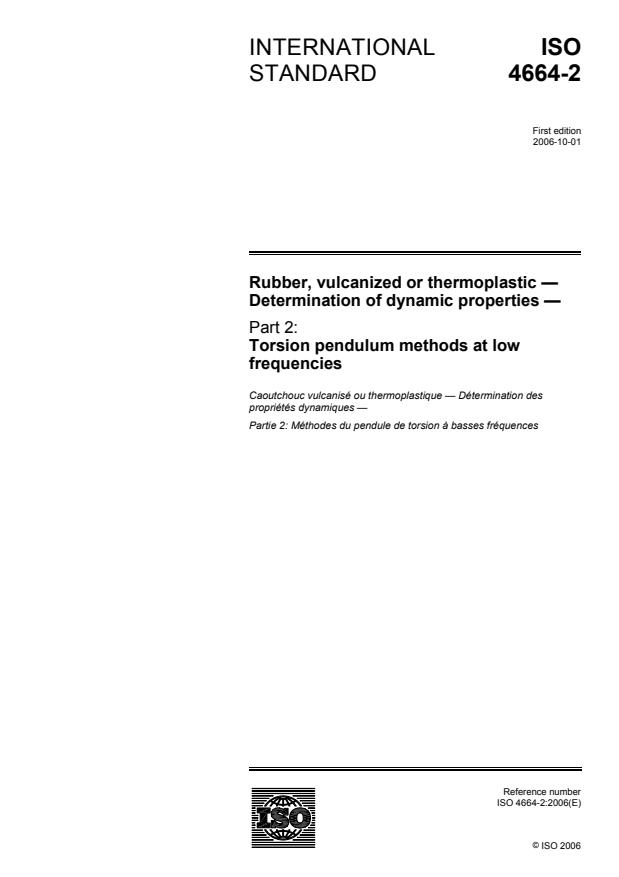
INTERNATIONAL ISO
STANDARD 4664-2
First edition
2006-10-01
Rubber, vulcanized or thermoplastic —
Determination of dynamic properties —
Part 2:
Torsion pendulum methods at low
frequencies
Caoutchouc vulcanisé ou thermoplastique — Détermination des
propriétés dynamiques —
Partie 2: Méthodes du pendule de torsion à basses fréquences
Reference number
©
ISO 2006
PDF disclaimer
This PDF file may contain embedded typefaces. In accordance with Adobe's licensing policy, this file may be printed or viewed but
shall not be edited unless the typefaces which are embedded are licensed to and installed on the computer performing the editing. In
downloading this file, parties accept therein the responsibility of not infringing Adobe's licensing policy. The ISO Central Secretariat
accepts no liability in this area.
Adobe is a trademark of Adobe Systems Incorporated.
Details of the software products used to create this PDF file can be found in the General Info relative to the file; the PDF-creation
parameters were optimized for printing. Every care has been taken to ensure that the file is suitable for use by ISO member bodies. In
the unlikely event that a problem relating to it is found, please inform the Central Secretariat at the address given below.
© ISO 2006
All rights reserved. Unless otherwise specified, no part of this publication may be reproduced or utilized in any form or by any means,
electronic or mechanical, including photocopying and microfilm, without permission in writing from either ISO at the address below or
ISO's member body in the country of the requester.
ISO copyright office
Case postale 56 • CH-1211 Geneva 20
Tel. + 41 22 749 01 11
Fax + 41 22 749 09 47
E-mail copyright@iso.org
Web www.iso.org
Published in Switzerland
ii © ISO 2006 – All rights reserved
Contents Page
Foreword. iv
1 Scope . 1
2 Normative references . 1
3 Terms and definitions. 1
4 Principle. 1
5 Apparatus . 2
5.1 Test piece holder . 2
5.2 Inertial member . 2
5.3 Torsion pendulum. 2
5.4 Thermostatted test chamber . 6
5.5 Devices for measurement of test piece dimensions. 6
6 Test pieces . 6
6.1 Dimensions. 6
6.2 Preparation . 6
6.3 Number . 6
6.4 Conditioning. 6
7 Strain, frequency and temperature of test . 7
7.1 Strain. 7
7.2 Frequency. 7
7.3 Temperature . 7
8 Procedure . 7
8.1 Measurement of dimensions of test piece .7
8.2 Mechanical conditioning of test piece. 7
8.3 Mounting of test piece. 8
8.4 Measurement of test piece free length . 8
8.5 Temperature conditioning of test piece . 8
8.6 Testing . 8
9 Expression of results . 9
9.1 Symbols . 9
9.2 Calculation of the elastic shear modulus (in-phase modulus) . 9
9.3 Calculation of mechanical damping . 10
10 Test report . 11
Bibliography . 12
Foreword
ISO (the International Organization for Standardization) is a worldwide federation of national standards bodies
(ISO member bodies). The work of preparing International Standards is normally carried out through ISO
technical committees. Each member body interested in a subject for which a technical committee has been
established has the right to be represented on that committee. International organizations, governmental and
non-governmental, in liaison with ISO, also take part in the work. ISO collaborates closely with the
International Electrotechnical Commission (IEC) on all matters of electrotechnical standardization.
International Standards are drafted in accordance with the rules given in the ISO/IEC Directives, Part 2.
The main task of technical committees is to prepare International Standards. Draft International Standards
adopted by the technical committees are circulated to the member bodies for voting. Publication as an
International Standard requires approval by at least 75 % of the member bodies casting a vote.
Attention is drawn to the possibility that some of the elements of this document may be the subject of patent
rights. ISO shall not be held responsible for identifying any or all such patent rights.
ISO 4664-2 was prepared by Technical Committee ISO/TC 45, Rubber and rubber products, Subcommittee
SC 2, Testing and analysis.
It cancels and replaces ISO 4663:1986, of which it constitutes a technical revision.
ISO 4664 consists of the following parts, under the general title Rubber, vulcanized or thermoplastic —
Determination of dynamic properties:
⎯ Part 1: General guidance
⎯ Part 2: Torsion pendulum methods at low frequencies
iv © ISO 2006 – All rights reserved
INTERNATIONAL STANDARD ISO 4664-2:2006(E)
Rubber, vulcanized or thermoplastic — Determination
of dynamic properties —
Part 2:
Torsion pendulum methods at low frequencies
WARNING — Persons using this part of ISO 4664 should be familiar with normal laboratory practice.
This part of ISO 4664 does not purport to address all of the safety problems, if any, associated with its
use. It is the responsibility of the user to establish appropriate safety and health practices and to
ensure compliance with any national regulatory conditions.
1 Scope
This part of ISO 4664 specifies methods, using a torsion pendulum, of determining the dynamic properties in
shear, that is the shear modulus and mechanical damping, of vulcanized or thermoplastic rubbers over a wide
temperature range at low frequencies in the range 0,1 Hz to 10 Hz and at comparatively low strains of less
−4
than 5 × 10 .
2 Normative references
The following referenced documents are indispensable for the application of this document. For dated
references, only the edition cited applies. For undated references, the latest edition of the referenced
document (including any amendments) applies.
ISO 4664-1, Rubber, vulcanized or thermoplastic — Determination of dynamic properties — Part 1: General
guidance
ISO 23529, Rubber — General procedures for preparing and conditioning test pieces for physical test
methods
3 Terms and definitions
For the purposes of this document, the terms and definitions given in ISO 4664-1 apply.
4 Principle
This test is primarily intended for the determination of the temperature at which the test piece shows
transitions in its visco-elastic properties, by plotting observed values of modulus and damping as a function of
temperature. The methods are not particularly accurate for the determination of absolute values of the
modulus.
In the torsion pendulum, a strip test piece of uniform cross-section constitutes the elastic member of the
pendulum. The test piece is clamped at both ends. One clamp is fixed to a rigid frame while the other one is
provided with an appropriate inertial mass, for example a flywheel.
Three methods of using the torsion pendulum are specified:
⎯ method A, in which the mass of the inertial member is supported by the test piece and the pendulum is
set in free damped oscillation;
⎯ method B, in which the mass of the inertial member is supported by a fine suspension wire and the
pendulum is set in free damped oscillation;
⎯ method C, which is similar to method B except that the oscillations are maintained at constant amplitude
by supplying energy to the system.
5 Apparatus
5.1 Test piece holder
The test piece shall be held between clamps, one of which is fixed and the other attached to the inertial
member. The length of the test piece between the clamps shall be between 30 mm and 100 mm, 50 mm being
the preferred length. Provision shall be made for the measurement of the length between the clamps to an
accuracy of 0,5 mm.
In order to obtain a constant temperature over the length of test pieces, the parts of the clamp protruding from
the thermostatted test chamber (5.4) shall be made of material having low thermal conductivity.
Care shall be taken to ensure that the test piece is free to expand or retract as a result of changes in
temperature without changing the initial stress or tension in the test piece.
5.2 Inertial member
The inertial member may be a disc or a symmetrically supported rod having a moment of inertia such that the
frequency of oscillation of the pendulum and test piece is between 0,1 Hz and 10 Hz at standard laboratory
temperature. In the case of method A, the mass of the inertial member is limited by the longitudinal stress (see
5.3.1). The moment of inertia of a disc or rod of about 30 kg⋅mm has been found to be suitable.
Means shall be attached to the inertial member to enable a torsional disturbance to be applied to the
pendulum in order to start the system oscillating. Low angles of deformation shall be used, such that the shear
−4
strain in the rubber is below 5 × 10 .
Means shall be provided for measuring the frequency of oscillation to an accuracy of ± 1 % in the region of
rubber elasticity. In the transition range, an accuracy of ± 5 % is permissible.
5.3 Torsion pendulum
5.3.1 Method A
The inertial member shall be freely suspended below the test piece as shown in Figure 1. The mass of the
inertial member shall be such that the longitudinal stress in the test piece is less than 30 kPa.
The method of measurement shall permit the determination of the amplitudes of deformation to an accuracy of
± 1 %. When recorders are used, the recording strip shall move with a speed which is known to within ± 1 %,
and with a linearity within ± 1 %.
NOTE If a lamp and mirror system is used to measure amplitude, a distance of at least 2 m is needed between the
mirror and scale to achieve the required precision.
2 © ISO 2006 – All rights reserved
Key
1 upper clamp 4 rigid connections 7 inertial member
2 test piece 5 lamp 8 thermostatted chamber
3 lower clamp 6 mirror 9 scale or recorder
Figure 1 — Uncompensated free-oscillation apparatus with counterweighted inertial member
suspended below the test piece
5.3.2 Method B
The torsion pendulum shall be constructed according to the principles shown in Figure 2. The inertial member
shall be supported from above by a fine wire suspension and the test piece shall be attached below. The
length and diameter of the wire shall be chosen so that the restoring torque due to the wire suspension is not
greater than 25 % of the restoring torque in the test piece plus the suspension.
The measurement system shall conform to that specified for method A.
Key
1 upper clamp 4 rigid connections 7 counterweight 10 scale or recorder
2 test piece 5 inertial member 8 torsion wire 11 thermostatted chamber
3 lower clamp 6 lamp 9 mirror
Figure 2 — Uncompensated free-oscillation apparatus with counterweighted i
...
NORME ISO
INTERNATIONALE 4664-2
Première édition
2006-10-01
Caoutchouc vulcanisé
ou thermoplastique — Détermination
des propriétés dynamiques —
Partie 2:
Méthodes du pendule de torsion à basses
fréquences
Rubber, vulcanized or thermoplastic — Determination of dynamic
properties —
Part 2: Torsion pendulum methods at low frequencies
Numéro de référence
©
ISO 2006
PDF – Exonération de responsabilité
Le présent fichier PDF peut contenir des polices de caractères intégrées. Conformément aux conditions de licence d'Adobe, ce fichier
peut être imprimé ou visualisé, mais ne doit pas être modifié à moins que l'ordinateur employé à cet effet ne bénéficie d'une licence
autorisant l'utilisation de ces polices et que celles-ci y soient installées. Lors du téléchargement de ce fichier, les parties concernées
acceptent de fait la responsabilité de ne pas enfreindre les conditions de licence d'Adobe. Le Secrétariat central de l'ISO décline toute
responsabilité en la matière.
Adobe est une marque déposée d'Adobe Systems Incorporated.
Les détails relatifs aux produits logiciels utilisés pour la création du présent fichier PDF sont disponibles dans la rubrique General Info
du fichier; les paramètres de création PDF ont été optimisés pour l'impression. Toutes les mesures ont été prises pour garantir
l'exploitation de ce fichier par les comités membres de l'ISO. Dans le cas peu probable où surviendrait un problème d'utilisation,
veuillez en informer le Secrétariat central à l'adresse donnée ci-dessous.
© ISO 2006
Droits de reproduction réservés. Sauf prescription différente, aucune partie de cette publication ne peut être reproduite ni utilisée sous
quelque forme que ce soit et par aucun procédé, électronique ou mécanique, y compris la photocopie et les microfilms, sans l'accord écrit
de l'ISO à l'adresse ci-après ou du comité membre de l'ISO dans le pays du demandeur.
ISO copyright office
Case postale 56 • CH-1211 Geneva 20
Tel. + 41 22 749 01 11
Fax. + 41 22 749 09 47
E-mail copyright@iso.org
Web www.iso.org
Publié en Suisse
ii © ISO 2006 – Tous droits réservés
Sommaire Page
Avant-propos. iv
1 Domaine d'application. 1
2 Références normatives . 1
3 Termes et définitions. 1
4 Principe. 1
5 Appareillage . 2
5.1 Support d'éprouvette. 2
5.2 Corps d'inertie. 2
5.3 Pendule de torsion. 2
5.4 Chambre d'essai thermorégulée . 6
5.5 Dispositifs de mesurage des dimensions de l'éprouvette . 6
6 Éprouvettes . 6
6.1 Dimensions. 6
6.2 Préparation . 6
6.3 Nombre . 6
6.4 Conditionnement . 6
7 Déformation, fréquence et température d'essai . 7
7.1 Déformation. 7
7.2 Fréquence. 7
7.3 Température . 7
8 Mode opératoire . 7
8.1 Mesurage des dimensions de l'éprouvette . 7
8.2 Conditionnement mécanique de l'éprouvette. 8
8.3 Montage de l'éprouvette. 8
8.4 Mesurage de la longueur libre de l'éprouvette . 8
8.5 Température de conditionnement de l'éprouvette . 8
8.6 Essai. 8
9 Expression des résultats . 9
9.1 Symboles . 9
9.2 Calculs du module de cisaillement élastique (module en phase) . 9
9.3 Calcul de l'amortissement mécanique .10
10 Rapport d'essai . 11
Bibliographie . 12
Avant-propos
L'ISO (Organisation internationale de normalisation) est une fédération mondiale d'organismes nationaux de
normalisation (comités membres de l'ISO). L'élaboration des Normes internationales est en général confiée
aux comités techniques de l'ISO. Chaque comité membre intéressé par une étude a le droit de faire partie du
comité technique créé à cet effet. Les organisations internationales, gouvernementales et non
gouvernementales, en liaison avec l'ISO participent également aux travaux. L'ISO collabore étroitement avec
la Commission électrotechnique internationale (CEI) en ce qui concerne la normalisation électrotechnique.
Les Normes internationales sont rédigées conformément aux règles données dans les Directives ISO/CEI,
Partie 2.
La tâche principale des comités techniques est d'élaborer les Normes internationales. Les projets de Normes
internationales adoptés par les comités techniques sont soumis aux comités membres pour vote. Leur
publication comme Normes internationales requiert l'approbation de 75 % au moins des comités membres
votants.
L'attention est appelée sur le fait que certains des éléments du présent document peuvent faire l'objet de
droits de propriété intellectuelle ou de droits analogues. L'ISO ne saurait être tenue pour responsable de ne
pas avoir identifié de tels droits de propriété et averti de leur existence.
L'ISO 4664-2 a été élaborée par le comité technique ISO/TC 45, Élastomères et produits à base
d'élastomères, sous-comité SC 2, Essais et analyses.
Elle annule et remplace l'ISO 4663:1986, dont elle constitue une révision technique.
L'ISO 4664 comprend les parties suivantes, présentées sous le titre général Caoutchouc vulcanisé ou
thermoplastique — Détermination des propriétés dynamiques:
— Partie 1: Lignes directrices
— Partie 2: Méthodes du pendule de torsion à basses fréquences
iv © ISO 2006 – Tous droits réservés
NORME INTERNATIONALE ISO 4664-2:2006(F)
Caoutchouc vulcanisé ou thermoplastique — Détermination
des propriétés dynamiques —
Partie 2:
Méthodes du pendule de torsion à basses fréquences
AVERTISSEMENT — Il convient que l'utilisateur de la présente partie de l'ISO 4664 connaisse bien les
pratiques courantes de laboratoire. La présente partie de l'ISO 4664 n'a pas pour but de traiter tous les
problèmes de sécurité qui sont, le cas échéant, liés à son utilisation. Il incombe à l'utilisateur de la
présente norme d'établir des pratiques appropriées en matière d'hygiène et de sécurité, et de
s'assurer de la conformité à la réglementation nationale en vigueur.
1 Domaine d'application
La présente partie de l'ISO 4664 spécifie des méthodes utilisant un pendule de torsion pour déterminer les
propriétés dynamiques en cisaillement, c'est-à-dire le module de cisaillement et l'amortissement mécanique,
des caoutchoucs vulcanisés ou thermoplastiques, sur une large plage de températures et à basses
−4
fréquences de l'ordre de 0,1 Hz à 10 Hz, et sous déformation relativement basse, inférieure à 5 × 10 .
2 Références normatives
Les documents de référence suivants sont indispensables pour l'application du présent document. Pour les
références datées, seule l'édition citée s'applique. Pour les références non datées, la dernière édition du
document de référence s'applique (y compris les éventuels amendements).
ISO 4664-1, Caoutchouc vulcanisé ou thermoplastique — Détermination des propriétés dynamiques —
Partie 1: Lignes directrices
ISO 23529, Caoutchouc — Procédures générales pour la préparation et le conditionnement des éprouvettes
pour les méthodes d'essais physiques
3 Termes et définitions
Pour les besoins du présent document, les termes et définitions donnés dans l'ISO 4664-1 s'appliquent.
4 Principe
Cet essai est avant tout destiné à déterminer la température à laquelle l'éprouvette présente, dans ses
propriétés viscoélastiques, des transitions que l'on observe en traçant les valeurs du module et de
l'amortissement en fonction de la température. Ces méthodes ne sont pas particulièrement précises pour
déterminer les valeurs absolues du module.
Une éprouvette en forme de bande, de section transversale uniforme, constitue la partie élastique du pendule
de torsion. L'éprouvette est serrée aux deux extrémités. Une bride de serrage est fixée sur un cadre rigide,
tandis que l'autre bride est solidaire d'une masse d'inertie appropriée, par exemple un volant.
Trois méthodes d'utilisation du pendule de torsion sont spécifiées:
⎯ méthode A, dans laquelle la masse du corps d'inertie est supportée par l'éprouvette, le pendule étant mis
en oscillation libre amortie;
⎯ méthode B, dans laquelle la masse du corps d'inertie est supportée par un fil fin de suspension, le
pendule étant mis en oscillation libre amortie;
⎯ méthode C, qui est similaire à la méthode B, excepté que les oscillations sont entretenues à amplitude
constante par un apport d'énergie.
5 Appareillage
5.1 Support d'éprouvette
L'éprouvette doit être maintenue par des brides de serrage, dont l'une est fixée et l'autre attachée au corps
d'inertie. La longueur de l'éprouvette entre les brides de serrage doit être comprise entre 30 mm et 100 mm,
50 mm étant la longueur recommandée. Des dispositions doivent être prises pour que le mesurage de la
longueur comprise entre les brides de serrage soit effectué à 0,5 mm près.
Pour obtenir une température constante sur toute la longueur des éprouvettes, les parties de la bride de
serrage dépassant de la chambre d'essai thermorégulée (5.4) doivent être en un matériau de faible
conductivité thermique.
Des précautions doivent être prises afin de s'assurer que l'éprouvette a la possibilité de s'étirer ou de se
rétracter librement suivant les variations de la température sans qu'il y ait changement de la contrainte ou de
la tension initiale.
5.2 Corps d'inertie
Le corps d'inertie peut être un disque ou une tige symétrique supportée symétriquement avec un moment
d'inertie tel que la fréquence d'oscillation du pendule et de l'éprouvette soit comprise entre 0,1 Hz et 10 Hz à
température normale de laboratoire. Dans le cas de la méthode A, la masse du corps d'inertie est limitée par
. 2
la contrainte longitudinale (voir 5.3.1). Le moment d'inertie d'un disque ou d'une tige d'environ 30 kg mm s'est
avéré acceptable.
Des dispositifs doivent être attachés au corps d'inertie pour permettre d'imprimer une torsion au pendule,
mettant ainsi le système en mouvement d'oscillation. De faibles angles de déformation doivent être utilisés, de
−4
manière que la contrainte de cisaillement dans le caoutchouc soit inférieure à 5 × 10 .
Des dispositifs doivent être prévus pour mesurer la fréquence d'oscillation à ± 1 % près dans la zone
d'élasticité du caoutchouc. Dans la zone de transition, une exactitude de ± 5 % est autorisée.
5.3 Pendule de torsion
5.3.1 Méthode A
Le corps d'inertie doit être suspendu librement sous l'éprouvette comme représenté à la Figure 1. La masse
du corps d'inertie doit être telle que la contrainte longitudinale dans l'éprouvette soit inférieure à 30 kPa.
La méthode de mesurage doit permettre de déterminer les amplitudes de déformation à ± 1 %. Si des
enregistreurs sont utilisés, la bande d'enregistrement doit se dérouler à une vitesse connue à ± 1 % près,
avec une linéarité précise à ± 1 %.
NOTE Si un système à lampe et à miroir est utilisé pour mesurer l'amplitude, une distance d'au moins 2 m entre le
miroir et l'échelle est nécessaire pour atteindre l'exactitude requise.
2 © ISO 2006 – Tous droits réservés
Légende
1 bride supérieure 4 fixations rigides 7 corps d'inertie
2 éprouvette 5 lampe 8 chambre thermorégulée
3 bride inférieure 6 miroir 9 échelle ou enregistreur
Figure 1 — Appareil à oscillation libre non compensée
avec le corps d'inertie suspendu sous l'éprouvette
5.3.2 Méthode B
Le pendule de torsion doit être construit selon les principes indiqués à la Figure 2. Le corps d'inertie doit être
supporté par en haut, par un fil fin et l'éprouvette doit être attachée en dessous. La longueur et le diamètre du
fil doivent être choisis de façon que le couple de rappel du fil de suspension ne soit pas supérieur à 25 % de
celui de l'éprouvette plus la suspension.
Le système de mesurage doit être conforme à celui spécifié pour la méthode A.
Légende
1 bride supérieure 4 fixations rigides 7 contre-poids 10 échelle ou enregistreur
2 éprouvette 5 corps d'inertie 8 fil de torsion 11 chambre thermorégulée
3 bride inférieure 6 lampe 9 miroir
Figure 2 — Appareil à oscillation libre non compensée avec le corps d'inertie
contrebalancé suspendu au-dessus de l'éprouvette
5.3.3 Méthode C
Le pendule de torsion pour cette méthode à résonan
...