

ISO/TS 23810:2018
(Main)Cardiovascular implants and artificial organs — Checklists for use of extracorporeal circulation equipment
General Information
- Abstract
This document covers the activities performed by perfusionists before, during, and after extracorporeal circulation. Clause 4 covers the perfusionists' actions during preoperative extracorporeal circulation (ECC) equipment setup prior to cardiopulmonary bypass (CPB), extracorporeal membrane oxygenation (ECMO), cardiopulmonary support (CPS), left or right heart bypass (LHB/RHB) or venovenous (VV) extracorporeal support for liver transplantation. Its requirements can serve as a checklist for verifying that the equipment, devices or systems have been set up correctly. The sequence of use of checklist items listed below can vary depending on customary institutional use or individual user preference. There are also four additional checklists for different phases of ECC (see Clause 5, Termination; Clause 6, Post-extracorporeal circulation; Clause 7, Emergent reinstitution of extracorporeal circulation; and Clause 8, Peri-procedural).
- Status
- Published
- Publication Date
- 19-Jul-2018
- Technical Committee
- ISO/TC 150/SC 2 - Cardiovascular implants and extracorporeal systems
- Drafting Committee
- ISO/TC 150/SC 2/WG 4 - Blood gas exchangers
- Current Stage
- 9060 - Close of review
- Completion Date
- 02-Dec-2029
Buy Documents

ISO/TS 23810:2018 - Cardiovascular implants and artificial organs — Checklists for use of extracorporeal circulation equipment Released:7/20/2018

ISO/TS 23810:2018 - Cardiovascular implants and artificial organs — Checklists for use of extracorporeal circulation equipment/20/2018
Overview
ISO/TS 23810:2018 - Cardiovascular implants and artificial organs - Checklists for use of extracorporeal circulation equipment - is a Technical Specification that defines checklists for activities performed by perfusionists before, during and after extracorporeal circulation (ECC). It covers preoperative setup for cardiopulmonary bypass (CPB), extracorporeal membrane oxygenation (ECMO), cardiopulmonary support (CPS), left/right heart bypass (LHB/RHB) and venovenous (VV) extracorporeal support used in procedures such as liver transplantation.
The document is checklist-focused: Clause 4 addresses preoperative ECC equipment setup, and additional checklists address termination (Clause 5), post-ECC (Clause 6), emergent reinstitution of ECC (Clause 7) and peri-procedural activities (Clause 8). The sequence of items can be adapted to institutional practice.
Key Topics
ISO/TS 23810:2018 organizes practical verification points across ECC systems, including:
- Patient information: identity, allergies, blood type/antibodies, medical record and procedure verification.
- Equipment and Instructions for Use (IFU): presence, compatibility and IFU availability.
- Sterility and component integrity: package integrity, expiration, serial/lot traceability.
- Pumps: electrical supply, batteries, roller and centrifugal pump checks.
- Cardioplegia: solutions, delivery methods, temperature control and leak/bubble prevention.
- Medical gas and vacuum supply: gas sources, blenders, hoses, connectors, pressures and exhaust.
- Components and tubing: connections, tubing direction/length, one‑way valves, leak and patency checks.
- Safety mechanisms: alarms, arterial filters/bubble traps, reservoirs, line occluders, vents and level sensors.
- Assisted venous return: positive/negative pressure relief, vacuum regulators and kinetic assistance.
- Monitoring and anticoagulation: temperature probes, pressure transducers, flow sensors and anticoagulation monitoring.
- Temperature control and supplies: water supplies, ranges and related consumables.
These topics form a pragmatic checklist to verify that devices, systems and consumables are set up correctly and safely.
Applications
ISO/TS 23810:2018 is intended for practical use by:
- Perfusionists and ECMO specialists performing ECC setup and management.
- Operating room teams and cardiac surgery staff to support consistent pre-op checks.
- Clinical engineers and biomedical staff responsible for equipment commissioning and maintenance.
- Hospital quality, safety and risk management teams for auditing, incident prevention and protocol standardization.
- Educators and trainers designing simulation and competency assessments.
Typical applications include preoperative verification, intraoperative safety checks, emergent reinstitution protocols, post-procedure handover, training curricula and institutional checklist implementation to reduce equipment-related errors.
Related standards
Refer to the broader ISO cardiovascular implants and artificial organs series and local clinical guidelines for complementary requirements on device performance, hospital medical gas systems and clinical governance. Use ISO/TS 23810:2018 as a practical checklist resource to align ECC setup with institutional policies and international best practice.
Relations
- Effective Date
- 05-Nov-2015
Buy Documents
ISO/TS 23810:2018 - Cardiovascular implants and artificial organs — Checklists for use of extracorporeal circulation equipment Released:7/20/2018
ISO/TS 23810:2018 - Cardiovascular implants and artificial organs — Checklists for use of extracorporeal circulation equipment/20/2018
Get Certified
Connect with accredited certification bodies for this standard

BSI Group
BSI (British Standards Institution) is the business standards company that helps organizations make excellence a habit.

TÜV Rheinland
TÜV Rheinland is a leading international provider of technical services.

TÜV SÜD
TÜV SÜD is a trusted partner of choice for safety, security and sustainability solutions.
Sponsored listings
Frequently Asked Questions
ISO/TS 23810:2018 is a technical specification published by the International Organization for Standardization (ISO). Its full title is "Cardiovascular implants and artificial organs — Checklists for use of extracorporeal circulation equipment". This standard covers: This document covers the activities performed by perfusionists before, during, and after extracorporeal circulation. Clause 4 covers the perfusionists' actions during preoperative extracorporeal circulation (ECC) equipment setup prior to cardiopulmonary bypass (CPB), extracorporeal membrane oxygenation (ECMO), cardiopulmonary support (CPS), left or right heart bypass (LHB/RHB) or venovenous (VV) extracorporeal support for liver transplantation. Its requirements can serve as a checklist for verifying that the equipment, devices or systems have been set up correctly. The sequence of use of checklist items listed below can vary depending on customary institutional use or individual user preference. There are also four additional checklists for different phases of ECC (see Clause 5, Termination; Clause 6, Post-extracorporeal circulation; Clause 7, Emergent reinstitution of extracorporeal circulation; and Clause 8, Peri-procedural).
This document covers the activities performed by perfusionists before, during, and after extracorporeal circulation. Clause 4 covers the perfusionists' actions during preoperative extracorporeal circulation (ECC) equipment setup prior to cardiopulmonary bypass (CPB), extracorporeal membrane oxygenation (ECMO), cardiopulmonary support (CPS), left or right heart bypass (LHB/RHB) or venovenous (VV) extracorporeal support for liver transplantation. Its requirements can serve as a checklist for verifying that the equipment, devices or systems have been set up correctly. The sequence of use of checklist items listed below can vary depending on customary institutional use or individual user preference. There are also four additional checklists for different phases of ECC (see Clause 5, Termination; Clause 6, Post-extracorporeal circulation; Clause 7, Emergent reinstitution of extracorporeal circulation; and Clause 8, Peri-procedural).
ISO/TS 23810:2018 is classified under the following ICS (International Classification for Standards) categories: 11.040.40 - Implants for surgery, prosthetics and orthotics. The ICS classification helps identify the subject area and facilitates finding related standards.
ISO/TS 23810:2018 has the following relationships with other standards: It is inter standard links to ISO/TS 23810:2012. Understanding these relationships helps ensure you are using the most current and applicable version of the standard.
ISO/TS 23810:2018 is available in PDF format for immediate download after purchase. The document can be added to your cart and obtained through the secure checkout process. Digital delivery ensures instant access to the complete standard document.
Standards Content (Sample)
TECHNICAL ISO/TS
SPECIFICATION 23810
Third edition
2018-07
Cardiovascular implants and artificial
organs — Checklists for use of
extracorporeal circulation equipment
Implants cardiovasculaires et organes artificiels — Listes de contrôle
pour l'équipement de circulation extracorporelle
Reference number
©
ISO 2018
© ISO 2018
All rights reserved. Unless otherwise specified, or required in the context of its implementation, no part of this publication may
be reproduced or utilized otherwise in any form or by any means, electronic or mechanical, including photocopying, or posting
on the internet or an intranet, without prior written permission. Permission can be requested from either ISO at the address
below or ISO’s member body in the country of the requester.
ISO copyright office
CP 401 • Ch. de Blandonnet 8
CH-1214 Vernier, Geneva
Phone: +41 22 749 01 11
Fax: +41 22 749 09 47
Email: copyright@iso.org
Website: www.iso.org
Published in Switzerland
ii © ISO 2018 – All rights reserved
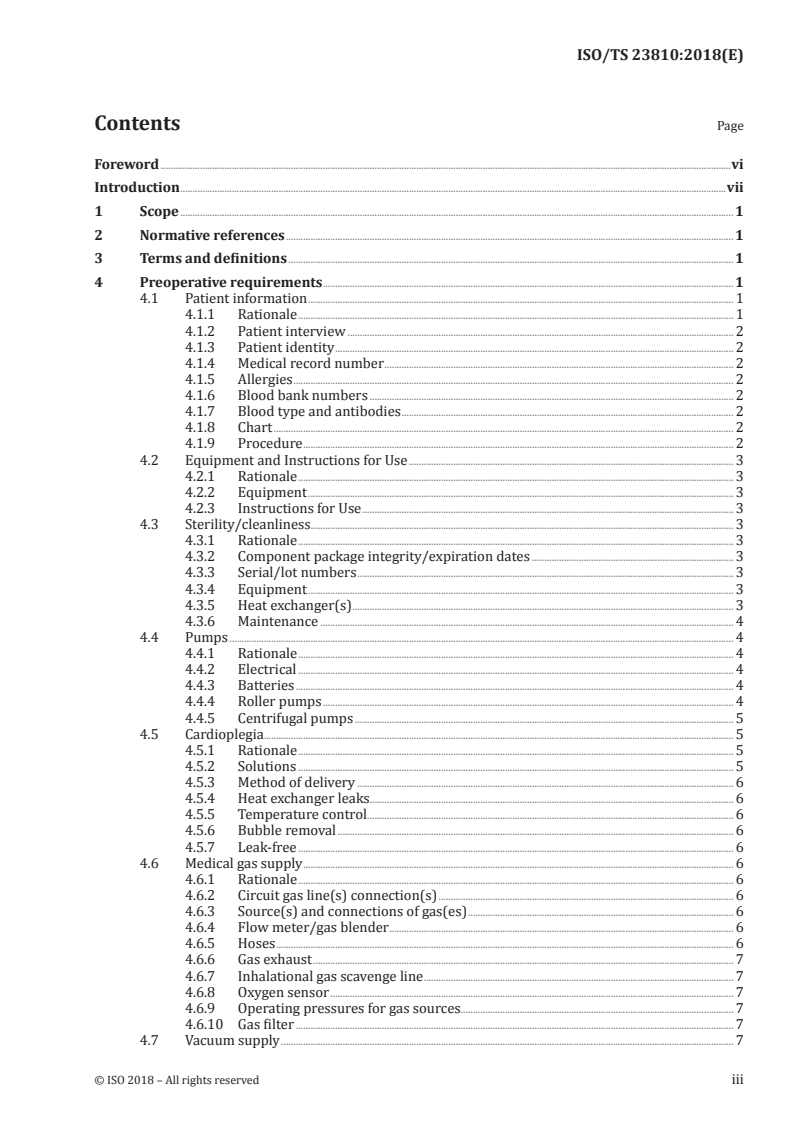
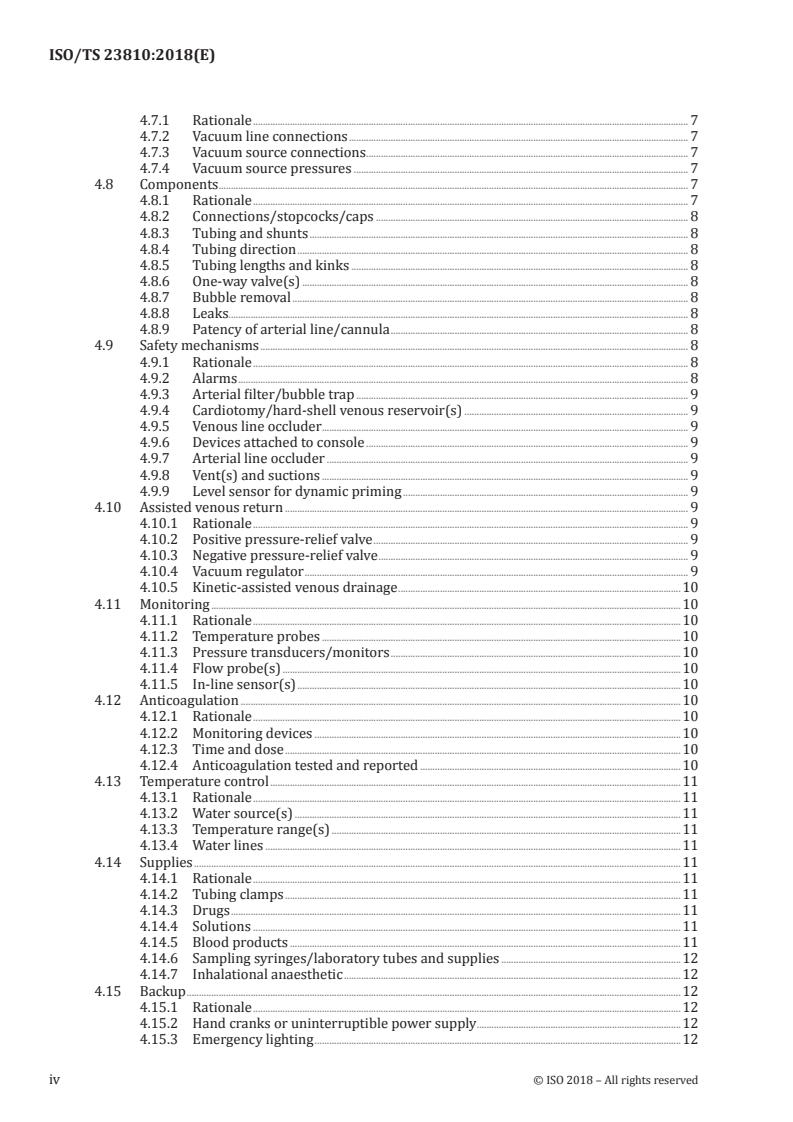
Contents Page
Foreword .vi
Introduction .vii
1 Scope . 1
2 Normative references . 1
3 Terms and definitions . 1
4 Preoperative requirements . 1
4.1 Patient information . 1
4.1.1 Rationale . 1
4.1.2 Patient interview . 2
4.1.3 Patient identity . 2
4.1.4 Medical record number . 2
4.1.5 Allergies . 2
4.1.6 Blood bank numbers . 2
4.1.7 Blood type and antibodies . 2
4.1.8 Chart . 2
4.1.9 Procedure . 2
4.2 Equipment and Instructions for Use . 3
4.2.1 Rationale . 3
4.2.2 Equipment . 3
4.2.3 Instructions for Use . 3
4.3 Sterility/cleanliness. 3
4.3.1 Rationale . 3
4.3.2 Component package integrity/expiration dates . 3
4.3.3 Serial/lot numbers . 3
4.3.4 Equipment . 3
4.3.5 Heat exchanger(s) . 3
4.3.6 Maintenance . 4
4.4 Pumps . 4
4.4.1 Rationale . 4
4.4.2 Electrical . 4
4.4.3 Batteries . 4
4.4.4 Roller pumps . 4
4.4.5 Centrifugal pumps . 5
4.5 Cardioplegia . 5
4.5.1 Rationale . 5
4.5.2 Solutions . 5
4.5.3 Method of delivery . 6
4.5.4 Heat exchanger leaks. 6
4.5.5 Temperature control . . 6
4.5.6 Bubble removal . 6
4.5.7 Leak-free . 6
4.6 Medical gas supply . 6
4.6.1 Rationale . 6
4.6.2 Circuit gas line(s) connection(s) . 6
4.6.3 Source(s) and connections of gas(es) . 6
4.6.4 Flow meter/gas blender . 6
4.6.5 Hoses . 6
4.6.6 Gas exhaust . 7
4.6.7 Inhalational gas scavenge line . 7
4.6.8 Oxygen sensor . 7
4.6.9 Operating pressures for gas sources. 7
4.6.10 Gas filter . 7
4.7 Vacuum supply . 7
4.7.1 Rationale . 7
4.7.2 Vacuum line connections . 7
4.7.3 Vacuum source connections . 7
4.7.4 Vacuum source pressures . 7
4.8 Components . 7
4.8.1 Rationale . 7
4.8.2 Connections/stopcocks/caps . 8
4.8.3 Tubing and shunts . 8
4.8.4 Tubing direction . 8
4.8.5 Tubing lengths and kinks . 8
4.8.6 One-way valve(s) . 8
4.8.7 Bubble removal . 8
4.8.8 Leaks. 8
4.8.9 Patency of arterial line/cannula . 8
4.9 Safety mechanisms . 8
4.9.1 Rationale . 8
4.9.2 Alarms . 8
4.9.3 Arterial filter/bubble trap . 9
4.9.4 Cardiotomy/hard-shell venous reservoir(s) . 9
4.9.5 Venous line occluder . . 9
4.9.6 Devices attached to console . 9
4.9.7 Arterial line occluder . 9
4.9.8 Vent(s) and suctions . 9
4.9.9 Level sensor for dynamic priming . 9
4.10 Assisted venous return . 9
4.10.1 Rationale . 9
4.10.2 Positive pressure-relief valve . 9
4.10.3 Negative pressure-relief valve . 9
4.10.4 Vacuum regulator . 9
4.10.5 Kinetic-assisted venous drainage .10
4.11 Monitoring .10
4.11.1 Rationale .10
4.11.2 Temperature probes .10
4.11.3 Pressure transducers/monitors .10
4.11.4 Flow probe(s) .10
4.11.5 In-line sensor(s) .10
4.12 Anticoagulation .10
4.12.1 Rationale .10
4.12.2 Monitoring devices .10
4.12.3 Time and dose .10
4.12.4 Anticoagulation tested and reported .10
4.13 Temperature control .11
4.13.1 Rationale .11
4.13.2 Water source(s) .11
4.13.3 Temperature range(s) .11
4.13.4 Water lines .11
4.14 Supplies .11
4.14.1 Rationale .11
4.14.2 Tubing clamps .11
4.14.3 Drugs .11
4.14.4 Solutions .11
4.14.5 Blood products .11
4.14.6 Sampling syringes/laboratory tubes and supplies .12
4.14.7 Inhalational anaesthetic .12
4.15 Backup .12
4.15.1 Rationale .12
4.15.2 Hand cranks or uninterruptible power supply .12
4.15.3 Emergency lighting .12
iv © ISO 2018 – All rights reserved
4.15.4 Backup oxygen tank with flow meter .12
4.15.5 Duplicate circuit components and hardware .12
4.15.6 Ice .12
5 Weaning and termination .12
5.1 Rationale.12
5.2 Inhalational anaesthetic .12
5.3 Assisted venous return .13
5.4 Cardiotomy/venous reservoirs .13
5.5 Shunt(s) .13
5.6 Vent(s) .13
5.7 Gas flow .13
5.8 Extracorporeal flow with centrifugal pump .13
6 Post-extracorporeal circulation .13
6.1 Rationale.13
6.2 Termination .13
6.3 Clamping .13
6.4 Bubble removal .13
6.5 Suction .13
6.6 Patient haemodynamics .13
7 Emergent re-initiation of extracorporeal circulation .14
7.1 Rationale.14
7.2 Anticoagulation .14
7.3 Circuit volume .14
7.4 Bubble removal .14
7.5 Medical gas supply .14
7.6 Alarms and alerts .14
7.7 Water supply .14
7.8 Tubing .14
8 Peri-procedural .14
8.1 Entrainment of air into the ECC .14
8.2 Reservoir level .14
8.3 ECC parameters .14
8.4 Water supply .15
8.5 Fluid balance .15
8.6 Personnel .15
9 Documentation .15
9.1 Rationale.15
9.2 Completion of the checklist and procedure record .15
9.3 Retention of the checklist .15
9.4 Expiration date .15
9.5 Operator's manuals .15
10 Devices or equipment not part of the extracorporeal circuit .15
10.1 Rationale.15
11 Annotations to the Bibliography .16
Bibliography .17
Foreword
ISO (the International Organization for Standardization) is a worldwide federation of national standards
bodies (ISO member bodies). The work of preparing International Standards is normally carried out
through ISO technical committees. Each member body interested in a subject for which a technical
committee has been established has the right to be represented on that committee. International
organizations, governmental and non-governmental, in liaison with ISO, also take part in the work.
ISO collaborates closely with the International Electrotechnical Commission (IEC) on all matters of
electrotechnical standardization.
The procedures used to develop this document and those intended for its further maintenance are
described in the ISO/IEC Directives, Part 1. In particular the different approval criteria needed for the
different types of ISO documents should be noted. This document was drafted in accordance with the
editorial rules of the ISO/IEC Directives, Part 2 (see www .iso .org/directives).
Attention is drawn to the possibility that some of the elements of this document may be the subject of
patent rights. ISO shall not be held responsible for identifying any or all such patent rights. Details of
any patent rights identified during the development of the document will be in the Introduction and/or
on the ISO list of patent declarations received (see www .iso .org/patents).
Any trade name used in this document is information given for the convenience of users and does not
constitute an endorsement.
For an explanation on the voluntary nature of standards, the meaning of ISO specific terms and
expressions related to conformity assessment, as well as information about ISO's adherence to the
World Trade Organization (WTO) principles in the Technical Barriers to Trade (TBT) see the following
URL: www .iso .org/iso/foreword .html.
This document was prepared by Technical Committee ISO/TC 150, Implants for surgery, Subcommittee
SC 2, Cardiovascular implants and extracorporeal systems.
This third edition cancels and replaces the second edition (ISO/TS 23810:2012), which has been
technically revised.
vi © ISO 2018 – All rights reserved
Introduction
This document has been published as a Technical Specification instead of an International Standard
for provisional application, so that individuals and/or professional groups who operate extracorporeal
circulation (ECC) equipment (e.g. perfusionists) may gather information and experience of its use in
practice. It can be used as a checklist, or a reasonable equivalent, before initiating extracorporeal
circulation, which users are encouraged to adapt to accommodate differences in circuit design or
variations in institutional clinical practice. It is intended to be used by healthcare facilities to create a
checklist appropriate to the particular needs of their institution. While this checklist is intended to be
comprehensive for many types of equipment used for ECC, inclusion of specific checklist items does not
necessarily mandate their use.
The purpose of this document is to provide generic guidelines for the safe use of ECC equipment.
Errors and omissions in the setup of ECC equipment have the potential to compromise the equipment's
intended functionality. In some cases, compromised functionality may result in severe injury to, or
the death of, the patient supported by ECC. Completing checklists before, during, and after a patient
is placed on ECC support and also for post-operative management is an aid to reducing errors and to
ensuring proper operation. Both users and patients can benefit from the use of such checklists. The
manufacturer can also receive assurance that the product and/or equipment are being used according
to the purposes for which it was designed and in accordance with the instructions for use.
The development of this document has been made possible thanks to the efforts of professional groups
(see the Bibliography) in developing similar checklists and provides for their wider dissemination and
recognition.
Extracorporeal circulation technology has been used clinically in a variety of concepts for more than
50 years and the equipment, techniques, and applications continue to evolve. While much technological
advancement in devices and techniques have occurred during this time, the fundamental purpose of
ECC remains unchanged. Thus, generic checklists are applicable to several modalities of ECC (see Scope)
and may be customized by clinicians for specific use depending on institutional or physician-mandated
applications. The acceptance into general practice of any guideline is most reasonably ensured if those
who must use such guidelines can reach consensus agreement on the key issues to be covered in a
checklist. The benefits to be gained assume a reduction in errors when a variety of ECC equipment is
used clinically.
Finally, this document fills an important niche in the improvement of patient safety, since no regulation
or standard exists in the area of preoperative checklists for ECC equipment.
TECHNICAL SPECIFICATION ISO/TS 23810:2018(E)
Cardiovascular implants and artificial organs — Checklists
for use of extracorporeal circulation equipment
1 Scope
This document covers the activities performed by perfusionists before, during, and after extracorporeal
circulation.
Clause 4 covers the perfusionists’ actions during preoperative extracorporeal circulation (ECC)
equipment setup prior to cardiopulmonary bypass (CPB), extracorporeal membrane oxygenation
(ECMO), cardiopulmonary support (CPS), left or right heart bypass (LHB/RHB) or venovenous (VV)
extracorporeal support for liver transplantation. Its requirements can serve as a checklist for verifying
that the equipment, devices or systems have been set up correctly. The sequence of use of checklist
items listed below can vary depending on customary institutional use or individual user preference.
There are also four additional checklists for different phases of ECC (see Clause 5, Termination; Clause 6,
Post-extracorporeal circulation; Clause 7, Emergent reinstitution of extracorporeal circulation; and
Clause 8, Peri-procedural).
2 Normative references
There are no normative references in this document.
3 Terms and definitions
No terms and definitions are listed in this document.
ISO and IEC maintain terminological databases for use in standardization at the following addresses:
— IEC Electropedia: available at http: //www .electropedia .org/
— ISO Online browsing platform: available at https: //www .iso .org/obp
4 Preoperative requirements
4.1 Patient information
4.1.1 Rationale
To minimize the risk of misidentifying the patient and the proposed procedure, which could lead to
use of inappropriate equipment and/or an inappropriate procedure, the correct patient for the correct
procedure should be confirmed before the procedure begins. A time-out in which the patient’s name
with other identifying information and the proposed procedure is announced and acknowledged
by all team members present is an important method for addressing this issue. Users should read
relevant portions of the patient’s medical record to confirm the patient’s history that could potentially
affect the safe conduct of extracorporeal circulation. Blood products may be needed urgently during
extracorporeal circulation, so the availability of correctly typed and crossed blood matched for
administration to the intended patient should be confirmed. For patients with specific blood product
restrictions and limitation of usage an alternative protocol shall be reviewed and confirmed.
4.1.2 Patient interview
Interview the patient except in the case of a patient condition that would prevent direct communication
and/or review the patient’s records, as per institutional protocol.
4.1.3 Patient identity
4.1.3.1 Confirm the patient's identity by matching the patient’s hand band with information in the
patient chart.
4.1.3.2 Cross check the patient’s identification with a clinical team member assigned to the case.
4.1.3.3 Other methods for patient identification such as asking the patient his or her name and date of
birth may be used per institutional protocol.
4.1.4 Medical record number
Crosscheck the hospital identity number for the patient with the patient’s medical record and record it
on any chart-work associated with the procedure.
4.1.5 Allergies
4.1.5.1 Confirm from the patient’s medical record whether there are any known or reported allergies
and record such information on any chart-work associated with the procedure.
4.1.5.2 Confirm the patient’s allergy status with a clinical team member assigned to the case.
4.1.6 Blood bank numbers
4.1.6.1 Confirm the number of units of blood available.
4.1.6.2 Match the identity of all designated blood bank products to the patient and double-check before
administering to the patient or into the extracorporeal circuit.
4.1.7 Blood type and antibodies
Confirm the patient’s blood type and possible antibody status by review of laboratory reports in the
patient’s chart before the procedure.
4.1.8 Chart
Review the patient’s medical chart before the procedure to determine vital statistics (e.g. height, weight,
body surface area, age, gender) or any other relevant information that could affect the performance of
extracorporeal circulation (e.g. haemoglobin/haematocrit, predicted haemoglobin/haematocrit during
ECC and any other relevant laboratory values or medical history/risk factors).
4.1.9 Procedure
4.1.9.1 Review the patient’s medical chart before the procedure to determine the intended medical
indication or surgical procedure.
4.1.9.2 Confirm the procedure by implementing a time-out with the clinical team.
2 © ISO 2018 – All rights reserved
4.2 Equipment and Instructions for Use
4.2.1 Rationale
The choice of equipment and ancillary devices to be used for extracorporeal circulation shall be
appropriate to the patient and proposed procedure for safe conduct of ECC. Users shall have read and
understood the most current manufacturers’ instructions for use to guide appropriate management of
extracorporeal circulation.
4.2.2 Equipment
Confirm the equipment chosen for use (disposable and reusable) is of the appropriate size and model
for the intended procedure and patient size.
4.2.3 Instructions for Use
Confirm the user has read and understood the most current manufacturers’ instructions for use and is
aware of any modifications/changes in order for the products to be operated and used safely before the
products are used, including before the preparation period.
4.3 Sterility/cleanliness
4.3.1 Rationale
All disposable equipment (e.g. oxygenators, reservoirs, tubing, cardioplegia delivery systems,
monitoring lines, and transducers) that will come into contact with the patient’s blood shall be sterile
to avoid infection. The surfaces of all non-disposable equipment (e.g. pump console, poles, trays,
tubing clamps, and ancillary systems such as cell salvage and self-standing cooler/heater units) should
be blood-free and body fluid-free before assembly of disposable equipment to minimize the risk of
transmission of blood-borne pathogens to the patient or user. Self-standing cooler/heater units using
water or ice shall be clean to reduce the risk of patient infection in the event there is a water-to-blood
leak or transmission of circulating water onto the sterile field.
4.3.2 Component package integrity/expiration dates
Visually inspect all component packaging and labelling prior to assembly to verify sterility and
expiration date.
4.3.3 Serial/lot numbers
Record the serial and/or lot numbers of components (e.g. oxygenator, reservoir, circuit tubing,
cardioplegia system), as well as the identification of the pump consoles.
4.3.4 Equipment
Confirm that reusable equipment is blood-free, body fluid-free, and clean prior to assembly, which may
include regular cleaning with an appropriate disinfectant per institutional protocol.
4.3.5 Heat exchanger(s)
4.3.5.1 For the water phases of all heat exchanger components, connect water source(s) with
circulating water and visually verify that there is no water leakage into the blood pathway(s) prior to
adding fluid priming volume.
4.3.5.2 Pressurized air or water without decay may be used as a method to verify heat exchanger water
phase integrity.
4.3.6 Maintenance
Confirm that all equipment has been maintained according to manufacturers' recommendations and
institutional regulation.
4.4 Pumps
4.4.1 Rationale
Blood pumps used for circulatory support, cardioplegia delivery, or aspiration of blood/air from the
surgical site shall be in proper working order with backup (electrical and/or mechanical) to avoid the
risk of inadequate delivery of extracorporeal circulation. Accurate displays of blood flow (e.g. read-outs
or flow meters) are important to avoid either hypo- or hyper-perfusion.
NOTE Pumps refers to all pumps, including arterial, and those used with subsystems such as vents,
cardioplegia and suckers.
4.4.2 Electrical
4.4.2.1 Power cord connections
4.4.2.1.1 Confirm that all electrical power cords are securely connected to the appropriate power
source(s).
4.4.2.1.2 Route all electrical power cords so as to minimize the risk of inadvertent disconnection from
the power source.
4.4.2.1.3 Confirm that no
...
TECHNICAL ISO/TS
SPECIFICATION 23810
Third edition
2018-07
Cardiovascular implants and artificial
organs — Checklists for use of
extracorporeal circulation equipment
Implants cardiovasculaires et organes artificiels — Listes de contrôle
pour l'équipement de circulation extracorporelle
Reference number
©
ISO 2018
© ISO 2018
All rights reserved. Unless otherwise specified, or required in the context of its implementation, no part of this publication may
be reproduced or utilized otherwise in any form or by any means, electronic or mechanical, including photocopying, or posting
on the internet or an intranet, without prior written permission. Permission can be requested from either ISO at the address
below or ISO’s member body in the country of the requester.
ISO copyright office
CP 401 • Ch. de Blandonnet 8
CH-1214 Vernier, Geneva
Phone: +41 22 749 01 11
Fax: +41 22 749 09 47
Email: copyright@iso.org
Website: www.iso.org
Published in Switzerland
ii © ISO 2018 – All rights reserved
Contents Page
Foreword .vi
Introduction .vii
1 Scope . 1
2 Normative references . 1
3 Terms and definitions . 1
4 Preoperative requirements . 1
4.1 Patient information . 1
4.1.1 Rationale . 1
4.1.2 Patient interview . 2
4.1.3 Patient identity . 2
4.1.4 Medical record number . 2
4.1.5 Allergies . 2
4.1.6 Blood bank numbers . 2
4.1.7 Blood type and antibodies . 2
4.1.8 Chart . 2
4.1.9 Procedure . 2
4.2 Equipment and Instructions for Use . 3
4.2.1 Rationale . 3
4.2.2 Equipment . 3
4.2.3 Instructions for Use . 3
4.3 Sterility/cleanliness. 3
4.3.1 Rationale . 3
4.3.2 Component package integrity/expiration dates . 3
4.3.3 Serial/lot numbers . 3
4.3.4 Equipment . 3
4.3.5 Heat exchanger(s) . 3
4.3.6 Maintenance . 4
4.4 Pumps . 4
4.4.1 Rationale . 4
4.4.2 Electrical . 4
4.4.3 Batteries . 4
4.4.4 Roller pumps . 4
4.4.5 Centrifugal pumps . 5
4.5 Cardioplegia . 5
4.5.1 Rationale . 5
4.5.2 Solutions . 5
4.5.3 Method of delivery . 6
4.5.4 Heat exchanger leaks. 6
4.5.5 Temperature control . . 6
4.5.6 Bubble removal . 6
4.5.7 Leak-free . 6
4.6 Medical gas supply . 6
4.6.1 Rationale . 6
4.6.2 Circuit gas line(s) connection(s) . 6
4.6.3 Source(s) and connections of gas(es) . 6
4.6.4 Flow meter/gas blender . 6
4.6.5 Hoses . 6
4.6.6 Gas exhaust . 7
4.6.7 Inhalational gas scavenge line . 7
4.6.8 Oxygen sensor . 7
4.6.9 Operating pressures for gas sources. 7
4.6.10 Gas filter . 7
4.7 Vacuum supply . 7
4.7.1 Rationale . 7
4.7.2 Vacuum line connections . 7
4.7.3 Vacuum source connections . 7
4.7.4 Vacuum source pressures . 7
4.8 Components . 7
4.8.1 Rationale . 7
4.8.2 Connections/stopcocks/caps . 8
4.8.3 Tubing and shunts . 8
4.8.4 Tubing direction . 8
4.8.5 Tubing lengths and kinks . 8
4.8.6 One-way valve(s) . 8
4.8.7 Bubble removal . 8
4.8.8 Leaks. 8
4.8.9 Patency of arterial line/cannula . 8
4.9 Safety mechanisms . 8
4.9.1 Rationale . 8
4.9.2 Alarms . 8
4.9.3 Arterial filter/bubble trap . 9
4.9.4 Cardiotomy/hard-shell venous reservoir(s) . 9
4.9.5 Venous line occluder . . 9
4.9.6 Devices attached to console . 9
4.9.7 Arterial line occluder . 9
4.9.8 Vent(s) and suctions . 9
4.9.9 Level sensor for dynamic priming . 9
4.10 Assisted venous return . 9
4.10.1 Rationale . 9
4.10.2 Positive pressure-relief valve . 9
4.10.3 Negative pressure-relief valve . 9
4.10.4 Vacuum regulator . 9
4.10.5 Kinetic-assisted venous drainage .10
4.11 Monitoring .10
4.11.1 Rationale .10
4.11.2 Temperature probes .10
4.11.3 Pressure transducers/monitors .10
4.11.4 Flow probe(s) .10
4.11.5 In-line sensor(s) .10
4.12 Anticoagulation .10
4.12.1 Rationale .10
4.12.2 Monitoring devices .10
4.12.3 Time and dose .10
4.12.4 Anticoagulation tested and reported .10
4.13 Temperature control .11
4.13.1 Rationale .11
4.13.2 Water source(s) .11
4.13.3 Temperature range(s) .11
4.13.4 Water lines .11
4.14 Supplies .11
4.14.1 Rationale .11
4.14.2 Tubing clamps .11
4.14.3 Drugs .11
4.14.4 Solutions .11
4.14.5 Blood products .11
4.14.6 Sampling syringes/laboratory tubes and supplies .12
4.14.7 Inhalational anaesthetic .12
4.15 Backup .12
4.15.1 Rationale .12
4.15.2 Hand cranks or uninterruptible power supply .12
4.15.3 Emergency lighting .12
iv © ISO 2018 – All rights reserved
4.15.4 Backup oxygen tank with flow meter .12
4.15.5 Duplicate circuit components and hardware .12
4.15.6 Ice .12
5 Weaning and termination .12
5.1 Rationale.12
5.2 Inhalational anaesthetic .12
5.3 Assisted venous return .13
5.4 Cardiotomy/venous reservoirs .13
5.5 Shunt(s) .13
5.6 Vent(s) .13
5.7 Gas flow .13
5.8 Extracorporeal flow with centrifugal pump .13
6 Post-extracorporeal circulation .13
6.1 Rationale.13
6.2 Termination .13
6.3 Clamping .13
6.4 Bubble removal .13
6.5 Suction .13
6.6 Patient haemodynamics .13
7 Emergent re-initiation of extracorporeal circulation .14
7.1 Rationale.14
7.2 Anticoagulation .14
7.3 Circuit volume .14
7.4 Bubble removal .14
7.5 Medical gas supply .14
7.6 Alarms and alerts .14
7.7 Water supply .14
7.8 Tubing .14
8 Peri-procedural .14
8.1 Entrainment of air into the ECC .14
8.2 Reservoir level .14
8.3 ECC parameters .14
8.4 Water supply .15
8.5 Fluid balance .15
8.6 Personnel .15
9 Documentation .15
9.1 Rationale.15
9.2 Completion of the checklist and procedure record .15
9.3 Retention of the checklist .15
9.4 Expiration date .15
9.5 Operator's manuals .15
10 Devices or equipment not part of the extracorporeal circuit .15
10.1 Rationale.15
11 Annotations to the Bibliography .16
Bibliography .17
Foreword
ISO (the International Organization for Standardization) is a worldwide federation of national standards
bodies (ISO member bodies). The work of preparing International Standards is normally carried out
through ISO technical committees. Each member body interested in a subject for which a technical
committee has been established has the right to be represented on that committee. International
organizations, governmental and non-governmental, in liaison with ISO, also take part in the work.
ISO collaborates closely with the International Electrotechnical Commission (IEC) on all matters of
electrotechnical standardization.
The procedures used to develop this document and those intended for its further maintenance are
described in the ISO/IEC Directives, Part 1. In particular the different approval criteria needed for the
different types of ISO documents should be noted. This document was drafted in accordance with the
editorial rules of the ISO/IEC Directives, Part 2 (see www .iso .org/directives).
Attention is drawn to the possibility that some of the elements of this document may be the subject of
patent rights. ISO shall not be held responsible for identifying any or all such patent rights. Details of
any patent rights identified during the development of the document will be in the Introduction and/or
on the ISO list of patent declarations received (see www .iso .org/patents).
Any trade name used in this document is information given for the convenience of users and does not
constitute an endorsement.
For an explanation on the voluntary nature of standards, the meaning of ISO specific terms and
expressions related to conformity assessment, as well as information about ISO's adherence to the
World Trade Organization (WTO) principles in the Technical Barriers to Trade (TBT) see the following
URL: www .iso .org/iso/foreword .html.
This document was prepared by Technical Committee ISO/TC 150, Implants for surgery, Subcommittee
SC 2, Cardiovascular implants and extracorporeal systems.
This third edition cancels and replaces the second edition (ISO/TS 23810:2012), which has been
technically revised.
vi © ISO 2018 – All rights reserved
Introduction
This document has been published as a Technical Specification instead of an International Standard
for provisional application, so that individuals and/or professional groups who operate extracorporeal
circulation (ECC) equipment (e.g. perfusionists) may gather information and experience of its use in
practice. It can be used as a checklist, or a reasonable equivalent, before initiating extracorporeal
circulation, which users are encouraged to adapt to accommodate differences in circuit design or
variations in institutional clinical practice. It is intended to be used by healthcare facilities to create a
checklist appropriate to the particular needs of their institution. While this checklist is intended to be
comprehensive for many types of equipment used for ECC, inclusion of specific checklist items does not
necessarily mandate their use.
The purpose of this document is to provide generic guidelines for the safe use of ECC equipment.
Errors and omissions in the setup of ECC equipment have the potential to compromise the equipment's
intended functionality. In some cases, compromised functionality may result in severe injury to, or
the death of, the patient supported by ECC. Completing checklists before, during, and after a patient
is placed on ECC support and also for post-operative management is an aid to reducing errors and to
ensuring proper operation. Both users and patients can benefit from the use of such checklists. The
manufacturer can also receive assurance that the product and/or equipment are being used according
to the purposes for which it was designed and in accordance with the instructions for use.
The development of this document has been made possible thanks to the efforts of professional groups
(see the Bibliography) in developing similar checklists and provides for their wider dissemination and
recognition.
Extracorporeal circulation technology has been used clinically in a variety of concepts for more than
50 years and the equipment, techniques, and applications continue to evolve. While much technological
advancement in devices and techniques have occurred during this time, the fundamental purpose of
ECC remains unchanged. Thus, generic checklists are applicable to several modalities of ECC (see Scope)
and may be customized by clinicians for specific use depending on institutional or physician-mandated
applications. The acceptance into general practice of any guideline is most reasonably ensured if those
who must use such guidelines can reach consensus agreement on the key issues to be covered in a
checklist. The benefits to be gained assume a reduction in errors when a variety of ECC equipment is
used clinically.
Finally, this document fills an important niche in the improvement of patient safety, since no regulation
or standard exists in the area of preoperative checklists for ECC equipment.
TECHNICAL SPECIFICATION ISO/TS 23810:2018(E)
Cardiovascular implants and artificial organs — Checklists
for use of extracorporeal circulation equipment
1 Scope
This document covers the activities performed by perfusionists before, during, and after extracorporeal
circulation.
Clause 4 covers the perfusionists’ actions during preoperative extracorporeal circulation (ECC)
equipment setup prior to cardiopulmonary bypass (CPB), extracorporeal membrane oxygenation
(ECMO), cardiopulmonary support (CPS), left or right heart bypass (LHB/RHB) or venovenous (VV)
extracorporeal support for liver transplantation. Its requirements can serve as a checklist for verifying
that the equipment, devices or systems have been set up correctly. The sequence of use of checklist
items listed below can vary depending on customary institutional use or individual user preference.
There are also four additional checklists for different phases of ECC (see Clause 5, Termination; Clause 6,
Post-extracorporeal circulation; Clause 7, Emergent reinstitution of extracorporeal circulation; and
Clause 8, Peri-procedural).
2 Normative references
There are no normative references in this document.
3 Terms and definitions
No terms and definitions are listed in this document.
ISO and IEC maintain terminological databases for use in standardization at the following addresses:
— IEC Electropedia: available at http: //www .electropedia .org/
— ISO Online browsing platform: available at https: //www .iso .org/obp
4 Preoperative requirements
4.1 Patient information
4.1.1 Rationale
To minimize the risk of misidentifying the patient and the proposed procedure, which could lead to
use of inappropriate equipment and/or an inappropriate procedure, the correct patient for the correct
procedure should be confirmed before the procedure begins. A time-out in which the patient’s name
with other identifying information and the proposed procedure is announced and acknowledged
by all team members present is an important method for addressing this issue. Users should read
relevant portions of the patient’s medical record to confirm the patient’s history that could potentially
affect the safe conduct of extracorporeal circulation. Blood products may be needed urgently during
extracorporeal circulation, so the availability of correctly typed and crossed blood matched for
administration to the intended patient should be confirmed. For patients with specific blood product
restrictions and limitation of usage an alternative protocol shall be reviewed and confirmed.
4.1.2 Patient interview
Interview the patient except in the case of a patient condition that would prevent direct communication
and/or review the patient’s records, as per institutional protocol.
4.1.3 Patient identity
4.1.3.1 Confirm the patient's identity by matching the patient’s hand band with information in the
patient chart.
4.1.3.2 Cross check the patient’s identification with a clinical team member assigned to the case.
4.1.3.3 Other methods for patient identification such as asking the patient his or her name and date of
birth may be used per institutional protocol.
4.1.4 Medical record number
Crosscheck the hospital identity number for the patient with the patient’s medical record and record it
on any chart-work associated with the procedure.
4.1.5 Allergies
4.1.5.1 Confirm from the patient’s medical record whether there are any known or reported allergies
and record such information on any chart-work associated with the procedure.
4.1.5.2 Confirm the patient’s allergy status with a clinical team member assigned to the case.
4.1.6 Blood bank numbers
4.1.6.1 Confirm the number of units of blood available.
4.1.6.2 Match the identity of all designated blood bank products to the patient and double-check before
administering to the patient or into the extracorporeal circuit.
4.1.7 Blood type and antibodies
Confirm the patient’s blood type and possible antibody status by review of laboratory reports in the
patient’s chart before the procedure.
4.1.8 Chart
Review the patient’s medical chart before the procedure to determine vital statistics (e.g. height, weight,
body surface area, age, gender) or any other relevant information that could affect the performance of
extracorporeal circulation (e.g. haemoglobin/haematocrit, predicted haemoglobin/haematocrit during
ECC and any other relevant laboratory values or medical history/risk factors).
4.1.9 Procedure
4.1.9.1 Review the patient’s medical chart before the procedure to determine the intended medical
indication or surgical procedure.
4.1.9.2 Confirm the procedure by implementing a time-out with the clinical team.
2 © ISO 2018 – All rights reserved
4.2 Equipment and Instructions for Use
4.2.1 Rationale
The choice of equipment and ancillary devices to be used for extracorporeal circulation shall be
appropriate to the patient and proposed procedure for safe conduct of ECC. Users shall have read and
understood the most current manufacturers’ instructions for use to guide appropriate management of
extracorporeal circulation.
4.2.2 Equipment
Confirm the equipment chosen for use (disposable and reusable) is of the appropriate size and model
for the intended procedure and patient size.
4.2.3 Instructions for Use
Confirm the user has read and understood the most current manufacturers’ instructions for use and is
aware of any modifications/changes in order for the products to be operated and used safely before the
products are used, including before the preparation period.
4.3 Sterility/cleanliness
4.3.1 Rationale
All disposable equipment (e.g. oxygenators, reservoirs, tubing, cardioplegia delivery systems,
monitoring lines, and transducers) that will come into contact with the patient’s blood shall be sterile
to avoid infection. The surfaces of all non-disposable equipment (e.g. pump console, poles, trays,
tubing clamps, and ancillary systems such as cell salvage and self-standing cooler/heater units) should
be blood-free and body fluid-free before assembly of disposable equipment to minimize the risk of
transmission of blood-borne pathogens to the patient or user. Self-standing cooler/heater units using
water or ice shall be clean to reduce the risk of patient infection in the event there is a water-to-blood
leak or transmission of circulating water onto the sterile field.
4.3.2 Component package integrity/expiration dates
Visually inspect all component packaging and labelling prior to assembly to verify sterility and
expiration date.
4.3.3 Serial/lot numbers
Record the serial and/or lot numbers of components (e.g. oxygenator, reservoir, circuit tubing,
cardioplegia system), as well as the identification of the pump consoles.
4.3.4 Equipment
Confirm that reusable equipment is blood-free, body fluid-free, and clean prior to assembly, which may
include regular cleaning with an appropriate disinfectant per institutional protocol.
4.3.5 Heat exchanger(s)
4.3.5.1 For the water phases of all heat exchanger components, connect water source(s) with
circulating water and visually verify that there is no water leakage into the blood pathway(s) prior to
adding fluid priming volume.
4.3.5.2 Pressurized air or water without decay may be used as a method to verify heat exchanger water
phase integrity.
4.3.6 Maintenance
Confirm that all equipment has been maintained according to manufacturers' recommendations and
institutional regulation.
4.4 Pumps
4.4.1 Rationale
Blood pumps used for circulatory support, cardioplegia delivery, or aspiration of blood/air from the
surgical site shall be in proper working order with backup (electrical and/or mechanical) to avoid the
risk of inadequate delivery of extracorporeal circulation. Accurate displays of blood flow (e.g. read-outs
or flow meters) are important to avoid either hypo- or hyper-perfusion.
NOTE Pumps refers to all pumps, including arterial, and those used with subsystems such as vents,
cardioplegia and suckers.
4.4.2 Electrical
4.4.2.1 Power cord connections
4.4.2.1.1 Confirm that all electrical power cords are securely connected to the appropriate power
source(s).
4.4.2.1.2 Route all electrical power cords so as to minimize the risk of inadvertent disconnection from
the power source.
4.4.2.1.3 Confirm that no
...