

ISO/IEC DGuide 99
(Main)International vocabulary of metrology (VIM)
General Information
- Abstract
- Status
- Not Published
- Technical Committee
- ISO/TMBG - Technical Management Board - groups
- Drafting Committee
- ISO/TMBG - Technical Management Board - groups
- Current Stage
- 4060 - Close of voting
- Start Date
- 15-Jul-2026
- Completion Date
- 14-Jul-2026
Buy Documents
ISO/IEC DGuide 99 - International vocabulary of metrology (VIM)

V ISO/IEC DVodilo 99:2026
Overview
ISO/IEC DGuide 99, also known as the International Vocabulary of Metrology (VIM), is a foundational document developed jointly by the International Organization for Standardization (ISO) and the International Electrotechnical Commission (IEC). Serving as a central reference for consistent terminology, the VIM is essential for anyone involved in measurement science - known as metrology - and its practical applications across science, industry, healthcare, and technology. The guide helps facilitate international harmonization and clear communication regarding measurement concepts, definitions, and practices.
The VIM is maintained by the Joint Committee for Guides in Metrology (JCGM), reflecting the collaborative efforts of leading global organizations in standardization and scientific research. Its terminology is widely adopted in international standards, regulatory contexts, and technical documentation.
Key Topics
The International Vocabulary of Metrology covers a broad spectrum of metrological terms and concepts, including:
- Quantities and Units: Provides standardized definitions for measurement quantities, systems of quantities, units (including base and derived units), and conversion factors.
- Measurement Processes: Explains fundamental measurement concepts such as measurand, measurement methods, procedures, and results.
- Measurement Quality: Defines terms related to measurement uncertainty, accuracy, trueness, precision, error, and repeatability.
- Measuring Devices and Properties: Describes measuring instruments, measuring systems, sensors, indication properties, and device performance criteria.
- Measurement Standards and Traceability: Addresses concepts like calibration, traceability chains, reference standards, and certified reference materials.
- Nominal Properties and Examinations: Introduces terminology for examination of nominal properties, supporting advances in digitalization and new measurement applications.
- Recent Revisions: Incorporates language simplification, enhanced focus on nominal properties, and alignment with the revised International System of Units (SI) and digitalization requirements.
Applications
VIM is invaluable in contexts where precise and shared understanding of measurement terms is required. Some of its practical applications include:
- Scientific Research: Ensures that research findings and measurement data can be communicated and interpreted consistently.
- Industry and Manufacturing: Supports quality assurance, calibration of equipment, and compliance with international standards.
- Healthcare and Clinical Laboratories: Provides clarity in laboratory measurements, medical device calibration, and clinical data reporting.
- Regulatory Compliance: Used as a reference in regulations that require traceable and standardized measurements.
- Digitalization and Data Exchange: Provides a basis for machine-readable and interoperable measurement vocabularies, supporting automation, IoT, and digital transformation.
By adopting the VIM, organizations improve data consistency, facilitate international trade, support innovation, and ensure regulatory alignment.
Related Standards
ISO/IEC DGuide 99 is referenced by numerous other international standards and guidance documents, including:
- JCGM Guidance Documents: The VIM is developed in parallel with JCGM's Guide to the Expression of Uncertainty in Measurement (GUM), both forming the core references in measurement science.
- ISO/IEC 17025: General requirements for the competence of testing and calibration laboratories.
- International System of Units (SI) Brochure: The VIM supports the terminology used in the SI.
- ISO 80000 Series: Quantities and units standards for specific fields.
- Regulatory documents and industry guidelines: Many rely on the VIM for terminology related to measurement, traceability, and quality control.
For organizations engaged in measurement or quality processes, integrating the International Vocabulary of Metrology into their documentation and systems is a best practice for ensuring clear, reliable, and globally accepted metrology communications.
Relations
- Effective Date
- 06-Jun-2022
Buy Documents
ISO/IEC DGuide 99 - International vocabulary of metrology (VIM)
V ISO/IEC DVodilo 99:2026
Get Certified
Connect with accredited certification bodies for this standard

BSMI (Bureau of Standards, Metrology and Inspection)
Taiwan's standards and inspection authority.
Sponsored listings
Frequently Asked Questions
ISO/IEC DGuide 99 is a draft published by the International Organization for Standardization (ISO). Its full title is "International vocabulary of metrology (VIM)". This standard covers: International vocabulary of metrology (VIM)
International vocabulary of metrology (VIM)
ISO/IEC DGuide 99 is classified under the following ICS (International Classification for Standards) categories: 01.040.17 - Metrology and measurement. Physical phenomena (Vocabularies); 17.020 - Metrology and measurement in general. The ICS classification helps identify the subject area and facilitates finding related standards.
ISO/IEC DGuide 99 has the following relationships with other standards: It is inter standard links to ISO/IEC Guide 99:2007. Understanding these relationships helps ensure you are using the most current and applicable version of the standard.
ISO/IEC DGuide 99 is available in PDF format for immediate download after purchase. The document can be added to your cart and obtained through the secure checkout process. Digital delivery ensures instant access to the complete standard document.
Standards Content (Sample)
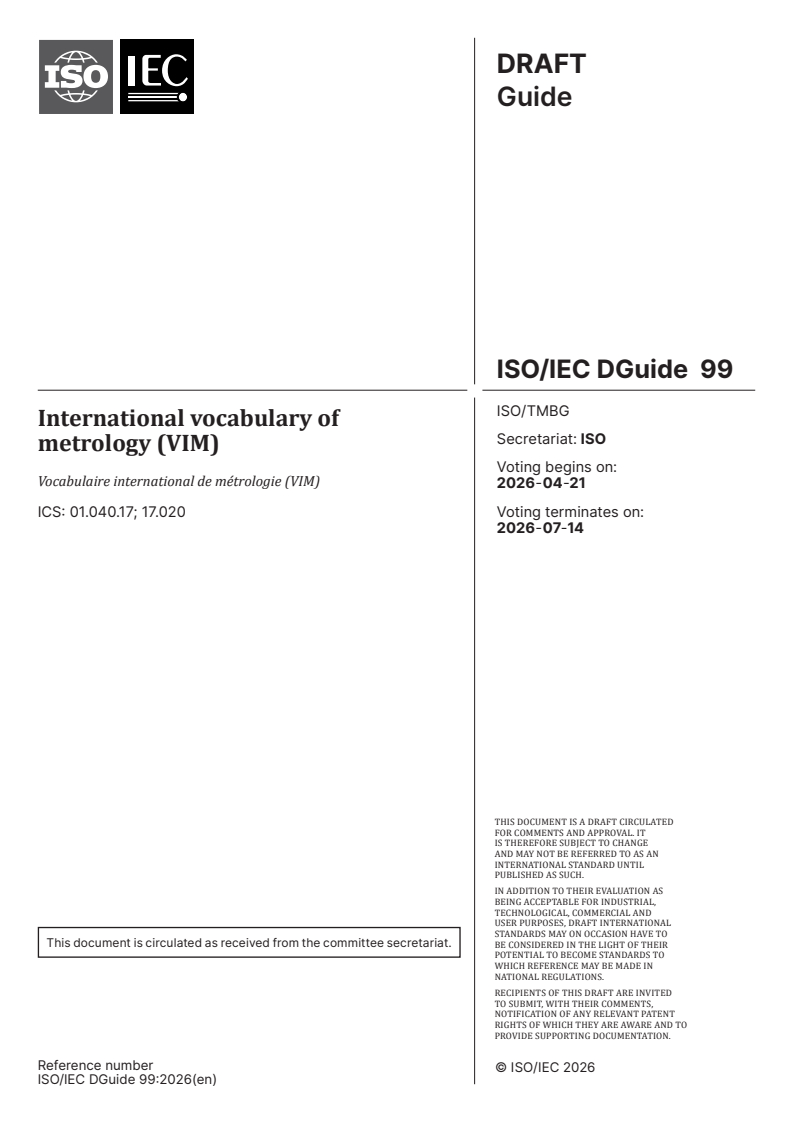
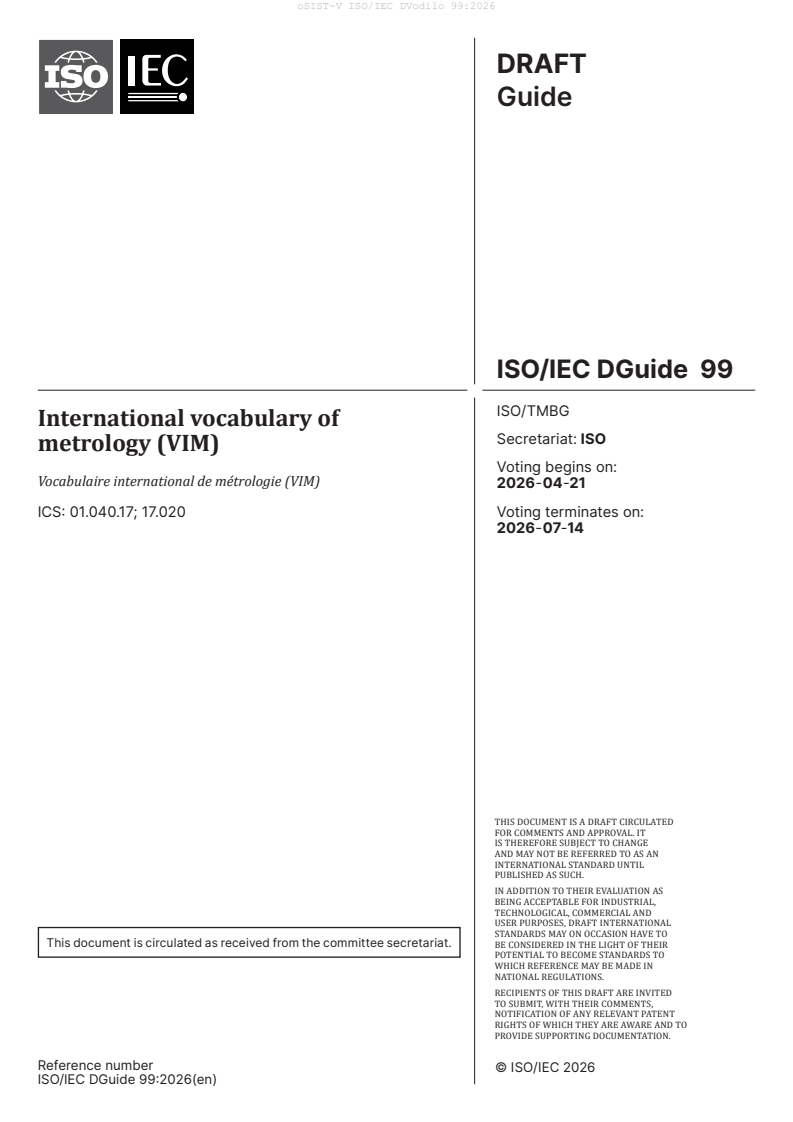
DRAFT
Guide
ISO/IEC DGuide 99
ISO/TMBG
International vocabulary of
Secretariat: ISO
metrology (VIM)
Voting begins on:
Vocabulaire international de métrologie (VIM)
2026-04-21
Voting terminates on:
ICS: 01.040.17; 17.020
2026-07-14
THIS DOCUMENT IS A DRAFT CIRCULATED
FOR COMMENTS AND APPROVAL. IT
IS THEREFORE SUBJECT TO CHANGE
AND MAY NOT BE REFERRED TO AS AN
INTERNATIONAL STANDARD UNTIL
PUBLISHED AS SUCH.
IN ADDITION TO THEIR EVALUATION AS
BEING ACCEPTABLE FOR INDUSTRIAL,
TECHNOLOGICAL, COMMERCIAL AND
USER PURPOSES, DRAFT INTERNATIONAL
STANDARDS MAY ON OCCASION HAVE TO
This document is circulated as received from the committee secretariat.
BE CONSIDERED IN THE LIGHT OF THEIR
POTENTIAL TO BECOME STANDARDS TO
WHICH REFERENCE MAY BE MADE IN
NATIONAL REGULATIONS.
RECIPIENTS OF THIS DRAFT ARE INVITED
TO SUBMIT, WITH THEIR COMMENTS,
NOTIFICATION OF ANY RELEVANT PATENT
RIGHTS OF WHICH THEY ARE AWARE AND TO
PROVIDE SUPPORTING DOCUMENTATION.
Reference number
© ISO/IEC 2026
DRAFT
Guide
ISO/IEC DGuide 99
ISO/TMBG
International vocabulary of
Secretariat: ISO
metrology (VIM)
Voting begins on:
Vocabulaire international de métrologie (VIM)
ICS: 01.040.17; 17.020 Voting terminates on:
THIS DOCUMENT IS A DRAFT CIRCULATED
FOR COMMENTS AND APPROVAL. IT
IS THEREFORE SUBJECT TO CHANGE
AND MAY NOT BE REFERRED TO AS AN
INTERNATIONAL STANDARD UNTIL
PUBLISHED AS SUCH.
IN ADDITION TO THEIR EVALUATION AS
BEING ACCEPTABLE FOR INDUSTRIAL,
© ISO/IEC 2026
TECHNOLOGICAL, COMMERCIAL AND
USER PURPOSES, DRAFT INTERNATIONAL
All rights reserved. Unless otherwise specified, or required in the context of its implementation, no part of this publication may
STANDARDS MAY ON OCCASION HAVE TO
be reproduced or utilized otherwise in any form or by any means, electronic or mechanical, including photocopying, or posting on
This document is circulated as received from the committee secretariat. BE CONSIDERED IN THE LIGHT OF THEIR
the internet or an intranet, without prior written permission. Permission can be requested from either ISO at the address below
POTENTIAL TO BECOME STANDARDS TO
WHICH REFERENCE MAY BE MADE IN
or ISO’s member body in the country of the requester.
NATIONAL REGULATIONS.
ISO copyright office
RECIPIENTS OF THIS DRAFT ARE INVITED
CP 401 • Ch. de Blandonnet 8
TO SUBMIT, WITH THEIR COMMENTS,
CH-1214 Vernier, Geneva
NOTIFICATION OF ANY RELEVANT PATENT
Phone: +41 22 749 01 11
RIGHTS OF WHICH THEY ARE AWARE AND TO
PROVIDE SUPPORTING DOCUMENTATION.
Email: copyright@iso.org
Website: www.iso.org
Published in Switzerland Reference number
© ISO/IEC 2026
© ISO/IEC 2026 – All rights reserved
ii
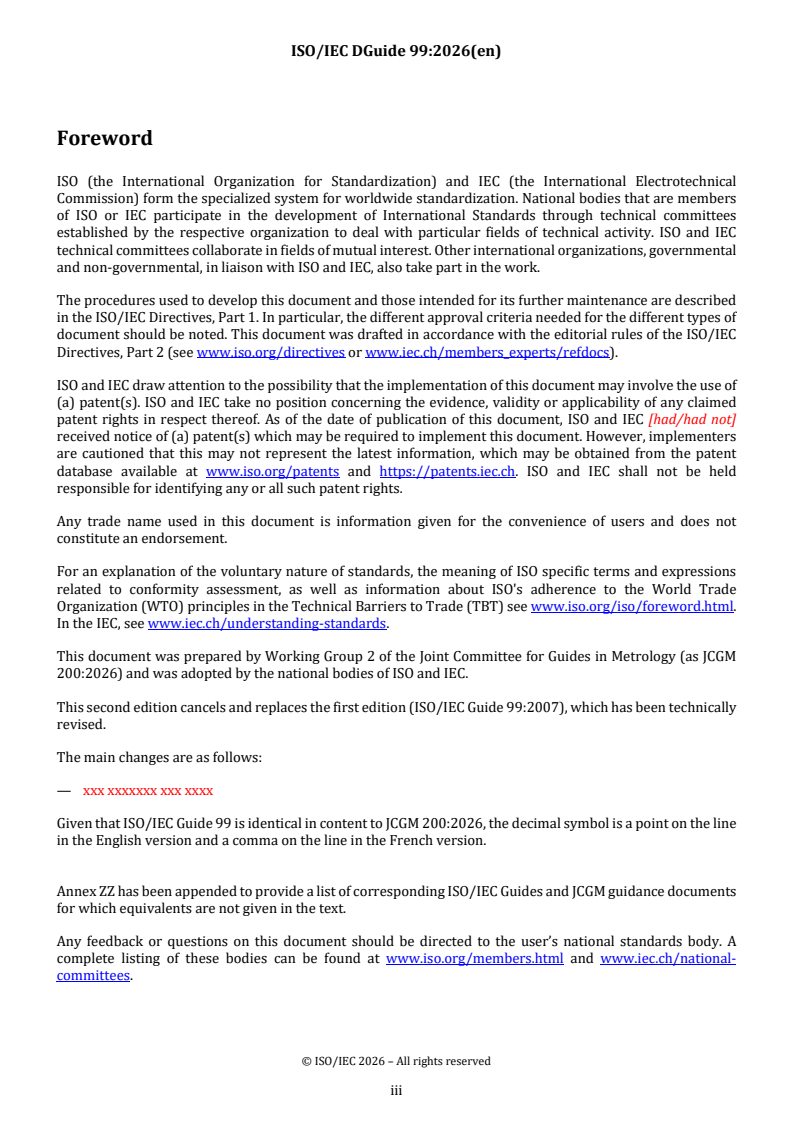
Foreword
ISO (the International Organization for Standardization) and IEC (the International Electrotechnical
Commission) form the specialized system for worldwide standardization. National bodies that are members
of ISO or IEC participate in the development of International Standards through technical committees
established by the respective organization to deal with particular fields of technical activity. ISO and IEC
technical committees collaborate in fields of mutual interest. Other international organizations, governmental
and non-governmental, in liaison with ISO and IEC, also take part in the work.
The procedures used to develop this document and those intended for its further maintenance are described
in the ISO/IEC Directives, Part 1. In particular, the different approval criteria needed for the different types of
document should be noted. This document was drafted in accordance with the editorial rules of the ISO/IEC
Directives, Part 2 (see www.iso.org/directives or www.iec.ch/members_experts/refdocs).
ISO and IEC draw attention to the possibility that the implementation of this document may involve the use of
(a) patent(s). ISO and IEC take no position concerning the evidence, validity or applicability of any claimed
patent rights in respect thereof. As of the date of publication of this document, ISO and IEC [had/had not]
received notice of (a) patent(s) which may be required to implement this document. However, implementers
are cautioned that this may not represent the latest information, which may be obtained from the patent
database available at www.iso.org/patents and https://patents.iec.ch. ISO and IEC shall not be held
responsible for identifying any or all such patent rights.
Any trade name used in this document is information given for the convenience of users and does not
constitute an endorsement.
For an explanation of the voluntary nature of standards, the meaning of ISO specific terms and expressions
related to conformity assessment, as well as information about ISO's adherence to the World Trade
Organization (WTO) principles in the Technical Barriers to Trade (TBT) see www.iso.org/iso/foreword.html.
In the IEC, see www.iec.ch/understanding-standards.
This document was prepared by Working Group 2 of the Joint Committee for Guides in Metrology (as JCGM
200:2026) and was adopted by the national bodies of ISO and IEC.
This second edition cancels and replaces the first edition (ISO/IEC Guide 99:2007), which has been technically
revised.
The main changes are as follows:
— xxx xxxxxxx xxx xxxx
Given that ISO/IEC Guide 99 is identical in content to JCGM 200:2026, the decimal symbol is a point on the line
in the English version and a comma on the line in the French version.
Annex ZZ has been appended to provide a list of corresponding ISO/IEC Guides and JCGM guidance documents
for which equivalents are not given in the text.
Any feedback or questions on this document should be directed to the user’s national standards body. A
complete listing of these bodies can be found at www.iso.org/members.html and www.iec.ch/national-
committees.
© ISO/IEC 2026 – All rights reserved
iii
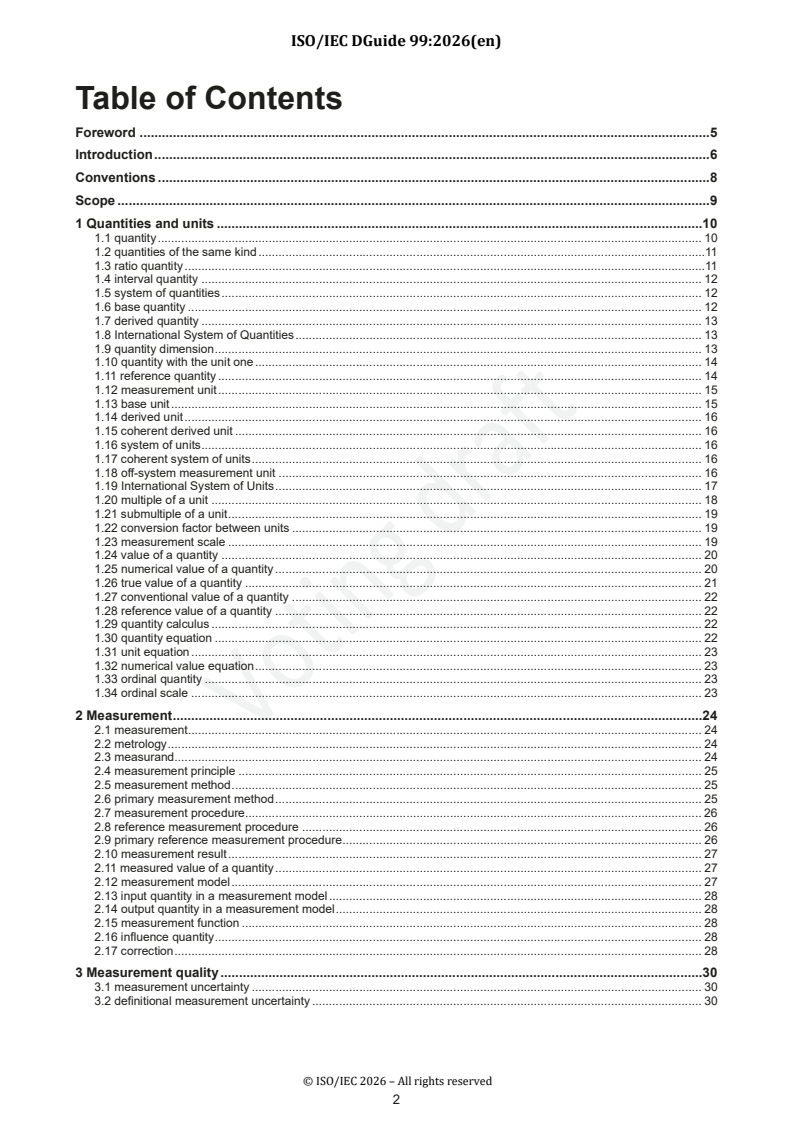
Table of Contents
Foreword . 5
Introduction . 6
Conventions . 8
Scope . 9
1 Quantities and units . 10
1.1 quantity . 10
1.2 quantities of the same kind .11
1.3 ratio quantity .11
1.4 interval quantity . 12
1.5 system of quantities . 12
1.6 base quantity . 12
1.7 derived quantity . 13
1.8 International System of Quantities . 13
1.9 quantity dimension . 13
1.10 quantity with the unit one . 14
1.11 reference quantity . 14
1.12 measurement unit . 15
1.13 base unit . 15
1.14 derived unit . 16
1.15 coherent derived unit . 16
1.16 system of units . 16
1.17 coherent system of units . 16
1.18 off-system measurement unit . 16
1.19 International System of Units . 17
1.20 multiple of a unit . 18
1.21 submultiple of a unit . 19
1.22 conversion factor between units . 19
1.23 measurement scale . 19
1.24 value of a quantity . 20
1.25 numerical value of a quantity . 20
1.26 true value of a quantity . 21
1.27 conventional value of a quantity . 22
1.28 reference value of a quantity . 22
1.29 quantity calculus . 22
1.30 quantity equation . 22
1.31 unit equation . 23
1.32 numerical value equation . 23
1.33 ordinal quantity . 23
1.34 ordinal scale . 23
2 Measurement . 24
2.1 measurement . 24
2.2 metrology . 24
2.3 measurand . 24
2.4 measurement principle . 25
2.5 measurement method . 25
2.6 primary measurement method . 25
2.7 measurement procedure . 26
2.8 reference measurement procedure . 26
2.9 primary reference measurement procedure . 26
2.10 measurement result . 27
2.11 measured value of a quantity . 27
2.12 measurement model . 27
2.13 input quantity in a measurement model . 28
2.14 output quantity in a measurement model . 28
2.15 measurement function . 28
2.16 influence quantity . 28
2.17 correction . 28
3 Measurement quality . 30
3.1 measurement uncertainty . 30
3.2 definitional measurement uncertainty . 30
© ISO/IEC 2026 – All rights reserved
3.3 target measurement uncertainty . 30
3.4 instrumental measurement uncertainty . 31
3.5 Type A evaluation of measurement uncertainty . 31
3.6 Type B evaluation of measurement uncertainty . 31
3.7 standard measurement uncertainty . 31
3.8 combined standard measurement uncertainty . 32
3.9 relative standard measurement uncertainty . 32
3.10 uncertainty budget . 32
3.11 expanded measurement uncertainty . 32
3.12 coverage interval . 32
3.13 coverage probability. 32
3.14 coverage factor . 32
3.15 measurement accuracy . 33
3.16 measurement trueness . 33
3.17 measurement precision . 33
3.18 measurement error . 34
3.19 systematic measurement error . 34
3.20 measurement bias . 34
3.21 random measurement error . 34
3.22 repeatability conditions of measurement . 35
3.23 measurement repeatability . 35
3.24 intermediate precision conditions of measurement . 35
3.25 intermediate measurement precision . 35
3.26 reproducibility conditions of measurement . 36
3.27 measurement reproducibility . 36
3.28 maximum permissible measurement error . 36
3.29 datum measurement error . 36
3.30 null measurement uncertainty . 36
4 Measuring devices and their properties. 38
4.1 measuring instrument . 38
4.2 measuring system . 38
4.3 indicating measuring instrument . 38
4.4 displaying measuring instrument . 38
4.5 scale of a displaying measuring instrument . 38
4.6 material measure . 38
4.7 measuring transducer . 39
4.8 sensor . 39
4.9 detector . 39
4.10 measuring chain . 39
4.11 adjustment . 40
4.12 zero adjustment . 40
4.13 indication . 40
4.14 blank indication . 40
4.15 indication interval . 40
4.16 nominal indication interval . 41
4.17 nominal value . 41
4.18 measuring interval . 41
4.19 operating condition . 41
4.20 rated operating conditions . 41
4.21 limiting operating conditions . 42
4.22 reference operating conditions . 42
4.23 sensitivity . 42
4.24 selectivity . 42
4.25 resolution . 43
4.26 discrimination threshold . 43
4.27 dead band . 43
4.28 detection limit . 43
4.29 stability . 44
4.30 instrumental bias . 44
4.31 instrumental drift . 44
4.32 step response time . 44
4.33 accuracy class . 44
5 Measurement standards and metrological traceability . 45
5.1 measurement standard . 45
5.2 international measurement standard . 45
5.3 national measurement standard . 46
© ISO/IEC 2026 – All rights reserved
5.4 primary measurement standard . 46
5.5 secondary measurement standard . 46
5.6 reference measurement standard . 46
5.7 working measurement standard . 46
5.8 travelling measurement standard . 47
5.9 transfer measurement device . 47
5.10 intrinsic measurement standard . 47
5.11 calibrator . 47
5.12 reference material . 47
5.13 certified reference material . 48
5.14 certified value of a CRM . 48
5.15 commutability of a reference material . 48
5.16 reference data . 48
5.17 standard reference data . 48
5.18 calibration . 49
5.19 calibration function . 49
5.20 calibration diagram . 49
5.21 calibration hierarchy. 49
5.22 metrological traceability . 50
5.23 metrological traceability chain . 50
5.24 verification . 51
5.25 validation . 51
5.26 metrological comparability of measurement results . 51
5.27 metrological compatibility of measurement results . 52
6 Nominal properties and examinations . 53
6.1 nominal property . 53
6.2 nominal properties of the same kind . 53
6.3 reference nominal property . 54
6.4 nominal scale . 54
6.5 value of a nominal property . 54
6.6 reference value of a nominal property . 55
6.7 nominal examination . 55
6.8 examinand . 55
6.9 examination principle . 55
6.10 examination method . 56
6.11 examination procedure . 56
6.12 reference examination procedure . 56
6.13 examination result . 57
6.14 examined value . 57
6.15 examination uncertainty . 57
6.16 examining system . 58
6.17 examination standard . 58
6.18 examination calibration . 58
6.19 examination traceability . 58
6.20 comparability of examination results . 59
Annex: Significant changes with respect to the VIM3 . 60
Changes in terms and definitions . 60
New entries . 70
Deleted entries . 71
Changes in the structure of chapters . 71
Other changes . 72
Alphabetical Index . 75
© ISO/IEC 2026 – All rights reserved
Foreword
Since its foundation, in 1997, the Joint Committee for Guides in Metrology (JCGM) has the purpose
to develop and maintain, at the international level, guidance documents addressing the general
metrological needs of science and technology, to consider arrangements for their dissemination, and
to promote worldwide adoption and implementation of the results of its work.
Eight international organizations currently form the JCGM:
x the two inter-governmental organizations concerned with metrology: the Bureau International
des Poids et Mesures (BIPM) and the Organisation Internationale de Métrologie Légale
(OIML);
x the two principal international standardization organizations: the International Organization
for Standardization (ISO) and the International Electrotechnical Commission (IEC);
x three international science unions: the International Union of Pure and Applied Chemistry
(IUPAC), the International Union of Pure and Applied Physics (IUPAP), and the International
Federation of Clinical Chemistry and Laboratory Medicine (IFCC);
x one international accreditation organization: the International Laboratory Accreditation
Cooperation (ILAC).
The JCGM has two Working Groups, JCGM-WG2:VIM, responsible for the International Vocabulary
of Metrology (the VIM), and JCGM-WG1:GUM, responsible for the Guide to the Expression of
Uncertainty in Measurement (the GUM). This document was developed and prepared for publication
by JCGM-WG2:VIM, and approved for release following the procedures of the JCGM and its Member
Organizations.
This fourth edition of the International Vocabulary of Metrology cancels and replaces the third edition.
A list of the principal changes in this edition can be found in the Annex on Significant Changes.
© ISO/IEC 2026 – All rights reserved
Introduction
The International Vocabulary of Metrology (“the VIM”) is a JCGM guidance document intended to
support worldwide harmonization of the fundamental terminology related to metrology. It constitutes
a recommendation on terminology that JCGM Member Organizations are encouraged to implement,
each according to its own purposes and in reference to its own scope.
The third edition of the VIM (denoted herein as the “VIM3”) was published by the JCGM in 2008, and
republished with minor corrections in 2012. Since then, interest in the topic of nominal properties
has increased substantially in the metrology community, with the recognition that metrology is often
important in the examination of nominal properties. The International System of Units (SI) was
revised in 2019, and a new, ninth, edition of the SI Brochure [1] has been published. There is greater
interest in digitalization, placing heavier demands on precise vocabulary for machine readability and
actionability. JCGM Member Organizations have requested simplification of the language in VIM
definitions, to facilitate wider understanding and translation. JCGM-WG2 has also published an
electronic “annotated VIM”, containing additional explanatory material which had not been
incorporated in a formal release of the VIM.
This fourth edition of the VIM (VIM4) has been designed to address these issues. To meet the needs
for new terminology to accommodate metrology related to nominal properties, a new chapter,
containing new entries related to nominal properties and their examination, has been introduced into
the VIM4. These new entries have mainly been taken from the Vocabulary on nominal property,
examination, and related concepts for clinical laboratory sciences [47], adapted for consistency with
other VIM terms and definitions. To address the revision of the SI, relevant entries have been revised
for consistency with the new approach, in which all the SI units are individual quantities defined by
reference to fundamental constants. The VIM4 also follows the SI Brochure in the treatment of
quantities that are counted and quantities defined as ratios; the VIM4 refers to these as “quantities
with the unit one”, as in the SI Brochure. Finally, a large part of the text has been revised to improve
readability, to add further clarifications through new Notes and Examples, and to incorporate many
of the annotations to the VIM3 in the electronic “annotated VIM”.
These changes, together with the opportunity for improvement presented by the revision of the VIM,
stimulated further consideration of other key concepts. In particular:
x The treatment of values of quantities, as appearing in basic relations like (m = 0.1234 kg),
A
has been improved. This relation is now more explicitly interpreted as an equation stating
that the individual quantity identified as the mass m of a given object A, and the individual
quantity identified as 0.1234 times the kilogram, are the same mass. As a consequence, the
presentation and definitions for concepts such as ‘quantity’, ‘value of a quantity’ and ‘true
value of a quantity’ have been significantly amended in this edition. These changes and their
rationale are discussed in more detail in the Annex on “Significant changes”.
x The systematic revision of the entries related to properties, including those about units,
scales, and values, has led to focusing on the ambiguity of the term “quantity”. This term is
used to refer to both quantities in the general sense, such as length and mass, and to
individual quantities, such as lengths and masses of particular objects. These cases are not
distinguished by separate terms and definitions in this Vocabulary, but new explanatory notes
and examples are provided for clarification.
© ISO/IEC 2026 – All rights reserved
x The use of the term “magnitude” was reviewed. In the previous edition of the VIM, ‘quantity’
was defined as a property that has a magnitude. In some contexts, however, “quantity” and
“magnitude” are considered synonyms. Further, “magnitude” is not easy to translate into
some other languages. Hence, “magnitude” is not used in this Vocabulary. Quantities are,
instead, operationally defined according to the nature of possible comparisons (ratio,
difference etc.) between them.
x Following the more extensive treatment of nominal properties, the definitions of
‘measurement’ and ‘metrology’ were also reviewed. Following inquiry among JCGM Member
Organizations, the existing definitions have been retained for this edition. However, new
Notes on these, and related, terms acknowledge the increased importance of nominal
properties and their examinations.
x The inclusion of additional terms for nominal properties, for which no ordering relation is
defined, stimulated further consideration of the related topic of ordinal properties. These can
be ordered meaningfully, but differences and ratios are not defined for them. The third edition
of the VIM described these as quantities despite the absence of difference and ratio
operations. After careful analysis, it was decided to minimize changes on this matter with
respect to the VIM3. This edition therefore maintains the position that ordinal properties are
quantities and measurement applies to them.
x Concepts for characterization of the quality of measurement and its results, including
‘measurement error’, ‘measurement accuracy’, and ‘measurement trueness’, have been
defined for greater generality than in previous editions. These terms are variously used in
metrology to describe both measured values and differences and parameters in statistical
models. To accommodate these uses, the VIM4 has adopted more general definitions,
phrased in terms of reference values, of which true values are specific cases. This approach
provides flexibility for the differing perspectives on the use of “true value”.
x The organization of terms into chapters has been revised; in particular, terms related to
metrological traceability and calibration are now grouped with terms related to measurement
standards (Chapter 5).
Finally, for transparency and to support users in the transition from the VIM3 to the VIM4, all changes
that are considered significant are presented and justified in an Annex of this Vocabulary.
© ISO/IEC 2026 – All rights reserved
Conventions
The definitions and terms given in this fourth edition of the VIM, as well as their formats, c
...
SLOVENSKI STANDARD
01-junij-2026
Mednarodna terminologija meroslovja (VIM)
International vocabulary of metrology (VIM)
Vocabulaire international de métrologie (VIM)
Ta slovenski standard je istoveten z: ISO/IEC DGuide 99
ICS:
01.040.17 Meroslovje in merjenje. Metrology and measurement.
Fizikalni pojavi (Slovarji) Physical phenomena
(Vocabularies)
17.020 Meroslovje in merjenje na Metrology and measurement
splošno in general
2003-01.Slovenski inštitut za standardizacijo. Razmnoževanje celote ali delov tega standarda ni dovoljeno.
DRAFT
Guide
ISO/IEC DGuide 99
ISO/TMBG
International vocabulary of
Secretariat: ISO
metrology (VIM)
Voting begins on:
Vocabulaire international de métrologie (VIM)
2026-04-21
Voting terminates on:
ICS: 01.040.17; 17.020
2026-07-14
THIS DOCUMENT IS A DRAFT CIRCULATED
FOR COMMENTS AND APPROVAL. IT
IS THEREFORE SUBJECT TO CHANGE
AND MAY NOT BE REFERRED TO AS AN
INTERNATIONAL STANDARD UNTIL
PUBLISHED AS SUCH.
IN ADDITION TO THEIR EVALUATION AS
BEING ACCEPTABLE FOR INDUSTRIAL,
TECHNOLOGICAL, COMMERCIAL AND
USER PURPOSES, DRAFT INTERNATIONAL
STANDARDS MAY ON OCCASION HAVE TO
This document is circulated as received from the committee secretariat.
BE CONSIDERED IN THE LIGHT OF THEIR
POTENTIAL TO BECOME STANDARDS TO
WHICH REFERENCE MAY BE MADE IN
NATIONAL REGULATIONS.
RECIPIENTS OF THIS DRAFT ARE INVITED
TO SUBMIT, WITH THEIR COMMENTS,
NOTIFICATION OF ANY RELEVANT PATENT
RIGHTS OF WHICH THEY ARE AWARE AND TO
PROVIDE SUPPORTING DOCUMENTATION.
Reference number
© ISO/IEC 2026
DRAFT
Guide
ISO/IEC DGuide 99
ISO/TMBG
International vocabulary of
Secretariat: ISO
metrology (VIM)
Voting begins on:
Vocabulaire international de métrologie (VIM)
ICS: 01.040.17; 17.020 Voting terminates on:
THIS DOCUMENT IS A DRAFT CIRCULATED
FOR COMMENTS AND APPROVAL. IT
IS THEREFORE SUBJECT TO CHANGE
AND MAY NOT BE REFERRED TO AS AN
INTERNATIONAL STANDARD UNTIL
PUBLISHED AS SUCH.
IN ADDITION TO THEIR EVALUATION AS
BEING ACCEPTABLE FOR INDUSTRIAL,
© ISO/IEC 2026
TECHNOLOGICAL, COMMERCIAL AND
USER PURPOSES, DRAFT INTERNATIONAL
All rights reserved. Unless otherwise specified, or required in the context of its implementation, no part of this publication may
STANDARDS MAY ON OCCASION HAVE TO
be reproduced or utilized otherwise in any form or by any means, electronic or mechanical, including photocopying, or posting on
This document is circulated as received from the committee secretariat. BE CONSIDERED IN THE LIGHT OF THEIR
the internet or an intranet, without prior written permission. Permission can be requested from either ISO at the address below
POTENTIAL TO BECOME STANDARDS TO
WHICH REFERENCE MAY BE MADE IN
or ISO’s member body in the country of the requester.
NATIONAL REGULATIONS.
ISO copyright office
RECIPIENTS OF THIS DRAFT ARE INVITED
CP 401 • Ch. de Blandonnet 8
TO SUBMIT, WITH THEIR COMMENTS,
CH-1214 Vernier, Geneva
NOTIFICATION OF ANY RELEVANT PATENT
Phone: +41 22 749 01 11
RIGHTS OF WHICH THEY ARE AWARE AND TO
PROVIDE SUPPORTING DOCUMENTATION.
Email: copyright@iso.org
Website: www.iso.org
Published in Switzerland Reference number
© ISO/IEC 2026
© ISO/IEC 2026 – All rights reserved
ii
Foreword
ISO (the International Organization for Standardization) and IEC (the International Electrotechnical
Commission) form the specialized system for worldwide standardization. National bodies that are members
of ISO or IEC participate in the development of International Standards through technical committees
established by the respective organization to deal with particular fields of technical activity. ISO and IEC
technical committees collaborate in fields of mutual interest. Other international organizations, governmental
and non-governmental, in liaison with ISO and IEC, also take part in the work.
The procedures used to develop this document and those intended for its further maintenance are described
in the ISO/IEC Directives, Part 1. In particular, the different approval criteria needed for the different types of
document should be noted. This document was drafted in accordance with the editorial rules of the ISO/IEC
Directives, Part 2 (see www.iso.org/directives or www.iec.ch/members_experts/refdocs).
ISO and IEC draw attention to the possibility that the implementation of this document may involve the use of
(a) patent(s). ISO and IEC take no position concerning the evidence, validity or applicability of any claimed
patent rights in respect thereof. As of the date of publication of this document, ISO and IEC [had/had not]
received notice of (a) patent(s) which may be required to implement this document. However, implementers
are cautioned that this may not represent the latest information, which may be obtained from the patent
database available at www.iso.org/patents and https://patents.iec.ch. ISO and IEC shall not be held
responsible for identifying any or all such patent rights.
Any trade name used in this document is information given for the convenience of users and does not
constitute an endorsement.
For an explanation of the voluntary nature of standards, the meaning of ISO specific terms and expressions
related to conformity assessment, as well as information about ISO's adherence to the World Trade
Organization (WTO) principles in the Technical Barriers to Trade (TBT) see www.iso.org/iso/foreword.html.
In the IEC, see www.iec.ch/understanding-standards.
This document was prepared by Working Group 2 of the Joint Committee for Guides in Metrology (as JCGM
200:2026) and was adopted by the national bodies of ISO and IEC.
This second edition cancels and replaces the first edition (ISO/IEC Guide 99:2007), which has been technically
revised.
The main changes are as follows:
— xxx xxxxxxx xxx xxxx
Given that ISO/IEC Guide 99 is identical in content to JCGM 200:2026, the decimal symbol is a point on the line
in the English version and a comma on the line in the French version.
Annex ZZ has been appended to provide a list of corresponding ISO/IEC Guides and JCGM guidance documents
for which equivalents are not given in the text.
Any feedback or questions on this document should be directed to the user’s national standards body. A
complete listing of these bodies can be found at www.iso.org/members.html and www.iec.ch/national-
committees.
© ISO/IEC 2026 – All rights reserved
iii
Table of Contents
Foreword . 5
Introduction . 6
Conventions . 8
Scope . 9
1 Quantities and units . 10
1.1 quantity . 10
1.2 quantities of the same kind .11
1.3 ratio quantity .11
1.4 interval quantity . 12
1.5 system of quantities . 12
1.6 base quantity . 12
1.7 derived quantity . 13
1.8 International System of Quantities . 13
1.9 quantity dimension . 13
1.10 quantity with the unit one . 14
1.11 reference quantity . 14
1.12 measurement unit . 15
1.13 base unit . 15
1.14 derived unit . 16
1.15 coherent derived unit . 16
1.16 system of units . 16
1.17 coherent system of units . 16
1.18 off-system measurement unit . 16
1.19 International System of Units . 17
1.20 multiple of a unit . 18
1.21 submultiple of a unit . 19
1.22 conversion factor between units . 19
1.23 measurement scale . 19
1.24 value of a quantity . 20
1.25 numerical value of a quantity . 20
1.26 true value of a quantity . 21
1.27 conventional value of a quantity . 22
1.28 reference value of a quantity . 22
1.29 quantity calculus . 22
1.30 quantity equation . 22
1.31 unit equation . 23
1.32 numerical value equation . 23
1.33 ordinal quantity . 23
1.34 ordinal scale . 23
2 Measurement . 24
2.1 measurement . 24
2.2 metrology . 24
2.3 measurand . 24
2.4 measurement principle . 25
2.5 measurement method . 25
2.6 primary measurement method . 25
2.7 measurement procedure . 26
2.8 reference measurement procedure . 26
2.9 primary reference measurement procedure . 26
2.10 measurement result . 27
2.11 measured value of a quantity . 27
2.12 measurement model . 27
2.13 input quantity in a measurement model . 28
2.14 output quantity in a measurement model . 28
2.15 measurement function . 28
2.16 influence quantity . 28
2.17 correction . 28
3 Measurement quality . 30
3.1 measurement uncertainty . 30
3.2 definitional measurement uncertainty . 30
© ISO/IEC 2026 – All rights reserved
3.3 target measurement uncertainty . 30
3.4 instrumental measurement uncertainty . 31
3.5 Type A evaluation of measurement uncertainty . 31
3.6 Type B evaluation of measurement uncertainty . 31
3.7 standard measurement uncertainty . 31
3.8 combined standard measurement uncertainty . 32
3.9 relative standard measurement uncertainty . 32
3.10 uncertainty budget . 32
3.11 expanded measurement uncertainty . 32
3.12 coverage interval . 32
3.13 coverage probability. 32
3.14 coverage factor . 32
3.15 measurement accuracy . 33
3.16 measurement trueness . 33
3.17 measurement precision . 33
3.18 measurement error . 34
3.19 systematic measurement error . 34
3.20 measurement bias . 34
3.21 random measurement error . 34
3.22 repeatability conditions of measurement . 35
3.23 measurement repeatability . 35
3.24 intermediate precision conditions of measurement . 35
3.25 intermediate measurement precision . 35
3.26 reproducibility conditions of measurement . 36
3.27 measurement reproducibility . 36
3.28 maximum permissible measurement error . 36
3.29 datum measurement error . 36
3.30 null measurement uncertainty . 36
4 Measuring devices and their properties. 38
4.1 measuring instrument . 38
4.2 measuring system . 38
4.3 indicating measuring instrument . 38
4.4 displaying measuring instrument . 38
4.5 scale of a displaying measuring instrument . 38
4.6 material measure . 38
4.7 measuring transducer . 39
4.8 sensor . 39
4.9 detector . 39
4.10 measuring chain . 39
4.11 adjustment . 40
4.12 zero adjustment . 40
4.13 indication . 40
4.14 blank indication . 40
4.15 indication interval . 40
4.16 nominal indication interval . 41
4.17 nominal value . 41
4.18 measuring interval . 41
4.19 operating condition . 41
4.20 rated operating conditions . 41
4.21 limiting operating conditions . 42
4.22 reference operating conditions . 42
4.23 sensitivity . 42
4.24 selectivity . 42
4.25 resolution . 43
4.26 discrimination threshold . 43
4.27 dead band . 43
4.28 detection limit . 43
4.29 stability . 44
4.30 instrumental bias . 44
4.31 instrumental drift . 44
4.32 step response time . 44
4.33 accuracy class . 44
5 Measurement standards and metrological traceability . 45
5.1 measurement standard . 45
5.2 international measurement standard . 45
5.3 national measurement standard . 46
© ISO/IEC 2026 – All rights reserved
5.4 primary measurement standard . 46
5.5 secondary measurement standard . 46
5.6 reference measurement standard . 46
5.7 working measurement standard . 46
5.8 travelling measurement standard . 47
5.9 transfer measurement device . 47
5.10 intrinsic measurement standard . 47
5.11 calibrator . 47
5.12 reference material . 47
5.13 certified reference material . 48
5.14 certified value of a CRM . 48
5.15 commutability of a reference material . 48
5.16 reference data . 48
5.17 standard reference data . 48
5.18 calibration . 49
5.19 calibration function . 49
5.20 calibration diagram . 49
5.21 calibration hierarchy. 49
5.22 metrological traceability . 50
5.23 metrological traceability chain . 50
5.24 verification . 51
5.25 validation . 51
5.26 metrological comparability of measurement results . 51
5.27 metrological compatibility of measurement results . 52
6 Nominal properties and examinations . 53
6.1 nominal property . 53
6.2 nominal properties of the same kind . 53
6.3 reference nominal property . 54
6.4 nominal scale . 54
6.5 value of a nominal property . 54
6.6 reference value of a nominal property . 55
6.7 nominal examination . 55
6.8 examinand . 55
6.9 examination principle . 55
6.10 examination method . 56
6.11 examination procedure . 56
6.12 reference examination procedure . 56
6.13 examination result . 57
6.14 examined value . 57
6.15 examination uncertainty . 57
6.16 examining system . 58
6.17 examination standard . 58
6.18 examination calibration . 58
6.19 examination traceability . 58
6.20 comparability of examination results . 59
Annex: Significant changes with respect to the VIM3 . 60
Changes in terms and definitions . 60
New entries . 70
Deleted entries . 71
Changes in the structure of chapters . 71
Other changes . 72
Alphabetical Index . 75
© ISO/IEC 2026 – All rights reserved
Foreword
Since its foundation, in 1997, the Joint Committee for Guides in Metrology (JCGM) has the purpose
to develop and maintain, at the international level, guidance documents addressing the general
metrological needs of science and technology, to consider arrangements for their dissemination, and
to promote worldwide adoption and implementation of the results of its work.
Eight international organizations currently form the JCGM:
x the two inter-governmental organizations concerned with metrology: the Bureau International
des Poids et Mesures (BIPM) and the Organisation Internationale de Métrologie Légale
(OIML);
x the two principal international standardization organizations: the International Organization
for Standardization (ISO) and the International Electrotechnical Commission (IEC);
x three international science unions: the International Union of Pure and Applied Chemistry
(IUPAC), the International Union of Pure and Applied Physics (IUPAP), and the International
Federation of Clinical Chemistry and Laboratory Medicine (IFCC);
x one international accreditation organization: the International Laboratory Accreditation
Cooperation (ILAC).
The JCGM has two Working Groups, JCGM-WG2:VIM, responsible for the International Vocabulary
of Metrology (the VIM), and JCGM-WG1:GUM, responsible for the Guide to the Expression of
Uncertainty in Measurement (the GUM). This document was developed and prepared for publication
by JCGM-WG2:VIM, and approved for release following the procedures of the JCGM and its Member
Organizations.
This fourth edition of the International Vocabulary of Metrology cancels and replaces the third edition.
A list of the principal changes in this edition can be found in the Annex on Significant Changes.
© ISO/IEC 2026 – All rights reserved
Introduction
The International Vocabulary of Metrology (“the VIM”) is a JCGM guidance document intended to
support worldwide harmonization of the fundamental terminology related to metrology. It constitutes
a recommendation on terminology that JCGM Member Organizations are encouraged to implement,
each according to its own purposes and in reference to its own scope.
The third edition of the VIM (denoted herein as the “VIM3”) was published by the JCGM in 2008, and
republished with minor corrections in 2012. Since then, interest in the topic of nominal properties
has increased substantially in the metrology community, with the recognition that metrology is often
important in the examination of nominal properties. The International System of Units (SI) was
revised in 2019, and a new, ninth, edition of the SI Brochure [1] has been published. There is greater
interest in digitalization, placing heavier demands on precise vocabulary for machine readability and
actionability. JCGM Member Organizations have requested simplification of the language in VIM
definitions, to facilitate wider understanding and translation. JCGM-WG2 has also published an
electronic “annotated VIM”, containing additional explanatory material which had not been
incorporated in a formal release of the VIM.
This fourth edition of the VIM (VIM4) has been designed to address these issues. To meet the needs
for new terminology to accommodate metrology related to nominal properties, a new chapter,
containing new entries related to nominal properties and their examination, has been introduced into
the VIM4. These new entries have mainly been taken from the Vocabulary on nominal property,
examination, and related concepts for clinical laboratory sciences [47], adapted for consistency with
other VIM terms and definitions. To address the revision of the SI, relevant entries have been revised
for consistency with the new approach, in which all the SI units are individual quantities defined by
reference to fundamental constants. The VIM4 also follows the SI Brochure in the treatment of
quantities that are counted and quantities defined as ratios; the VIM4 refers to these as “quantities
with the unit one”, as in the SI Brochure. Finally, a large part of the text has been revised to improve
readability, to add further clarifications through new Notes and Examples, and to incorporate many
of the annotations to the VIM3 in the electronic “annotated VIM”.
These changes, together with the opportunity for improvement presented by the revision of the VIM,
stimulated further consideration of other key concepts. In particular:
x The treatment of values of quantities, as appearing in basic relations like (m = 0.1234 kg),
A
has been improved. This relation is now more explicitly interpreted as an equation stating
that the individual quantity identified as the mass m of a given object A, and the individual
quantity identified as 0.1234 times the kilogram, are the same mass. As a consequence, the
presentation and definitions for concepts such as ‘quantity’, ‘value of a quantity’ and ‘true
value of a quantity’ have been significantly amended in this edition. These changes and their
rationale are discussed in more detail in the Annex on “Significant changes”.
x The systematic revision of the entries related to properties, including those about units,
scales, and values, has led to focusing on the ambiguity of the term “quantity”. This term is
used to refer to both quantities in the general sense, such as length and mass, and to
individual quantities, such as lengths and masses of particular objects. These cases are not
distinguished by separate terms and definitions in this Vocabulary, but new explanatory notes
and examples are provided for clarification.
© ISO/IEC 2026 – All rights reserved
x The use of the term “magnitude” was reviewed. In the previous edition of the VIM, ‘quantity’
was defined as a property that has a magnitude. In some contexts, however, “quantity” and
“magnitude” are considered synonyms. Further, “magnitude” is not easy to translate into
some other languages. Hence, “magnitude” is not used in this Vocabulary. Quantities are,
instead, operationally defined according to the nature of possible comparisons (ratio,
difference etc.) between them.
x Following the more extensive treatment of nominal properties, the definitions of
‘measurement’ and ‘metrology’ were also reviewed. Following inquiry among JCGM Member
Organizations, the existing definitions have been retained for this edition. However, new
Notes on these, and related, terms acknowledge the increased importance of nominal
properties and their examinations.
x The inclusion of additional terms for nominal properties, for which no ordering relation is
defined, stimulated further consideration of the related topic of ordinal properties. These can
be ordered meaningfully, but differences and ratios are not defined for them. The third edition
of the VIM described these as quantities despite the absence of difference and ratio
operations. After careful analysis, it was decided to minimize changes on this matter with
respect to the VIM3. This edition therefore maintains the position that ordinal properties are
quantities and measurement applies to them.
x Concepts for characterization of the quality of measurement and its results, including
‘measurement error’, ‘measurement accuracy’, and ‘measurement trueness’, have been
defined for greater generality th
...