


ISO 22992-2:2020
(Main)Textiles — Determination of certain preservatives — Part 2: Determination of triclosan residues method using LC-MS/MS
Textiles — Determination of certain preservatives — Part 2: Determination of triclosan residues method using LC-MS/MS
This document specifies a method for determination of triclosan residues in textiles by high performance liquid chromatography — tandem mass spectrometry (HPLC-MS/MS). This method is applicable to all kinds of textile products.
Textiles — Détermination de certains conservateurs — Partie 2: Détermination des résidus de triclosan par une méthode utilisant LC-MS/MS
General Information
- Status
- Published
- Publication Date
- 29-Oct-2020
- Technical Committee
- ISO/TC 38 - Textiles
- Drafting Committee
- ISO/TC 38/WG 22 - Composition and chemical testing
- Current Stage
- 9060 - Close of review
- Completion Date
- 04-Jun-2031
Overview
ISO 22992-2:2020 specifies a validated laboratory method for the determination of triclosan residues in textiles using liquid chromatography coupled with tandem mass spectrometry (HPLC‑/LC‑MS/MS). The procedure covers sample preparation, ultrasonic extraction with methanol, concentration and cleanup, instrumental analysis by LC‑MS/MS (electrospray ionization, MRM), calibration, blank control and result calculation. The method is applicable to all kinds of textile products.
Key topics and technical requirements
- Scope: Determination of triclosan (CAS 3380‑34‑5) in textile samples; applicable to all textile types.
- Sample preparation: Representative specimen cut to <5 mm pieces; typical test mass (1.00 ± 0.01) g.
- Extraction: Two-step ultrasonic extraction with methanol (25 mL each) at ≈40 °C for (30 ± 2) min; combined extracts concentrated with rotary evaporator to ≈1 mL, dried with nitrogen, reconstituted to 2 mL and filtered (0.22 µm).
- Standards & calibration: Stock standard 1 000 mg/L in methanol; working solutions prepared into at least five calibration levels; quantification by external standard method. Stock stored 0–4 °C up to 6 months; working solutions up to 3 months.
- LC‑MS/MS parameters (Annex A examples): C18 reversed‑phase column (150×2.1 mm, 3.5 µm); mobile phase methanol:water (90:10 v/v); flow 0.25 mL/min; injection 20 µL. ESI negative ion mode, MRM detection; typical precursor m/z 286.7 with transitions to m/z 35.0 (quant) and 142.1. Typical detection limit shown as 0.5 mg/kg.
- Quality control: Blank test to check contamination; dilution or increased sample mass recommended if analyte is outside linear range.
- Reporting & calculation: Results expressed as mg/kg (mass ratio triclosan/test specimen); report must reference ISO 22992‑2:2020 and note any deviations.
Practical applications and users
- Textile testing laboratories implementing regulatory or customer-driven chemical safety checks for triclosan in garments, home textiles and technical textiles.
- Manufacturers and suppliers verifying compliance, screening incoming materials or validating finishing processes that may use preservatives.
- Regulatory bodies and compliance auditors assessing conformity with chemical-restriction requirements.
- Research labs studying triclosan occurrence, migration or treatment effects in textile matrices.
Keywords: ISO 22992-2:2020, triclosan residues, textiles, HPLC‑MS/MS, LC‑MS/MS, ultrasonic extraction, MRM.
Related standards
- ISO 3696 - Water for analytical laboratory use (referenced for reagent water quality).
- ISO 22992 series - other parts address additional preservatives and methods (see ISO catalogue for full series).
Buy Documents


ISO 22992-2:2020 - Textiles -- Determination of certain preservatives
ISO 22992-2:2020 - Textiles — Determination of certain preservatives — Part 2: Determination of triclosan residues method using LC-MS/MS/30/2020
Get Certified
Connect with accredited certification bodies for this standard

Control Union Certifications
Global certification for agriculture and sustainability.

Bureau Veritas Bangladesh
Bureau Veritas certification services in Bangladesh.

ECOCERT France
Leader in organic and sustainability certification worldwide.
Sponsored listings
Frequently Asked Questions
ISO 22992-2:2020 is a standard published by the International Organization for Standardization (ISO). Its full title is "Textiles — Determination of certain preservatives — Part 2: Determination of triclosan residues method using LC-MS/MS". This standard covers: This document specifies a method for determination of triclosan residues in textiles by high performance liquid chromatography — tandem mass spectrometry (HPLC-MS/MS). This method is applicable to all kinds of textile products.
This document specifies a method for determination of triclosan residues in textiles by high performance liquid chromatography — tandem mass spectrometry (HPLC-MS/MS). This method is applicable to all kinds of textile products.
ISO 22992-2:2020 is classified under the following ICS (International Classification for Standards) categories: 59.060.01 - Textile fibres in general. The ICS classification helps identify the subject area and facilitates finding related standards.
ISO 22992-2:2020 is available in PDF format for immediate download after purchase. The document can be added to your cart and obtained through the secure checkout process. Digital delivery ensures instant access to the complete standard document.
Standards Content (Sample)
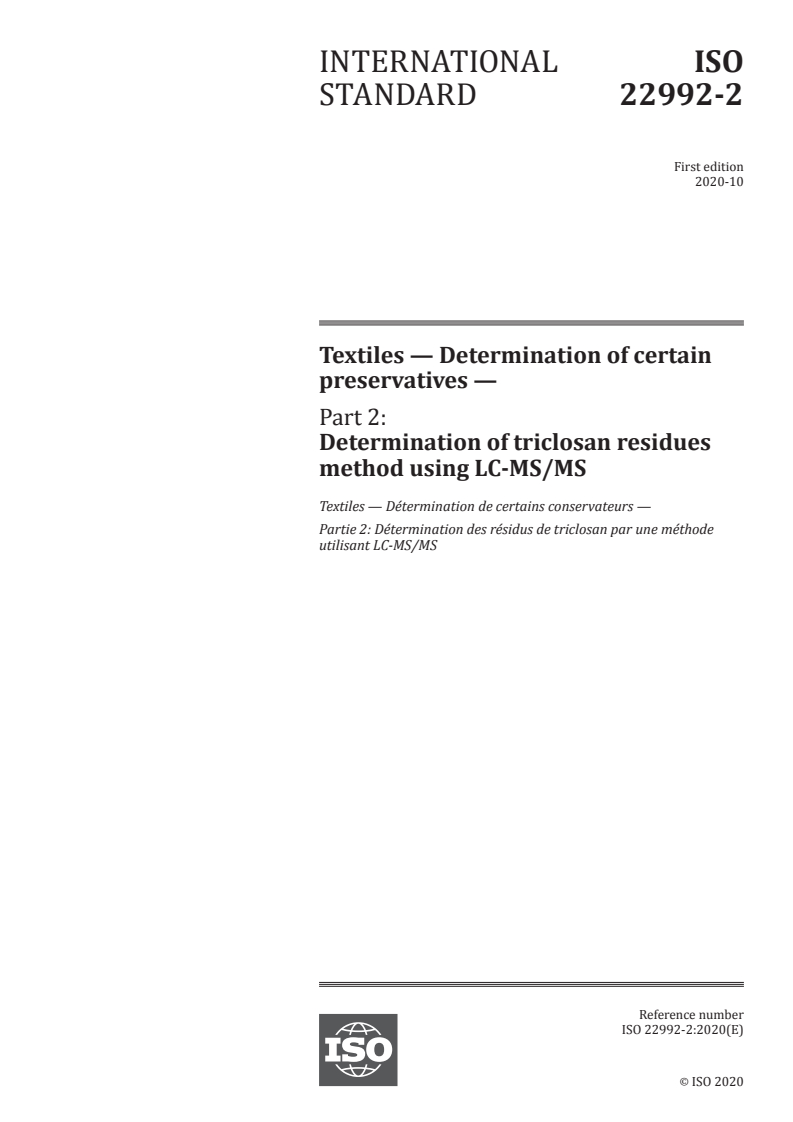
INTERNATIONAL ISO
STANDARD 22992-2
First edition
2020-10
Textiles — Determination of certain
preservatives —
Part 2:
Determination of triclosan residues
method using LC-MS/MS
Textiles — Détermination de certains conservateurs —
Partie 2: Détermination des résidus de triclosan par une méthode
utilisant LC-MS/MS
Reference number
©
ISO 2020
© ISO 2020
All rights reserved. Unless otherwise specified, or required in the context of its implementation, no part of this publication may
be reproduced or utilized otherwise in any form or by any means, electronic or mechanical, including photocopying, or posting
on the internet or an intranet, without prior written permission. Permission can be requested from either ISO at the address
below or ISO’s member body in the country of the requester.
ISO copyright office
CP 401 • Ch. de Blandonnet 8
CH-1214 Vernier, Geneva
Phone: +41 22 749 01 11
Email: copyright@iso.org
Website: www.iso.org
Published in Switzerland
ii © ISO 2020 – All rights reserved
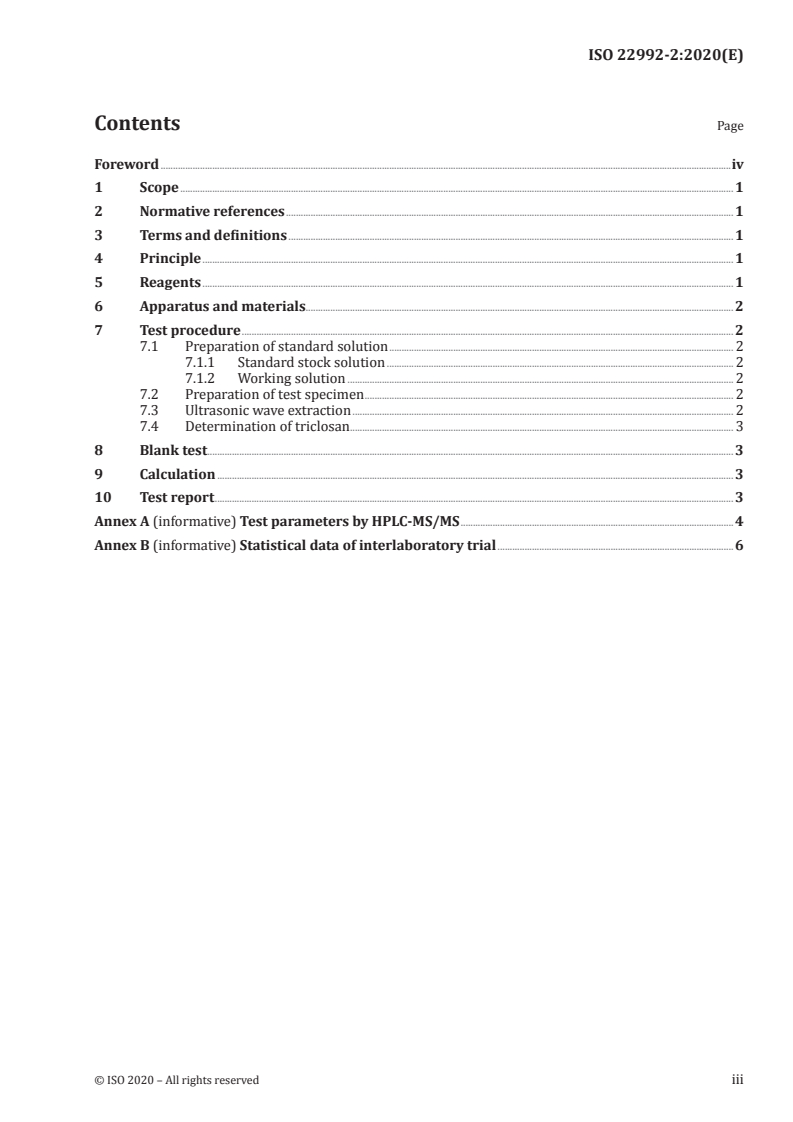
Contents Page
Foreword .iv
1 Scope . 1
2 Normative references . 1
3 Terms and definitions . 1
4 Principle . 1
5 Reagents . 1
6 Apparatus and materials. 2
7 Test procedure . 2
7.1 Preparation of standard solution . 2
7.1.1 Standard stock solution . 2
7.1.2 Working solution . 2
7.2 Preparation of test specimen . 2
7.3 Ultrasonic wave extraction . 2
7.4 Determination of triclosan . . 3
8 Blank test . 3
9 Calculation . 3
10 Test report . 3
Annex A (informative) Test parameters by HPLC-MS/MS . 4
Annex B (informative) Statistical data of interlaboratory trial . 6
Foreword
ISO (the International Organization for Standardization) is a worldwide federation of national standards
bodies (ISO member bodies). The work of preparing International Standards is normally carried out
through ISO technical committees. Each member body interested in a subject for which a technical
committee has been established has the right to be represented on that committee. International
organizations, governmental and non-governmental, in liaison with ISO, also take part in the work.
ISO collaborates closely with the International Electrotechnical Commission (IEC) on all matters of
electrotechnical standardization.
The procedures used to develop this document and those intended for its further maintenance are
described in the ISO/IEC Directives, Part 1. In particular, the different approval criteria needed for the
different types of ISO documents should be noted. This document was drafted in accordance with the
editorial rules of the ISO/IEC Directives, Part 2 (see www .iso .org/ directives).
Attention is drawn to the possibility that some of the elements of this document may be the subject of
patent rights. ISO shall not be held responsible for identifying any or all such patent rights. Details of
any patent rights identified during the development of the document will be in the Introduction and/or
on the ISO list of patent declarations received (see www .iso .org/ patents).
Any trade name used in this document is information given for the convenience of users and does not
constitute an endorsement.
For an explanation of the voluntary nature of standards, the meaning of ISO specific terms and
expressions related to conformity assessment, as well as information about ISO's adherence to the
World Trade Organization (WTO) principles in the Technical Barriers to Trade (TBT) see www .iso .org/
iso/ foreword .html.
This document was prepared by Technical Committee ISO/TC 38, Textiles.
A list of all parts in the ISO 22992 series can be found on the ISO website.
Any feedback or questions on this document should be directed to the user’s national standards body. A
complete listing of these bodies can be found at www .iso .org/ members .html.
iv © ISO 2020 – All rights reserved
INTERNATIONAL STANDARD ISO 22992-2:2020(E)
Textiles — Determination of certain preservatives —
Part 2:
Determination of triclosan residues method using LC-MS/
MS
WARNING — This document calls for the use of substances and/or procedures that can be
injurious to health if adequate precautions are not taken. It refers only to technical suitability
and does not absolve the user from legal obligations relating to health and safety at any stage.
It has been assumed in the drafting of this document that the execution of its provisions is
entrusted to appropriately qualified and experienced people.
1 Scope
This document specifies a method for determination of triclosan residues in
...
INTERNATIONAL ISO
STANDARD 22992-2
First edition
2020-10
Textiles — Determination of certain
preservatives —
Part 2:
Determination of triclosan residues
method using LC-MS/MS
Textiles — Détermination de certains conservateurs —
Partie 2: Détermination des résidus de triclosan par une méthode
utilisant LC-MS/MS
Reference number
©
ISO 2020
© ISO 2020
All rights reserved. Unless otherwise specified, or required in the context of its implementation, no part of this publication may
be reproduced or utilized otherwise in any form or by any means, electronic or mechanical, including photocopying, or posting
on the internet or an intranet, without prior written permission. Permission can be requested from either ISO at the address
below or ISO’s member body in the country of the requester.
ISO copyright office
CP 401 • Ch. de Blandonnet 8
CH-1214 Vernier, Geneva
Phone: +41 22 749 01 11
Email: copyright@iso.org
Website: www.iso.org
Published in Switzerland
ii © ISO 2020 – All rights reserved
Contents Page
Foreword .iv
1 Scope . 1
2 Normative references . 1
3 Terms and definitions . 1
4 Principle . 1
5 Reagents . 1
6 Apparatus and materials. 2
7 Test procedure . 2
7.1 Preparation of standard solution . 2
7.1.1 Standard stock solution . 2
7.1.2 Working solution . 2
7.2 Preparation of test specimen . 2
7.3 Ultrasonic wave extraction . 2
7.4 Determination of triclosan . . 3
8 Blank test . 3
9 Calculation . 3
10 Test report . 3
Annex A (informative) Test parameters by HPLC-MS/MS . 4
Annex B (informative) Statistical data of interlaboratory trial . 6
Foreword
ISO (the International Organization for Standardization) is a worldwide federation of national standards
bodies (ISO member bodies). The work of preparing International Standards is normally carried out
through ISO technical committees. Each member body interested in a subject for which a technical
committee has been established has the right to be represented on that committee. International
organizations, governmental and non-governmental, in liaison with ISO, also take part in the work.
ISO collaborates closely with the International Electrotechnical Commission (IEC) on all matters of
electrotechnical standardization.
The procedures used to develop this document and those intended for its further maintenance are
described in the ISO/IEC Directives, Part 1. In particular, the different approval criteria needed for the
different types of ISO documents should be noted. This document was drafted in accordance with the
editorial rules of the ISO/IEC Directives, Part 2 (see www .iso .org/ directives).
Attention is drawn to the possibility that some of the elements of this document may be the subject of
patent rights. ISO shall not be held responsible for identifying any or all such patent rights. Details of
any patent rights identified during the development of the document will be in the Introduction and/or
on the ISO list of patent declarations received (see www .iso .org/ patents).
Any trade name used in this document is information given for the convenience of users and does not
constitute an endorsement.
For an explanation of the voluntary nature of standards, the meaning of ISO specific terms and
expressions related to conformity assessment, as well as information about ISO's adherence to the
World Trade Organization (WTO) principles in the Technical Barriers to Trade (TBT) see www .iso .org/
iso/ foreword .html.
This document was prepared by Technical Committee ISO/TC 38, Textiles.
A list of all parts in the ISO 22992 series can be found on the ISO website.
Any feedback or questions on this document should be directed to the user’s national standards body. A
complete listing of these bodies can be found at www .iso .org/ members .html.
iv © ISO 2020 – All rights reserved
INTERNATIONAL STANDARD ISO 22992-2:2020(E)
Textiles — Determination of certain preservatives —
Part 2:
Determination of triclosan residues method using LC-MS/
MS
WARNING — This document calls for the use of substances and/or procedures that can be
injurious to health if adequate precautions are not taken. It refers only to technical suitability
and does not absolve the user from legal obligations relating to health and safety at any stage.
It has been assumed in the drafting of this document that the execution of its provisions is
entrusted to appropriately qualified and experienced people.
1 Scope
This document specifies a method for determination of triclosan residues in
...
Questions, Comments and Discussion
Ask us and Technical Secretary will try to provide an answer. You can facilitate discussion about the standard in here.
Loading comments...