


ISO/R 932:1969
(Main)Withdrawal of ISO/R 932-1969
Withdrawal of ISO/R 932-1969
Annulation de l'ISO/R 932-1969
General Information
- Status
- Withdrawn
- Publication Date
- 31-Dec-1968
- Withdrawal Date
- 31-Dec-1968
- Technical Committee
- ISO/TC 34 - Food products
- Drafting Committee
- ISO/TC 34 - Food products
- Current Stage
- 9599 - Withdrawal of International Standard
- Start Date
- 01-Dec-1980
- Completion Date
- 12-Feb-2026
Relations
- Revised
ISO 663:1981 - Animal and vegetable fats and oils — Determination of insoluble impurities content - Effective Date
- 15-Apr-2008


Get Certified
Connect with accredited certification bodies for this standard

BSI Group
BSI (British Standards Institution) is the business standards company that helps organizations make excellence a habit.

Bureau Veritas
Bureau Veritas is a world leader in laboratory testing, inspection and certification services.

DNV
DNV is an independent assurance and risk management provider.
Sponsored listings
Frequently Asked Questions
ISO/R 932:1969 is a standard published by the International Organization for Standardization (ISO). Its full title is "Withdrawal of ISO/R 932-1969". This standard covers: Withdrawal of ISO/R 932-1969
Withdrawal of ISO/R 932-1969
ISO/R 932:1969 is classified under the following ICS (International Classification for Standards) categories: 67.080.01 - Fruits, vegetables and derived products in general. The ICS classification helps identify the subject area and facilitates finding related standards.
ISO/R 932:1969 has the following relationships with other standards: It is inter standard links to ISO 663:1981. Understanding these relationships helps ensure you are using the most current and applicable version of the standard.
ISO/R 932:1969 is available in PDF format for immediate download after purchase. The document can be added to your cart and obtained through the secure checkout process. Digital delivery ensures instant access to the complete standard document.
Standards Content (Sample)
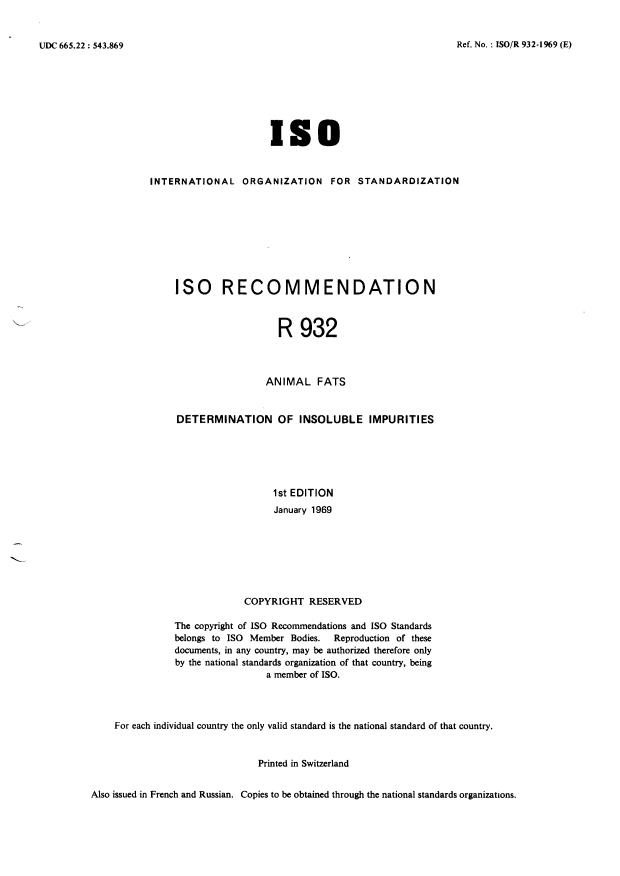
Ref. No. : ISO/R 932-1969 (E)
UDC 665.22 : 543.869
IS0
I NT ERN AT1 ON A L O RG A N l ZATl O N FOR STA N DAR DI ZATl O N
IS0 RECOMMENDATION
t
R 932
ANIMAL FATS
DETERMINATION OF INSOLUBLE IMPURITIES
1st EDITION
January 1969
COPYRIGHT RESERVED
The copyright of IS0 Recommendations and IS0 Standards
belongs to IS0 Member Bodies. Reproduction of these
documents, in any country, may be authorized therefore only
by the national standards organization of that country, being
a member of ISO.
For each individual country the only valid standard is the national standard of that country.
Printed in Switzerland
Also issued in French and Russian. Copies to be obtained through the national standards organizations.
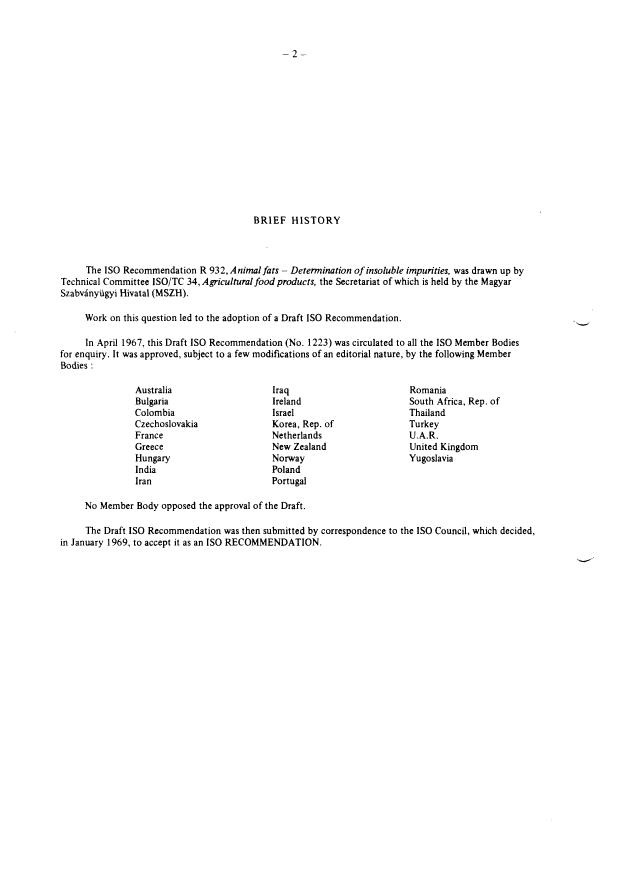
-2-
BRIEF HISTORY
The IS0 Recommendation R 932, Animal fats - Determination of insoluble impurities, was drawn up by
Technical Committee ISO/TC 34, Agricultural food products, the Secretariat of which is held by the Magyar
Szabvinyügyi Hivatal (MSZH).
Work on this question led to the adoption of a Draft IS0 Recommendation.
'W
In April 1967, this Draft IS0 Recommendation (No. 1223) was circulated to all the IS0 Member Bodies
for enquiry. It was approved, subject to a few modifications of an editorial nature, by the following Member
Bodies :
Australia Iraq Romania
Bulgaria Ireland South Africa, Rep. of
Colombia Israel Thailand
Czechoslovakia Korea, Rep. of Turkey
France Netherlands U.A.R.
Greece New Zealand United Kingdom
Hungary Norway Yugoslavia
India Poland
Portugal
Iran
No Member Body opposed the approval of the Draft.
The Draft IS0 Recommendation was then submitted by correspondence to the IS0 Council, which decided,
in January 1969, to accept it as an IS0 RECOMMENDATION.
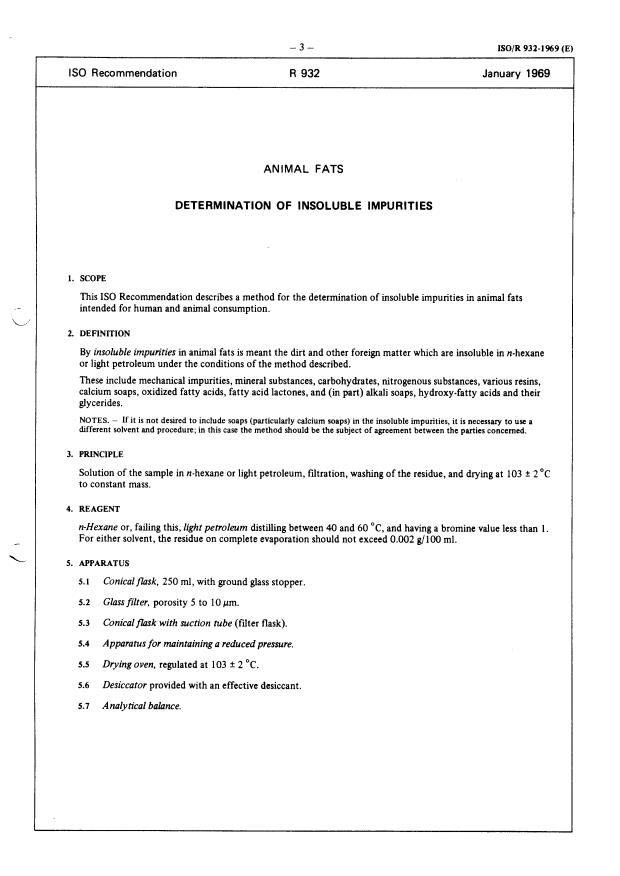
-3- ISO/R 932-1969 (E)
I SO Recommendation R 932 January 1969
ANIMAL FATS
DETERMINATION OF INSOLUBLE IMPURITIES
1. SCOPE
This IS0 Recommendation describes a method for the determination of insoluble impurities in animal fats
intended for human and animai consumption.
2. DEFINITION
By insoluble impurities in animal fats is meant the dirt and other foreign matter which are insoluble in n-hexane
or light petroleum under the conditions of the method described.
These include mechanical impurities, mineral substances, carbohydrates, nitrogenous substances, various resins,
calcium soaps, oxidized fatty acids, fatty acid lactones, and (in part) alkali soaps, hydroxy-fatty acids and their
glycerides.
NOTES. - If it is not desired to include soaps (particularly calcium soaps) in the insoluble impurities, it is necessary to use a
different solvent and procedure; in this case the method should be the subject of agreement between the parties concerned.
3. PRINCIPLE
Solution of the sample in n-hexane or light petroleum, filtration, washing of the residue, and drying at 103 t 2 OC
to constant mass.
4. REAGENT
n-Hexane or, failing this, light petroleum distilling between 40 and 60 OC, and having a bromine value less than 1.
For either solvent, the residue on complete
...
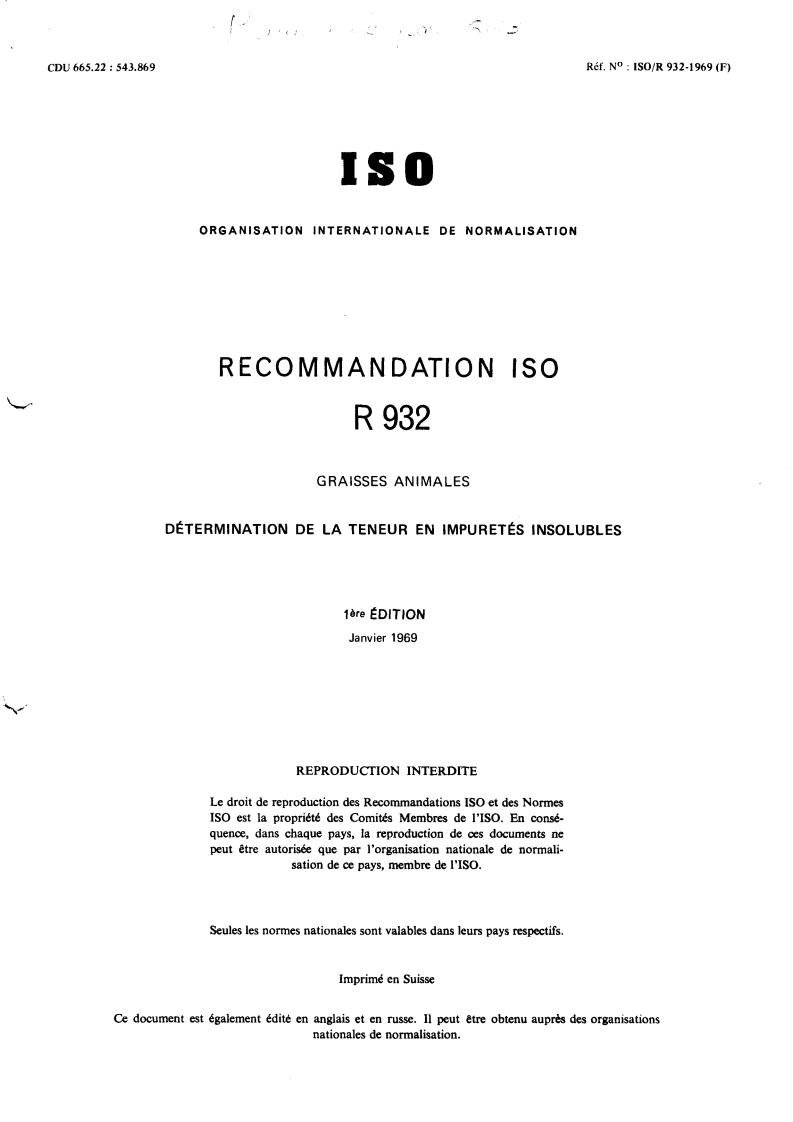
Réf. No : ISO/R 932-1969 (F)
CDU 665.22 : 543.869
IS0
ORGAN IS AT1 ON I N T ER N AT I O N A LE DE NORM A LI SAT I ON
RECOMMANDATION IS0
R 932
GRAISSES AN I MALES
DÉTERMINATION DE LA TENEUR EN IMPURETÉS INSOLUBLES
iere EDITION
Janvier 1969
REPRODUCTION INTERDITE
Le droit de reproduction des Recommandations IS0 et des Normes
IS0 est la propriété des Comités Membres de I’ISO. En consé-
quence, dans chaque pays, la reproduction de ces documents ne
peut être autorisée que par l’organisation nationale de normali-
sation de ce pays, membre de I’ISO.
Seules les normes nationales sont valables dans leurs pays respectifs.
Imprimé en Suisse
Ce document est également édité en anglais et en russe. Il peut être obtenu aup& des organisations
nationales de normalisation.
-2-
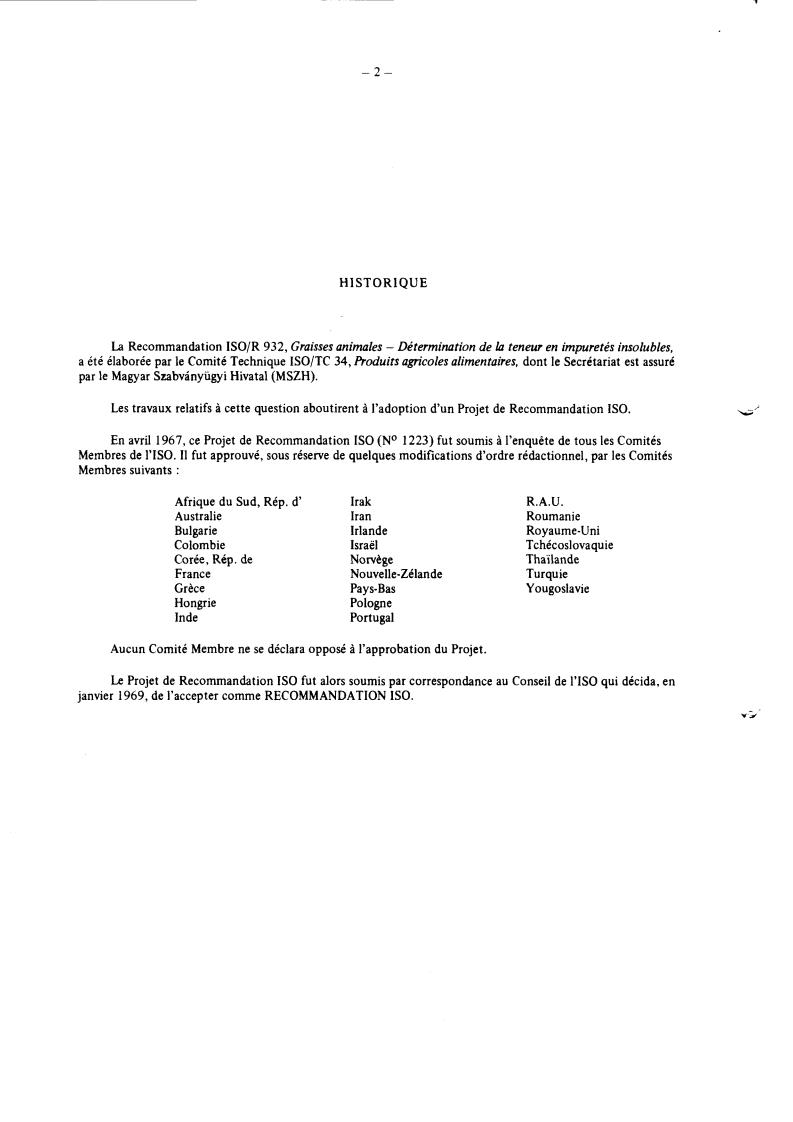
HISTORIQUE
La Recommandation ISO/R 932, Graisses animales - Détermination de la teneur en impuretés insolubles,
a été élaborée par le Comité Technique ISOlTC 34, Produits agricoles alimentaires, dont le Secrétariat est assuré
par le Magyar Szabvinyügyi Hivatal (MSZH).
Les travaux relatifs à cette question aboutirent à l’adoption d’un Projet de Recommandation ISO.
En avril 1967, ce Projet de Recommandation IS0 (NO 1223) fut soumis à l’enquête de tous les Comités
Membres de I’ISO. I1 fut approuvé, sous réserve de quelques modifications d’ordre rédactionnel, par les Comités
Membres suivants :
Afrique du Sud, Rép. d’ Irak R.A.U.
Australie Iran Roumanie
Bulgarie Irlande Royaume-Uni
Colombie Israël Tchécoslovaquie
Norvège Thaïlande
Corée, Rép. de
France Nouvelle-Zélande Turquie
Grèce Pays-Bas Yougoslavie
Hongrie Pologne
Inde Portugal
Aucun Comité Membre ne se déclara opposé à l’approbation du Projet.
Le Projet de Recommandation IS0 fut alors soumis par correspondance au Conseil de I’ISO qui décida, en
janvier 1969, de l’accepter comme RECOMMANDATION ISO.
ISO/R 932-1969 (F)
-3-
~
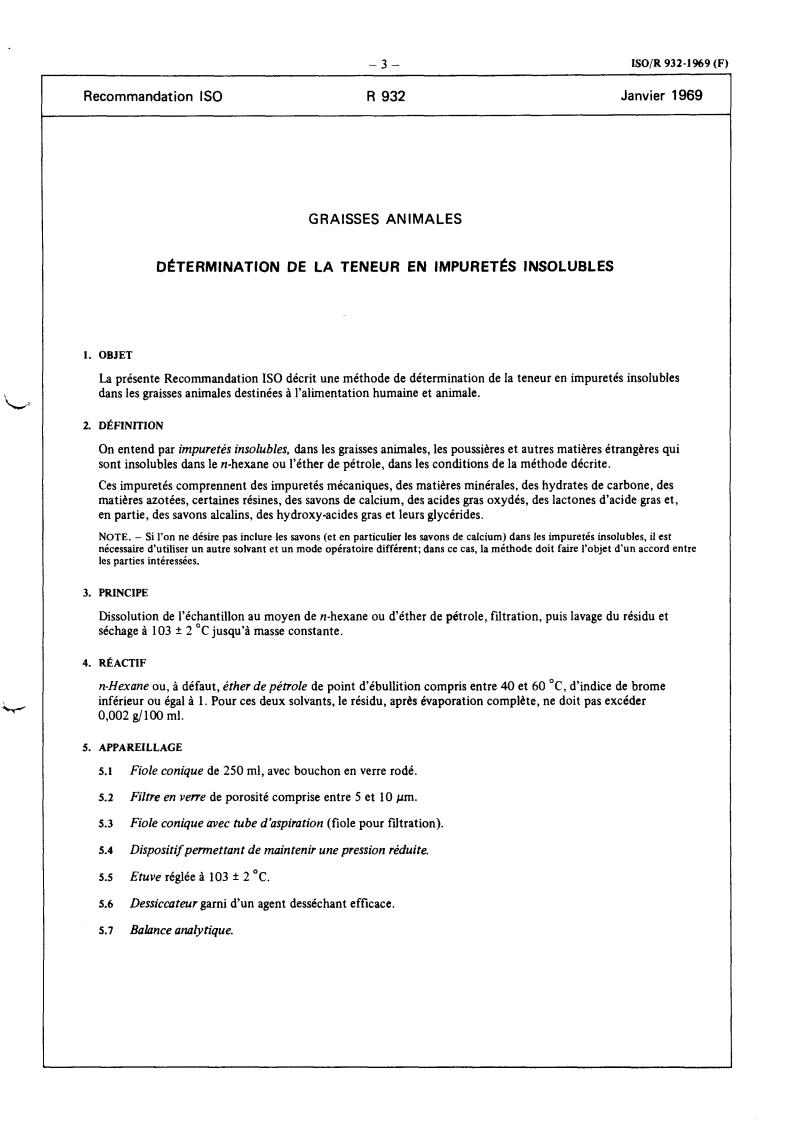
Recommandation IS0 R 932 Janvier 1969
GRAISSES ANIMALES
DÉTERMINATION DE LA TENEUR EN IMPURETÉS INSOLUBLES
1. OBJET
La présente Recommandation IS0 décrit une méthode de détermination de la teneur en impuretés insolubles
dans les graisses animales destinées à l’alimentation humaine et animale.
2. DÉFINITION
On entend par impuretés insolubles, dans les graisses animales, les poussières et autres matières étrangères qui
sont insolubles dans le n-hexane ou l’éther de pétrole, dans les conditions de la méthode décrite.
Ces impuretés comprennent des impuretés mécaniques, des matières minérales, des hydrates de carbone, des
matières azotées, certaines résines, des savons de calcium, des acides gras oxydés, des lactones d’acide gras et,
en partie, des savons alcalins, des hydroxy-acides gras et leurs glycérides.
NOTE. - Si i’on ne désire pas inclure les savons (et en particulier les savons de calcium) dans les impuretés insolubles, il est
nécessaire d‘utiliser un autre solvant et un mode opératoire différent; dans ce cas, la méthode doit faire I’objet d’un accord entre
les parties intéressées.
3. PRINCIPE
Dissolution de l’échantillon au moyen de n-hexane ou d’éther de pétrole, filtration, puis lavage du résidu et
séchage à 103 f 2 OC jusqu’à masse constante.
4. REACTIF
n-Hexane ou, à défaut, éther de pétrole de point d’ébullition compris entre 40 et 60 OC, d’indice de brome
inférieur ou égal à 1. Pour ces deux solvants, le résidu, après évaporatio
...
Questions, Comments and Discussion
Ask us and Technical Secretary will try to provide an answer. You can facilitate discussion about the standard in here.
Loading comments...