

ISO 20982:2020
(Main)Priests (caper) (Capparis spp.) — Specification and test methods
General Information
- Abstract
This document specifies requirements and test methods for priests (caper). It includes requirements for caper buds.
- Status
- Published
- Publication Date
- 03-Jun-2020
- Technical Committee
- ISO/TC 34/SC 3 - Fruits and vegetables and their derived products
- Drafting Committee
- ISO/TC 34/SC 3 - Fruits and vegetables and their derived products
- Current Stage
- 9060 - Close of review
- Completion Date
- 02-Dec-2030
Buy Documents


ISO 20982:2020 - Priests (caper) (Capparis spp.) -- Specification and test methods
ISO 20982:2020 - Priests (caper) (Capparis spp.) — Specification and test methods/4/2020
Overview
ISO 20982:2020 sets forth international specifications and test methods for priests (caper) buds derived from Capparis spp., specifically Capparis spinosa and Capparis ovata. This standard ensures quality, safety, and consistency for caper buds used primarily in culinary applications worldwide, particularly around the Mediterranean region. It covers classification, requirements for product quality, testing procedures, packaging, storage, and hygiene practices. The standard supports producers, exporters, and regulators by providing a clear framework for the evaluation and handling of caper buds.
Key Topics
Scope and Definition
Defines priests (caper) as the unopened flower buds harvested before blooming from Capparis shrubs. Details the botanical background and harvesting practices.Classification and Quality Requirements
Divides caper buds into six classes (Extra class, Class I to Class IV, and outside the class) based on size and quality. Provides general requirements such as cleanliness, absence of abnormal moisture, foreign taste or smell, and the exclusion of rotten buds.Tolerances
Specifies allowable tolerances in quality and size for each class category, facilitating fair grading and acceptance limits.Sampling
Defines sampling protocols compliant with ISO 874 and ISO 2859-1 to ensure representative, undamaged test samples.Test Methods
Includes test methods to evaluate titratable acidity, water-insoluble solids, mineral impurities content, pH, and soluble solids content based on referenced ISO standards (ISO 750, ISO 751, ISO 762, ISO 1842, ISO 2173).Packaging and Marking
Details packaging requirements to protect caper buds during shipment. Mandates clear product labelling including product name, producer details, batch number, product class, country of origin, expiry date, and other purchaser requirements.Storage and Transportation
Recommends optimum storage and transport conditions at temperatures between +10 °C and +15 °C with relative humidity of 80%-90%. Emphasizes minimizing storage time to preserve product freshness with proper air circulation and refrigeration.Hygiene, Contaminants, and Pesticides
Advises adherence to international food hygiene codes (CAC/RCP 1-1969) and compliance with Codex standards for contaminants and pesticide residues.
Applications
ISO 20982:2020 is essential for:
Producers and Growers
To ensure caper buds meet internationally recognized quality specifications, supporting market access and export compliance.Quality Control Laboratories
For conducting standardized tests ensuring the safety and quality of caper buds offered in commerce.Packaging and Logistics
To maintain caper freshness and prevent damage during storage and transit, applying recommended packaging and temperature controls.Importers, Exporters, and Retailers
Providing confidence in product classification, quality, and food safety compliance as per global marketplace requirements.Regulatory Authorities
Guiding inspections, conformity assessments, and trade regulations related to capers and associated products.
Related Standards
- ISO 874 – Sampling fresh fruits and vegetables
- ISO 2859-1 – Sampling procedures indexed by acceptance quality limit (AQL)
- ISO 750 – Determination of titratable acidity for fruit and vegetable products
- ISO 751 – Determination of water-insoluble solids in fruit and vegetable products
- ISO 762 – Determination of mineral impurities content
- ISO 1842 – Determination of pH in fruit and vegetable products
- ISO 2173 – Determination of soluble solids by refractometric method
- ISO 2169 – Physical conditions in cold stores for fruits and vegetables
- CAC/RCP 1-1969 – General Principles of Food Hygiene by Codex Alimentarius
- CODEX STAN 193-1995 – General Standard for Contaminants and Toxins in Food and Feed
By aligning with these standards, ISO 20982:2020 ensures comprehensive coverage of product quality, safety, and international trade requirements for priests (caper) buds.
Buy Documents
ISO 20982:2020 - Priests (caper) (Capparis spp.) -- Specification and test methods
ISO 20982:2020 - Priests (caper) (Capparis spp.) — Specification and test methods/4/2020
Get Certified
Connect with accredited certification bodies for this standard

BSI Group
BSI (British Standards Institution) is the business standards company that helps organizations make excellence a habit.

Bureau Veritas
Bureau Veritas is a world leader in laboratory testing, inspection and certification services.

DNV
DNV is an independent assurance and risk management provider.
Sponsored listings
Frequently Asked Questions
ISO 20982:2020 is a standard published by the International Organization for Standardization (ISO). Its full title is "Priests (caper) (Capparis spp.) — Specification and test methods". This standard covers: This document specifies requirements and test methods for priests (caper). It includes requirements for caper buds.
This document specifies requirements and test methods for priests (caper). It includes requirements for caper buds.
ISO 20982:2020 is classified under the following ICS (International Classification for Standards) categories: 67.080.01 - Fruits, vegetables and derived products in general. The ICS classification helps identify the subject area and facilitates finding related standards.
ISO 20982:2020 is available in PDF format for immediate download after purchase. The document can be added to your cart and obtained through the secure checkout process. Digital delivery ensures instant access to the complete standard document.
Standards Content (Sample)
INTERNATIONAL ISO
STANDARD 20982
First edition
2020-06
Priests (caper) (Capparis spp.) —
Specification and test methods
Câpriers (Capparis spp.) — Spécifications et méthodes
d'essai
Reference number
©
ISO 2020
© ISO 2020
All rights reserved. Unless otherwise specified, or required in the context of its implementation, no part of this publication may
be reproduced or utilized otherwise in any form or by any means, electronic or mechanical, including photocopying, or posting
on the internet or an intranet, without prior written permission. Permission can be requested from either ISO at the address
below or ISO’s member body in the country of the requester.
ISO copyright office
CP 401 • Ch. de Blandonnet 8
CH-1214 Vernier, Geneva
Phone: +41 22 749 01 11
Fax: +41 22 749 09 47
Email: copyright@iso.org
Website: www.iso.org
Published in Switzerland
ii © ISO 2020 – All rights reserved
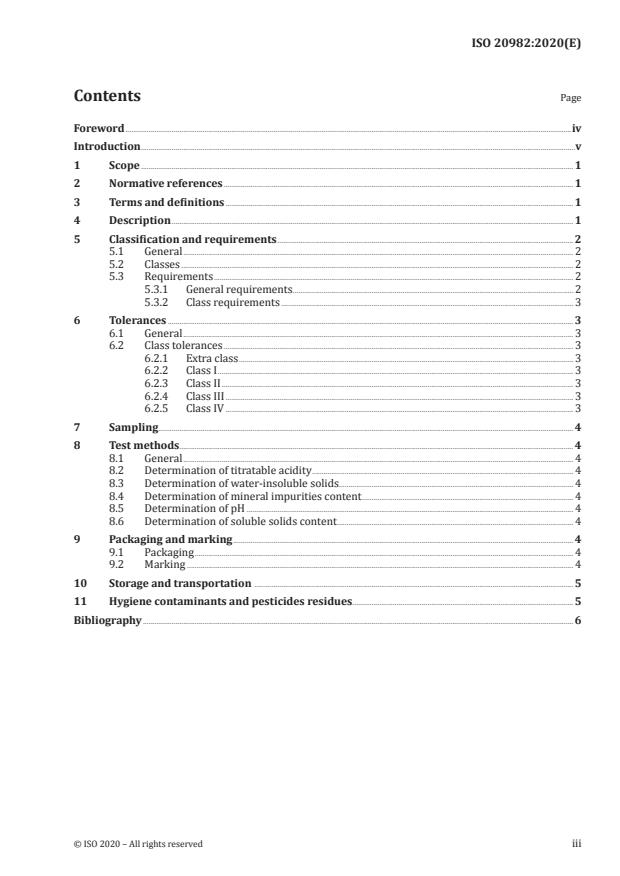
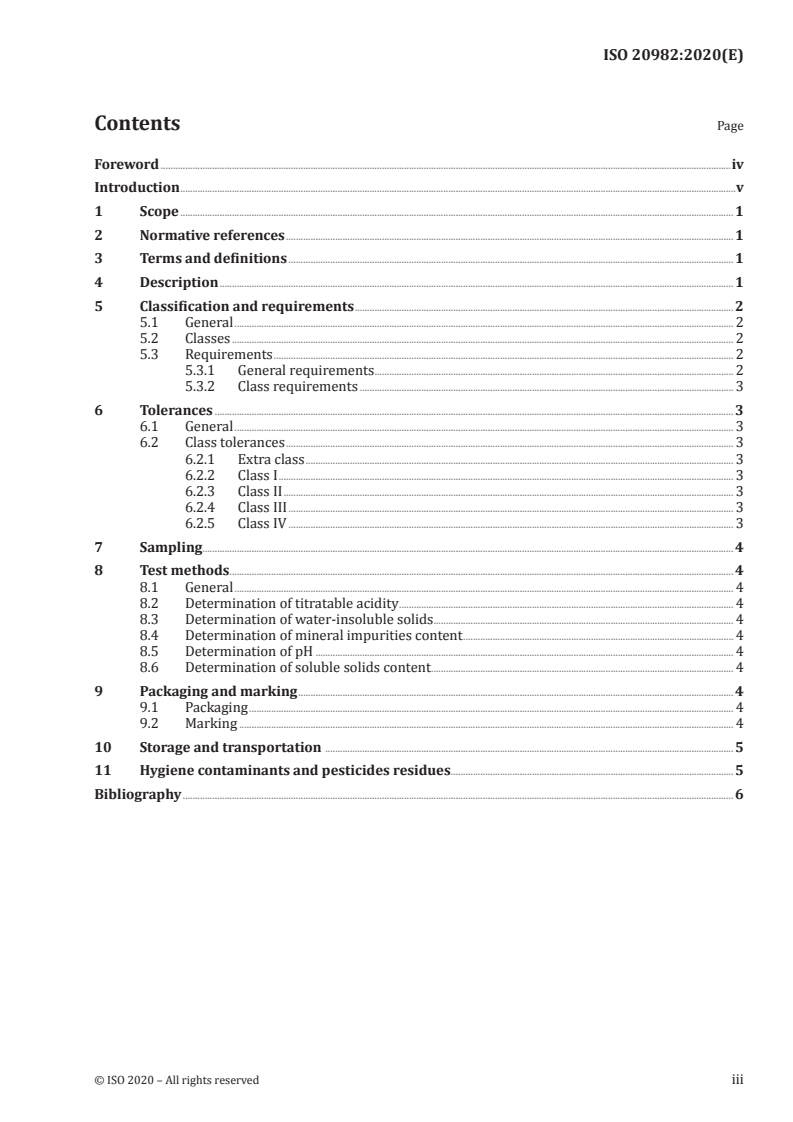
Contents Page
Foreword .iv
Introduction .v
1 Scope . 1
2 Normative references . 1
3 Terms and definitions . 1
4 Description . 1
5 Classification and requirements . 2
5.1 General . 2
5.2 Classes . 2
5.3 Requirements . 2
5.3.1 General requirements . 2
5.3.2 Class requirements . 3
6 Tolerances . 3
6.1 General . 3
6.2 Class tolerances . 3
6.2.1 Extra class . 3
6.2.2 Class I . 3
6.2.3 Class II . 3
6.2.4 Class III . 3
6.2.5 Class IV . 3
7 Sampling . 4
8 Test methods . 4
8.1 General . 4
8.2 Determination of titratable acidity . 4
8.3 Determination of water-insoluble solids . 4
8.4 Determination of mineral impurities content . 4
8.5 Determination of pH . 4
8.6 Determination of soluble solids content . 4
9 Packaging and marking . 4
9.1 Packaging . 4
9.2 Marking . 4
10 Storage and transportation . 5
11 Hygiene contaminants and pesticides residues . 5
Bibliography . 6
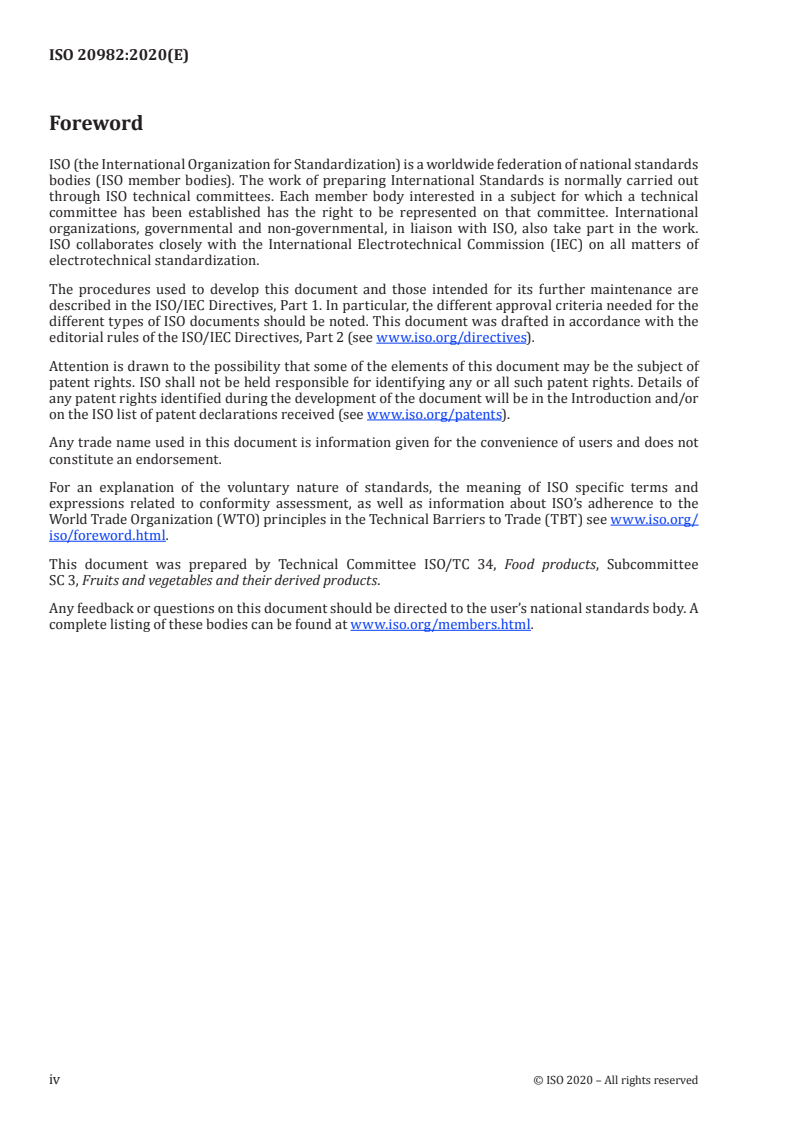
Foreword
ISO (the International Organization for Standardization) is a worldwide federation of national standards
bodies (ISO member bodies). The work of preparing International Standards is normally carried out
through ISO technical committees. Each member body interested in a subject for which a technical
committee has been established has the right to be represented on that committee. International
organizations, governmental and non-governmental, in liaison with ISO, also take part in the work.
ISO collaborates closely with the International Electrotechnical Commission (IEC) on all matters of
electrotechnical standardization.
The procedures used to develop this document and those intended for its further maintenance are
described in the ISO/IEC Directives, Part 1. In particular, the different approval criteria needed for the
different types of ISO documents should be noted. This document was drafted in accordance with the
editorial rules of the ISO/IEC Directives, Part 2 (see www .iso .org/ directives).
Attention is drawn to the possibility that some of the elements of this document may be the subject of
patent rights. ISO shall not be held responsible for identifying any or all such patent rights. Details of
any patent rights identified during the development of the document will be in the Introduction and/or
on the ISO list of patent declarations received (see www .iso .org/ patents).
Any trade name used in this document is information given for the convenience of users and does not
constitute an endorsement.
For an explanation of the voluntary nature of standards, the meaning of ISO specific terms and
expressions related to conformity assessment, as well as information about ISO’s adherence to the
World Trade Organization (WTO) principles in the Technical Barriers to Trade (TBT) see www .iso .org/
iso/ foreword .html.
This document was p
...
INTERNATIONAL ISO
STANDARD 20982
First edition
2020-06
Priests (caper) (Capparis spp.) —
Specification and test methods
Câpriers (Capparis spp.) — Spécifications et méthodes
d'essai
Reference number
©
ISO 2020
© ISO 2020
All rights reserved. Unless otherwise specified, or required in the context of its implementation, no part of this publication may
be reproduced or utilized otherwise in any form or by any means, electronic or mechanical, including photocopying, or posting
on the internet or an intranet, without prior written permission. Permission can be requested from either ISO at the address
below or ISO’s member body in the country of the requester.
ISO copyright office
CP 401 • Ch. de Blandonnet 8
CH-1214 Vernier, Geneva
Phone: +41 22 749 01 11
Fax: +41 22 749 09 47
Email: copyright@iso.org
Website: www.iso.org
Published in Switzerland
ii © ISO 2020 – All rights reserved
Contents Page
Foreword .iv
Introduction .v
1 Scope . 1
2 Normative references . 1
3 Terms and definitions . 1
4 Description . 1
5 Classification and requirements . 2
5.1 General . 2
5.2 Classes . 2
5.3 Requirements . 2
5.3.1 General requirements . 2
5.3.2 Class requirements . 3
6 Tolerances . 3
6.1 General . 3
6.2 Class tolerances . 3
6.2.1 Extra class . 3
6.2.2 Class I . 3
6.2.3 Class II . 3
6.2.4 Class III . 3
6.2.5 Class IV . 3
7 Sampling . 4
8 Test methods . 4
8.1 General . 4
8.2 Determination of titratable acidity . 4
8.3 Determination of water-insoluble solids . 4
8.4 Determination of mineral impurities content . 4
8.5 Determination of pH . 4
8.6 Determination of soluble solids content . 4
9 Packaging and marking . 4
9.1 Packaging . 4
9.2 Marking . 4
10 Storage and transportation . 5
11 Hygiene contaminants and pesticides residues . 5
Bibliography . 6
Foreword
ISO (the International Organization for Standardization) is a worldwide federation of national standards
bodies (ISO member bodies). The work of preparing International Standards is normally carried out
through ISO technical committees. Each member body interested in a subject for which a technical
committee has been established has the right to be represented on that committee. International
organizations, governmental and non-governmental, in liaison with ISO, also take part in the work.
ISO collaborates closely with the International Electrotechnical Commission (IEC) on all matters of
electrotechnical standardization.
The procedures used to develop this document and those intended for its further maintenance are
described in the ISO/IEC Directives, Part 1. In particular, the different approval criteria needed for the
different types of ISO documents should be noted. This document was drafted in accordance with the
editorial rules of the ISO/IEC Directives, Part 2 (see www .iso .org/ directives).
Attention is drawn to the possibility that some of the elements of this document may be the subject of
patent rights. ISO shall not be held responsible for identifying any or all such patent rights. Details of
any patent rights identified during the development of the document will be in the Introduction and/or
on the ISO list of patent declarations received (see www .iso .org/ patents).
Any trade name used in this document is information given for the convenience of users and does not
constitute an endorsement.
For an explanation of the voluntary nature of standards, the meaning of ISO specific terms and
expressions related to conformity assessment, as well as information about ISO’s adherence to the
World Trade Organization (WTO) principles in the Technical Barriers to Trade (TBT) see www .iso .org/
iso/ foreword .html.
This document was p
...