

ISO 21121:2025
(Main)Spices and condiments — Dried lime (whole, slices and ground) — Specification
General Information
- Abstract
This document specifies requirements for dried lime (Citrus aurantifolia (Christm.) Swingle, Citrus latifolia Tanaka, family Rutaceae) in whole, slices and ground form. This document is also applicable to lime that has been dehydrated by the sun and artificially dried lime. Recommendations relating to storage and transport conditions are given in Annex A.
- Status
- Published
- Publication Date
- 13-Aug-2025
- Technical Committee
- ISO/TC 34/SC 7 - Spices, culinary herbs and condiments
- Drafting Committee
- ISO/TC 34/SC 7 - Spices, culinary herbs and condiments
- Current Stage
- 6060 - International Standard published
- Start Date
- 14-Aug-2025
- Due Date
- 06-Jul-2026
- Completion Date
- 14-Aug-2025
Overview
ISO 21121:2025 - Spices and condiments - Dried lime (whole, slices and ground) - Specification defines quality, physical and chemical requirements for dried lime (Citrus aurantifolia and Citrus latifolia) in whole, sliced and ground forms. The standard covers sun‑dehydrated and artificially dried lime and includes guidance on sampling, test methods, packaging, marking and recommended storage and transport conditions (Annex A).
Key topics and technical requirements
- Product scope: whole, slices and ground dried lime (family Rutaceae).
- Sensory requirements: strong sour citric flavour and odour, free from earthy or foreign odours.
- Colour:
- Whole: light brown to relatively brown‑black
- Slices/ground: dark brown to black
- Chemical specifications (see ISO 21121:2025 Table 1):
- Moisture content (max): whole 9%, slices 8%, ground 8% (ISO 939)
- Total ash (dry basis, max):7.0% (ISO 928)
- Acid‑insoluble ash (dry basis, max):0.4% (ISO 930)
- Volatile oil (min, ml/100 g dry basis): whole 0.3, slices 0.2, ground 0.2 (ISO 6571)
- Total acidity (as citric acid, ground, min):18.0 g/100 g (ISO 750)
- Physical safety limits:
- No animal excreta, whole insects or insect‑defiled product (ISO 927)
- Non‑animal foreign matter ≤ 0.5%
- Extraneous (plant) matter ≤ 0.5%
- Sampling and test methods: sampling per ISO 948, sample preparation per ISO 2825, and analytical methods referenced in Table 1.
Applications and who should use it
ISO 21121:2025 is intended for:
- Dried lime producers, dehydrators and packers to meet consistent quality and labelling requirements.
- Exporters and importers to verify product conformity for trade.
- Food safety laboratories and QA teams for routine testing (moisture, ash, volatile oil, acidity, foreign matter).
- Buyers, retailers and specifiers who require defined product characteristics in procurement contracts.
- Regulators and auditors assessing compliance with spice and condiment standards.
Practical benefits include improved product consistency, clearer contractual specifications, reduced disputes over quality, and better shelf‑life protection through recommended packaging and storage guidance.
Related standards
ISO 21121:2025 references multiple normative methods for testing and sampling, including:
- ISO 939 (moisture), ISO 928 (total ash), ISO 930 (acid‑insoluble ash), ISO 6571 (volatile oil), ISO 750 (titratable acidity), ISO 927 (foreign/extraneous matter), ISO 948 (sampling), ISO 2825 (sample preparation).
Keywords: ISO 21121:2025, dried lime specification, spices and condiments, moisture content, volatile oil, total ash, sampling, packaging, storage.
Get Certified
Connect with accredited certification bodies for this standard

BSI Group
BSI (British Standards Institution) is the business standards company that helps organizations make excellence a habit.

Bureau Veritas
Bureau Veritas is a world leader in laboratory testing, inspection and certification services.

DNV
DNV is an independent assurance and risk management provider.
Sponsored listings
Frequently Asked Questions
ISO 21121:2025 is a standard published by the International Organization for Standardization (ISO). Its full title is "Spices and condiments — Dried lime (whole, slices and ground) — Specification". This standard covers: This document specifies requirements for dried lime (Citrus aurantifolia (Christm.) Swingle, Citrus latifolia Tanaka, family Rutaceae) in whole, slices and ground form. This document is also applicable to lime that has been dehydrated by the sun and artificially dried lime. Recommendations relating to storage and transport conditions are given in Annex A.
This document specifies requirements for dried lime (Citrus aurantifolia (Christm.) Swingle, Citrus latifolia Tanaka, family Rutaceae) in whole, slices and ground form. This document is also applicable to lime that has been dehydrated by the sun and artificially dried lime. Recommendations relating to storage and transport conditions are given in Annex A.
ISO 21121:2025 is classified under the following ICS (International Classification for Standards) categories: 67.080.01 - Fruits, vegetables and derived products in general. The ICS classification helps identify the subject area and facilitates finding related standards.
ISO 21121:2025 is available in PDF format for immediate download after purchase. The document can be added to your cart and obtained through the secure checkout process. Digital delivery ensures instant access to the complete standard document.
Standards Content (Sample)
International
Standard
ISO 21121
First edition
Spices and condiments — Dried
2025-08
lime (whole, slices and ground) —
Specification
Épices et condiments — Citron vert et lime séchés (entiers, en
tranches, moulus) — Spécifications
Reference number
© ISO 2025
All rights reserved. Unless otherwise specified, or required in the context of its implementation, no part of this publication may
be reproduced or utilized otherwise in any form or by any means, electronic or mechanical, including photocopying, or posting on
the internet or an intranet, without prior written permission. Permission can be requested from either ISO at the address below
or ISO’s member body in the country of the requester.
ISO copyright office
CP 401 • Ch. de Blandonnet 8
CH-1214 Vernier, Geneva
Phone: +41 22 749 01 11
Email: copyright@iso.org
Website: www.iso.org
Published in Switzerland
ii
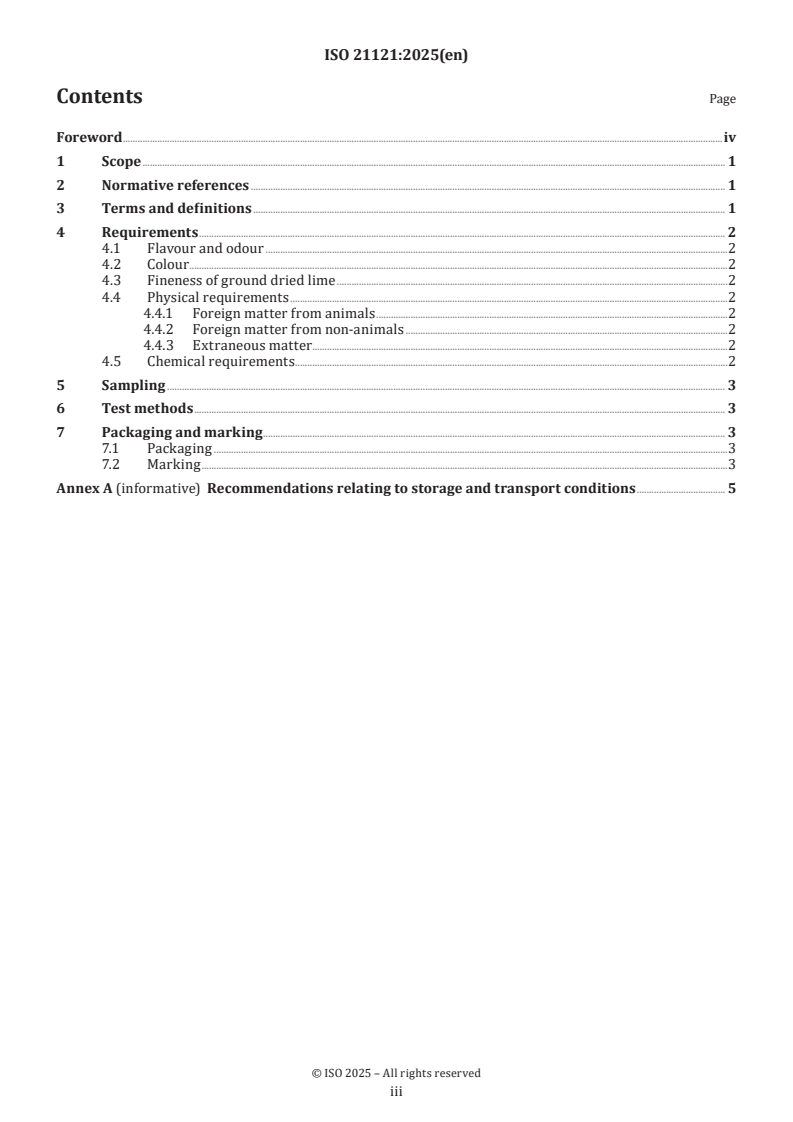
Contents Page
Foreword .iv
1 Scope . 1
2 Normative references . 1
3 Terms and definitions . 1
4 Requirements . 2
4.1 Flavour and odour .2
4.2 Colour .2
4.3 Fineness of ground dried lime .2
4.4 Physical requirements .2
4.4.1 Foreign matter from animals .2
4.4.2 Foreign matter from non-animals .2
4.4.3 Extraneous matter . .2
4.5 Chemical requirements . .2
5 Sampling . 3
6 Test methods . 3
7 Packaging and marking . 3
7.1 Packaging .3
7.2 Marking .3
Annex A (informative) Recommendations relating to storage and transport conditions . 5
iii
Foreword
ISO (the International Organization for Standardization) is a worldwide federation of national standards
bodies (ISO member bodies). The work of preparing International Standards is normally carried out through
ISO technical committees. Each member body interested in a subject for which a technical committee
has been established has the right to be represented on that committee. International organizations,
governmental and non-governmental, in liaison with ISO, also take part in the work. ISO collaborates closely
with the International Electrotechnical Commission (IEC) on all matters of electrotechnical standardization.
The procedures used to develop this document and those intended for its further maintenance are described
in the ISO/IEC Directives, Part 1. In particular, the different approval criteria needed for the different types
of ISO document should be noted. This document was drafted in accordance with the editorial rules of the
ISO/IEC Directives, Part 2 (see www.iso.org/directives).
ISO draws attention to the possibility that the implementation of this document may involve the use of (a)
patent(s). ISO takes no position concerning the evidence, validity or applicability of any claimed patent
rights in respect thereof. As of the date of publication of this document, ISO had not received notice of (a)
patent(s) which may be required to implement this document. However, implementers are cautioned that
this may not represent the latest information, which may be obtained from the patent database available at
www.iso.org/patents. ISO shall not be held responsible for identifying any or all such patent rights.
Any trade name used in this document is information given for the convenience of users and does not
constitute an endorsement.
For an explanation of the voluntary nature of standards, the meaning of ISO specific terms and expressions
related to conformity assessment, as well as information about ISO’s adherence to the World Trade
Organiz
...