

ISO 25202:2026
(Main)Leather — Chemical analysis — Determination of glutaraldehyde content
- Abstract
This document specifies a method for the determination of free and released glutaraldehyde in leathers, using liquid chromatography (LC).
- Status
- Published
- Publication Date
- 04-Oct-2026
- Technical Committee
- IULTCS - International Union of Leather Technologists and Chemists Societies
- Current Stage
- 6060 - International Standard published - 60 Publication
- Start Date
- 05-Oct-2026
- Due Date
- 22-Apr-2027
- Completion Date
- 22-Apr-2027
Buy Documents
ISO 25202:2026 - Leather — Chemical analysis — Determination of glutaraldehyde content
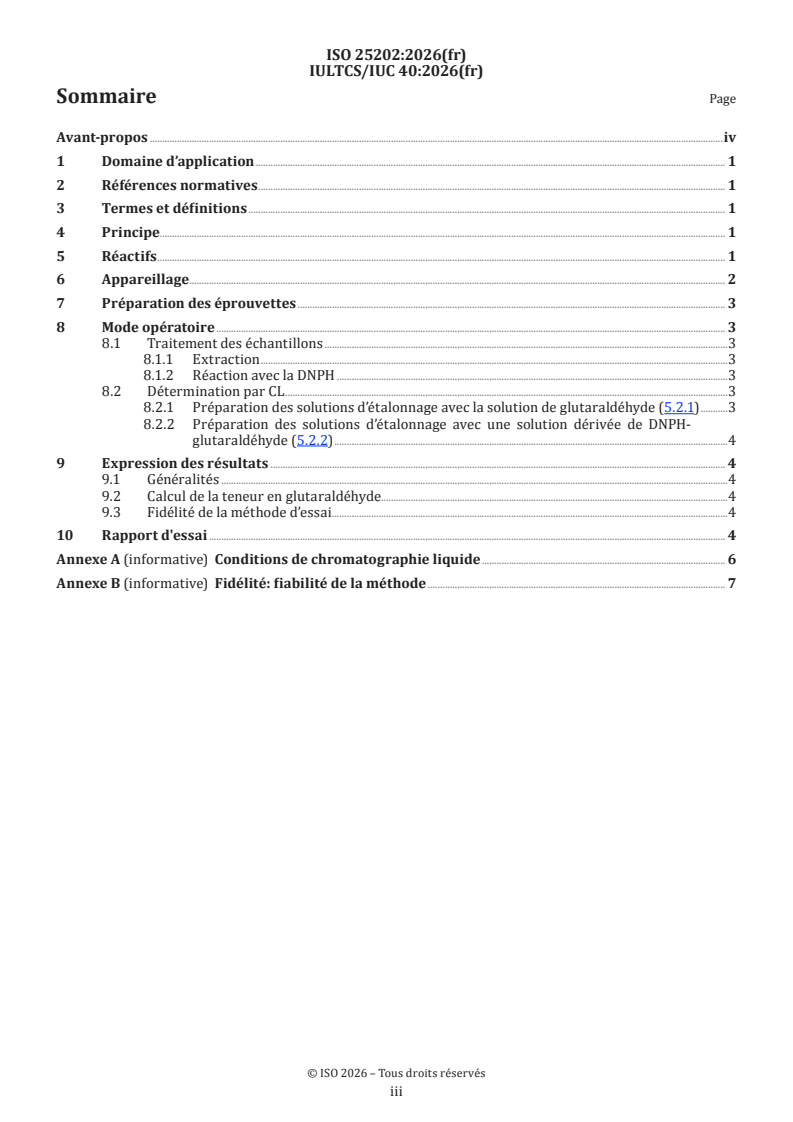
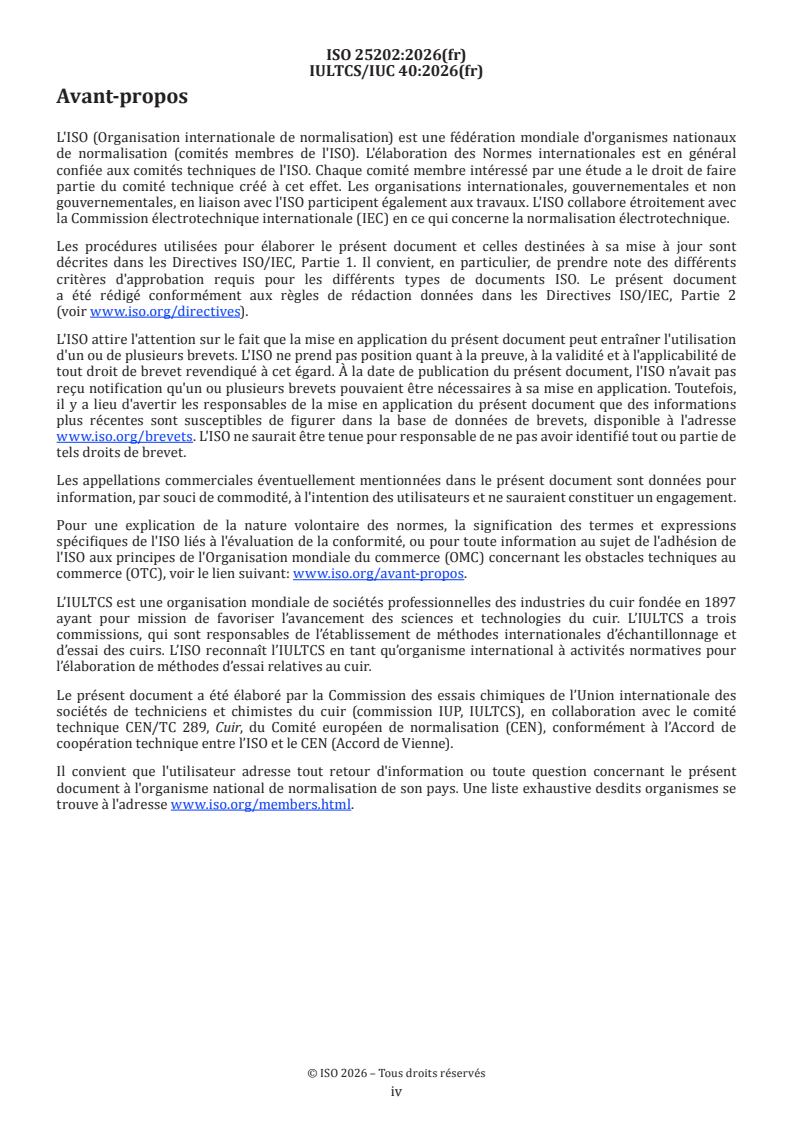
ISO 25202:2026 - Cuir — Analyse chimique — Détermination de la teneur en glutaraldéhyde
ISO 25202:2026 is an International Standard from ISO, developed with IULTCS, for the chemical analysis of leather. It specifies a liquid chromatography (LC) method for determining free and released glutaraldehyde in leathers, so laboratories can measure the substance and report the result in mg/kg.
What does ISO 25202:2026 specify?
ISO 25202:2026 specifies one analytical method for glutaraldehyde in leather. It covers the full workflow from specimen preparation and extraction to derivatization, LC measurement, calculation, and reporting.
The document is organized into:
- Clause 1 Scope
- Clause 2 Normative references
- Clause 3 Terms and definitions
- Clause 4 Principle
- Clause 5 Reagents
- Clause 6 Apparatus
- Clause 7 Preparation of test specimens
- Clause 8 Procedure
- Clause 9 Expression of results
- Clause 10 Test report
| Annex | What it covers |
|---|---|
| Annex A | Example liquid chromatography conditions |
| Annex B | Precision data and method reliability |
What are the key requirements of ISO 25202:2026?
ISO 25202:2026 requires a controlled extraction and LC-based measurement sequence, with specified reagents, timing, and reporting rules. In practice, this means the test is only comparable when the sample handling, derivatization, and calibration steps are kept consistent.
- Specimen preparation follows ISO 2418, and leather is cut according to ISO 4044. If the sample comes from finished products such as shoes or garments, the sampling details must be reported. This matters because the result depends on where the sample was taken and how it was prepared.
- Extraction uses 2 g of leather pieces, 50 ml of detergent solution, and shaking at 40 °C for 60 min. The leather-to-solution ratio must not be changed, and extraction and analysis should be done on the same working day. This keeps the release of glutaraldehyde comparable from sample to sample.
- Derivatization with DNPH converts aldehydes and ketones into hydrazones before LC analysis. The filtered extract is mixed with acetonitrile, DNPH solution, and water, then left for at least 60 min. This step is what makes glutaraldehyde measurable by the LC system.
- Calibration can use either glutaraldehyde solution or derivatised glutaraldehyde-DNPH solution. The document gives an example calibration range equivalent to 10 mg/kg to 100 mg/kg in leather, and Annex A gives an example LC setup. This helps the laboratory match standards to the expected sample level.
- LC measurement uses UV detection at (355 ± 5) nm, and Annex A notes that glutaraldehyde-DNPH can give two peaks on a C18 reversed-phase column. The calibration area is the sum of both peaks in that case, which matters for correct integration.
- Results are calculated from the calibration graph and expressed to the nearest 0.1 mg/kg. The calculation uses the measured concentration, dilution factor, sample mass, and extraction volume. This gives a single reportable number that can be used for specifications or internal control.
- Precision information is given in Annex B, and the method states a quantification limit of 25 mg/kg. This helps users judge whether the method is suitable for their control limit or verification task.
- Test reporting requires the standard reference, sample identification, result, unusual features, any deviations, and the test date. That makes the report traceable for audits and disputes.
What terms does ISO 25202:2026 define?
ISO 25202:2026 uses a small set of technical terms and abbreviations that matter for the method.
- Glutaraldehyde - the analyte measured in leather as free and released glutaraldehyde.
- Liquid chromatography (LC) - the separation and measurement technique used after derivatization.
- 2,4-dinitrophenylhydrazine (DNPH) - the reagent that reacts with aldehydes and ketones to form hydrazones for LC detection.
- Detergent solution - the extraction medium made with sodium dodecylsulfonate or sodium dodecylsulfate at 0.1%.
- Calibration graph - the plot used to convert detector response into glutaraldehyde concentration.
- Repeatability - the within-laboratory precision measure reported in Annex B as Sr.
- Reproducibility - the between-laboratory precision measure reported in Annex B as SR.
Who uses ISO 25202:2026?
ISO 25202:2026 is used by testing laboratories, leather manufacturers, tanneries, and quality teams that need to measure glutaraldehyde in leather. It is also relevant to laboratories that prepare samples, run LC analyses, and report results for specification checks, supplier control, or conformity assessment. Finished-product sampling may also be needed for items such as shoes and garments.
Which standards are used with ISO 25202:2026?
ISO 25202:2026 refers to these supporting standards:
- ISO 2418 - gives the position and preparation of specimens for testing.
- ISO 3696 - specifies the water quality used for analytical laboratory work.
- ISO 4044 - covers preparation of chemical test samples for leather.
- ISO 4787 - covers volumetric instruments and their use and capacity testing.
What does the ISO 25202:2026 document contain?
ISO 25202:2026 contains the principle of the test, the reagents and apparatus needed, the specimen preparation steps, and the full analytical procedure. It also includes the calculation approach for glutaraldehyde content and the required content of the test report.
Annex A provides an example LC method setup, including the column type, mobile phases, temperature, injection volume, and UV wavelength. It also includes a chromatogram example showing how glutaraldehyde-DNPH is handled on a C18 reversed-phase column.
Annex B presents collaborative-trial precision data from multiple laboratories and samples. That annex is used to judge method reliability and to understand the precision you can expect in routine testing.
Relations
- Consolidates
EN ISO 25202:2026 - Leather - Chemical analysis - Determination of glutaraldehyde content (ISO 25202:2026) - Effective Date
- 12-Feb-2026
Buy Documents
ISO 25202:2026 - Leather — Chemical analysis — Determination of glutaraldehyde content
ISO 25202:2026 - Cuir — Analyse chimique — Détermination de la teneur en glutaraldéhyde
Get Certified
Connect with accredited certification bodies for this standard

Control Union Certifications
Global certification for agriculture and sustainability.

Hohenstein Institut
Textile testing and certification.

Bureau Veritas Bangladesh
Bureau Veritas certification services in Bangladesh.
Sponsored listings
Frequently Asked Questions
ISO 25202:2026 is a standard published by the International Organization for Standardization (ISO). Its full title is "Leather — Chemical analysis — Determination of glutaraldehyde content". This standard covers: This document specifies a method for the determination of free and released glutaraldehyde in leathers, using liquid chromatography (LC).
This document specifies a method for the determination of free and released glutaraldehyde in leathers, using liquid chromatography (LC).
ISO 25202:2026 is classified under the following ICS (International Classification for Standards) categories: 59.140.30 - Leather and furs. The ICS classification helps identify the subject area and facilitates finding related standards.
ISO 25202:2026 has the following relationships with other standards: It is inter standard links to EN ISO 25202:2026. Understanding these relationships helps ensure you are using the most current and applicable version of the standard.
ISO 25202:2026 is available in PDF format for immediate download after purchase. The document can be added to your cart and obtained through the secure checkout process. Digital delivery ensures instant access to the complete standard document.
Standards Content (Sample)
Contents
- 1 Scope
- 2 Normative references
- 3 Terms and definitions
- 4 Principle
- 5 Reagents
- 6 Apparatus
- 7 Preparation of test specimens
- 8 Procedure
- 8.1 Sample processing
- 8.2 Determination by LC
- 9 Expression of results
- 9.1 General
- 9.2 Calculation of the glutaraldehyde content
- 9.3 Precision of the test method
- 10 Test report
- Annex A
- Annex B
1 Scope
This document specifies a method for the determination of free and released glutaraldehyde in leathers, using liquid chromatography (LC).
2 Normative references
The following documents are referred to in the text in such a way that some or all of their content constitutes requirements of this document. For dated references, only the edition cited applies. For undated references, the latest edition of the referenced document (including any amendments) applies. ISO 2418, Leather — Chemical, physical, mechanical and fastness tests — Position and preparation of specimens for testing ISO 3696, Water for analytical laboratory use — Specification and test methods ISO 4044, Leather — Chemical tests — Preparation of chemical test samples ISO 4787, Laboratory glass and plastic ware — Volumetric instruments — Methods for testing of capacity and for use
3 Terms and definitions
No terms and definitions are listed in this document.
ISO and IEC maintain terminology databases for use in standardization at the following addresses:
- ISO Online browsing platform: available at https:// www .iso .org/ obp
- IEC Electropedia: available at https:// www .electropedia .org/
4 Principle
Glutaraldehyde is separated and quantified as a derivative from other aldehydes and ketones by liquid chromatography. Glutaraldehyde and hydrolysed glutaraldehyde are detected using this method. The sample is extracted with a detergent solution at 40 °C. The extract is mixed with 2,4-dinitrophenylhydrazine, whereby aldehydes and ketones react to give the respective hydrazones. These are separated by means of a reversed-phase LC method, detected at (355 ± 5) nm and quantified.
5 Reagents
Use only reagents of recognised analytical grade, unless otherwise stated. 5.1 Water, grade 3 according to ISO 3696.
ISO 25202:2026(en) IULTCS/IUC 40:2026(en) 5.2 Glutaraldehyde solution.
The user of this document has the choice between using a non-derivatised glutaraldehyde solution (5.2.1) or a derivatised glutaraldehyde solution (5.2.2) 5.2.1 Glutaraldehyde solution, for example 100 µg/ml.
1) Certified stock solutions of glutaraldehyde (CAS RN® : 111-30-8) are commercially available. 5.2.2 Derivatised glutaraldehyde-DNPH solution, for example 100 µg/ml. Certified stock solutions of glutaraldehyde-DNPH (CAS RN®: 5085-07-4) are commercially available. The user of this standard shall carefully check the data of the manufacturer, the concentration of this type of solution could be given as “aldehyde equivalent”.
5.3 Sodium dodecylsulfonate, CAS RN®:2386-53-0, or sodium dodecylsulfate, CAS RN®:151-21-3 (detergent solution) 0,1 %.
5.4 Dinitrophenylhydrazine (DNPH) solution, consisting of 0,3 g DNPH (2,4-dinitrophenylhydrazine, CAS RN®: 119-26-6, reagent grade) dissolved in 100 ml concentrated o-phosphoric acid (85 % mass fraction) CAS RN®: 7664-38-2.
The quantity of DNPH is related to dry matter, so calculate the quantity accordingly. 5.5 Acetonitrile, CAS RN® : 75-05-8, LC grade.
6 Apparatus
The usual laboratory apparatus and laboratory glassware, according to ISO 4787, shall be used, in addition to the following.
6.1 Volumetric flasks of required volumes.
6.2 Erlenmeyer flasks with glass stoppers, of capacities 100 ml and 250 ml. 6.3 Paper filter (glutaraldehyde free).
6.4 Water bath, thermostatically controlled to (40 ± 2) °C, fitted with a flask shaker, frequency −1 (50 ± 10) min .
6.5 LC system with UV detection, (355 ± 5) nm or other validated apparatus. 6.6 Membrane filter, e.g. polyamide, 0,45 µm.
6.7 Analytical balance, weighing to an accuracy of 0,1 mg.
6.8 LC vial with PTFE cap.
...
Contents
- 1 Domaine d’application
- 2 Références normatives
- 3 Termes et définitions
- 4 Principe
- 5 Réactifs
- 5.3 Dodécylsulfonate de sodium, CAS RN®:2386-53-0, ou dodécylsulfate de sodium, CAS RN®:151-
- 5.4 Solution de dinitrophénylhydrazine (DNPH), composée de 0,3 g de DNPH
- 6 Appareillage
- 7 Préparation des éprouvettes
- 8 Mode opératoire
- 8.1 Traitement des échantillons
- 8.2 Détermination par CL
- 9 Expression des résultats
- 9.1 Généralités
- 9.2 Calcul de la teneur en glutaraldéhyde
- 9.3 Fidélité de la méthode d’essai
- 10 Rapport d'essai
- Annexe A
- Annexe B
1 Domaine d’application
Le présent document spécifie une méthode de détermination du glutaraldéhyde libre et du glutaraldéhyde dégagé dans les cuirs, par chromatographie en phase liquide (CL).
2 Références normatives
Les documents suivants sont cités dans le texte de sorte qu'ils constituent, pour tout ou partie de leur contenu, des exigences du présent document. Pour les références datées, seule l'édition citée s'applique. Pour les références non datées, la dernière édition du document de référence s'applique (y compris les éventuels amendements).
ISO 2418, Cuir — Essais chimiques, physiques, mécaniques et essais de solidité — Emplacement et préparation des spécimens pour les essais ISO 3696, Eau pour laboratoire à usage analytique — Spécification et méthodes d'essai ISO 4044, Cuir — Essais chimiques - Préparation des échantillons pour essais chimiques ISO 4787, Verrerie et matériel en plastique de laboratoire — Instruments volumétriques — Méthodes d'essai de la capacité et d'utilisation
3 Termes et définitions
Aucun terme n'est défini dans le présent document.
L'ISO et l'IEC tiennent à jour des bases de données terminologiques destinées à être utilisées en normalisation, consultables aux adresses suivantes:
- ISO Online browsing platform: disponible à l'adresse https:// www .iso .org/ obp
- IEC Electropedia: disponible à l'adresse https:// www .electropedia .org/
4 Principe
Le glutaraldéhyde est séparé et quantifié, en tant que dérivé d’autres aldéhydes et d’autres cétones, par chromatographie en phase liquide. Le glutaraldéhyde et le glutaraldéhyde hydrolysé sont détectés à l’aide de cette méthode.
L’échantillon est extrait avec une solution détergente à 40 °C. L’extrait est mélangé avec de la 2,4-dinitrophénylhydrazine, ce qui provoque la réaction des aldéhydes et des cétones qui produisent les hydrazones respectives. Celles-ci sont séparées par CL en phase inverse, détectées à (355 ± 5) nm et quantifiées.
5 Réactifs
Sauf indication contraire, utiliser uniquement des réactifs de qualité analytique reconnue. 5.1 Eau, de qualité 3 conformément à l'ISO 3696.
ISO 25202:2026(fr) IULTCS/IUC 40:2026(fr) 5.2 Solution de glutaraldéhyde.
L'utilisateur du présent document a le choix entre utiliser entre une solution de glutaraldéhyde non dérivée (5.2.1) ou une solution de glutaraldéhyde dérivée (5.2.2).
5.2.1 Solution de glutaraldéhyde, par exemple 100 µg/ml.
1) Des solutions mères certifiées de glutaraldéhyde (CAS RN® : 111-30-8) sont disponibles dans le commerce. 5.2.2 Solution dérivée de glutaraldéhyde-DNPH, par exemple 100 µg/ml. Des solutions mères certifiées de glutaraldéhyde-DNPH (CAS RN®: 5085-07-4) sont disponibles dans le commerce.
L’utilisateur de la présente norme doit vérifier soigneusement les données du fabricant, la concentration de ce type de solution peut être donnée comme “équivalent aldéhyde”.
5.3 Dodécylsulfonate de sodium, CAS RN®:2386-53-0, ou dodécylsulfate de sodium, CAS RN®:151-
21-3 (solution détergente) 0,1 %.
5.4 Solution de dinitrophénylhydrazine (DNPH), composée de 0,3 g de DNPH
(2,4-dinitrophénylhydrazine, CAS RN®: 119-26-6, qualité réactif) dissoute dans 100 ml d’acide o-phosphorique concentré (fraction massique de 85 %) CAS RN®: 7664-38-2. La quantité de DNPH étant liée à la matière sèche, calculer la quantité en conséquence. 5.5 Acétonitrile, CAS RN®: 75-05-8, de qualité pour CL.
6 Appareillage
L’appareillage de laboratoire courant et la verrerie de laboratoire conformes à l’ISO 4787 doivent être utilisés en plus des éléments ci-après.
6.1 Fioles jaugées aux volumes requis.
6.2 Fioles Erlenmeyers avec bouchons en verre, de 100 ml et 250 ml. 6.3 Filtre en papier (sans glutaraldéhyde).
−1 6.4 Bain-marie, thermostaté à (40 ± 2) °C, équipé d'un agitateur à fioles, fréquence de (50 ± 10) min . 6.5 Système CL à détection UV, (355 ± 5) nm ou autre appareil validé. 6.6 Filtre à membrane, par exemple en polyamide, 0,45 µm.
6.7 Balance analytique, ayant une exactitude de mesure de 0,1 mg. 6.8 Flacon pour CL avec bouchon en PTFE.
...