

ISO/IEC 23634:2022
(Main)Information technology — Automatic identification and data capture techniques — JAB Code polychrome bar code symbology specification
General Information
- Abstract
This document defines the requirements for the symbology known as JAB Code. It specifies the JAB Code symbology characteristics, symbol structure, symbol dimensions, symbol cascading rules, data character encodation, error correction rules, user-selectable application parameters, print quality requirements and a reference decode algorithm.
- Status
- Published
- Publication Date
- 19-Apr-2022
- Technical Committee
- ISO/IEC JTC 1/SC 31 - Automatic identification and data capture techniques
- Drafting Committee
- ISO/IEC JTC 1/SC 31/WG 1 - Data carrier
- Current Stage
- 6060 - International Standard published
- Start Date
- 20-Apr-2022
- Due Date
- 21-Mar-2023
- Completion Date
- 20-Apr-2022



Overview
ISO/IEC 23634:2022 specifies the JAB Code polychrome bar code symbology, a colour-capable 2D barcode format for automatic identification and data capture. The standard defines the JAB Code symbol structure, module dimensions, colour palette handling, data encodation, error correction, symbol cascading, print quality requirements and a reference decode algorithm. ISO/IEC 23634 is intended for implementers who need a formal specification to generate, print, verify and decode JAB Code symbols reliably.
Key Topics
- Symbology characteristics: Definitions of primary and secondary symbol types (square and rectangular), finder and alignment patterns, and reserved modules.
- Symbol structure & dimensions: Rules for symbol side size, module dimension and layout to ensure interoperable encoding and decoding.
- Colour palette and polychrome support: Metadata and palette construction methods to represent multiple colours in data modules, plus verification of palette accuracy.
- Data encodation & modes: Encoding modes (alphanumeric, byte, ECI, FNC1, etc.), metadata placement and procedures for generating the bitstream.
- Error correction & interleaving: Error correction levels, encoding parameters and interleaving algorithms to improve robustness against damage and printing defects.
- Symbol cascading: Docking and decoding order rules for multi-symbol messages that exceed a single symbol’s capacity.
- Reference decode algorithm: Image pre-processing, colour classification, finder/alignment pattern detection, sampling grid establishment and metadata/data decoding steps.
- Print quality & verification: Quality evaluation criteria and colour verification metrics (reference to ISO/IEC 15415 for verification parameters).
Applications
- Supply chain & logistics: Encoding richer data using colour palettes and cascading for complex product identifiers.
- Retail & packaging: High-density, multi-colour labelling where additional data or branding elements are embedded.
- Healthcare & pharmaceuticals: Secure, machine-readable multi-field data on labels (batch, expiry, serialization) with robust error correction.
- Software & hardware vendors: Barcode generator libraries, camera-based scanners and mobile apps implementing decoding algorithms.
- Printing & quality assurance: Printers, label converters and QA teams using the standard’s print quality and colour verification guidance.
Who should use it: barcode developers, systems integrators, scanner manufacturers, label printers, standards specialists and QA engineers involved in automatic identification and data capture (AIDC).
Related Standards
- ISO/IEC 15415 (print quality evaluation for 2D symbols) - referenced in the standard for verification parameters.
- Other 2D symbology standards (e.g., ISO/IEC 18004 QR Code, ISO/IEC 16022 Data Matrix) for context in AIDC implementations.
Keywords: ISO/IEC 23634, JAB Code, polychrome bar code, symbology specification, automatic identification, data capture, error correction, colour palette, symbol cascading, decode algorithm.
Get Certified
Connect with accredited certification bodies for this standard

BSI Group
BSI (British Standards Institution) is the business standards company that helps organizations make excellence a habit.

NYCE
Mexican standards and certification body.
Sponsored listings
Frequently Asked Questions
ISO/IEC 23634:2022 is a standard published by the International Organization for Standardization (ISO). Its full title is "Information technology — Automatic identification and data capture techniques — JAB Code polychrome bar code symbology specification". This standard covers: This document defines the requirements for the symbology known as JAB Code. It specifies the JAB Code symbology characteristics, symbol structure, symbol dimensions, symbol cascading rules, data character encodation, error correction rules, user-selectable application parameters, print quality requirements and a reference decode algorithm.
This document defines the requirements for the symbology known as JAB Code. It specifies the JAB Code symbology characteristics, symbol structure, symbol dimensions, symbol cascading rules, data character encodation, error correction rules, user-selectable application parameters, print quality requirements and a reference decode algorithm.
ISO/IEC 23634:2022 is classified under the following ICS (International Classification for Standards) categories: 35.040.50 - Automatic identification and data capture techniques. The ICS classification helps identify the subject area and facilitates finding related standards.
ISO/IEC 23634:2022 is available in PDF format for immediate download after purchase. The document can be added to your cart and obtained through the secure checkout process. Digital delivery ensures instant access to the complete standard document.
Standards Content (Sample)
INTERNATIONAL ISO/IEC
STANDARD 23634
First edition
2022-04
Information technology — Automatic
identification and data capture
techniques — JAB Code polychrome
bar code symbology specification
Reference number
© ISO/IEC 2022
© ISO/IEC 2022
All rights reserved. Unless otherwise specified, or required in the context of its implementation, no part of this publication may
be reproduced or utilized otherwise in any form or by any means, electronic or mechanical, including photocopying, or posting on
the internet or an intranet, without prior written permission. Permission can be requested from either ISO at the address below
or ISO’s member body in the country of the requester.
ISO copyright office
CP 401 • Ch. de Blandonnet 8
CH-1214 Vernier, Geneva
Phone: +41 22 749 01 11
Email: copyright@iso.org
Website: www.iso.org
Published in Switzerland
ii
© ISO/IEC 2022 – All rights reserved
Contents Page
Foreword .v
Introduction . vi
1 Scope . 1
2 Normative references . 1
3 Terms, definitions, abbreviated terms and symbols . 1
3.1 Terms and definitions . 1
3.2 Abbreviated terms . 2
3.3 Mathematical symbols . 3
3.4 Mathematical and logical operations . 3
4 Symbol description. 4
4.1 Basic characteristics . 4
4.2 Summary of additional features . 5
4.3 Symbol structure . 5
4.3.1 Square primary symbol . 5
4.3.2 Rectangle primary symbol . 5
4.3.3 Square secondary symbol . 5
4.3.4 Rectangle secondary symbol . 5
4.3.5 Symbol side size . 7
4.3.6 Module dimension . 9
4.3.7 Finder pattern . 9
4.3.8 Alignment pattern . . 10
4.3.9 Colour palette . 13
4.3.10 Metadata .13
4.3.11 Encoded data . 14
4.4 Metadata structure . 14
4.4.1 Metadata of a primary symbol . 14
4.4.2 Metadata of a secondary symbol . 16
4.4.3 Metadata error correction encoding . 18
4.4.4 Reserved modules for metadata and colour palette. 18
4.5 Symbol Cascading . 20
4.5.1 Symbol docking rules . 20
4.5.2 Symbol decoding order .20
5 Symbol generation .24
5.1 Encoding procedure overview . 24
5.2 Data analysis . 25
5.3 Encoding modes. 25
5.3.1 Encoding modes and character set . 25
5.3.2 Uppercase mode . .26
5.3.3 Lowercase mode . 27
5.3.4 Numeric mode .28
5.3.5 Punctuation mode .28
5.3.6 Mixed mode .28
5.3.7 Alphanumeric mode .28
5.3.8 Byte mode .29
5.3.9 Extended Channel Interpretation (ECI) mode .29
5.3.10 FNC1 mode .29
5.4 Error correction . 29
5.4.1 Error correction levels .29
5.4.2 Error correction parameters.30
5.4.3 Padding Bits . 30
5.4.4 Generating the error correction stream . 31
5.5 Data interleaving . 31
iii
© ISO/IEC 2022 – All rights reserved
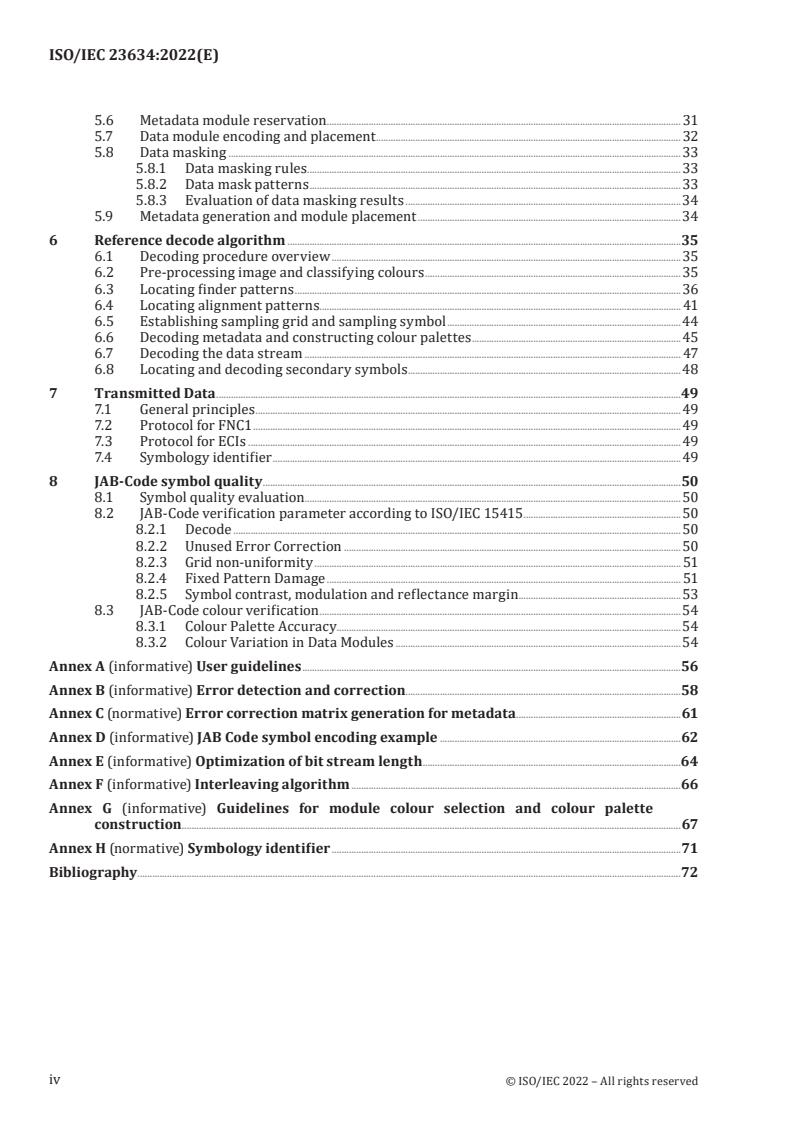
5.6 Metadata module reservation . 31
5.7 Data module encoding and placement . 32
5.8 Data masking . 33
5.8.1 Data masking rules . 33
5.8.2 Data mask patterns . 33
5.8.3 Evaluation of data masking results .34
5.9 Metadata generation and module placement .34
6 Reference decode algorithm .35
6.1 Decoding procedure overview .35
6.2 Pre-processing image and classifying colours . 35
6.3 Locating finder patterns .36
6.4 Locating alignment patterns. 41
6.5 Establishing sampling grid and sampling symbol .44
6.6 Decoding metadata and constructing colour palettes . 45
6.7 Decoding the data stream . 47
6.8 Locating and decoding secondary symbols .48
7 Transmitted Data .49
7.1 General principles .49
7.2 Protocol for FNC1 .49
7.3 Protocol for ECIs .49
7.4 Symbology identifier .49
8 JAB-Code symbol quality .50
8.1 Symbol quality evaluation . 50
8.2 JAB-Code verification parameter according to ISO/IEC 15415 .50
8.2.1 Decode . 50
8.2.2 Unused Error Correction .50
8.2.3 Grid non-uniformity . 51
8.2.4 Fixed Pattern Damage . 51
8.2.5 Symbol contrast, modulation and reflectance margin .53
8.3 JAB-Code colour verification .54
8.3.1 Colour Palette Accuracy . .54
8.3.2 Colour Variation in Data Modules .54
Annex A (informative) User guidelines .56
Annex B (informative) Error detection and correction.58
Annex C (normative) Error correction matrix generation for metadata .61
Annex D (informative) JAB Code symbol encoding example .62
Annex E (informative) Optimization of bit stream length .64
Annex F (informative) Interleaving algorithm .66
Annex G (informative) Guidelines for module colour selection and colour palette
construction .67
Annex H (normative) Symbology identifier .71
Bibliography .72
iv
© ISO/IEC 2022 – All rights reserved
Foreword
ISO (the International Organization for Standardization) and IEC (the International Electrotechnical
Commission) form the specialized system for worldwide standardization. National bodies that are
members of ISO or IEC participate in the development of International Standards through technical
committees established by the respective organization to deal with particular fields of technical
activity. ISO and IEC technical committees collaborate in fields of mutual interest. Other international
organizations, governmental and non-governmental, in liaison with ISO and IEC, also take part in the
work.
The procedures used to develop this document and those intended for its further maintenance
are described in the ISO/IEC Directives, Part 1. In particular, the different approval criteria
needed for the different types of document should be noted. This document was drafted in
accordance with the editorial rules of the ISO/IEC Directives, Part 2 (see www.iso.org/directives or
www.iec.ch/members_experts/refdocs).
Attention is drawn to the possibility that some of the elements of this document may be the subject
of patent rights. ISO and IEC shall not be held responsible for identifying any or all such patent
rights. Details of any patent rights identified during the development of the document will be in the
Introduction and/or on the ISO list of patent declarations received (see www.iso.org/patents) or the IEC
list of patent declarations received (see patents.iec.ch).
Any trade name used in this document is information given for the convenience of users and does not
constitute an endorsement.
For an explanation of the voluntary nature of standards, the meaning of ISO specific terms and
expressions related to conformity assessment, as well as information about ISO's adherence to
the World Trade Organization (WTO) principles in the Technical Barriers to Trade (TBT) see
www.iso.org/iso/foreword.html. In the IEC, see www.iec.ch/understanding-standards.
This document was prepared by Joint Technical Committee ISO/IEC JTC 1, Information technology,
Subcommittee SC 31, Automatic identification and data capture techniques.
Any feedback or questions on this document should be directed to the user’s national standards
body. A complete listing of these bodies can be found at www.iso.org/members.html and
www.iec.ch/national-committees.
v
© ISO/IEC 2022 – All rights reserved
Introduction
JAB Code is a colour-based, two-dimensional matrix symbology whose basic symbols are made up
of colourful modules, arranged in either square or rectangle grids. JAB Code has two types of basic
symbols: a primary symbol and the secondary symbol. A JAB Code contains one primary symbol, and
optionally, multiple secondary symbols. A primary symbol contains four finder patterns, located at the
corners of the symbol. Secondary symbols contain finder pattern.
A secondary symbol can be docked to a primary symbol, or another docked secondary symbol, in either
a horizontal or vertical direction. JAB Code can encode from small to large amounts of data, correlated
to user-specified percentages of the error correction.
Both manufacturers and users of bar code equipment require publicly available symbology standards
when developing equipment and application standards. The publication of standardised symbology
specifications, such as this one, are designed to achieve this.
vi
© ISO/IEC 2022 – All rights reserved
INTERNATIONAL STANDARD ISO/IEC 23634:2022(E)
Information technology — Automatic identification and
data capture techniques — JAB Code polychrome bar code
symbology specification
IMPORTANT — The electronic file of this document contains colours which are considered to be
useful for the correct understanding of the document. Users should therefore consider printing
this document using a colour printer.
1 Scope
This document defines the requirements for the symbology known as JAB Code. It specifies the JAB
Code symbology characteristics, symbol structure, symbol dimensions, symbol cascading rules, data
character encodation, error correction rules, user-selectable application parameters, print quality
requirements and a reference decode algorithm.
2 Normative references
The following documents are referred to in the text in such a way that some or all of their content
constitutes requirements of this document. For dated references, only the edition cited applies. For
undated references, the latest edition of the referenced document (including any amendments) applies.
ISO/IEC 646, Information technology — ISO 7-bit coded character set for information interchange
ISO/IEC 10646, Information technology — Universal coded character set (UCS)
ISO/IEC 15415, Information technology — Automatic identification and data capture techniques — Bar
code symbol print quality test specification — Two-dimensional symbols
ISO/IEC 15424, Information technology — Automatic identification and data capture techniques — Data
Carrier Identifiers (including Symbology Identifiers)
ISO/IEC 15434, Information technology — Automatic identification and data capture techniques — Syntax
for high-capacity ADC media
3 Terms, definitions, abbreviated terms and symbols
For the purposes of this document, the following terms and definitions apply.
ISO and IEC maintain terminology databases for use in standardization at the following addresses:
— ISO Online browsing platform: available at https:// www .iso .org/ obp
— IEC Electropedia: available at https:// www .electropedia .org/
3.1 Terms and definitions
3.1.1
module
single square in one colour within the matrix pattern that is the elemental entity used to encode data
3.1.2
finder pattern
fixed reference pattern at predefined positions in a matrix symbology, which enables the decode
software to locate the JAB symbol in an image
© ISO/IEC 2022 – All rights reserved
3.1.3
alignment pattern
fixed reference pattern at predefined positions in a matrix symbology, which enables the decode
software to resynchronize the coordinate mapping of the modules (3.1.1) in the event of moderate
amounts of distortion of the image
3.1.4
data interleaving
procedure which pseudo-randomly arranges the data in a matrix symbology
3.1.5
colour palette
set of reference modules (3.1.1) of colours used in the symbol, which is located at predefined positions
in a matrix symbology
3.1.6
padding bits
bits which do not represent data and are used to fill empty positions of the available encoding capacity
after the final bit of encoded data
3.1.7
primary symbol
main symbol which contains finder patterns and is used to locate the whole JAB code
3.1.8
secondary symbol
appending symbols which may be used to encode more data with a lower overhead in terms of auxiliary
modules (3.1.1)
3.1.9
host symbol
symbol, either primary or secondary, in a JAB Code which docks secondary symbols on its horizontal or
vertical sides
3.1.10
JAB Code
colour two-dimensional matrix symbology
Note 1 to entry: JAB code is used for “just another bar code”.
3.2 Abbreviated terms
LDPC low-density parity-check
SS in primary symbol: symbol shape flag / in secondary symbol: same shape and size flag
MSK masking reference
SE same error correction level
V side-version
E error correction parameter
S secondary positions
m raw data bits
c transmitted codeword
© ISO/IEC 2022 – All rights reserved
r received codeword
L number of iterations
FPDB fixed pattern damage in segment B
ECI extended channel interpretation
FNC1 function code one
GNU grid non-uniformity
UEC unused error correction
CSL centre surrounding layer
3.3 Mathematical symbols
For the purposes of this document, the following mathematical symbols apply:
N module colour mode indicating the number of module colours in the symbol
c
C symbol capacity in number of bits
P symbols net payload (the number of raw data bits)
n
P symbols gross payload (the number of encoded data bits)
g
P length of the encoded message including the metadata of docked secondary symbols and the
e
flag bit
K number of error correction bits in the symbol, equal to P -P
g n
H parity check matrix of LDPC code
w number of 1’s in each row in H (the parity check matrix of LDPC code)
r
w number of 1’s in each column in H (the parity check matrix of LDPC code)
c
3.4 Mathematical and logical operations
For the purposes of this document, the following mathematical and logic operations apply.
max(x,y) is the greater of x and y
div is the integer division operator
mod is the remainder after division
XOR is the exclusive-or logic function that outputs one only when the two inputs differ.
log (x) is the logarithm function to base 2.
ln(x) is the logarithm function to base e.
© ISO/IEC 2022 – All rights reserved
4 Symbol description
4.1 Basic characteristics
a) Encodable character set:
1) numeric data;
2) uppercase letters;
3) lowercase letters;
4) punctuation marks;
5) mixed characters;
6) alphanumeric data;
7) byte data (default interpretation: UTF-8 specified in ISO/IEC 10646);
8) ECI and FNC1.
b) Symbol type
1) In JAB Code there are two types of symbols: primary symbol and secondary symbol.
2) A JAB Code contains one primary symbol and optionally multiple secondary symbols.
c) Symbol shape
1) The primary symbol and secondary symbol in a JAB Code may be either square or rectangle.
2) Primary symbol and secondary symbol in a JAB Code may be of different shapes.
d) Symbol size
1) The smallest primary or secondary JAB Code symbol side size is 21 and the largest is 145. The
smallest square symbol is 21 × 21 modules and the largest is 145 × 145 modules.
2) No quiet zone is required for the symbol.
e) Module colour
1) The number of module colours is configurable in two modes: 4 or 8 colours.
2) Guidelines for colour selection are given in Annex G.
f) Representation of data
1) A module represents log (N ) binary bits. See 5.7.
2 c
2) The binary bits that a module represents correspond to the index value of the module colour in
the colour palette.
g) Data capacity
1) The data capacity of JAB Code depends on the symbol size, the number of module colours, and
the error correction level.
2) The capacity of a single-symbol square code is listed in Table 1.
h) Selectable error correction
1) User-selectable error correction levels are supported.
© ISO/IEC 2022 – All rights reserved
2) In one JAB Code, different error correction levels may be configured in each symbol.
i) Symbol cascading
1) Secondary symbols can be docked to the side of a primary symbol, or other secondary symbols.
2) JAB Code may have an arbitrary form by cascading primary and secondary symbols in
horizontal and vertical directions while adhering to the order in Figure 14.
j) Code type: Matrix
k) Orientation independent: Yes
4.2 Summary of additional features
The use of the following additional features is optional in JAB Code:
a) Mirror Imaging: When JAB Code is obtained in mirror reversal, it is still possible to achieve a valid
decode of a symbol with the standard reader. Refer to 6.2.
b) Extended Channel Interpretation: The ECI mechanism enables data using character sets other
than the default encodable set (e.g., Arabic, Chinese, Cyrillic, Greek, Hebrew) and other data
interpretations or industry-specific requirements to be represented.
4.3 Symbol structure
4.3.1 Square primary symbol
The structure of a square JAB Code primary symbol is shown in Figure 1 and given in Annex A. A square
primary symbol shall consist of finder pattern, alignment pattern (starting with Side-Version 6, and
larger), colour palette, encoded data and optionally metadata region. Four finder patterns are located at
the four symbol corners respectively, with one module between the outermost layer and the border. No
quiet zone surrounding the symbol is required. The primary symbol illustrated in Figure 1 is a square
symbol of Side-Version 2, whose width and height are 25 modules.
4.3.2 Rectangle primary symbol
The structure of a rectangle JAB Code primary symbol is shown in Figure 2. The structure of a rectangle
primary symbol is the same as a square primary symbol, except that the horizontal and vertical distance
between the finder patterns are not equal. Like square symbols, no quiet zone is required for rectangle
primary symbols. The primary symbol illustrated in Figure 2 is a rectangle symbol of a combination of
Side-Version 5 and 2, of which the width is 37 modules and the height is 25 modules.
4.3.3 Square secondary symbol
The structure of a square JAB Code secondary symbol is shown in Figure 3. Except for finder patterns,
secondary symbols contain the same patterns as the primary symbol, including alignment pattern,
colour palette and encoded data region. In secondary symbols, the four finder patterns are replaced by
four alignment patterns. Like the primary symbol, no surrounding quiet zone is required for secondary
symbols. The secondary symbol illustrated in Figure 3 is a square symbol of Side-Version 2, whose
width and height are 25 modules.
4.3.4 Rectangle secondary symbol
The structure of a rectangle JAB Code secondary symbol is shown in Figure 4. The structure of the
rectangle secondary symbol is the same as the rectangle primary symbol, except that the finder
patterns are replaced by four alignment patterns. No quiet zone is required for rectangle secondary
symbols. The secondary symbol illustrated in Figure 4 is a rectangle symbol of a combination of Side-
Version 5 and 2, whose width is 37 modules and whose height is 25 modules.
© ISO/IEC 2022 – All rights reserved
Key
1 Finder pattern UL
2 metadata and colour palette
3 Finder pattern LL
4 Finder pattern UR
5 encoded data
6 Finder pattern LR
Figure 1 — Structure of square primary symbol
Key
1 Finder pattern UL
2 metadata and colour palette
3 Finder pattern LL
4 Finder pattern UR
5 encoded data
6 Finder pattern LR
Figure 2 — Structure of rectangle primary symbol
© ISO/IEC 2022 – All rights reserved
Key
1 alignment pattern U
2 colour palette
3 alignment pattern L
4 encoded data
Figure 3 — Structure of square secondary symbol
Key
1 alignment pattern U
2 colour palette
3 alignment pattern L
4 encoded data
Figure 4 — Structure of rectangle secondary symbol
4.3.5 Symbol side size
The side of a JAB Code symbol may have one of 32 different sizes, referred to as Side-Version 1, Side-
Version 2, … Side-Version 32. See Table 1. The side size increases in steps of 4 modules, from 21 modules
in Side-Version 1, to 145 modules in Side-Version 32. A square symbol has the same Side-Version for
both the horizontal and vertical sides, while a rectangle symbol may have any combination of two
different side-versions for the horizontal and vertical sides. The smallest square symbol measures
21 × 21 modules and the largest square symbol measures 145 × 145 modules. The smallest rectangle
© ISO/IEC 2022 – All rights reserved
symbol measures 21 × 25 modules and the largest rectangle symbol measures 141 × 145 modules. The
rectangle symbol of 21 × 145 or 145 × 21 modules has the maximal proportion between the horizontal
and vertical sides.
The capacities listed in Table 1 are based on the recommended error correction level 3 for square
symbols, and a default of 8 colours. The number of data modules can be calculated according to the
following formulae:
DFCB= 4
Distance of Finder pattern Centre to Border:
MDBA=16
Minimum Distance between Alignment patterns:
am=−ax 02,/SideSize DFCB×+11MDBA−
Number of alignment pattern modules: ()()
xx
am=−ax 02,/SideSize DFCB×+11MDBA−
()()
yy
aa=+()22×+a −47×
()()
xy
44,if colorselected
Number of colours used in JAB code:
NumberOfModuleColor =
88,if colorselected
CN=−()umberOfModuleColor 24×
Number of colour palette modules:
Palette
FF=×4174; =×7
Number of finder pattern modules:
PrimarySecondary
Number of Metadata modules: MetadataLength
Metadata= *log 2
()
log ()NumberOfModuleColor
SideSize ×−SideSize aC−−FM− etadata
Number of data modules in primary:
xy Palette Primary
SideSize ×−SideSize aC−−F
Number of data modules in secondary:
xy Palette Secondary
Table 1 — Symbol side versions and square symbol capacity of JAB Code (default metadata)
Number of data modules Symbol net payload P (in bits)
n
Side size
Side-Ver-
Square Primary Square Secondary Square Primary Square Secondary
sion
(in modules)
4 8 4 8 4 8 4 8
1 21 338 349 405 389 676 1 047 810 1 167
2 25 522 533 589 573 1 044 1 599 1 178 1 719
3 29 738 749 805 789 1 476 2 247 1 610 2 367
4 33 986 997 1 053 1 037 1 972 2 991 2 106 3 111
5 37 1 266 1 277 1 333 1 317 2 532 3 831 2 666 3 951
6 41 1 543 1 554 1 610 1 594 3 086 4 662 3 220 4 782
7 45 1 887 1 898 1 954 1 938 3 774 5 694 3 908 5 814
8 49 2 263 2 274 2 330 2 314 4 526 6 822 4 660 6 942
9 53 2 671 2 682 2 738 2 722 5 342 8 046 5 476 8 166
10 57 3 062 3 073 3 129 3 113 6 124 9 219 6 258 9 339
11 61 3 534 3 545 3 601 3 585 7 068 10 635 7 202 10 755
12 65 4 038 4 049 4 105 4 089 8 076 12 147 8 210 12 267
13 69 4 574 4 585 4 641 4 625 9 148 13 755 9 282 13 875
14 73 5 079 5 090 5 146 5 130 10 158 15 270 10 292 15 390
15 77 5 679 5 690 5 746 5 730 11 358 17 070 11 492 17 190
16 81 6 311 6 322 6 378 6 362 12 622 18 966 12 756 19 086
17 85 6 975 6 986 7 042 7 026 13 950 20 958 14 084 21 078
© ISO/IEC 2022 – All rights reserved
Table 1 (continued)
Number of data modules Symbol net payload P (in bits)
n
Side size
Side-Ver-
Square Primary Square Secondary Square Primary Square Secondary
sion
(in modules)
4 8 4 8 4 8 4 8
18 89 7 594 7 605 7 661 7 645 15 188 22 815 15 322 22 935
19 93 8 322 8 333 8 389 8 373 16 644 24 999 16 778 25 119
20 97 9 082 9 093 9 149 9 133 18 164 27 279 18 298 27 399
21 101 9 874 9 885 9 941 9 925 19 748 29 655 19 882 29 775
22 105 10 607 10 618 10 674 10 658 21 214 31 854 21 348 31 974
23 109 11 463 11 474 11 530 11 514 22 926 34 422 23 060 34 542
24 113 12 351 12 362 12 418 12 402 24 702 37 086 24 836 37 206
25 117 13 271 13 282 13 338 13 322 26 542 39 846 26 676 39 966
26 121 14 118 14 129 14 185 14 169 28 236 42 387 28 370 42 507
27 125 15 102 15 113 15 169 15 153 30 204 45 339 30 338 45 459
28 129 16 118 16 129 16 185 16 169 32 236 48 387 32 370 48 507
29 133 17 166 17 177 17 233 17 217 34 332 51 531 34 466 51 651
30 137 18 127 18 138 18 194 18 178 36 254 54 414 36 388 54 534
31 141 19 239 19 250 19 306 19 290 38 478 57 750 38 612 57 870
32 145 20 383 20 394 20 450 20 434 40 766 61 182 40 900 61 302
4.3.6 Module dimension
JAB Code symbols (both primary and secondary symbols) shall conform to the following dimensions:
X dimension: the width of a module shall be specified by the application, taking into account the
technologies used to produce and scan the symbol.
Y dimension: the height of a module shall be equal to the X dimension.
No limit is placed on the module size in this specification. However, all modules in the symbols of a JAB
Code shall be of the same size.
4.3.7 Finder pattern
There are four types of finder patterns in JAB Code, i.e., Finder Pattern UL, Finder Pattern UR, Finder
Pattern LR and Finder Pattern LL, located at the upper left, the upper right, the lower right and lower
left corners respectively as illustrated in Figure 6. Each finder pattern contains two equal square
references made up of 3 × 3 modules as illustrated in Figure 5 for the UL finder pattern, connected with
each other by an overlapping module (core module).
The finder patterns have different orientations. The core module of Finder Pattern UL and Finder
Pattern UR shall be the lower right module of the upper reference, and the upper left module of the
lower reference, respectively. In Finder Pattern LR and Finder Pattern LL, the core shall be the lower
left module of the upper reference and the upper right module of the lower reference.
Each square reference in a finder pattern is constructed of three layers; all the same width of one
module. The layers in the two references are symmetric with respect to the core module, as illustrated
in Figure 5. Each finder pattern contains two colours. The colour of each layer is different from its
adjacent layers. Finder Pattern UL and Finder Pattern LL consist of black and cyan layers. Finder Pattern
UR and Finder Pattern LR are made up of yellow and black layers. Finder Pattern UL and UR have a
black core. Finder Pattern LR has a yellow core and Finder Pattern LL has a cyan core.
© ISO/IEC 2022 – All rights reserved
Figure 5 — Constructing the UL finder pattern
Key
1 Finder pattern UL
2 Finder pattern UR
3 Finder pattern LL
4 Finder pattern LR
Figure 6 — Finder patterns
4.3.8 Alignment pattern
There are four types of alignment patterns in JAB Code, i.e., Alignment Pattern X0, Alignment Pattern
X1, Alignment Pattern U and Alignment Pattern L, as illustrated in Figure 7. Each alignment pattern
is constructed of two square references (2 × 2 modules) consisting of two layers connected by an
overlapping core module. Alignment Pattern U and Alignment Pattern L have a yellow outer layer and
cyan cores, Alignment Pattern X0 and Alignment Pattern X1 have a cyan outer layer and yellow cores.
Alignment Pattern U shall be placed in secondary symbols at the same positions as Finder Pattern UL
and Finder Pattern UR in primary symbols. Alignment Pattern L shall be placed in secondary symbols
at the same positions as Finder Pattern LR and Finder Pattern LL in primary symbols as illustrated in
Figure 4. Alignment Pattern X0 and X1 shall be placed between finder patterns in primary symbols and
between Alignment Pattern U and Alignment Pattern L in secondary symbols as illustrated in Figure 8.
© ISO/IEC 2022 – All rights reserved
Key
1 alignment pattern X0
2 alignment pattern X1
3 alignment pattern U
4 alignment pattern L
Figure 7 — Alignment patterns
Alignment Pattern X0 and Alignment Pattern X1 are present only in JAB Code symbols which has Side-
Version 6 or larger. The number of alignment patterns depends on the side-version of each symbol side.
The alignment patterns are spaced as evenly as possible. For each side-version, the number of alignment
patterns and the column/row coordinates of the core module of each alignment pattern are specified in
Table 2, where the coordinate of the top-left module in the symbol is defined as (1, 1).
In either primary or secondary symbols, alignment patterns shall be placed on the intersections of
columns and rows of the coordinates listed in Table 2 except the positions where a finder pattern is
located. For example, Table 2 indicates the coordinates 4, 14, 32 and 54 for Side-Version 10. Therefore,
in a square primary symbol of Side-Version 10, the 12 alignment patterns are centred at (column, row)
positions (4, 14), (4, 32), (14, 4), (14, 14), (14, 32), (14, 54), (32, 4), (32, 14), (32, 32), (32, 54), (54, 14), (54,
32).
The first alignment pattern, which is located next to Finder Pattern UL in primary symbols or next
to Alignment Pattern U at the top-left corner in secondary symbols in either horizontal or vertical
direction, shall be Alignment X1. At the following placement positions of alignment patterns, Alignment
Pattern X0 and Alignment Pattern X1 shall be placed alternately in both horizontal and vertical
directions, as illustrated in Figure 8.
© ISO/IEC 2022 – All rights reserved
Figure 8 — Alignment pattern placement
Table 2 — Positions of alignment patterns
Number of
Side size
Side-Version alignment Column/Row (x/y) coordinates of core module
(in modules)
patterns
1 21 0 4 18
2 25 0 4 22
3 29 0 4 26
4 33 0 4 30
5 37 0 4 34
6 41 5 4 17 38
7 45 5 4 20 42
8 49 5 4 23 46
9 53 5 4 26 50
10 57 12 4 14 32 54
11 61 12 4 17 39 58
12 65 12 4 20 46 62
13 69 12 4 23 44 66
14 73 21 4 26 37 51 70
15 77 21 4 14 36 58 74
16 81 21 4 17 39 56 78
17 85 21 4 20 42 63 82
© ISO/IEC 2022 – All rights reserved
Table 2 (continued)
Number of
Side size
Side-Version alignment Column/Row (x/y) coordinates of core module
(in modules)
patterns
18 89 32 4 23 38 54 70 86
19 93 32 4 26 38 56 77 90
20 97 32 4 14 33 53 72 94
21 101 32 4 17 38 59 79 98
22 105 45 4 20 36 53 70 86 102
23 109 45 4 23 36 55 74 93 106
24 113 45 4 26 36 58 79 100 110
25 117 45 4 14 36 58 80 92 114
26 121 60 4 17 34 52 70 88 99 118
27 125 60 4 20 37 54 72 89 106 122
28 129 60 4 23 38 56 74 92 113 126
29 133 60 4 26 36 58 78 98 120 130
30 137 77 4 14 32 49 67 84 102 112 134
31 141 77 4 17 35 53 71 89 107 119 138
32 145 77 4 20 38 55 73 91 108 126 142
4.3.9 Colour palette
The colour palette provides reference module colour values for symbol decoding. As listed in Table 6,
two module colour modes are specified, allowing for minimally 4, and maximally 8 colours to be used
in a symbol. Hence the colour palette has a minimal size of 4, and maximal size of 8, containing up to 8
colours, which are indexed from 0 to 7. Table 3 shows an example of an 8-colour palette, corresponding
to module colour mode 2, and Table 4 shows the 4-colour palette. Refer to Annex G for guidelines on
module colour selection and colour palette construction.
In either primary or secondary symbols, four colour palettes shall be placed near to the finder patterns
or the alignment pattern U or L, which are located in different reserved regions. Each placed colour
palette contains all available module colours except the two colours used by the nearest finder pattern
or alignment pattern U or L.
...