

ISO/IEC 27034-5:2017
(Main)Information technology — Security techniques — Application security — Part 5: Protocols and application security controls data structure
General Information
- Abstract
ISO/IEC 27034-5 outlines and explains the minimal set of essential attributes of ASCs and details the activities and roles of the Application Security Life Cycle Reference Model (ASLCRM).
- Status
- Published
- Publication Date
- 08-Oct-2017
- Drafting Committee
- ISO/IEC JTC 1/SC 27/WG 4 - Security controls and services
- Current Stage
- 9093 - International Standard confirmed
- Start Date
- 09-May-2023
- Completion Date
- 29-Aug-2026

Overview
ISO/IEC 27034-5:2017 is part of the ISO/IEC 27034 series on application security. It documents the minimal set of essential attributes and a standardized data structure for Application Security Controls (ASCs) and describes the Application Security Life Cycle Reference Model (ASLCRM) - its activities, roles and processes. The standard promotes consistent creation, exchange, protection and reuse of ASCs to reduce cost and improve application-level security governance.
Key topics and technical requirements
- ASC information requirements - a defined, minimal set of essential attributes that should accompany an ASC to ensure it is usable, verifiable and reusable across projects and tools.
- Integrity assurance - guidance that ASC data must support integrity mechanisms (for example, recognized signing or verification methods) so controls can be trusted.
- Multilingual / multiregional data representation - support for representing ASC metadata in multiple languages or regions to enable global reuse.
- ASC data structure recommendations - principles for structuring ASC content to facilitate exchange (interoperability between tools/suppliers) and self-containedness (packaged controls include required metadata and context).
- Application Security Life Cycle Reference Model (ASLCRM) - detailed activities and roles across layers such as Application Management, Provisioning & Operation, Infrastructure Management and Application Audit. This includes processes for initiating, planning, executing, monitoring, transitioning, utilization, archival and destruction of application assets.
- Roles and ASC package - responsibilities for managers, ONF (Organization Normative Framework) committees, domain experts, suppliers and acquirers; and guidance on packaging ASCs for distribution and lifecycle mapping.
- Normative linkage - aligns with ISO/IEC 27034-1 (overview and concepts) and other parts of the 27034 suite.
Practical applications
- Standardizing how application security controls are described, stored and exchanged across organizations and vendors.
- Building an ASC library or repository where approved controls are discoverable and reusable across projects.
- Selecting or developing security tooling that interoperates using a common ASC data structure and exchange protocol.
- Supporting audits, provisioning and lifecycle activities by mapping ASC responsibilities into organizational processes.
- Reducing duplication and implementation cost by reusing verified, integrity-protected controls.
Who should use it
- Managers responsible for enterprise application security governance.
- ONF committees that manage organizational ASC libraries and approval processes.
- Domain experts who develop and validate ASCs.
- Tool vendors and ASC suppliers creating, signing and distributing controls.
- Acquirers integrating third‑party ASCs and mapping them to internal lifecycles.
Related standards
- ISO/IEC 27034-1 (Overview and concepts) - foundational concepts referenced normatively by ISO/IEC 27034-5.
Get Certified
Connect with accredited certification bodies for this standard

BSI Group
BSI (British Standards Institution) is the business standards company that helps organizations make excellence a habit.

Bureau Veritas
Bureau Veritas is a world leader in laboratory testing, inspection and certification services.

DNV
DNV is an independent assurance and risk management provider.
Sponsored listings
Frequently Asked Questions
ISO/IEC 27034-5:2017 is a standard published by the International Organization for Standardization (ISO). Its full title is "Information technology — Security techniques — Application security — Part 5: Protocols and application security controls data structure". This standard covers: ISO/IEC 27034-5 outlines and explains the minimal set of essential attributes of ASCs and details the activities and roles of the Application Security Life Cycle Reference Model (ASLCRM).
ISO/IEC 27034-5 outlines and explains the minimal set of essential attributes of ASCs and details the activities and roles of the Application Security Life Cycle Reference Model (ASLCRM).
ISO/IEC 27034-5:2017 is classified under the following ICS (International Classification for Standards) categories: 35.030 - IT Security; 35.040 - Information coding. The ICS classification helps identify the subject area and facilitates finding related standards.
ISO/IEC 27034-5:2017 is available in PDF format for immediate download after purchase. The document can be added to your cart and obtained through the secure checkout process. Digital delivery ensures instant access to the complete standard document.
Standards Content (Sample)
INTERNATIONAL ISO/IEC
STANDARD 27034-5
First edition
2017-10
Information technology — Security
techniques — Application security —
Part 5:
Protocols and application security
controls data structure
Technologies de l'information — Techniques de securite — Securite
des applications —
Partie 5: Protocoles et structure de données de contrôles de sécurité
d'application
Reference number
©
ISO/IEC 2017
© ISO/IEC 2017, Published in Switzerland
All rights reserved. Unless otherwise specified, no part of this publication may be reproduced or utilized otherwise in any form
or by any means, electronic or mechanical, including photocopying, or posting on the internet or an intranet, without prior
written permission. Permission can be requested from either ISO at the address below or ISO’s member body in the country of
the requester.
ISO copyright office
Ch. de Blandonnet 8 • CP 401
CH-1214 Vernier, Geneva, Switzerland
Tel. +41 22 749 01 11
Fax +41 22 749 09 47
copyright@iso.org
www.iso.org
ii © ISO/IEC 2017 – All rights reserved
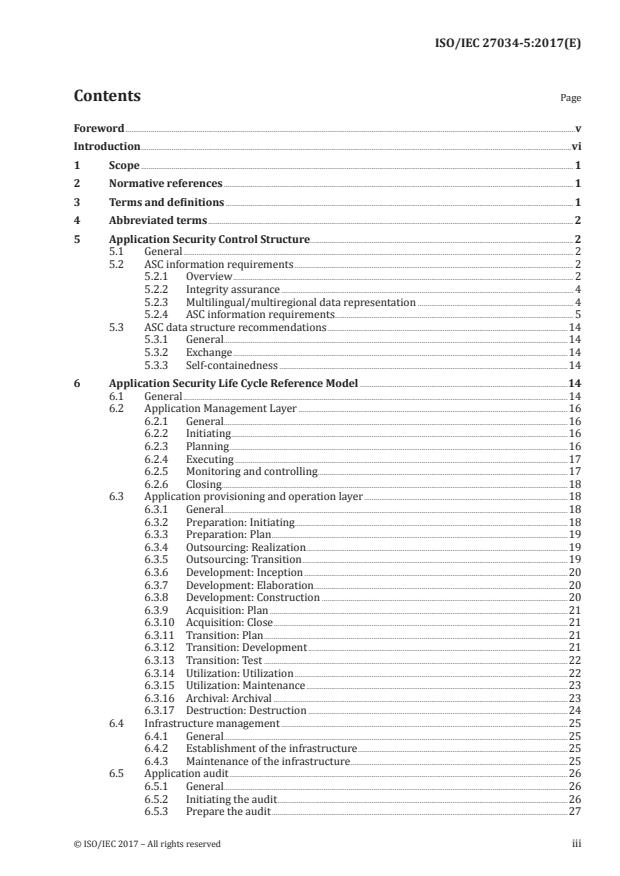
Contents Page
Foreword .v
Introduction .vi
1 Scope . 1
2 Normative references . 1
3 Terms and definitions . 1
4 Abbreviated terms . 2
5 Application Security Control Structure . 2
5.1 General . 2
5.2 ASC information requirements . 2
5.2.1 Overview . 2
5.2.2 Integrity assurance . 4
5.2.3 Multilingual/multiregional data representation . 4
5.2.4 ASC information requirements . 5
5.3 ASC data structure recommendations .14
5.3.1 General.14
5.3.2 Exchange .14
5.3.3 Self-containedness .14
6 Application Security Life Cycle Reference Model .14
6.1 General .14
6.2 Application Management Layer .16
6.2.1 General.16
6.2.2 Initiating .16
6.2.3 Planning .16
6.2.4 Executing .17
6.2.5 Monitoring and controlling .17
6.2.6 Closing . .18
6.3 Application provisioning and operation layer .18
6.3.1 General.18
6.3.2 Preparation: Initiating.18
6.3.3 Preparation: Plan .19
6.3.4 Outsourcing: Realization .19
6.3.5 Outsourcing: Transition .19
6.3.6 Development: Inception .20
6.3.7 Development: Elaboration .20
6.3.8 Development: Construction .20
6.3.9 Acquisition: Plan .21
6.3.10 Acquisition: Close .21
6.3.11 Transition: Plan .21
6.3.12 Transition: Development .21
6.3.13 Transition: Test .22
6.3.14 Utilization: Utilization .22
6.3.15 Utilization: Maintenance .23
6.3.16 Archival: Archival .23
6.3.17 Destruction: Destruction .24
6.4 Infrastructure management .25
6.4.1 General.25
6.4.2 Establishment of the infrastructure .25
6.4.3 Maintenance of the infrastructure .25
6.5 Application audit .26
6.5.1 General.26
6.5.2 Initiating the audit .26
6.5.3 Prepare the audit .27
© ISO/IEC 2017 – All rights reserved iii
6.5.4 Conduct the audit .27
6.5.5 Report .28
6.5.6 Complete the audit .28
6.5.7 Follow-up . .28
6.6 Roles .29
7 ASC Package .31
Bibliography .33
iv © ISO/IEC 2017 – All rights reserved
Foreword
ISO (the International Organization for Standardization) and IEC (the International Electrotechnical
Commission) form the specialized system for worldwide standardization. National bodies that are
members of ISO or IEC participate in the development of International Standards through technical
committees established by the respective organization to deal with particular fields of technical
activity. ISO and IEC technical committees collaborate in fields of mutual interest. Other international
organizations, governmental and non-governmental, in liaison with ISO and IEC, also take part in the
work. In the field of information technology, ISO and IEC have established a joint technical committee,
ISO/IEC JTC 1.
The procedures used to develop this document and those intended for its further maintenance are
described in the ISO/IEC Directives, Part 1. In particular the different approval criteria needed for the
different types of ISO documents should be noted. This document was drafted in accordance with the
editorial rules of the ISO/IEC Directives, Part 2 (see www.iso.org/directives).
Attention is drawn to the possibility that some of the elements of this document may be the subject of
patent rights. ISO shall not be held responsible for identifying any or all such patent rights. Details of
any patent rights identified during the development of the document will be in the Introduction and/or
on the ISO list of patent declarations received (see www.iso.org/patents).
Any trade name used in this document is information given for the convenience of users and does not
constitute an endorsement.
For an explanation on the voluntary nature of standards, the meaning of ISO specific terms and
expressions related to conformity assessment, as well as information about ISO's adherence to the
World Trade Organization (WTO) principles in the Technical Barriers to Trade (TBT) see the following
URL: www.iso.org/iso/foreword.html.
This document was prepared by Technical Committee ISO/IEC JTC 1, Information technology,
Subcommittee SC 27, IT Security techniques.
A list of all parts in the ISO/IEC 27034 series can be found on the ISO website.
© ISO/IEC 2017 – All rights reserved v
Introduction
General
There is an increasing need for organizations to focus on protecting their information at the application
level. A systematic approach towards increasing the level of application security provides an
organization with evidence that information being used or stored by its applications is being adequately
protected.
ISO/IEC 27034 (all parts) provides concepts, principles, frameworks, components and processes to
assist organizations in integrating security seamlessly throughout the life cycle of their applications.
The Application Security Control (ASC) is one of the key components of this document.
To facilitate the implementation of ISO/IEC 27034 (all parts) application security framework and the
communication and exchange of ASCs, a minimal set of essential attributes should be documented and
explained for realizing ASCs and certain other components of the framework.
This document explains the minimal set of essential attributes of ASCs and further details the
Application Security Life Cycle Reference Model (ASLCRM).
Purpose
The purpose of this document is to document and explain the essential information and data structure
requirements for ASCs. The advantages of a standardized set of essential information attributes and
data structure of ASCs include the following:
a) normalized ASC creation, communication, protection and verification in compliance with the
requirements of this document; and
b) minimized cost of security in application projects by facilitating the reuse of approved controls and
acquisition of ASCs from different sources.”
In addition, this document defines and details the processes, activities and roles involved in the
Application Security Life Cycle Reference Model.
Targeted audiences
General
The following audiences will find values and benefits when carrying their designated organizational roles:
a) managers;
b) ONF committee;
c) domain experts;
d) suppliers; and
e) acquirers.
Managers
Managers should read this document because they are responsible for:
a) ensuring the ASCs are reusable within the organization, and
b) ensuring the ASCs are available, communicated and used in application projects with proper tools
and procedures all across the organization.
vi © ISO/IEC 2017 – All rights reserved
Organization Normative Framework (ONF) Committee
The ONF Committee is responsible for managing the implementation and maintenance of the
application-security-related components and processes in the Organization Normative Framework.
The ONF Committee:
a) implements the ASC Library,
b) approves ASCs that correctly mitigate application security risks, and
c) manages the cost of implementing and maintaining the ASCs.
Domain experts
Domain experts contribute knowledge in application provisioning, operating or auditing, who:
a) participate in ASC development, validation and verification,
b) participate in ASC implementation and maintenance, by proposing strategies, components and
implementation processes for adapting ASCs to the organization's context, and
c) validate that ASCs are useable and useful in application projects.
Security tools and ASC supplier
Suppliers contribute to develop, maintain and distribute tools and/or ASCs. They
a) create, validate, enforce integrity (through a recognized method, such as signing), distribute and
apply ASCs, and
b) align with a common and standardized exchange protocol (structure and format) for ASCs.
Security tools and ASC acquirer
Acquires are individuals or organizations who want to acquire ASCs. They
a) integrate ASCs into their organization and ensure the interoperability of any internal and third-
party ASCs,
b) adapt ASCs and enforce their integrity, and
c) ensure that the activities and tasks of acquired ASCs can be mapped to the organization’s
application lifecycle.
© ISO/IEC 2017 – All rights reserved vii
INTERNATIONAL STANDARD ISO/IEC 27034-5:2017(E)
Information technology — Security techniques —
Application security —
Part 5:
Protocols and application security controls data structure
1 Scope
This document outlines and explains the minimal set of essential attributes of ASCs and details the
activities and roles of the Application Security Life Cycle Reference Model (ASLCRM).
2 Normative references
The following documents are referred to in the text in such a way that some or all of their content
constitutes requirements of this document. For dated references, only the edition cited applies. For
undated references, the latest edition of the referenced document (including any amendments) applies.
ISO/IEC 27034-1, Information technology — Security techniques — Application security — Part 1:
Overview and concepts
3 Terms and definitions
For the purposes of this document, the terms and definitions given in ISO/IEC 27034-1 and the
following apply.
ISO and IEC maintain terminological databases for use in standardization at the following addresses:
— ISO Online browsing platform: available at http://www.iso.org/obp
— IEC Electropedia: available at http://www.electropedia.org/
3.1
activity
set of actions or tasks carried out by an actor during the application’s life cycle
3.2
information group record
list of information elements to which an organization can assign labels, such as names, description and
categorization values
Note 1 to entry: To avoid confusion, information group name should be unique within the organization.
3.3
information element
piece of information that should be categorized and identified by a name, description, and domain
values (e.g. a field in a database)
Note 1 to entry: An information group can be seen as an information element.
© ISO/IEC 2017 – All rights reserved 1
4 Abbreviated terms
ASC Application Security Control
ASLC Application Security Life Cycle
ASLCRM Application Security Life Cycle Reference Model
ICT Information and Communication Technology
ONF Organization Normative Framework
5 Application Security Control Structure
5.1 General
Each Application Security Control (ASC) defines a security-related activity performed at a specific
point in an application's life cycle to mitigate a risk or to satisfy a requirement. The security activity is
supplemented by a verification measurement (activity) that specifies the necessary steps to verify its
successful application. For both the security activity and verification measurement, an ASC specifies
how, where, when and by whom the activity should be implemented. Information about the required
effort is also captured.
The purpose of this clause is to provide a specification of the ASC information requirements and data
structure recommendations. Organizations may choose to implement the information requirements
and data structure requirements using either a narrative approach or other suitable data structure,
which best suits organizational needs and requirements.
NOTE 1 To identifiy the minimum set of attributes needed to define a valid ASC, the name of each ASC attribute
defined in this document includes the mention “(M)” when the attribute is mandatory, or the mention “(O)”
when the attribute is optional.
NOTE 2 The inclusion of an optional attribute could require the implementation of subsequent mandatory
attributes. Mandatory attributes under an optional attribute are mandatory only when the optional attribute is
implemented [e.g. see 5.2.4.2, e)].
The purpose of this clause is also to provide a list of possible activities enabling the ONF Committee to
attach ASCs into the Application Security Life Cycle Reference Model (ASLCRM).
ASC developers should align their vocabulary with ISO/IEC 27034 (all parts) when they need to
describe assets.
5.2 ASC information requirements
5.2.1 Overview
This subclause defines the recommended information requirements for individual application security
controls. For a concrete implementation in form of an XML Schema of this document, please refer to
ISO/IEC 27034-5-1.
Note that this document does not define how the various ASC information items are identified
or managed. For details about the latter, consult the management and audit process defined in
ISO/IEC 27034-2, ISO/IEC 27034-3 and ISO/IEC 27034-4.
NOTE Explicit indication of an inheritance hierarchy is not implemented in the ASC structure, but could be
implemented in future versions.
2 © ISO/IEC 2017 – All rights reserved
Figure 1 — Main sections of ASC information
As specified in ISO/IEC 27034-1:2011, 8.1.2.6.5, and shown in Figure 1, each ASC should contain the
following sections:
a) ASC Identification (M): This section should contain the following information:
1) identification information about the ASC (id, name, etc.);
2) a high-level description of the scope and intent of the ASC;
3) information about the current version including the creation date, current lifecycle stage,
revision notes and identification information about its author and owner; and
4) references to super-ordinate and sub-ordinate ASCs.
b) ASC Objective (M): This section should contain the following information:
1) a detailed description of the ASC’s intent and security objective;
2) one or more security requirements that justify ‘why’ the ASC is needed as well as information
about the context and the application functionality from which the security requirements
originated;
3) one or more levels of trust for which the ASC is mandatory along with a description of the level
of trust range;
4) preconditions and assumptions for applying the ASC. In particular:
i) a list of preconditions;
ii) a list of (informal) threat assumptions; and
iii) a description of the operating environment (context of use).
c) ASC Security Activity (M): This section should contain the following information pertinent to the
security activity defined by the ASC:
1) a high-level description of the security activity (what);
2) a description of the asset that is protected (targeted) by carrying out the security activity
(where);
© ISO/IEC 2017 – All rights reserved 3
3) a definition of the roles (and required qualifications) involved in the execution of the tasks and
actions involved in the security activity (who);
4) an indication of the complexity and costs of the security activity (how much);
5) a detailed specification of the tasks and actions to be performed by the security activity, the
expected outcomes and preconditions (how); and
6) an indication as to when (relative to Application Security Life Cycle Reference Model) the tasks
and actions of the security activity should be performed (when).
d) ASC Verification Measurement (M): This section should contain the following information
pertinent to the verification measurements defined by the ASC:
1) a high-level description of the verification measurement (what);
2) a description of the asset that is verified (audited) by the verification measurement (where);
3) a definition of the roles (and required qualifications) involved in the execution of the tasks and
actions involved in the verification activity (who);
4) an indication of the complexity and costs of the verification measurement (how much);
5) a detailed specification of the tasks and actions to be performed by the verification activity, the
expected outcomes and preconditions (how); and
6) an indication as to when (relative to Application Security Life Cycle Reference Model) the tasks
and actions of the verification activity should be performed (when).
Further details for each information requirement are provided in 5.2.4.
5.2.2 Integrity assurance
In order to ensure the integrity of contents of ASCs, an ASC should be 'signable' (or similar recognized
method). It should support cascading and multiple e-signatures as well as timestamps.
5.2.3 Multilingual/multiregional data representation
In order to ensure global communication of ASCs, the ASC data structure should support localized text
and the specification of information items, processes or ICT in multiple languages.
4 © ISO/IEC 2017 – All rights reserved
5.2.4 ASC information requirements
5.2.4.1 Identification (M)
Figure 2 — Identification section of an ASC
As shown in Figure 2, an ASC should contain the following information pertinent to its identity:
a) Identification information about the ASC including:
1) UID (M): A unique identifier inside the schema;
2) Name (M): A representative name;
b) Description (M): High-level description of the ASCs intent and scope;
© ISO/IEC 2017 – All rights reserved 5
c) Version (M): Information describing this ASC version, including:
1) Number (M): The current version number of the ASC, using legal style numbering (e.g. 0.1.1
or 1.2);
2) Date (M): The creation date of the current version of the ASC;
3) Life cycle stage (M): The currently active stage within the ASC life cycle. The following life
cycle stage values are permissible:
i) creation request;
ii) design;
iii) design review and validation;
iv) development;
v) verification;
vi) approval;
vii) owners final approval;
viii) published for training;
ix) active;
x) expired;
xi) custom.
4) Maturity approval note (O): A maturity level indication of this version;
5) Revision notes (O): A description of how the ASC evolved from the previous version;
d) Author (O): Authors of the current version of the ASC and its affiliation, including their names and
contact information; and
e) Owner (O): Owners of the current version of the ASC and its affiliation, including their names and
contact information.
f) Graph relationships to super-ordinate and sub-ordinate ASCs are defined as follows and as
illustrated in Figure 3:
1) Subordination (M): References to zero, one or many subordinated ASCs' unique identification
numbers as a way to specify that the completion of the activities of all subordinate (children)
ASCs (in the order defined) is necessary to complete the activity of the superordinate ASC. A
short description of refered ASCs may be included.
2) Superordination (M): Reference to zero, one or many superordinate ASCs' unique
identification numbers as a way to specify its parent ASCs. A short description of refered parent
ASCs may be included.
6 © ISO/IEC 2017 – All rights reserved
Figure 3 — ASC graph relationship
5.2.4.2 Objectives
Figure 4 — Objective section of an ASC
As shown in Figure 4, an ASC should contain the following information pertinent to its security
objectives:
a) Description (M): A detailed description of the ASC's purpose and security objectives;
b) Addressed Security requirements (M): A non-empty set of requirements that are addressed
by performing the security activity of the ASC. For each requirement, the following information
should be captured:
© ISO/IEC 2017 – All rights reserved 7
Figure 5 — Security requirement section of an ASC
1) Context (O): Specifies the context (source) the requirement originates from. The following
context type values are permissible:
i) regulatory context;
ii) business context;
iii) technological context;
iv) application functionality;
v) custom.
2) Type (O): The type of the security requirements. The following values are permissible:
i) business requirements;
ii) business rules;
iii) regulatory requirements;
iv) user requirements;
v) actor qualifications requirements;
vi) quality attributes;
vii) system requirements;
v iii) process requirement s;
ix) functional requirements;
x) external interfaces;
xi) infrastructure requirements;
xii) constraints;
xiii) custom.
3) Name (M): A representative name for the requirement;
4) Description (M): A qualitative description of the requirement;
8 © ISO/IEC 2017 – All rights reserved
5) Source (O): The source document from which the requirement originates.
c) Assigned Levels of Trust (M): A list of one or more levels of trust for which the ASC is mandatory.
In order to keep the ASC self-contained, this information should be complemented by the level of
trust range which provides a definition of the assigned levels of trust as well as an indicator of the
relative strengths of each level;
d) Condition (O): Description of preconditions, assumptions and context of use for applying the ASC,
including, as shown in Figure 6:
1) Condition type (O): The type of the condition. The following values are permissible:
i) precondition;
ii) assumption;
iii) operating environment description;
iv) custom.
2) Description (M): May include the following:
i) a list of preconditions for applying the ASC;
ii) a list of (informal) threat assumptions which are mitigated by the ASC;
iii) a description of the operating environment (context of use).
Figure 6 — Condition section of an ASC
e) Level of Trust range (O):
Figure 7 — Level of Trust range section of an ASC
When a Level of Trust range exists in an ASC, the following information, as shown in Figure 7,
should describe each Level of Trust included in the range:
1) Level of Trust UID (M): Unique identification number in this schema, for this Level of Trust
2) Name (M): The Level of Trust name;
3) Label (M): A label, representing this Level of Trust;
© ISO/IEC 2017 – All rights reserved 9
4) Description (M): A short description of the Level of Trust to help the acquirer/receiver to
integrate this ASC at the right level in the acquirer’s ASC Library.
f) Prediction allowed indicator (O): Specifies whether prediction is allowed for the ASC. That is,
whether or not the correct functioning of the ASC shall be re-validated or not if the operating
context changes in a non-substantial manner. See ISO/IEC 27034-7 for details.
5.2.4.3 Security activity and verification measurement
An ASC should specify one security activity and one associated verification measurement. The security
activity specifies a set of tasks and actions that need to be carried out in order to fulfill the security
requirements associated with the ASC. The verification measurement specifies the tasks and actions
that need to be carried out in order to verify that the security requirements of the ASC have been met.
Figure 8 — Security activity and verification measurement sections of an ASC
As shown in Figure 8, an ASC should contain the following information for specifying both the security
activity and the verification measurement activity.
a) Synopsis (M): A condensed statement giving a general view of this activity. The following
information should be captured:
1) Name (M): Name of the activity;
2) Description (M): An informal description of the scope of the activity including its coverage
and outcome;
3) Target information (M): An indicator of the scope of the activity. It defines which group of
information items are protected / verified by the activity as a result of implementing the ASC
to people, processes or information and communications technology (ICT) involved with those
information items. In order for an ASC activity to be valid and 'useful' there shall be at least
one information item that is protected or verified by the ASC. For each information item the
following information is specified:
i) Name (M): A representative name for the information item, processes or ICT;
10 © ISO/IEC 2017 – All rights reserved
ii) Information group type (M): Associates one or more types with the information item,
processes or ICT. The following values are permissible:
I) laws and regulations;
II) organization or business line directives and regulations;
III) application life cycle processes;
IV) application process definition;
V) specification;
VI) application data;
VII) organization and user data;
VIII) roles permission definition;
IX) technological context definition;
X) custom.
iii) Description (M): A description of the information item, processes or ICT;
iv) Information classification (O): An indication of how sensitive (in terms of confidentiality,
integrity and availability) the information item is.
v) Information owner (O): Identifies the owner of this information item.
4) Outcome description (M): A description of the expected outcome as a result of applying the
activity.
5) Supporting expert resources (O): References to supporting (expert) resources to facilitate
the application of the activity.
b) Activity complexity (O): Indication of the complexity of the activity using quantitative and
qualitative measures.
NOTE This Activity complexity attribute is mandatory (M) when the Activity specification
attribute exists.
c) The following information should be captured:
1) Label (M): A descriptive complexity label. The following complexity values are permissible:
i) low;
ii) medium;
iii) high;
iv) extreme;
v) custom.
2) Description (M): A description of the complexity;
3) Global estimated cost (O): The estimated (monetary) cost for performing the activity;
4) Global estimated effort (O): The effort required to perform the activity (e.g. day/person);
5) Global estimated time (O): The time required to complete the activity.
© ISO/IEC 2017 – All rights reserved 11
6) Note (O): Supplemental information about the complexity of this activity.
d) Activity specification (O): A detailed description of the activity.
NOTE This Activity specification attribute is optional (O) because it is not required when the ASC
is a “head ASC” in an ASC hierarchy (see ISO/IEC 27034-1:2011, Figure 7) (see Figure 3). Otherwise, it is
required.
Each activity specification includes a Responsibility matrix referred (M) attribute that identifies
the type of responsibility matrix referred in this activity description. The following values are
permissible:
1) RACI;
2) RASCI.
The following labels are permissible for describing responsibilities:
1) responsible;
2) accountable;
3) support;
4) consulted;
5) informed.
Each activity specification includes a sequence of ordered tasks (M). Each task should contain the
following information:
1) Sequence (O): Execution sequence number ordering the tasks of this activity.
2) Description (M): A description of the task;
3) Pre-conditions (O): A set of preconditions (including precedence requirements) that need to
be satisfied before the task can be performed;
4) Required resources (M): The resources involved (and required) for performing the task. For
each resource allocation, the following information is specified:
i) Role name (M): A reference to the role that will be fulfilled by the resource. The set of
possible roles is defined by the ASLCRM (see 6.6).
ii) Responsibility (M): The RACI responsibility assumed by the role for that task.
iii) Description (O): A description of the nature of the resource allocation; and
iv) Required qualifications (O): A list of qualifications required to assume the role's
responsibility in the execution of the tasks and actions of the activity. For each role, the
qualifications required should be specified.
5) Execution moments (M): Indication of when [relative to the activities defined in the
Application Security Lifecycle Reference Model (Clause 6)] the task shall be performed. For
each execution moment the following information should be specified:
i) Execution order (M): The execution order relative to the referenced activity. The
following values are permissible:
I) before;
II) during;
III) after;
12 © ISO/IEC 2017 – All rights reserved
IV) custom.
ii) Life cycle reference (M): A reference to an activity in the Application Security Lifecycle
Reference. The values permissible for the role are defined by the ASRLCM (Clause 6);
iii) Name (O): An activity name, when the activity is referencing “Custom” in the life-cycle-
reference.
iv) Description (M): A description of when the task shall be performed;
v) Interval value, unit and label (M): The execution frequency value of the task.
I) The following time units are permissible for describing an interval value:
A) seconds;
B) minutes;
C) hours;
D) days;
E) weeks;
F) months;
G) semesters;
H) years.
II) The following labels are permissible for describing an interval:
A) once;
B) periodic;
C) on event;
D) custom.
6) Actions list (M): A sequence of low-level atomic action descriptions that need to be executed
in order to complete the task;
7) Outcome (M): The expected outcome of the task in terms of which artefacts are expected to be
produced as a result of task performance. For each expected artefact, the following information
should be specified:
i) Type (M): The type of artefact produced. The following values are permissible:
I) report;
II) document;
III) source code;
IV) compiled code;
V) executable code;
VI) script;
VII) library;
VIII) diagram;
© ISO/IEC 2017 – All rights reserved 13
IX) parameters file;
X) link;
XI) custom.
ii) Content (M): The expected content of the produced artefact.
8) Task estimated effort (O): The estimated effort required by the resource allocation to
complete this task.
9) Note (O): Provides additional information about this task if needed.
5.2.4.4 Self-containedness recommendation
When importing ASCs, a self-contained set of ASCs should be imported, i.e. all ASCs linked through a
hierarchy should be imported together.
Similarly references between ASCs acquired from an ASC supplier should be mapped to the referencing
scheme of the acquirer's own ASC Library.
5.3 ASC data structure recommendations
5.3.1 General
In what follows a set of recommendations is made for defining a suitable data structure for ASCs.
The objective of these recommendations is to facilitate exchange and communication of ASCs while
preserving their integrity.
5.3.2 Exchange
In order to foster the broad adoption and sharing of ASCs, an ASC should be defined in a platform-
independent and portable manner. ASCs should be communicated using the notation described in
ISO/IEC 27034-5-1.
5.3.3 Self-containedness
In order to ensure that ASCs can be understood and applied without consulting external documents,
the ASC data structure should support the inclusion of complex (non-text) data elements, such as
documents, source or executable code, etc. It is highly recommended to include the range of levels of
trust based on which recommended levels of trust the ASC has been defined for.
The identification and description of an item in an ASC should be understandable without a context, if
standardized identification schemes are used. E.g. ISO/IEC 19770-5 and ISO/IEC 19770-2.
6 Application Security Life Cycle Reference Model
6.1 General
The purpose of this clause is to further detail and list the activity labels proposed by the Application
Security Life Cycle Reference Model (ASLCRM) defined in ISO/IEC 27034-1. Figure 9 shows that the
life cycle of an application consists basically of two stages: Provisioning and Operation. The former is
further broken down into Preparation, Realization and Transition phases while the latter is subdivided
into Utilization / Maintenance, Archival and Destruction phases. In each phase, a set of activities in
application management, application provisioning and operation, infrastructure management and
application audit are executed involving several actors. It is the purpose of 6.2 to 6.6 to further detail
these activity labels as well as to provide generic definitions of the actors involved.
14 © ISO/IEC 2017 – All rights reserved
Figure 9 — Top-level view of the Application Security Life Cycle Reference Model
The various stages, phases and activities defined by the ASLCRM should be used as a referential in the
ASC definition to indicate when an ASC activity should be performed. Similarly, the actors and roles
defined by the ASLCRM should be used as referential in the ASC definition to indicate which resources
should be allocated for performing an ASC activity or task.
Figure 10 presents the ASLCRM elements as a tree, where the root is the “Life cycle reference” element,
the first level is the “layer”, the second level is the “stage”, the third level is the “activity area”, the fourth
level is the “activity sub-area” and the fifth level is the “activity label” itself. A path, as a sequence of
elements, may be selected to identify one specific activity label as an execution moment (5.2.4.3, d)5)).
Figure 10 — ActivityLabel selected from the Application Security Life Cycle Reference Model
In this example, the complete sequence to identify the activity label is: “Life Cycle Reference / Application
Infrastructure Layer / Operation Stage / Operation Infrastructure Management / … /Activity Label”.
© ISO/IEC 2017 – All rights reserved 15
6.2 Application Management Layer
6.2.1 General
Figure 11 — Application Management Processes
NOTE In Figure 11, “Application provisioning management” and “Application operation management”
represent two activity areas, while the elements “Initiating”, “Planning”, “Executing”, “Monitoring & controlling”
and “Closing” represent sub-activity areas. The activities l
...