

ISO/TS 17870-3:2023
(Main)Ceramic tiles — Installation — Part 3: Installation of large format porcelain tiles and panels by mechanical means onto a supporting structure
General Information
- Abstract
Classes A1a and B1a porcelain (as defined in ISO 13006) are now manufactured in much larger formats than previously available and are increasingly being used as an external cladding material for buildings. Classes A1b, A11a, and AIIb extruded ceramics (as defined in ISO 13006) are not covered by the scope of this document. These materials, when specifically developed for external façade applications, have been used extensively for many years and established methodologies already exist. Large format porcelain tiles or panels are generally considered to be too large to be used externally on high buildings when installed by conventional adhesive fixing methods (ISO/TR 17870-1 and ISO/TR 17870-2); therefore, mechanical fixings are used. As there are currently no published standards or guidelines for these products to be installed in this way, this document provides generic information on some typical types of mechanical fixing systems in use together with positive and negative wind load factors and typical testing procedures that can be used for evaluating anchor pull-out or edge fracture resistance. Also, because the current impact resistance test method for ceramics tiles (ISO 10545-5) relates only to traditional (bedded) installed tiling – which measures the coefficient of restitution – it is not an appropriate test for unbedded (unsupported) tiles, so alternative test methods (ISO 7892) are referred to for measuring hard-body and soft-body impact resistance. Guidance is provided regarding typical impact zones of vulnerability to hard and soft body impact and reference is made to anti-shatter mesh backings, which are sometimes applied to porcelain cladding tiles and panels. Installation systems which rely upon the chemical adhesion of metal brackets, straps or framing, etc. onto or into large format porcelain tiles or panels in conjunction with, or instead of, mechanical attachment, are not included in this document. The detailed principles for the design and construction of the substructure of ventilated façades, also known as rain screens, used on the outside of buildings, are well documented in other national and international standards and are not therefore, included in this document, other than in general reference.
- Status
- Published
- Publication Date
- 09-Jan-2023
- Technical Committee
- ISO/TC 189 - Ceramic tile
- Drafting Committee
- ISO/TC 189/WG 6 - Installation methods
- Current Stage
- 9093 - International Standard confirmed
- Start Date
- 30-Jul-2026
- Completion Date
- 29-Aug-2026



Overview
ISO/TS 17870-3:2023 is a technical specification developed by ISO for the mechanical installation of large format porcelain tiles and panels onto supporting structures, focusing particularly on external building cladding. This standard addresses the increasing use of large format tiles-specifically Classes A1a and B1a porcelain as defined by ISO 13006-in architectural facades, where traditional adhesive methods are often unsuitable due to the size and weight of the tiles. The document provides essential guidance for selecting appropriate mechanical fixing systems, evaluating wind load resistance, and ensuring impact resistance for high-rise and exterior applications.
Key Topics
Scope and Applicability
- Covers installation of large format porcelain tiles/panels (Classes A1a, B1a) by mechanical means.
- Excludes extruded ceramics such as Classes A1b, AIIa, AIIb (covered by other established methods).
Mechanical Fixing Systems
- Details various mechanical fixing methods such as undercut anchors, bracket and strap attachments, apertured tile systems, edge slotted systems, and visible overlapping clip systems.
- Emphasizes the need for fixing systems to withstand specified wind loads and prevent panel drift or deformation.
Wind Load Calculations
- Provides methodologies and example calculations for positive and negative wind load factors.
- Stresses the importance of pull-out and edge fracture resistance testing for anchor systems.
Impact Resistance
- Identifies limitations of existing test methods (ISO 10545-5) for large, unsupported tiles.
- Recommends alternative test methods (ISO 7892) for evaluating hard- and soft-body impact resistance relevant to external panels.
Guidance for Design and Installation
- Offers advice on handling, workmanship, setting out, erection sequences, and maintenance access.
- Highlights the importance of exchanging information among stakeholders to ensure correct installation according to project requirements.
Applications
The key applications of ISO/TS 17870-3:2023 include:
External Cladding for Buildings
- Ensuring safe and durable installation of large porcelain panels on facades, particularly high-rise buildings.
- Supporting the design of ventilated façade systems (rain screens) where enhanced weather resistance and thermal performance are required.
Architectural Façades
- Widely used in modern architecture for their aesthetic versatility and resilience.
- Suitable where adhesive methods are impractical due to the panel size or environmental exposure.
Public and Commercial Buildings
- Applicable for cladding large surfaces in infrastructure, commercial complexes, and public buildings.
- Enables compliance with best practice for wind, impact, and environmental resistance.
Retrofit and Renovation
- Provides reliable guidance for upgrading traditional cladding systems to large format porcelain panels.
Related Standards
ISO/TS 17870-3:2023 integrates and references several related standards within the ceramic tiles and building cladding domain:
- ISO 13006: Definitions and classifications of ceramic tiles, providing the basis for tile types covered by this document.
- ISO/TR 17870-1 and ISO/TR 17870-2: Address traditional adhesive installation methods, which are supplemented by this standard for mechanical applications.
- ISO 10545-5: Traditional impact resistance testing for bedded ceramic tiles.
- ISO 7892: Alternative test methods for impact resistance suitable for unsupported or unbedded panels.
- Ventilated Façade Standards: National and international documents covering detailed design/construction of façade substructures (rain screens), referenced for general guidance.
Practical Value
By following ISO/TS 17870-3:2023, architects, engineers, builders, and façade specialists can ensure:
- Compliance with Global Standards: Assurance of safety, durability, and performance in mechanical installations of large format porcelain tiles.
- Optimized Design and Installation: Reduction of construction issues related to wind, impact, and environmental loads.
- Long-term Façade Integrity: Enhanced service life and minimized risks of failure for modern building envelopes using large format ceramic panels.
For anyone involved in the specification, design, or installation of large format porcelain cladding, ISO/TS 17870-3:2023 offers critical, up-to-date industry guidance.
Get Certified
Connect with accredited certification bodies for this standard

DIBt (Deutsches Institut für Bautechnik)
German Institute for Building Technology.
DIN CERTCO
DIN Group product certification.

Aboma Certification B.V.
Specialized in construction, metal, and transport sectors.
Sponsored listings
Frequently Asked Questions
ISO/TS 17870-3:2023 is a technical specification published by the International Organization for Standardization (ISO). Its full title is "Ceramic tiles — Installation — Part 3: Installation of large format porcelain tiles and panels by mechanical means onto a supporting structure". This standard covers: Classes A1a and B1a porcelain (as defined in ISO 13006) are now manufactured in much larger formats than previously available and are increasingly being used as an external cladding material for buildings. Classes A1b, A11a, and AIIb extruded ceramics (as defined in ISO 13006) are not covered by the scope of this document. These materials, when specifically developed for external façade applications, have been used extensively for many years and established methodologies already exist. Large format porcelain tiles or panels are generally considered to be too large to be used externally on high buildings when installed by conventional adhesive fixing methods (ISO/TR 17870-1 and ISO/TR 17870-2); therefore, mechanical fixings are used. As there are currently no published standards or guidelines for these products to be installed in this way, this document provides generic information on some typical types of mechanical fixing systems in use together with positive and negative wind load factors and typical testing procedures that can be used for evaluating anchor pull-out or edge fracture resistance. Also, because the current impact resistance test method for ceramics tiles (ISO 10545-5) relates only to traditional (bedded) installed tiling – which measures the coefficient of restitution – it is not an appropriate test for unbedded (unsupported) tiles, so alternative test methods (ISO 7892) are referred to for measuring hard-body and soft-body impact resistance. Guidance is provided regarding typical impact zones of vulnerability to hard and soft body impact and reference is made to anti-shatter mesh backings, which are sometimes applied to porcelain cladding tiles and panels. Installation systems which rely upon the chemical adhesion of metal brackets, straps or framing, etc. onto or into large format porcelain tiles or panels in conjunction with, or instead of, mechanical attachment, are not included in this document. The detailed principles for the design and construction of the substructure of ventilated façades, also known as rain screens, used on the outside of buildings, are well documented in other national and international standards and are not therefore, included in this document, other than in general reference.
Classes A1a and B1a porcelain (as defined in ISO 13006) are now manufactured in much larger formats than previously available and are increasingly being used as an external cladding material for buildings. Classes A1b, A11a, and AIIb extruded ceramics (as defined in ISO 13006) are not covered by the scope of this document. These materials, when specifically developed for external façade applications, have been used extensively for many years and established methodologies already exist. Large format porcelain tiles or panels are generally considered to be too large to be used externally on high buildings when installed by conventional adhesive fixing methods (ISO/TR 17870-1 and ISO/TR 17870-2); therefore, mechanical fixings are used. As there are currently no published standards or guidelines for these products to be installed in this way, this document provides generic information on some typical types of mechanical fixing systems in use together with positive and negative wind load factors and typical testing procedures that can be used for evaluating anchor pull-out or edge fracture resistance. Also, because the current impact resistance test method for ceramics tiles (ISO 10545-5) relates only to traditional (bedded) installed tiling – which measures the coefficient of restitution – it is not an appropriate test for unbedded (unsupported) tiles, so alternative test methods (ISO 7892) are referred to for measuring hard-body and soft-body impact resistance. Guidance is provided regarding typical impact zones of vulnerability to hard and soft body impact and reference is made to anti-shatter mesh backings, which are sometimes applied to porcelain cladding tiles and panels. Installation systems which rely upon the chemical adhesion of metal brackets, straps or framing, etc. onto or into large format porcelain tiles or panels in conjunction with, or instead of, mechanical attachment, are not included in this document. The detailed principles for the design and construction of the substructure of ventilated façades, also known as rain screens, used on the outside of buildings, are well documented in other national and international standards and are not therefore, included in this document, other than in general reference.
ISO/TS 17870-3:2023 is classified under the following ICS (International Classification for Standards) categories: 91.100.23 - Ceramic tiles. The ICS classification helps identify the subject area and facilitates finding related standards.
ISO/TS 17870-3:2023 is available in PDF format for immediate download after purchase. The document can be added to your cart and obtained through the secure checkout process. Digital delivery ensures instant access to the complete standard document.
Standards Content (Sample)
TECHNICAL ISO/TS
SPECIFICATION 17870-3
First edition
2023-01
Ceramic tiles — Installation —
Part 3:
Installation of large format porcelain
tiles and panels by mechanical means
onto a supporting structure
Carreaux et dalles céramiques - Installation —
Partie 3: Installation des carreaux et panneaux céramiques grand
format par des moyens mécaniques sur une structure de support
Reference number
© ISO 2023
All rights reserved. Unless otherwise specified, or required in the context of its implementation, no part of this publication may
be reproduced or utilized otherwise in any form or by any means, electronic or mechanical, including photocopying, or posting on
the internet or an intranet, without prior written permission. Permission can be requested from either ISO at the address below
or ISO’s member body in the country of the requester.
ISO copyright office
CP 401 • Ch. de Blandonnet 8
CH-1214 Vernier, Geneva
Phone: +41 22 749 01 11
Email: copyright@iso.org
Website: www.iso.org
Published in Switzerland
ii
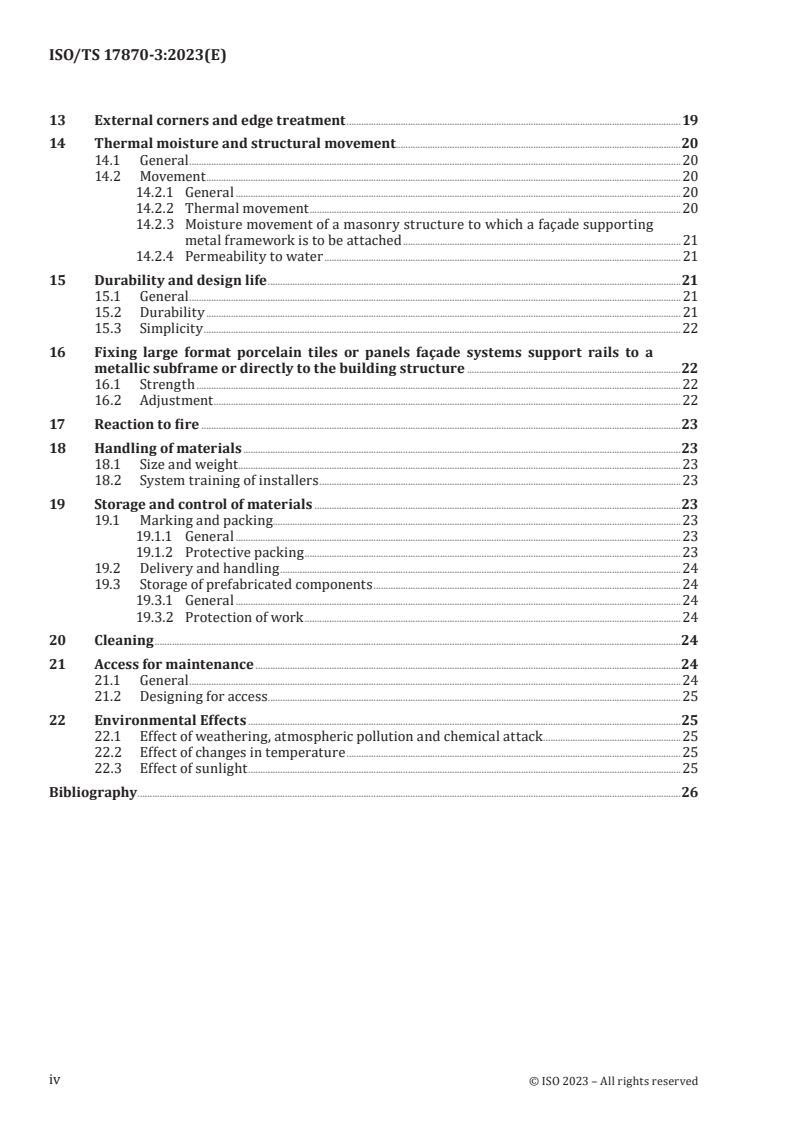
Contents Page
Foreword .v
1 Scope . 1
2 Normative references . 1
3 Terms and definitions . 1
4 Exchange of information . 3
5 Workmanship . 4
6 Ventilated façades . 4
6.1 General . 4
7 Methods of mechanical fixing for porcelain . 5
7.1 General . 5
7.2 Anchored systems . 5
7.2.1 General . 5
7.2.2 Bracket and strap attachment . 6
7.2.3 Undercut drilling . 7
7.2.4 Anchorage – pull-out testing of undercut anchors and edge fracture testing
of slotted edge systems . 7
7.3 Apertured tile systems. 8
7.4 Edge slotted systems . 9
7.4.1 General . 9
7.4.2 Horizontal drift. 10
7.4.3 Effect of frost . 10
7.5 Visible overlapping clip systems . 10
7.6 Off-site prefabrication . . 11
7.7 Cutting large format porcelain tiles or panels . 11
7.7.1 Wet cutting . 11
7.7.2 Scribe and break . 11
8 Erection sequence.11
9 Setting out .12
9.1 General .12
9.2 Plumb and planarity .12
10 Fixings .12
11 Wind loads .12
11.1 Wind-load calculations . 12
11.2 Wind-load testing . 13
11.3 Components - wind-load resistance . 13
11.4 Operational forces .13
12 Impact criteria and performance testing .13
12.1 General .13
12.2 Performance category . 13
12.3 Impact resistance . 14
12.4 Hard body impact testing .15
12.4.1 General .15
12.4.2 Equipment . 16
12.4.3 Procedure . 16
12.5 Soft body impact testing . 16
12.5.1 General . 16
12.5.2 Equipment . 17
12.5.3 Procedure . 18
12.6 Mesh backing . 19
iii
13 External corners and edge treatment .19
14 Thermal moisture and structural movement .20
14.1 General . 20
14.2 Movement . 20
14.2.1 General .20
14.2.2 Thermal movement .20
14.2.3 Moisture movement of a masonry structure to which a façade supporting
metal framework is to be attached . 21
14.2.4 Permeability to water . 21
15 Durability and design life .21
15.1 General . 21
15.2 Durability . 21
15.3 Simplicity . 22
16 Fixing large format porcelain tiles or panels façade systems support rails to a
metallic subframe or directly to the building structure .22
16.1 Strength . 22
16.2 Adjustment . 22
17 Reaction to fire .23
18 Handling of materials .23
18.1 Size and weight . 23
18.2 System training of installers .23
19 Storage and control of materials .23
19.1 Marking and packing.23
19.1.1 General .23
19.1.2 Protective packing . 23
19.2 Delivery and handling . 24
19.3 Storage of prefabricated components . 24
19.3.1 General . 24
19.3.2 Protection of work . 24
20 Cleaning .24
21 Access for maintenance .24
21.1 General . 24
21.2 Designing for access . 25
22 Environmental Effects .25
22.1 Effect of weathering, atmospheric pollution and chemical attack . 25
22.2 Effect of changes in temperature . 25
22.3 Effect of sunlight .25
Bibliography .26
iv
Foreword
ISO (the International Organization for Standardization) is a worldwide federation of national standards
bodies (ISO member bodies). The work of preparing International Standards is normally carried out
through ISO technical committees. Each member body interested in a subject for which a technical
committee has been established has the right to be represented on that committee. International
organizations, governmental and non-governmental, in liaison with ISO, also take part in the work.
ISO collaborates closely with the International Electrotechnical Commission (IEC) on all matters of
electrotechnical standardization.
The procedures used to develop this document and those intended for its further maintenance are
described in the ISO/IEC Directives, Part 1. In particular, the different approval criteria needed for the
different types of ISO documents should be noted. This document was drafted in accordance with the
editorial rules of the ISO/IEC Directives, Part 2 (see www.iso.org/directives).
Attention is drawn to the possibility that some of the elements of this document may be the subject of
patent rights. ISO shall not be held responsible for identifying any or all such patent rights. Details of
any patent rights identified during the development of the document will be in the Introduction and/or
on the ISO list of patent declarations received (see www.iso.org/patents).
Any trade name used in this document is information given for the convenience of users and does not
constitute an endorsement.
For an explanation of the voluntary nature of standards, the meaning of ISO specific terms and
expressions related to conformity assessment, as well as information about ISO's adherence to
the World Trade Organization (WTO) principles in the Technical Barriers to Trade (TBT), see
www.iso.org/iso/foreword.html.
This document was prepared by Technical Committee ISO/TC 189, Ceramic tile.
A list of all parts in the ISO 17870 series can be found on the ISO website.
Any feedback or questions on this document should be directed to the user’s national standards body. A
complete listing of these bodies can be found at www.iso.org/members.html.
v
TECHNICAL SPECIFICATION ISO/TS 17870-3:2023(E)
Ceramic tiles — Installation —
Part 3:
Installation of large format porcelain tiles and panels by
mechanical means onto a supporting structure
1 Scope
Classes A1a and B1a porcelain (as defined in ISO 13006) are now manufactured in much larger formats
than previously available and are increasingly being used as an external cladding material for buildings.
Classes A1b, A11a, and AIIb extruded ceramics (as defined in ISO 13006) are not covered by the scope
of this document. These materials, when specifically developed for external façade applications, have
been used extensively for many years and established methodologies already exist.
Large format porcelain tiles or panels are generally considered to be too large to be used externally
on high buildings when installed by conventional adhesive fixing methods (ISO/TR 17870-1 and
ISO/TR 17870-2); therefore, mechanical fixings are used.
As there are currently no published standards or guidelines for these products to be installed in this
way, this document provides generic information on some typical types of mechanical fixing systems
in use together with positive and negative wind load factors and typical testing procedures that can
be used for evaluating anchor pull-out or edge fracture resistance. Also, because the current impact
resistance test method for ceramics tiles (ISO 10545-5) relates only to traditional (bedded) installed
tiling – which measures the coefficient of restitution – it is not an appropriate test for unbedded
(unsupported) tiles, so alternative test methods (ISO 7892) are referred to for measuring hard-body
and soft-body impact resistance.
Guidance is provided regarding typical impact zones of vulnerability to hard and soft body impact and
reference is made to anti-shatter mesh backings, which are sometimes applied to porcelain cladding
tiles and panels.
Installation systems which rely upon the chemical adhesion of metal brackets, straps or framing,
etc. onto or into large format porcelain tiles or panels in conjunction with, or instead of, mechanical
attachment, are not included in this document.
The detailed principles for the design and construction of the substructure of ventilated façades,
also known as rain screens, used on the outside of buildings, are well documented in other national
and international standards and are not therefore, included in this document, other than in general
reference.
2 Normative references
There are no normative references in this document.
3 Terms and definitions
For the purposes of this document, the following terms and definitions apply.
ISO and IEC maintain terminology databases for use in standardization at the following addresses:
— ISO Online browsing platform: available at https:// www .iso .org/ obp
— IEC Electropedia: available at https:// www .electropedia .org/
3.1
arris
sharp edge formed by the intersection of two surfaces such as the corner of a masonry unit text of the
definition
3.2
porcelain
ceramic with water absorption ≤ 0,5 % (Class A1a or B1a according to ISO 13006)
3.3
large format porcelain tile
surface area >3 600 cm and no tile edge >1 200 mm
3.4
porcelain panel
surface area >1 m and any tile edge > 1 200 mm
3.5
ventilated façade
system for cladding the exterior of a building that provides for the formation of a cavity between the
building structure and the cladding to allow for the installation of a thermal/acoustic insulation layer
and an air cavity between the insulation layer (3.8) and the large format porcelain tiles (3.3) or panel
Note 1 to entry: Air cavity has a minimum of a 20 mm wide continuous air flow cavity.
3.6
drift
unintended sideways movement of large format porcelain tiles (3.3) or panels across a support structure
due to differential thermal expansion/contraction of components and/or gusting wind pressures
3.7
primary support
subframe or substructure, usually metal, onto which the large format porcelain tiles (3.3) or panels are
mounted
3.8
insulation layer
layer included to obtain sound or thermal insulation
3.9
movement joint
joint (3.10) in large format porcelain tiles (3.3) or panels, backgrounds or substrates, designed to
accommodate movement
3.10
joint
space between adjacent large format porcelain tiles (3.3) or panels
3.11
undercut anchor
special type of stress-free mechanical anchorage system used to secure brackets or straps onto large
format porcelain tiles (3.3) or panels
3.12
support system
metal brackets and rails used to form the subframe
3.13
vapour membrane
impervious layer to resist the passage of water but which will allow vapour from the building structure
to escape
3.14
slotted edge system
kerf edge system
slots formed into the edges of large format porcelain tiles (3.3) or panels to receive clips which are
secured to the façade subframe
3.15
overlapping clip
visible clips which overlap the edges of large format porcelain tiles (3.3) or panels and secured to the
façade subframe
3.16
hard-body impact
impact by hard projectiles that may be thrown, blown or otherwise caused to impact the façade
3.17
soft-body impact
impact from persons or other significantly heavy soft objects falling or pushing against the façade
3.18
negative wind load
negative load (suction) imposed onto the façade by strong or gusting wind
3.19
positive wind load
load imposed onto a façade by strong or gusting wind
3.20
workshop drawing
project-specific detailed installation drawing
4 Exchange of information
In order for the correct large format porcelain tiles or panels ventilated façade system to be installed in
appropriate conditions, at the right time, etc., it is essential that all parties have a clear understanding
of the requirements of the project. To ensure that this is achieved, it is essential that there is wide
consultation between all the parties involved in the project, including client, façade installer and
materials suppliers.
As each project will be unique, it is impossible to give a definitive list of the information to be exchanged,
but the following are common examples:
a) specification: the information required;
b) special attendances: access, unloading, hoisting and storage facilities, heat, light and power, and
any additional items considered necessary to expedite the work;
c) large format porcelain tiles or panels mechanical fixing system: technical specification and
instructions for transport, storage, use;
d) backgrounds: type of façade subframe construction; location on the building and any need for
movement joints;
e) associated work: services in or passing through the façade substructure and junctions with other
adjacent finishes;
f) finishes: type, size, and colour of large format porcelain, tiles or panels and layout requirements;
g) installation: type and technique;
h) workshop drawing;
i) wind load: engineering calculations;
j) programme: a time schedule for the progress of the work.
5 Workmanship
The installation of large format porcelain tiles or panels requires efficient supervision and the
employment of skilled operatives properly trained to install large format porcelain tiles or panels
façade systems to an appropriate level of competence.
The large format porcelain tiles or panels façade installers should be properly trained to work safely
from a scaffold or when using access equipment to work at height, including the use of a safety harness
and other equipment where necessary.
6 Ventilated façades
6.1 General
Ventilated façade systems vary in design, depending upon the performance criteria required by the
specifier, e.g. drained and ventilated, pressure equalised, compartmented.
The various requirements and recommendations contained in this document relate only to the
installation of mechanically fixed large format porcelain tiles or panels onto an appropriately designed,
drained and ventilated façade system subframe.
Usually a ventilated façade subframe will consist of primary support brackets that attach a metallic
subframe to the structure of the building, which may be masonry or concrete/steel frame, etc.
Primary support brackets, which are usually available in a range of sizes depending upon the façade
cavity dimension required, are securely fixed to the building structure and normally provide for some
adjustment of the subframe, which is appropriately attached to the primary support brackets after first
aligning it to the required planarity and perpendicularity.
A thermal/acoustic insulation layer may be installed and covered by a waterproof vapour membrane if
recommended by the façade designer or required in accordance with national regulations.
Purpose-designed horizontal rails are then attached to the subframe in accordance with the
specification at the correct levels and spacing to suit the setting out module of the large format porcelain
tiles or panels to be mechanically attached to them (see Figure 1).
Some ventilated façade primary support systems are suitable for the mechanical attachment of large
format porcelain tiles or panels directly onto the vertical support rails (See Figure 4, Figure 5 and
Figure 6).
In some countries ventilated façade systems are classified as ‘construction kits’ consisting of all the
components necessary to construct the façade and tested to appropriate standards.
7 Methods of mechanical fixing for porcelain
7.1 General
There are various methods of mechanically fixing large format porcelain tiles or panels. This clause
sets out details of some of the most popular types of mechanical fixing systems currently in use. It
is important that whichever mechanical fixing system is used, the fixing shall be able to sustain the
specified design load, without causing stresses within the large format porcelain tiles or panels.
7.2 Anchored systems
7.2.1 General
Whilst the precise design of undercut anchoring systems may vary between different manufacturers,
the general intent is to achieve invisible and stress-free fixing of appropriately designed brackets or
clips, to the rear sides of large format porcelain tiles or panels, for their attachment to a supporting
façade framework.
Undercut anchor details provided in this clause are, therefore, for general information purposes rather
than being design-specific.
Key
1 façade system brackets
2 undercut anchors
3 compression pads
4 façade system horizontal rail
5 subframe
6 building structure
7 vapour membrane
8 primary support bracket
9 insulation
Figure 1 — Typical anchored support brackets
The minimum thickness of large format porcelain tiles or panels to receive undercut anchors will be
determined by the façade system designer according to the size of the panel and the spacings between
the undercut anchors.
7.2.2 Bracket and strap attachment
Bracket or strap attachment to the backs of large format porcelain tiles or panels is usually by means of
specially designed anchors which, when tightened, expand at their base into undercut recesses at the
bottom of holes, drilled to precise depths into the porcelain using specially designed drilling apparatus
(see Figure 2 and Figure 3).
When the anchors are fully tightened to a predetermined torque value, they should not exert any
pressure between the porcelain and the anchor but should fit precisely into the undercut hole in order
to be able to satisfactorily secure the brackets or straps to the large format porcelain tiles or panels.
Some large format porcelain tiles or panels façade systems include compression pads which are fitted
between the large format porcelain tiles or panels and the bracket or strap attachment.
Undercut anchors should be made of austenitic stainless steel.
The diameter and depth of the anchor will depend upon the thickness and weight of the large format
porcelain tiles or panels, the anticipated wind loads and the frequency at which the anchor fixings are
spaced.
Where large format porcelain tiles or panels façade systems employ brackets which attach to horizontal
carrier rails, the top brackets should have adjustable bolts on them for final levelling adjustment.
One of the top brackets should be secured to the horizontal carrier rail by a suitable screw to prevent
any lateral drift of the large format porcelain tiles or panels.
Small cut porcelain returns/reveals are sometimes bracketed and undercut anchored to large format
porcelain tiles or panels. The large format porcelain tiles or panels and their fixings must be able to
support the additional loads created by the attachment of the return, taking into consideration also
that wind loads may increase at external corners of the building.
Undercut drilling, anchoring and fabrication of these units should only be carried out at quality-
controlled and appropriately accredited facilities in strict accordance with the façade designer’s
recommendations.
Final anchor tightness checks should be carried out on site by the façade installer immediately prior to
the installation of large format porcelain tiles or panels using a torque testing hand tool designed for
the purpose
7.2.3 Undercut drilling
a
Eccentric undercut drilling facility employed creates undercut recesses at base of drill holes.
Figure 2 — Example of undercut drill hole
Key
1 anchor
2 bracket or strap
3 anchor bolt
Figure 3 — Typical undercut anchor and bolt assembly
7.2.4 Anchorage – pull-out testing of undercut anchors and edge fracture testing of slotted
edge systems
There can sometimes be significant variations in the pull-out value of undercut anchors or slotted
edge wall strengths of some large format porcelain tiles and panels due to differences in tile or panel
manufacturing processes.
It is important to evaluate anchor pull-out or slot edged strength to ensure that the values exceed the
minimum design requirements necessary for resistance to wind load.
— Pull out resistance values – worked example:
Based on a 140 mph (max.) (225,3 kph) wind speed which produces a force of 2,4 kN/m and taking
into account a safety factor of 3:
Assume a 1 200 x 600 mm (0,72 m ) tile is used with four fixings.
NOTE Additional undercut anchors can be installed to the façade designer’s specification in order to
meet the required safety factor.
— Wind load calculation example
— With a force of 2,4 kN/m and a safety factor of 3, the system shall resist:
2 2
2,4 kN/m x 3 = 7,2 kN/m
— For the tile size 1 200 x 600 mm (0,72 m ):
2 2
7,2 kN/m x 0,72 m = 5,19 kN
— Using four fixings per tile, each fixing shall achieve a minimum pull out or slotted edge wall
fracture value of :
5,19 k ÷ 4 = 1,3 kN (each)
Calculations for the proposed design should be provided by a qualified façade designer.
7.3 Apertured tile systems
Key
1 porcelain panel with apertures through body
2 clip/fixing
3 façade support subframe
Figure 4 — Typical aperture and clip fixing
Some porcelain tile manufacturers produce large format porcelain tiles or panels, usually by extrusion,
which have apertures formed through their body, which are designed to receive mechanical end fixing
devices in order to facilitate attachment to a façade substructure.
Where mechanical fixings are fitted into apertures formed through the body of large format porcelain
tiles or panels, the fixings should not fit so tightly into the apertures, so as to prevent anticipated
differential thermal expansion/contraction movement between the large format porcelain tiles or
panels and the fixings or metal support structure to which the clips are attached taking place, as this
may result in the development of stresses within the façade system.
The large format porcelain tiles or panels manufacturer’s advice should be followed.
7.4 Edge slotted systems
7.4.1 General
Key
1 fixing clips fitted into slots cut into the edges of porcelain
2 subframe
3 building structure
4 vapour membrane
5 primary support bracket
6 insulation
Figure 5 — Typical horizontal edge slotted fixings
The minimum thickness of large format porcelain tiles or panels suitable for this type of fixing will be
determined by the façade designer taking into account the size of the large format porcelain tiles or
panels and the anticipated performance requirements of the façade. After slots have been formed, the
remaining front and rear edges of the slot walls should preferably be minimum 5 mm thick, subject to
the large format porcelain tiles or panels façade system manufacturer’s recommendations.
This type of fixing may not be appropriate for very large porcelain panels where the spans between
perimeter fixing points may be too great to achieve adequate restraint against negative wind loading.
Clips should not fit tightly into slots that are formed into the edges of the large format porcelain tiles or
panels, to prevent anticipated differential thermal expansion/contraction movement between the large
format porcelain tiles or panels and the metal support structure to which the clips are attached, as this
may result in the development of stresses within the façade system.
Due to climatic conditions, in some countries, the façade designer may consider that the slots formed in
the top edge of large format porcelain tiles or panels should be filled with silicone or other appropriate
substance to prevent water from reservoiring in the slot which may freeze and cause damage to the
large format porcelain tiles or panels.
7.4.2 Horizontal drift
Edge slotted clip systems should provide means for preventing large format porcelain tiles or panels
sideways movement, known as ‘drift’, along their horizontal support rails or clips.
The large format porcelain tiles or panels manufacturer’s advice should be followed.
7.4.3 Effect of frost
Due to climatic conditions in some countries where freezing temperatures are to be anticipated, water
should not become trapped in joints or slots in the top edges of large format porcelain tiles or panels, as
subsequent freezing can cause damage that may adversely affect performance of the material and the
integrity of the façade system.
7.5 Visible overlapping clip systems
Key
1 visible clips
2 sub frame
3 building structure
4 vapour membrane
5 primary support bracket
6 insulation
Figure 6 — Typical overlapping clip fixing
Visible clips overlap the large format porcelain tiles or panels at positions around their perimeter where
the clips can be fixed to the façade support structure.
This type of fixing may not be appropriate for some very large porcelain panels where the spans
between perimeter fixing points may be too great to achieve adequate restraint against negative wind
loading, but this will be determined by the façade designer taking into account the size of the large
format porcelain tiles or panels and the anticipated performance requirements of the façade.
The minimum thickness of large format porcelain tiles or panels for façades installed using overlapping
clips is determined by the span between clips without deflection or deformation of the large format
porcelain tiles or panels, when subjected to maximum wind load.
The large format porcelain tiles or panels manufacturer’s advice should be followed.
7.6 Off-site prefabrication
Undercut drilling of large format tiles or panels to accommodate fixing anchors for the attachment of
brackets or straps, etc. should be carried out off-site at a quality-controlled and appropriately accredited
facility.
The brackets or straps should also be attached to the large format porcelain tiles or panels at a quality-
controlled accredited facility where the necessary quality control procedures can be monitored and
recorded.
Some large format porcelain tiles or panels façade system manufacturers can also attach porcelain
reveals, soffits and cill pieces, by means of undercut anchored special bracketing onto the main large
format porcelain tiles or panels face units.
When slots or grooves are required to be formed in the edges of large format porcelain tiles or panels
to receive edge fixing clips, this should be carried out in a quality controlled accredited facility strictly
in accordance with the large format porcelain tiles or panels manufacturers’ recommendations as any
irregularity in the thickness of the remaining side walls of the slots and grooves can adversely affect
resistance to wind load pressures and impact.
7.7 Cutting large format porcelain tiles or panels
7.7.1 Wet cutting
The recommended method for cutting large format porcelain tiles or panels for open jointed ventilated
façades is by wet cutting using appropriate diamond encrusted cutting blades.
Dry machine cutting of large format porcelain tiles or panels is not recommend due to the release of
potentially hazardous dust particles that this cutting method can cause.
7.7.2 Scribe and break
Scribe and break is an appropriate technique for cutting some types of large format porcelain tiles
or panels, but it should be taken into account that for open jointed ventilated façades, the cut/broken
edges of the large format porcelain tiles or panels will be visible through the open joints.
8 Erection sequence
The project façade designer will normally be responsible for estimating the best time to install large
format porcelain tiles or panels. On low-rise buildings (up to five storeys), it is generally desirable to wait
until the main structure is complete before installation but on high-rise buildings enclosure of lower
storeys may sometimes be started before the structure is completed. This will enable lower storeys to
be weatherproofed and fitting-out of interior spaces to be started, but it does expose the enclosure to
the risk of damage from the hoisting of large structural items or from splashing by concrete.
If installation of the large format porcelain tiles or panels is delayed until the structure is complete,
there may be a choice of installing from the bottom up, or from the top down. If scaffolding is used,
there are advantages in installing from the top down. The enclosure may be fully weatherproofed and
finished, and scaffolding struck, as installation proceeds.
NOTE Some installation systems are non-sequential and allow large format porcelain tiles or panels to be
removed and replaced without damaging or interference with surrounding adjacent tiles or panels thus allowing
closure of the façade as scaffold is struck and scaffold ties to the building structure are removed.
9 Setting out
9.1 General
A benchmark or datum should be provided at each floor level for setting out the façade. Before
installation of large format porcelain tiles or panels is commenced, a survey of the building shell or
façade primary support framework should be made to ensure that it is within specified tolerances. If
any specified tolerances have been exceeded, the designer, manufacturer and enclosure subcontractor
should be immediately informed, and steps taken to remedy the deficiencies before installation of the
large format porcelain tiles or panels begins, by either remedial work on site
...