

ISO 17889-2:2023
(Main)Ceramic tiling systems — Sustainability for ceramic tiles and installation materials — Part 2: Specification for tile installation materials
General Information
- Abstract
This document specifies sustainability requirements together with assessment methods and evaluation schemes for ceramic tiles and installation materials. This document includes relevant criteria across product life cycle from raw material through manufacturing, use, and end-of-life management. This document applies to ceramic tile installation materials including: ceramic tiles, adhesives, grouts, membranes, etc. This document deals with adhesives and other tiling materials.
- Status
- Published
- Publication Date
- 04-May-2023
- Technical Committee
- ISO/TC 189 - Ceramic tile
- Drafting Committee
- ISO/TC 189/WG 7 - Sustainability issues for ceramic tiling systems
- Current Stage
- 6060 - International Standard published
- Start Date
- 05-May-2023
- Due Date
- 25-Jun-2022
- Completion Date
- 05-May-2023
Overview
ISO 17889-2:2023 is an international standard developed by the International Organization for Standardization (ISO) focusing on the sustainability of ceramic tiling systems, specifically tile installation materials. This part of the series specifies sustainability requirements, assessment methods, and evaluation schemes for ceramic tile installation materials, encompassing adhesive, grouts, membranes, and related products. The standard covers the entire product life cycle - from raw material sourcing and manufacturing to installation and end-of-life management - to enable consistent and comparable evaluation of sustainability in the ceramic tile industry.
ISO 17889-2:2023 is a valuable resource for manufacturers, designers, contractors, and stakeholders seeking to specify, assess, or procure sustainable ceramic tile installation materials. By implementing this standard, the tile industry can support greater environmental responsibility, economic value, and social well-being throughout the supply chain.
Key Topics
- Sustainability Criteria:
The standard applies a three-pillar model of sustainability, integrating environmental, economic, and social criteria:- Environmental: Focus on resource efficiency, emissions, packaging, use of recycled content, and overall environmental performance.
- Economic & Functional: Ensures product quality, durability, and functional adequacy to minimize waste and create long-term value.
- Social: Promotes health, safety, and fair labor practices throughout manufacturing and installation processes.
- Life Cycle Assessment:
Sustainability requirements are assessed across the product's full life cycle, including raw material extraction, manufacturing, distribution, installation, use, and end-of-life management. - Assessment Methods:
Clear evaluation schemes using both qualitative and quantitative indicators, with requirements classified as mandatory (pass/fail) or multirating (contributing to overall sustainability ratings). - Supplier Responsibility:
Provides guidelines for environmental buying agreements, supporting sustainable procurement and responsible sourcing.
Applications
ISO 17889-2:2023 is intended for various stakeholders in the building and construction industry who are involved with ceramic tile installation systems. Key applications include:
- Manufacturers:
- Guidance for developing, certifying, and marketing sustainable tile installation adhesives, grouts, membranes, and related materials.
- Framework for implementing environmental management systems (EMS), energy efficiency systems, and responsible sourcing of raw materials.
- Design Professionals and Specifiers:
- Reference point for specifying installation materials that meet recognized sustainability standards in project documentation.
- Supports green building certification efforts and sustainability-driven procurement.
- Contractors and Installers:
- Assists in choosing materials that meet health, safety, and environmental performance expectations.
- Encourages best practices in material handling, installation safety, and waste reduction.
- Building Owners and End-Users:
- Enables informed decisions in selecting construction products with lower environmental impact and higher durability.
- Enhances transparency through environmental labelling (such as Environmental Product Declarations and eco-labels).
Related Standards
ISO 17889-2:2023 works in concert with a series of international and regional standards. Key related documents include:
- ISO 17889-1 - Sustainability for ceramic tiles and installation materials - Part 1: Specification for ceramic tiles
- ISO 14024 - Environmental labels and declarations - Type I environmental labeling
- ISO 14025 - Environmental labels and declarations - Type III environmental declarations
- ISO 21930 - Sustainability in buildings and civil engineering works - Core rules for environmental product declarations of construction products and services
- ISO 16000 series - Indoor air determination methods (relevant for emissions assessment)
- EN 13284-1 - Stationary source emissions - Dust determination
- ISO 50001 - Energy management systems (for energy efficiency requirements)
Conclusion
By using ISO 17889-2:2023 as a reference for sustainability in ceramic tile installation materials, organizations and professionals can ensure compliance with internationally recognized practices, improve environmental outcomes, and respond to growing market demand for sustainable construction products. Implementing this standard supports better resource management, health and safety, and social responsibility in ceramic tiling systems.
Relations
- Consolidated By
ISO 2811-1:2023 - Paints and varnishes — Determination of density — Part 1: Pycnometer method - Effective Date
- 06-Jun-2022
Get Certified
Connect with accredited certification bodies for this standard

DIBt (Deutsches Institut für Bautechnik)
German Institute for Building Technology.
DIN CERTCO
DIN Group product certification.

Aboma Certification B.V.
Specialized in construction, metal, and transport sectors.
Sponsored listings
Frequently Asked Questions
ISO 17889-2:2023 is a standard published by the International Organization for Standardization (ISO). Its full title is "Ceramic tiling systems — Sustainability for ceramic tiles and installation materials — Part 2: Specification for tile installation materials". This standard covers: This document specifies sustainability requirements together with assessment methods and evaluation schemes for ceramic tiles and installation materials. This document includes relevant criteria across product life cycle from raw material through manufacturing, use, and end-of-life management. This document applies to ceramic tile installation materials including: ceramic tiles, adhesives, grouts, membranes, etc. This document deals with adhesives and other tiling materials.
This document specifies sustainability requirements together with assessment methods and evaluation schemes for ceramic tiles and installation materials. This document includes relevant criteria across product life cycle from raw material through manufacturing, use, and end-of-life management. This document applies to ceramic tile installation materials including: ceramic tiles, adhesives, grouts, membranes, etc. This document deals with adhesives and other tiling materials.
ISO 17889-2:2023 is classified under the following ICS (International Classification for Standards) categories: 91.100.23 - Ceramic tiles. The ICS classification helps identify the subject area and facilitates finding related standards.
ISO 17889-2:2023 has the following relationships with other standards: It is inter standard links to ISO 2811-1:2023. Understanding these relationships helps ensure you are using the most current and applicable version of the standard.
ISO 17889-2:2023 is available in PDF format for immediate download after purchase. The document can be added to your cart and obtained through the secure checkout process. Digital delivery ensures instant access to the complete standard document.
Standards Content (Sample)
INTERNATIONAL ISO
STANDARD 17889-2
First edition
2023-05
Ceramic tiling systems —
Sustainability for ceramic tiles and
installation materials —
Part 2:
Specification for tile installation
materials
Systèmes de carreaux céramiques - Durabilité des carreaux
céramiques et des matériaux de pose —
Partie 2: Spécification pour les matériaux de pose de carreaux
Reference number
© ISO 2023
All rights reserved. Unless otherwise specified, or required in the context of its implementation, no part of this publication may
be reproduced or utilized otherwise in any form or by any means, electronic or mechanical, including photocopying, or posting on
the internet or an intranet, without prior written permission. Permission can be requested from either ISO at the address below
or ISO’s member body in the country of the requester.
ISO copyright office
CP 401 • Ch. de Blandonnet 8
CH-1214 Vernier, Geneva
Phone: +41 22 749 01 11
Email: copyright@iso.org
Website: www.iso.org
Published in Switzerland
ii
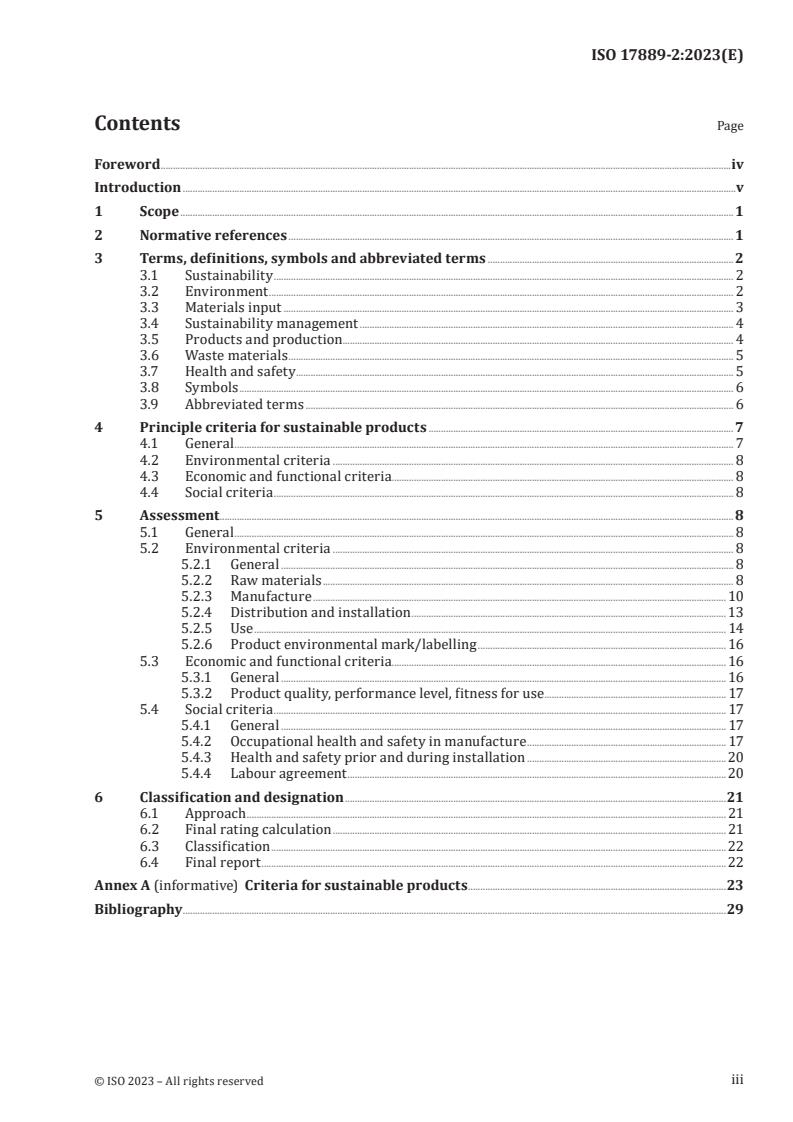
Contents Page
Foreword .iv
Introduction .v
1 Scope . 1
2 Normative references . 1
3 Terms, definitions, symbols and abbreviated terms . 2
3.1 Sustainability . 2
3.2 Environment . 2
3.3 Materials input . 3
3.4 Sustainability management . 4
3.5 Products and production . 4
3.6 Waste materials . 5
3.7 Health and safety . . 5
3.8 Symbols . 6
3.9 Abbreviated terms . 6
4 Principle criteria for sustainable products . 7
4.1 General . 7
4.2 Environmental criteria . 8
4.3 Economic and functional criteria. 8
4.4 Social criteria . 8
5 Assessment . .8
5.1 General . 8
5.2 Environmental criteria . 8
5.2.1 General . 8
5.2.2 Raw materials . 8
5.2.3 Manufacture . 10
5.2.4 Distribution and installation . 13
5.2.5 Use . 14
5.2.6 Product environmental mark/labelling . 16
5.3 Economic and functional criteria. 16
5.3.1 General . 16
5.3.2 Product quality, performance level, fitness for use . 17
5.4 Social criteria . 17
5.4.1 General . 17
5.4.2 Occupational health and safety in manufacture . 17
5.4.3 Health and safety prior and during installation . 20
5.4.4 Labour agreement .20
6 Classification and designation .21
6.1 Approach . 21
6.2 Final rating calculation . 21
6.3 Classification .22
6.4 Final report .22
Annex A (informative) Criteria for sustainable products .23
Bibliography .29
iii
Foreword
ISO (the International Organization for Standardization) is a worldwide federation of national standards
bodies (ISO member bodies). The work of preparing International Standards is normally carried out
through ISO technical committees. Each member body interested in a subject for which a technical
committee has been established has the right to be represented on that committee. International
organizations, governmental and non-governmental, in liaison with ISO, also take part in the work.
ISO collaborates closely with the International Electrotechnical Commission (IEC) on all matters of
electrotechnical standardization.
The procedures used to develop this document and those intended for its further maintenance are
described in the ISO/IEC Directives, Part 1. In particular, the different approval criteria needed for the
different types of ISO documents should be noted. This document was drafted in accordance with the
editorial rules of the ISO/IEC Directives, Part 2 (see www.iso.org/directives).
Attention is drawn to the possibility that some of the elements of this document may be the subject of
patent rights. ISO shall not be held responsible for identifying any or all such patent rights. Details of
any patent rights identified during the development of the document will be in the Introduction and/or
on the ISO list of patent declarations received (see www.iso.org/patents).
Any trade name used in this document is information given for the convenience of users and does not
constitute an endorsement.
For an explanation of the voluntary nature of standards, the meaning of ISO specific terms and
expressions related to conformity assessment, as well as information about ISO's adherence to
the World Trade Organization (WTO) principles in the Technical Barriers to Trade (TBT), see
www.iso.org/iso/foreword.html.
This document was prepared by Technical Committee ISO/TC 189, Ceramic tile.
A list of all parts in the ISO 17889 series can be found on the ISO website.
Any feedback or questions on this document should be directed to the user’s national standards body. A
complete listing of these bodies can be found at www.iso.org/members.html.
iv
Introduction
This document outlines the requirements for sustainable tiles and installation materials including
environmental, economic and social criteria, in order to:
— promote the development and use of sustainable ceramic tiles and installation materials;
— guide all stakeholders in environmental responsibility throughout the supply chain for tiles and
installation materials;
— provide a verifiable resource for tile product specification and for design professionals, contractors
and consumers to identify sustainable tiles and installation materials;
— increase the value of sustainable tiles and installation materials throughout the supply chain by
creating greater market awareness and demand.
This document provides a system for sustainability assessment using the life cycle approach, qualitative
and quantitative indicators for environmental, economic and social performance of ceramic tiling
systems. This document is focused on tile installation materials.
This document can be used to assess the sustainability performance of the product of interest.
Evaluation schemes, taking into account the materials mentioned in the product standards, to enable
comparability of the results of assessment, are part of this document.
v
INTERNATIONAL STANDARD ISO 17889-2:2023(E)
Ceramic tiling systems — Sustainability for ceramic tiles
and installation materials —
Part 2:
Specification for tile installation materials
1 Scope
This document specifies sustainability requirements together with assessment methods and evaluation
schemes for ceramic tiles and installation materials.
This document includes relevant criteria across product life cycle from raw material through
manufacturing, use, and end-of-life management.
This document applies to ceramic tile installation materials including: ceramic tiles, adhesives, grouts,
membranes, etc. This document deals with adhesives and other tiling materials.
2 Normative references
The following documents are referred to in the text in such a way that some or all of their content
constitutes requirements of this document. For dated references, only the edition cited applies. For
undated references, the latest edition of the referenced document (including any amendments) applies.
ISO 11890-1, Paints and varnishes — Determination of volatile organic compound (VOC) content — Part 1:
Difference method
ISO 11890-2, Paints and varnishes — Determination of volatile organic compounds(VOC) and/or semi
volatile organic compounds (SVOC) content — Part 2: Gas-chromatographic method
ISO 14024, Environmental labels and declarations — Type I environmental labelling — Principles and
procedures
ISO 14025, Environmental labels and declarations — Type III environmental declarations — Principles and
procedures
ISO 16000-3, Indoor air — Part 3: Determination of formaldehyde and other carbonyl compounds in indoor
and test chamber air — Active sampling method
ISO 16000-6, Indoor air — Part 6: Determination of organic compounds (VVOC, VOC, SVOC) in indoor and
test chamber air by active sampling on sorbent tubes, thermal desorption and gas chromatography using
MS or MS FID
ISO 16000-9, Indoor air — Part 9: Determination of the emission of volatile organic compounds from
building products and furnishing - Emission test chamber method
ISO 16000-11, Indoor air — Part 11: Determination of the emission of volatile organic compounds from
building products and furnishing — Sampling, storage of samples and preparation of test specimens
ISO 17889-1, Ceramic tiling systems — Sustainability for ceramic tiles and installation materials — Part 1:
Specification for ceramic tiles
ISO 21930, Sustainability in buildings and civil engineering works — Core rules for environmental product
declarations of construction products and services
EN 13284-1, Stationary source emissions - Determination of low range mass concentration of dust - Part 1:
Manual gravimetric method
ASTM D2369-10,Standard Test Method for Volatile Content of Coatings
ASTM D6886-18, Standard Test Method for Determination of the Weight Percent Individual Volatile Organic
Compounds in Waterborne Air-Dry Coatings by Gas Chromatography
3 Terms, definitions, symbols and abbreviated terms
For the purposes of this document, the terms and definitions given in ISO 17889-1 and the following
apply.
ISO and IEC maintain terminology databases for use in standardization at the following addresses:
— ISO Online browsing platform: available at https:// www. iso. org/o bp
— IEC Electropedia: available at https:// www. electropedia. org/
3.1 Sustainability
3.1.1
environmental sustainability
state in which the ecosystem and its functions are maintained for the present and future generation
3.1.2
economic sustainability
ability to provide sustainable, successful places in an economic context
Note 1 to entry: Economic considerations include employment, competitiveness, wealth and distribution, welfare,
accounting and regulation.
3.1.3
social sustainability
ability to provide sustainable, successful places in a social context
Note 1 to entry: It combines design of the physical realm with design of the world, infrastructure to support
social and cultural life, provides social amenities, systems for citizen engagement and spaces for people and
places to evolve.
3.1.4
LCA
life-cycle assessment
systematic evaluation of the environmental impact (3.2.3) of a product(s) that includes all stages of its
life cycle
3.2 Environment
3.2.1
environment
surroundings in which an organization operates, including air, water, land, natural resources, flora,
fauna, humans, and their interrelation
Note 1 to entry: Surroundings in this context extend from within an organization to the global system.
[SOURCE: ISO 14001:2015, 3.2.1, modified — Note 2 to entry deleted.]
3.2.2
environmental aspect
element of an organization’s activities or products or services that can interact with the environment
(3.2.1)
[SOURCE: ISO 14001:2015, 3.2.2, modified — Notes to entry deleted.]
3.2.3
environmental impact
change to the environment (3.2.1), whether adverse or beneficial, wholly or partially resulting from an
organization’s environmental aspects (3.2.2)
[SOURCE: ISO 14001:2015, 3.2.4]
3.3 Materials input
3.3.1
raw material
basic material that can be converted by processing or manufacturing, or a combination of both, into a
new product
Note 1 to entry: A raw material may be virgin, recycled, harvested, extracted, recovered, or manufactured when
used as an ingredient in a new material.
3.3.2
indigenous raw material
raw material (3.3.1) that is recovered, harvested, or extracted within an 800 km radius of the
manufacturing site
Note 1 to entry: Where materials are transported by water or rail, the distance to the manufacturing site shall
be determined by multiplying the distance that the materials are transported by water or rail by 0,25 and adding
that number to the distance transported by means other than water or rail.
3.3.3
fresh water
surface water and groundwater withdrawn for manufacturing use
3.3.5
packaging material
material intended for presentation to a consumer that is used for the containment, protection, handling,
or preservation of a product
Note 1 to entry: Included tools in a kit or parts of the packaging that are used directly in the combining or
installation of the product shall be excluded from this definition.
3.3.6
primary packaging
material that first envelops and holds the product of interest (3.5.2)
Note 1 to entry: It is intended to be the smallest unit of distribution or use and is the package which is in direct
contact with the contents. For ceramic tiles (3.5.1) the primary packaging is restricted to the following materials:
paper, cardboard or corrugate.
3.3.7
shipping material
material that is used for the containment, protection, handling, or preservation of a product while en
route from one location to another and that is generally not intended for presentation to a consumer
EXAMPLE Pallet, industrial carton, banding, freight panels, wood/lumber bracing, etc.
3.4 Sustainability management
3.4.1
EEMS
energy efficiency management system
energy management procedures to monitor, control, evaluate and improve the performance of the used
energy
3.4.2
EMS
environmental management system
environmental management procedures to monitor, control, evaluate and improve the organization
environmental performance
3.4.3
OHSMS
occupational health and safety management system
health and safety management system
procedures to monitor, control, evaluate and improve the system performance as regards health and
safety
3.4.4
environmental product declaration
EPD
standardized and life-cycle assessment (3.1.4) (LCA)-based tool—type III environmental declaration—
to communicate the environmental performance of a product or system
3.4.5
type I label
life-cycle assessment (3.1.4) (LCA)-based label which identifies products or services proven
environmentally preferable overall, within a specific product or service category
3.4.6
certified
product or management system validated by a certification body (3.4.7) in accordance with the relevant
standard
3.4.7
certification body
third-party conformity assessment body operating certification schemes
3.4.8
maintenance
service
actions which have the objective of retaining or restoring a product in or to a state in which it can
perform its intended function
3.5 Products and production
3.5.1
ceramic tile
ceramic surfacing unit, usually relatively thin in relation to facial area, having either a glazed or
unglazed face and fired above red heat in the course of manufacture to a temperature sufficiently high
to produce specific physical properties and characteristic
3.5.2
product of interest
single product or line of products with homogeneous technical characteristics and equal environmental
impacts (3.2.3) and performances
Note 1 to entry: In case of product-specific environmental criteria a “worst case scenario” analysis of a single
product may suffice to extend the boundaries of the product of interest to be representative of the facility’s entire
production (3.5.3).
3.5.3
production
industrial processes involving steps resulting in the manufacture of products or items
3.5.4
transport
movement of goods from one location to another
Note 1 to entry: The goods can be, for example, products, raw materials (3.3.1).
3.6 Waste materials
3.6.1
post-consumer material
waste material generated by households or by commercial, industrial and institutional facilities in their
role as end-users of the product, which can no longer be used for its original intended purpose
3.6.2
pre-consumer material
material, solid and/or liquid, diverted from a waste stream generated by the manufacturing process
Note 1 to entry: Reutilization of materials (i.e. rework, regrind or scrap generated in a process that does not enter
the waste stream and that is capable of being reclaimed within the same process that generated it) is excluded.
3.6.3
reclaimed waste
waste, scrap material, or water generated during manufacturing processes that, in lieu of disposal, is
captured and reused to manufacture more of the same product
3.7 Health and safety
3.7.1
hazard
source, situation, or act with a potential for harm in terms of human injury or ill health (3.7.3), or a
combination of theseNote 1 to entry: Adapted from ISO 45001.
3.7.2
hazard identification
process of recognizing that a hazard (3.7.1) exists and defining its characteristics
3.7.3
ill health
identifiable, adverse physical or mental condition arising from and/or made worse by a work activity
and/or work-related situation
3.7.4
safety in use
level of risks associated with the installation and use of the products
3.8 Symbols
Symbols Description Units
a arithmetical average
ave
c PM concentration in the i-th chimney stack mg/Nm
PM,i
emission factor of the pollutant “ j” (PM, HF) through emissions into
F g/kg
E, j
the atmosphere
I incidence of indigenous raw materials %
M post-consumer material input kg
post
M pre-consumer material input kg
pre
p quantity of indigenous raw materials in the body of the product of interest kg
I
p quantity (weight) of the body of the product of interest kg
t
P annual ceramic tile production m /year
sm
P annual ceramic tile production t/year
t
P annual production water utilized L/year
W
P annual production waste water discharged L/year
WD
Q volume flow rate of the i-th chimney stack Nm /h
i
R recycled and/or reclaimed waste content %
C
R post-consumer recycled content %
C, post
R pre-consumer recycled content %
C, pre
R reclaimed waste content
WC
R recycled material content of packaging materials %
MC
R reclaimed waste input kg
w
S sustainability rating %
ra
t operation time of the i-th chimney stack h/year
i
T total grinding water kg
GW
T total raw materials used in the product of interest kg
RM
V voluntary pass/fail requirements (V1)
V voluntary multirating managerial requirements (V2)
V voluntary multirating quantitative and performance requirements (V3)
W waste water discharge %
D
3.9 Abbreviated terms
EEMS energy efficiency management system
[5]
EMAS eco management and auditing scheme
EMS environmental management system
EPD environmental product declaration
HF hydrogen fluoride
M mandatory requirements
Nm cubic meter of gas measured in normal conditions (temperature = 273 K, pressure = 101,3 kPa)
OHSMS occupational health and safety management system
PM particulate matter
POTW publicly owned treatment works for wastewater
PPE personal protective equipment
RCS respirable crystalline silica
SDS safety data sheet
Sm cubic meter of gas measured in standard conditions (temperature = 273 K, pressure = 101,3 kPa)
V1 voluntary pass-fail requirements
V2 voluntary multirating managerial requirements
V3 voluntary multirating quantitative and performance requirements
VOC volatile organic compounds
4 Principle criteria for sustainable products
4.1 General
The criteria are based on the “three pillar model” of sustainability: environmental, economic and social
sustainability, as stipulated in the World Summit Conference 2005.
Environmental, economic, and social sustainability criteria are detailed in Tables A.1 to A.3 which
report the requirements that shall be used for the sustainability assessment according to this document.
Two categories of requirements are adopted:
Mandatory requirements: PASS/FAIL requirements, whose compliance is a pre-requisite for a
product assessed as sustainable. No rating is acknowledged for products compliant with mandatory
requirements. If a product isn’t compliant with all mandatory requirements cannot be classified as
sustainable.
Multirating, voluntary requirements: requirements which a product can comply with at different
levels, awarded through a different rating. The compliance level to multirating requirements contributes
to the final rating of the product, as specified in Clause 6.
All multirating, voluntary requirements require a mandatory minimum 100 % tier.
The requirements are listed in Annex A, Tables A.1, A.2 and A.3 are marked with the same numbers
used in Clause 5, and are classified according to the type:
M = mandatory requirement;
V1 = voluntary pass/fail requirements;
V2 = voluntary multirating managerial requirements;
V3 = voluntary multirating quantitative and performance requirements.
Reference to this classification of sustainability requirements will be made in Clause 6.
4.2 Environmental criteria
The environmental criteria are (see Annex A Table A.1):
— raw materials;
— manufacture;
— distribution and installation;
— use;
— product environmental mark/labelling.
4.3 Economic and functional criteria
The economic and functional criteria are (see Annex A, Table A.2) product quality, performance level
and fitness for use.
4.4 Social criteria
The social criteria are (see Annex A, Table A.3):
— health and safety in manufacture;
— health and safety during installation;
— health and safety in use.
5 Assessment
5.1 General
This clause describes the criteria and defines the requirements for the evaluation of sustainable
installation product for ceramic tiles.
For each of the criteria listed in Annex A, Tables A.1, A.2 and A.3, the requirements (either mandatory or
multirating), the test methods and/or calculation methods, and the units of measurement are indicated
for installation materials.
5.2 Environmental criteria
5.2.1 General
The environmental pillar requires the protection of the environment and the preservation of resources,
with implementation of good operational practices. For installation materials, sustainability means
optimized utilization of raw materials, including utilities (water and energy), as well as optimized
production and optimized transport.
5.2.2 Raw materials
5.2.2.1 General
Adhesives, sealants and waterproofing products for the installation of ceramic tiles have their main
impact on the environment due to the raw materials used in the formulation, especially hydraulic and
organic binders.
The quality and durability of the products are related to the raw materials and allow to decrease waste
coming from demolition and depletion of both mineral and elemental.
The control on the supply chain is essential to reduce environmental impacts coming from the
extraction and the transport of the raw materials in the plant.
5.2.2.2 Requirements for the evaluation
5.2.2.2.1 Materials records
The manufacturer shall maintain a list of all materials used in the manufacture of the product of
interest. The term “all materials” includes just the materials going into the final product. Materials used
for maintenance or auxiliary purposes shall not be considered in the framework of this requirement. At
a minimum, the list shall report the name of each material and its ingredient(s) listed in the respective
safety data sheet (SDS).
Calculation: the manufacturer shall give evidence of the availability of such records [YES/NO].
Mandatory requirement: YES
5.2.2.2.2 Transport – Indigenous raw materials
The higher the amount of indigenous raw materials used to manufacture an installation product, the
lower the environmental impact of the transport of the raw materials from their extraction area to the
manufacturing site. The parameter used to quantify this sustainability aspect is I [%], the incidence of
indigenous raw materials on the body of the product of interest. See Formula (1), Table 1 and A.2.
I = p × 100 / p (1)
I t
where
I is the incidence of indigenous raw materials, in percentage;
p is the quantity of indigenous raw materials in the body of the product of interest, in kg;
I
p is the quantity (weight) of the body of the product of interest, in kg.
t
Table 1 — Multirating requirements for indigenous raw materials
Rating (%) 100 110 120 130
References (%) I < 50 50 ≤ I < 75 75 ≤ I < 90 I ≥ 90
5.2.2.2.3 Recycled and/or reclaimed waste content
According to this requirement, the higher the amount of waste materials in the product, the higher the
sustainability of the product of interest itself. The parameter used to quantify this aspect is R [%], the
C
recycled and/or reclaimed waste content. See Formula (2) and Table 2.
R = R + ½ R + ½ R (2)
C C, post C, pre WC
where
R = M × 100/(T + T );
C, post post RM GW
R = M × 100/(T + T );
C, pre pre RM GW
R = R × 100/(T + T );
WC w RM GW
R is the recycled and/or reclaimed waste content;
C
R is the post-consumer recycled content;
C, post
R is the pre-consumer recycled content;
C, pre
R is the reclaimed waste content;
WC
M is the post-consumer material input, in kg;
post
M is the pre-consumer material input, in kg;
pre
T is the total raw materials used in the product of interest, in kg;
RM
T is the total grinding water, in kg;
GW
R is the reclaimed waste input, in kg.
w
Conservatively, a “worst case scenario” analysis of a single product with the lowest concentration of
recycled and/or reclaimed waste content may suffice to represent a facility’s entire production.
Table 2 — Multirating requirements for recycled and/or reclaimed waste content
Rating (%) 100 110 120 130
References (%) 3 ≤ R < 5 5 ≤ R < 15 15 ≤ R < 30 R ≥ 30
C C C C
5.2.2.2.4 Raw materials and outsourced services environmental buying agreement
The manufacturer of the product of interest shall have a written environmental policy statement with
each immediate supplier of raw materials (which make up, in aggregate, 90 % by weight of the finished
product) and with each provider of outsourced manufacturing and/or packaging services.
The written environmental policy statement shall provide documentation concerning the following:
Compliance with environmental regulations: compliance declaration with the relevant environmental
national regulations and laws by each immediate raw material supplier, outsourced manufacturer and
packaging service provider is in compliance.
Where the immediate supplier is a distributor and not a producer, the provisions listed above shall be
applied by the distributor to the producer of the supplied materials.
Calculation: the manufacturer shall give evidence of such records [YES/NO].
Mandatory requirements YES
5.2.3 Manufacture
5.2.3.1 General
The manufacturing process is commonly considered as the phase of the installation products life cycle
which is characterized by low environmental impact factors.
5.2.3.2 Requirements for the evaluation
5.2.3.2.1 Environmental management system (EMS)
The implementation of an appropriate environmental management system is a fundamental step
towards sustainability. The existence and the operation of this system defines the compliance to this
requirement. See Table 3.
Calculation: the manufacturer shall give evidence of the implementation of an environmental
management system based on documentation records (EMS) [YES/NO].
Optionally, the EMS may be developed pursuant to ISO 14001 [PURSUANT], with the minimum
requirements as follows:
— documentation that the manufacturer has evaluated the environmental aspects of its activities (see
ISO 14001:2015, 4.3.1);
— established objectives to prevent pollution, and promote continuous improvement (see
ISO 14001:2015, 4.3.3);
— provisions for control and maintenance of environmental documents (see ISO 14001:2015, 4.4.5);
— establishment, implementation and maintenance of a procedure for dealing with actual and potential
nonconformity, including corrective and preventive actions (see ISO 14001:2015, 4.5.3).
Furthermore, the EMS may be certified by a certification body according to ISO 14001, EMAS.
Table 3 — Multirating requirements for EMS
Rating (%) 100 110 120 130
References YES PURSUANT CERTIFIED
5.2.3.2.2 Energy efficiency management system (EEMS)
The implementation of an appropriate energy management system is a fundamental step towards
sustainability. The existence and the operation of this system defines the compliance to this
requirement. See Table 4.
Calculation: the manufacturer shall give evidence of the implementation and basic characteristics of
an energy efficiency management system based on documentation records (EEMS) [YES/NO].
Optionally, the EEMS may be developed pursuant to ISO 50001 with the minimum requirement of a
certified audit of heat fuel systems at least once every 5 years [PURSUANT].
Furthermore, the EEMS may be certified by a certification body according to ISO 50001 [CERTIFIED].
Table 4 — Multirating requirements for EEMS
Rating (%) 100 110 120 130
References YES PURSUANT CERTIFIED
5.2.3.2.3 Renewable energy usage (solar, hydro-electric, wind, marine, or geothermal)
The manufacturer shall give evidence of the adoption/implementation of measures aimed to improve
the use of renewable energy sources, in the unit in which the product(s) of interest is (are) manufactured.
See Table 5.
Calculation: the facility, manufacturing line, or manufacturing process associated to the product of
interest shall utilize renewable energy (purchased or created on-site or off-site) for at least 10 % of its
electric energy or 10 % of its gas energy, or a combination of the two [YES/NO].
Table 5 — Multirating requirements for renewable energy usage
Rating (%) 100 110 120 130
References NO YES
5.2.3.2.4 PM emission factor through emissions into the atmosphere
Technology for installation-products manufacturing can also be a powder technology, with associated
emission of particulate matter (PM) into the atmosphere. A large part of the total PM emitted is
transported by the suction lines installed in the manufacturing sections, in order to reduce the risks of
exposure to airborne particulates of the workers in the working environment. The parameter used to
quantify PM emission from the manufacture of the product of interest is the total PM emission factor,
F which can be calculated with reference to the unit product expressed either in m or in t. Total PM
E,PM
concentration measurements shall be carried out in all the chimney stacks of the manufacturing line,
with the method reported in EN 13284-1 or any equivalent standard included in the national legislation.
See Table 6.
Calculation: a reference is made to the “i-th” of the “n” chimney stacks of the manufacturing unit under
consideration, emitting into the atmosphere the pollutant “PM”.
-3
F = ∑ (c × Q × t × 10 )/P (3)
E, PM i PM,i i i t
where
c is the PM concentration in the i-th chimney stack, in mg/Nm ;
PM,i
Q is the volume flow rate of the i-th chimney stack, in Nm /h;
i
t is the operation time of the i-th chimney stack, in h/year;
i
P is the annual production of ceramic tiles, in t/year;
t
-3
10 is the conversion factor, in g/mg.
NOTE Formula (3) is expressed in (g/t).
Table 6 — Multirating requirements for PM emission factor
Rating (%) 100 110 120 130
References (g/t) 300 < F ≤ 700 100 < F ≤ 300 50 < F ≤ 100 F ≤ 50
E, PM E, PM E, PM E, PM
5.2.3.2.5 Internal or external reuse/recycling of packaging materials
Calculation: the facility in which the product of interest was manufactured shall have mechanisms to
reuse internally or recycle externally 50 % (by weight, volume, or item) of incoming shipping materials,
included but not limited to paper, plastic, cardboard, corrugate, and wood. For example, a carton baler
for cardboard and corrugate and recycling containers for paper, reuse and/or repair of incoming pallets,
and use of a pallet recycling company for unusable pallets [YES/NO]. See Table 7.
Table 7 — Multirating requirements for internal or external reuse/recycling of packaging
materials
Rating (%) 100 110 120 130
References 0 > 20 > 40 > 50
5.2.3.2.6 Reuse/recycling or separate collection of other materials
Calculation: the facility in which the product of interest was manufactured shall have mechanisms to
reuse internally or recycle externally or organize separate collection of all plastics, metals, exhausted
(used) oil, lead batteries and used packaging for materials [YES/NO].
Mandatory requirements YES
5.2.3.2.7 Waste water discharge
The parameter used to quantify this aspect is W (%), the waste water discharge. See Formula (4) and
D
Table 8.
W = P / P × 100 (4)
D WD W
where
W is the waste water discharge, in %;
D
P is the annual production waste water discharged, in L/year;
WD
P is the annual production water utilized, in L/year.
W
NOTE An example of waste water discharged is to publicly owned treatment works (POTW).
Any other way of water discharge shall be taken into consideration.
Table 8 — Multirating requirements for waste water discharge
Rating (%) 100 110 120 130
References (%) 20 < W ≤ 50 W ≤ 20 W ≤ 10 W ≤ 5
D D D D
5.2.4 Distribution and installation
5.2.4.1 General
The most significant environmental aspects associated with the distribution and installation of
products involve packaging and waste generated from the installation process.
5.2.4.2 Requirements for the evaluation: packaging
5.2.4.2.1 Weight of packaging
Calculation: the manufacturer shall package the product of interest using minimal material for 95 %
of the time, based on annual production of the product manufactured, in tons. The weight of primary
packaging ≤ 5 % of the total weight of product being packaged [YES/NO]. See Table 9.
Table 9 — Multirating requirements for weight of packaging
Rating (%) 100 110 120 130
References > 5 ≤ 5 ≤ 2 ≤ 1
5.2.4.2.2 Recycled material content of packaging materials
The product shall be packaged using material with recycled content. The manufacturer shall provide
a declaration from packaging supplier indicating the percentage and type (pre-consumer or post-
consumer) of recycled content. The parameter used to quantify this aspect is R (%), recycled material
MC
content of packaging materials. See Formula (5) and Table 10.
R = R + R (5)
MC C, post C, pre
where
R is the recycled material content of packaging materials, in %;
MC
R is the post-consumer recycled content, in %;
C, post
R is the pre-consumer recycled content, in %.
C, pre
Table 10 — Multirating requirements for recycled material content of packaging materials
Rating (%) 100 110 120 130
References (%) R ≤ 10 10 < R ≤ 20 20 < R ≤ 30 R > 30
MC MC MC MC
5.2.4.2.3 Environmental property of packaging materials
Calculation: the packaging material shall be recyclable and labelled as such with the appropriate
recycling classification (where applicable). See Table 11.
Table 11 — Multirating requirements for environmental property of packaging materials
Rating (%) 100 110 120 130
References 0 ≥ 20 ≥ 50 ≥ 85
5.2.4.3 Requirements for the evaluation: installation
5.2.4.3.1 Environmentally friendly installation — Guidance from manufacturer
Calculation: the manufacturer shall provide instructions to guide the applicator towards a correct
execution of the installation operations, with regards to the main environmental aspects/impacts. The
manufacturer shall provide information regarding responsible management of packaging materials
during and after the installation process [YES/NO].
Mandatory requirements YES
5.2.5 Use
5.2.5.1 General
The most potential for a significant environmental impact of products for installation of tiles can be
associated with the application and use activities, due to substances contained in the materials and
their emissions into indoor air. These aspects can affect both the applicator and the final users.
5.2.5.1.1 Product formulation
The products shall contain no substances of very high concern (SVHC) in a concentration more than
0,1 % (by unit weight).
Reference [6] lists SVHCs.
[8]
Alternatively, products shall not contain substances listed in the Red list :
— alkylphenols;
— asbestos;
— bisphenol A (BPA);
— cadmium;
— chlorinated polyethylene;
— chlorosulfonated polyethlene (CSPE);
— chlorofluorocarbons (CFCs);
— chlorobenzene;
— chloroprene (neoprene);
— chromium VI;
— chlorinated polyvinyl chloride (CPVC);
— formaldehyde (added);
— halogenated flame retardants (HFRs);
— hydrochlorofluorocarbons (HCFCs);
— lead (added);
— mercury;
— polychlorinated biphenyls (PCBs);
— perfluorinated compounds (PFCs);
— phthalates;
— polyvinyl chloride (PVC);
— polyvinylidene chloride (PVDC);
— short chain chlorinated paraffins;
— wood trea
...