


ISO/FDIS 18742
(Main)Ship and marine technology - High manganese austenitic steel - Specification for high manganese austenitic steel welded fittings for cryogenic temperature
Ship and marine technology - High manganese austenitic steel - Specification for high manganese austenitic steel welded fittings for cryogenic temperature
This specification covers wrought high manganese austenitic steel welded fittings for pressure piping cryogenic temperature. The specification of high manganese austenitic steel welded fittings can be applicable to all pressure retaining components and any non-pressure retaining component for hull systems and onshore projects.
Navires et technologie maritime — Acier austénitique à haute teneur en manganèse — Spécification pour les raccords soudés en acier austénitique à haute teneur en manganèse pour température cryogénique
General Information
Overview
ISO/FDIS 18742:2025 - "Ship and marine technology - High manganese austenitic steel - Specification for high manganese austenitic steel welded fittings for cryogenic temperature" defines requirements for wrought high manganese (Hi‑Mn) austenitic steel welded fittings used in cryogenic pressure piping. The document is intended to harmonize material, fabrication and inspection practices for marine and onshore cryogenic systems, and to align with IMO codes (IGC and IGF) for low‑temperature service. It also allows, by agreement with a purchaser, application to liquefied hydrogen systems.
Key topics and requirements
The standard covers the full lifecycle of Hi‑Mn welded fittings with emphasis on safety and suitability for cryogenic temperatures. Major technical topics include:
- Scope and material designation - applicability to pressure‑retaining and non‑pressure hull components and onshore projects.
- Health, safety and quality requirements for manufacture and handling.
- Manufacture, forming and welding procedures specific to Hi‑Mn austenitic steels.
- Chemical composition limits and material identification.
- Heat treatment provisions relevant to welded fittings for cryogenic service.
- Mechanical properties and testing requirements, including Charpy impact testing to demonstrate low‑temperature toughness comparable to materials listed in the IGC/IGF Codes.
- Inspection and testing methods: visual inspection, radiographic (RT) and ultrasonic testing (UT), penetrant testing (PT), and hydrostatic testing.
- Repairs, dimensional inspection, traceability, packing and documentation requirements to ensure consistent quality and supply chain transparency.
- Annex on hardness of Hi‑Mn welded fittings (detailed guidance provided).
Normative references include established test standards such as ISO 148‑1 (Charpy pendulum), ISO 3452‑1 (penetrant testing), ISO 4136 and ISO 5173 (weld destructive tests), and ISO 2566 (elongation conversion for steels).
Applications
ISO/FDIS 18742 is intended for:
- Shipyards, ship owners and naval architects specifying cryogenic piping and fittings for cargo and fuel systems.
- Material suppliers and manufacturers producing Hi‑Mn welded fittings for low‑temperature service.
- Inspection bodies and classification societies assessing conformity of cryogenic piping components.
- Operators of onshore cryogenic plants and projects that require pressure‑retaining fittings for LNG, LPG or, by agreement, liquefied hydrogen.
Related standards
Relevant international test and NDT standards are referenced within ISO/FDIS 18742 (e.g., ISO 148‑1, ISO 3452‑1, ISO 4136, ISO 5173, ISO 2566). The standard is designed to work alongside IMO IGC and IGF Codes for cryogenic marine applications.
Keywords: ISO 18742, high manganese austenitic steel, Hi‑Mn welded fittings, cryogenic temperature, ship and marine technology, cryogenic piping, liquefied hydrogen.
Standards Content (Sample)
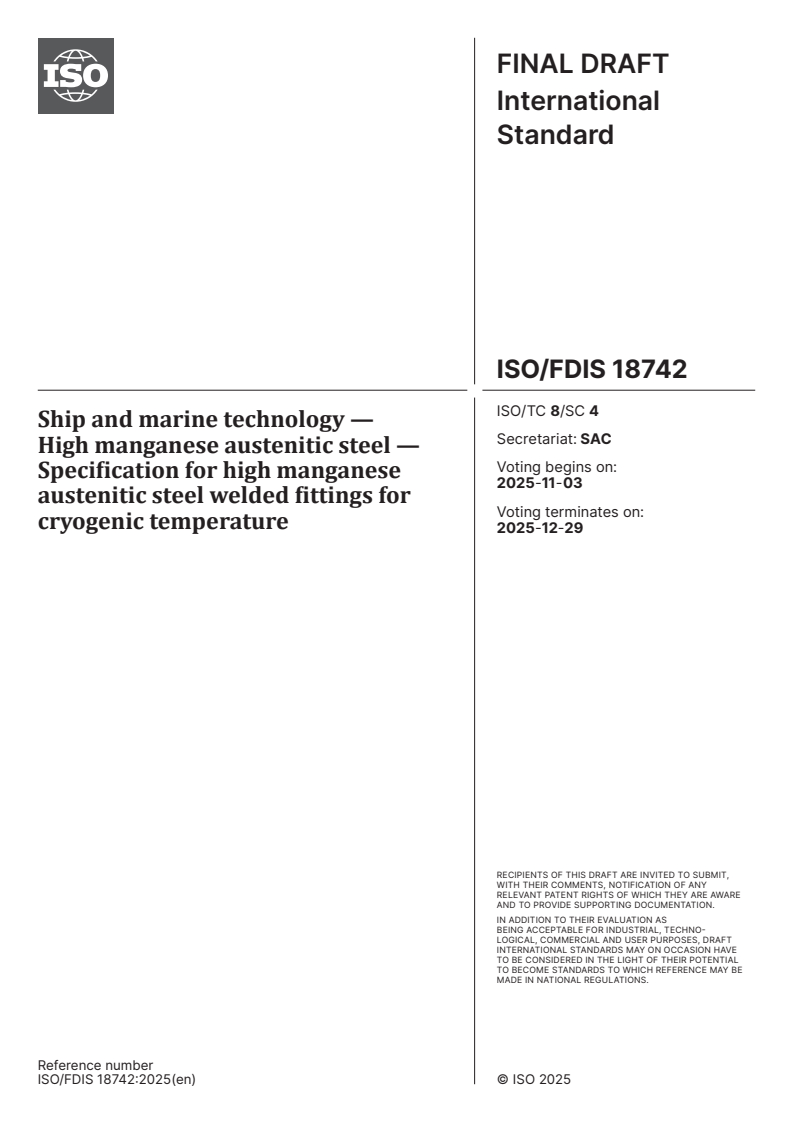
FINAL DRAFT
International
Standard
ISO/TC 8/SC 4
Ship and marine technology —
Secretariat: SAC
High manganese austenitic steel —
Voting begins on:
Specification for high manganese
2025-11-03
austenitic steel welded fittings for
Voting terminates on:
cryogenic temperature
2025-12-29
RECIPIENTS OF THIS DRAFT ARE INVITED TO SUBMIT,
WITH THEIR COMMENTS, NOTIFICATION OF ANY
RELEVANT PATENT RIGHTS OF WHICH THEY ARE AWARE
AND TO PROVIDE SUPPOR TING DOCUMENTATION.
IN ADDITION TO THEIR EVALUATION AS
BEING ACCEPTABLE FOR INDUSTRIAL, TECHNO
LOGICAL, COMMERCIAL AND USER PURPOSES, DRAFT
INTERNATIONAL STANDARDS MAY ON OCCASION HAVE
TO BE CONSIDERED IN THE LIGHT OF THEIR POTENTIAL
TO BECOME STAN DARDS TO WHICH REFERENCE MAY BE
MADE IN NATIONAL REGULATIONS.
Reference number
FINAL DRAFT
International
Standard
ISO/TC 8/SC 4
Ship and marine technology —
Secretariat: SAC
High manganese austenitic steel —
Voting begins on:
Specification for high manganese
austenitic steel welded fittings for
Voting terminates on:
cryogenic temperature
RECIPIENTS OF THIS DRAFT ARE INVITED TO SUBMIT,
WITH THEIR COMMENTS, NOTIFICATION OF ANY
RELEVANT PATENT RIGHTS OF WHICH THEY ARE AWARE
AND TO PROVIDE SUPPOR TING DOCUMENTATION.
© ISO 2025
IN ADDITION TO THEIR EVALUATION AS
All rights reserved. Unless otherwise specified, or required in the context of its implementation, no part of this publication may
BEING ACCEPTABLE FOR INDUSTRIAL, TECHNO
LOGICAL, COMMERCIAL AND USER PURPOSES, DRAFT
be reproduced or utilized otherwise in any form or by any means, electronic or mechanical, including photocopying, or posting on
INTERNATIONAL STANDARDS MAY ON OCCASION HAVE
the internet or an intranet, without prior written permission. Permission can be requested from either ISO at the address below
TO BE CONSIDERED IN THE LIGHT OF THEIR POTENTIAL
or ISO’s member body in the country of the requester.
TO BECOME STAN DARDS TO WHICH REFERENCE MAY BE
MADE IN NATIONAL REGULATIONS.
ISO copyright office
CP 401 • Ch. de Blandonnet 8
CH-1214 Vernier, Geneva
Phone: +41 22 749 01 11
Email: copyright@iso.org
Website: www.iso.org
Published in Switzerland Reference number
ii
Contents Page
Foreword .iv
Introduction .v
1 Scope . 1
2 Normative references . 1
3 Terms and definitions . 2
4 Abbreviated terms . 3
5 Health, safety and quality requirements . 3
5.1 Health and safety requirements .3
5.2 Quality requirements .3
6 Material designation . . 4
7 Manufacture . 4
8 Chemical composition . 4
9 Forming and welding . 5
10 Heat treatment . 6
11 Mechanical properties . 7
11.1 Preparation of test specimens and extent of testing .7
11.2 Mechanical properties .7
11.2.1 General .7
11.2.2 Tensile testing .8
11.2.3 Impact testing .8
11.2.4 Bend testing .8
11.2.5 Hardness testing.9
11.3 Retesting .9
12 Inspection . 9
12.1 General requirements .9
12.2 Visual inspection .9
12.3 RT and UT .10
12.4 PT . .10
12.5 Hydrostatic testing .11
13 Repairs .11
14 Dimension inspection .12
15 Traceability, handling and packing .12
16 Documentation .12
Annex A (normative) Hardness of Hi-Mn steel welded fittings . 14
Bibliography .15
iii
Foreword
ISO (the International Organization for Standardization) is a worldwide federation of national standards
bodies (ISO member bodies). The work of preparing International Standards is normally carried out through
ISO technical committees. Each member body interested in a subject for which a technical committee
has been established has the right to be represented on that committee. International organizations,
governmental and non-governmental, in liaison with ISO, also take part in the work. ISO collaborates closely
with the International Electrotechnical Commission (IEC) on all matters of electrotechnical standardization.
The procedures used to develop this document and those intended for its further maintenance are described
in the ISO/IEC Directives, Part 1. In particular, the different approval criteria needed for the different types
of ISO document should be noted. This document was drafted in accordance with the editorial rules of the
ISO/IEC Directives, Part 2 (see www.iso.org/directives).
ISO draws attention to the possibility that the implementation of this document may involve the use of (a)
patent(s). ISO takes no position concerning the evidence, validity or applicability of any claimed patent
rights in respect thereof. As of the date of publication of this document, ISO had not received notice of (a)
patent(s) which may be required to implement this document. However, implementers are cautioned that
this may not represent the latest information, which may be obtained from the patent database available at
www.iso.org/patents. ISO shall not be held responsible for identifying any or all such patent rights.
Any trade name used in this document is information given for the convenience of users and does not
constitute an endorsement.
For an explanation of the voluntary nature of standards, the meaning of ISO specific terms and expressions
related to conformity assessment, as well as information about ISO's adherence to the World Trade
Organization (WTO) principles in the Technical Barriers to Trade (TBT), see www.iso.org/iso/foreword.html.
This document was prepared by Technical Committee TC 8, Ships and marine technology, Subcommittee SC
4, Outfitting and deck machinery.
Any feedback or questions on this document should be directed to the user’s national standards body. A
complete listing of these bodies can be found at www.iso.org/members.html.
iv
Introduction
The aim of this document is to provide a set of common requirements for metallic materials used in cryogenic
[1] [2]
applications, in alignment with the IGC Code and IGF Code adopted by the International Maritime
Organization (IMO).
The newly developed, high manganese austenitic steel is expected to possess mechanical properties
including Charpy impact energy values comparable to those materials for cryogenic service listed in both the
IGC Code and IGF Code. Consequently, high manganese steel is intended to satisfy the strength requirements
of the structure of cargo tanks, fuel tanks and piping systems.
In addition, upon agreement with a purchaser, this document can be applied to piping systems for liquefied
hydrogen.
This document provides a standard specification of high manganese austenitic steel welded fittings
for material suppliers, ship owners, ship yards, manufacturers and shipping companies with regard to
producing, purchasing and using such materials.
v
FINAL DRAFT International Standard ISO/FDIS 18742:2025(en)
Ship and marine technology — High manganese austenitic
steel — Specification for high manganese austenitic steel
welded fittings for cryogenic temperature
1 Scope
This document provides requirements for wrought high manganese austenitic steel welded fittings used for
pressure piping at cryogenic temperature.
The specification of high manganese austenitic steel welded fittings is applicable to all pressure retaining
components and any non-pressure retaining components used in hull systems for marine technology and in
onshore projects.
2 Normative references
The following documents are referred to in the text in such a way that some or all of their content constitutes
requirements of this document. For dated references, only the edition cited applies. For undated references,
the latest edition of the referenced document (including any amendments) applies.
ISO 148-1, Metallic materials — Charpy pendulum impact test — Part 1: Test method
ISO 2566-1, Steel — Conversion of elongation values — Part 1: Carbon and low-alloy steels
ISO 2566-2, Steel — Conversion of elongation values — Part 2: Austenitic steels
ISO 3452-1, Non-destructive testing — Penetrant testing — Part 1: General principles
ISO 4136, Destructive tests on welds in metallic materials — Transverse tensile test
ISO 5173, Destructive tests on welds in metallic materials — Bend tests
ISO 6892-1, Metallic materials — Tensile testing — Part 1: Method of test at room temperature
ISO 9606-1, Qualification testing of welders — Fusion welding — Part 1: Steels
ISO 9712, Non-destructive testing — Qualification and certification of NDT personnel
ISO 10474, Steel and steel products — Inspection documents
ISO 15609-1, Specification and qualification of welding procedures for metallic materials — Welding procedure
specification — Part 1: Arc welding
ISO 15614-1, Specification and qualification of welding procedures for metallic materials — Welding procedure
test — Part 1: Arc and gas welding of steels and arc welding of nickel and nickel alloys
ISO 18265, Metallic materials — Conversion of hardness values
ASME B16.28, Wrought Steel Butt-Welding Short Radius Elbows and Returns
ASME B16.9, Factory-Made Wrought Buttwelding Fittings
ASME B31.3, Process Piping
ASME Boiler and Pressure Vessel Code, Section VIII, Division 1, 2023, Rules for Construction of Pressure Vessels
ASTM A960/960M, Standard Specification for Common Requirements for Wrought Steel Piping Fittings
3 Terms and definitions
For the purposes of this document, the following terms and definitions apply.
ISO and IEC maintain terminology databases for use in standardization at the following addresses:
— ISO Online browsing platform: available at https:// www .iso .org/ obp
— IEC Electropedia: available at https:// www .electropedia .org/
3.1
cryogenic service
service environment in which the minimum design temperature (3.2) is lower than −104 °C
3.2
design temperature
minimum temperature for selection of materials at which cargo or fuel can be loaded or transported in the
cargo or fuel tanks
3.3
heat
molten metal poured from a single melting furnace or all the molten metal from two or more furnaces
poured into a single ladle
3.4
high manganese austenitic steel
steel with high amount of manganese to retain austenitic as its primary phase at atmospheric and service
temperature
3.5
leak testing
hydrostatic leak test
pneumatic leak test
application of a pressure load, greater than the design load, to demonstrate the integrity of a pressure
system to safely withstand the design load
Note 1 to entry: ASME B31.3 uses the terms hydrostatic leak test, pneumatic leak test, or a combination of both methods,
such as a hydro-pneumatic test.
3.6
lot
fitting which is manufactured by the same manufacturer process, same heat number (same chemical
composition), same heat treatment and same welding procedure specification
3.7
manufacturer
organization, including subcontractors, which carries out operations (e.g. forming, heat treatment) that
affect the material properties of the finished product
3.8
purchaser
owner or another party acting on their behalf, who is responsible for procuring materials, components or
services intended for the design, construction or modification of fittings
3.9
test specimen
part that is subject to mechanical testing
3.10
starting material
material used as the initial input for the forging operation, such as a billet, bloom, or cast preform
3.11
under match
condition where the tensile strength of the weld metal is lower than that of the base metal
4 Abbreviated terms
For the purposes of this document, the following abbreviated terms are used.
ACCP ASNT Central Certification Program
AOD Argon oxygen decarburization
API American Petroleum Institute
ASNT American Society for Non-destructive Testing
BPVC Boiler and Pressure Vessel Code
HAZ Heat-affected zone
NDT Non-destructive testing
PT Penetrant testing
RT Radiographic testing
SMAW Shielded-metal arc welding
SMYS Specified minimum yield strength
UT Ultrasonic testing
VT Visual testing
5 Health, safety and quality requirements
5.1 Health and safety requirements
Each manufacturer is expected to operate in accordance with all relevant statutory health and safety
legislation pertaining to the location where manufacturing, testing and inspection take place.
At least, the following safety equipment and systems shall be provided:
a) ventilation and extraction facilities for welding-related activities or work in a confined space;
b) personal protective equipment including eye, breathing and hearing protection;
c) access/scaffolding/working platforms and fall-arrest protective equipment for working at height;
d) access and secure temporary formwork for working below product;
e) protective systems to prevent electric shock and build-up, or discharge, of static electricity.
Each manufacturer shall manage all work undertaken during manufacturing, including cleaning, flushing,
and leak testing activities.
5.2 Quality requirements
The manufacturer is responsible for implementing effective quality, process, production controls according
to manufacturing specifications.
The manufacturer shall prepare documented procedures for all critical manufacturing processes, including
but not limited to forging, heat treatment, machining and non-destructive testing.
The document specifies the requirements for high manganese austenitic steel welded fittings, including
chemical composition (see Clause 8) and mechanical properties (see Clause 10) as specified in this
specification.
6 Material designation
The high manganese steel welded fittings for cryogenic temperature is designated as follows:
2”
“HMW XXX” which denotes “High Manganese Steel Welded fittings with SMYS XXX N/mm
where
HM is High manganese steel
W is Welded fittings
XXX is the SMYS, expressed in N/mm
7 Manufacture
High manganese steel shall be manufactured by electric furnace, open hearth or by other processes, with or
without separate refining such as argon-oxygen-decarburization (AOD), unless otherwise specified by the
purchaser.
Steel metal shall be killed by de-oxidation practice.
8 Chemical composition
An analysis of each heat (i.e. each batch of molten steel) shall be carried out by the manufacturer to determine
the mass fractions of each element specified in Table 1.
The ladle analysis shall be carried out from a test sample which is taken during the pouring of the molten
metal into the mould.
When more than one ladle is poured into a single mould, the molten metal in each ladle shall be analysed in
accordance with Table 1.
When performing chemical analysis for elements that are not specified in Table 1, the manufacturer may
add elements or modify upon agreement with the purchaser. Residual elements such as Sn, Pb, Sb, As shall
not be added intentionally.
Table 1 — Chemical requirements
Dimensions in per cent (%) (mass fraction)
C Mn Si P S Cr Cu B N
22,50 to max.
0,35 to 0,55 0,10 to 0,50 max. 0,030 max. 0,010 3,00 to 4,00 0,30 to 0,70 max. 0,050
25,50 0,005 0
NOTE 1 These requirements apply to both heat and product analyses.
NOTE 2 Total aluminium is considered when the aluminium content is 0,03 % or higher, or acid soluble aluminium is 0,025 % or
higher.
Product analysis is not required for production, but a product analysis may be carried out upon agreement
between the manufacturer and the purchaser.
For product analysis, specimens shall be obtained from a finished product, or from production material that
is in the same condition of working, or from broken tensile test specimens after mechanical testing.
The product analysis result shall conform to the requirements in Table 2.
Table 2 — Product analysis tolerance
Dimensions in per cent (%) (mass fraction)
Elements Permissible variations
C ±0,02
Mn ±0,06
Si ±0,1
P ±0,010
S ±0,005
Cr ±0,10
Cu ±0,05
B ±0,000 5
N ±0,01
When a manufacturer adds elements which are not specifie
...
Formatted
...
Style Definition
...
Style Definition
...
Style Definition
...
Style Definition
...
Style Definition
...
ISO/TC 8/SC 4
Style Definition
...
Style Definition
...
Secretariat: SAC
Style Definition
...
Date: 2025-04-2310-20
Style Definition
...
Style Definition
...
Style Definition
...
Style Definition
...
Style Definition
...
Style Definition
...
ShipsShip and marine technology — High manganese austenitic steel
Style Definition
...
— Specification for high manganese austenitic steel welded fittings
Style Definition
...
for cryogenic temperature
Style Definition
...
Style Definition
...
Style Definition
...
Style Definition
...
Style Definition
...
Style Definition
...
Style Definition
...
Style Definition
...
FDIS stage
Style Definition
...
Style Definition
...
Style Definition
...
Style Definition
...
Style Definition
...
Style Definition
...
Style Definition
...
Style Definition
...
Style Definition
...
Style Definition
...
Style Definition
...
Style Definition
...
Style Definition
...
Style Definition
...
Style Definition
...
Style Definition
...
Style Definition
...
Style Definition
...
Style Definition
...
Style Definition
...
Style Definition
...
Style Definition
...
Style Definition
...
Style Definition
...
Style Definition
...
Style Definition
...
Style Definition
...
Style Definition
...
Style Definition
...
Style Definition
...
Style Definition
...
Style Definition
...
St l D fi iti
Formatted: Font: Bold
Formatted: HeaderCentered
Formatted: Default Paragraph Font
Formatted: Default Paragraph Font
All rights reserved. Unless otherwise specified, or required in the context of its implementation, no part of this publication
may be reproduced or utilized otherwise in any form or by any means, electronic or mechanical, including photocopying,
or posting on the internet or an intranet, without prior written permission. Permission can be requested from either ISO
at the address below or ISO’s member body in the country of the requester.
ISO copyright office
CP 401 • Ch. de Blandonnet 8
CH-1214 Vernier, Geneva
Phone: + 41 22 749 01 11
Formatted: English (United Kingdom)
Formatted: English (United Kingdom)
Fax: +41 22 749 09 47
EmailE-mail: copyright@iso.org
Formatted: German (Germany)
Website: www.iso.orgwww.iso.org
Formatted: zzCopyright address, Adjust space between
Latin and Asian text, Adjust space between Asian text
Published in Switzerland
and numbers
Formatted: German (Germany)
Formatted: Font: 11 pt
Formatted: FooterPageRomanNumber, Space Before:
0 pt, Line spacing: single
ii © ISO 18742 2025 – All rights reserved
ii
Formatted: Font: Bold
Formatted: HeaderCentered, Left
Contents Formatted: Adjust space between Latin and Asian text,
Adjust space between Asian text and numbers
Foreword . v
Introduction . vi
1 Scope . 1
2 Normative references . 1
3 Terms and definitions . 2
4 Abbreviated terms . 3
5 Health, safety and quality requirements . 4
5.1 Health and safety requirements . 4
5.2 Quality requirements . 4
6 Material designation . 4
7 Manufacture . 5
8 Chemical composition . 5
9 Forming and welding . 6
10 Heat treatment . 7
11 Mechanical properties . 8
11.1 Preparation of test specimens and extent of testing . 8
11.2 Mechanical properties . 8
11.3 Retesting . 10
12 Inspection . 11
12.1 General requirements . 11
12.2 Visual inspection . 11
12.3 RT and UT . 11
12.4 PT . 12
12.5 Hydrostatic testing . 13
13 Repairs . 13
14 Dimension inspection. 14
15 Traceability, handling and packing . 14
16 Documentation . 14
Annex A (normative) Hardness of Hi-Mn steel welded fittings . 16
Bibliography . 17
Foreword . iv
Introduction . v
Formatted: Font: 10 pt
1 Scope . 1
Formatted: Font: 10 pt
2 Normative references . 1
Formatted: Font: 10 pt
3 Terms and definitions . 2
Formatted: FooterCentered, Left, Space Before: 0 pt,
Tab stops: Not at 17.2 cm
4 Abbreviated terms . 3
Formatted: Font: 11 pt
5 Health, safety and quality requirements . 4
Formatted: FooterPageRomanNumber, Left, Space
5.1 Health and safety requirements . 4
After: 0 pt, Tab stops: Not at 17.2 cm
© ISO 2025 – All rights reserved
iii
Formatted: Font: Bold
Formatted: HeaderCentered
5.2 Quality Requirements . 4
6 Material designation . 4
7 Manufacture . 4
8 Chemical composition . 5
9 Forming and welding . 6
10 Heat treatment . 6
11 Mechanical properties . 7
11.1 Preparation of test specimens and extend of testing . 7
11.2 Mechanical properties . 8
11.3 Retesting . 9
12 Inspection . 10
12.1 General requirements . 10
12.2 Visual inspection . 10
12.3 RT and UT . 10
12.4 PT . 11
12.5 Hydrostatic testing . 12
13 Repairs . 12
14 Dimension inspection. 13
15 Traceability, handling and packing . 13
16 Documentation . 13
Annex A (informative) Hardness of Hi-Mn steel welded fittings . 14
Bibliography . 15
Formatted: Font: 11 pt
Formatted: FooterPageRomanNumber, Space Before:
0 pt, Line spacing: single
iv © ISO 18742 2025 – All rights reserved
iv
Formatted: Font: Bold
Formatted: HeaderCentered, Left
Foreword Formatted: Adjust space between Latin and Asian text,
Adjust space between Asian text and numbers
ISO (the International Organization for Standardization) is a worldwide federation of national standards
bodies (ISO member bodies). The work of preparing International Standards is normally carried out through
ISO technical committees. Each member body interested in a subject for which a technical committee has been
established has the right to be represented on that committee. International organizations, governmental and
non-governmental, in liaison with ISO, also take part in the work. ISO collaborates closely with the
International Electrotechnical Commission (IEC) on all matters of electrotechnical standardization.
The procedures used to develop this document and those intended for its further maintenance are described
in the ISO/IEC Directives, Part 1. In particular, the different approval criteria needed for the different types of
ISO document should be noted. This document was drafted in accordance with the editorial rules of the
ISO/IEC Directives, Part 2 (see www.iso.org/directives).
Formatted: English (United Kingdom)
Formatted: Default Paragraph Font, English (United
ISO draws attention to the possibility that the implementation of this document may involve the use of (a)
Kingdom)
patent(s). ISO takes no position concerning the evidence, validity or applicability of any claimed patent rights
Field Code Changed
in respect thereof. As of the date of publication of this document, ISO had not received notice of (a) patent(s)
which may be required to implement this document. However, implementers are cautioned that this may not
represent the latest information, which may be obtained from the patent database available at
www.iso.org/patents.www.iso.org/patents. ISO shall not be held responsible for identifying any or all such
patent rights.
Any trade name used in this document is information given for the convenience of users and does not
constitute an endorsement.
For an explanation of the voluntary nature of standards, the meaning of ISO specific terms and expressions
related to conformity assessment, as well as information about ISO's adherence to the World Trade
Organization (WTO) principles in the Technical Barriers to Trade (TBT), see www.iso.org/iso/foreword.html.
Formatted: English (United Kingdom)
Formatted: Default Paragraph Font, English (United
This document was prepared by Technical Committee TC 8, Ships and marine technology, Subcommittee SC 4,
Kingdom)
Outfitting and deck machinery.
Formatted: English (United Kingdom)
Any feedback or questions on this document should be directed to the user’s national standards body. A
Field Code Changed
complete listing of these bodies can be found at www.iso.org/members.html.www.iso.org/members.html.
Formatted: Adjust space between Latin and Asian text,
Adjust space between Asian text and numbers
Formatted: English (United Kingdom)
Formatted: Adjust space between Latin and Asian text,
Adjust space between Asian text and numbers
Formatted: Font: 10 pt
Formatted: Font: 10 pt
Formatted: Font: 10 pt
Formatted: FooterCentered, Left, Space Before: 0 pt,
Tab stops: Not at 17.2 cm
Formatted: Font: 11 pt
Formatted: FooterPageRomanNumber, Left, Space
After: 0 pt, Tab stops: Not at 17.2 cm
© ISO 2025 – All rights reserved
v
Formatted: Font: Bold
Formatted: HeaderCentered
Introduction
The aim of this document is to provide a set of common requirements for metallic materials used in cryogenic
[1][ ] [2][ ]
applications, in alignment with the IGC Code 1 and IGF Code 2 adopted by the International Maritime
Organization (IMO).
The newly developed, high manganese austenitic steel is expected to possess mechanical properties including
Charpy impact energy values comparable to those materials for cryogenic service listed in both the IGC Code
and IGF Code. Consequently, high manganese steel is intended to satisfy the strength requirements of the
structure of cargo tanks, fuel tanks and piping systems.
In addition, upon agreement with a purchaser, this document can be applied to piping systemsystems for
liquefied hydrogen.
This document provides a standard specification of high manganese austenitic steel welded fittings for
material suppliers, ship owners, ship yards, manufacturers and shipping companies with regard to producing,
purchasing and using such materials.
Formatted: Font: 11 pt
Formatted: FooterPageRomanNumber, Space Before:
0 pt, Line spacing: single
vi © ISO 18742 2025 – All rights reserved
vi
FINAL DRAFT International Standard ISO/FDIS 18742:2025(en)
Formatted
...
Formatted
...
Formatted
...
ShipsShip and marine technology — High manganese austenitic steel
Formatted
...
— Specification for high manganese austenitic steel welded fittings for
Formatted
...
cryogenic temperature
Formatted
...
Formatted
...
1 Scope
Formatted
...
This document provides requirements for wrought high manganese austenitic steel welded fittings used for
Formatted
...
pressure piping at cryogenic temperature.
Formatted
...
Formatted
The specification of high manganese austenitic steel welded fittings is applicable to all pressure retaining .
components and any non-pressure retaining components used in hull systems for marine technology and in
Formatted
...
onshore projects.
Formatted
...
Formatted
2 Normative references .
Formatted
...
The following documents are referred to in the text in such a way that some or all of their content constitutes
Formatted
...
requirements of this document. For dated references, only the edition cited applies. For undated references,
Formatted
the latest edition of the referenced document (including any amendments) applies.
...
Formatted
...
ISO 148--1, Metallic materials — Charpy pendulum impact test — Part 1: Test method
Formatted
...
ISO 2566-1, Steel — Conversion of elongation values — Part 1: Carbon and low-alloy steels
Formatted
...
Formatted
...
ISO 2566-2, Steel — Conversion of elongation values — Part 2: Austenitic steels
Formatted
...
ISO 3452-1, Non-destructive testing — Penetrant testing — Part 1: General principles
Formatted
...
Formatted
...
ISO 4136, Destructive tests on welds in metallic materials — Transverse tensile test
Formatted
...
ISO 5173, Destructive tests on welds in metallic materials — Bend tests
Formatted
...
Formatted
ISO 6892-1, Metallic materials — Tensile testing — Part 1: Method of test at room temperature
...
Formatted
...
ISO 9606--1, Qualification testing of welders — Fusion welding — Part 1: Steels
Formatted
...
ISO 9712, Non-destructive testing — Qualification and certification of NDT personnel Formatted
...
Formatted
...
ISO 10474, Steel and steel products — Inspection documents
Formatted
...
ISO 15609--1, Specification and qualification of welding procedures for metallic materials — Welding
Formatted
...
procedure specification — Part 1: Arc welding
Formatted
...
ISO 15614--1, Specification and qualification of welding procedures for metallic materials — Welding Formatted
...
procedure test — Part 1: Arc and gas welding of steels and arc welding of nickel and nickel alloys
Formatted
...
Formatted
...
ISO 18265, Metallic materials — Conversion of hardness values
Formatted
...
ASME B16.28, Wrought Steel Butt-Welding Short Radius Elbows and Returns
Formatted
...
Formatted
...
Formatted: Font: Bold
Formatted: HeaderCentered
ASME B16.9, Factory-Made Wrought Buttwelding Fittings
Formatted: Default Paragraph Font
Formatted: Default Paragraph Font
ASME B31.3, Process Piping
Formatted: Default Paragraph Font
ASME Boiler and Pressure Vessel Code, Section VIII, Division 1, 2023, Rules for Construction of Pressure Vessels
Formatted: Default Paragraph Font
Formatted: Default Paragraph Font
ASTM A370, Standard test methods and definitions for mechanical testing of steel products
Formatted: Default Paragraph Font
ASTM A960/960M, Standard Specification for Common Requirements for Wrought Steel Piping Fittings
Formatted: Default Paragraph Font
Formatted: Default Paragraph Font
ASTM A991/991M, Standard Test Method for Conducting Temperature Uniformity Surveys of Furnaces Used to
Heat Treat Steel Products
Formatted: Default Paragraph Font, English (United
Kingdom)
ASTM E8, Standard test methods for tension testing of metallic materials
Formatted: English (United Kingdom)
ASNT SNT-TC-1A, Personnel Qualification and Certification in Non-destructive Testing
Formatted: English (United Kingdom)
Formatted: Default Paragraph Font
Formatted: Default Paragraph Font
3 Terms and definitions Formatted: Default Paragraph Font
Formatted: Adjust space between Latin and Asian text,
For the purposes of this document, the following terms and definitions apply.
Adjust space between Asian text and numbers, Tab
stops: Not at 0.7 cm + 1.4 cm + 2.1 cm + 2.8 cm +
ISO and IEC maintain terminology databases for use in standardization at the following addresses:
3.5 cm + 4.2 cm + 4.9 cm + 5.6 cm + 6.3 cm + 7 cm
Formatted: Adjust space between Latin and Asian text,
— — ISO Online browsing platform: available at https://www.iso.org/obphttps://www.iso.org/obp
Adjust space between Asian text and numbers
— — IEC Electropedia: available at https://www.electropedia.org/https://www.electropedia.org/ Formatted: English (United Kingdom)
Formatted: Font: 11 pt, English (United Kingdom)
3.1 3.1
Formatted: English (United Kingdom)
cryogenic service
service environment in which the minimum design temperature (3.2)(3.2) is lower than -−104 °C
Formatted: English (United Kingdom)
Formatted: TermNum2, Adjust space between Latin
3.2 3.2
and Asian text, Adjust space between Asian text and
design temperature
numbers
minimum temperature for selection of materials at which cargo or fuel can be loaded or transported in the
cargo or fuel tanks
3.3 3.3
heat
molten metal poured from a single melting furnace or all the molten metal from two or more furnaces poured
into a single ladle
3.4 3.4
high manganese austenitic steel
steel with high amount of manganese to retain austenitic as its primary phase at atmospheric and service
temperature
3.5 3.5
Formatted: Regular, Font: Bold
leak testing
hydrostatic leak test
Formatted: Font: Bold
pneumatic leak test
Formatted: Regular, Font: Bold
application of a pressure load, greater than the design load, to demonstrate the integrity of a pressure system
Formatted: Font: 11 pt
to safely withstand the design load
Formatted: FooterPageNumber, Space Before: 0 pt,
Line spacing: single
2 © ISO 18742 2025 – All rights reserved
Formatted: Font: 11 pt, Bold
Formatted: Font: Bold
Formatted: HeaderCentered, Left
Note 1 to entry: ASME B31.3 uses the terms hydrostatic leak test, pneumatic leak test, or a combination of both methods,
such as a hydro-pneumatic test. Formatted: Font: Not Italic
3.6 3.6
lot
fitting which is manufactured by the same manufacturer process, same heat number (same chemical
composition), same heat treatment and same welding procedure specification
Formatted: Adjust space between Latin and Asian text,
Adjust space between Asian text and numbers
3.7 3.7
manufacturer
Formatted: Default Paragraph Font
organization, including subcontractors, which carries out operations (e.g. forming, heat treatment) that affect
Formatted: Adjust space between Latin and Asian text,
the material properties of the finished product
Adjust space between Asian text and numbers
Formatted Table
3.8 3.8
purchaser
Formatted: Table body (+), Adjust space between Latin
owner or another party acting on their behalf, who is responsible for procuring materials, components or
and Asian text, Adjust space between Asian text and
services intended for the design, construction or modification of fittings
numbers
Formatted: Table body (+), Adjust space between Latin
3.9 3.9
and Asian text, Adjust space between Asian text and
test specimen
numbers
part that is subject to for mechanical testing
Formatted: Table body (+), Adjust space between Latin
and Asian text, Adjust space between Asian text and
3.10 3.10
numbers
starting material
material used as the initial input for the forging operation, such as a billet, bloom, or cast preform. Formatted: Table body (+), Adjust space between Latin
and Asian text, Adjust space between Asian text and
3.11 numbers
3.11 Under
Formatted: Table body (+), Adjust space between Latin
under match and Asian text, Adjust space between Asian text and
A condition where the tensile strength of the weld metal is lower than that of the base metal. numbers
Formatted: Table body (+), Adjust space between Latin
and Asian text, Adjust space between Asian text and
numbers
4 Abbreviated terms
Formatted: Table body (+), Adjust space between Latin
and Asian text, Adjust space between Asian text and
For the purposes of this document, the following abbreviated terms are used.
numbers
Formatted: Table body (+), Adjust space between Latin
ACCP ASNT Central Certification Program
and Asian text, Adjust space between Asian text and
AOD Argon oxygen decarburization numbers
Formatted: Table body (+), Adjust space between Latin
API American Petroleum Institute
and Asian text, Adjust space between Asian text and
ASNT American Society for Non-destructive Testing
numbers
BPVC Boiler and pressure vessel codePressure Vessel Code
Formatted: Table body (+), Adjust space between Latin
and Asian text, Adjust space between Asian text and
HAZ Heat-affected zone
numbers
NDT Non-destructive testing
Formatted
...
PT Penetrant testing
Formatted: Font: 10 pt
RT Radiographic testing
Formatted: Font: 10 pt
SMAW Shielded-metal arc welding Formatted: Font: 10 pt
Formatted
SMYS Specified minimum yield strength
...
Formatted: Font: 11 pt
UT Ultrasonic testing
Formatted
...
© ISO 2025 – All rights reserved
Formatted: Font: Bold
Formatted: HeaderCentered
VT Visual testing
Formatted: Table body (+), Adjust space between Latin
and Asian text, Adjust space between Asian text and
numbers
5 Health, safety and quality requirements
Formatted: Space Before: 12 pt, Adjust space between
Latin and Asian text, Adjust space between Asian text
5.1 Health and safety requirements
and numbers
Formatted: Adjust space between Latin and Asian text,
Each manufacturer is expected to operate in accordance with all relevant statutory health and safety
Adjust space between Asian text and numbers, Tab
legislation pertaining to the location where these activitiesmanufacturing, testing and inspection take place
stops: Not at 0.71 cm
with each manufacturer’s responsibility.
Formatted: Adjust space between Latin and Asian text,
Adjust space between Asian text and numbers
At least, the following safety equipment and systems shall be provided:
a) a) ventilation and extraction facilities for welding-related activities or work in a confined space;
Formatted
...
b) b) personal protective equipment including eye, breathing and hearing protection;
c) c) access/scaffolding/working platforms and fall-arrest protective equipment for working at
Formatted
height; .
Formatted
...
d) d) access and secure temporary formwork for working below product;
Formatted
...
e) e) protective systems to prevent electric shock and build-up, or discharge, of static electricity;. Formatted: Font: Cambria, Font color: Auto
Formatted: Table body (+)
Each manufacturer shall manage all work undertaken during manufacturing, including cleaning, flushing, and
Formatted Table
leak testing activities.
Formatted: Font color: Auto
5.2 Quality requirements
Formatted: Font: Cambria, Font color: Auto
The manufacturer shall beis responsible for implementing effective quality, process, production controls in Formatted: Font: Cambria, Font color: Auto
accordance withaccording to manufacturing specifications.
Formatted: Font color: Auto
Formatted: Font: Cambria, Font color: Auto
The manufacturer shall prepare documented procedures for all critical manufacturing processes, including
but not limited to forging, heat treatment, machining, and non-destructive testing.
Formatted: Font color: Auto
Formatted: Font color: Auto
The document specifies the requirements for high manganese austenitic steel welded fittings, including
Formatted: Font: Cambria, Font color: Auto
chemical composition (see Clause 8)Clause 8) and mechanical properties (see Clause 10)Clause 10) as
specified in this specification.
Formatted: Font color: Auto
Formatted: Table body (+)
6 Material designation
Formatted: Font: Cambria, Font color: Auto
The high manganese steel welded fittings for cryogenic temperature is designated as follows:
Formatted: Font color: Auto
Formatted: Table body (+)
"
2 ”
"“HMW XXX"” which denotes "“High Manganese Steel Welded fittings with SMYS XXX N/mm
Formatted: Font: Cambria, Font color: Auto
where
Formatted: Font color: Auto
HM is High manganese steel
Formatted: Table body (+)
W is Welded fittings
Formatted: Font: Cambria, Font color: Auto
XXX is the SMYS, expressed in N/mm
Formatted: Font color: Auto
Formatted: Table body (+)
Formatted: Font: 11 pt
Formatted
...
4 © ISO 18742 2025 – All rights reserved
Formatted
...
Formatted
...
7 Manufacture
Formatted
...
High manganese steel shall be manufactured by electric furnace, open hearth or by other processes, with or
Formatted
...
without separate refining such as argon-oxygen-decarburization (AOD), unless otherwise specified by the
Formatted
purchaser.
...
Formatted
...
Steel metal shall be killed by de-oxidation practice.
Formatted
...
8 Chemical composition Formatted
...
Formatted
...
An analysis of each heat (i.e. each batch of molten steel) shall be carried out by the manufacturer to determine
Formatted
...
the mass fractions of each element specified in Table 1.Table 1.
Formatted Table
...
The ladle analysis shall be carried out from a test sample which is taken during the pouring of the molten metal
Formatted
...
into the mould.
Formatted
...
When more than one ladle is poured into a single mould, the molten metal in each ladle shall be analysed in
Formatted
...
accordance with Table 1.Table 1.
Formatted
...
When performing chemical analysis for elements that are not specified in Table 1,Table 1, the manufacturer Formatted
...
may add elements or modify upon agreement with the purchaser. Residual elements such as Sn, Pb, Sb, As
Formatted
...
shall not be added intentionally.
Formatted
...
Table 1 — Chemical requirements
Formatted
...
Unit: %Dimensions in per cent (%) (mass fraction)
Formatted
...
2)
Formatted
C Mn Si P S Cr Cu B N
...
Formatted
0,35 to 22,50 to 0,10 to max. max. 3,00 to 0,30 to max. .
max. 0,050
0,55 25,50 0,50 0,030 0,010 4,00 0,70 0,005 0
Formatted
...
NOTE 1 These requirements apply to both heat and product analyses.
Formatted
...
NOTE 2 Total aluminium is considered when the aluminium content is 0,03 % or higher, or acid soluble aluminium is 0,025 % or
Formatted
...
higher.
Formatted
...
Product analysis is not required for production, but a product analysis may be carried out upon agreement
Formatted
...
between the manufacturer and the purchaser.
Formatted
...
Formatted
For product analysis, specimens shall be obtained from a finished product, or from production material that
...
is in the same condition of working, or from broken tensile test specimens after mechanical testing.
Formatted
...
Formatted Table
...
The product analysis result shall conform to the requirements in Table 2.Table 2.
Formatted
...
Table 2 — Product analysis tolerance
Formatted
...
Unit: %Dimensions in per cent (%) (mass fraction)
Formatted
...
Elements Permissible variations
Formatted
...
C ±0,02
Formatted
...
Mn ±0,06
Formatted
...
Si ±0,1 Formatted
...
P ±0,010 Formatted
...
Formatted
S ±0,005
...
Formatted
Cr ±0,10 .
Formatted
...
© ISO 2025 – All rights reserved
Formatted: Font: Bold
Formatted: HeaderCentered
Elements Permissible variations
Formatted: Font: Bold
Cu ±0,05
Formatted: Font: 10 pt
B ±0,000 5
Formatted: Font: Bold
N ±0,01 Formatted: Font: 10 pt
Formatted: Adjust space between Latin and Asian text,
When a manufacturer adds elements which are not specified in Table 2,Table 2, additional limitations may be Adjust space between Asian text and numbers
established upon agreement between the purchaser and manufacturer.
Formatted Table
Formatted: Adjust space between Latin and Asian text,
9 Forming and welding
Adjust space between Asian text and numbers
Formatted: Adjust space between Latin and Asian text,
Forming operations shall be performed by pressing, bending or machining, or by a combination of two or more
Adjust space between Asian text and numbers
of these operations. The forming process shall be performed carefully so as to prevent injurious defects, dent,
distortion, scratchdents, distortions, scratches, etc. in the fittings.
Formatted: Adjust space between Latin and Asian text,
Adjust space between Asian text and numbers
For preparation of the forming process, tack welding may be used.
Formatted: Space Before: 12 pt, Adjust space between
Latin and Asian text, Adjust space between Asian text
All welding shall be carried out by one of fusion-welding process in accordance with the following:.
and numbers
Formatted: Adjust space between Latin and Asian text,
a) a) A welding procedure specification (WPS) shall be established in accordance with ISO 15614-1
Adjust space between Asian text and numbers
and ISO 15609-1. When using newly developed welding consumable, it should be agreed with a purchaser
or authorized party.
Formatted: Default Paragraph Font
Formatted: Default Paragraph Font
b) b) whenWhen a welding consumable trade name changes, a new WPS is required;.
Formatted: Default Paragraph Font
c) c) Welders or welding operators shall be qualified in accordance with ISO 9606-1.
Formatted: Numbered + Level: 1 + Numbering Style: a,
b, c, … + Start at: 1 + Alignment: Left + Aligned at: 0
d) d) allAll welded joints shall be finished in accordance with the ASME Boiler and Pressure Vessel
cm + Indent at: 0 cm, Adjust space between Latin and
Code, Section VIII, Division 1, Paragraph2023, paragraph UW-35.
Asian text, Adjust space between Asian text and
numbers
e) e) weldedWelded joints shall be ground flush;.
Formatted: Default Paragraph Font
f) f) theThe entire length of each weld shall be subject to 100 % NDT in accordance with Paragraph Formatted: Default Paragraph Font
UW-51 of the ASME Boiler and Pressure Vessel Code, Section VIII, Division 1., 2023, paragraph UW-51.
Formatted: Default Paragraph Font
Additional requirements, if any, are provided in Clause 12.312.3 and 12.412.4 of this document.
Formatted: Font: Cambria
g) g) whenWhen required by the purchaser, WPS shall be approved by an independent third party.
Considering the characteristics of high manganese austenitic steel, the allowable maximum heat input should
Formatted: Body Text, Adjust space between Latin and
be discussed with the starting material supplier.
Asian text, Adjust space between Asian text and
numbers, Tab stops: Not at 0.7 cm + 1.4 cm + 2.1 cm
Sidewall areas of the welded tee, which are manufactured by cold forming methods, shall be inspected by
+ 2.8 cm + 3.5 cm + 4.2 cm + 4.9 cm + 5.6 cm + 6.3
liquid penetrant examination. This area is defined by a circle that covers the area from the weld bevel of the cm + 7 cm
branch outlet to the centre-line of the body or run. Internal and external surfaces shall be examined when size
Formatted: Adjust space between Latin and Asian text,
permits accessibility.
Adjust space between Asian text and numbers
Any area excavated for the purpose of defect removal shall be re-examined using the same non-destructive
testing (NDT) method originally used to detect the defect.
Acceptable tees after liquid penetration inspection shall be marked with the symbol PT, as applicable, to
indicate compliance.
Formatted: Font: 11 pt
Stub ends may be produced by welding a ring, made from plate or bar of the same grade and composition, to
Formatted: FooterPageNumber, Space Before: 0 pt,
the outside of a straight section of pipe, to form the full lap.
Line spacing: single
6 © ISO 18742 2025 – All rights reserved
Formatted: Font: 11 pt, Bold
Formatted: Font: Bold
Formatted: HeaderCentered, Left
The weld shall be a double-welded, full-penetration joint and shall comply with non-destructive testing (NDT)
requirements in accordance with the ASME Boiler and Pressure Vessel Code, Section VIII, Division 1, or as
agreed between the manufacturer and purchaser.
10 Heat treatment
All welded fittings shall undergo austenitizing heat treatment followed by quenching in water, in accordance
with the approved welding procedure specification (WPS).
Heat treatment furnace temperature shall be effectively controlled by calibrated thermometers. Heat
treatment furnace temperature uniformity should be surveyed according to ASTM A991/A991M or other
Formatted: Default Paragraph Font
recognized standards. Welded fittings shall be heat treated in the effective zone of the furnace.
Formatted: Default Paragraph Font
Effective zone survey temperature shall be within 30 °C below norand 100 °C above the heat treatment set
temperature.
Maximum temperature variation of heat treatment furnace shall be within ± ± 14 °C.
The heat treat loading number shall be marked on the component or recorded on a traveller to ensure full
traceability to the heat treatment lot.
During heat treatment, fittings shall be placed in such a way as to ensure free circulation of heating during the
heat treatment process. The following requirements apply.
a) a) Welded fittings shall not be placed on the furnace floor directly.
Formatted: Numbered + Level: 1 + Numbering Style: a,
b, c, … + Start at: 1 + Alignment: Left + Aligned at: 0
b) b) Welded fittings shall not be piled in the bucket.
cm + Indent at: 0 cm, Adjust space between Latin and
Asian text, Adjust space between Asian text and
c) c) When using pallets or other fixtures, welded fittings shall be placed carefully to ensure free numbers
circulation of air and water between each welded fitting.
Transfer time welded fittings from heat treatment furnace to quenching tank shall be carried out at sufficient
Formatted: Adjust space between Latin and Asian text,
rate to prevent re-precipitation and cooling medium around each component during the cooling/quenching Adjust space between Asian text and numbers
operation.
Cooling water temperature shall not be higher than 50 °C for the whole cooling process.
The heat treatment report shall include at least the following information:
— — heat treatment furnace identification number;
— — fittings traceability number;
— — heating rate;
— — holding/soaking temperature and time;
Formatted: Font: 10 pt
— — cooling method and medium;
Formatted: Font: 10 pt
— — transfer time from furnace to cooling tank; Formatted: Font: 10 pt
Formatted: FooterCentered, Left, Space Before: 0 pt,
— — water temperature.
Tab stops: Not at 17.2 cm
Formatted: Font: 11 pt
Formatted: FooterPageNumber, Left, Space After: 0 pt,
Tab stops: Not at 17.2 cm
© ISO 2025 – All rights reserved
Formatted: Font: Bold
Formatted: HeaderCentered
11 Mechanical properties
11.1 Preparation of test specimens and extent of testing
Formatted: Adjust space between Latin and Asian text,
Adjust space between Asian text and numbers, Tab
The welded fittings, as represented by test specimens taken after completion of final heat treatment, shall
stops: Not at 0.71 cm
conform to the requirements for the applicable grade as specified in Table 3 and Table 4.Table 3 and Table 4.
Formatted: Adjust space between Latin and Asian text,
Adjust space between Asian text and numbers
At least one tensile testing, four sets of three Charpy impact test (at weld, fusion line, fusion line+1 mm and
fusion line+3 mm), and one bend test (including weld) shall be carried out from each lot unless otherwise
specified by the purchaser.
When product thickness is thinner than 6,0 mm, the impact test can be omitted.
Formatted: List Number 1, Numbered + Level: 1 +
Numbering Style: a, b, c, … + Start at: 1 + Alignment:
Test specimens shall be extracted from mid-thickness or full thickness of the fittings.
Left + Aligned at: 0 cm + Indent at: 0 cm, Adjust space
between Latin and Asian text, Adjust space between
The specific location and orientation of all test specimens shall conform to the applicable product specification
Asian text and numbers
and relevant testing standards (e.g., ASTM A370, E8,including ISO 6892-1) to ensure representative properties
for the intended application. ASTM A370 and ASTM E8 may also be referred to. Formatted: List Continue 2, Indent: First line: 0 ch,
Adjust space between Latin and Asian text, Adjust space
Test pieces representing fittings manufactured from pipe shall have a nominal outside diameter and wall between Asian text and numbers
thickness equal to that of the pipe from which the fitting was formed. Test pieces for fittings fabricated by
Formatted: List Number 1, Numbered + Level: 1 +
welding or formed from welded pipe shall be prepared with the same welding procedure and from the same
Numbering Style: a, b, c, … + Start at: 2 + Alignment:
heat or lot of weld metal as the fitting it represents.
Left + Aligned at: 0 cm + Indent at: 0 cm, Adjust space
between Latin and Asian text, Adjust space between
The required type and location of mechanical tests shall depend on the manufacturing process, as follows:
Asian text and numbers
Formatted: List Continue 2, Indent: First line: 0 ch,
a) a) Coldcold forming with welding
Adjust space between Latin and Asian text, Adjust space
between Asian text and numbers
— - Oneone tensile test on the weld;
Formatted: Adjust space between Latin and Asian text,
Adjust space between Asian text and numbers
— - Fourfour sets of Charpy impact tests at the following locations: weld, fusion line, fusion line
+ + 1 mm, fusion line + + 3 mm. Formatted: Adjust space between Latin and Asian text,
Adjust space between Asian text and numbers, Tab
b) b) Hothot forming with welding followed by reheat treatment: stops: Not at 0.71 cm
Formatted: Adjust space between Latin and Asian text,
— - Twotwo tensile tests, one on the base metal and one on the weld;
Adjust space between Asian text and numbers
Formatted: None, Adjust space between Latin and
— - Fivefive sets of Charpy impact tests at the following locations: base metal, weld, fusion line, fusion
Asian text, Adjust space between Asian text and
line + + 1 mm, fusion line + + 3 mm.
numbers
Formatted: Font: Bold
Maximum weight o
...
Frequently Asked Questions
ISO/FDIS 18742 is a draft published by the International Organization for Standardization (ISO). Its full title is "Ship and marine technology - High manganese austenitic steel - Specification for high manganese austenitic steel welded fittings for cryogenic temperature". This standard covers: This specification covers wrought high manganese austenitic steel welded fittings for pressure piping cryogenic temperature. The specification of high manganese austenitic steel welded fittings can be applicable to all pressure retaining components and any non-pressure retaining component for hull systems and onshore projects.
This specification covers wrought high manganese austenitic steel welded fittings for pressure piping cryogenic temperature. The specification of high manganese austenitic steel welded fittings can be applicable to all pressure retaining components and any non-pressure retaining component for hull systems and onshore projects.
ISO/FDIS 18742 is classified under the following ICS (International Classification for Standards) categories: 47.020.05 - Materials and components for shipbuilding. The ICS classification helps identify the subject area and facilitates finding related standards.
You can purchase ISO/FDIS 18742 directly from iTeh Standards. The document is available in PDF format and is delivered instantly after payment. Add the standard to your cart and complete the secure checkout process. iTeh Standards is an authorized distributor of ISO standards.
Questions, Comments and Discussion
Ask us and Technical Secretary will try to provide an answer. You can facilitate discussion about the standard in here.
Loading comments...