

ISO 10303-227:2005
(Main)Industrial automation systems and integration — Product data representation and exchange — Part 227: Application protocol: Plant spatial configuration
General Information
- Abstract
ISO 10303-227:2005 specifies the data structures for representing and exchanging spatial configuration information for plants sytems and ship systems, with an emphasis on piping systems. ISO 10303-227:2005 specifies the data structures for representing and exchanging the information to design, fabricate and construct a piping system, including the shape, material, connectionsand arrangements of the components of the system. It also specifies the data structures for representing and exchangingrequirements for the physical aspects of other plant and ship distribution systems including HVAC, cableways and mechanical systems.
- Status
- Published
- Publication Date
- 10-Oct-2005
- Technical Committee
- ISO/TC 184/SC 4 - Industrial data
- Drafting Committee
- ISO/TC 184/SC 4/WG 12 - STEP product modelling and resources
- Current Stage
- 9093 - International Standard confirmed
- Start Date
- 28-Jun-2024
- Completion Date
- 29-Aug-2026
Buy Documents
ISO 10303-227:2005 - Industrial automation systems and integration — Product data representation and exchange — Part 227: Application protocol: Plant spatial configuration Released:10/11/2005


ISO 10303-227:2005 - Industrial automation systems and integration — Product data representation and exchange — Part 227: Application protocol: Plant spatial configuration Released:10/11/2005
Overview
ISO 10303-227:2005 - part of the ISO 10303 (STEP) family - is the Application Protocol for Plant spatial configuration. It specifies the data structures and information models needed to represent and exchange spatial configuration information for plant and ship systems, with a primary focus on piping systems. The standard covers the geometric shape, materials, connections and arrangements of piping components and extends to physical aspects of other distribution systems such as HVAC, cableways, and mechanical systems.
Key topics and requirements
- Data structures for spatial configuration: Defines application objects and information requirements to describe component geometry, topology and spatial relationships for plant equipment and pipework.
- Piping system coverage: Emphasis on piping design, fabrication, construction and inspection information - including component shapes, connections and materials.
- Multi-domain support: Data models for HVAC, cableways and mechanical distribution systems alongside piping.
- Units of functionality (UoF): Modular functional building blocks (for example, piping_component_characterization, hvac_component_characterization, connection, shape) used to structure information requirements.
- Application interpreted model (AIM) and mappings: Includes AIM EXPRESS listings and mapping specifications to enable consistent implementation and software integration.
- Conformance classes and PICS: Defines multiple conformance classes (e.g., piping design, component spatial information, fabrication, inspection, HVAC spatial info) and provides a Protocol Information Conformance Statement (PICS) proforma.
- Annexes and guidance: Normative and informative annexes provide implementation guidance, AIM listings, usage guides and registration details.
Applications and practical value
ISO 10303-227 is used to:
- Enable interoperable exchange of plant layout and piping data between CAD, piping design, PLM/PDM and fabrication systems.
- Support engineering workflows across lifecycle stages: conceptual design, detailed piping design, fabrication, construction and inspection.
- Facilitate data handover between EPC contractors, fabricators and shipyards, reducing rework and data translation errors.
- Integrate analysis and simulation tools that require accurate spatial and material data from plant models.
Practical benefits include improved data consistency, reduced manual re-entry, better collaboration across disciplines (piping, HVAC, mechanical), and clearer traceability for fabrication and inspection.
Who should use it
- Plant and ship designers, piping and HVAC engineers
- CAD/CAE/PDM/PLM software vendors and integrators
- EPC contractors, fabricators and inspection teams
- Data managers and systems architects implementing STEP-based exchange
Related standards
- ISO 10303 (STEP) general parts (e.g., ISO 10303-1, ISO 10303-31) and other ISO 10303 application protocols for product data exchange.
Keywords: ISO 10303-227, plant spatial configuration, piping systems, STEP, product data representation and exchange, HVAC, cableways, application protocol, piping fabrication, conformance classes.
Relations
- Effective Date
- 15-Apr-2008
Buy Documents
ISO 10303-227:2005 - Industrial automation systems and integration — Product data representation and exchange — Part 227: Application protocol: Plant spatial configuration Released:10/11/2005
ISO 10303-227:2005 - Industrial automation systems and integration — Product data representation and exchange — Part 227: Application protocol: Plant spatial configuration Released:10/11/2005
Get Certified
Connect with accredited certification bodies for this standard

DVS-ZERT GmbH
German welding certification society.
CARES (UK Certification Authority for Reinforcing Steels)
UK certification for reinforcing steels and construction.
EWF/IIW (European/International Welding Federation)
International welding personnel certification.
Sponsored listings
Frequently Asked Questions
ISO 10303-227:2005 is a standard published by the International Organization for Standardization (ISO). Its full title is "Industrial automation systems and integration — Product data representation and exchange — Part 227: Application protocol: Plant spatial configuration". This standard covers: ISO 10303-227:2005 specifies the data structures for representing and exchanging spatial configuration information for plants sytems and ship systems, with an emphasis on piping systems. ISO 10303-227:2005 specifies the data structures for representing and exchanging the information to design, fabricate and construct a piping system, including the shape, material, connectionsand arrangements of the components of the system. It also specifies the data structures for representing and exchangingrequirements for the physical aspects of other plant and ship distribution systems including HVAC, cableways and mechanical systems.
ISO 10303-227:2005 specifies the data structures for representing and exchanging spatial configuration information for plants sytems and ship systems, with an emphasis on piping systems. ISO 10303-227:2005 specifies the data structures for representing and exchanging the information to design, fabricate and construct a piping system, including the shape, material, connectionsand arrangements of the components of the system. It also specifies the data structures for representing and exchangingrequirements for the physical aspects of other plant and ship distribution systems including HVAC, cableways and mechanical systems.
ISO 10303-227:2005 is classified under the following ICS (International Classification for Standards) categories: 25.040.40 - Industrial process measurement and control. The ICS classification helps identify the subject area and facilitates finding related standards.
ISO 10303-227:2005 has the following relationships with other standards: It is inter standard links to ISO 10303-227:2001. Understanding these relationships helps ensure you are using the most current and applicable version of the standard.
ISO 10303-227:2005 is available in PDF format for immediate download after purchase. The document can be added to your cart and obtained through the secure checkout process. Digital delivery ensures instant access to the complete standard document.
Standards Content (Sample)
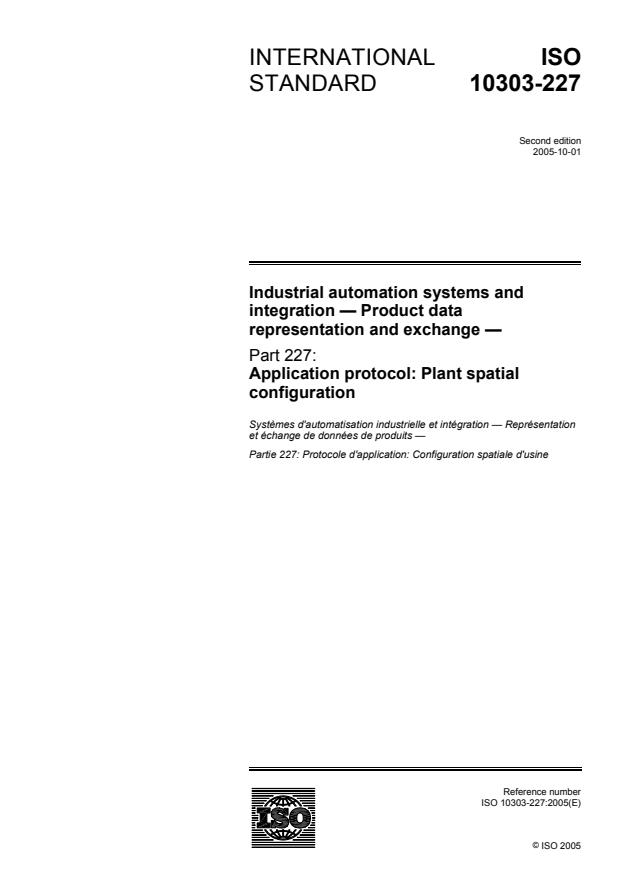
INTERNATIONAL ISO
STANDARD 10303-227
Second edition
2005-10-01
Industrial automation systems and
integration — Product data
representation and exchange —
Part 227:
Application protocol: Plant spatial
configuration
Systèmes d'automatisation industrielle et intégration — Représentation
et échange de données de produits —
Partie 227: Protocole d'application: Configuration spatiale d'usine
Reference number
©
ISO 2005
PDF disclaimer
This PDF file may contain embedded typefaces. In accordance with Adobe's licensing policy, this file may be printed or viewed but
shall not be edited unless the typefaces which are embedded are licensed to and installed on the computer performing the editing. In
downloading this file, parties accept therein the responsibility of not infringing Adobe's licensing policy. The ISO Central Secretariat
accepts no liability in this area.
Adobe is a trademark of Adobe Systems Incorporated.
Details of the software products used to create this PDF file can be found in the General Info relative to the file; the PDF-creation
parameters were optimized for printing. Every care has been taken to ensure that the file is suitable for use by ISO member bodies. In
the unlikely event that a problem relating to it is found, please inform the Central Secretariat at the address given below.
© ISO 2005
All rights reserved. Unless otherwise specified, no part of this publication may be reproduced or utilized in any form or by any means,
electronic or mechanical, including photocopying and microfilm, without permission in writing from either ISO at the address below or
ISO's member body in the country of the requester.
ISO copyright office
Case postale 56 • CH-1211 Geneva 20
Tel. + 41 22 749 01 11
Fax + 41 22 749 09 47
E-mail copyright@iso.org
Web www.iso.org
Published in Switzerland
ii © ISO 2005 – All rights reserved
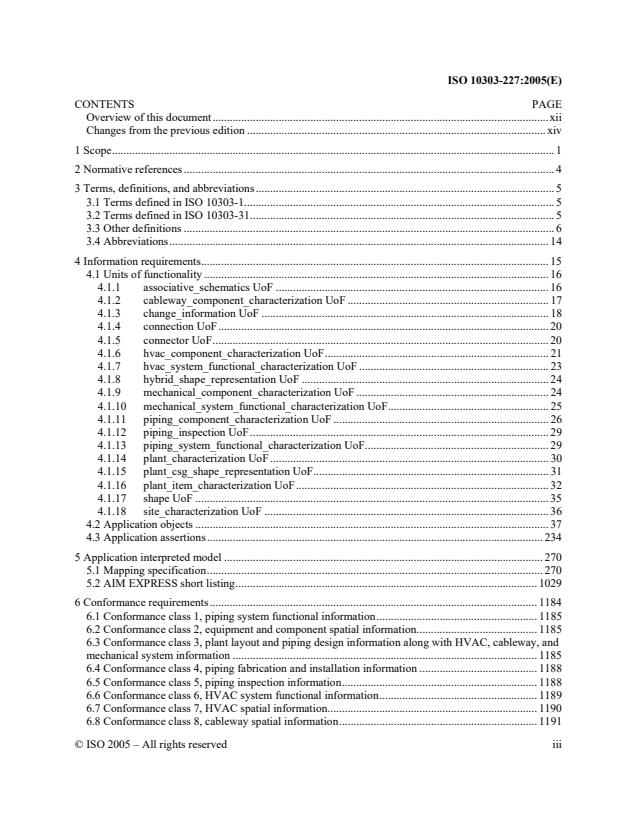
CONTENTS PAGE
Overview of this document.xii
Changes from the previous edition . xiv
1 Scope. 1
2 Normative references . 4
3 Terms, definitions, and abbreviations. 5
3.1 Terms defined in ISO 10303-1. 5
3.2 Terms defined in ISO 10303-31. 5
3.3 Other definitions . 6
3.4 Abbreviations. 14
4 Information requirements. 15
4.1 Units of functionality . 16
4.1.1 associative_schematics UoF . 16
4.1.2 cableway_component_characterization UoF . 17
4.1.3 change_information UoF . 18
4.1.4 connection UoF. 20
4.1.5 connector UoF. 20
4.1.6 hvac_component_characterization UoF. 21
4.1.7 hvac_system_functional_characterization UoF . 23
4.1.8 hybrid_shape_representation UoF . 24
4.1.9 mechanical_component_characterization UoF . 24
4.1.10 mechanical_system_functional_characterization UoF. 25
4.1.11 piping_component_characterization UoF . 26
4.1.12 piping_inspection UoF. 29
4.1.13 piping_system_functional_characterization UoF. 29
4.1.14 plant_characterization UoF . 30
4.1.15 plant_csg_shape_representation UoF. 31
4.1.16 plant_item_characterization UoF. 32
4.1.17 shape UoF . 35
4.1.18 site_characterization UoF . 36
4.2 Application objects . 37
4.3 Application assertions. 234
5 Application interpreted model . 270
5.1 Mapping specification. 270
5.2 AIM EXPRESS short listing. 1029
6 Conformance requirements. 1184
6.1 Conformance class 1, piping system functional information. 1185
6.2 Conformance class 2, equipment and component spatial information. 1185
6.3 Conformance class 3, plant layout and piping design information along with HVAC, cableway, and
mechanical system information . 1185
6.4 Conformance class 4, piping fabrication and installation information . 1188
6.5 Conformance class 5, piping inspection information. 1188
6.6 Conformance class 6, HVAC system functional information. 1189
6.7 Conformance class 7, HVAC spatial information. 1190
6.8 Conformance class 8, cableway spatial information. 1191
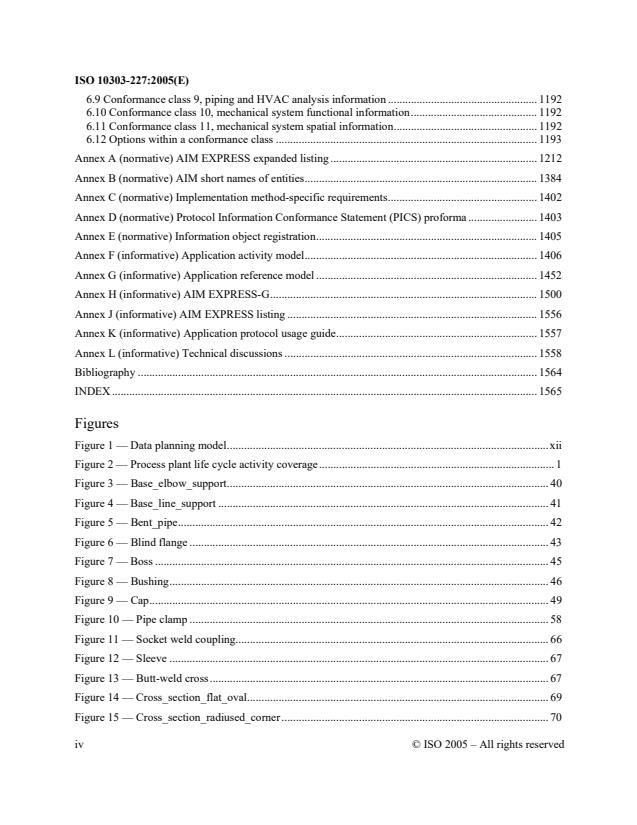
6.9 Conformance class 9, piping and HVAC analysis information . 1192
6.10 Conformance class 10, mechanical system functional information. 1192
6.11 Conformance class 11, mechanical system spatial information. 1192
6.12 Options within a conformance class . 1193
Annex A (normative) AIM EXPRESS expanded listing . 1212
Annex B (normative) AIM short names of entities. 1384
Annex C (normative) Implementation method-specific requirements. 1402
Annex D (normative) Protocol Information Conformance Statement (PICS) proforma . 1403
Annex E (normative) Information object registration. 1405
Annex F (informative) Application activity model. 1406
Annex G (informative) Application reference model . 1452
Annex H (informative) AIM EXPRESS-G. 1500
Annex J (informative) AIM EXPRESS listing . 1556
Annex K (informative) Application protocol usage guide. 1557
Annex L (informative) Technical discussions . 1558
Bibliography . 1564
INDEX . 1565
Figures
Figure 1 — Data planning model.xii
Figure 2 — Process plant life cycle activity coverage. 1
Figure 3 — Base_elbow_support. 40
Figure 4 — Base_line_support . 41
Figure 5 — Bent_pipe. 42
Figure 6 — Blind flange . 43
Figure 7 — Boss . 45
Figure 8 — Bushing. 46
Figure 9 — Cap. 49
Figure 10 — Pipe clamp . 58
Figure 11 — Socket weld coupling. 66
Figure 12 — Sleeve . 67
Figure 13 — Butt-weld cross. 67
Figure 14 — Cross_section_flat_oval. 69
Figure 15 — Cross_section_radiused_corner . 70
iv © ISO 2005 – All rights reserved
Figure 16 — Dummy_leg . 74
Figure 17 — Eccentric_base_elbow_support . 74
Figure 18 — Eccentric_reducer . 75
Figure 19 — Elbow. 76
Figure 20 — Expander_flange. 80
Figure 21 — Female_end. 83
Figure 22 — Ferrule. 84
Figure 23 — Hole_straddle_centreline_orientation. 86
Figure 24 — Flanged_end . 87
Figure 25 — Raised face flange .88
Figure 26 — Flat face flange . 88
Figure 27 — Ring type joint flange .88
Figure 28 — Male and female flange . 88
Figure 29 — Tongue and groove flange . 89
Figure 30 — Grooved_end . 94
Figure 31 — Gusset . 95
Figure 32 — Hangers both without_spring and with_spring. 96
Figure 33 — Hvac_elbow_90deg_reducing . 107
Figure 34 — Hvac_elbow_centred . 108
Figure 35 — Hvac_elbow_mitre. 109
Figure 36 — Hvac_offset_ogee_centred . 116
Figure 37 — Transition - rectangular to round . 124
Figure 38 — Transition - rectangle to round slanted . 125
Figure 39 — Insert_fitting . 127
Figure 40 — Lap_joint_flange. 131
Figure 41 — Lap_joint_stub_end . 131
Figure 42 — Lateral. 133
Figure 43 — Lug. 137
Figure 44 — Mitre_bend_pipe. 147
Figure 45 — Nipple . 148
Figure 46 — Olet . 149
Figure 47 — Orifice_flange. 151
Figure 48 — Orifice_plate . 152
Figure 49 — Pad . 154
Figure 50 — Paddle_blank . 155
Figure 51 — Paddle_spacer . 155
Figure 52 — Perforated_cap. 156
Figure 53 — Butt-weld Pipe Cap. 158
Figure 54 — Plate . 186
Figure 55 — Plug. 187
Figure 56 — Reducer. 190
Figure 57 — Reducing_flange. 191
Figure 58 — Reinforcing_plate . 192
Figure 59 — Reinforcing_ring. 193
Figure 60 — Ring_spacer . 194
Figure 61 — Forward and aft pointing ship's axes . 203
Figure 62 — Shoe . 205
Figure 63 — Slip_on_flange. 208
Figure 64 — Slip_on_jacket_flange . 209
Figure 65 — Socket . 209
Figure 66 — Socket_weld_flange. 210
Figure 67 — Spectacle_blind. 212
Figure 68 — Stay. 214
Figure 69 — Stopper. 215
Figure 70 — Stub_in. 219
Figure 71 — Tee . 224
Figure 72 — Threaded . 225
Figure 73 — Threaded_flange . 226
Figure 74 — Trunnion . 228
Figure 75 — Union . 229
Figure 76 — Weld_neck_flange. 231
Figure 77 — Weld_neck_jacket_flange . 232
Figure 78 — Y_type_lateral . 233
Figure F.1 — IDEF0 basic notation. 1425
Figure F.2 — A-0: Process plants. 1426
Figure F.3 — A0: Perform process plant life-cycle activities . 1427
vi © ISO 2005 – All rights reserved
Figure F.4 — A1: Manage and plan project . 1428
Figure F.5 — A2: Design and engineer plant . 1429
Figure F.6 — A21: Produce conceptual process design . 1430
Figure F.7 — A22: Produce conceptual plant design . 1431
Figure F.8 — A23: Produce final process design . 1432
Figure F.9 — A24: Produce final plant design . 1433
Figure F.10 — A242: Finalize layout and spatial design. 1434
Figure F.11 — A2426: Finalize piping. 1435
Figure F.12 — A24262: Finalize 3D piping details. 1436
Figure F.13 — A3: Procure goods and services . 1437
Figure F.14 — A4: Construct and commission plant . 1438
Figure F.15 — A42: Obtain construction services. 1439
Figure F.16 — A423: Obtain piping systems . 1440
Figure F.17 — A4233: Shop fabricate piping. 1441
Figure F.18 — A42331: Prepare shop fabrication piping. 1442
Figure F.19 — A42332: Shop fabricate piping. 1443
Figure F.20 — A42333: Inspect shop fabricated piping. 1444
Figure F.21 — A42334: Complete and ship shop fabricated piping . 1445
Figure F.22 — A5: Manage, operate, and maintain plant. 1446
Figure F.23 — A6: Decommission and dispose of plant. 1447
Figure G.1 — Off-page connectors. 1452
Figure G.2 — ARM diagram 1 of 47. 1453
Figure G.3 — ARM diagram 2 of 47. 1454
Figure G.4 — ARM diagram 3 of 47. 1455
Figure G.5 — ARM diagram 4 of 47. 1456
Figure G.6 — ARM diagram 5 of 47. 1457
Figure G.7 — ARM diagram 6 of 47. 1458
Figure G.8 — ARM diagram 7 of 47. 1459
Figure G.9 — ARM diagram 8 of 47. 1460
Figure G.10 — ARM diagram 9 of 47. 1461
Figure G.11 — ARM diagram 10 of 47. 1462
Figure G.12 — ARM diagram 11 of 47. 1463
Figure G.13 — ARM diagram 12 of 47. 1464
Figure G.14 — ARM diagram 13 of 47. 1465
Figure G.15 — ARM diagram 14 of 47. 1466
Figure G.16 — ARM diagram 15 of 47. 1467
Figure G.17 — ARM diagram 16 of 47. 1468
Figure G.18 — ARM diagram 17 of 47. 1469
Figure G.19 — ARM diagram 18 of 47. 1470
Figure G.20 — ARM diagram 19 of 47. 1471
Figure G.21 — ARM diagram 20 of 47. 1472
Figure G.22 — ARM diagram 21 of 47. 1473
Figure G.23 — ARM diagram 22 of 47. 1474
Figure G.24 — ARM diagram 23 of 47. 1475
Figure G.25 — ARM diagram 24 of 47. 1476
Figure G.26 — ARM diagram 25 of 47. 1477
Figure G.27 — ARM diagram 26 of 47. 1478
Figure G.28 — ARM diagram 27 of 47. 1479
Figure G.29 — ARM diagram 28 of 47. 1480
Figure G.30 — ARM diagram 29 of 47. 1481
Figure G.31 — ARM diagram 30 of 47. 1482
Figure G.32 — ARM diagram 31 of 47. 1483
Figure G.33 — ARM diagram 32 of 47. 1484
Figure G.34 — ARM diagram 33 of 47. 1485
Figure G.35 — ARM diagram 34 of 47. 1486
Figure G.36 — ARM diagram 35 of 47. 1487
Figure G.37 — ARM diagram 36 of 47. 1488
Figure G.38 — ARM diagram 37 of 47. 1489
Figure G.39 — ARM diagram 38 of 47. 1490
Figure G.40 — ARM diagram 39 of 47. 1491
Figure G.41 — ARM diagram 40 of 47. 1492
Figure G.42 — ARM diagram 41 of 47. 1493
Figure G.43 — ARM diagram 42 of 47. 1494
Figure G.44 — ARM diagram 43 of 47. 1495
Figure G.45 — ARM diagram 44 of 47. 1496
Figure G.46 — ARM diagram 45 of 47. 1497
viii © ISO 2005 – All rights reserved
Figure G.47 — ARM diagram 46 of 47. 1498
Figure G.48 — ARM diagram 47 of 47. 1499
Figure H.1 — AIM EXPRESS-G diagram 1 of 55. 1501
Figure H.2 — AIM EXPRESS-G diagram 2 of 55. 1502
Figure H.3 — AIM EXPRESS-G diagram 3 of 55. 1503
Figure H.4 — AIM EXPRESS-G diagram 4 of 55. 1504
Figure H.5 — AIM EXPRESS-G diagram 5 of 55. 1505
Figure H.6 — AIM EXPRESS-G diagram 6 of 55. 1506
Figure H.7 — AIM EXPRESS-G diagram 7 of 55. 1507
Figure H.8 — AIM EXPRESS-G diagram 8 of 55. 1508
Figure H.9 — AIM EXPRESS-G diagram 9 of 55. 1509
Figure H.10 — AIM EXPRESS-G diagram 10 of 55. 1510
Figure H.11 — AIM EXPRESS-G diagram 11 of 55. 1511
Figure H.12 — AIM EXPRESS-G diagram 12 of 55. 1512
Figure H.13 — AIM EXPRESS-G diagram 13 of 55. 1513
Figure H.14 — AIM EXPRESS-G diagram 14 of 55. 1514
Figure H.15 — AIM EXPRESS-G diagram 15 of 55. 1515
Figure H.16 — AIM EXPRESS-G diagram 16 of 55. 1516
Figure H.17 — AIM EXPRESS-G diagram 17 of 55. 1517
Figure H.18 — AIM EXPRESS-G diagram 18 of 55. 1518
Figure H.19 — AIM EXPRESS-G diagram 19 of 55. 1519
Figure H.20 — AIM EXPRESS-G diagram 20 of 55. 1520
Figure H.21 — AIM EXPRESS-G diagram 21 of 55. 1521
Figure H.22 — AIM EXPRESS-G diagram 22 of 55. 1522
Figure H.23 — AIM EXPRESS-G diagram 23 of 55. 1523
Figure H.24 — AIM EXPRESS-G diagram 24 of 55. 1524
Figure H.25 — AIM EXPRESS-G diagram 25 of 55. 1525
Figure H.26 — AIM EXPRESS-G diagram 26 of 55. 1526
Figure H.27 — AIM EXPRESS-G diagram 27 of 55. 1527
Figure H.28 — AIM EXPRESS-G diagram 28 of 55. 1528
Figure H.29 — AIM EXPRESS-G diagram 29 of 55. 1529
Figure H.30 — AIM EXPRESS-G diagram 30 of 55. 1530
Figure H.31 — AIM EXPRESS-G diagram 31 of 55. 1531
Figure H.32 — AIM EXPRESS-G diagram 32 of 55. 1532
Figure H.33 — AIM EXPRESS-G diagram 33 of 55. 1533
Figure H.34 — AIM EXPRESS-G diagram 34 of 55. 1534
Figure H.35 — AIM EXPRESS-G diagram 35 of 55. 1535
Figure H.36 — AIM EXPRESS-G diagram 36 of 55. 1536
Figure H.37 — AIM EXPRESS-G diagram 37 of 55. 1537
Figure H.38 — AIM EXPRESS-G diagram 38 of 55. 1538
Figure H.39 — AIM EXPRESS-G diagram 39 of 55. 1539
Figure H.40 — AIM EXPRESS-G diagram 40 of 55. 1540
Figure H.41 — AIM EXPRESS-G diagram 41 of 55. 1541
Figure H.42 — AIM EXPRESS-G diagram 42 of 55. 1542
Figure H.43 — AIM EXPRESS-G diagram 43 of 55. 1543
Figure H.44 — AIM EXPRESS-G diagram 44 of 55. 1544
Figure H.45 — AIM EXPRESS-G diagram 45 of 55. 1545
Figure H.46 — AIM EXPRESS-G diagram 46 of 55. 1546
Figure H.47 — AIM EXPRESS-G diagram 47 of 55. 1547
Figure H.48 — AIM EXPRESS-G diagram 48 of 55. 1548
Figure H.49 — AIM EXPRESS-G diagram 49 of 55. 1549
Figure H.50 — AIM EXPRESS-G diagram 50 of 55. 1550
Figure H.51 — AIM EXPRESS-G diagram 51 of 55. 1551
Figure H.52 — AIM EXPRESS-G diagram 52 of 55. 1552
Figure H.53 — AIM EXPRESS-G diagram 53 of 55. 1553
Figure H.54 — AIM EXPRESS-G diagram 54 of 55. 1554
Figure H.55 — AIM EXPRESS-G diagram 55 of 55. 1555
Figure L.1 — Relationship between logical connectivity and physical connectivity. 1563
Tables
Table 1 — Plant_item_shape interference clash detection . 183
Table 2 — Conformance classes. 1195
Table 3 — Conformance class (1 –11) elements . 1197
Table B. 1 — Short names of entities . 1384
Table F.1 — AAM ICOM to ARM UoF/entity mapping . 1449
x © ISO 2005 – All rights reserved
Foreword
ISO (the International Organization for Standardization) is a worldwide federation of national standards
bodies (ISO member bodies). The work of preparing International Standards is normally carried out
through ISO technical committees. Each member body interested in a subject for which a technical
committee has been established has the right to be represented on that committee. International
organizations, governmental and non-governmental, in liaison with ISO, also take part in the work. ISO
collaborates closely with the International Electrotechnical Commission (IEC) on all matters of
electrotechnical standardization.
International Standards are drafted in accordance with the rules given in the ISO/IEC Directives, Part 2.
Draft International Standards adopted by technical committees are circulated to the member bodies for
voting. Publication as an International Standard requires approval by at least 75% of the member bodies
casting a vote.
Attention is drawn to the possibility that some of the elements of this part of ISO may be the subject of
patent rights. ISO shall not be held responsible for identifying any or all such patent rights.
International Standard ISO 10303-227 was prepared by Technical Committee ISO/TC 184, Industrial
automation systems and integration, Subcommittee SC4, Industrial data.
This second edition of ISO 10303-227 cancels and replaces the first edition (ISO 10303-227:2001), of
which it constitutes a technical revision.
This International Standard is organized as a series of parts, each published separately. The structure of
this international standard is described in ISO 10303-1.
Each part of this International Standard is a member of one of the following series: description methods,
implementation methods, conformance testing methodology and framework, integrated generic resources,
integrated application resources, application protocols, abstract test suites, application interpreted
constructs, and application modules. This part is a member of the application protocols series.
A complete list of parts of ISO 10303 is available from the Internet:
http://www.tc184-sc4.org/titles/STEP_titles.htm
Should further parts of ISO 10303 be published, they will follow the same numbering pattern.
Introduction
ISO 10303 is an International Standard for the computer-interpretable representation of product
information and for the exchange of product data. The objective is to provide a neutral mechanism
capable of describing products throughout their life cycle. This mechanism is suitable not only for neutral
file exchange, but also as a basis for implementing and sharing product databases, and as a basis for
archiving.
Overview of this document
This part of ISO 10303 is a member of the application protocol series. This part of ISO 10303 specifies
an application protocol (AP) for the exchange of the spatial configuration information of industrial
facilities, for example, process plants, ships and their supporting systems. This information includes the
shape, spatial arrangement and connection characteristics of piping, HVAC (heating, ventilation and air-
conditioning), mechanical, and cableway system components as well as the shape and spatial arrangement
characteristics of other related plant systems (for example, instrumentation and controls, and structural
systems). Users of this standard should understand the basic principles and concepts of plant design, and
piping, HVAC, cableway, and mechanical system design.
PLANT
CHANGE
SCHEMATIC
REPRESENTATION
PLANT SYSTEM
PIPING SYSTEM
HVAC SYSTEM
FUNCTIONAL
FUNCTIONAL
CHARACTERIZATION MECHANICAL SYSTEM
CHARACTERIZATION
FUNCTIONAL
CHARACTERIZATION
PLANT ITEM
CABLEWAY COMPONENT
HVAC COMPONENT
CONNECTOR
MECHANICAL COMPONENT
CONNECTION
PIPING COMPONENT
PIPING FABRICATION
AND INSPECTION
ITEM SHAPE
Figure 1 — Data planning model
This AP specifies requirements for the exchange of information required for the design, analysis,
fabrication and installation of piping components and piping systems and information on the inspection of
xii © ISO 2005 – All rights reserved
fabricated piping. This AP specifies requirements fo
...
INTERNATIONAL ISO
STANDARD 10303-227
Second edition
2005-10-01
Industrial automation systems and
integration — Product data
representation and exchange —
Part 227:
Application protocol: Plant spatial
configuration
Systèmes d'automatisation industrielle et intégration — Représentation
et échange de données de produits —
Partie 227: Protocole d'application: Configuration spatiale d'usine
Reference number
©
ISO 2005
PDF disclaimer
This PDF file may contain embedded typefaces. In accordance with Adobe's licensing policy, this file may be printed or viewed but
shall not be edited unless the typefaces which are embedded are licensed to and installed on the computer performing the editing. In
downloading this file, parties accept therein the responsibility of not infringing Adobe's licensing policy. The ISO Central Secretariat
accepts no liability in this area.
Adobe is a trademark of Adobe Systems Incorporated.
Details of the software products used to create this PDF file can be found in the General Info relative to the file; the PDF-creation
parameters were optimized for printing. Every care has been taken to ensure that the file is suitable for use by ISO member bodies. In
the unlikely event that a problem relating to it is found, please inform the Central Secretariat at the address given below.
This CD-ROM/DVD contains:
1) the publication ISO 10303-227:2005 in portable document format (PDF), which can be viewed using
Adobe® Acrobat® Reader;
2) Two electronic attachments.
Adobe and Acrobat are trademarks of Adobe Systems Incorporated.
This second editio
...