

ISO 17633:2017
(Main)Welding consumables — Tubular cored electrodes and rods for gas shielded and non-gas shielded metal arc welding of stainless and heat-resisting steels — Classification
General Information
- Abstract
ISO 17633:2017 specifies requirements for classification of tubular flux and metal cored electrodes and rods, based on the all-weld metal chemical composition, the type of core, shielding gas, welding position and the all-weld metal mechanical properties, in the as-welded or heat-treated conditions, for gas shielded and non-gas shielded metal arc welding of stainless and heat-resisting steels. ISO 17633:2017 is a combined standard providing for classification utilizing a system based upon nominal composition or utilizing a system based upon alloy type. a) Clauses, subclauses, and tables which carry the suffix letter "A" are applicable only to products classified using the system based upon nominal composition. b) Clauses, subclauses, and tables which carry the suffix letter "B" are applicable only to products classified using the system based upon alloy type. c) Clauses, subclauses, and tables which do not have either the suffix letter "A" or the suffix letter "B" are applicable to all products classified in accordance with this document. ISO 17633:2017 does not use pulsed current for determining the product classification.
- Status
- Withdrawn
- Publication Date
- 29-Nov-2017
- Technical Committee
- ISO/TC 44/SC 3 - Welding consumables
- Drafting Committee
- ISO/TC 44/SC 3 - Welding consumables
- Current Stage
- 9599 - Withdrawal of International Standard
- Start Date
- 07-Mar-2025
- Completion Date
- 29-Aug-2026
Buy Documents
ISO 17633:2017 - Welding consumables — Tubular cored electrodes and rods for gas shielded and non-gas shielded metal arc welding of stainless and heat-resisting steels — Classification/30/2017
ISO 17633:2017 - Welding consumables -- Tubular cored electrodes and rods for gas shielded and non-gas shielded metal arc welding of stainless and heat-resisting steels -- Classification
REDLINE ISO 17633:2017 - Welding consumables — Tubular cored electrodes and rods for gas shielded and non-gas shielded metal arc welding of stainless and heat-resisting steels — Classification Released:11/30/2017
ISO 17633:2017 - Produits consommables pour le soudage — Fils et baguettes fourrés pour le soudage à l'arc avec ou sans protection gazeuse des aciers inoxydables et des aciers résistant aux températures élevées — Classification/30/2017
ISO 17633:2017 - Produits consommables pour le soudage -- Fils et baguettes fourrés pour le soudage a l'arc avec ou sans protection gazeuse des aciers inoxydables et des aciers résistant aux températures élevées -- Classification
Overview
ISO 17633:2017 - Welding consumables: Tubular cored electrodes and rods for gas shielded and non-gas shielded metal arc welding of stainless and heat‑resisting steels - Classification defines a unified classification system for tubular flux‑cored and metal‑cored electrodes and cored rods used to weld stainless steels and heat‑resisting steels. The standard covers identification, symbols, and requirements based on the all‑weld metal chemical composition, core type, shielding gas, welding position and all‑weld metal mechanical properties in as‑welded or heat‑treated conditions.
Key technical topics and requirements
- Two classification systems:
- System A - based on nominal chemical composition (suffix “A”).
- System B - based on alloy type (suffix “B”).
- Clauses/tables are marked with “A” or “B” where applicable; unmarked clauses apply to both.
- Product identification symbols: product type (T or TS), chemical composition/alloy designation, core type, shielding gas, and welding position.
- All‑weld metal requirements: chemical composition and mechanical property limits for deposits produced under specified deposition conditions.
- Core types: classification and descriptions for flux‑cored, metal‑cored and cored rods (detailed in Annexes B and C).
- Mechanical testing and test conditions: preheat/interpass considerations, pass sequence, and test specimen requirements (see Clause 6 and normative ISO test references).
- Chemical analysis and rounding procedures, requirements for retests and technical delivery conditions (Clauses 7–10).
- Ferrite considerations: informative guidance on ferrite content, formation and measurement (Annex D).
- Exclusion: pulsed current is not used for classification.
Practical applications
- Specification and labeling of filler materials on data sheets and packages for procurement and quality control.
- Selection of appropriate tubular cored electrodes/rods for welding stainless and heat‑resisting steels with specific corrosion, high‑temperature or mechanical property needs.
- Supporting Welding Procedure Specifications (WPS), qualification testing and acceptance criteria for fabrication and repair.
- Useful for manufacturers, welding engineers, fabricators and quality inspectors who need standardized designations and reproducible all‑weld metal characteristics.
Who should use ISO 17633:2017
- Welding consumable manufacturers for product classification and marking.
- Welding engineers and procedure writers selecting filler metals for stainless and heat‑resisting steel applications.
- Procurement/specification teams creating material call‑outs.
- Inspectors and labs performing mechanical and chemical verification of weld deposits.
Related standards
- ISO 14175 (welding gases), ISO 15792‑1 (all‑weld metal test methods), ISO 6947 (welding positions), ISO 544 (delivery conditions) and ISO 14344 (procurement of filler materials) - referenced in ISO 17633:2017 for test methods, gas definitions and delivery requirements.
Keywords: ISO 17633:2017, tubular cored electrodes, cored rods, stainless steels, heat‑resisting steels, welding consumables, classification, all‑weld metal, flux‑cored, metal‑cored, shielding gas.
Relations
- Effective Date
- 12-Feb-2026
- Consolidates
ISO 17754:2014 - Timber structures — Test methods — Torsional resistance of driving in screws - Effective Date
- 06-Jun-2022
- Effective Date
- 11-Dec-2021
- Effective Date
- 01-Apr-2023
- Effective Date
- 05-Nov-2015
Buy Documents
ISO 17633:2017 - Welding consumables — Tubular cored electrodes and rods for gas shielded and non-gas shielded metal arc welding of stainless and heat-resisting steels — Classification/30/2017
ISO 17633:2017 - Welding consumables -- Tubular cored electrodes and rods for gas shielded and non-gas shielded metal arc welding of stainless and heat-resisting steels -- Classification
REDLINE ISO 17633:2017 - Welding consumables — Tubular cored electrodes and rods for gas shielded and non-gas shielded metal arc welding of stainless and heat-resisting steels — Classification Released:11/30/2017
ISO 17633:2017 - Produits consommables pour le soudage — Fils et baguettes fourrés pour le soudage à l'arc avec ou sans protection gazeuse des aciers inoxydables et des aciers résistant aux températures élevées — Classification/30/2017
ISO 17633:2017 - Produits consommables pour le soudage -- Fils et baguettes fourrés pour le soudage a l'arc avec ou sans protection gazeuse des aciers inoxydables et des aciers résistant aux températures élevées -- Classification
Get Certified
Connect with accredited certification bodies for this standard

DVS-ZERT GmbH
German welding certification society.
CARES (UK Certification Authority for Reinforcing Steels)
UK certification for reinforcing steels and construction.
EWF/IIW (European/International Welding Federation)
International welding personnel certification.
Sponsored listings
Frequently Asked Questions
ISO 17633:2017 is a standard published by the International Organization for Standardization (ISO). Its full title is "Welding consumables — Tubular cored electrodes and rods for gas shielded and non-gas shielded metal arc welding of stainless and heat-resisting steels — Classification". This standard covers: ISO 17633:2017 specifies requirements for classification of tubular flux and metal cored electrodes and rods, based on the all-weld metal chemical composition, the type of core, shielding gas, welding position and the all-weld metal mechanical properties, in the as-welded or heat-treated conditions, for gas shielded and non-gas shielded metal arc welding of stainless and heat-resisting steels. ISO 17633:2017 is a combined standard providing for classification utilizing a system based upon nominal composition or utilizing a system based upon alloy type. a) Clauses, subclauses, and tables which carry the suffix letter "A" are applicable only to products classified using the system based upon nominal composition. b) Clauses, subclauses, and tables which carry the suffix letter "B" are applicable only to products classified using the system based upon alloy type. c) Clauses, subclauses, and tables which do not have either the suffix letter "A" or the suffix letter "B" are applicable to all products classified in accordance with this document. ISO 17633:2017 does not use pulsed current for determining the product classification.
ISO 17633:2017 specifies requirements for classification of tubular flux and metal cored electrodes and rods, based on the all-weld metal chemical composition, the type of core, shielding gas, welding position and the all-weld metal mechanical properties, in the as-welded or heat-treated conditions, for gas shielded and non-gas shielded metal arc welding of stainless and heat-resisting steels. ISO 17633:2017 is a combined standard providing for classification utilizing a system based upon nominal composition or utilizing a system based upon alloy type. a) Clauses, subclauses, and tables which carry the suffix letter "A" are applicable only to products classified using the system based upon nominal composition. b) Clauses, subclauses, and tables which carry the suffix letter "B" are applicable only to products classified using the system based upon alloy type. c) Clauses, subclauses, and tables which do not have either the suffix letter "A" or the suffix letter "B" are applicable to all products classified in accordance with this document. ISO 17633:2017 does not use pulsed current for determining the product classification.
ISO 17633:2017 is classified under the following ICS (International Classification for Standards) categories: 25.160.20 - Welding consumables. The ICS classification helps identify the subject area and facilitates finding related standards.
ISO 17633:2017 has the following relationships with other standards: It is inter standard links to EN ISO 17633:2018, ISO 17754:2014, ISO 17633:2017/Amd 1:2021, ISO 17633:2025, ISO 17633:2010. Understanding these relationships helps ensure you are using the most current and applicable version of the standard.
ISO 17633:2017 is available in PDF format for immediate download after purchase. The document can be added to your cart and obtained through the secure checkout process. Digital delivery ensures instant access to the complete standard document.
Standards Content (Sample)
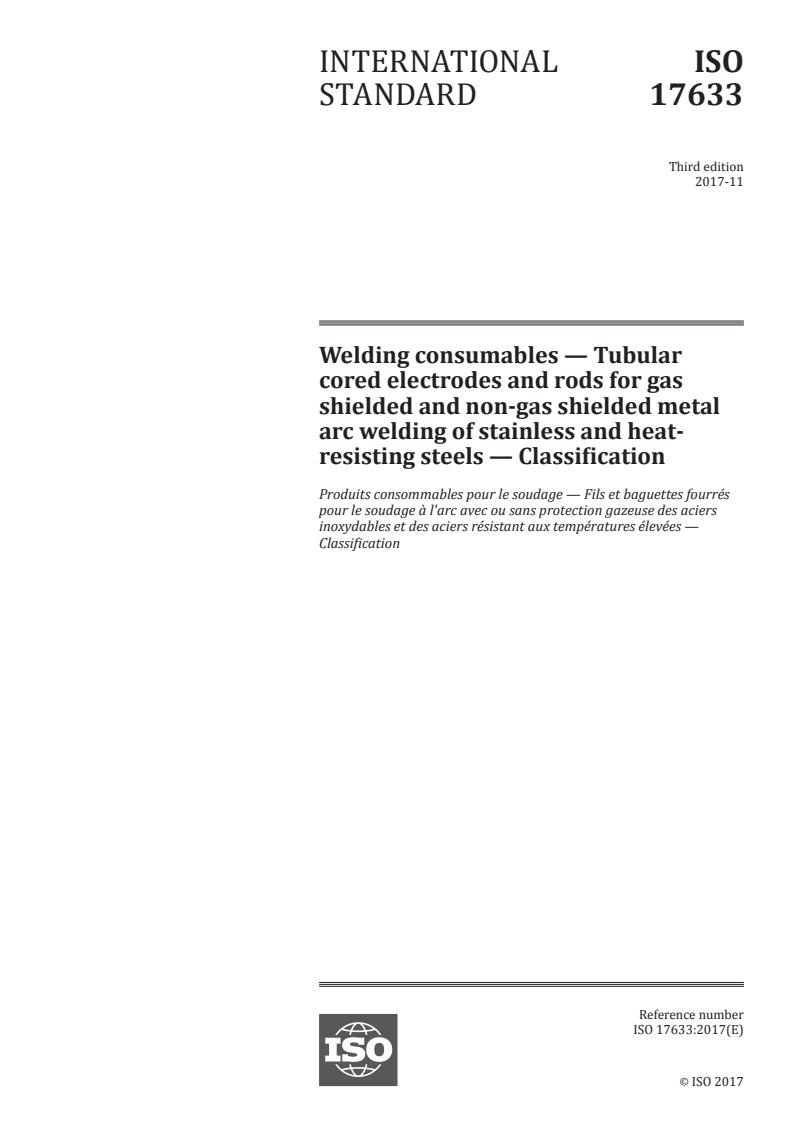
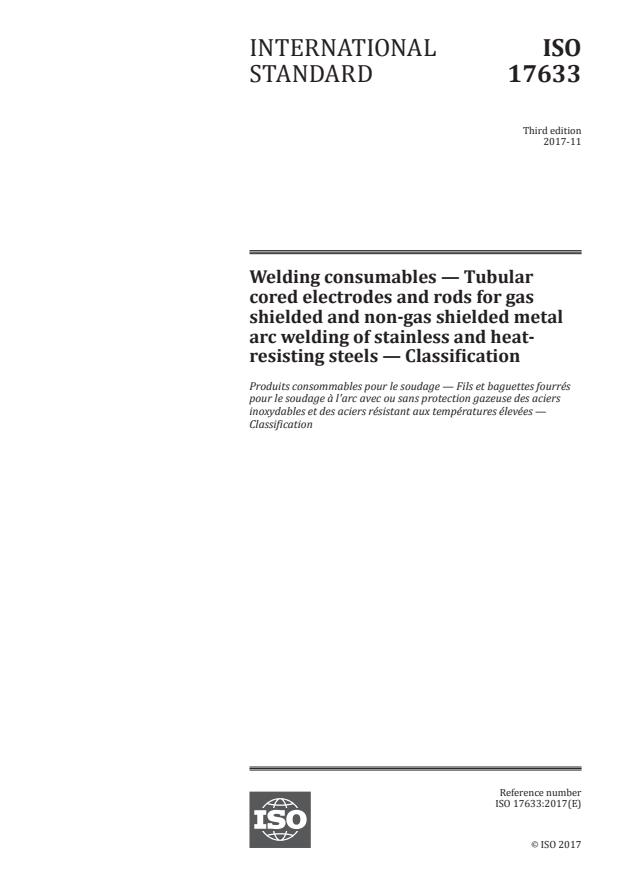
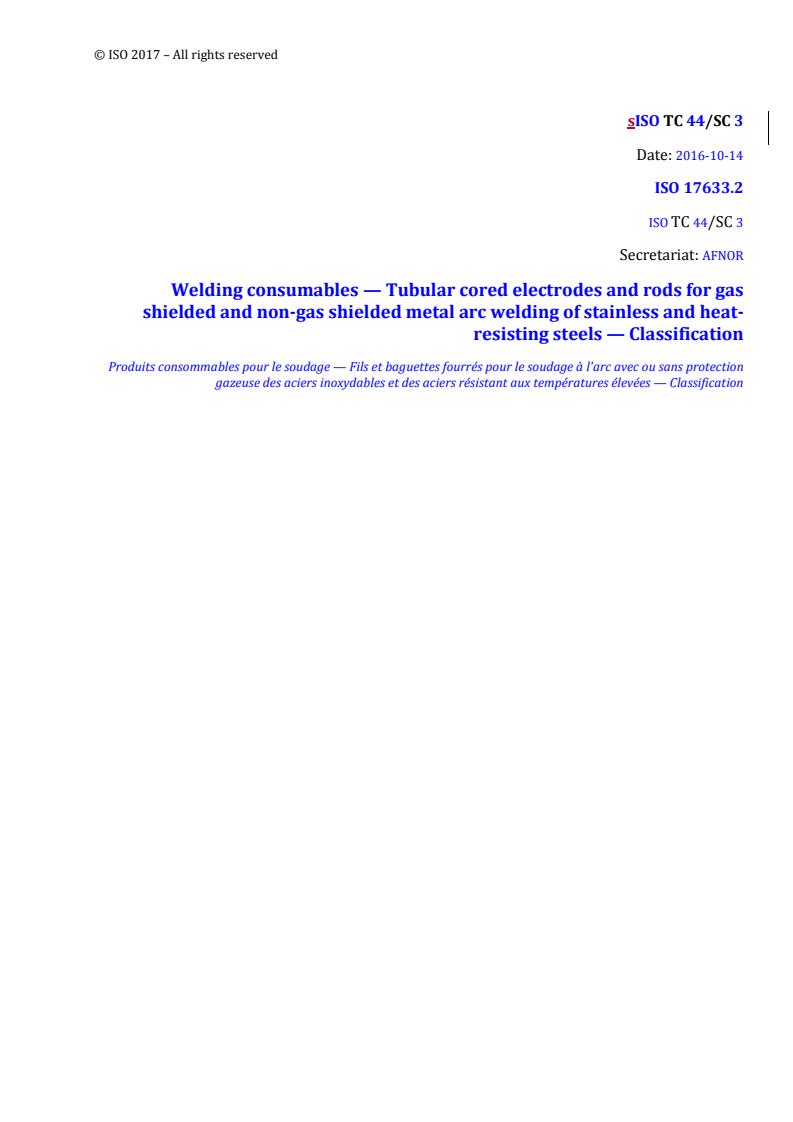
INTERNATIONAL ISO
STANDARD 17633
Third edition
2017-11
Welding consumables — Tubular
cored electrodes and rods for gas
shielded and non-gas shielded metal
arc welding of stainless and heat-
resisting steels — Classification
Produits consommables pour le soudage — Fils et baguettes fourrés
pour le soudage à l'arc avec ou sans protection gazeuse des aciers
inoxydables et des aciers résistant aux températures élevées —
Classification
Reference number
©
ISO 2017
© ISO 2017, Published in Switzerland
All rights reserved. Unless otherwise specified, no part of this publication may be reproduced or utilized otherwise in any form
or by any means, electronic or mechanical, including photocopying, or posting on the internet or an intranet, without prior
written permission. Permission can be requested from either ISO at the address below or ISO’s member body in the country of
the requester.
ISO copyright office
Ch. de Blandonnet 8 • CP 401
CH-1214 Vernier, Geneva, Switzerland
Tel. +41 22 749 01 11
Fax +41 22 749 09 47
copyright@iso.org
www.iso.org
ii © ISO 2017 – All rights reserved
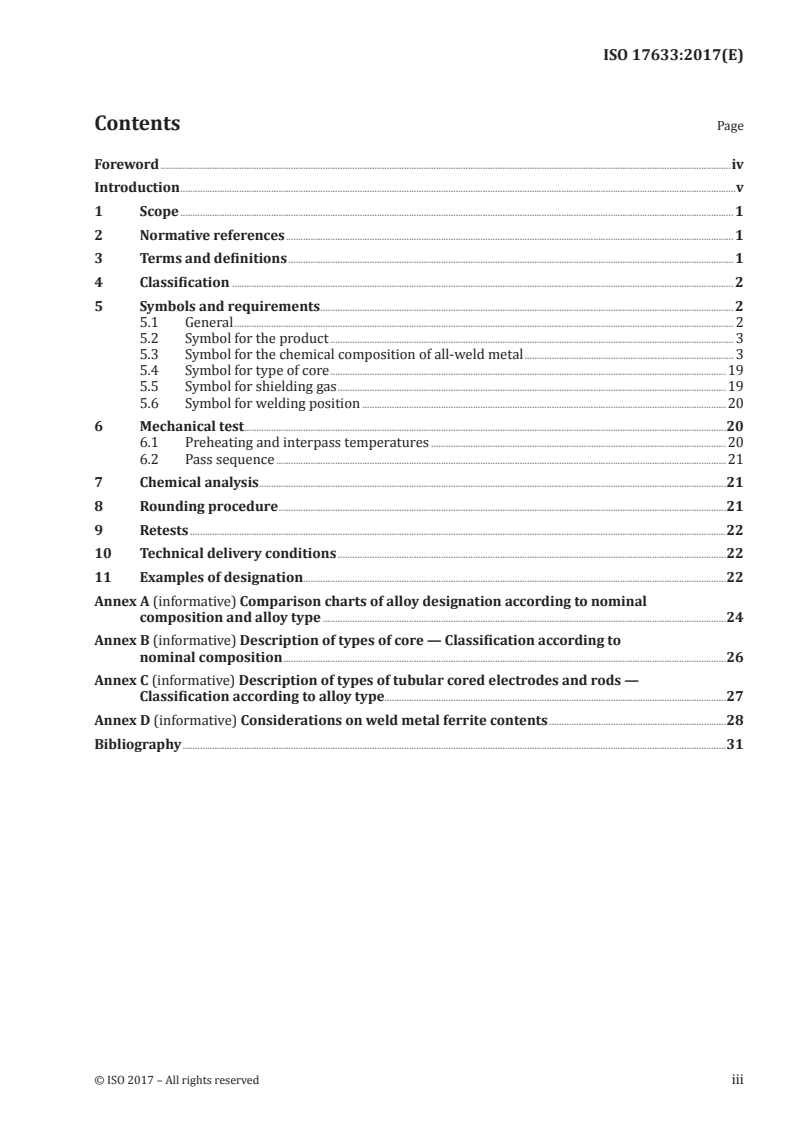
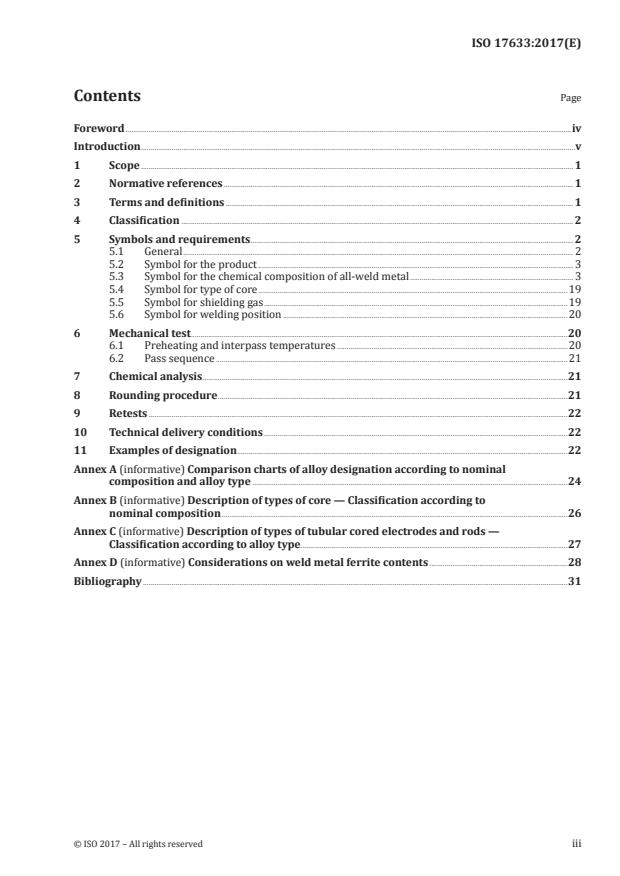
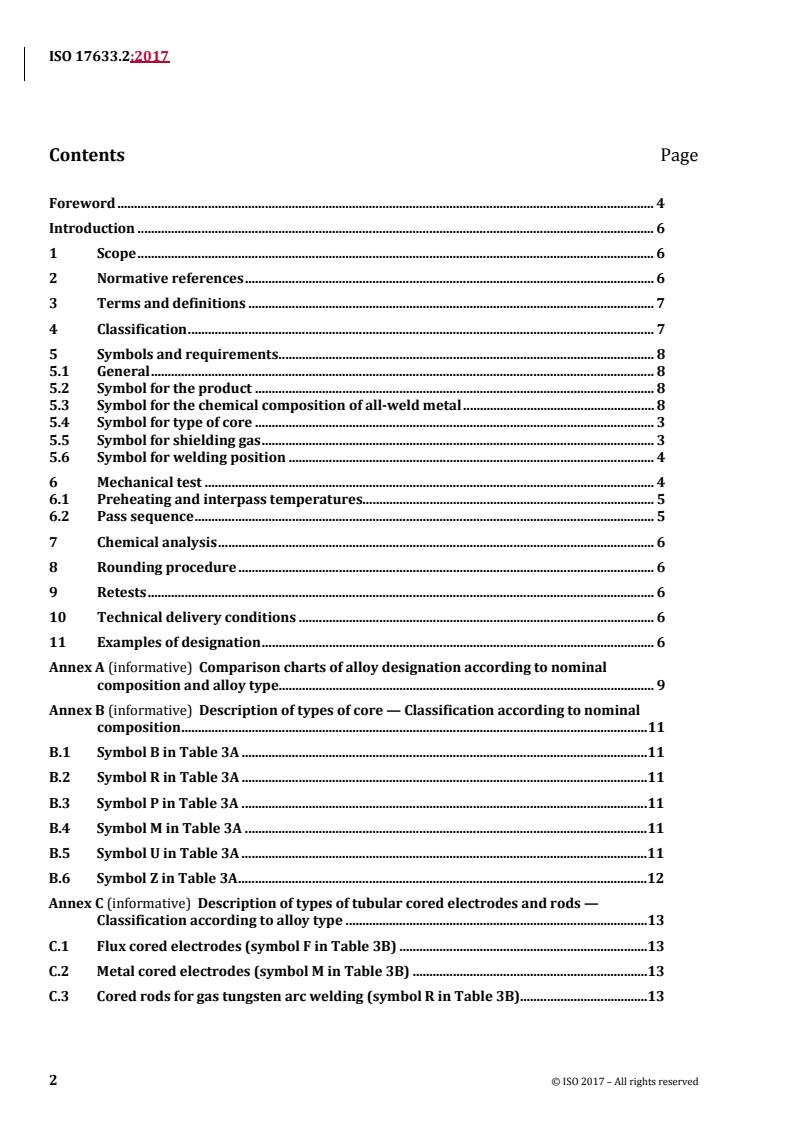
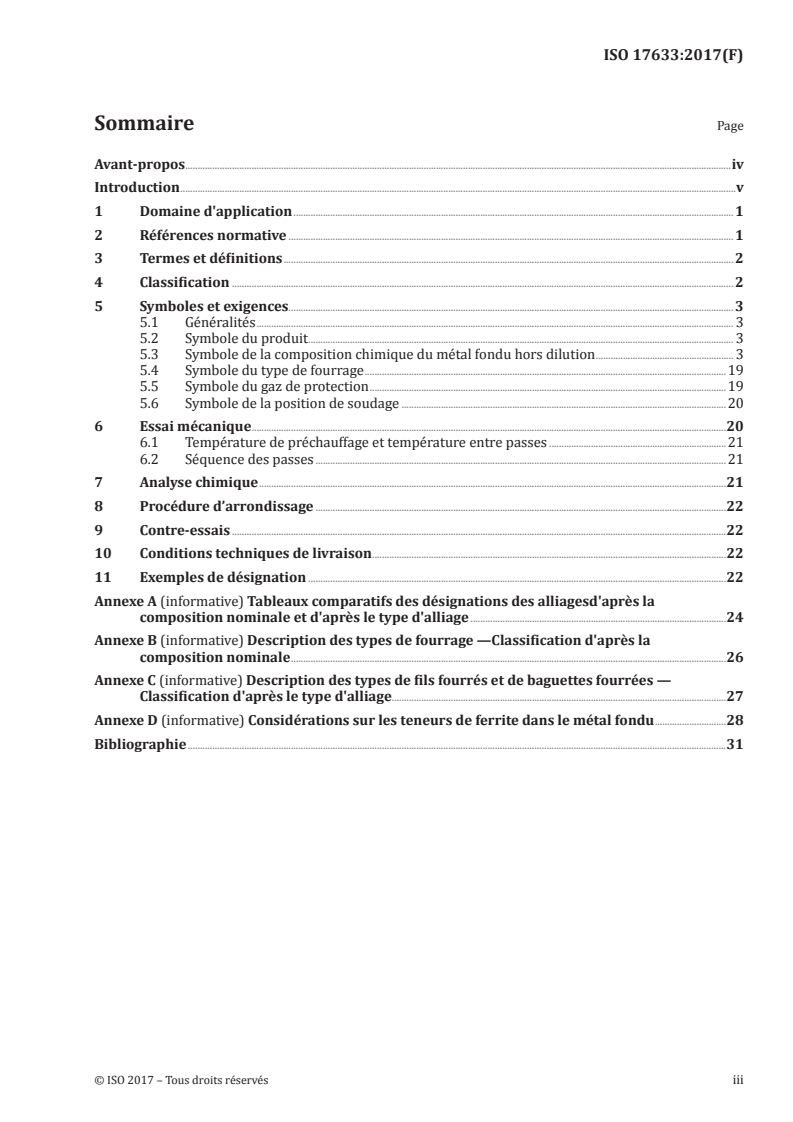
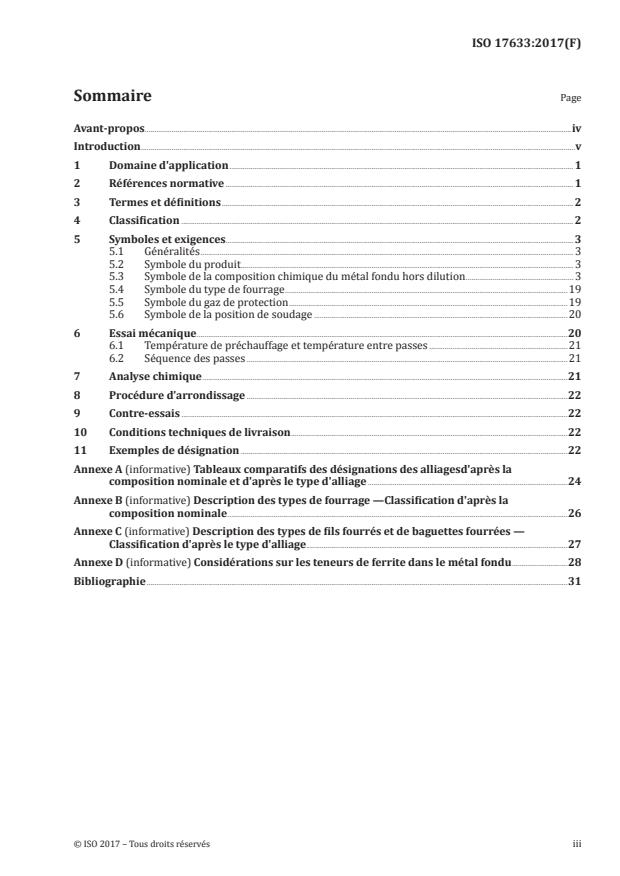
Contents Page
Foreword .iv
Introduction .v
1 Scope . 1
2 Normative references . 1
3 Terms and definitions . 1
4 Classification . 2
5 Symbols and requirements . 2
5.1 General . 2
5.2 Symbol for the product . 3
5.3 Symbol for the chemical composition of all-weld metal . 3
5.4 Symbol for type of core .19
5.5 Symbol for shielding gas .19
5.6 Symbol for welding position .20
6 Mechanical test .20
6.1 Preheating and interpass temperatures .20
6.2 Pass sequence .21
7 Chemical analysis .21
8 Rounding procedure .21
9 Retests .22
10 Technical delivery conditions .22
11 Examples of designation .22
Annex A (informative) Comparison charts of alloy designation according to nominal
composition and alloy type .24
Annex B (informative) Description of types of core — Classification according to
nominal composition .26
Annex C (informative) Description of types of tubular cored electrodes and rods —
Classification according to alloy type.27
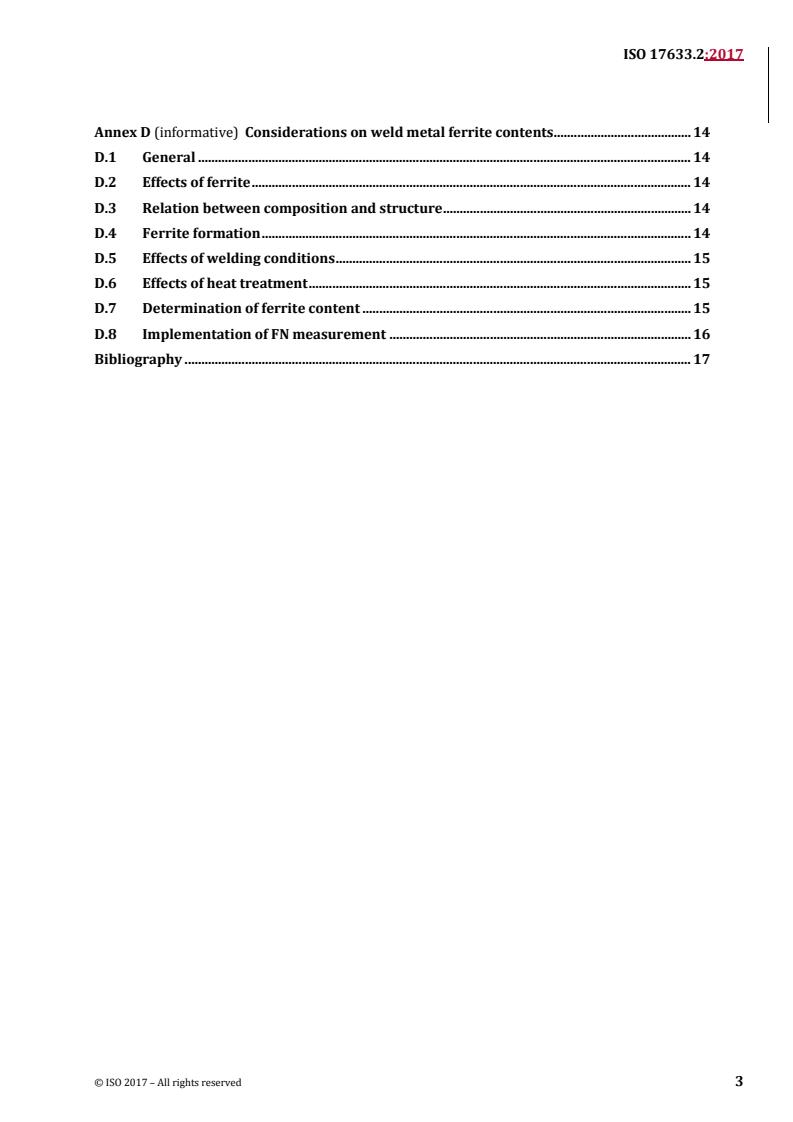
Annex D (informative) Considerations on weld metal ferrite contents .28
Bibliography .31
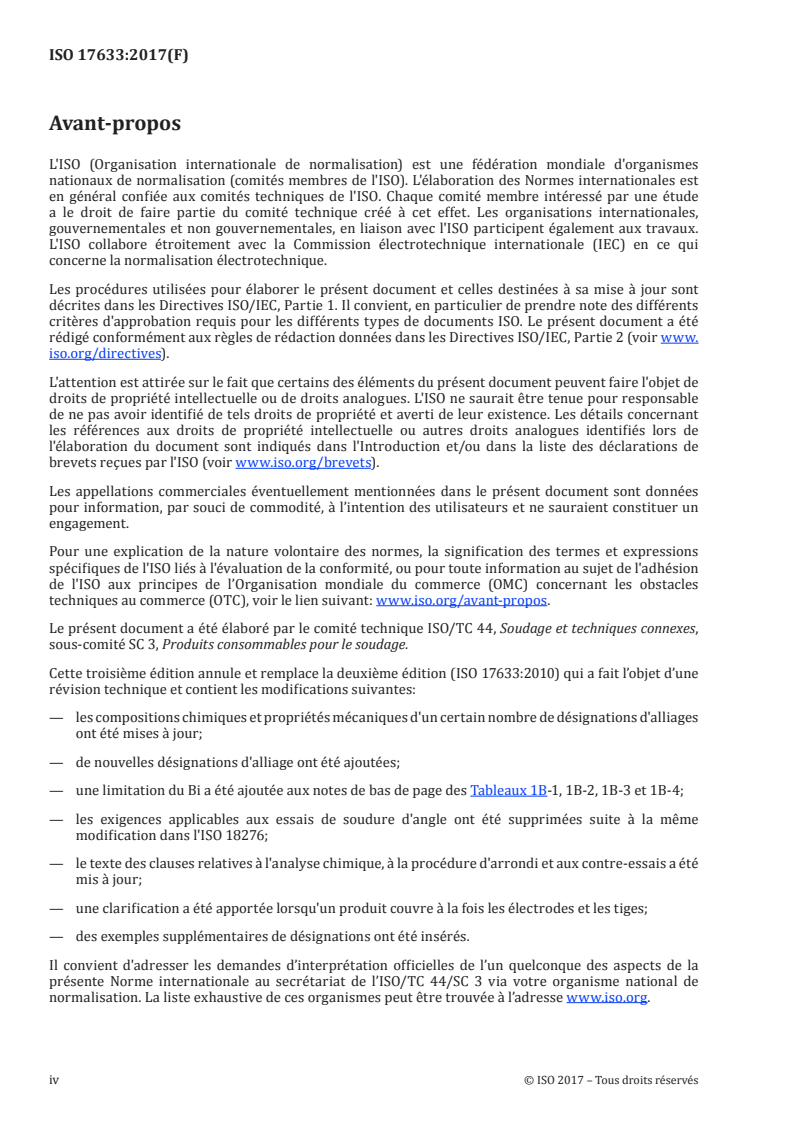
Foreword
ISO (the International Organization for Standardization) is a worldwide federation of national standards
bodies (ISO member bodies). The work of preparing International Standards is normally carried out
through ISO technical committees. Each member body interested in a subject for which a technical
committee has been established has the right to be represented on that committee. International
organizations, governmental and non-governmental, in liaison with ISO, also take part in the work.
ISO collaborates closely with the International Electrotechnical Commission (IEC) on all matters of
electrotechnical standardization.
The procedures used to develop this document and those intended for its further maintenance are
described in the ISO/IEC Directives, Part 1. In particular the different approval criteria needed for the
different types of ISO documents should be noted. This document was drafted in accordance with the
editorial rules of the ISO/IEC Directives, Part 2 (see www.iso.org/directives).
Attention is drawn to the possibility that some of the elements of this document may be the subject of
patent rights. ISO shall not be held responsible for identifying any or all such patent rights. Details of
any patent rights identified during the development of the document will be in the Introduction and/or
on the ISO list of patent declarations received (see www.iso.org/patents).
Any trade name used in this document is information given for the convenience of users and does not
constitute an endorsement.
For an explanation on the voluntary nature of standards, the meaning of ISO specific terms and
expressions related to conformity assessment, as well as information about ISO's adherence to the
World Trade Organization (WTO) principles in the Technical Barriers to Trade (TBT) see the following
URL: www.iso.org/iso/foreword.html.
This document was prepared by Technical Committee ISO/TC 44, Welding and allied processes,
Subcommittee SC 3, Welding consumables.
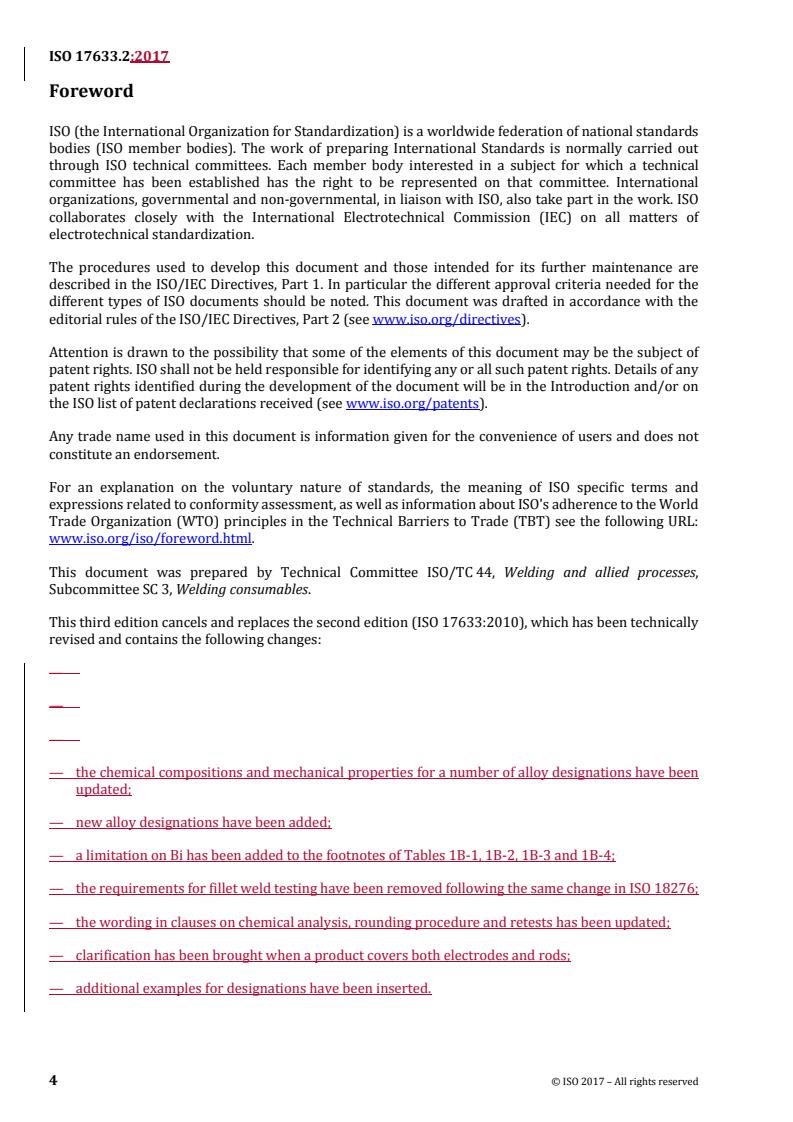
This third edition cancels and replaces the second edition (ISO 17633:2010), which has been technically
revised and contains the following changes:
— the chemical compositions and mechanical properties for a number of alloy designations have been
updated;
— new alloy designations have been added;
— a limitation on Bi has been added to the footnotes of Tables 1B-1, 1B-2, 1B-3 and 1B-4;
— the requirements for fillet weld testing have been removed following the same change in ISO 18276;
— the wording in clauses on chemical analysis, rounding procedure and retests has been updated;
— clarification has been brought when a product covers both electrodes and rods;
— additional examples for designations have been inserted.
Requests for official interpretations of any aspect of this document should be directed to the Secretariat
of ISO/TC 44/SC 3 via your national standards body. A complete listing of these bodies can be found at
www.iso.org.
iv © ISO 2017 – All rights reserved
Introduction
This document provides a classification system for tubular cored electrodes and rods for welding
stainless and heat resisting steels. It recognizes that there are two somewhat different approaches in the
global market to classifying a given tubular stainless steel welding consumable, and allows for either or
both to be used, to suit a particular market need. Application of either type of classification designation
(or of both, where suitable) identifies a product as classified in accordance with this document. The
classification in accordance with system A was mainly based on EN 12073:1999. The classification in
accordance with system B is mainly based upon standards used around the Pacific Rim.
INTERNATIONAL STANDARD ISO 17633:2017(E)
Welding consumables — Tubular cored electrodes
and rods for gas shielded and non-gas shielded metal
arc welding of stainless and heat-resisting steels —
Classification
1 Scope
This document specifies requirements for classification of tubular flux and metal cored electrodes
and rods, based on the all-weld metal chemical composition, the type of core, shielding gas, welding
position and the all-weld metal mechanical properties, in the as-welded or heat-treated conditions, for
gas shielded and non-gas shielded metal arc welding of stainless and heat-resisting steels.
This document is a combined standard providing for classification utilizing a system based upon
nominal composition or utilizing a system based upon alloy type.
a) Clauses, subclauses, and tables which carry the suffix letter “A” are applicable only to products
classified using the system based upon nominal composition.
b) Clauses, subclauses, and tables which carry the suffix letter “B” are applicable only to products
classified using the system based upon alloy type.
c) Clauses, subclauses, and tables which do not have either the suffix letter “A” or the suffix letter “B”
are applicable to all products classified in accordance with this document.
This document does not use pulsed current for determining the product classification.
2 Normative references
The following documents are referred to in the text in such a way that some or all of their content
constitutes requirements of this document. For dated references, only the edition cited applies. For
undated references, the latest edition of the referenced document (including any amendments) applies.
ISO 544, Welding consumables — Technical delivery conditions for filler materials and fluxes — Type of
product, dimensions, tolerances and markings
ISO 6847, Welding consumables — Deposition of a weld metal pad for chemical analysis
ISO 6947, Welding and allied processes — Welding positions
ISO 13916, Welding — Guidance on the measurement of preheating temperature, interpass temperature
and preheat maintenance temperature
ISO 14175, Welding consumables — Gases and gas mixtures for fusion welding and allied processes
ISO 14344, Welding consumables — Procurement of filler materials and fluxes
ISO 15792-1:2000, Welding consumables — Test methods — Part 1: Test methods for all-weld metal test
specimens in steel, nickel and nickel alloys. Amended by ISO 15792-1:2000/Amd 1:2011.
ISO 80000-1:2009, Quantities and units — Part 1: General. Corrected by ISO 80000-1:2009/Cor 1:2011.
3 Terms and definitions
No terms and definitions are listed in this document.
ISO and IEC maintain terminological databases for use in standardization at the following addresses:
— ISO Online browsing platform: available at https://www.iso.org/obp
— IEC Electropedia: available at http://www.electropedia.org/
4 Classification
Classification designations are based upon two approaches to indicate the chemical composition of the
all-weld metal deposit obtained with a given electrode or rod.
The “nominal composition” approach uses designation components indicating directly the nominal levels
of certain alloying elements, given in a particular order, and some symbols for low but significant levels
of other elements, whose levels are not conveniently expressed as integers. The “alloy type” approach
uses tradition-based three- or four-digit designations for alloy families, and an occasional additional
character or characters for compositional modifications of each original alloy within the family.
This clause includes the symbols for the type of product, the chemical composition of all-weld metal,
the type of core, the shielding gas and the welding position, in accordance with the symbols defined in
Clause 5.
In most cases, a given commercial product can be classified in both systems. Then either or both
classification designations can be used for the product.
4A Classification according to nominal 4B Classification according to alloy type
composition
The classification is divided into five parts: The classification is divided into five parts:
a) the first part gives a symbol indicating the a) the first part gives a symbol indicating the
product to be identified (see 5.2A); tubular cored electrode and rod (see 5.2B);
b) the second part gives a symbol indicating the b) the second part gives a symbol indicating the
chemical composition of the all-weld metal chemical composition of the all-weld metal
(see Table 1A); (see Table 1B-1 to Table 1B-4);
c) the third part gives a symbol indicating the c) the third part gives a symbol indicating the
type of core (see Table 3A); type of core (see Table 3B);
d) the fourth part gives a symbol indicating the d) the fourth part gives a symbol indicating the
shielding gas (see 5.5); shielding gas (see 5.5);
e) the fifth part gives a symbol indicating the e) the fifth part gives a symbol indicating the
welding position (see Table 4A). welding position (see Table 4B).
The full identification (see Clause 11) shall be used on packages and in the manufacturer’s literature
and data sheets.
5 Symbols and requirements
5.1 General
A given tubular cored electrode may be classified with more than one shielding gas. In such cases, each
shielding gas results in a separate classification.
2 © ISO 2017 – All rights reserved
5.2 Symbol for the product
5.2A Classification according to nominal 5.2B Classification according to alloy type
composition
The symbol for tubular cored product used in The symbol for tubular cored product used in
the metal arc welding process shall be the the metal arc welding process shall be the letters
letter “T”. “TS”. The initial letter, “T”, indicates tubular cored
electrode or rod as distinguished from covered
electrodes and from solid electrodes and rods. The
second letter, “S”, indicates that the alloy system is
stainless or heat-resisting steel.
5.3 Symbol for the chemical composition of all-weld metal
5.3A Classification according to nominal 5.3B Classification according to alloy type
composition
The symbols in Table 1A identify the chemical The symbols in Table 1B-1 identify the chemical
composition of all-weld metal determined composition of all-weld metal for gas shielded flux
in accordance with Clause 7. cored electrodes determined in accordance with
Clause 7.
The all-weld metal obtained with the tubular
cored product in Table 1A under conditions The symbols in Table 1B-2 identify the chemical
given in Clause 6 shall also fulfil the composition of all-weld metal for non-gas shielded
requirements given in Table 2A. (See Annex A.) flux cored electrodes determined in accordance
with Clause 7.
The symbols in Table 1B-3 identify the chemical
composition of all-weld metal for gas shielded
metal cored electrodes determined in accordance
with Clause 7.
The symbols in Table 1B-4 identify the chemical
composition of all-weld metal for cored products
for gas tungsten arc welding determined in
accordance with Clause 7.
The all-weld metal obtained with the tubular cored
electrodes and rods in Table 1B-1, Table 1B-2,
Table 1B-3 and Table 1B-4 under conditions given
in Clause 6 shall also fulfil the requirements given
in Table 2B. (See Annex A.)
4 © ISO 2017 – All rights reserved
Table 1A — Symbols and all-weld metal chemical composition requirements
(classification according to nominal composition)
a,b
Alloy Chemical composition, % (by mass)
designation
according to
c c d
C Mn Si P S Cr Ni Mo Nb + Ta Cu N Others
nominal
composition
Martensitic/ferritic types
13 0,12 1,5 1,0 0,030 0,025 11,0 to 14,0 0,3 0,3 — 0,5 — —
Ti: 10 × C
13 Ti 0,10 0,80 1,0 0,030 0,030 10,5 to 13,0 0,3 0,3 — 0,5 —
to 1,5
13 4 0,06 1,5 1,0 0,030 0,025 11,0 to 14,5 3,0 to 5,0 0,4 to 1,0 — 0,5 — —
17 0,12 1,5 1,0 0,030 0,025 16,0 to 18,0 0,3 0,3 — 0,5 — —
Austenitic types
19 9 L 0,04 2,0 1,2 0,030 0,025 18,0 to 21,0 9,0 to 11,0 0,3 — 0,5 — —
19 9 Nb 0,08 2,0 1,2 0,030 0,025 18,0 to 21,0 9,0 to 11,0 0,3 8 × C to 1,1 0,5 — —
19 12 3 L 0,04 2,0 1,2 0,030 0,025 17,0 to 20,0 10,0 to 13,0 2,5 to 3,0 — 0,5 — —
19 12 3 Nb 0,08 2,0 1,2 0,030 0,025 17,0 to 20,0 10,0 to 13,0 2,5 to 3,0 8 × C to 1,1 0,5 — —
Ferritic-austenitic types (sometimes referred to as austenitic-ferritic types)
22 9 3 N L 0,04 2,5 1,2 0,030 0,025 21,0 to 24,0 7,5 to 10,5 2,5 to 4,0 — 0,5 0,08 to 0,20 —
23 7 N L 0,04 0,4 to 1,5 1,0 0,030 0,020 22,5 to 25,5 6,5 to 10,0 0,8 — 0,5 0,10 to 0,20 —
25 9 4 N L 0,04 2,5 1,2 0,030 0,025 24,0 to 27,0 8,0 to 10,5 2,5 to 4,5 — — 0,20 to 0,30 —
1,0 to
25 9 4 Cu N L 0,04 2,5 1,2 0,030 0,025 24,0 to 27,0 8,0 to 10,5 2,5 to 4,5 — 0,20 to 0,30 —
2,5
Fully austenitic types
e
18 16 5 N L 0,03 1,0 to 4,0 1,0 0,03 0,02 17,0 to 20,0 16,0 to 19,0 3,5 to 5,0 — 0,5 0,10 to 0,20 —
e
19 13 4 N L 0,04 1,0 to 5,0 1,2 0,030 0,025 17,0 to 20,0 12,0 to 15,0 3,0 to 4,5 — 0,5 0,08 to 0,20 —
1,0 to
e
20 25 5 Cu N L 0,03 1,0 to 4,0 1,0 0,03 0,02 19,0 to 22,0 24,0 to 27,0 4,0 to 6,0 — 0,10 to 0,20 —
2,0
Special types — Often used for dissimilar metal joining
18 8 Mn 0,20 4,5 to 7,5 1,2 0,035 0,025 17,0 to 20,0 7,0 to 10,0 0,3 — 0,5 — —
18 9 Mn Mo 0,04 to 0,14 3,0 to 5,0 1,2 0,035 0,025 18,0 to 21,5 9,0 to 11,0 0,5 to 1,5 — — — —
20 10 3 0,08 2,5 1,2 0,035 0,025 19,5 to 22,0 9,0 to 11,0 2,0 to 4,0 — 0,5 — —
23 12 L 0,04 2,5 1,2 0,030 0,025 22,0 to 25,0 11,0 to 14,0 0,3 — 0,5 — —
Table 1A (continued)
a,b
Alloy Chemical composition, % (by mass)
designation
according to
c c d
C Mn Si P S Cr Ni Mo Nb + Ta Cu N Others
nominal
composition
10 × C
23 12 Nb 0,08 1,0 to 2,5 1,0 0,03 0,02 22,0 to 25,0 11,0 to 14,0 0,3 0,5 — —
to 1,0
23 12 2 L 0,04 2,5 1,2 0,030 0,025 22,0 to 25,0 11,0 to 14,0 2,0 to 3,0 — 0,5 — —
29 9 0,15 2,5 1,2 0,035 0,025 27,0 to 31,0 8,0 to 12,0 0,3 — 0,5 — —
Heat-resisting types
Cr + Mo:
16 8 2 0,10 1,0 1,0 to 2,5 0,03 0,02 14,5 to 17,5 7,5 to 9,5 1,0 to 2,5 — 0,5 —
18,5
19 9 H 0,04 to 0,08 1,0 1,0 to 2,5 0,03 0,02 18,0 to 21,0 9,0 to 11,0 0,3 — 0,5 — —
21 10 N 0,06 to 0,09 0,3 to 1,0 1,0 to 2,0 0,02 0,01 20,5 to 22,5 9,5 to 11,0 0,5 — 0,5 0,10 to 0,20 Ce: 0,05
22 12 H 0,15 2,5 1,2 0,030 0,025 20,0 to 23,0 10,0 to 13,0 0,3 — 0,5 — —
25 4 0,15 2,0 1,0 to 2,5 0,03 0,02 24,0 to 27,0 4,0 to 6,0 0,3 — 0,5 — —
e
25 20 0,06 to 0,20 1,0 to 5,0 1,2 0,030 0,025 23,0 to 27,0 18,0 to 22,0 0,3 — 0,5 — —
f
Z Any other agreed composition
a
Single values are maximum values.
b
“No requirement for analysis” is indicated by a dash.
c
The sum of P and S shall not exceed 0,050 % (by mass), except for 18 16 5 N L, 18 8 Mn, and 29 9.
d
Up to 20 % (by mass) of the amount of Nb can be replaced by Ta.
e
The all-weld metal is in most cases fully austenitic and therefore can be susceptible to microfissuring or hot cracking. The occurrence of fissuring or cracking
is reduced by increasing the weld metal manganese level and in recognition of this the manganese range is extended for a number of grades.
f
Consumables for which the chemical composition is not listed shall be symbolized similarly and prefixed by the letter Z. The chemical composition ranges are
not specified and it is possible that two products with the same Z classification are not interchangeable.
6 © ISO 2017 – All rights reserved
Table 1B — -1 — Symbols and all-weld metal chemical composition requirements of gas shielded flux cored electrodes
(classification according to alloy type)
a,b
Chemical composition, % (by mass)
Alloy
designation
Typical
according
shielding
c
C Mn Si P S Cr Ni Mo Nb + Ta Cu N Others
to alloy
gas
type
(see 5.5)
C1, M12,
307 0,13 3,30 to 4,75 1,0 0,04 0,03 18,0 to 20,5 9,0 to 10,5 0,5 to 1,5 — 0,75 — —
M21, Z
C1, M12,
308 0,08 0,5 to 2,5 1,0 0,04 0,03 18,0 to 21,0 9,0 to 11,0 0,75 — 0,75 — —
M21, Z
C1, M12,
308L 0,04 0,5 to 2,5 1,0 0,04 0,03 18,0 to 21,0 9,0 to 12,0 0,75 — 0,75 — —
M21, Z
C1, M12, 0,04 to
308H 0,5 to 2,5 1,0 0,04 0,03 18,0 to 21,0 9,0 to 11,0 0,75 — 0,75 — —
M21, Z 0,08
C1, M12,
308Mo 0,08 0,5 to 2,5 1,0 0,04 0,03 18,0 to 21,0 9,0 to 11,0 2,0 to 3,0 — 0,75 — —
M21, Z
C1, M12,
308LMo 0,04 0,5 to 2,5 1,0 0,04 0,03 18,0 to 21,0 9,0 to 12,0 2,0 to 3,0 — 0,75 — —
M21, Z
C1, M12, 0,12 to
308N 0,10 1,0 to 4,0 1,0 0,04 0,03 20,0 to 25,0 7,0 to 11,0 0,5 — 0,5
M21, Z 0,30
C1, M12,
309 0,10 0,5 to 2,5 1,0 0,04 0,03 22,0 to 25,0 12,0 to 14,0 0,75 — 0,75 — —
M21, Z
C1, M12,
309L 0,04 0,5 to 2,5 1,0 0,04 0,03 22,0 to 25,0 12,0 to 14,0 0,75 — 0,75 — —
M21, Z
C1, M12,
309H 0,04 to 0,10 0,5 to 2,5 1,0 0,04 0,03 22,0 to 25,0 12,0 to 14,0 0,75 — 0,75 — —
M21, Z
C1, M12,
309Mo 0,12 0,5 to 2,5 1,0 0,04 0,03 21,0 to 25,0 12,0 to 16,0 2,0 to 3,0 — 0,75 — —
M21, Z
C1, M12,
309LMo 0,04 0,5 to 2,5 1,0 0,04 0,03 21,0 to 25,0 12,0 to 16,0 2,0 to 3,0 — 0,75 — —
M21, Z
C1, M12,
309LNb 0,04 0,5 to 2,5 1,0 0,04 0,03 22,0 to 25,0 12,0 to 14,0 0,75 0,70 to 1,00 0,75 — —
M21, Z
C1, M12,
309LNiMo 0,04 0,5 to 2,5 1,0 0,04 0,03 20,5 to 23,5 15,0 to 17,0 2,5 to 3,5 — 0,75 — —
M21, Z
C1, M12, 20,0 to
310 0,20 1,0 to 2,5 1,0 0,03 0,03 25,0 to 28,0 0,75 — 0,75 — —
M21, Z 22,5
Table 1B (continued)
a,b
Chemical composition, % (by mass)
Alloy
designation
Typical
according
shielding
c
C Mn Si P S Cr Ni Mo Nb + Ta Cu N Others
to alloy
gas
type
(see 5.5)
C1, M12,
312 0,15 0,5 to 2,5 1,0 0,04 0,03 28,0 to 32,0 8,0 to 10,5 0,75 — 0,75 — —
M21, Z
C1, M12, 11,0 to
316 0,08 0,5 to 2,5 1,0 0,04 0,03 17,0 to 20,0 2,0 to 3,0 — 0,75 — —
M21, Z 14,0
C1, M12, 11,0 to
316L 0,04 0,5 to 2,5 1,0 0,04 0,03 17,0 to 20,0 2,0 to 3,0 — 0,75 — —
M21, Z 14,0
C1, M12, 0,04 to 11,0 to
316H 0,5 to 2,5 1,0 0,04 0,03 17,0 to 20,0 2,0 to 3,0 — 0,75 — —
M21, Z 0,08 14,0
C1, M12, 11,0 to
316LCu 0,04 0,5 to 2,5 1,0 0,04 0,03 17,0 to 20,0 1,25 to 2,75 — 1,0 to 2,5 — —
M21, Z 16,0
C1, M12, 12,0 to
317 0,08 0,5 to 2,5 1,0 0,04 0,03 18,0 to 21,0 3,0 to 4,0 — 0,75 — —
M21, Z 14,0
C1, M12, 12,0 to
317L 0,04 0,5 to 2,5 1,0 0,04 0,03 18,0 to 21,0 3,0 to 4,0 — 0,75 — —
M21, Z 14,0
C1, M12, 11,0 to
318 0,08 0,5 to 2,5 1,0 0,04 0,03 17,0 to 20,0 2,0 to 3,0 8 × C to 1,0 0,75 — —
M21, Z 14,0
C1, M12,
347 0,08 0,5 to 2,5 1,0 0,04 0,03 18,0 to 21,0 9,0 to 11,0 0,75 8 × C to 1,0 0,75 — —
M21, Z
C1, M12,
347L 0,04 0,5 to 2,5 1,0 0,04 0,03 18,0 to 21,0 9,0 to 11,0 0,75 8 × C to 1,0 0,75 — —
M21, Z
C1, M12, 0,04 to
347H 0,5 to 2,5 1,0 0,04 0,03 18,0 to 21,0 9,0 to 11,0 0,75 8 × C to 1,0 0,75 — —
M21, Z 0,08
C1, M12, Ti: 10 × C to
409 0,10 0,80 1,0 0,04 0,03 10,5 to 13,5 0,60 0,75 — 0,75 —
M21, Z 1,5
C1, M12,
409Nb 0,10 1,2 1,0 0,04 0,03 10,5 to 13,5 0,6 0,5 8 × C to 1,5 0,5 — —
M21, Z
C1, M12,
410 0,12 1,2 1,0 0,04 0,03 11,0 to 13,5 0,60 0,75 — 0,75 — —
M21, Z
C1, M12,
410NiMo 0,06 1,0 1,0 0,04 0,03 11,0 to 12,5 4,0 to 5,0 0,40 to 0,70 — 0,75 — —
M21, Z
8 © ISO 2017 – All rights reserved
Table 1B (continued)
a,b
Chemical composition, % (by mass)
Alloy
designation
Typical
according
shielding
c
C Mn Si P S Cr Ni Mo Nb + Ta Cu N Others
to alloy
gas
type
(see 5.5)
C1, M12,
430 0,10 1,2 1,0 0,04 0,03 15,0 to 18,0 0,60 0,75 — 0,75 — —
M21, Z
C1, M12,
430Nb 0,10 1,2 1,0 0,04 0,03 15,0 to 18,0 0,6 0,5 0,5 to 1,5 0,5 — —
M21, Z
C1, M12, Cr + Mo:
16–8-2 0,10 0,5 to 2,5 0,75 0,04 0,03 14,5 to 17,5 7,5 to 9,5 1,0 to 2,0 — 0,75 —
M21, Z 18,5
C1, M12, 0,08
2209 0,04 0,5 to 2,0 1,0 0,04 0,03 21,0 to 24,0 7,5 to 10,0 2,5 to 4,0 — 0,75 —
M21, Z to 0,20
C1, M12, 0,10 to
2307 0,04 2,0 1,0 0,03 0,02 22,5 to 25,5 6,5 to 10,0 0,8 — 0,50
M21, Z 0,20
C1, M12, 0,10
2553 0,04 0,5 to 1,5 0,75 0,04 0,03 24,0 to 27,0 8,5 to 10,5 2,9 to 3,9 — 1,5 to 2,5 —
M21, Z to 0,25
C1, M12, 0,20
2594 0,04 0,5 to 2,5 1,0 0,04 0,03 24,0 to 27,0 8,0 to 10,5 2,5 to 4,5 — 1,5 W: 1,0
M21, Z to 0,30
C1, M12, 0,08 to W: 1,0 to
2594W 0,04 0,5 to 2,0 1,0 0,04 0,03 23,0 to 27,0 8,0 to 11,0 2,5 to 4,0 — 1,0
M21, Z 0,30 2,5
C1, M12,
d
Z Any other agreed composition
M21, Z
a
Single values are maximum values.
b
“No requirement for analysis” is indicated by a dash.
c
For alloys intended for high temperature, Bi should be restricted to 20 ppm maximum.
d
Consumables for which the chemical composition is not listed shall be symbolized similarly and prefixed by the letter Z. The chemical composition ranges are
not specified and it is possible that two electrodes with the same Z classification are not interchangeable.
Table 1B — -2 — Symbols and all-weld metal chemical composition requirements of non-gas shielded flux cored electrodes
(classification according to alloy type)
a,b
Chemical composition, % (by mass)
Alloy
designation
Typical
according
shielding
c
C Mn Si P S Cr Ni Mo Nb + Ta Cu N Others
to alloy
gas
type
(see 5.5)
307 NO 0,13 3,30 to 4,75 1,0 0,04 0,03 19,5 to 22,0 9,0 to 10,5 0,5 to 1,5 — 0,75 — —
308 NO 0,08 0,5 to 2,5 1,0 0,04 0,03 19,5 to 22,0 9,0 to 11,0 0,75 — 0,75 — —
308L NO 0,04 0,5 to 2,5 1,0 0,04 0,03 19,5 to 22,0 9,0 to 12,0 0,75 — 0,75 — —
0,04 to
308H NO 0,5 to 2,5 1,0 0,04 0,03 19,5 to 22,0 9,0 to 11,0 0,75 — 0,75 — —
0,08
308Mo NO 0,08 0,5 to 2,5 1,0 0,04 0,03 18,0 to 21,0 9,0 to 11,0 2,0 to 3,0 — 0,75 — —
308LMo NO 0,04 0,5 to 2,5 1,0 0,04 0,03 18,0 to 21,0 9,0 to 12,0 2,0 to 3,0 — 0,75 — —
0,25
0,07 to
308HMo NO 1,25 to 2,25 to 0,04 0,03 19,0 to 21,5 9,0 to 10,7 1,8 to 2,4 — 0,75 — —
0,12
0,80
309 NO 0,10 0,5 to 2,5 1,0 0,04 0,03 23,0 to 25,5 12,0 to 14,0 0,75 — 0,75 — —
309L NO 0,04 0,5 to 2,5 1,0 0,04 0,03 23,0 to 25,5 12,0 to 14,0 0,75 — 0,75 — —
309Mo NO 0,12 0,5 to 2,5 1,0 0,04 0,03 21,0 to 25,0 12,0 to 16,0 2,0 to 3,0 — 0,75 — —
309LMo NO 0,04 0,5 to 2,5 1,0 0,04 0,03 21,0 to 25,0 12,0 to 16,0 2,0 to 3,0 — 0,75 — —
309LNb NO 0,04 0,5 to 2,5 1,0 0,04 0,03 23,0 to 25,5 12,0 to 14,0 0,75 0,70 to 1,00 0,75 — —
310 NO 0,20 1,0 to 2,5 1,0 0,03 0,03 25,0 to 28,0 20,0 to 22,5 0,75 — 0,75 — —
312 NO 0,15 0,5 to 2,5 1,0 0,04 0,03 28,0 to 32,0 8,0 to 10,5 0,75 — 0,75 — —
316 NO 0,08 0,5 to 2,5 1,0 0,04 0,03 18,0 to 20,5 11,0 to 14,0 2,0 to 3,0 — 0,75 — —
316L NO 0,04 0,5 to 2,5 1,0 0,04 0,03 18,0 to 20,5 11,0 to 14,0 2,0 to 3,0 — 0,75 — —
316LK NO 0,04 0,5 to 2,5 1,0 0,04 0,3 17,0 to 20,0 11,0 to 14,0 2,0 to 3,0 — 0,75 — —
0,04 to
316H NO 0,5 to 2,5 1,0 0,04 0,03 18,0 to 20,5 11,0 to 14,0 2,0 to 3,0 — 0,75 — —
0,08
316LCu NO 0,03 0,5 to 2,5 1,0 0,04 0,03 18,0 to 20,5 11,0 to 16,0 1,25 to 2,75 — 1,0 to 2,5 — —
317 NO 0,08 0,5 to 2,5 1,0 0,04 0,03 18,5 to 21,0 13,0 to 15,0 3,0 to 4,0 — 0,75 — —
317L NO 0,04 0,5 to 2,5 1,0 0,04 0,03 18,5 to 21,0 13,0 to 15,0 3,0 to 4,0 — 0,75 — —
318 NO 0,08 0,5 to 2,5 1,0 0,04 0,03 18,0 to 20,5 11,0 to 14,0 2,0 to 3,0 8 × C to 1,0 0,75 — —
347 NO 0,08 0,5 to 2,5 1,0 0,04 0,03 19,0 to 21,5 9,0 to 11,0 0,75 8 × C to 1,0 0,75 — —
10 © ISO 2017 – All rights reserved
Table 1B (continued)
a,b
Chemical composition, % (by mass)
Alloy
designation
Typical
according
shielding
c
C Mn Si P S Cr Ni Mo Nb + Ta Cu N Others
to alloy
gas
type
(see 5.5)
347L NO 0,04 0,5 to 2,5 1,0 0,04 0,03 19,0 to 21,5 9,0 to 11,0 0,75 8 × C to 1,0 0,75 — —
Ti: 10 × C
409 NO 0,10 0,80 1,0 0,04 0,03 10,5 to 13,5 0,60 0,75 — 0,75 —
to 1,5
409Nb NO 0,12 1,0 1,0 0,04 0,03 10,5 to 14,0 0,6 0,75 8 × C to 1,5 0,75 — —
410 NO 0,12 1,0 1,0 0,04 0,03 11,0 to 13,5 0,60 0,75 — 0,75 — —
410NiMo NO 0,06 1,0 1,0 0,04 0,03 11,0 to 12,5 4,0 to 5,0 0,40 to 0,70 — 0,75 — —
430 NO 0,10 1,0 1,0 0,04 0,03 15,0 to 18,0 0,60 0,75 — 0,75 — —
430Nb NO 0,10 1,0 1,0 0,04 0,03 15,0 to 18,0 0,6 0,75 0,5 to 1,5 0,75 — —
Cr + Mo:
16–8-2 NO 0,10 0,5 to 2,5 0,75 0,04 0,03 14,5 to 17,5 7,5 to 9,5 1,0 to 2,0 — 0,75 —
18,5
0,08 to
2209 NO 0,04 0,5 to 2,0 1,0 0,04 0,03 21,0 to 24,0 7,5 to 10,0 2,5 to 4,0 — 0,75 —
0,20
2307 NO 0,04 2,0 1,0 0,03 0,02 22,5 to 25,5 6,5 to 10,0 0,8 — 0,50 0,10 to 0,20 —
2553 NO 0,04 0,5 to 1,5 0,75 0,04 0,03 24,0 to 27,0 8,5 to 10,5 2,9 to 3,9 — 1,5 to 2,5 0,10 to 0,25 —
0,20 to
2594 NO 0,04 0,5 to 2,5 1,0 0,04 0,03 24,0 to 27,0 8,0 to 10,5 2,5 to 4,5 — 1,5 W: 1,0
0,30
d
Z NO Any other agreed composition
a
Single values are maximum values.
b
“No requirement for analysis” is indicated by a dash.
c
For alloys intended for high temperature, Bi should be restricted to 20 ppm maximum.
d
Consumables for which the chemical composition is not listed shall be symbolized similarly and prefixed by the letter Z. The chemical composition ranges are
not specified and it is possible that two electrodes with the same Z classification are not interchangeable.
Table 1B — -3 — Symbols and all-weld metal chemical composition requirements of gas shielded metal cored electrodes
(classification according to alloy type)
a,b
Chemical composition, % (by mass)
Alloy
designation
Typical
according
shielding
c
C Mn Si P S Cr Ni Mo Nb + Ta Cu N Others
to alloy
gas
type
(see 5.5)
M12, M13, 0,10 to V: 0,10 to
209 0,05 4,0 to 7,0 0,90 0,03 0,03 20,5 to 24,0 9,5 to 12,0 1,5 to 3,0 — 0,75
M21, I1, Z 0,30 0,30
M12, M13, 0,08 to
218 0,10 7,0 to 9,0 3,5 to 4,5 0,03 0,03 16,0 to 18,0 8,0 to 9,0 0,75 — 0,75 —
M21, I1, Z 0,18
M12, M13, 0,10 to
219 0,05 8,0 to 10,0 1,00 0,03 0,03 19,0 to 21,5 5,5 to 7,0 0,75 — 0,75 —
M21, I1, Z 0,30
M12, M13, 10,5 to 0,10 to
240 0,05 1,00 0,03 0,03 17,0 to 19,0 4,0 to 6,0 0,75 — 0,75 —
M21, I1, Z 13,5 0,30
M12, M13, 0,04 to 3,30 to 0,30 to
307 0,03 0,03 19,5 to 22,0 8,0 to 10,7 0,5 to 1,5 — 0,75 — —
M21, I1, Z 0,14 4,75 0,65
M12, M13, 0,30 to
308 0,08 1,0 to 2,5 0,03 0,03 19,5 to 22,0 9,0 to 11,0 0,75 — 0,75 — —
M21, I1, Z 0,65
M12, M13, 0,65 to
308Si 0,08 1,0 to 2,5 0,03 0,03 19,5 to 22,0 9,0 to 11,0 0,75 — 0,75 — —
M21, I1, Z 1,00
M12, M13, 0,04 to 0,30 to
308H 1,0 to 2,5 0,03 0,03 19,5 to 22,0 9,0 to 11,0 0,50 — 0,75 — —
M21, I1, Z 0,08 0,65
M12, M13, 0,30 to
308L 0,03 1,0 to 2,5 0,03 0,03 19,5 to 22,0 9,0 to 11,0 0,75 — 0,75 — —
M21, I1, Z 0,65
M12, M13, 0,65 to
308LSi 0,03 1,0 to 2,5 0,03 0,03 19,5 to 22,0 9,0 to 11,0 0,75 — 0,75 — —
M21, I1, Z 1,00
M12, M13, 0,30 to
308LMo 0,04 1,0 to 2,5 0,03 0,03 18,0 to 21,0 9,0 to 12,0 2,0 to 3,0 — 0,75 — —
M21, I1, Z 0,65
M12, M13, 0,30 to
308Mo 0,08 1,0 to 2,5 0,03 0,03 18,0 to 21,0 9,0 to 12,0 2,0 to 3,0 — 0,75 — —
M21, I1, Z 0,65
M12, M13, 0,30 to
309 0,12 1,0 to 2,5 0,03 0,03 23,0 to 25,0 12,0 to 14,0 0,75 — 0,75 — —
M21, I1, Z 0,65
M12, M13, 0,30 to
309L 0,03 1,0 to 2,5 0,03 0,03 23,0 to 25,0 12,0 to 14,0 0,75 — 0,75 — —
M21, I1, Z 0,65
M12, M13, 0,65 to
309LSi 0,03 1,0 to 2,5 0,03 0,03 23,0 to 25,0 12,0 to 14,0 0,75 — 0,75 — —
M21, I1, Z 1,00
12 © ISO 2017 – All rights reserved
Table 1B (continued)
a,b
Chemical composition, % (by mass)
Alloy
designation
Typical
according
shielding
c
C Mn Si P S Cr Ni Mo Nb + Ta Cu N Others
to alloy
gas
type
(see 5.5)
M12, M13, 0,65 to
309Si 0,12 1,0 to 2,5 0,03 0,03 23,0 to 25,0 12,0 to 14,0 0,75 — 0,75 — —
M21, I1, Z 1,00
M12, M13, 0,30 to
309LMo 0,03 1,0 to 2,5 0,03 0,03 23,0 to 25,0 12,0 to 14,0 2,0 to 3,0 — 0,75 — —
M21, I1, Z 0,65
M12, M13, 0,30 to
309Mo 0,12 1,0 to 2,5 0,03 0,03 23,0 to 25,0 12,0 to 14,0 2,0 to 3,0 — 0,75 — —
M21, I1, Z 0,65
M12, M13, 0,08 to 0,30 to
310 1,0 to 2,5 0,03 0,03 25,0 to 28,0 20,0 to 22,5 0,75 — 0,75 — —
M21, I1, Z 0,15 0,65
M12, M13, 0,30 to
312 0,15 1,0 to 2,5 0,03 0,03 28,0 to 32,0 8,0 to 10,5 0,75 — 0,75 — —
M21, I1, Z 0,65
M12, M13, 0,30 to
316 0,08 1,0 to 2,5 0,03 0,03 18,0 to 20,0 11,0 to 14,0 2,0 to 3,0 — 0,75 — —
M21, I1, Z 0,65
M12, M13, 0,04 to 0,30 to
316H 1,0 to 2,5 0,03 0,03 18,0 to 20,0 11,0 to 14,0 2,0 to 3,0 — 0,75 — —
M21, I1, Z 0,08 0,65
M12, M13, 0,30 to
316L 0,03 1,0 to 2,5 0,03 0,03 18,0 to 20,0 11,0 to 14,0 2,0 to 3,0 — 0,75 — —
M21, I1, Z 0,65
M12, M13, 0,30 to 0,10 to
316LMn 0,03 5,0 to 9,0 0,03 0,03 19,0 to 22,0 15,0 to 18,0 2,5 to 3,5 — 0,75 —
M21, I1, Z 0,65 0,20
M12, M13, 0,65 to
316LSi 0,03 1,0 to 2,5 0,03 0,03 18,0 to 20,0 11,0 to 14,0 2,0 to 3,0 — 0,75 — —
M21, I1, Z 1,00
M12, M13, 0,65 to
316Si 0,08 1,0 to 2,5 0,03 0,03 18,0 to 20,0 11,0 to 14,0 2,0 to 3,0 — 0,75 — —
M21, I1, Z 1,00
M12, M13, 0,30 to
317 0,08 1,0 to 2,5 0,03 0,03 18,5 to 20,5 13,0 to 15,0 3,0 to 4,0 — 0,75 — —
M21, I1, Z 0,65
M12, M13, 0,30 to
317L 0,03 1,0 to 2,5 0,03 0,03 18,5 to 20,5 13,0 to 15,0 3,0 to 4,0 — 0,75 — —
M21, I1, Z 0,65
M12, M13, 0,30 to 8 × C,
318 0,08 1,0 to 2,5 0,03 0,03 18,0 to 20,0 11,0 to 14,0 2,0 to 3,0 0,75 — —
M21, I1, Z 0,65 to 1,0
M12, M13, 8 × C
320 0,07 2,5 0,60 0,03 0,03 19,0 to 21,0 32,0 to 36,0 2,0 to 3,0 3,0 to 4,0 — —
M21, I1, Z to 1,0
Table 1B (continued)
a,b
Chemical composition, % (by mass)
Alloy
designation
Typical
according
shielding
c
C Mn Si P S Cr Ni Mo Nb + Ta Cu N Others
to alloy
gas
type
(see 5.5)
M12, M13, 8 × C
320LR 0,025 1,5 to 2,0 0,15 0,015 0,02 19,0 to 21,0 32,0 to 36,0 2,0 to 3,0 3,0 to 4,0 — —
M21, I1, Z to 0,40
M12, M13, 0,30 to Ti: 9 × C
321 0,08 1,0 to 2,5 0,03 0,03 18,5 to 20,5 9,0 to 10,5 0,75 — 0,75 —
M21, I1, Z 0,65 to 1,0
M12, M13, 0,18 to 0,30 to
330 1,0 to 2,5 0,03 0,03 15,0 to 17,0 34,0 to 37,0 0,75 — 0,75 — —
M21, I1, Z 0,25 0,65
M12, M13, 0,30 to
347 0,08 1,0 to 2,5 0,03 0,03 19,0 to 21,5 9,0 to 11,0 0,75 10 × C to 1,0 0,75 — —
M21, I1, Z 0,65
M12, M13, 0,65 to
347Si 0,08 1,0 to 2,5 0,03 0,03 19,0 to 21,5 9,0 to 11,0 0,75 10 × C to 1,0 0,75 — —
M21, I1, Z 1,00
M12, M13, 0,70 to
383 0,025 1,0 to 2,5 0,50 0,02 0,03 26,5 to 28,5 30,0 to 33,0 3,2 to 4,2 — — —
M21, I1, Z 1,50
M12, M13,
385 0,025 1,0 to 2,5 0,50 0,02 0,03 19,5 to 21,5 24,0 to 26,0 4,2 to 5,2 — 1,2 to 2,0 — —
M21, I1, Z
M12, M13, Ti: 10 × C
409 0,08 0,8 0,8 0,03 0,03 10,5 to 13,5 0,6 0,50 — 0,75 —
M21, I1, Z to 1,5
M12, M13, 10 × C to
409Nb 0,08 0,8 1,0 0,04 0,03 10,5 to 13,5 0,6 0,50 0,75 — —
M21, I1, Z 0,75
M12, M13,
410 0,12 0,6 0,5 0,03 0,03 11,5 to 13,5 0,6 0,75 — 0,75 — —
M21, I1, Z
M12, M13,
410NiMo 0,06 0,6 0,5 0,03 0,03 11,0 to 12,5 4,0 to 5,0 0,4 to 0,7 — 0,75 — —
M21, I1, Z
M12, M13, 0,25 to
420 0,6 0,5 0,03 0,03 12,0 to 14,0 0,6 0,75 — 0,75 — —
M21, I1, Z 0,40
M12, M13,
430 0,10 0,6 0,5 0,03 0,03 15,5 to 17,0 0,6 0,75 — 0,75 — —
M21, I1, Z
M12, M13,
430Nb 0,10 1,2 1,0 0,04 0,03 15,0 to 18,0 0,6 0,75 0,5 to 1,5 0,75 — —
M21, I1, Z
M12, M13, Ti: 10 × C
439 0,04 0,8 0,8 0,03 0,03 17,0 to 19,0 0,6 0,5 — 0,75 —
M21, I1, Z to 1,1
14 © ISO 2017 – All rights reserved
Table 1B (continued)
a,b
Chemical composition, % (by mass)
Alloy
designation
Typical
according
shielding
c
C Mn Si P S Cr Ni Mo Nb + Ta Cu N Others
to alloy
gas
type
(see 5.5)
M12, M13, 8 × C Ti: 0,10 to
439Nb 0,04 0,8 0,8 0,03 0,03 17,0 to 20,0 0,6 0,5 0,75 —
M21, I1, Z to 0,75 0,75
M12, M13, 0,75 to Ni +
446LMo 0,015 0,4 0,4 0,02 0,02 25,0 to 27,5 0,5 — 0,5 0,015
I1, Z 1,50 Cu = 0,5
M12, M13, 0,25 to 16,00 to 3,25 to
630 0,05 0,75 0,03 0,03 4,5 to 5,0 0,75 0,15 to 0,30 — —
M21, I1, Z 0,75 16,75 4,00
M12, M13, 0,50 to 0,08 to
2209 0,03 0,90 0,03 0,03 21,5 to 23,5 7,5 to 9,5 2,5 to 3,5 — 0,75 —
M21, I1, Z 2,00 0,20
M12, M13, 0,10 to
2553 0,04 1,5 1,0 0,04 0,03 24,0 to 27,0 4,5 to 6,5 2,9 to 3,9 — 1,5 to 2,5 —
M21, I1, Z 0,25
M12, M13, 0,20 to
2594 0,03 2,5 1,0 0,03 0,02 24,0 to 27,0 8,0 to 10,5 2,5 to 4,5 — 1,5 W: 1,0
M21, I1, Z 0,30
M12, M13, 0,30 to
16–8-2 0,10 1,0 to 2,0 0,03 0,03 14,5 to 16,5 7,5 to 9,5 1,0 to 2,0 — 0,75 — —
M21, I1, Z 0,65
M12, M13, 0,04 to 0,30 to
19–10H 1,0 to 2,0 0,03 0,03 18,5 to 20,0 9,0 to 11,0 0,25 0,05 0,75 — Ti: 0,05
M21, I1, Z 0,08 0,65
M12, M13, 0,35 to
33–31 0,015 2,00 0,50 0,02 0,01 31,0 to 35,0 30,0 to 33,0 0,5 to 2,0 — 0,3 to 1,2 —
M21, I1, Z 0,60
Table 1B (continued)
a,b
Chemical composition, % (by mass)
Alloy
designation
Typical
according
shielding
c
C Mn Si P S Cr Ni Mo Nb + Ta Cu N Others
to alloy
gas
type
(see 5.5)
Co: 16,0 to
21,0
W: 2,0 to
3,5
Nb: 0,30
Ta: 0,30 to
1,25
M12, M13, 0,05 to 0,50 to 0,20 to 0,10 to
3556 0,04 0,015 21,0 to 23,0 19,0 to 22,5 2,5 to 4,0 — —
M21, I1, Z 0,15 2,00 0,80 0,30
Al: 0,10 to
0,50
Zr: 0,001
to 0,100
La: 0,005
to 0,100
B: 0,02
M12, M13,
d
Z Any other agreed composition
M21, I1, Z
a
Single values are maximum values.
b
“No requirement for analysis” is indicated by a dash.
c
For alloys intended for high temperature, Bi should be restricted to 20 ppm maximum.
d
Consumables for which the chemical composition is not listed shall be symbolized similarly and prefixed by the letter Z. The chemical composition ranges are
not specified and it is possible that two electrodes with the same Z classification are not interchangeable.
16 © ISO 2017 – All rights reserved
Table 1B — -4 — Symbols and all-weld metal chemical composition requirements of cored products for gas tungsten arc welding
(classification according to alloy type)
a,b
Chemical composition, % (by mass)
Alloy
designation
Typical
according
shielding
c
C Mn Si P S Cr Ni Mo Nb + Ta Cu N Others
to alloy
gas
type
(see 5.5)
308L I1, Z 0,03 0,5 to 2,5 1,2 0,04 0,03 18,0 to 21,0 9,0 to 11,0 0,75 — 0,75 — —
309L I1, Z 0,03 0,5 to 2,5 1,2 0,04 0,03 22,0 to 25,0 12,0 to 14,0 0,75 — 0,75 — —
316L I1, Z 0,03 0,5 to 2,5 1,2 0,04 0,03 17,0 to 20,0 11,0 to 14,0 2,0 to 3,0 — 0,75 — —
347 I1, Z 0,08 0,5 to 2,5 1,2 0,04 0,03 18,0 to 21,0 9,0 to 11,0 0,75 8 × C to 1,0 0,75 — —
d
Z I1, Z Any other agreed composition
a
Single values are maximum values.
b
“No requirement for analysis” is indicated by a dash.
c
For alloys intended for high temperature, Bi should be restricted to 20 ppm maximum.
d
Consumables for which the chemical composition is not listed shall be symbolized similarly and prefixed by the letter Z. The chemical composition ranges are not specified
and it is possible that two rods with the same Z classification are not interchangeable.
Table 2A — Tensile properties of all-weld metal (classification according to nominal
composition)
Minimum proof Minimum tensile
Minimum
Alloy designation
strength strength
Post-weld
a
elongation
according to
R R heat treatment
p0,2 m
nominal composition
MPa MPa %
b
13 250 450 15
b
13 Ti 250 450 15
c
13 4 500 750 15
16 8 2 320 510 25 None
d
17 300 450 15
19 9 L 320 510 30
19 9 Nb 350 550 25
19 12 3 L 320 510 25
19 12 3 Nb 350 550 25
19 13 4 N L 350 550 25
19 9 H 350 550 30
22 9 3 N L 450 550 20
18 16 5 N L 300 480 25
18 8 Mn 350 500 25
18 9 Mn Mo 350 500 25
20 10 3 400 620 20
20 25 5 Cu N L 320 510 25 None
21 10 N 350 550 30
23 7 N L 450 570 20
23 12 L 320 510 25
23 12 Nb 350 550 25
23 12 2 L 350 550 25
29 9 450 650 15
22 12 H 350 550 25
25 20 350 550 20
25 4 450 650 15
25 9 4 Cu N L 550 620 18
25 9 4 N L 550 620 18
Z Not specified
a
Gauge length is equal to five times the test specimen diameter.
b
The weld test assembly (or the blank from it, from which the tensile test specimen is to be machined) shall be heated to
a temperature between 840 °C and 870 °C, held for 2 h, then furnace cooled to 600 °C, then cooled in air.
c
The weld test assembly (or the blank from it, from which the tensile test specimen is to be machined) shall be heated to
a temperature between 580 °C and 620 °C, held for 2 h, then cooled in air.
d
The weld test assembly (or the blank from it, from which the tensile test specimen is to be machined) shall be heated to
a temperature between 760 °C and 790 °C, held for 2 h, then furnace cooled to 600 °C, then cooled in air.
Table 2B — Tensile properties of all-weld metal (classification according to alloy type)
Minimum tensile Minimum
Alloy designation
Post-weld
a
strength elongation
according to
heat treatment
alloy type
MPa %
307 590 25
308 550 25
308L 520 25
308H 550 25
308Mo 550 25
308LMo 520 25
308HMo 550 25
308N 690 20
309 550 25
309L 520 25
309H 550 25
309Mo 550 15
309LMo 520 15
309LNiMo 520 15
None
309LNb 520 25
310 550 25
312 660 15
316 520 25
316L 485 25
316H 520 25
316LCu 485 25
317 550 20
317L 520 18
318 520 20
347 520 25
347L 520 25
347H 520 25
409 450 14
b
409Nb 450 14
b
410 520 15
c
410NiMo 760 10
d
430 450 15
d
430Nb 450 12
18 © ISO 2017 – All rights reserved
Table 2B (continued)
Minimum tensile Minimum
Alloy designation
Post-weld
a
strength elongation
according to
heat treatment
alloy type
MPa %
16–8-2 520 25
2209 690 15
2307 690 18
None
2553 760 13
2594 760 13
2594W 690 15
Z Not specified
a
Gauge length is equal to five times the test specimen diameter.
b
The weld test assembly (or the blank from it, from which the tensile test specimen is to be machined) shall be
heated to a temperature between 730 °C and 760 °C, held for 1 h, then furnace cooled to 315 °C, then cooled in air.
c
The weld test assembly (or the blank from it, from
...
INTERNATIONAL ISO
STANDARD 17633
Third edition
2017-11
Welding consumables — Tubular
cored electrodes and rods for gas
shielded and non-gas shielded metal
arc welding of stainless and heat-
resisting steels — Classification
Produits consommables pour le soudage — Fils et baguettes fourrés
pour le soudage à l'arc avec ou sans protection gazeuse des aciers
inoxydables et des aciers résistant aux températures élevées —
Classification
Reference number
©
ISO 2017
© ISO 2017, Published in Switzerland
All rights reserved. Unless otherwise specified, no part of this publication may be reproduced or utilized otherwise in any form
or by any means, electronic or mechanical, including photocopying, or posting on the internet or an intranet, without prior
written permission. Permission can be requested from either ISO at the address below or ISO’s member body in the country of
the requester.
ISO copyright office
Ch. de Blandonnet 8 • CP 401
CH-1214 Vernier, Geneva, Switzerland
Tel. +41 22 749 01 11
Fax +41 22 749 09 47
copyright@iso.org
www.iso.org
ii © ISO 2017 – All rights reserved
Contents Page
Foreword .iv
Introduction .v
1 Scope . 1
2 Normative references . 1
3 Terms and definitions . 1
4 Classification . 2
5 Symbols and requirements . 2
5.1 General . 2
5.2 Symbol for the product . 3
5.3 Symbol for the chemical composition of all-weld metal . 3
5.4 Symbol for type of core .19
5.5 Symbol for shielding gas .19
5.6 Symbol for welding position .20
6 Mechanical test .20
6.1 Preheating and interpass temperatures .20
6.2 Pass sequence .21
7 Chemical analysis .21
8 Rounding procedure .21
9 Retests .22
10 Technical delivery conditions .22
11 Examples of designation .22
Annex A (informative) Comparison charts of alloy designation according to nominal
composition and alloy type .24
Annex B (informative) Description of types of core — Classification according to
nominal composition .26
Annex C (informative) Description of types of tubular cored electrodes and rods —
Classification according to alloy type.27
Annex D (informative) Considerations on weld metal ferrite contents .28
Bibliography .31
Foreword
ISO (the International Organization for Standardization) is a worldwide federation of national standards
bodies (ISO member bodies). The work of preparing International Standards is normally carried out
through ISO technical committees. Each member body interested in a subject for which a technical
committee has been established has the right to be represented on that committee. International
organizations, governmental and non-governmental, in liaison with ISO, also take part in the work.
ISO collaborates closely with the International Electrotechnical Commission (IEC) on all matters of
electrotechnical standardization.
The procedures used to develop this document and those intended for its further maintenance are
described in the ISO/IEC Directives, Part 1. In particular the different approval criteria needed for the
different types of ISO documents should be noted. This document was drafted in accordance with the
editorial rules of the ISO/IEC Directives, Part 2 (see www.iso.org/directives).
Attention is drawn to the possibility that some of the elements of this document may be the subject of
patent rights. ISO shall not be held responsible for identifying any or all such patent rights. Details of
any patent rights identified during the development of the document will be in the Introduction and/or
on the ISO list of patent declarations received (see www.iso.org/patents).
Any trade name used in this document is information given for the convenience of users and does not
constitute an endorsement.
For an explanation on the voluntary nature of standards, the meaning of ISO specific terms and
expressions related to conformity assessment, as well as information about ISO's adherence to the
World Trade Organization (WTO) principles in the Technical Barriers to Trade (TBT) see the following
URL: www.iso.org/iso/foreword.html.
This document was prepared by Technical Committee ISO/TC 44, Welding and allied processes,
Subcommittee SC 3, Welding consumables.
This third edition cancels and replaces the second edition (ISO 17633:2010), which has been technically
revised and contains the following changes:
— the chemical compositions and mechanical properties for a number of alloy designations have been
updated;
— new alloy designations have been added;
— a limitation on Bi has been added to the footnotes of Tables 1B-1, 1B-2, 1B-3 and 1B-4;
— the requirements for fillet weld testing have been removed following the same change in ISO 18276;
— the wording in clauses on chemical analysis, rounding procedure and retests has been updated;
— clarification has been brought when a product covers both electrodes and rods;
— additional examples for designations have been inserted.
Requests for official interpretations of any aspect of this document should be directed to the Secretariat
of ISO/TC 44/SC 3 via your national standards body. A complete listing of these bodies can be found at
www.iso.org.
iv © ISO 2017 – All rights reserved
Introduction
This document provides a classification system for tubular cored electrodes and rods for welding
stainless and heat resisting steels. It recognizes that there are two somewhat different approaches in the
global market to classifying a given tubular stainless steel welding consumable, and allows for either or
both to be used, to suit a particular market need. Application of either type of classification designation
(or of both, where suitable) identifies a product as classified in accordance with this document. The
classification in accordance with system A was mainly based on EN 12073:1999. The classification in
accordance with system B is mainly based upon standards used around the Pacific Rim.
INTERNATIONAL STANDARD ISO 17633:2017(E)
Welding consumables — Tubular cored electrodes
and rods for gas shielded and non-gas shielded metal
arc welding of stainless and heat-resisting steels —
Classification
1 Scope
This document specifies requirements for classification of tubular flux and metal cored electrodes
and rods, based on the all-weld metal chemical composition, the type of core, shielding gas, welding
position and the all-weld metal mechanical properties, in the as-welded or heat-treated conditions, for
gas shielded and non-gas shielded metal arc welding of stainless and heat-resisting steels.
This document is a combined standard providing for classification utilizing a system based upon
nominal composition or utilizing a system based upon alloy type.
a) Clauses, subclauses, and tables which carry the suffix letter “A” are applicable only to products
classified using the system based upon nominal composition.
b) Clauses, subclauses, and tables which carry the suffix letter “B” are applicable only to products
classified using the system based upon alloy type.
c) Clauses, subclauses, and tables which do not have either the suffix letter “A” or the suffix letter “B”
are applicable to all products classified in accordance with this document.
This document does not use pulsed current for determining the product classification.
2 Normative references
The following documents are referred to in the text in such a way that some or all of their content
constitutes requirements of this document. For dated references, only the edition cited applies. For
undated references, the latest edition of the referenced document (including any amendments) applies.
ISO 544, Welding consumables — Technical delivery conditions for filler materials and fluxes — Type of
product, dimensions, tolerances and markings
ISO 6847, Welding consumables — Deposition of a weld metal pad for chemical analysis
ISO 6947, Welding and allied processes — Welding positions
ISO 13916, Welding — Guidance on the measurement of preheating temperature, interpass temperature
and preheat maintenance temperature
ISO 14175, Welding consumables — Gases and gas mixtures for fusion welding and allied processes
ISO 14344, Welding consumables — Procurement of filler materials and fluxes
ISO 15792-1:2000, Welding consumables — Test methods — Part 1: Test methods for all-weld metal test
specimens in steel, nickel and nickel alloys. Amended by ISO 15792-1:2000/Amd 1:2011.
ISO 80000-1:2009, Quantities and units — Part 1: General. Corrected by ISO 80000-1:2009/Cor 1:2011.
3 Terms and definitions
No terms and definitions are listed in this document.
ISO and IEC maintain terminological databases for use in standardization at the following addresses:
— ISO Online browsing platform: available at https://www.iso.org/obp
— IEC Electropedia: available at http://www.electropedia.org/
4 Classification
Classification designations are based upon two approaches to indicate the chemical composition of the
all-weld metal deposit obtained with a given electrode or rod.
The “nominal composition” approach uses designation components indicating directly the nominal levels
of certain alloying elements, given in a particular order, and some symbols for low but significant levels
of other elements, whose levels are not conveniently expressed as integers. The “alloy type” approach
uses tradition-based three- or four-digit designations for alloy families, and an occasional additional
character or characters for compositional modifications of each original alloy within the family.
This clause includes the symbols for the type of product, the chemical composition of all-weld metal,
the type of core, the shielding gas and the welding position, in accordance with the symbols defined in
Clause 5.
In most cases, a given commercial product can be classified in both systems. Then either or both
classification designations can be used for the product.
4A Classification according to nominal 4B Classification according to alloy type
composition
The classification is divided into five parts: The classification is divided into five parts:
a) the first part gives a symbol indicating the a) the first part gives a symbol indicating the
product to be identified (see 5.2A); tubular cored electrode and rod (see 5.2B);
b) the second part gives a symbol indicating the b) the second part gives a symbol indicating the
chemical composition of the all-weld metal chemical composition of the all-weld metal
(see Table 1A); (see Table 1B-1 to Table 1B-4);
c) the third part gives a symbol indicating the c) the third part gives a symbol indicating the
type of core (see Table 3A); type of core (see Table 3B);
d) the fourth part gives a symbol indicating the d) the fourth part gives a symbol indicating the
shielding gas (see 5.5); shielding gas (see 5.5);
e) the fifth part gives a symbol indicating the e) the fifth part gives a symbol indicating the
welding position (see Table 4A). welding position (see Table 4B).
The full identification (see Clause 11) shall be used on packages and in the manufacturer’s literature
and data sheets.
5 Symbols and requirements
5.1 General
A given tubular cored electrode may be classified with more than one shielding gas. In such cases, each
shielding gas results in a separate classification.
2 © ISO 2017 – All rights reserved
5.2 Symbol for the product
5.2A Classification according to nominal 5.2B Classification according to alloy type
composition
The symbol for tubular cored product used in The symbol for tubular cored product used in
the metal arc welding process shall be the the metal arc welding process shall be the letters
letter “T”. “TS”. The initial letter, “T”, indicates tubular cored
electrode or rod as distinguished from covered
electrodes and from solid electrodes and rods. The
second letter, “S”, indicates that the alloy system is
stainless or heat-resisting steel.
5.3 Symbol for the chemical composition of all-weld metal
5.3A Classification according to nominal 5.3B Classification according to alloy type
composition
The symbols in Table 1A identify the chemical The symbols in Table 1B-1 identify the chemical
composition of all-weld metal determined composition of all-weld metal for gas shielded flux
in accordance with Clause 7. cored electrodes determined in accordance with
Clause 7.
The all-weld metal obtained with the tubular
cored product in Table 1A under conditions The symbols in Table 1B-2 identify the chemical
given in Clause 6 shall also fulfil the composition of all-weld metal for non-gas shielded
requirements given in Table 2A. (See Annex A.) flux cored electrodes determined in accordance
with Clause 7.
The symbols in Table 1B-3 identify the chemical
composition of all-weld metal for gas shielded
metal cored electrodes determined in accordance
with Clause 7.
The symbols in Table 1B-4 identify the chemical
composition of all-weld metal for cored products
for gas tungsten arc welding determined in
accordance with Clause 7.
The all-weld metal obtained with the tubular cored
electrodes and rods in Table 1B-1, Table 1B-2,
Table 1B-3 and Table 1B-4 under conditions given
in Clause 6 shall also fulfil the requirements given
in Table 2B. (See Annex A.)
4 © ISO 2017 – All rights reserved
Table 1A — Symbols and all-weld metal chemical composition requirements
(classification according to nominal composition)
a,b
Alloy Chemical composition, % (by mass)
designation
according to
c c d
C Mn Si P S Cr Ni Mo Nb + Ta Cu N Others
nominal
composition
Martensitic/ferritic types
13 0,12 1,5 1,0 0,030 0,025 11,0 to 14,0 0,3 0,3 — 0,5 — —
Ti: 10 × C
13 Ti 0,10 0,80 1,0 0,030 0,030 10,5 to 13,0 0,3 0,3 — 0,5 —
to 1,5
13 4 0,06 1,5 1,0 0,030 0,025 11,0 to 14,5 3,0 to 5,0 0,4 to 1,0 — 0,5 — —
17 0,12 1,5 1,0 0,030 0,025 16,0 to 18,0 0,3 0,3 — 0,5 — —
Austenitic types
19 9 L 0,04 2,0 1,2 0,030 0,025 18,0 to 21,0 9,0 to 11,0 0,3 — 0,5 — —
19 9 Nb 0,08 2,0 1,2 0,030 0,025 18,0 to 21,0 9,0 to 11,0 0,3 8 × C to 1,1 0,5 — —
19 12 3 L 0,04 2,0 1,2 0,030 0,025 17,0 to 20,0 10,0 to 13,0 2,5 to 3,0 — 0,5 — —
19 12 3 Nb 0,08 2,0 1,2 0,030 0,025 17,0 to 20,0 10,0 to 13,0 2,5 to 3,0 8 × C to 1,1 0,5 — —
Ferritic-austenitic types (sometimes referred to as austenitic-ferritic types)
22 9 3 N L 0,04 2,5 1,2 0,030 0,025 21,0 to 24,0 7,5 to 10,5 2,5 to 4,0 — 0,5 0,08 to 0,20 —
23 7 N L 0,04 0,4 to 1,5 1,0 0,030 0,020 22,5 to 25,5 6,5 to 10,0 0,8 — 0,5 0,10 to 0,20 —
25 9 4 N L 0,04 2,5 1,2 0,030 0,025 24,0 to 27,0 8,0 to 10,5 2,5 to 4,5 — — 0,20 to 0,30 —
1,0 to
25 9 4 Cu N L 0,04 2,5 1,2 0,030 0,025 24,0 to 27,0 8,0 to 10,5 2,5 to 4,5 — 0,20 to 0,30 —
2,5
Fully austenitic types
e
18 16 5 N L 0,03 1,0 to 4,0 1,0 0,03 0,02 17,0 to 20,0 16,0 to 19,0 3,5 to 5,0 — 0,5 0,10 to 0,20 —
e
19 13 4 N L 0,04 1,0 to 5,0 1,2 0,030 0,025 17,0 to 20,0 12,0 to 15,0 3,0 to 4,5 — 0,5 0,08 to 0,20 —
1,0 to
e
20 25 5 Cu N L 0,03 1,0 to 4,0 1,0 0,03 0,02 19,0 to 22,0 24,0 to 27,0 4,0 to 6,0 — 0,10 to 0,20 —
2,0
Special types — Often used for dissimilar metal joining
18 8 Mn 0,20 4,5 to 7,5 1,2 0,035 0,025 17,0 to 20,0 7,0 to 10,0 0,3 — 0,5 — —
18 9 Mn Mo 0,04 to 0,14 3,0 to 5,0 1,2 0,035 0,025 18,0 to 21,5 9,0 to 11,0 0,5 to 1,5 — — — —
20 10 3 0,08 2,5 1,2 0,035 0,025 19,5 to 22,0 9,0 to 11,0 2,0 to 4,0 — 0,5 — —
23 12 L 0,04 2,5 1,2 0,030 0,025 22,0 to 25,0 11,0 to 14,0 0,3 — 0,5 — —
Table 1A (continued)
a,b
Alloy Chemical composition, % (by mass)
designation
according to
c c d
C Mn Si P S Cr Ni Mo Nb + Ta Cu N Others
nominal
composition
10 × C
23 12 Nb 0,08 1,0 to 2,5 1,0 0,03 0,02 22,0 to 25,0 11,0 to 14,0 0,3 0,5 — —
to 1,0
23 12 2 L 0,04 2,5 1,2 0,030 0,025 22,0 to 25,0 11,0 to 14,0 2,0 to 3,0 — 0,5 — —
29 9 0,15 2,5 1,2 0,035 0,025 27,0 to 31,0 8,0 to 12,0 0,3 — 0,5 — —
Heat-resisting types
Cr + Mo:
16 8 2 0,10 1,0 1,0 to 2,5 0,03 0,02 14,5 to 17,5 7,5 to 9,5 1,0 to 2,5 — 0,5 —
18,5
19 9 H 0,04 to 0,08 1,0 1,0 to 2,5 0,03 0,02 18,0 to 21,0 9,0 to 11,0 0,3 — 0,5 — —
21 10 N 0,06 to 0,09 0,3 to 1,0 1,0 to 2,0 0,02 0,01 20,5 to 22,5 9,5 to 11,0 0,5 — 0,5 0,10 to 0,20 Ce: 0,05
22 12 H 0,15 2,5 1,2 0,030 0,025 20,0 to 23,0 10,0 to 13,0 0,3 — 0,5 — —
25 4 0,15 2,0 1,0 to 2,5 0,03 0,02 24,0 to 27,0 4,0 to 6,0 0,3 — 0,5 — —
e
25 20 0,06 to 0,20 1,0 to 5,0 1,2 0,030 0,025 23,0 to 27,0 18,0 to 22,0 0,3 — 0,5 — —
f
Z Any other agreed composition
a
Single values are maximum values.
b
“No requirement for analysis” is indicated by a dash.
c
The sum of P and S shall not exceed 0,050 % (by mass), except for 18 16 5 N L, 18 8 Mn, and 29 9.
d
Up to 20 % (by mass) of the amount of Nb can be replaced by Ta.
e
The all-weld metal is in most cases fully austenitic and therefore can be susceptible to microfissuring or hot cracking. The occurrence of fissuring or cracking
is reduced by increasing the weld metal manganese level and in recognition of this the manganese range is extended for a number of grades.
f
Consumables for which the chemical composition is not listed shall be symbolized similarly and prefixed by the letter Z. The chemical composition ranges are
not specified and it is possible that two products with the same Z classification are not interchangeable.
6 © ISO 2017 – All rights reserved
Table 1B — -1 — Symbols and all-weld metal chemical composition requirements of gas shielded flux cored electrodes
(classification according to alloy type)
a,b
Chemical composition, % (by mass)
Alloy
designation
Typical
according
shielding
c
C Mn Si P S Cr Ni Mo Nb + Ta Cu N Others
to alloy
gas
type
(see 5.5)
C1, M12,
307 0,13 3,30 to 4,75 1,0 0,04 0,03 18,0 to 20,5 9,0 to 10,5 0,5 to 1,5 — 0,75 — —
M21, Z
C1, M12,
308 0,08 0,5 to 2,5 1,0 0,04 0,03 18,0 to 21,0 9,0 to 11,0 0,75 — 0,75 — —
M21, Z
C1, M12,
308L 0,04 0,5 to 2,5 1,0 0,04 0,03 18,0 to 21,0 9,0 to 12,0 0,75 — 0,75 — —
M21, Z
C1, M12, 0,04 to
308H 0,5 to 2,5 1,0 0,04 0,03 18,0 to 21,0 9,0 to 11,0 0,75 — 0,75 — —
M21, Z 0,08
C1, M12,
308Mo 0,08 0,5 to 2,5 1,0 0,04 0,03 18,0 to 21,0 9,0 to 11,0 2,0 to 3,0 — 0,75 — —
M21, Z
C1, M12,
308LMo 0,04 0,5 to 2,5 1,0 0,04 0,03 18,0 to 21,0 9,0 to 12,0 2,0 to 3,0 — 0,75 — —
M21, Z
C1, M12, 0,12 to
308N 0,10 1,0 to 4,0 1,0 0,04 0,03 20,0 to 25,0 7,0 to 11,0 0,5 — 0,5
M21, Z 0,30
C1, M12,
309 0,10 0,5 to 2,5 1,0 0,04 0,03 22,0 to 25,0 12,0 to 14,0 0,75 — 0,75 — —
M21, Z
C1, M12,
309L 0,04 0,5 to 2,5 1,0 0,04 0,03 22,0 to 25,0 12,0 to 14,0 0,75 — 0,75 — —
M21, Z
C1, M12,
309H 0,04 to 0,10 0,5 to 2,5 1,0 0,04 0,03 22,0 to 25,0 12,0 to 14,0 0,75 — 0,75 — —
M21, Z
C1, M12,
309Mo 0,12 0,5 to 2,5 1,0 0,04 0,03 21,0 to 25,0 12,0 to 16,0 2,0 to 3,0 — 0,75 — —
M21, Z
C1, M12,
309LMo 0,04 0,5 to 2,5 1,0 0,04 0,03 21,0 to 25,0 12,0 to 16,0 2,0 to 3,0 — 0,75 — —
M21, Z
C1, M12,
309LNb 0,04 0,5 to 2,5 1,0 0,04 0,03 22,0 to 25,0 12,0 to 14,0 0,75 0,70 to 1,00 0,75 — —
M21, Z
C1, M12,
309LNiMo 0,04 0,5 to 2,5 1,0 0,04 0,03 20,5 to 23,5 15,0 to 17,0 2,5 to 3,5 — 0,75 — —
M21, Z
C1, M12, 20,0 to
310 0,20 1,0 to 2,5 1,0 0,03 0,03 25,0 to 28,0 0,75 — 0,75 — —
M21, Z 22,5
Table 1B (continued)
a,b
Chemical composition, % (by mass)
Alloy
designation
Typical
according
shielding
c
C Mn Si P S Cr Ni Mo Nb + Ta Cu N Others
to alloy
gas
type
(see 5.5)
C1, M12,
312 0,15 0,5 to 2,5 1,0 0,04 0,03 28,0 to 32,0 8,0 to 10,5 0,75 — 0,75 — —
M21, Z
C1, M12, 11,0 to
316 0,08 0,5 to 2,5 1,0 0,04 0,03 17,0 to 20,0 2,0 to 3,0 — 0,75 — —
M21, Z 14,0
C1, M12, 11,0 to
316L 0,04 0,5 to 2,5 1,0 0,04 0,03 17,0 to 20,0 2,0 to 3,0 — 0,75 — —
M21, Z 14,0
C1, M12, 0,04 to 11,0 to
316H 0,5 to 2,5 1,0 0,04 0,03 17,0 to 20,0 2,0 to 3,0 — 0,75 — —
M21, Z 0,08 14,0
C1, M12, 11,0 to
316LCu 0,04 0,5 to 2,5 1,0 0,04 0,03 17,0 to 20,0 1,25 to 2,75 — 1,0 to 2,5 — —
M21, Z 16,0
C1, M12, 12,0 to
317 0,08 0,5 to 2,5 1,0 0,04 0,03 18,0 to 21,0 3,0 to 4,0 — 0,75 — —
M21, Z 14,0
C1, M12, 12,0 to
317L 0,04 0,5 to 2,5 1,0 0,04 0,03 18,0 to 21,0 3,0 to 4,0 — 0,75 — —
M21, Z 14,0
C1, M12, 11,0 to
318 0,08 0,5 to 2,5 1,0 0,04 0,03 17,0 to 20,0 2,0 to 3,0 8 × C to 1,0 0,75 — —
M21, Z 14,0
C1, M12,
347 0,08 0,5 to 2,5 1,0 0,04 0,03 18,0 to 21,0 9,0 to 11,0 0,75 8 × C to 1,0 0,75 — —
M21, Z
C1, M12,
347L 0,04 0,5 to 2,5 1,0 0,04 0,03 18,0 to 21,0 9,0 to 11,0 0,75 8 × C to 1,0 0,75 — —
M21, Z
C1, M12, 0,04 to
347H 0,5 to 2,5 1,0 0,04 0,03 18,0 to 21,0 9,0 to 11,0 0,75 8 × C to 1,0 0,75 — —
M21, Z 0,08
C1, M12, Ti: 10 × C to
409 0,10 0,80 1,0 0,04 0,03 10,5 to 13,5 0,60 0,75 — 0,75 —
M21, Z 1,5
C1, M12,
409Nb 0,10 1,2 1,0 0,04 0,03 10,5 to 13,5 0,6 0,5 8 × C to 1,5 0,5 — —
M21, Z
C1, M12,
410 0,12 1,2 1,0 0,04 0,03 11,0 to 13,5 0,60 0,75 — 0,75 — —
M21, Z
C1, M12,
410NiMo 0,06 1,0 1,0 0,04 0,03 11,0 to 12,5 4,0 to 5,0 0,40 to 0,70 — 0,75 — —
M21, Z
8 © ISO 2017 – All rights reserved
Table 1B (continued)
a,b
Chemical composition, % (by mass)
Alloy
designation
Typical
according
shielding
c
C Mn Si P S Cr Ni Mo Nb + Ta Cu N Others
to alloy
gas
type
(see 5.5)
C1, M12,
430 0,10 1,2 1,0 0,04 0,03 15,0 to 18,0 0,60 0,75 — 0,75 — —
M21, Z
C1, M12,
430Nb 0,10 1,2 1,0 0,04 0,03 15,0 to 18,0 0,6 0,5 0,5 to 1,5 0,5 — —
M21, Z
C1, M12, Cr + Mo:
16–8-2 0,10 0,5 to 2,5 0,75 0,04 0,03 14,5 to 17,5 7,5 to 9,5 1,0 to 2,0 — 0,75 —
M21, Z 18,5
C1, M12, 0,08
2209 0,04 0,5 to 2,0 1,0 0,04 0,03 21,0 to 24,0 7,5 to 10,0 2,5 to 4,0 — 0,75 —
M21, Z to 0,20
C1, M12, 0,10 to
2307 0,04 2,0 1,0 0,03 0,02 22,5 to 25,5 6,5 to 10,0 0,8 — 0,50
M21, Z 0,20
C1, M12, 0,10
2553 0,04 0,5 to 1,5 0,75 0,04 0,03 24,0 to 27,0 8,5 to 10,5 2,9 to 3,9 — 1,5 to 2,5 —
M21, Z to 0,25
C1, M12, 0,20
2594 0,04 0,5 to 2,5 1,0 0,04 0,03 24,0 to 27,0 8,0 to 10,5 2,5 to 4,5 — 1,5 W: 1,0
M21, Z to 0,30
C1, M12, 0,08 to W: 1,0 to
2594W 0,04 0,5 to 2,0 1,0 0,04 0,03 23,0 to 27,0 8,0 to 11,0 2,5 to 4,0 — 1,0
M21, Z 0,30 2,5
C1, M12,
d
Z Any other agreed composition
M21, Z
a
Single values are maximum values.
b
“No requirement for analysis” is indicated by a dash.
c
For alloys intended for high temperature, Bi should be restricted to 20 ppm maximum.
d
Consumables for which the chemical composition is not listed shall be symbolized similarly and prefixed by the letter Z. The chemical composition ranges are
not specified and it is possible that two electrodes with the same Z classification are not interchangeable.
Table 1B — -2 — Symbols and all-weld metal chemical composition requirements of non-gas shielded flux cored electrodes
(classification according to alloy type)
a,b
Chemical composition, % (by mass)
Alloy
designation
Typical
according
shielding
c
C Mn Si P S Cr Ni Mo Nb + Ta Cu N Others
to alloy
gas
type
(see 5.5)
307 NO 0,13 3,30 to 4,75 1,0 0,04 0,03 19,5 to 22,0 9,0 to 10,5 0,5 to 1,5 — 0,75 — —
308 NO 0,08 0,5 to 2,5 1,0 0,04 0,03 19,5 to 22,0 9,0 to 11,0 0,75 — 0,75 — —
308L NO 0,04 0,5 to 2,5 1,0 0,04 0,03 19,5 to 22,0 9,0 to 12,0 0,75 — 0,75 — —
0,04 to
308H NO 0,5 to 2,5 1,0 0,04 0,03 19,5 to 22,0 9,0 to 11,0 0,75 — 0,75 — —
0,08
308Mo NO 0,08 0,5 to 2,5 1,0 0,04 0,03 18,0 to 21,0 9,0 to 11,0 2,0 to 3,0 — 0,75 — —
308LMo NO 0,04 0,5 to 2,5 1,0 0,04 0,03 18,0 to 21,0 9,0 to 12,0 2,0 to 3,0 — 0,75 — —
0,25
0,07 to
308HMo NO 1,25 to 2,25 to 0,04 0,03 19,0 to 21,5 9,0 to 10,7 1,8 to 2,4 — 0,75 — —
0,12
0,80
309 NO 0,10 0,5 to 2,5 1,0 0,04 0,03 23,0 to 25,5 12,0 to 14,0 0,75 — 0,75 — —
309L NO 0,04 0,5 to 2,5 1,0 0,04 0,03 23,0 to 25,5 12,0 to 14,0 0,75 — 0,75 — —
309Mo NO 0,12 0,5 to 2,5 1,0 0,04 0,03 21,0 to 25,0 12,0 to 16,0 2,0 to 3,0 — 0,75 — —
309LMo NO 0,04 0,5 to 2,5 1,0 0,04 0,03 21,0 to 25,0 12,0 to 16,0 2,0 to 3,0 — 0,75 — —
309LNb NO 0,04 0,5 to 2,5 1,0 0,04 0,03 23,0 to 25,5 12,0 to 14,0 0,75 0,70 to 1,00 0,75 — —
310 NO 0,20 1,0 to 2,5 1,0 0,03 0,03 25,0 to 28,0 20,0 to 22,5 0,75 — 0,75 — —
312 NO 0,15 0,5 to 2,5 1,0 0,04 0,03 28,0 to 32,0 8,0 to 10,5 0,75 — 0,75 — —
316 NO 0,08 0,5 to 2,5 1,0 0,04 0,03 18,0 to 20,5 11,0 to 14,0 2,0 to 3,0 — 0,75 — —
316L NO 0,04 0,5 to 2,5 1,0 0,04 0,03 18,0 to 20,5 11,0 to 14,0 2,0 to 3,0 — 0,75 — —
316LK NO 0,04 0,5 to 2,5 1,0 0,04 0,3 17,0 to 20,0 11,0 to 14,0 2,0 to 3,0 — 0,75 — —
0,04 to
316H NO 0,5 to 2,5 1,0 0,04 0,03 18,0 to 20,5 11,0 to 14,0 2,0 to 3,0 — 0,75 — —
0,08
316LCu NO 0,03 0,5 to 2,5 1,0 0,04 0,03 18,0 to 20,5 11,0 to 16,0 1,25 to 2,75 — 1,0 to 2,5 — —
317 NO 0,08 0,5 to 2,5 1,0 0,04 0,03 18,5 to 21,0 13,0 to 15,0 3,0 to 4,0 — 0,75 — —
317L NO 0,04 0,5 to 2,5 1,0 0,04 0,03 18,5 to 21,0 13,0 to 15,0 3,0 to 4,0 — 0,75 — —
318 NO 0,08 0,5 to 2,5 1,0 0,04 0,03 18,0 to 20,5 11,0 to 14,0 2,0 to 3,0 8 × C to 1,0 0,75 — —
347 NO 0,08 0,5 to 2,5 1,0 0,04 0,03 19,0 to 21,5 9,0 to 11,0 0,75 8 × C to 1,0 0,75 — —
10 © ISO 2017 – All rights reserved
Table 1B (continued)
a,b
Chemical composition, % (by mass)
Alloy
designation
Typical
according
shielding
c
C Mn Si P S Cr Ni Mo Nb + Ta Cu N Others
to alloy
gas
type
(see 5.5)
347L NO 0,04 0,5 to 2,5 1,0 0,04 0,03 19,0 to 21,5 9,0 to 11,0 0,75 8 × C to 1,0 0,75 — —
Ti: 10 × C
409 NO 0,10 0,80 1,0 0,04 0,03 10,5 to 13,5 0,60 0,75 — 0,75 —
to 1,5
409Nb NO 0,12 1,0 1,0 0,04 0,03 10,5 to 14,0 0,6 0,75 8 × C to 1,5 0,75 — —
410 NO 0,12 1,0 1,0 0,04 0,03 11,0 to 13,5 0,60 0,75 — 0,75 — —
410NiMo NO 0,06 1,0 1,0 0,04 0,03 11,0 to 12,5 4,0 to 5,0 0,40 to 0,70 — 0,75 — —
430 NO 0,10 1,0 1,0 0,04 0,03 15,0 to 18,0 0,60 0,75 — 0,75 — —
430Nb NO 0,10 1,0 1,0 0,04 0,03 15,0 to 18,0 0,6 0,75 0,5 to 1,5 0,75 — —
Cr + Mo:
16–8-2 NO 0,10 0,5 to 2,5 0,75 0,04 0,03 14,5 to 17,5 7,5 to 9,5 1,0 to 2,0 — 0,75 —
18,5
0,08 to
2209 NO 0,04 0,5 to 2,0 1,0 0,04 0,03 21,0 to 24,0 7,5 to 10,0 2,5 to 4,0 — 0,75 —
0,20
2307 NO 0,04 2,0 1,0 0,03 0,02 22,5 to 25,5 6,5 to 10,0 0,8 — 0,50 0,10 to 0,20 —
2553 NO 0,04 0,5 to 1,5 0,75 0,04 0,03 24,0 to 27,0 8,5 to 10,5 2,9 to 3,9 — 1,5 to 2,5 0,10 to 0,25 —
0,20 to
2594 NO 0,04 0,5 to 2,5 1,0 0,04 0,03 24,0 to 27,0 8,0 to 10,5 2,5 to 4,5 — 1,5 W: 1,0
0,30
d
Z NO Any other agreed composition
a
Single values are maximum values.
b
“No requirement for analysis” is indicated by a dash.
c
For alloys intended for high temperature, Bi should be restricted to 20 ppm maximum.
d
Consumables for which the chemical composition is not listed shall be symbolized similarly and prefixed by the letter Z. The chemical composition ranges are
not specified and it is possible that two electrodes with the same Z classification are not interchangeable.
Table 1B — -3 — Symbols and all-weld metal chemical composition requirements of gas shielded metal cored electrodes
(classification according to alloy type)
a,b
Chemical composition, % (by mass)
Alloy
designation
Typical
according
shielding
c
C Mn Si P S Cr Ni Mo Nb + Ta Cu N Others
to alloy
gas
type
(see 5.5)
M12, M13, 0,10 to V: 0,10 to
209 0,05 4,0 to 7,0 0,90 0,03 0,03 20,5 to 24,0 9,5 to 12,0 1,5 to 3,0 — 0,75
M21, I1, Z 0,30 0,30
M12, M13, 0,08 to
218 0,10 7,0 to 9,0 3,5 to 4,5 0,03 0,03 16,0 to 18,0 8,0 to 9,0 0,75 — 0,75 —
M21, I1, Z 0,18
M12, M13, 0,10 to
219 0,05 8,0 to 10,0 1,00 0,03 0,03 19,0 to 21,5 5,5 to 7,0 0,75 — 0,75 —
M21, I1, Z 0,30
M12, M13, 10,5 to 0,10 to
240 0,05 1,00 0,03 0,03 17,0 to 19,0 4,0 to 6,0 0,75 — 0,75 —
M21, I1, Z 13,5 0,30
M12, M13, 0,04 to 3,30 to 0,30 to
307 0,03 0,03 19,5 to 22,0 8,0 to 10,7 0,5 to 1,5 — 0,75 — —
M21, I1, Z 0,14 4,75 0,65
M12, M13, 0,30 to
308 0,08 1,0 to 2,5 0,03 0,03 19,5 to 22,0 9,0 to 11,0 0,75 — 0,75 — —
M21, I1, Z 0,65
M12, M13, 0,65 to
308Si 0,08 1,0 to 2,5 0,03 0,03 19,5 to 22,0 9,0 to 11,0 0,75 — 0,75 — —
M21, I1, Z 1,00
M12, M13, 0,04 to 0,30 to
308H 1,0 to 2,5 0,03 0,03 19,5 to 22,0 9,0 to 11,0 0,50 — 0,75 — —
M21, I1, Z 0,08 0,65
M12, M13, 0,30 to
308L 0,03 1,0 to 2,5 0,03 0,03 19,5 to 22,0 9,0 to 11,0 0,75 — 0,75 — —
M21, I1, Z 0,65
M12, M13, 0,65 to
308LSi 0,03 1,0 to 2,5 0,03 0,03 19,5 to 22,0 9,0 to 11,0 0,75 — 0,75 — —
M21, I1, Z 1,00
M12, M13, 0,30 to
308LMo 0,04 1,0 to 2,5 0,03 0,03 18,0 to 21,0 9,0 to 12,0 2,0 to 3,0 — 0,75 — —
M21, I1, Z 0,65
M12, M13, 0,30 to
308Mo 0,08 1,0 to 2,5 0,03 0,03 18,0 to 21,0 9,0 to 12,0 2,0 to 3,0 — 0,75 — —
M21, I1, Z 0,65
M12, M13, 0,30 to
309 0,12 1,0 to 2,5 0,03 0,03 23,0 to 25,0 12,0 to 14,0 0,75 — 0,75 — —
M21, I1, Z 0,65
M12, M13, 0,30 to
309L 0,03 1,0 to 2,5 0,03 0,03 23,0 to 25,0 12,0 to 14,0 0,75 — 0,75 — —
M21, I1, Z 0,65
M12, M13, 0,65 to
309LSi 0,03 1,0 to 2,5 0,03 0,03 23,0 to 25,0 12,0 to 14,0 0,75 — 0,75 — —
M21, I1, Z 1,00
12 © ISO 2017 – All rights reserved
Table 1B (continued)
a,b
Chemical composition, % (by mass)
Alloy
designation
Typical
according
shielding
c
C Mn Si P S Cr Ni Mo Nb + Ta Cu N Others
to alloy
gas
type
(see 5.5)
M12, M13, 0,65 to
309Si 0,12 1,0 to 2,5 0,03 0,03 23,0 to 25,0 12,0 to 14,0 0,75 — 0,75 — —
M21, I1, Z 1,00
M12, M13, 0,30 to
309LMo 0,03 1,0 to 2,5 0,03 0,03 23,0 to 25,0 12,0 to 14,0 2,0 to 3,0 — 0,75 — —
M21, I1, Z 0,65
M12, M13, 0,30 to
309Mo 0,12 1,0 to 2,5 0,03 0,03 23,0 to 25,0 12,0 to 14,0 2,0 to 3,0 — 0,75 — —
M21, I1, Z 0,65
M12, M13, 0,08 to 0,30 to
310 1,0 to 2,5 0,03 0,03 25,0 to 28,0 20,0 to 22,5 0,75 — 0,75 — —
M21, I1, Z 0,15 0,65
M12, M13, 0,30 to
312 0,15 1,0 to 2,5 0,03 0,03 28,0 to 32,0 8,0 to 10,5 0,75 — 0,75 — —
M21, I1, Z 0,65
M12, M13, 0,30 to
316 0,08 1,0 to 2,5 0,03 0,03 18,0 to 20,0 11,0 to 14,0 2,0 to 3,0 — 0,75 — —
M21, I1, Z 0,65
M12, M13, 0,04 to 0,30 to
316H 1,0 to 2,5 0,03 0,03 18,0 to 20,0 11,0 to 14,0 2,0 to 3,0 — 0,75 — —
M21, I1, Z 0,08 0,65
M12, M13, 0,30 to
316L 0,03 1,0 to 2,5 0,03 0,03 18,0 to 20,0 11,0 to 14,0 2,0 to 3,0 — 0,75 — —
M21, I1, Z 0,65
M12, M13, 0,30 to 0,10 to
316LMn 0,03 5,0 to 9,0 0,03 0,03 19,0 to 22,0 15,0 to 18,0 2,5 to 3,5 — 0,75 —
M21, I1, Z 0,65 0,20
M12, M13, 0,65 to
316LSi 0,03 1,0 to 2,5 0,03 0,03 18,0 to 20,0 11,0 to 14,0 2,0 to 3,0 — 0,75 — —
M21, I1, Z 1,00
M12, M13, 0,65 to
316Si 0,08 1,0 to 2,5 0,03 0,03 18,0 to 20,0 11,0 to 14,0 2,0 to 3,0 — 0,75 — —
M21, I1, Z 1,00
M12, M13, 0,30 to
317 0,08 1,0 to 2,5 0,03 0,03 18,5 to 20,5 13,0 to 15,0 3,0 to 4,0 — 0,75 — —
M21, I1, Z 0,65
M12, M13, 0,30 to
317L 0,03 1,0 to 2,5 0,03 0,03 18,5 to 20,5 13,0 to 15,0 3,0 to 4,0 — 0,75 — —
M21, I1, Z 0,65
M12, M13, 0,30 to 8 × C,
318 0,08 1,0 to 2,5 0,03 0,03 18,0 to 20,0 11,0 to 14,0 2,0 to 3,0 0,75 — —
M21, I1, Z 0,65 to 1,0
M12, M13, 8 × C
320 0,07 2,5 0,60 0,03 0,03 19,0 to 21,0 32,0 to 36,0 2,0 to 3,0 3,0 to 4,0 — —
M21, I1, Z to 1,0
Table 1B (continued)
a,b
Chemical composition, % (by mass)
Alloy
designation
Typical
according
shielding
c
C Mn Si P S Cr Ni Mo Nb + Ta Cu N Others
to alloy
gas
type
(see 5.5)
M12, M13, 8 × C
320LR 0,025 1,5 to 2,0 0,15 0,015 0,02 19,0 to 21,0 32,0 to 36,0 2,0 to 3,0 3,0 to 4,0 — —
M21, I1, Z to 0,40
M12, M13, 0,30 to Ti: 9 × C
321 0,08 1,0 to 2,5 0,03 0,03 18,5 to 20,5 9,0 to 10,5 0,75 — 0,75 —
M21, I1, Z 0,65 to 1,0
M12, M13, 0,18 to 0,30 to
330 1,0 to 2,5 0,03 0,03 15,0 to 17,0 34,0 to 37,0 0,75 — 0,75 — —
M21, I1, Z 0,25 0,65
M12, M13, 0,30 to
347 0,08 1,0 to 2,5 0,03 0,03 19,0 to 21,5 9,0 to 11,0 0,75 10 × C to 1,0 0,75 — —
M21, I1, Z 0,65
M12, M13, 0,65 to
347Si 0,08 1,0 to 2,5 0,03 0,03 19,0 to 21,5 9,0 to 11,0 0,75 10 × C to 1,0 0,75 — —
M21, I1, Z 1,00
M12, M13, 0,70 to
383 0,025 1,0 to 2,5 0,50 0,02 0,03 26,5 to 28,5 30,0 to 33,0 3,2 to 4,2 — — —
M21, I1, Z 1,50
M12, M13,
385 0,025 1,0 to 2,5 0,50 0,02 0,03 19,5 to 21,5 24,0 to 26,0 4,2 to 5,2 — 1,2 to 2,0 — —
M21, I1, Z
M12, M13, Ti: 10 × C
409 0,08 0,8 0,8 0,03 0,03 10,5 to 13,5 0,6 0,50 — 0,75 —
M21, I1, Z to 1,5
M12, M13, 10 × C to
409Nb 0,08 0,8 1,0 0,04 0,03 10,5 to 13,5 0,6 0,50 0,75 — —
M21, I1, Z 0,75
M12, M13,
410 0,12 0,6 0,5 0,03 0,03 11,5 to 13,5 0,6 0,75 — 0,75 — —
M21, I1, Z
M12, M13,
410NiMo 0,06 0,6 0,5 0,03 0,03 11,0 to 12,5 4,0 to 5,0 0,4 to 0,7 — 0,75 — —
M21, I1, Z
M12, M13, 0,25 to
420 0,6 0,5 0,03 0,03 12,0 to 14,0 0,6 0,75 — 0,75 — —
M21, I1, Z 0,40
M12, M13,
430 0,10 0,6 0,5 0,03 0,03 15,5 to 17,0 0,6 0,75 — 0,75 — —
M21, I1, Z
M12, M13,
430Nb 0,10 1,2 1,0 0,04 0,03 15,0 to 18,0 0,6 0,75 0,5 to 1,5 0,75 — —
M21, I1, Z
M12, M13, Ti: 10 × C
439 0,04 0,8 0,8 0,03 0,03 17,0 to 19,0 0,6 0,5 — 0,75 —
M21, I1, Z to 1,1
14 © ISO 2017 – All rights reserved
Table 1B (continued)
a,b
Chemical composition, % (by mass)
Alloy
designation
Typical
according
shielding
c
C Mn Si P S Cr Ni Mo Nb + Ta Cu N Others
to alloy
gas
type
(see 5.5)
M12, M13, 8 × C Ti: 0,10 to
439Nb 0,04 0,8 0,8 0,03 0,03 17,0 to 20,0 0,6 0,5 0,75 —
M21, I1, Z to 0,75 0,75
M12, M13, 0,75 to Ni +
446LMo 0,015 0,4 0,4 0,02 0,02 25,0 to 27,5 0,5 — 0,5 0,015
I1, Z 1,50 Cu = 0,5
M12, M13, 0,25 to 16,00 to 3,25 to
630 0,05 0,75 0,03 0,03 4,5 to 5,0 0,75 0,15 to 0,30 — —
M21, I1, Z 0,75 16,75 4,00
M12, M13, 0,50 to 0,08 to
2209 0,03 0,90 0,03 0,03 21,5 to 23,5 7,5 to 9,5 2,5 to 3,5 — 0,75 —
M21, I1, Z 2,00 0,20
M12, M13, 0,10 to
2553 0,04 1,5 1,0 0,04 0,03 24,0 to 27,0 4,5 to 6,5 2,9 to 3,9 — 1,5 to 2,5 —
M21, I1, Z 0,25
M12, M13, 0,20 to
2594 0,03 2,5 1,0 0,03 0,02 24,0 to 27,0 8,0 to 10,5 2,5 to 4,5 — 1,5 W: 1,0
M21, I1, Z 0,30
M12, M13, 0,30 to
16–8-2 0,10 1,0 to 2,0 0,03 0,03 14,5 to 16,5 7,5 to 9,5 1,0 to 2,0 — 0,75 — —
M21, I1, Z 0,65
M12, M13, 0,04 to 0,30 to
19–10H 1,0 to 2,0 0,03 0,03 18,5 to 20,0 9,0 to 11,0 0,25 0,05 0,75 — Ti: 0,05
M21, I1, Z 0,08 0,65
M12, M13, 0,35 to
33–31 0,015 2,00 0,50 0,02 0,01 31,0 to 35,0 30,0 to 33,0 0,5 to 2,0 — 0,3 to 1,2 —
M21, I1, Z 0,60
Table 1B (continued)
a,b
Chemical composition, % (by mass)
Alloy
designation
Typical
according
shielding
c
C Mn Si P S Cr Ni Mo Nb + Ta Cu N Others
to alloy
gas
type
(see 5.5)
Co: 16,0 to
21,0
W: 2,0 to
3,5
Nb: 0,30
Ta: 0,30 to
1,25
M12, M13, 0,05 to 0,50 to 0,20 to 0,10 to
3556 0,04 0,015 21,0 to 23,0 19,0 to 22,5 2,5 to 4,0 — —
M21, I1, Z 0,15 2,00 0,80 0,30
Al: 0,10 to
0,50
Zr: 0,001
to 0,100
La: 0,005
to 0,100
B: 0,02
M12, M13,
d
Z Any other agreed composition
M21, I1, Z
a
Single values are maximum values.
b
“No requirement for analysis” is indicated by a dash.
c
For alloys intended for high temperature, Bi should be restricted to 20 ppm maximum.
d
Consumables for which the chemical composition is not listed shall be symbolized similarly and prefixed by the letter Z. The chemical composition ranges are
not specified and it is possible that two electrodes with the same Z classification are not interchangeable.
16 © ISO 2017 – All rights reserved
Table 1B — -4 — Symbols and all-weld metal chemical composition requirements of cored products for gas tungsten arc welding
(classification according to alloy type)
a,b
Chemical composition, % (by mass)
Alloy
designation
Typical
according
shielding
c
C Mn Si P S Cr Ni Mo Nb + Ta Cu N Others
to alloy
gas
type
(see 5.5)
308L I1, Z 0,03 0,5 to 2,5 1,2 0,04 0,03 18,0 to 21,0 9,0 to 11,0 0,75 — 0,75 — —
309L I1, Z 0,03 0,5 to 2,5 1,2 0,04 0,03 22,0 to 25,0 12,0 to 14,0 0,75 — 0,75 — —
316L I1, Z 0,03 0,5 to 2,5 1,2 0,04 0,03 17,0 to 20,0 11,0 to 14,0 2,0 to 3,0 — 0,75 — —
347 I1, Z 0,08 0,5 to 2,5 1,2 0,04 0,03 18,0 to 21,0 9,0 to 11,0 0,75 8 × C to 1,0 0,75 — —
d
Z I1, Z Any other agreed composition
a
Single values are maximum values.
b
“No requirement for analysis” is indicated by a dash.
c
For alloys intended for high temperature, Bi should be restricted to 20 ppm maximum.
d
Consumables for which the chemical composition is not listed shall be symbolized similarly and prefixed by the letter Z. The chemical composition ranges are not specified
and it is possible that two rods with the same Z classification are not interchangeable.
Table 2A — Tensile properties of all-weld metal (classification according to nominal
composition)
Minimum proof Minimum tensile
Minimum
Alloy designation
strength strength
Post-weld
a
elongation
according to
R R heat treatment
p0,2 m
nominal composition
MPa MPa %
b
13 250 450 15
b
13 Ti 250 450 15
c
13 4 500 750 15
16 8 2 320 510 25 None
d
17 300 450 15
19 9 L 320 510 30
19 9 Nb 350 550 25
19 12 3 L 320 510 25
19 12 3 Nb 350 550 25
19 13 4 N L 350 550 25
19 9 H 350 550 30
22 9 3 N L 450 550 20
18 16 5 N L 300 480 25
18 8 Mn 350 500 25
18 9 Mn Mo 350 500 25
20 10 3 400 620 20
20 25 5 Cu N L 320 510 25 None
21 10 N 350 550 30
23 7 N L 450 570 20
23 12 L 320 510 25
23 12 Nb 350 550 25
23 12 2 L 350 550 25
29 9 450 650 15
22 12 H 350 550 25
25 20 350 550 20
25 4 450 650 15
25 9 4 Cu N L 550 620 18
25 9 4 N L 550 620 18
Z Not specified
a
Gauge length is equal to five times the test specimen diameter.
b
The weld test assembly (or the blank from it, from which the tensile test specimen is to be machined) shall be heated to
a temperature between 840 °C and 870 °C, held for 2 h, then furnace cooled to 600 °C, then cooled in air.
c
The weld test assembly (or the blank from it, from which the tensile test specimen is to be machined) shall be heated to
a temperature between 580 °C and 620 °C, held for 2 h, then cooled in air.
d
The weld test assembly (or the blank from it, from which the tensile test specimen is to be machined) shall be heated to
a temperature between 760 °C and 790 °C, held for 2 h, then furnace cooled to 600 °C, then cooled in air.
Table 2B — Tensile properties of all-weld metal (classification according to alloy type)
Minimum tensile Minimum
Alloy designation
Post-weld
a
strength elongation
according to
heat treatment
alloy type
MPa %
307 590 25
308 550 25
308L 520 25
308H 550 25
308Mo 550 25
308LMo 520 25
308HMo 550 25
308N 690 20
309 550 25
309L 520 25
309H 550 25
309Mo 550 15
309LMo 520 15
309LNiMo 520 15
None
309LNb 520 25
310 550 25
312 660 15
316 520 25
316L 485 25
316H 520 25
316LCu 485 25
317 550 20
317L 520 18
318 520 20
347 520 25
347L 520 25
347H 520 25
409 450 14
b
409Nb 450 14
b
410 520 15
c
410NiMo 760 10
d
430 450 15
d
430Nb 450 12
18 © ISO 2017 – All rights reserved
Table 2B (continued)
Minimum tensile Minimum
Alloy designation
Post-weld
a
strength elongation
according to
heat treatment
alloy type
MPa %
16–8-2 520 25
2209 690 15
2307 690 18
None
2553 760 13
2594 760 13
2594W 690 15
Z Not specified
a
Gauge length is equal to five times the test specimen diameter.
b
The weld test assembly (or the blank from it, from which the tensile test specimen is to be machined) shall be
heated to a temperature between 730 °C and 760 °C, held for 1 h, then furnace cooled to 315 °C, then cooled in air.
c
The weld test assembly (or the blank from it, from
...
sISO TC 44/SC 3
Date: 2016-10-14
ISO 17633.2
ISO TC 44/SC 3
Secretariat: AFNOR
Welding consumables — Tubular cored electrodes and rods for gas
shielded and non-gas shielded metal arc welding of stainless and heat-
resisting steels — Classification
Produits consommables pour le soudage — Fils et baguettes fourrés pour le soudage à l'arc avec ou sans protection
gazeuse des aciers inoxydables et des aciers résistant aux températures élevées — Classification
ISO 17633.2:2017
Contents Page
Foreword . 4
Introduction . 6
1 Scope . 6
2 Normative references . 6
3 Terms and definitions . 7
4 Classification . 7
5 Symbols and requirements . 8
5.1 General . 8
5.2 Symbol for the product . 8
5.3 Symbol for the chemical composition of all-weld metal . 8
5.4 Symbol for type of core . 3
5.5 Symbol for shielding gas . 3
5.6 Symbol for welding position . 4
6 Mechanical test . 4
6.1 Preheating and interpass temperatures. 5
6.2 Pass sequence . 5
7 Chemical analysis . 6
8 Rounding procedure . 6
9 Retests . 6
10 Technical delivery conditions . 6
11 Examples of designation . 6
Annex A (informative) Comparison charts of alloy designation according to nominal
composition and alloy type. 9
Annex B (informative) Description of types of core — Classification according to nominal
composition .11
B.1 Symbol B in Table 3A .11
B.2 Symbol R in Table 3A .11
B.3 Symbol P in Table 3A .11
B.4 Symbol M in Table 3A .11
B.5 Symbol U in Table 3A .11
B.6 Symbol Z in Table 3A .12
Annex C (informative) Description of types of tubular cored electrodes and rods —
Classification according to alloy type .13
C.1 Flux cored electrodes (symbol F in Table 3B) .13
C.2 Metal cored electrodes (symbol M in Table 3B) .13
C.3 Cored rods for gas tungsten arc welding (symbol R in Table 3B).13
2 © ISO 2017 – All rights reserved
ISO 17633.2:2017
Annex D (informative) Considerations on weld metal ferrite contents . 14
D.1 General . 14
D.2 Effects of ferrite . 14
D.3 Relation between composition and structure . 14
D.4 Ferrite formation . 14
D.5 Effects of welding conditions . 15
D.6 Effects of heat treatment . 15
D.7 Determination of ferrite content . 15
D.8 Implementation of FN measurement . 16
Bibliography . 17
ISO 17633.2:2017
Foreword
ISO (the International Organization for Standardization) is a worldwide federation of national standards
bodies (ISO member bodies). The work of preparing International Standards is normally carried out
through ISO technical committees. Each member body interested in a subject for which a technical
committee has been established has the right to be represented on that committee. International
organizations, governmental and non-governmental, in liaison with ISO, also take part in the work. ISO
collaborates closely with the International Electrotechnical Commission (IEC) on all matters of
electrotechnical standardization.
The procedures used to develop this document and those intended for its further maintenance are
described in the ISO/IEC Directives, Part 1. In particular the different approval criteria needed for the
different types of ISO documents should be noted. This document was drafted in accordance with the
editorial rules of the ISO/IEC Directives, Part 2 (see www.iso.org/directives).
Attention is drawn to the possibility that some of the elements of this document may be the subject of
patent rights. ISO shall not be held responsible for identifying any or all such patent rights. Details of any
patent rights identified during the development of the document will be in the Introduction and/or on
the ISO list of patent declarations received (see www.iso.org/patents).
Any trade name used in this document is information given for the convenience of users and does not
constitute an endorsement.
For an explanation on the voluntary nature of standards, the meaning of ISO specific terms and
expressions related to conformity assessment, as well as information about ISO's adherence to the World
Trade Organization (WTO) principles in the Technical Barriers to Trade (TBT) see the following URL:
www.iso.org/iso/foreword.html.
This document was prepared by Technical Committee ISO/TC 44, Welding and allied processes,
Subcommittee SC 3, Welding consumables.
This third edition cancels and replaces the second edition (ISO 17633:2010), which has been technically
revised and contains the following changes:
—
—
—
— the chemical compositions and mechanical properties for a number of alloy designations have been
updated;
— new alloy designations have been added;
— a limitation on Bi has been added to the footnotes of Tables 1B-1, 1B-2, 1B-3 and 1B-4;
— the requirements for fillet weld testing have been removed following the same change in ISO 18276;
— the wording in clauses on chemical analysis, rounding procedure and retests has been updated;
— clarification has been brought when a product covers both electrodes and rods;
— additional examples for designations have been inserted.
4 © ISO 2017 – All rights reserved
ISO 17633.2:2017
Requests for official interpretations of any aspect of this document should be directed to the Secretariat
of ISO/TC 44/SC 3 via your national standards body. A complete listing of these bodies can be found at
www.iso.org.
ISO 17633.2:2017
Introduction
This document provides a classification system for tubular cored electrodes and rods for welding
stainless and heat resisting steels. It recognizes that there are two somewhat different approaches in the
global market to classifying a given tubular stainless steel welding consumable, and allows for either or
both to be used, to suit a particular market need. Application of either type of classification designation
(or of both, where suitable) identifies a product as classified in accordance with this document. The
classification in accordance with system A was mainly based on EN 12073:1999. The classification in
accordance with system B is mainly based upon standards used around the Pacific Rim.
Welding consumables — Tubular cored electrodes and rods for
gas shielded and non-gas shielded metal arc welding of stainless
and heat-resisting steels — Classification
1 Scope
This document specifies requirements for classification of tubular flux and metal cored electrodes and
rods, based on the all-weld metal chemical composition, the type of core, shielding gas, welding position
and the all-weld metal mechanical properties, in the as-welded or heat-treated conditions, for gas
shielded and non-gas shielded metal arc welding of stainless and heat-resisting steels.
This document is a combined standard providing for classification utilizing a system based upon nominal
composition or utilizing a system based upon alloy type.
a) Clauses, subclauses, and tables which carry the suffix letter “A” are applicable only to products
classified using the system based upon nominal composition.
b) Clauses, subclauses, and tables which carry the suffix letter “B” are applicable only to products
classified using the system based upon alloy type.
c) Clauses, subclauses, and tables which do not have either the suffix letter “A” or the suffix letter “B”
are applicable to all products classified in accordance with this document.
This document does not use pulsed current for determining the product classification.
2 Normative references
The following documents are referred to in the text in such a way that some or all of their content
constitutes requirements of this document. For dated references, only the edition cited applies. For
undated references, the latest edition of the referenced document (including any amendments) applies.
ISO 544, Welding consumables — Technical delivery conditions for filler materials and fluxes — Type of
product, dimensions, tolerances and markings
ISO 6847, Welding consumables — Deposition of a weld metal pad for chemical analysis
ISO 6947:2011, Welding and allied processes — Welding positions
ISO 13916, Welding — Guidance on the measurement of preheating temperature, interpass temperature
and preheat maintenance temperature
6 © ISO 2017 – All rights reserved
ISO 17633.2:2017
ISO 14175, Welding consumables — Gases and gas mixtures for fusion welding and allied processes
ISO 14344, Welding consumables — Procurement of filler materials and fluxes
ISO 15792-1:2000, Welding consumables — Test methods — Part 1: Test methods for all-weld metal test
specimens in steel, nickel and nickel alloys. Amended by ISO 15792-1:2000/Amd 1:2011.
ISO 80000-1:2009, Quantities and units — Part 1: General. Corrected by ISO 80000-1:2009/Cor 1:2011.
3 Terms and definitions
No terms and definitions are listed in this document.
ISO and IEC maintain terminological databases for use in standardization at the following addresses:
— ISO Online browsing platform: available at https://www.iso.org/obp
— IEC Electropedia: available at http://www.electropedia.org/
4 — ISO Online browsing platform: available at Classification
Classification designations are based upon two approaches to indicating the chemical composition of the
all-weld metal deposit obtained with a given electrode or rod.
The “nominal composition” approach uses designation components indicating directly the nominal levels
of certain alloying elements, given in a particular order, and some symbols for low but significant levels
of other elements, whose levels are not conveniently expressed as integers. The “alloy type” approach
uses tradition-based three- or four-digit designations for alloy families, and an occasional additional
character or characters for compositional modifications of each original alloy within the family.
This clause includes the symbols for the type of product, the chemical composition of all-weld metal, the
type of core, the shielding gas and the welding position, in accordance with the symbols defined in
Clause 5.
In most cases, a given commercial product can be classified in both systems. Then either or both
classification designations can be used for the product.
4A Classification according to nominal 4B Classification according to alloy type
composition
The classification is divided into five parts: The classification is divided into five parts:
a) the first part gives a symbol indicating the a) the first part gives a symbol indicating the
product to be identified (see 5.1A2A); tubular cored electrode and rod (see 5.2B);
b) the second part gives a symbol indicating the b) the second part gives a symbol indicating the
chemical composition of the all-weld metal chemical composition of the all-weld metal
(see Table 1A); (see Table 1B-1 to Table 1B-4);
c) the third part gives a symbol indicating the c) the third part gives a symbol indicating the
type of core (see Table 3A); type of core (see Table 3B);
d) the fourth part gives a symbol indicating the d) the fourth part gives a symbol indicating the
shielding gas (see 5.5); shielding gas (see 5.5);
e) the fifth part gives a symbol indicating the e) the fifth part gives a symbol indicating the
welding position (see Table 4A). welding position (see Table 4B).
ISO 17633.2:2017
The full identification (see Clause 11) shall be used on packages and in the manufacturer’s literature and
data sheets.
5 Symbols and requirements
5.1 General
A given tubular cored electrode may be classified with more than one shielding gas. In such cases, each
shielding gas results in a separate classification.
5.2 Symbol for the product
5.2A Classification according to nominal 5.2B Classification according to alloy type
composition
The symbol for tubular cored product used in The symbol for tubular cored product used in the
the metal arc welding process shall be the metal arc welding process shall be the letters
letter “T”. “TS”. The initial letter, “T”, indicates tubular
cored electrode or rod as distinguished from
covered electrodes and from solid electrodes and
rods. The second letter, “S”, indicates that the
alloy system is stainless or heat-resisting steel.
5.3 Symbol for the chemical composition of all-weld metal
5.3A Classification according to nominal 5.3B Classification according to alloy type
composition
The symbols in Table 1A identify the chemical The symbols in Table 1B-1 identify the chemical
composition of all-weld metal determined composition of all-weld metal for gas shielded
in accordance with Clause 7. flux cored electrodes determined in accordance
with Clause 7.
The all-weld metal obtained with the tubular
cored product in Table 1A under conditions The symbols in Table 1B-2 identify the chemical
given in Clause 6 shall also fulfil the composition of all-weld metal for non-gas
requirements given in Table 2A. (See Annex A.) shielded flux cored electrodes determined in
accordance with Clause 7.
The symbols in Table 1B-3 identify the chemical
composition of all-weld metal for gas shielded
metal cored electrodes determined in accordance
with Clause 7.
The symbols in Table 1B-4 identify the chemical
composition of all-weld metal for cored products
for gas tungsten arc welding determined in
accordance with Clause 7.
The all-weld metal obtained with the tubular
cored electrodes and rods in Table 1B-1,
Table 1B-2, Table 1B-3 and Table 1B-4 under
conditions given in Clause 6 shall also fulfil the
requirements given in Table 2B. (See Annex A.)
8 © ISO 2017 – All rights reserved
ISO/FDIS 17633:2017(E)
Table 1A — Symbols and all-weld metal chemical composition requirements
(classification according to nominal composition)
a,b
Alloy Chemical composition, % (by mass)
designation
according to
d
c c
C Mn Si Cr Ni Mo Cu N Others
nominal P S Nb + Ta
composition
Martensitic/ferritic types
13 0,12 1,5 1,0 0,030 0,025 11,0 to 14,0 0,3 0,3 — 0,5 — —
Ti: 10 × C
13 Ti 0,10 0,80 1,0 0,030 0,030 10,5 to 13,0 0,3 0,3 — 0,5 —
to 1,5
13 4 0,06 1,5 1,0 0,030 0,025 11,0 to 14,5 3,0 to 5,0 0,4 to 1,0 — 0,5 — —
17 0,12 1,5 1,0 0,030 0,025 16,0 to 18,0 0,3 0,3 — 0,5 — —
Austenitic types
19 9 L 0,04 2,0 1,2 0,030 0,025 18,0 to 21,0 9,0 to 11,0 0,3 — 0,5 — —
19 9 Nb 0,08 2,0 1,2 0,030 0,025 18,0 to 21,0 9,0 to 11,0 0,3 8 × C to 1,1 0,5 — —
19 12 3 L 0,04 2,0 1,2 0,030 0,025 17,0 to 20,0 10,0 to 13,0 2,5 to 3,0 — 0,5 — —
19 12 3 Nb 0,08 2,0 1,2 0,030 0,025 17,0 to 20,0 10,0 to 13,0 2,5 to 3,0 8 × C to 1,1 0,5 — —
Ferritic-austenitic types (sometimes referred to as austenitic-ferritic types)
22 9 3 N L 0,04 2,5 1,2 0,030 0,025 21,0 to 24,0 7,5 to 10,5 2,5 to 4,0 — 0,5 0,08 to 0,20 —
23 7 N L 0,04 0,4 to 1,5 1,0 0,030 0,020 22,5 to 25,5 6,5 to 10,0 0,8 — 0,5 0,10 to 0,20 —
25 9 4 N L 0,04 2,5 1,2 0,030 0,025 24,0 to 27,0 8,0 to 10,5 2,5 to 4,5 — — 0,20 to 0,30 —
1,0 to
25 9 4 Cu N L 0,04 2,5 1,2 0,030 0,025 24,0 to 27,0 8,0 to 10,5 2,5 to 4,5 — 0,20 to 0,30 —
2,5
Fully austenitic types
e
18 16 5 N L 0,03 1,0 to 4,0 1,0 0,03 0,02 17,0 to 20,0 16,0 to 19,0 3,5 to 5,0 — 0,5 0,10 to 0,20 —
e
19 13 4 N L 0,04 1,0 to 5,0 1,2 0,030 0,025 17,0 to 20,0 12,0 to 15,0 3,0 to 4,5 — 0,5 0,08 to 0,20 —
ISO/FDIS 17633:2017(E)
1,0 to
e
20 25 5 Cu N L 0,03 1,0 to 4,0 1,0 0,03 0,02 19,0 to 22,0 24,0 to 27,0 4,0 to 6,0 — 0,10 to 0,20 —
2,0
Special types — Often used for dissimilar metal joining
18 8 Mn 0,20 4,5 to 7,5 1,2 0,035 0,025 17,0 to 20,0 7,0 to 10,0 0,3 — 0,5 — —
18 9 Mn Mo 0,04 to 0,14 3,0 to 5,0 1,2 0,035 0,025 18,0 to 21,5 9,0 to 11,0 0,5 to 1,5 — — — —
20 10 3 0,08 2,5 1,2 0,035 0,025 19,5 to 22,0 9,0 to 11,0 2,0 to 4,0 — 0,5 — —
23 12 L 0,04 2,5 1,2 0,030 0,025 22,0 to 25,0 11,0 to 14,0 0,3 — 0,5 — —
10 × C
23 12 Nb 0,08 1,0 to 2,5 1,0 0,03 0,02 22,0 to 25,0 11,0 to 14,0 0,3 0,5 — —
to 1,0
23 12 2 L 0,04 2,5 1,2 0,030 0,025 22,0 to 25,0 11,0 to 14,0 2,0 to 3,0 — 0,5 — —
29 9 0,15 2,5 1,2 0,035 0,025 27,0 to 31,0 8,0 to 12,0 0,3 — 0,5 — —
Heat-resisting types
1,0 to Cr + Mo:
16 8 2 0,10 1,0 0,03 0,02 14,5 to 17,5 7,5 to 9,5 1,0 to 2,5 — 0,5 —
2,5 18,5
1,0 to
19 9 H 0,04 to 0,08 1,0 0,03 0,02 18,0 to 21,0 9,0 to 11,0 0,3 — 0,5 — —
2,5
1,0 to
21 10 N 0,06 to 0,09 0,3 to 1,0 0,02 0,01 20,5 to 22,5 9,5 to 11,0 0,5 — 0,5 0,10 to 0,20 Ce: 0,05
2,0
22 12 H 0,15 2,5 1,2 0,030 0,025 20,0 to 23,0 10,0 to 13,0 0,3 — 0,5 — —
1,0 to
25 4 0,15 2,0 0,03 0,02 24,0 to 27,0 4,0 to 6,0 0,3 — 0,5 — —
2,5
e
25 20 0,06 to 0,20 1,0 to 5,0 1,2 0,030 0,025 23,0 to 27,0 18,0 to 22,0 0,3 — 0,5 — —
f
Z Any other agreed composition
10 © ISO 2017 – All rights reserved
ISO/FDIS 17633:2017(E)
For alloys intended for high temperature, Bi should be restricted to 20 ppm maximum.
a
Single values are maximum values.
b
“No requirement for analysis” is indicated by a dash.
c
The sum of P and S shall not exceed 0,050 % (by mass), except for 18 16 5 N L, 18 8 Mn, and 29 9.
d
Up to 20 % (by mass) of the amount of Nb can be replaced by Ta.
e
The all-weld metal is in most cases fully austenitic and therefore can be susceptible to microfissuring or hot cracking. The occurrence of fissuring or cracking is
reduced by increasing the weld metal manganese level and in recognition of this the manganese range is extended for a number of grades.
f
Consumables for which the chemical composition is not listed shall be symbolized similarly and prefixed by the letter Z. The chemical composition ranges are
not specified and it is possible that two products with the same Z classification are not interchangeable.
Table 1B-1 — Symbols and all-weld metal chemical composition requirements of gas shielded flux cored electrodes
(classification according to alloy type)
a,b
Chemical composition, % (by mass)
Alloy
designation
Typical
according
shielding
c
C Mn Si P S Cr Ni Mo Nb + Ta Cu N
Others
to alloy
gas
type
(see 5.5)
C1, M12, 3,30 to
307 0,13 1,0 0,04 0,03 18,0 to 20,5 9,0 to 10,5 0,5 to 1,5 — 0,75 — —
M21, Z 4,75
C1, M12,
308 0,08 0,5 to 2,5 1,0 0,04 0,03 18,0 to 21,0 9,0 to 11,0 0,75 — 0,75 — —
M21, Z
C1, M12,
308L 0,04 0,5 to 2,5 1,0 0,04 0,03 18,0 to 21,0 9,0 to 12,0 0,75 — 0,75 — —
M21, Z
C1, M12, 0,04 to
308H 0,5 to 2,5 1,0 0,04 0,03 18,0 to 21,0 9,0 to 11,0 0,75 — 0,75 — —
M21, Z 0,08
C1, M12,
308Mo 0,08 0,5 to 2,5 1,0 0,04 0,03 18,0 to 21,0 9,0 to 11,0 2,0 to 3,0 — 0,75 — —
M21, Z
C1, M12,
308LMo 0,04 0,5 to 2,5 1,0 0,04 0,03 18,0 to 21,0 9,0 to 12,0 2,0 to 3,0 — 0,75 — —
M21, Z
C1, M12, 0,12 to
308N 0,10 1,0 to 4,0 1,0 0,04 0,03 20,0 to 25,0 7,0 to 11,0 0,5 — 0,5
M21, Z 0,30
ISO/FDIS 17633:2017(E)
C1, M12, 12,0 to
309 0,10 0,5 to 2,5 1,0 0,04 0,03 22,0 to 25,0 0,75 — 0,75 — —
M21, Z 14,0
C1, M12, 12,0 to
309L 0,04 0,5 to 2,5 1,0 0,04 0,03 22,0 to 25,0 0,75 — 0,75 — —
M21, Z 14,0
C1, M12, 0,04 to 12,0 to
309H 0,5 to 2,5 1,0 0,04 0,03 22,0 to 25,0 0,75 — 0,75 — —
M21, Z 0,10 14,0
C1, M12, 12,0 to
309Mo 0,12 0,5 to 2,5 1,0 0,04 0,03 21,0 to 25,0 2,0 to 3,0 — 0,75 — —
M21, Z 16,0
C1, M12, 12,0 to
309LMo 0,04 0,5 to 2,5 1,0 0,04 0,03 21,0 to 25,0 2,0 to 3,0 — 0,75 — —
M21, Z 16,0
C1, M12, 12,0 to
309LNb 0,04 0,5 to 2,5 1,0 0,04 0,03 22,0 to 25,0 0,75 0,70 to 1,00 0,75 — —
M21, Z 14,0
C1, M12, 15,0 to
309LNiMo 0,04 0,5 to 2,5 1,0 0,04 0,03 20,5 to 23,5 2,5 to 3,5 — 0,75 — —
M21, Z 17,0
C1, M12, 20,0 to
310 0,20 1,0 to 2,5 1,0 0,03 0,03 25,0 to 28,0 0,75 — 0,75 — —
M21, Z 22,5
C1, M12,
312 0,15 0,5 to 2,5 1,0 0,04 0,03 28,0 to 32,0 8,0 to 10,5 0,75 — 0,75 — —
M21, Z
C1, M12, 11,0 to
316 0,08 0,5 to 2,5 1,0 0,04 0,03 17,0 to 20,0 2,0 to 3,0 — 0,75 — —
M21, Z 14,0
C1, M12, 11,0 to
316L 0,04 0,5 to 2,5 1,0 0,04 0,03 17,0 to 20,0 2,0 to 3,0 — 0,75 — —
M21, Z 14,0
C1, M12, 0,04 to 11,0 to
316H 0,5 to 2,5 1,0 0,04 0,03 17,0 to 20,0 2,0 to 3,0 — 0,75 — —
M21, Z 0,08 14,0
C1, M12, 11,0 to 1,0 to
316LCu 0,04 0,5 to 2,5 1,0 0,04 0,03 17,0 to 20,0 1,25 to 2,75 — — —
M21, Z 16,0 2,5
C1, M12, 12,0 to
317 0,08 0,5 to 2,5 1,0 0,04 0,03 18,0 to 21,0 3,0 to 4,0 — 0,75 — —
M21, Z 14,0
C1, M12, 12,0 to
317L 0,04 0,5 to 2,5 1,0 0,04 0,03 18,0 to 21,0 3,0 to 4,0 — 0,75 — —
M21, Z 14,0
12 © ISO 2017 – All rights reserved
ISO/FDIS 17633:2017(E)
C1, M12, 11,0 to
318 0,08 0,5 to 2,5 1,0 0,04 0,03 17,0 to 20,0 2,0 to 3,0 8 × C to 1,0 0,75 — —
M21, Z 14,0
C1, M12,
347 0,08 0,5 to 2,5 1,0 0,04 0,03 18,0 to 21,0 9,0 to 11,0 0,75 8 × C to 1,0 0,75 — —
M21, Z
C1, M12,
347L 0,04 0,5 to 2,5 1,0 0,04 0,03 18,0 to 21,0 9,0 to 11,0 0,75 8 × C to 1,0 0,75 — —
M21, Z
C1, M12, 0,04 to
347H 0,5 to 2,5 1,0 0,04 0,03 18,0 to 21,0 9,0 to 11,0 0,75 8 × C to 1,0 0,75 — —
M21, Z 0,08
C1, M12, Ti: 10 × C to
409 0,10 0,80 1,0 0,04 0,03 10,5 to 13,5 0,60 0,75 — 0,75 —
M21, Z 1,5
C1, M12,
409Nb 0,10 1,2 1,0 0,04 0,03 10,5 to 13,5 0,6 0,5 8 × C to 1,5 0,5 — —
M21, Z
C1, M12,
410 0,12 1,2 1,0 0,04 0,03 11,0 to 13,5 0,60 0,75 — 0,75 — —
M21, Z
C1, M12,
410NiMo 0,06 1,0 1,0 0,04 0,03 11,0 to 12,5 4,0 to 5,0 0,40 to 0,70 — 0,75 — —
M21, Z
C1, M12,
430 0,10 1,2 1,0 0,04 0,03 15,0 to 18,0 0,60 0,75 — 0,75 — —
M21, Z
C1, M12,
430Nb 0,10 1,2 1,0 0,04 0,03 15,0 to 18,0 0,6 0,5 0,5 to 1,5 0,5 — —
M21, Z
C1, M12, Cr + Mo:
16–8-2 0,10 0,5 to 2,5 0,75 0,04 0,03 14,5 to 17,5 7,5 to 9,5 1,0 to 2,0 — 0,75 —
M21, Z 18,5
C1, M12, 0,08
2209 0,04 0,5 to 2,0 1,0 0,04 0,03 21,0 to 24,0 7,5 to 10,0 2,5 to 4,0 — 0,75 —
M21, Z to 0,20
C1, M12, 0,10 to
2307 0,04 2,0 1,0 0,03 0,02 22,5 to 25,5 6,5 to 10,0 0,8 — 0,50
M21, Z 0,20
C1, M12, 1,5 to 0,10
2553 0,04 0,5 to 1,5 0,75 0,04 0,03 24,0 to 27,0 8,5 to 10,5 2,9 to 3,9 — —
M21, Z 2,5 to 0,25
C1, M12, 0,20
2594 0,04 0,5 to 2,5 1,0 0,04 0,03 24,0 to 27,0 8,0 to 10,5 2,5 to 4,5 — 1,5 W: 1,0
M21, Z to 0,30
C1, M12, 0,08 to W: 1,0 to
2594W 0,04 0,5 to 2,0 1,0 0,04 0,03 23,0 to 27,0 8,0 to 11,0 2,5 to 4,0 — 1,0
M21, Z 0,30 2,5
ISO/FDIS 17633:2017(E)
C1, M12,
d
Z Any other agreed composition
M21, Z
a
Single values are maximum values.
b
“No requirement for analysis” is indicated by a dash.
c
For alloys intended for high temperature, Bi should be restricted to 20 ppm maximum.
d
Consumables for which the chemical composition is not listed shall be symbolized similarly and prefixed by the letter Z. The chemical composition ranges are
not specified and it is possible that two electrodes with the same Z classification are not interchangeable.
Table 1B-2 — Symbols and all-weld metal chemical composition requirements of non-gas shielded flux cored electrodes
(classification according to alloy type)
a,b
Chemical composition, % (by mass)
Alloy
designation Typical
shieldin
according
c
g C Mn Si P S Cr Ni Mo Nb + Ta Cu N Others
to alloy
gas
type
(see 5.5)
3,30 to
307 NO 0,13 1,0 0,04 0,03 19,5 to 22,0 9,0 to 10,5 0,5 to 1,5 — 0,75 — —
4,75
308 NO 0,08 0,5 to 2,5 1,0 0,04 0,03 19,5 to 22,0 9,0 to 11,0 0,75 — 0,75 — —
308L NO 0,04 0,5 to 2,5 1,0 0,04 0,03 19,5 to 22,0 9,0 to 12,0 0,75 — 0,75 — —
0,04 to
308H NO 0,5 to 2,5 1,0 0,04 0,03 19,5 to 22,0 9,0 to 11,0 0,75 — 0,75 — —
0,08
308Mo NO 0,08 0,5 to 2,5 1,0 0,04 0,03 18,0 to 21,0 9,0 to 11,0 2,0 to 3,0 — 0,75 — —
308LMo NO 0,04 0,5 to 2,5 1,0 0,04 0,03 18,0 to 21,0 9,0 to 12,0 2,0 to 3,0 — 0,75 — —
0,25
0,07 to 1,25 to
308HMo NO to 0,04 0,03 19,0 to 21,5 9,0 to 10,7 1,8 to 2,4 — 0,75 — —
0,12 2,25
0,80
309 NO 0,10 0,5 to 2,5 1,0 0,04 0,03 23,0 to 25,5 12,0 to 14,0 0,75 — 0,75 — —
309L NO 0,04 0,5 to 2,5 1,0 0,04 0,03 23,0 to 25,5 12,0 to 14,0 0,75 — 0,75 — —
309Mo NO 0,12 0,5 to 2,5 1,0 0,04 0,03 21,0 to 25,0 12,0 to 16,0 2,0 to 3,0 — 0,75 — —
14 © ISO 2017 – All rights reserved
ISO/FDIS 17633:2017(E)
309LMo NO 0,04 0,5 to 2,5 1,0 0,04 0,03 21,0 to 25,0 12,0 to 16,0 2,0 to 3,0 — 0,75 — —
309LNb NO 0,04 0,5 to 2,5 1,0 0,04 0,03 23,0 to 25,5 12,0 to 14,0 0,75 0,70 to 1,00 0,75 — —
310 NO 0,20 1,0 to 2,5 1,0 0,03 0,03 25,0 to 28,0 20,0 to 22,5 0,75 — 0,75 — —
312 NO 0,15 0,5 to 2,5 1,0 0,04 0,03 28,0 to 32,0 8,0 to 10,5 0,75 — 0,75 — —
316 NO 0,08 0,5 to 2,5 1,0 0,04 0,03 18,0 to 20,5 11,0 to 14,0 2,0 to 3,0 — 0,75 — —
316L NO 0,04 0,5 to 2,5 1,0 0,04 0,03 18,0 to 20,5 11,0 to 14,0 2,0 to 3,0 — 0,75 — —
316LK NO 0,04 0,5 to 2,5 1,0 0,04 0,3 17,0 to 20,0 11,0 to 14,0 2,0 to 3,0 — 0,75 — —
0,04 to
316H NO 0,5 to 2,5 1,0 0,04 0,03 18,0 to 20,5 11,0 to 14,0 2,0 to 3,0 — 0,75 — —
0,08
1,0 to
316LCu NO 0,03 0,5 to 2,5 1,0 0,04 0,03 18,0 to 20,5 11,0 to 16,0 1,25 to 2,75 — — —
2,5
317 NO 0,08 0,5 to 2,5 1,0 0,04 0,03 18,5 to 21,0 13,0 to 15,0 3,0 to 4,0 — 0,75 — —
317L NO 0,04 0,5 to 2,5 1,0 0,04 0,03 18,5 to 21,0 13,0 to 15,0 3,0 to 4,0 — 0,75 — —
318 NO 0,08 0,5 to 2,5 1,0 0,04 0,03 18,0 to 20,5 11,0 to 14,0 2,0 to 3,0 8 × C to 1,0 0,75 — —
347 NO 0,08 0,5 to 2,5 1,0 0,04 0,03 19,0 to 21,5 9,0 to 11,0 0,75 8 × C to 1,0 0,75 — —
347L NO 0,04 0,5 to 2,5 1,0 0,04 0,03 19,0 to 21,5 9,0 to 11,0 0,75 8 × C to 1,0 0,75 — —
Ti: 10 × C
409 NO 0,10 0,80 1,0 0,04 0,03 10,5 to 13,5 0,60 0,75 — 0,75 —
to 1,5
409Nb NO 0,12 1,0 1,0 0,04 0,03 10,5 to 14,0 0,6 0,75 8 × C to 1,5 0,75 — —
410 NO 0,12 1,0 1,0 0,04 0,03 11,0 to 13,5 0,60 0,75 — 0,75 — —
410NiMo NO 0,06 1,0 1,0 0,04 0,03 11,0 to 12,5 4,0 to 5,0 0,40 to 0,70 — 0,75 — —
430 NO 0,10 1,0 1,0 0,04 0,03 15,0 to 18,0 0,60 0,75 — 0,75 — —
430Nb NO 0,10 1,0 1,0 0,04 0,03 15,0 to 18,0 0,6 0,75 0,5 to 1,5 0,75 — —
Cr + Mo:
16–8-2 NO 0,10 0,5 to 2,5 0,75 0,04 0,03 14,5 to 17,5 7,5 to 9,5 1,0 to 2,0 — 0,75 —
18,5
0,08 to
2209 NO 0,04 0,5 to 2,0 1,0 0,04 0,03 21,0 to 24,0 7,5 to 10,0 2,5 to 4,0 — 0,75 —
0,20
ISO/FDIS 17633:2017(E)
0,10 to
2307 NO 0,04 2,0 1,0 0,03 0,02 22,5 to 25,5 6,5 to 10,0 0,8 — 0,50 —
0,20
1,5 to 0,10 to
2553 NO 0,04 0,5 to 1,5 0,75 0,04 0,03 24,0 to 27,0 8,5 to 10,5 2,9 to 3,9 — —
2,5 0,25
0,20 to
2594 NO 0,04 0,5 to 2,5 1,0 0,04 0,03 24,0 to 27,0 8,0 to 10,5 2,5 to 4,5 — 1,5 W: 1,0
0,30
d
Z NO Any other agreed composition
a
Single values are maximum values.
b
“No requirement for analysis” is indicated by a dash.
c
For alloys intended for high temperature, Bi should be restricted to 20 ppm maximum.
d
Consumables for which the chemical composition is not listed shall be symbolized similarly and prefixed by the letter Z. The chemical composition ranges are
not specified and it is possible that two electrodes with the same Z classification are not interchangeable.
Table 1B-3 — Symbols and all-weld metal chemical composition requirements of gas shielded metal cored electrodes
(classification according to alloy type)
a,b
Chemical composition, % (by mass)
Alloy
designation
Typical
according
shielding
c
C Mn Si P S Cr Ni Mo Nb + Ta Cu N Others
to alloy
gas
type
(see 5.5)
M12, M13, 0,10 to V: 0,10 to
209 0,05 4,0 to 7,0 0,90 0,03 0,03 20,5 to 24,0 9,5 to 12,0 1,5 to 3,0 — 0,75
M21, I1, Z 0,30 0,30
M12, M13, 0,08 to
218 0,10 7,0 to 9,0 3,5 to 4,5 0,03 0,03 16,0 to 18,0 8,0 to 9,0 0,75 — 0,75 —
M21, I1, Z 0,18
M12, M13, 8,0 to 0,10 to
219 0,05 1,00 0,03 0,03 19,0 to 21,5 5,5 to 7,0 0,75 — 0,75 —
M21, I1, Z 10,0 0,30
M12, M13, 10,5 to 0,10 to
240 0,05 1,00 0,03 0,03 17,0 to 19,0 4,0 to 6,0 0,75 — 0,75 —
M21, I1, Z 13,5 0,30
M12, M13, 0,04 to 3,30 to 0,30 to
307 0,03 0,03 19,5 to 22,0 8,0 to 10,7 0,5 to 1,5 — 0,75 — —
M21, I1, Z 0,14 4,75 0,65
16 © ISO 2017 – All rights reserved
ISO/FDIS 17633:2017(E)
M12, M13, 0,30 to
308 0,08 1,0 to 2,5 0,03 0,03 19,5 to 22,0 9,0 to 11,0 0,75 — 0,75 — —
M21, I1, Z 0,65
M12, M13, 0,65 to
308Si 0,08 1,0 to 2,5 0,03 0,03 19,5 to 22,0 9,0 to 11,0 0,75 — 0,75 — —
M21, I1, Z 1,00
M12, M13, 0,04 to 0,30 to
308H 1,0 to 2,5 0,03 0,03 19,5 to 22,0 9,0 to 11,0 0,50 — 0,75 — —
M21, I1, Z 0,08 0,65
M12, M13, 0,30 to
308L 0,03 1,0 to 2,5 0,03 0,03 19,5 to 22,0 9,0 to 11,0 0,75 — 0,75 — —
M21, I1, Z 0,65
M12, M13, 0,65 to
308LSi 0,03 1,0 to 2,5 0,03 0,03 19,5 to 22,0 9,0 to 11,0 0,75 — 0,75 — —
M21, I1, Z 1,00
M12, M13, 0,30 to
308LMo 0,04 1,0 to 2,5 0,03 0,03 18,0 to 21,0 9,0 to 12,0 2,0 to 3,0 — 0,75 — —
M21, I1, Z 0,65
M12, M13, 0,30 to
308Mo 0,08 1,0 to 2,5 0,03 0,03 18,0 to 21,0 9,0 to 12,0 2,0 to 3,0 — 0,75 — —
M21, I1, Z 0,65
M12, M13, 0,30 to
309 0,12 1,0 to 2,5 0,03 0,03 23,0 to 25,0 12,0 to 14,0 0,75 — 0,75 — —
M21, I1, Z 0,65
M12, M13, 0,30 to
309L 0,03 1,0 to 2,5 0,03 0,03 23,0 to 25,0 12,0 to 14,0 0,75 — 0,75 — —
M21, I1, Z 0,65
M12, M13, 0,65 to
309LSi 0,03 1,0 to 2,5 0,03 0,03 23,0 to 25,0 12,0 to 14,0 0,75 — 0,75 — —
M21, I1, Z 1,00
M12, M13, 0,65 to
309Si 0,12 1,0 to 2,5 0,03 0,03 23,0 to 25,0 12,0 to 14,0 0,75 — 0,75 — —
M21, I1, Z 1,00
M12, M13, 0,30 to
309LMo 0,03 1,0 to 2,5 0,03 0,03 23,0 to 25,0 12,0 to 14,0 2,0 to 3,0 — 0,75 — —
M21, I1, Z 0,65
M12, M13, 0,30 to
309Mo 0,12 1,0 to 2,5 0,03 0,03 23,0 to 25,0 12,0 to 14,0 2,0 to 3,0 — 0,75 — —
M21, I1, Z 0,65
M12, M13, 0,08 to 0,30 to
310 1,0 to 2,5 0,03 0,03 25,0 to 28,0 20,0 to 22,5 0,75 — 0,75 — —
M21, I1, Z 0,15 0,65
M12, M13, 0,30 to
312 0,15 1,0 to 2,5 0,03 0,03 28,0 to 32,0 8,0 to 10,5 0,75 — 0,75 — —
M21, I1, Z 0,65
M12, M13, 0,30 to
316 0,08 1,0 to 2,5 0,03 0,03 18,0 to 20,0 11,0 to 14,0 2,0 to 3,0 — 0,75 — —
M21, I1, Z 0,65
ISO/FDIS 17633:2017(E)
M12, M13, 0,04 to 0,30 to
316H 1,0 to 2,5 0,03 0,03 18,0 to 20,0 11,0 to 14,0 2,0 to 3,0 — 0,75 — —
M21, I1, Z 0,08 0,65
M12, M13, 0,30 to
316L 0,03 1,0 to 2,5 0,03 0,03 18,0 to 20,0 11,0 to 14,0 2,0 to 3,0 — 0,75 — —
M21, I1, Z 0,65
M12, M13, 0,30 to 0,10 to
316LMn 0,03 5,0 to 9,0 0,03 0,03 19,0 to 22,0 15,0 to 18,0 2,5 to 3,5 — 0,75 —
M21, I1, Z 0,65 0,20
M12, M13, 0,65 to
316LSi 0,03 1,0 to 2,5 0,03 0,03 18,0 to 20,0 11,0 to 14,0 2,0 to 3,0 — 0,75 — —
M21, I1, Z 1,00
M12, M13, 0,65 to
316Si 0,08 1,0 to 2,5 0,03 0,03 18,0 to 20,0 11,0 to 14,0 2,0 to 3,0 — 0,75 — —
M21, I1, Z 1,00
M12, M13, 0,30 to
317 0,08 1,0 to 2,5 0,03 0,03 18,5 to 20,5 13,0 to 15,0 3,0 to 4,0 — 0,75 — —
M21, I1, Z 0,65
M12, M13, 0,30 to
317L 0,03 1,0 to 2,5 0,03 0,03 18,5 to 20,5 13,0 to 15,0 3,0 to 4,0 — 0,75 — —
M21, I1, Z 0,65
M12, M13, 0,30 to 8 × C,
318 0,08 1,0 to 2,5 0,03 0,03 18,0 to 20,0 11,0 to 14,0 2,0 to 3,0 0,75 — —
M21, I1, Z 0,65 to 1,0
M12, M13, 8 × C
320 0,07 2,5 0,60 0,03 0,03 19,0 to 21,0 32,0 to 36,0 2,0 to 3,0 3,0 to 4,0 — —
M21, I1, Z to 1,0
M12, M13, 8 × C
320LR 0,025 1,5 to 2,0 0,15 0,015 0,02 19,0 to 21,0 32,0 to 36,0 2,0 to 3,0 3,0 to 4,0 — —
M21, I1, Z to 0,40
M12, M13, 0,30 to Ti: 9 × C
321 0,08 1,0 to 2,5 0,03 0,03 18,5 to 20,5 9,0 to 10,5 0,75 — 0,75 —
M21, I1, Z 0,65 to 1,0
M12, M13, 0,18 to 0,30 to
330 1,0 to 2,5 0,03 0,03 15,0 to 17,0 34,0 to 37,0 0,75 — 0,75 — —
M21, I1, Z 0,25 0,65
M12, M13, 0,30 to 10 × C to
347 0,08 1,0 to 2,5 0,03 0,03 19,0 to 21,5 9,0 to 11,0 0,75 0,75 — —
M21, I1, Z 0,65 1,0
M12, M13, 0,65 to 10 × C to
347Si 0,08 1,0 to 2,5 0,03 0,03 19,0 to 21,5 9,0 to 11,0 0,75 0,75 — —
M21, I1, Z 1,00 1,0
M12, M13, 0,70 to
383 0,025 1,0 to 2,5 0,50 0,02 0,03 26,5 to 28,5 30,0 to 33,0 3,2 to 4,2 — — —
M21, I1, Z 1,50
18 © ISO 2017 – All rights reserved
ISO/FDIS 17633:2017(E)
M12, M13,
385 0,025 1,0 to 2,5 0,50 0,02 0,03 19,5 to 21,5 24,0 to 26,0 4,2 to 5,2 — 1,2 to 2,0 — —
M21, I1, Z
M12, M13, Ti: 10 × C
409 0,08 0,8 0,8 0,03 0,03 10,5 to 13,5 0,6 0,50 — 0,75 —
M21, I1, Z to 1,5
M12, M13, 10 × C to
409Nb 0,08 0,8 1,0 0,04 0,03 10,5 to 13,5 0,6 0,50 0,75 — —
M21, I1, Z 0,75
M12, M13,
410 0,12 0,6 0,5 0,03 0,03 11,5 to 13,5 0,6 0,75 — 0,75 — —
M21, I1, Z
M12, M13,
410NiMo 0,06 0,6 0,5 0,03 0,03 11,0 to 12,5 4,0 to 5,0 0,4 to 0,7 — 0,75 — —
M21, I1, Z
M12, M13, 0,25 to
420 0,6 0,5 0,03 0,03 12,0 to 14,0 0,6 0,75 — 0,75 — —
M21, I1, Z 0,40
M12, M13,
430 0,10 0,6 0,5 0,03 0,03 15,5 to 17,0 0,6 0,75 — 0,75 — —
M21, I1, Z
M12, M13,
430Nb 0,10 1,2 1,0 0,04 0,03 15,0 to 18,0 0,6 0,75 0,5 to 1,5 0,75 — —
M21, I1, Z
M12, M13, Ti: 10 × C
439 0,04 0,8 0,8 0,03 0,03 17,0 to 19,0 0,6 0,5 — 0,75 —
M21, I1, Z to 1,1
M12, M13, 8 × C Ti: 0,10 to
439Nb 0,04 0,8 0,8 0,03 0,03 17,0 to 20,0 0,6 0,5 0,75 —
M21, I1, Z to 0,75 0,75
M12, M13, 0,75 to Ni +
446LMo 0,015 0,4 0,4 0,02 0,02 25,0 to 27,5 0,5 — 0,5 0,015
I1, Z 1,50 Cu = 0,5
M12, M13, 0,25 to 16,00 to 3,25 to
630 0,05 0,75 0,03 0,03 4,5 to 5,0 0,75 0,15 to 0,30 — —
M21, I1, Z 0,75 16,75 4,00
M12, M13, 0,50 to 0,08 to
2209 0,03 0,90 0,03 0,03 21,5 to 23,5 7,5 to 9,5 2,5 to 3,5 — 0,75 —
M21, I1, Z 2,00 0,20
M12, M13, 0,10 to
2553 0,04 1,5 1,0 0,04 0,03 24,0 to 27,0 4,5 to 6,5 2,9 to 3,9 — 1,5 to 2,5 —
M21, I1, Z 0,25
M12, M13, 0,20 to
2594 0,03 2,5 1,0 0,03 0,02 24,0 to 27,0 8,0 to 10,5 2,5 to 4,5 — 1,5 W: 1,0
M21, I1, Z 0,30
M12, M13, 0,30 to
16–8-2 0,10 1,0 to 2,0 0,03 0,03 14,5 to 16,5 7,5 to 9,5 1,0 to 2,0 — 0,75 — —
M21, I1, Z 0,65
ISO/FDIS 17633:2017(E)
M12, M13, 0,04 to 0,30 to
19–10H 1,0 to 2,0 0,03 0,03 18,5 to 20,0 9,0 to 11,0 0,25 0,05 0,75 — Ti: 0,05
M21, I1, Z 0,08 0,65
M12, M13, 0,35 to
33–31 0,015 2,00 0,50 0,02 0,01 31,0 to 35,0 30,0 to 33,0 0,5 to 2,0 — 0,3 to 1,2 —
M21, I1, Z 0,60
Co: 16,0 to
21,0
W: 2,0 to
3,5
Nb: 0,30
Ta: 0,30 to
1,25
M12, M13, 0,05 to 0,50 to 0,20 to 0,10 to
3556 0,04 0,015 21,0 to 23,0 19,0 to 22,5 2,5 to 4,0 — —
M21, I1, Z 0,15 2,00 0,80 0,30
Al: 0,10 to
0,50
Zr: 0,001
to 0,100
La: 0,005
to 0,100
B: 0,02
M12, M13,
d
Z Any other agreed composition
M21, I1, Z
a
Single values are maximum values.
b
“No requirement for analysis” is indicated by a dash.
c
For alloys intended for high temperature, Bi should be restricted to 20 ppm maximum.
d
Consumables for which the chemical composition is not listed shall be symbolized similarly and prefixed by the letter Z. The chemical composition ranges are
not specified and it is possible that two electrodes with the same Z classification are not interchangeable.
Table 1B-4 — Symbols and all-weld metal chemical composition requirements of cored products for gas tungsten arc welding
(classification according to alloy type)
a,b
Chemical composition, % (by mass)
20 © ISO 2017 – All rights reserved
ISO/FDIS 17633:2017(E)
Alloy
Typical
designation
shielding
c
according C Mn Si P S Cr Ni Mo Nb + Ta Cu N Others
gas
to alloy
(see 5.5)
type
308L I1, Z 0,03 0,5 to 2,5 1,2 0,04 0,03 18,0 to 21,0 9,0 to 11,0 0,75 — 0,75 — —
309L I1, Z 0,03 0,5 to 2,5 1,2 0,04 0,03 22,0 to 25,0 12,0 to 14,0 0,75 — 0,75 — —
316L I1, Z 0,03 0,5 to 2,5 1,2 0,04 0,03 17,0 to 20,0 11,0 to 14,0 2,0 to 3,0 — 0,75 — —
347 I1, Z 0,08 0,5 to 2,5 1,2 0,04 0,03 18,0 to 21,0 9,0 to 11,0 0,75 8 × C to 1,0 0,75 — —
d
I1, Z Any other agreed composition
Z
a
Single values are maximum values.
b
“No requirement for analysis” is indicated by a dash.
c
For alloys intended for high temperature, Bi should be restricted to 20 ppm maximum.
d
Consumables for which the chemical composition is not listed shall be symbolized similarly and prefixed by the letter Z. The chemical composition ranges are not specified and it
is possible that two rods with the same Z classification are not interchangeable.
ISO/FDIS 17633:2017(E)
Table 2A — Tensile properties of all-weld metal (classification according to nominal
composition)
Minimum proof Minimum tensile
Alloy designation
Minimum
strength strength
according to a Post-weld
elongation
R
nominal Rp0,2 heat treatment
m
composition
MPa MPa %
b
13 250 450 15
b
13 Ti 250 450 15
c
13 4 500 750 15
16 8 2 320 510 25 None
d
17 300 450 15
19 9 L 320 510 30
19 9 Nb 350 550 25
19 12 3 L 320 510 25
19 12 3 Nb 350 550 25
19 13 4 N L 350 550 25
19 9 H 350 550 30
22 9 3 N L 450 550 20
18 16 5 N L 300 480 25
18 8 Mn 350 500 25
18 9 Mn Mo 350 500 25
20 10 3 400 620 20
20 25 5 Cu N L 320 510 25 None
21 10 N 350 550 30
23 7 N L 450 570 20
23 12 L 320 510 25
23 12 Nb 350 550 25
23 12 2 L 350 550 25
29 9 450 650 15
22 12 H 350 550 25
25 20 350 550 20
25 4 450 650 15
25 9 4 Cu N L 550 620 18
25 9 4 N L 550 620 18
Z Not specified
a
Gauge length is equal to five times the test specimen diameter.
ISO/FDIS 17633:2017(E)
b
The weld test assembly (or the blank from it, from which the tensile test specimen is to be machined) shall be
heated to a temperature between 840 °C and 870 °C, held for 2 h, then furnace cooled to 600 °C, then cooled in air.
c
The weld test assembly (or the blank from it, from which the tensile test specimen is to be machined) shall be
heated to a temperature between 580 °C and 620 °C, held for 2 h, then cooled in air.
d
The weld test assembly (or the blank from it, from which the tensile test specimen is to be machined) shall be
heated to a temperature between 760 °C and 790 °C, held for 2 h, then furnace cooled to 600 °C, then cooled in air.
Table 2B — Tensile properties of all-weld metal (classification according to alloy type)
Minimum tensile Minimum
Alloy designation
a
Post-weld
strength elongation
according to
heat treatment
alloy type
MPa %
307 590 25
308 550 25
308L 520 25
308H 550 25
308Mo 550 25
308LMo 520 25
308HMo 550 25
308N 690 20
309 550 25
309L 520 25
309H 550 25
309Mo 550 15
309LMo 520 15
309LNiMo 520 15
None
309LNb 520 25
310 550 25
312 660 15
316 520 25
316L 485 25
316H 520 25
316LCu 485 25
317 550 20
317L 520 18
318 520 20
347 520 25
347L 520 25
347H 520 25
409 450 14
b
409Nb 450 14
ISO/FDIS 17633:2017(E)
b
410 520 15
c
410NiMo 760 10
d
430 450 15
d
430Nb 450 12
16–8-2 520 25
2209 690 15
2307 690 18
None
2553 760 13
2594 760 13
2594W 690 15
Z Not specified
a
Gauge length is equal to five times the test specimen diameter.
b
The weld test assembly (or the blank from it, from which the tensile test specimen is to be machined) shall be
heated to a temperature between 730 °C and 760 °C, held for 1 h, then furnace cooled to 315 °C, then cooled in
air.
c
The weld test assembly (or the blank from it, from which the tensile test specimen is to be machined) shall be
heated to a temperature between 590 °C and 620 °C, held for 1 h, then cooled in air.
d
The weld test assembly (or the blank from it, from which the tensile test specimen is to be machined) shall be
heated to a temperature between 760 °C and 790 °C, held for 2 h, then furnace cooled to 600 °C, then cooled in
air.
5.4 Symbol for type of core
The
...
NORME ISO
INTERNATIONALE 17633
Troisième édition
2017-11
Produits consommables pour le
soudage — Fils et baguettes fourrés
pour le soudage à l'arc avec ou
sans protection gazeuse des aciers
inoxydables et des aciers résistant aux
températures élevées — Classification
Welding consumables — Tubular cored electrodes and rods for gas
shielded and non-gas shielded metal arc welding of stainless and
heat-resisting steels — Classification
Numéro de référence
©
ISO 2017
DOCUMENT PROTÉGÉ PAR COPYRIGHT
© ISO 2017, Publié en Suisse
Droits de reproduction réservés. Sauf indication contraire, aucune partie de cette publication ne peut être reproduite ni utilisée
sous quelque forme que ce soit et par aucun procédé, électronique ou mécanique, y compris la photocopie, l’affichage sur
l’internet ou sur un Intranet, sans autorisation écrite préalable. Les demandes d’autorisation peuvent être adressées à l’ISO à
l’adresse ci-après ou au comité membre de l’ISO dans le pays du demandeur.
ISO copyright office
Ch. de Blandonnet 8 • CP 401
CH-1214 Vernier, Geneva, Switzerland
Tel. +41 22 749 01 11
Fax +41 22 749 09 47
copyright@iso.org
www.iso.org
ii © ISO 2017 – Tous droits réservés
Sommaire Page
Avant-propos .iv
Introduction .v
1 Domaine d'application . 1
2 Références normative . 1
3 Termes et définitions . 2
4 Classification . 2
5 Symboles et exigences. 3
5.1 Généralités . 3
5.2 Symbole du produit . 3
5.3 Symbole de la composition chimique du métal fondu hors dilution . 3
5.4 Symbole du type de fourrage .19
5.5 Symbole du gaz de protection .19
5.6 Symbole de la position de soudage .20
6 Essai mécanique .20
6.1 Température de préchauffage et température entre passes .21
6.2 Séquence des passes .21
7 Analyse chimique .21
8 Procédure d’arrondissage .22
9 Contre-essais .22
10 Conditions techniques de livraison .22
11 Exemples de désignation .22
Annexe A (informative) Tableaux comparatifs des désignations des alliagesd'après la
composition nominale et d'après le type d'alliage .24
Annexe B (informative) Description des types de fourrage —Classification d'après la
composition nominale .26
Annexe C (informative) Description des types de fils fourrés et de baguettes fourrées —
Classification d'après le type d'alliage .27
Annexe D (informative) Considérations sur les teneurs de ferrite dans le métal fondu .28
Bibliographie .31
Avant-propos
L'ISO (Organisation internationale de normalisation) est une fédération mondiale d'organismes
nationaux de normalisation (comités membres de l'ISO). L'élaboration des Normes internationales est
en général confiée aux comités techniques de l'ISO. Chaque comité membre intéressé par une étude
a le droit de faire partie du comité technique créé à cet effet. Les organisations internationales,
gouvernementales et non gouvernementales, en liaison avec l'ISO participent également aux travaux.
L'ISO collabore étroitement avec la Commission électrotechnique internationale (IEC) en ce qui
concerne la normalisation électrotechnique.
Les procédures utilisées pour élaborer le présent document et celles destinées à sa mise à jour sont
décrites dans les Directives ISO/IEC, Partie 1. Il convient, en particulier de prendre note des différents
critères d'approbation requis pour les différents types de documents ISO. Le présent document a été
rédigé conformément aux règles de rédaction données dans les Directives ISO/IEC, Partie 2 (voir www.
iso.org/directives).
L'attention est attirée sur le fait que certains des éléments du présent document peuvent faire l'objet de
droits de propriété intellectuelle ou de droits analogues. L'ISO ne saurait être tenue pour responsable
de ne pas avoir identifié de tels droits de propriété et averti de leur existence. Les détails concernant
les références aux droits de propriété intellectuelle ou autres droits analogues identifiés lors de
l'élaboration du document sont indiqués dans l'Introduction et/ou dans la liste des déclarations de
brevets reçues par l'ISO (voir www.iso.org/brevets).
Les appellations commerciales éventuellement mentionnées dans le présent document sont données
pour information, par souci de commodité, à l’intention des utilisateurs et ne sauraient constituer un
engagement.
Pour une explication de la nature volontaire des normes, la signification des termes et expressions
spécifiques de l'ISO liés à l'évaluation de la conformité, ou pour toute information au sujet de l'adhésion
de l'ISO aux principes de l’Organisation mondiale du commerce (OMC) concernant les obstacles
techniques au commerce (OTC), voir le lien suivant: www.iso.org/avant-propos.
Le présent document a été élaboré par le comité technique ISO/TC 44, Soudage et techniques connexes,
sous-comité SC 3, Produits consommables pour le soudage.
Cette troisième édition annule et remplace la deuxième édition (ISO 17633:2010) qui a fait l’objet d’une
révision technique et contient les modifications suivantes:
— les compositions chimiques et propriétés mécaniques d'un certain nombre de désignations d'alliages
ont été mises à jour;
— de nouvelles désignations d'alliage ont été ajoutées;
— une limitation du Bi a été ajoutée aux notes de bas de page des Tableaux 1B-1, 1B-2, 1B-3 et 1B-4;
— les exigences applicables aux essais de soudure d'angle ont été supprimées suite à la même
modification dans l'ISO 18276;
— le texte des clauses relatives à l'analyse chimique, à la procédure d'arrondi et aux contre-essais a été
mis à jour;
— une clarification a été apportée lorsqu'un produit couvre à la fois les électrodes et les tiges;
— des exemples supplémentaires de désignations ont été insérés.
Il convient d'adresser les demandes d’interprétation officielles de l’un quelconque des aspects de la
présente Norme internationale au secrétariat de l’ISO/TC 44/SC 3 via votre organisme national de
normalisation. La liste exhaustive de ces organismes peut être trouvée à l’adresse www.iso.org.
iv © ISO 2017 – Tous droits réservés
Introduction
Le présent document fournit un système de classification pour les fils et baguettes fourrés utilisés
pour le soudage des aciers inoxydables. Il tient compte du fait qu'il y a deux approches quelque peu
différentes pour classifier, au niveau du marché mondial, un produit fourré consommable donné en
acier inoxydable, et permet l'emploi de l'une de ces deux approches ou des deux à la fois pour remplir
un besoin spécifique du marché. L'utilisation, pour la classification, de l'un de ces deux types de
désignation (ou des deux, si applicable) permet l'identification d'un produit classifié conformément au
présent document.
La classification suivant le système A est principalement basée sur la norme EN 12073:1999. La
classification suivant le système B est principalement basée sur les normes utilisées dans la zone
Pacifique.
NORME INTERNATIONALE ISO 17633:2017(F)
Produits consommables pour le soudage — Fils et
baguettes fourrés pour le soudage à l'arc avec ou sans
protection gazeuse des aciers inoxydables et des aciers
résistant aux températures élevées — Classification
1 Domaine d'application
Le présent document spécifie les exigences de classification des fils et baguettes fourrés de flux ou
de métal, en fonction de la composition chimique du métal fondu hors dilution, du type fourrage, du
gaz de protection, de la position de soudage et des caractéristiques mécaniques du métal fondu hors
dilution, fils et baguettes étant destinés au soudage à l'arc avec ou sans protection gazeuse des aciers
inoxydables et résistant aux températures élevées.
Le présent document est une norme mixte permettant une classification utilisant un système basé sur
la classification d'après la composition nominale ou utilisant un système d'après le type d'alliage.
a) Les articles, paragraphes et tableaux qui portent la lettre «A» ne sont applicables qu'aux produits
classifiés selon le système basé sur la composition nominale.
b) Les articles, paragraphes et tableaux qui portent la lettre «B» ne sont applicables qu'aux produits
classifiés selon le système basé sur le type d'alliage.
c) Les articles, paragraphes et tableaux qui ne portent ni la lettre «A» ni la lettre «B» sont applicables
aux fils fourrés pour le soudage à l'arc classifiés conformément au présent document.
Le présent document n’utilise pas le courant pulsé pour la détermination de la classification des
produits.
2 Références normative
Les documents de référence suivants sont indispensables pour l'application du présent document. Pour
les références datées, seule l'édition citée s'applique. Pour les références non datées, la dernière édition
du document de référence s'applique (y compris les éventuels amendements).
ISO 544, Produits consommables pour le soudage — Conditions techniques de livraison des produits
d’apport et des flux — Type de produits, dimensions, tolérances et marquage
ISO 6847, Produits consommables pour le soudage — Exécution d’un dépôt de métal fondu pour l’analyse
chimique
ISO 6947, Soudage et techniques connexes — Positions de soudage
ISO 13916, Soudage — Lignes directrices pour le mesurage de la température de préchauffage, de la
température entre passes et de la température de maintien du préchauffage
ISO 14175, Produits consommables pour le soudage — Gaz et mélanges gazeux pour le soudage par fusion
et les techniques connexes
ISO 14344, Produits consommables pour le soudage — Approvisionnement en matériaux d’apport et flux
ISO 15792-1:2000, Produits consommables pour le soudage — Méthodes d’essai — Partie 1: Méthodes
d’essai pour les éprouvettes de métal fondu hors dilution pour le soudage de l’acier, du nickel et des
alliages de nickel. Modifié par l'ISO 15792-1:2000/Amd 1:2011.
ISO 80000-1:2009, Grandeurs et unités — Partie 1: Généralités. Corrigé par l'ISO 80000-1:2009/Cor 1:2011.
3 Termes et définitions
Aucun terme n'est défini dans le présent document.
L'ISO et l'IEC tiennent à jour des bases de données terminologiques destinées à être utilisées en
normalisation, consultables aux adresses suivantes:
— ISO Online browsing platform: disponible à l’adresse https://www.iso.org/obp
— IEC Electropedia: disponible à l’adresse http://www.electropedia.org/
4 Classification
Les désignations classifiées sont basées sur deux systèmes pour indiquer la composition chimique du
métal fondu hors dilution obtenu avec un fil ou une baguette donnés.
Le système basé sur la «composition nominale» utilise des éléments de désignation indiquant
directement les teneurs nominales de certains éléments d'alliage, présentés dans un ordre donné, et
certains symboles pour de basses teneurs d'autres éléments qui jouent un rôle important, mais qui
sont difficiles à exprimer par des nombres entiers. Le système basé sur le «type d'alliage» utilise les
désignations traditionnelles à trois ou quatre chiffres pour les familles d'alliages et, occasionnellement,
un ou des symboles supplémentaires pour des modifications de composition de chaque alliage d'origine
dans la même famille.
Le présent article comprend les symboles du type de produit, de la composition chimique du métal fondu
hors dilution, du type de fourrage, du gaz de protection et de la position de soudage, conformément aux
symboles définis à l'Article 5.
Dans la plupart des cas, un produit commercial donné peut être classifié dans les deux systèmes. Il est
alors possible d'utiliser pour la désignation classifiée du produit l'un des deux systèmes, ou les deux
systèmes.
4A Classification d’après la composition nominale 4B Classification d'après le type d'alliage
La classification est divisée en cinq parties: La classification est divisée en cinq parties:
a) la première partie donne le symbole du produit a) la première partie donne le symbole du fil fourré
à identifier (voir 5.2A); ou de la baguette fourrée (voir 5.2B);
b) la deuxième partie donne le symbole de la com- b) la deuxième partie donne le symbole de la com-
position chimique du métal fondu hors dilution (voir position chimique du métal fondu hors dilution (voir
Tableau 1A); Tableau 1B-1 à Tableau 1B-4);
c) la troisième partie donne le symbole du type de c) la troisième partie donne le symbole du type de
fourrage (voir Tableau 3A); fourrage (voir Tableau 3B);
d) la quatrième partie donne le symbole du gaz de d) la quatrième partie donne le symbole du gaz de
protection (voir 5.5); protection (voir 5.5);
e) la cinquième partie donne le symbole de la posi- e) la cinquième partie donne le symbole de la posi-
tion de soudage (voir Tableau 4A). tion de soudage (voir Tableau 4B).
La désignation complète (voir l’Article 11) doit être utilisée sur les emballages, dans la documentation
commerciale et dans les fiches techniques du fabricant.
2 © ISO 2017 – Tous droits réservés
5 Symboles et exigences
5.1 Généralités
Un fil fourré donné peut être classifié avec plus d'un gaz de protection. Dans ces cas-là, chaque gaz de
protection engendre une classification séparée.
5.2 Symbole du produit
5.2A Classification d'après la composition 5.2B Classification d'après le type d'alliage
nominale
Le symbole d'un fil fourré utilisé en soudage à l'arc Le symbole d'un fil fourré ou d'une baguette fourrée
doit être la lettre «T». utilisés en soudage à l'arc doit être constitué des
lettres «TS». La première lettre, «T», signifie qu'il
s'agit d'un fil fourré ou d'une baguette fourrée,
pour les distinguer des électrodes enrobées et des
baguettes ou fils pleins. La deuxième lettre, «S»,
indique que le matériau est un acier inoxydable ou
résistant aux températures élevées.
5.3 Symbole de la composition chimique du métal fondu hors dilution
5.3A Classification d'après la composition 5.3B Classification d'après le type d'alliage
nominale
Les symboles dans le Tableau 1A identifient la Les symboles dans le Tableau 1B-1 identifient la
composition chimique du métal fondu hors dilution composition chimique du métal fondu hors dilu-
déterminée conformément à l’Article 7. tion pour des fils fourrés sous protection gazeuse
déterminée conformément à l’Article 7.
Le métal fondu hors dilution obtenu avec les fils
fourrés du Tableau 1A dans les conditions précisées Les symboles dans le Tableau 1B-2 identifient la
à l’Article 6 doit également satisfaire aux exigences composition chimique du métal fondu hors dilu-
du Tableau 2A. (Voir Annexe A.) tion pour des fils fourrés sans protection gazeuse
déterminée conformément à l’Article 7.
Les symboles dans le Tableau 1B-3 identifient la
composition chimique du métal fondu hors dilution
pour des électrodes fourrées de métal sous protec-
tion gazeuse déterminée conformément à l’Article 7.
Les symboles dans le Tableau 1B-4 identifient la
composition chimique du métal fondu hors dilution
pour des produits fourrés pour soudage TIG déter-
minée conformément l’Article 7.
Le métal fondu hors dilution obtenu avec les fils
fourrés et les baguettes fourrées des Tableau 1B-1,
Tableau 1B-2, Tableau 1B-3 et Tableau 1B-4 dans les
conditions précisées à l’Article 6 doit également satis-
faire aux exigences du Tableau 2B. (voir Annexe A.)
4 © ISO 2017 – Tous droits réservés
Tableau 1A — Symboles et exigences de la composition chimique du métal fondu hors dilution
(classification d'après la composition nominale)
a, b
Désignation de Composition chimique, % (en masse)
l'alliage d'après
la composition c c d
C Mn Si P S Cr Ni Mo Nb + Ta Cu N Autres
nominale
Types martensitiques/ferritiques
13 0,12 1,5 1,0 0,030 0,025 11,0 à 14,0 0,3 0,3 — 0,5 — —
Ti: 10 × C
13 Ti 0,10 0,80 1,0 0,030 0,030 10,5 à 13,0 0,3 0,3 — 0,5 —
à 1,5
13 4 0,06 1,5 1,0 0,030 0,025 11,0 à 14,5 3,0 à 5,0 0,4 à 1,0 — 0,5 — —
17 0,12 1,5 1,0 0,030 0,025 16,0 à 18,0 0,3 0,3 — 0,5 — —
Types austenitiques
19 9 L 0,04 2,0 1,2 0,030 0,025 18,0 à 21,0 9,0 à 11,0 0,3 — 0,5 — —
19 9 Nb 0,08 2,0 1,2 0,030 0,025 18,0 à 21,0 9,0 à 11,0 0,3 8 × C à 1,1 0,5 — —
19 12 3 L 0,04 2,0 1,2 0,030 0,025 17,0 à 20,0 10,0 à 13,0 2,5 à 3,0 — 0,5 — —
19 12 3 Nb 0,08 2,0 1,2 0,030 0,025 17,0 à 20,0 10,0 à 13,0 2,5 à 3,0 8 × C à 1,1 0,5 — —
Types ferritiques-austénitiques (parfois appelés types austéno-ferritiques)
22 9 3 N L 0,04 2,5 1,2 0,030 0,025 21,0 à 24,0 7,5 à 10,5 2,5 à 4,0 — 0,5 0,08 à 0,20 —
23 7 N L 0,04 0,4 à 1,5 1,0 0,030 0,020 22,5 à 25,5 6,5 à 10,0 0,8 — 0,5 0,10 à 0,20 —
25 9 4 N L 0,04 2,5 1,2 0,030 0,025 24,0 à 27,0 8,0 à 10,5 2,5 à 4,5 — — 0,20 à 0,30 —
25 9 4 Cu N L 0,04 2,5 1,2 0,030 0,025 24,0 à 27,0 8,0 à 10,5 2,5 à 4,5 — 1,0 à 2,5 0,20 à 0,30 —
Types entièrement austénitiques
e
18 16 5 N L 0,03 1,0 à 4,0 1,0 0,03 0,02 17,0 à 20,0 16,0 à 19,0 3,5 à 5,0 — 0,5 0,10 à 0,20 —
e
19 13 4 N L 0,04 1,0 à 5,0 1,2 0,030 0,025 17,0 à 20,0 12,0 à 15,0 3,0 à 4,5 — 0,5 0,08 à 0,20 —
e
20 25 5 Cu N L 0,03 1,0 à 4,0 1,0 0,03 0,02 19,0 à 22,0 24,0 à 27,0 4,0 à 6,0 — 1,0 à 2,0 0,10 à 0,20 —
Types spéciaux — Souvent utilisés pour associer des métaux dissemblables
18 8 Mn 0,20 4,5 à 7,5 1,2 0,035 0,025 17,0 à 20,0 7,0 à 10,0 0,3 — 0,5 — —
18 9 Mn Mo 0,04 à 0,14 3,0 à 5,0 1,2 0,035 0,025 18,0 à 21,5 9,0 à 11,0 0,5 à 1,5 — — — —
20 10 3 0,08 2,5 1,2 0,035 0,025 19,5 à 22,0 9,0 à 11,0 2,0 à 4,0 — 0,5 — —
23 12 L 0,04 2,5 1,2 0,030 0,025 22,0 à 25,0 11,0 à 14,0 0,3 — 0,5 — —
10 × C
23 12 Nb 0,08 1,0 à 2,5 1,0 0,03 0,02 22,0 à 25,0 11,0 à 14,0 0,3 0,5 — —
à 1,0
Tableau 1A (suite)
a, b
Désignation de Composition chimique, % (en masse)
l'alliage d'après
la composition c c d
C Mn Si P S Cr Ni Mo Nb + Ta Cu N Autres
nominale
23 12 2 L 0,04 2,5 1,2 0,030 0,025 22,0 à 25,0 11,0 à 14,0 2,0 à 3,0 — 0,5 — —
29 9 0,15 2,5 1,2 0,035 0,025 27,0 à 31,0 8,0 à 12,0 0,3 — 0,5 — —
Types résistant aux températures élevées
Cr + Mo:
16 8 2 0,10 1,0 1,0 à 2,5 0,03 0,02 14,5 à 17,5 7,5 à 9,5 1,0 à 2,5 — 0,5 —
18,5
19 9 H 0,04 à 0,08 1,0 1,0 à 2,5 0,03 0,02 18,0 à 21,0 9,0 à 11,0 0,3 — 0,5 — —
21 10 N 0,06 à 0,09 0,3 à 1,0 1,0 à 2,0 0,02 0,01 20,5 à 22,5 9,5 à 11,0 0,5 — 0,5 0,10 à 0,20 Ce: 0,05
22 12 H 0,15 2,5 1,2 0,030 0,025 20,0 à 23,0 10,0 à 13,0 0,3 — 0,5 — —
25 4 0,15 2,0 1,0 à 2,5 0,03 0,02 24,0 à 27,0 4,0 à 6,0 0,3 — 0,5 — —
e
25 20 0,06 à 0,20 1,0 à 5,0 1,2 0,030 0,025 23,0 à 27,0 18,0 à 22,0 0,3 — 0,5 — —
f
Z Toute autre composition acceptée
a
Les valeurs uniques figurant dans le tableau sont des valeurs maximales.
b
Le tiret est utilisé pour indiquer que l'analyse n'est pas nécessaire.
c
La somme de P et de S ne doit pas dépasser 0,050 % (en masse), sauf pour 18 16 5 N L, 18 8 Mn et 29 9.
d
Ta peut remplacer Nb dans une limite de 20 % (en masse) maximum de la quantité de Nb.
e
Le métal fondu hors dilution est, dans la plupart des cas entièrement austénitique et peut donc être sensible à une microfissuration ou à une fissuration à
chaud. L'augmentation de la quantité de manganèse dans le métal fondu réduit l'apparition de fissurations ou craquelures; pour en tenir compte, la gamme de
teneur en manganèse augmente.
f
Les produits consommables dont la composition chimique ne figure pas dans le tableau doivent être symbolisés de façon semblable avec, en préfixe, la lette Z.
Les gammes de composition chimique n'étant pas indiquées, deux produits de même classification Z ne sont pas interchangeables.
6 © ISO 2017 – Tous droits réservés
Tableau 1B — -1 — Symboles et exigences de la composition chimique du métal fondu hors dilution des fils fourrés sous protection
gazeuse
(classification d'après le type d'alliage)
a, b
Désignation Composition chimique, % (en masse)
de l'alliage
d'après la
Gaz de pro-
composi- c
tection C Mn Si P S Cr Ni Mo Nb + Ta Cu N Autres
tion nomi-
(voir 5.5)
nale
C1, M12,
307 0,13 3,30 à 4,75 1,0 0,04 0,03 18,0 à 20,5 9,0 à 10,5 0,5 à 1,5 — 0,75 — —
M21, Z
C1, M12,
308 0,08 0,5 à 2,5 1,0 0,04 0,03 18,0 à 21,0 9,0 à 11,0 0,75 — 0,75 — —
M21, Z
C1, M12,
308L 0,04 0,5 à 2,5 1,0 0,04 0,03 18,0 à 21,0 9,0 à 12,0 0,75 — 0,75 — —
M21, Z
C1, M12,
308H 0,04 à 0,08 0,5 à 2,5 1,0 0,04 0,03 18,0 à 21,0 9,0 à 11,0 0,75 — 0,75 — —
M21, Z
C1, M12,
308Mo 0,08 0,5 à 2,5 1,0 0,04 0,03 18,0 à 21,0 9,0 à 11,0 2,0 à 3,0 — 0,75 — —
M21, Z
C1, M12,
308LMo 0,04 0,5 à 2,5 1,0 0,04 0,03 18,0 à 21,0 9,0 à 12,0 2,0 à 3,0 — 0,75 — —
M21, Z
C1, M12, 0,12 à
308N 0,10 1,0 à 4,0 1,0 0,04 0,03 20,0 à 25,0 7,0 à 11,0 0,5 — 0,5
M21, Z 0,30
C1, M12,
309 0,10 0,5 à 2,5 1,0 0,04 0,03 22,0 à 25,0 12,0 à 14,0 0,75 — 0,75 — —
M21, Z
C1, M12,
309L 0,04 0,5 à 2,5 1,0 0,04 0,03 22,0 à 25,0 12,0 à 14,0 0,75 — 0,75 — —
M21, Z
C1, M12,
309H 0,04 à 0,10 0,5 à 2,5 1,0 0,04 0,03 22,0 à 25,0 12,0 à 14,0 0,75 — 0,75 — —
M21, Z
C1, M12,
309Mo 0,12 0,5 à 2,5 1,0 0,04 0,03 21,0 à 25,0 12,0 à 16,0 2,0 à 3,0 — 0,75 — —
M21, Z
C1, M12,
309LMo 0,04 0,5 à 2,5 1,0 0,04 0,03 21,0 à 25,0 12,0 à 16,0 2,0 à 3,0 — 0,75 — —
M21, Z
C1, M12,
309LNb 0,04 0,5 à 2,5 1,0 0,04 0,03 22,0 à 25,0 12,0 à 14,0 0,75 0,70 à 1,00 0,75 — —
M21, Z
C1, M12,
309LNiMo 0,04 0,5 à 2,5 1,0 0,04 0,03 20,5 à 23,5 15,0 à 17,0 2,5 à 3,5 — 0,75 — —
M21, Z
Tableau 1B (suite)
a, b
Désignation Composition chimique, % (en masse)
de l'alliage
d'après la
Gaz de pro-
composi- c
tection C Mn Si P S Cr Ni Mo Nb + Ta Cu N Autres
tion nomi-
(voir 5.5)
nale
C1, M12,
310 0,20 1,0 à 2,5 1,0 0,03 0,03 25,0 à 28,0 20,0 à 22,5 0,75 — 0,75 — —
M21, Z
C1, M12,
312 0,15 0,5 à 2,5 1,0 0,04 0,03 28,0 à 32,0 8,0 à 10,5 0,75 — 0,75 — —
M21, Z
C1, M12,
316 0,08 0,5 à 2,5 1,0 0,04 0,03 17,0 à 20,0 11,0 à 14,0 2,0 à 3,0 — 0,75 — —
M21, Z
C1, M12,
316L 0,04 0,5 à 2,5 1,0 0,04 0,03 17,0 à 20,0 11,0 à 14,0 2,0 à 3,0 — 0,75 — —
M21, Z
C1, M12,
316H 0,04 à 0,08 0,5 à 2,5 1,0 0,04 0,03 17,0 à 20,0 11,0 à 14,0 2,0 à 3,0 — 0,75 — —
M21, Z
C1, M12,
316LCu 0,04 0,5 à 2,5 1,0 0,04 0,03 17,0 à 20,0 11,0 à 16,0 1,25 à 2,75 — 1,0 à 2,5 — —
M21, Z
C1, M12,
317 0,08 0,5 à 2,5 1,0 0,04 0,03 18,0 à 21,0 12,0 à 14,0 3,0 à 4,0 — 0,75 — —
M21, Z
C1, M12,
317L 0,04 0,5 à 2,5 1,0 0,04 0,03 18,0 à 21,0 12,0 à 14,0 3,0 à 4,0 — 0,75 — —
M21, Z
C1, M12,
318 0,08 0,5 à 2,5 1,0 0,04 0,03 17,0 à 20,0 11,0 à 14,0 2,0 à 3,0 8 × C à 1,0 0,75 — —
M21, Z
C1, M12,
347 0,08 0,5 à 2,5 1,0 0,04 0,03 18,0 à 21,0 9,0 à 11,0 0,75 8 × C à 1,0 0,75 — —
M21, Z
C1, M12,
347L 0,04 0,5 à 2,5 1,0 0,04 0,03 18,0 à 21,0 9,0 à 11,0 0,75 8 × C à 1,0 0,75 — —
M21, Z
C1, M12,
347H 0,04 à 0,08 0,5 à 2,5 1,0 0,04 0,03 18,0 à 21,0 9,0 à 11,0 0,75 8 × C à 1,0 0,75 — —
M21, Z
C1, M12, Ti: 10 × C
409 0,10 0,80 1,0 0,04 0,03 10,5 à 13,5 0,60 0,75 — 0,75 —
M21, Z à 1,5
C1, M12,
409Nb 0,10 1,2 1,0 0,04 0,03 10,5 à 13,5 0,6 0,5 8 × C à 1,5 0,5 — —
M21, Z
C1, M12,
410 0,12 1,2 1,0 0,04 0,03 11,0 à 13,5 0,60 0,75 — 0,75 — —
M21, Z
8 © ISO 2017 – Tous droits réservés
Tableau 1B (suite)
a, b
Désignation Composition chimique, % (en masse)
de l'alliage
d'après la
Gaz de pro-
composi- c
tection C Mn Si P S Cr Ni Mo Nb + Ta Cu N Autres
tion nomi-
(voir 5.5)
nale
C1, M12,
410NiMo 0,06 1,0 1,0 0,04 0,03 11,0 à 12,5 4,0 à 5,0 0,40 à 0,70 — 0,75 — —
M21, Z
C1, M12,
430 0,10 1,2 1,0 0,04 0,03 15,0 à 18,0 0,60 0,75 — 0,75 — —
M21, Z
C1, M12,
430Nb 0,10 1,2 1,0 0,04 0,03 15,0 à 18,0 0,6 0,5 0,5 à 1,5 0,5 — —
M21, Z
C1, M12, Cr + Mo:
16-8-2 0,10 0,5 à 2,5 0,75 0,04 0,03 14,5 à 17,5 7,5 à 9,5 1,0 à 2,0 — 0,75 —
M21, Z 18,5
C1, M12, 0,08
2209 0,04 0,5 à 2,0 1,0 0,04 0,03 21,0 à 24,0 7,5 à 10,0 2,5 à 4,0 — 0,75 —
M21, Z à 0,20
C1, M12, 0,10 à
2307 0,04 2,0 1,0 0,03 0,02 22,5 à 25,5 6,5 à 10,0 0,8 — 0,50
M21, Z 0,20
C1, M12, 0,10
2553 0,04 0,5 à 1,5 0,75 0,04 0,03 24,0 à 27,0 8,5 à 10,5 2,9 à 3,9 — 1,5 à 2,5 —
M21, Z à 0,25
C1, M12, 0,20
2594 0,04 0,5 à 2,5 1,0 0,04 0,03 24,0 à 27,0 8,0 à 10,5 2,5 à 4,5 — 1,5 W: 1,0
M21, Z à 0,30
C1, M12, 0,08 à W: 1,0 à
2594W 0,04 0,5 à 2,0 1,0 0,04 0,03 23,0 à 27,0 8,0 à 11,0 2,5 à 4,0 — 1,0
M21, Z 0,30 2,5
C1, M12,
d
Z Toute autre composition acceptée
M21, Z
a
Les valeurs uniques figurant dans le tableau sont des valeurs maximales.
b
Le tiret est utilisé pour indiquer que l'analyse n'est pas nécessaire.
c
Pour les températures de service élevées ou PWHT. Bi < 0.002 % est recommandé.
d
Les produits consommables dont la composition chimique ne figure pas dans le tableau doivent être symbolisés de façon semblable avec, en préfixe, la lette Z.
Les gammes de composition chimique n'étant pas indiquées, deux électrodes de même classification Z ne sont pas interchangeables.
Tableau 1B — -2 — Symboles et exigences de la composition chimique du métal fondu hors dilution des fils fourrés sans protection
gazeuse
(classification d'après le type d'alliage)
a, b
Désigna- Composition chimique, % (en masse)
tion de
l'alliage
Gaz de pro-
d'après la
c
tection C Mn Si P S Cr Ni Mo Nb + Ta Cu N Autres
composi-
(voir 5.5)
tion nomi-
nale
307 NO 0,13 3,30 à 4,75 1,0 0,04 0,03 19,5 à 22,0 9,0 à 10,5 0,5 à 1,5 — 0,75 — —
308 NO 0,08 0,5 à 2,5 1,0 0,04 0,03 19,5 à 22,0 9,0 à 11,0 0,75 — 0,75 — —
308L NO 0,04 0,5 à 2,5 1,0 0,04 0,03 19,5 à 22,0 9,0 à 12,0 0,75 — 0,75 — —
0,04 à
308H NO 0,5 à 2,5 1,0 0,04 0,03 19,5 à 22,0 9,0 à 11,0 0,75 — 0,75 — —
0,08
308Mo NO 0,08 0,5 à 2,5 1,0 0,04 0,03 18,0 à 21,0 9,0 à 11,0 2,0 à 3,0 — 0,75 — —
308LMo NO 0,04 0,5 à 2,5 1,0 0,04 0,03 18,0 à 21,0 9,0 à 12,0 2,0 à 3,0 — 0,75 — —
0,07 à 0,25 à
308HMo NO 1,25 à 2,25 0,04 0,03 19,0 à 21,5 9,0 à 10,7 1,8 à 2,4 — 0,75 — —
0,12 0,80
309 NO 0,10 0,5 à 2,5 1,0 0,04 0,03 23,0 à 25,5 12,0 à 14,0 0,75 — 0,75 — —
309L NO 0,04 0,5 à 2,5 1,0 0,04 0,03 23,0 à 25,5 12,0 à 14,0 0,75 — 0,75 — —
309Mo NO 0,12 0,5 à 2,5 1,0 0,04 0,03 21,0 à 25,0 12,0 à 16,0 2,0 à 3,0 — 0,75 — —
309LMo NO 0,04 0,5 à 2,5 1,0 0,04 0,03 21,0 à 25,0 12,0 à 16,0 2,0 à 3,0 — 0,75 — —
309LNb NO 0,04 0,5 à 2,5 1,0 0,04 0,03 23,0 à 25,5 12,0 à 14,0 0,75 0,70 à 1,00 0,75 — —
310 NO 0,20 1,0 à 2,5 1,0 0,03 0,03 25,0 à 28,0 20,0 à 22,5 0,75 — 0,75 — —
312 NO 0,15 0,5 à 2,5 1,0 0,04 0,03 28,0 à 32,0 8,0 à 10,5 0,75 — 0,75 — —
316 NO 0,08 0,5 à 2,5 1,0 0,04 0,03 18,0 à 20,5 11,0 à 14,0 2,0 à 3,0 — 0,75 — —
316L NO 0,04 0,5 à 2,5 1,0 0,04 0,03 18,0 à 20,5 11,0 à 14,0 2,0 à 3,0 — 0,75 — —
316LK NO 0,04 0,5 à 2,5 1,0 0,04 0,3 17,0 à 20,0 11,0 à 14,0 2,0 à 3,0 — 0,75 — —
0,04 à
316H NO 0,5 à 2,5 1,0 0,04 0,03 18,0 à 20,5 11,0 à 14,0 2,0 à 3,0 — 0,75 — —
0,08
316LCu NO 0,03 0,5 à 2,5 1,0 0,04 0,03 18,0 à 20,5 11,0 à 16,0 1,25 à 2,75 — 1,0 à 2,5 — —
317 NO 0,08 0,5 à 2,5 1,0 0,04 0,03 18,5 à 21,0 13,0 à 15,0 3,0 à 4,0 — 0,75 — —
317L NO 0,04 0,5 à 2,5 1,0 0,04 0,03 18,5 à 21,0 13,0 à 15,0 3,0 à 4,0 — 0,75 — —
10 © ISO 2017 – Tous droits réservés
Tableau 1B (suite)
a, b
Désigna- Composition chimique, % (en masse)
tion de
l'alliage
Gaz de pro-
d'après la
c
tection C Mn Si P S Cr Ni Mo Nb + Ta Cu N Autres
composi-
(voir 5.5)
tion nomi-
nale
318 NO 0,08 0,5 à 2,5 1,0 0,04 0,03 18,0 à 20,5 11,0 à 14,0 2,0 à 3,0 8 × C à 1,0 0,75 — —
347 NO 0,08 0,5 à 2,5 1,0 0,04 0,03 19,0 à 21,5 9,0 à 11,0 0,75 8 × C à 1,0 0,75 — —
347L NO 0,04 0,5 à 2,5 1,0 0,04 0,03 19,0 à 21,5 9,0 à 11,0 0,75 8 × C à 1,0 0,75 — —
Ti: 10 × C
409 NO 0,10 0,80 1,0 0,04 0,03 10,5 à 13,5 0,60 0,75 — 0,75 —
à 1,5
409Nb NO 0,12 1,0 1,0 0,04 0,03 10,5 à 14,0 0,6 0,75 8 × C à 1,5 0,75 — —
410 NO 0,12 1,0 1,0 0,04 0,03 11,0 à 13,5 0,60 0,75 — 0,75 — —
410NiMo NO 0,06 1,0 1,0 0,04 0,03 11,0 à 12,5 4,0 à 5,0 0,40 à 0,70 — 0,75 — —
430 NO 0,10 1,0 1,0 0,04 0,03 15,0 à 18,0 0,60 0,75 — 0,75 — —
430Nb NO 0,10 1,0 1,0 0,04 0,03 15,0 à 18,0 0,6 0,75 0,5 à 1,5 0,75 — —
Cr + Mo:
16-8-2 NO 0,10 0,5 à 2,5 0,75 0,04 0,03 14,5 à 17,5 7,5 à 9,5 1,0 à 2,0 — 0,75 —
18,5
0,08 à
2209 NO 0,04 0,5 à 2,0 1,0 0,04 0,03 21,0 à 24,0 7,5 à 10,0 2,5 à 4,0 — 0,75 —
0,20
0,10 à
2307 NO 0,04 2,0 1,0 0,03 0,02 22,5 à 25,5 6,5 à 10,0 0,8 — 0,50 —
0,20
0,10 à
2553 NO 0,04 0,5 à 1,5 0,75 0,04 0,03 24,0 à 27,0 8,5 à 10,5 2,9 à 3,9 — 1,5 à 2,5 —
0,25
0,20 à
2594 NO 0,04 0,5 à 2,5 1,0 0,04 0,03 24,0 à 27,0 8,0 à 10,5 2,5 à 4,5 — 1,5 W: 1,0
0,30
d
Z NON Toute autre composition acceptée
a
Les valeurs uniques figurant dans le tableau sont des valeurs maximales.
b
Le tiret est utilisé pour indiquer que l'analyse n'est pas nécessaire.
c
Pour les alliages prévus pour des températures élevées, il convient de restreindre le Bi à 20 ppm maximum.
d
Les produits consommables dont la composition chimique ne figure pas dans le tableau doivent être symbolisés de façon semblable avec, en préfixe, la lette Z.
Les gammes de composition chimique n'étant pas indiquées, deux électrodes de même classification Z ne sont pas interchangeables.
Tableau 1B — -3 Symboles et exigences de la composition chimique du métal fondu hors dilution des électrodes fourrées de métal sous
protection gazeuse (classification d'après le type d'alliage)
a,b
Désignation Composition chimique, % (en masse)
de l'alliage
Gaz de pro-
d'après la
tection C Mn Si P S Cr Ni Mo Nb + Ta Cu N Autres
composition
(voir 5.5)
nominale
M12, M13, 0,10 à V: 0,10 à
209 0,05 4,0 à 7,0 0,90 0,03 0,03 20,5 à 24,0 9,5 à 12,0 1,5 à 3,0 — 0,75
M21, I1, Z 0,30 0,30
M12, M13, 0,08 à
218 0,10 7,0 à 9,0 3,5 à 4,5 0,03 0,03 16,0 à 18,0 8,0 à 9,0 0,75 — 0,75 —
M21, I1, Z 0,18
M12, M13, 0,10 à
219 0,05 8,0 à 10,0 1,00 0,03 0,03 19,0 à 21,5 5,5 à 7,0 0,75 — 0,75 —
M21, I1, Z 0,30
M12, M13, 10,5 à 0,10 à
240 0,05 1,00 0,03 0,03 17,0 à 19,0 4,0 à 6,0 0,75 — 0,75 —
M21, I1, Z 13,5 0,30
M12, M13, 0,04 à
307 3,30 à 4,75 0,30 à 0,65 0,03 0,03 19,5 à 22,0 8,0 à 10,7 0,5 à 1,5 — 0,75 — —
M21, I1, Z 0,14
M12, M13,
308 0,08 1,0 à 2,5 0,30 à 0,65 0,03 0,03 19,5 à 22,0 9,0 à 11,0 0,75 — 0,75 — —
M21, I1, Z
M12, M13,
308Si 0,08 1,0 à 2,5 0,65 à 1,00 0,03 0,03 19,5 à 22,0 9,0 à 11,0 0,75 — 0,75 — —
M21, I1, Z
M12, M13, 0,04 à
308H 1,0 à 2,5 0,30 à 0,65 0,03 0,03 19,5 à 22,0 9,0 à 11,0 0,50 — 0,75 — —
M21, I1, Z 0,08
M12, M13,
308L 0,03 1,0 à 2,5 0,30 à 0,65 0,03 0,03 19,5 à 22,0 9,0 à 11,0 0,75 — 0,75 — —
M21, I1, Z
M12, M13,
308LSi 0,03 1,0 à 2,5 0,65 à 1,00 0,03 0,03 19,5 à 22,0 9,0 à 11,0 0,75 — 0,75 — —
M21, I1, Z
M12, M13,
308LMo 0,04 1,0 à 2,5 0,30 à 0,65 0,03 0,03 18,0 à 21,0 9,0 à 12,0 2,0 à 3,0 — 0,75 — —
M21, I1, Z
M12, M13,
308Mo 0,08 1,0 à 2,5 0,30 à 0,65 0,03 0,03 18,0 à 21,0 9,0 à 12,0 2,0 à 3,0 — 0,75 — —
M21, I1, Z
M12, M13,
309 0,12 1,0 à 2,5 0,30 à 0,65 0,03 0,03 23,0 à 25,0 12,0 à 14,0 0,75 — 0,75 — —
M21, I1, Z
M12, M13,
309L 0,03 1,0 à 2,5 0,30 à 0,65 0,03 0,03 23,0 à 25,0 12,0 à 14,0 0,75 — 0,75 — —
M21, I1, Z
M12, M13,
309LSi 0,03 1,0 à 2,5 0,65 à 1,00 0,03 0,03 23,0 à 25,0 12,0 à 14,0 0,75 — 0,75 — —
M21, I1, Z
12 © ISO 2017 – Tous droits réservés
Tableau 1B (suite)
a,b
Désignation Composition chimique, % (en masse)
de l'alliage
Gaz de pro-
d'après la
tection C Mn Si P S Cr Ni Mo Nb + Ta Cu N Autres
composition
(voir 5.5)
nominale
M12, M13,
309Si 0,12 1,0 à 2,5 0,65 à 1,00 0,03 0,03 23,0 à 25,0 12,0 à 14,0 0,75 — 0,75 — —
M21, I1, Z
M12, M13,
309LMo 0,03 1,0 à 2,5 0,30 à 0,65 0,03 0,03 23,0 à 25,0 12,0 à 14,0 2,0 à 3,0 — 0,75 — —
M21, I1, Z
M12, M13,
309Mo 0,12 1,0 à 2,5 0,30 à 0,65 0,03 0,03 23,0 à 25,0 12,0 à 14,0 2,0 à 3,0 — 0,75 — —
M21, I1, Z
M12, M13, 0,08 à
310 1,0 à 2,5 0,30 à 0,65 0,03 0,03 25,0 à 28,0 20,0 à 22,5 0,75 — 0,75 — —
M21, I1, Z 0,15
M12, M13,
312 0,15 1,0 à 2,5 0,30 à 0,65 0,03 0,03 28,0 à 32,0 8,0 à 10,5 0,75 — 0,75 — —
M21, I1, Z
M12, M13,
316 0,08 1,0 à 2,5 0,30 à 0,65 0,03 0,03 18,0 à 20,0 11,0 à 14,0 2,0 à 3,0 — 0,75 — —
M21, I1, Z
M12, M13, 0,04 à
316H 1,0 à 2,5 0,30 à 0,65 0,03 0,03 18,0 à 20,0 11,0 à 14,0 2,0 à 3,0 — 0,75 — —
M21, I1, Z 0,08
M12, M13,
316L 0,03 1,0 à 2,5 0,30 à 0,65 0,03 0,03 18,0 à 20,0 11,0 à 14,0 2,0 à 3,0 — 0,75 — —
M21, I1, Z
M12, M13, 0,10 à
316LMn 0,03 5,0 à 9,0 0,30 à 0,65 0,03 0,03 19,0 à 22,0 15,0 à 18,0 2,5 à 3,5 — 0,75 —
M21, I1, Z 0,20
M12, M13,
316LSi 0,03 1,0 à 2,5 0,65 à 1,00 0,03 0,03 18,0 à 20,0 11,0 à 14,0 2,0 à 3,0 — 0,75 — —
M21, I1, Z
M12, M13,
316Si 0,08 1,0 à 2,5 0,65 à 1,00 0,03 0,03 18,0 à 20,0 11,0 à 14,0 2,0 à 3,0 — 0,75 — —
M21, I1, Z
M12, M13,
317 0,08 1,0 à 2,5 0,30 à 0,65 0,03 0,03 18,5 à 20,5 13,0 à 15,0 3,0 à 4,0 — 0,75 — —
M21, I1, Z
M12, M13,
317L 0,03 1,0 à 2,5 0,30 à 0,65 0,03 0,03 18,5 à 20,5 13,0 à 15,0 3,0 à 4,0 — 0,75 — —
M21, I1, Z
M12, M13, 8 × C,
318 0,08 1,0 à 2,5 0,30 à 0,65 0,03 0,03 18,0 à 20,0 11,0 à 14,0 2,0 à 3,0 0,75 — —
M21, I1, Z à 1,0
M12, M13, 8 × C
320 0,07 2,5 0,60 0,03 0,03 19,0 à 21,0 32,0 à 36,0 2,0 à 3,0 3,0 à 4,0 — —
M21, I1, Z à 1,0
Tableau 1B (suite)
a,b
Désignation Composition chimique, % (en masse)
de l'alliage
Gaz de pro-
d'après la
tection C Mn Si P S Cr Ni Mo Nb + Ta Cu N Autres
composition
(voir 5.5)
nominale
M12, M13, 8 × C
320LR 0,025 1,5 à 2,0 0,15 0,015 0,02 19,0 à 21,0 32,0 à 36,0 2,0 à 3,0 3,0 à 4,0 — —
M21, I1, Z à 0,40
M12, M13, Ti: 9 × C
321 0,08 1,0 à 2,5 0,30 à 0,65 0,03 0,03 18,5 à 20,5 9,0 à 10,5 0,75 — 0,75 —
M21, I1, Z à 1,0
M12, M13, 0,18 à
330 1,0 à 2,5 0,30 à 0,65 0,03 0,03 15,0 à 17,0 34,0 à 37,0 0,75 — 0,75 — —
M21, I1, Z 0,25
M12, M13,
347 0,08 1,0 à 2,5 0,30 à 0,65 0,03 0,03 19,0 à 21,5 9,0 à 11,0 0,75 10 × C à 1,0 0,75 — —
M21, I1, Z
M12, M13,
347Si 0,08 1,0 à 2,5 0,65 à 1,00 0,03 0,03 19,0 à 21,5 9,0 à 11,0 0,75 10 × C à 1,0 0,75 — —
M21, I1, Z
M12, M13, 0,70 à
383 0,025 1,0 à 2,5 0,50 0,02 0,03 26,5 à 28,5 30,0 à 33,0 3,2 à 4,2 — — —
M21, I1, Z 1,50
M12, M13,
385 0,025 1,0 à 2,5 0,50 0,02 0,03 19,5 à 21,5 24,0 à 26,0 4,2 à 5,2 — 1,2 à 2,0 — —
M21, I1, Z
M12, M13, Ti: 10 × C
409 0,08 0,8 0,8 0,03 0,03 10,5 à 13,5 0,6 0,50 — 0,75 —
M21, I1, Z à 1,5
M12, M13,
409Nb 0,08 0,8 1,0 0,04 0,03 10,5 à 13,5 0,6 0,50 10 × C à 0,75 0,75 — —
M21, I1, Z
M12, M13,
410 0,12 0,6 0,5 0,03 0,03 11,5 à 13,5 0,6 0,75 — 0,75 — —
M21, I1, Z
M12, M13,
410NiMo 0,06 0,6 0,5 0,03 0,03 11,0 à 12,5 4,0 à 5,0 0,4 à 0,7 — 0,75 — —
M21, I1, Z
M12, M13, 0,25 à
420 0,6 0,5 0,03 0,03 12,0 à 14,0 0,6 0,75 — 0,75 — —
M21, I1, Z 0,40
M12, M13,
430 0,10 0,6 0,5 0,03 0,03 15,5 à 17,0 0,6 0,75 — 0,75 — —
M21, I1, Z
M12, M13,
430Nb 0,10 1,2 1,0 0,04 0,03 15,0 à 18,0 0,6 0,75 0,5 à 1,5 0,75 — —
M21, I1, Z
M12, M13, Ti: 10 × C
439 0,04 0,8 0,8 0,03 0,03 17,0 à 19,0 0,6 0,5 — 0,75 —
M21, I1, Z à 1,1
14 © ISO 2017 – Tous droits réservés
Tableau 1B (suite)
a,b
Désignation Composition chimique, % (en masse)
de l'alliage
Gaz de pro-
d'après la
tection C Mn Si P S Cr Ni Mo Nb + Ta Cu N Autres
composition
(voir 5.5)
nominale
M12, M13, 8 × C Ti: 0,10 à
439Nb 0,04 0,8 0,8 0,03 0,03 17,0 à 20,0 0,6 0,5 0,75 —
M21, I1, Z à 0,75 0,75
M12, M13, Ni +
446LMo 0,015 0,4 0,4 0,02 0,02 25,0 à 27,5 0,5 0,75 à 1,50 — 0,5 0,015
I1, Z Cu = 0,5
M12, M13, 0,25 à 16,00 à 3,25 à
630 0,05 0,75 0,03 0,03 4,5 à 5,0 0,75 0,15 à 0,30 — —
M21, I1, Z 0,75 16,75 4,00
M12, M13, 0,50 à 0,08 à
2209 0,03 0,90 0,03 0,03 21,5 à 23,5 7,5 à 9,5 2,5 à 3,5 — 0,75 —
M21, I1, Z 2,00 0,20
M12, M13, 0,10 à
2553 0,04 1,5 1,0 0,04 0,03 24,0 à 27,0 4,5 à 6,5 2,9 à 3,9 — 1,5 à 2,5 —
M21, I1, Z 0,25
M12, M13, 0,20 à
2594 0,03 2,5 1,0 0,03 0,02 24,0 à 27,0 8,0 à 10,5 2,5 à 4,5 — 1,5 W: 1,0
M21, I1, Z 0,30
M12, M13,
16–8-2 0,10 1,0 à 2,0 0,30 à 0,65 0,03 0,03 14,5 à 16,5 7,5 à 9,5 1,0 à 2,0 — 0,75 — —
M21, I1, Z
M12, M13, 0,04 à
19–10H 1,0 à 2,0 0,30 à 0,65 0,03 0,03 18,5 à 20,0 9,0 à 11,0 0,25 0,05 0,75 — Ti: 0,05
M21, I1, Z 0,08
M12, M13, 0,35 à
33–31 0,015 2,00 0,50 0,02 0,01 31,0 à 35,0 30,0 à 33,0 0,5 à 2,0 — 0,3 à 1,2 —
M21, I1, Z 0,60
Tableau 1B (suite)
a,b
Désignation Composition chimique, % (en masse)
de l'alliage
Gaz de pro-
d'après la
tection C Mn Si P S Cr Ni Mo Nb + Ta Cu N Autres
composition
(voir 5.5)
nominale
Co: 16,0 à
21,0
W: 2,0 à
3,5
Nb: 0,30
Ta: 0,30 à
1,25
M12, M13, 0,05 à 0,50 à 0,10 à
3556 0,20 à 0,80 0,04 0,015 21,0 à 23,0 19,0 à 22,5 2,5 à 4,0 — —
M21, I1, Z 0,15 2,00 0,30
Al: 0,10 à
0,50
Zr: 0,001 à
0,100
La: 0,005 à
0,100
B: 0,02
M12, M13,
d
Z Toute autre composition acceptée
M21, I1, Z
a
Les valeurs uniques figurant dans le tableau sont des valeurs maximales.
b
Le tiret est utilisé pour indiquer que l'analyse n'est pas nécessaire.
c
Pour les alliages prévus pour des températures élevées, il convient de restreindre le Bi à 20 ppm maximum.
d
Les produits consommables dont la composition chimique ne figure pas dans le tableau doivent être symbolisés de façon semblable avec, en préfixe, la lette Z.
Les gammes de composition chimique n'étant pas indiquées, deux électrodes de même classification Z ne sont pas interchangeables.
16 © ISO 2017 – Tous droits réservés
Tableau 1B — -4 — Symboles et exigences de la composition chimique du métal fondu hors dilution des baguettes fourrées pour soudage
TIG
(classification d'après le type d'alliage)
a,b
Composition chimique, % (en masse)
Désignation
de l'alliage
Gaz de
d'après la
protec-
c
C Mn Si P S Cr Ni Mo Nb + Ta Cu N Others
composition
tion
nominale
(voir 5.5)
308L I1, Z 0,03 0,5 à 2,5 1,2 0,04 0,03 18,0 à 21,0 9,0 à 11,0 0,75 — 0,75 — —
309L I1, Z 0,03 0,5 à 2,5 1,2 0,04 0,03 22,0 à 25,0 12,0 à 14,0 0,75 — 0,75 — —
316L I1, Z 0,03 0,5 à 2,5 1,2 0,04 0,03 17,0 à 20,0 11,0 à 14,0 2,0 à 3,0 — 0,75 — —
347 I1, Z 0,08 0,5 à 2,5 1,2 0,04 0,03 18,0 à 21,0 9,0 à 11,0 0,75 8 × C à 1,0 0,75 — —
d
Z I1, Z Toute autre composition acceptée
a
Les valeurs uniques figurant dans le tableau sont des valeurs maximales.
b
Le tiret est utilisé pour indiquer que l'analyse n'est pas nécessaire.
c
Pour les alliages prévus pour des températures élevées, il convient de restreindre le Bi à 20 ppm maximum.
d
Les produits consommables dont la composition chimique ne figure pas dans le tableau doivent être symbolisés de façon semblable avec, en préfixe, la lette Z.
Les gammes de composition chimique n'étant pas indiquées, deux électrodes de même classification Z ne sont pas interchangeables.
Tableau 2A — Caractéristiques de traction du métal fondu hors dilution
(classification d'après la composition nominale)
Limite apparente
Résistance à la trac-
Traitement
Désignation de
d'élasticité mini-
Allongement
tion minimale
thermique
l'alliage
male a
minimal
après soudage
d'après la composition
R R
p0,2 m
nominale
MPa MPa %
b
13 250 450 15
b
13 Ti 250 450 15
c
13 4 500 750 15
16 8 2 320 510 25 Aucun
d
17 300 450 15
19 9 L 320 510 30
19 9 Nb 350 550 25
19 12 3 L 320 510 25
19 12 3 Nb 350 550 25
19 13 4 N L 350 550 25
19 9 H 350 550 30
22 9 3 N L 450 550 20
18 16 5 N L 300 480 25
18 8 Mn 350 500 25
18 9 Mn Mo 350 500 25
20 10 3 400 620 20
20 25 5 Cu N L 320 510 25 Aucun
21 10 N 350 550 30
23 7 N L 450 570 20
23 12 L 320 510 25
23 12 Nb 350 550 25
23 12 2 L 350 550 25
29 9 450 650 15
22 12 H 350 550 25
25 20 350 550 20
25 4 450 650 15
25 9 4 Cu N L 550 620 18
25 9 4 N L 550 620 18
Z Non précisé
a
La longueur calibrée est égale à cinq fois le diamètre de l'éprouvette.
b
L'assemblage d'essai (ou l'ébauche qui en a été prélevée pour usiner l'éprouvette de traction) doit être chauf-
fé à une température comprise entre 840 °C et 870 °C, avec maintien pendant 2 h, puis refroidi au four jusqu'à
600 °C, et enfin refroidi à l'air.
c
...
NORME ISO
INTERNATIONALE 17633
Troisième édition
2017-11
Produits consommables pour le
soudage — Fils et baguettes fourrés
pour le soudage à l'arc avec ou
sans protection gazeuse des aciers
inoxydables et des aciers résistant aux
températures élevées — Classification
Welding consumables — Tubular cored electrodes and rods for gas
shielded and non-gas shielded metal arc welding of stainless and
heat-resisting steels — Classification
Numéro de référence
©
ISO 2017
DOCUMENT PROTÉGÉ PAR COPYRIGHT
© ISO 2017, Publié en Suisse
Droits de reproduction réservés. Sauf indication contraire, aucune partie de cette publication ne peut être reproduite ni utilisée
sous quelque forme que ce soit et par aucun procédé, électronique ou mécanique, y compris la photocopie, l’affichage sur
l’internet ou sur un Intranet, sans autorisation écrite préalable. Les demandes d’autorisation peuvent être adressées à l’ISO à
l’adresse ci-après ou au comité membre de l’ISO dans le pays du demandeur.
ISO copyright office
Ch. de Blandonnet 8 • CP 401
CH-1214 Vernier, Geneva, Switzerland
Tel. +41 22 749 01 11
Fax +41 22 749 09 47
copyright@iso.org
www.iso.org
ii © ISO 2017 – Tous droits réservés
Sommaire Page
Avant-propos .iv
Introduction .v
1 Domaine d'application . 1
2 Références normative . 1
3 Termes et définitions . 2
4 Classification . 2
5 Symboles et exigences. 3
5.1 Généralités . 3
5.2 Symbole du produit . 3
5.3 Symbole de la composition chimique du métal fondu hors dilution . 3
5.4 Symbole du type de fourrage .19
5.5 Symbole du gaz de protection .19
5.6 Symbole de la position de soudage .20
6 Essai mécanique .20
6.1 Température de préchauffage et température entre passes .21
6.2 Séquence des passes .21
7 Analyse chimique .21
8 Procédure d’arrondissage .22
9 Contre-essais .22
10 Conditions techniques de livraison .22
11 Exemples de désignation .22
Annexe A (informative) Tableaux comparatifs des désignations des alliagesd'après la
composition nominale et d'après le type d'alliage .24
Annexe B (informative) Description des types de fourrage —Classification d'après la
composition nominale .26
Annexe C (informative) Description des types de fils fourrés et de baguettes fourrées —
Classification d'après le type d'alliage .27
Annexe D (informative) Considérations sur les teneurs de ferrite dans le métal fondu .28
Bibliographie .31
Avant-propos
L'ISO (Organisation internationale de normalisation) est une fédération mondiale d'organismes
nationaux de normalisation (comités membres de l'ISO). L'élaboration des Normes internationales est
en général confiée aux comités techniques de l'ISO. Chaque comité membre intéressé par une étude
a le droit de faire partie du comité technique créé à cet effet. Les organisations internationales,
gouvernementales et non gouvernementales, en liaison avec l'ISO participent également aux travaux.
L'ISO collabore étroitement avec la Commission électrotechnique internationale (IEC) en ce qui
concerne la normalisation électrotechnique.
Les procédures utilisées pour élaborer le présent document et celles destinées à sa mise à jour sont
décrites dans les Directives ISO/IEC, Partie 1. Il convient, en particulier de prendre note des différents
critères d'approbation requis pour les différents types de documents ISO. Le présent document a été
rédigé conformément aux règles de rédaction données dans les Directives ISO/IEC, Partie 2 (voir www.
iso.org/directives).
L'attention est attirée sur le fait que certains des éléments du présent document peuvent faire l'objet de
droits de propriété intellectuelle ou de droits analogues. L'ISO ne saurait être tenue pour responsable
de ne pas avoir identifié de tels droits de propriété et averti de leur existence. Les détails concernant
les références aux droits de propriété intellectuelle ou autres droits analogues identifiés lors de
l'élaboration du document sont indiqués dans l'Introduction et/ou dans la liste des déclarations de
brevets reçues par l'ISO (voir www.iso.org/brevets).
Les appellations commerciales éventuellement mentionnées dans le présent document sont données
pour information, par souci de commodité, à l’intention des utilisateurs et ne sauraient constituer un
engagement.
Pour une explication de la nature volontaire des normes, la signification des termes et expressions
spécifiques de l'ISO liés à l'évaluation de la conformité, ou pour toute information au sujet de l'adhésion
de l'ISO aux principes de l’Organisation mondiale du commerce (OMC) concernant les obstacles
techniques au commerce (OTC), voir le lien suivant: www.iso.org/avant-propos.
Le présent document a été élaboré par le comité technique ISO/TC 44, Soudage et techniques connexes,
sous-comité SC 3, Produits consommables pour le soudage.
Cette troisième édition annule et remplace la deuxième édition (ISO 17633:2010) qui a fait l’objet d’une
révision technique et contient les modifications suivantes:
— les compositions chimiques et propriétés mécaniques d'un certain nombre de désignations d'alliages
ont été mises à jour;
— de nouvelles désignations d'alliage ont été ajoutées;
— une limitation du Bi a été ajoutée aux notes de bas de page des Tableaux 1B-1, 1B-2, 1B-3 et 1B-4;
— les exigences applicables aux essais de soudure d'angle ont été supprimées suite à la même
modification dans l'ISO 18276;
— le texte des clauses relatives à l'analyse chimique, à la procédure d'arrondi et aux contre-essais a été
mis à jour;
— une clarification a été apportée lorsqu'un produit couvre à la fois les électrodes et les tiges;
— des exemples supplémentaires de désignations ont été insérés.
Il convient d'adresser les demandes d’interprétation officielles de l’un quelconque des aspects de la
présente Norme internationale au secrétariat de l’ISO/TC 44/SC 3 via votre organisme national de
normalisation. La liste exhaustive de ces organismes peut être trouvée à l’adresse www.iso.org.
iv © ISO 2017 – Tous droits réservés
Introduction
Le présent document fournit un système de classification pour les fils et baguettes fourrés utilisés
pour le soudage des aciers inoxydables. Il tient compte du fait qu'il y a deux approches quelque peu
différentes pour classifier, au niveau du marché mondial, un produit fourré consommable donné en
acier inoxydable, et permet l'emploi de l'une de ces deux approches ou des deux à la fois pour remplir
un besoin spécifique du marché. L'utilisation, pour la classification, de l'un de ces deux types de
désignation (ou des deux, si applicable) permet l'identification d'un produit classifié conformément au
présent document.
La classification suivant le système A est principalement basée sur la norme EN 12073:1999. La
classification suivant le système B est principalement basée sur les normes utilisées dans la zone
Pacifique.
NORME INTERNATIONALE ISO 17633:2017(F)
Produits consommables pour le soudage — Fils et
baguettes fourrés pour le soudage à l'arc avec ou sans
protection gazeuse des aciers inoxydables et des aciers
résistant aux températures élevées — Classification
1 Domaine d'application
Le présent document spécifie les exigences de classification des fils et baguettes fourrés de flux ou
de métal, en fonction de la composition chimique du métal fondu hors dilution, du type fourrage, du
gaz de protection, de la position de soudage et des caractéristiques mécaniques du métal fondu hors
dilution, fils et baguettes étant destinés au soudage à l'arc avec ou sans protection gazeuse des aciers
inoxydables et résistant aux températures élevées.
Le présent document est une norme mixte permettant une classification utilisant un système basé sur
la classification d'après la composition nominale ou utilisant un système d'après le type d'alliage.
a) Les articles, paragraphes et tableaux qui portent la lettre «A» ne sont applicables qu'aux produits
classifiés selon le système basé sur la composition nominale.
b) Les articles, paragraphes et tableaux qui portent la lettre «B» ne sont applicables qu'aux produits
classifiés selon le système basé sur le type d'alliage.
c) Les articles, paragraphes et tableaux qui ne portent ni la lettre «A» ni la lettre «B» sont applicables
aux fils fourrés pour le soudage à l'arc classifiés conformément au présent document.
Le présent document n’utilise pas le courant pulsé pour la détermination de la classification des
produits.
2 Références normative
Les documents de référence suivants sont indispensables pour l'application du présent document. Pour
les références datées, seule l'édition citée s'applique. Pour les références non datées, la dernière édition
du document de référence s'applique (y compris les éventuels amendements).
ISO 544, Produits consommables pour le soudage — Conditions techniques de livraison des produits
d’apport et des flux — Type de produits, dimensions, tolérances et marquage
ISO 6847, Produits consommables pour le soudage — Exécution d’un dépôt de métal fondu pour l’analyse
chimique
ISO 6947, Soudage et techniques connexes — Positions de soudage
ISO 13916, Soudage — Lignes directrices pour le mesurage de la température de préchauffage, de la
température entre passes et de la température de maintien du préchauffage
ISO 14175, Produits consommables pour le soudage — Gaz et mélanges gazeux pour le soudage par fusion
et les techniques connexes
ISO 14344, Produits consommables pour le soudage — Approvisionnement en matériaux d’apport et flux
ISO 15792-1:2000, Produits consommables pour le soudage — Méthodes d’essai — Partie 1: Méthodes
d’essai pour les éprouvettes de métal fondu hors dilution pour le soudage de l’acier, du nickel et des
alliages de nickel. Modifié par l'ISO 15792-1:2000/Amd 1:2011.
ISO 80000-1:2009, Grandeurs et unités — Partie 1: Généralités. Corrigé par l'ISO 80000-1:2009/Cor 1:2011.
3 Termes et définitions
Aucun terme n'est défini dans le présent document.
L'ISO et l'IEC tiennent à jour des bases de données terminologiques destinées à être utilisées en
normalisation, consultables aux adresses suivantes:
— ISO Online browsing platform: disponible à l’adresse https://www.iso.org/obp
— IEC Electropedia: disponible à l’adresse http://www.electropedia.org/
4 Classification
Les désignations classifiées sont basées sur deux systèmes pour indiquer la composition chimique du
métal fondu hors dilution obtenu avec un fil ou une baguette donnés.
Le système basé sur la «composition nominale» utilise des éléments de désignation indiquant
directement les teneurs nominales de certains éléments d'alliage, présentés dans un ordre donné, et
certains symboles pour de basses teneurs d'autres éléments qui jouent un rôle important, mais qui
sont difficiles à exprimer par des nombres entiers. Le système basé sur le «type d'alliage» utilise les
désignations traditionnelles à trois ou quatre chiffres pour les familles d'alliages et, occasionnellement,
un ou des symboles supplémentaires pour des modifications de composition de chaque alliage d'origine
dans la même famille.
Le présent article comprend les symboles du type de produit, de la composition chimique du métal fondu
hors dilution, du type de fourrage, du gaz de protection et de la position de soudage, conformément aux
symboles définis à l'Article 5.
Dans la plupart des cas, un produit commercial donné peut être classifié dans les deux systèmes. Il est
alors possible d'utiliser pour la désignation classifiée du produit l'un des deux systèmes, ou les deux
systèmes.
4A Classification d’après la composition nominale 4B Classification d'après le type d'alliage
La classification est divisée en cinq parties: La classification est divisée en cinq parties:
a) la première partie donne le symbole du produit a) la première partie donne le symbole du fil fourré
à identifier (voir 5.2A); ou de la baguette fourrée (voir 5.2B);
b) la deuxième partie donne le symbole de la com- b) la deuxième partie donne le symbole de la com-
position chimique du métal fondu hors dilution (voir position chimique du métal fondu hors dilution (voir
Tableau 1A); Tableau 1B-1 à Tableau 1B-4);
c) la troisième partie donne le symbole du type de c) la troisième partie donne le symbole du type de
fourrage (voir Tableau 3A); fourrage (voir Tableau 3B);
d) la quatrième partie donne le symbole du gaz de d) la quatrième partie donne le symbole du gaz de
protection (voir 5.5); protection (voir 5.5);
e) la cinquième partie donne le symbole de la posi- e) la cinquième partie donne le symbole de la posi-
tion de soudage (voir Tableau 4A). tion de soudage (voir Tableau 4B).
La désignation complète (voir l’Article 11) doit être utilisée sur les emballages, dans la documentation
commerciale et dans les fiches techniques du fabricant.
2 © ISO 2017 – Tous droits réservés
5 Symboles et exigences
5.1 Généralités
Un fil fourré donné peut être classifié avec plus d'un gaz de protection. Dans ces cas-là, chaque gaz de
protection engendre une classification séparée.
5.2 Symbole du produit
5.2A Classification d'après la composition 5.2B Classification d'après le type d'alliage
nominale
Le symbole d'un fil fourré utilisé en soudage à l'arc Le symbole d'un fil fourré ou d'une baguette fourrée
doit être la lettre «T». utilisés en soudage à l'arc doit être constitué des
lettres «TS». La première lettre, «T», signifie qu'il
s'agit d'un fil fourré ou d'une baguette fourrée,
pour les distinguer des électrodes enrobées et des
baguettes ou fils pleins. La deuxième lettre, «S»,
indique que le matériau est un acier inoxydable ou
résistant aux températures élevées.
5.3 Symbole de la composition chimique du métal fondu hors dilution
5.3A Classification d'après la composition 5.3B Classification d'après le type d'alliage
nominale
Les symboles dans le Tableau 1A identifient la Les symboles dans le Tableau 1B-1 identifient la
composition chimique du métal fondu hors dilution composition chimique du métal fondu hors dilu-
déterminée conformément à l’Article 7. tion pour des fils fourrés sous protection gazeuse
déterminée conformément à l’Article 7.
Le métal fondu hors dilution obtenu avec les fils
fourrés du Tableau 1A dans les conditions précisées Les symboles dans le Tableau 1B-2 identifient la
à l’Article 6 doit également satisfaire aux exigences composition chimique du métal fondu hors dilu-
du Tableau 2A. (Voir Annexe A.) tion pour des fils fourrés sans protection gazeuse
déterminée conformément à l’Article 7.
Les symboles dans le Tableau 1B-3 identifient la
composition chimique du métal fondu hors dilution
pour des électrodes fourrées de métal sous protec-
tion gazeuse déterminée conformément à l’Article 7.
Les symboles dans le Tableau 1B-4 identifient la
composition chimique du métal fondu hors dilution
pour des produits fourrés pour soudage TIG déter-
minée conformément l’Article 7.
Le métal fondu hors dilution obtenu avec les fils
fourrés et les baguettes fourrées des Tableau 1B-1,
Tableau 1B-2, Tableau 1B-3 et Tableau 1B-4 dans les
conditions précisées à l’Article 6 doit également satis-
faire aux exigences du Tableau 2B. (voir Annexe A.)
4 © ISO 2017 – Tous droits réservés
Tableau 1A — Symboles et exigences de la composition chimique du métal fondu hors dilution
(classification d'après la composition nominale)
a, b
Désignation de Composition chimique, % (en masse)
l'alliage d'après
la composition c c d
C Mn Si P S Cr Ni Mo Nb + Ta Cu N Autres
nominale
Types martensitiques/ferritiques
13 0,12 1,5 1,0 0,030 0,025 11,0 à 14,0 0,3 0,3 — 0,5 — —
Ti: 10 × C
13 Ti 0,10 0,80 1,0 0,030 0,030 10,5 à 13,0 0,3 0,3 — 0,5 —
à 1,5
13 4 0,06 1,5 1,0 0,030 0,025 11,0 à 14,5 3,0 à 5,0 0,4 à 1,0 — 0,5 — —
17 0,12 1,5 1,0 0,030 0,025 16,0 à 18,0 0,3 0,3 — 0,5 — —
Types austenitiques
19 9 L 0,04 2,0 1,2 0,030 0,025 18,0 à 21,0 9,0 à 11,0 0,3 — 0,5 — —
19 9 Nb 0,08 2,0 1,2 0,030 0,025 18,0 à 21,0 9,0 à 11,0 0,3 8 × C à 1,1 0,5 — —
19 12 3 L 0,04 2,0 1,2 0,030 0,025 17,0 à 20,0 10,0 à 13,0 2,5 à 3,0 — 0,5 — —
19 12 3 Nb 0,08 2,0 1,2 0,030 0,025 17,0 à 20,0 10,0 à 13,0 2,5 à 3,0 8 × C à 1,1 0,5 — —
Types ferritiques-austénitiques (parfois appelés types austéno-ferritiques)
22 9 3 N L 0,04 2,5 1,2 0,030 0,025 21,0 à 24,0 7,5 à 10,5 2,5 à 4,0 — 0,5 0,08 à 0,20 —
23 7 N L 0,04 0,4 à 1,5 1,0 0,030 0,020 22,5 à 25,5 6,5 à 10,0 0,8 — 0,5 0,10 à 0,20 —
25 9 4 N L 0,04 2,5 1,2 0,030 0,025 24,0 à 27,0 8,0 à 10,5 2,5 à 4,5 — — 0,20 à 0,30 —
25 9 4 Cu N L 0,04 2,5 1,2 0,030 0,025 24,0 à 27,0 8,0 à 10,5 2,5 à 4,5 — 1,0 à 2,5 0,20 à 0,30 —
Types entièrement austénitiques
e
18 16 5 N L 0,03 1,0 à 4,0 1,0 0,03 0,02 17,0 à 20,0 16,0 à 19,0 3,5 à 5,0 — 0,5 0,10 à 0,20 —
e
19 13 4 N L 0,04 1,0 à 5,0 1,2 0,030 0,025 17,0 à 20,0 12,0 à 15,0 3,0 à 4,5 — 0,5 0,08 à 0,20 —
e
20 25 5 Cu N L 0,03 1,0 à 4,0 1,0 0,03 0,02 19,0 à 22,0 24,0 à 27,0 4,0 à 6,0 — 1,0 à 2,0 0,10 à 0,20 —
Types spéciaux — Souvent utilisés pour associer des métaux dissemblables
18 8 Mn 0,20 4,5 à 7,5 1,2 0,035 0,025 17,0 à 20,0 7,0 à 10,0 0,3 — 0,5 — —
18 9 Mn Mo 0,04 à 0,14 3,0 à 5,0 1,2 0,035 0,025 18,0 à 21,5 9,0 à 11,0 0,5 à 1,5 — — — —
20 10 3 0,08 2,5 1,2 0,035 0,025 19,5 à 22,0 9,0 à 11,0 2,0 à 4,0 — 0,5 — —
23 12 L 0,04 2,5 1,2 0,030 0,025 22,0 à 25,0 11,0 à 14,0 0,3 — 0,5 — —
10 × C
23 12 Nb 0,08 1,0 à 2,5 1,0 0,03 0,02 22,0 à 25,0 11,0 à 14,0 0,3 0,5 — —
à 1,0
Tableau 1A (suite)
a, b
Désignation de Composition chimique, % (en masse)
l'alliage d'après
la composition c c d
C Mn Si P S Cr Ni Mo Nb + Ta Cu N Autres
nominale
23 12 2 L 0,04 2,5 1,2 0,030 0,025 22,0 à 25,0 11,0 à 14,0 2,0 à 3,0 — 0,5 — —
29 9 0,15 2,5 1,2 0,035 0,025 27,0 à 31,0 8,0 à 12,0 0,3 — 0,5 — —
Types résistant aux températures élevées
Cr + Mo:
16 8 2 0,10 1,0 1,0 à 2,5 0,03 0,02 14,5 à 17,5 7,5 à 9,5 1,0 à 2,5 — 0,5 —
18,5
19 9 H 0,04 à 0,08 1,0 1,0 à 2,5 0,03 0,02 18,0 à 21,0 9,0 à 11,0 0,3 — 0,5 — —
21 10 N 0,06 à 0,09 0,3 à 1,0 1,0 à 2,0 0,02 0,01 20,5 à 22,5 9,5 à 11,0 0,5 — 0,5 0,10 à 0,20 Ce: 0,05
22 12 H 0,15 2,5 1,2 0,030 0,025 20,0 à 23,0 10,0 à 13,0 0,3 — 0,5 — —
25 4 0,15 2,0 1,0 à 2,5 0,03 0,02 24,0 à 27,0 4,0 à 6,0 0,3 — 0,5 — —
e
25 20 0,06 à 0,20 1,0 à 5,0 1,2 0,030 0,025 23,0 à 27,0 18,0 à 22,0 0,3 — 0,5 — —
f
Z Toute autre composition acceptée
a
Les valeurs uniques figurant dans le tableau sont des valeurs maximales.
b
Le tiret est utilisé pour indiquer que l'analyse n'est pas nécessaire.
c
La somme de P et de S ne doit pas dépasser 0,050 % (en masse), sauf pour 18 16 5 N L, 18 8 Mn et 29 9.
d
Ta peut remplacer Nb dans une limite de 20 % (en masse) maximum de la quantité de Nb.
e
Le métal fondu hors dilution est, dans la plupart des cas entièrement austénitique et peut donc être sensible à une microfissuration ou à une fissuration à
chaud. L'augmentation de la quantité de manganèse dans le métal fondu réduit l'apparition de fissurations ou craquelures; pour en tenir compte, la gamme de
teneur en manganèse augmente.
f
Les produits consommables dont la composition chimique ne figure pas dans le tableau doivent être symbolisés de façon semblable avec, en préfixe, la lette Z.
Les gammes de composition chimique n'étant pas indiquées, deux produits de même classification Z ne sont pas interchangeables.
6 © ISO 2017 – Tous droits réservés
Tableau 1B — -1 — Symboles et exigences de la composition chimique du métal fondu hors dilution des fils fourrés sous protection
gazeuse
(classification d'après le type d'alliage)
a, b
Désignation Composition chimique, % (en masse)
de l'alliage
d'après la
Gaz de pro-
composi- c
tection C Mn Si P S Cr Ni Mo Nb + Ta Cu N Autres
tion nomi-
(voir 5.5)
nale
C1, M12,
307 0,13 3,30 à 4,75 1,0 0,04 0,03 18,0 à 20,5 9,0 à 10,5 0,5 à 1,5 — 0,75 — —
M21, Z
C1, M12,
308 0,08 0,5 à 2,5 1,0 0,04 0,03 18,0 à 21,0 9,0 à 11,0 0,75 — 0,75 — —
M21, Z
C1, M12,
308L 0,04 0,5 à 2,5 1,0 0,04 0,03 18,0 à 21,0 9,0 à 12,0 0,75 — 0,75 — —
M21, Z
C1, M12,
308H 0,04 à 0,08 0,5 à 2,5 1,0 0,04 0,03 18,0 à 21,0 9,0 à 11,0 0,75 — 0,75 — —
M21, Z
C1, M12,
308Mo 0,08 0,5 à 2,5 1,0 0,04 0,03 18,0 à 21,0 9,0 à 11,0 2,0 à 3,0 — 0,75 — —
M21, Z
C1, M12,
308LMo 0,04 0,5 à 2,5 1,0 0,04 0,03 18,0 à 21,0 9,0 à 12,0 2,0 à 3,0 — 0,75 — —
M21, Z
C1, M12, 0,12 à
308N 0,10 1,0 à 4,0 1,0 0,04 0,03 20,0 à 25,0 7,0 à 11,0 0,5 — 0,5
M21, Z 0,30
C1, M12,
309 0,10 0,5 à 2,5 1,0 0,04 0,03 22,0 à 25,0 12,0 à 14,0 0,75 — 0,75 — —
M21, Z
C1, M12,
309L 0,04 0,5 à 2,5 1,0 0,04 0,03 22,0 à 25,0 12,0 à 14,0 0,75 — 0,75 — —
M21, Z
C1, M12,
309H 0,04 à 0,10 0,5 à 2,5 1,0 0,04 0,03 22,0 à 25,0 12,0 à 14,0 0,75 — 0,75 — —
M21, Z
C1, M12,
309Mo 0,12 0,5 à 2,5 1,0 0,04 0,03 21,0 à 25,0 12,0 à 16,0 2,0 à 3,0 — 0,75 — —
M21, Z
C1, M12,
309LMo 0,04 0,5 à 2,5 1,0 0,04 0,03 21,0 à 25,0 12,0 à 16,0 2,0 à 3,0 — 0,75 — —
M21, Z
C1, M12,
309LNb 0,04 0,5 à 2,5 1,0 0,04 0,03 22,0 à 25,0 12,0 à 14,0 0,75 0,70 à 1,00 0,75 — —
M21, Z
C1, M12,
309LNiMo 0,04 0,5 à 2,5 1,0 0,04 0,03 20,5 à 23,5 15,0 à 17,0 2,5 à 3,5 — 0,75 — —
M21, Z
Tableau 1B (suite)
a, b
Désignation Composition chimique, % (en masse)
de l'alliage
d'après la
Gaz de pro-
composi- c
tection C Mn Si P S Cr Ni Mo Nb + Ta Cu N Autres
tion nomi-
(voir 5.5)
nale
C1, M12,
310 0,20 1,0 à 2,5 1,0 0,03 0,03 25,0 à 28,0 20,0 à 22,5 0,75 — 0,75 — —
M21, Z
C1, M12,
312 0,15 0,5 à 2,5 1,0 0,04 0,03 28,0 à 32,0 8,0 à 10,5 0,75 — 0,75 — —
M21, Z
C1, M12,
316 0,08 0,5 à 2,5 1,0 0,04 0,03 17,0 à 20,0 11,0 à 14,0 2,0 à 3,0 — 0,75 — —
M21, Z
C1, M12,
316L 0,04 0,5 à 2,5 1,0 0,04 0,03 17,0 à 20,0 11,0 à 14,0 2,0 à 3,0 — 0,75 — —
M21, Z
C1, M12,
316H 0,04 à 0,08 0,5 à 2,5 1,0 0,04 0,03 17,0 à 20,0 11,0 à 14,0 2,0 à 3,0 — 0,75 — —
M21, Z
C1, M12,
316LCu 0,04 0,5 à 2,5 1,0 0,04 0,03 17,0 à 20,0 11,0 à 16,0 1,25 à 2,75 — 1,0 à 2,5 — —
M21, Z
C1, M12,
317 0,08 0,5 à 2,5 1,0 0,04 0,03 18,0 à 21,0 12,0 à 14,0 3,0 à 4,0 — 0,75 — —
M21, Z
C1, M12,
317L 0,04 0,5 à 2,5 1,0 0,04 0,03 18,0 à 21,0 12,0 à 14,0 3,0 à 4,0 — 0,75 — —
M21, Z
C1, M12,
318 0,08 0,5 à 2,5 1,0 0,04 0,03 17,0 à 20,0 11,0 à 14,0 2,0 à 3,0 8 × C à 1,0 0,75 — —
M21, Z
C1, M12,
347 0,08 0,5 à 2,5 1,0 0,04 0,03 18,0 à 21,0 9,0 à 11,0 0,75 8 × C à 1,0 0,75 — —
M21, Z
C1, M12,
347L 0,04 0,5 à 2,5 1,0 0,04 0,03 18,0 à 21,0 9,0 à 11,0 0,75 8 × C à 1,0 0,75 — —
M21, Z
C1, M12,
347H 0,04 à 0,08 0,5 à 2,5 1,0 0,04 0,03 18,0 à 21,0 9,0 à 11,0 0,75 8 × C à 1,0 0,75 — —
M21, Z
C1, M12, Ti: 10 × C
409 0,10 0,80 1,0 0,04 0,03 10,5 à 13,5 0,60 0,75 — 0,75 —
M21, Z à 1,5
C1, M12,
409Nb 0,10 1,2 1,0 0,04 0,03 10,5 à 13,5 0,6 0,5 8 × C à 1,5 0,5 — —
M21, Z
C1, M12,
410 0,12 1,2 1,0 0,04 0,03 11,0 à 13,5 0,60 0,75 — 0,75 — —
M21, Z
8 © ISO 2017 – Tous droits réservés
Tableau 1B (suite)
a, b
Désignation Composition chimique, % (en masse)
de l'alliage
d'après la
Gaz de pro-
composi- c
tection C Mn Si P S Cr Ni Mo Nb + Ta Cu N Autres
tion nomi-
(voir 5.5)
nale
C1, M12,
410NiMo 0,06 1,0 1,0 0,04 0,03 11,0 à 12,5 4,0 à 5,0 0,40 à 0,70 — 0,75 — —
M21, Z
C1, M12,
430 0,10 1,2 1,0 0,04 0,03 15,0 à 18,0 0,60 0,75 — 0,75 — —
M21, Z
C1, M12,
430Nb 0,10 1,2 1,0 0,04 0,03 15,0 à 18,0 0,6 0,5 0,5 à 1,5 0,5 — —
M21, Z
C1, M12, Cr + Mo:
16-8-2 0,10 0,5 à 2,5 0,75 0,04 0,03 14,5 à 17,5 7,5 à 9,5 1,0 à 2,0 — 0,75 —
M21, Z 18,5
C1, M12, 0,08
2209 0,04 0,5 à 2,0 1,0 0,04 0,03 21,0 à 24,0 7,5 à 10,0 2,5 à 4,0 — 0,75 —
M21, Z à 0,20
C1, M12, 0,10 à
2307 0,04 2,0 1,0 0,03 0,02 22,5 à 25,5 6,5 à 10,0 0,8 — 0,50
M21, Z 0,20
C1, M12, 0,10
2553 0,04 0,5 à 1,5 0,75 0,04 0,03 24,0 à 27,0 8,5 à 10,5 2,9 à 3,9 — 1,5 à 2,5 —
M21, Z à 0,25
C1, M12, 0,20
2594 0,04 0,5 à 2,5 1,0 0,04 0,03 24,0 à 27,0 8,0 à 10,5 2,5 à 4,5 — 1,5 W: 1,0
M21, Z à 0,30
C1, M12, 0,08 à W: 1,0 à
2594W 0,04 0,5 à 2,0 1,0 0,04 0,03 23,0 à 27,0 8,0 à 11,0 2,5 à 4,0 — 1,0
M21, Z 0,30 2,5
C1, M12,
d
Z Toute autre composition acceptée
M21, Z
a
Les valeurs uniques figurant dans le tableau sont des valeurs maximales.
b
Le tiret est utilisé pour indiquer que l'analyse n'est pas nécessaire.
c
Pour les températures de service élevées ou PWHT. Bi < 0.002 % est recommandé.
d
Les produits consommables dont la composition chimique ne figure pas dans le tableau doivent être symbolisés de façon semblable avec, en préfixe, la lette Z.
Les gammes de composition chimique n'étant pas indiquées, deux électrodes de même classification Z ne sont pas interchangeables.
Tableau 1B — -2 — Symboles et exigences de la composition chimique du métal fondu hors dilution des fils fourrés sans protection
gazeuse
(classification d'après le type d'alliage)
a, b
Désigna- Composition chimique, % (en masse)
tion de
l'alliage
Gaz de pro-
d'après la
c
tection C Mn Si P S Cr Ni Mo Nb + Ta Cu N Autres
composi-
(voir 5.5)
tion nomi-
nale
307 NO 0,13 3,30 à 4,75 1,0 0,04 0,03 19,5 à 22,0 9,0 à 10,5 0,5 à 1,5 — 0,75 — —
308 NO 0,08 0,5 à 2,5 1,0 0,04 0,03 19,5 à 22,0 9,0 à 11,0 0,75 — 0,75 — —
308L NO 0,04 0,5 à 2,5 1,0 0,04 0,03 19,5 à 22,0 9,0 à 12,0 0,75 — 0,75 — —
0,04 à
308H NO 0,5 à 2,5 1,0 0,04 0,03 19,5 à 22,0 9,0 à 11,0 0,75 — 0,75 — —
0,08
308Mo NO 0,08 0,5 à 2,5 1,0 0,04 0,03 18,0 à 21,0 9,0 à 11,0 2,0 à 3,0 — 0,75 — —
308LMo NO 0,04 0,5 à 2,5 1,0 0,04 0,03 18,0 à 21,0 9,0 à 12,0 2,0 à 3,0 — 0,75 — —
0,07 à 0,25 à
308HMo NO 1,25 à 2,25 0,04 0,03 19,0 à 21,5 9,0 à 10,7 1,8 à 2,4 — 0,75 — —
0,12 0,80
309 NO 0,10 0,5 à 2,5 1,0 0,04 0,03 23,0 à 25,5 12,0 à 14,0 0,75 — 0,75 — —
309L NO 0,04 0,5 à 2,5 1,0 0,04 0,03 23,0 à 25,5 12,0 à 14,0 0,75 — 0,75 — —
309Mo NO 0,12 0,5 à 2,5 1,0 0,04 0,03 21,0 à 25,0 12,0 à 16,0 2,0 à 3,0 — 0,75 — —
309LMo NO 0,04 0,5 à 2,5 1,0 0,04 0,03 21,0 à 25,0 12,0 à 16,0 2,0 à 3,0 — 0,75 — —
309LNb NO 0,04 0,5 à 2,5 1,0 0,04 0,03 23,0 à 25,5 12,0 à 14,0 0,75 0,70 à 1,00 0,75 — —
310 NO 0,20 1,0 à 2,5 1,0 0,03 0,03 25,0 à 28,0 20,0 à 22,5 0,75 — 0,75 — —
312 NO 0,15 0,5 à 2,5 1,0 0,04 0,03 28,0 à 32,0 8,0 à 10,5 0,75 — 0,75 — —
316 NO 0,08 0,5 à 2,5 1,0 0,04 0,03 18,0 à 20,5 11,0 à 14,0 2,0 à 3,0 — 0,75 — —
316L NO 0,04 0,5 à 2,5 1,0 0,04 0,03 18,0 à 20,5 11,0 à 14,0 2,0 à 3,0 — 0,75 — —
316LK NO 0,04 0,5 à 2,5 1,0 0,04 0,3 17,0 à 20,0 11,0 à 14,0 2,0 à 3,0 — 0,75 — —
0,04 à
316H NO 0,5 à 2,5 1,0 0,04 0,03 18,0 à 20,5 11,0 à 14,0 2,0 à 3,0 — 0,75 — —
0,08
316LCu NO 0,03 0,5 à 2,5 1,0 0,04 0,03 18,0 à 20,5 11,0 à 16,0 1,25 à 2,75 — 1,0 à 2,5 — —
317 NO 0,08 0,5 à 2,5 1,0 0,04 0,03 18,5 à 21,0 13,0 à 15,0 3,0 à 4,0 — 0,75 — —
317L NO 0,04 0,5 à 2,5 1,0 0,04 0,03 18,5 à 21,0 13,0 à 15,0 3,0 à 4,0 — 0,75 — —
10 © ISO 2017 – Tous droits réservés
Tableau 1B (suite)
a, b
Désigna- Composition chimique, % (en masse)
tion de
l'alliage
Gaz de pro-
d'après la
c
tection C Mn Si P S Cr Ni Mo Nb + Ta Cu N Autres
composi-
(voir 5.5)
tion nomi-
nale
318 NO 0,08 0,5 à 2,5 1,0 0,04 0,03 18,0 à 20,5 11,0 à 14,0 2,0 à 3,0 8 × C à 1,0 0,75 — —
347 NO 0,08 0,5 à 2,5 1,0 0,04 0,03 19,0 à 21,5 9,0 à 11,0 0,75 8 × C à 1,0 0,75 — —
347L NO 0,04 0,5 à 2,5 1,0 0,04 0,03 19,0 à 21,5 9,0 à 11,0 0,75 8 × C à 1,0 0,75 — —
Ti: 10 × C
409 NO 0,10 0,80 1,0 0,04 0,03 10,5 à 13,5 0,60 0,75 — 0,75 —
à 1,5
409Nb NO 0,12 1,0 1,0 0,04 0,03 10,5 à 14,0 0,6 0,75 8 × C à 1,5 0,75 — —
410 NO 0,12 1,0 1,0 0,04 0,03 11,0 à 13,5 0,60 0,75 — 0,75 — —
410NiMo NO 0,06 1,0 1,0 0,04 0,03 11,0 à 12,5 4,0 à 5,0 0,40 à 0,70 — 0,75 — —
430 NO 0,10 1,0 1,0 0,04 0,03 15,0 à 18,0 0,60 0,75 — 0,75 — —
430Nb NO 0,10 1,0 1,0 0,04 0,03 15,0 à 18,0 0,6 0,75 0,5 à 1,5 0,75 — —
Cr + Mo:
16-8-2 NO 0,10 0,5 à 2,5 0,75 0,04 0,03 14,5 à 17,5 7,5 à 9,5 1,0 à 2,0 — 0,75 —
18,5
0,08 à
2209 NO 0,04 0,5 à 2,0 1,0 0,04 0,03 21,0 à 24,0 7,5 à 10,0 2,5 à 4,0 — 0,75 —
0,20
0,10 à
2307 NO 0,04 2,0 1,0 0,03 0,02 22,5 à 25,5 6,5 à 10,0 0,8 — 0,50 —
0,20
0,10 à
2553 NO 0,04 0,5 à 1,5 0,75 0,04 0,03 24,0 à 27,0 8,5 à 10,5 2,9 à 3,9 — 1,5 à 2,5 —
0,25
0,20 à
2594 NO 0,04 0,5 à 2,5 1,0 0,04 0,03 24,0 à 27,0 8,0 à 10,5 2,5 à 4,5 — 1,5 W: 1,0
0,30
d
Z NON Toute autre composition acceptée
a
Les valeurs uniques figurant dans le tableau sont des valeurs maximales.
b
Le tiret est utilisé pour indiquer que l'analyse n'est pas nécessaire.
c
Pour les alliages prévus pour des températures élevées, il convient de restreindre le Bi à 20 ppm maximum.
d
Les produits consommables dont la composition chimique ne figure pas dans le tableau doivent être symbolisés de façon semblable avec, en préfixe, la lette Z.
Les gammes de composition chimique n'étant pas indiquées, deux électrodes de même classification Z ne sont pas interchangeables.
Tableau 1B — -3 Symboles et exigences de la composition chimique du métal fondu hors dilution des électrodes fourrées de métal sous
protection gazeuse (classification d'après le type d'alliage)
a,b
Désignation Composition chimique, % (en masse)
de l'alliage
Gaz de pro-
d'après la
tection C Mn Si P S Cr Ni Mo Nb + Ta Cu N Autres
composition
(voir 5.5)
nominale
M12, M13, 0,10 à V: 0,10 à
209 0,05 4,0 à 7,0 0,90 0,03 0,03 20,5 à 24,0 9,5 à 12,0 1,5 à 3,0 — 0,75
M21, I1, Z 0,30 0,30
M12, M13, 0,08 à
218 0,10 7,0 à 9,0 3,5 à 4,5 0,03 0,03 16,0 à 18,0 8,0 à 9,0 0,75 — 0,75 —
M21, I1, Z 0,18
M12, M13, 0,10 à
219 0,05 8,0 à 10,0 1,00 0,03 0,03 19,0 à 21,5 5,5 à 7,0 0,75 — 0,75 —
M21, I1, Z 0,30
M12, M13, 10,5 à 0,10 à
240 0,05 1,00 0,03 0,03 17,0 à 19,0 4,0 à 6,0 0,75 — 0,75 —
M21, I1, Z 13,5 0,30
M12, M13, 0,04 à
307 3,30 à 4,75 0,30 à 0,65 0,03 0,03 19,5 à 22,0 8,0 à 10,7 0,5 à 1,5 — 0,75 — —
M21, I1, Z 0,14
M12, M13,
308 0,08 1,0 à 2,5 0,30 à 0,65 0,03 0,03 19,5 à 22,0 9,0 à 11,0 0,75 — 0,75 — —
M21, I1, Z
M12, M13,
308Si 0,08 1,0 à 2,5 0,65 à 1,00 0,03 0,03 19,5 à 22,0 9,0 à 11,0 0,75 — 0,75 — —
M21, I1, Z
M12, M13, 0,04 à
308H 1,0 à 2,5 0,30 à 0,65 0,03 0,03 19,5 à 22,0 9,0 à 11,0 0,50 — 0,75 — —
M21, I1, Z 0,08
M12, M13,
308L 0,03 1,0 à 2,5 0,30 à 0,65 0,03 0,03 19,5 à 22,0 9,0 à 11,0 0,75 — 0,75 — —
M21, I1, Z
M12, M13,
308LSi 0,03 1,0 à 2,5 0,65 à 1,00 0,03 0,03 19,5 à 22,0 9,0 à 11,0 0,75 — 0,75 — —
M21, I1, Z
M12, M13,
308LMo 0,04 1,0 à 2,5 0,30 à 0,65 0,03 0,03 18,0 à 21,0 9,0 à 12,0 2,0 à 3,0 — 0,75 — —
M21, I1, Z
M12, M13,
308Mo 0,08 1,0 à 2,5 0,30 à 0,65 0,03 0,03 18,0 à 21,0 9,0 à 12,0 2,0 à 3,0 — 0,75 — —
M21, I1, Z
M12, M13,
309 0,12 1,0 à 2,5 0,30 à 0,65 0,03 0,03 23,0 à 25,0 12,0 à 14,0 0,75 — 0,75 — —
M21, I1, Z
M12, M13,
309L 0,03 1,0 à 2,5 0,30 à 0,65 0,03 0,03 23,0 à 25,0 12,0 à 14,0 0,75 — 0,75 — —
M21, I1, Z
M12, M13,
309LSi 0,03 1,0 à 2,5 0,65 à 1,00 0,03 0,03 23,0 à 25,0 12,0 à 14,0 0,75 — 0,75 — —
M21, I1, Z
12 © ISO 2017 – Tous droits réservés
Tableau 1B (suite)
a,b
Désignation Composition chimique, % (en masse)
de l'alliage
Gaz de pro-
d'après la
tection C Mn Si P S Cr Ni Mo Nb + Ta Cu N Autres
composition
(voir 5.5)
nominale
M12, M13,
309Si 0,12 1,0 à 2,5 0,65 à 1,00 0,03 0,03 23,0 à 25,0 12,0 à 14,0 0,75 — 0,75 — —
M21, I1, Z
M12, M13,
309LMo 0,03 1,0 à 2,5 0,30 à 0,65 0,03 0,03 23,0 à 25,0 12,0 à 14,0 2,0 à 3,0 — 0,75 — —
M21, I1, Z
M12, M13,
309Mo 0,12 1,0 à 2,5 0,30 à 0,65 0,03 0,03 23,0 à 25,0 12,0 à 14,0 2,0 à 3,0 — 0,75 — —
M21, I1, Z
M12, M13, 0,08 à
310 1,0 à 2,5 0,30 à 0,65 0,03 0,03 25,0 à 28,0 20,0 à 22,5 0,75 — 0,75 — —
M21, I1, Z 0,15
M12, M13,
312 0,15 1,0 à 2,5 0,30 à 0,65 0,03 0,03 28,0 à 32,0 8,0 à 10,5 0,75 — 0,75 — —
M21, I1, Z
M12, M13,
316 0,08 1,0 à 2,5 0,30 à 0,65 0,03 0,03 18,0 à 20,0 11,0 à 14,0 2,0 à 3,0 — 0,75 — —
M21, I1, Z
M12, M13, 0,04 à
316H 1,0 à 2,5 0,30 à 0,65 0,03 0,03 18,0 à 20,0 11,0 à 14,0 2,0 à 3,0 — 0,75 — —
M21, I1, Z 0,08
M12, M13,
316L 0,03 1,0 à 2,5 0,30 à 0,65 0,03 0,03 18,0 à 20,0 11,0 à 14,0 2,0 à 3,0 — 0,75 — —
M21, I1, Z
M12, M13, 0,10 à
316LMn 0,03 5,0 à 9,0 0,30 à 0,65 0,03 0,03 19,0 à 22,0 15,0 à 18,0 2,5 à 3,5 — 0,75 —
M21, I1, Z 0,20
M12, M13,
316LSi 0,03 1,0 à 2,5 0,65 à 1,00 0,03 0,03 18,0 à 20,0 11,0 à 14,0 2,0 à 3,0 — 0,75 — —
M21, I1, Z
M12, M13,
316Si 0,08 1,0 à 2,5 0,65 à 1,00 0,03 0,03 18,0 à 20,0 11,0 à 14,0 2,0 à 3,0 — 0,75 — —
M21, I1, Z
M12, M13,
317 0,08 1,0 à 2,5 0,30 à 0,65 0,03 0,03 18,5 à 20,5 13,0 à 15,0 3,0 à 4,0 — 0,75 — —
M21, I1, Z
M12, M13,
317L 0,03 1,0 à 2,5 0,30 à 0,65 0,03 0,03 18,5 à 20,5 13,0 à 15,0 3,0 à 4,0 — 0,75 — —
M21, I1, Z
M12, M13, 8 × C,
318 0,08 1,0 à 2,5 0,30 à 0,65 0,03 0,03 18,0 à 20,0 11,0 à 14,0 2,0 à 3,0 0,75 — —
M21, I1, Z à 1,0
M12, M13, 8 × C
320 0,07 2,5 0,60 0,03 0,03 19,0 à 21,0 32,0 à 36,0 2,0 à 3,0 3,0 à 4,0 — —
M21, I1, Z à 1,0
Tableau 1B (suite)
a,b
Désignation Composition chimique, % (en masse)
de l'alliage
Gaz de pro-
d'après la
tection C Mn Si P S Cr Ni Mo Nb + Ta Cu N Autres
composition
(voir 5.5)
nominale
M12, M13, 8 × C
320LR 0,025 1,5 à 2,0 0,15 0,015 0,02 19,0 à 21,0 32,0 à 36,0 2,0 à 3,0 3,0 à 4,0 — —
M21, I1, Z à 0,40
M12, M13, Ti: 9 × C
321 0,08 1,0 à 2,5 0,30 à 0,65 0,03 0,03 18,5 à 20,5 9,0 à 10,5 0,75 — 0,75 —
M21, I1, Z à 1,0
M12, M13, 0,18 à
330 1,0 à 2,5 0,30 à 0,65 0,03 0,03 15,0 à 17,0 34,0 à 37,0 0,75 — 0,75 — —
M21, I1, Z 0,25
M12, M13,
347 0,08 1,0 à 2,5 0,30 à 0,65 0,03 0,03 19,0 à 21,5 9,0 à 11,0 0,75 10 × C à 1,0 0,75 — —
M21, I1, Z
M12, M13,
347Si 0,08 1,0 à 2,5 0,65 à 1,00 0,03 0,03 19,0 à 21,5 9,0 à 11,0 0,75 10 × C à 1,0 0,75 — —
M21, I1, Z
M12, M13, 0,70 à
383 0,025 1,0 à 2,5 0,50 0,02 0,03 26,5 à 28,5 30,0 à 33,0 3,2 à 4,2 — — —
M21, I1, Z 1,50
M12, M13,
385 0,025 1,0 à 2,5 0,50 0,02 0,03 19,5 à 21,5 24,0 à 26,0 4,2 à 5,2 — 1,2 à 2,0 — —
M21, I1, Z
M12, M13, Ti: 10 × C
409 0,08 0,8 0,8 0,03 0,03 10,5 à 13,5 0,6 0,50 — 0,75 —
M21, I1, Z à 1,5
M12, M13,
409Nb 0,08 0,8 1,0 0,04 0,03 10,5 à 13,5 0,6 0,50 10 × C à 0,75 0,75 — —
M21, I1, Z
M12, M13,
410 0,12 0,6 0,5 0,03 0,03 11,5 à 13,5 0,6 0,75 — 0,75 — —
M21, I1, Z
M12, M13,
410NiMo 0,06 0,6 0,5 0,03 0,03 11,0 à 12,5 4,0 à 5,0 0,4 à 0,7 — 0,75 — —
M21, I1, Z
M12, M13, 0,25 à
420 0,6 0,5 0,03 0,03 12,0 à 14,0 0,6 0,75 — 0,75 — —
M21, I1, Z 0,40
M12, M13,
430 0,10 0,6 0,5 0,03 0,03 15,5 à 17,0 0,6 0,75 — 0,75 — —
M21, I1, Z
M12, M13,
430Nb 0,10 1,2 1,0 0,04 0,03 15,0 à 18,0 0,6 0,75 0,5 à 1,5 0,75 — —
M21, I1, Z
M12, M13, Ti: 10 × C
439 0,04 0,8 0,8 0,03 0,03 17,0 à 19,0 0,6 0,5 — 0,75 —
M21, I1, Z à 1,1
14 © ISO 2017 – Tous droits réservés
Tableau 1B (suite)
a,b
Désignation Composition chimique, % (en masse)
de l'alliage
Gaz de pro-
d'après la
tection C Mn Si P S Cr Ni Mo Nb + Ta Cu N Autres
composition
(voir 5.5)
nominale
M12, M13, 8 × C Ti: 0,10 à
439Nb 0,04 0,8 0,8 0,03 0,03 17,0 à 20,0 0,6 0,5 0,75 —
M21, I1, Z à 0,75 0,75
M12, M13, Ni +
446LMo 0,015 0,4 0,4 0,02 0,02 25,0 à 27,5 0,5 0,75 à 1,50 — 0,5 0,015
I1, Z Cu = 0,5
M12, M13, 0,25 à 16,00 à 3,25 à
630 0,05 0,75 0,03 0,03 4,5 à 5,0 0,75 0,15 à 0,30 — —
M21, I1, Z 0,75 16,75 4,00
M12, M13, 0,50 à 0,08 à
2209 0,03 0,90 0,03 0,03 21,5 à 23,5 7,5 à 9,5 2,5 à 3,5 — 0,75 —
M21, I1, Z 2,00 0,20
M12, M13, 0,10 à
2553 0,04 1,5 1,0 0,04 0,03 24,0 à 27,0 4,5 à 6,5 2,9 à 3,9 — 1,5 à 2,5 —
M21, I1, Z 0,25
M12, M13, 0,20 à
2594 0,03 2,5 1,0 0,03 0,02 24,0 à 27,0 8,0 à 10,5 2,5 à 4,5 — 1,5 W: 1,0
M21, I1, Z 0,30
M12, M13,
16–8-2 0,10 1,0 à 2,0 0,30 à 0,65 0,03 0,03 14,5 à 16,5 7,5 à 9,5 1,0 à 2,0 — 0,75 — —
M21, I1, Z
M12, M13, 0,04 à
19–10H 1,0 à 2,0 0,30 à 0,65 0,03 0,03 18,5 à 20,0 9,0 à 11,0 0,25 0,05 0,75 — Ti: 0,05
M21, I1, Z 0,08
M12, M13, 0,35 à
33–31 0,015 2,00 0,50 0,02 0,01 31,0 à 35,0 30,0 à 33,0 0,5 à 2,0 — 0,3 à 1,2 —
M21, I1, Z 0,60
Tableau 1B (suite)
a,b
Désignation Composition chimique, % (en masse)
de l'alliage
Gaz de pro-
d'après la
tection C Mn Si P S Cr Ni Mo Nb + Ta Cu N Autres
composition
(voir 5.5)
nominale
Co: 16,0 à
21,0
W: 2,0 à
3,5
Nb: 0,30
Ta: 0,30 à
1,25
M12, M13, 0,05 à 0,50 à 0,10 à
3556 0,20 à 0,80 0,04 0,015 21,0 à 23,0 19,0 à 22,5 2,5 à 4,0 — —
M21, I1, Z 0,15 2,00 0,30
Al: 0,10 à
0,50
Zr: 0,001 à
0,100
La: 0,005 à
0,100
B: 0,02
M12, M13,
d
Z Toute autre composition acceptée
M21, I1, Z
a
Les valeurs uniques figurant dans le tableau sont des valeurs maximales.
b
Le tiret est utilisé pour indiquer que l'analyse n'est pas nécessaire.
c
Pour les alliages prévus pour des températures élevées, il convient de restreindre le Bi à 20 ppm maximum.
d
Les produits consommables dont la composition chimique ne figure pas dans le tableau doivent être symbolisés de façon semblable avec, en préfixe, la lette Z.
Les gammes de composition chimique n'étant pas indiquées, deux électrodes de même classification Z ne sont pas interchangeables.
16 © ISO 2017 – Tous droits réservés
Tableau 1B — -4 — Symboles et exigences de la composition chimique du métal fondu hors dilution des baguettes fourrées pour soudage
TIG
(classification d'après le type d'alliage)
a,b
Composition chimique, % (en masse)
Désignation
de l'alliage
Gaz de
d'après la
protec-
c
C Mn Si P S Cr Ni Mo Nb + Ta Cu N Others
composition
tion
nominale
(voir 5.5)
308L I1, Z 0,03 0,5 à 2,5 1,2 0,04 0,03 18,0 à 21,0 9,0 à 11,0 0,75 — 0,75 — —
309L I1, Z 0,03 0,5 à 2,5 1,2 0,04 0,03 22,0 à 25,0 12,0 à 14,0 0,75 — 0,75 — —
316L I1, Z 0,03 0,5 à 2,5 1,2 0,04 0,03 17,0 à 20,0 11,0 à 14,0 2,0 à 3,0 — 0,75 — —
347 I1, Z 0,08 0,5 à 2,5 1,2 0,04 0,03 18,0 à 21,0 9,0 à 11,0 0,75 8 × C à 1,0 0,75 — —
d
Z I1, Z Toute autre composition acceptée
a
Les valeurs uniques figurant dans le tableau sont des valeurs maximales.
b
Le tiret est utilisé pour indiquer que l'analyse n'est pas nécessaire.
c
Pour les alliages prévus pour des températures élevées, il convient de restreindre le Bi à 20 ppm maximum.
d
Les produits consommables dont la composition chimique ne figure pas dans le tableau doivent être symbolisés de façon semblable avec, en préfixe, la lette Z.
Les gammes de composition chimique n'étant pas indiquées, deux électrodes de même classification Z ne sont pas interchangeables.
Tableau 2A — Caractéristiques de traction du métal fondu hors dilution
(classification d'après la composition nominale)
Limite apparente
Résistance à la trac-
Traitement
Désignation de
d'élasticité mini-
Allongement
tion minimale
thermique
l'alliage
male a
minimal
après soudage
d'après la composition
R R
p0,2 m
nominale
MPa MPa %
b
13 250 450 15
b
13 Ti 250 450 15
c
13 4 500 750 15
16 8 2 320 510 25 Aucun
d
17 300 450 15
19 9 L 320 510 30
19 9 Nb 350 550 25
19 12 3 L 320 510 25
19 12 3 Nb 350 550 25
19 13 4 N L 350 550 25
19 9 H 350 550 30
22 9 3 N L 450 550 20
18 16 5 N L 300 480 25
18 8 Mn 350 500 25
18 9 Mn Mo 350 500 25
20 10 3 400 620 20
20 25 5 Cu N L 320 510 25 Aucun
21 10 N 350 550 30
23 7 N L 450 570 20
23 12 L 320 510 25
23 12 Nb 350 550 25
23 12 2 L 350 550 25
29 9 450 650 15
22 12 H 350 550 25
25 20 350 550 20
25 4 450 650 15
25 9 4 Cu N L 550 620 18
25 9 4 N L 550 620 18
Z Non précisé
a
La longueur calibrée est égale à cinq fois le diamètre de l'éprouvette.
b
L'assemblage d'essai (ou l'ébauche qui en a été prélevée pour usiner l'éprouvette de traction) doit être chauf-
fé à une température comprise entre 840 °C et 870 °C, avec maintien pendant 2 h, puis refroidi au four jusqu'à
600 °C, et enfin refroidi à l'air.
c
...