

ISO/IEC 23941:2022
(Main)Information technology — Automatic identification and data capture techniques — Rectangular Micro QR Code (rMQR) bar code symbology specification
General Information
- Abstract
This document defines the requirements for the symbology known as rMQR. It specifies the rMQR symbology characteristics, data character encoding methods, symbol formats, dimensional characteristics, error correction rules, reference decoding algorithm, printing quality requirements and user-selectable application parameters.
- Status
- Published
- Publication Date
- 19-May-2022
- Technical Committee
- ISO/IEC JTC 1/SC 31 - Automatic identification and data capture techniques
- Drafting Committee
- ISO/IEC JTC 1/SC 31/WG 1 - Data carrier
- Current Stage
- 6060 - International Standard published
- Start Date
- 20-May-2022
- Due Date
- 08-Mar-2023
- Completion Date
- 20-May-2022


Overview
ISO/IEC 23941:2022 specifies the Rectangular Micro QR Code (rMQR) bar code symbology for automatic identification and data capture (AIDC). The standard defines how rMQR symbols are built, encoded, printed, and decoded - including symbology characteristics, data encoding methods, symbol formats, dimensional characteristics, error correction rules, reference decoding algorithms, printing quality requirements, and user-selectable application parameters. It targets compact, rectangular QR-style barcodes optimized for small-mark areas.
Key Topics
- Symbology definition and structure: Detailed specification of symbol components such as finder patterns, timing patterns, alignment patterns, separators, encoding region and quiet zone.
- Symbol versions and formats: Rules for symbol sizes and layout variants to support different data capacities.
- Data encoding modes: Support and rules for Numeric, Alphanumeric, Byte, Kanji, Extended Channel Interpretation (ECI), FNC1 modes and mode-mixing strategies.
- Error correction: Error detection and correction capacity, generator polynomials and procedures for generating/decoding error correction codewords.
- Codeword placement & masking: Algorithms for placing codewords in the matrix and data mask patterns to optimize readability.
- Reference decoding algorithm: A normative decode procedure allowing interoperable implementations and auto-discrimination.
- Printing and marking requirements: Dimensional characteristics, human-readable interpretation, marking guidelines and print-quality parameters specific to rMQR.
- Conformance & quality assurance: Requirements and process-control measurements to ensure reliable symbol creation and scanning.
- Normative and informative annexes: Examples, byte mode character sets, print quality aspects, test procedures and user guidance.
Applications and Who Uses It
- When to use rMQR: Ideal for marking on small items or constrained surfaces where traditional QR codes don’t fit - e.g., electronics components, medical devices, pharmaceuticals, jewelry, small-pack retail tags, and certain identity documents.
- Primary users:
- Barcode symbology designers and integrators
- Software developers for barcode generators and decoders
- Scanner and imaging hardware manufacturers
- Label and direct-part-marking (DPM) printers
- Quality assurance and process control teams
- Regulatory/compliance officers specifying AIDC implementations
- Benefits: Enables compact, high-reliability data encoding with standardized error correction and decoding rules to maintain interoperability across scanners and printing technologies.
Related Standards
- Other QR and 2D barcode standards (for example, QR Code specifications such as ISO/IEC 18004)
- Print-quality and symbol grading standards used in AIDC workflows (see ISO/IEC print-quality standards)
- Implementation typically aligns rMQR usage with existing AIDC and supply-chain standards for interoperability.
Keywords: ISO/IEC 23941:2022, rMQR, Rectangular Micro QR Code, barcode symbology specification, automatic identification and data capture, error correction, encoding, decoding, printing quality.
Relations
- Effective Date
- 04-Feb-2023
Get Certified
Connect with accredited certification bodies for this standard

BSI Group
BSI (British Standards Institution) is the business standards company that helps organizations make excellence a habit.

NYCE
Mexican standards and certification body.
Sponsored listings
Frequently Asked Questions
ISO/IEC 23941:2022 is a standard published by the International Organization for Standardization (ISO). Its full title is "Information technology — Automatic identification and data capture techniques — Rectangular Micro QR Code (rMQR) bar code symbology specification". This standard covers: This document defines the requirements for the symbology known as rMQR. It specifies the rMQR symbology characteristics, data character encoding methods, symbol formats, dimensional characteristics, error correction rules, reference decoding algorithm, printing quality requirements and user-selectable application parameters.
This document defines the requirements for the symbology known as rMQR. It specifies the rMQR symbology characteristics, data character encoding methods, symbol formats, dimensional characteristics, error correction rules, reference decoding algorithm, printing quality requirements and user-selectable application parameters.
ISO/IEC 23941:2022 is classified under the following ICS (International Classification for Standards) categories: 35.040.50 - Automatic identification and data capture techniques. The ICS classification helps identify the subject area and facilitates finding related standards.
ISO/IEC 23941:2022 has the following relationships with other standards: It is inter standard links to ISO 23308-2:2025. Understanding these relationships helps ensure you are using the most current and applicable version of the standard.
ISO/IEC 23941:2022 is available in PDF format for immediate download after purchase. The document can be added to your cart and obtained through the secure checkout process. Digital delivery ensures instant access to the complete standard document.
Standards Content (Sample)
INTERNATIONAL ISO/IEC
STANDARD 23941
First edition
2022-05
Information technology — Automatic
identification and data capture
techniques — Rectangular Micro QR
Code (rMQR) bar code symbology
specification
Technologies de l'information — Techniques d'identification
automatique et de capture des données — Spécification de la
symbologie de code à barres Rectangular Micro QR Code (rMQR)
Reference number
© ISO/IEC 2022
© ISO/IEC 2022
All rights reserved. Unless otherwise specified, or required in the context of its implementation, no part of this publication may
be reproduced or utilized otherwise in any form or by any means, electronic or mechanical, including photocopying, or posting on
the internet or an intranet, without prior written permission. Permission can be requested from either ISO at the address below
or ISO’s member body in the country of the requester.
ISO copyright office
CP 401 • Ch. de Blandonnet 8
CH-1214 Vernier, Geneva
Phone: +41 22 749 01 11
Email: copyright@iso.org
Website: www.iso.org
Published in Switzerland
ii
© ISO/IEC 2022 – All rights reserved
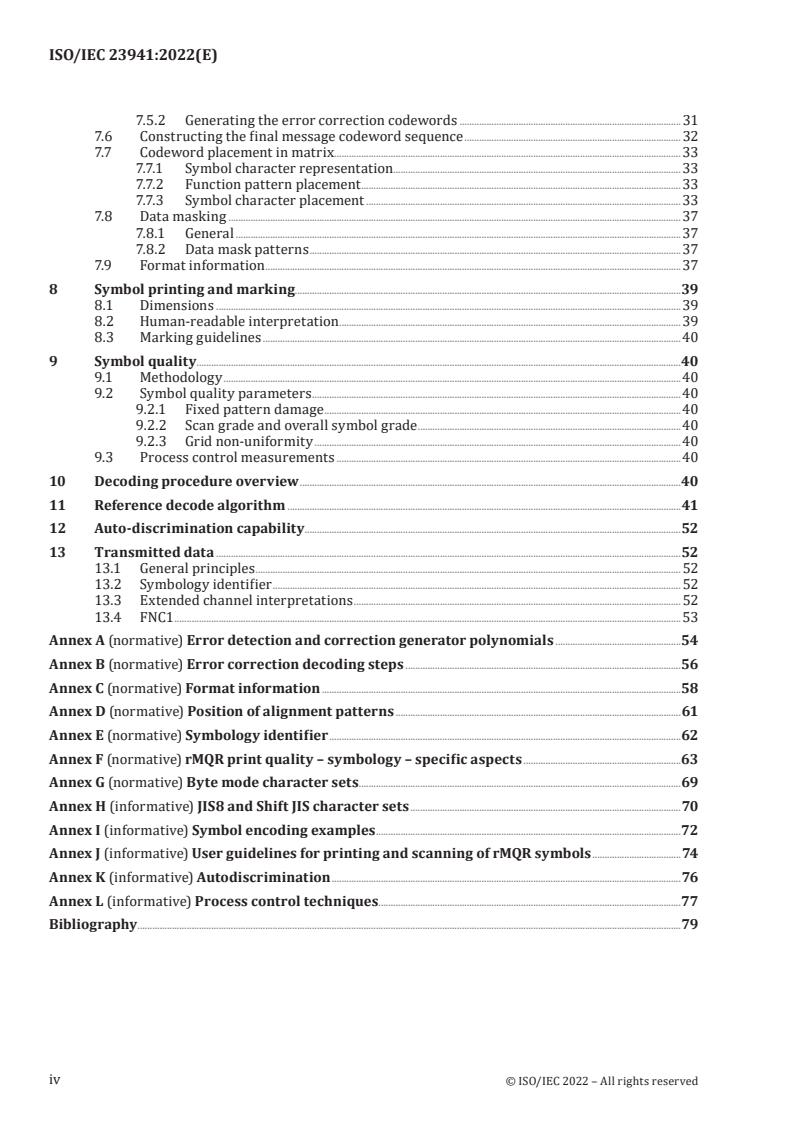
Contents Page
Foreword .v
Introduction . vi
1 Scope . 1
2 Normative references . 1
3 Terms and definitions . 1
4 Mathematical and logical symbols, abbreviated terms and conventions .3
4.1 Mathematical and logical symbols. 3
4.2 Abbreviated terms . 3
4.3 Conventions . 3
4.3.1 Module positions . 3
4.3.2 Byte notation . 3
4.3.3 Version references. 3
5 Conformance . 4
6 rMQR specifications . .4
6.1 Basic characteristics . 4
6.2 Summary of additional features . 5
6.3 Symbol structure . 5
6.3.1 General . 5
6.3.2 Symbol Versions and sizes . 8
6.3.3 Finder pattern . 10
6.3.4 Separator . 10
6.3.5 Timing pattern . 10
6.3.6 Alignment patterns . 11
6.3.7 Finder sub pattern . 11
6.3.8 Corner finder pattern .12
6.3.9 Encoding region .12
6.3.10 Quiet zone . 13
7 Requirements .13
7.1 Encode procedure overview . .13
7.2 Data analysis . 14
7.3 Modes . 15
7.3.1 General .15
7.3.2 Extended channel interpretation (ECI) mode . 15
7.3.3 Numeric mode . 15
7.3.4 Alphanumeric mode . 15
7.3.5 Byte mode .15
7.3.6 Kanji mode . 16
7.3.7 Mixing modes . 16
7.3.8 FNC1 mode . 16
7.4 Data encoding . 16
7.4.1 Sequence of data . 16
7.4.2 Extended channel interpretation (ECI) mode . 18
7.4.3 Numeric mode . 20
7.4.4 Alphanumeric mode . 21
7.4.5 Byte mode . 22
7.4.6 Kanji mode . 22
7.4.7 Mixing modes .23
7.4.8 FNC1 modes . 24
7.4.9 Terminator .25
7.4.10 Bit stream to codeword conversion . 25
7.5 Error correction .28
7.5.1 Error correction capacity .28
iii
© ISO/IEC 2022 – All rights reserved
7.5.2 Generating the error correction codewords . 31
7.6 Constructing the final message codeword sequence . 32
7.7 Codeword placement in matrix. 33
7.7.1 Symbol character representation. 33
7.7.2 Function pattern placement . 33
7.7.3 Symbol character placement . 33
7.8 Data masking . 37
7.8.1 General . 37
7.8.2 Data mask patterns . 37
7.9 Format information . 37
8 Symbol printing and marking.39
8.1 Dimensions .39
8.2 Human-readable interpretation . 39
8.3 Marking guidelines .40
9 Symbol quality .40
9.1 Methodology .40
9.2 Symbol quality parameters .40
9.2.1 Fixed pattern damage .40
9.2.2 Scan grade and overall symbol grade .40
9.2.3 Grid non-uniformity .40
9.3 Process control measurements .40
10 Decoding procedure overview .40
11 Reference decode algorithm .41
12 Auto-discrimination capability .52
13 Transmitted data .52
13.1 General principles . 52
13.2 Symbology identifier . 52
13.3 Extended channel interpretations . 52
13.4 FNC1 . 53
Annex A (normative) Error detection and correction generator polynomials .54
Annex B (normative) Error correction decoding steps .56
Annex C (normative) Format information .58
Annex D (normative) Position of alignment patterns .61
Annex E (normative) Symbology identifier .62
Annex F (normative) rMQR print quality – symbology – specific aspects .63
Annex G (normative) Byte mode character sets .69
Annex H (informative) JIS8 and Shift JIS character sets .70
Annex I (informative) Symbol encoding examples .72
Annex J (informative) User guidelines for printing and scanning of rMQR symbols .74
Annex K (informative) Autodiscrimination .76
Annex L (informative) Process control techniques.77
Bibliography .79
iv
© ISO/IEC 2022 – All rights reserved
Foreword
ISO (the International Organization for Standardization) and IEC (the International Electrotechnical
Commission) form the specialized system for worldwide standardization. National bodies that are
members of ISO or IEC participate in the development of International Standards through technical
committees established by the respective organization to deal with particular fields of technical
activity. ISO and IEC technical committees collaborate in fields of mutual interest. Other international
organizations, governmental and non-governmental, in liaison with ISO and IEC, also take part in the
work.
The procedures used to develop this document and those intended for its further maintenance
are described in the ISO/IEC Directives, Part 1. In particular, the different approval criteria
needed for the different types of document should be noted. This document was drafted in
accordance with the editorial rules of the ISO/IEC Directives, Part 2 (see www.iso.org/directives or
www.iec.ch/members_experts/refdocs).
Attention is drawn to the possibility that some of the elements of this document may be the subject
of patent rights. ISO and IEC shall not be held responsible for identifying any or all such patent
rights. Details of any patent rights identified during the development of the document will be in the
Introduction and/or on the ISO list of patent declarations received (see www.iso.org/patents) or the IEC
list of patent declarations received (see patents.iec.ch).
Any trade name used in this document is information given for the convenience of users and does not
constitute an endorsement.
For an explanation of the voluntary nature of standards, the meaning of ISO specific terms and
expressions related to conformity assessment, as well as information about ISO's adherence to
the World Trade Organization (WTO) principles in the Technical Barriers to Trade (TBT) see
www.iso.org/iso/foreword.html. In the IEC, see www.iec.ch/understanding-standards.
This document was prepared by Joint Technical Committee ISO/IEC JTC 1, Information technology,
Subcommittee SC 31, Automatic identification and data capture techniques.
Any feedback or questions on this document should be directed to the user’s national standards
body. A complete listing of these bodies can be found at www.iso.org/members.html and
www.iec.ch/national-committees.
v
© ISO/IEC 2022 – All rights reserved
Introduction
Rectangular Micro QR Code (rMQR) is a matrix symbology. The symbol consists of an array of nominally
square modules, arranged in a rectangular pattern. Included is a unique finder pattern located at a
single corner which is intended to assist in easy location of the symbols position, size, and inclination.
A wide range of sizes of symbol is provided for, together with two levels of error correction. Module
dimensions are user-specified to enable symbol production by a wide variety of techniques.
vi
© ISO/IEC 2022 – All rights reserved
INTERNATIONAL STANDARD ISO/IEC 23941:2022(E)
Information technology — Automatic identification and
data capture techniques — Rectangular Micro QR Code
(rMQR) bar code symbology specification
1 Scope
This document defines the requirements for the symbology known as rMQR. It specifies the
rMQR symbology characteristics, data character encoding methods, symbol formats, dimensional
characteristics, error correction rules, reference decoding algorithm, printing quality requirements
and user-selectable application parameters.
2 Normative references
The following documents are referred to in the text in such a way that some or all of their content
constitutes requirements of this document. For dated references, only the edition cited applies. For
undated references, the latest edition of the referenced document (including any amendments) applies.
ISO/IEC 19762, Information technology — Automatic identification and data capture (AIDC) techniques —
Harmonized vocabulary
ISO/IEC 8859-1, Information technology — 8-bit single-byte coded graphic character sets — Part 1: Latin
alphabet No. 1
ISO/IEC 15415, Information technology — Automatic identification and data capture techniques — Bar
code symbol print quality test specification — Two-dimensional symbols
3 Terms and definitions
For the purpose of this document, the terms and definitions given in ISO/IEC 19762 and the following
apply.
ISO and IEC maintain terminology databases for use in standardization at the following addresses:
— ISO Online browsing platform: available at https:// www .iso .org/ obp
— IEC Electropedia: available at https:// www .electropedia .org/
3.1
character count indicator
bit sequence which defines the data string length in a mode (3.6)
3.2
encoding region
region of the symbol not occupied by function patterns (3.4) and available for encoding of data and error
correction codewords, and for format information (3.3)
3.3
format information
encoded pattern containing information on the error correction level and version (3.15) applied to
symbol characteristics
© ISO/IEC 2022 – All rights reserved
3.4
function pattern
overhead component of the symbol [finder pattern, separator (3.12), timing patterns (3.14), alignment
patterns, finder sub patterns and corner finder pattern] required for location of the symbol or
identification of its characteristics to assist in decoding
3.5
masking
process of XORing the bit pattern in an area of the symbol with a mask pattern to equalize the number
of light and dark modules
3.6
mode
method of representing a defined character set as a bit string
3.7
mode indicator
identifier indicating in which mode (3.6) the following data sequence is encoded
3.8
padding bit
zero bit, not representing data, used to fill empty positions of the final codeword during the encoding
process
3.9
remainder bit
zero bit, not representing data, used to fill empty positions of the symbol encoding region (3.2) after
the final symbol character, where the area of the encoding region (3.2) does not divide exactly into 8-bit
symbol characters
3.10
remainder codeword
codeword, placed after the data codeword stream that was generated in data encoding process, used
to fill empty codeword positions to meet the requirements of number of data codeword of the version
(3.15) and error correction definitions
3.11
segment
sequence of data encoded according to the rules of one ECI or encoding mode
3.12
separator
function pattern (3.4) of all light modules, one module wide, used to separate the finder pattern from
the rest of the symbol
3.13
terminator
bit pattern of defined number (depending on symbol) of all zero bits used to end the bit string
representing data
3.14
timing pattern
alternating sequence of dark and light modules enabling module coordinates in the symbol to be
determined
© ISO/IEC 2022 – All rights reserved
3.15
version
size of the symbol represented in terms of the number of modules in the vertical and horizontal axes,
indicated, for example, as R7x59
Note 1 to entry: The error correction level applied to the symbol can be suffixed to the Version Indicator, e.g.,
Version R11x27-M.
3.16
version Indicator
five-bit identifier indicating symbol version used for a part of the format information (3.3)
3.17
error correction level indicator
one-bit identifier indicating error correction level used for a part of the format information (3.3)
4 Mathematical and logical symbols, abbreviated terms and conventions
4.1 Mathematical and logical symbols
DIV is the integer division operator
MOD is the integer remainder after division
XOR is the exclusive-or logic function whose output is one only when its two inputs are not equivalent.
It is represented by the symbol ⊕.
4.2 Abbreviated terms
BCH Bose-Chaudhuri-Hocquenghem
ECI Extended Channel Interpretation
RS Reed-Solomon
4.3 Conventions
4.3.1 Module positions
For ease of reference, module positions are defined by their row and column coordinates in the symbol,
in the form (i, j) where i designates the row (counting from the top downwards) and j the column
(counting from left to right) in which the module is located, with counting commencing at 0. Module
(0, 0) is therefore located at the upper left corner of the symbol.
4.3.2 Byte notation
Byte contents are shown as hexadecimal (hex) values.
4.3.3 Version references
Symbol versions are referred to in the form Version RC xC -E where C identifies the vertical number
V H V
of modules (7, 9, 11, 13, 15, 17), C identifies the horizontal number of modules (27, 43, 59, 77, 99, 139),
H
and E indicates the error correction level (M and H). For example, R13x27-M indicates a rectangular
symbol that has 13 vertical modules, 27 horizontal modules, and an error correction level M. Versions
may be referred to without error correction level. For example, R13x27.
NOTE For M and H, see 6.1 e).
© ISO/IEC 2022 – All rights reserved
5 Conformance
rMQR symbols (and equipment designed to produce or read rMQR symbols) shall be considered as
conforming with this document if they provide or support the features defined in this document.
6 rMQR specifications
6.1 Basic characteristics
rMQR is a matrix symbology with the following characteristics.
a) Encodable character set:
1) numeric data (digits 0 - 9);
2) alphanumeric data (digits 0 - 9; upper case letters A - Z; nine other characters, as shown in
Table 5.);
3) byte data [default shall be the character set defined in Annex G; or other sets as otherwise
defined (see 7.3.5)];
4) Kanji characters (Characters can be compacted into 13 bits (see 7.3.6).
b) Representation of data:
A dark module is nominally a binary one and a light module is nominally a binary zero. See 6.2 for
details of reflectance reversal.
c) Symbol size (not including quiet zone):
See Table 1 for the symbol sizes for 7 x 43 modules to 17 x 139 modules (Version R7x43 to R17x139).
d) Data characters per symbol:
The maximum symbol size of Version R17x139-M is as specified below.
— numeric data: 361 characters
— alphanumeric data: 219 characters
— Byte data: 150 characters
— Kanji data: 92 characters
e) Selectable error correction:
This symbology supports two levels of Reed-Solomon error correction, M and H, which allows the
recovery of rMQR codewords up to the indicated rate below.
— M 15 %
— H 30 %
f) Code type:
Matrix
g) Orientation independence:
Yes (both rotation and reflection)
© ISO/IEC 2022 – All rights reserved
Figure 1 illustrates a Version R13x27 rMQR symbol in normal colour and with reflectance reversal (see
6.2), in both normal and mirror image orientations.
6.2 Summary of additional features
The use of the following additional features is optional in rMQR.
— Extended channel interpretations (ECI)
This mechanism enables data using character sets other than the default encodable set (e.g., Arabic,
Cyrillic, Greek) and other data interpretations (e.g., compacted data using defined compression
schemes) or other industry-specific requirements to be encoded. See 7.3.2.
— Reflectance reversal
Symbols are intended to be read when marked so that the image is either dark on light or light
on dark (see Figure 1). The specifications in this document are based on dark images on a light
background. In the case of symbols produced with reflectance reversal, references to dark or light
modules should be taken as references to light or dark modules respectively.
— Mirror imaging
The arrangement of modules defined in this document represents the “normal” orientation of the
symbol. It is, however, possible to achieve a valid decode of a symbol in which the arrangement
of the modules has been laterally transposed. When viewed with the rMQR finder pattern at the
top left, and the finder sub pattern at the bottom right corners of the symbol, the effect of mirror
imaging is to interchange the row and column positions of the modules. (See Figure 1.)
a) Normal orientation and normal reflectance ar- b) Normal orientation and reversed reflec-
rangement tances
c) Mirror image orientation and normal reflectance d) Mirror image orientation and reversed
arrangement reflectances
NOTE The corner marks in Figures 1 indicate the extent of the quiet zone.
Figure 1 — Examples of rMQR symbol encoding the text "12345678901234567890123456"
6.3 Symbol structure
6.3.1 General
Each rMQR symbol shall be constructed of nominally square modules set out in a rectangular array and
shall consist of an encoding region and function pattern. The function pattern shall contain a finder
pattern, separator, timing patterns, alignment patterns, finder sub patterns and corner finder pattern.
See Figure 2.
© ISO/IEC 2022 – All rights reserved
Function patterns do not encode data. The symbol shall be surrounded on all four sides by a quiet zone
border.
Figures 2 to 7 illustrate the structure of a Version R7x43, R9x43, R11x43, R13x43, R15x43 and R17x43
symbols, respectively.
Figure 2 — Structure of Version R7x43 rMQR symbol
Figure 3 — Structure of Version R9x43 rMQR symbol
© ISO/IEC 2022 – All rights reserved
Figure 4 — Structure of Version R11x43 rMQR symbol
Figure 5 — Structure of Version R13x43 rMQR symbol
© ISO/IEC 2022 – All rights reserved
Figure 6 — Structure of Version R15x43 rMQR symbol
Figure 7 — Structure of Version R17x43 rMQR symbol
6.3.2 Symbol Versions and sizes
There are 32 sizes of rMQR symbol, referred to as Version R7x43 to R17x139. The vertical module
has 6 sizes depending on the number of modules, e.g., 7, 9, 11, 13, 15, 17, and the horizontal module
has 6 sizes depending on the number of modules, e.g., 27, 43, 59, 77, 99, 139. Table 1 shows code sizes
for all versions. Figure 8 illustrates the structure of symbols with 11 vertical modules and 27 to 139
© ISO/IEC 2022 – All rights reserved
horizontal modules. Figure 9 illustrates the structure of symbols with 43 horizontal modules and 7 to
17 vertical modules.
Figure 8 — rMQR symbols with 11 vertical modules and 27 to 139 horizontal modules
Figure 9 — rMQR symbols with 43 horizontal modules and 7 to 17 vertical modules
© ISO/IEC 2022 – All rights reserved
6.3.3 Finder pattern
A single finder pattern is located at the upper left corner of the symbol as illustrated in Figures 2 to 7.
For a symbol with 7 vertical modules, it is located at the leftmost of the symbol. Each finder pattern
may be viewed as three superimposed concentric squares and is constructed of 7 × 7 dark modules,
5 × 5 light modules and 3 × 3 dark modules. The ratio of module widths in each finder pattern is 1 : 1 : 3
: 1 : 1 as illustrated in Figure 10. Identification of the finder pattern together with the timing patterns
unambiguously defines the size, location and rotational orientation of the symbol in the field of view.
Key
A 3 modules
B 5 modules
C 7 modules
Figure 10 — Structure of finder pattern
6.3.4 Separator
A one-module wide separator, constructed of all light modules, is placed between each finder pattern
and the encoding region, as illustrated in Figures 2 to 7.
6.3.5 Timing pattern
The horizontal and vertical timing patterns respectively consist of a one-module wide row or column of
alternating dark and light modules. They enable the symbol density and version to be determined and
provide datum positions for determining module coordinates.
The horizontal timing pattern runs across row 0 of the symbol between a separator at the right of
the finder pattern and a corner finder pattern at the right end of the symbol. It also runs across the
lowermost row of the symbol between a corner finder pattern at the left end of the symbol and the
finder sub pattern, excluding the position of the alignment pattern. The vertical timing pattern runs
down column 0 of the symbol between a separator below the finder pattern and a corner finder pattern
at the lowermost end of the symbol. It also runs down the rightmost column between a corner finder
pattern at the upper end of the symbol and a finder sub pattern. The timing pattern also runs down a
column of symmetrically located upper and lower alignment patterns, from the top to the bottom of
the alignment patterns. Figure 11 illustrates the timing pattern area of Version R17x43 symbol. Timing
patterns are areas enclosed by dotted lines in this figure. Symbols with 7 to 11 vertical modules do
not have timing patterns at the column 0, nor do symbols with 7 and 9 vertical modules have timing
patterns at the right end of the symbol. See Figures 2 to 7.
© ISO/IEC 2022 – All rights reserved
Figure 11 — Timing pattern area of Version R17x43
6.3.6 Alignment patterns
Alignment patterns are present in symbols with 43 or more horizontal modules. Each alignment
pattern may be viewed as two superimposed concentric squares, constructed of 3 x 3 dark modules,
and a single central light module. The structure of an alignment pattern is shown in Figure 12. The
number of alignment patterns depends on the number of horizontal modules. The alignment patterns
shall be placed at the position defined in Annex D, except for symbols with 27 horizontal modules.
Key
A 1 module
B 3 modules
Figure 12 — Structure of alignment pattern
6.3.7 Finder sub pattern
The finder sub pattern is placed at the right-hand bottom of the symbol, as illustrated in Figures 2
through 7. The finder sub pattern may be viewed as three superimposed concentric squares, and is
constructed of 5 x 5 dark modules, 3 x 3 light modules, and a single central dark module. The structure
of finder sub pattern is shown in Figure 13.
© ISO/IEC 2022 – All rights reserved
Key
A 1 module
B 3 modules
C 5 modules
Figure 13 — Structure of finder sub pattern
6.3.8 Corner finder pattern
The corner finder pattern is located at the upper right and the lower left of rMQR symbol, as illustrated
in Figures 2 through 7. The corner finder pattern is constructed of 3 dark modules in the horizontal
direction, and 3 dark modules in the vertical direction that intersect at the upper right or lower left
of the symbol, and 1 light module which is located so as to contact an angle made by the dark modules
described above. See Figure 14. Symbols with 7 vertical modules do not have a lower left corner finder
pattern. Symbols with 9 vertical modules have a lower left corner finder pattern of 3 dark modules in
the horizontal direction, as shown in Figure 15.
Key
A 1 module
B 3 modules
Figure 14 — Structure of corner finder pattern
Key
A 1 module
B 3 modules
Figure 15 — Structure of lower left corner finder pattern of symbols with 9 vertical modules
6.3.9 Encoding region
This region shall contain the symbol characters representing data, those representing error correction
codewords, and the format information. Refer to 7.7.1 for details of the symbol characters. Refer to 7.9
for details of the format information.
© ISO/IEC 2022 – All rights reserved
6.3.10 Quiet zone
The width of the quiet zone shall be 2X, surround the symbol on all four sides, and shall be free of all
other markings. Its nominal reflectance value shall be equal to that of the light modules.
7 Requirements
7.1 Encode procedure overview
This clause provides an overview of the steps required to convert input data to a rMQR symbol. (For
examples of encoding, see Annex I.)
Step 1 Data analysis
Analyze the input data stream to identify the variety of different characters to be encoded. The rMQR
symbol format supports the extended channel interpretation feature, enabling data differing from
the default character set to be encoded. rMQR includes several modes (see 7.3) to allow different sub-
sets of characters to be converted into symbol characters in efficient ways. Switch between modes
as necessary in order to achieve the most efficient conversion of data into a binary string. Select the
required error correction level. A list of rMQR symbol versions and their data capacities are shown in
Table 1.
Step 2 Data encoding
Convert the data characters into a bit stream in accordance with the rules for the mode in force, as
defined in 7.4.2 to 7.4.7, inserting mode indicators as necessary to change modes at the beginning of
each new mode segment, and a terminator at the end of the data sequence. Split the resulting bit stream
into 8-bit codewords. Add remainder codewords as necessary to fill the number of data codewords (as
defined in Table 6) required for the version and error correction level.
Step 3 Error correction coding
Divide the codeword sequence into the required number of blocks (as defined in Table 8) to enable the
error correction algorithms to be processed. Generate the error correction codewords for each block,
appending the error correction codewords to the end of the data codeword sequence.
Step 4 Structure final message
Interleave the data and error correction codewords from each block as described in 7.6 (step 3), and
add remainder bits as necessary.
Step 5 Module placement in matrix
Place the codeword modules in the matrix together with the finder pattern, separators, timing pattern,
alignment patterns (if required), finder sub pattern and corner finder pattern. Refer to 7.7 for details of
codeword placement in matrix.
Step 6 Data masking
Apply the data masking patterns to the encoding region of the symbol. Refer to 7.8 for details of data
masking.
Step 7 Format information
Generate the format information and complete the symbol. Refer to 7.9 for details of format information.
© ISO/IEC 2022 – All rights reserved
Table 1 — Codeword capacity of all versions of rMQR symbols
No. of modules/ Symbol
Data
side Function Format capacity -
capacity
pattern information Data modules Remainder
Version [codewords]
Hori-
modules modules except (D) bits
Vertical
a
zontal
(C) (D) (E = AB – C –
(A)
(E)
(B)
D)
R7x43 7 43 161 36 104 13 0
R7x59 7 59 206 36 171 21 3
R7x77 7 77 242 36 261 32 5
R7x99 7 99 299 36 358 44 6
R7x139 7 139 392 36 545 68 1
R9x43 9 43 181 36 170 21 2
R9x59 9 59 228 36 267 33 3
R9x77 9 77 264 36 393 49 1
R9x99 9 99 323 36 532 66 4
R9x139 9 139 418 36 797 99 5
R11x27 11 27 139 36 122 15 2
R11x43 11 43 188 36 249 31 1
R11x59 11 59 237 36 376 47 0
R11x77 11 77 273 36 538 67 2
R11x99 11 99 334 36 719 89 7
R11x139 11 139 431 36 1062 132 6
R13x27 13 27 143 36 172 21 4
R13x43 13 43 194 36 329 41 1
R13x59 13 59 245 36 486 60 6
R13x77 13 77 281 36 684 85 4
R13x99 13 99 344 36 907 113 3
R13x139 13 139 443 36 1328 166 0
R15x43 15 43 200 36 409 51 1
R15x59 15 59 253 36 596 74 4
R15x77 15 77 289 36 830 103 6
R15x99 15 99 354 36 1095 136 7
R15x139 15 139 455 36 1594 199 2
R17x43 17 43 206 36 489 61 1
R17x59 17 59 261 36 706 88 2
R17x77 17 77 297 36 976 122 0
R17x99 17 99 364 36 1283 160 3
R17x139 17 139 467 36 1860 232 4
a
All codewords are 8 bits in length.
7.2 Data analysis
Analyse the input data string to determine its content and select the default or other appropriate ECI
and the appropriate mode to encode each sequence as described in 7.4. Each mode in sequence from
Numeric mode to Kanji mode progressively requires more bits per character. When modes are mixed,
it is possible to switch from mode to mode within a symbol in order to minimize the bit stream length
for data, parts of which can more efficiently be encoded in one mode than other parts, e.g., numeric
sequences followed by alphanumeric sequences. It is in theory most efficient to encode data in the
© ISO/IEC 2022 – All rights reserved
mode requiring the fewest bits per data character, but as there is some overhead in the form of mode
indicator and character count indicator associated with each mode change, it does not always result
in the shortest overall bit stream to change modes for a small number of characters. Also, because the
capacity of symbols increases in discrete steps from one version to the next, it is not always necessary
to achieve the maximum conversion efficiency in every case.
7.3 Modes
7.3.1 General
The modes defined below are based on the character values and assignments associated with the default
ECI. When any other ECI is in force, the byte values rather than the specific character assignments shall
be used to select the optimum data compaction mode. For example, numeric mode would be appropriate
if there is a sequence of data byte values within the range 30 to 39 inclusive. In this case the
HEX HEX
compaction is carried out using the default numeric or alphabetic equivalents of the byte values.
NOTE … data is figured in hexadecimal.
HEX
7.3.2 Extended channel interpretation (ECI) mode
The extended channel interpretation (ECI) protocol defined in References [21] to [23], allows the output
data s
...