

ISO 2418:2023
(Main)Leather — Chemical, physical, mechanical and fastness tests — Position and preparation of specimens for testing
General Information
- Abstract
This document specifies the position of laboratory test specimens within a piece of leather and the method of labelling and marking the laboratory test specimens for future identification. In addition, this document specifies the design of press knives for cutting test pieces and the preparation of test pieces. It is applicable to all types of leather derived from mammals, irrespective of the tanning used. It is not applicable to leathers derived from birds, fish, reptiles or furs.
- Status
- Published
- Publication Date
- 05-Feb-2023
- Technical Committee
- IULTCS - International Union of Leather Technologists and Chemists Societies
- Current Stage
- 6060 - International Standard published
- Start Date
- 06-Feb-2023
- Due Date
- 07-Jun-2023
- Completion Date
- 06-Feb-2023
Buy Documents
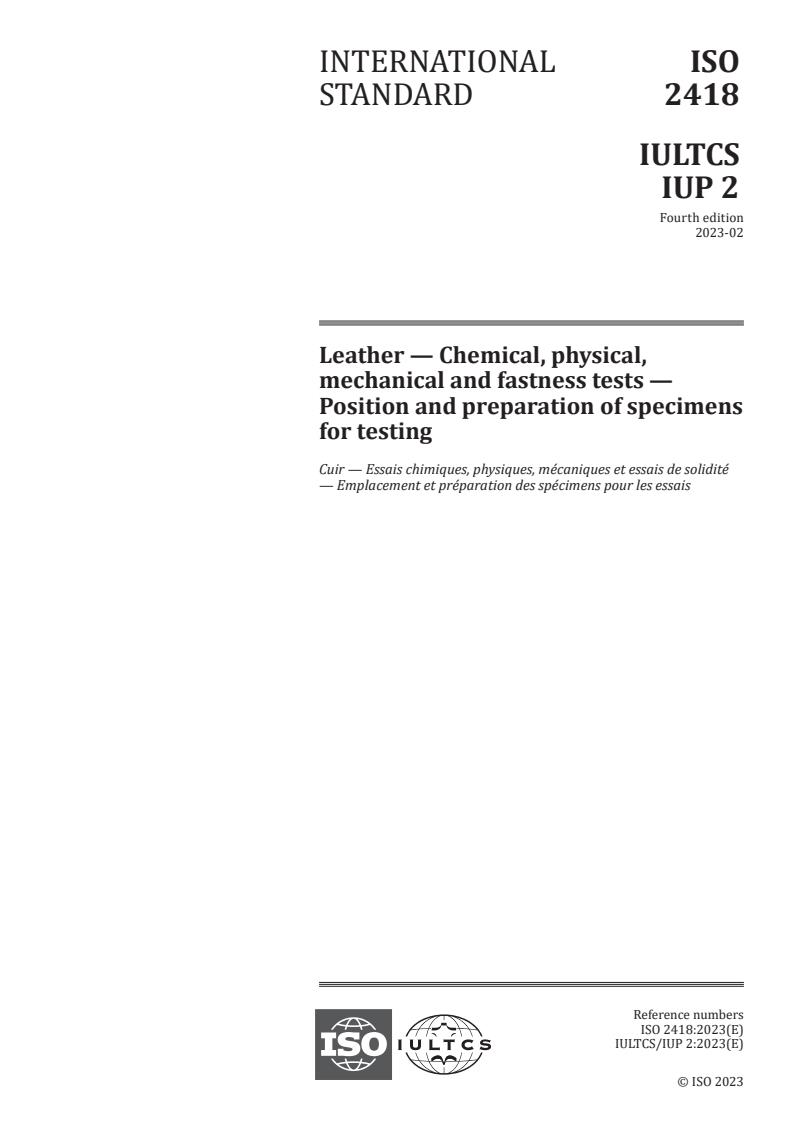
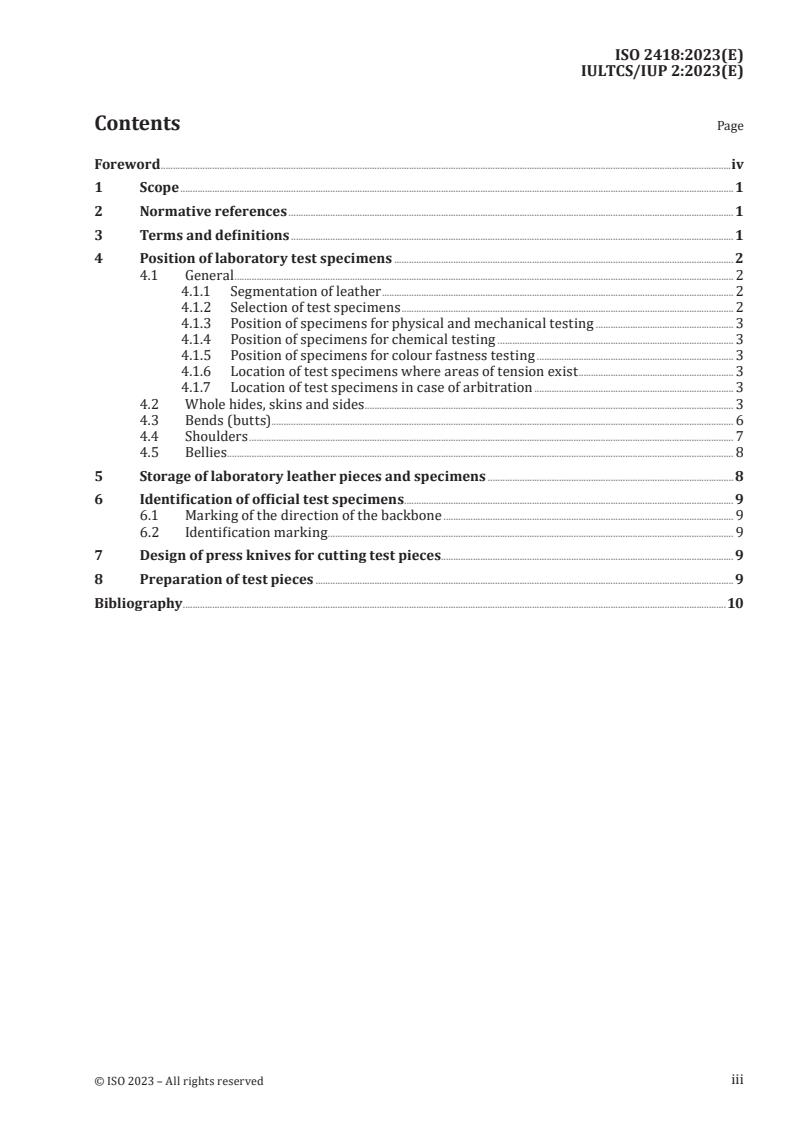
ISO 2418:2023 - Leather — Chemical, physical, mechanical and fastness tests — Position and preparation of specimens for testing Released:2/6/2023
ISO 2418:2023 - Cuir — Essais chimiques, physiques, mécaniques et essais de solidité — Emplacement et préparation des spécimens pour les essais Released:2/6/2023
Overview
ISO 2418:2023 - Leather - Chemical, physical, mechanical and fastness tests - Position and preparation of specimens for testing provides clear, standardized rules for selecting, labelling and preparing laboratory specimens from leather. The fourth edition defines how to locate specimen areas on whole hides, sides and typical segments (bends/butts, shoulders and bellies), how to mark and store specimens, and basic requirements for cutting tools (press knives) and test-piece preparation. It applies to leathers derived from mammals and is not applicable to bird, fish, reptile or fur leathers.
Key topics and requirements
- Specimen position and segmentation
- Defines segmentation (bend/butt, shoulder, belly) and prescribes exact specimen areas with accompanying figures for whole hides and segments.
- Includes tolerances for location (e.g., AE distance table: AD < 350 mm → AE = 0 mm; 350 ≤ AD < 600 mm → AE = 20 mm; AD ≥ 600 mm → AE = 50 mm).
- Selection criteria
- Test specimen areas must be free of obvious defects (scratches, flay cuts).
- Preference given to specimens cut from whole hides or sides to reduce variability between segments.
- Test-specific location guidance
- Distinct guidance for physical and mechanical, chemical, and colour fastness testing (different shaded/non-shaded areas in the standard’s figures).
- Rules for when to extend sampling area (e.g., when minimum mass for chemical testing is not met).
- Storage and contamination control
- Store specimens to avoid contamination and localized heating.
- Identification and marking
- Mark backbone direction with an arrow; label specimens with batch reference, preparation date, specimen reference and segment (bend/shoulder/belly).
- Press knives and preparation
- Specifies design requirements for press knives and procedures for cutting and preparing test pieces (see Clauses 7 and 8).
Practical applications
- Ensures consistent, repeatable specimen preparation for laboratory testing across tanneries and testing facilities.
- Supports quality control (physical, chemical, mechanical and colour fastness testing) and reduces inter-laboratory variability.
- Provides clear rules for arbitration testing - only specimens from specified whole-hide areas are acceptable unless otherwise agreed.
- Useful for creating documented traceability of specimens for regulatory compliance and product certification.
Who should use this standard
- Leather testing laboratories and quality assurance teams
- Tanneries and leather manufacturers
- Product compliance and certification bodies
- Research institutions studying leather properties
- Dispute resolution and arbitration panels in the leather trade
Related standards
- ISO 15115 - Leather: Vocabulary (referenced for terms and definitions)
- Standards for specific tests (e.g., tensile test methods such as ISO 3376) are used together with ISO 2418:2023 for test-piece shape and dimensions.
Keywords: ISO 2418:2023, leather testing, specimen preparation, test piece, press knives, leather quality control, chemical physical mechanical fastness tests.
Relations
- Effective Date
- 25-Aug-2026
- Referred By
EN ISO 20701:2024 - Leather - Tests for colour fastness - Colour fastness to saliva (ISO 20701:2024) - Effective Date
- 09-Feb-2026
- Effective Date
- 09-Feb-2026
- Effective Date
- 09-Feb-2026
- Effective Date
- 09-Feb-2026
- Effective Date
- 09-Feb-2026
- Effective Date
- 09-Feb-2026
- Effective Date
- 09-Feb-2026
- Referred By
EN ISO 11642:2025 - Leather - Tests for colour fastness - Colour fastness to water (ISO 11642:2025) - Effective Date
- 09-Feb-2026
- Effective Date
- 09-Feb-2026
- Effective Date
- 09-Feb-2026
- Effective Date
- 09-Feb-2026
- Effective Date
- 09-Feb-2026
- Referred By
EN ISO 11936:2023 - Leather - Determination of total content of certain bisphenols (ISO 11936:2023) - Effective Date
- 09-Feb-2026
- Effective Date
- 09-Feb-2026
Buy Documents
ISO 2418:2023 - Leather — Chemical, physical, mechanical and fastness tests — Position and preparation of specimens for testing Released:2/6/2023
ISO 2418:2023 - Cuir — Essais chimiques, physiques, mécaniques et essais de solidité — Emplacement et préparation des spécimens pour les essais Released:2/6/2023
Get Certified
Connect with accredited certification bodies for this standard

Control Union Certifications
Global certification for agriculture and sustainability.

Hohenstein Institut
Textile testing and certification.

Bureau Veritas Bangladesh
Bureau Veritas certification services in Bangladesh.
Sponsored listings
Frequently Asked Questions
ISO 2418:2023 is a standard published by the International Organization for Standardization (ISO). Its full title is "Leather — Chemical, physical, mechanical and fastness tests — Position and preparation of specimens for testing". This standard covers: This document specifies the position of laboratory test specimens within a piece of leather and the method of labelling and marking the laboratory test specimens for future identification. In addition, this document specifies the design of press knives for cutting test pieces and the preparation of test pieces. It is applicable to all types of leather derived from mammals, irrespective of the tanning used. It is not applicable to leathers derived from birds, fish, reptiles or furs.
This document specifies the position of laboratory test specimens within a piece of leather and the method of labelling and marking the laboratory test specimens for future identification. In addition, this document specifies the design of press knives for cutting test pieces and the preparation of test pieces. It is applicable to all types of leather derived from mammals, irrespective of the tanning used. It is not applicable to leathers derived from birds, fish, reptiles or furs.
ISO 2418:2023 is classified under the following ICS (International Classification for Standards) categories: 59.140.30 - Leather and furs. The ICS classification helps identify the subject area and facilitates finding related standards.
ISO 2418:2023 has the following relationships with other standards: It is inter standard links to EN ISO 26082-1:2026, EN ISO 20701:2024, EN ISO 3377-2:2025, EN ISO 3379:2024, EN ISO 20433:2024, EN ISO 2417:2025, EN ISO 5403-1:2025, EN ISO 17236:2025, EN ISO 11642:2025, EN ISO 18218-1:2023, EN ISO 17232:2025, EN ISO 11641:2025, EN ISO 17234-1:2024, EN ISO 11936:2023, EN ISO 25089:2025. Understanding these relationships helps ensure you are using the most current and applicable version of the standard.
ISO 2418:2023 is available in PDF format for immediate download after purchase. The document can be added to your cart and obtained through the secure checkout process. Digital delivery ensures instant access to the complete standard document.
Standards Content (Sample)
INTERNATIONAL ISO
STANDARD 2418
IULTCS
IUP 2
Fourth edition
2023-02
Leather — Chemical, physical,
mechanical and fastness tests —
Position and preparation of specimens
for testing
Cuir — Essais chimiques, physiques, mécaniques et essais de solidité
— Emplacement et préparation des spécimens pour les essais
Reference numbers
IULTCS/IUP 2:2023(E)
IULTCS/IUP 2:2023(E)
© ISO 2023
All rights reserved. Unless otherwise specified, or required in the context of its implementation, no part of this publication may
be reproduced or utilized otherwise in any form or by any means, electronic or mechanical, including photocopying, or posting on
the internet or an intranet, without prior written permission. Permission can be requested from either ISO at the address below
or ISO’s member body in the country of the requester.
ISO copyright office
CP 401 • Ch. de Blandonnet 8
CH-1214 Vernier, Geneva
Phone: +41 22 749 01 11
Email: copyright@iso.org
Website: www.iso.org
Published in Switzerland
ii
IULTCS/IUP 2:2023(E)
Contents Page
Foreword .iv
1 Scope . 1
2 Normative references . 1
3 Terms and definitions . 1
4 Position of laboratory test specimens . 2
4.1 General . 2
4.1.1 Segmentation of leather . 2
4.1.2 Selection of test specimens . 2
4.1.3 Position of specimens for physical and mechanical testing . 3
4.1.4 Position of specimens for chemical testing . 3
4.1.5 Position of specimens for colour fastness testing . 3
4.1.6 Location of test specimens where areas of tension exist . 3
4.1.7 Location of test specimens in case of arbitration . 3
4.2 Whole hides, skins and sides . 3
4.3 Bends (butts) . 6
4.4 Shoulders . 7
4.5 Bellies . 8
5 Storage of laboratory leather pieces and specimens . 8
6 Identification of official test specimens . 9
6.1 Marking of the direction of the backbone . 9
6.2 Identification marking . 9
7 Design of press knives for cutting test pieces. 9
8 Preparation of test pieces .9
Bibliography .10
iii
IULTCS/IUP 2:2023(E)
Foreword
ISO (the International Organization for Standardization) is a worldwide federation of national standards
bodies (ISO member bodies). The work of preparing International Standards is normally carried out
through ISO technical committees. Each member body interested in a subject for which a technical
committee has been established has the right to be represented on that committee. International
organizations, governmental and non-governmental, in liaison with ISO, also take part in the work.
ISO collaborates closely with the International Electrotechnical Commission (IEC) on all matters of
electrotechnical standardization.
The procedures used to develop this document and those intended for its further maintenance are
described in the ISO/IEC Directives, Part 1. In particular, the different approval criteria needed for the
different types of ISO documents should be noted. This document was drafted in accordance with the
editorial rules of the ISO/IEC Directives, Part 2 (see www.iso.org/directives).
Attention is drawn to the possibility that some of the elements of this document may be the subject of
patent rights. ISO shall not be held responsible for identifying any or all such patent rights. Details of
any patent rights identified during the development of the document will be in the Introduction and/or
on the ISO list of patent declarations received (see www.iso.org/patents).
Any trade name used in this document is information given for the convenience of users and does not
constitute an endorsement.
For an explanation of the voluntary nature of standards, the meaning of ISO specific terms and
expressions related to conformity assessment, as well as information about ISO's adherence to
the World Trade Organization (WTO) principles in the Technical Barriers to Trade (TBT), see
www.iso.org/iso/foreword.html.
IULTCS, originally formed in 1897, is a world-wide organization of professional leather societies to
further the advancement of leather science and technology. IULTCS has three Commissions, which
are responsible for establishing international methods for the sampling and testing of leather. ISO
recognizes IULTCS as an international standardizing body for the preparation of test methods for
leather.
This document was prepared by the Physical Test Commission of the International Union of Leather
Technologists and Chemists Societies (IUP Commission, IULTCS), in collaboration with the European
Committee for Standardization (CEN) Technical Committee CEN/TC 289, Leather, in accordance with
the Agreement on technical cooperation between ISO and CEN (Vienna Agreement).
The Chemical and Fastness Test Commissions were consulted in the preparation of this document. The
locations of the test specimens are identical to those given in IUP 2 published in J. Soc. Leather Trades
Chemists, 42, pp. 382–385, 1958 and IUC 2 published in J. Soc. Leather Trades Chemists, 49, pp. 6–8, 1965.
IUP 2 was declared an official method in 1959 and IUC 2 in 1965. Updated versions were published
in J. Soc. Leather Tech. Chem., 82, p. 194, 1998 and further revisions were published in J. Soc. Leather
Tech. Chem., 84, p. 303, 2000 and reconfirmed as official methods in March 2001. This document differs
slightly in the text and includes tolerances for measurements but the locations of the test specimens are
identical.
This fourth edition cancels and replaces the third edition (ISO 2418:2017), which has been technically
revised.
The main changes are as follows:
— title has been revised to more correctly explain the purpose of this document;
— entries 3.1 and 3.2 have been added and the text throughout the document has been revised to use
the words “specimen” and “test piece” where appropriate instead of “sample” and “sampling”;
iv
IULTCS/IUP 2:2023(E)
— 4.1 has been revised and reorganised; in addition, in 4.1.1 when the client identifies the part of the
hide or skin supplied and the location of the backbone then the laboratory is not responsible for this
identification;
— in 4.2 a new Table 1 specifies the distance from the backbone depending on the size of the leather
hide or skin;
— new Clauses 7 and 8 have been added to specify the press knives used for cutting test pieces and the
preparation of the test pieces.
Any feedback or questions on this document should be directed to the user’s national standards body. A
complete listing of these bodies can be found at www.iso.org/members.html.
v
INTERNATIONAL STANDARD
IULTCS/IUP 2:2023(E)
Leather — Chemical,
...
NORME ISO
INTERNATIONALE 2418
IULTCS
IUP 2
Quatrième édition
2023-02
Cuir — Essais chimiques, physiques,
mécaniques et essais de solidité —
Emplacement et préparation des
spécimens pour les essais
Leather — Chemical, physical, mechanical and fastness tests —
Position and preparation of specimens for testing
Numéros de référence
IULTCS/IUP 2:2023(F)
IULTCS/IUP 2:2023(F)
DOCUMENT PROTÉGÉ PAR COPYRIGHT
© ISO 2023
Tous droits réservés. Sauf prescription différente ou nécessité dans le contexte de sa mise en œuvre, aucune partie de cette
publication ne peut être reproduite ni utilisée sous quelque forme que ce soit et par aucun procédé, électronique ou mécanique,
y compris la photocopie, ou la diffusion sur l’internet ou sur un intranet, sans autorisation écrite préalable. Une autorisation peut
être demandée à l’ISO à l’adresse ci-après ou au comité membre de l’ISO dans le pays du demandeur.
ISO copyright office
Case postale 401 • Ch. de Blandonnet 8
CH-1214 Vernier, Genève
Tél.: +41 22 749 01 11
E-mail: copyright@iso.org
Web: www.iso.org
Publié en Suisse
ii
IULTCS/IUP 2:2023(F)
Sommaire Page
Avant-propos .iv
1 Domaine d’application . 1
2 Références normatives .1
3 Termes et définitions . 1
4 Emplacement des spécimens destinés aux essais en laboratoire .2
4.1 Généralités . 2
4.1.1 Segmentation du cuir . 2
4.1.2 Sélection des spécimens . 3
4.1.3 Emplacement des spécimens pour les essais physiques et mécaniques . 3
4.1.4 Emplacement des spécimens pour les essais chimiques . 3
4.1.5 Emplacement des spécimens pour les essais de solidité des teintures . 3
4.1.6 Emplacement des spécimens dans des zones sous tension . 3
4.1.7 Emplacement des spécimens en cas d’arbitrage . 3
4.2 Cuirs entiers, peaux et bandes . 4
4.3 Demi-croupons (croupons) . 5
4.4 Collets . 6
4.5 Flancs . 7
5 Conservation des pièces de cuir et des spécimens en laboratoire .8
6 Identification des spécimens officiels . 8
6.1 Marquage du sens de l’échine . 8
6.2 Marquage d’identification. 9
7 Conception des couteaux à presse pour la découpe des éprouvettes .9
8 Préparation des éprouvettes . 9
Bibliographie .10
iii
IULTCS/IUP 2:2023(F)
Avant-propos
L’ISO (Organisation internationale de normalisation) est une fédération mondiale d’organismes
nationaux de normalisation (comités membres de l’ISO). L’élaboration des Normes internationales est
en général confiée aux comités techniques de l’ISO. Chaque comité membre intéressé par une étude
a le droit de faire partie du comité technique créé à cet effet. Les organisations internationales,
gouvernementales et non gouvernementales, en liaison avec l’ISO participent également aux travaux.
L’ISO collabore étroitement avec la Commission électrotechnique internationale (IEC) en ce qui
concerne la normalisation électrotechnique.
Les procédures utilisées pour élaborer le présent document et celles destinées à sa mise à jour sont
décrites dans les Directives ISO/IEC, Partie 1. Il convient, en particulier de prendre note des différents
critères d’approbation requis pour les différents types de documents ISO. Le présent document
a été rédigé conformément aux règles de rédaction données dans les Directives ISO/IEC, Partie 2
(voir www.iso.org/directives).
L’attention est attirée sur le fait que certains des éléments du présent document peuvent faire l’objet de
droits de propriété intellectuelle ou de droits analogues. L’ISO ne saurait être tenue pour responsable
de ne pas avoir identifié de tels droits de propriété et averti de leur existence. Les détails concernant
les références aux droits de propriété intellectuelle ou autres droits analogues identifiés lors de
l’élaboration du document sont indiqués dans l’Introduction et/ou dans la liste des déclarations de
brevets reçues par l’ISO (voir www.iso.org/brevets).
Les appellations commerciales éventuellement mentionnées dans le présent document sont données
pour information, par souci de commodité, à l’intention des utilisateurs et ne sauraient constituer un
engagement.
Pour une explication de la nature volontaire des normes, la signification des termes et expressions
spécifiques de l’ISO liés à l’évaluation de la conformité, ou pour toute information au sujet de l’adhésion
de l’ISO aux principes de l’Organisation mondiale du commerce (OMC) concernant les obstacles
techniques au commerce (OTC), voir www.iso.org/iso/fr/avant-propos.
Fondée en 1897, l’IULTCS est une organisation mondiale de professionnels du cuir destinée à faire
progresser la science et la technologie du cuir. L’IULTCS est composée de trois Commissions, qui sont
responsables de l’établissement de méthodes internationales d’échantillonnage et d’essai du cuir. L’ISO
reconnaît l’IULTCS en tant qu’organisme international de normalisation pour l’élaboration de méthodes
d’essai applicables au cuir.
Le présent document a été élaboré par la Commission des essais physiques de l’Union internationale des
sociétés de techniciens et chimistes du cuir (commission IUP, IULTCS) en collaboration avec le comité
technique du Comité européen de normalisation (CEN) CEN/TC 289, Cuir, conformément à l’Accord de
coopération technique entre l’ISO et le CEN (Accord de Vienne).
Les commissions des essais chimiques et de solidité ont été consultées pour la préparation du présent
document. Les emplacements des spécimens sont identiques à ceux indiqués dans le document IUP 2
publié dans J. Soc. Leather Trades Chemists, 42, pp. 382–385, 1958 et IUC 2 publié dans J. Soc. Leather
Trades Chemists, 49, pp. 6–8, 1965. Le document IUP 2 a été déclaré méthode officielle en 1959 et
l’IUC 2 en 1965. Des versions révisées ont été publiées dans J. Soc. Leather Tech. Chem., 82, p. 194,
1998 et d’autres versions révisées ont été publiées dans J. Soc. Leather Tech. Chem., 84, p. 303, 2000 et
confirmées comme méthodes officielles en mars 2001. Le texte du présent document diffère légèrement
et inclut des tolérances pour les mesurages, mais les emplacements des spécimens sont identiques.
Cette quatrième édition annule et remplace la troisième édition (ISO 2418:2017), qui a fait l’objet d’une
révision technique.
Les principales modifications sont les suivantes:
— le titre a été modifié afin de mieux traduire l’objectif du présent document;
iv
IULTCS/IUP 2:2023(F)
— les Articles 3.1 et 3.2 ont été ajoutés et l’ensemble du texte du document a été révisé pour utiliser
les termes «spécimen» et «éprouvette» le cas échéant pour remplacer les termes «échantillon» et
«échantillonnage»;
— le paragraphe 4.1 a été révisé et réorganisé. En outre, en 4.1.1 lorsque le client identifie la partie du
cuir ou de la peau fournie et l’emplacement de l’échine, le laboratoire n’est pas responsable de cette
identification;
— en 4.2, un nouveau Tableau 1 spécifie la distance à partir de l’échine selon la taille du cuir ou de la
peau;
— les Articles 7 et 8 ont été ajoutés afin de spécifier les couteaux à presse utilisés pour découper les
éprouvettes et les préparer.
Il convient que l’utilisateur adresse tout retour d’information ou toute question concernant le présent
document à l’organisme national de normalisation de son pays. Une liste exhaustive desdits organismes
se trouve à l’adresse www.iso.org/fr/members.html.
v
NORME INTERNATIONALE
IULTCS/IUP 2:2023(F)
Cuir — Essais chimiques, physiques, mécaniques et essais
de solidité — Emplacement et préparation des spécimens
pour les essais
1 Domaine d’application
Le présent document spécifie l’emplacement des spécimens à prélever sur une pièce de cuir et la
méthode d’étiquetage et de marquage des spécimens en vue de leur identification ultérieure. En outre,
le présent document spécifie la conception des couteaux à presse pour découper les éprouvettes et les
préparer.
Il est applicable à tous les types de cuirs de mammifères, quel que soit le mod
...