


ISO 13623:2009
(Main)Petroleum and natural gas industries — Pipeline transportation systems
Petroleum and natural gas industries — Pipeline transportation systems
ISO 13623:2009 specifies requirements and gives recommendations for the design, materials, construction, testing, operation, maintenance and abandonment of pipeline systems used for transportation in the petroleum and natural gas industries. ISO 13623:2009 applies to pipeline systems on land and offshore, connecting wells, production plants, process plants, refineries and storage facilities, including any section of a pipeline constructed within the boundaries of such facilities for the purpose of its connection. A figure shows the extent of pipeline systems covered by ISO 13623:2009. ISO 13623:2009 applies to rigid, metallic pipelines. It is not applicable for flexible pipelines or those constructed from other materials, such as glass-reinforced plastics. ISO 13623:2009 is applicable to all new pipeline systems and can be applied to modifications made to existing ones. It is not intended that it apply retroactively to existing pipeline systems. ISO 13623:2009 describes the functional requirements of pipeline systems and provides a basis for their safe design, construction, testing, operation, maintenance and abandonment.
Industries du pétrole et du gaz naturel — Systèmes de transport par conduites
General Information
- Status
- Withdrawn
- Publication Date
- 10-Jun-2009
- Withdrawal Date
- 10-Jun-2009
- Technical Committee
- ISO/TC 67/SC 2 - Pipeline transportation systems
- Drafting Committee
- ISO/TC 67/SC 2 - Pipeline transportation systems
- Current Stage
- 9599 - Withdrawal of International Standard
- Start Date
- 29-Sep-2017
- Completion Date
- 12-Feb-2026
Relations
- Effective Date
- 09-Feb-2026
- Effective Date
- 09-Feb-2026
- Effective Date
- 09-Feb-2026
- Effective Date
- 09-Feb-2026
- Effective Date
- 09-Feb-2026
- Effective Date
- 09-Feb-2026
- Effective Date
- 09-Feb-2026
- Effective Date
- 09-Feb-2026
- Effective Date
- 09-Feb-2026
- Effective Date
- 09-Feb-2026
- Effective Date
- 31-Dec-2011
- Effective Date
- 15-Apr-2008

Get Certified
Connect with accredited certification bodies for this standard

ABS Quality Evaluations Inc.
American Bureau of Shipping quality certification.

Element Materials Technology
Materials testing and product certification.

ABS Group Brazil
ABS Group certification services in Brazil.
Sponsored listings
Frequently Asked Questions
ISO 13623:2009 is a standard published by the International Organization for Standardization (ISO). Its full title is "Petroleum and natural gas industries — Pipeline transportation systems". This standard covers: ISO 13623:2009 specifies requirements and gives recommendations for the design, materials, construction, testing, operation, maintenance and abandonment of pipeline systems used for transportation in the petroleum and natural gas industries. ISO 13623:2009 applies to pipeline systems on land and offshore, connecting wells, production plants, process plants, refineries and storage facilities, including any section of a pipeline constructed within the boundaries of such facilities for the purpose of its connection. A figure shows the extent of pipeline systems covered by ISO 13623:2009. ISO 13623:2009 applies to rigid, metallic pipelines. It is not applicable for flexible pipelines or those constructed from other materials, such as glass-reinforced plastics. ISO 13623:2009 is applicable to all new pipeline systems and can be applied to modifications made to existing ones. It is not intended that it apply retroactively to existing pipeline systems. ISO 13623:2009 describes the functional requirements of pipeline systems and provides a basis for their safe design, construction, testing, operation, maintenance and abandonment.
ISO 13623:2009 specifies requirements and gives recommendations for the design, materials, construction, testing, operation, maintenance and abandonment of pipeline systems used for transportation in the petroleum and natural gas industries. ISO 13623:2009 applies to pipeline systems on land and offshore, connecting wells, production plants, process plants, refineries and storage facilities, including any section of a pipeline constructed within the boundaries of such facilities for the purpose of its connection. A figure shows the extent of pipeline systems covered by ISO 13623:2009. ISO 13623:2009 applies to rigid, metallic pipelines. It is not applicable for flexible pipelines or those constructed from other materials, such as glass-reinforced plastics. ISO 13623:2009 is applicable to all new pipeline systems and can be applied to modifications made to existing ones. It is not intended that it apply retroactively to existing pipeline systems. ISO 13623:2009 describes the functional requirements of pipeline systems and provides a basis for their safe design, construction, testing, operation, maintenance and abandonment.
ISO 13623:2009 is classified under the following ICS (International Classification for Standards) categories: 75.200 - Petroleum products and natural gas handling equipment. The ICS classification helps identify the subject area and facilitates finding related standards.
ISO 13623:2009 has the following relationships with other standards: It is inter standard links to EN ISO 21329:2004, EN ISO 15589-2:2014, EN 14161:2011+A1:2015, EN ISO 21809-1:2011, EN ISO 15589-1:2017, EN ISO 21809-2:2014, EN ISO 21809-3:2016, EN 14161:2011, EN 14870-1:2011, CEN ISO/TS 12747:2013, ISO 13623:2017, ISO 13623:2000. Understanding these relationships helps ensure you are using the most current and applicable version of the standard.
ISO 13623:2009 is available in PDF format for immediate download after purchase. The document can be added to your cart and obtained through the secure checkout process. Digital delivery ensures instant access to the complete standard document.
Standards Content (Sample)
INTERNATIONAL ISO
STANDARD 13623
Second edition
2009-06-15
Petroleum and natural gas industries —
Pipeline transportation systems
Industries du pétrole et du gaz naturel — Systèmes de transport
par conduites
Reference number
©
ISO 2009
PDF disclaimer
This PDF file may contain embedded typefaces. In accordance with Adobe's licensing policy, this file may be printed or viewed but
shall not be edited unless the typefaces which are embedded are licensed to and installed on the computer performing the editing. In
downloading this file, parties accept therein the responsibility of not infringing Adobe's licensing policy. The ISO Central Secretariat
accepts no liability in this area.
Adobe is a trademark of Adobe Systems Incorporated.
Details of the software products used to create this PDF file can be found in the General Info relative to the file; the PDF-creation
parameters were optimized for printing. Every care has been taken to ensure that the file is suitable for use by ISO member bodies. In
the unlikely event that a problem relating to it is found, please inform the Central Secretariat at the address given below.
© ISO 2009
All rights reserved. Unless otherwise specified, no part of this publication may be reproduced or utilized in any form or by any means,
electronic or mechanical, including photocopying and microfilm, without permission in writing from either ISO at the address below or
ISO's member body in the country of the requester.
ISO copyright office
Case postale 56 • CH-1211 Geneva 20
Tel. + 41 22 749 01 11
Fax + 41 22 749 09 47
E-mail copyright@iso.org
Web www.iso.org
Published in Switzerland
ii © ISO 2009 – All rights reserved
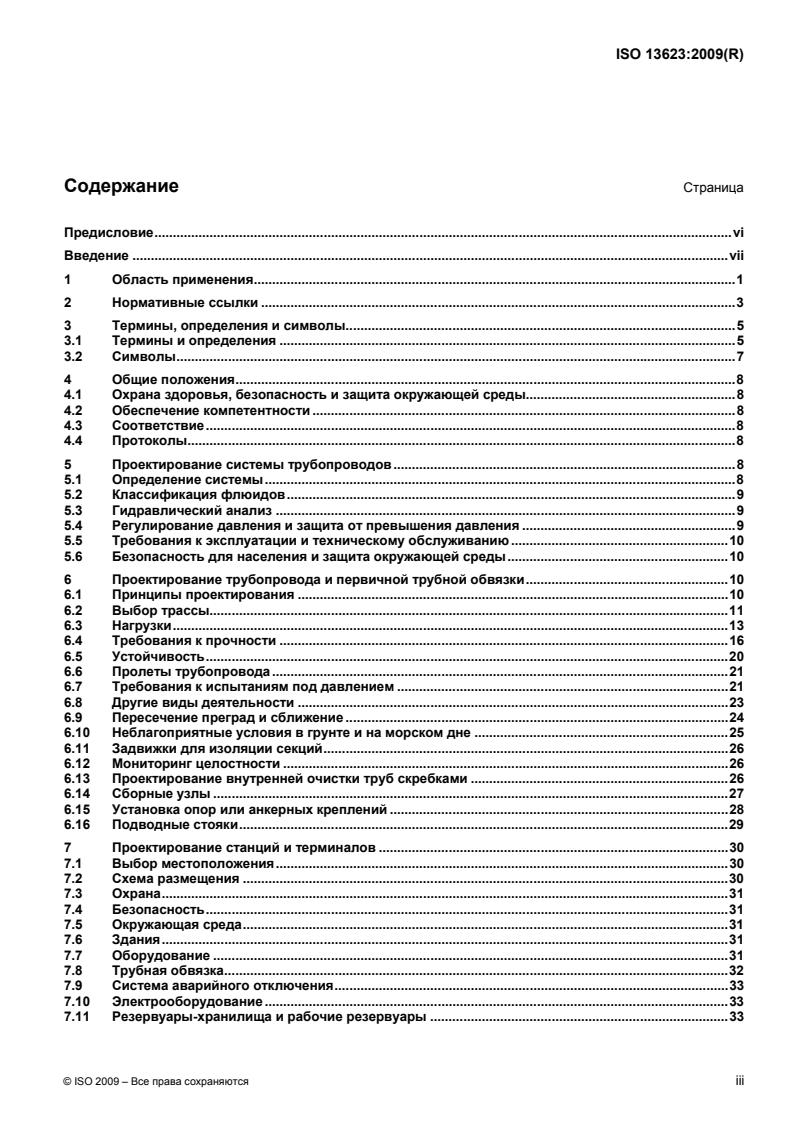
Contents Page
Foreword .vi
Introduction.vii
1 Scope .1
2 Normative references.3
3 Terms, definitions and symbols.5
3.1 Terms and definitions .5
3.2 Symbols.7
4 General .7
4.1 Health, safety and the environment.7
4.2 Competence assurance .8
4.3 Compliance .8
4.4 Records .8
5 Pipeline system design.8
5.1 System definition.8
5.2 Categorization of fluids.8
5.3 Hydraulic analysis .9
5.4 Pressure control and overpressure protection .9
5.5 Requirements for operation and maintenance.9
5.6 Public safety and protection of the environment.10
6 Design of pipeline and primary piping .10
6.1 Design principles.10
6.2 Route selection.10
6.3 Loads .12
6.4 Strength requirements .15
6.5 Stability.19
6.6 Pipeline spanning.20
6.7 Pressure test requirements.20
6.8 Other activities.21
6.9 Crossings and encroachments.23
6.10 Adverse ground and seabed conditions.24
6.11 Section isolation valves.24
6.12 Integrity monitoring.24
6.13 Design for pigging.24
6.14 Fabricated components .25
6.15 Attachment of supports or anchors .26
6.16 Offshore risers.27
7 Design of stations and terminals.28
7.1 Selection of location .28
7.2 Layout .28
7.3 Security.28
7.4 Safety .29
7.5 Environment.29
7.6 Buildings .29
7.7 Equipment .29
7.8 Piping.30
7.9 Emergency shutdown system.30
7.10 Electrical.31
7.11 Storage and working tankage .31
7.12 Heating and cooling stations. 31
7.13 Metering and pressure control stations . 31
7.14 Monitoring and communication systems. 31
7.15 Compressor stations for on-land gas supply systems. 32
8 Materials and coatings . 32
8.1 General material requirements for pipelines and primary piping. 32
8.2 Line pipe . 35
8.3 Components other than pipe. 35
8.4 Coatings. 36
9 Corrosion management. 38
9.1 General. 38
9.2 Internal corrosivity evaluation. 38
9.3 Internal corrosion mitigation . 39
9.4 External corrosion evaluation . 40
9.5 External corrosion mitigation. 42
9.6 Monitoring programmes and methods. 43
9.7 Evaluation of monitoring and inspection results . 44
9.8 Corrosion-management documentation . 44
10 Construction. 44
10.1 General. 44
10.2 Preparation of the route on land . 45
10.3 Preparation of the route offshore. 46
10.4 Welding and joining. 46
10.5 Coating. 47
10.6 Installation of pipelines on land . 47
10.7 Installation of offshore pipelines . 49
10.8 Cleaning and gauging . 52
10.9 As-built surveys . 52
10.10 Construction records . 52
11 Testing . 52
11.1 General. 52
11.2 Safety . 53
11.3 Procedures . 53
11.4 Acceptance criteria. 54
11.5 Tie-ins following testing. 54
11.6 Testing equipment. 54
11.7 Test documentation and records . 55
11.8 Disposal of test fluids. 55
11.9 Protection following test. 55
12 Pre-commissioning and commissioning. 56
12.1 General. 56
12.2 Cleaning and gauging procedures. 56
12.3 Drying procedures . 56
12.4 Functional testing of equipment and systems . 57
12.5 Documentation and records . 57
12.6 Start-up procedures and introduction of transported fluid. 57
13 Operation, maintenance and abandonment. 57
13.1 Management . 57
13.2 Operations . 60
13.3 Maintenance . 61
13.4 Changes to the design condition . 68
13.5 Life extension. 69
13.6 Abandonment. 70
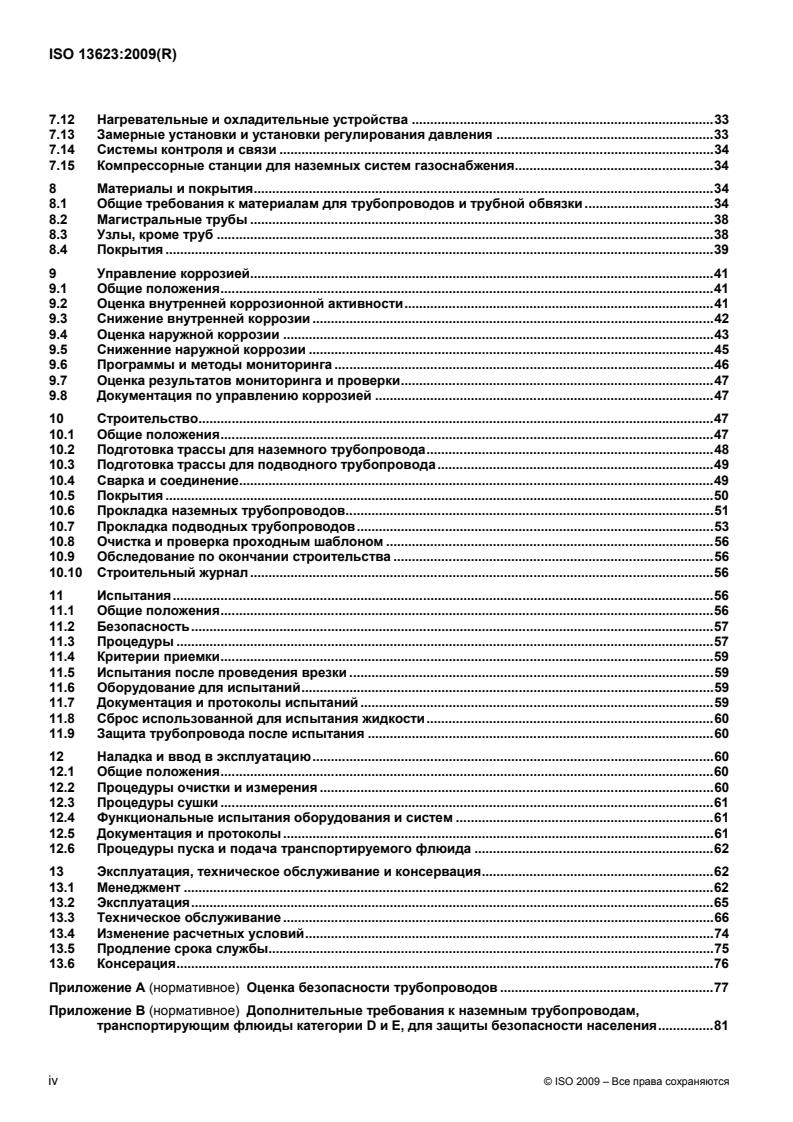
Annex A (normative) Safety evaluation of pipelines. 71
Annex B (normative) Supplementary requirements for public safety of pipelines for category D
and E fluids on land. 75
iv © ISO 2009 – All rights reserved
Annex C (informative) Pipeline route selection process.78
Annex D (informative) Examples of factors for routing considerations.79
Annex E (informative) Scope of procedures for operation, maintenance and emergencies .81
Annex F (informative) Records and documentation.83
Bibliography.84
Foreword
ISO (the International Organization for Standardization) is a worldwide federation of national standards bodies
(ISO member bodies). The work of preparing International Standards is normally carried out through ISO
technical committees. Each member body interested in a subject for which a technical committee has been
established has the right to be represented on that committee. International organizations, governmental and
non-governmental, in liaison with ISO, also take part in the work. ISO collaborates closely with the
International Electrotechnical Commission (IEC) on all matters of electrotechnical standardization.
International Standards are drafted in accordance with the rules given in the ISO/IEC Directives, Part 2.
The main task of technical committees is to prepare International Standards. Draft International Standards
adopted by the technical committees are circulated to the member bodies for voting. Publication as an
International Standard requires approval by at least 75 % of the member bodies casting a vote.
Attention is drawn to the possibility that some of the elements of this document may be the subject of patent
rights. ISO shall not be held responsible for identifying any or all such patent rights.
ISO 13623 was prepared by Technical Committee ISO/TC 67, Materials, equipment and offshore structures
for the petroleum, petrochemical and natural gas industries, Subcommittee SC 2, Pipeline transportation
systems.
This second edition cancels and replaces the first edition, (ISO 13623:2000), which has been technically
revised. Major revisions include replacement of various references to national standards with references to
International Standards; replacement of sections on coatings and cathodic protection with ISO references;
revision of design to accommodate line pipe above L555 in the new edition of ISO 3183; and the addition of a
section on life extension.
vi © ISO 2009 – All rights reserved
Introduction
Significant differences exist between member countries in the areas of public safety and protection of the
environment, which cannot be reconciled into a single preferred approach to pipeline transportation systems
for the petroleum and natural gas industries. Reconciliation was further complicated by the existence in some
member countries of legislation that establishes requirements for public safety and protection of the
environment. Recognizing these differences, ISO/TC 67/SC 2 concluded that this International Standard,
ISO 13623, should allow individual countries to apply their national requirements for public safety and the
protection of the environment.
This International Standard is not a design manual; rather, it is intended for use in conjunction with sound
engineering practice and judgment. This International Standard allows the use of innovative techniques and
procedures, such as reliability-based limit state design methods, providing the minimum requirements of this
International Standard are satisfied.
INTERNATIONAL STANDARD ISO 13623:2009(E)
Petroleum and natural gas industries — Pipeline transportation
systems
1 Scope
This International Standard specifies requirements and gives recommendations for the design, materials,
construction, testing, operation, maintenance and abandonment of pipeline systems used for transportation in
the petroleum and natural gas industries.
It applies to pipeline systems on land and offshore, connecting wells, production plants, process plants,
refineries and storage facilities, including any section of a pipeline constructed within the boundaries of such
facilities for the purpose of its connection. The extent of pipeline systems covered by this International
Standard is illustrated in Figure 1.
This International Standard applies to rigid, metallic pipelines. It is not applicable for flexible pipelines or those
constructed from other materials, such as glass-reinforced plastics.
This International Standard is applicable to all new pipeline systems and can be applied to modifications made
to existing ones. It is not intended that it apply retroactively to existing pipeline systems.
It describes the functional requirements of pipeline systems and provides a basis for their safe design,
construction, testing, operation, maintenance and abandonment.
Key
1 wellsite 5 pump station 9 depot
2 gathering station, treatment plant or process plant 6 valve station 10 distribution
3 liquid 7 tankage 11 compressor station
4 gas 8 refinery 12 pressure-reduction station
Pipeline elements covered by this International Standard
Connections with other facilities. The pipeline system should include an isolation valve at connections with
other facilities and at branches.
Pipeline elements not covered by this International Standard.
Station/plant area, offshore installation not covered by this International Standard.
Station/plant area covered by this International Standard.
NOTE The pipeline system should include an isolation valve at connections with other facilities and at branches.
Figure 1 — Extent of pipeline systems covered by this International Standard
2 © ISO 2009 – All rights reserved
2 Normative references
The following referenced documents are indispensable for the application of this document. For dated
references, only the edition cited applies. For undated references, the latest edition of the referenced
document (including any amendments) corrigendum, and maintenance agency output applies.
ISO 148-1, Metallic materials ⎯ Charpy pendulum impact test ⎯ Part 1: Test method
ISO 3183:2007, Petroleum and natural gas industries ⎯ Steel pipe for pipeline transportation systems
ISO 3977 (all parts), Gas turbines ⎯ Procurement
ISO 10439, Petroleum, chemical and gas service industries ⎯ Centrifugal compressors
ISO 10474:1991, Steel and steel products ⎯ Inspection documents
ISO 13707, Petroleum and natural gas industries ⎯ Reciprocating compressors
ISO 13709, Centrifugal pumps for petroleum, petrochemical and natural gas industries
ISO 13710, Petroleum, petrochemical and natural gas industries ⎯ Reciprocating positive displacement
pumps
ISO 13847, Petroleum and natural gas industries ⎯ Pipeline transportation systems ⎯ Welding of pipelines
ISO 14313, Petroleum and natural gas industries ⎯ Pipeline transportation systems ⎯ Pipeline valves
ISO 14723, Petroleum and natural gas industries ⎯ Pipeline transportation systems ⎯ Subsea pipeline
valves
ISO 15156-1, Petroleum and natural gas industries ⎯ Materials for use in H S-containing environments in oil
and gas production ⎯ Part 1: General principles for selection of cracking-resistant materials
ISO 15156-2, Petroleum and natural gas industries ⎯ Materials for use in H S-containing environments in oil
and gas production ⎯ Part 2: Cracking-resistant carbon and low alloy steels, and the use of cast irons
ISO 15156-3, Petroleum and natural gas industries ⎯ Materials for use in H S-containing environments in oil
and gas production ⎯ Part 3: Cracking-resistant CRAs (corrosion-resistant alloys) and other alloys
ISO 15589-1, Petroleum and natural gas industries ⎯ Cathodic protection of pipeline transportation
systems ⎯ Part 1: On-land pipelines
ISO 15589-2, Petroleum and natural gas industries ⎯ Cathodic protection of pipeline transportation
systems ⎯ Part 2: Offshore pipelines
ISO 15590-1, Petroleum and natural gas industries ⎯ Induction bends, fittings and flanges for pipeline
transportation systems ⎯ Part 1: Induction bends
ISO 15590-2, Petroleum and natural gas industries ⎯ Induction bends, fittings and flanges for pipeline
transportation systems ⎯ Part 2: Fittings
ISO 15590-3, Petroleum and natural gas industries ⎯ Induction bends, fittings and flanges for pipeline
transportation systems ⎯ Part 3: Flanges
ISO 15649, Petroleum and natural gas industries ⎯ Piping
ISO 16708, Petroleum and natural gas industries — Pipeline transportation systems — Reliability-based limit
state methods
ISO 21809-1, Petroleum and natural gas industries ⎯ External coatings for buried or submerged pipelines
used in pipeline transportation systems ⎯ Part 1: Polyolefin coatings (3-layer PE and 3-layer PP)
ISO 21809-2, Petroleum and natural gas industries ⎯ External coatings for buried or submerged pipelines
used in pipeline transportation systems ⎯ Part 2: Fusion-bonded epoxy coatings
ISO 21809-3, Petroleum and natural gas industries ⎯ External coatings for buried or submerged pipelines
used in pipeline transportation systems ⎯ Part 3: Field joint coatings
ISO 21809-4, Petroleum and natural gas industries ⎯ External coatings for buried or submerged pipelines
used in pipeline transportation systems ⎯ Part 4: Polyethylene coatings (2-layer PE)
ISO 21809-5, Petroleum and natural gas industries ⎯ External coatings for buried or submerged pipelines
used in pipeline transportation systems ⎯ Part 5: External concrete coatings
IEC 60034-1, Rotating electrical machines ⎯ Part 1: Rating and performance
IEC 60079-10, Electrical apparatus for explosive gas atmospheres ⎯ Part 10: Classification of hazardous
areas
IEC 60079-14, Electrical apparatus for explosive gas atmospheres ⎯ Part 14: Electrical installations in
hazardous areas (other than mines)
1)
API 620, Design and Construction of Large, Welded, Low-Pressure Storage Tanks
API 650, Welded Steel Tanks for Oil Storage
ASME B16.5, Pipe Flanges and Flanged Fittings — NPS 1/2 Through NPS 24
ASME Boiler and Pressure Vessel Code, Section VIII, Division I, Rules for Construction of Pressure Vessels
(BPVC)
2)
MSS SP-25, Standard Marking System for Valves, Fittings, Flanges and Unions
MSS SP-44, Steel Pipeline Flanges
3)
NFPA 30, Flammable and Combustible Liquids Code
NFPA 220, Standard on Types of Building Construction
1) American Petroleum Institute, 1220 L Street, Northwest Washington, DC 20005-4070, USA.
2) Manufacturer’s Standardization Society of the Valve and Fittings Industry, 127 Park Street, N.E., Vienna, VA 22180,
USA.
3) National Fire Protection Association, 1 Batterymarch Park, PO Box 9101, Quincy, MA 02269-9101, USA.
4 © ISO 2009 – All rights reserved
3 Terms, definitions and symbols
3.1 Terms and definitions
For the purposes of this International Standard, the following terms and definitions apply.
3.1.1
commissioning
activities associated with the initial filling of a pipeline system with the fluid being transported
3.1.2
design life
period for which the design basis is planned to remain valid
3.1.3
design pressure
maximum internal pressure of the pressure-containing components of the pipeline system designed in
compliance with this International Standard
3.1.4
design strength
strength level to be used in design, based on material’s specified minimum properties
3.1.5
fabricated assembly
grouping of pipe and components assembled as a unit and installed as a subunit of a pipeline system
3.1.6
fluid
medium being transported through the pipeline system
3.1.7
hot tapping
tapping, by mechanical cutting, of an in-service pipeline or piping
3.1.8
in-service pipeline
pipeline that has been commissioned for the transportation of fluid
3.1.9
lay corridor
corridor in which an offshore pipeline is being installed, usually determined prior to construction
3.1.10
location class
geographic area classified according to criteria based on population density and human activity
3.1.11
maintenance
all activities designed to retain the pipeline system in a state in which it can perform its required functions
NOTE These activities include inspections, surveys, testing, servicing, replacement, remedial works and repairs.
3.1.12
maximum allowable operating pressure
MAOP
maximum internal pressure at which a pipeline system, or parts thereof, is allowed to be operated in
compliance with this International Standard
3.1.13
offshore pipeline
pipeline laid in maritime waters and estuaries seaward of the ordinary high water mark
3.1.14
pipeline
those components of a pipeline system connected together to convey fluids between stations and/or plants,
including pipe, pig traps, components, appurtenances, isolating valves, and sectionalising valves
See Figure 1.
3.1.15
pipeline on land
pipeline laid on or in land, including lines laid under inland water courses
3.1.16
pipeline system
pipelines, stations, supervisory control and data acquisition system (SCADA), safety systems, corrosion
protection systems, and any other equipment, facility or building used in the transportation of fluids
3.1.17
piping
pipe, fittings and components inside stations and terminals, but not part of the pipeline
3.1.18
primary piping
piping conveying or storing the fluid transported by the pipeline
3.1.19
right-of-way
corridor of land within which the pipeline operator has the right to conduct activities in accordance with the
agreement with the land owner
3.1.20
riser
that part of an offshore pipeline, including subsea spool pieces, that extends from the sea bed to the pipeline
termination point on an offshore installation
3.1.21
secondary piping
piping carrying fluids other than those of the primary piping and pipeline, such as fuel gas, water, or lube oil
3.1.22
specified minimum tensile strength
SMTS
minimum tensile strength required by the specification or standard under which the material is purchased
3.1.23
specified minimum yield strength
SMYS
minimum yield strength required by the specification or standard under which the material is purchased
3.1.24
station
facility for the purpose of increasing pressure, decreasing pressure, storage, metering, heating, cooling or
isolating the transported fluid
6 © ISO 2009 – All rights reserved
3.2 Symbols
A internal cross-sectional area of the pipe
i
A cross-sectional area of pipewall
s
D specified diameter (outside or inside)
D maximum measured diameter (outside or inside)
max
D minimum measured diameter (outside or inside)
min
D nominal outside diameter
o
E modulus of elasticity
f hoop-stress design factor, obtained from Table 2 for pipelines on land and Table 3 for offshore
h
pipelines;
F pipe wall axial force
p design pressure
id
p minimum external hydrostatic pressure
od
O ovality or out-of-roundness
t specified minimum wall thickness
min
T installation temperature
T maximum or minimum metal temperature during operation
ν Poisson ratio
α linear coefficient of thermal expansion
σ equivalent stress
eq
σ circumferential stress
h
σ circumferential hoop stress due to fluid pressure
hp
σ longitudinal stress
l
σ specified minimum yield strength (SMYS) at the maximum design temperature
y
σ design strength
D
τ shear stress
4 General
4.1 Health, safety and the environment
The objective of this International Standard is that the design, material selection and specification,
construction, testing, operation, maintenance and abandonment of pipeline systems for the petroleum and
natural gas industries be safe and conducted with due regard to public safety and the protection of the
environment.
4.2 Competence assurance
All work associated with the design, construction, testing, operation, maintenance and abandonment of the
pipeline system shall be carried out by suitably qualified and competent persons.
4.3 Compliance
A quality system should be applied to assist compliance with the requirements of this International Standard.
NOTE ISO/TS 29001 gives sector-specific guidance on quality management systems.
4.4 Records
Records of the pipeline system shall be kept and maintained throughout its lifetime to demonstrate compliance
with the requirements of this International Standard. Annex F can be used for guidance or records which
should be retained.
5 Pipeline system design
5.1 System definition
The extent of the pipeline system, its functional requirements and applicable legislation should be defined and
documented.
The extent of the system should be defined by describing the system, including the facilities with their general
locations and the demarcations and interfaces with other facilities.
The functional requirements should define the required design life and design conditions. Foreseeable normal,
extreme and shut-in operating conditions with their possible ranges in flowrates, pressures, temperatures, fluid
compositions and fluid qualities should be identified and considered when defining the design conditions.
5.2 Categorization of fluids
The fluids being transported shall be placed in one of the following five categories given in Table 1 according
to the hazard potential with respect to public safety.
Table 1 — Classification of fluids with respect to potential hazard to public safety
Category A Non-flammable, water-based fluids.
Category B Flammable and/or toxic fluids that are liquids at ambient temperature and at atmospheric pressure
conditions. Typical examples are oil and petroleum products. Methanol is an example of a flammable
and toxic fluid.
Category C Non-flammable fluids that are non-toxic gases at ambient temperature and atmospheric pressure
conditions. Typical examples are nitrogen, carbon dioxide, argon and air.
Category D Non-toxic, single-phase natural gas.
Category E Flammable and/or toxic fluids that are gases at ambient temperature and atmospheric pressure
conditions and are conveyed as gases and/or liquids. Typical examples are hydrogen, natural gas (not
otherwise covered in category D), ethane, ethylene, liquefied petroleum gas (such as propane and
butane), natural gas liquids, ammonia and chlorine.
Gases or liquids not specifically included by name should be classified in the category containing fluids most
closely similar in hazard potential to those quoted. If the category is not clear, the more hazardous category
shall be assumed.
8 © ISO 2009 – All rights reserved
5.3 Hydraulic analysis
The hydraulics of the pipeline system should be analysed to demonstrate that the system can safely transport
the fluids for the design conditions specified in 5.1, and to identify and determine the constraints and
requirements for its operation. This analysis should cover steady-state and transient operating conditions.
NOTE Examples of constraints and operational requirements are allowances for pressure surges, prevention of
blockage such as caused by the formation of hydrates and wax deposition, measures to prevent unacceptable pressure
losses from higher viscosities at lower operating temperatures, measures for the control of liquid slug volumes in multi-
phase fluid transport, flow regime for internal corrosion control, erosional velocities and avoidance of slack line operations.
5.4 Pressure control and overpressure protection
Provisions such as pressure-control valves or automatic shutdown of pressurizing equipment shall be installed,
or procedures implemented, if the operating pressure can exceed the maximum allowable operating pressure
anywhere in the pipeline system. Such provisions or procedures shall prevent the operating pressure from
exceeding MAOP under normal steady-state conditions.
Overpressure protection, such as relief or source-isolation valves, shall be provided if necessary to prevent
incidental pressures exceeding the limits specified in 6.3.2.2 anywhere in the pipeline system.
5.5 Requirements for operation and maintenance
The requirements for the operation and maintenance of the pipeline system shall be established and
documented for use in the design and the preparation of procedures for operations and maintenance. Aspects
for which requirements should be specified include
⎯ requirements for identification of pipelines, stations and fluids transported;
⎯ principles for system control, including consideration of manning levels and instrumentation;
⎯ location and hierarchy of control centres;
⎯ voice and data communications;
⎯ corrosion management;
⎯ condition monitoring;
⎯ leak detection;
⎯ pigging philosophy;
⎯ access, sectionalizing and isolation for operation, maintenance and replacement;
⎯ interfaces with upstream and downstream facilities;
⎯ emergency shut-in;
⎯ depressurization with venting and/or drainage;
⎯ shutdowns and restart;
⎯ requirements identified from the hydraulic analysis.
5.6 Public safety and protection of the environment
National requirements that take precedence over the requirements in this International Standard shall be
specified by the country in which the pipeline system is located. The requirements in this International
Standard for public safety and protection of the environment shall apply where no specific national
requirements exist.
On-land pipeline systems for category D and E fluids should meet the requirements for public safety of
Annex B where specific requirements for public safety have not been defined by the country in which the
pipeline is located.
6 Design of pipeline and primary piping
6.1 Design principles
The extent and detail of the design shall be sufficient to demonstrate that the integrity and serviceability
required by this International Standard can be maintained during the design life.
Representative values for loads and load resistance shall be selected in accordance with good engineering
practice. Methods of analysis may be based on analytical, numerical or empirical models, or a combination of
these methods.
Principles of reliability-based limit state design methods may be applied, provided that all relevant ultimate and
serviceability limit states are considered. All sources of uncertainty in loads and load resistance shall be
considered and sufficient statistical data shall be available for adequate characterization of these uncertainties.
Reliability-based limit-state design methods shall not be used to replace the requirements in Tables 2 and 3
for the maximum permissible hoop stress due to fluid pressure.
NOTE 1 Ultimate limit states are normally associated with loss of structural integrity, e.g. rupture, fracture, fatigue or
collapse, whereas exceeding serviceability limit states prevents the pipeline from operating as intended.
NOTE 2 ISO 16708 gives guidance on reliability-based limit state design.
6.2 Route selection
6.2.1 Considerations
6.2.1.1 General
Route selection shall take into account the design, construction, operation, maintenance and abandonment of
the pipeline in accordance with this International Standard.
To minimize the possibility of future corrective work and limitations, anticipated urban and industry
developments shall be considered.
Factors that shall be considered during route selection include
⎯ safety of the public, and personnel working on or near the pipeline;
⎯ protection of the environment;
⎯ other property and facilities;
⎯ third-party activities;
10 © ISO 2009 – All rights reserved
⎯ geotechnical, corrosivity and hydrographical conditions;
⎯ requirements for construction, operation and maintenance;
⎯ national and/or local requirements;
⎯ future exploration.
Annex C provides guidance on the planning of a route selection. Annex D provides examples of factors that
should be addressed during the considerations required in 6.2.1.1 to 6.2.1.7.
6.2.1.2 Public safety
Pipelines conveying category B, C, D and E fluids should, where practicable, avoid built-up areas or areas
with frequent human activity.
In the absence of public safety requirements in a country, a safety evaluation shall be performed in
accordance with the general requirements of Annex A for
⎯ pipelines conveying category D fluids in locations where multi-storey buildings are prevalent, where traffic
is heavy or dense, and where there can be numerous other utilities underground;
⎯ pipelines conveying category E fluids.
6.2.1.3 Environment
An assessment of environmental impact shall consider as a minimum:
⎯ temporary works during construction, repair and modification;
⎯ the long-term presence of the pipeline;
⎯ potential loss of fluids.
6.2.1.4 Other facilities
Facilities along the pipeline route that can affect the pipeline should be identified and their impact evaluated in
consultation with the operator of these facilities.
6.2.1.5 Third-party activities
Third-party activities along the route shall be identified and should be evaluated in consultation with these
parties.
6.2.1.6 Geotechnical, hydrographical and meteorological conditions
Adverse geotechnical and hydrographic conditions shall be identified and mitigating measures defined. In
some instances, such as under arctic conditions, it can be necessary also to review meteorological conditions.
6.2.1.7 Construction, testing, operation and maintenance
The route shall permit the required access and working width for the construction, testing, operation and
maintenance, including any replacement, of the pipeline. The availability of utilities necessary for construction,
operation and maintenance should also be reviewed.
6.2.2 Surveys — Pipelines on land
Route and soil surveys shall be carried out to identify and locate with sufficient accuracy the relevant
geographical, ge
...
МЕЖДУНАРОДНЫЙ ISO
СТАНДАРТ 13623
Второе издание
2009-06-15
Промышленность нефтяная и газовая.
Системы транспортирования по
трубопроводам
Petroleum and natural gas industries – Pipeline transportation systems
Ответственность за подготовку русской версии несёт GOST R (Российская
Федерация) в соответствии со статьёй 18.1 Устава
Ссылочный номер
©
ISO 2000
Отказ от ответственности при работе в PDF
Настоящий файл PDF может содержать интегрированные шрифты. В соответствии с условиями лицензирования, принятыми
фирмой Adobe, этот файл можно распечатать или смотреть на экране, но его нельзя изменить, пока не будет получена лицензия на
установку интегрированных шрифтов в компьютере, на котором ведется редактирование. В случае загрузки настоящего файла
заинтересованные стороны принимают на себя ответственность за соблюдение лицензионных условий фирмы Adobe. Центральный
секретариат ISO не несет никакой ответственности в этом отношении.
Adobe - торговый знак Adobe Systems Incorporated.
Подробности, относящиеся к программным продуктам, использованным для создания настоящего файла PDF, можно найти в
рубрике General Info файла; параметры создания PDF оптимизированы для печати. Были приняты во внимание все меры
предосторожности с тем, чтобы обеспечить пригодность настоящего файла для использования комитетами – членами ISO. В
редких случаях возникновения проблемы, связанной со сказанным выше, просим информировать Центральный секретариат по
адресу, приведенному ниже.
ДОКУМЕНТ ЗАЩИЩЕН АВТОРСКИМ ПРАВОМ
Все права сохраняются. Если не указано иное, никакую часть настоящей публикации нельзя копировать или использовать в какой-
либо форме или каким-либо электронным или механическим способом, включая фотокопии и микрофильмы, без предварительного
письменного согласия ISO по указанному ниже адресу или членов ISO в стране заказчика.
ISO copyright office
Case postale 56 • CH-1211 Geneva 20
Tel. + 41 22 749 01 11
Fax + 41 22 734 10 79
E-mail copyright@iso.ch
Web www.iso.ch
Опубликовано в Швейцарии
ii © ISO 2009 – Все права сохраняются
Содержание Страница
Предисловие.vi
Введение .vii
1 Область применения.1
2 Нормативные ссылки .3
3 Термины, определения и символы.5
3.1 Термины и определения .5
3.2 Символы.7
4 Общие положения.8
4.1 Охрана здоровья, безопасность и защита окружающей среды.8
4.2 Обеспечение компетентности .8
4.3 Соответствие.8
4.4 Протоколы.8
5 Проектирование системы трубопроводов.8
5.1 Определение системы.8
5.2 Классификация флюидов.9
5.3 Гидравлический анализ .9
5.4 Регулирование давления и защита от превышения давления .9
5.5 Требования к эксплуатации и техническому обслуживанию .10
5.6 Безопасность для населения и защита окружающей среды.10
6 Проектирование трубопровода и первичной трубной обвязки.10
6.1 Принципы проектирования .10
6.2 Выбор трассы.11
6.3 Нагрузки.13
6.4 Требования к прочности .16
6.5 Устойчивость.20
6.6 Пролеты трубопровода.21
6.7 Требования к испытаниям под давлением .21
6.8 Другие виды деятельности .23
6.9 Пересечение преград и сближение .24
6.10 Неблагоприятные условия в грунте и на морском дне .25
6.11 Задвижки для изоляции секций.26
6.12 Мониторинг целостности .26
6.13 Проектирование внутренней очистки труб скребками .26
6.14 Сборные узлы .27
6.15 Установка опор или анкерных креплений .28
6.16 Подводные стояки.29
7 Проектирование станций и терминалов .30
7.1 Выбор местоположения.30
7.2 Схема размещения .30
7.3 Охрана.31
7.4 Безопасность.31
7.5 Окружающая среда.31
7.6 Здания.31
7.7 Оборудование .31
7.8 Трубная обвязка.32
7.9 Система аварийного отключения.33
7.10 Электрооборудование .33
7.11 Резервуары-хранилища и рабочие резервуары .33
7.12 Нагревательные и охладительные устройства .33
7.13 Замерные установки и установки регулирования давления .33
7.14 Системы контроля и связи .34
7.15 Компрессорные станции для наземных систем газоснабжения.34
8 Материалы и покрытия.34
8.1 Общие требования к материалам для трубопроводов и трубной обвязки .34
8.2 Магистральные трубы .38
8.3 Узлы, кроме труб .38
8.4 Покрытия .39
9 Управление коррозией.41
9.1 Общие положения.41
9.2 Оценка внутренней коррозионной активности.41
9.3 Снижение внутренней коррозии .42
9.4 Оценка наружной коррозии .43
9.5 Сниженние наружной коррозии .45
9.6 Программы и методы мониторинга .46
9.7 Оценка результатов мониторинга и проверки.47
9.8 Документация по управлению коррозией .47
10 Строительство.47
10.1 Общие положения.47
10.2 Подготовка трассы для наземного трубопровода.48
10.3 Подготовка трассы для подводного трубопровода.49
10.4 Сварка и соединение.49
10.5 Покрытия .50
10.6 Прокладка наземных трубопроводов.51
10.7 Прокладка подводных трубопроводов.53
10.8 Очистка и проверка проходным шаблоном .56
10.9 Обследование по окончании строительства .56
10.10 Строительный журнал.56
11 Испытания.56
11.1 Общие положения.56
11.2 Безопасность.57
11.3 Процедуры .57
11.4 Критерии приемки.59
11.5 Испытания после проведения врезки .59
11.6 Оборудование для испытаний.59
11.7 Документация и протоколы испытаний.59
11.8 Сброс использованной для испытания жидкости.60
11.9 Защита трубопровода после испытания .60
12 Наладка и ввод в эксплуатацию.60
12.1 Общие положения.60
12.2 Процедуры очистки и измерения .60
12.3 Процедуры сушки .61
12.4 Функциональные испытания оборудования и систем .61
12.5 Документация и протоколы.61
12.6 Процедуры пуска и подача транспортируемого флюида .62
13 Эксплуатация, техническое обслуживание и консервация.62
13.1 Менеджмент .62
13.2 Эксплуатация.65
13.3 Техническое обслуживание .66
13.4 Изменение расчетных условий.74
13.5 Продление срока службы.75
13.6 Консерация.76
Приложение A (нормативное) Оценка безопасности трубопроводов .77
Приложение B (нормативное) Дополнительные требования к наземным трубопроводам,
транспортирующим флюиды категории D и Е, для защиты безопасности населения.81
iv © ISO 2009 – Все права сохраняются
Приложение C (информативное) Процесс выбора трассы трубопровода.84
Приложение D (информативное) Примеры факторов, учитываемых при выборе трассы.85
Приложение E (информативное) Объем процедур для эксплуатации, технического
обслуживания и аварийных ситуаций .87
Приложение F (информативное) Протоколы и документация .89
Библиография .90
Предисловие
Международная организация по стандартизации (ISO) является всемирной федерацией национальных
организаций по стандартизации (комитетов-членов ISO). Разработка международных стандартов обычно
осуществляется техническими комитетами ISO. Каждый комитет-член, заинтересованный в деятельности,
для которой был создан технический комитет, имеет право быть представленным в этом комитете.
Международные правительственные и неправительственные организации, имеющие связи с ISO, также
принимают участие в работах. ISO осуществляет тесное сотрудничество с международной
электротехнической комиссией (IEC) по всем вопросам стандартизации в области электротехники.
Проекты международных стандартов разрабатываются согласно правилам, привёденным в Директивах
ISO/IEC, Часть 2.
Главной задачей технических комитетов является подготовка международных стандартов. Проекты
международных стандартов, принятые техническими комитетами, рассылаются комитетам-членам на
голосование. Для публикации в качестве международного стандарта требуется одобрение не менее 75 %
комитетов-членов, принявших участие в голосовании.
Следует иметь в виду, что, возможно, некоторые элементы настоящего международного стандарта могут
быть объектом патентных прав. ISO не несет ответственности за определение некоторых или всех таких
патентных прав.
Международный стандарт ISO 13623 разработан Техническим комитетом ISO/ТC 67, Материалы,
оборудование и морские сооружения для нефтяной и газовой промышленности, Подкомитетом SC 2,
Системы транспортирования по трубопроводам.
Настоящее второе издание отменяет и заменяет первое издание (ISO 13623:2000), которое прошло
технический пересмотр. Основные изменения включают замену различных ссылок на национальные
стандарты ссылками на международные стандарты; замену разделов по покрытиям и катодной защите
ссылками ISO; пересмотр проекта с целью включения трубопроводов, изготовленных из сортов стали выше
L555, в новое издание ISO 3183; и дополнение к разделу по продлению срока службы.
vi © ISO 2009 – Все права сохраняются
Введение
В вопросах безопасности населения и защиты окружающей среды среди стран-членов ИСО существуют
значительные различия, которые невозможно свести в один предпочтительный подход к системам
транспортирования по трубопроводам для нефтяной и газовой промышленности. Согласование также
осложнялось существованием в некоторых странах законов, устанавливающих требования к безопасности
населения и защите окружающей среды. Признавая эти различия, в ISO TC 67/SC 2 пришли к заключению,
что данный международный стандарт ISO 13623 должен разрешать применение отдельными странами
своих национальных требований к безопасности населения и защите окружающей среды.
Данный международный стандарт не является руководством по проектированию, он скорее предназначен
для применения в сочетании с установившейся практикой технических разработок и решений. Настоящий
международный стандарт позволяет использовать инновационные технологии и процедуры, такие как
методы расчета надежности по предельным состояниям, при условии выполнения минимальных
требований, установленных в данном международном стандарте.
МЕЖДУНАРОДНЫЙ СТАНДАРТ ISO 13623:2009(R)
Промышленность нефтяная и газовая. Системы
транспортирования по трубопроводам
1 Область применения
Данный международный стандарт устанавливает требования и дает рекомендации по проектированию,
материалам, строительству, испытаниям, эксплуатации, техническому обслуживанию и консервации систем
трубопроводов, используемых для транспортирования в нефтяной и газовой промышленности.
Данный стандарт применим к наземным и подводным трубопроводным системам, соединяющим скважины,
производственные и перерабатывающие установки, нефтеперегонные заводы и хранилища, включая
любые участки трубопровода в границах этих сооружений, предназначенные для подключения этих
сооружений. На Рисунке 1 показаны системы трубопроводов, на которые распространяется данный
международный стандарт.
Настоящий международный стандарт применяется к жестким металлическим трубопроводам. Он не
применим к гибким трубопроводам или трубопроводам, построенным из других материалов, например,
армированных стекловолокном пластмасс.
Настоящий международный стандарт распространяется на все вновь строящиеся трубопроводные системы
и может применяться для модификации существующих систем. Данный стандарт не имеет обратной силы и
не предназначен для обязательного применения к существующим системам трубопроводов.
Он описывает функциональные требования к системам трубопроводов и обеспечивает основу для их
безопасного проектирования, строительства, испытаний, эксплуатации, технического обслуживания и
консервации.
Обозначение
1 скважина 5 насосно-перекачивающая 9 хранилище
станция
2 сборный пункт, очистные или перерабатывающие 6 станция задвижек 10 распределительная сеть
установки
3 жидкость 7 резервуарный парк 11 компрессорная станция
4 газ 8 нефтеперегонный завод 12 редукционная станция
Элементы трубопроводной системы, подпадающей под данный международный стандарт
Подключения к другим сооружениям. Рекомендуется установить в трубопроводную систему изолирующие задвижки в
местах подключения к другим сооружениям и ответвлений.
Элементы трубопроводной системы, не подпадающие под данный международный стандарт.
Участок станции/установки, морские сооружения, не подпадающие под данный международный стандарт.
Участок станции/установки, подпадающий под данный международный стандарт.
ПРИМЕЧАНИЕ Рекомендуется установить в трубопроводную систему изолирующие задвижки в местах подключения к другим
сооружениям и ответвлений.
Рисунок 1 — Системы трубопроводов, на которые распространяется данный международный
стандарт
2 © ISO 2009 – Все права сохраняются
2 Нормативные ссылки
Следующие ссылочные документы обязательны для применения данного документа. Для жестких ссылок
применяется только указанное издание. Для плавающих ссылок применяется самое последнее издание
указанного документа (включая все изменения).
ISO 148-1, Материалы металлические. Испытание на удар по Шарпи на маятниковом копре. Часть 1. Метод
испытания
ISO 3183:2007, Промышленность нефтяная и газовая. Трубы стальные для трубопроводных
транспортных систем
ISO 3977 (все части), Турбины газовые. Технические условия на поставку
ISO 10439, Промышленность нефтяная, химическая и газовая. Компрессоры центробежные
ISO 10474:1991, Сталь и стальные изделия. Документы о контроле
ISO 13707, Промышленность нефтяная и газовая. Поршневые компрессоры
ISO 13709, Насосы центробежные для нефтяной, нефтехимической и газовой промышленности
ISO 13710, Промышленность нефтяная, нефтехимическая и газовая. Поршневые насосы прямого
вытеснения
ISO 13847, Промышленность нефтяная и газовая. Системы транспортирования по трубопроводам.
Сварка трубопроводов.
ISO 14313, Промышленность нефтяная и газовая. Системы транспортирования по трубопроводам.
Задвижки для трубопроводов
ISO 14723, Промышленность нефтяная и газовая. Системы транспортирования по трубопроводам.
Задвижки для подводных трубопроводов
ISO 15156-1, Промышленность нефтяная и газовая. Материалы для применения в средах, содержащих
сероводород, при нефте- и газодобыче. Часть 1. Общие принципы выбора трещиностойких материалов
ISO 15156-2, Промышленность нефтяная и газовая. Материалы для применения в средах, содержащих
сероводород, при нефте- и газодобыче. Часть 2. Трещиностойкие углеродистые и низколегированные
стали и применение литейного чугуна
ISO 15156-3, Промышленность нефтяная и газовая. Материалы для применения в средах, содержащих
сероводород, при нефте- и газодобыче. Часть 3. Трещиностойкие коррозионностойкие (CRA) и другие
сплавы
ISO 15589-1, Промышленность нефтяная и газовая. Катодная защита систем транспортирования по
трубопроводам. Часть 1. Наземные трубопроводы
ISO 15589-2, Промышленность нефтяная и газовая. Катодная защита систем транспортирования по
трубопроводам. Часть 2. Морские трубопроводы
ISO 15590-1, Промышленность нефтяная и газовая. Колена, изготовленные методом индукционного
нагрева, фитинги и фланцы для систем транспортировки по трубопроводам. Часть 1. Колена,
изготовленные методом индукционного нагрева
ISO 15590-2, Промышленность нефтяная и газовая. Колена, изготовленные методом индукционного
нагрева, фитинги и фланцы для систем транспортировки по трубопроводам. Часть 2. Фитинги
ISO 15590-3, Промышленность нефтяная и газовая. Колена, изготовленные методом индукционного
нагрева, фитинги и фланцы для систем транспортировки по трубопроводам. Часть 3. Фланцы
ISO 15649, Промышленность нефтяная и газовая. Трубы
ISO 16708, Промышленность нефтяная и газовая. Системы транспортирования по трубопроводам.
Методы расчета надежности по предельным состояниям
ISO 21809-1, Промышленность нефтяная и газовая. Наружные покрытия для подземных или подводных
трубопроводов, используемых в системах транспортирования по трубопроводам. Часть 1.
Полиолефиновые покрытия (трехслойный полиэтилен (РЕ) и трехслойный полипропилен (РР))
ISO 21809-2, Промышленность нефтяная и газовая. Наружные покрытия для подземных или подводных
трубопроводов, используемых в системах транспортирования по трубопроводам. Часть 2.
Наплавляемые эпоксидные покрытия
ISO 21809-3, Промышленность нефтяная и газовая. Наружные покрытия для подземных или подводных
трубопроводов, используемых в системах транспортирования по трубопроводам. Часть 3. Покрытия
стыков, наносимые в полевых условиях
ISO 21809-4, Промышленность нефтяная и газовая. Наружные покрытия для подземных или подводных
трубопроводов, используемых в системах транспортирования по трубопроводам. Часть 4.
Полиэтиленовые покрытия (2-слойный РЕ)
ISO 21809-5, Промышленность нефтяная и газовая. Наружные покрытия для подземных или подводных
трубопроводов, используемых в системах транспортирования по трубопроводам. Часть 5. Наружные
бетонные покрытия
IEC 60034-1, Машины электрические вращающиеся. Часть 1. Номинальные значения параметров и
эксплуатационные характеристики
IEC 60079-10, Оборудование электрическое для взрывоопасных газовых сред. Часть 10. Классификация
опасных зон
IEC 60079-14, Оборудование электрическое для взрывоопасных газовых сред. Часть 14. Электрические
установки в опасных зонах (кроме шахт)
1)
API 620, Проектирование и строительство крупных сварных резервуаров-хранилищ, работающих при
низком давлении
API 650, Стальные сварные резервуары-хранилища для нефти
ASME B16.5, Трубные фланцы и фланцевая арматура. Размеры NPS ½ до NPS 24
Код ASME по котлам и сосудам для работы под давлением, Секция VIII, Раздел I, Правила
конструирования сосудов для работы под давлением (BPVC)
2)
MSS SP-25, Стандартная система маркировки задвижек, арматуры, фланцев и узлов
MSS SP-44, Стальные трубопроводные фланцы
3)
NFPA 30, Нормы для самовозгарающихся и горючих жидкостей
1) American Petroleum Institute, 1220 L Street, Northwest Washington, DC 20005-4070, USA.
2) Manufacturer’s Standardization Society of the Valve and Fittings Industry, 127 Park Street, N.E., Vienna, VA 22180, USA.
3) National Fire Protection Association, 1 Batterymarch Park, PO Box 9101, Quincy, MA 02269-9101, USA.
4 © ISO 2009 – Все права сохраняются
NFPA 220, Стандарты на строительство типовых зданий
3 Термины, определения и символы
3.1 Термины и определения
Применительно к данному международному стандарту применяются следующие термины и определения.
3.1.1
ввод в эксплуатацию
commissionning
мероприятия по первоначальному заполнению трубопроводной системы транспортируемым по ней
флюидом
3.1.2
расчетный срок службы
design life
период времени, в течение которого основы проектирования остаются действующими
3.1.3
расчетное давление
design pressure
максимальное внутреннее давление работающих под давлением узлов трубопроводной системы,
спроектированной в соответствии с данным международным стандартом
3.1.4
расчетная прочность
design strength
уровень прочности, используемый при проектировании на основании заданных минимальных свойств
материала
3.1.5
сборный узел
fabricated assembly
группа труб и узлов, собранная в комплекте и устанавливаемая как единый узел в трубопроводной системе
3.1.6
флюид
fluid
вещество, транспортируемое по трубопроводной системе
3.1.7
горячее нарезание резьбы
hot tapping
нарезание резьбы механическим резанием на находящемся в эксплуатации трубопроводе или трубе
3.1.8
эксплуатируемый трубопровод
in-service pipeline
трубопровод, который введен в эксплуатацию для транспортирования флюида
3.1.9
коридор прокладки
lay corridor
коридор, в котором монтируется подводный трубопровод, обычно определяемый до начала строительства
3.1.10
класс местоположения
location class
географический район, классифицируемый в соответствии с критериями, основанными на плотности
населения и его деятельности
3.1.11
техническое обслуживание
maintenance
все мероприятия, предназначенные для поддержания системы трубопровода в таком состоянии, чтобы он
мог использоваться по назначению
ПРИМЕЧАНИЕ К этим мероприятиям относятся проверки, обследования, испытания, обслуживание, замена частей,
восстановительные и ремонтные работы.
3.1.12
максимальное допустимое рабочее давление
(МАОР)
maximum allowable operating pressure
максимальное внутреннее давление, при котором допускается эксплуатация трубопроводной системы, или
части ее в соответствии с данным международным стандартом
3.1.13
подводный трубопровод
offshore pipeline
трубопровод, проложенный в морских водах и устьях рек в сторону моря от обычной отметки
максимального подъема уровня воды
3.1.14
трубопровод
pipeline
те узлы трубопроводной системы, соединенные вместе, по которым передается флюид между станциями
и/или установками, включая трубы, ловушки для скребков, узлы, дополнительные приспособления,
изолирующие и секционирующие задвижки
См. Рисунок 1.
3.1.15
наземный трубопровод
pipeline on land
трубопровод, проложенный по земле или в земле, включая линии, проложенные под наземными
водотоками
3.1.16
система трубопровода
pipeline system
трубопроводы, станции, система диспетческого управления и сбора данных (SCADA), аварийные системы,
системы защиты от коррозии и любое другое оборудование, сооружения или здания, используемые для
транспортирования флюидов
3.1.17
трубная обвязка
piping
труба, фитинги и узлы внутри станций и терминалов, не являющиеся частью рассматриваемого
трубопровода
3.1.18
первичная трубная обвязка
primary piping
система труб для подачи или хранения флюида, транспортируемого по рассматриваемому трубопроводу
3.1.19
полоса отвода
right-of-way
наземный коридор, в пределах которого оператор трубопровода имеет право осуществлять мероприятия в
соответствии с соглашением с владельцем земли
6 © ISO 2009 – Все права сохраняются
3.1.20
стояк
riser
та часть подводного трубопровода, включая подводные скрепляющие трубные секции, которые проходят от
морского дна до места подключения к трубопроводу на морском сооружении
3.1.21
вторичная трубная обвязка
secondary piping
система труб для подачи флюидов, отличающихся от флюидов в первичной трубной обвязке или
трубопроводе, например, газообразного топлива, воды или масла
3.1.22
заданный минимальный предел прочности
specified minimum tensile strength
SMTS
минимальный предел прочности на растяжение, требуемый техническими условиями или стандартом, в
соответствии с которым закупается материал
3.1.23
заданный минимальный предел текучести
specified minimum yield strength
SMYS
минимальный предел текучести, требуемый техническими условиями или стандартом, в соответствии с
которым закупается материал
3.1.24
станция
station
сооружение для увеличения давления, снижения давления, хранения, измерения, нагревания, охлаждения
или отключения подачи транспортируемого флюида
3.2 Символы
A площадь внутреннего поперечного сечения трубы
i
A площадь поперечного сечения стенки трубы
s
D заданный диаметр (наружный или внутренний)
D максимальный измеренный диаметр (наружный или внутренний)
max
D минимальный измеренный диаметр (наружный или внутренний)
min
D номинальный наружный диаметр
o
E модуль упругости
f коэффициент безопасности для окружного напряжения, полученный из Таблицы 2 для наземных
h
трубопроводов и из Таблицы 3 для подводных трубопроводов
F осевая нагрузка на стенку трубы
p расчетное давление
id
p минимальное внешнее гидростатическое давление
od
O овальность или отклонение от окружности
t заданная минимальная толщина стенки
min
T температура монтажа
T максимальная или минимальная температура металла при эксплуатации
ν коэффициент Пуассона
α линейный коэффициент теплового расширения
σ эквивалентное напряжение
eq
σ окружное напряжение
h
σ окружное напряжение за счет давления флюида
hp
σ продольное напряжение
l
σ заданный минимальный предел текучести (SMYS) при максимальной расчетной температуре
y
σ расчетная прочность
D
τ напряжение сдвига
4 Общие положения
4.1 Охрана здоровья, безопасность и защита окружающей среды
Цель данного международного стандарта заключается в том, чтобы проектирование, выбор материала и
технические условия, строительство, испытания, эксплуатация, техническое обслуживание и консервация
трубопроводных систем для нефтяной и газовой промышленности были безопасны и осуществлялись с
надлежащим учетом безопасности населения и защиты окружающей среды.
4.2 Обеспечение компетентности
Все работы, связанные с проектированием, строительством, испытаниями, эксплуатацией, техническим
обслуживанием и консервацией трубопроводных систем должны осуществляться надлежащим образом
аттестованным и компетентным персоналом.
4.3 Соответствие
Для соответствия требованиям данного международного стандарта следует применять систему
обеспечения качества.
ПРИМЕЧАНИЕ ISO/TS 29001 обеспечивает конкретные указания в отношении систем менеджмента качества.
4.4 Протоколы
Протоколы, касающиеся трубопроводной системы, должны храниться и вестись в течение всего срока службы
трубопровода для демонстрации соответствия требованиям данного международного стандарта. Приложение F
можно использовать в качестве руководства в отношении протоколов, которые должны сохраняться.
5 Проектирование системы трубопроводов
5.1 Определение системы
Необходимо определить и задокументировать границы трубопроводной системы, предъявляемые к ней
функциональные требования и применимое законодательство.
8 © ISO 2009 – Все права сохраняются
Границы трубопроводной системы следует определять путем описания этой системы, включая сооружения
вместе с их общим расположением, а также границами раздела и точками контакта с другими
сооружениями.
Функциональные требования должны определять требуемый расчетный срок службы и расчетные условия.
При определении расчетных условий следует определить и рассмотреть прогнозируемые условия
нормальной эксплуатации, экстремальные условия эксплуатации и условия перекрытия с возможными
диапазонами расходов, давлений, температур, составов и качества флюида.
5.2 Классификация флюидов
Транспортируемые флюиды должны быть отнесены к одной из пяти категорий в соответствии с возможным
риском для безопасности населения:
Таблица 1 – Классификация флюидов в соответствии с возможным риском для безопасности
населения
Категория A Обычные негорючие водные флюиды.
Категория B Горючие и/или токсичные флюиды, которые при наружной температуре и атмосферном давлении
являются жидкостями. Типичными примерами являются нефть и нефтепродукты. Метанол является
примером горючей и токсичной жидкости.
Категория C Негорючие флюиды, которые при наружной температуре и атмосферном давлении являются
нетоксичными газами. Типичными примерами является азот, диоксид углерода, аргон и воздух.
Категория D Нетоксичный однофазный природный газ.
Категория E Горючие и/или токсичные флюиды, которые при наружной температуре и атмосферном давлении
являются газами и транспортируются в виде газа и/или жидкости. Типичными примерами является
водород, природный газ (не подпадающий под категорию D), этан, этилен, сжиженный нефтяной газ
(такой как пропан и бутан), сжиженный природный газ, аммиак и хлор.
Газы или жидкости, не включенные конкретно по названию, следует относить к категории, включающей
флюиды с наиболее близким риском к рассматриваемому флюиду. Если категория не ясна, следует
отнести флюид к более опасной категории.
5.3 Гидравлический анализ
Гидравлические характеристики трубопроводной системы следует проанализировать с целью
демонстрации возможностей системы безопасно транспортировать данный флюид в расчетных условиях,
установленных в 5.1, а также идентификации и определения ограничений и требований к ее эксплуатации.
Такой анализ должен охватывать стационарные и переходные условия эксплуатации.
ПРИМЕЧАНИЕ Примерами ограничений и требований к эксплуатации являются: допуски на выброс давления,
предотвращение засорения, например, в результате образования гидратов и отложения воска; меры по
предотвращению неприемлемых потерь давления за счет высокой вязкости при низких температурах эксплуатации;
меры по регулированию объема жидкого шлака при транспортировании многофазного флюида, режима потока для
предотвращения внутренней коррозии, скорости эрозии и предотвращение работы провисшей нитки.
5.4 Регулирование давления и защита от превышения давления
Необходимо установить такое оборудование, как клапаны регулировки давления, или средства для
автоматического отключения оборудования, работающего под давлением, либо ввести соответствующие
процедуры, если в любом месте трубопроводной системы рабочее давление может превышать
максимальное допустимое рабочее давление. Такие средства или процедуры должны препятствовать тому,
чтобы рабочее давление превысило МАОР (максимальное допустимое рабочее давление) при нормальных
стационарных условиях.
Защита от превышения давления, такая как применение предохранительных клапанов или клапанов для
изолирования источника давления, должна быть обеспечена, если необходимо предупредить случайное
превышение пределов давления, установленных в 6.3.2.1, на любом участке трубопроводной системы.
5.5 Требования к эксплуатации и техническому обслуживанию
Требования к эксплуатации и техническому обслуживанию трубопроводной системы должны быть
установлены и задокументированы для использования при проектировании и подготовке процедур
эксплуатации и технического обслуживания. Аспекты, для которых следует задать требования, включают:
⎯ требования к идентификации трубопроводов, станций и транспортируемых флюидов;
⎯ принципы управления системой, учитывая уровень участия человека и обеспечение контрольно-
измерительными приборами;
⎯ расположение и подчиненность центров управления;
⎯ системы голосовой связи и передачи данных;
⎯ менеджмент коррозии;
⎯ диагностический контроль технического состояния;
⎯ обнаружение течи;
⎯ подход к внутренней очистке скребками;
⎯ доступ, разделение на секции и изолирование для эксплуатации, технического обслуживания и замены;
⎯ стыки с сооружениями вверх и вниз по потоку;
⎯ аварийное перекрытие;
⎯ сброс давления с помощью вентиляции и/или слива;
⎯ отключение и последующий пуск;
⎯ требования, определенные при гидравлическом анализе.
5.6 Безопасность для населения и защита окружающей среды
Национальные требования, которые имеют преимущества перед требованиями данного международного
стандарта, должны устанавливаться той страной, в которой расположен трубопровод. Требования
настоящего международного стандарта в отношении безопасности населения и защиты окружающей среды
должны применяться там, где не существует конкретных национальных требований.
Наземные трубопроводные системы для транспортирования флюидов категории D и Е должны
соответствовать требованиям к безопасности для населения приложения В, если специальные требования
к безопасности для населения не определены страной, в которой расположен трубопровод.
6 Проектирование трубопровода и первичной трубной обвязки
6.1 Принципы проектирования
Объем и конкретные данные проектирования трубопроводной системы должны быть достаточными для
того, чтобы продемонстрировать, что целостность и эксплуатационная пригодность, требуемые данным
международным стандартом, могут поддерживаться в течение расчетного срока службы данной
трубопроводной системы.
10 © ISO 2009 – Все права сохраняются
Репрезентативные значения нагрузок и сопротивлений нагрузке должны выбираться в соответствии с
установившейся инженерной практикой. Методы анализа могут быть основаны на аналитической, числовой
или эмпирической модели либо на их сочетании.
Можно пользоваться принципами оценки надежности с использованием методов расчета по предельным
состояниям при условии, что все соответствующие крайние предельные состояния и предельные состояния
эксплуатационной надежности учтены. Все соответствующие источники неопределенности для нагрузок и
сопротивления нагрузке должны учитываться. Необходимо иметь достаточный объем статистических
данных для адекватной характеристики этих неопределенностей.
Принципы оценки надежности с использованием методов расчета по предельным состояниям не должны
использоваться взамен требов
...
Questions, Comments and Discussion
Ask us and Technical Secretary will try to provide an answer. You can facilitate discussion about the standard in here.
Loading comments...