


ISO/IEC TR 19791:2010
(Main)Information technology — Security techniques — Security assessment of operational systems
Information technology — Security techniques — Security assessment of operational systems
ISO/IEC TR 19791:2010 provides guidance and criteria for the security evaluation of operational systems. It provides an extension to the scope of ISO/IEC 15408 by taking into account a number of critical aspects of operational systems not addressed in ISO/IEC 15408 evaluation. The principal extensions that are required address evaluation of the operational environment surrounding the target of evaluation, and the decomposition of complex operational systems into security domains that can be separately evaluated. ISO/IEC TR 19791:2010 provides: a definition and model for operational systems; a description of the extensions to ISO/IEC 15408 evaluation concepts needed to evaluate such operational systems; a methodology and process for performing the security evaluation of operational systems; additional security evaluation criteria to address those aspects of operational systems not covered by the ISO/IEC 15408 evaluation criteria. ISO/IEC TR 19791:2010 permits the incorporation of security products evaluated against ISO/IEC 15408 into operational systems evaluated as a whole using ISO/IEC TR 19791:2010. ISO/IEC TR 19791:2010 is limited to the security evaluation of operational systems and does not consider other forms of system assessment. It does not define techniques for the identification, assessment and acceptance of operational risk.
Technologies de l'information — Techniques de sécurité — Évaluation de la sécurité des systèmes opérationnels
General Information
- Status
- Published
- Publication Date
- 21-Mar-2010
- Current Stage
- 9093 - International Standard confirmed
- Start Date
- 16-Sep-2015
- Completion Date
- 12-Feb-2026
Relations
- Effective Date
- 18-Dec-2008
Overview
ISO/IEC TR 19791:2010 - Information technology - Security techniques - Security assessment of operational systems - is a Technical Report that extends the product-focused evaluation model of ISO/IEC 15408 (Common Criteria) to cover complex, real-world operational systems. The report defines an operational system model (people, processes and technology in an operational environment) and provides guidance, criteria and a methodology for performing security evaluations of such systems. It is limited to security evaluation activities and explicitly does not define operational risk‑identification or risk‑acceptance techniques.
Key topics and technical requirements
- Definition and model for operational systems - clarifies scope beyond IT products to include personnel, procedures and the operational environment.
- Extensions to ISO/IEC 15408 concepts - adapts evaluation philosophy and assurance concepts to operational systems and composite systems.
- Decomposition into security domains - guidance for splitting complex systems into evaluable domains.
- Methodology and process for evaluation - roles and responsibilities, timing of evaluation, evaluation activities and periodic reassessment.
- Documentation and artefact requirements - System Security Target (SST), Protection Profiles, architecture, design, configuration and operational guidance.
- Testing, configuration management and vulnerability assessment - procedures and assurance classes tailored to operational system concerns.
- Use of evaluated products - how ISO/IEC 15408‑evaluated components can be incorporated into operational system evaluations.
- Annex material - normative annexes providing functional control requirements, assurance requirements and a detailed evaluation methodology.
Practical applications and who uses it
ISO/IEC TR 19791:2010 is intended for:
- Evaluators and evaluation authorities applying Common Criteria concepts to deployed systems.
- System developers, integrators and architects designing secure operational systems and preparing System Security Targets (SSTs) or System Protection Profiles.
- Security managers and operations teams responsible for pre‑deployment testing, configuration management, vulnerability assessment and live operation preparation.
- Sponsors and acquisition authorities seeking a structured security evaluation approach for complex, composite systems.
Typical uses include pre‑deployment security evaluation of integrated systems, acceptance testing of operational environments, and supporting accreditation or assurance decisions where product evaluations alone are insufficient.
Related standards
- ISO/IEC 15408 (Common Criteria) - main baseline standard extended by TR 19791.
- ISO/IEC JTC 1/SC 27 - the technical committee responsible for IT security techniques and related standards.
Note: TR 19791 complements ISO/IEC 15408 and provides operational‑level evaluation guidance; it does not replace formal risk assessment standards.
Keywords: ISO/IEC TR 19791:2010, security assessment of operational systems, operational system security evaluation, ISO/IEC 15408 extensions, System Security Target, Protection Profile, security domains, operational environment.
Get Certified
Connect with accredited certification bodies for this standard

BSI Group
BSI (British Standards Institution) is the business standards company that helps organizations make excellence a habit.

Bureau Veritas
Bureau Veritas is a world leader in laboratory testing, inspection and certification services.

DNV
DNV is an independent assurance and risk management provider.
Sponsored listings
Frequently Asked Questions
ISO/IEC TR 19791:2010 is a technical report published by the International Organization for Standardization (ISO). Its full title is "Information technology — Security techniques — Security assessment of operational systems". This standard covers: ISO/IEC TR 19791:2010 provides guidance and criteria for the security evaluation of operational systems. It provides an extension to the scope of ISO/IEC 15408 by taking into account a number of critical aspects of operational systems not addressed in ISO/IEC 15408 evaluation. The principal extensions that are required address evaluation of the operational environment surrounding the target of evaluation, and the decomposition of complex operational systems into security domains that can be separately evaluated. ISO/IEC TR 19791:2010 provides: a definition and model for operational systems; a description of the extensions to ISO/IEC 15408 evaluation concepts needed to evaluate such operational systems; a methodology and process for performing the security evaluation of operational systems; additional security evaluation criteria to address those aspects of operational systems not covered by the ISO/IEC 15408 evaluation criteria. ISO/IEC TR 19791:2010 permits the incorporation of security products evaluated against ISO/IEC 15408 into operational systems evaluated as a whole using ISO/IEC TR 19791:2010. ISO/IEC TR 19791:2010 is limited to the security evaluation of operational systems and does not consider other forms of system assessment. It does not define techniques for the identification, assessment and acceptance of operational risk.
ISO/IEC TR 19791:2010 provides guidance and criteria for the security evaluation of operational systems. It provides an extension to the scope of ISO/IEC 15408 by taking into account a number of critical aspects of operational systems not addressed in ISO/IEC 15408 evaluation. The principal extensions that are required address evaluation of the operational environment surrounding the target of evaluation, and the decomposition of complex operational systems into security domains that can be separately evaluated. ISO/IEC TR 19791:2010 provides: a definition and model for operational systems; a description of the extensions to ISO/IEC 15408 evaluation concepts needed to evaluate such operational systems; a methodology and process for performing the security evaluation of operational systems; additional security evaluation criteria to address those aspects of operational systems not covered by the ISO/IEC 15408 evaluation criteria. ISO/IEC TR 19791:2010 permits the incorporation of security products evaluated against ISO/IEC 15408 into operational systems evaluated as a whole using ISO/IEC TR 19791:2010. ISO/IEC TR 19791:2010 is limited to the security evaluation of operational systems and does not consider other forms of system assessment. It does not define techniques for the identification, assessment and acceptance of operational risk.
ISO/IEC TR 19791:2010 is classified under the following ICS (International Classification for Standards) categories: 35.030 - IT Security; 35.040 - Information coding. The ICS classification helps identify the subject area and facilitates finding related standards.
ISO/IEC TR 19791:2010 has the following relationships with other standards: It is inter standard links to ISO/IEC TR 19791:2006. Understanding these relationships helps ensure you are using the most current and applicable version of the standard.
ISO/IEC TR 19791:2010 is available in PDF format for immediate download after purchase. The document can be added to your cart and obtained through the secure checkout process. Digital delivery ensures instant access to the complete standard document.
Standards Content (Sample)
TECHNICAL ISO/IEC
REPORT TR
Second edition
2010-04-01
Information technology — Security
techniques — Security assessment of
operational systems
Technologies de l'information — Techniques de sécurité — Évaluation
de la sécurité des systèmes opérationnels
Reference number
©
ISO/IEC 2010
PDF disclaimer
This PDF file may contain embedded typefaces. In accordance with Adobe's licensing policy, this file may be printed or viewed but
shall not be edited unless the typefaces which are embedded are licensed to and installed on the computer performing the editing. In
downloading this file, parties accept therein the responsibility of not infringing Adobe's licensing policy. The ISO Central Secretariat
accepts no liability in this area.
Adobe is a trademark of Adobe Systems Incorporated.
Details of the software products used to create this PDF file can be found in the General Info relative to the file; the PDF-creation
parameters were optimized for printing. Every care has been taken to ensure that the file is suitable for use by ISO member bodies. In
the unlikely event that a problem relating to it is found, please inform the Central Secretariat at the address given below.
© ISO/IEC 2010
All rights reserved. Unless otherwise specified, no part of this publication may be reproduced or utilized in any form or by any means,
electronic or mechanical, including photocopying and microfilm, without permission in writing from either ISO at the address below or
ISO's member body in the country of the requester.
ISO copyright office
Case postale 56 • CH-1211 Geneva 20
Tel. + 41 22 749 01 11
Fax + 41 22 749 09 47
E-mail copyright@iso.org
Web www.iso.org
Published in Switzerland
ii © ISO/IEC 2010 – All rights reserved
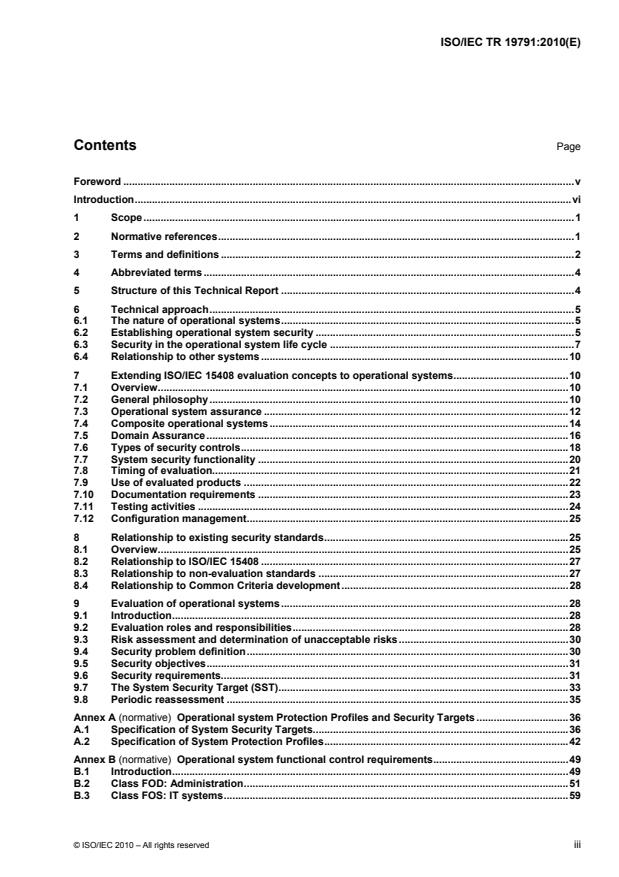
Contents Page
Foreword .v
Introduction.vi
1 Scope.1
2 Normative references.1
3 Terms and definitions .2
4 Abbreviated terms.4
5 Structure of this Technical Report .4
6 Technical approach.5
6.1 The nature of operational systems.5
6.2 Establishing operational system security .5
6.3 Security in the operational system life cycle .7
6.4 Relationship to other systems .10
7 Extending ISO/IEC 15408 evaluation concepts to operational systems.10
7.1 Overview.10
7.2 General philosophy.10
7.3 Operational system assurance .12
7.4 Composite operational systems .14
7.5 Domain Assurance.16
7.6 Types of security controls.18
7.7 System security functionality .20
7.8 Timing of evaluation.21
7.9 Use of evaluated products .22
7.10 Documentation requirements .23
7.11 Testing activities .24
7.12 Configuration management.25
8 Relationship to existing security standards.25
8.1 Overview.25
8.2 Relationship to ISO/IEC 15408 .27
8.3 Relationship to non-evaluation standards .27
8.4 Relationship to Common Criteria development.28
9 Evaluation of operational systems.28
9.1 Introduction.28
9.2 Evaluation roles and responsibilities.28
9.3 Risk assessment and determination of unacceptable risks.30
9.4 Security problem definition.30
9.5 Security objectives.31
9.6 Security requirements.31
9.7 The System Security Target (SST).33
9.8 Periodic reassessment .35
Annex A (normative) Operational system Protection Profiles and Security Targets .36
A.1 Specification of System Security Targets.36
A.2 Specification of System Protection Profiles.42
Annex B (normative) Operational system functional control requirements.49
B.1 Introduction.49
B.2 Class FOD: Administration.51
B.3 Class FOS: IT systems.59
© ISO/IEC 2010 – All rights reserved iii
B.4 Class FOA: User Assets.69
B.5 Class FOB: Business .71
B.6 Class FOP: Facility and Equipment .73
B.7 Class FOT: Third parties .78
B.8 Class FOM: Management .80
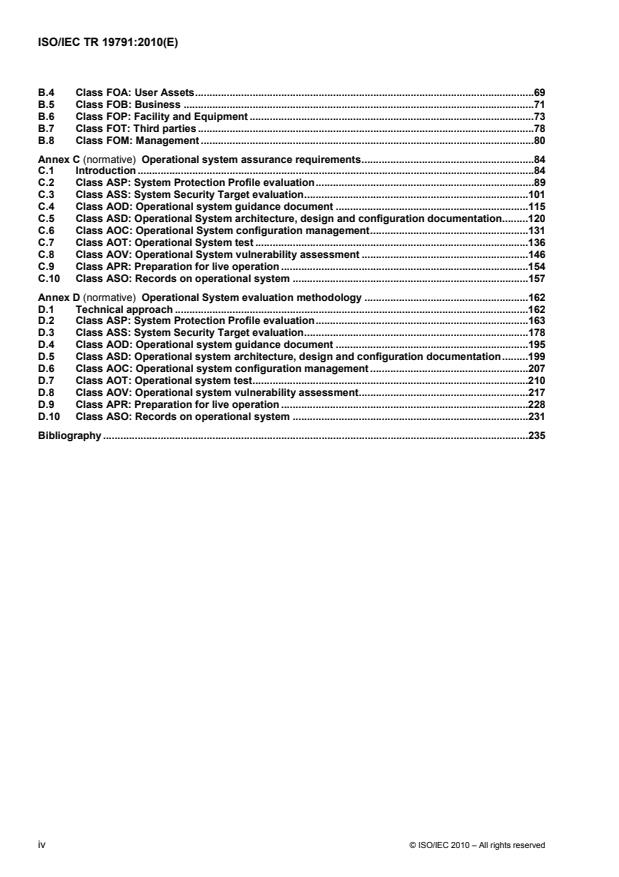
Annex C (normative) Operational system assurance requirements.84
C.1 Introduction.84
C.2 Class ASP: System Protection Profile evaluation.89
C.3 Class ASS: System Security Target evaluation.101
C.4 Class AOD: Operational system guidance document .115
C.5 Class ASD: Operational System architecture, design and configuration documentation.120
C.6 Class AOC: Operational System configuration management.131
C.7 Class AOT: Operational System test .136
C.8 Class AOV: Operational System vulnerability assessment .146
C.9 Class APR: Preparation for live operation .154
C.10 Class ASO: Records on operational system .157
Annex D (normative) Operational System evaluation methodology .162
D.1 Technical approach .162
D.2 Class ASP: System Protection Profile evaluation.163
D.3 Class ASS: System Security Target evaluation.178
D.4 Class AOD: Operational system guidance document .195
D.5 Class ASD: Operational system architecture, design and configuration documentation.199
D.6 Class AOC: Operational system configuration management .207
D.7 Class AOT: Operational system test.210
D.8 Class AOV: Operational system vulnerability assessment.217
D.9 Class APR: Preparation for live operation .228
D.10 Class ASO: Records on operational system .231
Bibliography .235
iv © ISO/IEC 2010 – All rights reserved
Foreword
ISO (the International Organization for Standardization) and IEC (the International Electrotechnical
Commission) form the specialized system for worldwide standardization. National bodies that are members of
ISO or IEC participate in the development of International Standards through technical committees
established by the respective organization to deal with particular fields of technical activity. ISO and IEC
technical committees collaborate in fields of mutual interest. Other international organizations, governmental
and non-governmental, in liaison with ISO and IEC, also take part in the work. In the field of information
technology, ISO and IEC have established a joint technical committee, ISO/IEC JTC 1.
International Standards are drafted in accordance with the rules given in the ISO/IEC Directives, Part 2.
The main task of the joint technical committee is to prepare International Standards. Draft International
Standards adopted by the joint technical committee are circulated to national bodies for voting. Publication as
an International Standard requires approval by at least 75 % of the national bodies casting a vote.
In exceptional circumstances, the joint technical committee may propose the publication of a Technical Report
of one of the following types:
— type 1, when the required support cannot be obtained for the publication of an International Standard,
despite repeated efforts;
— type 2, when the subject is still under technical development or where for any other reason there is the
future but not immediate possibility of an agreement on an International Standard;
— type 3, when the joint technical committee has collected data of a different kind from that which is
normally published as an International Standard (“state of the art”, for example).
Technical Reports of types 1 and 2 are subject to review within three years of publication, to decide whether
they can be transformed into International Standards. Technical Reports of type 3 do not necessarily have to
be reviewed until the data they provide are considered to be no longer valid or useful.
Attention is drawn to the possibility that some of the elements of this document may be the subject of patent
rights. ISO and IEC shall not be held responsible for identifying any or all such patent rights.
ISO/IEC TR 19791, which is a Technical Report of type 2, was prepared by Joint Technical Committee
ISO/IEC JTC 1, Information technology, Subcommittee SC 27, IT Security techniques.
This second edition cancels and replaces the first edition (ISO/IEC TR 19791:2006), which has been
technically revised.
© ISO/IEC 2010 – All rights reserved v
Introduction
This Technical Report is a support document that defines extensions to ISO/IEC 15408 to enable the security
assessment (evaluation) of operational systems. ISO/IEC 15408, as currently defined, provides support for
specifying the IT security functionality that exists in products and systems. However, it does not capture
certain critical aspects of an operational system that must be precisely specified in order to effectively
evaluate such a system.
This Technical Report provides extended evaluation criteria and guidance for assessing both the information
technology and the operational aspects of such systems. It is primarily aimed at those who are involved in the
development, integration, deployment and security management of operational systems, as well as evaluators
seeking to apply ISO/IEC 15408 to such systems. It will be relevant to evaluation authorities responsible for
approving and confirming evaluator actions. Evaluation sponsors, and other parties interested in operational
system security, will be a secondary audience, for their background information.
Considering the complexity of this project and the need for additional work, the target has been defined to be
a Technical Report Type 2. In the future, once additional experience has been gained in this area, it is hoped
that it may be possible to convert this Technical Report into an International Standard to support evaluations
of operational systems. Until some formalisation of an approach is performed, it is considered unlikely that
many operational system evaluations of this nature will be undertaken due to the lack of specific guidance
available, a gap that this Technical Report is designed to fill.
There are fundamental issues in regards to the definition and use of the term system. ISO/IEC 15408, with its
focus on product evaluation, uses the term system to include only the information technology (IT) aspects of
the system. The term operational system, as used within this Technical Report, covers the combination of
personnel, procedures and processes integrated with technology-based functions and mechanisms, applied
together to establish an acceptable level of residual risk in a defined operational environment.
This is a revised edition, updated for compatibility with the third edition of ISO/IEC 15408.
vi © ISO/IEC 2010 – All rights reserved
TECHNICAL REPORT ISO/IEC TR 19791:2010(E)
Information technology — Security techniques — Security
assessment of operational systems
1 Scope
This Technical Report provides guidance and criteria for the security evaluation of operational systems. It
provides an extension to the scope of ISO/IEC 15408, by taking into account a number of critical aspects of
operational systems not addressed in ISO/IEC 15408 evaluation. The principal extensions that are required
address evaluation of the operational environment surrounding the target of evaluation, and the
decomposition of complex operational systems into security domains that can be separately evaluated.
This Technical Report provides
a) a definition and model for operational systems,
b) a description of the extensions to ISO/IEC 15408 evaluation concepts needed to evaluate such
operational systems,
c) a methodology and process for performing the security evaluation of operational systems,
d) additional security evaluation criteria to address those aspects of operational systems not covered by the
ISO/IEC 15408 evaluation criteria.
This Technical Report permits the incorporation of security products evaluated against ISO/IEC 15408 into
operational systems evaluated as a whole using this Technical Report.
This Technical Report is limited to the security evaluation of operational systems and does not consider other
forms of system assessment. It does not define techniques for the identification, assessment and acceptance
of operational risk.
2 Normative references
The following referenced documents are indispensable for the application of this document. For dated
references, only the edition cited applies. For undated references, the latest edition of the referenced
document (including any amendments) applies.
ISO/IEC 15408-1, Information technology — Security techniques — Evaluation criteria for IT security —
Part 1: Introduction and general model
ISO/IEC 15408-2, Information technology — Security techniques — Evaluation criteria for IT security —
Part 2: Security functional components
ISO/IEC 15408-3, Information technology — Security techniques — Evaluation criteria for IT security —
Part 3: Security assurance components
ISO/IEC 18045, Information technology — Security techniques — Methodology for IT security evaluation
© ISO/IEC 2010 – All rights reserved 1
3 Terms and definitions
For the purposes of this document, the terms and definitions given in ISO/IEC 15408-1, ISO/IEC 18045 and
the following apply.
3.1
component
identifiable and distinct portion of an operational system that implements part of that system’s functionality
3.2
external operational system
separate operational system which interfaces to the operational system that is the subject of evaluation
3.3
management controls
security controls (i.e., safeguards and countermeasures) for an information system that focus on the
management of risk and the management of information system security
[NIST SP 800-53]
3.4
operational controls
security controls (i.e., safeguards and countermeasures) for an information system that primarily are
implemented and executed by people (as opposed to systems)
[NIST SP 800-53]
3.5
operational system
information system, including its non-IT aspects, considered in the context of its operating environment
3.6
residual risk
risk remaining after risk treatment
[ISO/IEC Guide 73:2002]
3.7
risk
potential that a given threat will exploit vulnerabilities of an asset or group of assets and thereby cause harm
to the organization
NOTE This definition is identical to that of 'information security risk' in ISO/IEC 27005:2008.
3.8
risk analysis
systematic use of information to identify sources and to estimate the risk
[ISO/IEC Guide 73:2002]
3.9
risk assessment
overall process of risk analysis and risk evaluation
[ISO/IEC Guide 73:2002]
2 © ISO/IEC 2010 – All rights reserved
3.10
risk management
coordinated activities to direct and control an organization with regard to risk
[ISO/IEC Guide 73:2002]
3.11
risk treatment
process of selection and implementation of options to modify risk
[ISO/IEC Guide 73:2002]
3.12
security controls
management, operational, and technical controls (i.e., safeguards or countermeasures) prescribed for an
information system to protect the confidentiality, integrity, and availability of the system and its information
[NIST SP 800-53]
NOTE This definition is intended to include controls that provide accountability, authenticity, non-repudiation, privacy
and reliability, which are sometimes considered as distinct from confidentiality, integrity and availability.
3.13
security domain
portion of an operational system that implements the same set of security policies
3.14
subsystem
one or more operational system components that are capable of execution separately from the rest of the
system
3.15
system target of evaluation
operational system that is being operated in accordance with its operational guidance, including both technical
and operational controls
NOTE Operational controls form part of the operational environment. They are not evaluated in ISO/IEC 15408
evaluation.
3.16
technical controls
security controls (i.e., safeguards and countermeasures) for an information system that are primarily
implemented and executed by the information system through mechanisms contained in the hardware,
software, or firmware components of the system
[NIST SP 800-53]
3.17
verification
assessment processes used to confirm that the security controls for an operational system are implemented
correctly and are effective in their application
© ISO/IEC 2010 – All rights reserved 3
4 Abbreviated terms
For the purposes of this document, the abbreviated terms given in ISO/IEC 15408-1, ISO/IEC 18045 and the
following apply.
COTS Commercial Off The Shelf
OSF Operational Security Functionality
SP Special Publication
SPP System Protection Profile
SSA System Security Assurance
SSF System Security Functionality
SST System Security Target
STOE System Target of Evaluation
5 Structure of this Technical Report
Clauses 1 to 4 contain introductory and reference material, and are followed by this overview of the contents
of the Report (Clause 5).
Clause 6, Technical approach, describes the technical approach to operational systems assessment used in
this Technical Report.
Clause 7, Extending ISO/IEC 15408 evaluation concepts to operational systems, describes how
ISO/IEC 15408 evaluation concepts have been extended for use in operational system evaluation.
Clause 8, Relationship to existing security standards, describes the relationship between this Technical
Report and other security standards which have been used in its development.
Clause 9, Evaluation of operational systems, contains requirements for specification of security problems,
security objectives, security requirements, SST contents and periodic reassessment which are needed in
order to evaluate operational systems.
Annex A, Operational system Protection Profiles and Security Targets, defines the security requirement
specifications needed for operational systems.
Annex B, Operational system functional control requirements, defines the additional security functional
requirements needed for operational systems.
Annex C, Operational system assurance requirements, defines the additional security assurance requirements
needed for operational systems.
Annex D, Operational system evaluation methodology, defines additional actions to be performed by an
evaluator conducting the evaluation of an operational system.
4 © ISO/IEC 2010 – All rights reserved
6 Technical approach
6.1 The nature of operational systems
For the purposes of this Technical Report, an operational system is defined as an information system,
including its non-IT aspects, considered in the context of its operating environment.
Many operational systems are complex in nature, made up of a combination of subsystems that are partially
proprietary and unique in nature, and partially constructed using bought-in general products. They interact
with and have dependencies upon other systems. An operational system is typically built using components
from multiple vendors. These components may be integrated to compose the operational system by an
integrator that does not perform any development functions, only configuration and interconnection.
However, operational systems typically:
⎯ are under the control of a single entity, the operational system owner;
⎯ are built against specific needs, for a specific type of operation;
⎯ change frequently; either in technical set-up and/or in operational requirements;
⎯ contain a considerable (or even large) number of components;
⎯ contain bought-in components that possess a large number of possible configuration alternatives;
⎯ enable the operational system owner to balance technical (and specifically IT) and non-technical security
measures;
⎯ contain components with different degrees and types of security assurance.
6.2 Establishing operational system security
Secure products offer an important contribution to operational system security and indeed the use of products
evaluated against ISO/IEC 15408 may be preferable in construction of a secure operational system. However,
security problems in operational systems are caused not only from product problems but also from operational
system problems in a real operational environment, such as poor application of bug fixes, poor setting of
access control parameters or filtering rules of a firewall, poor linking of files directories, etc. Furthermore, in
the case of a network, the security level of an operational system connected to the network might be of
concern to other operational systems that have to communicate with it.
This Technical Report is based upon a three step approach to establishing the necessary level of security for
an operational system:
a) risk assessment, to determine the security risks applicable to a system;
b) risk reduction, to counter or eliminate security risks by the selection, application and assessment of
security controls;
c) accreditation, to confirm that the residual risks remaining within the system after the controls are applied
are appropriate for the system to be used in live operation.
Conceptually, this three step process is shown in Figure 1 following.
© ISO/IEC 2010 – All rights reserved 5
Risk Assessment
Risk identification
Risk analysis
Risk evaluation
Selection of controls
Specification of controls in the System
Security Target (SST)
Application of controls
Risk Reduction
(Scope of this
Application of security controls to the
Technical Report)
System Target of Evaluation (STOE)
Assessment of controls
Evaluation of compliance with the SST
Accreditation
Acceptance of residual risks
Figure 1 — Process for establishing operational system security
This Technical Report addresses only the middle step of the three step process, namely risk reduction through
the selection, application and assessment of security controls. To do this, it uses a security evaluation
approach, based upon the security evaluation model for IT security controls defined in ISO/IEC 15408, but
extended to deal with all types of security controls.
Techniques and methods for risk assessment are beyond the scope of this report. For more information on
risk assessment, see ISO/IEC 27005 [1]. Techniques and models for accreditation are a management
responsibility, also beyond the scope of this report. For more information on one possible approach, see
NIST SP 800-37 [2].
The security evaluation model of ISO/IEC 15408 excludes consideration of the operational environment
surrounding the IT portion of the information system. The operational environment is treated as assumptions
in ISO/IEC 15408 evaluation, but cannot be discounted for operational systems. Typically, operational
systems are reliant on non-IT security measures, e.g. measures of an administrative or physical nature. There
is therefore a need to define ways to express and evaluate such requirements and controls, as an extension
6 © ISO/IEC 2010 – All rights reserved
to the ISO/IEC 15408 specification criteria. This Technical Report extends ISO/IEC 15408 to do this. The
extensions include, but are not limited to:
a) Positioning security evaluation within an overall methodology for the security assessment of operational
systems including their operational environment.
b) A methodology for specifying the internal structure of operational systems, including details of internal
and external interfaces, to the extent necessary to understand how the various portions of an operational
system interoperate.
c) A catalogue of assurance criteria to express the extensions to the scope of evaluation (see Annex A).
d) A catalogue of functional criteria to express additional operational security controls (see Annex B).
e) A catalogue of assurance criteria to express the additional evaluation tasks needed to assess operational
systems (see Annex C).
f) A catalogue of evaluator actions to express the additional activities required to assess operational
systems (see Annex D).
Extending the ISO/IEC 15408 approach to the evaluation of complete operational systems has the advantage
of using a defined existing metric so that common and mutual understanding of evaluation results is possible.
For a specific operational system, advertising the evaluation result in a way that is compatible with
ISO/IEC 15408 might bring business advantage to customers, not only for service provider systems such as
internet banking systems, but also from the view point of social responsibility.
Operational system evaluation requires that a prior risk assessment has identified the security risks applicable
to an operational system, and determined those risks that are unacceptable and must be reduced or
eliminated through technical and operational controls. It then consists of the following steps:
a) Setting security objectives for the operational system that will reduce the unacceptable risks to a level
which is tolerable.
b) Selecting and specifying technical and operational security controls that satisfy the security objectives for
the operational system, taking due account of controls that already exist.
c) Defining concrete, measurable assurance requirements for both the technical and operational controls to
gain the requisite level of confidence that the operational system meets its security objectives.
d) Recording the decisions made in a System Security Target (SST).
e) Evaluating the actual operational system to judge compliance with the SST.
f) Periodically reassessing both the security risks to the operational system and the operational system’s
ability to address those risks.
Although this model is an extension of the ISO/IEC 15408 model, it is consistent with that model so that
ISO/IEC 15408 evaluation results can be reused.
6.3 Security in the operational system life cycle
6.3.1 Overview
The life cycle of an operational system is considered to have four phases, namely development/integration,
installation, system operation and modification. The security controls of an operational system must be
assessed throughout the lifetime of the system. This is illustrated in Figure 2 following.
© ISO/IEC 2010 – All rights reserved 7
Development/Integration
Identify risks
Design system / prepare SST
Design security controls
Purchase / develop applications
Integrate / configure system
Development testing / security evaluation
Installation
Implement security controls
Test in operational environment
Operation
Operate / monitor security controls
Monitor minor changes
Assess security problems
Modification
Review / implement major changes
Re-test / re-evaluate security controls
Decommissioning
Figure 2 — Security within operational system lifecycle
6.3.2 Development/integration phase
During the development/integration phase, the first security activity is to identify the risks to the operational
system. Those risks that are considered unacceptable must be reduced or eliminated by security measures
built into the system. Following the risk assessment and identification of risks to be eliminated, an authorized
officer of the organization, the Accreditor, must consider the anticipated residual risks, and the sum of the
residual risks, and confirm that they will be acceptable.
The operational system will then be designed, including the use of software and hardware products, the
physical facilities required, the business application programs needed and the technical security controls
required. The design of the operational system must be recorded in the SST. The SST will contain a
description of the system security requirements, including the risks to be countered and the security objectives
to be achieved by technical and operational controls. The list of technical and operational controls
documented in the SST will represent an instantiation of the system security objectives.
8 © ISO/IEC 2010 – All rights reserved
For the purposes of correctness, security objectives should be specified in the SST that address all risks
identified as unacceptable. The SST should specify security requirements that completely satisfy the security
objectives without any additions or omissions. The design documentation for the operational system should
identify precise security countermeasures within the operational system that meet all of the security
requirements specified in the SST. The countermeasures might be security functions, facilities, procedures or
rules. The countermeasures should be adequately controlled, managed and applied to the system. The
security countermeasures should be implemented without any unauthorized addition, elimination or
modification. The implementation should be verified with testing of the system or checking of documents. The
operation of security countermeasures should be adequately described in the guidance documents.
For effectiveness, the selected security requirements should reduce all security risks identified by risk
assessment as unacceptable to a level that can be tolerated as residual risks. Each security countermeasure
should work effectively in combination with other countermeasures to satisfy the overall security requirements
for the operational system. The strength of the security mechanisms should be sufficient to match the
expected attack potential. Vulnerability survey or vulnerability analysis and penetration testing might be
required with the expected attack potential.
Evaluators should be involved in the development/integration phase, early in the system life cycle, to facilitate
their understanding of the system and its intended environment, as well as to provide input from review of
design documentation, and to provide guidance on evaluation and guidance documentation to be used as part
of assurance evidence. Ideally the full SST should be evaluated in a preliminary evaluation to confirm that
there are no inconsistencies or omissions in the security requirements and proposed controls.
The business applications and systems software, including the technical security controls, are then produced
or purchased, and the system is integrated, configured, and tested by the developer. At the same time, the
operational security organization is created and security policies, rules and procedures produced and
integrated into the system. The proper security configuration settings should be identified and implemented.
Following integration testing, the operational system should be security tested as part of the developer’s
requirements verification testing. Typically, system specific security controls such as access controls can be
verified by the developer prior to deployment at the operational site. Testing of site specific security controls
(both technical and operational) is deferred until the system is installed in its intended operational
environment. Verification testing will confirm the strength of security mechanisms, as well as the correct
operation of the security controls.
The operational system will then be evaluated. The evaluation should confirm that all risks, as detailed in the
SST, that have to be countered by security controls are addressed by the system at an acceptable level. The
result of the evaluation is an independent confirmation to the system owner that this is the case.
The Certification Report will list any confirmed vulnerabilities found in evaluation, and identify any
recommended corrective actions, as required. The system owner will then prepare a corrective action plan to
reduce or eliminate the identified vulnerabilities, as deemed appropriate. The result of the certification of the
system will be presented to the Accreditor for determination that the actual residual risk to operations and
system assets is acceptable. The output of this phase will be an authorization for the system to operate.
6.3.3 Installation phase
During the installation phase, the technical and operational controls will be implemented and prepared for use
in the operational environment. Site specific controls will be tested, and other controls retested to confirm that
they perform correctly in the actual operational environment.
For the purposes of correctness, the controls should be compliant with the security requirements documented
in the SST and authorized for use by a competent person. To be effective, all persons should be trained in use
of the security controls and procedures.
6.3.4 System operation phase
In the system operation phase, records of the operation of technical controls and operational controls should
be collected and assessed. Audit trails and monitoring records for all access to assets should be logged.
© ISO/IEC 2010 – All rights reserved 9
Security countermeasures should be confirmed as operating as intended. It should be verified that
unauthorized operations and unacceptable risks have not occurred. Secure states should be recovered from
insecure states within the required time. Changes due to routine maintenance should be monitored and
assessed for security problems. Records of actual access and utilization of assets should be inspected.
Security problems should be reported, reviewed and analyzed.
The purpose of these activities is to provide feedback to the Accreditor when changes occur that may have an
impact on operational system security. Typically, in systems operation, a critical subset of the operational
system security controls should be identified for regular monitoring to determine their continued effectiveness.
Additionally, the system owner should have in place a configuration management, control, and reporting
system that documents the current operational system assets, its configuration, and presents that information
to the responsible parties.
6.3.5 Modification phase
During the system modification phase, any proposed or actual operational system changes beyond the scope
of routine maintenance should be reviewed, analysed and, if necessary, tested to determine their impact on
operational system security before being implemented in live operation. This includes changes to procedures
and policies. Penetration testing of modified controls should be performed to verify their effective operation.
The results of impact analysis and testing should be presented to the Accreditor to determine the need for
security re-evaluation. Where modifications are deemed not to have significantly increased the residual risks,
perhaps because they have already been assessed as part of a product assurance maintenance process,
re-authorization may be given without re-evaluation. However, if the evaluation results have been invalidated,
re-evaluation may be required.
The final act of system modification is decommissioning, where a system is closed down and its data
archived, destroyed or transferred to other systems. The Accreditor will be required to confirm that the system
has been successfully terminated.
6.4 Relationship to other systems
An operational system may interact with other related systems and may form part of a larger whole. The
STOE of the evaluated operational system is defined to be that portion of the group of systems that is
evaluated, including both IT systems and their operational environment. The remainder is considered to be
external operational systems. An operational system may have security objectives that are met by the external
operational systems, but these are not analysed or evaluated.
7 Extending ISO/IEC 15408 evaluation concepts to operational systems
7.1 Overview
The purpose of this clause is to document the philosophy that underpins the ISO/IEC 15408 approach to
security evaluation and then to extend it to operational systems. ISO/IEC 15408 addresses only technical
controls and their related management controls; in operational systems, technical controls and operational
controls combine to protect the information and other assets of the organization.
7.2 General philosophy
For many organizations, information is the primary asset and requires protection against the threats of
unauthorised release, modification, or destruction. Those assets are protected using a combination of
technical controls and supporting operational control infrastructures of personnel, policy, procedures and
physical protection measures. The overall ISO/IEC 15408 philosophy is that threats to organizational assets
should be clearly articulated and countered using a combination of technical control and operational control
infrastructures. The technical control requirements for addressing threats are included in ISO/IEC 15408-2.
Under ISO/IEC 15408, the requirements for the operational controls were considered separately as part of an
external accreditation process and therefore were not directly addressed by the security evaluation. This
10 © ISO/IEC 2010 – All rights reserved
document seeks to formali
...
Questions, Comments and Discussion
Ask us and Technical Secretary will try to provide an answer. You can facilitate discussion about the standard in here.
Loading comments...