


ISO/IEC TS 19249:2017
(Main)Information technology — Security techniques — Catalogue of architectural and design principles for secure products, systems and applications
Information technology — Security techniques — Catalogue of architectural and design principles for secure products, systems and applications
ISO/IEC TS 19249:2017 provides a catalogue of architectural and design principles that can be used in the development of secure products, systems and applications together with guidance on how to use those principles effectively. ISO/IEC TS 19249:2017 gives guidelines for the development of secure products, systems and applications including a more effective assessment with respect to the security properties they are supposed to implement. ISO/IEC TS 19249:2017 does not establish any requirements for the evaluation or the assessment process or implementation.
Technologies de l'information — Techniques de sécurité — Catalogue des principes architecturaux et conceptuels pour la sécurisation des produits, systèmes et applications
General Information
- Status
- Published
- Publication Date
- 26-Oct-2017
- Current Stage
- 9093 - International Standard confirmed
- Start Date
- 28-Oct-2024
- Completion Date
- 12-Feb-2026
Relations
- Consolidated By
ISO 21945:2020 - Solid biofuels — Simplified sampling method for small scale applications - Effective Date
- 06-Jun-2022
Overview
ISO/IEC TS 19249:2017 - Information technology - Security techniques - Catalogue of architectural and design principles for secure products, systems and applications - is a technical specification that catalogs proven architectural and design principles to support the development and assessment of secure products, systems and applications. The document provides guidance on how to use those principles effectively, offers examples and evaluation considerations, and links architectural/design choices to security properties - without imposing mandatory evaluation or implementation requirements.
Key Topics
The specification organizes principles into architectural and design categories and provides structured guidance for each, including purpose, usage, examples and evaluation considerations.
Architectural principles (selected):
- Domain separation - isolating functional or security domains and defining inter-domain communication.
- Layering - structuring software/hardware into layers with well-defined interfaces.
- Encapsulation - hiding internal implementation to reduce exposure and enforce interfaces.
- Redundancy - replicating components to increase availability and resilience while managing consistency.
- Virtualization - isolating resources and mapping virtual to physical resources securely.
Design principles (selected):
- Least privilege - granting minimal privileges required for tasks.
- Attack surface minimization - reducing accessible interfaces and functionality exposed to untrusted parties.
- Centralized parameter validation - validating input consistently to prevent injection and misuse.
- Centralized general security services - reusing common security functions (auth, crypto, logging).
- Preparing for error and exception handling - designing fail-safe behaviors and secure error reporting.
Important attributes:
- Guidance for applying principles to support specific security properties (confidentiality, integrity, availability).
- Examples and practical trade-offs (usability, performance).
- Considerations for evaluation to assist developers and evaluators in judging how well principles support claimed security properties.
Applications
ISO/IEC TS 19249:2017 is useful for:
- Security architects and system designers selecting architecture and design patterns for secure products, systems and applications.
- Software developers implementing secure design practices (least privilege, input validation, encapsulation).
- Product managers and risk owners assessing design choices for security trade-offs (availability vs. redundancy).
- Security evaluators and assessors mapping design/architecture to security properties during assessments (note: the TS does not mandate evaluation procedures).
Practical uses include secure platform design, secure application development, hardening virtualized environments, and preparing design documentation for security assessment.
Related Standards
- ISO/IEC 15408 (all parts) - Evaluation criteria for IT security (Common Criteria).
- ISO/IEC 18045 - Methodology for IT security evaluation.
- ISO Online browsing platform / IEC Electropedia for normative definitions.
ISO/IEC TS 19249:2017 is a guidance resource linking architectural and design best practices to security objectives, helping teams design and evaluate secure systems while complementing formal evaluation frameworks.


Get Certified
Connect with accredited certification bodies for this standard

BSI Group
BSI (British Standards Institution) is the business standards company that helps organizations make excellence a habit.

Bureau Veritas
Bureau Veritas is a world leader in laboratory testing, inspection and certification services.

DNV
DNV is an independent assurance and risk management provider.
Sponsored listings
Frequently Asked Questions
ISO/IEC TS 19249:2017 is a technical specification published by the International Organization for Standardization (ISO). Its full title is "Information technology — Security techniques — Catalogue of architectural and design principles for secure products, systems and applications". This standard covers: ISO/IEC TS 19249:2017 provides a catalogue of architectural and design principles that can be used in the development of secure products, systems and applications together with guidance on how to use those principles effectively. ISO/IEC TS 19249:2017 gives guidelines for the development of secure products, systems and applications including a more effective assessment with respect to the security properties they are supposed to implement. ISO/IEC TS 19249:2017 does not establish any requirements for the evaluation or the assessment process or implementation.
ISO/IEC TS 19249:2017 provides a catalogue of architectural and design principles that can be used in the development of secure products, systems and applications together with guidance on how to use those principles effectively. ISO/IEC TS 19249:2017 gives guidelines for the development of secure products, systems and applications including a more effective assessment with respect to the security properties they are supposed to implement. ISO/IEC TS 19249:2017 does not establish any requirements for the evaluation or the assessment process or implementation.
ISO/IEC TS 19249:2017 is classified under the following ICS (International Classification for Standards) categories: 35.030 - IT Security; 35.040 - Information coding. The ICS classification helps identify the subject area and facilitates finding related standards.
ISO/IEC TS 19249:2017 has the following relationships with other standards: It is inter standard links to ISO 21945:2020. Understanding these relationships helps ensure you are using the most current and applicable version of the standard.
ISO/IEC TS 19249:2017 is available in PDF format for immediate download after purchase. The document can be added to your cart and obtained through the secure checkout process. Digital delivery ensures instant access to the complete standard document.
Standards Content (Sample)
TECHNICAL ISO/IEC TS
SPECIFICATION 19249
First edition
2017-10
Information technology — Security
techniques — Catalogue of
architectural and design principles
for secure products, systems and
applications
Technologies de l'information — Techniques de sécurité — Catalogue
des principes architecturaux et conceptuels pour la sécurisation des
produits, systèmes et applications
Reference number
©
ISO/IEC 2017
© ISO/IEC 2017, Published in Switzerland
All rights reserved. Unless otherwise specified, no part of this publication may be reproduced or utilized otherwise in any form
or by any means, electronic or mechanical, including photocopying, or posting on the internet or an intranet, without prior
written permission. Permission can be requested from either ISO at the address below or ISO’s member body in the country of
the requester.
ISO copyright office
Ch. de Blandonnet 8 • CP 401
CH-1214 Vernier, Geneva, Switzerland
Tel. +41 22 749 01 11
Fax +41 22 749 09 47
copyright@iso.org
www.iso.org
ii © ISO/IEC 2017 – All rights reserved
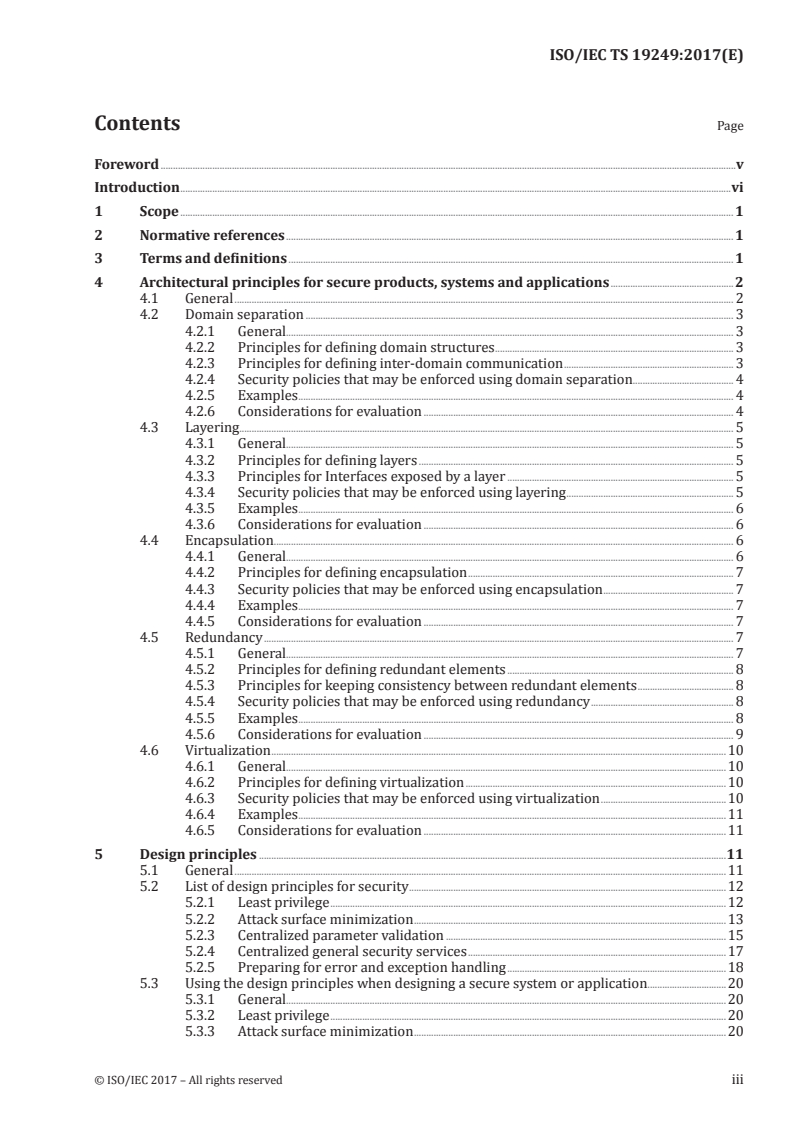
Contents Page
Foreword .v
Introduction .vi
1 Scope . 1
2 Normative references . 1
3 Terms and definitions . 1
4 Architectural principles for secure products, systems and applications .2
4.1 General . 2
4.2 Domain separation . 3
4.2.1 General. 3
4.2.2 Principles for defining domain structures . 3
4.2.3 Principles for defining inter-domain communication . 3
4.2.4 Security policies that may be enforced using domain separation. 4
4.2.5 Examples . 4
4.2.6 Considerations for evaluation . 4
4.3 Layering. 5
4.3.1 General. 5
4.3.2 Principles for defining layers . 5
4.3.3 Principles for Interfaces exposed by a layer . 5
4.3.4 Security policies that may be enforced using layering . 5
4.3.5 Examples . 6
4.3.6 Considerations for evaluation . 6
4.4 Encapsulation. 6
4.4.1 General. 6
4.4.2 Principles for defining encapsulation . 7
4.4.3 Security policies that may be enforced using encapsulation . 7
4.4.4 Examples . 7
4.4.5 Considerations for evaluation . 7
4.5 Redundancy . 7
4.5.1 General. 7
4.5.2 Principles for defining redundant elements . 8
4.5.3 Principles for keeping consistency between redundant elements . 8
4.5.4 Security policies that may be enforced using redundancy . 8
4.5.5 Examples . 8
4.5.6 Considerations for evaluation . 9
4.6 Virtualization .10
4.6.1 General.10
4.6.2 Principles for defining virtualization .10
4.6.3 Security policies that may be enforced using virtualization .10
4.6.4 Examples .11
4.6.5 Considerations for evaluation .11
5 Design principles .11
5.1 General .11
5.2 List of design principles for security .12
5.2.1 Least privilege .12
5.2.2 Attack surface minimization .13
5.2.3 Centralized parameter validation .15
5.2.4 Centralized general security services .17
5.2.5 Preparing for error and exception handling .18
5.3 Using the design principles when designing a secure system or application .20
5.3.1 General.20
5.3.2 Least privilege .20
5.3.3 Attack surface minimization .20
© ISO/IEC 2017 – All rights reserved iii
5.3.4 Centralized parameter validation .20
5.3.5 Centralized security services .20
5.3.6 Preparing for error and exception handling .21
6 Evaluation activities for the architectural principles .21
6.1 General .21
6.2 Domain separation .22
6.3 Layering.23
6.4 Encapsulation.23
6.5 Redundancy .24
6.6 Virtualization .25
Bibliography .26
iv © ISO/IEC 2017 – All rights reserved
Foreword
ISO (the International Organization for Standardization) and IEC (the International Electrotechnical
Commission) form the specialized system for worldwide standardization. National bodies that are
members of ISO or IEC participate in the development of International Standards through technical
committees established by the respective organization to deal with particular fields of technical
activity. ISO and IEC technical committees collaborate in fields of mutual interest. Other international
organizations, governmental and non-governmental, in liaison with ISO and IEC, also take part in the
work. In the field of information technology, ISO and IEC have established a joint technical committee,
ISO/IEC JTC 1.
The procedures used to develop this document and those intended for its further maintenance are
described in the ISO/IEC Directives, Part 1. In particular the different approval criteria needed for
the different types of document should be noted. This document was drafted in accordance with the
editorial rules of the ISO/IEC Directives, Part 2 (see www.iso.org/directives).
Attention is drawn to the possibility that some of the elements of this document may be the subject
of patent rights. ISO and IEC shall not be held responsible for identifying any or all such patent
rights. Details of any patent rights identified during the development of the document will be in the
Introduction and/or on the ISO list of patent declarations received (see www.iso.org/patents).
Any trade name used in this document is information given for the convenience of users and does not
constitute an endorsement.
For an explanation on the voluntary nature of standards, the meaning of ISO specific terms and
expressions related to conformity assessment, as well as information about ISO's adherence to the
World Trade Organization (WTO) principles in the Technical Barriers to Trade (TBT) see the following
URL: www.iso.org/iso/foreword.html.
This document was prepared by Technical Committee ISO/IEC JTC 1, Information technology,
Subcommittee SC 27, IT Security techniques.
© ISO/IEC 2017 – All rights reserved v
Introduction
This document describes architectural and design principles that may be used in the development of
secure products, systems and applications.
Each principle is described in a structured way, characterizing the principle itself, describing how it can
be used, how it can support security, how it may help in the security assessment of the product, system
or application, as well as its dependency on other principles described in this document.
Examples are provided for each principle on how it may be implemented, how it may contribute to
security properties and functions and what other aspects have to be taken into account in the example
provided to also address non-security related requirements like usability and performance.
A guideline is provided linking this to security evaluations performed using ISO/IEC 15408 (all parts)
and ISO/IEC 18045 and addresses both developers and evaluators of secure products, systems and
applications.
vi © ISO/IEC 2017 – All rights reserved
TECHNICAL SPECIFICATION ISO/IEC TS 19249:2017(E)
Information technology — Security techniques —
Catalogue of architectural and design principles for secure
products, systems and applications
1 Scope
This document provides a catalogue of architectural and design principles that can be used in the
development of secure products, systems and applications together with guidance on how to use those
principles effectively.
This document gives guidelines for the development of secure products, systems and applications
including a more effective assessment with respect to the security properties they are supposed to
implement.
This document does not establish any requirements for the evaluation or the assessment process or
implementation.
2 Normative references
The following documents are referred to in the text in such a way that some or all of their content
constitutes requirements of this document. For dated references, only the edition cited applies. For
undated references, the latest edition of the referenced document (including any amendments) applies.
ISO/IEC 15408-1, Information technology — Security techniques — Evaluation criteria for IT security —
Part 1: Introduction and general model
ISO/IEC 15408-2, Information technology — Security techniques — Evaluation criteria for IT security —
Part 2: Security functional components
ISO/IEC 15408-3, Information technology — Security techniques — Evaluation criteria for IT security —
Part 3: Security assurance components
ISO/IEC 18045, Information technology — Security techniques — Methodology for IT security evaluation
3 Terms and definitions
For the purposes of this document, terms and definitions given in ISO/IEC 15408-1, ISO/IEC 15408-2,
ISO/IEC 15408-3 and ISO/IEC 18045 apply.
ISO and IEC maintain terminological databases for use in standardization at the following addresses:
— ISO Online browsing platform: available at https://www.iso.org/obp
— IEC Electropedia: available at http://www.electropedia.org/
3.1
security property
property of a system or application that is crucial to achieve the security objectives defined for the
system or application
3.2
security relevant attribute
attribute assigned to an object, subject or user of a system or application that is used to enforce a
security policy
© ISO/IEC 2017 – All rights reserved 1
3.3
privilege
specific security relevant attribute for a subject or user that allows that user or subject to perform
dedicated activities bound to that security relevant attribute
3.4
transparent encryption service
service provided by the system that is either always on or that can be switched on by an administrator
which automatically encrypts and decrypts data on persistent storage or on communication links and
where the user that stores or transmits data is not aware that this encryption service is performed
EXAMPLE Automatic disk encryption services (like self-encrypting disks); tunnelling a communication link
through an IPSec or TLS protected communication link.
4 Architectural principles for secure products, systems and applications
4.1 General
Building a secure product, system or application requires not only the implementation of functional
requirements but also an architecture that allows for the effective enforcement of specific security
properties the product, system or application is supposed to enforce. The ability to withstand attacks
the product, system or application may face in its intended operational environment is highly dependent
on an architecture that prohibits those attacks or – if they cannot be prohibited – allows for detection of
such attacks and/or limitation of the damage such an attack can cause. Structuring the product, system
or application into dedicated domains that are isolated from each other and can only communicate
using well defined communication paths where specific security policies can be enforced is a generic
architectural principle that can be applied. The architectural structure imposed by such domains has
to be carefully selected to support the enforcement of security properties and requirements but also
assist in the implementation of non-security related requirements. Such a structure should also not
cause unacceptable degradation of the performance of the product, system or application. Finding
the right balance in the architectural structure that supports all requirements for a product, system
or application is the main topic the architectural principles defined in this clause can be used in co-
operation with the related design principles.
There are a few fundamental principles for security that need to be observed regardless of any
architecture or design principle. Those have been known for a long time and were first documented in a
[1]
study performed on behalf of the US Government in 1972. Those fundamental principles are:
— the implementation of security functions needs to be such that those functions cannot be bypassed
or tampered with by untrusted code;
— the security functions need to be always invoked when required to enforce the security policy;
— the part that implements the security functionality need to be small enough to be analysed for
correctness and potential security critical side effects.
In a later report [2], the parts of a product that need to be trusted for enforcing the security policy and
that satisfy the security principles above was called the "Trusted Computing Base" or TCB.
A number of design principles discussed in this document were previously introduced in [3] in
1974. Since then, IT products and systems have significantly grown in complexity and are now often
distributed, rely on external service providers, and cover a wider spectrum of security functionality.
This requires more complex architectures and designs and this document provides a description of
architectural and design principles with their security-related aspects.
2 © ISO/IEC 2017 – All rights reserved
4.2 Domain separation
4.2.1 General
A domain is a concept for encapsulating components, data and/or programs into separate entities which
can be managed separately including assigning privileges and other security attributes to each domain.
There may be defined communication channels between domains, implemented in a way that allows to
control which domains can communicate with which other domain and also allow a domain receiving a
request from another domain over a communication channel to identify from which domain the request
comes, allowing to base its reaction also on the identity of the requesting domain.
There may be reasons for structuring a system, application etc. other than security. This document only
takes security-related reasons for structuring into account.
From a security point of view, structuring a product, system or application into separated domains
may be an effective method to keep functions and objects requiring a dedicated set of privileges, access
rights together or to isolate critical functions and objects from less critical ones. Domain separation is
especially important and helpful if specific security properties can be mapped to dedicated domains
and the proof that a system or product satisfies those properties can be restricted to proofing this for
those dedicated domains.
Domain separation is also often associated with a distributed design where the individual domains are
implemented on physically separated parts of a system or an application and communicate via network
connections. In such architectures a domain may provide some general service that is used by multiple
systems. Examples of security services provided in such a way are directory services, centralized
authentication services, certificate management services or centralized access control services.
4.2.2 Principles for defining domain structures
There are not only security reasons that should be taken into account when structuring an application
or a system into separate domains. In this document only the security relevant reasons are listed.
The security reason for defining domains is to separate components of an application or system with
common security relevant attributes like privileges, access to files, etc. from other components with
different security relevant attributes. A good domain structure allows each domain to execute with the
least privileges it requires to perform its task. In addition the isolation of domains with well-defined
and controlled interfaces and interactions between them allows for better error detection, limited
error propagation and implementation of a defence-in-depth strategy. Domains should be separated
from each other such that the interference between the domains is limited and can be controlled.
The method used for isolation depends on the operational environment. Individual domains may be
implemented on different physical systems interconnected by some network; they may be implemented
by different virtual machines that communicate via mechanisms provided by the underlying virtual
machine monitor; or they may be implemented as separate processes operating on an operating system.
In those cases the separation mechanism is provided by the underlying hardware, virtual machine
monitor or operating system. In other cases the application or system itself may implement a layer that
provides the general separation mechanism itself (often using supporting features of the underlying
hardware or software).
It is often a good strategy to define domains that are exposed to an attack surface with just the minimum
set of privileges they need for their operation. Trust in such domains by other domains should also be
limited which requires other domains to perform additional checks on data they receive from such a
domain with a lower level of trust.
4.2.3 Principles for defining inter-domain communication
Inter-domain communication is required for the individual domains to be able to cooperate. Since
domains have different privileges and may be exposed to different attack surfaces, the communication
© ISO/IEC 2017 – All rights reserved 3
between different domains needs to be controlled by a policy that takes the threats associated with the
differences in privileges and attack surfaces into account. Such a policy therefore needs to identify:
— what one domain can trust another domain for;
— what one domain can assume about data received from another domain (e.g., if data attributes can
be trusted, if data has been parsed for its syntax and structure, if data has been kept confidential);
— which security validations need to be performed;
— when to accept or reject data received.
4.2.4 Security policies that may be enforced using domain separation
Domain separation can be used as a basis to define information flow policies or workflow policies by
defining the way domain can interact with each other. Policies may be defined based on the identity of
domains or their attributes like their privileges. Also the level of trust into the individual domains may
be used for policy enforcement.
4.2.5 Examples
4.2.5.1 Structuring a network into domains
Networks may be structured into domains (segments) where the communication between different
domains is regulated by gateways like routers with firewall functions or more complex application
layer filtering appliances. Routing as well as techniques like VPN or VLAN may be used for defining the
communication paths between domains while firewalls and gateways perform protocol and content
related controls. Information flow control policies based on data labels can also be effectively enforced
by domain separation where sample "trusted gateways" control the interfaces between different "single
label" domains and ensure that data flows to a domain only when the label corresponds to the label of
the domain.
4.2.5.2 Structuring an application into domains
Similar to networks, single applications can be structured into domains, which in this case are different
processes. Those processes may either be a single physical system or distributed on multiple systems
within a network. On a single system the processes are usually separated by the operating system or
virtual machine monitor, which also provide the capability for defining and using communication paths
between those processes.
4.2.5.3 Structuring data into domains
Data can also be structured into domains based on the importance of the data and its protection
requirements. Critical data can then be put into a domain with a high level of protection like one that
can only be accessed by processes with high privileges or one that is kept redundant to avoid data
loss. Another method for structuring data into different domains is to encrypt data in each domain
using a different encryption key. Whoever wants to get access to the information is required to have
access to the key of the domain for decryption. Domains for data may be implemented by different files
(which allow for different access control attributes), implemented by different disks with different
reliability/integrity properties (like RAID levels) or make use of a DBMS as data storage that provides
additional security like transaction safety.
4.2.6 Considerations for evaluation
In an evaluation, the aspects that need to be considered first are the mechanisms used to separate the
domains and the mechanisms used for inter-domain communication.
4 © ISO/IEC 2017 – All rights reserved
Mechanisms that enforce domain separation, strength of domain separation and management of
domains (if applicable) like creation, deletion of domains or changing the privileges of domains are the
focus when evaluating the security aspects of domain separation. The aspects to be considered are:
— the strength of the separation mechanisms that separate domains such that the only way domains
can influence each other is via the defined communication mechanisms;
— whether the domains and their privileges are static or dynamic (if they are dynamic, a more complex
model needs to be established and evaluated showing that the security properties of the system
cannot be violated by the dynamics allowed).
4.3 Layering
4.3.1 General
Layering is a hierarchical architecture where functions of one layer use functions of the next lower
layer and provide functions that are used by the next higher layer in the hierarchy. Usually in a layered
architecture the lowest layer provides very basic simple functions that are then used by the next higher
layer to implement more complex functions, then used by the next layer to provide even more complex
functions, and so on. Each layer abstracts from the functions provided by lower layers allowing to
use those functions of lower layers only by the functions it provides. This allows each layer to also
implement its own security policy – provided the layering architecture is implemented in a way that
does not allow a layer to bypass the functions of the next lower layer and use functions provided two
more layers down directly.
Layering is widely used in the design of network protocols and also in the design of applications. It is
not primarily used for security reasons, but for supporting maintainability and extensibility – aspects
that also support security and assurance.
4.3.2 Principles for defining layers
From a security point of view, layers provide a mechanism allowing the distribution of security
functionality throughout the different layers depending on the abstraction of the functions and objects
provided by each layer as well as the protection of functions implemented in hierarchically lower layers
from being tampered with or bypassed by functions implemented in hierarchically higher layers.
In order to protect hierarchically lower layers, each layer (or a set of adjacent layers) may be implemented
as its own domain with hierarchically lower layers having more privileges than higher layers.
4.3.3 Principles for Interfaces exposed by a layer
A layer usually implements higher level services by using functions of the next lower layer. This implies
that all the abstractions required for a layer to implement its functionality can be built using interfaces
provided by the next lower layer. In some cases a layer may be allowed to access functions of not just
the next lower layer but also functions of layers lower than just the adjacent one.
4.3.4 Security policies that may be enforced using layering
Layering is not primarily an architectural principle associated with specific security policies, but it
may be used efficiently for implementing security functionality within a layer that is transparent for
higher layers. Transparent encryption services are one example of such a security service that may
be implemented in a layer. This is quite common, e.g., for file systems as well as for cryptographic
protocols. Also other security services that support integrity, access control or redundancy providing
services can be implemented in a dedicated layer in a transparent way.
© ISO/IEC 2017 – All rights reserved 5
4.3.5 Examples
4.3.5.1 File system layering
For example in a layered implementation of a file system, the lowest layer may just provide access
to raw sectors of a disk and its only security functionality may be to ensure the integrity of the disk
sectors. A second layer may then implement virtual disks based on the raw disk sector layer and provide
additional security functionality like a basic access control to those virtual disks (e.g., by allowing it to
assign them to partitions or applications) or even implement full disk encryption functionality for those
virtual disks or by implementing enhanced integrity mechanisms.
A third layer may then implement a file system on those virtual disks where the file system provides
sophisticated access control functionality (e.g., based on access control list and/or other file security
attributes) and potentially file based encryption.
A fourth layer on top of such a file system may be implemented by an application where the data of
files is presented to individual users of the application implementing its own access control or other
security functions based on individual records in the files.
4.3.5.2 Cryptographic functions
Also cryptographic functions can be implemented in a layered way. As an example the following layers
may be defined.
— The lowest layers implements the basic cryptographic primitives like the encryption algorithms,
hash algorithms, and random number generation.
— The next higher layer uses those functions to implement digital signature generation, digital
signature verification, message authentication codes, key generation, key exchange, and key
management etc.
— The next layer implements functions like certificate validation, certificate generation, and key
wrapping.
4.3.6 Considerations for evaluation
Layering may be used within a single trust domain to structure functions within this domain or it
may implement layers as their own domains. In the first case, no specific evaluation aspects need to
be considered. In the case where layers are implemented as separate domains, the evaluation needs to
verify the domain separation aspects are satisfied and in addition that layers are built correctly on each
other. While it is not forbidden that a layer uses functions not just from the next lower layer but also
from deeper layers, such an implementation may allow bypassing security functionality implemented
in a layer. An evaluation needs to carefully analyse such an implementation to ensure that bypassing
security functionality in such an implementation is not possible.
4.4 Encapsulation
4.4.1 General
Encapsulation is an architectural principle where objects are "encapsulated" by the functions used for
accessing, manipulating or managing the objects. The sum of such functions that encapsulate an object
can be viewed as an agent that controls the object.
In such a concept the functions that encapsulate an object can define a security policy for the object.
They can define how the object is instantiated, potentially change the object's instantiation (e.g., if the
object consists of data, change where and how the data is stored) and also define an access control policy
for the object (which requires that the encapsulation function can securely obtain all the information
required to make a policy decision like the ensured identity of the accessor).
6 © ISO/IEC 2017 – All rights reserved
4.4.2 Principles for defining encapsulation
When encapsulation is used for security reasons, the agents that control the object may of course also
implement different security functions protecting the object. Those security functions can, for example,
include access control, security audit, integrity protection or transparent encryption.
Agents implementing security functions need to be separated from untrusted entities and ensure that
they cannot be tampered with and bypassed.
4.4.3 Security policies that may be enforced using encapsulation
There are a number of security functions that can be implemented by agents encapsulating an object.
Those include: controlling access to the object itself; controlling who is allowed to use specific functions
operating on the object; controlling the management of the object; controlling and managing security
attributes and privileges an agent associates with the object; auditing the use of functions; ensuring
integrity and availability of an object; or encrypting the content of an object when it is stored in
containers not fully controlled by the agent (e.g. if the objects are records stored in a file).
4.4.4 Examples
In a UNIX environment the setuid mechanism allows for an effective implementation of encapsulation.
Instead of giving a user access to, e.g., a configuration file that contains multiple configuration
parameters, a set of programs can be developed where each program is responsible for the management
of just one of those parameters. Each of those programs then gets the setuid attribute set where on
invocation the user ID is switched to one that is given read and write access to the configuration file. If
no other user has those access rights to the file, access to the configuration file (for users that are not
the superuser) is through the different setuid programs only. The set of those setuid programs can be
viewed as an agent that encapsulates the configuration file.
The setuid programs themselves can now control access to the individual configuration parameter,
control the values for those parameter, audit their changes, keep a history for recovery purposes, ensure
consistency with other parameters, store parameter in encrypted form only and others. In addition,
this form of encapsulation allows for delegation of specific security administration work and thereby
establishes specific administrative roles where each role has access only to the set of administrative
functions it requires.
4.4.5 Considerations for evaluation
Evaluating the efficiency of encapsulation requires the evaluator to consider the following aspects.
— Is the encapsulation complete or are there aspects of the encapsulated object that are accessible
without using explicitly provided functions?
— Can the mechanism that implements the encapsulation itself be tampered with?
— Can the encapsulation be modified by unauthorized entities (including security attributes related to
encapsulation)?
4.5 Redundancy
4.5.1 General
Redundancy is an architectural principle that allows for recovery of elements like data, functions,
communication links, devices, etc. even in the case of errors. If continuous operation even in the case of
errors or flaws is required, redundancy is often used to allow for automatic recovery. Redundancy can
also be used to improve the availability of an element especially if one can expect a high usage rate of an
element that can only sequentially be used or has performance limitations.
© ISO/IEC 2017 – All rights reserved 7
If redundancy is used to allow for recovery or continuous operation in case of errors or flaws, it is
important to have functionality that is able to detect potential errors and flaws as fast as possible and
is able determine which of the elements still operates correctly. In addition, faulty elements need to be
replaced or repaired quickly to ensure the target level of redundancy. Otherwise an additional error or
flaw within the phase of reduced redundancy may become critical.
In case redundancy is used for recovery, it is critical to detect the error or flaw within the operational
phase where recovery is possible. For example, within a transactional system one usually has only the
phase before the transaction is committed in which the recovery procedures will work.
Redundancy for improvement of availability requires a management function that distributes the
work among the redundant elements such that throughput is maximized or the maximum wait time is
minimized.
4.5.2 Principles for defining redundant elements
When deciding for redundant elements within an architecture the following aspects should be
considered:
— the criticality/importance of the element;
— the likelihood of a failure that impacts the element;
— the requirements for availability of the element (usually determined by the requirements for
throughput or maximum wait time/minimum response time).
4.5.3 Principles for keeping consistency between redundant elements
The main problem with redundancy is to ensure consistency between redundant elements. When data
is stored redundantly, any update to that data needs to be reflected to all storage areas involved. Errors
or attacks that prohibit the correct update of all those storage areas lead to inconsistencies that defy
the purpose of redundancy and may even lead to security breaches. It is therefore important to ensure
that updates are correctly reflected, keep an indicator as long as the update is not fully committed and
potentially ensure that updates performed just partially can be either rolled back or completed before
the associated data is used.
When functions are implemented in a redundant way they need to be synchronized when the use
resources that can only be serially used.
4.5.4 Security policies that may be enforced using redundancy
Redundancy can support the availability functions and data as well as the integrity of data. Storing
data in a redundant way can overcome problems with storage failures of individual sectors on a disk or
the whole disk, but it can also be part of a disaster recovery plan where data is stored redundantly in
different locations. It can also assist availability by keeping a copy of data that is used often or is likely
to be used within a short time frame in storage that can be accessed faster than the regular storage.
Redundancy can also be used to minimize the effect of an attack if that attack targets only one of the
redundant mechanisms. This can be used in cases where one expects a function of mechanism to fail
only as a result of an attack. In such cases redundancy can be used as a mechanism to determine that
one is under attack, detect the function or mechanism that is attacked and perform corrective actions.
4.5.5 Examples
RAID (redundant array of independent disks) is a good example for a technique that uses redundancy to
increase reliability and availability of disk storage. Another example is high availability cluster solution
where the failure of a cluster element is detected and then the tasks performed by the failed cluster
element are taken over by another element in the cluster.
8 © ISO/IEC 2017 – All rights reserved
In both examples redundancy is used in combination with error/failure detection, suspension of
erroneous elements until they are fixed, and a restarting mechanism that allows a fixed element to
be automatically synchronized up to the state where it is fully functional again and the system has
reached the original level of redundancy.
As stated, redundancy can also be used to detect that a function has been maliciously modified. An
example for suc
...
Questions, Comments and Discussion
Ask us and Technical Secretary will try to provide an answer. You can facilitate discussion about the standard in here.
Loading comments...