


IEC 60601-2-13:2003
(Main)Medical electrical equipment — Part 2-13: Particular requirements for the safety and essential performance of anaesthetic systems
Medical electrical equipment — Part 2-13: Particular requirements for the safety and essential performance of anaesthetic systems
Appareils électromédicaux — Partie 2-13: Règles particulières de sécurité et performance essentielle pour les systèmes d'anesthésie
General Information
- Status
- Withdrawn
- Publication Date
- 30-Nov-2003
- Withdrawal Date
- 30-Nov-2003
- Technical Committee
- ISO/TC 121/SC 1 - Breathing attachments and anaesthetic machines
- Drafting Committee
- ISO/TC 121/SC 1 - Breathing attachments and anaesthetic machines
- Current Stage
- 9599 - Withdrawal of International Standard
- Start Date
- 08-Aug-2011
- Completion Date
- 12-Feb-2026
Relations
- Effective Date
- 06-Jun-2022
- Effective Date
- 05-Feb-2011
- Effective Date
- 15-Apr-2008
- Effective Date
- 15-Apr-2008
Get Certified
Connect with accredited certification bodies for this standard

BSI Group
BSI (British Standards Institution) is the business standards company that helps organizations make excellence a habit.

TÜV Rheinland
TÜV Rheinland is a leading international provider of technical services.

TÜV SÜD
TÜV SÜD is a trusted partner of choice for safety, security and sustainability solutions.
Sponsored listings
Frequently Asked Questions
IEC 60601-2-13:2003 is a standard published by the International Organization for Standardization (ISO). Its full title is "Medical electrical equipment — Part 2-13: Particular requirements for the safety and essential performance of anaesthetic systems". This standard covers: Medical electrical equipment — Part 2-13: Particular requirements for the safety and essential performance of anaesthetic systems
Medical electrical equipment — Part 2-13: Particular requirements for the safety and essential performance of anaesthetic systems
IEC 60601-2-13:2003 is classified under the following ICS (International Classification for Standards) categories: 11.040.10 - Anaesthetic, respiratory and reanimation equipment. The ICS classification helps identify the subject area and facilitates finding related standards.
IEC 60601-2-13:2003 has the following relationships with other standards: It is inter standard links to IEC 60601-2-13:2003/Amd 1:2006, ISO 80601-2-13:2011, IEC 60601-2-13:1998; is excused to IEC 60601-2-13:2003/Amd 1:2006. Understanding these relationships helps ensure you are using the most current and applicable version of the standard.
IEC 60601-2-13:2003 is available in PDF format for immediate download after purchase. The document can be added to your cart and obtained through the secure checkout process. Digital delivery ensures instant access to the complete standard document.
Standards Content (Sample)
INTERNATIONAL IEC
STANDARD
60601-2-13
Third edition
2003-05
Medical electrical equipment –
Part 2-13:
Particular requirements for the safety and
essential performance of anaesthetic systems
Appareils électromédicaux –
Partie 2-13:
Règles particulières de sécurité et
performance essentielle pour les systèmes d’anesthésie
Reference number
Publication numbering
As from 1 January 1997 all IEC publications are issued with a designation in the
60000 series. For example, IEC 34-1 is now referred to as IEC 60034-1.
Consolidated editions
The IEC is now publishing consolidated versions of its publications. For example,
edition numbers 1.0, 1.1 and 1.2 refer, respectively, to the base publication, the
base publication incorporating amendment 1 and the base publication incorporating
amendments 1 and 2.
Further information on IEC publications
The technical content of IEC publications is kept under constant review by the IEC,
thus ensuring that the content reflects current technology. Information relating to
this publication, including its validity, is available in the IEC Catalogue of
publications (see below) in addition to new editions, amendments and corrigenda.
Information on the subjects under consideration and work in progress undertaken
by the technical committee which has prepared this publication, as well as the list
of publications issued, is also available from the following:
• IEC Web Site (www.iec.ch)
• Catalogue of IEC publications
The on-line catalogue on the IEC web site (http://www.iec.ch/searchpub/cur_fut.htm)
enables you to search by a variety of criteria including text searches, technical
committees and date of publication. On-line information is also available on
recently issued publications, withdrawn and replaced publications, as well as
corrigenda.
• IEC Just Published
This summary of recently issued publications (http://www.iec.ch/online_news/
justpub/jp_entry.htm) is also available by email. Please contact the Customer
Service Centre (see below) for further information.
• Customer Service Centre
If you have any questions regarding this publication or need further assistance,
please contact the Customer Service Centre:
Email: custserv@iec.ch
Tel: +41 22 919 02 11
Fax: +41 22 919 03 00
INTERNATIONAL IEC
STANDARD
60601-2-13
Third edition
2003-05
Medical electrical equipment –
Part 2-13:
Particular requirements for the safety and
essential performance of anaesthetic systems
Appareils électromédicaux –
Partie 2-13:
Règles particulières de sécurité et
performance essentielle pour les systèmes d’anesthésie
IEC 2003
All rights reserved. Unless otherwise specified, no part of this publication may be reproduced or utilized in any form or by any
means, electronic or mechanical, including photocopying and microfilm, without permission in writing from the publisher.
IEC Copyright Office Case postale 56 CH-1211 Genève 20 Switzerland
• • •
PRICE CODE
X
For price, see current catalogue
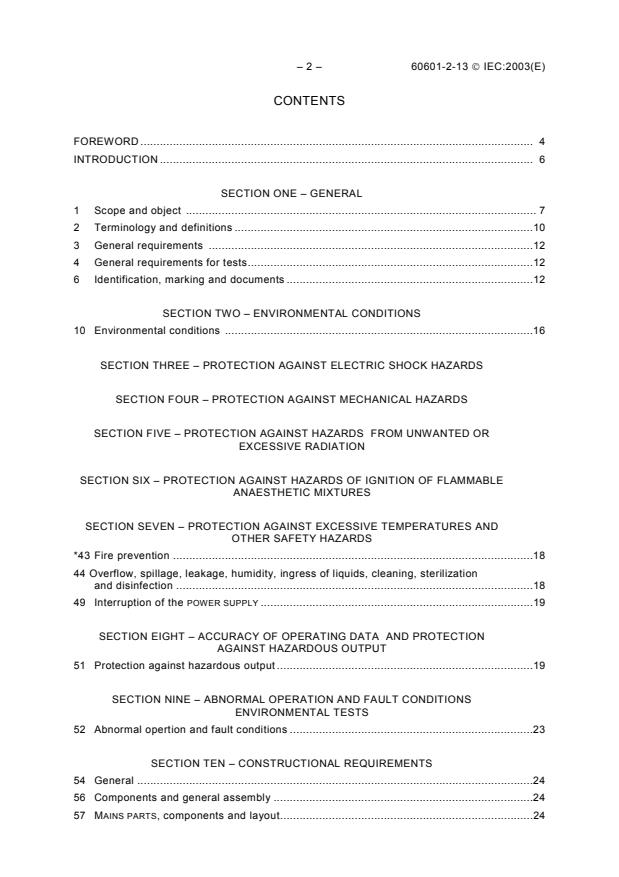
– 2 – 60601-2-13 IEC:2003(E)
CONTENTS
FOREWORD . 4
INTRODUCTION . 6
SECTION ONE – GENERAL
1 Scope and object . 7
2 Terminology and definitions .10
3 General requirements .12
4 General requirements for tests.12
6 Identification, marking and documents .12
SECTION TWO – ENVIRONMENTAL CONDITIONS
10 Environmental conditions .16
SECTION THREE – PROTECTION AGAINST ELECTRIC SHOCK HAZARDS
SECTION FOUR – PROTECTION AGAINST MECHANICAL HAZARDS
SECTION FIVE – PROTECTION AGAINST HAZARDS FROM UNWANTED OR
EXCESSIVE RADIATION
SECTION SIX – PROTECTION AGAINST HAZARDS OF IGNITION OF FLAMMABLE
ANAESTHETIC MIXTURES
SECTION SEVEN – PROTECTION AGAINST EXCESSIVE TEMPERATURES AND
OTHER SAFETY HAZARDS
*43 Fire prevention .18
44 Overflow, spillage, leakage, humidity, ingress of liquids, cleaning, sterilization
and disinfection .18
49 Interruption of the POWER SUPPLY .19
SECTION EIGHT – ACCURACY OF OPERATING DATA AND PROTECTION
AGAINST HAZARDOUS OUTPUT
51 Protection against hazardous output .19
SECTION NINE – ABNORMAL OPERATION AND FAULT CONDITIONS
ENVIRONMENTAL TESTS
52 Abnormal opertion and fault conditions .23
SECTION TEN – CONSTRUCTIONAL REQUIREMENTS
54 General .24
56 Components and general assembly .24
57 MAINS PARTS, components and layout.24
60601-2-13 IEC:2003(E) – 3 –
SECTION 101 – ADDITIONAL CLAUSES SPECIFIC TO ANAESTHETIC GAS
DELIVERY SYSTEMS
101 Medical gas supply.25
102 Medical gas pipeline inlet connections .25
103 Medical gas supply pressure monitoring.26
104 Medical gas supply PRESSURE REGULATORs.26
105 Anaesthetic gas delivery system piping .26
106 Gas flow metering .27
107 Gas mixer .28
108 Oxygen flush.29
109 Fresh gas outlet .29
110 Checklist.29
Annex AA (informative) Guidance and rationale for particular clauses and subclauses
in this particular standard .30
Annex BB (informative) MONITORING DEVICES, ALARM SYSTEM(S) and PROTECTION DEVICES.34
Annex CC (informative) Separate devices of an ANAESTHETIC SYSTEM .35
Annex DD (normative) Test for flammability of anaesthetic agent .37
Annex EE (informative) Clauses of this International Standard addressing
the essential requirements or other provisions of EU directives .38
Bibliography .43
Index of defined terms .44
Figure 101 – Profile of oxygen flow control knob for applications other than anaesthetic
vapour delivery device flow control (See 106.3) .28
Table 101 – Test conditions for expiratory volume tests .21
Table 102 – Force of axial pulls .25
Table BB.1 – Summary of the relationship of MONITORING DEVICES, ALARM SYSTEM(S)
and PROTECTION DEVICES with regard to delivery devices.34
Table CC.1 – Applicable requirement clauses for separate devices of
an ANAESTHETIC SYSTEM .35
Table EE.1 – Correspondence between this International Standard and EEC Directive
93/42/EEC . 38
– 4 – 60601-2-13 IEC:2003(E)
INTERNATIONAL ELECTROTECHNICAL COMMISSION
___________
MEDICAL ELECTRICAL EQUIPMENT –
Part 2-13: Particular requirements for the safety
and essential performance of anaesthetic systems
FOREWORD
1) The IEC (International Electrotechnical Commission) is a worldwide organization for standardization comprising
all national electrotechnical committees (IEC National Committees). The object of the IEC is to promote
international co-operation on all questions concerning standardization in the electrical and electronic fields. To
this end and in addition to other activities, the IEC publishes International Standards. Their preparation is
entrusted to technical committees; any IEC National Committee interested in the subject dealt with may
participate in this preparatory work. International, governmental and non-governmental organizations liaising
with the IEC also participate in this preparation. The IEC collaborates closely with the International
Organization for Standardization (ISO) in accordance with conditions determined by agreement between the
two organizations.
2) The formal decisions or agreements of the IEC on technical matters express, as nearly as possible, an
international consensus of opinion on the relevant subjects since each technical committee has representation
from all interested National Committees.
3) The documents produced have the form of recommendations for international use and are published in the form
of standards, technical specifications, technical reports or guides and they are accepted by the National
Committees in that sense.
4) In order to promote international unification, IEC National Committees undertake to apply IEC International
Standards transparently to the maximum extent possible in their national and regional standards. Any
divergence between the IEC Standard and the corresponding national or regional standard shall be clearly
indicated in the latter.
5) The IEC provides no marking procedure to indicate its approval and cannot be rendered responsible for any
equipment declared to be in conformity with one of its standards.
6) Attention is drawn to the possibility that some of the elements of this International Standard may be the subject
of patent rights. The IEC shall not be held responsible for identifying any or all such patent rights.
International Standard IEC 60601-2-13 has been developed by a Joint Working Group
consisting of IEC/SC 62D, Electromedical equipment, of IEC technical committee 62:
Electrical equipment in medical practice, and ISO TC 121/SC 1, Breathing attachments and
anaesthetic machines.
It is published as double logo standard.
This third edition cancels and replaces the second edition published in 1998. This edition
constitutes a technical revision.
The text of this Particular Standard is based on the following documents:
FDIS Report on voting
62D/475/FDIS 62D/476/RVD
Full information on the voting for the approval of this Particular Standard can be found in the
report on voting indicated in the above table. In ISO, the standard has been approved by 13
P-members out of 13 having cast a vote.
This publication has been drafted in accordance with the ISO/IEC Directives, Part 2.
In this Particular Standard, the following print types are used:
− requirements, compliance with which can be tested and definitions: roman type;
− explanations, advice, notes, general statements, exceptions and references: smaller type;
60601-2-13 IEC:2003(E) – 5 –
− test specifications: italic type;
− TERMS DEFINED IN CLAUSE 2 OF THE GENERAL STANDARD OR OF THIS PARTICULAR STANDARD:
SMALL CAPITALS.
The committee has decided that the contents of this publication will remain unchanged until
2007. At this date, the publication will be
• reconfirmed;
• withdrawn;
• replaced by a revised edition, or
• amended.
– 6 – 60601-2-13 IEC:2003(E)
INTRODUCTION
In response to requests for harmonization between the current European and International
standards for anaesthetic workstations this standard has been developed by the
IEC/ISO Joint Working Group to specify requirements for ANAESTHETIC SYSTEMS supplied
complete, as well as requirements for individual devices which are intended to be part of an
ANAESTHETIC SYSTEM. It applies in conjunction with IEC 60601-1:1988 (Including all
amendments) hereafter referred to as the General Standard. As stated in 1.3 of
IEC 60601-1-1988, the requirements in this standard take priority over those of the General
Standard.
This standard has been structured to allow USERS to configure an ANAESTHETIC SYSTEM in
conformance with professional guidelines and to meet the needs of their clinical practice.
In order to achieve this aim, the standard identifies particular requirements pertinent to
specific devices, and to their associated MONITORING DEVICE(S), ALARM SYSTEM(s) and
PROTECTION DEVICE(S), and defines the interfaces. This standard also specifies requirements
for optional devices, together with their respective MONITORING DEVICE(S), ALARM SYSTEM(S)
and PROTECTION DEVICE(S).
The indicated requirements are followed by specifications for the relevant tests. An asterisk
(*) denotes clauses for which there is a rationale comment in Annex AA. It is considered that
knowledge of the reasons for these requirements will facilitate the proper application of the
standard and be of use in any revision that may be necessitated by changes in clinical
practice or as a result of developments in technology.
NOTE The decimal separator for all numeric values is "," (comma).
The following graphic representation of the structure of this standard is being provided for
informational purposes only.
General requirements
IEC 60601-2-13
Monitoring, alarm
Mandatory
ANAESTHETIC gas
and protection
delivery device
devices *)
ISO 8835-2
ANAESTHETIC
breathing system
Monitoring, alarm
ISO/DIS 8835-3
AGSS and protection
Anaesthetic
devices *)
system
Monitoring, alarm
Anaesthetic vapour
ISO/DIS 8835-4
and protection
delivery device
devices *)
Optional
devices
Monitoring, alarm
Anaesthetic
and protection
ISO/DIS 8835-5
ventilator
devices *)
Monitoring, alarm
Other devices(s) ISO/DIS 8835-X
and protection
devices *)
60601-2-13 IEC:2003(E) – 7 –
MEDICAL ELECTRICAL EQUIPMENT–
Part 2-13: Particular requirements for the safety
and essential performance of anaesthetic systems
SECTION ONE – GENERAL
The clauses and subclauses of this section of the General Standard apply except as follows:
1 Scope and object
This clause of the General Standard applies except as follows:
1.1 Scope
Addition
This Particular Standard specifies safety and essential performance requirements for an
ANAESTHETIC SYSTEM (as defined in 2.101.7) as well as individual devices designed for use in
an ANAESTHETIC SYSTEM.
This Particular Standard does not apply to:
– ANAESTHETIC SYSTEM(S) intended for use with flammable anaesthetic agents, as
determined by Annex DD,
– portable ANAESTHETIC SYSTEM(S) for use in remote sites, open fields for rescue operations
or in disaster areas,
– dental analgesia apparatus.
1.2 Object
Replacement:
The object of this Particular Standard is to specify particular safety and essential performance
requirements for individual devices designed for use in an ANAESTHETIC SYSTEM as well as
specific requirements for the ANAESTHETIC GAS DELIVERY SYSTEM. This standard specifies
requirements and defines interfaces for:
– individual devices designed for use in an ANAESTHETIC SYSTEM(S), and
– integrated ANAESTHETIC SYSTEMS.
1.3 Particular Standards
This Particular Standard amends and supplements a set of IEC publications consisting of
IEC 60601-1:1988, Medical electrical equipment – Part 1: General requirements for safety,
its amendment 1 (1991) and amendment 2 (1995), hereinafter referred to as the “General
Standard”.
The General Standard takes into account IEC 60601-1-1:2000, Medical electrical equipment –
Part 1-1: General requirements for safety – Collateral standard: Safety requirements for
medical electrical systems and IEC 60601-1-2 2001, Medical electrical equipment – Part 1-2:
General requirements for safety – Collateral standard: Electromagnetic compatibility –
Requirements and tests.
– 8 – 60601-2-13 IEC:2003(E)
The numbering of sections, clauses and subclauses of this Particular Standard corresponds
with that of the General Standard. The changes to the text of the General Standard are
specified by the use of the following words:
“Replacement” means that the clause or subclause of the General Standard is replaced
completely by the text of this Particular Standard.
“Addition” means that the text of this Particular Standard is additional to the requirements of
the General Standard.
“Amendment” means that the clause or subclause of the General Standard is amended as
indicated by the text of this Particular Standard.
Subclauses or figures which are additional to those of the General Standard are numbered
starting from 101, additional annexes are lettered AA, BB, etc., and additional items aa), bb),
etc.
The term "this standard" covers this Particular Standard, used together with the General
Standard and the Collateral Standards.
Where there is no corresponding section, clause or subclause in this Particular Standard, the
section, clause or subclause of the General Standard, although possibly not relevant, applies
without modification.
Where it is intended that any part of the General Standard, although possibly relevant, is not
to be applied, a statement to that effect is given in this Particular Standard.
The requirements of this Particular Standard replacing or modifying requirements of the
General Standard or a Collateral Standard take precedence over the corresponding general
requirement(s).
1.3.101 Related International Standards
The following referenced documents are indispensable for the application of this document.
For dated references, only the edition cited applies. For undated references, the latest edition
of the referenced document (including any amendments) applies.
IEC 60079-4:1975, Electrical apparatus for explosive gas atmospheres – Part 4: Method of
test for ignition temperature
IEC 60079-11:1999, Electrical apparatus for explosive gas atmospheres – Part 11: Intrinsic
safety"
ISO 32:1977, Gas cylinders for medical use – Marking for identification of content
ISO 407:1991, Small medical gas cylinders – Pin-index yoke-type valve connections
ISO 3746:1995, Acoustics – Determination of sound power levels of noise sources using
sound pressure – Survey method using an enveloping measurement surface over a reflecting
plane
ISO 4135:2001, Anaesthetic and respiratory equipment – Vocabulary
ISO 5145:1990, Cylinder valve outlets for gases and gas mixtures – Selection and
dimensioning
60601-2-13 IEC:2003(E) – 9 –
ISO 5356-1:1996, Anaesthetic and respiratory equipment – Conical connectors – Part 1:
Cones and sockets
ISO 5356-2:1987, Anaesthetic and respiratory equipment – Conical connectors – Part 2:
Screw-threaded, weight-bearing connectors
ISO 5359:2000, Low-pressure hose assemblies for use with medical gases
ISO 5362:2000, Anaesthetic reservoir bags
ISO 7396-1:2002, Medical gas pipeline systems – Part 1: Pipelines for compressed medical
gases and vacuum
ISO 7767:1997, Oxygen monitors for monitoring patient breathing mixtures – Safety
requirements
ISO 8835-2:1999, Inhalational anaesthesia systems – Part 2: Anaesthetic breathing systems
for adults
ISO 8835-3:1997, Inhalational anaesthesia systems – Part 3: Anaesthetic gas scavenging
systems – Transfer and receiving systems
ISO 8835-4, Inhalational anaesthesia systems – Part 4: Anaesthetic vapour delivery
)
devices
ISO 8835-5, Inhalational anaesthesia systems – Part 5: Requirements for anaesthetic
)
ventilators
ISO 9170-1:1999, Terminal units for medical gas pipeline systems – Part 1: Terminal units for
use with compressed medical gases and vacuum
ISO 9703-1:1992, Anaesthesia and respiratory care alarm signals – Part 1: Visual alarm
signals
ISO 9703-2:1994, Anaesthesia and respiratory care alarm signals – Part 2: Auditory alarm
signals
ISO 9703-3, Anaesthesia and respiratory care alarm signals – Part 3: Guidance on application
of alarms
ISO 9918:1993, Capnometers for use with humans – Requirements
ISO 10524:1995, Pressure regulators and pressure regulators with flow-metering devices for
medical gas systems
ISO 11196:1996, Anaesthetic gas monitors
ISO 15223:2000, Medical devices – Symbols to be used with medical device labels, labelling
and information to be supplied
___________
1)
To be published.
2)
To be published.
– 10 – 60601-2-13 IEC:2003(E)
2 Terminology and definitions
This clause of the General Standard applies except as follows:
Addition before 2.1:
An index of defined terms used in this Particular Standard is given after the annexes.
Additional definitions:
2.101.1
ALARM CONDITION
condition that occurs when a variable that is being monitored by an ALARM SYSTEM equals or
falls outside the set ALARM LIMIT(s)
2.101.2
ALARM LIMIT
value(s) which are set by the manufacturer, the device, the USER or OPERATOR, which define
the threshold range of the ALARM CONDITION
2.101.3
ALARM SIGNAL
signal, the purpose of which is to alert the OPERATOR of an abnormal condition in the PATIENT
or the EQUIPMENT that may develop into a SAFETY HAZARD which requires OPERATOR awareness
or action
2.101.4
ALARM SYSTEM
system that is intended to make the OPERATOR(S) aware of an ALARM CONDITION, in the PATIENT
or EQUIPMENT, by means of its ALARM SIGNAL(S)
2.101.5
ANAESTHETIC GAS DELIVERY SYSTEM
assembly of components which controls and delivers the fresh gas into the ANAESTHETIC
BREATHING SYSTEM
NOTE It may include a flow control system, flow meters and/or a gas mixing system and ANAESTHETIC GAS DELIVERY SYSTEM
PIPING.
2.101.6
ANAESTHETIC GAS DELIVERY SYSTEM PIPING
all pipework, including unions, from unidirectional valves in the pipeline inlets and from the
outlets of the PRESSURE REGULATOR(s) to the flow control system, as well as the piping
connecting the flow control system and the piping connecting the ANAESTHETIC VAPOUR
DELIVERY DEVICE to the FRESH GAS OUTLET. It includes piping leading to and from pneumatic
ALARM SYSTEM(S), pressure indicators, oxygen flush and gas power outlets
2.101.7
ANAESTHETIC SYSTEM (ANAESTHETIC WORKSTATION)
inhalational ANAESTHETIC SYSTEM that contains an ANAESTHETIC GAS DELIVERY SYSTEM, an
ANAESTHETIC BREATHING SYSTEM and the required MONITORING DEVICE(S), ALARM SYSTEM(S), and
PROTECTION DEVICES
NOTE The ANAESTHETIC SYSTEM can also include, but is not limited to, ANAESTHETIC VAPOUR DELIVERY DEVICE(S),
ANAESTHETIC VENTILATOR(S), anaesthetic gas scavenging systems, and their associated MONITORING DEVICE(S),
ALARM SYSTEM(S) and PROTECTION DEVICE(S).
2.101.8
ANAESTHETIC VAPOUR DELIVERY DEVICE
device which provides the vapour of an anaesthetic agent in a controllable concentration
60601-2-13 IEC:2003(E) – 11 –
2.101.9
ANAESTHETIC VENTILATOR
automatic device, which is connected via the ANAESTHETIC BREATHING SYSTEM to the PATIENT'S
airway and is designed to augment or provide ventilation of the PATIENT during anaesthesia
2.101.10
ANNUNCIATION, ANNUNCIATE, ANNUNCIATING
communication of ALARM SIGNALS to the OPERATOR
2.101.11
DISABLE, DISABLED
state of indefinite duration in which the ALARM SYSTEM or part of the ALARM SYSTEM does not
ANNUNCIATE an auditory ALARM SIGNAL
2.101.12
LEGIBLE
displayed qualitative or quantitative information, values, functions, and/or markings
discernible or identifiable to an OPERATOR with 6-6 (20/20) vision (corrected if necessary) from
a distance of 1 m at a light level of 215 lux, when viewing the information, markings, etc
perpendicular to and including 15° above, below, left and right of the normal line of sight of
the OPERATOR
2.101.13
MONITORING DEVICE
device which continuously or repeatedly measures and indicates the value of a variable to the
OPERATOR
2.101.14
NON-LATCHING ALARM SIGNAL
ALARM SIGNAL that automatically stops ANNUNCIATING when its associated ALARM CONDITION no
longer exists
2.101.15
OXYGEN RICH ENVIRONMENT
environment in which the partial pressure of oxygen is greater than 275 hPa
2.101.16
POWER SUPPLY
source of energy other than that generated directly by the human body or by gravity that
makes the device function
2.101.17
PROTECTION DEVICE
device which, without intervention by the OPERATOR protects the PATIENT from hazardous
output due to incorrect delivery of energy or substances
2.101.18
RESERVE ELECTRICAL POWER SOURCE
part of EQUIPMENT that temporarily supplies power to the electrical system in the event of an
interruption of the primary electrical supply
2.101.19
SILENCE, SILENCED
state of temporary duration in which the ALARM SYSTEM or part of the ALARM SYSTEM does not
ANNUNCIATE an auditory ALARM SIGNAL
– 12 – 60601-2-13 IEC:2003(E)
3 General requirements
This clause of the General Standard applies except as follows:
3.6 Addition:
An oxidant leak which is not detected by e.g. an ALARM SYSTEM or periodic inspection shall be
considered a NORMAL CONDITION and not a SINGLE FAULT CONDITION.
4 General requirements for tests
This clause of the General Standard applies except as follows:
Addition:
4.101 Other test methods
The manufacturer may use type tests different from those detailed within this standard, if an
equivalent degree of compliance is obtained. However, in the event of dispute, the methods
specified in this standard shall be used as the reference methods.
6 Identification, marking and documents
This clause of the General Standard applies except as follows:
6.1 Marking on the outside of EQUIPMENT or EQUIPMENT parts
*j) Power input
Addition (after the existing last sentence):
The RATED power input marking shall include the maximum RATED power output available to
the AUXILIARY MAINS SOCKET OUTLET(S), with which the ANAESTHETIC SYSTEM is equipped.
*k) Mains power output
Replacement:
Each AUXILIARY MAINS SOCKET OUTLET shall be marked with its RATED output in units of
amperes. If AUXILIARY MAINS SOCKET OUTLET(S) can accept a standard mains plug, the
AUXILIARY MAINS SOCKET OUTLET shall be marked with symbol 14 of Table D.1 of the General
Standard.
Addition:
aa) The ANAESTHETIC SYSTEM and/or its devices
The ANAESTHETIC SYSTEM and/or its devices shall be legibly marked with the following
information as applicable:
1) the name or trade name and address of the manufacturer;
2) the name and address of the distributor/supplier;
3) the symbol for “batch code“, or “serial number” (see ISO 15223);
4) a LEGIBLE arrow showing the direction of flow for any OPERATOR-detachable
components or devices that are flow-direction-sensitive unless designed in such a way
that prevents incorrect assembly;
5) each OPERATOR – accessible gas specific inlet and outlet shall be marked with:
60601-2-13 IEC:2003(E) – 13 –
a) the gas name or chemical symbol in accordance with ISO 5359, if colour coding is
used it shall be in accordance with ISO 32.
b) the RATED supply pressure range in SI units;
6) status of oxygen flow and anaesthetic vapour flow in the event of interruption of the
supply mains.
Alternatively the following may be marked on the packaging:
7) an indication of the latest date after which the device may not be put into service;
expressed as the year and month.(e.g. symbol given in ISO 15223);
8) an indication, e.g. symbol given in ISO 15223, that the device is not for reuse;
9) the year of manufacture except for single use devices and those covered by the date
of expiry (see ISO 15223);
10) means to differentiate between the same or similar products (both sterile and non-
sterile) placed on the market by the same manufacturer;
11) details necessary to identify the device and the contents of packaging if the intended
purpose of the device is not obvious to the operator;
12) any special operating instructions.
bb) Additions specific to ANAESTHETIC GAS DELIVERY SYSTEM
– If operator-accessible, the fresh gas outlet shall be marked.
6.3 Marking of controls and instruments
Addition:
aa) All cylinder and pipeline pressure indicators shall be graduated in SI units and identified
with the gas name or the chemical symbol in accordance with ISO 5359. If colour coding
is used it shall be in accordance with ISO 32.
NOTE Additional units, for example bar may be used.
bb) All markings shall be durable and LEGIBLE and if color coding is used it shall be in
accordance with ISO 32. If the gas name or chemical symbol is used it shall be in accord-
ance with ISO 5359.
cc) Additions specific to anaesthetic gas delivery system
– Each flow adjustment control shall be identified with the gas that it controls, and be
marked with an indication how to increase and decrease the gas flow;
– If applicable, the point of reference for reading the flow indication shall be identified;
– The oxygen flush control shall be marked with one of the following:
“OXYGEN FLUSH”
“O FLUSH”
“O +”
6.8 ACCOMPANYING DOCUMENTS
6.8.2 Instructions for use
Additions:
aa) The instructions for use shall contain a statement to the effect that the ANAESTHETIC
SYSTEM is intended to be used with the following MONITORING DEVICE(S), ALARM SYSTEM(S),
and PROTECTION DEVICES, and unless the following are integral to the ANAESTHETIC GAS
– 14 – 60601-2-13 IEC:2003(E)
DELIVERY SYSTEM, the manufacturer/supplier of the ANAESTHETIC GAS DELIVERY SYSTEM shall
provide information how to connect these devices:
– pressure measuring in accordance with 8.1 of ISO 8835-2;
– pressure limitation device in accordance with 51.101.1;
– exhaled volume monitor in accordance with 51.101.4;
– breathing system integrity ALARM SYSTEM in accordance with 51.101.5;
– Continuing pressure alarm in accordance with 51.101.6;
–O monitor in accordance with ISO 7767;
–CO monitor in accordance with ISO 9918.
bb) The instructions for use shall contain a statement to the effect that any adult ANAESTHETIC
BREATHING SYSTEM used with the ANAESTHETIC GAS DELIVERY SYSTEM shall comply with
ISO 8835-2.
Unless the ANAESTHETIC BREATHING SYSTEM is integral to the ANAESTHETIC GAS DELIVERY
SYSTEM, the manufacturer/supplier of the ANAESTHETIC GAS DELIVERY SYSTEM shall provide
information on how to connect an ANAESTHETIC BREATHING SYSTEM.
cc) The instructions for use shall contain a statement to the effect that an ANAESTHETIC
VAPOUR DELIVERY DEVICE used with the ANAESTHETIC SYSTEM shall comply with ISO 8835-4.
Unless the ANAESTHETIC VAPOUR DELIVERY DEVICE is integral to the ANAESTHETIC GAS
DELIVERY SYSTEM, the manufacturer/supplier of the ANAESTHETIC GAS DELIVERY SYSTEM shall
provide information on how to connect an ANAESTHETIC VAPOUR DELIVERY DEVICE.
dd) The instructions for use shall contain a statement to the effect that, if the ANAESTHETIC
SYSTEM is designed to be equipped with an ANAESTHETIC VAPOUR DELIVERY DEVICE, the
ANAESTHETIC VAPOUR DELIVERY DEVICE is to be used with an ANAESTHETIC AGENT MONITOR
complying with ISO 11196.
Unless the ANAESTHETIC AGENT MONITOR is an integral part of the ANAESTHETIC SYSTEM the
manufacturer/supplier of the ANAESTHETIC SYSTEM shall provide information on how to
connect an ANAESTHETIC AGENT MONITOR.
ee) The instructions for use shall contain a statement to the effect that, if the ANAESTHETIC
SYSTEM is designed to be equipped with an ANAESTHETIC VENTILATOR, the ANAESTHETIC
VENTILATOR shall comply with the requirements of ISO 8835-5.
Unless the ANAESTHETIC VENTILATOR is an integral part of the ANAESTHETIC SYSTEM the
manufacturer/supplier of the ANAESTHETIC SYSTEM shall provide information on how to
connect an ANAESTHETIC VENTILATOR.
ff) The instructions for use of ANAESTHETIC SYSTEM(S) and/or individual devices shall provide
information on the method of enabling the ANAESTHETIC SYSTEM or individual devices
including the MONITORING DEVICE(S), ALARM SYSTEM(S) and PROTECTION DEVICE(S) required
by this standard.
NOTE This information may form part of the pre-use checklist.
gg) The instructions for use shall state the conditions (e.g. ambient temperature and pressure
saturated (ATPS), body temperature and pressure saturated (BTPS), standard
temperature and pressure dry (STPD)) under which the measured values are displayed.
hh) The instructions for use shall state whether the ANAESTHETIC SYSTEM or individual device is
suitable for use in a magnetic resonance imaging (MRI) environment and any related
restrictions.
60601-2-13 IEC:2003(E) – 15 –
*ii) The instructions for use shall contain a statement to the effect that, IEC 60601-1-1 applies
both for combinations of items of MEDICAL ELECTRICAL EQUIPMENT and for combinations of
at least one item of MEDICAL ELECTRICAL EQUIPMENT with one or more items of NON-MEDICAL
ELECTRICAL EQUIPMENT. Even if there is no functional connection between the individual
pieces of equipment, when they are connected to an AUXILLIARY MAINS SOCKET OUTLET they
constitute a MEDICAL ELECTRICAL SYSTEM. It is essential that OPERATORS are aware of the
risks of increased leakage currents when equipment is connected to an AUXILLIARY MAINS
SOCKET OUTLET.
jj) The instructions for use shall contain a statement to the effect that FLAMMABLE
ANAESTHETIC AGENTS such as diethyl ether and cyclopropane shall not be used in the
ANAESTHETIC SYSTEM. Only anaesthetic agents which comply with the requirements for
NON-FLAMMABLE ANAESTHETIC AGENTS as specified in Annex DD of this Particular Standard
are suitable for use in the ANAESTHETIC SYSTEM.
kk) The instructions for use shall contain a list of ALARM SYSTEMS to be tested, the methods of
verifying their correct function, and the recommended frequency of verification. The list
shall include, as a minimum, the ALARM SYSTEMS required by this standard.
NOTE 1 Risk analysis may determine the necessity of verifying any additional ALARM SYSTEMS.
NOTE 2 The correct function of an ALARM SYSTEM may be checked by a built-in self test.
ll) The instructions for use shall contain a statement to the effect that, if AUXILIARY MAINS
SOCKET OUTLET(S) are provided, the connection of EQUIPMENT to the AUXILIARY MAINS
SOCKET OUTLET(S) may increase the leakage currents to values exceeding the allowable
limits.
mm)T he instructions for use shall contain instructions for testing for correct assembly and
connection of each gas supply.
nn) The instructions for use shall contain recommended methods of cleaning, disinfection or
sterilization prior to first use.
oo) The instructions for use shall contain a statement to the effect that independent means of
ventilation (e.g. a self-inflating manually powered resuscitator with mask) be available
whenever the ANAESTHETIC SYSTEM is in use.
pp) The instructions for use shall disclose all alarm limit(s) that are factory pre-set.
qq) The instructions for use shall disclose the presence of all latex based components and
their location.
rr) The instructions for use shall disclose, any restriction on re-use for re-usable components.
ss) The instructions for use shall disclose risks related to disposal, and precautions to be
taken to avoid such risks.
tt) The instructions for use shall disclose configuration(s) and condition(s) under which
Clause 24 of the General Standard is met.
uu) The instructions for use shall disclose the location of and instructions relevant to any filter
elements to be replaced by the operator.
vv) The instructions for use shall contain a description of the functioning of the ANAESTHETIC
SYSTEM or individual device after interruption of the power supply, and where applicable
the functioning of the ANAESTHETIC SYSTEM or individual devices after a switch-over to a
reserve power supply.
– 16 – 60601-2-13 IEC:2003(E)
ww) The instructions for use shall disclose, where applicable, all information necessary for the
connection to an ANAESTHETIC VENTILATOR recommended for use with the ANAESTHETIC
SYSTEM.
xx) The instructions for use shall disclose, if provided, the minimum detectable exhaled
volume, the accuracy of the indicated exhaled volumes and the resolution of the exhaled
volume monitor when tested according to 51.101.4.
yy) The instructions for use shall include the information required in item a) of 6.8.3 of the
General Standard.
zz) The instructions for use shall disclose, where applicable, the medical gas pipeline supply
pressure(s) at which the ANAESTHETIC SYSTEM will cease to deliver gas.
aaa) The instructions for use shall contain a statement to the effect that a malfunction of the
central gas supply system may cause more than one or even all devices connected to it
to stop their operation simultaneously.
bbb) Manufacturers of ANAESTHETIC GAS DELIVERY SYSTEM(S), MONITORING DEVICE(S), ALARM
SYSTEM(S) and PROTECTION DEVICE(S) intended for use in an ANAESTHETIC SYSTEM shall
state in the instructions for use that whoever assembles an ANAESTHETIC SYSTEM from
individual devices or systems shall provide the checklist for the ANAESTHETIC SYSTEM.
ccc) Additions specific to the ANAESTHETIC GAS DELIVERY SYSTEM
– The instructions for use shall contain the pressure and flow characteristics of any gas
power outlet(s) throughout the range of RATED inlet pressures, and at twice the
maximum RATED inlet pressure.
– The instructions for use shall contain specifications of the oxygen failure ALARM
SYSTEM(S) and if applicable the associated gas cut-off device(s).
– The instructions for use shall contain the range of pressures and flows for which any
GAS MIXER is designed. (See 107.2).
6.8.3 Technical description
Additions:
aa) Pressure relief devices
The technical description shall include the operating characteristics and location of any
pressure relief devices fitted to the ANAESTHETIC SYSTEM or individual device.
bb) Checklist for the ANAESTHETIC SYSTEM
Manufacturers of ANAESTHETIC GAS DELIVERY SYSTEM(S), MONITORING DEVICE(S), ALARM
SYSTEM(S) and PROTECTION DEVICE(S) intended for use in an ANAESTHETIC SYSTEM shall
state in the technical description that whoever assembles an ANAESTHETIC SYSTEM from
individual devices or systems shall provide the checklist for the ANAESTHETIC SYSTEM.
SECTION TWO – ENVIRONMENTAL CONDITIONS
10 Environmental conditions
This clause of the General Standard applies except as follows:
60601-2-13 IEC:2003(E) – 17 –
10.2.1 Environment
Amendment:
The environmental conditions in this subclause apply unless otherwise specified by the
manufacturer.
Addition:
*10.2.101 Pneumatic power
The ANAESTHETIC SYSTEM or individual device shall operate and meet the requirements of this
Particular Standard throughout the range of inlet pressures specified by the manufacturer,
and shall cause no SAFETY HAZARD under a SINGLE FAULT CONDITION of twice the maximum
RATED inlet pressure specified by the manufacturer.
In addition, if the ANAESTHETIC SYSTEM or individual device is intended to be connected to
either:
– a medical gas pipeline system complying with ISO 7396 via terminal units complying with
ISO 9170-1 and flexible hose connections complying with ISO 5359, or
–a PRESSURE REGULATOR complying with ISO 10524,
the following apply:
– the range of pressures specified shall cover the range specified in these standards;
– the time-weighted average input flow (over 10 s) required by the ANAESTHETIC SYSTEM or
individual device for each gas shall not exceed 60 l/min at a pressure of 280 kPa
measured at the gas inlet port, with the oxygen flush not activated.
NOTE 1 Internal PRESSURE REGULATORs may be required to accommodate the range of operating pressures and
SINGLE FAULT CONDITION of maximum inlet pressures.
NOTE 2 Under the SINGLE FAULT CONDITION of overpressure (i.e, twice the maximum RATED inlet pressure
specified by the manufacturer) the gas should continue to flow to the ANAESTHETIC BREATHING SYSTEM. Under this
condition the flow from the ANAESTHETIC SYSTEM is allowed to be outside the manufacturers specified tolerance.
Test for compliance: The device shall be operated under normal conditions with the most
adverse operating settings (e. g. highest driving gas consumption, highest fresh gas delivery
and highest nominal gas consumption at any power supply output, if provided, but without
activated O flush).
SECTION THREE – PROTECTION AGAINST ELECTRIC SHOCK HAZARDS
The clauses and subclauses of this section of the General Standard apply.
SECTION FOUR – PROTECTION AGAINST MECHANICAL HAZARDS
The clauses and subclauses of this section of the General Standard apply.
SECTION FIVE – PROTECTION AGAINST HAZARDS FROM
UNWANTED OR EXCESSIVE RADIATION
The clauses and subclauses of this section of the General Standard apply.
– 18 – 60601-2-13 IEC:2003(E)
SECTION SIX – PROTECTION AGAINST HAZARDS OF IGNITION OF
FLAMMABLE ANAESTHETIC MIXTURES
The clauses and subclauses of this section of the General Standard do not apply.
SECTION SEVEN – PROTECTION AGAINST EXCESSIVE TEMPERATURES
AND OTHER SAFETY HAZARDS
*43 Fire prevention
This clause of the General Standard applies except as follows:
43.2 Oxygen rich environments
Addition:
In order to reduce the risk to PATIENTS, to other persons or to the surroundings due to fire,
ignitable materials in an OXYGEN RICH ENVIRONMENT under NORMAL and SINGLE FAULT
CONDITIONS, shall not, at the same time, be subjected to conditions in which:
– the temperature of the material is raised to its minimum ignition temperature; and
– an oxidant is present.
The minimum ignition temperature is determined in accordance with IEC 60079-4 using the
oxidizing conditions present under NORMAL and SINGLE FAULT CONDITIONS.
Compliance is checked by determining the temperature to which the material is raised to
under NORMAL and SINGLE FAULT CONDITIONS.
If sparking can occur under NORMAL or SINGLE FAULT CONDITIONS, the material subjected to the
energy dissipation of the spark shall not ignite under the oxidizing conditions present.
Compliance is checked by observing if ignition occurs under the most unfavorable
combination of NORMAL CONDITIONS with a SINGLE FAULT.
44 Overflow, spillage, leakage, humidity, ingress of liquids, cleaning,
sterilization and disinfection
This clause of the General Standard applies accept as follows:
44.3 Spillage
Amendment of the first two lines:
The ANAESTHETIC SYSTEM and individual devices shall be so constructed that spillage does not
wet parts which, when wetted, can cause a SAFETY HAZARD.
Compliance is checked by the test given in 44.3 of the General Standard.
44.7 Cleaning, sterilization and disinfection
Amendment:
All components not specified by the manufacturer as for single PATIENT use, which come into
contact with the exhaled PATIENT gas that may be re-breathed, shall be capable of being
60601-2-13 IEC:2003(E) – 19 –
sterilized or disinfected, unless means are provided for bacterial/v
...
Questions, Comments and Discussion
Ask us and Technical Secretary will try to provide an answer. You can facilitate discussion about the standard in here.
Loading comments...