

ISO/IEC 14496-1:2010/Amd 2:2014
(Amendment)Information technology — Coding of audio-visual objects — Part 1: Systems — Amendment 2: Support for raw audio-visual data
General Information
- Abstract
- Status
- Withdrawn
- Publication Date
- 13-Jan-2014
- Current Stage
- 9599 - Withdrawal of International Standard
- Start Date
- 17-Jul-2026
- Completion Date
- 29-Aug-2026

Overview
ISO/IEC 14496-1:2010/Amd 2:2014 is an important amendment to the international standard ISO/IEC 14496-1, which addresses the coding of audio-visual objects, specifically the systems aspect within the MPEG-4 framework. This amendment introduces comprehensive support for raw audio-visual data, enabling more flexible and interoperable handling of uncompressed or minimally processed audio and video streams within MPEG-4 scenes.
Issued by ISO (International Organization for Standardization) and IEC (International Electrotechnical Commission), this standard enhancement advances multimedia technology by defining crucial mechanisms for integrating raw audio and raw video data in complex audio-visual systems.
Key Topics
This amendment focuses on several essential areas critical to supporting raw audio-visual data in MPEG-4 systems:
ObjectTypeIndication and DecoderSpecificInfo Extensions
Amendment 2 defines new object types and decoder configuration descriptors that specify characteristics of raw audio and raw video streams. These include:RAWVideoConfigfor raw video with attributes like width, height, bit depth, stride, and frame rate.RAWAudioConfigfor raw audio describing sampling rate, bit depth, number of channels, and channel configuration.
Access Unit Definitions for Raw Data
The amendment clarifies how raw audio and video access units are represented, enabling seamless decoder integration and streaming.Updated Code Ranges for Registration Authority and ISO Use
The amendment allocates new ranges in various tables for registration authority and ISO use, facilitating registry and future extensions for raw data streams.Coding4CC (Four Character Code) Usage
Coding4CC values are used to precisely represent raw data formats, supporting interoperability and compliance with the MPEG-4 Registration Authority specifications.Metadata for Frame Packing and Channel Mapping
It introduces detailed metadata elements such as frame packing information for multi-view video and channel configuration mappings for audio, enhancing multi-dimensional and multi-channel content handling.
Applications
This amendment has practical applications in numerous technology domains where raw audio and video data are critical:
Professional Video Production and Broadcasting
Enables direct integration of raw video streams facilitating advanced editing, compositing, and real-time transmission workflows.High-Quality Audio Systems and Archiving
Supports use of uncompressed or lossless audio formats in streaming, broadcasting, and archival systems, preserving audio fidelity.Multimedia Streaming and Network Transmission
Enhances streaming protocols and container formats by including native support for raw data, improving compatibility across devices and platforms.Virtual Reality (VR) and Multi-View Video Systems
Facilitates multi-view video streaming and 3D video applications by standardizing frame packing and multi-channel configurations.Custom Codec and Decoder Development
Provides a framework for codec designers and developers to implement raw audio-video data support in MPEG-4 systems, improving embedded and multimedia device compatibility.
Related Standards
ISO/IEC 14496-1:2010/Amd 2:2014 is closely linked with the following standards and specifications:
ISO/IEC 14496-1:2010 (Base Systems Standard)
The foundational MPEG-4 Systems standard which Amendment 2 extends.ISO/IEC 14496-20:2008
Defines LASeR and SAF streams referenced in new object type indications.ISO/IEC 23001-8
Coding Independent Code Points standard used for frame packing and channel configuration definitions.MPEG-4 Registration Authority (mp4ra.org)
Responsible for coding4CC registrations ensuring unique identification of raw audio and video formats.
This amendment is vital for developers, system architects, and content creators aiming to utilize raw audio-visual data in MPEG-4 environments, ensuring precise coding, interoperability, and extensibility in multimedia technology solutions. For comprehensive implementation details, access to the full ISO/IEC 14496-1:2010/Amd 2:2014 document through ISO official channels is recommended.
Relations
- Amends
ISO/IEC 14496-1:2010 - Information technology — Coding of audio-visual objects — Part 1: Systems - Effective Date
- 04-Sep-2021
- Revised
ISO/IEC 14496-1:2026 - Information technology — Coding of audio-visual objects — Part 1: Systems - Effective Date
- 10-Sep-2022
Get Certified
Connect with accredited certification bodies for this standard

BSI Group
BSI (British Standards Institution) is the business standards company that helps organizations make excellence a habit.

NYCE
Mexican standards and certification body.
Sponsored listings
Frequently Asked Questions
ISO/IEC 14496-1:2010/Amd 2:2014 is a standard published by the International Organization for Standardization (ISO). Its full title is "Information technology — Coding of audio-visual objects — Part 1: Systems — Amendment 2: Support for raw audio-visual data". This standard covers: Information technology — Coding of audio-visual objects — Part 1: Systems — Amendment 2: Support for raw audio-visual data
Information technology — Coding of audio-visual objects — Part 1: Systems — Amendment 2: Support for raw audio-visual data
ISO/IEC 14496-1:2010/Amd 2:2014 is classified under the following ICS (International Classification for Standards) categories: 35.040 - Information coding; 35.040.40 - Coding of audio, video, multimedia and hypermedia information. The ICS classification helps identify the subject area and facilitates finding related standards.
ISO/IEC 14496-1:2010/Amd 2:2014 has the following relationships with other standards: It is inter standard links to ISO/IEC 14496-1:2010, ISO/IEC 14496-1:2026. Understanding these relationships helps ensure you are using the most current and applicable version of the standard.
ISO/IEC 14496-1:2010/Amd 2:2014 is available in PDF format for immediate download after purchase. The document can be added to your cart and obtained through the secure checkout process. Digital delivery ensures instant access to the complete standard document.
Standards Content (Sample)
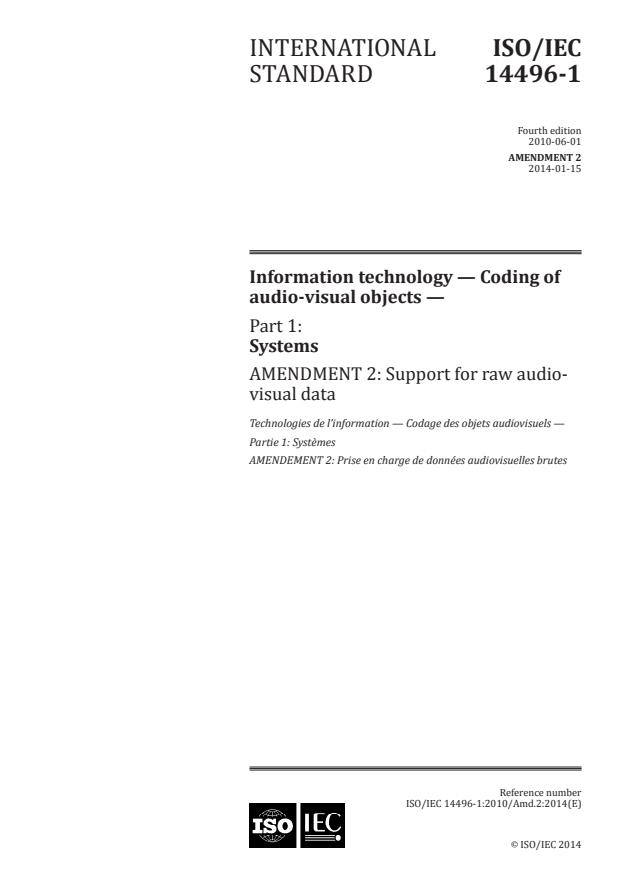
INTERNATIONAL ISO/IEC
STANDARD 14496-1
Fourth edition
2010-06-01
AMENDMENT 2
2014-01-15
Information technology — Coding of
audio-visual objects —
Part 1:
Systems
AMENDMENT 2: Support for raw audio-
visual data
Technologies de l’information — Codage des objets audiovisuels —
Partie 1: Systèmes
AMENDEMENT 2: Prise en charge de données audiovisuelles brutes
Reference number
ISO/IEC 14496-1:2010/Amd.2:2014(E)
©
ISO/IEC 2014
ISO/IEC 14496-1:2010/Amd.2:2014(E)
© ISO/IEC 2014
All rights reserved. Unless otherwise specified, no part of this publication may be reproduced or utilized otherwise in any form
or by any means, electronic or mechanical, including photocopying, or posting on the internet or an intranet, without prior
written permission. Permission can be requested from either ISO at the address below or ISO’s member body in the country of
the requester.
ISO copyright office
Case postale 56 • CH-1211 Geneva 20
Tel. + 41 22 749 01 11
Fax + 41 22 749 09 47
E-mail copyright@iso.org
Web www.iso.org
Published in Switzerland
ii © ISO/IEC 2014 – All rights reserved
ISO/IEC 14496-1:2010/Amd.2:2014(E)
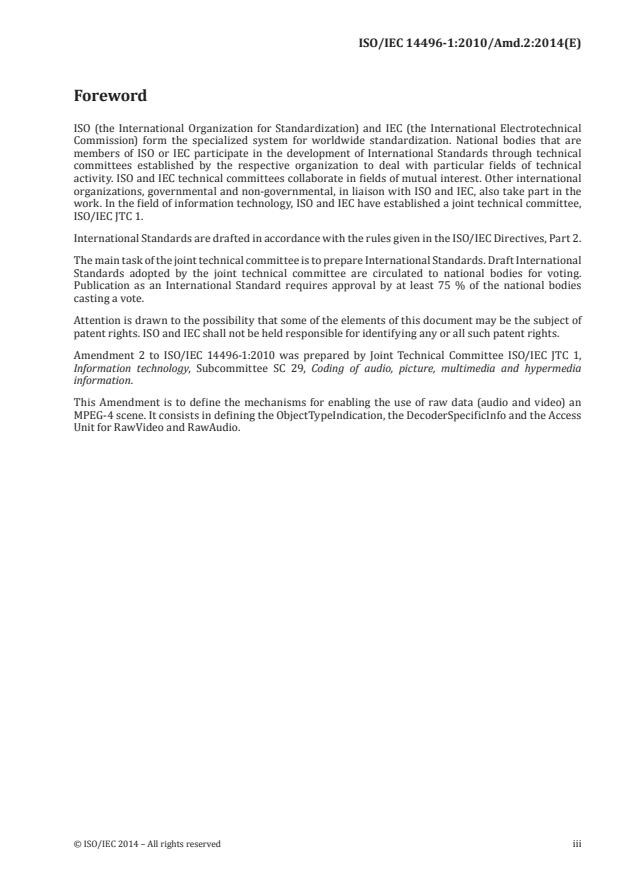
Foreword
ISO (the International Organization for Standardization) and IEC (the International Electrotechnical
Commission) form the specialized system for worldwide standardization. National bodies that are
members of ISO or IEC participate in the development of International Standards through technical
committees established by the respective organization to deal with particular fields of technical
activity. ISO and IEC technical committees collaborate in fields of mutual interest. Other international
organizations, governmental and non-governmental, in liaison with ISO and IEC, also take part in the
work. In the field of information technology, ISO and IEC have established a joint technical committee,
ISO/IEC JTC 1.
International Standards are drafted in accordance with the rules given in the ISO/IEC Directives, Part 2.
The main task of the joint technical committee is to prepare International Standards. Draft International
Standards adopted by the joint technical committee are circulated to national bodies for voting.
Publication as an International Standard requires approval by at least 75 % of the national bodies
casting a vote.
Attention is drawn to the possibility that some of the elements of this document may be the subject of
patent rights. ISO and IEC shall not be held responsible for identifying any or all such patent rights.
Amendment 2 to ISO/IEC 14496-1:2010 was prepared by Joint Technical Committee ISO/IEC JTC 1,
Information technology, Subcommittee SC 29, Coding of audio, picture, multimedia and hypermedia
information.
This Amendment is to define the mechanisms for enabling the use of raw data (audio and video) an
MPEG-4 scene. It consists in defining the ObjectTypeIndication, the DecoderSpecificInfo and the Access
Unit for RawVideo and RawAudio.
© ISO/IEC 2014 – All rights reserved iii
ISO/IEC 14496-1:2010/Amd.2:2014(E)
Information technology — Coding of audio-visual
objects —
Part 1:
Systems
AMENDMENT 2: Support for raw audio-visual data
In Table 1, replace line:
0x6A-0xBF Reserved for ISO use
with lines:
0x6A-0x92 Reserved for Registration Authority
0x93-0xBF Reserved for ISO use
In Table 2, replace line:
0x09-0xBF Reserved for ISO (command tags)
with lines:
0x09-0x63 Reserved for Registration Authority
0x64-0xBF Reserved for ISO (command tags)
In Table 5, replace line:
0x09-0x1F reserved for ISO use
with lines:
0x09 LASeR stream (defined in ISO/IEC 14496-20:2008, clauses
6 and 12)
0x0A SAF stream (defined in ISO/IEC 14496-20:2008, clause 7)
0x0B Raw video stream
0x0C Raw audio stream
0x0D-0x1F reserved for ISO use
In Table
...