


ISO 15564:1998
(Main)Guide for use of radiation-sensitive indicators
Guide for use of radiation-sensitive indicators
Guide pour l'utilisation d'indicateurs sensibles aux rayonnements
General Information
- Status
- Withdrawn
- Publication Date
- 19-Dec-1998
- Withdrawal Date
- 19-Dec-1998
- Drafting Committee
- ISO/TC 85/WG 3 - Dosimetry for radiation processing
- Current Stage
- 9599 - Withdrawal of International Standard
- Start Date
- 18-Apr-2002
- Completion Date
- 12-Feb-2026
Relations
- Effective Date
- 15-Apr-2008

Get Certified
Connect with accredited certification bodies for this standard

BSMI (Bureau of Standards, Metrology and Inspection)
Taiwan's standards and inspection authority.
Sponsored listings
Frequently Asked Questions
ISO 15564:1998 is a standard published by the International Organization for Standardization (ISO). Its full title is "Guide for use of radiation-sensitive indicators". This standard covers: Guide for use of radiation-sensitive indicators
Guide for use of radiation-sensitive indicators
ISO 15564:1998 is classified under the following ICS (International Classification for Standards) categories: 17.240 - Radiation measurements. The ICS classification helps identify the subject area and facilitates finding related standards.
ISO 15564:1998 has the following relationships with other standards: It is inter standard links to ISO/ASTM 51539:2002. Understanding these relationships helps ensure you are using the most current and applicable version of the standard.
ISO 15564:1998 is available in PDF format for immediate download after purchase. The document can be added to your cart and obtained through the secure checkout process. Digital delivery ensures instant access to the complete standard document.
Standards Content (Sample)
INTERNATIONAL IS0
STANDARD
First edition
1998-12-X
Guide for use of radiation-sensitive
indicators
Guide pour I’utilisation d ’indicateurs sensibles aux rayonnements
Reference number
IS0 15564: 1998(E)
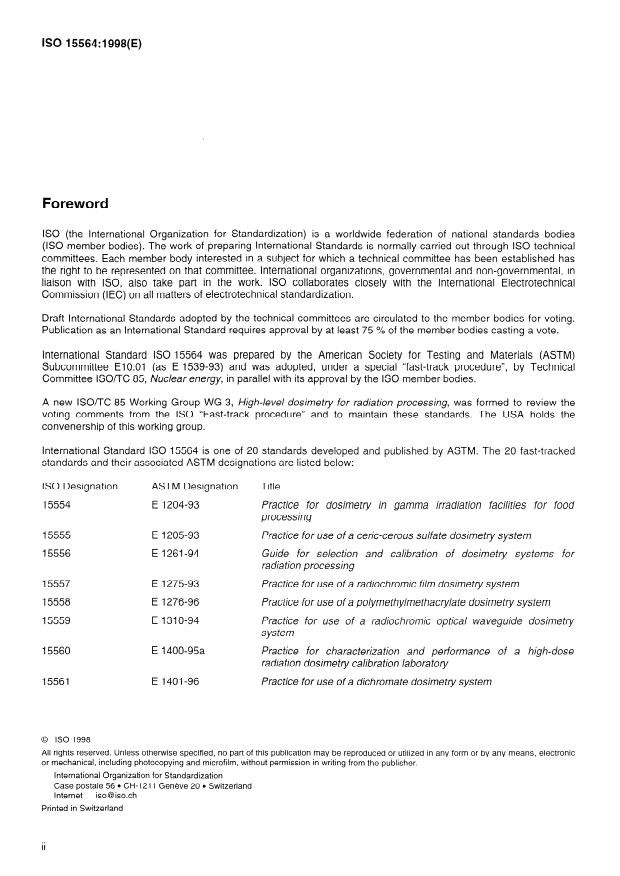
IS0 15564:1998(E)
Foreword
IS0 (the International Organization for Standardization) is a worldwide federation of national standards bodies
(IS0 member bodies). The work of preparing International Standards is normally carried out through IS0 technical
committees. Each member body interested in a subject for which a technical committee has been established has
the right to be represented on that committee. International organizations, governmental and non-governmental, in
liaison with ISO, also take part in the work. IS0 collaborates closely with the International Electrotechnical
Commission (IEC) on all matters of electrotechnical standardization.
Draft International Standards adopted by the technical co mmittees are circulated to the member bodies for voting.
Publication as an lnternationa I Standard requires approval by at least 75 % of the membe r bodies casting a vote.
International Standard IS0 15564 was prepared by the American Society for Testing and Materials (ASTM)
Subcommittee E1O.O1 (as E 1539-93) and was adopted, under a special “fast-track procedure ”, by Technical
Committee ISOflC 85, Nuclear energy, in parallel with its approval by the IS0 member bodies.
A new ISO/TC 85 Working Group WG 3, High-level dosimetry for radiation processing, was formed to review the
voting comments from the IS0 “Fast-track procedure” and to maintain these standards. The USA holds the
convenership of this working group.
International Standard IS0 15564 is one of 20 standards developed and published by ASTM. The 20 fast-tracked
standards and their associated ASTM desianations are listed below:
d
IS0 Designation ASTM Designation Title
15554 E 1204-93 Practice for dosimetry in gamma irradiation facilities for food
processing
-I 5555 E 1205-93 Practice for use of a ceric-cerous sulfate dosimetry system
E 1261-94 Guide for seiection and calibration of dosimetry systems for
radiation processing
E 1275-93 Practice for use of a radiochromic film dosimetry system
15558 E 1276-96 Practice for use of a polymethylmethacry/ate dosimetry system
I5559 E 1310-94 Practice for use of a radiochromic optical waveguide dosimetry
system
E 1400-95a Practice for characterization and performance of a high-dose
radiation dosimetry calibration laboratory
15561 E 1401-96 Practice for use of a dichromate dosimetry system
0 IS0 1998
All rights reserved. Unless otherwise specified, no part of this publication may be reproduced or utilized in any form or by any means, electronic
permission
or mechanical, inci uding photocopying and microfil m, without in writing from the publisher.
International Organization for Standardization
Case postale 56 l CH-1211 Geneve 20 l Switzerland
Internet iso @ iso.ch
Printed in Switzerland
IS0 15564:1998(E)
Q IS0
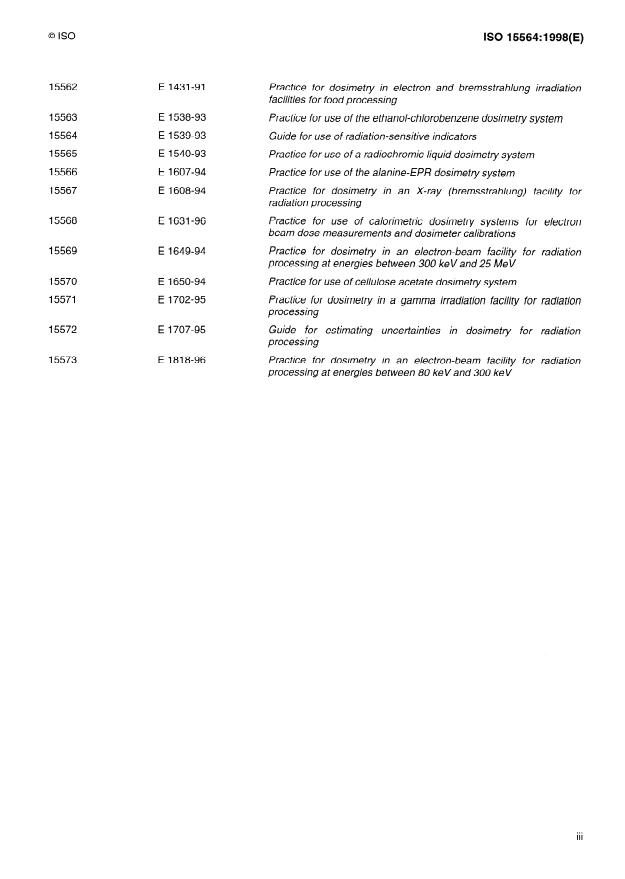
E1431-91 Practice for dosimetry in electron and bremsstrahiung irradiation
facilities for food processing
E 1538-93 Practice for use of the ethanol-chiorobenzene dosimetry system
E 1539-93
15564 Guide for use of radiation-sensitive indicators
E 1540-93 Practice for use of a radiochromic liquid dosimetry system
15566 E 1607-94 Practice for use of the aianine-EPR dosimetry system
Practice for dosimetry in an X-ray (bremsstrahiung) facility for
15567 E 1608-94
radiation processing
Practice for use of calorimetric dosimetry systems for electron
15568 E 1631-96
beam dose measurements and dosimeter calibrations
Practice for dosimetry in an electron-beam facility for radiation
15569 E 1649-94
processing at energies between 300 keV and 25 MeV
Practice for use of cellulose acetate dosimetry system
15570 E 1650-94
Practice for dosimetry in a gamma irradiation facility for radiation
E 1702-95
processing
E 1707-95 Guide for estimating uncertainties in dosimetry for radiation
processing
E 1818-96 Practice for dosimetry in an electron-beam facility for radiation
processing at energies between 80 keV and 300 keV
IS0 15564: 1998(E)
0 IS0
AMERICAN SOCIETY FOR TESTING AND MATERIALS
1916 Race St Philadelphia, Pa 19103
Designation: E 1539 - 93
Reprinted from the Annual Book of ASTM Standards. Copyright ASTM
If not listed in the current combined index, will appear in the next edition.
ITI
Standard Guide for
Use of Radiation-Sensitive Indicators’
This standard is issued under the fixed designation E 1539; the number immediately following the designation indicates the year of
original adoption or, in the case of revision, the year of last revision. A number in parentheses indicates the year of last reapproval. A
superscript epsilon (e) indicates an editorial change since the last revision or reapprovai.
4. Significance and Use
1. Scope
1.1 This guide covers the use of radiation-sensitive indica- 4.1 Radiation-sensitive indicators may be used to show
that products have been exposed to a radiation source. They
tors in radiation processing. These indicators may be labels,
should be used only to provide a qualitative indication of
papers, or inks which undergo a color change or become
radiation exposure and can be used to distinguish processed
colored when exposed to ionizing radiation.2
1.2 The purpose of these indicators is to determine irradiation units from unprocessed irradiation units.
visually whether or not a product has been irradiated, rather
NOTE l-The use of such materials does not eliminate the need for
than to measure different dose levels.
other process-control procedures, such as
...
Questions, Comments and Discussion
Ask us and Technical Secretary will try to provide an answer. You can facilitate discussion about the standard in here.
Loading comments...