

ISO 5667-1:2023
(Main)Water quality — Sampling — Part 1: Guidance on the design of sampling programmes and sampling techniques
General Information
- Abstract
This document sets out the general principles for, and provides guidance on, the design of sampling programmes and sampling techniques for all aspects of sampling of water (including waste waters, sludges, effluents, suspended solids and sediments). This document does not include detailed instructions for specific sampling situations, which are covered in various other parts of the ISO 5667 series and in ISO 19458.
- Status
- Published
- Publication Date
- 13-Mar-2023
- Technical Committee
- ISO/TC 147/SC 6 - Sampling (general methods)
- Drafting Committee
- ISO/TC 147/SC 6 - Sampling (general methods)
- Current Stage
- 9092 - International Standard to be revised
- Start Date
- 14-Mar-2025
- Completion Date
- 29-Aug-2026
Buy Documents


ISO 5667-1:2023 - Water quality — Sampling — Part 1: Guidance on the design of sampling programmes and sampling techniques Released:14. 03. 2023

ISO 5667-1:2023 - Qualité de l'eau — Échantillonnage — Partie 1: Recommandations relatives à la conception des programmes et des techniques d’échantillonnage/9/2023
Overview
ISO 5667-1:2023 - Water quality - Sampling - Part 1 provides general principles and practical guidance for the design of sampling programmes and sampling techniques for all water matrices, including waste waters, sludges, effluents, suspended solids and sediments. It sets out high-level requirements for planning, safety, variability assessment and selection of sampling approaches, and it points users to specific parts of the ISO 5667 series (and ISO 19458) for detailed, matrix-specific procedures.
Key topics and technical focus
- Scope and objectives: Guidance on designing representative sampling programmes for monitoring, compliance, investigations and research.
- Safety and environmental considerations: Personnel safety and general environmental protection when sampling water, sludges and sediments.
- Programme design: Roles and responsibilities of sampling personnel, defining monitoring objectives, dealing with variability and identifying sampling locations.
- Variability and statistical considerations: Recognizing random and systematic variations, selecting frequency, duration and timing of sampling occasions, and principles for establishing representative sampling plans.
- Sampling techniques: Overview of spot, periodic (time- or flow-dependent), continuous, series and composite sampling; large-volume and passive sampling approaches.
- Flow measurements: When and how flow, velocity and discharge measurements support water quality goals (load calculations, dilution, mass flux).
- Sampling equipment and containers: General guidance on selection of sampling devices and containers for physical and chemical analyses.
- Quality assurance links: Cross-references to QA/QC guidance and preservation/handling standards to ensure sample integrity.
Practical applications and users
ISO 5667-1:2023 is designed for practitioners who plan, manage or perform water quality sampling, including:
- Environmental consultants and field technicians establishing monitoring programmes
- Water and wastewater utility managers assessing treatment plant performance
- Regulatory authorities and compliance officers designing surveillance and enforcement sampling
- Laboratory managers and QA staff coordinating sample preservation, handling and chain-of-custody
- Researchers and academics conducting field investigations of rivers, lakes, groundwater, marine waters, sludges and sediments
Typical uses include compliance monitoring, pollution incident investigations, baseline environmental assessments, load and mass flux calculations, and the design of long-term water quality monitoring networks.
Related standards
ISO 5667-1:2023 is the general part of a broader series. Key related documents include:
- ISO 5667-3 (preservation and handling of samples)
- ISO 5667-14 (quality assurance and quality control of sampling)
- ISO 5667-4/5/6/9/10/11/12/13/15/16/17/19/20/21/22/24/26 (matrix-specific sampling guidance)
- ISO 19458 (microbiological sampling procedures)
Using ISO 5667-1 together with these specific parts ensures legally defensible, representative and high-quality water sampling programmes. Keywords: ISO 5667-1:2023, water quality sampling, sampling programmes, sampling techniques, wastewater sampling, sediment sampling, sampling equipment, flow measurement, QA/QC.
Relations
- Effective Date
- 09-Feb-2026
- Effective Date
- 09-Feb-2026
- Effective Date
- 09-Feb-2026
- Effective Date
- 09-Feb-2026
- Effective Date
- 09-Feb-2026
- Effective Date
- 09-Feb-2026
- Effective Date
- 09-Feb-2026
- Effective Date
- 09-Feb-2026
- Effective Date
- 09-Feb-2026
- Effective Date
- 09-Feb-2026
- Effective Date
- 09-Feb-2026
- Effective Date
- 12-Feb-2026
- Effective Date
- 06-Jun-2022
- Effective Date
- 06-Jun-2022
Buy Documents
ISO 5667-1:2023 - Water quality — Sampling — Part 1: Guidance on the design of sampling programmes and sampling techniques Released:14. 03. 2023
ISO 5667-1:2023 - Qualité de l'eau — Échantillonnage — Partie 1: Recommandations relatives à la conception des programmes et des techniques d’échantillonnage/9/2023
Get Certified
Connect with accredited certification bodies for this standard

CIS Institut d.o.o.
Personal Protective Equipment (PPE) certification body. Notified Body NB-2890 for EU Regulation 2016/425 PPE.

Kiwa BDA Testing
Building and construction product certification.
Kmetijski inštitut Slovenije
Agricultural Institute of Slovenia. Soil testing, plant health, agricultural product analysis.
Sponsored listings
Frequently Asked Questions
ISO 5667-1:2023 is a standard published by the International Organization for Standardization (ISO). Its full title is "Water quality — Sampling — Part 1: Guidance on the design of sampling programmes and sampling techniques". This standard covers: This document sets out the general principles for, and provides guidance on, the design of sampling programmes and sampling techniques for all aspects of sampling of water (including waste waters, sludges, effluents, suspended solids and sediments). This document does not include detailed instructions for specific sampling situations, which are covered in various other parts of the ISO 5667 series and in ISO 19458.
This document sets out the general principles for, and provides guidance on, the design of sampling programmes and sampling techniques for all aspects of sampling of water (including waste waters, sludges, effluents, suspended solids and sediments). This document does not include detailed instructions for specific sampling situations, which are covered in various other parts of the ISO 5667 series and in ISO 19458.
ISO 5667-1:2023 is classified under the following ICS (International Classification for Standards) categories: 13.060.45 - Examination of water in general. The ICS classification helps identify the subject area and facilitates finding related standards.
ISO 5667-1:2023 has the following relationships with other standards: It is inter standard links to EN ISO 23696-1:2025, EN ISO 17294-2:2023, EN ISO 19361:2025, EN ISO 23695:2025, EN ISO 13164-4:2023, EN ISO 23548:2025, EN ISO 13165-1:2024, EN ISO 23697-1:2025, EN 17892:2024, EN ISO 23697-2:2025, EN ISO 23696-2:2025, EN ISO 5667-1:2023, ISO 11403-2:2022, ISO 5667-1:2020. Understanding these relationships helps ensure you are using the most current and applicable version of the standard.
ISO 5667-1:2023 is available in PDF format for immediate download after purchase. The document can be added to your cart and obtained through the secure checkout process. Digital delivery ensures instant access to the complete standard document.
Standards Content (Sample)
INTERNATIONAL ISO
STANDARD 5667-1
Fourth edition
2023-03
Water quality — Sampling —
Part 1:
Guidance on the design of sampling
programmes and sampling techniques
Qualité de l'eau — Échantillonnage —
Partie 1: Recommandations relatives à la conception des programmes
et des techniques d’échantillonnage
Reference number
© ISO 2023
All rights reserved. Unless otherwise specified, or required in the context of its implementation, no part of this publication may
be reproduced or utilized otherwise in any form or by any means, electronic or mechanical, including photocopying, or posting on
the internet or an intranet, without prior written permission. Permission can be requested from either ISO at the address below
or ISO’s member body in the country of the requester.
ISO copyright office
CP 401 • Ch. de Blandonnet 8
CH-1214 Vernier, Geneva
Phone: +41 22 749 01 11
Email: copyright@iso.org
Website: www.iso.org
Published in Switzerland
ii
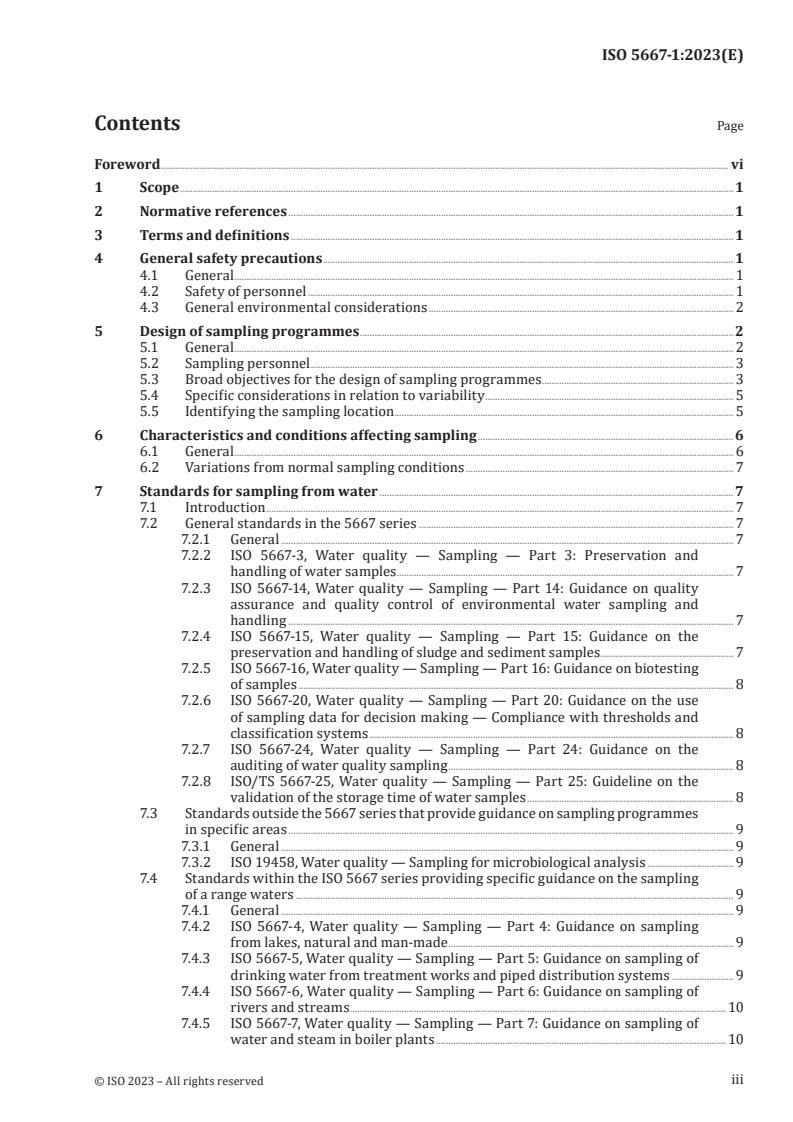
Contents Page
Foreword . vi
1 Scope . 1
2 Normative references . 1
3 Terms and definitions . 1
4 General safety precautions . 1
4.1 General . 1
4.2 Safety of personnel . 1
4.3 General environmental considerations . 2
5 Design of sampling programmes .2
5.1 General . 2
5.2 Sampling personnel . 3
5.3 Broad objectives for the design of sampling programmes . 3
5.4 Specific considerations in relation to variability . 5
5.5 Identifying the sampling location . 5
6 Characteristics and conditions affecting sampling . 6
6.1 General . 6
6.2 Variations from normal sampling conditions . 7
7 Standards for sampling from water . 7
7.1 Introduction . 7
7.2 General standards in the 5667 series . 7
7.2.1 General . 7
7.2.2 ISO 5667-3, Water quality — Sampling — Part 3: Preservation and
handling of water samples . 7
7.2.3 ISO 5667-14, Water quality — Sampling — Part 14: Guidance on quality
assurance and quality control of environmental water sampling and
handling . 7
7.2.4 ISO 5667-15, Water quality — Sampling — Part 15: Guidance on the
preservation and handling of sludge and sediment samples . 7
7.2.5 ISO 5667-16, Water quality — Sampling — Part 16: Guidance on biotesting
of samples . 8
7.2.6 ISO 5667-20, Water quality — Sampling — Part 20: Guidance on the use
of sampling data for decision making — Compliance with thresholds and
classification systems . 8
7.2.7 ISO 5667-24, Water quality — Sampling — Part 24: Guidance on the
auditing of water quality sampling . 8
7.2.8 ISO/TS 5667-25, Water quality — Sampling — Part 25: Guideline on the
validation of the storage time of water samples . 8
7.3 Standards outside the 5667 series that provide guidance on sampling programmes
in specific areas . 9
7.3.1 General . 9
7.3.2 ISO 19458, Water quality — Sampling for microbiological analysis . 9
7.4 Standards within the ISO 5667 series providing specific guidance on the sampling
of a range waters . 9
7.4.1 General . 9
7.4.2 ISO 5667-4, Water quality — Sampling — Part 4: Guidance on sampling
from lakes, natural and man-made . 9
7.4.3 ISO 5667-5, Water quality — Sampling — Part 5: Guidance on sampling of
drinking water from treatment works and piped distribution systems . 9
7.4.4 ISO 5667-6, Water quality — Sampling — Part 6: Guidance on sampling of
rivers and streams . 10
7.4.5 ISO 5667-7, Water quality — Sampling — Part 7: Guidance on sampling of
water and steam in boiler plants . 10
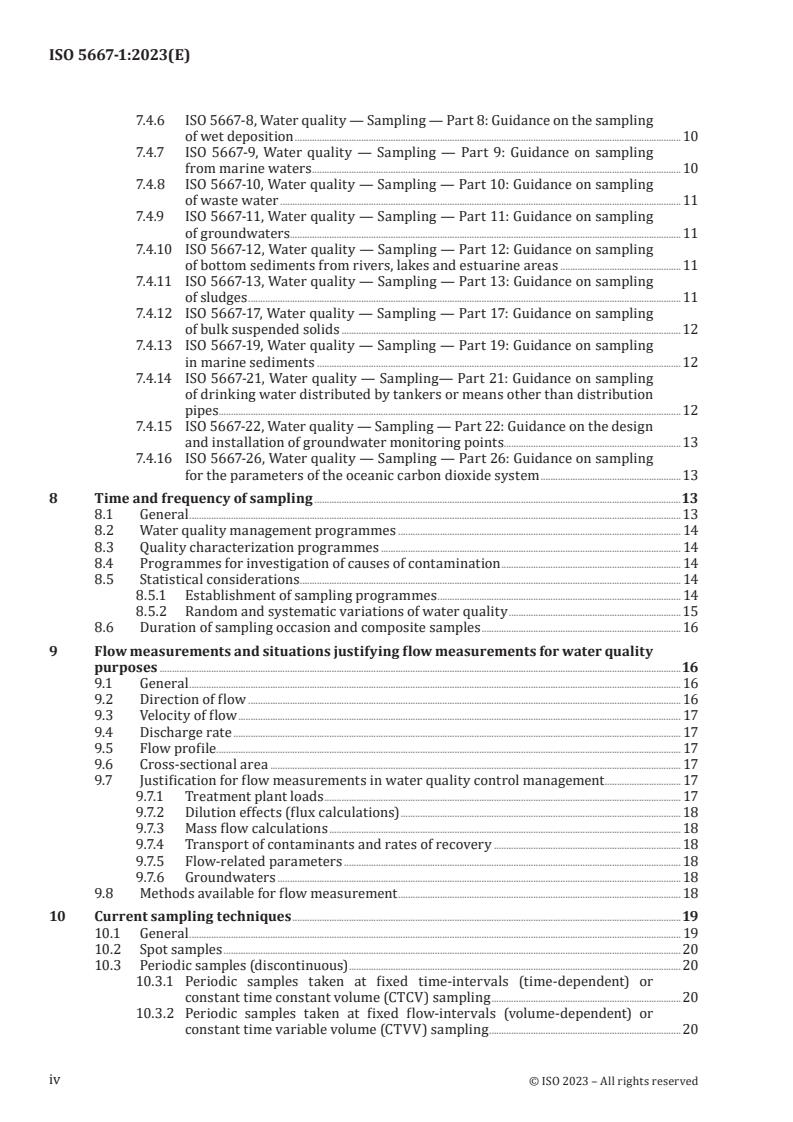
iii
7.4.6 ISO 5667-8, Water quality — Sampling — Part 8: Guidance on the sampling
of wet deposition . 10
7.4.7 ISO 5667-9, Water quality — Sampling — Part 9: Guidance on sampling
from marine waters . 10
7.4.8 ISO 5667-10, Water quality — Sampling — Part 10: Guidance on sampling
of waste water . 11
7.4.9 ISO 5667-11, Water quality — Sampling — Part 11: Guidance on sampling
of groundwaters. 11
7.4.10 ISO 5667-12, Water quality — Sampling — Part 12: Guidance on sampling
of bottom sediments from rivers, lakes and estuarine areas . 11
7.4.11 ISO 5667-13, Water quality — Sampling — Part 13: Guidance on sampling
of sludges . 11
7.4.12 ISO 5667-17, Water quality — Sampling — Part 17: Guidance on sampling
of bulk suspended solids .12
7.4.13 ISO 5667-19, Water quality — Sampling — Part 19: Guidance on sampling
in marine sediments .12
7.4.14 ISO 5667-21, Water quality — Sampling— Part 21: Guidance on sampling
of drinking water distributed by tankers or means other than distribution
pipes.12
7.4.15 ISO 5667-22, Water quality — Sampling — Part 22: Guidance on the design
and installation of groundwater monitoring points.13
7.4.16 ISO 5667-26, Water quality — Sampling — Part 26: Guidance on sampling
for the parameters of the oceanic carbon dioxide system .13
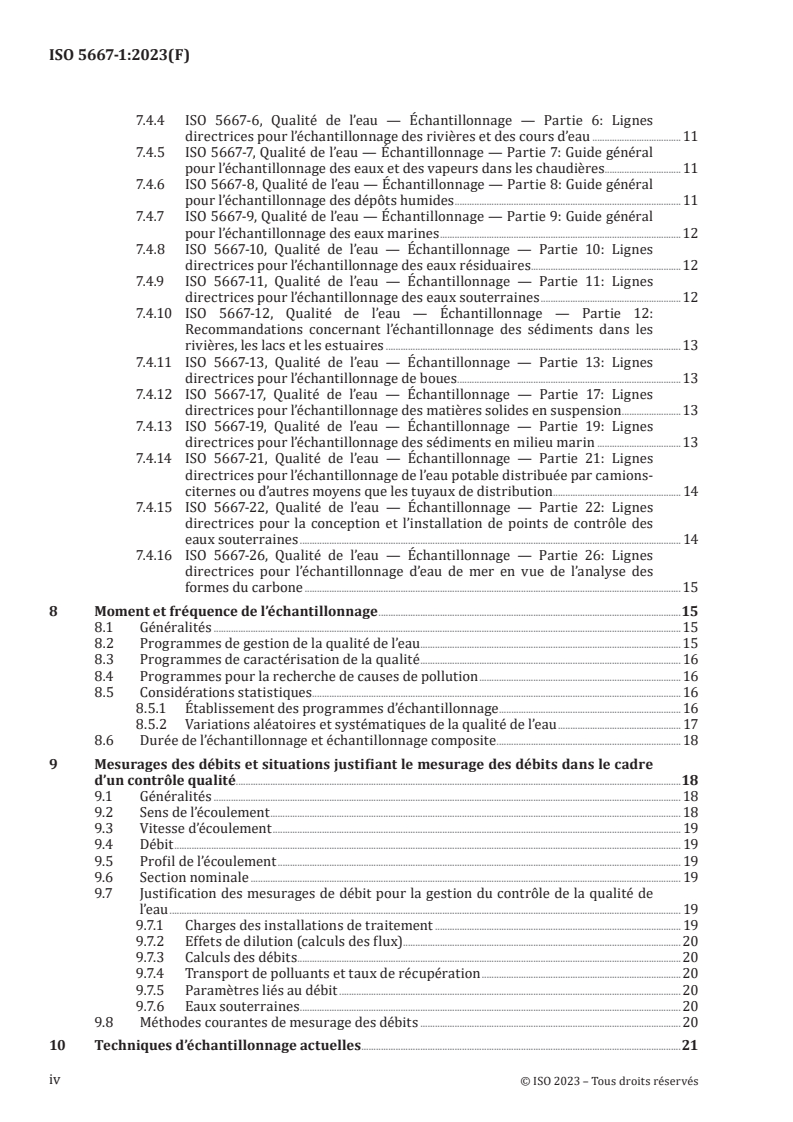
8 Time and frequency of sampling .13
8.1 General .13
8.2 Water quality management programmes . 14
8.3 Quality characterization programmes . 14
8.4 Programmes for investigation of causes of contamination . 14
8.5 Statistical considerations . . 14
8.5.1 Establishment of sampling programmes . 14
8.5.2 Random and systematic variations of water quality .15
8.6 Duration of sampling occasion and composite samples . 16
9 Flow measurements and situations justifying flow measurements for water quality
purposes .16
9.1 General . 16
9.2 Direction of flow . 16
9.3 Velocity of flow . 17
9.4 Discharge rate . 17
9.5 Flow profile. 17
9.6 Cross-sectional area . 17
9.7 Justification for flow measurements in water quality control management . 17
9.7.1 Treatment plant loads . 17
9.7.2 Dilution effects (flux calculations) . 18
9.7.3 Mass flow calculations . 18
9.7.4 Transport of contaminants and rates of recovery . 18
9.7.5 Flow-related parameters . 18
9.7.6 Groundwaters . 18
9.8 Methods available for flow measurement . 18
10 Current sampling techniques .19
10.1 General . 19
10.2 Spot samples . 20
10.3 Periodic samples (discontinuous) . 20
10.3.1 Periodic samples taken at fixed time-intervals (time-dependent) or
constant time constant volume (CTCV) sampling .20
10.3.2 Periodic samples taken at fixed flow-intervals (volume-dependent) or
constant time variable volume (CTVV) sampling .20
iv
10.3.3 Periodic samples taken at fixed flow-intervals (flow-dependent) or
constant volume variable time (CVVT) sampling . 21
10.4 Continuous samples . 21
10.4.1 Continuous samples taken at fixed flow rates (time-continuous sampling) . 21
10.4.2 Continuous samples taken at variable flow rates (flow-continuous sampling) . 21
10.5 Series sampling . 21
10.6 Composite samples . 21
10.7 Large-volume samples . 21
11 Passive sampling .22
12 Sampling equipment for physical or chemical characteristics .22
12.1 General .22
12.2 Sampling containers . 23
12.2.1 General .23
12.2.2 Types of sample container . 23
12.3 Equipment for spot sampling . . 24
12.4 Sampling equipment for sediments . 24
12.4.1 Grab or dredge sampling . 24
12.4.2 Core samplers . .25
12.5 Sampling equipment for dissolved gases and volatile materials . 25
12.6 Sampling equipment for radioactivity characteristics . 25
12.7 Sampling equipment for biological and microbiological characteristics .26
12.8 Automatic sampling equipment .26
12.9 Sampling equipment for passive sampling . 26
12.10 Sampling equipment for suspended sediments . 27
13 Quality assurance and quality control of environmental water sampling and
handling .27
13.1 General . 27
13.2 Sources of contamination . 27
13.3 Control or prevention of contamination .28
14 Transport to, and storage of samples at, the depot or laboratory .28
15 Sample identification and records . .29
15.1 General .29
15.2 Data management . 29
15.3 Samples that can be used for legal purposes .30
Annex A (informative) Diagrams illustrating types of periodic and continuous sampling .31
Annex B (informative) Diagram illustrating types of field paperwork and labels .34
Annex C (informative) Alternative and emerging sampling techniques .36
Annex D (informative) Preparation of sampling equipment .38
Bibliography .39
v
Foreword
ISO (the International Organization for Standardization) is a worldwide federation of national standards
bodies (ISO member bodies). The work of preparing International Standards is normally carried out
through ISO technical committees. Each member body interested in a subject for which a technical
committee has been established has the right to be represented on that committee. International
organizations, governmental and non-governmental, in liaison with ISO, also take part in the work.
ISO collaborates closely with the International Electrotechnical Commission (IEC) on all matters of
electrotechnical standardization.
The procedures used to develop this document and those intended for its further maintenance are
described in the ISO/IEC Directives, Part 1. In particular, the different approval criteria needed for the
different types of ISO documents should be noted. This document was drafted in accordance with the
editorial rules of the ISO/IEC Directives, Part 2 (see www.iso.org/directives).
Attention is drawn to the possibility that some of the elements of this document may be the subject of
patent rights. ISO shall not be held responsible for identifying any or all such patent rights. Details of
any patent rights identified during the development of the document will be in the Introduction and/or
on the ISO list of patent declarations received (see www.iso.org/patents).
Any trade name used in this document is information given for the convenience of users and does not
constitute an endorsement.
For an explanation of the voluntary nature of standards, the meaning of ISO specific terms and
expressions related to conformity assessment, as well as information about ISO's adherence to
the World Trade Organization (WTO) principles in the Technical Barriers to Trade (TBT) see
www.iso.org/iso/foreword.html.
This document was prepared by Technical Committee ISO/TC 147, Water quality, Subcommittee SC 6,
Sampling (general methods), in collaboration with the European Committee for Standardization (CEN)
Technical Committee CEN/TC 230, Water analysis, in accordance with the Agreement on technical
cooperation between ISO and CEN (Vienna Agreement).
This fourth edition cancels and replaces the third edition (ISO 5667-1:2020), of which it constitutes a
minor revision. The changes compared to the previous edition are as follows:
— corrections have been made to 10.3 and associated cross-references to Annex A;
— subclauses have been included in Clause 7 referring to the most recent additions to the ISO 5667
series.
A list of all parts in the ISO 5667 series can be found on the ISO website.
Any feedback or questions on this document should be directed to the user’s national standards body. A
complete listing of these bodies can be found at www.iso.org/members.html.
vi
INTERNATIONAL STANDARD ISO 5667-1:2023(E)
Water quality — Sampling —
Part 1:
Guidance on the design of sampling programmes and
sampling techniques
1 Scope
This document sets out the general principles for, and provides guidance on, the design of sampling
programmes and sampling techniques for all aspects of sampling of water (including waste waters,
sludges, effluents, suspended solids and sediments).
This document does not include detailed instructions for specific sampling situations, which are
covered in various other parts of the ISO 5667 series and in ISO 19458.
2 Normative references
There are no normative references.
3 Terms and definitions
No terms and definitions are listed in this document.
ISO and IEC maintain terminology databases for use in standardization at the following addresses:
— ISO Online browsing platform: available at https:// www .iso .org/ obp
— IEC Electropedia: available at https:// www .electropedia .org/
4 General safety precautions
4.1 General
Attention is drawn to the requirements of national and/or regional health and safety regulations.
The following are general examples of safety considerations.
4.2 Safety of personnel
The enormously wide range of conditions encountered in sampling water bodies and bottom sediments
can subject sampling personnel to a variety of safety and health risks. Precautions should be taken
to avoid inhalation of toxic gases and ingestion of toxic materials through the nose, mouth and skin.
Personnel responsible for the design of sampling programmes and for carrying out sampling operations
should ensure that sampling personnel are informed of the necessary precautions to be taken in
sampling operations.
Weather conditions should be taken into account in order to ensure the safety of personnel and
equipment and it is essential that life jackets and lifelines should be worn when sampling large masses
of water. Before sampling from ice-covered waters, the location and extent of weak ice should be
carefully checked. If self-contained underwater breathing apparatus or other diving equipment is used,
it should always be checked and maintained in accordance with relevant ISO or national standards to
ensure reliability.
Boats or platforms used for sampling purposes should be capable of being maintained in a stable
condition. In all waters, precautions should be taken in relation to commercial ships and fishing
vessels; for example, the correct signal flags should be flown to indicate the nature of the work being
undertaken.
Sampling from unsafe sites, such as unstable river banks, should be avoided wherever possible. If this
is not possible, the operation should be conducted by a team using appropriate precautions rather than
by a single operator. Wherever possible, sampling from bridges should be used as a substitute for bank
sampling unless bank conditions are the specific subject of the sampling study.
Safe access to sampling sites in all weather is essential for frequent routine sampling. Where relevant,
precautions should be taken where additional natural hazards are present, such as fauna or flora, that
can endanger the health or safety of personnel.
Hazardous materials (e.g. bottles containing concentrated acids) should be properly labelled.
If instruments or other items of equipment are to be installed on a river bank for sampling purposes,
locations that are susceptible to flooding or vandalism should be avoided or appropriate precautions
taken.
Many other situations arise during the sampling of water when special precautions should be taken
to avoid accidents. For example, some industrial effluents can be corrosive or can contain toxic or
flammable materials. The potential dangers associated with contact with sewage should also not be
overlooked; these can be gaseous, microbiological, radiological, virological or zoological, such as from
amoebae or helminthes.
Gas protection equipment, breathing apparatus, resuscitation apparatus and other safety equipment
should be available when sampling personnel need to enter sampling locations containing hazardous
atmospheres. In addition, the concentration of oxygen and of any likely toxic or asphyxiating vapour or
gas likely to be present should be measured before personnel enter enclosed spaces.
In the sampling of steam and hot discharges, special care is necessary, and recognized sampling
techniques designed to remove hazards should be applied.
The handling of radioactive samples requires special care, and the special techniques required should
be strictly applied.
The use of electrically operated sampling equipment in or near water can present special electrocution
hazards. Work procedures, site design and equipment maintenance should be planned so as to minimize
these hazards. Where appropriate, specific materials and equipment, for example, ‘atmosphere
explosible’ equipment, should be used.
4.3 General environmental considerations
While working in the field environmental protection should be observed. In any sampling activity there
should be measures taken to avoid environmental impacts on the sampling site surroundings and the
working space.
Measures should be designed to avoid any harm to flora and fauna when installing equipment using
machinery (subsoil compaction) or when developing the access and egress form the site.
5 Design of sampling programmes
5.1 General
Whenever a volume of water, suspended solids, bottom sediment or sludge is to be characterized, it is
generally impossible to examine the whole and it is therefore necessary to take samples.
Samples are collected and examined primarily for the following reasons:
a) to determine the concentration of associated physical, chemical, microbiological, biological and
radiological parameters in space and time;
b) with bottom sediments, to obtain a visual indication of their nature;
c) to estimate the flux of material;
d) to assess trends over time or over space;
e) for conformance with, or attainment of, criteria, standards or objectives.
Sampling programmes, the outcome of which will be estimates of summary statistics and trends,
should be designed in full awareness of the issues of statistical sampling error and the techniques by
which these errors are quantified and how they are used to take decisions.
The samples collected should be as representative as possible of the whole to be characterized, and all
precautions should be taken to ensure that, as far as possible, the samples do not undergo any changes
in the interval between sampling and analysis (see ISO 5667-3 for additional guidance). The sampling
of multiphase systems, such as water containing suspended solids or immiscible organic liquids, can
present special problems and in such cases, specific advice should be sought (see Clause 6).
5.2 Sampling personnel
Attention is drawn to the fact that certification and accreditation of the sampling process and the
individuals implementing it can be required or recommended at national level. Also refer to 7.2.6,
ISO 5667-14 and ISO 5667-24.
5.3 Broad objectives for the design of sampling programmes
Before any sampling programme is devised, it is very important that the objectives of the programme
are carefully established since they are the major factors in determining the position of sampling sites,
frequency of sampling, duration of sampling, sampling procedures, subsequent treatment of samples
and analytical requirements. The degree of accuracy and precision necessary for the estimation of
parameter concentrations sought should also be taken into account, as should the manner in which
the results are to be expressed and presented, for example, as concentrations or mass loads, maximum
and/or minimum values, arithmetic means, median values, etc. The sampling programme should be
designed to be capable of estimating the error in such values as affected by statistical sampling error
and errors in chemical analysis.
Additionally, a list of parameters of interest should be compiled and the relevant analytical procedures
consulted since these can give guidance on precautions to be observed during sampling and subsequent
handling (general guidance on handling of samples is given in ISO 5667-3).
It can often be necessary to carry out a preliminary sampling and analysis programme before the
final objectives can be defined. It is important to take into account all relevant data from previous
programmes at the same or similar locations and other information on local conditions. Previous
personal experience of similar programmes or situations can also be very valuable when setting up
a new programme for the first time. Putting sufficient effort in time and money into the design of a
proper sampling programme is a good investment that will ensure that the required information is
obtained both efficiently and economically; failure to put proper effort into this aspect can result in
either failure of the programme to achieve its objectives and/or over-expenditure of time and money.
Three broad objectives can be distinguished as follows (these are covered in more detail in 8.2, 8.3 and
8.4):
— quality control measurements within water or waste water treatment plants used to decide when
short-term process corrections are required;
— quality characterization measurements used to estimate quality, perhaps as part of a research
project, for setting and measuring performance targets against regulatory targets, for long-term
control purposes or to indicate long-term trends;
— identification and control of sources of contamination.
The purpose of the programme can change from quality characterization to quality control and vice-
versa. For example, a longer-term programme for nitrate characterization can become a short-term
quality control programme requiring increased frequency of sampling as the nitrate concentration
approaches a critical value.
No single sampling study can satisfy all possible purposes. It is therefore important that specific
sampling programmes are optimized for specific study purposes, such as the following:
a) to determine the suitability of water for an intended use and, if necessary, to assess any treatment
or control requirements, for example, to examine borehole water for cooling, boiler feed or process
purposes or, if a natural spring, as a possible source of water intended for human consumption;
b) to study the effect of waste discharges, including accidental spillages, on a receiving water;
c) to assess the performance and control of water, sewage and industrial effluent plants, for example
1) to assess the variations and long-term changes in load entering a treatment works,
2) to determine the efficiency of each stage in a treatment process,
3) to provide evidence of quality of treated water,
4) to control the concentration of treated substances including those which can constitute a
health hazard or which can inhibit a bacteriological process, and
5) to control substances which can damage the fabric of plant or equipment;
d) to study the effects of fresh and saline water flows on estuarine conditions in order to provide
information on mixing patterns and associated stratification with variations in tides and
freshwater flow;
e) to identify and quantify products lost from industrial processes; this information is required
when product balances across the plant are to be assessed and when effluent discharges are to be
measured;
f) to establish the quality of boiler water, steam condensate and other reclaimed water, enabling its
suitability for a particular intended purpose to be assessed;
g) to control the operation of industrial cooling water systems; this enables the use of water to be
optimized and, at the same time, the problems associated with scale formation and corrosion to be
minimized;
h) to study the effects of atmospheric contaminants on the quality of rainwater; this provides useful
information on air quality and also indicates if problems are likely to arise, for example, on exposed
electrical contacts;
i) to assess the effect of inputs from the land on water quality from naturally occurring materials, or
contamination by fertilizers, pesticides and chemicals used in agriculture, or both;
j) to assess the effect of the accumulation and release of substances by bottom sediments on the
aquatic biota in the water mass or bottom sediment;
k) to study the effect of abstraction, river regulation and river-to-river transfers on natural water-
courses; for example, varying proportions of waters of different quality can be involved in river
regulation and the quality of the resulting blend can fluctuate;
l) to assess changes in water quality which occur in distribution systems for water for human
consumption; these changes can occur for a number of reasons, for example, contamination,
introduction of water from a new source, biological growths, deposition of scale or dissolution of
metal;
m) to gather information for compiling pollution load estimations of river catchment areas as well as
information about the significance of different pollution sources:
n) to assess the effect of anthropogenic changes (global warming, ocean acidification, eutrophication,
dust storms, etc.) on the water quality in marine environments and long-term variations in
biogeochemical cycling and spatio-temporal distribution of environmentally important components
(nutrients, dissolved gases, contaminants, suspended solids, etc).
On some occasions, the conditions can be sufficiently stable and the forms of variability understood
for the required information and the accompanying estimates of errors to be obtained from a simple
sampling programme. But, in most locations, quality characteristics are subject to continuous variations
in time and space and, ideally, assessment should also be continuous. However, this is often very costly
and, in many situations, impossible to achieve. In the absence of continuous low-error monitoring, and
in the use of data collected by sampling, it is vital to take account of sampling error. When considering
sampling programmes, the special considerations given in 5.4 should be borne in mind.
5.4 Specific considerations in relation to variability
Sampling programmes can be complex in situations and locations where wide, rapid and continuous
variations occur in characteristics such as the concentrations of parameters of interest. These variations
can be caused by such factors as extreme changes in temperature, flow patterns or plant operating
conditions (as well as in things like chemical analysis). The design of any sampling programme should
take this variability into account, either by means of continuous assessment (see Figure A.1) (although
this is often very costly and, in many situations, impossible to achieve), or by taking into account the
following recommendations.
a) The programme should be set in terms of the requirements of techniques that allow the estimation
of statistical sampling error.
b) Sampling should be avoided at or near boundaries of systems unless those conditions are of special
interest.
c) Care should be taken to eliminate or minimize any changes in the concentration of parameters of
interest that can be produced by the sampling process itself, and to ensure that changes during the
period between sampling and analysis are avoided or minimized. For detailed guidance on these
issues, reference should be made to ISO 5667-14.
d) Composite sampling may be used to give the best indication of the average composition over a
period of time, provided that the parameter being measured is stable during the period of sampling
and examination. Data derived from composite sampling should be considered a specific data type
in databases so that this type of data is not confused with discrete samples. It should be borne in
mind that composite samples are of little value in determining transient peak conditions.
In situations of extreme variability of flow, or concentration, or both (e.g. intermittent plant effluents),
there may be a benefit in studying the discharge or flow parameters to ascertain whether a pattern is
evident, before committing to a particular sampling programme.
5.5 Identifying the sampling location
Depending on the objectives to be achieved (see 5.3), the sampling network can be anything from a
single site to, for example, an entire river catchment. A basic river network can comprise sampling
sites at the tidal limit, major tributaries at its confluence and major discharges of sewage or industrial
effluent.
In designing water quality sampling networks, it is usual to make provision for the measurement of
flow at key stations (see Clause 9).
Identifying the sampling location enables comparative samples to be taken. In most river sampling
situations, sampling locations can readily be fixed by reference to physical features on the river bank.
On uncovered estuarine and coastal shores, sampling locations can similarly be related to an easily
recognizable static object. For sampling from a boat or ship in these situations, instrumental methods
(e.g. global positioning system) for location identification should be used. Map references or other
standard forms of reference can be valuable in achieving this.
6 Characteristics and conditions affecting sampling
6.1 General
Flow can change from streamlined to turbulen
...
NORME ISO
INTERNATIONALE 5667-1
Quatrième édition
2023-03
Qualité de l'eau — Échantillonnage —
Partie 1:
Recommandations relatives à la
conception des programmes et des
techniques d’échantillonnage
Water quality — Sampling —
Part 1: Guidance on the design of sampling programmes and
sampling techniques
Numéro de référence
DOCUMENT PROTÉGÉ PAR COPYRIGHT
© ISO 2023
Tous droits réservés. Sauf prescription différente ou nécessité dans le contexte de sa mise en œuvre, aucune partie de cette
publication ne peut être reproduite ni utilisée sous quelque forme que ce soit et par aucun procédé, électronique ou mécanique,
y compris la photocopie, ou la diffusion sur l’internet ou sur un intranet, sans autorisation écrite préalable. Une autorisation peut
être demandée à l’ISO à l’adresse ci-après ou au comité membre de l’ISO dans le pays du demandeur.
ISO copyright office
Case postale 401 • Ch. de Blandonnet 8
CH-1214 Vernier, Genève
Tél.: +41 22 749 01 11
E-mail: copyright@iso.org
Web: www.iso.org
Publié en Suisse
ii
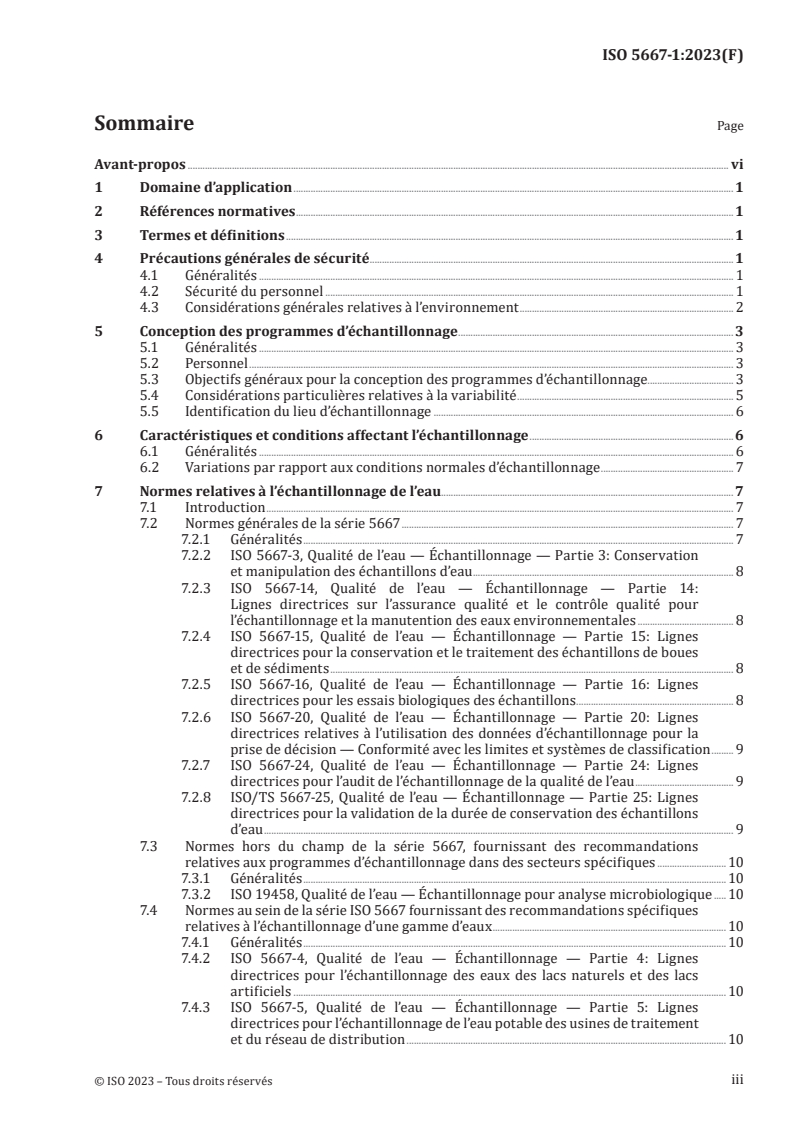
Sommaire Page
Avant-propos . vi
1 Domaine d’application . 1
2 Références normatives .1
3 Termes et définitions . 1
4 Précautions générales de sécurité . .1
4.1 Généralités . 1
4.2 Sécurité du personnel . 1
4.3 Considérations générales relatives à l’environnement . 2
5 Conception des programmes d’échantillonnage . 3
5.1 Généralités . 3
5.2 Personnel . 3
5.3 Objectifs généraux pour la conception des programmes d’échantillonnage. 3
5.4 Considérations particulières relatives à la variabilité . 5
5.5 Identification du lieu d’échantillonnage . 6
6 Caractéristiques et conditions affectant l’échantillonnage . 6
6.1 Généralités . 6
6.2 Variations par rapport aux conditions normales d’échantillonnage . 7
7 Normes relatives à l’échantillonnage de l’eau. 7
7.1 Introduction . 7
7.2 Normes générales de la série 5667 . 7
7.2.1 Généralités . 7
7.2.2 ISO 5667-3, Qualité de l’eau — Échantillonnage — Partie 3: Conservation
et manipulation des échantillons d’eau . 8
7.2.3 ISO 5667-14, Qualité de l’eau — Échantillonnage — Partie 14:
Lignes directrices sur l’assurance qualité et le contrôle qualité pour
l’échantillonnage et la manutention des eaux environnementales . 8
7.2.4 ISO 5667-15, Qualité de l’eau — Échantillonnage — Partie 15: Lignes
directrices pour la conservation et le traitement des échantillons de boues
et de sédiments . 8
7.2.5 ISO 5667-16, Qualité de l’eau — Échantillonnage — Partie 16: Lignes
directrices pour les essais biologiques des échantillons . 8
7.2.6 ISO 5667-20, Qualité de l’eau — Échantillonnage — Partie 20: Lignes
directrices relatives à l’utilisation des données d’échantillonnage pour la
prise de décision — Conformité avec les limites et systèmes de classification . 9
7.2.7 ISO 5667-24, Qualité de l’eau — Échantillonnage — Partie 24: Lignes
directrices pour l’audit de l’échantillonnage de la qualité de l’eau . 9
7.2.8 ISO/TS 5667-25, Qualité de l’eau — Échantillonnage — Partie 25: Lignes
directrices pour la validation de la durée de conservation des échantillons
d’eau . 9
7.3 Normes hors du champ de la série 5667, fournissant des recommandations
relatives aux programmes d’échantillonnage dans des secteurs spécifiques . 10
7.3.1 Généralités . 10
7.3.2 ISO 19458, Qualité de l’eau — Échantillonnage pour analyse microbiologique . 10
7.4 Normes au sein de la série ISO 5667 fournissant des recommandations spécifiques
relatives à l’échantillonnage d’une gamme d’eaux . 10
7.4.1 Généralités . 10
7.4.2 ISO 5667-4, Qualité de l’eau — Échantillonnage — Partie 4: Lignes
directrices pour l’échantillonnage des eaux des lacs naturels et des lacs
artificiels . 10
7.4.3 ISO 5667-5, Qualité de l’eau — Échantillonnage — Partie 5: Lignes
directrices pour l’échantillonnage de l’eau potable des usines de traitement
et du réseau de distribution . 10
iii
7.4.4 ISO 5667-6, Qualité de l’eau — Échantillonnage — Partie 6: Lignes
directrices pour l’échantillonnage des rivières et des cours d’eau . 11
7.4.5 ISO 5667-7, Qualité de l’eau — Échantillonnage — Partie 7: Guide général
pour l’échantillonnage des eaux et des vapeurs dans les chaudières. 11
7.4.6 ISO 5667-8, Qualité de l’eau — Échantillonnage — Partie 8: Guide général
pour l’échantillonnage des dépôts humides . 11
7.4.7 ISO 5667-9, Qualité de l’eau — Échantillonnage — Partie 9: Guide général
pour l’échantillonnage des eaux marines .12
7.4.8 ISO 5667-10, Qualité de l’eau — Échantillonnage — Partie 10: Lignes
directrices pour l’échantillonnage des eaux résiduaires.12
7.4.9 ISO 5667-11, Qualité de l’eau — Échantillonnage — Partie 11: Lignes
directrices pour l’échantillonnage des eaux souterraines .12
7.4.10 ISO 5667-12, Qualité de l’eau — Échantillonnage — Partie 12:
Recommandations concernant l’échantillonnage des sédiments dans les
rivières, les lacs et les estuaires . 13
7.4.11 ISO 5667-13, Qualité de l’eau — Échantillonnage — Partie 13: Lignes
directrices pour l’échantillonnage de boues . . .13
7.4.12 ISO 5667-17, Qualité de l’eau — Échantillonnage — Partie 17: Lignes
directrices pour l’échantillonnage des matières solides en suspension .13
7.4.13 ISO 5667-19, Qualité de l’eau — Échantillonnage — Partie 19: Lignes
directrices pour l’échantillonnage des sédiments en milieu marin .13
7.4.14 ISO 5667-21, Qualité de l’eau — Échantillonnage — Partie 21: Lignes
directrices pour l’échantillonnage de l’eau potable distribuée par camions-
citernes ou d’autres moyens que les tuyaux de distribution . 14
7.4.15 ISO 5667-22, Qualité de l’eau — Échantillonnage — Partie 22: Lignes
directrices pour la conception et l’installation de points de contrôle des
eaux souterraines . 14
7.4.16 ISO 5667-26, Qualité de l’eau — Échantillonnage — Partie 26: Lignes
directrices pour l’échantillonnage d’eau de mer en vue de l’analyse des
formes du carbone . 15
8 Moment et fréquence de l’échantillonnage .15
8.1 Généralités . 15
8.2 Programmes de gestion de la qualité de l’eau . 15
8.3 Programmes de caractérisation de la qualité . 16
8.4 Programmes pour la recherche de causes de pollution . 16
8.5 Considérations statistiques. 16
8.5.1 Établissement des programmes d’échantillonnage . 16
8.5.2 Variations aléatoires et systématiques de la qualité de l’eau . 17
8.6 Durée de l’échantillonnage et échantillonnage composite . 18
9 Mesurages des débits et situations justifiant le mesurage des débits dans le cadre
d’un contrôle qualité.18
9.1 Généralités . 18
9.2 Sens de l’écoulement . 18
9.3 Vitesse d’écoulement . 19
9.4 Débit . 19
9.5 Profil de l’écoulement . 19
9.6 Section nominale . 19
9.7 Justification des mesurages de débit pour la gestion du contrôle de la qualité de
l’eau . 19
9.7.1 Charges des installations de traitement . 19
9.7.2 Effets de dilution (calculs des flux) . 20
9.7.3 Calculs des débits . .20
9.7.4 Transport de polluants et taux de récupération . 20
9.7.5 Paramètres liés au débit . 20
9.7.6 Eaux souterraines . 20
9.8 Méthodes courantes de mesurage des débits . 20
10 Techniques d’échantillonnage actuelles .21
iv
10.1 Généralités . 21
10.2 Échantillonnage ponctuel . 22
10.3 Échantillonnage périodique (discontinu) . 22
10.3.1 Échantillons périodiques prélevés à intervalles de temps fixes (asservis
au temps) ou échantillonnage à volume constant et à intervalles de temps
constants (CTCV) .22
10.3.2 Échantillons périodiques prélevés à intervalles de débit fixes (asservis au
volume) ou échantillonnage à volume variable et à intervalles de temps
constants (CTVV) . 23
10.3.3 Échantillons périodiques prélevés à intervalles de débit fixes (asservis
au débit) ou échantillonnage à intervalles de temps variables et à volume
constant (CVVT) . 23
10.4 Échantillonnage en continu . 23
10.4.1 Échantillons prélevés en continu sous débit constant (échantillonnage
continu asservi au temps) . 23
10.4.2 Échantillons prélevés en continu sous débit variable (échantillonnage
continu asservi au débit) . 23
10.5 Échantillonnage en série.23
10.6 Échantillonnage composite . 23
10.7 Échantillonnage de grand volume . 24
11 Échantillonnage passif .24
12 Matériel d’échantillonnage pour analyses physiques ou chimiques .25
12.1 Généralités . 25
12.2 Récipients . 25
12.2.1 Généralités . 25
12.2.2 Différents types de récipients . 26
12.3 Matériel pour l’échantillonnage ponctuel . 27
12.4 Matériel d’échantillonnage pour sédiments . 27
12.4.1 Échantillonnage par bennes préleveuses ou dragues . 27
12.4.2 Carottiers .28
12.5 Matériel d’échantillonnage pour analyse des gaz dissous et des substances volatiles .28
12.6 Matériel d’échantillonnage pour analyses de radioactivité .28
12.7 Matériel d’échantillonnage pour analyses biologiques et microbiologiques.28
12.8 Matériel d’échantillonnage automatique .28
12.9 Matériel d’échantillonnage pour échantillonnage passif .29
12.10 Matériel d’échantillonnage pour sédiments en suspension .29
13 Assurance qualité et contrôle qualité de l’échantillonnage et de la manutention des
eaux environnementales .30
13.1 Généralités .30
13.2 Sources de contamination . 30
13.3 Contrôle ou prévention de la contamination .30
14 Transport des échantillons vers le dépôt ou le laboratoire et stockage
en ces endroits .31
15 Identification et enregistrements des échantillons .32
15.1 Généralités . 32
15.2 Gestion des données . 32
15.3 Échantillons susceptibles d’être utilisés pour des besoins légaux . 33
Annexe A (informative) Diagrammes illustrant les types d’échantillonnages périodiques
et continus.34
Annexe B (informative) Diagramme illustrant les types de traçabilité à réaliser sur le
terrain et étiquettes .37
Annexe C (informative) Techniques d’échantillonnage alternatives et émergentes .39
Annexe D (informative) Préparation du matériel d’échantillonnage .41
v
Avant-propos
L'ISO (Organisation internationale de normalisation) est une fédération mondiale d'organismes
nationaux de normalisation (comités membres de l'ISO). L'élaboration des Normes internationales est
en général confiée aux comités techniques de l'ISO. Chaque comité membre intéressé par une étude
a le droit de faire partie du comité technique créé à cet effet. Les organisations internationales,
gouvernementales et non gouvernementales, en liaison avec l'ISO participent également aux travaux.
L'ISO collabore étroitement avec la Commission électrotechnique internationale (IEC) en ce qui
concerne la normalisation électrotechnique.
Les procédures utilisées pour élaborer le présent document et celles destinées à sa mise à jour sont
décrites dans les Directives ISO/IEC, Partie 1. Il convient, en particulier, de prendre note des différents
critères d'approbation requis pour les différents types de documents ISO. Le présent document a
été rédigé conformément aux règles de rédaction données dans les Directives ISO/IEC, Partie 2 (voir
www.iso.org/directives).
L’ISO attire l’attention sur le fait que la mise en application du présent document peut entraîner
l’utilisation d’un ou de plusieurs brevets. L’ISO ne prend pas position quant à la preuve, à la validité
et à l’applicabilité de tout droit de brevet revendiqué à cet égard. À la date de publication du présent
document, l’ISO n'avait pas reçu notification qu’un ou plusieurs brevets pouvaient être nécessaires à sa
mise en application. Toutefois, il y a lieu d’avertir les responsables de la mise en application du présent
document que des informations plus récentes sont susceptibles de figurer dans la base de données de
brevets, disponible à l'adresse www.iso.org/brevets. L’ISO ne saurait être tenue pour responsable de ne
pas avoir identifié tout ou partie de tels droits de propriété.
Les appellations commerciales éventuellement mentionnées dans le présent document sont données
pour information, par souci de commodité, à l’intention des utilisateurs et ne sauraient constituer un
engagement.
Pour une explication de la nature volontaire des normes, la signification des termes et expressions
spécifiques de l'ISO liés à l'évaluation de la conformité, ou pour toute information au sujet de l'adhésion
de l'ISO aux principes de l’Organisation mondiale du commerce (OMC) concernant les obstacles
techniques au commerce (OTC), voir www.iso.org/avant-propos.
Le présent document a été élaboré par le comité technique ISO/TC 147, Qualité de l’eau, sous-comité SC 6,
Échantillonnage (méthodes générales), en collaboration avec le comité technique CEN/TC 230, Analyse de
l’eau, du Comité européen de normalisation (CEN), conformément à l’Accord de coopération technique
entre l’ISO et le CEN (Accord de Vienne).
Cette quatrième édition annule et remplace la troisième édition (ISO 5667-1:2020), dont elle constitue
une révision mineure. Les modifications par rapport à l’édition précédente sont les suivantes:
— des corrections ont été apportées en 10.3 et aux renvois associés à l’Annexe A;
— des paragraphes ont été ajoutés à l’Article 7, par référence aux ajouts les plus récents à la série
ISO 5667.
Une liste de toutes les parties de la série ISO 5667 se trouve sur le site web de l’ISO.
Il convient que l’utilisateur adresse tout retour d’information ou toute question concernant le présent
document à l’organisme national de normalisation de son pays. Une liste exhaustive desdits organismes
se trouve à l’adresse www.iso.org/fr/members.html.
vi
NORME INTERNATIONALE ISO 5667-1:2023(F)
Qualité de l'eau — Échantillonnage —
Partie 1:
Recommandations relatives à la conception des
programmes et des techniques d’échantillonnage
1 Domaine d’application
Le présent document énonce les principes généraux et fournit des recommandations relatives à la
conception des programmes et des techniques d’échantillonnage, en tenant compte de tous les aspects
relatifs à l’échantillonnage des eaux (y compris des eaux résiduaires, des boues, des effluents, des
matières en suspension et des sédiments).
Le présent document n’inclut pas de consignes détaillées pour les cas d’échantillonnages spécifiques,
qui sont couverts par différentes autres parties de la série ISO 5667 et par l’ISO 19458.
2 Références normatives
Le présent document ne contient aucune référence normative.
3 Termes et définitions
Aucun terme n’est défini dans le présent document.
L’ISO et l’IEC tiennent à jour des bases de données terminologiques destinées à être utilisées en
normalisation, consultables aux adresses suivantes:
— ISO Online browsing platform: disponible à l’adresse https:// www .iso .org/ obp;
— IEC Electropedia: disponible à l’adresse https:// www .electropedia .org/ .
4 Précautions générales de sécurité
4.1 Généralités
L’attention est attirée sur le respect des exigences réglementaires nationales et/ou régionales en
matière de santé et de sécurité.
Les points suivants sont des exemples généraux de considérations relatives à la sécurité.
4.2 Sécurité du personnel
La grande diversité des conditions rencontrées pour l’échantillonnage de la masse d’eau et des sédiments
de fond peut exposer le personnel à des risques multiples pour sa sécurité et sa santé. Il convient de
prendre des précautions afin d’éviter l’inhalation de gaz toxiques et l’absorption de matières toxiques
par le nez, la bouche et par voie cutanée. Il convient que le personnel responsable de la conception
des programmes d’échantillonnage et de la mise en œuvre des opérations d’échantillonnage s’assure
que le personnel chargé de l’échantillonnage est informé des précautions nécessaires à prendre pour
effectuer les échantillonnages.
Il convient de tenir compte des conditions climatiques afin d’assurer la sécurité du personnel et
du matériel et il convient de porter des gilets de sauvetage et d’utiliser des garde-corps lorsque
les échantillonnages sont effectués sur de grands volumes d’eau. Avant d’échantillonner des eaux
gelées, il convient de repérer soigneusement l’emplacement et l’étendue de glace de faible épaisseur.
Si un appareil de respiration autonome subaquatique ou un autre matériel de plongée est utilisé,
il convient de le contrôler en permanence et de l’entretenir conformément aux normes ISO ou
nationales pertinentes afin d’assurer sa fiabilité.
Il convient que les bateaux et les plates-formes utilisés pour l’échantillonnage soient maintenus en état
stable. Dans tous les cas, il convient de prendre des précautions vis-à-vis des bateaux de commerce et
de pêche; par exemple, il convient de battre le pavillon approprié afin d’indiquer la nature de l’opération
en cours.
Il convient d’éviter, dans la mesure du possible, l’échantillonnage sur des zones dangereuses telles
que les berges instables. En cas d’impossibilité, il convient de mener cette opération en équipe plutôt
que seul, en prenant les précautions adéquates. Il convient, dans la mesure du possible, de réaliser les
échantillonnages à partir d’un pont plutôt que du rivage, sauf si l’état des rivages est l’objet spécifique
de l’étude.
Pour l’échantillonnage réalisé d’une façon systématique et fréquente, un accès sécurisé aux sites
d’échantillonnage par tous les temps est primordial. Il convient, le cas échéant, de prendre des
précautions en présence de risques naturels supplémentaires, tels que faune ou flore, pouvant mettre
en danger la santé ou la sécurité du personnel.
Il convient que les matières dangereuses (par exemple des flacons contenant des acides concentrés)
soient correctement étiquetées.
Dans le cas d’installations d’instruments ou d’autres matériels sur une berge de rivière, il convient
soit d’éviter de les exposer aux risques d’inondation ou de vandalisme, soit de prendre les précautions
adéquates.
D’autres situations peuvent également survenir lors de l’échantillonnage de l’eau pour lesquelles
il convient de prendre des précautions particulières afin d’éviter les accidents. Par exemple, les effluents
industriels peuvent être corrosifs, contenir des produits toxiques ou être inflammables. Il convient aussi
de ne pas négliger les risques potentiels associés au contact des eaux résiduaires; ceux-ci peuvent être
dus à des gaz ou être de nature microbiologique, radiologique, virologique ou zoologique, par exemple
la présence d’amibes ou d’helminthes.
Il convient de disposer de matériel de protection contre les gaz, d’appareils respiratoires, d’un appareil
de réanimation et de tout autre matériel de sécurité lorsque le personnel chargé de l’échantillonnage
doit s’engager dans les emplacements d’échantillonnage caractérisés par une atmosphère dangereuse.
De plus, il convient de mesurer les teneurs en oxygène et en vapeur ou en gaz toxiques ou asphyxiants
risquant d’être présents avant que le personnel pénètre dans des espaces clos.
L’échantillonnage de vapeurs et de rejets chauds requiert des soins particuliers, il convient d’appliquer
des techniques d’échantillonnage éprouvées conçues pour éliminer les dangers.
La manutention d’échantillons radioactifs nécessite également des soins particuliers et il convient
d’appliquer strictement les techniques particulières requises.
L’emploi de matériel d’échantillonnage électrique peut présenter, dans l’eau ou à proximité, des dangers
d’électrocution. Il convient de planifier les modes opératoires de travail, la conception du site et
l’entretien du matériel de façon à réduire ces risques. Le cas échéant, il convient d’utiliser des matériaux
et du matériel spécifiques, par exemple du matériel ATEX (utilisable en atmosphère explosible).
4.3 Considérations générales relatives à l’environnement
Lors du travail sur le terrain, il convient de respecter les principes de protection de l’environnement.
Pour toute activité d’échantillonnage, il convient de prendre des mesures pour éviter les impacts
environnementaux aux alentours du site d’échantillonnage et de l’espace de travail.
Il convient d’élaborer les mesures de manière à éviter tout dommage à la flore et à la faune lors de
l’installation du matériel à l’aide de machines (compactage du sous-sol) ou de l’aménagement des accès
et des sorties du site.
5 Conception des programmes d’échantillonnage
5.1 Généralités
Lorsqu’une eau, des matières en suspension, un sédiment de fond ou une boue doi(ven)t être
caractérisé(es), il est généralement impossible d’en examiner la totalité et il est donc nécessaire
de prélever des échantillons.
Les échantillons sont prélevés et examinés essentiellement pour les raisons suivantes:
a) pour déterminer la concentration des paramètres physiques, chimiques, microbiologiques,
biologiques et radiologiques correspondants dans l’espace et dans le temps;
b) pour obtenir une indication visuelle de leur nature, s’il s’agit de sédiments de fond;
c) pour estimer le flux de matière;
d) pour évaluer les tendances au fil du temps ou dans l’espace;
e) pour vérifier la conformité à des critères, normes ou objectifs ou leur réalisation.
Il convient de concevoir les programmes d’échantillonnage, dont le résultat est une estimation des
statistiques et des tendances récapitulatives, en tenant compte des risques d’erreur d’échantillonnage
statistique et des techniques permettant le calcul de ces erreurs et leur utilisation comme outil d’aide
à la décision.
Il convient que les échantillons prélevés soient les plus représentatifs possible de la totalité de la masse
d’eau à caractériser. Il convient également de prendre toutes les précautions afin de s’assurer que,
dans la mesure du possible, ils ne subissent aucune modification entre l’instant de l’échantillonnage et
celui de l’analyse (voir l’ISO 5667-3 pour des recommandations supplémentaires). L’échantillonnage de
milieux multiphases, tels que des eaux contenant des matières en suspension ou des liquides organiques
non miscibles, peut présenter des problèmes particuliers. En pareil cas, il convient de demander un avis
spécifique (voir Article 6).
5.2 Personnel
L’attention est attirée sur le fait que la certification et l’accréditation du processus d’échantillonnage
et des personnes le mettant en œuvre peuvent être exigées ou recommandées au niveau national.
Se reporter également à 7.2.6, à l’ISO 5667-14 et à l’ISO 5667-24.
5.3 Objectifs généraux pour la conception des programmes d’échantillonnage
Avant de mettre en place tout programme d’échantillonnage, il est très important d’en définir les
objectifs avec soin, puisqu’ils constituent les principaux facteurs à prendre en considération pour
déterminer la position des sites d’échantillonnage, la fréquence, la durée et les modes d’échantillonnage,
le traitement des échantillons et les besoins analytiques. Il convient de prendre en compte le degré
d’exactitude et de fidélité nécessaire à l’évaluation des concentrations des paramètres recherchés, ainsi
que la façon d’exprimer et de présenter les résultats, par exemple sous forme de concentrations ou de
charges massiques, de valeurs maximales et/ou minimales, de moyennes arithmétiques, de valeurs
médianes, etc. Il convient de concevoir un programme d’échantillonnage permettant d’évaluer l’erreur
entachant ces valeurs qui sont faussées tant par des erreurs d’échantillonnage statistique que par des
erreurs au niveau des analyses chimiques.
Il convient, en outre, d’établir une liste des paramètres d’intérêt et de consulter les modes
opératoires d’analyse correspondants, car ils sont susceptibles de fournir des recommandations
relatives aux précautions à observer lors de l’échantillonnage et pour les manipulations ultérieures
(des recommandations générales relatives à la manipulation des échantillons sont données dans
l’ISO 5667-3).
Il peut souvent être nécessaire de réaliser un premier programme d’échantillonnage et d’analyse
préalablement à la définition finale des objectifs. Il est important de prendre en compte toute donnée
fournie par des programmes antérieurs relatifs à des situations identiques ou similaires et toute
information relative aux conditions locales. L’expérience antérieure acquise par le personnel dans
des programmes similaires ou dans des situations analogues peut être également très précieuse au
moment de la mise en place d’un nouveau programme. Le temps et l’argent alloués à la conception d’un
programme d’échantillonnage constituent généralement un bon investissement qui donne l’assurance
d’obtenir de façon efficiente et économique l’information requise; toute négligence dans le traitement
de cet aspect peut être à l’origine d’un échec du programme par rapport à ses objectifs et/ou d’un
dépassement du budget et/ou du délai.
Trois objectifs généraux peuvent être distingués comme suit (ils sont repris de façon détaillée en 8.2,
8.3 et 8.4):
— contrôle de la qualité dans les installations de traitement d’eau ou d’eaux résiduaires, utilisé pour
décider du moment où des corrections à court terme doivent être appliquées au procédé;
— caractérisation de la qualité pour son évaluation, par exemple comme élément d’un programme
de recherche, afin de fixer et de mesurer les objectifs de performance par rapport aux objectifs
réglementaires, à des fins de contrôle à long terme, ou pour indiquer les tendances à long terme;
— identification et contrôle des sources de pollution.
L’objectif du programme peut passer d’une caractérisation de la qualité à un contrôle de la qualité,
ou inversement. Par exemple, un programme à long terme pour le mesurage des nitrates peut devenir
un programme de contrôle de qualité à court terme, nécessitant une fréquence d’échantillonnage accrue
si la concentration de nitrates avoisine une valeur critique.
Aucune étude d’échantillonnage ne peut, à elle seule, satisfaire à tous les buts possibles. Par conséquent,
il est important que les programmes d’échantillonnage spécifiques soient optimisés pour les besoins
d’études spécifiques, telles que les suivantes:
a) détermination de l’aptitude à l’emploi d’une eau pour un usage donné et, si besoin est, définition
des traitements ou des contrôles nécessaires (par exemple examen d’une eau de forage destinée
au refroidissement, à l’alimentation des chaudières ou à un procédé de fabrication, ou examen d’une
eau de source naturelle en vue de son utilisation possible comme eau destinée à la consommation
humaine);
b) étude des effets de rejets d’égouts, y compris les rejets accidentels sur une eau réceptrice;
c) évaluation des performances et contrôle des installations de traitement d’eaux, d’eaux résiduaires
et d’effluents industriels, par exemple:
1) estimation des variations et des changements à long terme de la charge entrant dans une
station de traitement;
2) détermination de l’efficacité de chaque étape d’un mode de traitement;
3) mise en évidence de la qualité d’une eau traitée;
4) contrôle de la concentration des substances après traitement, y compris de celles qui peuvent
présenter un risque pour la santé ou qui peuvent inhiber un traitement bactériologique; et
5) contrôle des substances qui peuvent endommager l’installation ou le matériel;
d) étude des effets des courants d’eau douce et des courants d’eau salée dans un estuaire, de manière
à fournir des informations sur la façon dont se fait le mélange et sur sa stratification en fonction
des variations de la marée et du courant d’eau douce;
e) identification et quantification des produits rejetés par des installations industrielles; cette
information est nécessaire lorsqu’il faut établir un bilan d’un produit à l’intérieur d’une installation
et lorsqu’il faut déterminer les quantités rejetées d’effluent;
f) définition de la qualité d’une eau de chaudière, d’un condensat de vapeur et d’autres eaux de
recyclage, permettant d’évaluer son aptitude à une utilisation particulière prévue;
g) contrôle du fonctionnement des systèmes de refroidissement industriel; cela permet d’optimiser
l’emploi de l’eau tout en réduisant les problèmes d’entartrage et de corrosion;
h) étude des effets des polluants atmosphériques sur la qualité de l’eau de pluie; elle fournit des
informations utiles sur la qualité de l’air et indique la probabilité d’apparition de problèmes,
par exemple sur les contacts électriques non protégés;
i) évaluation des effets sur la qualité de l’eau des apports du sol provenant de matières d’origines
naturelles, ou de la pollution par les engrais, les pesticides et les produits chimiques utilisés dans
l’agriculture, ou des deux à la fois;
j) évaluation des effets de l’accumulation et de la libération de substances par les sédiments de fond,
sur le biotope aquatique de la masse d’eau ou des sédiments de fond;
k) études des effets d’un captage, d’une régulation de rivière et des transferts entre rivières sur les
cours d’eau naturels; par exemple des proportions variables d’eaux de qualités différentes peuvent
être mises en jeu lors de la régulation d’une rivière et la qualité du mélange en résultant peut
fluctuer;
l) évaluation des changements de qualité de l’eau qui interviennent dans les réseaux de distribution
d’eau destinée à la consommation humaine; ces changements peuvent survenir pour de nombreuses
raisons, par exemple pollution, introduction d’une eau d’origine différente, croissances biologiques,
entartrage ou dissolution de métal;
m) recueil d’informations afin de compiler les estimations de charge polluante des bassins de rivière,
ainsi que d’informations sur l’importance de différentes sources de pollution;
n) évaluation de l’effet des changements anthropiques (réchauffement climatique, acidification des
océans, eutrophisation, tempêtes de poussière, etc.) sur la qualité de l’eau dans les milieux marins
et des variations à long terme du cycle biogéochimique et de la répartition spatio-temporelle des
constituants importants pour l’environnement (nutriments, gaz dissous, polluants, matières en
suspension, etc.).
Dans certains cas, les conditions peuvent être suffisamment stables et les formes de variations
suffisamment comprises pour pouvoir obtenir les i
...