


ISO/FDIS 2768
(Main)Geometrical product specifications (GPS) — Dimensional tolerancing — Tolerance limits for general specification of linear and angular sizes
Geometrical product specifications (GPS) — Dimensional tolerancing — Tolerance limits for general specification of linear and angular sizes
This part is intended to simplify drawing indications and specifies general tolerances in four tolerance classes. It applies to the dimensions of workpieces that are produced by metal removal or are formed from sheet metal. It contains three tables and an informative annex with regard to concepts behind general tolerancing of dimensions.
Spécification géométrique des produits (GPS) — Tolérancement dimensionnel — Limites de tolérance pour la spécification générale des tailles linéaires et angulaires
La présente partie de l'ISO 2768 vise à simplifier les dessins techniques et spécifie les tolérances générales pour les dimensions linéaires et angulaires sans indication de tolérances selon quatre classes de tolérance. NOTE 1 -- Le concept du tolérancement général pour les dimensions linéaires et angulaires est décrit dans l'annexe A. Elle concerne les dimensions des pièces exécutées par enlèvement de métal ou des pièces exécutées en tôle. NOTES 2 Ces tolérances peuvent être applicables également à des matériaux autres que le métal. 3 Des Normes internationales analogues existent, par exemple l'ISO 8062 pour les pièces moulées, ou pourront être établies par la suite. La présente partie de l'ISO 2768 est applicable exclusivement aux dimensions sans indication de tolérances individuelles suivantes : a) dimensions linéaires (par exemple dimensions extérieures, dimensions intérieures, dimensions de décrochements, diamètres, rayons, distances, rayons extérieurs et hauteurs de chanfrein pour arêtes abattues); b) dimensions angulaires, y compris les dimensions angulaires qui habituellement ne sont pas indiquées, par exemple angles droits (90 °), à moins qu'il soit fait référence à l'ISO 2768-2, ou angles de polygones réguliers; c) dimensions linéaires et angulaires obtenues par usinage de pièces assemblées. La présente partie de l'ISO 2768 ne s'applique pas aux dimensions suivantes : a) dimensions linéaires et angulaires dont les tolérances générales sont définies par référence à d'autres normes de tolérances générales; b) dimensions auxiliaires indiquées entre parenthèses; c) dimensions théoriquement exactes indiquées dans un cadre rectangulaire.
General Information
- Status
- Not Published
- Current Stage
- 5020 - FDIS ballot initiated: 2 months. Proof sent to secretariat
- Start Date
- 06-Apr-2026
- Completion Date
- 06-Apr-2026
Relations
- Effective Date
- 12-Feb-2026
- Effective Date
- 08-Oct-2022
Overview
ISO/FDIS 2768: Geometrical Product Specifications (GPS) - Dimensional Tolerancing - Tolerance Limits for General Specification of Linear and Angular Sizes is a key international standard developed by ISO Technical Committee 213. This standard is designed to simplify and standardize the indication of general tolerances on engineering drawings, providing a clear and structured approach to tolerance limits for linear and angular dimensions. ISO/FDIS 2768 is applicable to workpieces produced by metal removal as well as parts formed from sheet metal and supports consistent communication of dimensional requirements in technical documentation.
The standard introduces four tolerance classes and covers nominal sizes above 0.5 mm up to 4000 mm for linear dimensions, along with comprehensive guidelines for angular tolerances. By establishing commonly recognized tolerance limits, ISO/FDIS 2768 aids manufacturers, designers, and engineers in ensuring part interchangeability and production efficiency, reducing the risk of ambiguity or misinterpretation in technical product documentation.
Key Topics
- General Tolerance Classes: The standard divides tolerances into four classes - fine (f), medium (m), coarse (c), and very coarse (v) - providing flexibility to match part function and manufacturing capabilities.
- Scope of Application: Applies to linear and angular sizes of workpieces, supporting both machined and sheet metal components. The specified tolerances do not depend on material or manufacturing method, extending the field of application.
- Tolerance Tables: Includes detailed tables for selecting tolerance limits based on nominal size and chosen class, covering a wide range of manufacturing scenarios.
- Simplified Drawing Indication: Reduces the need for individual tolerancing on drawings by allowing reference to general tolerance classes, streamlining the design-to-manufacturing process.
- Integration with ISO GPS System: Aligns with the ISO Geometrical Product Specifications (GPS) framework, referencing related standards for size definitions (ISO 14405) and general specifications (ISO 22081).
- Exclusions and Clarifications: Does not cover tolerances for theoretical exact dimensions (TED), auxiliary dimensions, broken edges, radii, or chamfers, ensuring users rely on other relevant standards for those features.
Applications
ISO/FDIS 2768 serves a broad range of industries including automotive, aerospace, machinery, metal fabrication, and sheet metal processing. Its practical applications include:
- Engineering Drawings: Reduces detailed tolerance notation by allowing a single reference to general tolerance limits and a specified class, ensuring clear communication and easy interpretation.
- Production and Quality Control: Provides universally recognized tolerance bands that facilitate the inspection and verification of part conformity, supporting robust quality management systems.
- Supply Chain and Procurement: Ensures global suppliers and partners interpret dimensional requirements consistently, minimizing disputes or nonconformities related to ambiguous dimensions.
- Legacy and Modern Applications: Maintains values familiar from legacy standards (such as ISO 2768-1:1989), supporting continued use in ongoing projects while removing ambiguity in current practices.
Related Standards
To ensure comprehensive coverage of geometrical product specifications and dimensional tolerancing, ISO/FDIS 2768 should be used in conjunction with the following related standards:
- ISO 8015: Geometrical product specifications - Fundamentals, concepts, principles, and rules
- ISO 14405-1: Dimensional tolerancing - Linear sizes
- ISO 14405-3: Dimensional tolerancing - Angular sizes
- ISO 22081: General geometrical specifications and size specifications
- ISO 14638: GPS matrix model, establishing the position and relationships among GPS standards
- ISO 14253-1: Inspection by measurement - Decision rules for conformity assessment
These references ensure that users of ISO/FDIS 2768 can trace requirements, practices, and principles through the ISO GPS framework, promoting international harmonization in technical product documentation and manufacturing.
By adopting ISO/FDIS 2768, organizations benefit from simplified design communication, efficient manufacturing, and a reduction in tolerance-related errors, helping maintain competitiveness in global markets.
Buy Documents
ISO/FDIS 2768 - Geometrical product specifications (GPS) — Dimensional tolerancing — Tolerance limits for general specification of linear and angular sizes/30/2025
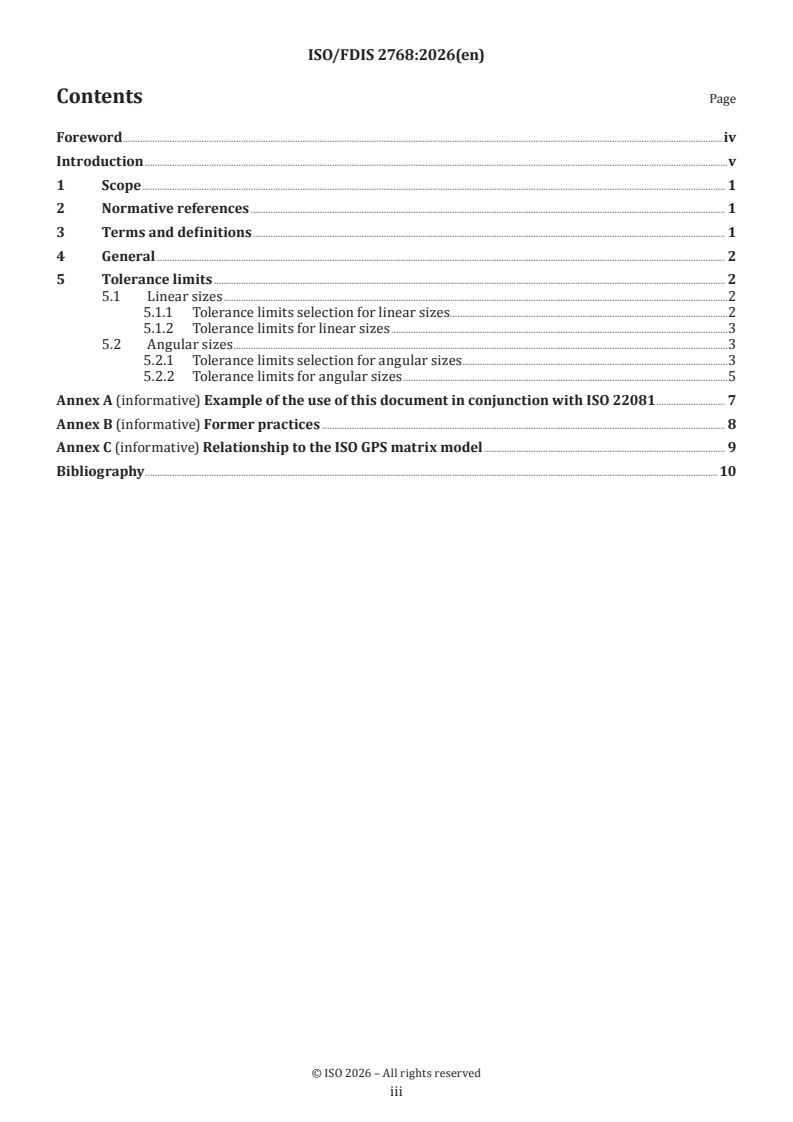
ISO/FDIS 2768 - Geometrical product specifications (GPS) — Dimensional tolerancing — Tolerance limits for general specification of linear and angular sizes
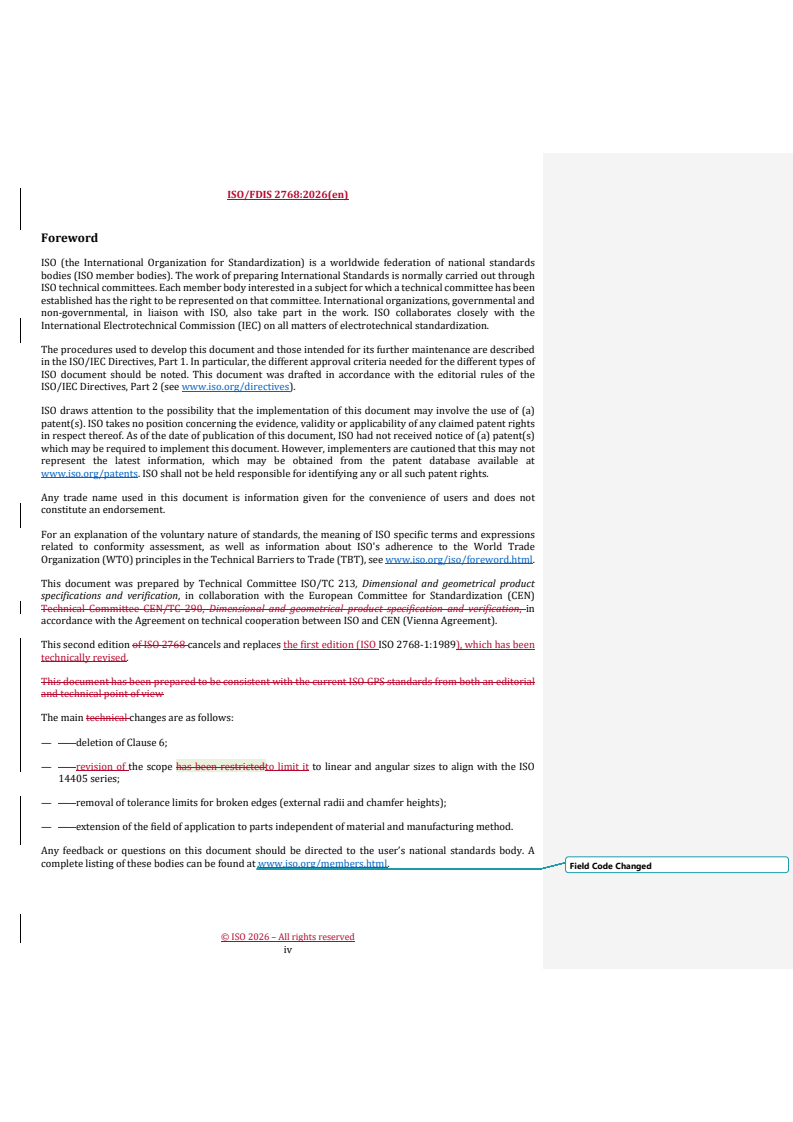
REDLINE ISO/FDIS 2768 - Geometrical product specifications (GPS) — Dimensional tolerancing — Tolerance limits for general specification of linear and angular sizes
ISO/FDIS 2768 - Spécification géométrique des produits (GPS) — Tolérancement dimensionnel — Limites de tolérance pour la spécification générale des tailles linéaires et angulaires/7/2025
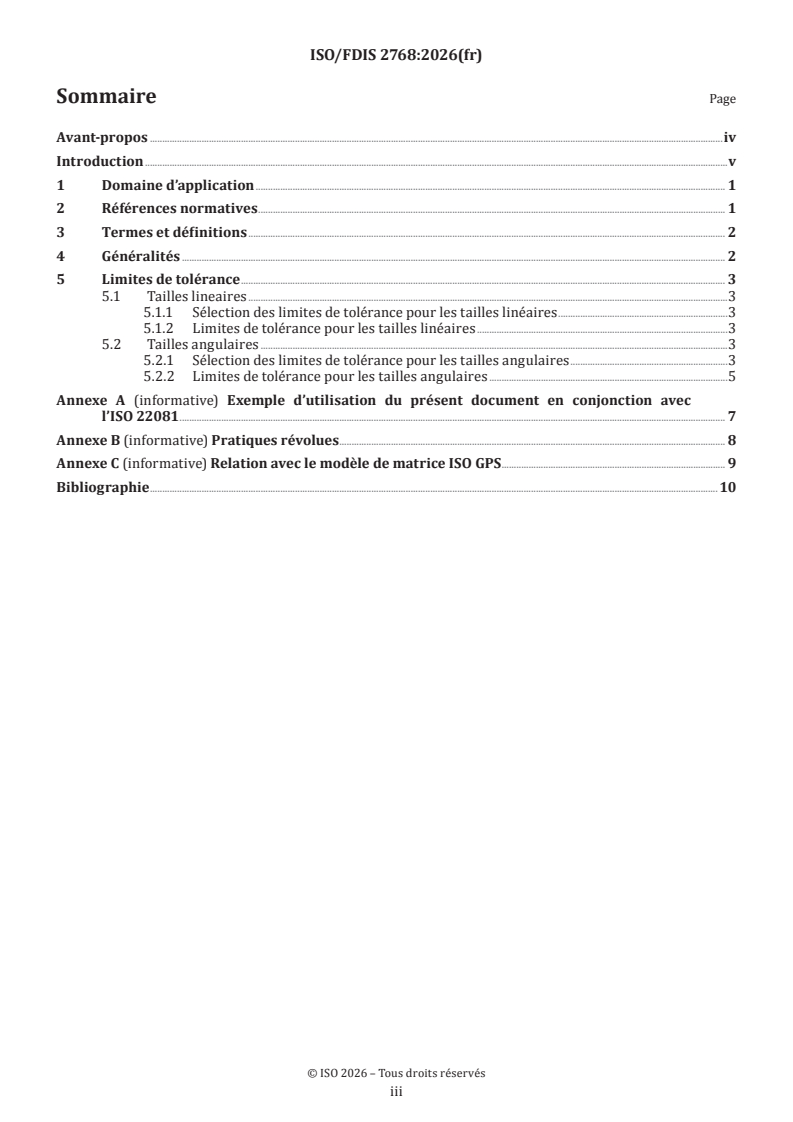
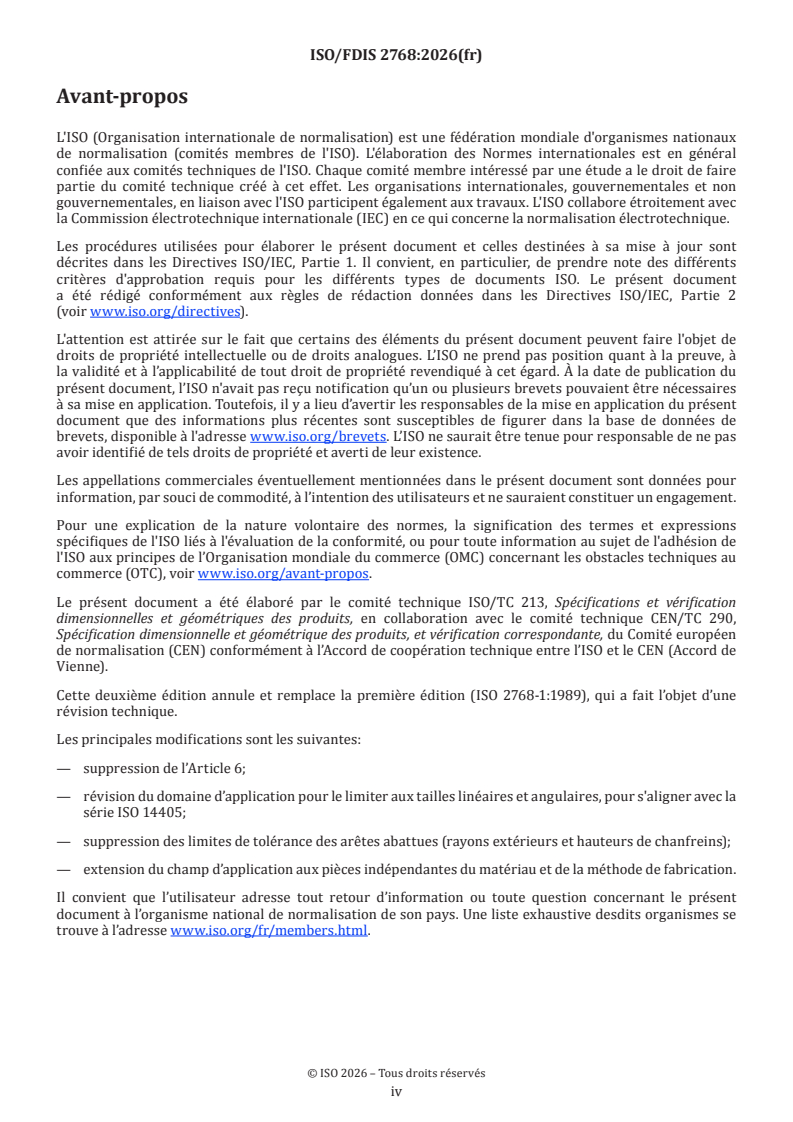
ISO/FDIS 2768 - Spécification géométrique des produits (GPS) — Tolérancement dimensionnel — Limites de tolérance pour la spécification générale des tailles linéaires et angulaires
Get Certified
Connect with accredited certification bodies for this standard

BSMI (Bureau of Standards, Metrology and Inspection)
Taiwan's standards and inspection authority.
Sponsored listings
Frequently Asked Questions
ISO/FDIS 2768 is a draft published by the International Organization for Standardization (ISO). Its full title is "Geometrical product specifications (GPS) — Dimensional tolerancing — Tolerance limits for general specification of linear and angular sizes". This standard covers: This part is intended to simplify drawing indications and specifies general tolerances in four tolerance classes. It applies to the dimensions of workpieces that are produced by metal removal or are formed from sheet metal. It contains three tables and an informative annex with regard to concepts behind general tolerancing of dimensions.
This part is intended to simplify drawing indications and specifies general tolerances in four tolerance classes. It applies to the dimensions of workpieces that are produced by metal removal or are formed from sheet metal. It contains three tables and an informative annex with regard to concepts behind general tolerancing of dimensions.
ISO/FDIS 2768 is classified under the following ICS (International Classification for Standards) categories: 17.040.40 - Geometrical Product Specification (GPS). The ICS classification helps identify the subject area and facilitates finding related standards.
ISO/FDIS 2768 has the following relationships with other standards: It is inter standard links to FprEN ISO 2768, ISO 2768-1:1989. Understanding these relationships helps ensure you are using the most current and applicable version of the standard.
ISO/FDIS 2768 is available in PDF format for immediate download after purchase. The document can be added to your cart and obtained through the secure checkout process. Digital delivery ensures instant access to the complete standard document.
Standards Content (Sample)
DRAFT
International
Standard
ISO/DIS 2768
ISO/TC 213
Geometrical product specifications
Secretariat: BSI
(GPS) — Dimensional tolerancing
Voting begins on:
— Tolerance limits for general
2025-08-25
specification of linear and angular
Voting terminates on:
sizes
2025-11-17
Spécification géométrique des produits (GPS) — Tolérancement
dimensionnel — Limites de tolérance pour la spécification
générale des tailles linéaires et angulaires
ICS: 17.040.40
THIS DOCUMENT IS A DRAFT CIRCULATED
FOR COMMENTS AND APPROVAL. IT
IS THEREFORE SUBJECT TO CHANGE
AND MAY NOT BE REFERRED TO AS AN
INTERNATIONAL STANDARD UNTIL
PUBLISHED AS SUCH.
This document is circulated as received from the committee secretariat.
IN ADDITION TO THEIR EVALUATION AS
BEING ACCEPTABLE FOR INDUSTRIAL,
TECHNOLOGICAL, COMMERCIAL AND
USER PURPOSES, DRAFT INTERNATIONAL
STANDARDS MAY ON OCCASION HAVE TO
ISO/CEN PARALLEL PROCESSING
BE CONSIDERED IN THE LIGHT OF THEIR
POTENTIAL TO BECOME STANDARDS TO
WHICH REFERENCE MAY BE MADE IN
NATIONAL REGULATIONS.
RECIPIENTS OF THIS DRAFT ARE INVITED
TO SUBMIT, WITH THEIR COMMENTS,
NOTIFICATION OF ANY RELEVANT PATENT
RIGHTS OF WHICH THEY ARE AWARE AND TO
PROVIDE SUPPORTING DOCUMENTATION.
Reference number
ISO/DIS 2768:2025(en)
DRAFT
ISO/DIS 2768:2025(en)
International
Standard
ISO/DIS 2768
ISO/TC 213
Geometrical product specifications
Secretariat: BSI
(GPS) — Dimensional tolerancing
Voting begins on:
— Tolerance limits for general
specification of linear and angular
Voting terminates on:
sizes
Spécification géométrique des produits (GPS) — Tolérancement
dimensionnel — Limites de tolérance pour la spécification
générale des tailles linéaires et angulaires
ICS: 17.040.40
THIS DOCUMENT IS A DRAFT CIRCULATED
FOR COMMENTS AND APPROVAL. IT
IS THEREFORE SUBJECT TO CHANGE
AND MAY NOT BE REFERRED TO AS AN
INTERNATIONAL STANDARD UNTIL
PUBLISHED AS SUCH.
This document is circulated as received from the committee secretariat.
IN ADDITION TO THEIR EVALUATION AS
BEING ACCEPTABLE FOR INDUSTRIAL,
© ISO 2025
TECHNOLOGICAL, COMMERCIAL AND
USER PURPOSES, DRAFT INTERNATIONAL
All rights reserved. Unless otherwise specified, or required in the context of its implementation, no part of this publication may
STANDARDS MAY ON OCCASION HAVE TO
ISO/CEN PARALLEL PROCESSING
be reproduced or utilized otherwise in any form or by any means, electronic or mechanical, including photocopying, or posting on
BE CONSIDERED IN THE LIGHT OF THEIR
the internet or an intranet, without prior written permission. Permission can be requested from either ISO at the address below
POTENTIAL TO BECOME STANDARDS TO
WHICH REFERENCE MAY BE MADE IN
or ISO’s member body in the country of the requester.
NATIONAL REGULATIONS.
ISO copyright office
RECIPIENTS OF THIS DRAFT ARE INVITED
CP 401 • Ch. de Blandonnet 8
TO SUBMIT, WITH THEIR COMMENTS,
CH-1214 Vernier, Geneva
NOTIFICATION OF ANY RELEVANT PATENT
Phone: +41 22 749 01 11
RIGHTS OF WHICH THEY ARE AWARE AND TO
PROVIDE SUPPORTING DOCUMENTATION.
Email: copyright@iso.org
Website: www.iso.org
Published in Switzerland Reference number
ISO/DIS 2768:2025(en)
ii
ISO/DIS 2768:2025(en)
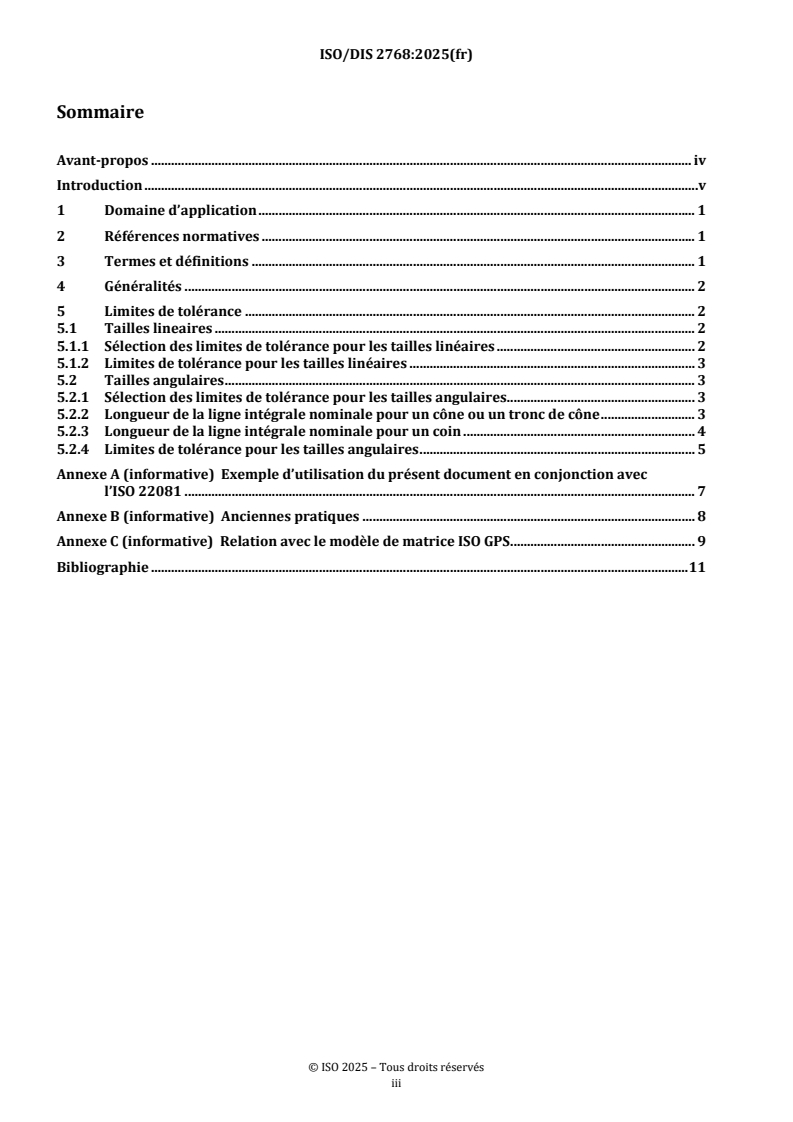
Contents Page
Foreword .iv
Introduction .v
1 Scope . 1
2 Normative references . 1
3 Terms and definitions . 1
4 General . 1
5 Tolerance limits . 2
5.1 Linear sizes .2
5.1.1 Tolerance limits selection for linear sizes.2
5.1.2 Tolerance limits for linear sizes .2
5.2 Angular sizes .3
5.2.1 Tolerance limits selection for angular sizes .3
5.2.2 Nominal integral line length for a cone or a frustum .3
5.2.3 Nominal integral line length for a wedge .3
5.2.4 Tolerance limits for angular sizes .5
Annex A (informative) Example of the use of this document in conjunction with ISO 22081. 6
Annex B (informative) Former practice . 7
Annex C (informative) Relation to the ISO GPS matrix model . 8
Bibliography . 9
iii
ISO/DIS 2768:2025(en)
Foreword
ISO (the International Organization for Standardization) is a worldwide federation of national standards
bodies (ISO member bodies). The work of preparing International Standards is normally carried out through
ISO technical committees. Each member body interested in a subject for which a technical committee
has been established has the right to be represented on that committee. International organizations,
governmental and non-governmental, in liaison with ISO, also take part in the work. ISO collaborates closely
with the International Electrotechnical Commission (IEC) on all matters of electrotechnical standardization.
The procedures used to develop this document and those intended for its further maintenance are described
in the ISO/IEC Directives, Part 1. In particular, the different approval criteria needed for the different types
of ISO documents should be noted. This document was drafted in accordance with the editorial rules of the
ISO/IEC Directives, Part 2 (see www.iso.org/directives).
ISO draws attention to the possibility that the implementation of this document may involve the use of (a)
patent(s). ISO takes no position concerning the evidence, validity or applicability of any claimed patent
rights in respect thereof. As of the date of publication of this document, ISO had not received notice of (a)
patent(s) which may be required to implement this document. However, implementers are cautioned that
this may not represent the latest information, which may be obtained from the patent database available at
www.iso.org/patents. ISO shall not be held responsible for identifying any or all such patent rights.
Any trade name used in this document is information given for the convenience of users and does not
constitute an endorsement.
For an explanation of the voluntary nature of standards, the meaning of ISO specific terms and expressions
related to conformity assessment, as well as information about ISO's adherence to the World Trade
Organization (WTO) principles in the Technical Barriers to Trade (TBT), see www.iso.org/iso/foreword.html.
This document was prepared by Technical Committee ISO/TC 213, Dimensional and geometrical product
specifications and verification.
This second edition cancels and replaces the first edition (ISO 2768-1:1989), which has been technically
revised.
The main changes are as follows:
— Editorial rework to make this document consistent with current ISO GPS standards
— Rules and text rework to make this document consistent with current ISO GPS standards
— Removal of Clause 6: Rejection rule from this document
— Restriction of the scope of this document to linear sizes and angular sizes to be consistent with
ISO 14405-1, ISO 14405-2 and ISO 14405-3
— Removal of tolerance limits for broken edges, radii and chamfers, from this document
— Extension of field of application to parts independent of material and manufacturing method
Any feedback or questions on this document should be directed to the user’s national standards body. A
complete listing of these bodies can be found at www.iso.org/members.html.
iv
ISO/DIS 2768:2025(en)
Introduction
This document is a geometrical product specification (ISO GPS) standard and is to be regarded as a
complementary ISO GPS standard (see ISO 14638). It influences chain link A of the chains of standards on size.
The ISO GPS matrix model given in ISO 14638 gives an overview of the ISO GPS system of which this
document is a part. The fundamental rules of ISO GPS given in ISO 8015 apply to this document and the
default decision rules given in ISO 14253-1 apply to the specifications made following this document, unless
otherwise indicated.
For more detailed information of the relation of this document to other standards and the ISO GPS matrix
model, see Annex C, Table C.1.
This document contains tables of tolerance limits for linear sizes and angular sizes.
ISO 2768:1973 was a general tolerance standard for parts produced by metal removal processes.
ISO 2768-1:1989 updated the tolerances and extended the tables covering a wider range of nominal sizes, and
introduced tolerance for chamfers and radii. It also changed the field of application by adding parts formed
from sheet metal. Significant changes have occurred in industry since the theses standards was released, for
example, machine performance, process capability, metrology or process planning. As the tolerance limits
contained in this document have not been updated, they are probably no longer representative of the current
state of the art in industry
However, it is observed that ISO 2768-1:1989 is still heavily used and that its usage is still widespread in
industry. ISO 2768-1:1989 is sometimes even used for parts made of non-metallic materials or manufactured
with process other than machining. However, those materials and manufacturing process were not part of
the assumptions made for the determination of the values contained herein.
This revised document intends to continue to provide to the users a set of values that is still considered as
a useful source of information by many companies around the world while removing the main source of
ambiguities that that was present in ISO 2768-1:1989. This document used in conjunction with ISO 22081
allows to minimize the ambiguities and misinterpretation and to respect legacy constraints by using the
same values that were used in the past for the general
...
FINAL DRAFT
International
Standard
ISO/TC 213
Geometrical product specifications
Secretariat: BSI
(GPS) — Dimensional tolerancing
Voting begins on:
— Tolerance limits for general
2026-04-06
specification of linear and angular
Voting terminates on:
sizes
2026-06-01
Spécification géométrique des produits (GPS) — Tolérancement
dimensionnel — Limites de tolérance pour la spécification
générale des tailles linéaires et angulaires
RECIPIENTS OF THIS DRAFT ARE INVITED TO SUBMIT,
WITH THEIR COMMENTS, NOTIFICATION OF ANY
RELEVANT PATENT RIGHTS OF WHICH THEY ARE AWARE
AND TO PROVIDE SUPPOR TING DOCUMENTATION.
IN ADDITION TO THEIR EVALUATION AS
BEING ACCEPTABLE FOR INDUSTRIAL, TECHNO
ISO/CEN PARALLEL PROCESSING LOGICAL, COMMERCIAL AND USER PURPOSES, DRAFT
INTERNATIONAL STANDARDS MAY ON OCCASION HAVE
TO BE CONSIDERED IN THE LIGHT OF THEIR POTENTIAL
TO BECOME STAN DARDS TO WHICH REFERENCE MAY BE
MADE IN NATIONAL REGULATIONS.
Reference number
FINAL DRAFT
International
Standard
ISO/TC 213
Geometrical product specifications
Secretariat: BSI
(GPS) — Dimensional tolerancing
Voting begins on:
— Tolerance limits for general
specification of linear and angular
Voting terminates on:
sizes
Spécification géométrique des produits (GPS) — Tolérancement
dimensionnel — Limites de tolérance pour la spécification
générale des tailles linéaires et angulaires
RECIPIENTS OF THIS DRAFT ARE INVITED TO SUBMIT,
WITH THEIR COMMENTS, NOTIFICATION OF ANY
RELEVANT PATENT RIGHTS OF WHICH THEY ARE AWARE
AND TO PROVIDE SUPPOR TING DOCUMENTATION.
© ISO 2026
IN ADDITION TO THEIR EVALUATION AS
All rights reserved. Unless otherwise specified, or required in the context of its implementation, no part of this publication may
BEING ACCEPTABLE FOR INDUSTRIAL, TECHNO
ISO/CEN PARALLEL PROCESSING
LOGICAL, COMMERCIAL AND USER PURPOSES, DRAFT
be reproduced or utilized otherwise in any form or by any means, electronic or mechanical, including photocopying, or posting on
INTERNATIONAL STANDARDS MAY ON OCCASION HAVE
the internet or an intranet, without prior written permission. Permission can be requested from either ISO at the address below
TO BE CONSIDERED IN THE LIGHT OF THEIR POTENTIAL
or ISO’s member body in the country of the requester.
TO BECOME STAN DARDS TO WHICH REFERENCE MAY BE
MADE IN NATIONAL REGULATIONS.
ISO copyright office
CP 401 • Ch. de Blandonnet 8
CH-1214 Vernier, Geneva
Phone: +41 22 749 01 11
Email: copyright@iso.org
Website: www.iso.org
Published in Switzerland Reference number
ii
Contents Page
Foreword .iv
Introduction .v
1 Scope . 1
2 Normative references . 1
3 Terms and definitions . 1
4 General . 2
5 Tolerance limits . 2
5.1 Linear sizes .2
5.1.1 Tolerance limits selection for linear sizes.2
5.1.2 Tolerance limits for linear sizes .3
5.2 Angular sizes .3
5.2.1 Tolerance limits selection for angular sizes .3
5.2.2 Tolerance limits for angular sizes .5
Annex A (informative) Example of the use of this document in conjunction with ISO 22081 . 7
Annex B (informative) Former practices . 8
Annex C (informative) Relationship to the ISO GPS matrix model . 9
Bibliography .10
iii
Foreword
ISO (the International Organization for Standardization) is a worldwide federation of national standards
bodies (ISO member bodies). The work of preparing International Standards is normally carried out through
ISO technical committees. Each member body interested in a subject for which a technical committee
has been established has the right to be represented on that committee. International organizations,
governmental and non-governmental, in liaison with ISO, also take part in the work. ISO collaborates closely
with the International Electrotechnical Commission (IEC) on all matters of electrotechnical standardization.
The procedures used to develop this document and those intended for its further maintenance are described
in the ISO/IEC Directives, Part 1. In particular, the different approval criteria needed for the different types
of ISO document should be noted. This document was drafted in accordance with the editorial rules of the
ISO/IEC Directives, Part 2 (see www.iso.org/directives).
ISO draws attention to the possibility that the implementation of this document may involve the use of (a)
patent(s). ISO takes no position concerning the evidence, validity or applicability of any claimed patent
rights in respect thereof. As of the date of publication of this document, ISO had not received notice of (a)
patent(s) which may be required to implement this document. However, implementers are cautioned that
this may not represent the latest information, which may be obtained from the patent database available at
www.iso.org/patents. ISO shall not be held responsible for identifying any or all such patent rights.
Any trade name used in this document is information given for the convenience of users and does not
constitute an endorsement.
For an explanation of the voluntary nature of standards, the meaning of ISO specific terms and expressions
related to conformity assessment, as well as information about ISO's adherence to the World Trade
Organization (WTO) principles in the Technical Barriers to Trade (TBT), see www.iso.org/iso/foreword.html.
This document was prepared by Technical Committee ISO/TC 213, Dimensional and geometrical product
specifications and verification, in collaboration with the European Committee for Standardization (CEN) in
accordance with the Agreement on technical cooperation between ISO and CEN (Vienna Agreement).
This second edition cancels and replaces the first edition (ISO ISO 2768-1:1989), which has been technically
revised.
The main changes are as follows:
— deletion of Clause 6;
— revision of the scope to limit it to linear and angular sizes to align with the ISO 14405 series;
— removal of tolerance limits for broken edges (external radii and chamfer heights);
— extension of the field of application to parts independent of material and manufacturing method.
Any feedback or questions on this document should be directed to the user’s national standards body. A
complete listing of these bodies can be found at www.iso.org/members.html.
iv
Introduction
This document is a geometrical product specification (GPS) standard and is to be regarded as a
complementary ISO GPS standard (see ISO 14638). It influences chain link A of the chains of standards on
size.
The ISO GPS matrix model given in ISO 14638 gives an overview of the ISO GPS system of which this
document is a part. The fundamental rules of ISO GPS given in ISO 8015 apply to this document and the
default decision rules given in ISO 14253-1 apply to specifications made in accordance with this document,
unless otherwise indicated.
For more detailed information of the relationship of this document to other standards and the ISO GPS
matrix model, see Annex C, Table C.1.
This document contains tables of tolerance limits for linear sizes and angular sizes.
ISO 2768:1973 was a general tolerance standard for parts produced by metal removal processes.
ISO 2768-1:1989 updated the tolerances and extended the tables covering a wider range of nominal sizes,
and introduced tolerances for broken edges (external radii and chamfer heights). It also changed the field of
application by adding parts formed from sheet metal. Significant changes have occurred in industry since
these standards were released, for example, machine performance, process capability, metrology or process
planning. The tolerance limits contained in this document have not been updated. Therefore, this document
is no longer representative of the current state of the art in industry.
However, ISO 2768-1:1989 is still heavily used and its usage is still widespread in industry. ISO 2768-1:1989
is sometimes even used for parts made of non-metallic materials or manufactured with process other than
machining. However, those materials and manufacturing process were not part of the assumptions made for
the determination of the values contained herein.
This document intends to continue to provide the users a set of values that are still considered a useful source
of information by many companies around the world while removing the main source of ambiguities that
was present in ISO 2768-1:1989. This document, used in conjunction with ISO 22081, minimizes ambiguities
and misinterpretation and respects legacy constraints by using the same values that were used in the past
for the general specification of linear and angular sizes.
The user is reminded that the selection of tolerance limits derived from a functional analysis often allows
for an optimized product. This is in contrast with selecting values from the tables in this document that are
not correlated to functional needs. For further information, see the fundamental assumptions and principles
stated in ISO 8015.
v
FINAL DRAFT International Standard ISO/FDIS 2768:2026(en)
Geometrical product specifications (GPS) — Dimensional
tolerancing — Tolerance limits for general specification of
linear and angular sizes
1 Scope
This document establishes a system of tolerance limits utilizing tolerance classes for linear and angular
sizes.
This document is applicable to general size specificat
...
ISO/TC 213
Secretariat: BSI
Date: 2026-01-2003-23
Geometrical product specifications (GPS) — Dimensional tolerancing
— Tolerance limits for general specification of linear and angular
sizes
Spécification géométrique des produits (GPS) — Tolérancement dimensionnel — Limites de tolérance pour la
spécification générale des tailles linéaires et angulaires
FDIS stage
TThhiiss dr draafftt i iss susubbmmiitttteed d ttoo aa ppaarraallellel l vvoottee i inn IISSOO,, CCEEN.N.
All rights reserved. Unless otherwise specified, or required in the context of its implementation, no part of this publication
may be reproduced or utilized otherwise in any form or by any means, electronic or mechanical, including photocopying,
or posting on the internet or an intranet, without prior written permission. Permission can be requested from either ISO
at the address below or ISO’s member body in the country of the requester.
ISO copyright office
CP 401 • Ch. de Blandonnet 8
CH-1214 Vernier, Geneva
Phone: + 41 22 749 01 11
EmailE-mail: copyright@iso.org
Website: www.iso.org
Published in Switzerland
ii
Contents
Foreword . iv
Introduction . v
1 Scope . 1
2 Normative references . 1
3 Terms and definitions . 2
4 General . 2
5 Tolerance limits . 3
5.1 Linear sizes . 3
5.2 Angular sizes . 3
Annex A (informative) Example of the use of this document in conjunction with ISO 22081 . 8
Annex B (informative) Former practices . 10
Annex C (informative) Relationship to the ISO GPS matrix model . 11
Bibliography . 13
iii
Foreword
ISO (the International Organization for Standardization) is a worldwide federation of national standards
bodies (ISO member bodies). The work of preparing International Standards is normally carried out through
ISO technical committees. Each member body interested in a subject for which a technical committee has been
established has the right to be represented on that committee. International organizations, governmental and
non-governmental, in liaison with ISO, also take part in the work. ISO collaborates closely with the
International Electrotechnical Commission (IEC) on all matters of electrotechnical standardization.
The procedures used to develop this document and those intended for its further maintenance are described
in the ISO/IEC Directives, Part 1. In particular, the different approval criteria needed for the different types of
ISO document should be noted. This document was drafted in accordance with the editorial rules of the
ISO/IEC Directives, Part 2 (see www.iso.org/directives).
ISO draws attention to the possibility that the implementation of this document may involve the use of (a)
patent(s). ISO takes no position concerning the evidence, validity or applicability of any claimed patent rights
in respect thereof. As of the date of publication of this document, ISO had not received notice of (a) patent(s)
which may be required to implement this document. However, implementers are cautioned that this may not
represent the latest information, which may be obtained from the patent database available at
www.iso.org/patents. ISO shall not be held responsible for identifying any or all such patent rights.
Any trade name used in this document is information given for the convenience of users and does not
constitute an endorsement.
For an explanation of the voluntary nature of standards, the meaning of ISO specific terms and expressions
related to conformity assessment, as well as information about ISO's adherence to the World Trade
Organization (WTO) principles in the Technical Barriers to Trade (TBT), see www.iso.org/iso/foreword.html.
This document was prepared by Technical Committee ISO/TC 213, Dimensional and geometrical product
specifications and verification, in collaboration with the European Committee for Standardization (CEN)
Technical Committee CEN/TC 290, Dimensional and geometrical product specification and verification, in
accordance with the Agreement on technical cooperation between ISO and CEN (Vienna Agreement).
This second edition of ISO 2768 cancels and replaces the first edition (ISO ISO 2768-1:1989), which has been
technically revised.
This document has been prepared to be consistent with the current ISO GPS standards from both an editorial
and technical point of view
The main technical changes are as follows:
— — deletion of Clause 6;
— — revision of the scope has been restrictedto limit it to linear and angular sizes to align with the ISO
14405 series;
— — removal of tolerance limits for broken edges (external radii and chamfer heights);
— — extension of the field of application to parts independent of material and manufacturing method.
Any feedback or questions on this document should be directed to the user’s national standards body. A
complete listing of these bodies can be found at www.iso.org/members.html.
Field Code Changed
iv
Introduction
This document is a geometrical product specification (ISO GPS) standard and is to be regarded as a
complementary ISO GPS standard (see ISO 14638). It influences chain link A of the chains of standards on size.
The ISO GPS matrix model given in ISO 14638 gives an overview of the ISO GPS system of which this document
is a part. The fundamental rules of ISO GPS given in ISO 8015 apply to this document and the default decision
rules given in ISO 14253-1 apply to specifications made in accordance with this document, unless otherwise
indicated.
For more detailed information of the relationrelationship of this document to other standards and the ISO GPS
matrix model, see Annex C, Table C.1Annex C, Table C.1.
This document contains tables of tolerance limits for linear sizes and angular sizes.
ISO 2768:1973 was a general tolerance standard for parts produced by metal removal processes.
ISO 2768-1:1989 updated the tolerances and extended the tables covering a wider range of nominal sizes, and
introduced tolerances for broken edges (external radii and chamfer heights). It also changed the field of
application by adding parts formed from sheet metal. Significant changes have occurred in industry since these
standards were released, for example, machine performance, process capability, metrology or process
planning. The tolerance limits contained in this document have not been updated. Therefore, this document is
no longer representative of the current state of the art in industry.
However, ISO 2768-1:1989 is still heavily used and its usage is still widespread in industry. ISO 2768-1:1989
is sometimes even used for parts made of non-metallic materials or manufactured with process other than
machining. However, those materials and manufacturing process were not part of the assumptions made for
the determination of the values contained herein.
This document intends to continue to provide the users a set of values that are still considered a useful source
of information by many companies around the world while removing the main source of ambiguities that was
present in ISO 2768-1:1989. This document, used in conjunction with ISO 22081, minimizes ambiguities and
misinterpretation and respects legacy constraints by using the same values that were used in the past for the
general specification of linear and angular sizes.
The user is reminded that the selection of tolerance limits derived from a functional analysis often allows for
an optimized product. This is in contrast with selecting values from the tables in this document that are not
correlated to functional needs. For further information, see the fundamental assumptions and principles
stated in ISO 8015.
v
DRAFT International Standard ISO/FDIS 2768:2026(en)
Geometrical product specifications (GPS) — Dimensional tolerancing
— Tolerance limits for general specification of linear and angular sizes
1 Scope
This document establishes a system of tolerance limits utilizing tolerance classes for linear and angular sizes.
This document is applicable to general size specifications for features with a nominal linear size from 0,5mm
up to and including 4000mm4 000 mm, and to features with any nominal angular size. The given tolerance
limits are intended to be used with the default specification operators from the ISO GPS system.
NOTE: 1 See ISO 14405-1 and ISO 14405-3 for further information regarding sizes including default specification
operators.
This document does not apply to other types of dimensional specifications, such as linear and angular
distances etc.
NOTE: 2 See ISO 14405-2 for further information regarding distances and other types of dimensions.
This document is applicable on its own, in conjunction with ISO 22081 or any other document for general
specifications as long as the interactions are unambiguously described.
NOTE: 3 See ISO 8015 for information about the responsibility principle, the general specification principle, etc.
2 Normative references
The following documents are referred to in the text in such a way that some or all of their content constitutes
requirements of this document. For dated references, only the edition cited applies. For undated references,
the latest edition of the referenced document (including any amendments) applies.
ISO 8015, Geometrical product specifications (GPS) — Fundamentals — Concepts, principles and rules
ISO 14405--1, Geometrical product specifications (GPS) — Dimensional tolerancing — Part 1: Linear sizes
ISO 14405-2, Geometrical product specifications (GPS) — Dimensional tolerancing — Part 2: Dimensions other
than linear or angular sizes
ISO 14405--3, Geometrical product specifications (GPS) — Dimensional tolerancing — Part 3: Angular sizes
ISO 22081, Ge
...
PROJET
Norme
internationale
ISO/DIS 2768
ISO/TC 213
Spécification géométrique des
Secrétariat: BSI
produits (GPS) — Tolérancement
Début de vote:
dimensionnel — Limites de
2025-08-25
tolérance pour la spécification
Vote clos le:
générale des tailles linéaires et
2025-11-17
angulaires
Geometrical product specifications (GPS) — Dimensional
tolerancing — Tolerance limits for general specification of linear
and angular sizes
ICS: 17.040.40
CE DOCUMENT EST UN PROJET DIFFUSÉ
POUR OBSERVATIONS ET APPROBATION. IL
EST DONC SUSCEPTIBLE DE MODIFICATION
ET NE PEUT ÊTRE CITÉ COMME NORME
INTERNATIONALE AVANT SA PUBLICATION EN
TANT QUE TELLE.
OUTRE LE FAIT D’ÊTRE EXAMINÉS POUR
Ce document n’a pas été rédigé par le Secrétariat central de l’ISO.
ÉTABLIR S’ILS SONT ACCEPTABLES À DES
FINS INDUSTRIELLES, TECHNOLOGIQUES ET
COMMERCIALES, AINSI QUE DU POINT DE VUE
DES UTILISATEURS, LES PROJETS DE NORMES
INTERNATIONALES DOIVENT PARFOIS ÊTRE
TRAITEMENT PARALLÈLE ISO/CEN
CONSIDÉRÉS DU POINT DE VUE DE LEUR
POSSIBILITÉ DE DEVENIR DES NORMES
POUVANT SERVIR DE RÉFÉRENCE DANS LA
RÉGLEMENTATION NATIONALE.
LES DESTINATAIRES DU PRÉSENT PROJET
SONT INVITÉS À PRÉSENTER, AVEC LEURS
OBSERVATIONS, NOTIFICATION DES DROITS
DE PROPRIÉTÉ DONT ILS AURAIENT
ÉVENTUELLEMENT CONNAISSANCE
ET À FOURNIR UNE DOCUMENTATION
EXPLICATIVE.
Numéro de référence
ISO/DIS 2768:2025(fr)
ISO/DIS 2768:2025(fr)
ISO/DIS 2768:2025(fr)
ISO/TC 213
Secrétariat: BSI
Date: 01/07/2025
Spécification géométrique des produits (GPS) — Tolérancement dimensionnel — Limites de
tolérance pour la spécification générale des tailles linéaires et angulaires
Geometrical product specifications (GPS) — Dimensional tolerancing — Tolerance limits for general
specification of linear and angular sizes
ICS: 17.040.40
DOCUMENT PROTÉGÉ PAR COPYRIGHT
© ISO 2025
Tous droits réservés. Sauf prescription différente ou nécessité dans le contexte de sa mise en œuvre, aucune partie de cette
publication ne peut être reproduite ni utilisée sous quelque forme que ce soit et par aucun procédé, électronique ou mécanique,
y compris la photocopie, ou la diffusion sur l’internet ou sur un intranet, sans autorisation écrite préalable. Une autorisation peut
être demandée à l’ISO à l’adresse ci-après ou au comité membre de l’ISO dans le pays du demandeur.
ISO copyright office
Case postale 401 • Ch. de Blandonnet 8
CH-1214 Vernier, Genève
Tél.: +41 22 749 01 11
E-mail: copyright@iso.org
Web: www.iso.org
Publié en Suisse
ii
ISO/DIS 2768:2025(fr)
Sommaire
Avant‐propos . iv
Introduction . v
1 Domaine d’application . 1
2 Références normatives . 1
3 Termes et définitions . 1
4 Généralités . 2
5 Limites de tolérance . 2
5.1 Tailles lineaires . 2
5.1.1 Sélection des limites de tolérance pour les tailles linéaires . 2
5.1.2 Limites de tolérance pour les tailles linéaires . 3
5.2 Tailles angulaires . 3
5.2.1 Sélection des limites de tolérance pour les tailles angulaires . 3
5.2.2 Longueur de la ligne intégrale nominale pour un cône ou un tronc de cône . 3
5.2.3 Longueur de la ligne intégrale nominale pour un coin . 4
5.2.4 Limites de tolérance pour les tailles angulaires . 5
Annexe A (informative) Exemple d’utilisation du présent document en conjonction avec
l’ISO 22081 . 7
Annexe B (informative) Anciennes pratiques . 8
Annexe C (informative) Relation avec le modèle de matrice ISO GPS . 9
Bibliographie . 11
iii
ISO/DIS 2768:2025(fr)
Avant‐propos
L’ISO (Organisation internationale de normalisation) est une fédération mondiale d’organismes nationaux de
normalisation (comités membres de l’ISO). L’élaboration des Normes internationales est en général confiée
aux comités techniques de l’ISO. Chaque comité membre intéressé par une étude a le droit de faire partie du
comité technique créé à cet effet. Les organisations internationales, gouvernementales et non
gouvernementales, en liaison avec l’ISO participent également aux travaux. L’ISO collabore étroitement avec
la Commission électrotechnique internationale (IEC) en ce qui concerne la normalisation électrotechnique.
Les procédures utilisées pour élaborer le présent document et celles destinées à sa mise à jour sont décrites
dans les Directives ISO/IEC, Partie 1. Il convient, en particulier, de prendre note des différents critères
d’approbation requis pour les différents types de documents ISO. Le présent document a été rédigé
conformément aux règles de rédaction données dans les Directives ISO/IEC, Partie 2 (voir
www.iso.org/directives).
L’ISO attire l’attention sur le fait que la mise en application du présent document peut entraîner l’utilisation
d’un ou de plusieurs brevets. L’ISO ne prend pas position quant à la preuve, à la validité et à l’applicabilité de
tout droit de brevet revendiqué à cet égard. À la date de publication du présent document, l’ISO n’avait pas
reçu notification qu’un ou plusieurs brevets pouvaient être nécessaires à sa mise en application. Toutefois, il
y a lieu d’avertir les responsables de la mise en application du présent document que des informations plus
récentes sont susceptibles de figurer dans la base de données de brevets, disponible à l’adresse
www.iso.org/brevets. L’ISO ne saurait être tenue pour responsable de ne pas avoir identifié tout ou partie de
tels droits de brevet.
Les appellations commerciales éventuellement mentionnées dans le présent document sont données pour
information, par souci de commodité, à l’intention des utilisateurs et ne sauraient constituer un engagement.
Pour une explication de la nature volontaire des normes, la signification des termes et expressions spécifiques
de l’ISO liés à l’évaluation de la conformité, ou pour toute information au sujet de l’adhésion de l’ISO aux
principes de l’Organisation mondiale du commerce (OMC) concernant les obstacles techniques au commerce
(OTC), voir www.iso.org/iso/fr/avant-propos.html.
Le présent document a été élaboré par le comité technique ISO/TC 213, Spécifications et vérification
dimensionnelles et géométriques des produits.
Cette deuxième édition annule et remplace la première édition (ISO 2768-1:1989), qui a fait l’objet d’une
révision technique.
Les principales modifications sont les suivantes :
— révision éditoriale pour rendre le présent document conforme aux normes ISO GPS actuelles;
— les règles et le texte retravaillés pour rendre le présent document cohérent avec les normes ISO GPS
actuelles;
— suppression de l’Article 6, règle de rejet, du présent document;
— restriction du domaine d’application du présent document aux tailles linéaires et aux tailles angulaires,
pour être cohérent avec l’ISO 14405-1, l’ISO 14405-2 et l’ISO 14405-3;
— suppression du présent document des limites de tolérance des arêtes abattues, rayons et chanfreins;
— extension du champ d’application aux pièces indépendantes du matériau et de la méthode de fabrication.
Il convient que l’utilisateur adresse tout retour d’information ou toute question concernant le présent
document à l’organisme national de normalisation de son pays. Une liste exhaustive desdits organismes se
trouve à l’adresse www.iso.org/fr/members.html.
iv
ISO/DIS 2768:2025(fr)
Introduction
Le présent document est une norme de spécification géométrique des produits (ISO GPS) et est à considérer
comme une norme ISO GPS complémentaire (voir l’ISO 14638). Il influence le maillon A des chaînes de normes
relatives à la taille.
Le modèle de matrice ISO GPS de l’ISO 14638 donne une vue d’ensemble du système ISO GPS dont le présent
document fait partie. Les principes fondamentaux du système ISO GPS donnés dans l’ISO 8015 s’appliquent au
présent document et les règles de décision par défaut données dans l’ISO 14253-1 s’appliquent aux
spécifications faites conformément au présent document, sauf indication contraire.
Pour de plus amples informations sur la relation du présent document avec les autres normes et le modèle de
matrice ISO GPS, voir l’Annexe C, Tableau C.1.
Ce document contient des tableaux de limites de tolérance pour les tailles linéaires et les tailles angulaires.
L’ISO 2768:1973 était une norme générale de tolérance pour les pièces produites par des procédés
d’enlèvement de métal. L’ISO 2768-1:1989 a mis à jour les tolérances et élargi les tableaux pour couvrir une
plus large gamme de tailles nominales, et a introduit des tolérances pour les chanfreins et les rayons. Il a
également changé le champ d’application en ajoutant des pièces formées à partir de tôle. Des changements
significatifs se sont produits dans l’industrie depuis la publication de ces normes, par exemple, la performance
des machines, la capabilité des procédé, la métrologie ou la planification des processus. Comme les limites de
tolérance contenues dans le présent document n’ont pas été mises à jour, elles ne sont probablement plus
représentatives de l’état actuel de la technique dans l’industrie.
Toutefois, on a observé que l’ISO 2768-1:1989 est encore largement utilisée et que son utilisation est toujours
répandue dans l’industrie. L’ISO 2768-1:1989 est parfois même utilisée pour des pièces en matériaux non
métalliques ou fabriquées avec un procédé autre que l’usinage. Cependant, ces matériaux et ce procedé de
fabrication ne faisaient pas partie des hypothèses formulées pour la détermination des valeurs contenues ici.
Le présent document révisé a pour but de continuer à fournir aux utilisateurs un ensemble de valeurs qui est
toujours considéré comme une source d’information utile par de nombreuses entreprises dans le monde, tout
en supprimant la principale source d’ambiguïtés qui était présente dans l’ISO 2768-1:1989. Le présent
document utilisé en conjonction avec l’ISO 22081 permet de minimiser les ambiguïtés et les erreurs
d’interprétation et de respecter les contraintes héritées en utilisant les mêmes valeurs que celles utilisées dans
le passé pour la spécification générale des tailles linéaires et des tailles angulaires.
Sur une note plus générale, il est rappelé à l’utilisateur que la sélection des limites de tolérance issues d’une
analyse fonctionnelle permet souvent d’optimiser le produit. Cela est en opposition avec la sélection de valeurs
depuis le présent document qui ne sont pas corrélées aux besoins fonctionnels. À cet égard, se référer aux
hypothèses et principes fondamentaux énoncés dans l’ISO 8015.
Il n’est pas exclu que le présent document soit retiré à l’avenir. Les utilisateurs sont fortement encouragés à
travailler sur un remplacement des valeurs contenues ici pour les tolérances générales avec des valeurs
fonctionnelles ou des valeurs collectées à partir de données de procédé réelles.
v
PROJET de Norme Internationale ISO/DIS 2768:2025(fr)
Spécification géométrique des produits (GPS) — Tolérancement
dimensionnel — Limites de tolérance pour la spécification générale
des tailles linéaires et angulaires
1 Domaine d’application
Le présent document fournit des limites de tolérance réparties en quatre classes de tolérance pour les tailles
linéaires supérieures à 0,5 mm et jusqu’à 4 000 mm, ainsi que pour les tailles angulaires.
Les limites de tolérance données sont destinées à être utilisées avec des spécifications de taille entre deux
points.
Le présent document peut ê
...
PROJET FINAL
Norme
internationale
ISO/TC 213
Spécification géométrique des
Secrétariat: BSI
produits (GPS) — Tolérancement
Début de vote:
dimensionnel — Limites de
2026-04-06
tolérance pour la spécification
Vote clos le:
générale des tailles linéaires et
2026-06-01
angulaires
Geometrical product specifications (GPS) — Dimensional
tolerancing — Tolerance limits for general specification of linear
and angular sizes
LES DESTINATAIRES DU PRÉSENT PROJET SONT
INVITÉS À PRÉSENTER, AVEC LEURS OBSERVATIONS,
NOTIFICATION DES DROITS DE PROPRIÉTÉ DONT ILS
AURAIENT ÉVENTUELLEMENT CONNAISSANCE ET À
FOURNIR UNE DOCUMENTATION EXPLICATIVE.
OUTRE LE FAIT D’ÊTRE EXAMINÉS POUR
ÉTABLIR S’ILS SONT ACCEPTABLES À DES FINS
INDUSTRIELLES, TECHNOLOGIQUES ET COM-MERCIALES,
AINSI QUE DU POINT DE VUE DES UTILISATEURS, LES
PROJETS DE NORMES
TRAITEMENT PARALLÈLE ISO/CEN
INTERNATIONALES DOIVENT PARFOIS ÊTRE CONSIDÉRÉS
DU POINT DE VUE DE LEUR POSSI BILITÉ DE DEVENIR DES
NORMES POUVANT
SERVIR DE RÉFÉRENCE DANS LA RÉGLEMENTATION
NATIONALE.
Numéro de référence
PROJET FINAL
Norme
internationale
ISO/TC 213
Spécification géométrique des
Secrétariat: BSI
produits (GPS) — Tolérancement
Début de vote:
dimensionnel — Limites de
2026-04-06
tolérance pour la spécification
Vote clos le:
générale des tailles linéaires et
2026-06-01
angulaires
Geometrical product specifications (GPS) — Dimensional
tolerancing — Tolerance limits for general specification of linear
and angular sizes
LES DESTINATAIRES DU PRÉSENT PROJET SONT
INVITÉS À PRÉSENTER, AVEC LEURS OBSERVATIONS,
NOTIFICATION DES DROITS DE PROPRIÉTÉ DONT ILS
AURAIENT ÉVENTUELLEMENT CONNAISSANCE ET À
FOURNIR UNE DOCUMENTATION EXPLICATIVE.
DOCUMENT PROTÉGÉ PAR COPYRIGHT
OUTRE LE FAIT D’ÊTRE EXAMINÉS POUR
ÉTABLIR S’ILS SONT ACCEPTABLES À DES FINS
© ISO 2026 INDUSTRIELLES, TECHNOLOGIQUES ET COM-MERCIALES,
AINSI QUE DU POINT DE VUE DES UTILISATEURS, LES
Tous droits réservés. Sauf prescription différente ou nécessité dans le contexte de sa mise en œuvre, aucune partie de cette
PROJETS DE NORMES
TRAITEMENT PARALLÈLE ISO/CEN
INTERNATIONALES DOIVENT PARFOIS ÊTRE CONSIDÉRÉS
publication ne peut être reproduite ni utilisée sous quelque forme que ce soit et par aucun procédé, électronique ou mécanique,
DU POINT DE VUE DE LEUR POSSI BILITÉ DE DEVENIR DES
y compris la photocopie, ou la diffusion sur l’internet ou sur un intranet, sans autorisation écrite préalable. Une autorisation peut
NORMES POUVANT
être demandée à l’ISO à l’adresse ci-après ou au comité membre de l’ISO dans le pays du demandeur.
SERVIR DE RÉFÉRENCE DANS LA RÉGLEMENTATION
NATIONALE.
ISO copyright office
Case postale 401 • Ch. de Blandonnet 8
CH-1214 Vernier, Genève
Tél.: +41 22 749 01 11
E-mail: copyright@iso.org
Web: www.iso.org
Publié en Suisse Numéro de référence
ii
Sommaire Page
Avant-propos .iv
Introduction .v
1 Domaine d’application .1
2 Références normatives .1
3 Termes et définitions . 2
4 Généralités . 2
5 Limites de tolérance .3
5.1 Tailles lineaires .3
5.1.1 Sélection des limites de tolérance pour les tailles linéaires .3
5.1.2 Limites de tolérance pour les tailles linéaires .3
5.2 Tailles angulaires .3
5.2.1 Sélection des limites de tolérance pour les tailles angulaires .3
5.2.2 Limites de tolérance pour les tailles angulaires .5
Annexe A (informative) Exemple d’utilisation du présent document en conjonction avec
l’ISO 22081 . 7
Annexe B (informative) Pratiques révolues . 8
Annexe C (informative) Relation avec le modèle de matrice ISO GPS .9
Bibliographie . 10
iii
Avant-propos
L'ISO (Organisation internationale de normalisation) est une fédération mondiale d'organismes nationaux
de normalisation (comités membres de l'ISO). L'élaboration des Normes internationales est en général
confiée aux comités techniques de l'ISO. Chaque comité membre intéressé par une étude a le droit de faire
partie du comité technique créé à cet effet. Les organisations internationales, gouvernementales et non
gouvernementales, en liaison avec l'ISO participent également aux travaux. L'ISO collabore étroitement avec
la Commission électrotechnique internationale (IEC) en ce qui concerne la normalisation électrotechnique.
Les procédures utilisées pour élaborer le présent document et celles destinées à sa mise à jour sont
décrites dans les Directives ISO/IEC, Partie 1. Il convient, en particulier, de prendre note des différents
critères d'approbation requis pour les différents types de documents ISO. Le présent document
a été rédigé conformément aux règles de rédaction données dans les Directives ISO/IEC, Partie 2
(voir www.iso.org/directives).
L'attention est attirée sur le fait que certains des éléments du présent document peuvent faire l'objet de
droits de propriété intellectuelle ou de droits analogues. L’ISO ne prend pas position quant à la preuve, à
la validité et à l’applicabilité de tout droit de propriété revendiqué à cet égard. À la date de publication du
présent document, l’ISO n'avait pas reçu notification qu’un ou plusieurs brevets pouvaient être nécessaires
à sa mise en application. Toutefois, il y a lieu d’avertir les responsables de la mise en application du présent
document que des informations plus récentes sont susceptibles de figurer dans la base de données de
brevets, disponible à l'adresse www.iso.org/brevets. L’ISO ne saurait être tenue pour responsable de ne pas
avoir identifié de tels droits de propriété et averti de leur existence.
Les appellations commerciales éventuellement mentionnées dans le présent document sont données pour
information, par souci de commodité, à l’intention des utilisateurs et ne sauraient constituer un engagement.
Pour une explication de la nature volontaire des normes, la signification des termes et expressions
spécifiques de l'ISO liés à l'évaluation de la conformité, ou pour toute information au sujet de l'adhésion de
l'ISO aux principes de l’Organisation mondiale du commerce (OMC) concernant les obstacles techniques au
commerce (OTC), voir www.iso.org/avant-propos.
Le présent document a été élaboré par le comité technique ISO/TC 213, Spécifications et vérification
dimensionnelles et géométriques des produits, en collaboration avec le comité technique CEN/TC 290,
Spécification dimensionnelle et géométrique des produits, et vérification correspondante, du Comité européen
de normalisation (CEN) conformément à l’Accord de coopération technique entre l’ISO et le CEN (Accord de
Vienne).
Cette deuxième édition annule et remplace la première édition (ISO 2768-1:1989), qui a fait l’objet d’une
révision technique.
Les principales modifications sont les suivantes:
— suppression de l’Article 6;
— révision du domaine d’application pour le limiter aux tailles linéaires et angulaires, pour s'aligner avec la
série ISO 14405;
— suppression des limites de tolérance des arêtes abattues (rayons extérieurs et hauteurs de chanfreins);
— extension du champ d’application aux pièces indépendantes du matériau et de la méthode de fabrication.
Il convient que l’utilisateur adresse tout retour d’information ou toute question concernant le présent
document à l’organisme national de normalisation de son pays. Une liste exhaustive desdits organismes se
trouve à l’adresse www.iso.org/fr/members.html.
iv
Introduction
Le présent document est une norme de spécification géométrique des produits (GPS) et est à considérer
comme une norme ISO GPS complémentaire (voir l’ISO 14638). Il influence le maillon A des chaînes de
normes relatives à la taille.
Le modèle de matrice ISO GPS de l’ISO 14638 donne une vue d’ensemble du système ISO GPS dont le présent
document fait partie. Les principes fondamentaux du système ISO GPS donnés dans l’ISO 8015 s’appliquent
au présent document et les règles de décision par défaut données dans l’ISO 14253-1 s’appliquent aux
spécifications faites conformément au présent document, sauf indication contraire.
Pour de plus amples informations sur la relation du présent document avec les autres normes et le modèle de
matrice ISO GPS, voir l’Annexe C, Tableau C.1.
Ce document contient des tableaux de limites de tolérance pour les tailles linéaires et les tailles angulaires.
L’ISO 2768:1973 était une norme générale de tolérance pour les pièces produites par des procédés
d’enlèvement de métal.
L’ISO 2768-1:1989 a mis à jour les tolérances et élargi les tableaux pour couvrir une gamme plus large de
tailles nominales, et a introduit des tolérances pour les arêtes abattues (rayons extérieurs et hauteurs de
chanfreins). Il a également changé le champ d’application en ajoutant des pièces formées à partir de tôle. Des
changements significatifs se sont produits dans l’industrie depuis la publication de ces normes, par exemple
la performance des machines, la capabilité des procédés, la métrologie ou la planification des processus.
Les limites de tolérance contenues dans le présent document n’ont pas été mises à jour. Par conséquent le
présent document n'est plus représentatif de l’état de l'art actuel dans l’industrie.
Toutefois, l’ISO 2768-1:1989 est encore largement utilisée et son utilisation est toujours répandue dans
l’industrie. L’ISO 2768-1:1989 est parfois même utilisée pour des pièces en matériaux non métalliques ou
fabriquées avec un procédé autre que l’usinage. Cependant, ces matériaux et ce procédé de fabrication ne
faisaient pas partie des hypothèses formulées pour la détermination des valeurs contenues ici.
Le présent document a pour but de continuer à fournir aux utilisateurs un ensemble de valeurs qui est
toujours considéré une source d’information utile par de nombreuses entreprises dans le monde, tout
en supprimant la principale source d’ambiguïtés qui était présente dans l’ISO 2768-1:1989. Le présent
document, utilisé en conjonction avec l’ISO 22081, minimise les ambiguïtés et les erreurs d’interprétation et
respecte les contraintes de l’historique en utilisant les mêmes valeurs que celles utilisées dans le passé pour
la spécification générale des tailles linéaires et angulaires.
Il est rappelé à l’utilisateur que la sélection des limites de tolérance issues d’une analyse fonctionnelle permet
souvent d'avoir un produit optimisé. Cela est en opposition avec la sélection de valeurs à partir des tableaux
du présent document qui ne sont pas corrélées aux besoins fonctionnels. Pour plus d'informations, voir les
hypothèses et principes fondamentaux énoncés dans l’ISO 8015.
v
PROJET FINAL Norme internationale ISO/FDIS 2768:2026(fr)
Spécification géométrique des produits (GPS) —
Tolérancement dimensionnel — Limites de tolérance pour la
spécification générale des tailles linéaires et angulaires
1 Domaine d’application
Le présent document établit un système de limites de tolérance en utilisant des classes de tolérance pour les
tailles linéaires et angulaires.
Le présent document s'applique aux spécifications générales de taille pour les éléments avec une taille
linéaire nominale allant de 0,5 mm jusqu'à et y compris 4 000 mm, et aux éléments avec toute taille ang
...
Questions, Comments and Discussion
Ask us and Technical Secretary will try to provide an answer. You can facilitate discussion about the standard in here.
Loading comments...