

ISO 15609-4:2009
(Main)Specification and qualification of welding procedures for metallic materials — Welding procedure specification — Part 4: Laser beam welding
General Information
- Abstract
ISO 15609-4:2009 specifies requirements for the content of the welding procedure specification (WPS) for laser beam welding processes, including overlay welding. It is not applicable to other processes for cladding (e.g. thermal spraying). Variables listed in ISO 15609-4:2009 are those influencing the quality and properties of the welded joint.
- Status
- Published
- Publication Date
- 11-May-2009
- Technical Committee
- ISO/TC 44/SC 10 - Quality management in the field of welding
- Current Stage
- 9060 - Close of review
- Completion Date
- 02-Sep-2030
Buy Documents
ISO 15609-4:2009 - Specification and qualification of welding procedures for metallic materials — Welding procedure specification — Part 4: Laser beam welding Released:5/12/2009

ISO 15609-4:2009 - Descriptif et qualification d'un mode opératoire de soudage pour les matériaux métalliques — Descriptif d'un mode opératoire de soudage — Partie 4: Soudage par faisceau laser Released:5/12/2009
Overview - ISO 15609-4:2009 (Laser Beam Welding WPS)
ISO 15609-4:2009 defines the required content of a welding procedure specification (WPS) for laser beam welding, including overlay welding. It is part of the ISO 15609 series on specification and qualification of welding procedures for metallic materials. The standard identifies the variables that influence weld quality and properties and sets out the information that must be recorded to make, reproduce and qualify laser welds. It does not apply to other cladding processes (for example, thermal spraying).
Key topics and technical requirements
ISO 15609-4 lists the technical content a WPS must contain. Important topics include:
- Welding process identification (laser beam welding - ISO 4063 process number)
- Manufacturer and WPS traceability (references to WPQR or qualification records)
- Equipment and laser source details, such as:
- source type (e.g., Nd:YAG, CO2), nominal power, continuous or pulsed mode
- beam quality parameters (TEM, beam divergence, wavelength, polarization, beam parameter product/BPP)
- Beam delivery and focusing system: transmission method (fiber, mirrors), beam shaping, focal length, focal spot and beam diameter on the workpiece
- Beam and pulse parameters: laser power at the workpiece, peak power, pulse energy, repetition rate, pulse duration and pulse shape, slope up/down (power ramping), oscillation patterns
- Mechanical and process parameters: travel speed, feed rates for filler/wire, working distance, beam orientation and angles, weld position (per ISO 6947)
- Gas and powder handling for overlay welding: plasma suppression, shielding/backing gas flow, carrier gas composition and flow (for powder feeding)
- Parent materials and filler details: material designations, thickness/diameter ranges, cleaning/handling instructions
- Joint design, preparation and fixturing: sketches, tolerances, jigs, backing, tack/cosmetic passes
- Thermal treatments and post‑weld operations: preheat/post‑weld heat treatment temperatures and times, mechanical or chemical finishing
- Examples and annex: model WPS formats and guidance are provided (informative Annex A)
Applications and users
ISO 15609-4 is used to:
- Prepare reproducible, auditable WPS documents for laser beam welding
- Assist welding engineers, procedure writers, quality managers and welding inspectors in ensuring consistency and traceability of laser welding operations
- Support manufacturers in aerospace, automotive, energy, medical devices and high-precision fabrication where laser welding or overlay welding is applied
- Provide a basis for welding procedure qualification and conformity to contractual or regulatory requirements
Related standards
- ISO 15607 (general rules for welding procedure specification series)
- ISO 4063 (welding process nomenclature)
- ISO 6947 (weld working positions)
- ISO 14175 (gases for welding)
- ISO/TR 25901 (welding vocabulary)
- Other parts of ISO 15609 (Parts 1–5 cover arc, gas, electron beam, laser beam, resistance welding)
Keywords: ISO 15609-4:2009, laser beam welding, WPS, welding procedure specification, overlay welding, beam parameters, focal spot, welding qualification.
Relations
- Effective Date
- 09-Feb-2026
- Effective Date
- 09-Feb-2026
- Effective Date
- 09-Feb-2026
- Effective Date
- 09-Feb-2026
- Effective Date
- 09-Feb-2026
- Effective Date
- 09-Feb-2026
- Effective Date
- 09-Feb-2026
- Effective Date
- 09-Feb-2026
- Effective Date
- 09-Feb-2026
- Effective Date
- 09-Feb-2026
- Effective Date
- 09-Feb-2026
- Effective Date
- 09-Feb-2026
- Effective Date
- 09-Feb-2026
- Effective Date
- 09-Feb-2026
- Effective Date
- 12-Feb-2026
Buy Documents
ISO 15609-4:2009 - Specification and qualification of welding procedures for metallic materials — Welding procedure specification — Part 4: Laser beam welding Released:5/12/2009
ISO 15609-4:2009 - Descriptif et qualification d'un mode opératoire de soudage pour les matériaux métalliques — Descriptif d'un mode opératoire de soudage — Partie 4: Soudage par faisceau laser Released:5/12/2009
Get Certified
Connect with accredited certification bodies for this standard

DVS-ZERT GmbH
German welding certification society.
CARES (UK Certification Authority for Reinforcing Steels)
UK certification for reinforcing steels and construction.
EWF/IIW (European/International Welding Federation)
International welding personnel certification.
Sponsored listings
Frequently Asked Questions
ISO 15609-4:2009 is a standard published by the International Organization for Standardization (ISO). Its full title is "Specification and qualification of welding procedures for metallic materials — Welding procedure specification — Part 4: Laser beam welding". This standard covers: ISO 15609-4:2009 specifies requirements for the content of the welding procedure specification (WPS) for laser beam welding processes, including overlay welding. It is not applicable to other processes for cladding (e.g. thermal spraying). Variables listed in ISO 15609-4:2009 are those influencing the quality and properties of the welded joint.
ISO 15609-4:2009 specifies requirements for the content of the welding procedure specification (WPS) for laser beam welding processes, including overlay welding. It is not applicable to other processes for cladding (e.g. thermal spraying). Variables listed in ISO 15609-4:2009 are those influencing the quality and properties of the welded joint.
ISO 15609-4:2009 is classified under the following ICS (International Classification for Standards) categories: 25.160.10 - Welding processes. The ICS classification helps identify the subject area and facilitates finding related standards.
ISO 15609-4:2009 has the following relationships with other standards: It is inter standard links to EN ISO 11970:2025, EN ISO 14732:2025, EN ISO 15607:2019, EN ISO 13709:2009, EN ISO 15611:2024, EN ISO 14723:2009, EN ISO 15614-11:2025, EN ISO 16924:2018, EN ISO 3834-5:2015, EN ISO 15614-7:2019, EN ISO 15614-7:2016, EN ISO 15612:2018, EN ISO 13628-15:2011, EN ISO 15613:2025, EN ISO 15609-4:2009. Understanding these relationships helps ensure you are using the most current and applicable version of the standard.
ISO 15609-4:2009 is available in PDF format for immediate download after purchase. The document can be added to your cart and obtained through the secure checkout process. Digital delivery ensures instant access to the complete standard document.
Standards Content (Sample)
INTERNATIONAL ISO
STANDARD 15609-4
Second edition
2009-05-15
Specification and qualification of welding
procedures for metallic materials —
Welding procedure specification —
Part 4:
Laser beam welding
Descriptif et qualification d'un mode opératoire de soudage pour les
matériaux métalliques — Descriptif d'un mode opératoire de
soudage —
Partie 4: Soudage par faisceau laser
Reference number
©
ISO 2009
PDF disclaimer
This PDF file may contain embedded typefaces. In accordance with Adobe's licensing policy, this file may be printed or viewed but
shall not be edited unless the typefaces which are embedded are licensed to and installed on the computer performing the editing. In
downloading this file, parties accept therein the responsibility of not infringing Adobe's licensing policy. The ISO Central Secretariat
accepts no liability in this area.
Adobe is a trademark of Adobe Systems Incorporated.
Details of the software products used to create this PDF file can be found in the General Info relative to the file; the PDF-creation
parameters were optimized for printing. Every care has been taken to ensure that the file is suitable for use by ISO member bodies. In
the unlikely event that a problem relating to it is found, please inform the Central Secretariat at the address given below.
© ISO 2009
All rights reserved. Unless otherwise specified, no part of this publication may be reproduced or utilized in any form or by any means,
electronic or mechanical, including photocopying and microfilm, without permission in writing from either ISO at the address below or
ISO's member body in the country of the requester.
ISO copyright office
Case postale 56 • CH-1211 Geneva 20
Tel. + 41 22 749 01 11
Fax + 41 22 749 09 47
E-mail copyright@iso.org
Web www.iso.org
Published in Switzerland
ii © ISO 2009 – All rights reserved
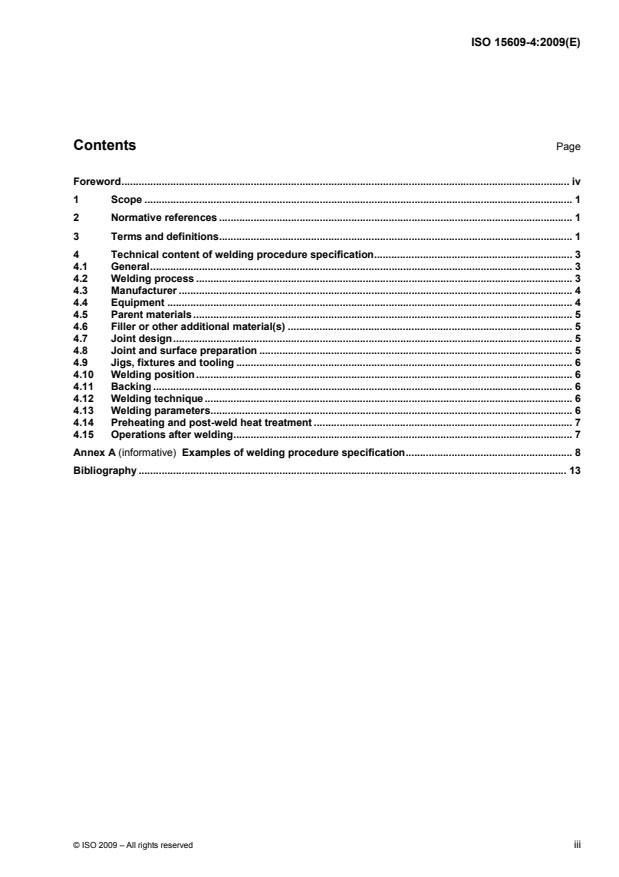
Contents Page
Foreword. iv
1 Scope . 1
2 Normative references . 1
3 Terms and definitions. 1
4 Technical content of welding procedure specification. 3
4.1 General. 3
4.2 Welding process . 3
4.3 Manufacturer . 4
4.4 Equipment . 4
4.5 Parent materials . 5
4.6 Filler or other additional material(s) . 5
4.7 Joint design. 5
4.8 Joint and surface preparation . 5
4.9 Jigs, fixtures and tooling . 6
4.10 Welding position. 6
4.11 Backing . 6
4.12 Welding technique. 6
4.13 Welding parameters. 6
4.14 Preheating and post-weld heat treatment . 7
4.15 Operations after welding. 7
Annex A (informative) Examples of welding procedure specification. 8
Bibliography . 13
Foreword
ISO (the International Organization for Standardization) is a worldwide federation of national standards bodies
(ISO member bodies). The work of preparing International Standards is normally carried out through ISO
technical committees. Each member body interested in a subject for which a technical committee has been
established has the right to be represented on that committee. International organizations, governmental and
non-governmental, in liaison with ISO, also take part in the work. ISO collaborates closely with the
International Electrotechnical Commission (IEC) on all matters of electrotechnical standardization.
International Standards are drafted in accordance with the rules given in the ISO/IEC Directives, Part 2.
The main task of technical committees is to prepare International Standards. Draft International Standards
adopted by the technical committees are circulated to the member bodies for voting. Publication as an
International Standard requires approval by at least 75 % of the member bodies casting a vote.
Attention is drawn to the possibility that some of the elements of this document may be the subject of patent
rights. ISO shall not be held responsible for identifying any or all such patent rights.
ISO 15609-4 was prepared by Technical Committee ISO/TC 44, Welding and allied processes, Subcommittee
SC 10, Unification of requirements in the field of metal welding.
This second edition cancels and replaces the first edition (ISO 15609-4:2004), which has been technically
revised.
ISO 15609 consists of the following parts, under the general title Specification and qualification of welding
procedures for metallic materials — Welding procedure specification:
⎯ Part 1: Arc welding
⎯ Part 2: Gas welding
⎯ Part 3: Electron beam welding
⎯ Part 4: Laser beam welding
⎯ Part 5: Resistance welding
The following part is planned:
⎯ Part 6: Laser arc hybrid welding
Requests for official interpretations of any aspect of this part of ISO 15609 should be directed to the
Secretariat of ISO/TC 44/SC 10 via your national standards body, a complete listing of which can be found at
www.iso.org.
iv © ISO 2009 – All rights reserved
INTERNATIONAL STANDARD ISO 15609-4:2009(E)
Specification and qualification of welding procedures for
metallic materials — Welding procedure specification —
Part 4:
Laser beam welding
1 Scope
This part of ISO 15609 specifies requirements for the content of the welding procedure specification (WPS) for
laser beam welding processes, including overlay welding. It is not applicable to other processes for cladding
(e.g. thermal spraying).
This part of ISO 15609 is part of a series of standards, and details of this series are given in ISO 15607:2003,
Annex A.
Variables listed in this part of ISO 15609 are those influencing the quality and properties of the welded joint.
The dimensions mentioned in this part of ISO 15609 influence the metallurgical and mechanical qualities, the
geometry of the structural member and other important performance properties.
2 Normative references
The following referenced documents are indispensable for the application of this document. For dated
references, only the edition cited applies. For undated references, the latest edition of the referenced
document (including any amendments) applies.
ISO 4063, Welding and allied processes — Nomenclature of processes and reference numbers
ISO 6947, Welds — Working positions — Definitions of angles of slope and rotation
ISO 14175, Welding consumables — Gases and gas mixtures for fusion welding and allied processes
ISO 15607:2003, Specification and qualification of welding procedures for metallic materials — General rules
ISO/TR 25901:2007, Welding and related processes — Vocabulary
3 Terms and definitions
For the purposes of this document, the terms and definitions given in ISO 15607:2003, ISO/TR 25901:2007
and the following apply.
3.1
slope up
〈beam welding〉 controlled increase of the beam power at the beginning of the welding
[ISO/TR 25901:2007, definition 2.337]
3.2
slope down
controlled decrease of the beam power at the end of the welding
NOTE 1 Adapted from ISO/TR 25901:2007, definition 2.336.
NOTE 2 The slope down region is the region on the workpiece in which the effects of slope down occur. It can consist
of one or two of the following areas, depending on the selected welding mode.
a) In full penetration welding, it can consist of
⎯ a region where beam penetration is still complete, and
⎯ a region where penetration is partial or decreasing.
b) In partial penetration welding, it can consist of
⎯ a region where penetration decreases continuously.
3.3
working distance
〈beam welding〉 distance between the surface of the workpiece and a standard reference point of the
equipment which is traceable to the true focusing lens or mirror centre
[ISO/TR 25901:2007, definition 2.472]
NOTE This is a practical reference distance only.
3.4
tacking pass
pass made to hold the parts to be welded in proper alignment until the final welds are made
NOTE 1 Adapted from ISO/TR 25901:2007, definition 2.370.
NOTE 2 This can be produced by a continuous or discontinuous pass with partial penetration.
3.5
pass
run
single operation of welding that is part of the production of a completed weld
NOTE 1 Adapted from ISO/TR 25901:2007, definition 2.312.
NOTE 2 The term “pass” is commonly used in beam welding.
3.6
cosmetic pass
pass for superficial remelting of the weld in order to enhance appearance
NOTE 1 Adapted from ISO/TR 25901:2007, definition 2.75.
NOTE 2 This pass can be performed with a defocused or oscillating beam.
3.7
overlap
〈beam welding〉 portion of the weld pass remelted prior to the slope down
[ISO/TR 25901:2007, definition 2.249]
NOTE For overlay welding, portion of a welding pass remelted by the adjoining pass.
2 © ISO 2009 – All rights reserved
3.8
back support
piece of metal or other auxiliary material placed against the workpiece on the back face of the joint in order to
retain the molten weld metal
NOTE Adapted from ISO/TR 25901:2007, definition 2.24.
3.9
focal length
〈beam welding〉 distance between the centre of the focusing lens or mirror and the focal spot
[ISO/TR 25901:2007, definition 2.146]
NOTE In a thick lens or system of lenses, the principal plane is often inside the lens. For set-up purposes, operators
often use the “back focal length”,
...
NORME ISO
INTERNATIONALE 15609-4
Deuxième édition
2009-05-15
Descriptif et qualification d'un mode
opératoire de soudage pour les matériaux
métalliques — Descriptif d'un mode
opératoire de soudage —
Partie 4:
Soudage par faisceau laser
Specification and qualification of welding procedures for metallic
materials — Welding procedure specification —
Part 4: Laser beam welding
Numéro de référence
©
ISO 2009
PDF – Exonération de responsabilité
Le présent fichier PDF peut contenir des polices de caractères intégrées. Conformément aux conditions de licence d'Adobe, ce fichier
peut être imprimé ou visualisé, mais ne doit pas être modifié à moins que l'ordinateur employé à cet effet ne bénéficie d'une licence
autorisant l'utilisation de ces polices et que celles-ci y soient installées. Lors du téléchargement de ce fichier, les parties concernées
acceptent de fait la responsabilité de ne pas enfreindre les conditions de licence d'Adobe. Le Secrétariat central de l'ISO décline toute
responsabilité en la matière.
Adobe est une marque déposée d'Adobe Systems Incorporated.
Les détails relatifs aux produits logiciels utilisés pour la création du présent fichier PDF sont disponibles dans la rubrique General Info
du fichier; les paramètres de création PDF ont été optimisés pour l'impression. Toutes les mesures ont été prises pour garantir
l'exploitation de ce fichier par les comités membres de l'ISO. Dans le cas peu probable où surviendrait un problème d'utilisation,
veuillez en informer le Secrétariat central à l'adresse donnée ci-dessous.
DOCUMENT PROTÉGÉ PAR COPYRIGHT
© ISO 2009
Droits de reproduction réservés. Sauf prescription différente, aucune partie de cette publication ne peut être reproduite ni utilisée sous
quelque forme que ce soit et par aucun procédé, électronique ou mécanique, y compris la photocopie et les microfilms, sans l'accord écrit
de l'ISO à l'adresse ci-après ou du comité membre de l'ISO dans le pays du demandeur.
ISO copyright office
Case postale 56 • CH-1211 Geneva 20
Tel. + 41 22 749 01 11
Fax + 41 22 749 09 47
E-mail copyright@iso.org
Web www.iso.org
Publié en Suisse
ii © ISO 2009 – Tous droits réservés
Sommaire Page
Avant-propos. iv
1 Domaine d'application. 1
2 Références normatives . 1
3 Termes et définitions. 2
4 Contenu technique d'un descriptif de mode opératoire de soudage (DMOS) . 3
4.1 Généralités . 3
4.2 Procédé de soudage. 4
4.3 Fabricant. 4
4.4 Matériel . 4
4.5 Matériaux de base. 5
4.6 Matériaux d'apport ou autres produits consommables. 5
4.7 Conception de l'assemblage . 5
4.8 Préparation des joints et de la surface. 6
4.9 Gabarits, montages et outillage . 6
4.10 Position de soudage. 6
4.11 Support envers. 6
4.12 Technique de soudage. 6
4.13 Paramètres de soudage . 6
4.14 Préchauffage et traitement thermique après soudage . 7
4.15 Opérations après soudage . 7
Annexe A (informative) Exemples de descriptifs de mode opératoire de soudage (DMOS). 8
Bibliographie . 13
Avant-propos
L'ISO (Organisation internationale de normalisation) est une fédération mondiale d'organismes nationaux de
normalisation (comités membres de l'ISO). L'élaboration des Normes internationales est en général confiée
aux comités techniques de l'ISO. Chaque comité membre intéressé par une étude a le droit de faire partie du
comité technique créé à cet effet. Les organisations internationales, gouvernementales et non
gouvernementales, en liaison avec l'ISO participent également aux travaux. L'ISO collabore étroitement avec
la Commission électrotechnique internationale (CEI) en ce qui concerne la normalisation électrotechnique.
Les Normes internationales sont rédigées conformément aux règles données dans les Directives ISO/CEI,
Partie 2.
La tâche principale des comités techniques est d'élaborer les Normes internationales. Les projets de Normes
internationales adoptés par les comités techniques sont soumis aux comités membres pour vote. Leur
publication comme Normes internationales requiert l'approbation de 75 % au moins des comités membres
votants.
L'attention est appelée sur le fait que certains des éléments du présent document peuvent faire l'objet de
droits de propriété intellectuelle ou de droits analogues. L'ISO ne saurait être tenue pour responsable de ne
pas avoir identifié de tels droits de propriété et averti de leur existence.
L'ISO 15609-4 a été élaborée par le comité technique ISO/TC 44, Soudage et techniques connexes,
sous-comité SC 10, Unification des prescriptions dans la technique du soudage des métaux.
Cette deuxième édition annule et remplace la première édition (ISO 15609-4:2004), qui a fait l'objet d'une
révision technique.
L'ISO 15609 comprend les parties suivantes, présentées sous le titre général Descriptif et qualification d'un
mode opératoire de soudage pour les matériaux métalliques — Descriptif d'un mode opératoire de soudage:
⎯ Partie 1: Soudage à l'arc
⎯ Partie 2: Soudage aux gaz
⎯ Partie 3: Soudage par faisceau d'électrons
⎯ Partie 4: Soudage par faisceau laser
⎯ Partie 5: Soudage par résistance
La partie suivante est prévue:
⎯ Partie 6: Soudage hybride laser-arc
Il convient d'adresser les demandes d'interprétation officielles de l'un quelconque des aspects de la présente
partie de l'ISO 15609 au secrétariat de l'ISO/TC 44/SC 10 via votre organisme national de normalisation. La
liste exhaustive de ces organismes peut être trouvée à l'adresse www.iso.org.
iv © ISO 2009 – Tous droits réservés
NORME INTERNATIONALE ISO 15609-4:2009(F)
Descriptif et qualification d'un mode opératoire de soudage
pour les matériaux métalliques — Descriptif d'un mode
opératoire de soudage —
Partie 4:
Soudage par faisceau laser
1 Domaine d'application
La présente partie de l'ISO 15609 spécifie les exigences relatives au contenu du descriptif du mode
opératoire de soudage (DMOS) par faisceau laser, y compris le rechargement par soudage. Elle n'est pas
applicable aux autres procédés de rechargement (par exemple à la projection thermique).
La présente partie de l'ISO 15609 fait partie d'une série de normes dont les détails sont donnés dans
l'ISO 15607:2003, Annexe A.
Les variables énumérées dans la présente partie de l'ISO 15609 sont celles qui ont une influence sur la
qualité et les caractéristiques du joint soudé. Les dimensions données dans la présente partie de l'ISO 15609
ont une influence sur les qualités métallurgiques et mécaniques, sur la géométrie de la structure et sur
d'autres caractéristiques importantes de fonctionnement.
2 Références normatives
Les documents de référence suivants sont indispensables pour l'application du présent document. Pour les
références datées, seule l'édition citée s'applique. Pour les références non datées, la dernière édition du
document de référence s'applique (y compris les éventuels amendements).
ISO 4063, Soudage et techniques connexes — Nomenclature et numérotation des procédés
ISO 6947, Soudures — Positions de travail — Définitions des angles d'inclinaison et de rotation
ISO 14175, Produits consommables pour le soudage — Gaz et mélanges gazeux pour le soudage par fusion
et les techniques connexes
ISO 15607:2003, Descriptif et qualification d'un mode opératoire de soudage pour les matériaux
métalliques — Règles générales
ISO/TR 25901:2007, Soudage et techniques connexes — Vocabulaire
3 Termes et définitions
Pour les besoins du présent document, les termes et définitions donnés dans l'ISO 15607:2003,
l'ISO/TR 25901:2007 ainsi que les suivants s'appliquent.
3.1
montée en puissance
〈soudage par faisceau〉 accroissement contrôlé de la puissance du faisceau au début du soudage
[ISO/TR 25901:2007, définition 2.337]
3.2
évanouissement
réduction contrôlée de la puissance du faisceau à la fin du soudage
NOTE 1 Adapté de l'ISO/TR 25901:2007, définition 2.336.
NOTE 2 La zone d'évanouissement correspond à la zone de la pièce où s'effectue la diminution de puissance. Elle
peut comporter une ou deux parties, selon le mode de soudage choisi.
a) En soudage à pleine pénétration, elle peut comporter
⎯ une partie où la pénétration du faisceau est toujours complète, et
⎯ une partie où la pénétration est partielle ou décroissante.
b) En soudage à pénétration partielle, elle peut comporter
⎯ une partie où la pénétration décroît en continu.
3.3
distance de tir
〈soudage par faisceau〉 distance entre la surface de la pièce et un point de référence du matériel qui peut être
rapporté au centre de la lentille de focalisation ou du miroir
NOTE 1 Adapté de l'ISO/TR 25901:2007, définition 2.472.
NOTE 2 Il s'agit seulement d'une distance de référence pratique.
3.4
passe de pointage
épinglage
passe destinée à assurer l'alignement correct des pièces à souder avant l'exécution des soudures définitives
NOTE 1 Adapté de l'ISO/TR 25901:2007, définition 2.370.
NOTE 2 Elle peut être constituée d'une passe continue ou discontinue, à pénétration partielle.
3.5
passe
opération isolée de soudage faisant partie de la réalisation d'une soudure complète
NOTE Adapté de l'ISO/TR 25901:2007, définition 2.312.
3.6
passe de lissage
passe de refusion superficielle de la soudure afin d'en améliorer l'aspect
NOTE 1 Adapté de l'ISO/TR 25901:2007, définition 2.75.
NOTE 2 Cette passe peut être effectuée avec un faisceau défocalisé ou oscillant.
2 © ISO 2009 – Tous droits réservés
3.7
recouvrement
〈soudage par faisceau〉 portion de soudure refondue avant évanouissement
[ISO/TR 25901:2007, définition 2.249]
NOTE Pour le rechargement par soudage, la partie de la passe de soudage refondue par la passe adjacente.
3.8
support envers
pièce de métal, ou autre matériau auxiliaire, placée contre la pièce, à l'envers du joint, destinée à retenir le
bain de métal en fusion
NOTE Adapté de l'ISO/TR 25901:2007, définition 2.24.
3.9
distance focale
〈soudage par faisceau〉 distance entre le centre de la lentille de focalisation ou du miroir et la tache focale
[ISO/TR 25901:2007, définition 2.146]
NOTE Dans le cas d'une lentille épaisse ou d'un système de lentilles, le plan principal est souvent situé à l'intérieur
de la lentille. Pour l'installation, les opérateurs utilisent souvent la «distance focale arrière», c'est-à-dire la distance entre la
surface avant de la lentille de focalisation ou du système de miroir et la tache focale.
3.10
tache focale
〈soudage par faisceau〉 partie du faisceau au-delà du système de focalisation où l'aire de la section du
faisceau est minimale
[ISO/TR 25901:2007, définition 2.147]
3.11
mise en forme du faisceau
adaptation des propriétés géométriques de la zone effective du faisceau et de la distribution de densité de
puissance par des composants optiques appropriés
3.12
gaz porteur
gaz de transport
〈rechargement par soudage〉 gaz utilisé pour acheminer le matériau d'apport jusqu'a
...