

ISO 4158:1978
(Main)Ferrosilicon, ferrosilicomanganese and ferrosilicochromium — Determination of silicon content — Gravimetric method
General Information
- Abstract
The method is applicable to alloys containing from 8 to 95 % (m/m) silicon. Specifies principle, reagents, apparatus, sample, procedure, expression of results, reproducibility and test report. Warns of perchloric acid fumes.
- Status
- Published
- Publication Date
- 30-Nov-1978
- Technical Committee
- ISO/TC 132 - Ferroalloys
- Drafting Committee
- ISO/TC 132 - Ferroalloys
- Current Stage
- 9060 - Close of review
- Completion Date
- 04-Mar-2031
Buy Documents

ISO 4158:1978 - Ferrosilicon, ferrosilicomanganese and ferrosilicochromium -- Determination of silicon content -- Gravimetric method
ISO 4158:1978 - Ferrosilicon, ferrosilicomanganese and ferrosilicochromium — Determination of silicon content — Gravimetric method/1/1978
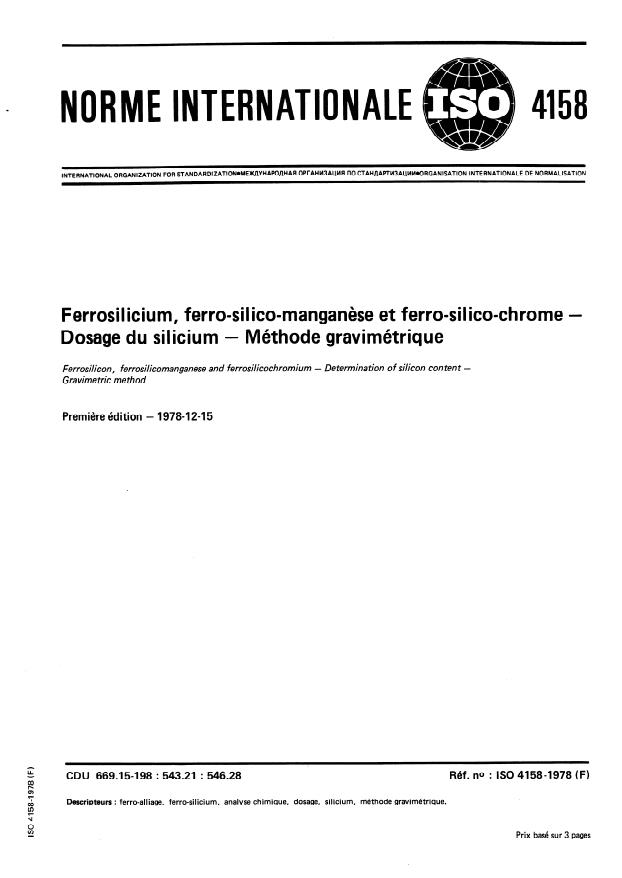
ISO 4158:1978 - Ferro-silicium, ferro-silico-manganese et ferro-silico-chrome -- Dosage du silicium -- Méthode gravimétrique
ISO 4158:1978 - Ferro-silicium, ferro-silico-manganèse et ferro-silico-chrome — Dosage du silicium — Méthode gravimétrique/1/1978
ISO 4158:1978 - Ferro-silicium, ferro-silico-manganèse et ferro-silico-chrome — Dosage du silicium — Méthode gravimétrique/1/1978
Overview
ISO 4158:1978 specifies a gravimetric method for the determination of silicon content in ferrosilicon, ferrosilicomanganese and ferrosilicochromium alloys. The method is applicable to alloys containing 8–95% (m/m) silicon and covers principle, reagents, apparatus, sampling, procedure, expression of results, reproducibility and the required test report. The procedure uses oxidative fusion (sodium peroxide), acid decomposition and gravimetric isolation of silica, with a conversion factor to report silicon content. Note: the standard warns of hazards from perchloric acid fumes when heated.
Key topics and technical requirements
- Scope: suitable for ferro‑alloys with 8–95% Si (m/m).
- Principle: convert silicon to silicate by sodium peroxide fusion, acidify, isolate silica by double insolubilization and volatilization (HF + H2SO4), then weigh residues to calculate silicon by difference.
- Sample sizes:
- ≤ 50% Si: 0.50 ± 0.0002 g (typical)
50% Si: 0.25 ± 0.0002 g
- Note: for < 25% Si a 1 g sample may be used.
- Reagents and materials: sodium peroxide fusion flux, perchloric acid, hydrofluoric acid, hydrochloric and sulfuric acids, silver nitrate (10 g/L) for chloride check; laboratory-grade reagents and distilled water are required.
- Apparatus: silica‑free crucibles (iron-free/graphite/nickel/zirconium), platinum capsules, PTFE or inert beakers, muffle furnace, desiccator and standard filtration equipment.
- Calculation: silicon content is calculated from weighed masses of the capsule plus impure silica and capsule plus impurities, with a conversion factor 0.4674 to convert SiO2 → Si. Blank corrections are required (masses m1..m4 specified in the method).
- Performance: stated reproducibility (95% confidence) for an experienced operator is approximately ±0.30% for Si > 50% and ±0.20% for Si ≤ 50%.
Practical applications and users
- Laboratories performing metallurgical analysis of ferroalloys.
- Quality control and incoming material inspection in steel mills, alloy producers and foundries.
- Research and process control in metallurgy and materials science where accurate silicon determination in ferrous alloys is required.
- Accredited testing labs preparing test reports in line with ISO practice.
Practical benefits include a definitive, traceable gravimetric result suitable for certification, process control and product specification compliance.
Safety and best practice
- The method involves perchloric acid and hydrofluoric acid; use appropriate fume hoods, PPE and procedures for perchloric acid heating and HF handling.
- Follow laboratory safety regulations and local hazardous‑chemical protocols.
Related standards
- ISO 3713 - Ferro‑alloys - Sampling and preparation of samples (referenced for sample preparation).
Relations
- Effective Date
- 06-Jun-2022
Buy Documents
ISO 4158:1978 - Ferrosilicon, ferrosilicomanganese and ferrosilicochromium -- Determination of silicon content -- Gravimetric method
ISO 4158:1978 - Ferrosilicon, ferrosilicomanganese and ferrosilicochromium — Determination of silicon content — Gravimetric method/1/1978
ISO 4158:1978 - Ferro-silicium, ferro-silico-manganese et ferro-silico-chrome -- Dosage du silicium -- Méthode gravimétrique
ISO 4158:1978 - Ferro-silicium, ferro-silico-manganèse et ferro-silico-chrome — Dosage du silicium — Méthode gravimétrique/1/1978
ISO 4158:1978 - Ferro-silicium, ferro-silico-manganèse et ferro-silico-chrome — Dosage du silicium — Méthode gravimétrique/1/1978
Get Certified
Connect with accredited certification bodies for this standard

Element Materials Technology
Materials testing and product certification.

Inštitut za kovinske materiale in tehnologije
Institute of Metals and Technology. Materials testing, metallurgical analysis, NDT.
Sponsored listings
Frequently Asked Questions
ISO 4158:1978 is a standard published by the International Organization for Standardization (ISO). Its full title is "Ferrosilicon, ferrosilicomanganese and ferrosilicochromium — Determination of silicon content — Gravimetric method". This standard covers: The method is applicable to alloys containing from 8 to 95 % (m/m) silicon. Specifies principle, reagents, apparatus, sample, procedure, expression of results, reproducibility and test report. Warns of perchloric acid fumes.
The method is applicable to alloys containing from 8 to 95 % (m/m) silicon. Specifies principle, reagents, apparatus, sample, procedure, expression of results, reproducibility and test report. Warns of perchloric acid fumes.
ISO 4158:1978 is classified under the following ICS (International Classification for Standards) categories: 77.100 - Ferroalloys. The ICS classification helps identify the subject area and facilitates finding related standards.
ISO 4158:1978 has the following relationships with other standards: It is inter standard links to ISO 8359:1996. Understanding these relationships helps ensure you are using the most current and applicable version of the standard.
ISO 4158:1978 is available in PDF format for immediate download after purchase. The document can be added to your cart and obtained through the secure checkout process. Digital delivery ensures instant access to the complete standard document.
Standards Content (Sample)
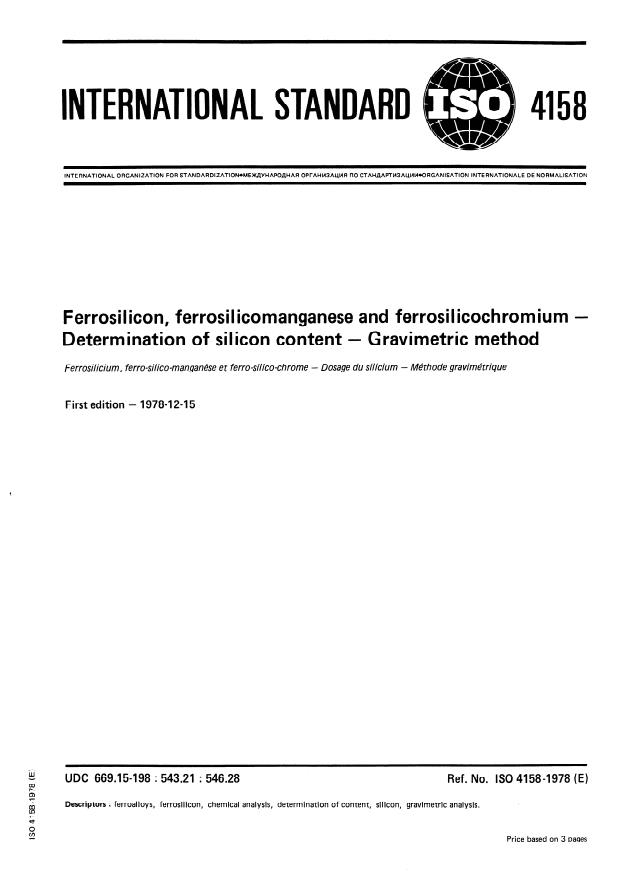
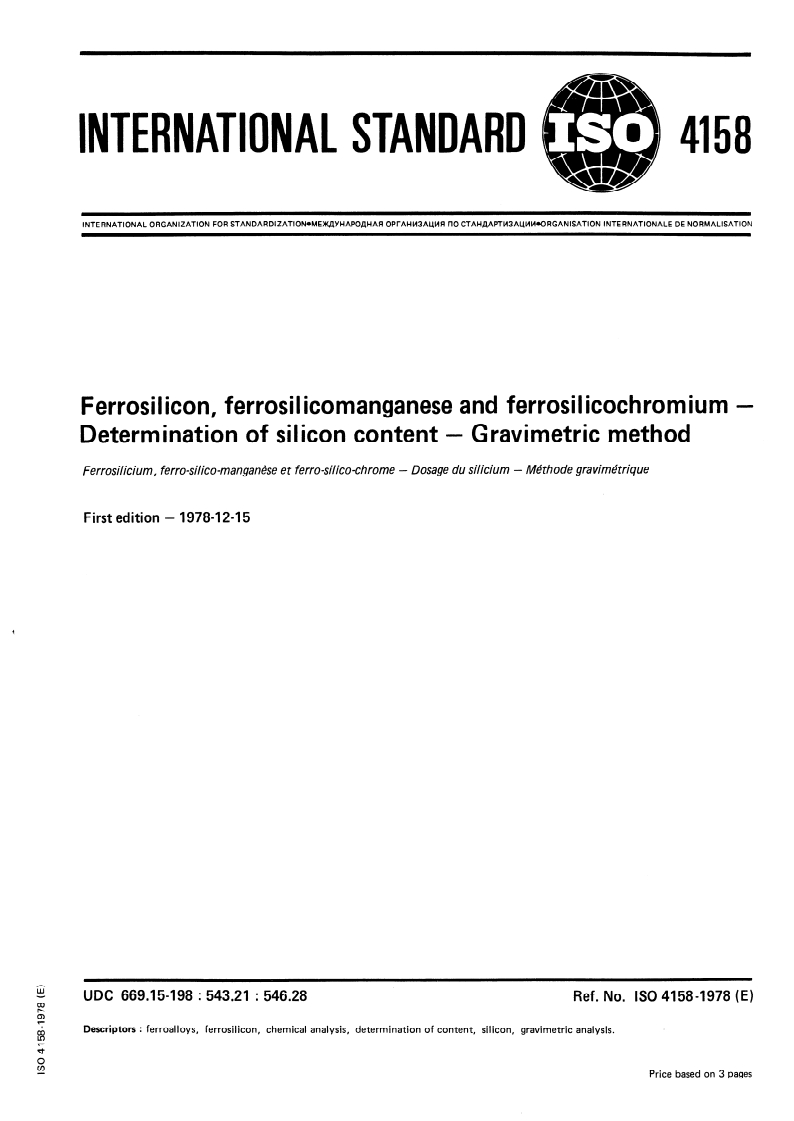
INTERNATIONAL STANDARD
415%
INTERNATIONAL ORGANIZATION FOR STANDARDIZATIONWlE~YHAPO~HAR OPrAHM3A~MR I-IO CTAHflAPTbl3A~MkWORGANISATION INTERNATIONALE DE NORMALISATION
Ferrosilicon, ferrosilicomanganese and ferrosilicochromium -
Determination of Silicon content - Gravimetric method
Ferrosilicium, ferro-silico-manganhe et ferro-silico-chrome - Dosage du silicium - Mthode gravimgtrique
First edition - 1978-12-15
UDC 669.15-198 : 543.21 : 546.28
Ref. No. ISO 4158-1978 (E)
Descriptors : ferroalloys, ferrosilicon, Chemical analysis, determination of content, Silicon, gravimetric analysis.
Price based on 3 pages
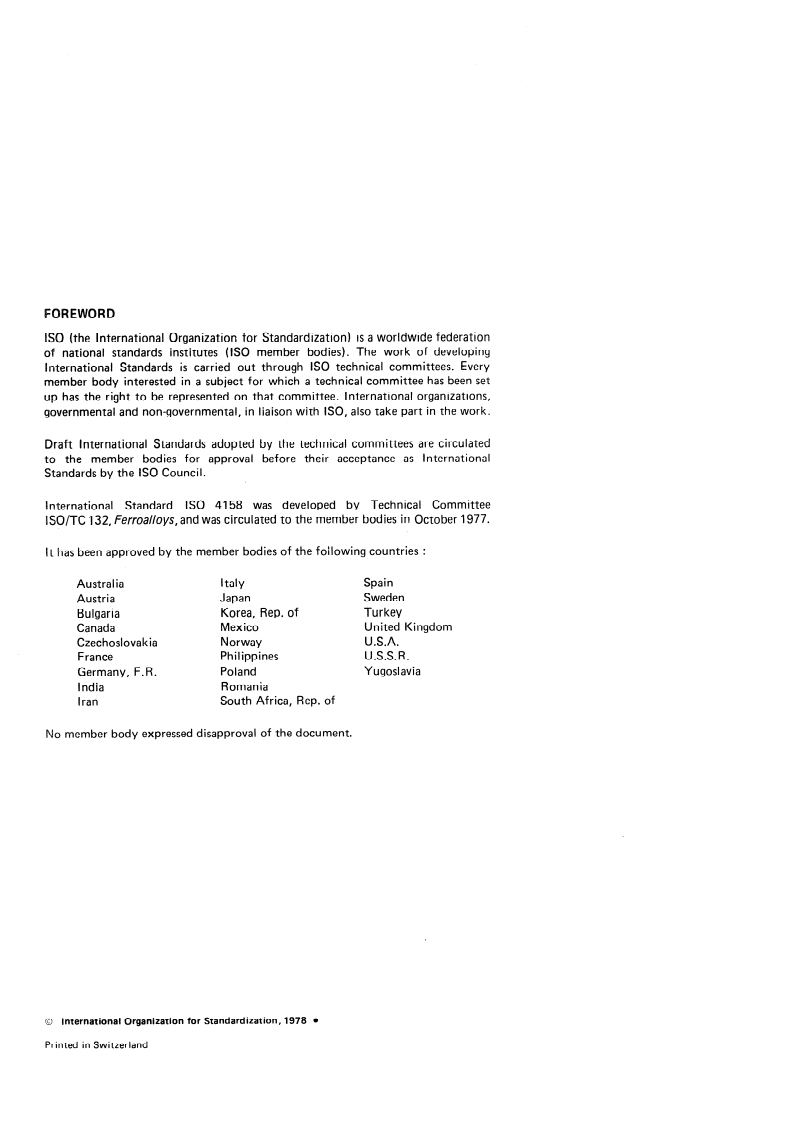
ISO (the International Organization for Standardization) is a worldwide federation
of national Standards institutes (ISO member bodies). The work of developing
International Standards is carried out through ISO technical committees. Every
member body interested in a subject for which a technical committee has been set
up has the right to be represented on that committee. International organizations,
governmental and non-governmental, in liaison with ISO, also take part in the work.
International Standard ISO 4158 was developed by Technical Committee
ISO/TC 132, Ferroaloys, and was circulated to the member bodies in October 1977.
Bt has been approved by the member bodies of the foilowing countries :
Spain
Austral ia I taly
Japan Sweden
Austria
Korea, Rep. of Turkey
Bulgaria
Canada Wlexico United Kingdom
Czechoslovakia Norway U.S.A.
France Philippines U.S.S.R.
Germany, F. R. Poland Yugoslavia
India Romania
Iran South Africa, Rep. of
No member body expressed disapproval of the document.
@ International Organkation for Standardkation, 1978 l
Printed in Switzerland
ISO 41584978 (E)
INTERNATIONAL STANDARD
Ferrosilicon, ferrosilicomanganese and ferrosilicochromium -
Determination of Silicon content - Gravimetric method
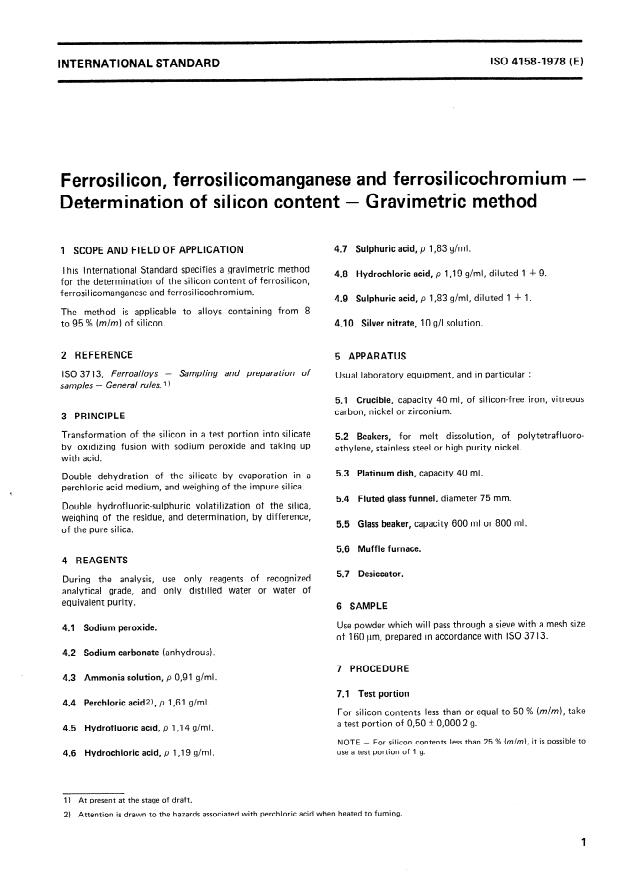
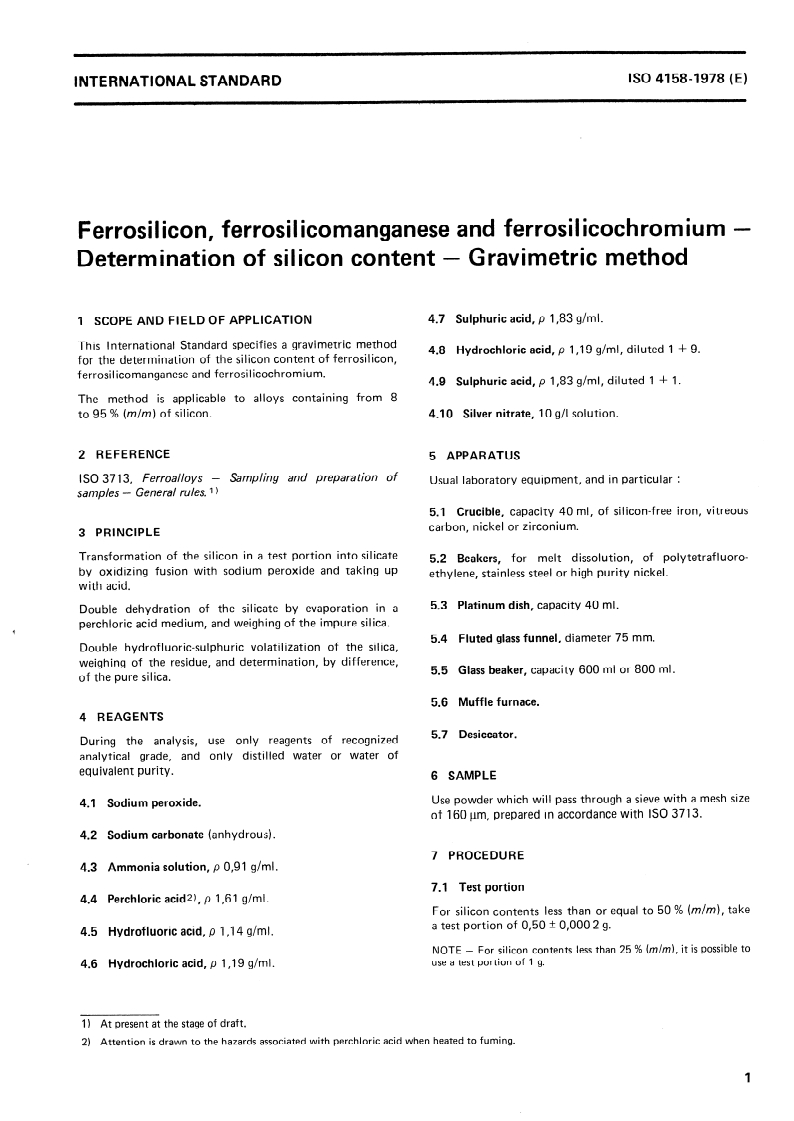
4.7 Sulphuric acid, p 1,83 g/mI.
1 SCOPE AND FIELD OF APPLICATION
This International Standard specifies a gravimetric method
4.8 Hydrochlorit acid, p 1,19 g/ml, diluted 1 i- 9.
for the determination of the Silicon content of ferrosilicon,
ferrosilicomanganese and ferrosilicochromium.
4.9 Sulphuric acid, p 1,83 g/ml, diluted 1 + 1.
The method is applicable to alloys containing from 8
t0 95 % (mlm) of Silicon.
4.10 Silver nitrate, 10 g/l Solution.
2 REFERENCE
5 APPARATUS
Sampling and preparation of
ISO 3713, Ferroalloys -
Usual laboratory equipment, and in particular :
samples - General rules. 1)
5.1 Crucible, capacity 40 ml, of Silicon-free iron, vitreous
carbon, nicke1 or zirconium.
3 PRINCIPLE
Transformation of the Silicon in a test Portion into silicate
5.2 Beakers, for melt dissolution, of polytetrafluoro-
by oxidizing fusion with sodium peroxide and taking up
ethylene, stainless steel or high purity nickel.
with acid.
5.3 Platinum dish, capacity 40 ml.
Double dehydration of the silicate by evaporation in a
perchloric acid medium, and weighing of the impure silica.
5.4 Fluted glass funnel, diameter 75 mm.
Double hydrofluoric-sulphuric volatilization of the silica,
weighing of the residue, and determination, by differente,
5.5 Glass beaker, capacity 600 ml or 800 ml.
of the pure silica.
5.6 Muff Ie f urnace.
4 REAGENTS
5.7 Desiccator.
During the analysis, use only reagents of recognized
analytical grade, and only distilled water or water of
equivalent purity.
6 SAMPLE
Use powder which will pass through a sieve with a mesh size
4.1 Sodium Peroxide.
of 160 Pm, prepared in accordance with ISO 3713.
4.2 Sodium carbonate (anhydrous).
7 PROCEDURE
4.3 Ammonia Solution, p 0,91 g/ml.
7.1 Test Portion
4.4 Perchlorit acid*J, p 1,61 g/ml.
For Silicon contents less than or equal to 50 % (mlm), take
a test Portion of 0,50 * 0,000 2 g.
4.5 Hydrofluoric acid, p 1 ,14 g/ml.
NOTE - For Silicon contents less than 25 % (m/m), it is possible to
use a test Portion of 1 g.
4.6 Hydrochlorit acid, p 1 ,19 g/ml.
1) At present at the Stage of draft.
2) Attention is drawn to the hazards associated with perchloric acid when heated to fuming.
ISO 4158-1978 (E)
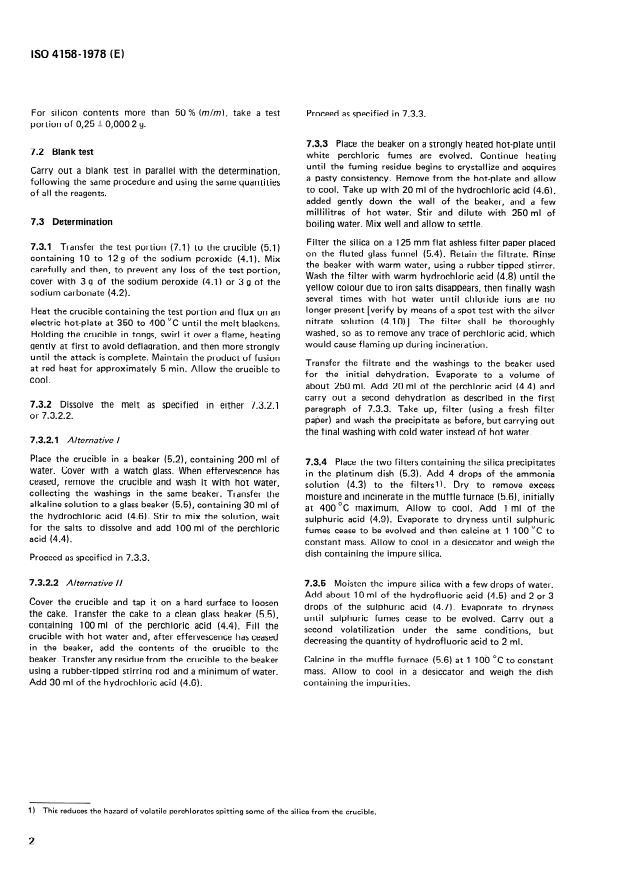
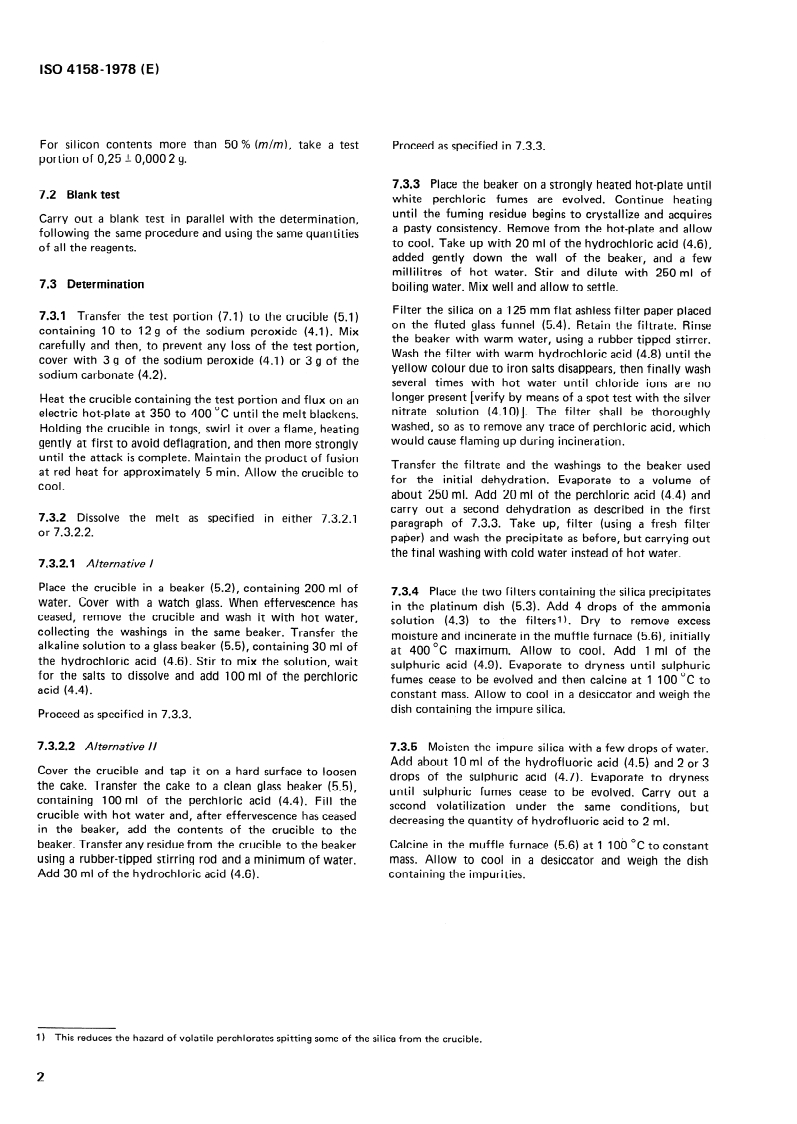
mlm), take a test
For Silicon contents more than 50 % Proceed as specified in 7.3.3.
Portion of 025 + 0,000 2 g.
7.3.3 Place the beaker on a strongly heated hot-plate until
7.2 Blank test
white perchloric fumes are evolved. Continue heating
until the fuming residue begins to crystallize and acquires
Carry out a blank test in parallel with the determination,
a pasty consistency. Remove from the hot-plate and allow
following the same procedure and using :he same quantities
to cool. Take up with 20 ml of the hydrochloric acid (4.6),
of all the reagents.
added gently down the wall of the beaker, and a few
millilitres of hot water. Stir and dilute with 250 ml of
7.3 Determination boiling water. Mix weil and allow to settle.
Filter the silica on a 125 mm flat ashless filter Paper placed
7.3.1 Transfer the test Portion (7.1) to the crucible (5.1)
on the fluted glass funnel (5.4). Retain the filtrate. Rinse
co
...
INTERNATIONAL STANDARD
415%
INTERNATIONAL ORGANIZATION FOR STANDARDIZATIONWlE~YHAPO~HAR OPrAHM3A~MR I-IO CTAHflAPTbl3A~MkWORGANISATION INTERNATIONALE DE NORMALISATION
Ferrosilicon, ferrosilicomanganese and ferrosilicochromium -
Determination of Silicon content - Gravimetric method
Ferrosilicium, ferro-silico-manganhe et ferro-silico-chrome - Dosage du silicium - Mthode gravimgtrique
First edition - 1978-12-15
UDC 669.15-198 : 543.21 : 546.28
Ref. No. ISO 4158-1978 (E)
Descriptors : ferroalloys, ferrosilicon, Chemical analysis, determination of content, Silicon, gravimetric analysis.
Price based on 3 pages
ISO (the International Organization for Standardization) is a worldwide federation
of national Standards institutes (ISO member bodies). The work of developing
International Standards is carried out through ISO technical committees. Every
member body interested in a subject for which a technical committee has been set
up has the right to be represented on that committee. International organizations,
governmental and non-governmental, in liaison with ISO, also take part in the work.
International Standard ISO 4158 was developed by Technical Committee
ISO/TC 132, Ferroaloys, and was circulated to the member bodies in October 1977.
Bt has been approved by the member bodies of the foilowing countries :
Spain
Austral ia I taly
Japan Sweden
Austria
Korea, Rep. of Turkey
Bulgaria
Canada Wlexico United Kingdom
Czechoslovakia Norway U.S.A.
France Philippines U.S.S.R.
Germany, F. R. Poland Yugoslavia
India Romania
Iran South Africa, Rep. of
No member body expressed disapproval of the document.
@ International Organkation for Standardkation, 1978 l
Printed in Switzerland
ISO 41584978 (E)
INTERNATIONAL STANDARD
Ferrosilicon, ferrosilicomanganese and ferrosilicochromium -
Determination of Silicon content - Gravimetric method
4.7 Sulphuric acid, p 1,83 g/mI.
1 SCOPE AND FIELD OF APPLICATION
This International Standard specifies a gravimetric method
4.8 Hydrochlorit acid, p 1,19 g/ml, diluted 1 i- 9.
for the determination of the Silicon content of ferrosilicon,
ferrosilicomanganese and ferrosilicochromium.
4.9 Sulphuric acid, p 1,83 g/ml, diluted 1 + 1.
The method is applicable to alloys containing from 8
t0 95 % (mlm) of Silicon.
4.10 Silver nitrate, 10 g/l Solution.
2 REFERENCE
5 APPARATUS
Sampling and preparation of
ISO 3713, Ferroalloys -
Usual laboratory equipment, and in particular :
samples - General rules. 1)
5.1 Crucible, capacity 40 ml, of Silicon-free iron, vitreous
carbon, nicke1 or zirconium.
3 PRINCIPLE
Transformation of the Silicon in a test Portion into silicate
5.2 Beakers, for melt dissolution, of polytetrafluoro-
by oxidizing fusion with sodium peroxide and taking up
ethylene, stainless steel or high purity nickel.
with acid.
5.3 Platinum dish, capacity 40 ml.
Double dehydration of the silicate by evaporation in a
perchloric acid medium, and weighing of the impure silica.
5.4 Fluted glass funnel, diameter 75 mm.
Double hydrofluoric-sulphuric volatilization of the silica,
weighing of the residue, and determination, by differente,
5.5 Glass beaker, capacity 600 ml or 800 ml.
of the pure silica.
5.6 Muff Ie f urnace.
4 REAGENTS
5.7 Desiccator.
During the analysis, use only reagents of recognized
analytical grade, and only distilled water or water of
equivalent purity.
6 SAMPLE
Use powder which will pass through a sieve with a mesh size
4.1 Sodium Peroxide.
of 160 Pm, prepared in accordance with ISO 3713.
4.2 Sodium carbonate (anhydrous).
7 PROCEDURE
4.3 Ammonia Solution, p 0,91 g/ml.
7.1 Test Portion
4.4 Perchlorit acid*J, p 1,61 g/ml.
For Silicon contents less than or equal to 50 % (mlm), take
a test Portion of 0,50 * 0,000 2 g.
4.5 Hydrofluoric acid, p 1 ,14 g/ml.
NOTE - For Silicon contents less than 25 % (m/m), it is possible to
use a test Portion of 1 g.
4.6 Hydrochlorit acid, p 1 ,19 g/ml.
1) At present at the Stage of draft.
2) Attention is drawn to the hazards associated with perchloric acid when heated to fuming.
ISO 4158-1978 (E)
mlm), take a test
For Silicon contents more than 50 % Proceed as specified in 7.3.3.
Portion of 025 + 0,000 2 g.
7.3.3 Place the beaker on a strongly heated hot-plate until
7.2 Blank test
white perchloric fumes are evolved. Continue heating
until the fuming residue begins to crystallize and acquires
Carry out a blank test in parallel with the determination,
a pasty consistency. Remove from the hot-plate and allow
following the same procedure and using :he same quantities
to cool. Take up with 20 ml of the hydrochloric acid (4.6),
of all the reagents.
added gently down the wall of the beaker, and a few
millilitres of hot water. Stir and dilute with 250 ml of
7.3 Determination boiling water. Mix weil and allow to settle.
Filter the silica on a 125 mm flat ashless filter Paper placed
7.3.1 Transfer the test Portion (7.1) to the crucible (5.1)
on the fluted glass funnel (5.4). Retain the filtrate. Rinse
co
...
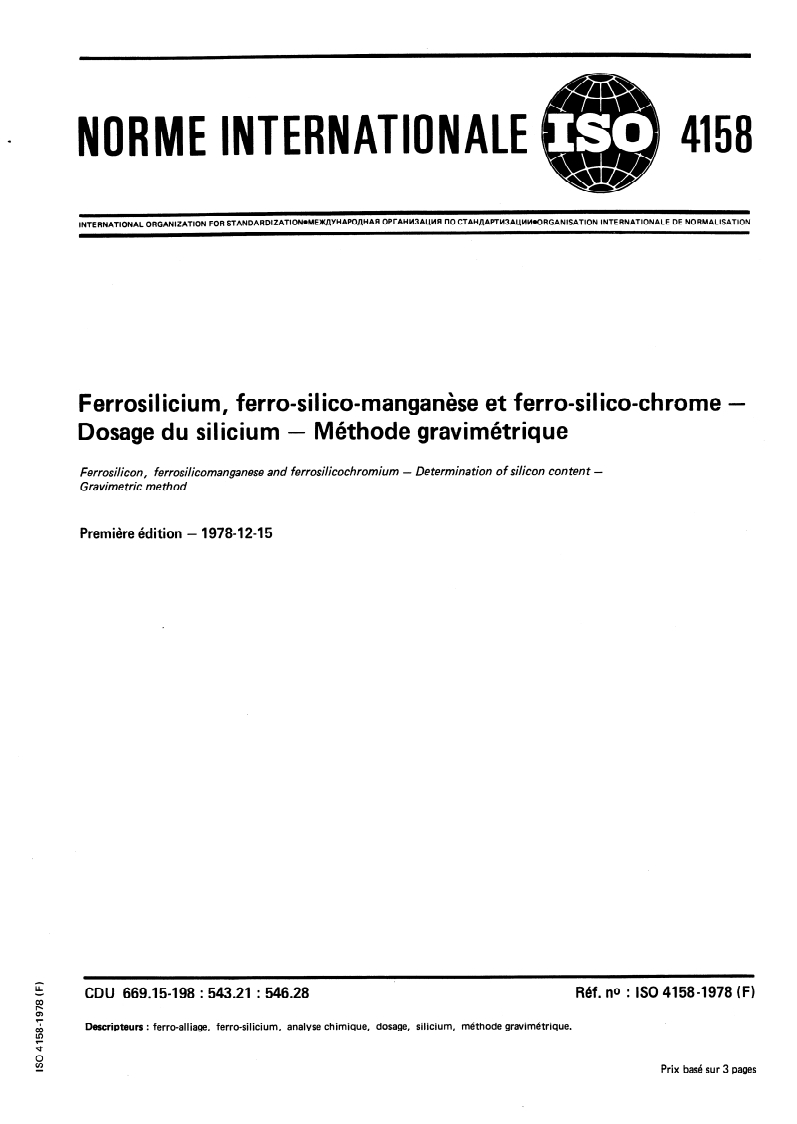
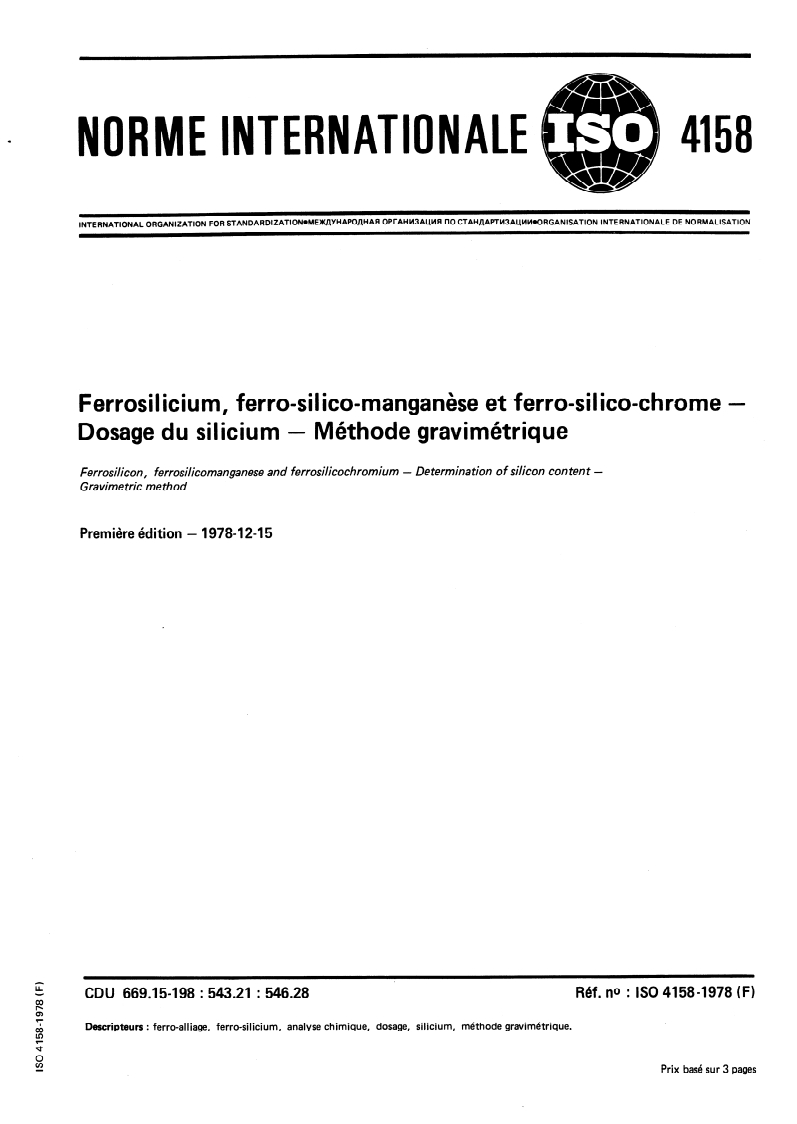
l NORME INTERNATIONALE
INTERNATIONAL ORGANIZATION FOR STANDARDIfATION.ME)I(L1YHAPO~HAR OPrAHMJAUMR n0 CTAH~APTH3ALWWORGANISATION INTERNATIONALE DE NORMALISATION
Ferrosilicium, ferro-silice-manganèse et ferro-silice-chrome -
Dosage du silicium - Méthode gravimétrique
Ferrosilicon, ferrosilicomanganese and ferrosilicochromium - Oetermination of silicon content -
Gravimetric method
Première édition - 1978-l 2-l 5
CDU 669.15-198 : 543.21 : 546.28
Réf. no : ISO 4158-1978 (F)
Descripteurs : ferra-alliage, ferro-silicium, analyse chimique, dosage, silicium, méthode gravimétrique.
Prix basé sur 3 pages
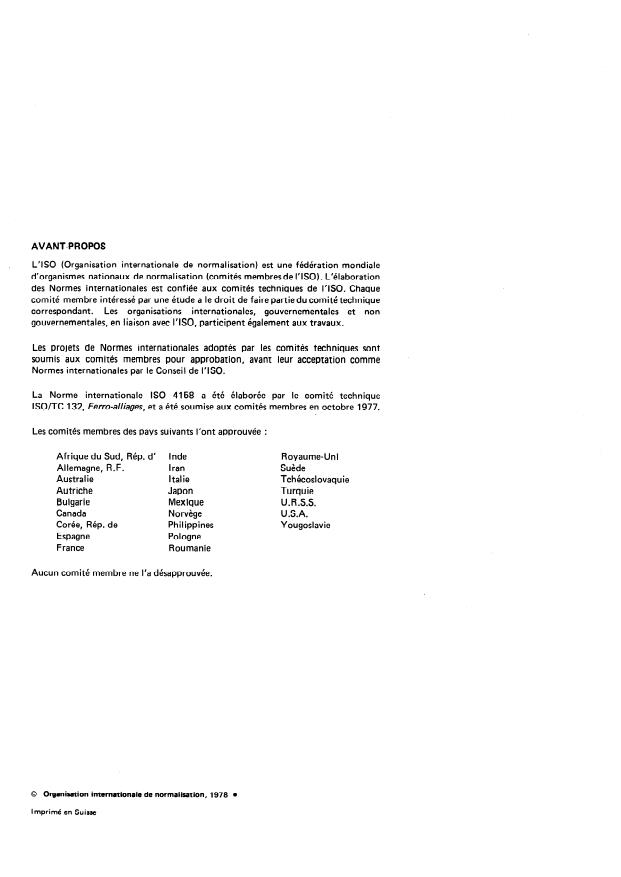
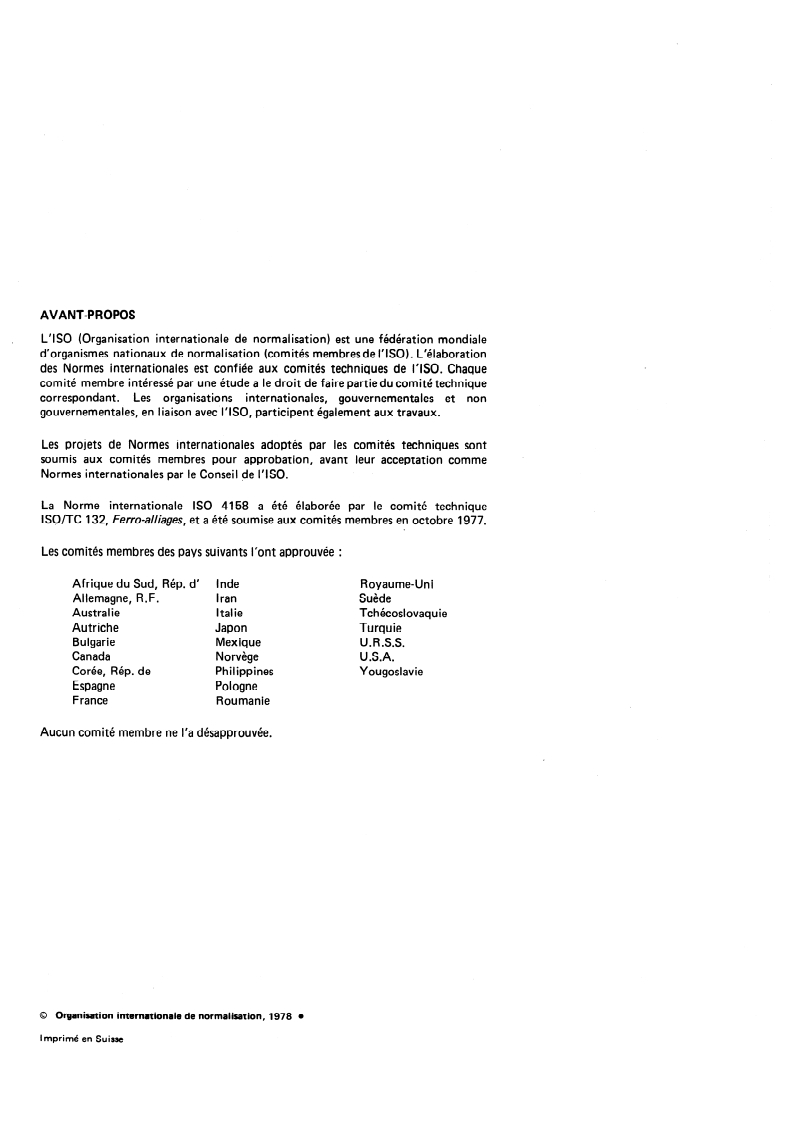
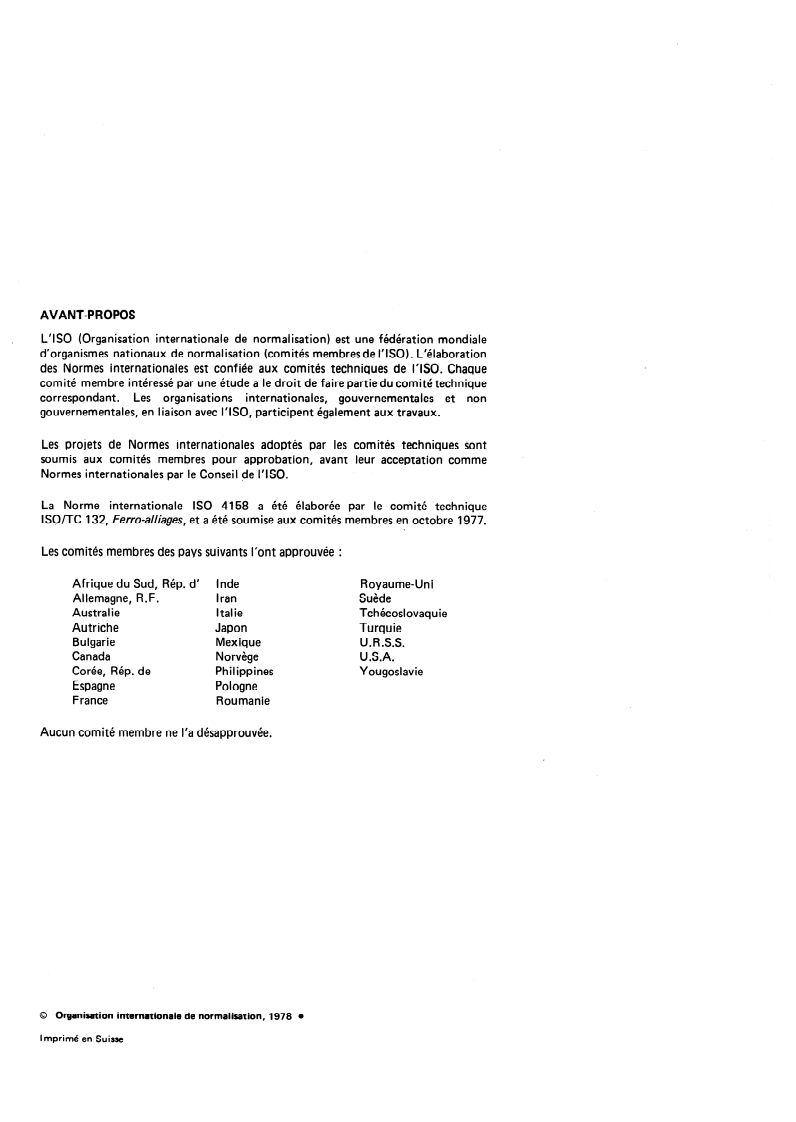
AVANT-PROPOS
L’ISO (Organisation internationale de normalisation) est une fédération mondiale
d’organismes nationaux de normalisation (comités membres de I’ISO). L’élaboration
des Normes internationales est confiée aux comités techniques de I’ISO. Chaque
comité membre intéressé par une étude a le droit de faire partie du comité technique
correspondant. Les organisations internationales, gouvernementales et non
gouvernementales, en liaison avec I’ISO, participent également aux travaux.
Les projets de Normes internationales adoptés par les comités techniques sont
soumis aux comités membres pour approbation, avant leur acceptation comme
Normes internationales par le Conseil de I’ISO.
La Norme internationale ISO 4158 a été élaborée par le comité technique
ISC/TC 132, Ferro-a//iages, et a été soumise aux comités membres en octobre 1977.
Les comités membres des pays suivants l’ont approuvée :
Afrique du Sud, Rép. d’ Inde Royaume-Uni
Iran Suède
Allemagne, R.F.
Australie Italie Tchécoslovaquie
Turquie
Autriche Japon
Bulgarie Mexique U.R.S.S.
Canada Norvège U.S.A.
Corée, Rép. de Philippines Yougoslavie
Espagne Pologne
France Roumanie
Aucun comité membre ne l’a désapprouvée.
0 Organisation internationale de normalisation, 1978 l
Imprimé en Suisse
ISO 41583978 (F)
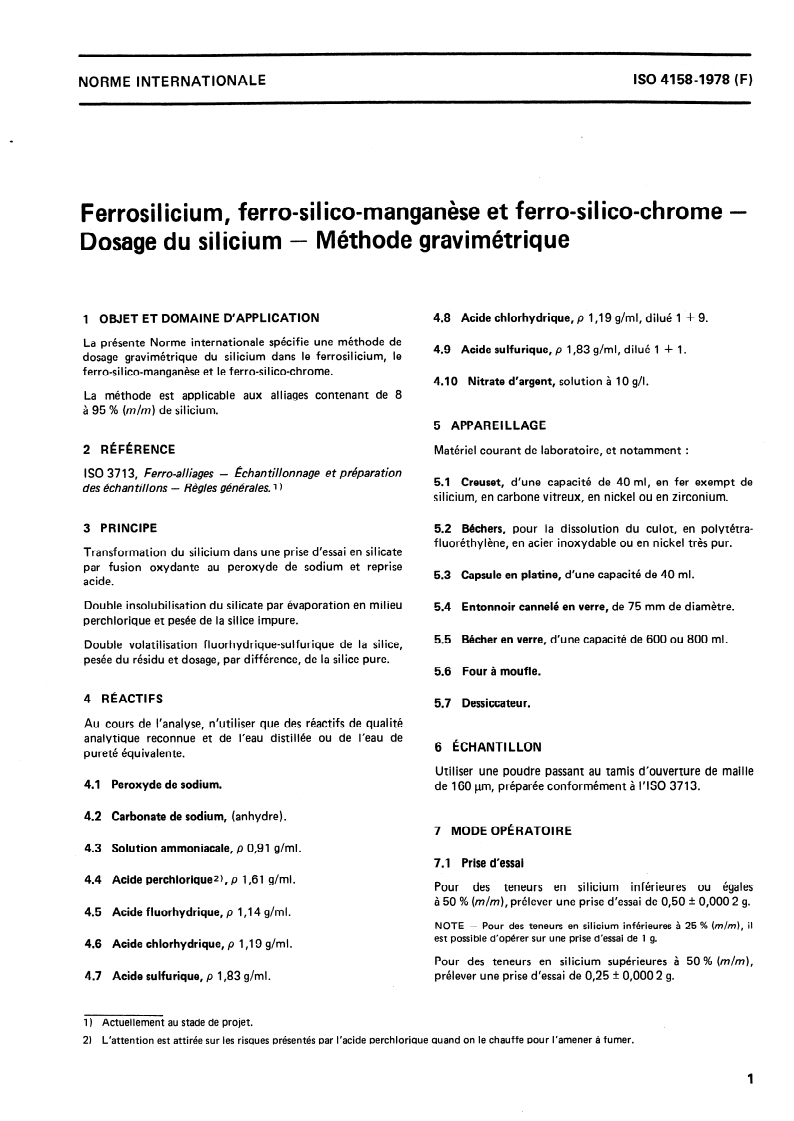
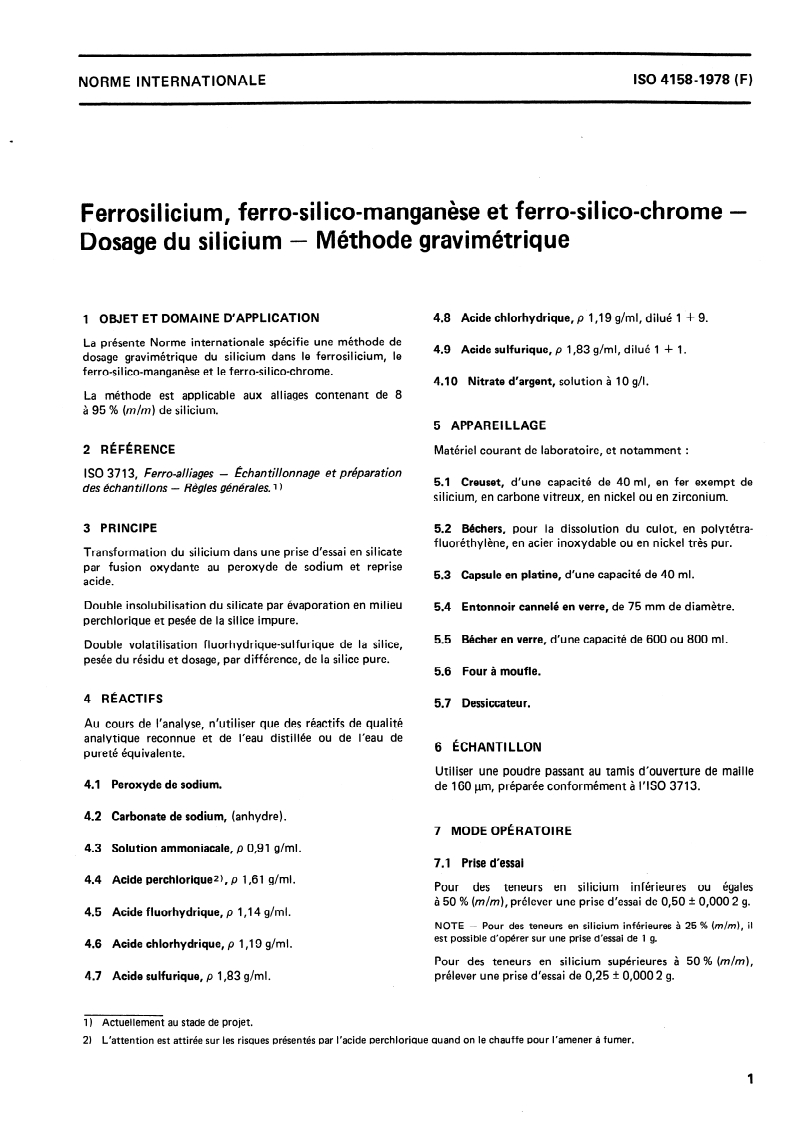
NORME INTERNATIONALE
Ferrosilicium, ferro-silice-manganèse et ferro-silice-chrome -
- Méthode gravimétrique
Dosage du silicium
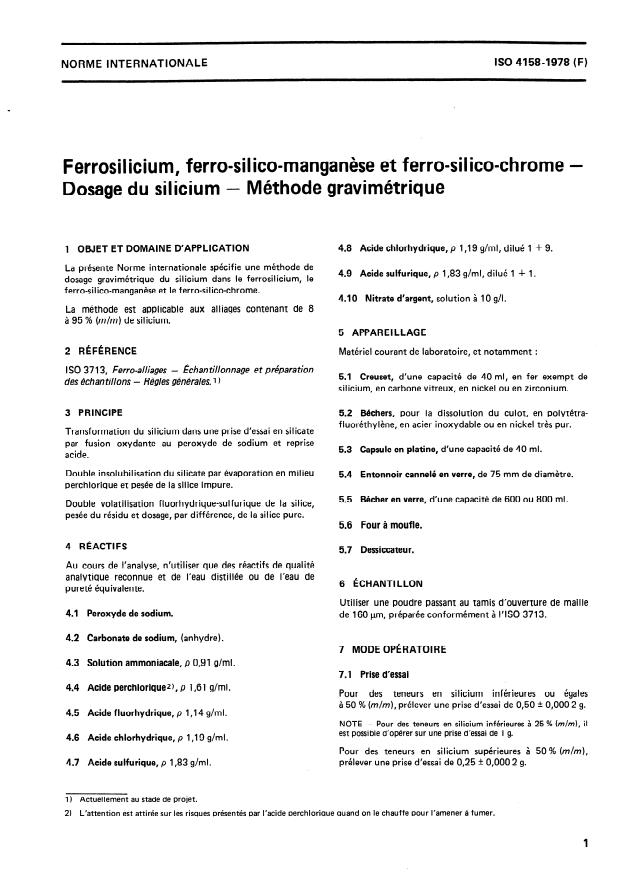
1 OBJET ET DOMAINE D’APPLICATION 4.8 Acide chlorhydrique, p 1 ,19 g/ml, dilué 1 + 9.
La présente Norme internationale spécifie une méthode de
4.9 Acide sulfurique, p 1,83 g/ml, dilué 1 + 1.
dosage gravimétrique du silicium dans le ferrosilicium, le
ferro-silice-manganèse et le ferro-silice-chrome.
4.10 Nitrate d’argent, solution à 10 g/l.
La méthode est applicable aux alliages contenant de 8
à 95 % (mlm) de silicium.
5 APPAREILLAGE
2 REFERENCE Matériel courant de laboratoire, et notamment :
ISO 37 13, Ferro-alliages - Échan tillonnage et préparation
5.1 Creuset, d’une capacité de 40 ml, en fer exempt de
des échantillons - Règles générales. 1)
silicium, en carbone vitreux, en nickel ou en zirconium.
3 PRINCIPE 5.2 Béchers, pour la dissolution du culot, en polytétra-
fluoréthylène, en acier inoxydable ou en nickel très pur.
Transformation du silicium dans une prise d’essai en silicate
par fusion oxydante au peroxyde de sodium et reprise
5.3 Capsule en platine, d’une capacité de 40 ml.
acide.
Double insolubilisation du silicate par évaporation en milieu
5.4 Entonnoir cannelé en verre, de 75 mm de diamètre.
perchlorique et pesée de la silice impure.
5.5 Bécher en verre, d’une capacité de 600 ou 800 ml.
Double volatilisation fluorhydrique-sulfurique de la silice,
pesée du résidu et dosage, par différence, de la silice pure.
5.6 Four à moufle.
4 RÉACTIFS
Dessiccateur.
5.7
Au cours de l’analyse, n’utiliser que des réactifs de qualité
analytique reconnue et de l’eau distillée ou de l’eau de
6 ÉCHANTI LL0N
pureté équivalente.
Utiliser une poudre passant au tamis d’ouverture de maille
Peroxyde de sodium.
4.1 de 160 um, préparée conformément à I’ISO 3713.
4.2 Carbonate de sodium, (anhydre).
7 MODE OPERATOIRE
4.3 Solution ammoniacale, p 0,91 g/ml.
7.1 Prise d’essai
Acide perchlorique2), p 1,61 g/ml.
4.4
Pour des teneurs en silicium inférieures ou égales
à 50 % (mlm), prélever une prise d’essai de 0,50 + 0,000 2 g.
Acide fluorhydrique, p 1,14 g/ml.
4.5
NOTE - Pour des teneurs en silicium inférieures à 25 % (m/m), il
est possible d’opérer sur une prise d’essai de 1 g.
4.6 Acide chlorhydrique, p 1,19 g/ml.
Pour des teneurs en silicium supérieures à 50 % (mh),
prélever une prise d’essai de 0,25 + 0,000 2 g.
4.7 Acide sulfurique, p 1,83 g/ml.
1) Actuellement au stade de projet.
2) L’attention est attirée sur les risques présentés par l’acide perchlorique quand on le chauffe pour l’amener à fumer.
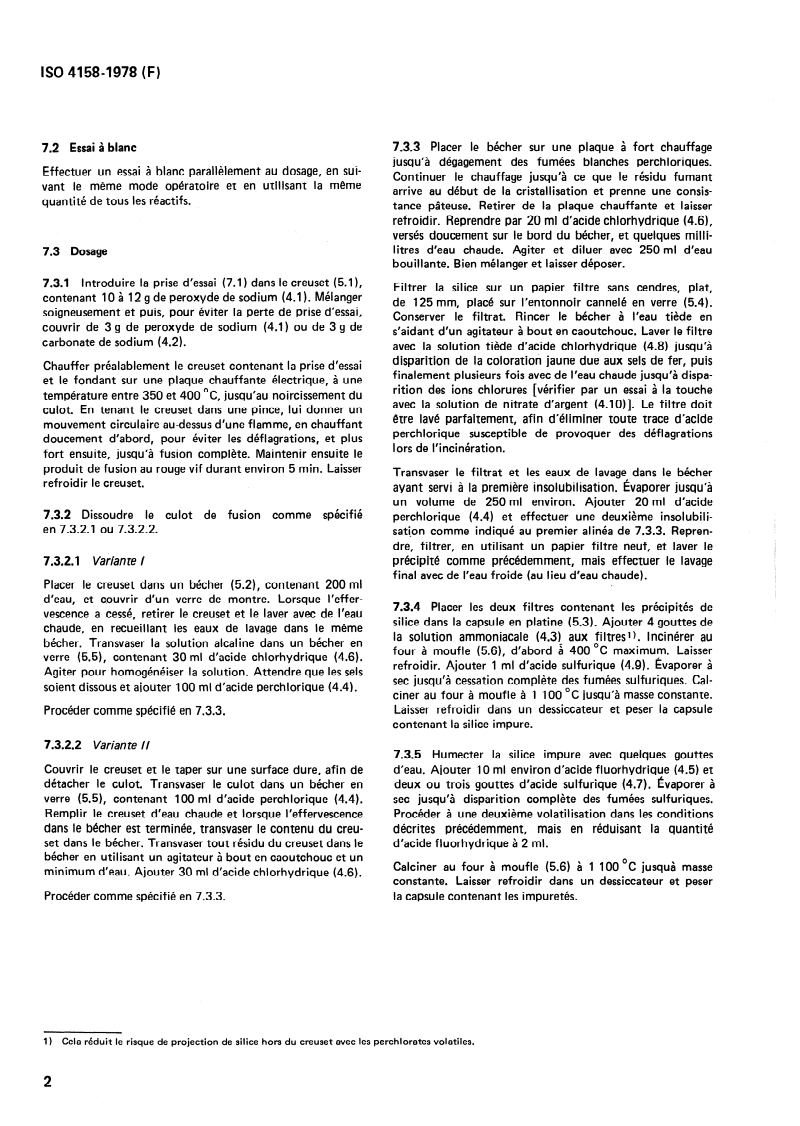
ISO 4158-1978 (F)
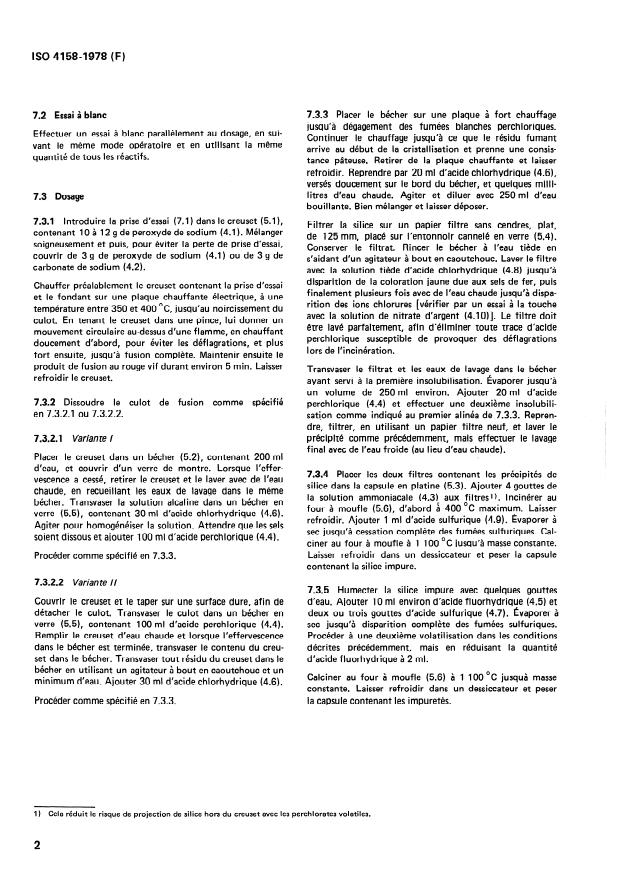
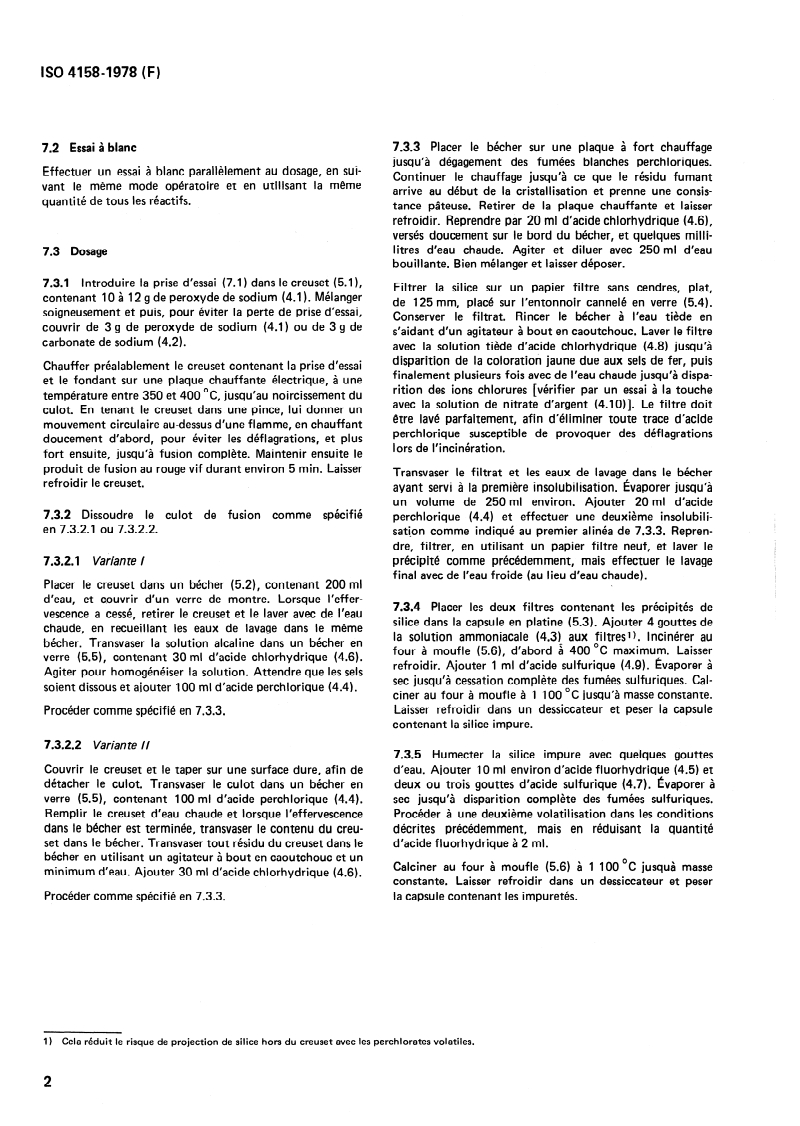
7.3.3 Placer le bécher sur une plaque à fort chauffage
7.2 Essai à blanc
jusqu’à dégagement des fumées blanches perchloriques.
Effectuer un essai à blanc parallèlement au dosage, en sui-
Continuer le chauffage jusqu’à ce que le résidu fumant
vant le même mode opératoire et en utilisant la même
arrive au début de la cristallisation et prenne une consis-
quantité de tous les réactifs.
tance pâteuse. Retirer de la plaque chauffante et laisser
refroidir. Reprendre par 20 ml d’acide chlorhydrique (4.6),
versés doucement sur le bord du bécher, et quelques milli-
litres d’eau chaude. Agiter et diluer avec 250 ml d’eau
7.3 Dosage
bouillante. Bien mélanger et laisser déposer.
7.3.1 Introduire la prise d’essai (7.1) dans le creuset (5.1),
Filtrer la silice sur un papier filtre sans cendres, plat,
contenant 10 à 12 g de peroxyde de sodium (4.1). Mélanger
de 125 mm, placé sur l’entonnoir cannelé en verre (5.4).
so
...
l NORME INTERNATIONALE
INTERNATIONAL ORGANIZATION FOR STANDARDIfATION.ME)I(L1YHAPO~HAR OPrAHMJAUMR n0 CTAH~APTH3ALWWORGANISATION INTERNATIONALE DE NORMALISATION
Ferrosilicium, ferro-silice-manganèse et ferro-silice-chrome -
Dosage du silicium - Méthode gravimétrique
Ferrosilicon, ferrosilicomanganese and ferrosilicochromium - Oetermination of silicon content -
Gravimetric method
Première édition - 1978-l 2-l 5
CDU 669.15-198 : 543.21 : 546.28
Réf. no : ISO 4158-1978 (F)
Descripteurs : ferra-alliage, ferro-silicium, analyse chimique, dosage, silicium, méthode gravimétrique.
Prix basé sur 3 pages
AVANT-PROPOS
L’ISO (Organisation internationale de normalisation) est une fédération mondiale
d’organismes nationaux de normalisation (comités membres de I’ISO). L’élaboration
des Normes internationales est confiée aux comités techniques de I’ISO. Chaque
comité membre intéressé par une étude a le droit de faire partie du comité technique
correspondant. Les organisations internationales, gouvernementales et non
gouvernementales, en liaison avec I’ISO, participent également aux travaux.
Les projets de Normes internationales adoptés par les comités techniques sont
soumis aux comités membres pour approbation, avant leur acceptation comme
Normes internationales par le Conseil de I’ISO.
La Norme internationale ISO 4158 a été élaborée par le comité technique
ISC/TC 132, Ferro-a//iages, et a été soumise aux comités membres en octobre 1977.
Les comités membres des pays suivants l’ont approuvée :
Afrique du Sud, Rép. d’ Inde Royaume-Uni
Iran Suède
Allemagne, R.F.
Australie Italie Tchécoslovaquie
Turquie
Autriche Japon
Bulgarie Mexique U.R.S.S.
Canada Norvège U.S.A.
Corée, Rép. de Philippines Yougoslavie
Espagne Pologne
France Roumanie
Aucun comité membre ne l’a désapprouvée.
0 Organisation internationale de normalisation, 1978 l
Imprimé en Suisse
ISO 41583978 (F)
NORME INTERNATIONALE
Ferrosilicium, ferro-silice-manganèse et ferro-silice-chrome -
- Méthode gravimétrique
Dosage du silicium
1 OBJET ET DOMAINE D’APPLICATION 4.8 Acide chlorhydrique, p 1 ,19 g/ml, dilué 1 + 9.
La présente Norme internationale spécifie une méthode de
4.9 Acide sulfurique, p 1,83 g/ml, dilué 1 + 1.
dosage gravimétrique du silicium dans le ferrosilicium, le
ferro-silice-manganèse et le ferro-silice-chrome.
4.10 Nitrate d’argent, solution à 10 g/l.
La méthode est applicable aux alliages contenant de 8
à 95 % (mlm) de silicium.
5 APPAREILLAGE
2 REFERENCE Matériel courant de laboratoire, et notamment :
ISO 37 13, Ferro-alliages - Échan tillonnage et préparation
5.1 Creuset, d’une capacité de 40 ml, en fer exempt de
des échantillons - Règles générales. 1)
silicium, en carbone vitreux, en nickel ou en zirconium.
3 PRINCIPE 5.2 Béchers, pour la dissolution du culot, en polytétra-
fluoréthylène, en acier inoxydable ou en nickel très pur.
Transformation du silicium dans une prise d’essai en silicate
par fusion oxydante au peroxyde de sodium et reprise
5.3 Capsule en platine, d’une capacité de 40 ml.
acide.
Double insolubilisation du silicate par évaporation en milieu
5.4 Entonnoir cannelé en verre, de 75 mm de diamètre.
perchlorique et pesée de la silice impure.
5.5 Bécher en verre, d’une capacité de 600 ou 800 ml.
Double volatilisation fluorhydrique-sulfurique de la silice,
pesée du résidu et dosage, par différence, de la silice pure.
5.6 Four à moufle.
4 RÉACTIFS
Dessiccateur.
5.7
Au cours de l’analyse, n’utiliser que des réactifs de qualité
analytique reconnue et de l’eau distillée ou de l’eau de
6 ÉCHANTI LL0N
pureté équivalente.
Utiliser une poudre passant au tamis d’ouverture de maille
Peroxyde de sodium.
4.1 de 160 um, préparée conformément à I’ISO 3713.
4.2 Carbonate de sodium, (anhydre).
7 MODE OPERATOIRE
4.3 Solution ammoniacale, p 0,91 g/ml.
7.1 Prise d’essai
Acide perchlorique2), p 1,61 g/ml.
4.4
Pour des teneurs en silicium inférieures ou égales
à 50 % (mlm), prélever une prise d’essai de 0,50 + 0,000 2 g.
Acide fluorhydrique, p 1,14 g/ml.
4.5
NOTE - Pour des teneurs en silicium inférieures à 25 % (m/m), il
est possible d’opérer sur une prise d’essai de 1 g.
4.6 Acide chlorhydrique, p 1,19 g/ml.
Pour des teneurs en silicium supérieures à 50 % (mh),
prélever une prise d’essai de 0,25 + 0,000 2 g.
4.7 Acide sulfurique, p 1,83 g/ml.
1) Actuellement au stade de projet.
2) L’attention est attirée sur les risques présentés par l’acide perchlorique quand on le chauffe pour l’amener à fumer.
ISO 4158-1978 (F)
7.3.3 Placer le bécher sur une plaque à fort chauffage
7.2 Essai à blanc
jusqu’à dégagement des fumées blanches perchloriques.
Effectuer un essai à blanc parallèlement au dosage, en sui-
Continuer le chauffage jusqu’à ce que le résidu fumant
vant le même mode opératoire et en utilisant la même
arrive au début de la cristallisation et prenne une consis-
quantité de tous les réactifs.
tance pâteuse. Retirer de la plaque chauffante et laisser
refroidir. Reprendre par 20 ml d’acide chlorhydrique (4.6),
versés doucement sur le bord du bécher, et quelques milli-
litres d’eau chaude. Agiter et diluer avec 250 ml d’eau
7.3 Dosage
bouillante. Bien mélanger et laisser déposer.
7.3.1 Introduire la prise d’essai (7.1) dans le creuset (5.1),
Filtrer la silice sur un papier filtre sans cendres, plat,
contenant 10 à 12 g de peroxyde de sodium (4.1). Mélanger
de 125 mm, placé sur l’entonnoir cannelé en verre (5.4).
so
...
l NORME INTERNATIONALE
INTERNATIONAL ORGANIZATION FOR STANDARDIfATION.ME)I(L1YHAPO~HAR OPrAHMJAUMR n0 CTAH~APTH3ALWWORGANISATION INTERNATIONALE DE NORMALISATION
Ferrosilicium, ferro-silice-manganèse et ferro-silice-chrome -
Dosage du silicium - Méthode gravimétrique
Ferrosilicon, ferrosilicomanganese and ferrosilicochromium - Oetermination of silicon content -
Gravimetric method
Première édition - 1978-l 2-l 5
CDU 669.15-198 : 543.21 : 546.28
Réf. no : ISO 4158-1978 (F)
Descripteurs : ferra-alliage, ferro-silicium, analyse chimique, dosage, silicium, méthode gravimétrique.
Prix basé sur 3 pages
AVANT-PROPOS
L’ISO (Organisation internationale de normalisation) est une fédération mondiale
d’organismes nationaux de normalisation (comités membres de I’ISO). L’élaboration
des Normes internationales est confiée aux comités techniques de I’ISO. Chaque
comité membre intéressé par une étude a le droit de faire partie du comité technique
correspondant. Les organisations internationales, gouvernementales et non
gouvernementales, en liaison avec I’ISO, participent également aux travaux.
Les projets de Normes internationales adoptés par les comités techniques sont
soumis aux comités membres pour approbation, avant leur acceptation comme
Normes internationales par le Conseil de I’ISO.
La Norme internationale ISO 4158 a été élaborée par le comité technique
ISC/TC 132, Ferro-a//iages, et a été soumise aux comités membres en octobre 1977.
Les comités membres des pays suivants l’ont approuvée :
Afrique du Sud, Rép. d’ Inde Royaume-Uni
Iran Suède
Allemagne, R.F.
Australie Italie Tchécoslovaquie
Turquie
Autriche Japon
Bulgarie Mexique U.R.S.S.
Canada Norvège U.S.A.
Corée, Rép. de Philippines Yougoslavie
Espagne Pologne
France Roumanie
Aucun comité membre ne l’a désapprouvée.
0 Organisation internationale de normalisation, 1978 l
Imprimé en Suisse
ISO 41583978 (F)
NORME INTERNATIONALE
Ferrosilicium, ferro-silice-manganèse et ferro-silice-chrome -
- Méthode gravimétrique
Dosage du silicium
1 OBJET ET DOMAINE D’APPLICATION 4.8 Acide chlorhydrique, p 1 ,19 g/ml, dilué 1 + 9.
La présente Norme internationale spécifie une méthode de
4.9 Acide sulfurique, p 1,83 g/ml, dilué 1 + 1.
dosage gravimétrique du silicium dans le ferrosilicium, le
ferro-silice-manganèse et le ferro-silice-chrome.
4.10 Nitrate d’argent, solution à 10 g/l.
La méthode est applicable aux alliages contenant de 8
à 95 % (mlm) de silicium.
5 APPAREILLAGE
2 REFERENCE Matériel courant de laboratoire, et notamment :
ISO 37 13, Ferro-alliages - Échan tillonnage et préparation
5.1 Creuset, d’une capacité de 40 ml, en fer exempt de
des échantillons - Règles générales. 1)
silicium, en carbone vitreux, en nickel ou en zirconium.
3 PRINCIPE 5.2 Béchers, pour la dissolution du culot, en polytétra-
fluoréthylène, en acier inoxydable ou en nickel très pur.
Transformation du silicium dans une prise d’essai en silicate
par fusion oxydante au peroxyde de sodium et reprise
5.3 Capsule en platine, d’une capacité de 40 ml.
acide.
Double insolubilisation du silicate par évaporation en milieu
5.4 Entonnoir cannelé en verre, de 75 mm de diamètre.
perchlorique et pesée de la silice impure.
5.5 Bécher en verre, d’une capacité de 600 ou 800 ml.
Double volatilisation fluorhydrique-sulfurique de la silice,
pesée du résidu et dosage, par différence, de la silice pure.
5.6 Four à moufle.
4 RÉACTIFS
Dessiccateur.
5.7
Au cours de l’analyse, n’utiliser que des réactifs de qualité
analytique reconnue et de l’eau distillée ou de l’eau de
6 ÉCHANTI LL0N
pureté équivalente.
Utiliser une poudre passant au tamis d’ouverture de maille
Peroxyde de sodium.
4.1 de 160 um, préparée conformément à I’ISO 3713.
4.2 Carbonate de sodium, (anhydre).
7 MODE OPERATOIRE
4.3 Solution ammoniacale, p 0,91 g/ml.
7.1 Prise d’essai
Acide perchlorique2), p 1,61 g/ml.
4.4
Pour des teneurs en silicium inférieures ou égales
à 50 % (mlm), prélever une prise d’essai de 0,50 + 0,000 2 g.
Acide fluorhydrique, p 1,14 g/ml.
4.5
NOTE - Pour des teneurs en silicium inférieures à 25 % (m/m), il
est possible d’opérer sur une prise d’essai de 1 g.
4.6 Acide chlorhydrique, p 1,19 g/ml.
Pour des teneurs en silicium supérieures à 50 % (mh),
prélever une prise d’essai de 0,25 + 0,000 2 g.
4.7 Acide sulfurique, p 1,83 g/ml.
1) Actuellement au stade de projet.
2) L’attention est attirée sur les risques présentés par l’acide perchlorique quand on le chauffe pour l’amener à fumer.
ISO 4158-1978 (F)
7.3.3 Placer le bécher sur une plaque à fort chauffage
7.2 Essai à blanc
jusqu’à dégagement des fumées blanches perchloriques.
Effectuer un essai à blanc parallèlement au dosage, en sui-
Continuer le chauffage jusqu’à ce que le résidu fumant
vant le même mode opératoire et en utilisant la même
arrive au début de la cristallisation et prenne une consis-
quantité de tous les réactifs.
tance pâteuse. Retirer de la plaque chauffante et laisser
refroidir. Reprendre par 20 ml d’acide chlorhydrique (4.6),
versés doucement sur le bord du bécher, et quelques milli-
litres d’eau chaude. Agiter et diluer avec 250 ml d’eau
7.3 Dosage
bouillante. Bien mélanger et laisser déposer.
7.3.1 Introduire la prise d’essai (7.1) dans le creuset (5.1),
Filtrer la silice sur un papier filtre sans cendres, plat,
contenant 10 à 12 g de peroxyde de sodium (4.1). Mélanger
de 125 mm, placé sur l’entonnoir cannelé en verre (5.4).
so
...