


ISO 18541-1:2014
(Main)Road vehicles — Standardized access to automotive repair and maintenance information (RMI) — Part 1: General information and use case definition
Road vehicles — Standardized access to automotive repair and maintenance information (RMI) — Part 1: General information and use case definition
ISO 18541-1:2014 provides a general overview and structure of each part of ISO 18541. It also specifies use cases related to repair and maintenance information (RMI) systems in order to standardize the access to RMI for independent operators. ISO 18541-1:2014 also describes the use cases applicable to the standardized access to automotive RMI. The use cases address real world scenarios (e.g. servicing vehicles) in regard to the information access necessary to perform vehicle roadside assistance, inspection, diagnosis, repair and maintenance, including the updating and replacement of Electronic Control Units (ECU). ISO 18541-1:2014 provides an overview of the entire standard and how it applies to the automotive industry. ISO 18541-1:2014 is applicable to light passenger and commercial vehicles as defined in regulation (EC) 715/2007 Article 2.
Véhicules routiers — Normalisation de l'accès aux informations relatives à la réparation et à la maintenance pour l'automobile (RMI) — Partie 1: Informations générales et définitions de cas d'usage
ISO 18541-1:2014 contient des « informations générales » qui donnent un aperçu général et la structure de chaque partie de la norme. Elle spécifie également des « cas d'utilisation » relatifs aux systèmes d'information de réparation et de maintenance (RMI) afin de normaliser l'accès aux RMI pour des opérateurs indépendants. Cette partie de l'ISO 18541 décrit également les cas d'utilisation applicables à l'accès normalisé aux RMI pour l'automobile. Les cas d'utilisation portent sur des scénarios réalistes (par exemple dans le cadre de la maintenance de véhicules) en ce qui concerne l'accès aux informations nécessaire pour l'assistance routière, le contrôle, le diagnostic, la réparation et la maintenance, y compris la mise à jour et le remplacement des Unités de Contrôle Électronique (UCE). Les systèmes RMI utilisés par le personnel pour réaliser les opérations d'entretien comprennent : - un système accessible sur Internet, qui donne accès aux RMI nécessaires pour réaliser la ou les opérations d'entretien ; - la fourniture de coordonnées pour des RMI spécifiques ; - un cadre de mesures destiné à sécuriser l'accès aux informations RMI liées à la sécurité du véhicule. Cette partie de l'ISO 18541 donne un aperçu général de l'ensemble de la norme et de ses modalités d'application à l'industrie automobile. Cette partie de l'ISO 18541 s'applique aux véhicules particuliers et utilitaires légers tels que définis dans le Règlement (CE) 715/2007, Article 2.[15]
General Information
- Status
- Withdrawn
- Publication Date
- 17-Sep-2014
- Withdrawal Date
- 17-Sep-2014
- Technical Committee
- ISO/TC 22/SC 31 - Data communication
- Drafting Committee
- ISO/TC 22/SC 31 - Data communication
- Current Stage
- 9599 - Withdrawal of International Standard
- Start Date
- 15-Jun-2021
- Completion Date
- 12-Feb-2026
Relations
- Effective Date
- 09-Feb-2026
- Effective Date
- 09-Feb-2026
- Effective Date
- 09-Feb-2026
- Effective Date
- 09-Feb-2026
- Effective Date
- 09-Feb-2026
- Effective Date
- 09-Feb-2026
- Effective Date
- 09-Feb-2026
- Effective Date
- 12-Feb-2026
- Effective Date
- 06-Jun-2022
- Effective Date
- 23-Apr-2020
ISO 18541-1:2014 - Road vehicles -- Standardized access to automotive repair and maintenance information (RMI)
ISO 18541-1:2014 - Véhicules routiers -- Normalisation de l'acces aux informations relatives a la réparation et a la maintenance pour l'automobile (RMI)
Get Certified
Connect with accredited certification bodies for this standard

TÜV Rheinland
TÜV Rheinland is a leading international provider of technical services.

TÜV SÜD
TÜV SÜD is a trusted partner of choice for safety, security and sustainability solutions.

AIAG (Automotive Industry Action Group)
American automotive industry standards and training.
Sponsored listings
Frequently Asked Questions
ISO 18541-1:2014 is a standard published by the International Organization for Standardization (ISO). Its full title is "Road vehicles — Standardized access to automotive repair and maintenance information (RMI) — Part 1: General information and use case definition". This standard covers: ISO 18541-1:2014 provides a general overview and structure of each part of ISO 18541. It also specifies use cases related to repair and maintenance information (RMI) systems in order to standardize the access to RMI for independent operators. ISO 18541-1:2014 also describes the use cases applicable to the standardized access to automotive RMI. The use cases address real world scenarios (e.g. servicing vehicles) in regard to the information access necessary to perform vehicle roadside assistance, inspection, diagnosis, repair and maintenance, including the updating and replacement of Electronic Control Units (ECU). ISO 18541-1:2014 provides an overview of the entire standard and how it applies to the automotive industry. ISO 18541-1:2014 is applicable to light passenger and commercial vehicles as defined in regulation (EC) 715/2007 Article 2.
ISO 18541-1:2014 provides a general overview and structure of each part of ISO 18541. It also specifies use cases related to repair and maintenance information (RMI) systems in order to standardize the access to RMI for independent operators. ISO 18541-1:2014 also describes the use cases applicable to the standardized access to automotive RMI. The use cases address real world scenarios (e.g. servicing vehicles) in regard to the information access necessary to perform vehicle roadside assistance, inspection, diagnosis, repair and maintenance, including the updating and replacement of Electronic Control Units (ECU). ISO 18541-1:2014 provides an overview of the entire standard and how it applies to the automotive industry. ISO 18541-1:2014 is applicable to light passenger and commercial vehicles as defined in regulation (EC) 715/2007 Article 2.
ISO 18541-1:2014 is classified under the following ICS (International Classification for Standards) categories: 43.040.15 - Car informatics. On board computer systems; 43.180 - Diagnostic, maintenance and test equipment. The ICS classification helps identify the subject area and facilitates finding related standards.
ISO 18541-1:2014 has the following relationships with other standards: It is inter standard links to EN ISO 18542-1:2012, EN ISO 18541-4:2015, EN ISO 18541-3:2014, EN ISO 18541-2:2014, EN ISO 18542-2:2014, EN ISO 18541-6:2018, EN ISO 18541-5:2018, EN ISO 18541-1:2014, ISO 10111:2000, ISO 18541-1:2021. Understanding these relationships helps ensure you are using the most current and applicable version of the standard.
ISO 18541-1:2014 is available in PDF format for immediate download after purchase. The document can be added to your cart and obtained through the secure checkout process. Digital delivery ensures instant access to the complete standard document.
Standards Content (Sample)
INTERNATIONAL ISO
STANDARD 18541-1
First edition
2014-09-15
Road vehicles — Standardized access
to automotive repair and maintenance
information (RMI) —
Part 1:
General information and use case
definition
Véhicules routiers — Normalisation de l’accès aux informations
relatives à la réparation et à la maintenance pour l’automobile
(RMI) —
Partie 1: Informations générales et définitions de cas d’usage
Reference number
©
ISO 2014
© ISO 2014
All rights reserved. Unless otherwise specified, no part of this publication may be reproduced or utilized otherwise in any form
or by any means, electronic or mechanical, including photocopying, or posting on the internet or an intranet, without prior
written permission. Permission can be requested from either ISO at the address below or ISO’s member body in the country of
the requester.
ISO copyright office
Case postale 56 • CH-1211 Geneva 20
Tel. + 41 22 749 01 11
Fax + 41 22 749 09 47
E-mail copyright@iso.org
Web www.iso.org
Published in Switzerland
ii © ISO 2014 – All rights reserved
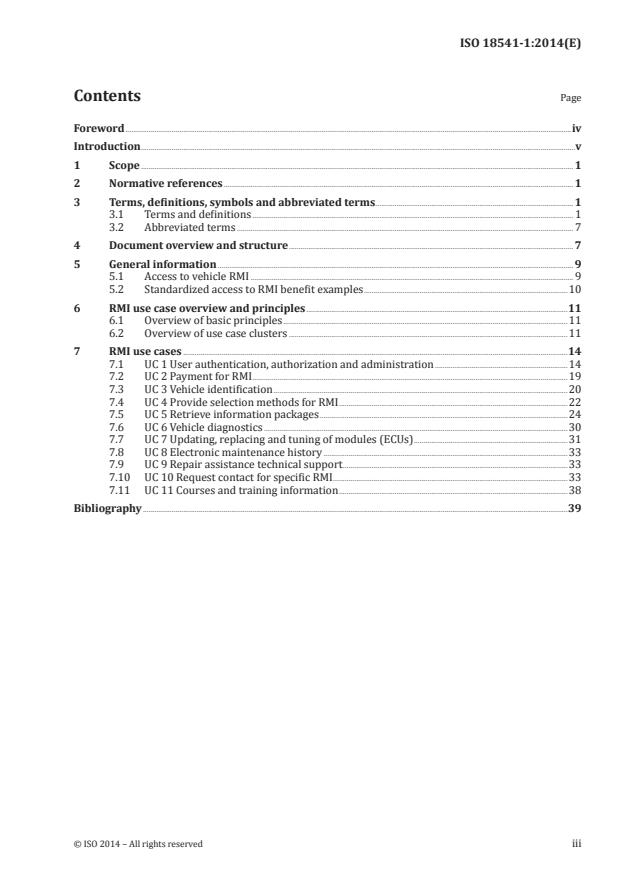
Contents Page
Foreword .iv
Introduction .v
1 Scope . 1
2 Normative references . 1
3 Terms, definitions, symbols and abbreviated terms . 1
3.1 Terms and definitions . 1
3.2 Abbreviated terms . 7
4 Document overview and structure . 7
5 General information . 9
5.1 Access to vehicle RMI . 9
5.2 Standardized access to RMI benefit examples .10
6 RMI use case overview and principles .11
6.1 Overview of basic principles .11
6.2 Overview of use case clusters .11
7 RMI use cases .14
7.1 UC 1 User authentication, authorization and administration .14
7.2 UC 2 Payment for RMI .19
7.3 UC 3 Vehicle identification .20
7.4 UC 4 Provide selection methods for RMI .22
7.5 UC 5 Retrieve information packages .24
7.6 UC 6 Vehicle diagnostics .30
7.7 UC 7 Updating, replacing and tuning of modules (ECUs) .31
7.8 UC 8 Electronic maintenance history .33
7.9 UC 9 Repair assistance technical support .33
7.10 UC 10 Request contact for specific RMI .33
7.11 UC 11 Courses and training information .38
Bibliography .39
Foreword
ISO (the International Organization for Standardization) is a worldwide federation of national standards
bodies (ISO member bodies). The work of preparing International Standards is normally carried out
through ISO technical committees. Each member body interested in a subject for which a technical
committee has been established has the right to be represented on that committee. International
organizations, governmental and non-governmental, in liaison with ISO, also take part in the work.
ISO collaborates closely with the International Electrotechnical Commission (IEC) on all matters of
electrotechnical standardization.
The procedures used to develop this document and those intended for its further maintenance are
described in the ISO/IEC Directives, Part 1. In particular the different approval criteria needed for the
different types of ISO documents should be noted. This document was drafted in accordance with the
editorial rules of the ISO/IEC Directives, Part 2 (see www.iso.org/directives).
Attention is drawn to the possibility that some of the elements of this document may be the subject of
patent rights. ISO shall not be held responsible for identifying any or all such patent rights. Details of
any patent rights identified during the development of the document will be in the Introduction and/or
on the ISO list of patent declarations received (see www.iso.org/patents).
Any trade name used in this document is information given for the convenience of users and does not
constitute an endorsement.
For an explanation on the meaning of ISO specific terms and expressions related to conformity
assessment, as well as information about ISO’s adherence to the WTO principles in the Technical Barriers
to Trade (TBT) see the following URL: Foreword - Supplementary information.
ISO 18541-1:2013 was prepared by the European Committee for Standardization (CEN) Technical
Committee CEN/TC 301, Road vehicles, in collaboration with ISO Technical Committee ISO/TC 22, Road
vehicles, Subcommittee SC 3, Electrical and electronic equipment, in accordance with the agreement on
technical cooperation between ISO and CEN (Vienna Agreement).
ISO 18541 consists of the following parts, under the general title Road vehicles — Standardized access to
automotive repair and maintenance information (RMI):
— Part 1: General information and use case definition
— Part 2: Technical requirements
— Part 3: Functional user interface requirements
— Part 4: Conformance test
ISO 18542, Road vehicles — Standardized repair and maintenance information (RMI) terminology, is a
complementary standard that defines standardized RMI terminology and consists of two parts:
— Part 1: General information and use case definition
— Part 2: Standardized process implementation requirements, Registration Authority
The standardized RMI terminology is contained in a so-called ‘Digital Annex’ that is maintained and
published by the CEN-appointed Registration Authority.
iv © ISO 2014 – All rights reserved
Introduction
This set of standards includes the requirements to be fulfilled by Repair and Maintenance Information
(RMI) systems as applied by the European Commission — Enterprise and Industry Directorate-General,
[[5]]
Consumer goods — Automotive industry EC mandate M/421 , dated Brussels, 21 January 2008.
This mandate relates to the EC type-approval system for vehicles falling into the scopes of Directives
70/156/EEC (replaced by 2007/46/EC [8]), 2002/24/EC [6] and 2003/37/EC [7] and, in particular, to
requirements for access to vehicle repair and maintenance information by independent operators.
This International Standard only covers access to automotive repair and maintenance information for
light passenger and commercial vehicles (see NOTE 1) and heavy duty vehicles (see NOTE 2) based on
Directive 70/156/EEC (replaced by 2007/46/EC [8]).
The purpose of the EC Mandate M/421 is to develop a standard or set of standards which specify the
requirements to provide standardized access to automotive repair and maintenance information (RMI)
for independent operators.
The information included in this part of ISO 18541 derives from the legislative requirements on European
level in the field of RMI and related security requirements and can be referenced by legislation in other
countries.
NOTE 1 Regulation (EC) No 715/2007 of the European Parliament and of the Council of 20 June 2007 on
type-approval of motor vehicles with respect to emissions from light passenger and commercial vehicles
(Euro 5 and Euro 6) and on access to vehicle repair and maintenance information and Commission Regulation
(EC) No 692/2008 of 18 July 2008 implementing and amending Regulation (EC) No 715/2007 of the European
Parliament and of the Council on type-approval of motor vehicles with respect to emissions from light passenger
and commercial vehicles (Euro 5 and Euro 6) and on access to vehicle repair and maintenance information and
amending Commission Regulation (EU) No 566/2011 of 8 June 2011 amending Regulation (EC) No 715/2007 of
the European Parliament and of the Council and Commission Regulation (EC) No 692/2008 as regards access to
vehicle repair and maintenance information.
NOTE 2 Regulation (EC) No 595/2009 of the European Pparliament and of the Council of 18 June 2009 on type-
approval of motor vehicles with respect to emissions from heavy duty vehicles (Euro VI) and on access to vehicle
repair and maintenance information, Commission Regulation (EU) No 582/2011 of 25 May 2011 implementing
and amending Regulation (EC) No 595/2009 of the European Parliament and of the Council with respect to
emissions from heavy duty vehicles (Euro VI), and Commission Regulation (EU) No 64/2012 of 23 January 2012
amending Regulation (EU) No 582/2011 2011 implementing and amending Regulation (EC) No 595/2009 of the
European Parliament and of the Council with respect to emissions from heavy duty vehicles (Euro VI).
INTERNATIONAL STANDARD ISO 18541-1:2014(E)
Road vehicles — Standardized access to automotive repair
and maintenance information (RMI) —
Part 1:
General information and use case definition
1 Scope
This part of ISO 18541 provides a general overview and structure of each part of ISO 18541. It also
specifies use cases related to repair and maintenance information (RMI) systems in order to standardize
the access to RMI for independent operators.
This part of ISO 18541 also describes the use cases applicable to the standardized access to automotive
RMI. The use cases address real world scenarios (e.g. servicing vehicles) in regard to the information
access necessary to perform vehicle roadside assistance, inspection, diagnosis, repair and maintenance,
including the updating and replacement of Electronic Control Units (ECU).
The RMI systems used by personnel to perform the services consist of:
— a Web-based system, which provides access to RMI needed to perform the service(s);
— contact information for specific RMI;
— a security framework to protect access to security related RMI.
This part of ISO 18541 provides an overview of the entire standard and how it applies to the automotive
industry.
This part of ISO 18541 is applicable to light passenger and commercial vehicles as defined in regulation
[15]
(EC) 715/2007 Article 2.
2 Normative references
The following documents, in whole or in part, are normatively referenced in this document and are
indispensable for its application. For dated references, only the edition cited applies. For undated
references, the latest edition of the referenced document (including any amendments) applies.
ISO 18541-2, Road vehicles — Standardized access to automotive repair and maintenance information
(RMI) — Part 2: Technical requirements
3 Terms, definitions, symbols and abbreviated terms
3.1 Terms and definitions
For the purposes of this document, the following terms and definitions apply.
3.1.1
access level
level of access to RMI which is either relevant to security or not relevant to security
EXAMPLE One might consider an access to RMI relevant to security and another one to RMI not relevant to
security. They represent two different access levels.
3.1.2
accessories
supplementary features and components selected by a vehicle owner to enhance safety, performance,
comfort, etc. and whose fitting does not impact on the vehicle approval
3.1.3
alternate fuel
type of fuel that is either gaseous at atmospheric temperature and pressure or substantially non-mineral
oil derived
[15]
Note 1 to entry: Adopted from Regulation (EC) 715/2007.
3.1.4
alternate fuels retrofit systems
engine systems mounted on an already registered vehicle for the purpose of operation with alternative
fuels
3.1.5
alternative fuels system manufacturer
manufacturer of an engine system operating with an alternative fuel
3.1.6
appropriate software level
applicable software version for the individual vehicle
3.1.7
authorized repairer
AR
provider of repair and maintenance services for motor vehicles operating within the distribution system
set up by a supplier of motor vehicles
[10]
Note 1 to entry: See Regulation (EC) 461/2010 Article 1 (1)(c).
3.1.8
certificate
electronic document which uses a digital signature to bind a public key with an identity
3.1.9
converted vehicle
factory-produced vehicle which has been altered by the addition, deletion, substitution or modification
of the body, chassis or essential parts that resembles, but is no longer identical to, the original vehicle for
a special purpose e.g. to act as rescue vehicle or taxicab
3.1.10
detailed diagnosis
diagnostic process that identifies, with precision, potential malfunction causes
Note 1 to entry: A precise diagnosis can be achieved in several steps, whereby the user might be requested to
perform test actions on the vehicle or to enter symptoms.
3.1.11
diagnostic information
description of an error or symptom and a list of potential causes or hints for further investigation to the
same level and content as provided to the AR
3.1.12
diagnostic trouble code
DTC
numeric or alphanumeric identifier which identifies or labels a malfunction
[16]
Note 1 to entry: Adopted from United Nations Global Technical Regulation No.°5.
2 © ISO 2014 – All rights reserved
3.1.13
electronic maintenance history
digital information package with virtual stamps that confirms the execution of the prescribed
maintenance actions according to the VM’s schedule
3.1.14
global technical regulation
GTR
World-Wide Harmonized On-Board Diagnostics Global Technical Regulation No.°5
[16]
Note 1 to entry: See Reference.
3.1.15
independent operator
IO
company or legal entity other than authorized dealers and repairers who is directly or indirectly
involved in the repair and maintenance of motor vehicles
EXAMPLE Repairers, manufacturers or distributors of repair equipment, tools or spare parts, publishers of
technical information, automobile clubs, roadside assistance operators, operators offering inspection and testing
services, operators offering training for installers, manufacturers and repairers of equipment for alternative fuel
vehicles.
3.1.16
IO approval
process by which, upon payment of a reasonable and proportionate fee, the CAB sanctions or approves
a legitimate commercial enterprise to engage in security-related RMI activities
3.1.17
IO authorization
process by which, upon payment of a reasonable and proportionate fee, the CAB assesses that an
individual employee of an approved IO complies with the requirements specified in this part of ISO 18541
and is entitled to be given access to security-related RMI
Note 1 to entry: As part of this authorization, the individual employee will be allocated, upon payment of a
reasonable and proportionate fee, a secure hardware token containing a personal digital certificate and a PIN
that will be supplied by the Trust Centre
3.1.18
IO legal representative
natural person empowered to legally represent the IO in all aspects of the access to vehicle RMI
3.1.19
information package
collection of information provided by the VM’s RMI system in response to a specific request
3.1.20
information type
category, group or set of information
EXAMPLE Workshop procedures (for body repair, temporary repair, periodic technical inspection), wiring
diagrams, technical service bulletins, recall information and maintenance information.
3.1.21
integrated diagnostics
process which interprets via an integrated application the memory content of ECUs and provides a
diagnostic and repair recommendation
Note 1 to entry: Diagnostic application and VM RMI systems cooperate online, so technical information is provided
during the diagnostics process and used for the diagnostic steps.
3.1.22
IO employee
natural person employed by the IO
3.1.23
maintenance history
history of the performed, prescribed actions for maintaining a vehicle
EXAMPLE Oil changes and other periodic maintenance.
3.1.24
maintenance schedule
prescribed sequence of maintenance actions for a vehicle following the requirements of the manufacturer
3.1.25
on-board diagnostics
OBD
system on board a vehicle or engine which is capable of detecting malfunctions and, if applicable, of
indicating their occurrence by means of an alert system, identifying the likely area of the malfunctions
by means of information stored in computer memory, and/or communicating that information off-board
[16]
Note 1 to entry: Module ‘A’ of GTR No.°5 concerns the whole vehicle. By referring to that module, the OBD
definition is understood as not being restricted to emissions.
3.1.26
p-code
standardized DTC for powertrain errors according to ISO 15031-6
3.1.27
partnered accessories
accessories which have been tested, quality assured and certified by the VM and for which the VM
assumes product liability
3.1.28
potential repair descriptions
list of potential causes and possible actions recommended to fix a problem
3.1.29
product features
features of a specific vehicle that may be used for navigation through the VM RMI system
EXAMPLE Engine type (petrol/diesel), transmission type (manual/automatic).
3.1.30
product structure
inter-related set of units and sub-units in which a vehicle can be divided
Note 1 to entry: The product structure is VM specific.
3.1.31
periodic technical inspection service
PTI service
particular procedure for testing a vehicle during a PTI
EXAMPLE Procedure for testing brake lights.
3.1.32
recall
process whereby a VM notifies all owners of a specific vehicle of a condition or defect that could affect
safety, safe operation or environmental issues of that vehicle
4 © ISO 2014 – All rights reserved
3.1.33
redistributor
IO offering RMI within their own internal (closed) network
EXAMPLE RAC, ADAC, garage networks.
3.1.34
remanufacturing
process of overhauling an engine, major assembly or component, to return the engine, major assembly
or component to the VM’s original specification
3.1.35
repair and maintenance information
RMI
all information required for diagnosis, servicing, inspection, periodic monitoring, repair, re-programming
or re-initialising of the vehicle and which the manufacturers provide for their authorized dealers and
repairers, including all subsequent amendments and supplements to such information
Note 1 to entry: This information includes all information required for fitting parts or equipment on vehicles.
[9]
Note 2 to entry: Adapted from Regulation (EC) 715/2007.
3.1.36
republisher
IO who publishes RMI to an external network using the RMI of the VM
3.1.37
security framework
set of processes, roles and technical devices for access to security-related RMI recommended by the EC
Forum on Vehicle RMI to the EC
[15] [14]
Note 1 to entry: As mandated in the Regulations (EC) 715/2007 and (EC) 692/2008.
Note 2 to entry: The framework is based on the approval and authorization of IOs by certified entities to access
security related RMI at the VM RMI system. The physical access to the VM RMI system for security related RMI is
bound to a digital certificate.
3.1.38
security-related RMI
RMI subject to protection measures in the security framework
3.1.39
security repair and maintenance information
SERMI
de-facto association founded by IO and VM organizations to act as the owner for the process and scheme
defined in the EC Forum for Access to Vehicle RMI, Report on Access to security-related RMI, version 1.1
3.1.40
selection methods
possible methods of selecting RMI
EXAMPLE Searches for a term in the document titles, information type, document ID or other criteria.
3.1.41
standardized non-proprietary VCI functionality
current standards for communication with a vehicle
EXAMPLE ISO 22900-2, SAE J2534–1/2.
3.1.42
technical service bulletin
TSB
bulletin issued by the manufacturer detailing a fix for a known concern
Note 1 to entry: The bulletin is for informational purposes only.
3.1.43
temporary repair procedure
temporary solution to a problem that is usually available at roadside services
EXAMPLE Closing the roof of a convertible.
3.1.44
vehicle communication interface functionality
VCI functionality
set of functions to provide communication between vehicle systems and a software application for
diagnostics or reprogramming according to the requirements specified in ISO 18541-2
3.1.45
vehicle identification number
VIN
unique 17-character serial number given by the VM to identify individual motor vehicles
3.1.46
vehicle manufacturer
VM
person or body who is responsible to the approval authority for all aspects of the type approval or
authorization process and for ensuring conformity of production of a vehicle
Note 1 to entry: It is not essential that the person or body be directly involved in all stages of the construction of
the vehicle, system, component or separate technical unit which is the subject of the approval process.
[8]
Note 2 to entry: Adapted from Directive 2007/46/EC.
3.1.47
vehicle manufacturer repair and maintenance information system
VM RMI system
information system by which the VM provides access to RMI through a website
3.1.48
workshop procedure
information provided by a VM describing specific repair and maintenance
EXAMPLE Repair procedures, working advice or other instructions.
6 © ISO 2014 – All rights reserved
3.2 Abbreviated terms
AR authorized repairer
BP basic principle
CAB conformity assessment body
DRP direct re-publisher
DTC diagnostic trouble code
ECU electronic control unit
GTR global technical regulations
GUI graphical user interface
HMI human machine interface
IO independent operator
IR independent repairer
MI malfunction indicator
OBD on-board diagnostic
PIN personal identification number
PTI periodic technical inspection
PTT pass-thru tool
RMI repair and maintenance information
SERMI security repair and maintenance information
TSB technical service bulletin
VCI vehicle communication interface
VIN vehicle identification number
VM vehicle manufacturer
4 Document overview and structure
The ISO 18541 document set provides an implementer with all documents and references required to
support the implementation of the requirements related to standardized access to automotive RMI in
accordance with the requirements set forth in EC mandate M/421.
— This part of ISO 18541: General information and use case definition
This part provides an overview of the document set and structure along with the use case
definitions and a common set of resources (definitions, references) for use by all subsequent parts.
The standardized access to Automotive RMI shall be implemented by the VMs in their RMI systems.
— ISO 18541-2: Technical requirements
Part 2 specifies all technical requirements related to a VM RMI system. These requirements will
reflect the deriving needs from the use cases as specified in Part 1.
EXAMPLE (not a complete list):
— access-related data administration;
— information technology architecture;
— external interfaces;
— technical infrastructure recommendations;
— operations.
— ISO 18541-3: Functional user interface requirements
Part 3 specifies all functional user interface requirements related to a VM RMI system e.g.
navigational pathway and user guidance. These requirements will reflect the deriving needs from
the use cases as specified in Part 1.
— ISO 18541-4: Conformance test
Part 4 specifies conformance test cases for a self-conformance test by the
provider of the VM RMI system. The conformance test cases will follow the
use case definition of Part 1 as well as the requirements stated in Parts 2 and 3.
The purpose of Part 4 is to provide information to the VM RMI system provider to build and test the
VM RMI system against the conformance test cases. This final step in the development process of
the VM RMI system is an enabler for all providers that their VM RMI system meets a high degree of
functional requirements expected by the end user.
Figure 1 illustrates the document structure of ISO 18541 with reference to ISO 18542.
Figure 1 — Document structure
8 © ISO 2014 – All rights reserved
5 General information
5.1 Access to vehicle RMI
This part of ISO 18541 specifies use cases and requirements to be supported by VM RMI systems.
Figure 2 illustrates a typical example of an implementation scenario of a VM RMI, Diagnostics and Flash
Programming Web-based server environment. The Independent Operators use RMI clients (meeting the
specification in ISO 18541-2:2014, Annex A) which shall have access to the Internet.
Multiple VM RMI system configuration scenarios related to the server and client software architecture
are possible and a purely online solution is not precluded. It is the VM’s responsibility to support an RMI
system configuration scenario which meets the requirements and objectives of standardized access to
automotive RMI from a user’s point of view.
VM RMI system configuration scenarios are described in ISO 18541-2. The following VM RMI system
configuration scenarios are examples and should not be considered a complete list of possible
configurations to satisfy the use cases and requirements.
— Configuration scenario #1 describes the following server and client installation:
— Server(s): VM RMI Web system, VM Diagnostic software and configuration data for download
by all clients, VM Flash Programming software and ECU files for download by all clients;
— Client(s): Browser capable computing hardware platform, diagnostic software installation
downloaded from the server, Flash programming software installation downloaded from the
server, VCI connected to vehicle and computing hardware platform with vehicle communication
protocol support to retrieve data from the vehicle through the diagnostic connector, diagnostics
and Flash programming executed on the client computing hardware platform.
— Configuration scenario #2 describes the following server and client installation:
— Server(s): VM RMI Web system, VM diagnostic software and configuration data for download
by all clients, VM Flash programming software and ECU files for download by all clients,
diagnostics and Flash programming executed on the server for all clients;
— Client(s): Browser capable computing hardware platform, diagnostic software installation
downloaded from the server, Flash programming software installation downloaded from the
server, VCI connected to vehicle and computing hardware platform with vehicle communication
protocol support to retrieve data from the vehicle through the diagnostic connector, the
diagnostics and Flash programming user interface is separated from the server applications
and executed on the client computing hardware platform.
Figure 2 depicts a typical example of the access to vehicle RMI.
Key
1 Repair and Maintenance Information
2 Vehicle Communication Interface
Figure 2 — Typical example of access to vehicle RMI
5.2 Standardized access to RMI benefit examples
5.2.1 Independent operators
The following benefits are applicable to independent repairers:
— similar functional GUI for all vehicle brands,
— same functional RMI search terminology,
— functionally equivalent RMI navigational pathway,
— single PC connected to Internet to access RMI of all vehicle brands.
5.2.2 Vehicle manufacturers
The following benefits are applicable to the vehicle manufacturer service department and repair shops:
— improved sales of RMI to independent operators,
10 © ISO 2014 – All rights reserved
— streamlining of access to RMI to a single method,
— simplification of future RMI system development,
— provision of a consistent interface between RMI, diagnostics and other information.
6 RMI use case overview and principles
6.1 Overview of basic principles
Basic principles have been established as a guideline to define the RMI use cases:
— BP1: RMI use cases describe the interaction between an independent operator and the VM websites
for RMI access.
— BP2: The use cases in the RMI standard define a common way to organize VM websites for RMI
access.
— BP3: The content of the technical information provided by the VM website for RMI and the quality
of the access implementation is the responsibility of the VM.
[9]
— BP4: Actors for the use cases are independent operators as defined in regulation EC 715/2007, VM
RMI system and VM. Special roles for specific use cases may be defined and explained in 3.1.
— BP5: Security use cases are a subset of RMI use cases.
— BP6: The primary purpose of the RMI standard is to support the existing relevant European
legislation for access to RMI. In addition, it has been developed in a way that can be referenced by
legislation in other countries.
— BP7: The VM is required to provide for the purposes of repair and maintenance the same information
that it provides to its ARs in a non-discriminatory manner.
— BP8: The VM is only expected to provide the VM RMI system and information in the languages as
provided to its ARs.
6.2 Overview of use case clusters
Table 1 provides an overview of the main RMI use cases. A main RMI use case cluster may have one or
more use cases.
Table 1 — Main use case clusters
Main title of use
# Brief description Use case reference
case cluster
1 User The use cases belonging to this cluster describe how UC 1.1 Register IO for use of
authentication, to obtain a license to use the VM RMI system, keep the VM RMI system
authorization and user data and access level up to date, protect RMI
UC 1.2 Register IO employee
administration against misuse and how to get access to the VM RMI
for use of the VM RMI system
system.
UC 1.3 Maintain IO status
UC 1.4 Maintain user status
UC 1.5 Request to de-register
IO employee
UC 1.6 Login to VM RMI system
UC 1.7 Grant access to security-
related RMI
Table 1 (continued)
Main title of use
# Brief description Use case reference
case cluster
2 Payment for RMI The use cases belonging to this cluster describe the UC 2 Payment for RMI
handling of payments.
3 Vehicle The use cases belonging to this cluster describe how UC 3.1 Vehicle identification
identification to identify a specific vehicle, vehicle summary and through use of the VIN
type of vehicle. The identification methods are:
UC 3.2 Vehicle type identifica-
— by VIN search and/or tion via product features
— product feature.
4 Provide selection The use cases belonging to this cluster describe how UC 4.1 Select information type
methods for RMI to choose the preferred method to locate and select
UC 4.2 Search by standardized
information.
terms
The VM RMI system presents a list of all selection
UC 4.3 Navigate using product
methods supported by the system. A combination of
structure
methods shall be possible. The user can for instance
request for a term in document titles of a single type.
UC 4.4 Select by document
The different access methods are alternative ways to
find the same documents in the VM system.
The purpose of these use cases is to enable the user to
find the required information. There shall be ways to
find this information by at least one of the predefined
selection methods (see 7.3).
The selection methods supported are:
— by information types,
— by standardized terms,
— by product structure and
— by document identifier.
5 Retrieve The use cases belonging to this cluster describe the UC 5.1 Workshop procedures
information retrieval of selected repair and maintenance informa-
UC 5.2 Wiring diagrams
packages tion packages.
UC 5.3 Technical service bul-
The user selects one of many documents in the search
letin
result list. The VM RMI system displays the selected
package of information which are:
UC 5.4 Recall information
— workshop procedures (for body repair, tem- UC 5.5 Maintenance schedule
porary repair, periodic technical inspection),
UC 5.6 Spare parts
— wiring diagrams,
UC 5.7 Accessories
— technical service bulletins,
UC 5.8 Labour times
— recall information,
UC 5.9 Converted vehicles
— maintenance information,
UC 5.10 Special tools
— etc.
6 Vehicle The use cases belonging to this cluster describe the UC 6.1 DTC resolution
diagnostics support for:
UC 6.2 VM symptom resolution
— DTC resolution,
UC 6.3 Integrated diagnostics
— symptom resolution and
— integrated diagnostics.
12 © ISO 2014 – All rights reserved
Table 1 (continued)
Main title of use
# Brief description Use case reference
case cluster
7 Updating, The use cases belonging to this cluster describe the UC 7.1 Updating and replacing
replacing and support of the legitimate update or replacement of modules
tuning of modules vehicle modules/ECUs to return to an operational
UC 7.2 Tuning kit
(ECUs) state after repair or tuning with a VM application
using approved and known VCIs which meet the
standards required by legislation.
8 Electronic The use cases belonging to this cluster describe how UC 8 Electronic maintenance
maintenance to get access and to update the history of VM pre- history
history scribed maintenance actions.
9 Repair Assistance, The use cases belonging to this cluster describe how UC 9 Repair assistance techni-
Technical Support to get advice from the VM if repair assistance or tech- cal support
nical support is needed.
10 Request contact The use cases belonging to this cluster describe how UC 10.1 Electronic tool infor-
information to request contact information in order to receive mation (Diagnostic, Repro-
information about: gramming, VCI)
— electronic tool, UC 10.2 Test equipment and
diagnostic tool manufacturers
— diagnostics,
UC 10.3 Training material (del-
— VCI,
egate information)
— training material,
UC 10.4 Redistributors
— etc.
UC 10.5 Republishers
UC 10.6 Inspection and testing
services
UC 10.7 Alternative fuels retro-
fit systems
UC 10.8 Engine and compo-
nents remanufacturing
UC 10.9 Component and parts
manufacturers
UC 10.10 Validation of indepen-
dently developed non-proprie-
tary VCIs
11 Courses and The use cases belonging to this cluster describe how UC 11 Courses and training
training to get information regarding training course avail- information
information ability (online or Web-based training).
Figure 3 illustrates all use case clusters and associated use cases.
The detailed definition of each use case is defined in Clause 7.
Figure 3 — Use case clusters and associated use cases overview
7 RMI use cases
7.1 UC 1 User authentication, authorization and administration
7.1.1 UC 1.1 Register IO for use of the VM RMI system
Table 2 specifies the applicable use case to meet the requirements.
Table 2 — UC 1.1 Register IO for use of the VM RMI system
Actor IO legal representative.
Goal To register the IO for use of the VM RMI system.
14 © ISO 2014 – All rights reserved
Table 2 (continued)
Use case input IO data:
— IO name,
— IO postal address,
— country,
— postal address for invoicing if different from IO postal address,
— inter-community VAT No.,
— first name, family name of the IO legal representative,
— e-mail address for communication with the IO legal representative in all aspects of
the VM RMI system usage,
— preferred language,
— choice of an User ID and password of the IO legal representative (the User ID must
be unique in the VM system),
— optionally, a confirmation of the IO approval, according to the SERMI scheme, if the
IO wants to request access to security-related RMI,
— optionally, in addition to the already accepted Terms and Conditions, an IO com-
mercial re-user completes a declaration of intent (template). The declaration of intent is
only applicable, if the VM RMI system does not offer navigation via product features.
Further input may be requested in recognition of local legislation.
Agreement to:
— Terms and Conditions,
— registration fee if applicable.
Use case output Notification of:
— Contract agreement between IO and VM established or rejected.
— IO legal representative registered or rejected.
— Acceptance or rejection of the IO approval to access security-related RMI.
Justification in case of rejection.
Table 2 (continued)
Brief description The VM validates the identity and the legitimacy of the requester. The implemented valida-
tion mechanism is VM specific and has to follow local legal requirements.
If the data entered by the IO is incorrect or the identity and the legitimacy of the requester
cannot be validated then the VM has the right to reject the requested registration and the
VM shall inform the requester of the reason in a prompt and traceable manner. In case of
rejection the IO has the right to remedy, rectify, correct or re-input the data according to
the reason for rejection.
If the IO wants to request access to security-related RMI, the VM checks the validity of the
confirmation of IO´s approval.
— In addition to the previously accepted Terms and Conditions, the IO commercial re-
user completes a declaration of intent (template). The IO commercial re-user then receives
access via VIN (UC 3.1 Vehicle identification through use of the VIN) and Product Features
(UC 3.2 Vehicle type identification via product features) to the website.
— Based on the declaration of intent an extended contract may be necessary for
republishing. The contract details are negotiated and agreed between IO and VM.
IO legal representative formally agrees with the Terms and Conditions for VM RMI system
use.
The VM accepts IO´s legal representative as a user. The VM RMI system asks the user to
choose a User ID and assigns a first password to the user or allows them to enter one that
satisfies the VM´s password security requirements.
VM may charge a reasonable registration fee to the IO.
Classification Mandatory.
7.1.2 UC 1.2 Register IO employee for use of the VM RMI system
Table 3 specifies the applicable use case to meet the requirements.
16 © ISO 2014 – All rights reserved
Table 3 — UC 1.2 Register IO employee for use of the VM RMI system
Actor IO legal representative or IO employee.
Goal To register IO employee for use of the VM RMI system as defined by the IO legal representa-
tive.
Use case input EITHER:
— Request from the IO legal representative person to register a new IO employee,
— User id and password of the IO legal representative person;
OR:
— An IO employee’s request, indicating that they are associated with an IO, and are
requesting confirmation from the IO legal representative to complete registration;
— In that case company identification data are additionally required as input.
BOTH:
— An email-address for communication with the user in all aspects of the VM RMI
system usage,
— Preferred language,
— Choice of an User ID and a password (the User ID shall be unique in the VM system).
Further input may be requested in recognition of local legislation.
Use case output IO´s employee registered as an authorized user in the VM RMI system.
Brief description The VM requests the IO legal representative to confirm the validity of the IO data.
The VM accepts IO´s employee as an user and communicates this to the user. The VM RMI
system asks the user to choose a User ID and either assigns an initial password to the user
or allows them to enter one that satisfies the VM´s password security requirements.
VM may charge a reasonable registration fee to the IO.
Classification Mandatory.
7.1.3 UC 1.3 Maintain IO status
Table 4 specifies the applicable use case to meet the requirements.
Table 4 — UC 1.3 Maintain IO status
Actor IO legal representative.
Goal Keep IO data up to date.
Use case input Request to change IO data.
Use case output Updated IO data.
Brief description On IO request the VM RMI system or the VM administrator updates the IO data. Some
changes may require a new validation or even a new registration of the IO (e.g. new com-
pany name and type). A clear policy statement on the conditions for a new validation or
registration is reflected in the Terms and Conditions on the VM RM
...
NORME ISO
INTERNATIONALE 18541-1
Première édition
2014-09-15
Véhicules routiers — Normalisation de
l'accès aux informations relatives à la
réparation et à la maintenance pour
l'automobile (RMI) —
Partie 1:
Informations générales et définitions de
cas d'usage
Road vehicles — Standardized access to automotive repair and
maintenance information (RMI) —
Part 1: General information and use case definition
Numéro de référence
©
ISO 2014
DOCUMENT PROTÉGÉ PAR COPYRIGHT
© ISO 2014
Droits de reproduction réservés. Sauf indication contraire, aucune partie de cette publication ne peut être reproduite ni utilisée sous
quelque forme que ce soit et par aucun procédé, électronique ou mécanique, y compris la photocopie, l’affichage sur l’internet ou sur un
Intranet, sans autorisation écrite préalable. Les demandes d’autorisation peuvent être adressées à l’ISO à l’adresse ci-après ou au comité
membre de l’ISO dans le pays du demandeur.
ISO copyright office
Case postale 56 CH-1211 Geneva 20
Tel. + 41 22 749 01 11
Fax + 41 22 749 09 47
E-mail copyright@iso.org
Web www.iso.org
Publié en Suisse
ii © ISO 2014 – Tous droits réservés
Sommaire Page
Avant-propos . iv
Introduction . vi
1 Domaine d'application . 1
2 Références normatives . 1
3 Termes, définitions, symboles et abréviations . 2
3.2 Abréviations . 8
4 Aperçu et structure du document . 9
5 Informations générales . 10
5.1 Accès aux RMI d’un véhicule . 10
5.2 Exemples d’avantages offerts par un accès normalisé aux RMI . 12
6 Aperçu et principes des cas d’utilisation des RMI . 13
6.1 Aperçu . 13
7 Cas d’utilisation des RMI . 22
7.1 UC 1 Authentification, autorisation et administration des utilisateurs . 22
7.2 UC 2 Paiement pour des RMI . 28
7.3 UC 3 Identification d'un véhicule . 29
7.4 UC 4 Méthodes de sélection pour les RMI . 32
7.5 UC 5 Recherche de dossiers d’information . 34
7.6 UC 6 Diagnostic relatif au véhicule . 43
7.7 UC 7 Mise à jour, remplacement et réglage de modules (UCE) . 45
7.8 UC 8 Historique de maintenance électronique . 47
7.9 UC 9 Assistance technique et aide à la réparation . 48
7.10 UC 10 Demande de coordonnées pour des RMI spécifiques . 48
7.11 UC 11 Cours et informations relatives à la formation. 56
Bibliographie . 57
Avant-propos
L'ISO (Organisation internationale de normalisation) est une fédération mondiale d'organismes
nationaux de normalisation (comités membres de l'ISO). L'élaboration des Normes internationales est
en général confiée aux comités techniques de l'ISO. Chaque comité membre intéressé par une étude a le
droit de faire partie du comité technique créé à cet effet. Les organisations internationales,
gouvernementales et non gouvernementales, en liaison avec l'ISO participent également aux travaux.
L'ISO collabore étroitement avec la Commission électrotechnique internationale (CEI) en ce qui
concerne la normalisation électrotechnique.
Les Normes internationales sont rédigées et maintenues conformément aux règles données dans les
Directives ISO/CEI, Partie 1. En particulier, il est à noter que les différents critères d'approbation
nécessaires pour la différents types de documents de l'ISO se font conformément aux règles des
directives ISO / CEI, Partie 2 (voir www.iso.org/directives).
Il est attiré l'attention sur le fait que certains des éléments du présent document peuvent faire l'objet de
droits de brevet. L'ISO ne saurait être tenue responsable d'identifier de tels droits de brevets. Les
détails des droits de brevet identifiés lors de l'élaboration du document seront dans l'introduction et /
ou sur la liste ISO des déclarations de brevets reçus (voir www.iso.org/patents).
Tout nom de marque utilisé dans ce document est fourni pour la commodité des utilisateurs et ne
constitue pas une approbation.
Pour une explication sur la signification des termes et expressions spécifiques de l’ISO liés à l’évaluation
de la conformité, ainsi que des informations sur l'adhésion de l'ISO aux principes de l'OMC pour les
obstacles techniques au commerce (OTC), voir l'adresse suivante: Avant‐propos ‐ Les informations
supplémentaires.
L'ISO 18541‐1 a été élaborée par le comité technique CEN/TC 301, Véhicules routiers en collaboration
avec le comité technique ISO/TC 22, Véhicules routiers, sous‐comité SC 3, équipements électriques et
électroniques, selon l’accord de coopération technique entre le CEN et l’ISO (accord de Vienne).
L'ISO 18541 comprend les parties suivantes, présentées sous le titre général Véhicules routiers —
Normalisation de l'accès aux informations relatives à la réparation et à la maintenance pour l'automobile
(RMI):
Partie 1: Informations générales et définition de cas d'utilisation
Partie 2 : Exigences techniques
Partie 3 : Exigences fonctionnelles relatives à l’interface utilisateur
Partie 4 : Test de conformité
L’ISO 18542, Véhicules routiers — Terminologie normalisée pour l'information sur la réparation et la
maintenance (RMI), est une norme complémentaire qui définit la terminologie normalisée des RMI et
comprend deux parties:
Partie 1: Informations générales et définition de cas d'utilisation
iv PROOF/ÉPREUVE © ISO 20## – Tous droits réservés
— Partie 2: Exigences de mise en œuvre des procédés normalisés, Autorité d'Enregistrement
La terminologie normalisée des RMI est contenue dans ce qu’il est convenu d’appeler l'‘Annexe
Digitale’ qui est maintenue et publiée par l’Autorité d’Enregistrement nommée par le CEN.
Introduction
La présente série de normes contient les exigences auxquelles doivent se conformer les systèmes
d'Information sur la Réparation et la Maintenance (RMI) en application du Mandat CE M/421 relatif à
l'industrie automobile donné par la Commission Européenne – Direction Générale Entreprise et
Industrie, Biens de consommation, fait à Bruxelles le 21 janvier 2008.
Ce mandat porte sur le système de réception CE des véhicules relevant des domaines d’application des
Directives 70/156/CEE (remplacée par 2007/46/CE [8]), 2002/24/CE [6] et 2003/37/CE [7] et, en
particulier, sur les exigences concernant l'accès aux informations relatives à la réparation et à la
maintenance des véhicules par des opérateurs indépendants.
La présente norme traite uniquement de l'accès aux informations sur la réparation et la maintenance
des véhicules particuliers et utilitaires légers (voir NOTE 1) et des véhicules utilitaires lourds (voir
NOTE 2) fondé sur la Directive 70/156/CEE (remplacée par 2007/46/CE [8]).
Le Mandat CE M/421 a pour objet l'élaboration d'une norme ou d'une série de normes spécifiant les
exigences pour fournir à des opérateurs indépendants un « accès normalisé aux informations relatives à
la réparation et à la maintenance (RMI) pour l'automobile ».
Les informations contenues dans la présente partie de la norme découlent des exigences législatives au
niveau européen dans le domaine des informations relatives à la réparation et à la maintenance et des
prescriptions de sécurité associées, et peuvent être citées en référence par la législation dans d’autres
pays.
NOTE 1 REGLEMENT (CE) n° 715/2007 DU PARLEMENT EUROPEEN ET DU CONSEIL du 20 juin 2007 relatif à la réception
des véhicules à moteur au regard des émissions des véhicules particuliers et utilitaires légers (Euro 5 et Euro 6) et aux
informations sur la réparation et l'entretien des véhicules [9] et REGLEMENT (CE) n° 692/2008 DE LA COMMISSION du
18 juillet 2008 portant application et modification du Règlement (CE) n° 715/2007 du Parlement européen et du Conseil
relatif à la réception des véhicules à moteur au regard des émissions des véhicules particuliers et utilitaires légers (Euro 5
et Euro 6) et aux informations sur la réparation et l’entretien des véhicules [14] et REGLEMENT (UE) n° 566/2011 DE LA
COMMISSION du 8 juin 2011 [10] portant modification du règlement (CE) n° 715/2007 du Parlement européen et du
Conseil et du Règlement (CE) n° 692/2008 de la Commission en ce qui concerne l’accès aux informations sur la réparation
et l’entretien des véhicules.
NOTE 2 REGLEMENT (CE) n° 595/2009 DU PARLEMENT EUROPEEN ET DU CONSEIL du 18 juin 2009 relatif
à la réception des véhicules à moteur et des moteurs au regard des émissions des véhicules utilitaires lourds
(Euro VI) et à l’accès aux informations sur la réparation et l’entretien des véhicules, REGLEMENT (UE)
n° 582/2011 de la COMMISSION du 25 mai 2011 portant modalités d'application et modification du
Règlement (CE) n° 595/2009 du Parlement européen et du Conseil au regard des émissions des véhicules
utilitaires lourds (Euro VI), et REGLEMENT (UE) n° 64/2012 de la COMMISSION du 23 janvier 2012 modifiant le
règlement (UE) n° 582/2011 portant modalités d’application et modification du règlement (CE) n° 595/2009 du
Parlement européen et du Conseil au regard des émissions des véhicules utilitaires lourds (Euro VI).
vi PROOF/ÉPREUVE © ISO 20## – Tous droits réservés
NORME INTERNATIONALE ISO 18541-1:2014(F)
Véhicules routiers — Normalisation de l'accès aux informations
relatives à la réparation et à la maintenance pour l'automobile
(RMI) —
Partie 1:
Informations générales et définitions de cas d'usage
1 Domaine d'application
La présente partie de la norme ISO 18541 contient des « informations générales » qui donnent un
aperçu général et la structure de chaque partie de la norme. Elle spécifie également des « cas
d’utilisation » relatifs aux systèmes d’information de réparation et de maintenance (RMI) afin de
normaliser l’accès aux RMI pour des opérateurs indépendants.
Cette partie de l’ISO 18541 décrit également les cas d’utilisation applicables à l’accès normalisé aux RMI
pour l’automobile. Les cas d’utilisation portent sur des scénarios réalistes (par exemple dans le cadre de
la maintenance de véhicules) en ce qui concerne l’accès aux informations nécessaire pour l’assistance
routière, le contrôle, le diagnostic, la réparation et la maintenance, y compris la mise à jour et le
remplacement des Unités de Contrôle Électronique (UCE).
Les systèmes RMI utilisés par le personnel pour réaliser les opérations d’entretien comprennent :
un système accessible sur Internet, qui donne accès aux RMI nécessaires pour réaliser la ou les
opérations d’entretien ;
la fourniture de coordonnées pour des RMI spécifiques ;
un cadre de mesures destiné à sécuriser l'accès aux informations RMI liées à la sécurité du véhicule.
Cette partie de l’ISO 18541 donne un aperçu général de l’ensemble de la norme et de ses modalités
d’application à l’industrie automobile.
Cette partie de l’ISO 18541 s'applique aux véhicules particuliers et utilitaires légers tels que définis
[15]
dans le Règlement (CE) 715/2007, Article 2.
2 Références normatives
Les documents suivants, en tout ou partie, sont référencés de façon normative dans le présent
document et sont indispensables à son application. Pour les références datées, seule l'édition citée
s'applique. Pour les références non datées, la dernière édition du document de référence s'applique (y
compris les éventuels amendements).
ISO 18541‐2, Véhicules routiers — Normalisation de l'accès aux informations relatives à la réparation et à
la maintenance pour l'automobile (RMI) — Partie 2 : Exigences techniques
3 Termes, définitions, symboles et abréviations
3.1 Termes and définitions
Pour les besoins du présent document, les termes et définitions suivants s'appliquent.
3.1.1
niveaux d’accès
un des niveaux d’accès aux RMI. Deux niveaux d'accès sont définis dans la présente norme : un accès
aux RMI liées à la sécurité et un autre aux RMI non liées à la sécurité
EXEMPLE Il est possible d’envisager un accès aux RMI à travers deux critères : la sécurité et les RMI non liées
à la sécurité. Ils représentent deux niveaux d’accès différents.
3.1.2
accessoires
caractéristiques et composants supplémentaires choisis par le propriétaire d'un véhicule pour
améliorer la sécurité, les performances, le confort, etc. et dont l'installation n'a pas d'incidence sur la
réception du véhicule
3.1.3
carburant alternatif
type de carburant qui est ou bien gazeux à la température et à la pression de l’air ou bien d’origine
principalement non pétrolière
[15]
NOTE D'après le Règlement (CE) 715/2007.
3.1.4
systèmes de retrofit pour carburants alternatifs
systèmes de motorisation montés sur un véhicule déjà enregistré dans le but de le faire fonctionner
avec des carburants alternatifs
3.1.5
fabricant de systèmes pour carburants alternatifs
fabricant d’un système de motorisation fonctionnant avec un carburant alternatif
3.1.6
niveau logiciel approprié
version logicielle applicable pour le véhicule considéré
3.1.7
réparateur agréé
RA
prestataire de services de réparation et d'entretien de véhicules automobiles qui opère au sein du
système de distribution créé par un fournisseur de véhicules automobiles ; voir Règlement (CE)
10]
461/2010, article 1 (1)(c)[
3.1.8
certificat
document électronique qui utilise une signature numérique pour associer une clé à une identité
2 © ISO 2014 – Tous droits réservés
3.1.9
véhicule transformé
véhicule de série qui, dans un but particulier, par exemple pour servir de véhicule de secours ou de taxi,
a été modifié par l’ajout, la suppression, la substitution ou la modification de la carrosserie, du châssis
ou de pièces essentielles, qui ressemble, mais n’est plus identique, au véhicule d’origine
3.1.10
diagnostic détaillé
processus de diagnostic qui identifie avec précision les causes possibles d’un dysfonctionnement
NOTE Un diagnostic précis peut être obtenu en plusieurs étapes au cours desquelles il peut être
demandé à l’utilisateur de procéder à des opérations de contrôle sur le véhicule ou de simuler des
causes de défaillance.
3.1.11
informations de diagnostic
description d’une erreur ou d’un symptôme et liste des causes potentielles ou messages d’aide pour une
recherche approfondie de même niveau et contenu que ceux fournis à un RA
3.1.12
code de diagnostic d’anomalie
CDA
identifiant numérique ou alphanumérique qui identifie un dysfonctionnement
16]
NOTE D'après le Règlement technique mondial n° 5 des Nations Unies n°5[
3.1.13
historique de maintenance électronique
dossier d’information numérique portant un marquage virtuel qui confirme l'exécution des opérations
d’entretien prescrites conformément au programme du constructeur de véhicules (CV)
3.1.14
règlement technique mondial
RTM
]
règlement technique mondial harmonisé n° 5 relatif aux systèmes de diagnostic embarqué[
3.1.15
opérateur indépendant
OI
entreprises, autres que des revendeurs et réparateurs agréés, qui sont directement ou indirectement
impliqués dans la réparation et la maintenance de véhicules à moteur, notamment les réparateurs, les
fabricants ou les distributeurs de matériels de réparation, d’outils ou de pièces de rechange, les éditeurs
d’informations techniques, les automobiles clubs, les opérateurs d’assistance routière, les opérateurs
proposant des services de contrôle et d’essai, les opérateurs proposant la formation d’installateurs, de
fabricants et de réparateurs d’équipements pour véhicules à carburant alternatif
NOTE Le terme « entreprise » désigne une société ou une entité juridique.
3.1.16
agrément d'un OI
processus par lequel, moyennant le paiement d'une redevance raisonnable et proportionnée,
l'organisme d'évaluation de la conformité (OEC) agrée ou approuve une entreprise commerciale
légitime et l'autorise à accéder aux RMI liées à la sécurité
3.1.17
autorisation d'un OI
processus par lequel, moyennant le paiement d'une redevance raisonnable et proportionnée, l'OEC
évalue qu'un employé d'un OI agréé satisfait aux exigences spécifiées dans le présent document et est
autorisé à accéder aux RMI liées à la sécurité. Dans le cadre de cette autorisation, l'employé se verra
attribuer, moyennant le paiement d'une redevance [raisonnable et proportionnée], un jeton matériel
sécurisé contenant un certificat numérique personnel et un PIN qui sera fourni par le centre
d’authentification
3.1.18
représentant légal de l'OI
personne physique habilitée à représenter légalement l'OI dans tous les aspects de l'accès aux RMI de
véhicules
3.1.19
recueil d’information
ensemble d’informations fourni par le système RMI du constructeur de véhicules (CV) en réponse à une
demande spécifique
3.1.20
type d’informations
catégorie, groupe ou ensemble d’informations
EXEMPLE Procédures d’atelier (pour une réparation de la carrosserie, une réparation provisoire, un contrôle
technique périodique), schémas de câblages, bulletins techniques d’entretien, informations de rappel et
informations sur la maintenance.
3.1.21
diagnostic intégré
processus qui interprète, au moyen d’une application intégrée, le contenu de la mémoire des UCE et
fournit un diagnostic et une recommandation de réparation
NOTE L’application de diagnostic et le système RMI du constructeur de véhicules coopèrent en ligne, de telle
sorte que les informations techniques soient fournies durant le processus de diagnostic et utilisées pour les étapes
de diagnostic.
3.1.22
employé d'un OI
personne physique employée par l'OI
3.1.23
historique de maintenance
historique des opérations prescrites réalisées pour la maintenance d’un véhicule
EXEMPLE Vidanges et autre entretien périodique.
3.1.24
programme de maintenance
séquence d’opérations de maintenance prescrite pour un véhicule suivant les exigences du constructeur
3.1.25
système de diagnostic embarqué
OBD
système embarqué sur un véhicule ou un moteur qui a la capacité de détecter les dysfonctionnements
et, le cas échéant, d’indiquer leur apparition au moyen d’un système d’alerte, d’identifier le domaine
4 © ISO 2014 – Tous droits réservés
probable des dysfonctionnements au moyen d’informations stockées dans une mémoire d’un
calculateur et/ou de transmettre ces informations à l’extérieur du véhicule
[16]
NOTE Le module « A' »du RTM n° 5 concerne le véhicule dans son intégralité. En se référant à ce module, il
faut comprendre que la définition de l’OBD ne se limite pas aux émissions.
3.1.26
p-code
CDA normalisé pour les erreurs du groupe motopropulseur conformément à l’ISO 15031‐6
3.1.27
pièces d'origine fournies par un partenaire
pièces d'origine qui ont été soumises à essai et dont la qualité est assurée et certifiée par le constructeur
de véhicules et pour lesquels le constructeur de véhicules assume la responsabilité du fait du produit
3.1.28
descriptions des réparations possibles
liste des causes potentielles et des actions possibles recommandées pour régler un problème
3.1.29
caractéristiques du produit
caractéristiques d’un véhicule spécifique qui peuvent être utilisées pour naviguer dans le système RMI
du constructeur du véhicule
EXEMPLE Type de moteur (essence/diesel), type de transmission (manuelle/automatique), etc.
3.1.30
structure du produit
ensemble interdépendant d’unités et de sous‐unités composant un véhicule
NOTE La structure d’un produit est propre au constructeur de véhicules.
3.1.31
contrôle technique périodique
service CTP
procédure particulière de contrôle d’un véhicule lors d’un CTP
EXEMPLE Procédure pour contrôler les feux de freinage.
3.1.32
rappel
processus au cours duquel un constructeur de véhicules informe tous les propriétaires d’un véhicule
particulier d’une condition ou d’un défaut susceptible d’affecter la sécurité, la sécurité de
fonctionnement ou les questions environnementales associées à un véhicule
3.1.33
redistributeur
opérateur indépendant offrant des RMI sur son propre réseau interne (fermé), par exemple réseaux
RAC, ADAC, de garages
3.1.34
reconditionnement
processus de révision complète d'un moteur, d'un ensemble ou d'un composant majeur, afin de rendre
le moteur, l'ensemble ou le composant majeur à nouveau conforme aux spécifications d'origine du
constructeur de véhicules
3.1.35
informations relatives à la réparation et à la maintenance
RMI
toute information nécessaire pour le diagnostic, la maintenance, l’inspection, la surveillance périodique,
la réparation, la reprogrammation ou la réinitialisation du véhicule et que les constructeurs fournissent
pour leurs concessionnaires et réparateurs agréés, notamment toutes les modifications ultérieures et
les suppléments à cette information
NOTE 1 Cette information comprend toutes les informations nécessaires sur les accessoires ou équipements de
bord.
[9]
NOTE 2 D'après le Règlement (CE) 715/2007.
3.1.36
ré-éditeur
opérateur indépendant qui publie des RMI sur un réseau externe en utilisant les RMI du constructeur de
véhicules
3.1.37
cadre de mesures destiné à sécuriser l'accès aux informations RMI liées à la sécurité du véhicule
ensemble de processus, de rôles et de dispositifs techniques permettant d'accéder à des RMI relatives à
la sécurité recommandé à la CE par le Forum européen sur les RMI des véhicules, en application des
[15] [14]
Règlements (CE) 715/2007 et (CE) 692/2008
NOTE Le cadre est fondé sur l’approbation et l’agrément d’opérateurs indépendants par des organismes
certifiés leur permettant d’accéder aux RMI relatives à la sécurité au niveau du système RMI du constructeur de
véhicules. L’accès physique au système RMI du constructeur de véhicules pour des RMI relatives à la sécurité est
associé à un certificat numérique.
3.1.38
RMI relatives à la sécurité
RMI faisant l’objet de mesures de protection dans le cadre de la sécurité
3.1.39
informations sur la réparation et la maintenance relatives à la sécurité
SERMI
association fondée de facto par les organisations d'opérateurs indépendants (OI) et de constructeurs de
véhicules (CV) pour agir en tant qu'utilisateurs du processus et du programme défini dans le Forum
européen sur l'accès aux RMI des véhicules, Rapport sur l'accès aux RMI relatives à la sécurité, version 1.1
3.1.40
méthodes de sélection
méthodes possibles pour sélectionner des RMI
EXEMPLE Recherches d’un terme dans les titres de document, d’un type d’information, de l’identificateur
d’un document ou d’autres critères.
3.1.41
fonctionnalités standardisées des VCI non propriétaires
normes en vigueur pour la communication avec un véhicule
EXEMPLE ISO 22900‐2, SAE J2534‐1/‐2.
6 © ISO 2014 – Tous droits réservés
3.1.42
bulletin technique d'entretien
BTE
bulletin publié par le constructeur détaillant une réparation pour un problème connu ; le bulletin est
publié uniquement à titre d’information
3.1.43
procédure de réparation provisoire
solution provisoire à un problème qui est habituellement mise à la disposition des services d’assistance
routière
EXEMPLE Fermer le toit d’une voiture décapotable.
3.1.44
fonctionnalité de l’interface de communication avec un véhicule
fonctionnalité VCI
ensemble de fonctions assurant la communication entre les systèmes d’un véhicule et une application
logicielle à des fins de diagnostic ou de reprogrammation conformément aux exigences spécifiées dans
l’ISO 18541‐2
3.1.45
numéro d’identification du véhicule
VIN
numéro de série unique à 17 caractères, attribué par le constructeur de véhicules pour identifier
chaque véhicule à moteur
3.1.46
constructeur de véhicules
CV
personne ou organisme responsable devant l’autorité compétente en matière de réception de tous les
aspects du processus de réception par type ou de l’autorisation et de la conformité de la production
d’un véhicule. Cette personne ou cet organisme ne doit pas nécessairement intervenir directement à
toutes les étapes de la construction d'un véhicule, d'un système, d'un composant ou d'une entité
technique soumis à réception
[8]
NOTE D'après la Directive 2007/46/CE.
3.1.47
système d’information relatif à la réparation et à la maintenance des véhicules d’un
constructeur de véhicules
système RMI d'un CV
système d’information par lequel le constructeur de véhicules donne accès aux RMI par le biais d’un site
internet
3.1.48
procédure d’atelier
informations fournies par un constructeur de véhicules décrivant une réparation ou une maintenance
spécifique, par exemple procédures de réparation, conseils de travail ou autres instructions
3.2 Abréviations
RA Réparateur Agréé
PF Principe Fondamental
OEC Organisme d'Évaluation de la Conformité
DRP ré‐éditeur direct (Direct Re‐Publisher)
CDA Code de Diagnostic d’Anomalie
UCE Unité de Contrôle Électronique
RTM Règlements Techniques Mondiaux
GUI interface graphique utilisateur (Graphical User Interface)
IHM Interface Homme‐Machine
OI Opérateur Indépendant
RI Réparateur Indépendant
MI indicateur de dysfonctionnement (Malfunction Indicator)
OBD système de diagnostic embarqué (On‐Board Diagnostic)
PIN numéro d’identification personnel (Personal Identification Number)
CTP Contrôle Technique Périodique
PTT outil d’intercommunication (Pass‐Thru Tool)
RMI informations relatives à la réparation et à la maintenance (Repair and Maintenance
Information)
SERMI informations sur la réparation et la maintenance relatives à la sécurité (SEcurity Repair
and Maintenance Information)
BTE Bulletin Technique d'Entretien
VCI interface de communication avec le véhicule (Vehicle Communication Interface)
VIN numéro d’identification du véhicule (Vehicle Identification Number)
CV constructeur de véhicules
8 © ISO 2014 – Tous droits réservés
4 Aperçu et structure du document
La série de normes ISO 18541 fournit à un ingénieur d'application la totalité des documents et des
références nécessaires à la mise en œuvre des exigences relatives à l'accès normalisé aux informations
relatives à la réparation et à la maintenance des véhicules conformément aux exigences spécifiées dans
le mandat CE M/421 [1].
ISO 18541‐1 : Informations générales et définition de cas d'utilisation
Cette partie fournit un aperçu de l’ensemble des documents et de leur structure ainsi que des
définitions de cas d’utilisation et un ensemble commun de ressources (définitions, références)
devant être utilisé par toutes les autres parties. L’accès normalisé aux RMI pour l’automobile doit
être mis en œuvre par les constructeurs de véhicules dans leurs systèmes RMI.
ISO 18541‐2 : Exigences techniques
Cette partie spécifie toutes les exigences techniques relatives au système RMI d’un constructeur de
véhicules. Ces exigences reflèteront les besoins qui découlent des cas d'utilisation spécifiés dans la
partie 1.
EXEMPLE (liste non exhaustive) :
administration des données relatives à l’accès ;
architecture des technologies de l'information ;
interfaces externes ;
recommandations relatives à l’infrastructure technique ;
opérations.
ISO 18541‐3 : Exigences fonctionnelles relatives à l'interface utilisateur
Cette partie spécifie toutes les exigences fonctionnelles relatives à l'interface utilisateur associée au
système RMI d'un constructeur de véhicules, par exemple parcours de navigation et guide de
l'utilisateur. Ces exigences reflèteront les besoins qui découlent des cas d'utilisation spécifiés dans
la partie 1.
ISO 18541‐4 : Test de conformité
Cette partie spécifie les cas de test de conformité permettant un autotest de conformité par le
fournisseur du système RMI du constructeur de véhicules. Les cas de test de conformité suivront la
définition des cas d'utilisation de la partie 1 et respecteront les exigences spécifiées dans les
parties 2 et 3.
Cette partie de la norme a pour objectif de fournir des informations au fournisseur du système RMI
du constructeur de véhicules lui permettant de construire et de tester le système RMI avec les cas
de test de conformité. Cette étape finale du processus de développement du système RMI du
constructeur de véhicules est un outil permettant à tous les fournisseurs de s’assurer que leur
système RMI de CV répond au niveau élevé d’exigences fonctionnelles attendu par l’utilisateur final.
La Figure 1 illustre la structure documentaire de la norme « Normalisation de l'accès aux RMI pour
l'automobile » et la référence à la norme « Terminologie RMI normalisée ».
EN ISO 18541 Normalisation de l’accès aux informations relatives à la réparation
et à la maintenance pour l’automobile (RMI)
Partie 1
Partie 3
Partie 2
Exigences fonctionnelles
Informations générales Partie 4
Exigences
relatives à l’interface
et définition de cas Test de conformité
techniques
d’utilisation
utilisateur
EN ISO 18542Terminologie de l’information normalisée relative à la réparation et à la maintenance (RMI)
Partie 1 Partie 2 DA
Informations générales Exigences de mise en œuvre
Annexe numérique
et définition de cas de la terminologie
des procédés normalisés,
d’utilisation RMI normalisée
autorité d’enregistrement
Figure 1 — Structure documentaire
5 Informations générales
5.1 Accès aux RMI d’un véhicule
La présente norme spécifie des cas d’utilisation ainsi que les exigences devant être satisfaites par les
systèmes RMI des constructeurs de véhicules.
La Figure 2 illustre un exemple type de scénario de mise en œuvre d'un environnement de serveur sur
Internet pour les RMI de CV, le diagnostic et la programmation flash. Les opérateurs indépendants
utilisent les clients RMI qui doivent avoir accès à Internet.
De multiples scénarios de configuration des systèmes RMI de CV en rapport avec l’architecture logicielle
client‐serveur sont possibles et une solution totalement en ligne n’est pas exclue. Le constructeur de
véhicules a la responsabilité d’opter pour un scénario de configuration de système RMI qui réponde aux
exigences et à l’objectif de « normalisation de l’accès aux RMI pour l’automobile » du point de vue de
l’utilisateur.
Les scénarios de configuration du système RMI du CV sont décrits dans la partie 2 de la présente norme.
Les scénarios suivants de configuration du système RMI du CV sont des exemples et il convient de ne
pas les considérer comme une liste complète des configurations possibles permettant de répondre aux
cas d’utilisation et aux exigences :
le scénario de configuration n° 1 décrit l’installation client‐serveur suivante :
10 © ISO 2014 – Tous droits réservés
serveur(s) : système RMI du CV accessible sur Internet, logiciel de diagnostic du CV et données
de configuration pouvant être téléchargés par tous les clients, logiciel de programmation flash
du CV et fichiers UCE pouvant être téléchargés par tous les clients ;
client(s) : plate‐forme navigable, installation du logiciel de diagnostic téléchargé à partir du
serveur, installation du logiciel de programmation flash téléchargé à partir du serveur, VCI
connectée au véhicule et à la plate‐forme avec prise en charge du protocole de communication
avec le véhicule pour extraire les données du véhicule grâce à une fiche diagnostic, diagnostic
et programmation flash exécutés sur la plate‐forme du client ;
le scénario de configuration n° 2 décrit l’installation client‐serveur suivante :
serveur(s) : système RMI du CV accessible sur Internet, logiciel de diagnostic du CV et données
de configuration pouvant être téléchargés par tous les clients, logiciel de programmation flash
du CV et fichiers UCE pouvant être téléchargés par tous les clients, diagnostic et
programmation flash exécutés sur le serveur pour tous les clients ;
client(s) : plate‐forme navigable, installation du logiciel de diagnostic téléchargé à partir du
serveur, installation du logiciel de programmation flash téléchargé à partir du serveur, VCI
connectée au véhicule et à la plate‐forme avec prise en charge du protocole de communication
avec le véhicule pour extraire les données du véhicule grâce à une fiche diagnostic, l’interface
utilisateur de diagnostic et de programmation flash est séparée des applications serveur et
exécutée sur la plate‐forme du client.
La Figure 2 illustre un exemple typique d'accès aux RMI d'un véhicule.
Opérateurs indépendants
RMI Diagnostic Programmation
VCI
Internet
RMI du CV, Diagnostic et programmation flash
CV n°1 . n° n Environnement serveur
Légende
1 Informations relatives à la réparation et à la maintenance
2 Interface de communication avec le véhicule
Figure 2 — Exemple typique d'accès aux RMI d'un véhicule
5.2 Exemples d’avantages offerts par un accès normalisé aux RMI
5.2.1 Opérateurs indépendants
Les avantages suivants sont applicables aux réparateurs indépendants :
GUI fonctionnelle similaire pour toutes les marques de véhicules ;
même terminologie de recherche fonctionnelle des RMI ;
parcours de navigation dans les RMI fonctionnellement équivalent ;
12 © ISO 2014 – Tous droits réservés
un seul ordinateur connecté à Internet pour accéder aux RMI de toutes les marques de véhicules.
5.2.2 Constructeurs de véhicules
Les avantages suivants sont applicables au service technique et aux ateliers de réparation des
constructeurs de véhicules :
augmentation des ventes des RMI aux opérateurs indépendants ;
accès simplifié aux RMI par une seule méthode ;
la norme peut simplifier le développement d’un futur système RMI ;
la norme peut fournir une interface cohérente entre les RMI, le diagnostic et d’autres informations.
6 Aperçu et principes des cas d’utilisation des RMI
6.1 Aperçu
6.1.1 Principes fondamentaux de la définition des cas d’utilisation
Les principes fondamentaux ont été établis sous forme de lignes directrices pour définir les cas
d’utilisation des RMI :
PF1 : les cas d’utilisation des RMI décrivent l’interaction entre les sites Internet d’un opérateur
indépendant et de constructeurs de véhicules pour l’accès aux RMI ;
PF2 : les cas d’utilisation donnés dans la norme relative aux RMI définissent une méthode commune
d’organisation des sites Internet des constructeurs de véhicules en vue d’un accès aux RMI ;
PF3 : le contenu des informations techniques fournies par le site Internet du constructeur de
véhicules pour les RMI et la qualité de mise en œuvre de l’accès relèvent de la responsabilité du
constructeur de véhicules ;
PF4 : pour les cas d'utilisation, les acteurs sont les opérateurs indépendants tels que définis dans le
Règlement CE 715/2007 [9], le système RMI du constructeur de véhicules et le constructeur de
véhicules. Des rôles particuliers pour des cas d'utilisation spécifiques peuvent être définis et
expliqués en 3.1 ;
PF5 : les cas d’utilisation relatifs à la sécurité sont un sous‐ensemble des cas d’utilisation des RMI ;
PF6 : le principal objectif de la norme relative aux RMI est de mettre en application la législation
européenne pertinente existante pour l’accès aux RMI. De plus, elle a été élaborée de manière à
pouvoir être citée en référence par la législation dans d’autres pays ;
PF7 : pour les besoins de la réparation et de la maintenance, il est demandé au constructeur de
véhicules de fournir, sans discrimination, les mêmes informations que celles qu’il fournit à ses
réparateurs agréés ;
PF8 : le constructeur de véhicules n’est tenu de fournir le système RMI de CV et les informations
que dans les langues prévues pour ses réparateurs agréés.
6.1.2 Groupes (clusters) de cas d’utilisation
Le Tableau 1 donne un aperçu des principaux cas d'utilisation des RMI. Un groupe principal (cluster) de
cas d’utilisation peut comprendre un ou plusieurs cas d’utilisation.
Tableau 1 — Principaux groupes (clusters) de cas d'utilisation
Titre principal
Référence des cas
# du groupe de Description succincte
d’utilisation
cas d’utilisation
1 Authentification, Les cas d’utilisation appartenant à ce groupe UC 1.1 Enregistrement de l'OI
autorisation et décrivent comment obtenir une licence permettant pour l’usage du système RMI
administration d’utiliser le système RMI d’un constructeur de du CV
des utilisateurs véhicules, tenir à jour les données relatives aux
UC 1.2 Enregistrement d'un
utilisateurs et les niveaux d’accès correspondants,
employé de l'OI pour l’usage
protéger les RMI contre tout utilisation malveillant et
du système RMI du CV
accéder aux RMI d’un constructeur de véhicules.
UC 1.3 Mise à jour du statut
d’un OI
UC 1.4 Mise à jour du statut
d’un utilisateur
UC 1.5 Demande de
désactivation d'un employé de
l'OI
UC 1.6 Connexion au système
RMI du CV
UC 1.7 Autorisation d'accès
aux RMI relatives à la sécurité
2 Paiement pour Les cas d’utilisation appartenant à ce groupe UC 2 Paiement pour des RMI
des RMI décrivent le traitement des paiements.
3 Identification du Les cas d’utilisation appartenant à ce groupe UC 3.1 Identification d’un
véhicule décrivent comment identifier un véhicule spécifique, véhicule en utilisant le VIN
le sommaire du véhicule et le type de véhicule. Les
UC 3.2 identification du type
méthodes d’identification sont :
de véhicule par des
recherche par VIN et/ou caractéristiques du produit
caractéristique du produit.
4 Fournir des Les cas d’utilisation appartenant à ce groupe UC 4.1 Sélection d’un type
méthodes de décrivent comment choisir la méthode préférentielle d’informations
sélection des pour localiser et sélectionner des informations.
UC 4.2 Recherche par des
RMI
Le système RMI du constructeur de véhicules termes normalisés
présente une liste de toutes les méthodes de sélection
UC 4.3 Navigation en utilisant
prises en charge par le système. Il doit être possible
la structure du produit
de combiner des méthodes. L’utilisateur peut, par
exemple, rechercher un terme dans des titres de
UC 4.4 Sélection par un
documents d’un seul type. Les différentes méthodes identificateur de document
d’accès sont des manières alternatives de trouver les
mêmes documents dans le système du constructeur
de véhicules.
Ces cas d’utilisation ont pour but de permettre à
l’utilisateur de trouver les informations requises. Il
doit y avoir moyen de trouver ces informations par au
moins l'une des méthodes de sélection prédéfinies
14 © ISO 2014 – Tous droits réservés
(voir 7.3).
Les méthodes de sélection prises en charge sont :
par types d’information ;
par termes normalisés ;
par structure du produit ; et
par un identificateur de document.
Tableau 1 — (suite)
Titre principal
Référence des cas
# du groupe de Description succincte
d’utilisation
cas d’utilisation
5 Extraire les Les cas d’utilisation appartenant à ce groupe UC 5.1 Procédures d’atelier
dossiers décrivent l’extraction des dossiers d’information
UC 5.2 Schémas de câblage
d’information sélectionnés relatifs à la réparation et à la
maintenance. UC 5.3 Bulletin technique
d’entretien
L’utilisateur sélectionne l’un des nombreux
documents dans la liste des résultats de recherche. Le UC 5.4 Informations de rappel
système RMI du constructeur de véhicules affiche le
UC 5.5 Programme de
dossier d’information sélectionné, à savoir :
maintenance
des procédures d’atelier (pour la réparation de
UC 5.6 Pièces de rechange
la carrosserie, la réparation provisoire, le
contrôle technique périodique) ; UC 5.7 Accessoires
des schémas de câblage ; UC 5.8 Temps de travail
UC 5.9 Véhicules transformés
des bulletins techniques d'entretien ;
UC 5.10 Outils spéciaux
des informations de rappel ;
des informations sur la maintenance ;
etc.
6 Diagnostic relatif Les cas d’utilisation appartenant à ce groupe UC 6.1 Résolution par CDA
au véhicule décrivent l’aide pour :
UC 6.2 Résolution par
symptômes du CV
la résolution par CDA ;
UC 6.3 Diagnostic intégré
la résolution par symptômes ; et
le diagnostic intégré.
7 Mise à jour, Les cas d’utilisation appartenant à ce groupe UC 7.1 Mise à jour et
remplacement et décrivent la prise en charge de la mise à jour ou du remplacement de modules
réglage de remplacement légitime de modules/UCE du véhicule
UC 7.2 Kit de réglage
modules (UCE) afin de les remettre en état de marche après
réparation ou réglage à l’aide d’une application du
constructeur de véhicules et de VCI approuvées et
connues pour se conformer aux normes prescrites
par la législation.
8 Historique de Les cas d’utilisation appartenant à ce
...
Questions, Comments and Discussion
Ask us and Technical Secretary will try to provide an answer. You can facilitate discussion about the standard in here.
Loading comments...