

ISO 14133-1:2016
(Main)Optics and photonics — Specifications for binoculars, monoculars and spotting scopes — Part 1: General purpose instruments
General Information
- Abstract
ISO 14133-1:2016 gives requirements for general purpose binoculars, monoculars and spotting scopes. It is not applicable to high performance binoculars, monoculars and spotting scopes, which are specified in ISO 14133‑2.
- Status
- Withdrawn
- Publication Date
- 01-May-2016
- Technical Committee
- ISO/TC 172/SC 4 - Telescopic systems
- Drafting Committee
- ISO/TC 172/SC 4 - Telescopic systems
- Current Stage
- 9599 - Withdrawal of International Standard
- Start Date
- 04-Jun-2025
- Completion Date
- 29-Aug-2026
Buy Documents
ISO 14133-1:2016 - Optics and photonics -- Specifications for binoculars, monoculars and spotting scopes
ISO 14133-1:2016 - Optics and photonics — Specifications for binoculars, monoculars and spotting scopes — Part 1: General purpose instruments/2/2016
Overview
ISO 14133-1:2016 - "Optics and photonics - Specifications for binoculars, monoculars and spotting scopes - Part 1: General purpose instruments" defines minimum optical and informational requirements for general‑purpose binoculars, monoculars and spotting scopes. It establishes measurable tolerances and minimum performance values, required consumer information and marking, and refers to test methods and environmental requirements for product verification. This part does not apply to high‑performance instruments (see ISO 14133‑2).
Key topics and technical requirements
- Scope and classification: Applies to general purpose binoculars, monoculars and spotting scopes; high‑performance devices are covered in ISO 14133‑2.
- Performance tolerances (examples):
- Magnification tolerance: ±5%
- Field of view (object space): ±5%
- Entrance pupil diameter: ±5%
- Exit pupil diameter: ±10%
- Image rotation: ±1.5°
- Relative difference in magnification: 2%
- Minimum optical limits:
- Limit of resolution expressed as formulas depending on exit pupil and magnification (e.g., ε ≤ 300 / D for exit pupil ≤ 4.0 mm; ε ≤ 75 / Γ for exit pupil > 4.0 mm).
- Dioptre adjustment ranges: typically 6 m⁻¹ (including −2 to +2) for spotting scopes/monoculars; binoculars with centre focus have 6 m⁻¹ and ±2 m⁻¹ individual compensation; individual‑focus binoculars ±3 m⁻¹.
- Interpupillary distance limits: 56 to 70 mm.
- Non‑parallelism and ergonomic limits: Vertical and horizontal beam alignment tolerances vary with magnification; excessive non‑parallelism is not recommended for long‑term use.
- Marking and product information:
- Required markings: magnification (e.g., 8×42), entrance pupil, field of view, manufacturer/trademark, product ID, country of origin, zero dioptre position, serial number.
- Product documentation must include technical data such as exit pupil, eye relief, close‑focus distance, resolution/MTF, light transmission, coatings, mass, mechanical dimensions, operational/storage temperatures, and water tightness.
Applications and users
- Manufacturers and product designers use ISO 14133‑1 to set product specifications and ensure consistent quality for general‑purpose optics.
- Test labs and quality assurance teams apply the standard’s tolerances and referenced test methods to verify compliance.
- Retailers, procurement officers and informed consumers rely on the standard’s marking and information requirements to compare products.
- Regulatory bodies and standards committees reference ISO 14133‑1 when defining conformity claims for general purpose binoculars, monoculars and spotting scopes.
Related standards
- ISO 14133‑2 - High performance instruments
- ISO 10109‑4 - Environmental requirements for telescopic systems
- ISO 14490‑1, ISO 14490‑2, ISO 14490‑7 - Test methods for basic characteristics, binocular systems and limit of resolution
- ISO 14132‑1 / ‑2 - Vocabulary and terms for telescopic systems
Keywords: ISO 14133-1, binoculars specifications, monocular standards, spotting scopes, optics and photonics, exit pupil, dioptre adjustment, field of view, limit of resolution, test methods.
Relations
- Effective Date
- 06-Jun-2022
- Effective Date
- 04-Nov-2015
Buy Documents
ISO 14133-1:2016 - Optics and photonics -- Specifications for binoculars, monoculars and spotting scopes
ISO 14133-1:2016 - Optics and photonics — Specifications for binoculars, monoculars and spotting scopes — Part 1: General purpose instruments/2/2016
Frequently Asked Questions
ISO 14133-1:2016 is a standard published by the International Organization for Standardization (ISO). Its full title is "Optics and photonics — Specifications for binoculars, monoculars and spotting scopes — Part 1: General purpose instruments". This standard covers: ISO 14133-1:2016 gives requirements for general purpose binoculars, monoculars and spotting scopes. It is not applicable to high performance binoculars, monoculars and spotting scopes, which are specified in ISO 14133‑2.
ISO 14133-1:2016 gives requirements for general purpose binoculars, monoculars and spotting scopes. It is not applicable to high performance binoculars, monoculars and spotting scopes, which are specified in ISO 14133‑2.
ISO 14133-1:2016 is classified under the following ICS (International Classification for Standards) categories: 37.020 - Optical equipment. The ICS classification helps identify the subject area and facilitates finding related standards.
ISO 14133-1:2016 has the following relationships with other standards: It is inter standard links to ISO 14133:2025, ISO 14133-1:2006. Understanding these relationships helps ensure you are using the most current and applicable version of the standard.
ISO 14133-1:2016 is available in PDF format for immediate download after purchase. The document can be added to your cart and obtained through the secure checkout process. Digital delivery ensures instant access to the complete standard document.
Standards Content (Sample)
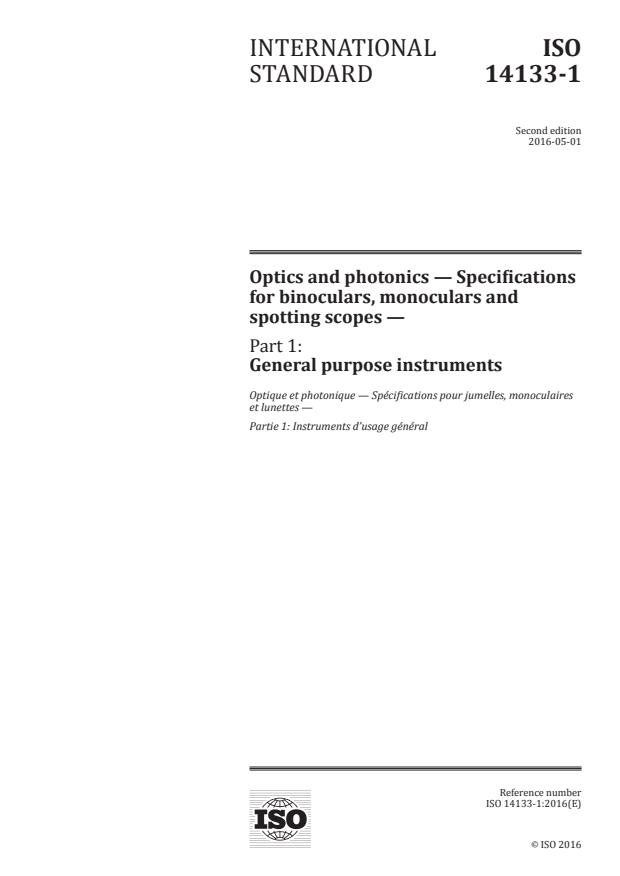
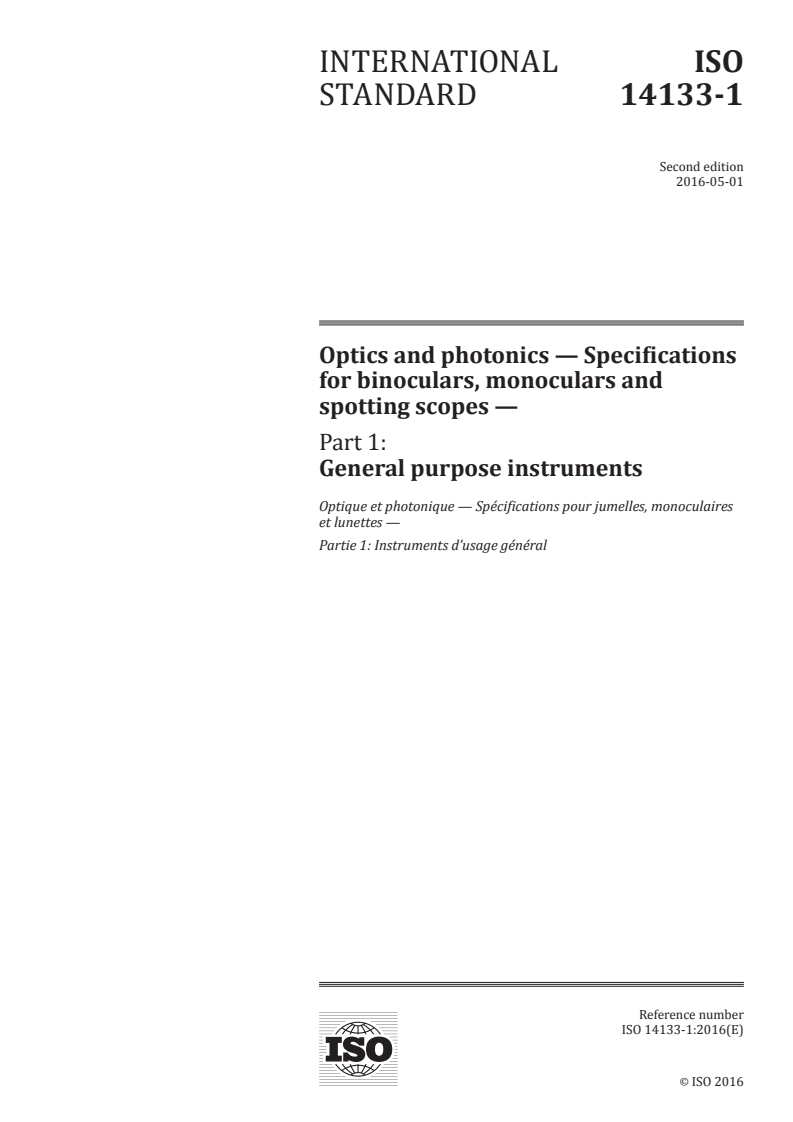
INTERNATIONAL ISO
STANDARD 14133-1
Second edition
2016-05-01
Optics and photonics — Specifications
for binoculars, monoculars and
spotting scopes —
Part 1:
General purpose instruments
Optique et photonique — Spécifications pour jumelles, monoculaires
et lunettes —
Partie 1: Instruments d’usage général
Reference number
©
ISO 2016
© ISO 2016, Published in Switzerland
All rights reserved. Unless otherwise specified, no part of this publication may be reproduced or utilized otherwise in any form
or by any means, electronic or mechanical, including photocopying, or posting on the internet or an intranet, without prior
written permission. Permission can be requested from either ISO at the address below or ISO’s member body in the country of
the requester.
ISO copyright office
Ch. de Blandonnet 8 • CP 401
CH-1214 Vernier, Geneva, Switzerland
Tel. +41 22 749 01 11
Fax +41 22 749 09 47
copyright@iso.org
www.iso.org
ii © ISO 2016 – All rights reserved
Contents Page
Foreword .iv
1 Scope . 1
2 Normative references . 1
3 Terms and definitions . 1
4 Specifications . 1
5 Consumer information . 3
5.1 Designation and marking . 3
5.2 Information of the product . 3
5.3 Compliance . 4
Bibliography . 5
Foreword
ISO (the International Organization for Standardization) is a worldwide federation of national standards
bodies (ISO member bodies). The work of preparing International Standards is normally carried out
through ISO technical committees. Each member body interested in a subject for which a technical
committee has been established has the right to be represented on that committee. International
organizations, governmental and non-governmental, in liaison with ISO, also take part in the work.
ISO collaborates closely with the International Electrotechnical Commission (IEC) on all matters of
electrotechnical standardization.
The procedures used to develop this document and those intended for its further maintenance are
described in the ISO/IEC Directives, Part 1. In particular the different approval criteria needed for the
different types of ISO documents should be noted. This document was drafted in accordance with the
editorial rules of the ISO/IEC Directives, Part 2 (see www.iso.org/directives).
Attention is drawn to the possibility that some of the elements of this document may be the subject of
patent rights. ISO shall not be held responsible for identifying any or all such patent rights. Details of
any patent rights identified during the development of the document will be in the Introduction and/or
on the ISO list of patent declarations received (see www.iso.org/patents).
Any trade name used in this document is information given for the convenience of users and does not
constitute an endorsement.
For an explanation on the meaning of ISO specific terms and expressions related to conformity
assessment, as well as information about ISO’s adherence to the WTO principles in the Technical
Barriers to Trade (TBT) see the following URL: Foreword - Supplementary information.
The committee responsible for this document is ISO/TC 172, Optics and photonics, Subcommittee SC 4,
Telescopic systems.
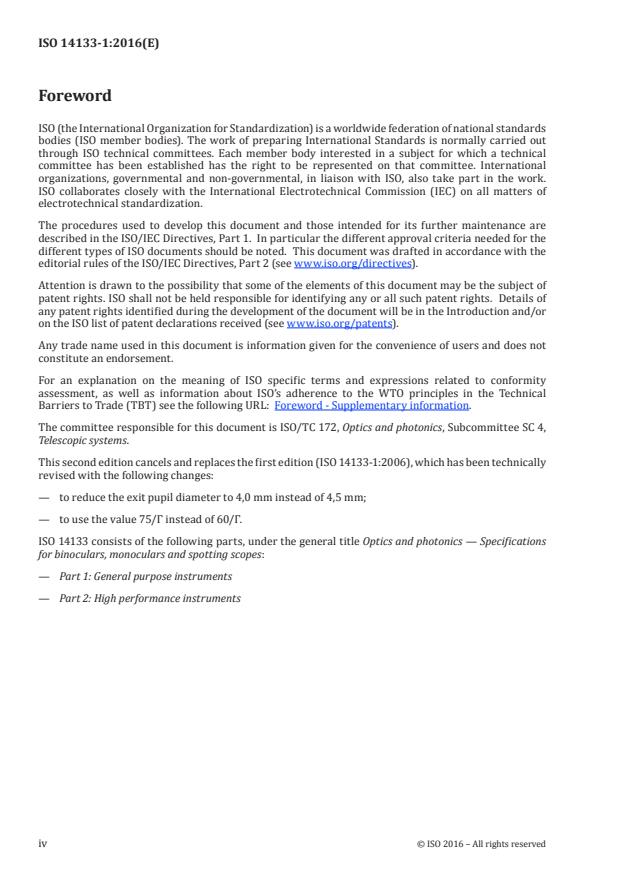
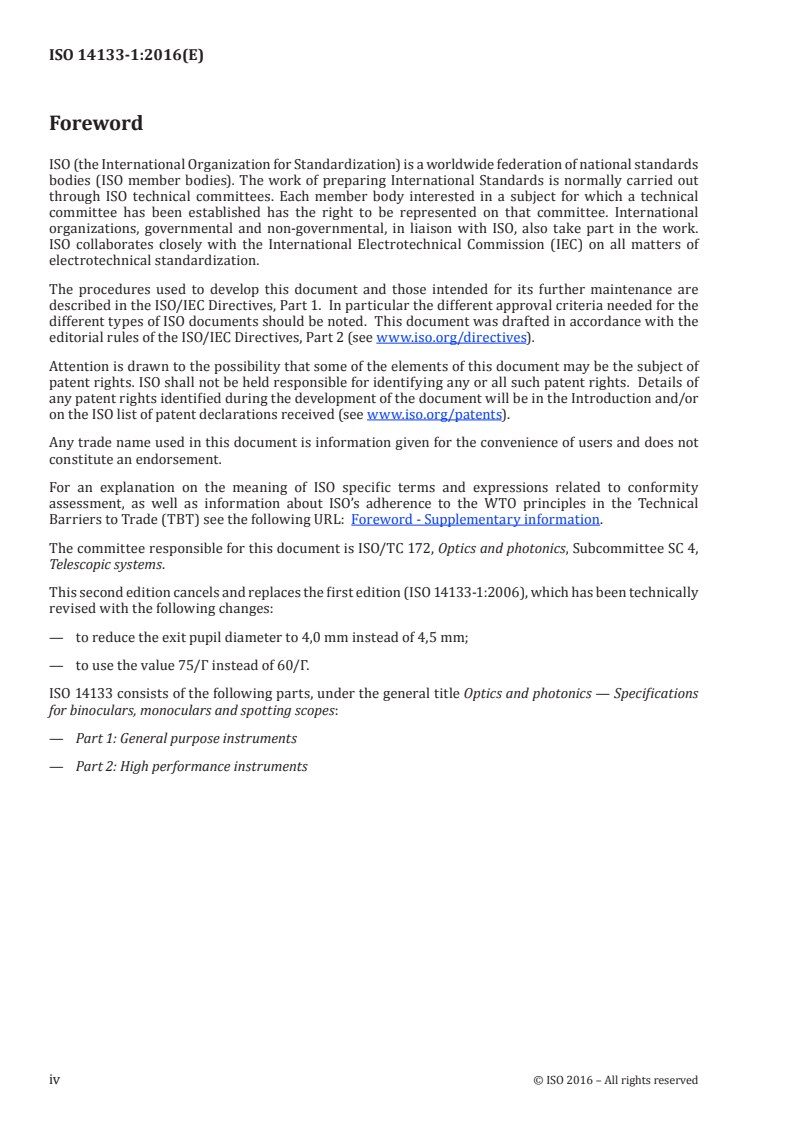
This second edition cancels and replaces the first edition (ISO 14133-1:2006), which has been technically
revised with the following changes:
— to reduce the exit pupil diameter to 4,0 mm instead of 4,5 mm;
— to use the value 75/Γ instead of 60/Γ.
ISO 14133 consists of the following parts, under the general title Optics and photonics — Specifications
for binoculars, monoculars and spotting scopes:
— Part 1: General purpose instruments
— Part 2: High performance instruments
iv © ISO 2016 – All rights reserved
INTERNATIONAL STANDARD ISO 14133-1:2016(E)
Optics and photonics — Specifications for binoculars,
monoculars and spotting scopes —
Part 1:
General purpose instruments
1 Scope
This part of ISO 14133 gives requirements for general purpose binoculars, monoculars and spotting
scopes. It is not applicable to high performance binoculars, monoculars and spotting scopes, which are
specified in ISO 14133-2.
2 Normative references
The following documents, in whole or in part, are normatively referenced in this document and are
indispensable for its application. For dated references, only the edition cited applies. For undated
references, the latest edition of the referenced document (including any amendments) applies.
ISO 10109-4, Optics and optical instruments — Environmental requirements — Part 4: Test requirements
for telescopic systems
ISO 14132-1
...
INTERNATIONAL ISO
STANDARD 14133-1
Second edition
2016-05-01
Optics and photonics — Specifications
for binoculars, monoculars and
spotting scopes —
Part 1:
General purpose instruments
Optique et photonique — Spécifications pour jumelles, monoculaires
et lunettes —
Partie 1: Instruments d’usage général
Reference number
©
ISO 2016
© ISO 2016, Published in Switzerland
All rights reserved. Unless otherwise specified, no part of this publication may be reproduced or utilized otherwise in any form
or by any means, electronic or mechanical, including photocopying, or posting on the internet or an intranet, without prior
written permission. Permission can be requested from either ISO at the address below or ISO’s member body in the country of
the requester.
ISO copyright office
Ch. de Blandonnet 8 • CP 401
CH-1214 Vernier, Geneva, Switzerland
Tel. +41 22 749 01 11
Fax +41 22 749 09 47
copyright@iso.org
www.iso.org
ii © ISO 2016 – All rights reserved
Contents Page
Foreword .iv
1 Scope . 1
2 Normative references . 1
3 Terms and definitions . 1
4 Specifications . 1
5 Consumer information . 3
5.1 Designation and marking . 3
5.2 Information of the product . 3
5.3 Compliance . 4
Bibliography . 5
Foreword
ISO (the International Organization for Standardization) is a worldwide federation of national standards
bodies (ISO member bodies). The work of preparing International Standards is normally carried out
through ISO technical committees. Each member body interested in a subject for which a technical
committee has been established has the right to be represented on that committee. International
organizations, governmental and non-governmental, in liaison with ISO, also take part in the work.
ISO collaborates closely with the International Electrotechnical Commission (IEC) on all matters of
electrotechnical standardization.
The procedures used to develop this document and those intended for its further maintenance are
described in the ISO/IEC Directives, Part 1. In particular the different approval criteria needed for the
different types of ISO documents should be noted. This document was drafted in accordance with the
editorial rules of the ISO/IEC Directives, Part 2 (see www.iso.org/directives).
Attention is drawn to the possibility that some of the elements of this document may be the subject of
patent rights. ISO shall not be held responsible for identifying any or all such patent rights. Details of
any patent rights identified during the development of the document will be in the Introduction and/or
on the ISO list of patent declarations received (see www.iso.org/patents).
Any trade name used in this document is information given for the convenience of users and does not
constitute an endorsement.
For an explanation on the meaning of ISO specific terms and expressions related to conformity
assessment, as well as information about ISO’s adherence to the WTO principles in the Technical
Barriers to Trade (TBT) see the following URL: Foreword - Supplementary information.
The committee responsible for this document is ISO/TC 172, Optics and photonics, Subcommittee SC 4,
Telescopic systems.
This second edition cancels and replaces the first edition (ISO 14133-1:2006), which has been technically
revised with the following changes:
— to reduce the exit pupil diameter to 4,0 mm instead of 4,5 mm;
— to use the value 75/Γ instead of 60/Γ.
ISO 14133 consists of the following parts, under the general title Optics and photonics — Specifications
for binoculars, monoculars and spotting scopes:
— Part 1: General purpose instruments
— Part 2: High performance instruments
iv © ISO 2016 – All rights reserved
INTERNATIONAL STANDARD ISO 14133-1:2016(E)
Optics and photonics — Specifications for binoculars,
monoculars and spotting scopes —
Part 1:
General purpose instruments
1 Scope
This part of ISO 14133 gives requirements for general purpose binoculars, monoculars and spotting
scopes. It is not applicable to high performance binoculars, monoculars and spotting scopes, which are
specified in ISO 14133-2.
2 Normative references
The following documents, in whole or in part, are normatively referenced in this document and are
indispensable for its application. For dated references, only the edition cited applies. For undated
references, the latest edition of the referenced document (including any amendments) applies.
ISO 10109-4, Optics and optical instruments — Environmental requirements — Part 4: Test requirements
for telescopic systems
ISO 14132-1
...