


ISO/TS 17837:2008
(Main)Processed cheese products — Determination of nitrogen content and crude protein calculation — Kjeldahl method
Processed cheese products — Determination of nitrogen content and crude protein calculation — Kjeldahl method
ISO/TS 17837|IDF/RM 25:2008 specifies a method for the determination of the nitrogen content and crude protein content by calculation in processed cheese products by using the Kjeldahl principle, both traditional and block digestion methods.
Fromages fondus — Détermination de la teneur en azote et calcul des protéines brutes — Méthode Kjeldahl
General Information
- Status
- Withdrawn
- Publication Date
- 05-Mar-2008
- Withdrawal Date
- 05-Mar-2008
- Technical Committee
- ISO/TC 34/SC 5 - Milk and milk products
- Drafting Committee
- ISO/TC 34/SC 5 - Milk and milk products
- Current Stage
- 9599 - Withdrawal of International Standard
- Start Date
- 03-Feb-2014
- Completion Date
- 12-Feb-2026
Relations
- Effective Date
- 12-Feb-2014
Get Certified
Connect with accredited certification bodies for this standard

BSI Group
BSI (British Standards Institution) is the business standards company that helps organizations make excellence a habit.

Bureau Veritas
Bureau Veritas is a world leader in laboratory testing, inspection and certification services.

DNV
DNV is an independent assurance and risk management provider.
Sponsored listings
Frequently Asked Questions
ISO/TS 17837:2008 is a technical specification published by the International Organization for Standardization (ISO). Its full title is "Processed cheese products — Determination of nitrogen content and crude protein calculation — Kjeldahl method". This standard covers: ISO/TS 17837|IDF/RM 25:2008 specifies a method for the determination of the nitrogen content and crude protein content by calculation in processed cheese products by using the Kjeldahl principle, both traditional and block digestion methods.
ISO/TS 17837|IDF/RM 25:2008 specifies a method for the determination of the nitrogen content and crude protein content by calculation in processed cheese products by using the Kjeldahl principle, both traditional and block digestion methods.
ISO/TS 17837:2008 is classified under the following ICS (International Classification for Standards) categories: 67.100.01 - Milk and milk products in general. The ICS classification helps identify the subject area and facilitates finding related standards.
ISO/TS 17837:2008 has the following relationships with other standards: It is inter standard links to ISO 8968-1:2014. Understanding these relationships helps ensure you are using the most current and applicable version of the standard.
ISO/TS 17837:2008 is available in PDF format for immediate download after purchase. The document can be added to your cart and obtained through the secure checkout process. Digital delivery ensures instant access to the complete standard document.
Standards Content (Sample)
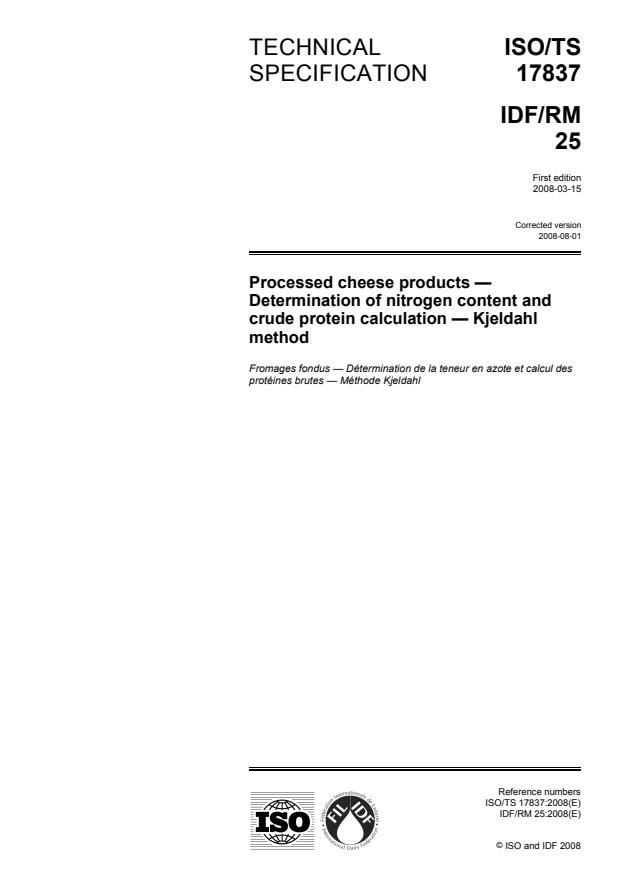
TECHNICAL ISO/TS
SPECIFICATION 17837
IDF/RM
First edition
2008-03-15
Corrected version
2008-08-01
Processed cheese products —
Determination of nitrogen content and
crude protein calculation — Kjeldahl
method
Fromages fondus — Détermination de la teneur en azote et calcul des
protéines brutes — Méthode Kjeldahl
Reference numbers
IDF/RM 25:2008(E)
©
ISO and IDF 2008
IDF/RM 25:2008
PDF disclaimer
This PDF file may contain embedded typefaces. In accordance with Adobe's licensing policy, this file may be printed or viewed but
shall not be edited unless the typefaces which are embedded are licensed to and installed on the computer performing the editing. In
downloading this file, parties accept therein the responsibility of not infringing Adobe's licensing policy. The ISO Central Secretariat
accepts no liability in this area.
Adobe is a trademark of Adobe Systems Incorporated.
Details of the software products used to create this PDF file can be found in the General Info relative to the file; the PDF-creation
parameters were optimized for printing. Every care has been taken to ensure that the file is suitable for use by ISO member bodies. In
the unlikely event that a problem relating to it is found, please inform the Central Secretariat at the address given below.
© ISO and IDF 2008
All rights reserved. Unless otherwise specified, no part of this publication may be reproduced or utilized in any form or by any means,
electronic or mechanical, including photocopying and microfilm, without permission in writing from either ISO or IDF at the respective
address below.
ISO copyright office International Dairy Federation
Case postale 56 • CH-1211 Geneva 20 Diamant Building • Boulevard Auguste Reyers 80 • B-1030 Brussels
Tel. + 41 22 749 01 11 Tel. + 32 2 733 98 88
Fax + 41 22 749 09 47 Fax + 32 2 733 04 13
E-mail copyright@iso.org E-mail info@fil-idf.org
Web www.iso.org Web www.fil-idf.org
Published in Switzerland
ii © ISO and IDF 2008 – All rights reserved
IDF/RM 25:2008
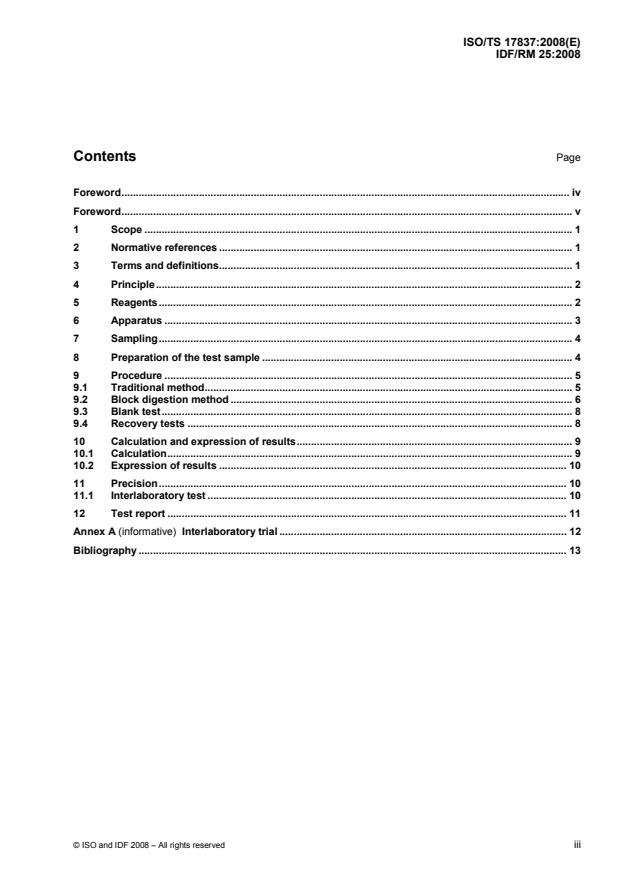
Contents Page
Foreword. iv
Foreword. v
1 Scope . 1
2 Normative references . 1
3 Terms and definitions. 1
4 Principle. 2
5 Reagents. 2
6 Apparatus . 3
7 Sampling. 4
8 Preparation of the test sample . 4
9 Procedure . 5
9.1 Traditional method. 5
9.2 Block digestion method . 6
9.3 Blank test. 8
9.4 Recovery tests . 8
10 Calculation and expression of results. 9
10.1 Calculation. 9
10.2 Expression of results . 10
11 Precision. 10
11.1 Interlaboratory test . 10
12 Test report . 11
Annex A (informative) Interlaboratory trial . 12
Bibliography . 13
IDF/RM 25:2008
Foreword
ISO (the International Organization for Standardization) is a worldwide federation of national standards
bodies (ISO member bodies). The work of preparing International Standards is normally carried out through
ISO technical committees. Each member body interested in a subject for which a technical committee has
been established has the right to be represented on that committee. International organizations, governmental
and non-governmental, in liaison with ISO, also take part in the work. ISO collaborates closely with the
International Electrotechnical Commission (IEC) on all matters of electrotechnical standardization.
International Standards are drafted in accordance with the rules given in the ISO/IEC Directives, Part 2.
The main task of technical committees is to prepare International Standards. Draft International Standards
adopted by the technical committees are circulated to the member bodies for voting. Publication as an
International Standard requires approval by at least 75 % of the member bodies casting a vote.
In other circumstances, particularly when there is an urgent market requirement for such documents, a
technical committee may decide to publish other types of document:
⎯ an ISO Publicly Available Specification (ISO/PAS) represents an agreement between technical experts in
an ISO working group and is accepted for publication if it is approved by more than 50 % of the members
of the parent committee casting a vote;
⎯ an ISO Technical Specification (ISO/TS) represents an agreement between the members of a technical
committee and is accepted for publication if it is approved by 2/3 of the members of the committee casting
a vote.
An ISO/PAS or ISO/TS is reviewed after three years in order to decide whether it will be confirmed for a
further three years, revised to become an International Standard, or withdrawn. If the ISO/PAS or ISO/TS is
confirmed, it is reviewed again after a further three years, at which time it must either be transformed into an
International Standard or be withdrawn.
Attention is drawn to the possibility that some of the elements of this document may be the subject of patent
rights. ISO shall not be held responsible for identifying any or all such patent rights.
ISO/TS 17837⎪IDF/RM 25 was prepared by Technical Committee ISO/TC 34, Food products, Subcommittee
SC 5, Milk and milk products, and the International Dairy Federation (IDF). It is being published jointly by ISO
and IDF.
This corrected version of ISO/TS 17837:2008⎪IDF/RM 25 incorporates the following corrections:
a) the introductory element of the title on the cover and page 1, “Milk and milk products”, has been modified to
“Processed cheese products”, the corresponding change in the French title on the cover being the deletion of
“Lait et produits laitiers” and insertion of “Fromages fondus”;
b) in the ISO foreword, the penultimate paragraph (a previous edit of the final paragraph) has been deleted;
c) Clause 1 and its Note have been modified to relate solely to processed cheese products;
d) the title “8.1 Cheese” and the whole of 8.2 have been deleted, with corresponding updates to the contents
list;
e) in 9.1.1, line 2, and in 9.2.1, line 2, “8.1 or 8.2” has been deleted, and “Clause 8” inserted;
f) in 9.1.2.1, paragraph 2, line 2, and 9.2.2.1, paragraph 5, line 2, “for milk analysis” has been deleted.
iv © ISO and IDF 2008 – All rights reserved
IDF/RM 25:2008
Foreword
IDF (the International Dairy Federation) is a non-profit organization representing the dairy sector worldwide.
IDF membership comprises National Committees in every member country as well as regional dairy
associations having signed a formal agreement on cooperation with IDF. All members of IDF have the right to
be represented at the IDF Standing Committees carrying out the technical work. IDF collaborates with ISO in
the development of standard methods of analysis and sampling for milk and milk products.
Draft International Standards adopted by the Action Teams and Standing Committees are circulated to the
National Committees for voting. Publication as an International Standard requires approval by at least 50 % of
the IDF National Committees casting a vote.
In other circumstances, particularly when there is an urgent market requirement for such documents, a
Standing Committee may decide to publish another type of normative document which is called by IDF:
Reviewed method. Such a method represents an agreement between the members of a Standing Committee
and is accepted for publication if it is approved by at least 50 % of the committee members casting a vote.
A Reviewed method is equal to an ISO/PAS or ISO/TS and will, therefore, also be published jointly under ISO
conditions.
Attention is drawn to the possibility that some of the elements of this document may be the subject of patent
rights. IDF shall not be held responsible for identifying any or all such patent rights.
ISO/TS 17837⎪IDF/RM 25 was prepared by the International Dairy Federation (IDF) and Technical Committee
ISO/TC 34, Food products, Subcommittee SC 5, Milk and milk products. It is being published jointly by IDF
and ISO.
All work was carried out by the Joint ISO-IDF Action Team on Nitrogen compounds of the Standing committee
on Main components in milk under the aegis of its project leader, Mr. J. Romero (US).
This edition of ISO/TS 17837⎪IDF/RM 25 cancels and replaces IDF 25:1964, which has undergone minor
editorial and technical revisions.
This corrected version of ISO/TS 17837:2008⎪IDF/RM 25 incorporates the following corrections:
a) the introductory element of the title on the cover and page 1, “Milk and milk products”, has been modified to
“Processed cheese products”, the corresponding change in the French title on the cover being the deletion of
“Lait et produits laitiers” and insertion of “Fromages fondus”;
b) in the ISO foreword, the penultimate paragraph (a previous edit of the final paragraph) has been deleted;
c) Clause 1 and its Note have been modified to relate solely to processed cheese products;
d) the title “8.1 Cheese” and the whole of 8.2 have been deleted, with corresponding updates to the contents
list;
e) in 9.1.1, line 2, and in 9.2.1, line 2, “8.1 or 8.2” has been deleted, and “Clause 8” inserted;
f) in 9.1.2.1, paragraph 2, line 2, and 9.2.2.1, paragraph 5, line 2, “for milk analysis” has been deleted.
TECHNICAL SPECIFICATION
IDF/RM 25:2008
Processed cheese products — Determination of nitrogen
content and crude protein calculation — Kjeldahl method
WARNING — Performance of the method specified in this Technical Specification may involve the use
of hazardous materials, operations, and equipment. This Technical Specification does not purport to
address all the safety risks associated with such performance. It is the responsibility of the user to
establish appropriate safety and health practices and determine the applicability of local regulatory
limitations prior to performance of the method.
1 Scope
This Technical Specification specifies a method for the determination of the nitrogen content and crude protein
content by calculation in processed cheese products by using the Kjeldahl principle, both traditional and block
digestion methods.
NOTE Inaccurate crude protein results are obtained if non-dairy sources of nitrogen are present in the specified
processed cheese products.
2 Normative references
The following referenced documents are indispensable for the application of this document. For dated
references, only the edition cited applies. For undated references, the latest edition of the referenced
document (including any amendments) applies.
ISO 385, Laboratory glassware — Burettes
ISO 1042, Laboratory glassware — One-mark volumetric flasks
ISO 4788, Laboratory glassware — Graduated measuring cylinders
3 Terms and definitions
For the purposes of this document, the following terms and definitions apply.
3.1
nitrogen content
mass fraction of nitrogen determined by the procedure specified in this Technical Specification
NOTE The nitrogen mass fraction is expressed as a percentage.
3.2
crude protein content
mass fraction of crude protein calculated as specified by this Technical Specification
NOTE The crude protein mass fraction is expressed as a percentage.
IDF/RM 25:2008
4 Principle
A test portion is digested with a mixture of concentrated sulfuric acid and potassium sulfate. Copper(II) sulfate
is used as a catalyst to thereby convert organic nitrogen present to ammonium sulfate. The function of the
potassium sulfate is to elevate the boiling point of the sulfuric acid and to provide a stronger oxidizing mixture
for digestion. Excess sodium hydroxide is added to the cooled digest to liberate ammonia. The liberated
ammonia is steam distilled into excess boric acid solution and titrated against a hydrochloric acid standard
volumetric solution. The nitrogen content is calculated from the amount of ammonia produced and the crude
protein content from the nitrogen content obtained.
5 Reagents
Unless otherwise specified, use only reagents of recognized analytical grade, and only distilled or
demineralized water or water of equivalent purity.
5.1 Potassium sulfate (K SO ), nitrogen free.
2 4
5.2 Copper(II) sulfate pentahydrate solution, ρ(CuSO ·5H O) = 5,0 g/100 ml.
4 2
Dissolve 5,0 g of copper(II) sulfate pentahydrate in water in a 100 ml one-mark volumetric flask (6.8). Dilute to
the mark with water and mix.
5.3 Sulfuric acid (H SO), with a mass fraction of between 95 % and 98 %, nitrogen free
2 4
[ρ (H SO ) ≈ 1,84 g/ml].
20 2 4
5.4 Sodium hydroxide aqueous solution, nitrogen free, containing 50 g of sodium hydroxide (NaOH) per
100 g (mass fraction of sodium hydroxide, w = 50 %).
NaOH
If plugging of the flow system in an automatic distillation unit is a problem, use a solution with w = 40 %.
NaOH
5.5 Indicator solution.
5.5.1 Dissolve 0,1 g of methyl red in 95 % (volume fraction) ethanol in a 50 ml one-mark volumetric flask
(6.8). Dilute to the 50 ml mark with similar ethanol and mix.
5.5.2 Dissolve 0,5 g of bromocresol green in 95 % (volume fraction) ethanol in a 250 ml one-mark
volumetric flask (6.8). Dilute to the mark with similar ethanol and mix.
5.5.3 Mix one volume of the methyl red solution (5.5.1) with five volumes of the bromocresol green solution
(5.5.2) or combine and mix all of both solutions.
5.6 Boric acid solution, ρ(H BO ) = 40,0 g/l.
3 3
Dissolve 40,0 g of boric acid (H BO ) in 1 l hot water in a 1 000 ml one-mark volumetric flask (6.8). Allow the
3 3
flask and its contents to cool to 20 °C. Make up to the mark with water, add 3 ml of indicator solution (5.5.3)
and mix.
Store the solution, which is light orange in colour, in a borosilicate glass bottle. Protect the solution from light
and sources of ammonia during storage.
NOTE If using electronic pH end-point titration, the addition of the indicator solution (5.5.3) to the boric acid solution
can be omitted. On the other hand, the change in colour can also be used as a check on proper titration procedures.
5.7 Hydrochloric acid standard solution, c(HCI) = (0,1 ± 0,000 5) mol/l.
The purchase of pre-standardized hydrochloric acid standard solution from a reputable manufacturer is
recommended.
2 © ISO and IDF 2008 – All rights reserved
IDF/RM 25:2008
Using pre-standardized solutions avoids introduction of systematic errors when diluting a concentrated stock
hydrochloric acid solution and then determining the molarity of the acid, a process which can give rise to poor
reproducibility performance of the method. It also avoids the use of a standard solution for titration having a
higher concentration than the mentioned upper limit (0,1 ± 0,000 5 mol/l), as that reduces the total titration
volume per sample. In the latter case, the uncertainty in readability of the burette becomes a larger
percentage of the value, which has a negative impact on the repeatability and reproducibility performance of
the method. The same issues and additional sources of error arise when another acid (e.g. sulfuric acid) is
substituted for hydrochloric acid. Such substitutions are therefore not recommended.
5.8 Ammonium sulfate [(NH ) SO ], with a minimum mass fraction assay of 99,9 % on dried material.
4 2 4
Immediately before use, dry the ammonium sulfate at 102 °C ± 2 °C for 2 h. Cool to room temperature in a
desiccator.
5.9 Tryptophan (C H N O ) or lysine hydrochloride (C H N O ·HCl), with a minimum mass fraction
11 12 2 2 6 14 2 2
assay of 99 %. When stored in a desiccator, it is not necessary to dry these reagents in an oven before use.
5.10 Sucrose (C H O ), with a mass fraction of nitrogen of less than 0,002 %. Do not dry the sucrose in
12 22 11
an oven before use.
6 Apparatus
Usual laboratory apparatus and, in particular, the following.
6.1 Kjeldahl flasks, of capacity 500 ml or 800 ml.
6.2 Analytical balance, capable of weighing to the nearest 0,1 mg.
6.3 Burette or automatic pipette, capable of delivering portions of 1,0 ml of copper(II) sulfate solution (5.2).
6.4 Graduated measuring cylinders, of capacities 50 ml, 100 ml and 500 ml, complying with the
requirements of ISO 4788, class A.
6.5 Conical flasks, of capacity 500 ml, graduated at every 200 ml.
6.6 Burette, of capacity 50 ml, graduated at least at every 0,1 ml, complying with the requirements of
ISO 385, class A. Alternatively, an automatic burette can be used fulfilling the same requirements.
6.7 Grinding device.
6.8 One-mark volumetric flasks, of capacities 50 ml, 100 ml, 250 ml, and 1 000 ml, complying with the
requirements of ISO 1042, class A.
6.9 Boiling aids, e.g. calcined pumice, zinc dust, hard pieces of porcelain or high-purity amphoteric
alundum (i.e. carborundum) granules, plain, mesh size 10. Do not reuse the aids.
NOTE Glass beads of approximately 5 mm diameter can also be used, but they may not promote boiling as efficiently
as the alundum granules. More foaming problems may be encountered during digestion with glass beads.
6.10 Digestion apparatus, to hold the Kjeldahl flasks (6.1) in an inclined position (approximately 45°), with
electric heaters or gas burners that do not heat the flasks above the level of their contents, and with a fume
extraction system.
The heater source should be adjustable to control the maximum heater setting to be used during digestion.
Preheat the heat source at the heater setting for evaluation. In the case of a gas heater, the preheated period
shall be 10 min and for an electric heater, it shall be 30 min. For each of the heaters, determine the heater
IDF/RM 25:2008
setting that brings 250 ml of water including 5 to 10 boiling aids with an initial temperature of 25 °C to its
boiling point in 5 min to 6 min. This is the maximum heater setting to be used during digestion.
6.11 Distillation apparatus (traditional method), made of borosilicate glass or other suitable material to
which can be fitted a Kjeldahl flask (6.1) consisting of an efficient splash-head connected to an efficient
condenser with straight inner tube and an outlet tube attached to its lower end. The connecting tubing and
stopper(s) shall be close-fitting and preferably made of neoprene.
NOTE The distillation apparatus mentioned above may be replaced by the complete Parnas-Wagner distillation
configuration (see Reference [4]) or other suitable equipment.
6.12 Digestion block, aluminium alloy block or equivalent block, fitted with an adjustable temperature
control and device for measuring block temperature.
6.13 Digestion tubes, of capacity 250 ml, suitable for use with the digestion block (6.12).
6.14 Exhaust manifold, suitable for use with the digestion tubes (6.13).
6.15 Centrifugal scrubber apparatus or filter pump or aspirator, constructed of acid resistant material, for
use with mains water supply.
6.16 Distillation unit (block digesting method), capable of steam distilling, manual or semi-automatic,
suitable for accepting digestion tubes (6.13) and conical flasks (6.5).
6.17 Automatic titrator, provided with a pH-meter.
The pH-meter shall be calibrated properly in the range of pH 4 to pH 7 following normal laboratory
pH-calibration procedures.
6.18 Spatula or suitable transfer device.
6.19 Filter paper, nitrogen-free, of dimensions and porosity suitable to hold the cheese test portion.
6.20 Water bath, capable of maintaining a temperature of between 38 °C and 40 °C.
7 Sampling
A representative sample should have been sent to the laboratory. It should not have been damaged or
changed during transport or storage.
Sampling is not part of the method specified in this International Standard. A recommended sampling method
[1]
is given in ISO 707|IDF 50 .
8 Preparation of the test sample
Remove the rind, smear or mouldy surface layer of the cheese, in such a way as to provide a test sample
representative of the cheese as it is usually consumed.
Grind (6.7) the representative test sample thus obtained. Quickly mix the whole mass and preferably grind the
mass again quickly. Analyse the test sample as soon as possible after grinding.
Using a spatula (6.18), weigh 1 g of ground cheese on to a pre-folded, tarred filter paper (6.19). Enclose the
test sample in filter paper and drop the whole on to the bottom of a Kjeldahl flask (6.1) or digestion tube (6.13)
as indicated in 9.1.1 or 9.2.1.
4 © ISO and IDF 2008 – All rights reserved
IDF/RM 25:2008
9 Procedure
9.1 Traditional method
9.1.1 Test portion and pre-treatment
Add to a clean and dry Kjeldahl flask (6.1), 5 to 10 boiling aids (6.9), 15,0 g of the potassium sulfate (5.1), 1,0
ml of the copper(II) sulfate solution (5.2). Then add the prepared test sample as indicated in Clause 8, and
25 ml of the sulfuric acid (5.3) while using the sulfuric acid to wash down any copper(II) sulfate solution,
potassium sulfate or test portion left on the neck of the flask. Gently mix the contents of the Kjeldahl flask.
9.1.2 Determination
9.1.2.1 Digestion
Turn on the fume extraction system of the digestion apparatus (6.10) prior to beginning the digestion. He
...
Questions, Comments and Discussion
Ask us and Technical Secretary will try to provide an answer. You can facilitate discussion about the standard in here.
Loading comments...