

ISO 19998:2026
(Main)Structural bolting coordination — Tasks and responsibilities
- Abstract
This document specifies provisions for structural bolting coordination, including tasks and responsibilities.
- Status
- Published
- Publication Date
- 15-Nov-2026
- Technical Committee
- ISO/TC 167 - Steel and aluminium structures
- Drafting Committee
- ISO/TC 167/WG 4 - Structural bolting
- Current Stage
- 6060 - International Standard published - 60 Publication
- Start Date
- 16-Nov-2026
- Due Date
- 16-Nov-2026
- Completion Date
- 16-Nov-2026

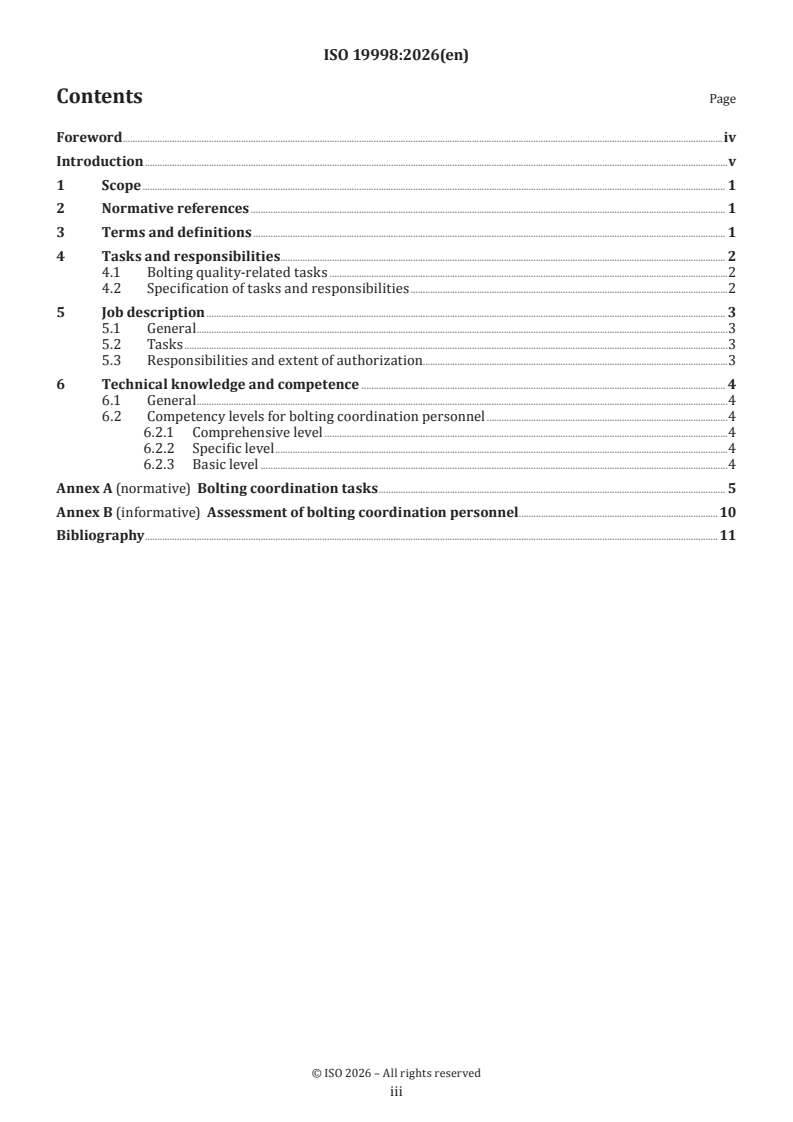
ISO 19998:2026 is an International Standard from ISO on structural bolting coordination. It specifies the tasks and responsibilities needed to coordinate structural bolting and related activities, mainly for contractors and bolting coordination personnel. The document helps define who does what, what authority they have, and what competence they need.
What does ISO 19998:2026 specify?
ISO 19998:2026 specifies provisions for structural bolting coordination, including tasks and responsibilities. Its structure is practical: clauses 4 to 6 cover task assignment, job descriptions, and technical knowledge and competence, while the annexes provide the detailed task list and assessment guidance.
| Annex | What it covers |
|---|---|
| Annex A | Normative list of bolting coordination tasks to consider for structural bolting and related activities |
| Annex B | Informative guidance for assessing bolting coordination personnel |
The document is written for use with structural bolting work in projects, contracts, and application standards. It ties coordination to the contractor’s quality and technical control, so the reader can assign responsibilities in a way that matches the work being done.
What are the key requirements of ISO 19998:2026?
ISO 19998:2026 places the overall responsibility for bolting coordination on the contractor. In practice, a contractor cannot leave coordination undefined or assume that another party takes over that responsibility.
- Use Annex A to assign tasks and responsibilities. Clause 4.1 says the contractor shall use Annex A to assign bolting coordination tasks, and may supplement it for special applications. This matters because the standard expects the task list to be adapted to the project instead of applied mechanically.
- Define responsibilities clearly when several people are involved. Clause 4.2 requires tasks and responsibilities to be clearly assigned when more than one person performs bolting coordination. This avoids gaps between planning, supervision, inspection, and approval.
- Keep contractor responsibility even when coordination is subcontracted. Clause 4.2 says subcontracted coordination must be defined and documented, but compliance remains the contractor’s responsibility. In practice, outsourcing does not remove accountability.
- Prepare job descriptions for all bolting coordination personnel. Clause 5 requires job descriptions to include tasks, responsibilities, and extent of authorization. This matters because people need to know what they may accept, validate, or decide on behalf of the contractor.
- Set competence according to work complexity and quality requirements. Clause 4.2 and Clause 6 link competence to complexity, product type, criticality, and the quality requirements in the ISO 17607 series or other applicable standards. This means the level of competence should rise with the consequences of a failed bolted connection.
- Demonstrate both technical knowledge and competence. Clause 6 requires competence in the assigned tasks and technical knowledge gained through education, training, experience, or a combination of these. Annex B may be used to assess that competence.
- Match personnel to one of three competency levels. Clause 6.2 defines comprehensive, specific, and basic levels. The comprehensive level is for highly complex and unpredictable conditions, the specific level for complex conditions, and the basic level for common or predictable work. This helps project teams place the right person in the right role.
- Cover the full coordination cycle. Annex A groups tasks from requirement review and technical review to equipment, planning, procedure qualification, inspections, non-conformance, traceability, records, and health, safety and environment. That means bolting coordination is not only installation oversight - it also includes preparation, control, and close-out.
What terms does ISO 19998:2026 define?
- Contractor - the entity that carries out bolting and related activities under the same technical and quality management, and remains responsible for the bolting operations.
- Bolting coordination - the coordination of operations for all bolting and bolting-related activities, which may be done by one person or a team.
- Bolting coordination personnel - the person or group carrying out defined bolting coordination tasks, appointed by the contractor for specific responsibilities.
- Inspection - conformity evaluation of bolting variables by observation and judgment, with measurement or testing where appropriate.
- Competence - proven ability to use knowledge, skills, and personal, social, or methodological abilities effectively in work situations with responsibility and autonomy.
- Responsibility - the accountability, duties, obligations, and associated rights assigned by the contractor as a result of competence in the job.
- Qualification - the formal outcome of an assessment and validation process showing that a person has achieved the learning outcomes for a given program.
Who uses ISO 19998:2026?
ISO 19998:2026 is used by contractors, project managers, quality managers, and bolting coordination personnel in structural steel and aluminium work. It is also relevant to supervisors, inspectors, and anyone who prepares job descriptions, assigns authorization, or checks competence for bolting-related tasks.
It is especially useful where structural bolting is governed by project specifications, contract documents, or application standards. The standard helps teams decide who reviews requirements, who controls work, who inspects, and who documents results.
Which standards are used with ISO 19998:2026?
- ISO 17607 (all parts) - the only normative reference; it provides the structural steelwork execution context that this standard relies on.
- ISO 17607-1, ISO 17607-3, ISO 17607-4, ISO 17607-6 - named in Clause 4.2 as applicable parts used when determining competence and quality requirements for bolting coordination personnel.
- ISO 14731:2019 - cited in the bibliography and used as the source for several definitions and the competence-assessment approach reflected in Annex B.
What does the ISO 19998:2026 document contain?
ISO 19998:2026 contains a short core of clauses and two annexes that support practical role assignment. Clause 4 sets out how tasks and responsibilities are allocated, Clause 5 covers job descriptions and authorization, and Clause 6 sets the knowledge and competence expectations for bolting coordination personnel.
Annex A gives a detailed checklist of coordination tasks, from reviewing requirements and technical details to inspection, traceability, records, and HSE. Annex B gives guidance for assessing personnel through experience review, technical understanding, and interviews or site walk-arounds.
Frequently Asked Questions
ISO 19998:2026 is a standard published by the International Organization for Standardization (ISO). Its full title is "Structural bolting coordination — Tasks and responsibilities". This standard covers: This document specifies provisions for structural bolting coordination, including tasks and responsibilities.
This document specifies provisions for structural bolting coordination, including tasks and responsibilities.
ISO 19998:2026 is classified under the following ICS (International Classification for Standards) categories: 21.060.01 - Fasteners in general. The ICS classification helps identify the subject area and facilitates finding related standards.
ISO 19998:2026 is available in PDF format for immediate download after purchase. The document can be added to your cart and obtained through the secure checkout process. Digital delivery ensures instant access to the complete standard document.
Standards Content (Sample)
Contents
- Introduction
- 1 Scope
- 2 Normative references
- 3 Terms and definitions
- 3.1 contractor
- 3.2 bolting coordination
- 3.3 bolting coordination personnel
- 3.4 inspection
- 3.5 skill
- 3.6 knowledge
- 3.7 qualification
- 3.8 competence
- 3.9 responsibility
- 4 Tasks and responsibilities
- 4.1 Bolting quality-related tasks
- 4.2 Specification of tasks and responsibilities
- 5 Job description
- 5.1 General
- 5.2 Tasks
- 5.3 Responsibilities and extent of authorization
- 6 Technical knowledge and competence
- 6.1 General
- 6.2 Competency levels for bolting coordination personnel
- Annex A
- Annex B
- Bibliography
Introduction
When structural bolting is performed, it is important for it to be coordinated properly to establish confidence in the bolting quality and ensure reliable performance in service. A clear definition of the tasks and responsibilities of bolting coordination personnel involved in boltingrelated activities (e.g. planning, executing, supervising and inspecting) is essential for proper coordination. Specific requirements for bolting coordination personnel are sometimes included in regulatory documents, application standards, and contracts.
International Standard ISO 19998:2026(en) Structural bolting coordination — Tasks and responsibilities
1 Scope
This document specifies provisions for structural bolting coordination, including tasks and responsibilities.
2 Normative references
The following documents are referred to in the text in such a way that some or all of their content constitutes requirements of this document. For dated references, only the edition cited applies. For undated references, the latest edition of the referenced document (including any amendments) applies. ISO 17607 (all parts), Steel structures — Execution of structural steelwork
3 Terms and definitions
For the purposes of this document, the following terms and definitions apply. ISO and IEC maintain terminology databases for use in standardization at the following addresses:
- ISO Online browsing platform: available at https:// www .iso .org/ obp
- IEC Electropedia: available at https:// www .electropedia .org/
3.1 contractor
entity carrying out bolting and related activities under the same technical and quality management Note 1 to entry: Bolting and related activities can be carried out in a workshop or onsite or both, but the contractor remains responsible for the bolting operations.
3.2 bolting coordination
coordination of operations for all bolting and bolting-related activities Note 1 to entry: Bolting coordination can be assigned to an individual or a team.
3.3 bolting coordination personnel
person or group of people performing defined bolting coordination tasks Note 1 to entry: Different personnel can be appointed by the contractor (3.1) for different bolting and related tasks. Note 2 to entry: A qualification and/or practical experience can be required.
3.4 inspection
conformity evaluation of bolting variables by observation and judgment, accompanied as appropriate by measurement or testing Note 1 to entry: Bolting inspection is a part of bolting coordination.
ISO 19998:2026(en)
3.5 skill
ability to apply knowledge and experience to complete tasks and solve problems Note 1 to entry: Skills are described as cognitive (involving the use of logical, intuitive and creative thinking) or practical (involving manual dexterity and the use of methods, materials, tools and instruments). [SOURCE: ISO 14731:2019, 3.5]
3.6 knowledge
outcome of the assimilation of information, the body of facts, principles, theories and practices that are related to a field of work, through learning (theoretical and/or factual) [SOURCE: ISO 14731:2019, 3.6, modified — "that are" changed to "that is"]
3.7 qualification
<personnel> formal outcome of an assessment and validation process to determine that an individual has achieved learning outcomes for a given program [SOURCE: ISO 14731:2019, 3.7, modified — "outcomes to" changed to "outcomes for"]
3.8 competence
proven ability to effectively use knowledge, skills and personal, social and/or methodological abilities, in a wide variety of work situations in terms of responsibility and autonomy [SOURCE: ISO 14731:2019, 3.8]
3.9 responsibility
accountability, duties, obligations and associated rights assigned by the contractor (3.1) as a result of competence (3.8) in the job [SOURCE: ISO 14731:2019, 3.9]
4 Tasks and responsibilities
4.1 Bolting quality-related tasks
Annex A shall be used by the contractor to assign bolting coordination tasks and responsibilities to bolting coordination personnel. It may be supplemented for special applications. Not all the items are applicable to all contractors or quality system requirements, and selection shall be made as appropriate. EXAMPLE Where there is no post-installation testing specified, torque testing is not required.
4.2 Specification of tasks and responsibilities
Bolting coordination shall be the responsibility of the contractor. The tasks of bolting coordination personnel shall be selected from Annex A and/or as specified, for example, in application standards and other documents. The level of competence of bolting coordination personnel shall be determined in accordance with the complexity of the bolting and related activities, product type(s), criticality of the application, and the quality requirements described in or specified in ISO 17607-1, ISO 17607-3, ISO 17607-4, ISO 17607-6, or other applicable standards. Each task in Annex A can be associated with a number of activities, such as:
- specification and preparation;
ISO 19998:2026(en) - planning; - production control; - inspection, checking or witnessing.
The contractor shall appoint at least one person to be responsible for bolting coordination tasks. Where more than one person carries out bolting coordination, the tasks and responsibilities shall be clearly defined and assigned.
NOTE Clearly defining and assigning tasks and responsibilities ensures that competent persons are assigned to each specific bolting coordination task.
If bolting coordination is subcontracted, the tasks and responsibilities shall be defined and documented. However, compliance with this document shall remain the responsibility of the contractor. EXAMPLE Examples of items to be addressed when bolting coordination is subcontracted:
a) a provision for the subcontracted bolting coordination personnel to visit the premises, routine or otherwise; b) reports of all visits, including purpose and activities carried out.
5 Job description
5.1 General
The contractor shall prepare job descriptions for all bolting coordination personnel. The job descriptions for bolting coordination personnel shall include at least their tasks and responsibilities and their extent of authorization, see 5.2 and 5.3.
The contractor shall determine the level of education, qualification, and experience (see Clause 6) required for bolting coordination personnel.
Each contractor is responsible for the appointment of their bolting coordination personnel. This appointment is not transferable to other contractors. Appointment of tasks to other contractors does not relieve the primary contractor of responsibility for that task.
5.2 Tasks
The tasks assigned to bolting coordination personnel shall be identified in accordance with 4.2.
...