

ISO 2174:1990
(Main)Surface active agents — Preparation of water with known calcium hardness
General Information
- Abstract
A stock solution is prepared by dissolving an appropriate quantity of calcium chloride in water. The calcium content of this stock solution is determined by complexometric titration with the disodium salt of (ethylenedinitrilo)tetraacetic acid (EDTA) using a mixture of Mordant Black 11 (C.I. 14645) and methyl red as indicator. Dilute solutions of the hardness required are prepared by dilution of appropriate volumes of the stock solution.
- Status
- Published
- Publication Date
- 04-Apr-1990
- Technical Committee
- ISO/TC 91 - Surface active agents
- Drafting Committee
- ISO/TC 91 - Surface active agents
- Current Stage
- 9060 - Close of review
- Completion Date
- 02-Dec-2031
Buy Documents




ISO 2174:1990 - Surface active agents -- Preparation of water with known calcium hardness
ISO 2174:1990 - Surface active agents — Preparation of water with known calcium hardness/5/1990

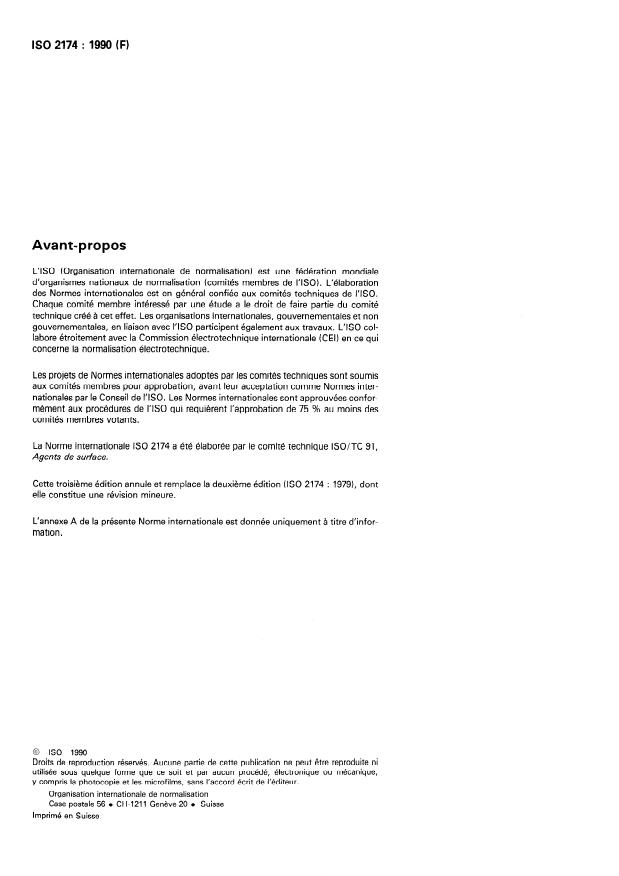

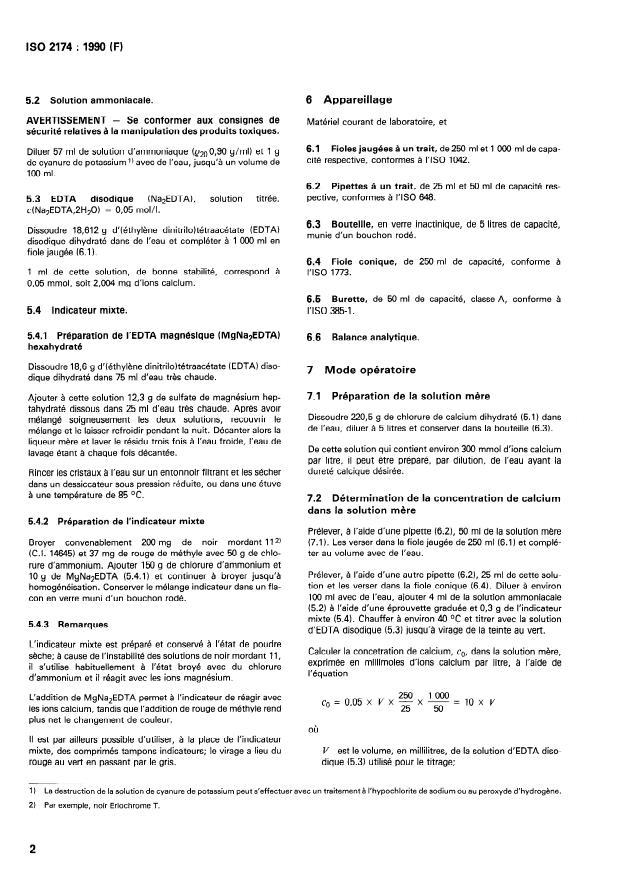
ISO 2174:1990 - Agents de surface -- Préparation d'une eau de dureté calcique déterminée

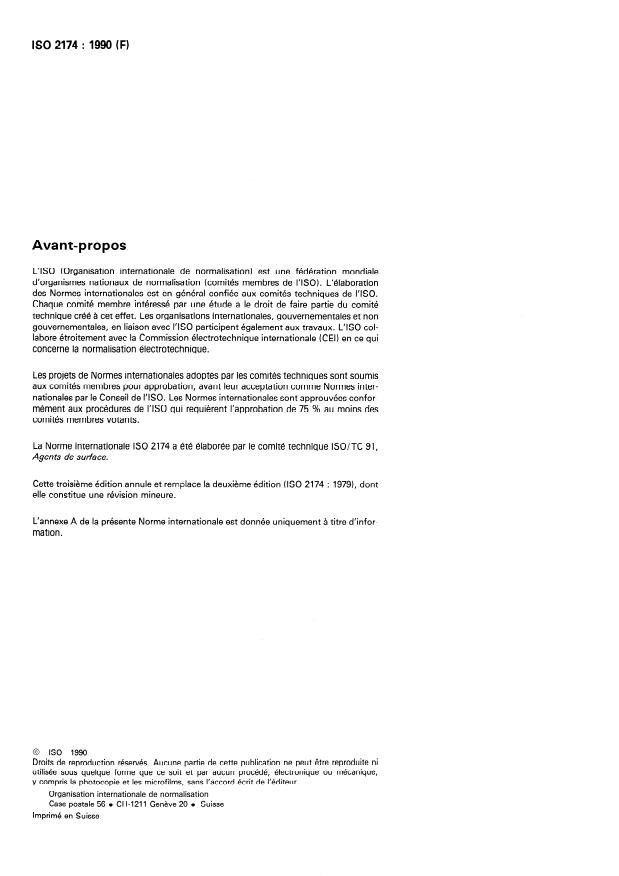

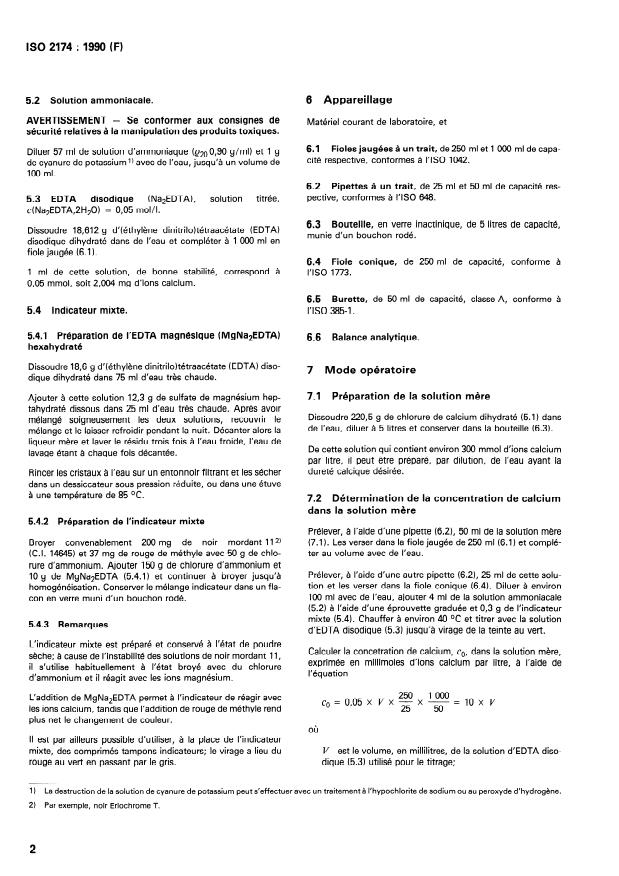
ISO 2174:1990 - Agents de surface -- Préparation d'une eau de dureté calcique déterminée
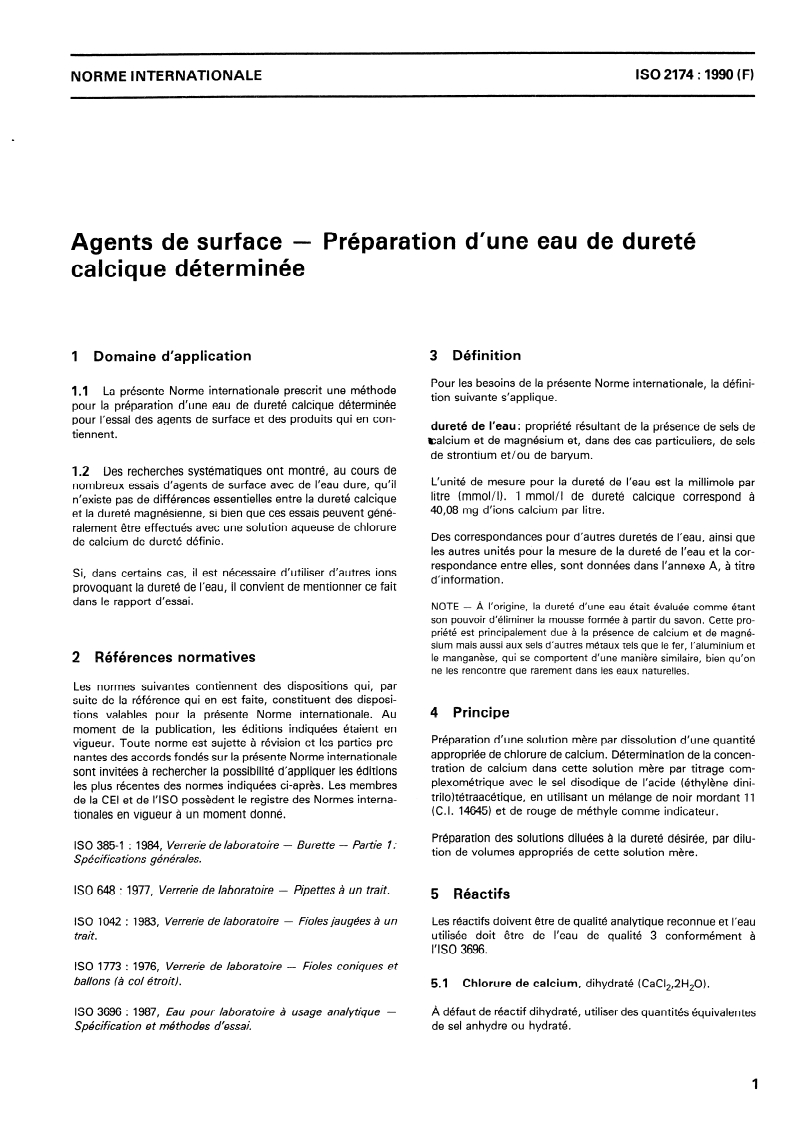
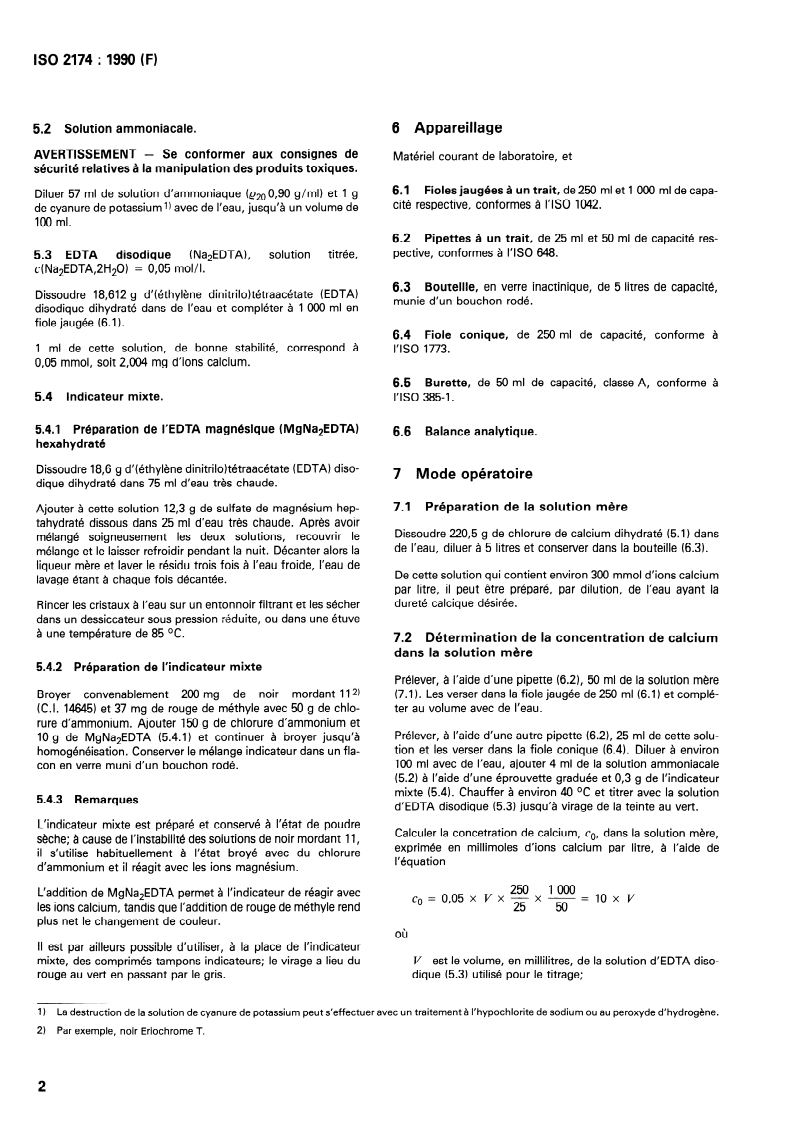
ISO 2174:1990 - Agents de surface — Préparation d'une eau de dureté calcique déterminée/5/1990
ISO 2174:1990 - Agents de surface — Préparation d'une eau de dureté calcique déterminée/5/1990
Overview
ISO 2174:1990 - "Surface active agents - Preparation of water with known calcium hardness" specifies a laboratory method to prepare and verify aqueous solutions of defined calcium hardness for testing surfactants and related products. The standard describes making a concentrated stock solution from calcium chloride, determining its calcium content by complexometric titration with EDTA, and preparing working waters of required hardness by dilution.
Key Topics
- Purpose: Provide reproducible water of known calcium hardness (expressed in mmol/l) for surfactant testing.
- Units and conversions: Uses mmol/l for hardness (1 mmol/l Ca2+ = 40.08 mg Ca2+/L); Annex A gives conversion factors to other hardness units.
- Reagents:
- Calcium chloride dihydrate (CaCl2·2H2O) stock preparation (example: 220.5 g dissolved to 5 L to produce ≈300 mmol Ca2+/L).
- Standardized disodium EDTA solution (c = 0.05 mol/L) for titration.
- Mixed indicator (Mordant Black 11/C.I. 14645 blended with methyl red and Mg‑EDTA) and ammoniacal solution (note: contains cyanide in the procedure - see safety).
- Analytical method:
- Determine calcium concentration of the stock by complexometric titration of an aliquot with EDTA until the mixed indicator changes color (red → green).
- Calculate stock concentration from titrant volume and EDTA concentration; then compute required stock volume for specified hardness and dilute to volume.
- Apparatus: Class A volumetric flasks, pipettes, burette, 5 L glass bottle, conical flasks and analytical balance (standards referenced for glassware and laboratory water).
Applications and Who Uses It
- Laboratories performing surfactant performance and stability tests where water hardness affects foam, detergency, and product behavior.
- Chemical and consumer product manufacturers needing standardized test waters for QA, R&D, method validation, and inter-laboratory comparison.
- Test houses and standards organizations that require reproducible water hardness preparation for protocols involving surface active agents.
Practical benefits: reproducible test waters, clear calculation and dilution steps, and traceable EDTA titration to quantify calcium content before use.
Related Standards
- ISO 3696 - Laboratory water quality
- ISO 385-1 - Burettes
- ISO 1042 - Volumetric flasks
- ISO 648 - Pipettes
- ISO 1773 - Conical flasks and flasks
Note: follow laboratory safety precautions (especially when preparing ammoniacal cyanide-containing reagents) and use the standard for exact formulas, equations and procedural details.
Relations
- Effective Date
- 25-Aug-2026
- Effective Date
- 15-Apr-2008
Buy Documents
ISO 2174:1990 - Surface active agents -- Preparation of water with known calcium hardness
ISO 2174:1990 - Surface active agents — Preparation of water with known calcium hardness/5/1990
ISO 2174:1990 - Agents de surface -- Préparation d'une eau de dureté calcique déterminée
ISO 2174:1990 - Agents de surface -- Préparation d'une eau de dureté calcique déterminée
ISO 2174:1990 - Agents de surface — Préparation d'une eau de dureté calcique déterminée/5/1990
ISO 2174:1990 - Agents de surface — Préparation d'une eau de dureté calcique déterminée/5/1990
Get Certified
Connect with accredited certification bodies for this standard

ECOCERT
Organic and sustainability certification.

Eurofins Food Testing Global
Global leader in food, environment, and pharmaceutical product testing.

Intertek Bangladesh
Intertek certification and testing services in Bangladesh.
Sponsored listings
Frequently Asked Questions
ISO 2174:1990 is a standard published by the International Organization for Standardization (ISO). Its full title is "Surface active agents — Preparation of water with known calcium hardness". This standard covers: A stock solution is prepared by dissolving an appropriate quantity of calcium chloride in water. The calcium content of this stock solution is determined by complexometric titration with the disodium salt of (ethylenedinitrilo)tetraacetic acid (EDTA) using a mixture of Mordant Black 11 (C.I. 14645) and methyl red as indicator. Dilute solutions of the hardness required are prepared by dilution of appropriate volumes of the stock solution.
A stock solution is prepared by dissolving an appropriate quantity of calcium chloride in water. The calcium content of this stock solution is determined by complexometric titration with the disodium salt of (ethylenedinitrilo)tetraacetic acid (EDTA) using a mixture of Mordant Black 11 (C.I. 14645) and methyl red as indicator. Dilute solutions of the hardness required are prepared by dilution of appropriate volumes of the stock solution.
ISO 2174:1990 is classified under the following ICS (International Classification for Standards) categories: 71.100.40 - Surface active agents. The ICS classification helps identify the subject area and facilitates finding related standards.
ISO 2174:1990 has the following relationships with other standards: It is inter standard links to EN ISO 9271:2024, ISO 2174:1979. Understanding these relationships helps ensure you are using the most current and applicable version of the standard.
ISO 2174:1990 is available in PDF format for immediate download after purchase. The document can be added to your cart and obtained through the secure checkout process. Digital delivery ensures instant access to the complete standard document.
Standards Content (Sample)
2003-01.Slovenski inštitut za standardizacijo. Razmnoževanje celote ali delov tega standarda ni dovoljeno.Površinsko aktivne snovi - Priprava vode z znano kalcijevo trdotoAgents de surface -- Préparation d'une eau de dureté calcique déterminéeSurface active agents -- Preparation of water with known calcium hardness71.100.40Površinsko aktivna sredstvaSurface active agentsICS:Ta slovenski standard je istoveten z:ISO 2174:1990SIST ISO 2174:1995en01-avgust-1995SIST ISO 2174:1995SLOVENSKI
STANDARD
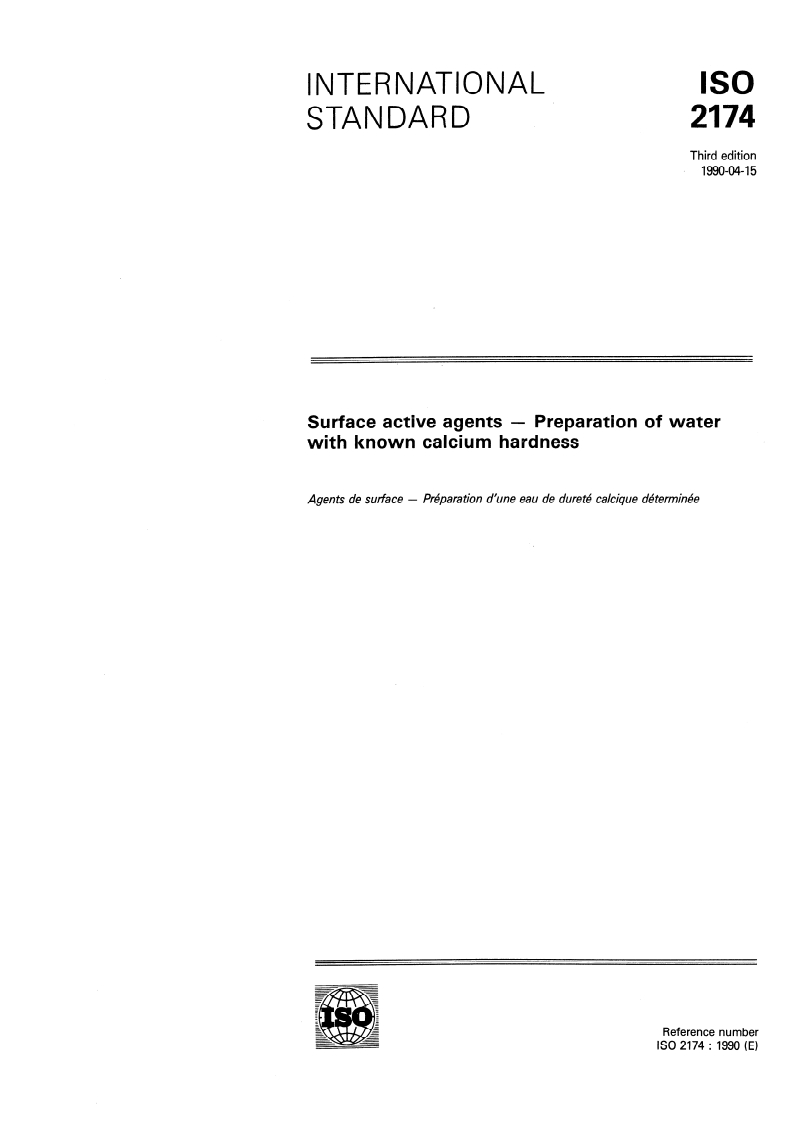
INTERNATIONAL STANDARD ISO 2174 Third edition 1990-04-15 Surface active agents - Preparation of water with known Calcium hardness Agents de sutface - Prbpara tion d’une eau de duret6 calcique d&ermMe Reference number ISO 2174 : 1990 (El SIST ISO 2174:1995
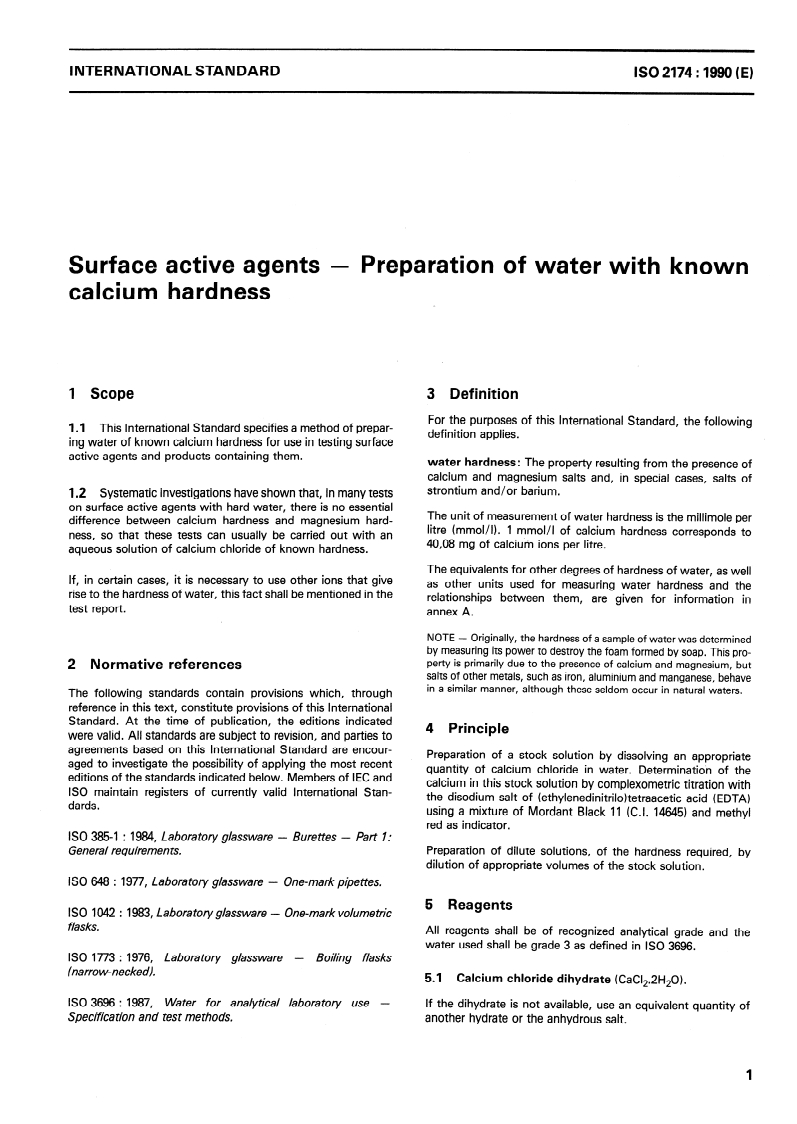
INTERNATIONAL STANDARD ISO 2174 : 1990 (E) Surface active agents - Preparation of water with known Calcium hardness 1 Scope 1 .l This International Standard specifies a method of prepar- ing water of known Calcium hardness for use in testing surface active agents and products containing them. 1.2 Systematic investigations have shown that, in many tests on surface active agents with hard water, there is no essential differente between Calcium hardness and magnesium hard- ness, so that these tests tan usually be carried out with an aqueous solution of Calcium chloride of known hardness. If, in certain cases, it is necessaty to use other ions that give rise to the hardness of water, this fact shall be mentioned in the test report. 2 Normative references The following Standards contain provisions which, through reference in this text, constitute provisions of this International Standard. At the time of publication, the editions indicated were valid. All Standards are subject to revision, and Parties to agreements based on this International Standard are encour- aged to investigate the possibility of applying the most recent editions of the Standards indicated below. Members of IEC and ISO maintain registers of currently valid International Stan- dards. ISO 385-1 : 1984, Laboratory glassware - Burettes - Part 7: General requiremen ts. ISO 648 : 1977, Laboratory glassware - Qne-mark pipettes. ISO 1042 : 1983, Laboratory glassware - One-mark volumetric flasks. ISO 1773 : 1976, Laboratory glassware - Boiling flasks (narrow-necked). ISO 3696 : 1987, Water for analytical laboratory use - Specifica tion and test methods. 3 Definition For the purposes of this International Standard, the following definition applies. water hardness: The property resulting from the presence of Calcium and magnesium salts and, in special cases, salts of strontium and/or barium. The unit of measurement of water hardness is the millimole per litre (mmol/l). 1 mmol/l of Calcium hardness corresponds to 40,08 mg of Calcium ions per litre. The equivalents for other degrees of hardness of water, as weil as other units used for measuring water hardness and the relationships between them, are given for information in annex A. NOTE - Originally, the hardness of a Sample of water was determined by measuring its power to destroy the foam formed by soap. This pro- petty is primarily due to the presence of Calcium and magnesium, but salts of other metals, such as iron, aluminium and manganese, behave in a similar manner, although these seldom occur in natura1 waters. 4 Principle Preparation of a stock Solution by dissolving an appropriate quantity of Calcium chloride in water. Determination of the Calcium in this stock Solution by complexometric titration with the disodium salt of (ethylenedinitrilo)tetraacetic acid (EDTA) using a mixture of Mordant Black 11 (C.I. 14645) and methyl red as indicator. Preparation of dilute solutions, of the hardness required, by dilution of appropriate volumes of the stock solution. 5 Reagents All reagents shall be of recognized analytical grade and the water used shall be grade 3 as defined in ISO 3696. 5.1 Calcium chloride dihydrate (CaC1,.2H20). lf the dihydrate is not available, use an equivalent quantity of another hydrate or the anhydrous salt. SIST ISO 2174:1995
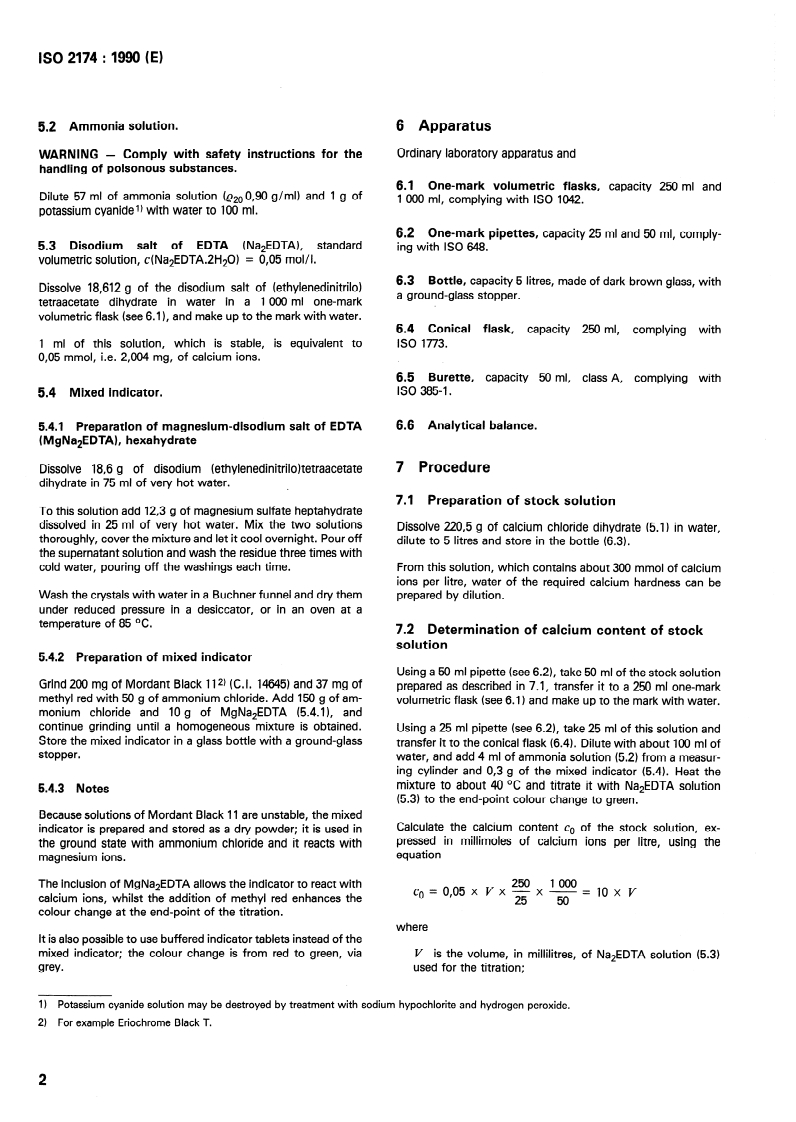
ISO 2174 : 1990 (EI 5.2 Ammonia solution. WARNING - Comply with safety instructions for the h
...
INTERNATIONAL
ISO
STANDARD
Third edition
1990-04-15
Surface active agents - Preparation of water
with known Calcium hardness
Agents de sutface - Prbpara tion d’une eau de duret6 calcique d&ermMe
Reference number
ISO 2174 : 1990 (El
Foreword
ISO (the International Organization for Standardization) is a worldwide federation of
national Standards bodies (ISO member bodies). The work of preparing International
Standards is normally carried out through ISO technical committees. Esch-member
body interested in a subject for which a technical committee has been established has
the right to be represented on that committee. International organizations, govern-
mental and non-governmental, in liaison with ISO, also take part in the work. ISO
collaborates closely with the International Electrotechnical Commission (IEC) on all
matters of electrotechnical standardization.
Draft International Standards adopted by the technical committees are circulated to
the member bodies for approval before their acceptance as International Standards by
the ISO Council. They are approved in accordance with ISO procedures requiring at
least 75 % approval by the member bodies voting.
International Standard ISO 2174 was prepared by Technical Committee ISO/TC 91,
Surface active agents.
This third edition cancels and replaces the second edition (ISO 2174 : 1979), of which
it constitutes a minor revision.
Annex A of this International Standard is for information only.
0 ISO 1990
All rights reserved. No part of this publication may be reproduced or utilized in any form or by any
means, electronie or mechanical, including photocopying and microfilm, without Permission in
writing from the publisher.
International Organization for Standardization
Case postale 56 l CH-121 1 Geneve 20 l Switzerland
Printed in Switzerland
ISO 2174 : 1990 (E)
INTERNATIONAL STANDARD
Preparation of water with known
Surface active agents -
Calcium hardness
1 Scope 3 Definition
For the purposes of this International Standard, the following
1 .l This International Standard specifies a method of prepar-
definition applies.
ing water of known Calcium hardness for use in testing surface
active agents and products containing them.
water hardness: The property resulting from the presence of
Calcium and magnesium salts and, in special cases, salts of
strontium and/or barium.
1.2 Systematic investigations have shown that, in many tests
on surface active agents with hard water, there is no essential
The unit of measurement of water hardness is the millimole per
differente between Calcium hardness and magnesium hard-
litre (mmol/l). 1 mmol/l of Calcium hardness corresponds to
ness, so that these tests tan usually be carried out with an
40,08 mg of Calcium ions per litre.
aqueous solution of Calcium chloride of known hardness.
The equivalents for other degrees of hardness of water, as weil
If, in certain cases, it is necessaty to use other ions that give
as other units used for measuring water hardness and the
rise to the hardness of water, this fact shall be mentioned in the
relationships between them, are given for information in
test report.
annex A.
NOTE - Originally, the hardness of a Sample of water was determined
by measuring its power to destroy the foam formed by soap. This pro-
petty is primarily due to the presence of Calcium and magnesium, but
2 Normative references
salts of other metals, such as iron, aluminium and manganese, behave
in a similar manner, although these seldom occur in natura1 waters.
The following Standards contain provisions which, through
reference in this text, constitute provisions of this International
Standard. At the time of publication, the editions indicated
4 Principle
were valid. All Standards are subject to revision, and Parties to
agreements based on this International Standard are encour-
Preparation of a stock Solution by dissolving an appropriate
aged to investigate the possibility of applying the most recent
quantity of Calcium chloride in water. Determination of the
editions of the Standards indicated below. Members of IEC and
Calcium in this stock Solution by complexometric titration with
ISO maintain registers of currently valid International Stan-
the disodium salt of (ethylenedinitrilo)tetraacetic acid (EDTA)
dards.
using a mixture of Mordant Black 11 (C.I. 14645) and methyl
red as indicator.
ISO 385-1 : 1984, Laboratory glassware - Burettes - Part 7:
Preparation of dilute solutions, of the hardness required, by
General requiremen ts.
dilution of appropriate volumes of the stock solution.
ISO 648 : 1977, Laboratory glassware - Qne-mark pipettes.
5 Reagents
ISO 1042 : 1983, Laboratory glassware - One-mark volumetric
flasks.
All reagents shall be of recognized analytical grade and the
water used shall be grade 3 as defined in ISO 3696.
ISO 1773 : 1976, Laboratory glassware - Boiling flasks
(narrow-necked).
5.1 Calcium chloride dihydrate (CaC1,.2H20).
lf the dihydrate is not available, use an equivalent quantity of
ISO 3696 : 1987, Water for analytical laboratory use -
Specifica tion and test methods. another hydrate or the anhydrous salt.
ISO 2174 : 1990 (EI
5.2 Ammonia solution. 6 Apparatus
Ordinary laboratory apparatus and
- Comply with safety instructions for the
WARNING
handling of poisonous substances.
6.1 One-mark volumetric flasks, capacity 250 ml and
Dilute 57 ml of ammonia Solution (~~~0,90 g/ml) and 1 g of
1 000 ml, complying with ISO 1042.
potassium cyanidel) with water to 100 ml.
6.2 One-mark pipettes, capacity 25 ml and 50 ml, comply-
5.3 Disodium salt of EDTA (Na2EDTA), Standard ing with ISO 648.
volumetric Solution, c( Na2EDTA.2H20) = 0,05 mol/l.
6.3 Bottle, capacity 5 litres,
...
INTERNATIONAL
ISO
STANDARD
Third edition
1990-04-15
Surface active agents - Preparation of water
with known Calcium hardness
Agents de sutface - Prbpara tion d’une eau de duret6 calcique d&ermMe
Reference number
ISO 2174 : 1990 (El
Foreword
ISO (the International Organization for Standardization) is a worldwide federation of
national Standards bodies (ISO member bodies). The work of preparing International
Standards is normally carried out through ISO technical committees. Esch-member
body interested in a subject for which a technical committee has been established has
the right to be represented on that committee. International organizations, govern-
mental and non-governmental, in liaison with ISO, also take part in the work. ISO
collaborates closely with the International Electrotechnical Commission (IEC) on all
matters of electrotechnical standardization.
Draft International Standards adopted by the technical committees are circulated to
the member bodies for approval before their acceptance as International Standards by
the ISO Council. They are approved in accordance with ISO procedures requiring at
least 75 % approval by the member bodies voting.
International Standard ISO 2174 was prepared by Technical Committee ISO/TC 91,
Surface active agents.
This third edition cancels and replaces the second edition (ISO 2174 : 1979), of which
it constitutes a minor revision.
Annex A of this International Standard is for information only.
0 ISO 1990
All rights reserved. No part of this publication may be reproduced or utilized in any form or by any
means, electronie or mechanical, including photocopying and microfilm, without Permission in
writing from the publisher.
International Organization for Standardization
Case postale 56 l CH-121 1 Geneve 20 l Switzerland
Printed in Switzerland
ISO 2174 : 1990 (E)
INTERNATIONAL STANDARD
Preparation of water with known
Surface active agents -
Calcium hardness
1 Scope 3 Definition
For the purposes of this International Standard, the following
1 .l This International Standard specifies a method of prepar-
definition applies.
ing water of known Calcium hardness for use in testing surface
active agents and products containing them.
water hardness: The property resulting from the presence of
Calcium and magnesium salts and, in special cases, salts of
strontium and/or barium.
1.2 Systematic investigations have shown that, in many tests
on surface active agents with hard water, there is no essential
The unit of measurement of water hardness is the millimole per
differente between Calcium hardness and magnesium hard-
litre (mmol/l). 1 mmol/l of Calcium hardness corresponds to
ness, so that these tests tan usually be carried out with an
40,08 mg of Calcium ions per litre.
aqueous solution of Calcium chloride of known hardness.
The equivalents for other degrees of hardness of water, as weil
If, in certain cases, it is necessaty to use other ions that give
as other units used for measuring water hardness and the
rise to the hardness of water, this fact shall be mentioned in the
relationships between them, are given for information in
test report.
annex A.
NOTE - Originally, the hardness of a Sample of water was determined
by measuring its power to destroy the foam formed by soap. This pro-
petty is primarily due to the presence of Calcium and magnesium, but
2 Normative references
salts of other metals, such as iron, aluminium and manganese, behave
in a similar manner, although these seldom occur in natura1 waters.
The following Standards contain provisions which, through
reference in this text, constitute provisions of this International
Standard. At the time of publication, the editions indicated
4 Principle
were valid. All Standards are subject to revision, and Parties to
agreements based on this International Standard are encour-
Preparation of a stock Solution by dissolving an appropriate
aged to investigate the possibility of applying the most recent
quantity of Calcium chloride in water. Determination of the
editions of the Standards indicated below. Members of IEC and
Calcium in this stock Solution by complexometric titration with
ISO maintain registers of currently valid International Stan-
the disodium salt of (ethylenedinitrilo)tetraacetic acid (EDTA)
dards.
using a mixture of Mordant Black 11 (C.I. 14645) and methyl
red as indicator.
ISO 385-1 : 1984, Laboratory glassware - Burettes - Part 7:
Preparation of dilute solutions, of the hardness required, by
General requiremen ts.
dilution of appropriate volumes of the stock solution.
ISO 648 : 1977, Laboratory glassware - Qne-mark pipettes.
5 Reagents
ISO 1042 : 1983, Laboratory glassware - One-mark volumetric
flasks.
All reagents shall be of recognized analytical grade and the
water used shall be grade 3 as defined in ISO 3696.
ISO 1773 : 1976, Laboratory glassware - Boiling flasks
(narrow-necked).
5.1 Calcium chloride dihydrate (CaC1,.2H20).
lf the dihydrate is not available, use an equivalent quantity of
ISO 3696 : 1987, Water for analytical laboratory use -
Specifica tion and test methods. another hydrate or the anhydrous salt.
ISO 2174 : 1990 (EI
5.2 Ammonia solution. 6 Apparatus
Ordinary laboratory apparatus and
- Comply with safety instructions for the
WARNING
handling of poisonous substances.
6.1 One-mark volumetric flasks, capacity 250 ml and
Dilute 57 ml of ammonia Solution (~~~0,90 g/ml) and 1 g of
1 000 ml, complying with ISO 1042.
potassium cyanidel) with water to 100 ml.
6.2 One-mark pipettes, capacity 25 ml and 50 ml, comply-
5.3 Disodium salt of EDTA (Na2EDTA), Standard ing with ISO 648.
volumetric Solution, c( Na2EDTA.2H20) = 0,05 mol/l.
6.3 Bottle, capacity 5 litres,
...
ORME ISO
INTERNATIONALE
Troisième édition
1990-04-l 5
Agents de surface - Préparation d’une eau de
dureté calcique déterminée
Surface active agents - Preparation of water with known calcium hardness
Numéro de référence
ISO 2174 : 1990 (FI
ISO 2174 : 1990 (FI
Avant-propos
L’ISO (Organisation internationale de normalisation) est une fédération mondiale
d’organismes nationaux de normalisation (comités membres de I’ISO). L’élaboration
des Normes internationales est en général confiée aux comités techniques de I’ISO.
Chaque comité membre intéressé par une étude a le droit de faire partie du comité
technique créé à cet effet. Les organisations internationales, gouvernementales et non
gouvernementales, en liaison avec I’ISO participent également aux travaux. L’ISO col-
labore étroitement avec la Commission électrotechnique internationale (CEI) en ce qui
concerne la normalisation électrotechnique.
Les projets de Normes internationales adoptés par les comités techniques sont soumis
aux comités membres pour approbation, avant leur acceptation comme Normes inter-
nationales par le Conseil de I’ISO. Les Normes internationales sont approuvées confor-
mément aux procédures de I’ISO qui requièrent l’approbation de 75 % au moins des
comités membres votants.
La Norme internationale ISO 2174 a été élaborée par le comité technique ISO/TC 91,
Agents de surface.
Cette troisième édition annule et remplace la deuxième édition (ISO 2174 : 19791, dont
elle constitue une révision mineure.
L’annexe A de la présente Norme internationale est donnée uniquement à titre d’infor-
mation.
0 ISO 1990
Droits de reproduction réservés. Aucune partie de cette publication ne peut être reproduite ni
utilisée sous quelque forme que ce soit et par aucun procédé, électronique ou mécanique,
y compris la photocopie et les microfilms, sans l’accord écrit de l’éditeur.
Organisation internationale de normalisation
Case postale 56 l CH-121 1 Genève 20 l Suisse
Imprimé en Suisse
NORME INTERNATIONALE ISO 2174 : 1990 (F)
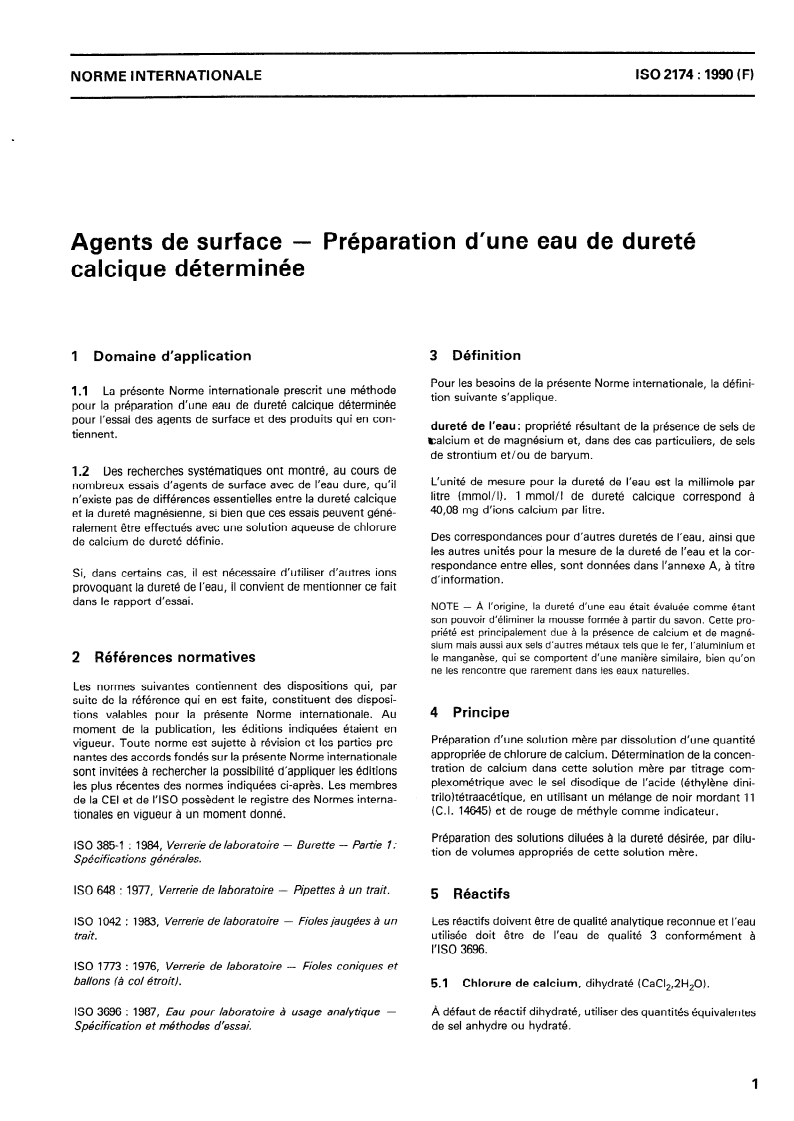
Agents de surface - Préparation d’une eau de dureté
ue déterminée
3 Définition
1 Domaine d’application
Pour les besoins de la présente Norme internationale, la défini-
1.1 La présente Norme internationale prescrit une méthode
tion suivante s’applique.
pour la préparation d’une eau de dureté calcique déterminée
pour l’essai des agents de surface et des produits qui en con-
dureté de l’eau: propriété résultant de la présence de sels de
tiennent.
Icalcium et de magnésium et, dans des cas particuliers, de sels
de strontium et/ou de baryum.
1.2 Des recherches systématiques ont montré, au cours de
L’unité de mesure pour la dureté de l’eau est la millimole par
nombreux essais d’agents de surface avec de l’eau dure, qu’il
litre (mmol/l). 1 mmol/l de dureté calcique correspond à
n’existe pas de différences essentielles entre la dureté calcique
40,08 mg d’ions calcium par litre.
et la dureté magnésienne, si bien que ces essais peuvent géné-
ralement être effectués avec une solution aqueuse de chlorure
Des correspondances pour d’autres duretés de l’eau, ainsi que
de calcium de dureté définie.
les autres unités pour la mesure de la dureté de l’eau et la cor-
respondance entre elles, sont données dans l’annexe A, à titre
Si, dans certains cas, il est nécessaire d’utiliser d’autres ions
d’information.
provoquant la dureté de l’eau, il convient de mentionner ce fait
dans le rapport d’essai.
NOTE - À l’origine, la dureté d’une eau était évaluée comme étant
son pouvoir d’éliminer la mousse formée à partir du savon. Cette pro-
priété est principalement due à la présence de calcium et de magné-
sium mais aussi aux sels d’autres métaux tels que le fer, l’aluminium et
le manganèse, qui se comportent d’une manière similaire, bien qu’on
2 Références normatives
ne les rencontre que rarement dans les eaux naturelles.
Les normes suivantes contiennent des dispositions qui, par
suite de la référence qui en est faite, constituent des disposi-
4 Principe
tions valables pour la présente Norme internationale. Au
moment de la publication, les éditions indiquées étaient en
Préparation d’une solution mère par dissolution d’une quantité
vigueur. Toute norme est sujette à révision et les parties pre-
appropriée de chlorure de calcium. Détermination de la concen-
nantes des accords fondés sur la présente Norme internationale
tration de calcium dans cette solution mère par titrage com-
sont invitées à rechercher la possibilité d’appliquer les éditions
plexométrique avec le sel disodique de l’acide (éthylène dini-
les plus récentes des normes indiquées ci-après. Les membres
trilo)tétraacétique, en utilisant un mélange de noir mordant 11
de la CEI et de I’ISO possèdent le registre des Normes interna-
(C.I. 14645) et de rouge de méthyle comme indicateur.
tionales en vigueur à un moment donné.
Préparation des solutions diluées à la dureté désirée, par dilu-
ISO 385-l : 1984, Verrerie de laboratoire - Burette - Partie I :
tion de volumes appropriés de cette solution mère.
Spécifications générales.
ISO 648 : 1977, Verrerie de laboratoire - Pipettes à un trait.
5 Réactifs
ISO 1042 : 1983, Verrerie de t’abora toire - Fioles jaugées à un Les réactifs doivent être de qualité analytique reconnue et l’eau
trait. utilisée doit être de l’eau de qualité 3 conformément à
I’ISO 3696.
OS0 1773 : 1976, Verrerie de laboratoire - Fioles coniques et
ballons (à col é trait).
5.1 Chlorure de calcium, dihydraté ( CaC12,2H,0).
ISO 3696 : 1987, Eau pour laboratoire à usage analytique - À défaut de réactif dihydraté, utiliser des quantités équivalentes
Spécifica tion et méthodes d’essai. de sel anhydre ou hydraté.
ISO 2174 : 1990 (FI
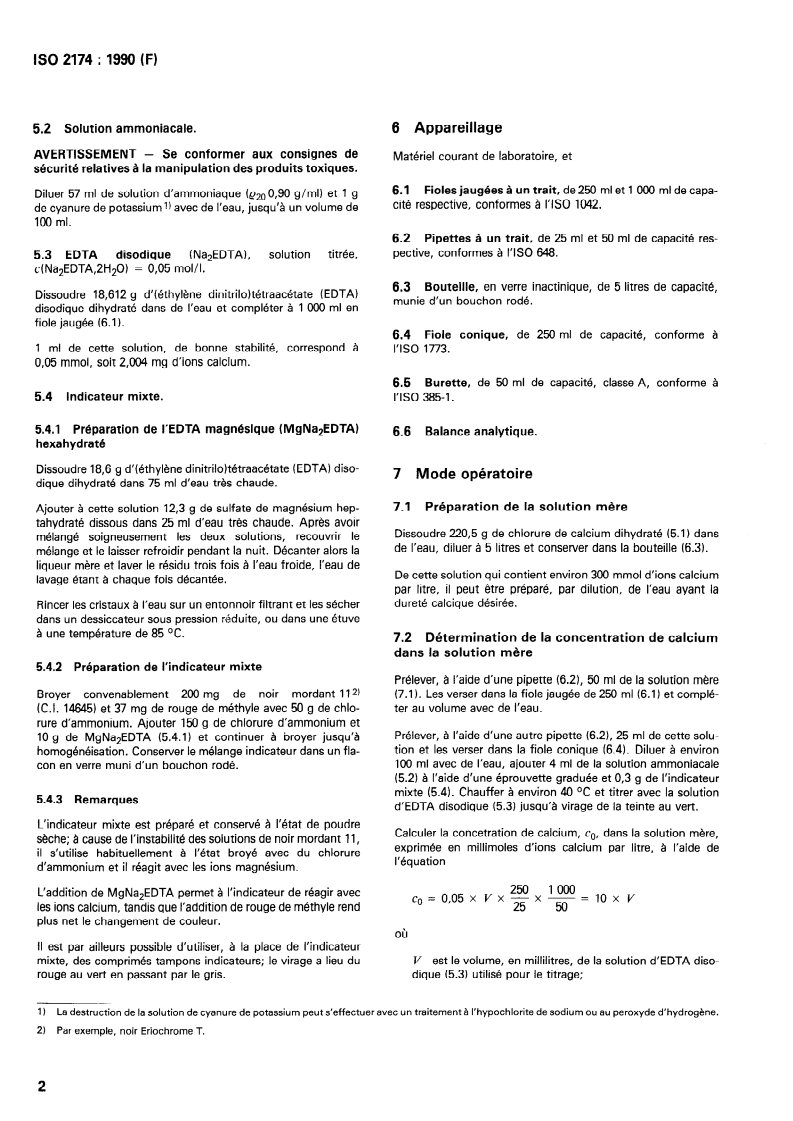
5.2 Solution ammoniacale. 6 Appareillage
- Se conformer aux consignes de
AVERTISSEMENT
Matériel courant de laboratoire, et
sécurité relatives à la manipulation des produits toxiques.
6.1 Fioles jaugées à un trait, de 250 ml et 1 000 ml de capa-
Diluer 57 ml de solution d’ammoniaque (~~~0,90 g/ml) et 1 g
cité respective, conformes à I’ISO 1042.
de cyanure de potassium 1) avec de l’eau, jusqu’à un volume de
100 ml.
6.2 Pipettes à un trait, de 25 ml et 50 ml de capacité res-
pective, conformes à I’ISO 648.
5.3 EDTA
...
ORME ISO
INTERNATIONALE
Troisième édition
1990-04-l 5
Agents de surface - Préparation d’une eau de
dureté calcique déterminée
Surface active agents - Preparation of water with known calcium hardness
Numéro de référence
ISO 2174 : 1990 (FI
ISO 2174 : 1990 (FI
Avant-propos
L’ISO (Organisation internationale de normalisation) est une fédération mondiale
d’organismes nationaux de normalisation (comités membres de I’ISO). L’élaboration
des Normes internationales est en général confiée aux comités techniques de I’ISO.
Chaque comité membre intéressé par une étude a le droit de faire partie du comité
technique créé à cet effet. Les organisations internationales, gouvernementales et non
gouvernementales, en liaison avec I’ISO participent également aux travaux. L’ISO col-
labore étroitement avec la Commission électrotechnique internationale (CEI) en ce qui
concerne la normalisation électrotechnique.
Les projets de Normes internationales adoptés par les comités techniques sont soumis
aux comités membres pour approbation, avant leur acceptation comme Normes inter-
nationales par le Conseil de I’ISO. Les Normes internationales sont approuvées confor-
mément aux procédures de I’ISO qui requièrent l’approbation de 75 % au moins des
comités membres votants.
La Norme internationale ISO 2174 a été élaborée par le comité technique ISO/TC 91,
Agents de surface.
Cette troisième édition annule et remplace la deuxième édition (ISO 2174 : 19791, dont
elle constitue une révision mineure.
L’annexe A de la présente Norme internationale est donnée uniquement à titre d’infor-
mation.
0 ISO 1990
Droits de reproduction réservés. Aucune partie de cette publication ne peut être reproduite ni
utilisée sous quelque forme que ce soit et par aucun procédé, électronique ou mécanique,
y compris la photocopie et les microfilms, sans l’accord écrit de l’éditeur.
Organisation internationale de normalisation
Case postale 56 l CH-121 1 Genève 20 l Suisse
Imprimé en Suisse
NORME INTERNATIONALE ISO 2174 : 1990 (F)
Agents de surface - Préparation d’une eau de dureté
ue déterminée
3 Définition
1 Domaine d’application
Pour les besoins de la présente Norme internationale, la défini-
1.1 La présente Norme internationale prescrit une méthode
tion suivante s’applique.
pour la préparation d’une eau de dureté calcique déterminée
pour l’essai des agents de surface et des produits qui en con-
dureté de l’eau: propriété résultant de la présence de sels de
tiennent.
Icalcium et de magnésium et, dans des cas particuliers, de sels
de strontium et/ou de baryum.
1.2 Des recherches systématiques ont montré, au cours de
L’unité de mesure pour la dureté de l’eau est la millimole par
nombreux essais d’agents de surface avec de l’eau dure, qu’il
litre (mmol/l). 1 mmol/l de dureté calcique correspond à
n’existe pas de différences essentielles entre la dureté calcique
40,08 mg d’ions calcium par litre.
et la dureté magnésienne, si bien que ces essais peuvent géné-
ralement être effectués avec une solution aqueuse de chlorure
Des correspondances pour d’autres duretés de l’eau, ainsi que
de calcium de dureté définie.
les autres unités pour la mesure de la dureté de l’eau et la cor-
respondance entre elles, sont données dans l’annexe A, à titre
Si, dans certains cas, il est nécessaire d’utiliser d’autres ions
d’information.
provoquant la dureté de l’eau, il convient de mentionner ce fait
dans le rapport d’essai.
NOTE - À l’origine, la dureté d’une eau était évaluée comme étant
son pouvoir d’éliminer la mousse formée à partir du savon. Cette pro-
priété est principalement due à la présence de calcium et de magné-
sium mais aussi aux sels d’autres métaux tels que le fer, l’aluminium et
le manganèse, qui se comportent d’une manière similaire, bien qu’on
2 Références normatives
ne les rencontre que rarement dans les eaux naturelles.
Les normes suivantes contiennent des dispositions qui, par
suite de la référence qui en est faite, constituent des disposi-
4 Principe
tions valables pour la présente Norme internationale. Au
moment de la publication, les éditions indiquées étaient en
Préparation d’une solution mère par dissolution d’une quantité
vigueur. Toute norme est sujette à révision et les parties pre-
appropriée de chlorure de calcium. Détermination de la concen-
nantes des accords fondés sur la présente Norme internationale
tration de calcium dans cette solution mère par titrage com-
sont invitées à rechercher la possibilité d’appliquer les éditions
plexométrique avec le sel disodique de l’acide (éthylène dini-
les plus récentes des normes indiquées ci-après. Les membres
trilo)tétraacétique, en utilisant un mélange de noir mordant 11
de la CEI et de I’ISO possèdent le registre des Normes interna-
(C.I. 14645) et de rouge de méthyle comme indicateur.
tionales en vigueur à un moment donné.
Préparation des solutions diluées à la dureté désirée, par dilu-
ISO 385-l : 1984, Verrerie de laboratoire - Burette - Partie I :
tion de volumes appropriés de cette solution mère.
Spécifications générales.
ISO 648 : 1977, Verrerie de laboratoire - Pipettes à un trait.
5 Réactifs
ISO 1042 : 1983, Verrerie de t’abora toire - Fioles jaugées à un Les réactifs doivent être de qualité analytique reconnue et l’eau
trait. utilisée doit être de l’eau de qualité 3 conformément à
I’ISO 3696.
OS0 1773 : 1976, Verrerie de laboratoire - Fioles coniques et
ballons (à col é trait).
5.1 Chlorure de calcium, dihydraté ( CaC12,2H,0).
ISO 3696 : 1987, Eau pour laboratoire à usage analytique - À défaut de réactif dihydraté, utiliser des quantités équivalentes
Spécifica tion et méthodes d’essai. de sel anhydre ou hydraté.
ISO 2174 : 1990 (FI
5.2 Solution ammoniacale. 6 Appareillage
- Se conformer aux consignes de
AVERTISSEMENT
Matériel courant de laboratoire, et
sécurité relatives à la manipulation des produits toxiques.
6.1 Fioles jaugées à un trait, de 250 ml et 1 000 ml de capa-
Diluer 57 ml de solution d’ammoniaque (~~~0,90 g/ml) et 1 g
cité respective, conformes à I’ISO 1042.
de cyanure de potassium 1) avec de l’eau, jusqu’à un volume de
100 ml.
6.2 Pipettes à un trait, de 25 ml et 50 ml de capacité res-
pective, conformes à I’ISO 648.
5.3 EDTA
...
ORME ISO
INTERNATIONALE
Troisième édition
1990-04-l 5
Agents de surface - Préparation d’une eau de
dureté calcique déterminée
Surface active agents - Preparation of water with known calcium hardness
Numéro de référence
ISO 2174 : 1990 (FI
ISO 2174 : 1990 (FI
Avant-propos
L’ISO (Organisation internationale de normalisation) est une fédération mondiale
d’organismes nationaux de normalisation (comités membres de I’ISO). L’élaboration
des Normes internationales est en général confiée aux comités techniques de I’ISO.
Chaque comité membre intéressé par une étude a le droit de faire partie du comité
technique créé à cet effet. Les organisations internationales, gouvernementales et non
gouvernementales, en liaison avec I’ISO participent également aux travaux. L’ISO col-
labore étroitement avec la Commission électrotechnique internationale (CEI) en ce qui
concerne la normalisation électrotechnique.
Les projets de Normes internationales adoptés par les comités techniques sont soumis
aux comités membres pour approbation, avant leur acceptation comme Normes inter-
nationales par le Conseil de I’ISO. Les Normes internationales sont approuvées confor-
mément aux procédures de I’ISO qui requièrent l’approbation de 75 % au moins des
comités membres votants.
La Norme internationale ISO 2174 a été élaborée par le comité technique ISO/TC 91,
Agents de surface.
Cette troisième édition annule et remplace la deuxième édition (ISO 2174 : 19791, dont
elle constitue une révision mineure.
L’annexe A de la présente Norme internationale est donnée uniquement à titre d’infor-
mation.
0 ISO 1990
Droits de reproduction réservés. Aucune partie de cette publication ne peut être reproduite ni
utilisée sous quelque forme que ce soit et par aucun procédé, électronique ou mécanique,
y compris la photocopie et les microfilms, sans l’accord écrit de l’éditeur.
Organisation internationale de normalisation
Case postale 56 l CH-121 1 Genève 20 l Suisse
Imprimé en Suisse
NORME INTERNATIONALE ISO 2174 : 1990 (F)
Agents de surface - Préparation d’une eau de dureté
ue déterminée
3 Définition
1 Domaine d’application
Pour les besoins de la présente Norme internationale, la défini-
1.1 La présente Norme internationale prescrit une méthode
tion suivante s’applique.
pour la préparation d’une eau de dureté calcique déterminée
pour l’essai des agents de surface et des produits qui en con-
dureté de l’eau: propriété résultant de la présence de sels de
tiennent.
Icalcium et de magnésium et, dans des cas particuliers, de sels
de strontium et/ou de baryum.
1.2 Des recherches systématiques ont montré, au cours de
L’unité de mesure pour la dureté de l’eau est la millimole par
nombreux essais d’agents de surface avec de l’eau dure, qu’il
litre (mmol/l). 1 mmol/l de dureté calcique correspond à
n’existe pas de différences essentielles entre la dureté calcique
40,08 mg d’ions calcium par litre.
et la dureté magnésienne, si bien que ces essais peuvent géné-
ralement être effectués avec une solution aqueuse de chlorure
Des correspondances pour d’autres duretés de l’eau, ainsi que
de calcium de dureté définie.
les autres unités pour la mesure de la dureté de l’eau et la cor-
respondance entre elles, sont données dans l’annexe A, à titre
Si, dans certains cas, il est nécessaire d’utiliser d’autres ions
d’information.
provoquant la dureté de l’eau, il convient de mentionner ce fait
dans le rapport d’essai.
NOTE - À l’origine, la dureté d’une eau était évaluée comme étant
son pouvoir d’éliminer la mousse formée à partir du savon. Cette pro-
priété est principalement due à la présence de calcium et de magné-
sium mais aussi aux sels d’autres métaux tels que le fer, l’aluminium et
le manganèse, qui se comportent d’une manière similaire, bien qu’on
2 Références normatives
ne les rencontre que rarement dans les eaux naturelles.
Les normes suivantes contiennent des dispositions qui, par
suite de la référence qui en est faite, constituent des disposi-
4 Principe
tions valables pour la présente Norme internationale. Au
moment de la publication, les éditions indiquées étaient en
Préparation d’une solution mère par dissolution d’une quantité
vigueur. Toute norme est sujette à révision et les parties pre-
appropriée de chlorure de calcium. Détermination de la concen-
nantes des accords fondés sur la présente Norme internationale
tration de calcium dans cette solution mère par titrage com-
sont invitées à rechercher la possibilité d’appliquer les éditions
plexométrique avec le sel disodique de l’acide (éthylène dini-
les plus récentes des normes indiquées ci-après. Les membres
trilo)tétraacétique, en utilisant un mélange de noir mordant 11
de la CEI et de I’ISO possèdent le registre des Normes interna-
(C.I. 14645) et de rouge de méthyle comme indicateur.
tionales en vigueur à un moment donné.
Préparation des solutions diluées à la dureté désirée, par dilu-
ISO 385-l : 1984, Verrerie de laboratoire - Burette - Partie I :
tion de volumes appropriés de cette solution mère.
Spécifications générales.
ISO 648 : 1977, Verrerie de laboratoire - Pipettes à un trait.
5 Réactifs
ISO 1042 : 1983, Verrerie de t’abora toire - Fioles jaugées à un Les réactifs doivent être de qualité analytique reconnue et l’eau
trait. utilisée doit être de l’eau de qualité 3 conformément à
I’ISO 3696.
OS0 1773 : 1976, Verrerie de laboratoire - Fioles coniques et
ballons (à col é trait).
5.1 Chlorure de calcium, dihydraté ( CaC12,2H,0).
ISO 3696 : 1987, Eau pour laboratoire à usage analytique - À défaut de réactif dihydraté, utiliser des quantités équivalentes
Spécifica tion et méthodes d’essai. de sel anhydre ou hydraté.
ISO 2174 : 1990 (FI
5.2 Solution ammoniacale. 6 Appareillage
- Se conformer aux consignes de
AVERTISSEMENT
Matériel courant de laboratoire, et
sécurité relatives à la manipulation des produits toxiques.
6.1 Fioles jaugées à un trait, de 250 ml et 1 000 ml de capa-
Diluer 57 ml de solution d’ammoniaque (~~~0,90 g/ml) et 1 g
cité respective, conformes à I’ISO 1042.
de cyanure de potassium 1) avec de l’eau, jusqu’à un volume de
100 ml.
6.2 Pipettes à un trait, de 25 ml et 50 ml de capacité res-
pective, conformes à I’ISO 648.
5.3 EDTA
...
ORME ISO
INTERNATIONALE
Troisième édition
1990-04-l 5
Agents de surface - Préparation d’une eau de
dureté calcique déterminée
Surface active agents - Preparation of water with known calcium hardness
Numéro de référence
ISO 2174 : 1990 (FI
ISO 2174 : 1990 (FI
Avant-propos
L’ISO (Organisation internationale de normalisation) est une fédération mondiale
d’organismes nationaux de normalisation (comités membres de I’ISO). L’élaboration
des Normes internationales est en général confiée aux comités techniques de I’ISO.
Chaque comité membre intéressé par une étude a le droit de faire partie du comité
technique créé à cet effet. Les organisations internationales, gouvernementales et non
gouvernementales, en liaison avec I’ISO participent également aux travaux. L’ISO col-
labore étroitement avec la Commission électrotechnique internationale (CEI) en ce qui
concerne la normalisation électrotechnique.
Les projets de Normes internationales adoptés par les comités techniques sont soumis
aux comités membres pour approbation, avant leur acceptation comme Normes inter-
nationales par le Conseil de I’ISO. Les Normes internationales sont approuvées confor-
mément aux procédures de I’ISO qui requièrent l’approbation de 75 % au moins des
comités membres votants.
La Norme internationale ISO 2174 a été élaborée par le comité technique ISO/TC 91,
Agents de surface.
Cette troisième édition annule et remplace la deuxième édition (ISO 2174 : 19791, dont
elle constitue une révision mineure.
L’annexe A de la présente Norme internationale est donnée uniquement à titre d’infor-
mation.
0 ISO 1990
Droits de reproduction réservés. Aucune partie de cette publication ne peut être reproduite ni
utilisée sous quelque forme que ce soit et par aucun procédé, électronique ou mécanique,
y compris la photocopie et les microfilms, sans l’accord écrit de l’éditeur.
Organisation internationale de normalisation
Case postale 56 l CH-121 1 Genève 20 l Suisse
Imprimé en Suisse
NORME INTERNATIONALE ISO 2174 : 1990 (F)
Agents de surface - Préparation d’une eau de dureté
ue déterminée
3 Définition
1 Domaine d’application
Pour les besoins de la présente Norme internationale, la défini-
1.1 La présente Norme internationale prescrit une méthode
tion suivante s’applique.
pour la préparation d’une eau de dureté calcique déterminée
pour l’essai des agents de surface et des produits qui en con-
dureté de l’eau: propriété résultant de la présence de sels de
tiennent.
Icalcium et de magnésium et, dans des cas particuliers, de sels
de strontium et/ou de baryum.
1.2 Des recherches systématiques ont montré, au cours de
L’unité de mesure pour la dureté de l’eau est la millimole par
nombreux essais d’agents de surface avec de l’eau dure, qu’il
litre (mmol/l). 1 mmol/l de dureté calcique correspond à
n’existe pas de différences essentielles entre la dureté calcique
40,08 mg d’ions calcium par litre.
et la dureté magnésienne, si bien que ces essais peuvent géné-
ralement être effectués avec une solution aqueuse de chlorure
Des correspondances pour d’autres duretés de l’eau, ainsi que
de calcium de dureté définie.
les autres unités pour la mesure de la dureté de l’eau et la cor-
respondance entre elles, sont données dans l’annexe A, à titre
Si, dans certains cas, il est nécessaire d’utiliser d’autres ions
d’information.
provoquant la dureté de l’eau, il convient de mentionner ce fait
dans le rapport d’essai.
NOTE - À l’origine, la dureté d’une eau était évaluée comme étant
son pouvoir d’éliminer la mousse formée à partir du savon. Cette pro-
priété est principalement due à la présence de calcium et de magné-
sium mais aussi aux sels d’autres métaux tels que le fer, l’aluminium et
le manganèse, qui se comportent d’une manière similaire, bien qu’on
2 Références normatives
ne les rencontre que rarement dans les eaux naturelles.
Les normes suivantes contiennent des dispositions qui, par
suite de la référence qui en est faite, constituent des disposi-
4 Principe
tions valables pour la présente Norme internationale. Au
moment de la publication, les éditions indiquées étaient en
Préparation d’une solution mère par dissolution d’une quantité
vigueur. Toute norme est sujette à révision et les parties pre-
appropriée de chlorure de calcium. Détermination de la concen-
nantes des accords fondés sur la présente Norme internationale
tration de calcium dans cette solution mère par titrage com-
sont invitées à rechercher la possibilité d’appliquer les éditions
plexométrique avec le sel disodique de l’acide (éthylène dini-
les plus récentes des normes indiquées ci-après. Les membres
trilo)tétraacétique, en utilisant un mélange de noir mordant 11
de la CEI et de I’ISO possèdent le registre des Normes interna-
(C.I. 14645) et de rouge de méthyle comme indicateur.
tionales en vigueur à un moment donné.
Préparation des solutions diluées à la dureté désirée, par dilu-
ISO 385-l : 1984, Verrerie de laboratoire - Burette - Partie I :
tion de volumes appropriés de cette solution mère.
Spécifications générales.
ISO 648 : 1977, Verrerie de laboratoire - Pipettes à un trait.
5 Réactifs
ISO 1042 : 1983, Verrerie de t’abora toire - Fioles jaugées à un Les réactifs doivent être de qualité analytique reconnue et l’eau
trait. utilisée doit être de l’eau de qualité 3 conformément à
I’ISO 3696.
OS0 1773 : 1976, Verrerie de laboratoire - Fioles coniques et
ballons (à col é trait).
5.1 Chlorure de calcium, dihydraté ( CaC12,2H,0).
ISO 3696 : 1987, Eau pour laboratoire à usage analytique - À défaut de réactif dihydraté, utiliser des quantités équivalentes
Spécifica tion et méthodes d’essai. de sel anhydre ou hydraté.
ISO 2174 : 1990 (FI
5.2 Solution ammoniacale. 6 Appareillage
- Se conformer aux consignes de
AVERTISSEMENT
Matériel courant de laboratoire, et
sécurité relatives à la manipulation des produits toxiques.
6.1 Fioles jaugées à un trait, de 250 ml et 1 000 ml de capa-
Diluer 57 ml de solution d’ammoniaque (~~~0,90 g/ml) et 1 g
cité respective, conformes à I’ISO 1042.
de cyanure de potassium 1) avec de l’eau, jusqu’à un volume de
100 ml.
6.2 Pipettes à un trait, de 25 ml et 50 ml de capacité res-
pective, conformes à I’ISO 648.
5.3 EDTA
...